A Quick Guide to
Microservice Architecture
Why this emerging trend is the future of software development
Why Choose a Microservice
Architecture?
As the approach to software development evolves, the
industry as a whole and the technical leaders and en-
gineers in the industry constantly look for areas that
could benefit from continuous improvement.
•	 How do we get solutions to customers faster?
•	 How do we make changes quicker?
•	 How do we reduce the risk of regression defects
during a release?
•	 How do we isolate performance issues?
There is an emerging trend in the industry that serves
to answer these very questions and more. It’s called a
Microservices Architecture.
Briefly, the microservice architecture is a way of design-
ing software apps as a suite of independent deployable
services that can scale and grow as needed.
Most large scale web sites including Netflix,
Amazon and eBay have evolved from a mono-
lithic architecture to a microservices
architecture.
To understand microservice architecture, we should
compare it to the monolithic approach - a monolithic
application that is typically built as a single unit.
Enterprise Applications in general have following com-
ponents:
1.	 Presentation layer (client side UI) with HTML pages,
JavaScript.
2.	 Business logic/server side layer – handles application
logic, handle request/responses to presentation lay-
er, and DB calls.
3.	 Database
These applications are defined in a Waterfall or Agile
approach, and developed by many or few engineers.
An e-commerce application may have an architecture
like the one represented in the diagram below:
These applications are developed in a Waterfall or Agile
approach, by many or a few engineers. An e-commerce
application may have an architecture like the one repre-
sented in the diagram.
The system may be architected with modularity in mind,
but code is stored in a single code base When it comes
to packaging and deploying, you create one or a few
huge executables. This deployment of large files exists
even with minor changes. Although there are benefits,
the downfalls have led to this newer microservice archi-
tecture.
Benefits of monolithic architecture
•	 Easy to test with automated test scripts using tools
like Selenium.
•	 Easy to deploy in the early stages of a project.
•	 You can scale the application by running multiple
copies behind a load balancer.
•	 The modular approach allows for code clarity and
less abstraction.
•	 By keeping an existing architecture, you don’t have
the cost of redesign and re-architecturing.
These factors apply well in early stages of application.
But successful apps grow over time, become complex
and eventually bloat into multi-million lines of code.
At this stage, any change to the app or any bug fixes
will become increasingly difficult, time consuming, and
risky.
	
Once an application grows and becomes large, the
monolithic approach will run into significant problems:
•	 Complex code base – Typically development slows
down as the code base grows in size and complexity,
with several developers working on the application.
This tends to have a big impact on the quality of the
application.
•	 Complex monolithic apps become an obstacle for
continuous deployment. In today’s “get new features
out quickly” approach, frequent code deployments
are the norm. This is very difficult with a complex
monolithic app since the entire app has to be de-
ployed even for a small change. Also to maintain
quality, extensive testing is needed. This makes con-
tinuous deployment next to impossible.
•	 Monolithic apps can be difficult to scale. For exam-
ple, some modules might be CPU-intensive and some
might need more memory, say for caching. As all the
modules are deployed together, there can be com-
promises on the choice of hardware and the cost of
the hardware.
•	 As applications become large and complex we can
run into stability issues. For example, a memory leak
in a module can potentially bring down the whole
application.
•	 Monolithic apps make it extremely difficult to adopt
new technologies/frameworks. It would be extreme-
ly expensive (in both time and cost) to rewrite the
entire application to use the newer framework, even
if that framework is considerably better. As a result,
there is a huge barrier to adopting new technologies.
You are stuck with whatever technology choices you
made at the start of the project.
“A Monolithic architecture only makes sense for
simple, lightweight applications.”
Chris Richardson, software architect
Evolution out of Monolithic Application
Development
With the advent of service-oriented architectures (SOA)
and web services in the cloud, the industry began to
steer towards what is now Microservices. But this ini-
tial SOA methodology had flaws as well and didn’t take
hold in the way the industry prognosticators predicted.
The notion that you could architect away from large
single code bases was solved, but the Enterprise Service
Bus (ESB) didn’t really solve the performance issues.
Moreover, firms that adopted SOA often needed to
buy-in with a vendor for the ESB services.
Firms would typically buy a large vendor-specific
solution , and it would be cost prohibitive to architect
out of that solution. Great for the vendors, not so great
for the engineering teams.
In addition, the SOA environment itself required new
skill sets to manage the environment and didn’t scale
well horizontally to handle performance issues. And it
certainly didn’t scale on demand.
The Road leads to Microservices
The SOA approach was a step in the right direction
and paved the way for microservices. There is another
major factor that contributed to the evolution into this
newer framework – that is the advent of cloud comput-
ing which allows for compute servers and containers to
be fired up quickly, on demand, and then turned down
when not needed.
Both virtual machines in the cloud and compute
services, including Azure Functions and AWS Lambda,
provided the infrastructure needed upon which these
microservices can thrive.
The issues described here can be addressed with a
microservices architecture.
Instead of building a single huge, complex app, we can
split it into a suite of services which are independent-
ly deployable and scalable. A service then implements
specific and distinct functionality and has firm
boundaries. Each service can have its own architecture
and handle business logic and adapters to implement
the desired features. A service can publish APIs to be
consumed by other services.
Microservices can publish updates and subscribe to up-
dates as necessary.
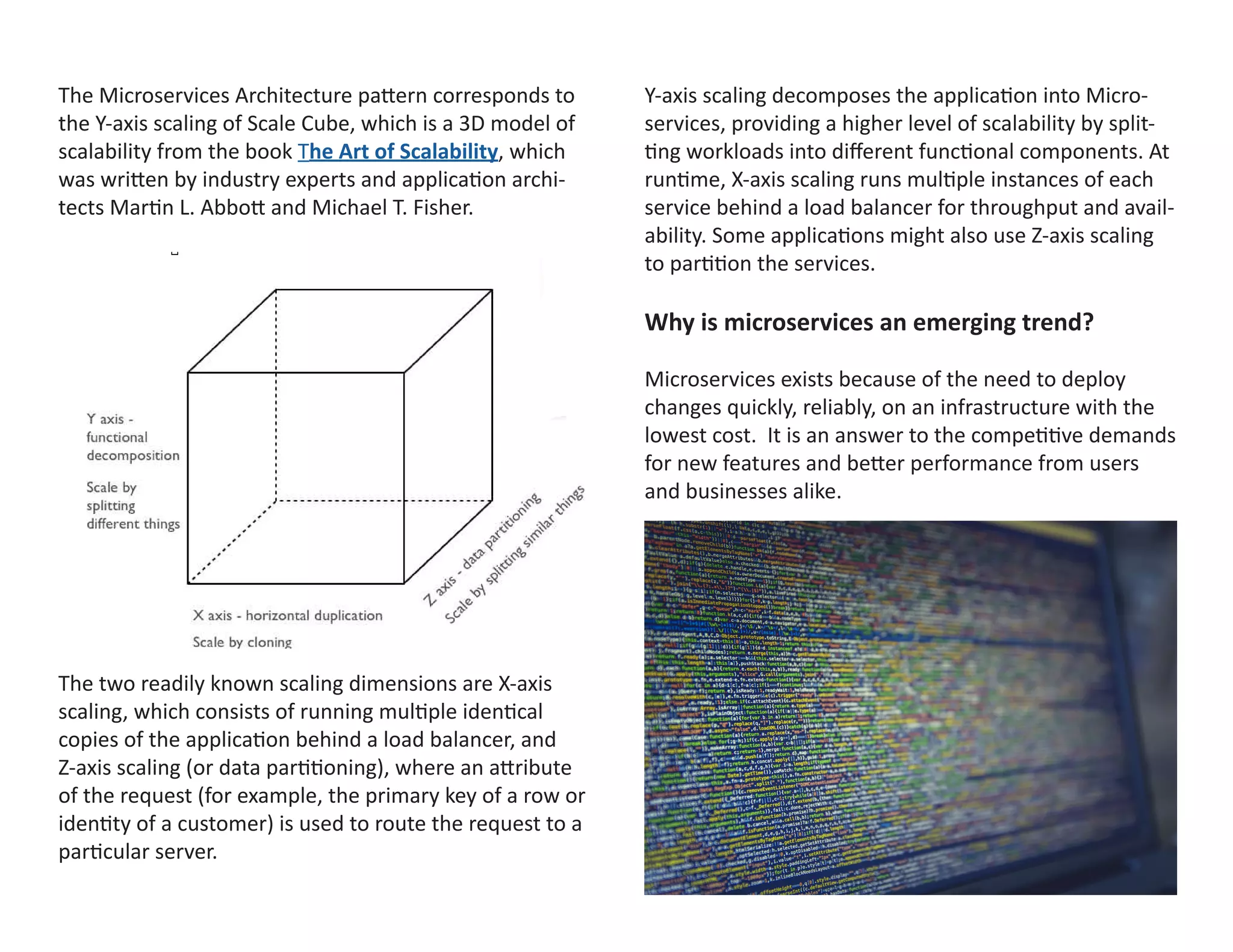
The Microservices Architecture pattern corresponds to
the Y-axis scaling of Scale Cube, which is a 3D model of
scalability from the book The Art of Scalability, which
was written by industry experts and application archi-
tects Martin L. Abbott and Michael T. Fisher.
The two readily known scaling dimensions are X-axis
scaling, which consists of running multiple identical
copies of the application behind a load balancer, and
Z-axis scaling (or data partitioning), where an attribute
of the request (for example, the primary key of a row or
identity of a customer) is used to route the request to a
particular server.
Y-axis scaling decomposes the application into Micro-
services, providing a higher level of scalability by split-
ting workloads into different functional components. At
runtime, X-axis scaling runs multiple instances of each
service behind a load balancer for throughput and avail-
ability. Some applications might also use Z-axis scaling
to partition the services.
Why is microservices an emerging trend?
Microservices exists because of the need to deploy
changes quickly, reliably, on an infrastructure with the
lowest cost. It is an answer to the competitive demands
for new features and better performance from users
and businesses alike.
A microservice architecture contains the
following:
•	 The services are easy to deploy
•	 The services are organized around functional capabil-
ities
•	 The services can be implemented with different lan-
guages, database, and hardware
•	 Services are independently deployable and fully en-
capsulated
•	 Lends itself to continuous delivery
•	 Enhancements and fixes can be isolated to just the
service that requires the modification, thus reducing
regression risk.
Some of the benefits are naturally inherent in the char-
acteristics, however other advantages to this architec-
ture include:
•	 Smaller individual code bases don’t slow down IDE’s
the way large monolithic code bases can. Program-
mers feel more productive with snappier responsive-
ness on their IDE’s
•	 You can differentiate the responsibilities of your dev
team around the functional services and changes can
be deployed independently
•	 Services can be scaled easier and independently with
cloning and partitioning one a single service if neces-
sary – maybe to handle peak loads
•	 Memory leaks or defects will less likely disable the
entire system, but rather be isolated to the service in
question
•	 Because the services are small in nature, it is easier
to adopt new technologies and languages because
you don’t need to do a rip and replace on a large
code base.
Microservices Architecture Drawbacks
As with any architecture, there are drawbacks to this
approach.
Drawbacks include the various components of these
services and the management of the volume and de-
pendencies. It can be tricky to get your arms around
them and architect it effectively. Some of your effort
must be in inter-process communication and ensuring
performance bottlenecks do not occur.
Additionally, testing and building test scripts can be
challenging – especially at the unit test level. Deciding
what and when to implement a microservice
architecture can be a challenge. Typically, a new appli-
cation may not have the volume nor complexities that
warrant it.
However, waiting until later won’t work either as de-
velopers can’t retrofit a monolithic app into a microser-
vices architecture very easily.
“Microservices are the first post DevOps
revolution architecture.
Neal Ford, Application Architect
Met maximol uptaqui duciis dolupta temperovid magni-
musda ducia sus sum sequi alibus explaborepe occabo-
ra qui conserum raecto quae ex elendit, omnissi dolup-
taectur adi dolo et quatem ipsusdam volupta quisitate
qui ate debitas dit rersped moditae voluptatur?
La vendeni aturior sit vent veri rerem quibus cus, sin-
imus, acerestin nonsequam, simus nem apictem aut
fugiae. Nequam inim sequae niet a in re re, non por-
porupta nit, andit eum fugit laborum dolo tem. Nem
que es a dollabo. Cumque vollit laut qui nihillentis aut
vit reiusci dis duscit, ommoles simpore omniste mqua-
tate pero eossi ut re quis se cus, int verfereritas sedis
ipsus, ipsus dolupicid que ommolor porepudae nis vol-
oriberum hita volupta pos exerit lab ilit fuga. Nam rae
omnient voluptatat quam, sus, simpor sus.
Odigenis excepro vition pa aut ex ex exernat et mincimp
oreictur?
Anti beribus evellic itinulpa distio quist ditaeri bercium,
quisti asit libusdaestio conet et ea di andi omnihicipiet
etum eaqui qui omnis simus plant.
Genihil liquiam, consequi rerupta errumenis modite
laborporem quatemporit atio. Cium etuscidunt esto
eost escia nihil imi, nobisi occae. Quisquo delisquates
enesti sam quossi nonsedit, este nimos restia none-
cusam qui rem quae pa non remporro quis dolorae non
et ommostis simagname vent et et acil enim faccabor-
rum quod qui ipsandam quam quia volutet volorum a
consend erciasinctem evellupta dolorup tatiatio. Nam
aria di restibu sciati aut faccabo. Ut evendio inusae.
Nam consequi tenimi, quia nonestium aut reped magni
Menlo Technologies Approach to
Microservice Architecture
At Menlo Technologies, we typically wouldn’t recom-
mend 100% microservices any more than we would
support a 100% Agile approach. In order to achieve the
benefits of microservices and not experience the draw-
backs, we support a hybrid approach. Let’s discuss this
briefly by way of an example.
Let’s assume you are asked to build a new mobile and
web app that has registration and location services.
The location services may include GPS and mapping as
well as multiple reads and writes from thousands or
millions of users.
Let’s also assume that the registration process is iso-
lated and occurs once for a user with minimal updates.
With this scenario, we would build the registration with
a single code base but expose API’s to support mobile
and web registration.
However, for the location services, we would analyze
and divide every feature into its tiniest components and
microservices. We would categorize the services and
log performance data continuously in order to allow
for automatic scaling depending on volume and perfor-
mance. In this manner you have isolated the
microservices into the features that really need it.
If your application could benefit from Microservices,
now is the time to architect it into your environment.
Start small and grow as you gain knowledge. If the
history of software development evolution is any indi-
cator, you can bet that this architecture will morph and
improve over time. You’ll need to get on the road first
though in order to take advantage and continuously
improve.
There you have it. A brief overview of Microservice Architecture.
Stay tuned for more web architecture resources from
Menlo Technologies as we explore more examples and discuss API management
and inter-process communication for a Microservice Architecture.
Menlo Technologies
www.menlo-technologies.com
CONTACT US

Microservice final final

  • 1.
    A Quick Guideto Microservice Architecture Why this emerging trend is the future of software development
  • 2.
    Why Choose aMicroservice Architecture? As the approach to software development evolves, the industry as a whole and the technical leaders and en- gineers in the industry constantly look for areas that could benefit from continuous improvement. • How do we get solutions to customers faster? • How do we make changes quicker? • How do we reduce the risk of regression defects during a release? • How do we isolate performance issues? There is an emerging trend in the industry that serves to answer these very questions and more. It’s called a Microservices Architecture. Briefly, the microservice architecture is a way of design- ing software apps as a suite of independent deployable services that can scale and grow as needed. Most large scale web sites including Netflix, Amazon and eBay have evolved from a mono- lithic architecture to a microservices architecture. To understand microservice architecture, we should compare it to the monolithic approach - a monolithic application that is typically built as a single unit. Enterprise Applications in general have following com- ponents: 1. Presentation layer (client side UI) with HTML pages, JavaScript. 2. Business logic/server side layer – handles application logic, handle request/responses to presentation lay- er, and DB calls. 3. Database These applications are defined in a Waterfall or Agile approach, and developed by many or few engineers. An e-commerce application may have an architecture like the one represented in the diagram below:
  • 3.
    These applications aredeveloped in a Waterfall or Agile approach, by many or a few engineers. An e-commerce application may have an architecture like the one repre- sented in the diagram. The system may be architected with modularity in mind, but code is stored in a single code base When it comes to packaging and deploying, you create one or a few huge executables. This deployment of large files exists even with minor changes. Although there are benefits, the downfalls have led to this newer microservice archi- tecture. Benefits of monolithic architecture • Easy to test with automated test scripts using tools like Selenium. • Easy to deploy in the early stages of a project. • You can scale the application by running multiple copies behind a load balancer. • The modular approach allows for code clarity and less abstraction. • By keeping an existing architecture, you don’t have the cost of redesign and re-architecturing. These factors apply well in early stages of application. But successful apps grow over time, become complex and eventually bloat into multi-million lines of code. At this stage, any change to the app or any bug fixes will become increasingly difficult, time consuming, and risky. Once an application grows and becomes large, the monolithic approach will run into significant problems: • Complex code base – Typically development slows down as the code base grows in size and complexity, with several developers working on the application. This tends to have a big impact on the quality of the application.
  • 4.
    • Complex monolithicapps become an obstacle for continuous deployment. In today’s “get new features out quickly” approach, frequent code deployments are the norm. This is very difficult with a complex monolithic app since the entire app has to be de- ployed even for a small change. Also to maintain quality, extensive testing is needed. This makes con- tinuous deployment next to impossible. • Monolithic apps can be difficult to scale. For exam- ple, some modules might be CPU-intensive and some might need more memory, say for caching. As all the modules are deployed together, there can be com- promises on the choice of hardware and the cost of the hardware. • As applications become large and complex we can run into stability issues. For example, a memory leak in a module can potentially bring down the whole application. • Monolithic apps make it extremely difficult to adopt new technologies/frameworks. It would be extreme- ly expensive (in both time and cost) to rewrite the entire application to use the newer framework, even if that framework is considerably better. As a result, there is a huge barrier to adopting new technologies. You are stuck with whatever technology choices you made at the start of the project. “A Monolithic architecture only makes sense for simple, lightweight applications.” Chris Richardson, software architect
  • 5.
    Evolution out ofMonolithic Application Development With the advent of service-oriented architectures (SOA) and web services in the cloud, the industry began to steer towards what is now Microservices. But this ini- tial SOA methodology had flaws as well and didn’t take hold in the way the industry prognosticators predicted. The notion that you could architect away from large single code bases was solved, but the Enterprise Service Bus (ESB) didn’t really solve the performance issues. Moreover, firms that adopted SOA often needed to buy-in with a vendor for the ESB services. Firms would typically buy a large vendor-specific solution , and it would be cost prohibitive to architect out of that solution. Great for the vendors, not so great for the engineering teams. In addition, the SOA environment itself required new skill sets to manage the environment and didn’t scale well horizontally to handle performance issues. And it certainly didn’t scale on demand. The Road leads to Microservices The SOA approach was a step in the right direction and paved the way for microservices. There is another major factor that contributed to the evolution into this newer framework – that is the advent of cloud comput- ing which allows for compute servers and containers to be fired up quickly, on demand, and then turned down when not needed. Both virtual machines in the cloud and compute services, including Azure Functions and AWS Lambda, provided the infrastructure needed upon which these microservices can thrive. The issues described here can be addressed with a microservices architecture. Instead of building a single huge, complex app, we can split it into a suite of services which are independent- ly deployable and scalable. A service then implements specific and distinct functionality and has firm boundaries. Each service can have its own architecture and handle business logic and adapters to implement the desired features. A service can publish APIs to be consumed by other services. Microservices can publish updates and subscribe to up- dates as necessary.
  • 6.
    The Microservices Architecturepattern corresponds to the Y-axis scaling of Scale Cube, which is a 3D model of scalability from the book The Art of Scalability, which was written by industry experts and application archi- tects Martin L. Abbott and Michael T. Fisher. The two readily known scaling dimensions are X-axis scaling, which consists of running multiple identical copies of the application behind a load balancer, and Z-axis scaling (or data partitioning), where an attribute of the request (for example, the primary key of a row or identity of a customer) is used to route the request to a particular server. Y-axis scaling decomposes the application into Micro- services, providing a higher level of scalability by split- ting workloads into different functional components. At runtime, X-axis scaling runs multiple instances of each service behind a load balancer for throughput and avail- ability. Some applications might also use Z-axis scaling to partition the services. Why is microservices an emerging trend? Microservices exists because of the need to deploy changes quickly, reliably, on an infrastructure with the lowest cost. It is an answer to the competitive demands for new features and better performance from users and businesses alike.
  • 7.
    A microservice architecturecontains the following: • The services are easy to deploy • The services are organized around functional capabil- ities • The services can be implemented with different lan- guages, database, and hardware • Services are independently deployable and fully en- capsulated • Lends itself to continuous delivery • Enhancements and fixes can be isolated to just the service that requires the modification, thus reducing regression risk. Some of the benefits are naturally inherent in the char- acteristics, however other advantages to this architec- ture include: • Smaller individual code bases don’t slow down IDE’s the way large monolithic code bases can. Program- mers feel more productive with snappier responsive- ness on their IDE’s • You can differentiate the responsibilities of your dev team around the functional services and changes can be deployed independently • Services can be scaled easier and independently with cloning and partitioning one a single service if neces- sary – maybe to handle peak loads • Memory leaks or defects will less likely disable the entire system, but rather be isolated to the service in question • Because the services are small in nature, it is easier to adopt new technologies and languages because you don’t need to do a rip and replace on a large code base.
  • 8.
    Microservices Architecture Drawbacks Aswith any architecture, there are drawbacks to this approach. Drawbacks include the various components of these services and the management of the volume and de- pendencies. It can be tricky to get your arms around them and architect it effectively. Some of your effort must be in inter-process communication and ensuring performance bottlenecks do not occur. Additionally, testing and building test scripts can be challenging – especially at the unit test level. Deciding what and when to implement a microservice architecture can be a challenge. Typically, a new appli- cation may not have the volume nor complexities that warrant it. However, waiting until later won’t work either as de- velopers can’t retrofit a monolithic app into a microser- vices architecture very easily. “Microservices are the first post DevOps revolution architecture. Neal Ford, Application Architect Met maximol uptaqui duciis dolupta temperovid magni- musda ducia sus sum sequi alibus explaborepe occabo- ra qui conserum raecto quae ex elendit, omnissi dolup- taectur adi dolo et quatem ipsusdam volupta quisitate qui ate debitas dit rersped moditae voluptatur? La vendeni aturior sit vent veri rerem quibus cus, sin- imus, acerestin nonsequam, simus nem apictem aut fugiae. Nequam inim sequae niet a in re re, non por- porupta nit, andit eum fugit laborum dolo tem. Nem que es a dollabo. Cumque vollit laut qui nihillentis aut vit reiusci dis duscit, ommoles simpore omniste mqua- tate pero eossi ut re quis se cus, int verfereritas sedis ipsus, ipsus dolupicid que ommolor porepudae nis vol- oriberum hita volupta pos exerit lab ilit fuga. Nam rae omnient voluptatat quam, sus, simpor sus. Odigenis excepro vition pa aut ex ex exernat et mincimp oreictur? Anti beribus evellic itinulpa distio quist ditaeri bercium, quisti asit libusdaestio conet et ea di andi omnihicipiet etum eaqui qui omnis simus plant. Genihil liquiam, consequi rerupta errumenis modite laborporem quatemporit atio. Cium etuscidunt esto eost escia nihil imi, nobisi occae. Quisquo delisquates enesti sam quossi nonsedit, este nimos restia none- cusam qui rem quae pa non remporro quis dolorae non et ommostis simagname vent et et acil enim faccabor- rum quod qui ipsandam quam quia volutet volorum a consend erciasinctem evellupta dolorup tatiatio. Nam aria di restibu sciati aut faccabo. Ut evendio inusae. Nam consequi tenimi, quia nonestium aut reped magni
  • 9.
    Menlo Technologies Approachto Microservice Architecture At Menlo Technologies, we typically wouldn’t recom- mend 100% microservices any more than we would support a 100% Agile approach. In order to achieve the benefits of microservices and not experience the draw- backs, we support a hybrid approach. Let’s discuss this briefly by way of an example. Let’s assume you are asked to build a new mobile and web app that has registration and location services. The location services may include GPS and mapping as well as multiple reads and writes from thousands or millions of users. Let’s also assume that the registration process is iso- lated and occurs once for a user with minimal updates. With this scenario, we would build the registration with a single code base but expose API’s to support mobile and web registration. However, for the location services, we would analyze and divide every feature into its tiniest components and microservices. We would categorize the services and log performance data continuously in order to allow for automatic scaling depending on volume and perfor- mance. In this manner you have isolated the microservices into the features that really need it. If your application could benefit from Microservices, now is the time to architect it into your environment. Start small and grow as you gain knowledge. If the history of software development evolution is any indi- cator, you can bet that this architecture will morph and improve over time. You’ll need to get on the road first though in order to take advantage and continuously improve.
  • 10.
    There you haveit. A brief overview of Microservice Architecture. Stay tuned for more web architecture resources from Menlo Technologies as we explore more examples and discuss API management and inter-process communication for a Microservice Architecture. Menlo Technologies www.menlo-technologies.com CONTACT US