Microservices, SOA and APIs:
Friends or Enemies?
Co-author:
Brian Petrini
(petrini@us.ibm.com)
Presenter/Author:
Kim Clark
(kim.clark@uk.ibm.com)
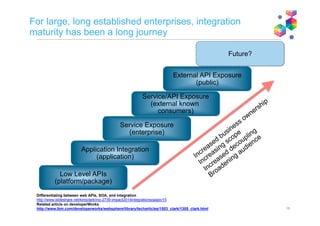
Evolving exposure of business function
Service Exposure
(enterprise)
Low Level APIs
(platform/package)
Application Integration
(application)
Service/API Exposure
(external known
consumers)
External API Exposure
(public)
Future?
Differentiating between web APIs, SOA, and integration
http://www.slideshare.net/kimjclark/ino-2739-impact2014integrationsoaapiv15
Related article on developerWorks
http://ibm.biz/ApiVsSoa
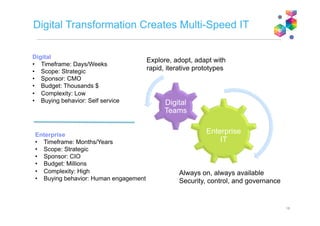
Digital Transformation Creates Multi-Modal IT
Digital
• Timeframe: Days/Weeks
• Scope: Strategic
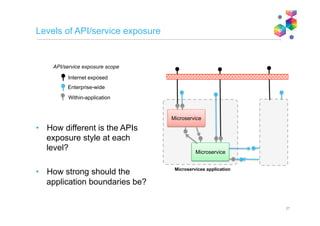
• Sponsor: CMO
• Budget: $
• Complexity: Low
• Buying behavior: Self service
Enterprise
• Timeframe: Months/Years
• Scope: Strategic
• Sponsor: CIO
• Budget: $$$
• Complexity: High
• Buying behavior: Human engagement
Enterprise
IT
Digital
Teams
Explore, adopt, adapt with
rapid, iterative prototypes
Always on, always available
Security, control, and governance
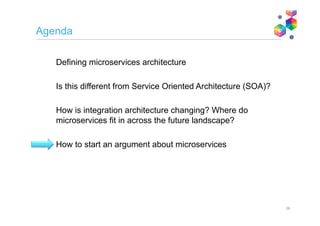
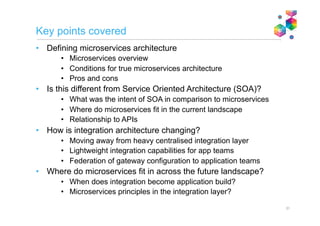
Agenda
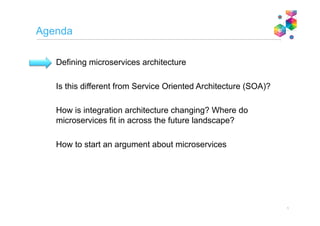
Defining microservices architecture
Is this different from Service Oriented Architecture (SOA)?
How is integration architecture changing? Where do
microservices fit in across the future landscape?
How to start an argument about microservices
3
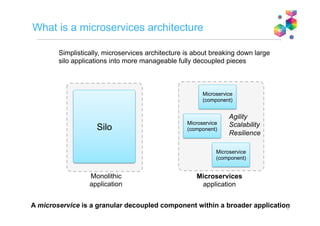
What is microservices architecture
Monolithic
application
Microservices
application
Silo
Microservice
(component)
Microservice
(component)
Microservice
(component)
A microservice is a granular decoupled component within a broader application
Agility
Scalability
Resilience
Simplistically, microservices architecture is about breaking down large
silo applications into more manageable fully decoupled pieces
Microservice
component
Microservice
component
Microservice
component
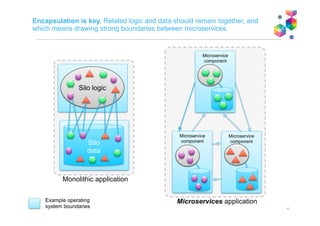
Encapsulation is key. Related logic and data should remain together, and
which means drawing strong boundaries between microservices.
Monolithic application
Microservices application
Silo logic
Silo
data
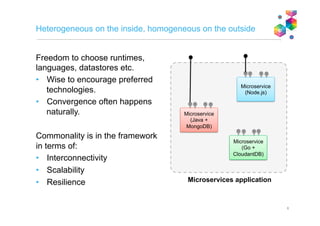
Heterogeneous on the inside, homogeneous on the outside
Freedom to choose runtimes,
languages, datastores etc.
• Wise to encourage preferred
technologies.
• Convergence often happens
naturally.
Commonality is in the framework
in terms of:
• Interconnectivity
• Scalability
• Resilience
6
Microservices application
Microservice
(Node.js)
Microservice
(Java +
MongoDB)
Microservice
(Go +
CloudantDB)
Why Microservices?
Small scoped, independent, scalable components
Scaling
Elastic scalability
Workload orchestration
Agility
Faster iteration cycles
Bounded context (code and data)
Resilience
Reduced dependencies
Fail fast
7
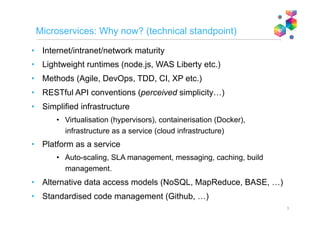
Microservices: Why now? (technical standpoint)
• Internet/intranet/network maturity
• Lightweight runtimes (node.js, WAS Liberty etc.)
• Methods & tools (Agile, DevOps, TDD, CI, XP, Puppet, Chef…)
• Lightweight protocols (RESTful APIs, lightweight messaging)
• Simplified infrastructure
• OS virtualisation (hypervisors), containerisation (e.g. Docker),
infrastructure as a service (IaaS), workload virtualisation
(Kubernetes, Mesos, Spark…)
• Platform as a service
• Auto-scaling, workload management, SLA management,
messaging, caching, build management.
• Alternative data persistance models (NoSQL, MapReduce, BASE,
CQRS)
• Standardised code management (Github, …)
8
Microservice
component
Microservice
component
Microservice
component
WAS
LibertyNode.js
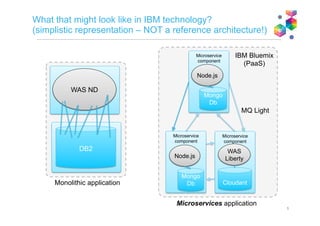
What that might look like in IBM technology?
(simplistic representation – NOT a reference architecture!)
Monolithic application
Microservices application
WAS ND
DB2
Mongo
Db
Cloudant
Cloudant
Node.js
IBM Bluemix
(PaaS)
Message
Hub
(Kafka)
JSON/
HTTP
Microservice
MicroserviceMicroservice
Microservice
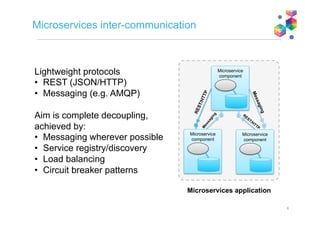
Microservices inter-communication
Aim is decoupling for robustness
Messaging where possible
• Lightweight messaging
(e.g. AMQP, Kafka)
• Publish/subscribe
• Eventual consistency
Direct calls where necessary
Lightweight protocols
(e.g. JSON/HTTP)
• Load balancing/scaling via service
discovery
• Circuit breaker
• Caching
Microservices application
Microservice
Subscribe
JSON
/HTTP
Microservice
Microservice
Message
Hub
API
Microservice
Publish
API
JSON
/HTTP Publish
Service
Discovery
Application frameworks at the network level
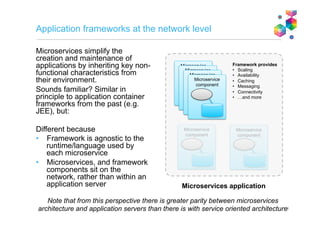
Microservices simplify the
creation and maintenance of
applications by inheriting key non-
functional characteristics from
their environment.
Sounds familiar? Similar in
principle to application container
frameworks from the past (e.g.
JEE), but:
Different because
• Framework is agnostic to the
runtime/language used by
each microservice
• Microservices, and framework
components sit on the
network, rather than within an
application server Microservices application
Microservice
component
Microservice
component
Microservice
componentMicroservice
component
Framework provides
• Scaling
• Availability
• Caching
• Messaging
• Connectivity
• …and more
Note that from this perspective there is greater parity between microservices
architecture and application servers than there is with service oriented architecture11
Can everything become a microservice?
What about the things you can’t change?
• You can’t refactor all systems to microservices
• Most applications have an “if it ain’t broke, don’t fix it” policy
• Old systems may be unrealistic to re-engineer
• What if you can’t change the datastore?
• Are you doing microservices if your data remains in a silo?
• Can you manage without transactionality to the database?
• Will techniques like BASE, CQRS work?
• How do existing systems fit into a microservices architecture?
• How do you isolate yourself from their availability issues?
• What if they don’t scale as well as your microservices do?
12
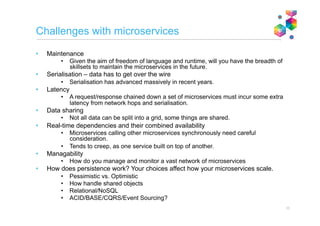
Challenges with microservices
Automation
Automation is key to retaining agility: Test automation. Continuous integration and deployment
and more…
Managing and monitoring
How do you manage and monitor a vast network of microservices
Maintenance
Given the aim of freedom of language and runtime, will you have the breadth of skillsets to
maintain the microservices in the future.
Serialisation
Data has to get over the wire more often (however, serialisation has advanced massively in
recent years)
Latency
A request/response chained down a set of microservices must incur some extra latency from
network hops and serialisation.
Data sharing
Not all data can be split into a grid, some things are shared.
Real-time dependencies
What is the combined availability of all dependencies
Microservices calling other microservices synchronously need careful consideration.
Tends to creep, as one service built on top of another.
How does persistence work?
Pessimistic vs. Optimistic
How handle shared objects
Relational/NoSQL
ACID/BASE/CQRS/Event Sourcing?
13
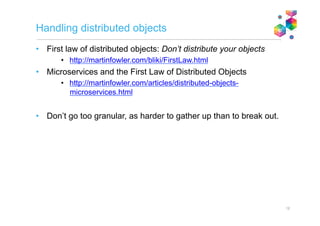
Handling distributed objects
First law of distributed objects: Don’t distribute your objects!
http://martinfowler.com/bliki/FirstLaw.html
Microservices and the First Law of Distributed Objects
http://martinfowler.com/articles/distributed-objects-
microservices.html
Don’t go too granular too soon.
It is harder to gather up than to break out.
14
Are we really doing microservices?
Martin Fowler/James Lewis
1. Componentization
2. Organized around Business
Capabilities
3. Products not Projects
4. Smart endpoints and dumb pipes
5. Decentralized Governance
6. Decentralized Data Management
7. Infrastructure Automation
8. Design for failure
9. Evolutionary Design
http://martinfowler.com/articles/microser
vices.html
15
12 factor apps
I. Codebase
II. Dependencies
III. Config
IV. Backing Services
V. Build, release, run
VI. Processes
VII. Port binding
VIII. Concurrency
IX. Disposability
X. Dev/prod parity
XI. Logs
XII. Admin processes
http://12factor.net
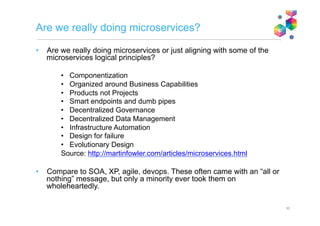
Are we really doing microservices or just aligning with some of the
microservices principles?
Consider the adoption paths of SOA, XP, agile, devops etc. These often come
with an “all or nothing” message, but can you take on the whole package?
Agenda
Defining microservices architecture
Is this different from Service Oriented Architecture (SOA)?
How is integration architecture changing? Where do
microservices fit in across the future landscape?
How to start an argument about microservices
16
Microservice
component
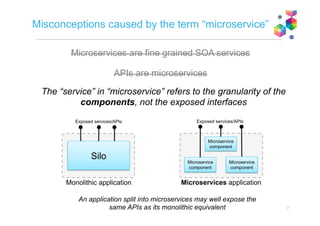
Common misconception resulting from the term “microservice”
Monolithic application Microservices application
Exposed services/APIs
Microservice
component
Microservice
component
Exposed services/APIs
Silo
component
Microservices are just more fine grained web services
APIs are microservices
“micro” refers to the granularity of the components,
not the granularity of the exposed interfaces
x 1 x 3
x 4x 4
Is “microservices architecture” is really
“micro-component architecture”?
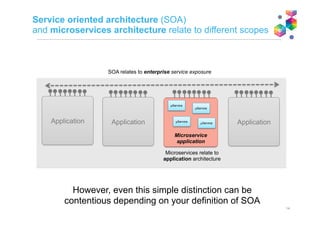
Application
SOA relates to enterprise service exposure *
Application ApplicationApplication
Service oriented architecture (SOA)
and microservices architecture relate to different scopes
Microservice
application
µService
µServiceµService
µService
Microservices relate to
application architecture
* this simple distinction can be contentious depending on your definition of SOA
“Microservices, SOA, and APIs: Friends or enemies?”
http://ibm.biz/MicroservicesVsSoa
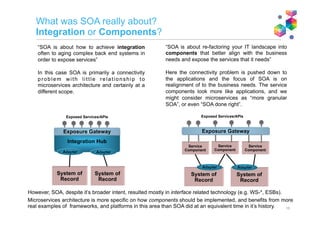
What was SOA really about?
Integration or Components?
Opinion 1: “SOA is about how to achieve
integration often to aging complex back end
systems in order to expose services”
In this case SOA is primarily a connectivity
problem with little relationship to
microservices architecture and certainly at a
different scope.
Opinion 2: “SOA is about re-factoring your IT
landscape into components that better align with
the business needs and expose the services that it
requires”
Here the connectivity problem is pushed down to
the applications and the focus of SOA is on
realignment of to the business needs. The service
components look more like applications, and we
might consider microservices as “more granular
SOA”, or even “SOA done right”.
System of
Record
Integration Hub
Adapter Adapter
Exposure Gateway
Exposed Services/APIs
System of
Record
System of
Record
Adapter
Exposed Services/APIs
System of
Record
Adapter
Service
Component
Service
Component
Service
Component
Exposure Gateway
However, SOA, despite it’s broader intent, resulted mostly in interface related technology (e.g. WS-*, ESBs).
Microservices architecture is more specific on how components should be implemented, and benefits from more
real examples of frameworks, and platforms in this area than SOA did at an equivalent time in it’s history. 19
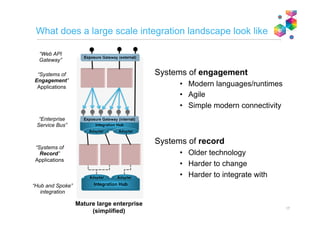
What does a large scale integration landscape look like
Systems of engagement
• Modern languages/runtimes
• Agile
• Simple modern connectivity
Systems of record
• Older technology
• Harder to change
• Harder to integrate with
Integration Hub
Integration Hub
Adapter Adapter
“Systems of
Engagement”
Applications
Exposure Gateway (internal)
“Systems of
Record”
Applications
Mature large enterprise
(simplified)
Exposure Gateway (external)
Adapter Adapter
“Hub and Spoke”
integration
“Enterprise
Service Bus?”
“Web API
Gateway”
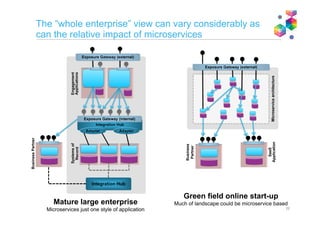
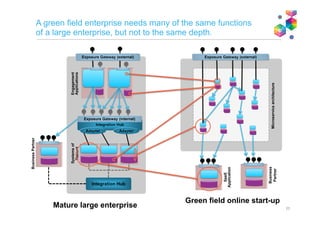
Why such split opinions on microservices vs SOA?
21
Integration Hub
Integration Hub
Adapter Adapter
Engagement
Applications
SaaS
Application
BusinessPartner
Systemsof
Record
Business
Partner
Exposure Gateway (external)
Mature large enterprise
Microservices are just one style of application
Exposing services is an integration and data challenge
Green field online start-up
Much of landscape could be microservice based
The landscape is as (micro)service oriented architecture
Exposure Gateway (external)
Microservice
application
µService
µServiceµService
µService
Exposure Gateway (internal)
µService
µService
µService
µService
µService
µService
µService
µService
µService
µService
µService
EnterpriseBoundary
EnterpriseBoundary
Adapter Adapter
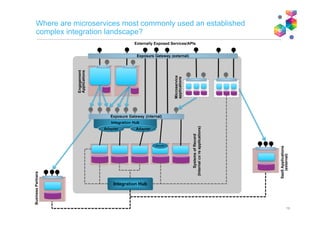
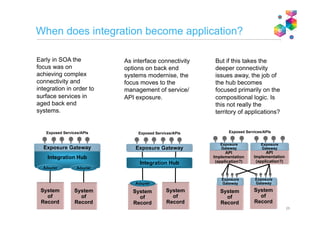
Where do we typically see microservices in large organisations today?
22
Systems
ofRecord
Integration Hub
Integration Hub
Adapter Adapter
Engagement
Applications
Microservice
applications
SaaSApplications
(external)
Adapter
Externally Exposed Services/APIs
Exposure Gateway (internal)
Exposure Gateway (external)
BusinessPartners
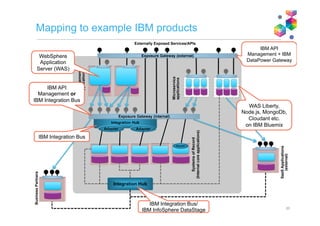
Mapping to example IBM products
23
SystemsofRecord
(Internalcoreapplications)
Integration Hub
Integration Hub
Adapter Adapter
Engagement
Applications
Microservice
applications
SaaSApplications
(external)
Adapter
Externally Exposed Services/APIs
Exposure Gateway (internal)
Exposure Gateway (external)
BusinessPartners
WebSphere
Application
Server (WAS)
IBM API Connect or
IBM Integration Bus
IBM Integration Bus
IBM Integration Bus
WAS Liberty,
Node.js, MongoDb,
Cloudant etc.
on IBM Bluemix
IBM API Connect +
IBM DataPower
Gateway
IBM API Connect
IBM MQ feeding
events IBM
Message Hub in
Bluemix, or IIB
talking directly to
Kafka APIs
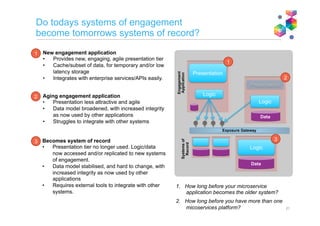
Where might we see microservice principles in use going forward?
24
Systems
ofRecord
Integration Hub
Integration Hub
Adapter Adapter
Engagement
Applications
Microservice
applications
SaaSApplications
(external)
Adapter
Externally Exposed Services/APIs
Exposure Gateway (internal)
Exposure Gateway (external)
BusinessPartners
Agenda
Defining microservices architecture
Is this different from Service Oriented Architecture (SOA)?
How is integration architecture changing? Where do
microservices fit in across the future landscape?
How to start an argument about microservices
25
Integration Domain
Enterprise Ownership Boundary
The Integration Domain of the Hybrid Enterprise
Dedicated CloudPublic CloudSaaS
Customers Business Partners
Appl. Appl.Appl.Appl.Appl.Appl.
Appl. Appl. Appl. Appl.
On-Premise
Appl.Appl. Appl.Appl. Appl.
Local Cloud
Appl. Appl.
ApplicationApplication
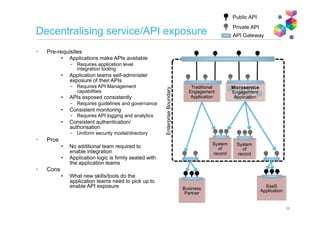
Decentralising synchronous integration
Engagement
Applications
System
of
Record
Integration
Public API
Enterprise API
API Gateway
System
of RecordSystem
of
Record
Integration
EnterpriseBoundary
Exposure Gateway (external)
SaaS
Application
Business
Partner
In a perfect world…
• Application teams self-
administer exposure of their
own APIs
• Application teams handle their
own integration needs
• Access to external APIs is
governed using the same
mechanisms used to govern
access to internal APIs.
• Application logic is firmly seated
with the application teams
• API monitoring/diagnostics
would be gathered consistently
across the organisation
• Security models would be
implemented more consistently
ApplicationApplication
So where is the ESB now?
Where might we find microservices here?
What about event driven integration?
What is an application boundary
in an microservices world?
Similar to application boundaries
today because
• Group related functionality
• Enable more coarse grained
ownership and responsibility (in
addition to full ownership at the
microservice level)
Different because
• Application sub-components
(microservices) are truly
independent.
• Application boundaries can be
easily changed – it’s primarily
about the right ownership
• Application boundaries can spread
across network boundaries (e.g.
between clouds)…but should they!
28
µService
µService
µService
µService
µService
µService
µService
µService
µService
µService
µService
Microservice
component
Inter-microservice vs. inter-application communication
Microservices
application
Microservice
component
Microservice
component
Inter-microservice communication
• Lightweight protocols: HTTP,
application messaging
• Runtime component registry
• Client-side load balancing and circuit
breaker patterns
Microservices
application
Exposure Gateway
Inter-application communication
• Enterprise protocols: Managed API
gateways, enterprise messaging
• Design time developer portals
• Gateway load balancing and throttling
JSON/HTTP RESTful communication styles may
be present in both types of communication, but
their implementation may be radically different.
JSON/HTTP
Agenda
Defining microservices architecture
Is this different from Service Oriented Architecture (SOA)?
How is integration architecture changing? Where do
microservices fit in across the future landscape?
How to start an argument about microservices
30
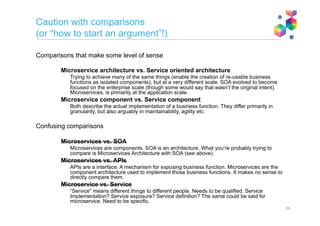
Caution with comparisons
(or “how to start an argument”!)
Comparisons that make some level of sense
Microservice architecture vs. Service oriented architecture
Trying to achieve many of the same things (enable the creation of re-usable business
functions as isolated components), but at a very different scale. SOA evolved to become
focused on the enterprise scale (though some would say that wasn’t the original intent).
Microservices, is primarily at the application scale.
Microservice component vs. Service component
Both describe the actual implementation of a business function. They differ primarily in
granularity, but also arguably in maintainability, agility etc.
Confusing comparisons
Microservices vs. SOA
Microservices are components. SOA is an architecture. What you’re probably trying to
compare is Microservices Architecture with SOA (see above).
Microservices vs. APIs
APIs are a interface. A mechanism for exposing business function. Microservices are the
component architecture used to implement those business functions. It makes no sense to
directly compare them.
Microservice vs. Service
“Service” means different things to different people. Needs to be qualified. Service
Implementation? Service exposure? Service definition? The same could be said for
microservice. Need to be specific.
31
Questions?
32
http://www.slideshare.net/kimjclark/presentations
https://www.linkedin.com/in/kimjulianclark
Thank You

Microservices: Where do they fit within a rapidly evolving integration architecture?

  • 1.
    Microservices, SOA andAPIs: Friends or Enemies? Co-author: Brian Petrini (petrini@us.ibm.com) Presenter/Author: Kim Clark (kim.clark@uk.ibm.com)
  • 2.
    Evolving exposure ofbusiness function Service Exposure (enterprise) Low Level APIs (platform/package) Application Integration (application) Service/API Exposure (external known consumers) External API Exposure (public) Future? Differentiating between web APIs, SOA, and integration http://www.slideshare.net/kimjclark/ino-2739-impact2014integrationsoaapiv15 Related article on developerWorks http://ibm.biz/ApiVsSoa
  • 3.
    Digital Transformation CreatesMulti-Modal IT Digital • Timeframe: Days/Weeks • Scope: Strategic • Sponsor: CMO • Budget: $ • Complexity: Low • Buying behavior: Self service Enterprise • Timeframe: Months/Years • Scope: Strategic • Sponsor: CIO • Budget: $$$ • Complexity: High • Buying behavior: Human engagement Enterprise IT Digital Teams Explore, adopt, adapt with rapid, iterative prototypes Always on, always available Security, control, and governance
  • 4.
    Agenda Defining microservices architecture Isthis different from Service Oriented Architecture (SOA)? How is integration architecture changing? Where do microservices fit in across the future landscape? How to start an argument about microservices 3
  • 5.
    What is microservicesarchitecture Monolithic application Microservices application Silo Microservice (component) Microservice (component) Microservice (component) A microservice is a granular decoupled component within a broader application Agility Scalability Resilience Simplistically, microservices architecture is about breaking down large silo applications into more manageable fully decoupled pieces
  • 6.
    Microservice component Microservice component Microservice component Encapsulation is key.Related logic and data should remain together, and which means drawing strong boundaries between microservices. Monolithic application Microservices application Silo logic Silo data
  • 7.
    Heterogeneous on theinside, homogeneous on the outside Freedom to choose runtimes, languages, datastores etc. • Wise to encourage preferred technologies. • Convergence often happens naturally. Commonality is in the framework in terms of: • Interconnectivity • Scalability • Resilience 6 Microservices application Microservice (Node.js) Microservice (Java + MongoDB) Microservice (Go + CloudantDB)
  • 8.
    Why Microservices? Small scoped,independent, scalable components Scaling Elastic scalability Workload orchestration Agility Faster iteration cycles Bounded context (code and data) Resilience Reduced dependencies Fail fast 7
  • 9.
    Microservices: Why now?(technical standpoint) • Internet/intranet/network maturity • Lightweight runtimes (node.js, WAS Liberty etc.) • Methods & tools (Agile, DevOps, TDD, CI, XP, Puppet, Chef…) • Lightweight protocols (RESTful APIs, lightweight messaging) • Simplified infrastructure • OS virtualisation (hypervisors), containerisation (e.g. Docker), infrastructure as a service (IaaS), workload virtualisation (Kubernetes, Mesos, Spark…) • Platform as a service • Auto-scaling, workload management, SLA management, messaging, caching, build management. • Alternative data persistance models (NoSQL, MapReduce, BASE, CQRS) • Standardised code management (Github, …) 8
  • 10.
    Microservice component Microservice component Microservice component WAS LibertyNode.js What that mightlook like in IBM technology? (simplistic representation – NOT a reference architecture!) Monolithic application Microservices application WAS ND DB2 Mongo Db Cloudant Cloudant Node.js IBM Bluemix (PaaS) Message Hub (Kafka) JSON/ HTTP
  • 11.
    Microservice MicroserviceMicroservice Microservice Microservices inter-communication Aim isdecoupling for robustness Messaging where possible • Lightweight messaging (e.g. AMQP, Kafka) • Publish/subscribe • Eventual consistency Direct calls where necessary Lightweight protocols (e.g. JSON/HTTP) • Load balancing/scaling via service discovery • Circuit breaker • Caching Microservices application Microservice Subscribe JSON /HTTP Microservice Microservice Message Hub API Microservice Publish API JSON /HTTP Publish Service Discovery
  • 12.
    Application frameworks atthe network level Microservices simplify the creation and maintenance of applications by inheriting key non- functional characteristics from their environment. Sounds familiar? Similar in principle to application container frameworks from the past (e.g. JEE), but: Different because • Framework is agnostic to the runtime/language used by each microservice • Microservices, and framework components sit on the network, rather than within an application server Microservices application Microservice component Microservice component Microservice componentMicroservice componentMicroservice componentMicroservice component Framework provides • Scaling • Availability • Caching • Messaging • Connectivity • …and more Note that from this perspective there is greater parity between microservices architecture and application servers than there is with service oriented architecture11
  • 13.
    Can everything becomea microservice? What about the things you can’t change? • You can’t refactor all systems to microservices • Most applications have an “if it ain’t broke, don’t fix it” policy • Old systems may be unrealistic to re-engineer • What if you can’t change the datastore? • Are you doing microservices if your data remains in a silo? • Can you manage without transactionality to the database? • Will techniques like BASE, CQRS work? • How do existing systems fit into a microservices architecture? • How do you isolate yourself from their availability issues? • What if they don’t scale as well as your microservices do? 12
  • 14.
    Challenges with microservices Automation Automationis key to retaining agility: Test automation. Continuous integration and deployment and more… Managing and monitoring How do you manage and monitor a vast network of microservices Maintenance Given the aim of freedom of language and runtime, will you have the breadth of skillsets to maintain the microservices in the future. Serialisation Data has to get over the wire more often (however, serialisation has advanced massively in recent years) Latency A request/response chained down a set of microservices must incur some extra latency from network hops and serialisation. Data sharing Not all data can be split into a grid, some things are shared. Real-time dependencies What is the combined availability of all dependencies Microservices calling other microservices synchronously need careful consideration. Tends to creep, as one service built on top of another. How does persistence work? Pessimistic vs. Optimistic How handle shared objects Relational/NoSQL ACID/BASE/CQRS/Event Sourcing? 13
  • 15.
    Handling distributed objects Firstlaw of distributed objects: Don’t distribute your objects! http://martinfowler.com/bliki/FirstLaw.html Microservices and the First Law of Distributed Objects http://martinfowler.com/articles/distributed-objects- microservices.html Don’t go too granular too soon. It is harder to gather up than to break out. 14
  • 16.
    Are we reallydoing microservices? Martin Fowler/James Lewis 1. Componentization 2. Organized around Business Capabilities 3. Products not Projects 4. Smart endpoints and dumb pipes 5. Decentralized Governance 6. Decentralized Data Management 7. Infrastructure Automation 8. Design for failure 9. Evolutionary Design http://martinfowler.com/articles/microser vices.html 15 12 factor apps I. Codebase II. Dependencies III. Config IV. Backing Services V. Build, release, run VI. Processes VII. Port binding VIII. Concurrency IX. Disposability X. Dev/prod parity XI. Logs XII. Admin processes http://12factor.net Are we really doing microservices or just aligning with some of the microservices principles? Consider the adoption paths of SOA, XP, agile, devops etc. These often come with an “all or nothing” message, but can you take on the whole package?
  • 17.
    Agenda Defining microservices architecture Isthis different from Service Oriented Architecture (SOA)? How is integration architecture changing? Where do microservices fit in across the future landscape? How to start an argument about microservices 16
  • 18.
    Microservice component Common misconception resultingfrom the term “microservice” Monolithic application Microservices application Exposed services/APIs Microservice component Microservice component Exposed services/APIs Silo component Microservices are just more fine grained web services APIs are microservices “micro” refers to the granularity of the components, not the granularity of the exposed interfaces x 1 x 3 x 4x 4 Is “microservices architecture” is really “micro-component architecture”?
  • 19.
    Application SOA relates toenterprise service exposure * Application ApplicationApplication Service oriented architecture (SOA) and microservices architecture relate to different scopes Microservice application µService µServiceµService µService Microservices relate to application architecture * this simple distinction can be contentious depending on your definition of SOA “Microservices, SOA, and APIs: Friends or enemies?” http://ibm.biz/MicroservicesVsSoa
  • 20.
    What was SOAreally about? Integration or Components? Opinion 1: “SOA is about how to achieve integration often to aging complex back end systems in order to expose services” In this case SOA is primarily a connectivity problem with little relationship to microservices architecture and certainly at a different scope. Opinion 2: “SOA is about re-factoring your IT landscape into components that better align with the business needs and expose the services that it requires” Here the connectivity problem is pushed down to the applications and the focus of SOA is on realignment of to the business needs. The service components look more like applications, and we might consider microservices as “more granular SOA”, or even “SOA done right”. System of Record Integration Hub Adapter Adapter Exposure Gateway Exposed Services/APIs System of Record System of Record Adapter Exposed Services/APIs System of Record Adapter Service Component Service Component Service Component Exposure Gateway However, SOA, despite it’s broader intent, resulted mostly in interface related technology (e.g. WS-*, ESBs). Microservices architecture is more specific on how components should be implemented, and benefits from more real examples of frameworks, and platforms in this area than SOA did at an equivalent time in it’s history. 19
  • 21.
    What does alarge scale integration landscape look like Systems of engagement • Modern languages/runtimes • Agile • Simple modern connectivity Systems of record • Older technology • Harder to change • Harder to integrate with Integration Hub Integration Hub Adapter Adapter “Systems of Engagement” Applications Exposure Gateway (internal) “Systems of Record” Applications Mature large enterprise (simplified) Exposure Gateway (external) Adapter Adapter “Hub and Spoke” integration “Enterprise Service Bus?” “Web API Gateway”
  • 22.
    Why such splitopinions on microservices vs SOA? 21 Integration Hub Integration Hub Adapter Adapter Engagement Applications SaaS Application BusinessPartner Systemsof Record Business Partner Exposure Gateway (external) Mature large enterprise Microservices are just one style of application Exposing services is an integration and data challenge Green field online start-up Much of landscape could be microservice based The landscape is as (micro)service oriented architecture Exposure Gateway (external) Microservice application µService µServiceµService µService Exposure Gateway (internal) µService µService µService µService µService µService µService µService µService µService µService EnterpriseBoundary EnterpriseBoundary Adapter Adapter
  • 23.
    Where do wetypically see microservices in large organisations today? 22 Systems ofRecord Integration Hub Integration Hub Adapter Adapter Engagement Applications Microservice applications SaaSApplications (external) Adapter Externally Exposed Services/APIs Exposure Gateway (internal) Exposure Gateway (external) BusinessPartners
  • 24.
    Mapping to exampleIBM products 23 SystemsofRecord (Internalcoreapplications) Integration Hub Integration Hub Adapter Adapter Engagement Applications Microservice applications SaaSApplications (external) Adapter Externally Exposed Services/APIs Exposure Gateway (internal) Exposure Gateway (external) BusinessPartners WebSphere Application Server (WAS) IBM API Connect or IBM Integration Bus IBM Integration Bus IBM Integration Bus WAS Liberty, Node.js, MongoDb, Cloudant etc. on IBM Bluemix IBM API Connect + IBM DataPower Gateway IBM API Connect IBM MQ feeding events IBM Message Hub in Bluemix, or IIB talking directly to Kafka APIs
  • 25.
    Where might wesee microservice principles in use going forward? 24 Systems ofRecord Integration Hub Integration Hub Adapter Adapter Engagement Applications Microservice applications SaaSApplications (external) Adapter Externally Exposed Services/APIs Exposure Gateway (internal) Exposure Gateway (external) BusinessPartners
  • 26.
    Agenda Defining microservices architecture Isthis different from Service Oriented Architecture (SOA)? How is integration architecture changing? Where do microservices fit in across the future landscape? How to start an argument about microservices 25
  • 27.
    Integration Domain Enterprise OwnershipBoundary The Integration Domain of the Hybrid Enterprise Dedicated CloudPublic CloudSaaS Customers Business Partners Appl. Appl.Appl.Appl.Appl.Appl. Appl. Appl. Appl. Appl. On-Premise Appl.Appl. Appl.Appl. Appl. Local Cloud Appl. Appl.
  • 28.
    ApplicationApplication Decentralising synchronous integration Engagement Applications System of Record Integration PublicAPI Enterprise API API Gateway System of RecordSystem of Record Integration EnterpriseBoundary Exposure Gateway (external) SaaS Application Business Partner In a perfect world… • Application teams self- administer exposure of their own APIs • Application teams handle their own integration needs • Access to external APIs is governed using the same mechanisms used to govern access to internal APIs. • Application logic is firmly seated with the application teams • API monitoring/diagnostics would be gathered consistently across the organisation • Security models would be implemented more consistently ApplicationApplication So where is the ESB now? Where might we find microservices here? What about event driven integration?
  • 29.
    What is anapplication boundary in an microservices world? Similar to application boundaries today because • Group related functionality • Enable more coarse grained ownership and responsibility (in addition to full ownership at the microservice level) Different because • Application sub-components (microservices) are truly independent. • Application boundaries can be easily changed – it’s primarily about the right ownership • Application boundaries can spread across network boundaries (e.g. between clouds)…but should they! 28 µService µService µService µService µService µService µService µService µService µService µService
  • 30.
    Microservice component Inter-microservice vs. inter-applicationcommunication Microservices application Microservice component Microservice component Inter-microservice communication • Lightweight protocols: HTTP, application messaging • Runtime component registry • Client-side load balancing and circuit breaker patterns Microservices application Exposure Gateway Inter-application communication • Enterprise protocols: Managed API gateways, enterprise messaging • Design time developer portals • Gateway load balancing and throttling JSON/HTTP RESTful communication styles may be present in both types of communication, but their implementation may be radically different. JSON/HTTP
  • 31.
    Agenda Defining microservices architecture Isthis different from Service Oriented Architecture (SOA)? How is integration architecture changing? Where do microservices fit in across the future landscape? How to start an argument about microservices 30
  • 32.
    Caution with comparisons (or“how to start an argument”!) Comparisons that make some level of sense Microservice architecture vs. Service oriented architecture Trying to achieve many of the same things (enable the creation of re-usable business functions as isolated components), but at a very different scale. SOA evolved to become focused on the enterprise scale (though some would say that wasn’t the original intent). Microservices, is primarily at the application scale. Microservice component vs. Service component Both describe the actual implementation of a business function. They differ primarily in granularity, but also arguably in maintainability, agility etc. Confusing comparisons Microservices vs. SOA Microservices are components. SOA is an architecture. What you’re probably trying to compare is Microservices Architecture with SOA (see above). Microservices vs. APIs APIs are a interface. A mechanism for exposing business function. Microservices are the component architecture used to implement those business functions. It makes no sense to directly compare them. Microservice vs. Service “Service” means different things to different people. Needs to be qualified. Service Implementation? Service exposure? Service definition? The same could be said for microservice. Need to be specific. 31
  • 33.
  • 34.