Running head: APPLE FINANCIAL ANALYSIS 0
0
APPLE FINANCIAL ANALYSIS
Name of Student
Institution affiliation
APPLE FINANCIAL ANALYSIS 1
Executive Summary
Apple Inc. has been at the forefront of the technology sector for a long time. The
company has been at its best for a couple of years though it almost took a nosedive after it
suspended one of its founding members. The company has dedicated millions of dollars to
research and development, and this has been one of its key drivers (Apple Inc., 2016). It is the
World’s leading technology company by revenues, and it is also the World’s second largest
mobile phone manufacturer after Samsung. The company rakes in billions of dollars in annual
sales revenues. Its origin is the United States but it is listed on the New York Securities
Exchange and the London Securities Exchange. This paper looks at the comparative financial
performance of Apple Inc. over three years and also the performance of Apple stocks in recent
times. Apple stocks are good for the investor as their value keeps on rising owing to investor
confidence in the company. The company has invested heavily in the research and development
of new products and services which has allowed Apple to stay ahead of its competitors. The
company is currently engaged in a cut-throat competition though it has cut a niche for its
products whereby it sells them at a premium. The rationale behind choosing Apple is that it is a
normal company that shows exemplary leadership in the products that it develops. The company
has continued to develop superior products that have seen it increase its
Apple’s Financial Analysis
Financial analysis is crucial for decision makers. It helps them to make an informed
decision based on the outcome of the evaluation (Paramasivan & Subramanian, 2009). Apple has
remained profitable for the better part of its history. In fact, at the early years of its inception, the
company amassed significant wealth for its shareholders, thereby gaining a lot of investor
confidence. It is this confidence in the company’s financial performance that has seen the
APPLE FINANCIAL ANALYSIS 2
company’s financials growing exponentially. The financial analysis is a good deed for the
potential investors as it communicates the future of the company. It allows the investors to
evaluate the going concern of the company with respect to the financial performance of the
company (Elliott & Elliott, 2008). A recent evaluation of the recent years is necessary to give the
right picture of the company’s financial performance. In this assignment, the financial years
running from 2012 to 2014 were used to show the company’s financial performance. The
financial analysis includes the ratio analysis, the horizontal analysis and the vertical analysis of
the financial statements (Kimmel & Weygandt, 2007). The three most crucial financial
statements are the statement of financial incomes, the statement of comprehensive incomes and
the statement of cash flows.
RATIO ANALYSIS
Solvency Ratios
These ratios show the level of leverage that the company has on its financial statements.
They include the times interest earned ratio, the equity multiplier, the total debt ratio, the debt to
equity ratio and the cash coverage ratio. These ratios measure the firm’s indebtedness (Kimmel
& Weygandt, 2007). For instance, the total debt ratio measures the proportion of debts to assets
by dividing the two. The total debts are the numerator, and the total assets are the denominator.
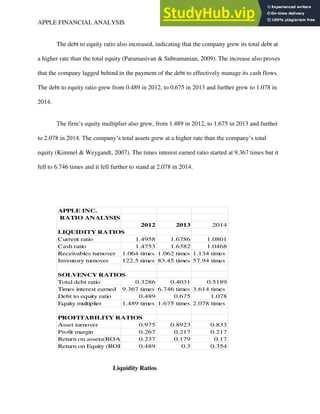
The company’s indebtedness grew from 0.3286 in 2012 to 0.4031 in 2013 and further to 0.5189
in 2014. The total assets grew at a lesser rate than the total debts, thus increasing Apple’s
indebtedness for the three years.
APPLE FINANCIAL ANALYSIS 3
The debt to equity ratio also increased, indicating that the company grew its total debt at
a higher rate than the total equity (Paramasivan & Subramanian, 2009). The increase also proves
that the company lagged behind in the payment of the debt to effectively manage its cash flows.
The debt to equity ratio grew from 0.489 in 2012, to 0.675 in 2013 and further grew to 1.078 in
2014.
The firm’s equity multiplier also grew, from 1.489 in 2012, to 1.675 in 2013 and further
to 2.078 in 2014. The company’s total assets grew at a higher rate than the company’s total
equity (Kimmel & Weygandt, 2007). The times interest earned ratio started at 9.367 times but it
fell to 6.746 times and it fell further to stand at 2.078 in 2014.
APPLE INC.
RATIO ANALYSIS
2012 2013 2014
LIQUIDITY RATIOS
Current ratio 1.4958 1.6786 1.0801
Cash ratio 1.4753 1.6382 1.0468
Receivables turnover 1.064 times 1.062 times 1.134 times
Inventory turnover 122.5 times 83.45 times 57.94 times
SOLVENCY RATIOS
Total debt ratio 0.3286 0.4031 0.5189
Times interest earned 9.367 times 6.746 times 3.614 times
Debt to equity ratio 0.489 0.675 1.078
Equity multiplier 1.489 times 1.675 times 2.078 times
PROFITABILITY RATIOS
Asset turnover 0.975 0.8923 0.833
Profit margin 0.267 0.217 0.217
Return on assets(ROA) 0.237 0.179 0.17
Return on Equity (ROE 0.489 0.3 0.354
Liquidity Ratios
APPLE FINANCIAL ANALYSIS 4
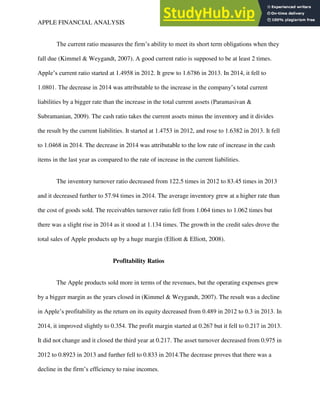
The current ratio measures the firm’s ability to meet its short term obligations when they
fall due (Kimmel & Weygandt, 2007). A good current ratio is supposed to be at least 2 times.
Apple’s current ratio started at 1.4958 in 2012. It grew to 1.6786 in 2013. In 2014, it fell to
1.0801. The decrease in 2014 was attributable to the increase in the company’s total current
liabilities by a bigger rate than the increase in the total current assets (Paramasivan &
Subramanian, 2009). The cash ratio takes the current assets minus the inventory and it divides
the result by the current liabilities. It started at 1.4753 in 2012, and rose to 1.6382 in 2013. It fell
to 1.0468 in 2014. The decrease in 2014 was attributable to the low rate of increase in the cash
items in the last year as compared to the rate of increase in the current liabilities.
The inventory turnover ratio decreased from 122.5 times in 2012 to 83.45 times in 2013
and it decreased further to 57.94 times in 2014. The average inventory grew at a higher rate than
the cost of goods sold. The receivables turnover ratio fell from 1.064 times to 1.062 times but
there was a slight rise in 2014 as it stood at 1.134 times. The growth in the credit sales drove the
total sales of Apple products up by a huge margin (Elliott & Elliott, 2008).
Profitability Ratios
The Apple products sold more in terms of the revenues, but the operating expenses grew
by a bigger margin as the years closed in (Kimmel & Weygandt, 2007). The result was a decline
in Apple’s profitability as the return on its equity decreased from 0.489 in 2012 to 0.3 in 2013. In
2014, it improved slightly to 0.354. The profit margin started at 0.267 but it fell to 0.217 in 2013.
It did not change and it closed the third year at 0.217. The asset turnover decreased from 0.975 in
2012 to 0.8923 in 2013 and further fell to 0.833 in 2014.The decrease proves that there was a
decline in the firm’s efficiency to raise incomes.
APPLE FINANCIAL ANALYSIS 5
APPLE’S STATEMENT OF COMPREHENSIVE INCOME
Horizontal Analysis
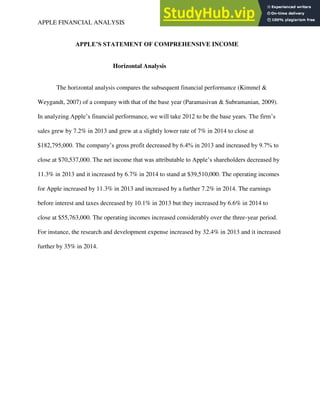
The horizontal analysis compares the subsequent financial performance (Kimmel &
Weygandt, 2007) of a company with that of the base year (Paramasivan & Subramanian, 2009).
In analyzing Apple’s financial performance, we will take 2012 to be the base years. The firm’s
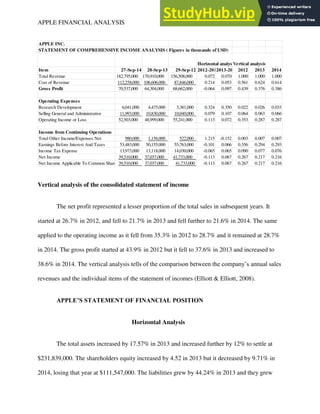
sales grew by 7.2% in 2013 and grew at a slightly lower rate of 7% in 2014 to close at
$182,795,000. The company’s gross profit decreased by 6.4% in 2013 and increased by 9.7% to
close at $70,537,000. The net income that was attributable to Apple’s shareholders decreased by
11.3% in 2013 and it increased by 6.7% in 2014 to stand at $39,510,000. The operating incomes
for Apple increased by 11.3% in 2013 and increased by a further 7.2% in 2014. The earnings
before interest and taxes decreased by 10.1% in 2013 but they increased by 6.6% in 2014 to
close at $55,763,000. The operating incomes increased considerably over the three-year period.
For instance, the research and development expense increased by 32.4% in 2013 and it increased
further by 35% in 2014.
APPLE FINANCIAL ANALYSIS 6
APPLE INC.
STATEMENT OF COMPREHENSIVE INCOME ANALYSIS ( Figures in thousands of USD)
Horizontal analysiVertical analysis
Item 27-Sep-14 28-Sep-13 29-Sep-12 2012-2012013-201 2012 2013 2014
Total Revenue 182,795,000 170,910,000 156,508,000 0.072 0.070 1.000 1.000 1.000
Cost of Revenue 112,258,000 106,606,000 87,846,000 0.214 0.053 0.561 0.624 0.614
Gross Profit 70,537,000 64,304,000 68,662,000 -0.064 0.097 0.439 0.376 0.386
Operating Expenses
Research Development 6,041,000 4,475,000 3,381,000 0.324 0.350 0.022 0.026 0.033
Selling General and Administrative 11,993,000 10,830,000 10,040,000 0.079 0.107 0.064 0.063 0.066
Operating Income or Loss 52,503,000 48,999,000 55,241,000 0.113 0.072 0.353 0.287 0.287
Income from Continuing Operations
Total Other Income/Expenses Net 980,000 1,156,000 522,000 1.215 -0.152 0.003 0.007 0.007
Earnings Before Interest And Taxes 53,483,000 50,155,000 55,763,000 -0.101 0.066 0.356 0.294 0.293
Income Tax Expense 13,973,000 13,118,000 14,030,000 -0.065 0.065 0.090 0.077 0.076
Net Income 39,510,000 37,037,000 41,733,000 -0.113 0.067 0.267 0.217 0.216
Net Income Applicable To Common Share 39,510,000 37,037,000 41,733,000 -0.113 0.067 0.267 0.217 0.216
Vertical analysis of the consolidated statement of income
The net profit represented a lesser proportion of the total sales in subsequent years. It
started at 26.7% in 2012, and fell to 21.7% in 2013 and fell further to 21.6% in 2014. The same
applied to the operating income as it fell from 35.3% in 2012 to 28.7% and it remained at 28.7%
in 2014. The gross profit started at 43.9% in 2012 but it fell to 37.6% in 2013 and increased to
38.6% in 2014. The vertical analysis tells of the comparison between the company’s annual sales
revenues and the individual items of the statement of incomes (Elliott & Elliott, 2008).
APPLE’S STATEMENT OF FINANCIAL POSITION
Horizontal Analysis
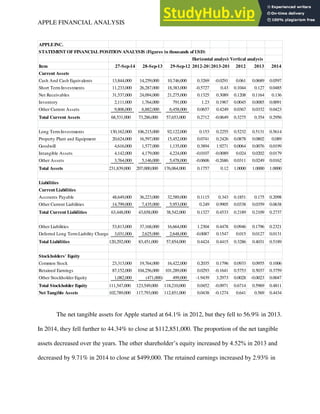
The total assets increased by 17.57% in 2013 and increased further by 12% to settle at
$231,839,000. The shareholders equity increased by 4.52 in 2013 but it decreased by 9.71% in
2014, losing that year at $111,547,000. The liabilities grew by 44.24% in 2013 and they grew
APPLE FINANCIAL ANALYSIS 7
further by 44.15% in 2014, losing that year at $120,292,000. The current liabilities closed at
$63,448,000, having risen by 13.27% in 2013 and risen further by 45.33% in 2014. The
horizontal analysis for the company tells of the comparison between the current year’s financial
performance and the previous year’s financial performance (Elliott & Elliott, 2008).
Vertical Analysis
The vertical analysis takes the total assets as the base figure for the analysis and it equates
all other items of the balance sheet to the total assets to find their proportion, which is
represented as a percentage of the total assets (Kimmel & Weygandt, 2007). The current
liabilities represented an all-time high proportion of the current assets in 2014, at 27.37%
compared to 21.09% in 2013 and 21.89% in 2012. The total shareholders’ equity decreased in
proportion from 67.14% in 2012 to 59.69% in 2013 and 48.11% in 2014. The current assets
represented the highest proportion in 2013 at 35.4% as compared to 29.56% in 2014 and 32.75%
in 2012. The cash represented 6.1% of the total assets in 2012 and the proportion increased to
6.89% in 2013 but fell to 5.97% in 2014.
APPLE FINANCIAL ANALYSIS 8
APPLEINC.
STATEMENT OF FINANCIAL POSITION ANALYSIS (Figures in thousands of USD)
Horizontal analysisVertical analysis
Item 27-Sep-14 28-Sep-13 29-Sep-12 2012-2012013-201 2012 2013 2014
Current Assets
Cash And Cash Equivalents 13,844,000 14,259,000 10,746,000 0.3269 -0.0291 0.061 0.0689 0.0597
Short TermInvestments 11,233,000 26,287,000 18,383,000 -0.5727 0.43 0.1044 0.127 0.0485
Net Receivables 31,537,000 24,094,000 21,275,000 0.1325 0.3089 0.1208 0.1164 0.136
Inventory 2,111,000 1,764,000 791,000 1.23 0.1967 0.0045 0.0085 0.0091
Other Current Assets 9,806,000 6,882,000 6,458,000 0.0657 0.4249 0.0367 0.0332 0.0423
Total Current Assets 68,531,000 73,286,000 57,653,000 0.2712 -0.0649 0.3275 0.354 0.2956
Long TermInvestments 130,162,000 106,215,000 92,122,000 0.153 0.2255 0.5232 0.5131 0.5614
Property Plant and Equipment 20,624,000 16,597,000 15,452,000 0.0741 0.2426 0.0878 0.0802 0.089
Goodwill 4,616,000 1,577,000 1,135,000 0.3894 1.9271 0.0064 0.0076 0.0199
Intangible Assets 4,142,000 4,179,000 4,224,000 -0.0107 -0.0089 0.024 0.0202 0.0179
Other Assets 3,764,000 5,146,000 5,478,000 -0.0606 -0.2686 0.0311 0.0249 0.0162
Total Assets 231,839,000 207,000,000 176,064,000 0.1757 0.12 1.0000 1.0000 1.0000
Liabilities
Current Liabilities
Accounts Payable 48,649,000 36,223,000 32,589,000 0.1115 0.343 0.1851 0.175 0.2098
Other Current Liabilities 14,799,000 7,435,000 5,953,000 0.249 0.9905 0.0338 0.0359 0.0638
Total Current Liabilities 63,448,000 43,658,000 38,542,000 0.1327 0.4533 0.2189 0.2109 0.2737
Other Liabilities 53,813,000 37,168,000 16,664,000 1.2304 0.4478 0.0946 0.1796 0.2321
Deferred Long TermLiability Charges 3,031,000 2,625,000 2,648,000 -0.0087 0.1547 0.015 0.0127 0.0131
Total Liabilities 120,292,000 83,451,000 57,854,000 0.4424 0.4415 0.3286 0.4031 0.5189
Stockholders' Equity
Common Stock 23,313,000 19,764,000 16,422,000 0.2035 0.1796 0.0933 0.0955 0.1006
Retained Earnings 87,152,000 104,256,000 101,289,000 0.0293 -0.1641 0.5753 0.5037 0.3759
Other Stockholder Equity 1,082,000 (471,000) 499,000 -1.9439 3.2973 0.0028 -0.0023 0.0047
Total Stockholder Equity 111,547,000 123,549,000 118,210,000 0.0452 -0.0971 0.6714 0.5969 0.4811
Net Tangible Assets 102,789,000 117,793,000 112,851,000 0.0438 -0.1274 0.641 0.569 0.4434
The net tangible assets for Apple started at 64.1% in 2012, but they fell to 56.9% in 2013.
In 2014, they fell further to 44.34% to close at $112,851,000. The proportion of the net tangible
assets decreased over the years. The other shareholder’s equity increased by 4.52% in 2013 and
decreased by 9.71% in 2014 to close at $499,000. The retained earnings increased by 2.93% in
APPLE FINANCIAL ANALYSIS 9
2013 but they decreased by 16.41% to close at $101,289,000. A decline in the financial strength
of Apple is proven through the decline in its statement of financial position items.
STATEMENT OF CASH FLOWS ANALYSIS
APPLE INC.
STATEMENT OF CASH FLOWS( Figures in thousands of USD)
Horizontal analysis
Item 27-Sep-14 28-Sep-13 29-Sep-12 2012-2013 2013-2014
Net Income 39,510,000 37,037,000 41,733,000 -0.1125 0.0668
Cash Flows from Operating Activities
Depreciation 7,946,000 6,757,000 3,277,000 1.0619 0.176
Adjustments To Net Income 5,210,000 3,394,000 6,145,000 -0.4477 0.5351
Changes In Accounts Receivables -6,452,000 -1,949,000 -6,965,000 -0.7202 2
Changes In Liabilities 13,408,000 8,320,000 9,843,000 -0.1547 0.6115
Changes In Inventories -76,000 -973,000 -15,000 63.8667 -0.9219
Changes In Other Operating Activities 167,000 1,080,000 -3,162,000 1.3416 -0.8454
Total Cash Flow From Operating Activitie 59,713,000 53,666,000 50,856,000 0.0553 0.1127
Cash Flows from Investing Activities
Capital Expenditures -9,571,000 -8,165,000 -8,295,000 -0.0157 0.1722
Investments -9,017,000 -24,042,000 -38,427,000 -0.3743 -0.6249
Other Cash flows from Investing Activities -3,991,000 -1,567,000 -1,505,000 0.0412 1.5470
Total Cash Flows From Investing Activities -22,579,000 -33,774,000 -48,227,000 -0.2997 -0.3315
Cash Flows from Financing Activities
Dividends Paid -11,126,000 -10,564,000 -2,488,000 3.2460 0.0532
Sale Purchase of Stock -44,270,000 -22,330,000 665,000 -32.5789 0.9825
Net Borrowings & financing activities 17,108,000 15,814,000 -1,226,000 13.8989 0.0818
Total Cash Flows From Financing Activiti -37,549,000 -16,379,000 -1,698,000 8.6461 1.2925
Change In Cash and Cash Equivalents -415,000 3,513,000 931,000 2.7734 -1.1181
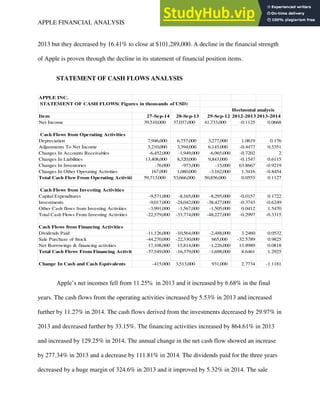
Apple’s net incomes fell from 11.25% in 2013 and it increased by 6.68% in the final
years. The cash flows from the operating activities increased by 5.53% in 2013 and increased
further by 11.27% in 2014. The cash flows derived from the investments decreased by 29.97% in
2013 and decreased further by 33.15%. The financing activities increased by 864.61% in 2013
and increased by 129.25% in 2014. The annual change in the net cash flow showed an increase
by 277.34% in 2013 and a decrease by 111.81% in 2014. The dividends paid for the three years
decreased by a huge margin of 324.6% in 2013 and it improved by 5.32% in 2014. The sale
APPLE FINANCIAL ANALYSIS 10
purchase of the share decreased by 3257.89% in 2013 and it increased by 98.25% in 2014. The
changes in the liabilities decreased by 15.47% in 2013, and increased by 61.15% in 2014. The
investment cash flows decreased by 37.43% in 2013 and decreased further by 62.49%. The
financing activities show how the company has been applying its finances to increase its
investments (Elliott & Elliott, 2008).
Sales Forecast for Apple Inc.
The horizontal analysis shows that Apple’s sales increased by 7.2% in the first period,
and by 7% in the second period. An average of the two is 7.1%, which would be applied in
forecasting the increase in sales for the next years. In 2015, we would forecast that the sales
revenues would grow from $182,795,000 to $195,773,445. Based on the sales forecast growth of
7.1%, we could as well forecast the sales revenues for 2016 by multiplying the sales revenues of
2015 by 1.071, to get $209,673,360.
Stock Price Analysis
Apple’s share prices have been rising and falling depending on the market forces of demand and
supply as well as the investor perception. In times where the company’s management goes to the
media to announce the launch of a new product, the share prices increase. In times when the
company shares negative information, its share prices dwindle significantly. One such scenario
was the announcement by former chief executive officer regarding his resignation and the
subsequent appointment of his successor, Mr. Tim Cook. The stock markets did not receive this
news with the compassion that it deserved considering the health status of the outgoing chief
executive. Most investors shied off the shares amid dwindling investor perception that the
APPLE FINANCIAL ANALYSIS 11
company would fall as it did when the former chief executive went off the board for being fired
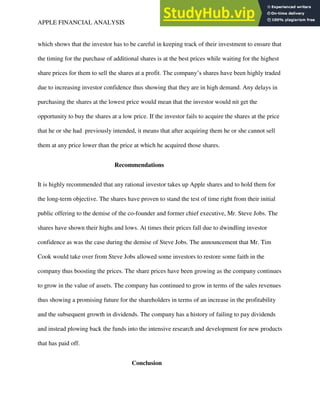
some years earlier. The diagram below shows the recent share price trends for the company;
Date Open High Low Close Volume Adj Close
2/1/2017 127.03 137.48 127.01 136.99 31,400,800 136.990005
1/3/2017 115.8 122.44 114.76 121.35 30,607,400 120.826149
12/1/2016 110.37 118.02 108.25 115.82 30,445,600 115.320023
11/1/2016 113.46 113.77 104.08 110.52 36,072,200 110.0429
10/3/2016 112.71 118.69 112.28 113.54 33,968,200 112.472404
9/1/2016 106.14 116.18 102.53 113.05 47,828,300 111.987015
8/1/2016 104.41 110.23 104 106.1 28,686,500 105.102364
7/1/2016 95.49 104.55 94.37 104.21 35,675,600 102.673927
6/1/2016 99.02 101.89 91.5 95.6 37,040,500 94.190842
5/2/2016 93.97 100.73 89.47 99.86 44,886,900 98.388046
4/1/2016 108.78 112.39 92.51 93.74 44,806,000 91.799339
3/1/2016 97.65 110.42 97.42 108.99 35,088,000 106.73362
The company has had the highest closing price at $136.99 in February 2017 and it hit the lowest
closing price at $93.74 in April 2016. The shares traded the most at forty seven million, eight
hundred and twenty eight thousand, three hundred shares in September 2016. The lowest share
price as shown in the figure above was $89.47 which occurred on the second day of May, 2017.
The company moved a total of four hundred and thirty six million, five hundred and six thousand
shares in the last twelve months. The average movement of shares per month for the company
stood at thirty six million, three hundred and seventy five thousand and five hundred. Out of the
twelve months, it is only in three months, namely; April, June and September that the company’s
opening balance fell below the closing share price.
Risk Level of Apple Shares
Apple shares have a low risk for the investor as they do not fluctuate in value as rapidly as other
shares. The figure above shows slight fluctuations of the share prices within twelve months,
APPLE FINANCIAL ANALYSIS 12
which shows that the investor has to be careful in keeping track of their investment to ensure that
the timing for the purchase of additional shares is at the best prices while waiting for the highest
share prices for them to sell the shares at a profit. The company’s shares have been highly traded
due to increasing investor confidence thus showing that they are in high demand. Any delays in
purchasing the shares at the lowest price would mean that the investor would nit get the
opportunity to buy the shares at a low price. If the investor fails to acquire the shares at the price
that he or she had previously intended, it means that after acquiring them he or she cannot sell
them at any price lower than the price at which he acquired those shares.
Recommendations
It is highly recommended that any rational investor takes up Apple shares and to hold them for
the long-term objective. The shares have proven to stand the test of time right from their initial
public offering to the demise of the co-founder and former chief executive, Mr. Steve Jobs. The
shares have shown their highs and lows. At times their prices fall due to dwindling investor
confidence as was the case during the demise of Steve Jobs. The announcement that Mr. Tim
Cook would take over from Steve Jobs allowed some investors to restore some faith in the
company thus boosting the prices. The share prices have been growing as the company continues
to grow in the value of assets. The company has continued to grow in terms of the sales revenues
thus showing a promising future for the shareholders in terms of an increase in the profitability
and the subsequent growth in dividends. The company has a history of failing to pay dividends
and instead plowing back the funds into the intensive research and development for new products
that has paid off.
Conclusion
APPLE FINANCIAL ANALYSIS 13
The company showed a weak solvency and a decline in its financial strength as well as in its
profitability (Kimmel & Weygandt, 2007). The profitability decreased considerably over the
three years as the liquidity took a dip but it improved slightly towards the end of the three year
period. The financial managers of the company have to manipulate the company’s finances to its
advantage to prevent it from getting into financial difficulties or insolvency (Paramasivan &
Subramanian, 2009). They have to ensure that the company meets its financial obligations when
they fall due. The investors are mostly interested with the profitability of the company. They
have to ensure that the company meets its financial obligations by raising the required incomes
(Elliott & Elliott, 2008). They are also interested with the future growth of Apple. Increased
profitability is a good sign for them as it builds their confidence in the company.
References
AAPL Balance Sheet | Apple Inc. Stock - Yahoo! Finance. (n.d.). Retrieved March 01, 2017,
from https://finance.yahoo.com/q/bs?s=AAPL Balance Sheet
AAPL Cash Flow | Apple Inc. Stock - Yahoo! Finance. (n.d.). Retrieved March 01, 2017, from
https://finance.yahoo.com/q/cf?s=AAPL Cash Flow
AAPL Income Statement | Apple Inc. Stock - Yahoo! Finance. (n.d.). Retrieved March 01, 2017,
from https://finance.yahoo.com/q/is?s=AAPL Income Statement
Apple Inc. (AAPL) | P/E since 2005. (n.d.). Retrieved March 01, 2017, from https://www.stock-
analysis-on.net/NASDAQ/Company/Apple-Inc/Long-Term-Trends/P-E
Apple inc (AAPL) Snapshot. (n.d.). Retrieved March 01, 2017, from
https://stocktradeprices.com/AAPL
Elliott, B., & Elliott, J. (2008). Financial accounting and reporting (12th ed.). Harlow: Financial
APPLE FINANCIAL ANALYSIS 14
Times Prentice Hall.
Hoggett, J. (2012). Accounting (8th edition.). Milton, Qld.: John Wiley and Sons Australia.
Kimmel, P., & Weygandt, J. (2007). Financial accounting: Tools for business decision making
(4th edition.). Hoboken, NJ: John Wiley.
Paramasivan, C., & Subramanian, T. (2009). Financial management. New Delhi: New Age
International (P).
Stittle, J., & Wearing, B. (2008). Financial accounting. Los Angeles: SAGE Publications.

APPLE FINANCIAL ANALYSIS

  • 1.
    Running head: APPLEFINANCIAL ANALYSIS 0 0 APPLE FINANCIAL ANALYSIS Name of Student Institution affiliation
  • 2.
    APPLE FINANCIAL ANALYSIS1 Executive Summary Apple Inc. has been at the forefront of the technology sector for a long time. The company has been at its best for a couple of years though it almost took a nosedive after it suspended one of its founding members. The company has dedicated millions of dollars to research and development, and this has been one of its key drivers (Apple Inc., 2016). It is the World’s leading technology company by revenues, and it is also the World’s second largest mobile phone manufacturer after Samsung. The company rakes in billions of dollars in annual sales revenues. Its origin is the United States but it is listed on the New York Securities Exchange and the London Securities Exchange. This paper looks at the comparative financial performance of Apple Inc. over three years and also the performance of Apple stocks in recent times. Apple stocks are good for the investor as their value keeps on rising owing to investor confidence in the company. The company has invested heavily in the research and development of new products and services which has allowed Apple to stay ahead of its competitors. The company is currently engaged in a cut-throat competition though it has cut a niche for its products whereby it sells them at a premium. The rationale behind choosing Apple is that it is a normal company that shows exemplary leadership in the products that it develops. The company has continued to develop superior products that have seen it increase its Apple’s Financial Analysis Financial analysis is crucial for decision makers. It helps them to make an informed decision based on the outcome of the evaluation (Paramasivan & Subramanian, 2009). Apple has remained profitable for the better part of its history. In fact, at the early years of its inception, the company amassed significant wealth for its shareholders, thereby gaining a lot of investor confidence. It is this confidence in the company’s financial performance that has seen the
  • 3.
    APPLE FINANCIAL ANALYSIS2 company’s financials growing exponentially. The financial analysis is a good deed for the potential investors as it communicates the future of the company. It allows the investors to evaluate the going concern of the company with respect to the financial performance of the company (Elliott & Elliott, 2008). A recent evaluation of the recent years is necessary to give the right picture of the company’s financial performance. In this assignment, the financial years running from 2012 to 2014 were used to show the company’s financial performance. The financial analysis includes the ratio analysis, the horizontal analysis and the vertical analysis of the financial statements (Kimmel & Weygandt, 2007). The three most crucial financial statements are the statement of financial incomes, the statement of comprehensive incomes and the statement of cash flows. RATIO ANALYSIS Solvency Ratios These ratios show the level of leverage that the company has on its financial statements. They include the times interest earned ratio, the equity multiplier, the total debt ratio, the debt to equity ratio and the cash coverage ratio. These ratios measure the firm’s indebtedness (Kimmel & Weygandt, 2007). For instance, the total debt ratio measures the proportion of debts to assets by dividing the two. The total debts are the numerator, and the total assets are the denominator. The company’s indebtedness grew from 0.3286 in 2012 to 0.4031 in 2013 and further to 0.5189 in 2014. The total assets grew at a lesser rate than the total debts, thus increasing Apple’s indebtedness for the three years.
  • 4.
    APPLE FINANCIAL ANALYSIS3 The debt to equity ratio also increased, indicating that the company grew its total debt at a higher rate than the total equity (Paramasivan & Subramanian, 2009). The increase also proves that the company lagged behind in the payment of the debt to effectively manage its cash flows. The debt to equity ratio grew from 0.489 in 2012, to 0.675 in 2013 and further grew to 1.078 in 2014. The firm’s equity multiplier also grew, from 1.489 in 2012, to 1.675 in 2013 and further to 2.078 in 2014. The company’s total assets grew at a higher rate than the company’s total equity (Kimmel & Weygandt, 2007). The times interest earned ratio started at 9.367 times but it fell to 6.746 times and it fell further to stand at 2.078 in 2014. APPLE INC. RATIO ANALYSIS 2012 2013 2014 LIQUIDITY RATIOS Current ratio 1.4958 1.6786 1.0801 Cash ratio 1.4753 1.6382 1.0468 Receivables turnover 1.064 times 1.062 times 1.134 times Inventory turnover 122.5 times 83.45 times 57.94 times SOLVENCY RATIOS Total debt ratio 0.3286 0.4031 0.5189 Times interest earned 9.367 times 6.746 times 3.614 times Debt to equity ratio 0.489 0.675 1.078 Equity multiplier 1.489 times 1.675 times 2.078 times PROFITABILITY RATIOS Asset turnover 0.975 0.8923 0.833 Profit margin 0.267 0.217 0.217 Return on assets(ROA) 0.237 0.179 0.17 Return on Equity (ROE 0.489 0.3 0.354 Liquidity Ratios
  • 5.
    APPLE FINANCIAL ANALYSIS4 The current ratio measures the firm’s ability to meet its short term obligations when they fall due (Kimmel & Weygandt, 2007). A good current ratio is supposed to be at least 2 times. Apple’s current ratio started at 1.4958 in 2012. It grew to 1.6786 in 2013. In 2014, it fell to 1.0801. The decrease in 2014 was attributable to the increase in the company’s total current liabilities by a bigger rate than the increase in the total current assets (Paramasivan & Subramanian, 2009). The cash ratio takes the current assets minus the inventory and it divides the result by the current liabilities. It started at 1.4753 in 2012, and rose to 1.6382 in 2013. It fell to 1.0468 in 2014. The decrease in 2014 was attributable to the low rate of increase in the cash items in the last year as compared to the rate of increase in the current liabilities. The inventory turnover ratio decreased from 122.5 times in 2012 to 83.45 times in 2013 and it decreased further to 57.94 times in 2014. The average inventory grew at a higher rate than the cost of goods sold. The receivables turnover ratio fell from 1.064 times to 1.062 times but there was a slight rise in 2014 as it stood at 1.134 times. The growth in the credit sales drove the total sales of Apple products up by a huge margin (Elliott & Elliott, 2008). Profitability Ratios The Apple products sold more in terms of the revenues, but the operating expenses grew by a bigger margin as the years closed in (Kimmel & Weygandt, 2007). The result was a decline in Apple’s profitability as the return on its equity decreased from 0.489 in 2012 to 0.3 in 2013. In 2014, it improved slightly to 0.354. The profit margin started at 0.267 but it fell to 0.217 in 2013. It did not change and it closed the third year at 0.217. The asset turnover decreased from 0.975 in 2012 to 0.8923 in 2013 and further fell to 0.833 in 2014.The decrease proves that there was a decline in the firm’s efficiency to raise incomes.
  • 6.
    APPLE FINANCIAL ANALYSIS5 APPLE’S STATEMENT OF COMPREHENSIVE INCOME Horizontal Analysis The horizontal analysis compares the subsequent financial performance (Kimmel & Weygandt, 2007) of a company with that of the base year (Paramasivan & Subramanian, 2009). In analyzing Apple’s financial performance, we will take 2012 to be the base years. The firm’s sales grew by 7.2% in 2013 and grew at a slightly lower rate of 7% in 2014 to close at $182,795,000. The company’s gross profit decreased by 6.4% in 2013 and increased by 9.7% to close at $70,537,000. The net income that was attributable to Apple’s shareholders decreased by 11.3% in 2013 and it increased by 6.7% in 2014 to stand at $39,510,000. The operating incomes for Apple increased by 11.3% in 2013 and increased by a further 7.2% in 2014. The earnings before interest and taxes decreased by 10.1% in 2013 but they increased by 6.6% in 2014 to close at $55,763,000. The operating incomes increased considerably over the three-year period. For instance, the research and development expense increased by 32.4% in 2013 and it increased further by 35% in 2014.
  • 7.
    APPLE FINANCIAL ANALYSIS6 APPLE INC. STATEMENT OF COMPREHENSIVE INCOME ANALYSIS ( Figures in thousands of USD) Horizontal analysiVertical analysis Item 27-Sep-14 28-Sep-13 29-Sep-12 2012-2012013-201 2012 2013 2014 Total Revenue 182,795,000 170,910,000 156,508,000 0.072 0.070 1.000 1.000 1.000 Cost of Revenue 112,258,000 106,606,000 87,846,000 0.214 0.053 0.561 0.624 0.614 Gross Profit 70,537,000 64,304,000 68,662,000 -0.064 0.097 0.439 0.376 0.386 Operating Expenses Research Development 6,041,000 4,475,000 3,381,000 0.324 0.350 0.022 0.026 0.033 Selling General and Administrative 11,993,000 10,830,000 10,040,000 0.079 0.107 0.064 0.063 0.066 Operating Income or Loss 52,503,000 48,999,000 55,241,000 0.113 0.072 0.353 0.287 0.287 Income from Continuing Operations Total Other Income/Expenses Net 980,000 1,156,000 522,000 1.215 -0.152 0.003 0.007 0.007 Earnings Before Interest And Taxes 53,483,000 50,155,000 55,763,000 -0.101 0.066 0.356 0.294 0.293 Income Tax Expense 13,973,000 13,118,000 14,030,000 -0.065 0.065 0.090 0.077 0.076 Net Income 39,510,000 37,037,000 41,733,000 -0.113 0.067 0.267 0.217 0.216 Net Income Applicable To Common Share 39,510,000 37,037,000 41,733,000 -0.113 0.067 0.267 0.217 0.216 Vertical analysis of the consolidated statement of income The net profit represented a lesser proportion of the total sales in subsequent years. It started at 26.7% in 2012, and fell to 21.7% in 2013 and fell further to 21.6% in 2014. The same applied to the operating income as it fell from 35.3% in 2012 to 28.7% and it remained at 28.7% in 2014. The gross profit started at 43.9% in 2012 but it fell to 37.6% in 2013 and increased to 38.6% in 2014. The vertical analysis tells of the comparison between the company’s annual sales revenues and the individual items of the statement of incomes (Elliott & Elliott, 2008). APPLE’S STATEMENT OF FINANCIAL POSITION Horizontal Analysis The total assets increased by 17.57% in 2013 and increased further by 12% to settle at $231,839,000. The shareholders equity increased by 4.52 in 2013 but it decreased by 9.71% in 2014, losing that year at $111,547,000. The liabilities grew by 44.24% in 2013 and they grew
  • 8.
    APPLE FINANCIAL ANALYSIS7 further by 44.15% in 2014, losing that year at $120,292,000. The current liabilities closed at $63,448,000, having risen by 13.27% in 2013 and risen further by 45.33% in 2014. The horizontal analysis for the company tells of the comparison between the current year’s financial performance and the previous year’s financial performance (Elliott & Elliott, 2008). Vertical Analysis The vertical analysis takes the total assets as the base figure for the analysis and it equates all other items of the balance sheet to the total assets to find their proportion, which is represented as a percentage of the total assets (Kimmel & Weygandt, 2007). The current liabilities represented an all-time high proportion of the current assets in 2014, at 27.37% compared to 21.09% in 2013 and 21.89% in 2012. The total shareholders’ equity decreased in proportion from 67.14% in 2012 to 59.69% in 2013 and 48.11% in 2014. The current assets represented the highest proportion in 2013 at 35.4% as compared to 29.56% in 2014 and 32.75% in 2012. The cash represented 6.1% of the total assets in 2012 and the proportion increased to 6.89% in 2013 but fell to 5.97% in 2014.
  • 9.
    APPLE FINANCIAL ANALYSIS8 APPLEINC. STATEMENT OF FINANCIAL POSITION ANALYSIS (Figures in thousands of USD) Horizontal analysisVertical analysis Item 27-Sep-14 28-Sep-13 29-Sep-12 2012-2012013-201 2012 2013 2014 Current Assets Cash And Cash Equivalents 13,844,000 14,259,000 10,746,000 0.3269 -0.0291 0.061 0.0689 0.0597 Short TermInvestments 11,233,000 26,287,000 18,383,000 -0.5727 0.43 0.1044 0.127 0.0485 Net Receivables 31,537,000 24,094,000 21,275,000 0.1325 0.3089 0.1208 0.1164 0.136 Inventory 2,111,000 1,764,000 791,000 1.23 0.1967 0.0045 0.0085 0.0091 Other Current Assets 9,806,000 6,882,000 6,458,000 0.0657 0.4249 0.0367 0.0332 0.0423 Total Current Assets 68,531,000 73,286,000 57,653,000 0.2712 -0.0649 0.3275 0.354 0.2956 Long TermInvestments 130,162,000 106,215,000 92,122,000 0.153 0.2255 0.5232 0.5131 0.5614 Property Plant and Equipment 20,624,000 16,597,000 15,452,000 0.0741 0.2426 0.0878 0.0802 0.089 Goodwill 4,616,000 1,577,000 1,135,000 0.3894 1.9271 0.0064 0.0076 0.0199 Intangible Assets 4,142,000 4,179,000 4,224,000 -0.0107 -0.0089 0.024 0.0202 0.0179 Other Assets 3,764,000 5,146,000 5,478,000 -0.0606 -0.2686 0.0311 0.0249 0.0162 Total Assets 231,839,000 207,000,000 176,064,000 0.1757 0.12 1.0000 1.0000 1.0000 Liabilities Current Liabilities Accounts Payable 48,649,000 36,223,000 32,589,000 0.1115 0.343 0.1851 0.175 0.2098 Other Current Liabilities 14,799,000 7,435,000 5,953,000 0.249 0.9905 0.0338 0.0359 0.0638 Total Current Liabilities 63,448,000 43,658,000 38,542,000 0.1327 0.4533 0.2189 0.2109 0.2737 Other Liabilities 53,813,000 37,168,000 16,664,000 1.2304 0.4478 0.0946 0.1796 0.2321 Deferred Long TermLiability Charges 3,031,000 2,625,000 2,648,000 -0.0087 0.1547 0.015 0.0127 0.0131 Total Liabilities 120,292,000 83,451,000 57,854,000 0.4424 0.4415 0.3286 0.4031 0.5189 Stockholders' Equity Common Stock 23,313,000 19,764,000 16,422,000 0.2035 0.1796 0.0933 0.0955 0.1006 Retained Earnings 87,152,000 104,256,000 101,289,000 0.0293 -0.1641 0.5753 0.5037 0.3759 Other Stockholder Equity 1,082,000 (471,000) 499,000 -1.9439 3.2973 0.0028 -0.0023 0.0047 Total Stockholder Equity 111,547,000 123,549,000 118,210,000 0.0452 -0.0971 0.6714 0.5969 0.4811 Net Tangible Assets 102,789,000 117,793,000 112,851,000 0.0438 -0.1274 0.641 0.569 0.4434 The net tangible assets for Apple started at 64.1% in 2012, but they fell to 56.9% in 2013. In 2014, they fell further to 44.34% to close at $112,851,000. The proportion of the net tangible assets decreased over the years. The other shareholder’s equity increased by 4.52% in 2013 and decreased by 9.71% in 2014 to close at $499,000. The retained earnings increased by 2.93% in
  • 10.
    APPLE FINANCIAL ANALYSIS9 2013 but they decreased by 16.41% to close at $101,289,000. A decline in the financial strength of Apple is proven through the decline in its statement of financial position items. STATEMENT OF CASH FLOWS ANALYSIS APPLE INC. STATEMENT OF CASH FLOWS( Figures in thousands of USD) Horizontal analysis Item 27-Sep-14 28-Sep-13 29-Sep-12 2012-2013 2013-2014 Net Income 39,510,000 37,037,000 41,733,000 -0.1125 0.0668 Cash Flows from Operating Activities Depreciation 7,946,000 6,757,000 3,277,000 1.0619 0.176 Adjustments To Net Income 5,210,000 3,394,000 6,145,000 -0.4477 0.5351 Changes In Accounts Receivables -6,452,000 -1,949,000 -6,965,000 -0.7202 2 Changes In Liabilities 13,408,000 8,320,000 9,843,000 -0.1547 0.6115 Changes In Inventories -76,000 -973,000 -15,000 63.8667 -0.9219 Changes In Other Operating Activities 167,000 1,080,000 -3,162,000 1.3416 -0.8454 Total Cash Flow From Operating Activitie 59,713,000 53,666,000 50,856,000 0.0553 0.1127 Cash Flows from Investing Activities Capital Expenditures -9,571,000 -8,165,000 -8,295,000 -0.0157 0.1722 Investments -9,017,000 -24,042,000 -38,427,000 -0.3743 -0.6249 Other Cash flows from Investing Activities -3,991,000 -1,567,000 -1,505,000 0.0412 1.5470 Total Cash Flows From Investing Activities -22,579,000 -33,774,000 -48,227,000 -0.2997 -0.3315 Cash Flows from Financing Activities Dividends Paid -11,126,000 -10,564,000 -2,488,000 3.2460 0.0532 Sale Purchase of Stock -44,270,000 -22,330,000 665,000 -32.5789 0.9825 Net Borrowings & financing activities 17,108,000 15,814,000 -1,226,000 13.8989 0.0818 Total Cash Flows From Financing Activiti -37,549,000 -16,379,000 -1,698,000 8.6461 1.2925 Change In Cash and Cash Equivalents -415,000 3,513,000 931,000 2.7734 -1.1181 Apple’s net incomes fell from 11.25% in 2013 and it increased by 6.68% in the final years. The cash flows from the operating activities increased by 5.53% in 2013 and increased further by 11.27% in 2014. The cash flows derived from the investments decreased by 29.97% in 2013 and decreased further by 33.15%. The financing activities increased by 864.61% in 2013 and increased by 129.25% in 2014. The annual change in the net cash flow showed an increase by 277.34% in 2013 and a decrease by 111.81% in 2014. The dividends paid for the three years decreased by a huge margin of 324.6% in 2013 and it improved by 5.32% in 2014. The sale
  • 11.
    APPLE FINANCIAL ANALYSIS10 purchase of the share decreased by 3257.89% in 2013 and it increased by 98.25% in 2014. The changes in the liabilities decreased by 15.47% in 2013, and increased by 61.15% in 2014. The investment cash flows decreased by 37.43% in 2013 and decreased further by 62.49%. The financing activities show how the company has been applying its finances to increase its investments (Elliott & Elliott, 2008). Sales Forecast for Apple Inc. The horizontal analysis shows that Apple’s sales increased by 7.2% in the first period, and by 7% in the second period. An average of the two is 7.1%, which would be applied in forecasting the increase in sales for the next years. In 2015, we would forecast that the sales revenues would grow from $182,795,000 to $195,773,445. Based on the sales forecast growth of 7.1%, we could as well forecast the sales revenues for 2016 by multiplying the sales revenues of 2015 by 1.071, to get $209,673,360. Stock Price Analysis Apple’s share prices have been rising and falling depending on the market forces of demand and supply as well as the investor perception. In times where the company’s management goes to the media to announce the launch of a new product, the share prices increase. In times when the company shares negative information, its share prices dwindle significantly. One such scenario was the announcement by former chief executive officer regarding his resignation and the subsequent appointment of his successor, Mr. Tim Cook. The stock markets did not receive this news with the compassion that it deserved considering the health status of the outgoing chief executive. Most investors shied off the shares amid dwindling investor perception that the
  • 12.
    APPLE FINANCIAL ANALYSIS11 company would fall as it did when the former chief executive went off the board for being fired some years earlier. The diagram below shows the recent share price trends for the company; Date Open High Low Close Volume Adj Close 2/1/2017 127.03 137.48 127.01 136.99 31,400,800 136.990005 1/3/2017 115.8 122.44 114.76 121.35 30,607,400 120.826149 12/1/2016 110.37 118.02 108.25 115.82 30,445,600 115.320023 11/1/2016 113.46 113.77 104.08 110.52 36,072,200 110.0429 10/3/2016 112.71 118.69 112.28 113.54 33,968,200 112.472404 9/1/2016 106.14 116.18 102.53 113.05 47,828,300 111.987015 8/1/2016 104.41 110.23 104 106.1 28,686,500 105.102364 7/1/2016 95.49 104.55 94.37 104.21 35,675,600 102.673927 6/1/2016 99.02 101.89 91.5 95.6 37,040,500 94.190842 5/2/2016 93.97 100.73 89.47 99.86 44,886,900 98.388046 4/1/2016 108.78 112.39 92.51 93.74 44,806,000 91.799339 3/1/2016 97.65 110.42 97.42 108.99 35,088,000 106.73362 The company has had the highest closing price at $136.99 in February 2017 and it hit the lowest closing price at $93.74 in April 2016. The shares traded the most at forty seven million, eight hundred and twenty eight thousand, three hundred shares in September 2016. The lowest share price as shown in the figure above was $89.47 which occurred on the second day of May, 2017. The company moved a total of four hundred and thirty six million, five hundred and six thousand shares in the last twelve months. The average movement of shares per month for the company stood at thirty six million, three hundred and seventy five thousand and five hundred. Out of the twelve months, it is only in three months, namely; April, June and September that the company’s opening balance fell below the closing share price. Risk Level of Apple Shares Apple shares have a low risk for the investor as they do not fluctuate in value as rapidly as other shares. The figure above shows slight fluctuations of the share prices within twelve months,
  • 13.
    APPLE FINANCIAL ANALYSIS12 which shows that the investor has to be careful in keeping track of their investment to ensure that the timing for the purchase of additional shares is at the best prices while waiting for the highest share prices for them to sell the shares at a profit. The company’s shares have been highly traded due to increasing investor confidence thus showing that they are in high demand. Any delays in purchasing the shares at the lowest price would mean that the investor would nit get the opportunity to buy the shares at a low price. If the investor fails to acquire the shares at the price that he or she had previously intended, it means that after acquiring them he or she cannot sell them at any price lower than the price at which he acquired those shares. Recommendations It is highly recommended that any rational investor takes up Apple shares and to hold them for the long-term objective. The shares have proven to stand the test of time right from their initial public offering to the demise of the co-founder and former chief executive, Mr. Steve Jobs. The shares have shown their highs and lows. At times their prices fall due to dwindling investor confidence as was the case during the demise of Steve Jobs. The announcement that Mr. Tim Cook would take over from Steve Jobs allowed some investors to restore some faith in the company thus boosting the prices. The share prices have been growing as the company continues to grow in the value of assets. The company has continued to grow in terms of the sales revenues thus showing a promising future for the shareholders in terms of an increase in the profitability and the subsequent growth in dividends. The company has a history of failing to pay dividends and instead plowing back the funds into the intensive research and development for new products that has paid off. Conclusion
  • 14.
    APPLE FINANCIAL ANALYSIS13 The company showed a weak solvency and a decline in its financial strength as well as in its profitability (Kimmel & Weygandt, 2007). The profitability decreased considerably over the three years as the liquidity took a dip but it improved slightly towards the end of the three year period. The financial managers of the company have to manipulate the company’s finances to its advantage to prevent it from getting into financial difficulties or insolvency (Paramasivan & Subramanian, 2009). They have to ensure that the company meets its financial obligations when they fall due. The investors are mostly interested with the profitability of the company. They have to ensure that the company meets its financial obligations by raising the required incomes (Elliott & Elliott, 2008). They are also interested with the future growth of Apple. Increased profitability is a good sign for them as it builds their confidence in the company. References AAPL Balance Sheet | Apple Inc. Stock - Yahoo! Finance. (n.d.). Retrieved March 01, 2017, from https://finance.yahoo.com/q/bs?s=AAPL Balance Sheet AAPL Cash Flow | Apple Inc. Stock - Yahoo! Finance. (n.d.). Retrieved March 01, 2017, from https://finance.yahoo.com/q/cf?s=AAPL Cash Flow AAPL Income Statement | Apple Inc. Stock - Yahoo! Finance. (n.d.). Retrieved March 01, 2017, from https://finance.yahoo.com/q/is?s=AAPL Income Statement Apple Inc. (AAPL) | P/E since 2005. (n.d.). Retrieved March 01, 2017, from https://www.stock- analysis-on.net/NASDAQ/Company/Apple-Inc/Long-Term-Trends/P-E Apple inc (AAPL) Snapshot. (n.d.). Retrieved March 01, 2017, from https://stocktradeprices.com/AAPL Elliott, B., & Elliott, J. (2008). Financial accounting and reporting (12th ed.). Harlow: Financial
  • 15.
    APPLE FINANCIAL ANALYSIS14 Times Prentice Hall. Hoggett, J. (2012). Accounting (8th edition.). Milton, Qld.: John Wiley and Sons Australia. Kimmel, P., & Weygandt, J. (2007). Financial accounting: Tools for business decision making (4th edition.). Hoboken, NJ: John Wiley. Paramasivan, C., & Subramanian, T. (2009). Financial management. New Delhi: New Age International (P). Stittle, J., & Wearing, B. (2008). Financial accounting. Los Angeles: SAGE Publications.