


Presentation On

Appendicitis
Presented To
Dr.Ghazala Shaheen
BEMS, Ph.D(Clinical Therapeutics)
Lecture of Clinical Therapeutics
College of Conventional Medicine
The Islamia University of Bahawalpur
Presented By
Dr.Noshair Adil Ch
BEMS RMP DEMS
Contents
 Appendicitis
 Appendix
 Path physiology

 Causes
 Clinical Features
 Diagnosis

Clinical
Blood and Urine Test
Imaging
 Treatment
o Non Surgical
o Surgical
Appendicitis
 Appendicitis is a condition in which your appendix

becomes inflamed and fills with pus.
 Appendicitis is an inflammation of the appendix
 Appendicitis is common. Typical symptoms
include abdominal pain and vomiting that
gradually get worse over 6-24 hours
What and where is the appendix?
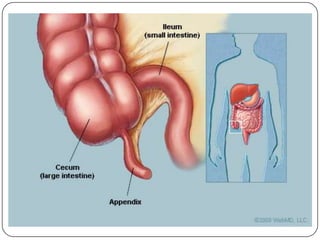
 The appendix is a small dead end pouch, like a

little tube, that comes off the caecum. The
caecum is the first part of the large intestine. Just
before the colon. The small intestine digests and
absorbs food. The parts of the food that are not
digested begin to be formed into faeces (motions)
in the caecum.
 The appendix is normally about 5-10 cm long and
thin. The appendix appears to have no function.
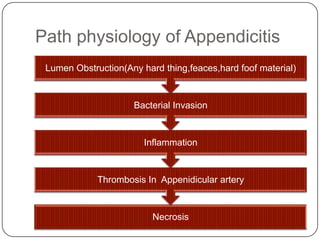
Path physiology of Appendicitis
Lumen Obstruction(Any hard thing,feaces,hard foof material)

Bacterial Invasion

Inflammation

Thrombosis In Appenidicular artery

Necrosis
Causes
The main cause of appendicitis is Obstruction of
Lumen of appendix
Cause of Lumen Blockage
 Any Foreign Material
 Trauma
 Infection
 Intestinal Worm
 Lymphadenitis
 Stool
Clinical Features
 Pain in upper abdomen that becomes sharp as it moves to the lower right

abdomen.
 Loss of appetite
 Nausea and/or Vomiting soon after Abdominal Pain begins
 Abdominal swelling
 Fever of 99-102 degrees Fahrenheit
 Inability to pass gas

Almost half the time, other symptoms of appendicitis appear, including:
 Dull or sharp pain anywhere in the upper or lower abdomen, back, or rectum
 Painful urination
 Vomiting that precedes the abdominal pain
 Severe cramps
 Constipation or Diarrhea with gas
Diagnosis
Clinical
Blood and Urine Test
Imaging
Pathology
Differential diagnosis
Clinical Diagnosis
 Aure-Rozanova sign

Increased pain on palpation with finger in right
Lumbar Triangle
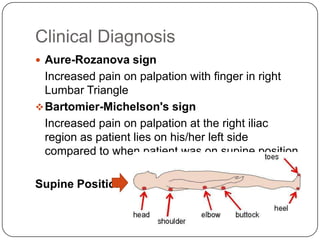
 Bartomier-Michelson's sign
Increased pain on palpation at the right iliac
region as patient lies on his/her left side
compared to when patient was on supine position
Supine Position
Clinical Diagonsis
 Dunphy's sign

Increased pain in the
right upper quadrant with coughing
 Obturator sign
If an inflamed appendix is in contact with the
Obturator Internus spasm of the muscle is called
Obturator sign. It is demonstrated by flexing and
internal rotation of the hip and pain is occur in
Hypogastrium
Clinical Diagnosis
 Sitkovskiy Sign

Increased pain in the right iliac region as patient lies
on his/her left side.
 Psoas sign

If an inflamed appendix is in contact with the
Psoas major spasm of the muscle is called Psoas
Sign. It is demonstrated by flexing and internal
rotation of the right hip and pain is occur in Right
lower quadrent
Blood Test and Urine Test
 Complete Blood Count (CBC) is done to check for

signs of infection. 70-90 percent of people with
appendicitis may have an elevated white blood
cells
 Urine Analysis for Urinary Tract Infection. there is
a possibility of a microscopic Pyuria the condition
of urine containing pus, or Hematuria, urine
containing red blood cells, caused by the
proximity of the appendix to the Ureter and
bladder in acute appendicitis.
Imaging
 X–Ray
 Ultrasound

On USG free fluid collection in the right iliac fossa
is to seen
along with a visible appendix without blood flow
 C.T Scane
Management
 Non Surgical

 Surgical

 Antibiotics

 Pre surgery

 Anti-Inflammatory

 After surgery

 Anti-Emetic

 Appendectomy

 Fluid Replacement

 Laparotomy

Therapy
Non-Surgical
 Antibiotics Plants

 Glycyrrhiza

Jaiphal(Myristica
Fragrens)
Dried Ripe Fruits of
Jaiphal have antibacterial activity
Cap: jaiphal 500mg
1+1+1
Joshanda-e-Istakhudos
1 packet X BD

glabra(Malathi)
Dried Roots of
Glycyrrhiza glabra is
used as a antibiotic
Cap: Pepicone 500mg
1+1
 Althaea
officinalis(Khatmi)
Root, leaves and
flowers are used a
antibiotic
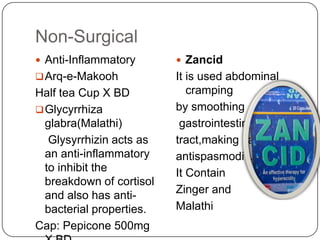
Non-Surgical
 Anti-Inflammatory

 Zancid

 Arq-e-Makooh

It is used abdominal
cramping
by smoothing
gastrointestinal
tract,making itan
antispasmodic.
It Contain
Zinger and
Malathi

Half tea Cup X BD
 Glycyrrhiza
glabra(Malathi)
Glysyrrhizin acts as
an anti-inflammatory
to inhibit the
breakdown of cortisol
and also has antibacterial properties.
Cap: Pepicone 500mg
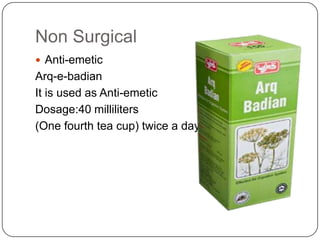
Non Surgical
 Anti-emetic

Arq-e-badian
It is used as Anti-emetic
Dosage:40 milliliters
(One fourth tea cup) twice a day
Non Surgical
 Fluid Replacement Therapy

Inj: Ringer Lactate 1000ml I.v Stat
Surgical Managment
 Pre-Surgery

The treatment begins by keeping the patient
away from eating or drinking in preparation for
surgery
o Antibiotics
Antibiotic such as Cefotaxime Na or Ciprofloxacine
is given Intravenously
Surgical Treatment
 Appendectomy

The Surgical procedure for the removal of the
appendix is called an Appendectomy
 Laparotomy

Laparotomy is the traditional type of surgery
used for treating appendicitis. This procedure
consists in the removal of the infected appendix
through a single larger incision in the lower right
area of the abdomen.
Surgical Treatment
 Laparoscopic surgery

The newer method to treat appendicitis is
the laproscopic Surgery This surgical procedure
consists of making three to four incisions in the
abdomen, each 0.25 to 0.5 inches (6.4 to
12.7 mm) long. This type of appendectomy is
made by inserting a special surgical tool called
laparoscope into one of the incisions. The
laparoscope is connected to a monitor outside the
patient's body and it is designed to help the
surgeon to inspect the infected area in the
abdomen. The other two incisions are made for
the specific removal of the appendix by
Appendicitis
Appendicitis

Appendicitis

  • 2.
  • 3.
    Presented To Dr.Ghazala Shaheen BEMS,Ph.D(Clinical Therapeutics) Lecture of Clinical Therapeutics College of Conventional Medicine The Islamia University of Bahawalpur
  • 4.
  • 5.
    Contents  Appendicitis  Appendix Path physiology  Causes  Clinical Features  Diagnosis Clinical Blood and Urine Test Imaging  Treatment o Non Surgical o Surgical
  • 6.
    Appendicitis  Appendicitis isa condition in which your appendix becomes inflamed and fills with pus.  Appendicitis is an inflammation of the appendix  Appendicitis is common. Typical symptoms include abdominal pain and vomiting that gradually get worse over 6-24 hours
  • 7.
    What and whereis the appendix?  The appendix is a small dead end pouch, like a little tube, that comes off the caecum. The caecum is the first part of the large intestine. Just before the colon. The small intestine digests and absorbs food. The parts of the food that are not digested begin to be formed into faeces (motions) in the caecum.  The appendix is normally about 5-10 cm long and thin. The appendix appears to have no function.
  • 9.
    Path physiology ofAppendicitis Lumen Obstruction(Any hard thing,feaces,hard foof material) Bacterial Invasion Inflammation Thrombosis In Appenidicular artery Necrosis
  • 10.
    Causes The main causeof appendicitis is Obstruction of Lumen of appendix Cause of Lumen Blockage  Any Foreign Material  Trauma  Infection  Intestinal Worm  Lymphadenitis  Stool
  • 11.
    Clinical Features  Painin upper abdomen that becomes sharp as it moves to the lower right abdomen.  Loss of appetite  Nausea and/or Vomiting soon after Abdominal Pain begins  Abdominal swelling  Fever of 99-102 degrees Fahrenheit  Inability to pass gas Almost half the time, other symptoms of appendicitis appear, including:  Dull or sharp pain anywhere in the upper or lower abdomen, back, or rectum  Painful urination  Vomiting that precedes the abdominal pain  Severe cramps  Constipation or Diarrhea with gas
  • 12.
    Diagnosis Clinical Blood and UrineTest Imaging Pathology Differential diagnosis
  • 13.
    Clinical Diagnosis  Aure-Rozanovasign Increased pain on palpation with finger in right Lumbar Triangle  Bartomier-Michelson's sign Increased pain on palpation at the right iliac region as patient lies on his/her left side compared to when patient was on supine position Supine Position
  • 14.
    Clinical Diagonsis  Dunphy'ssign Increased pain in the right upper quadrant with coughing  Obturator sign If an inflamed appendix is in contact with the Obturator Internus spasm of the muscle is called Obturator sign. It is demonstrated by flexing and internal rotation of the hip and pain is occur in Hypogastrium
  • 15.
    Clinical Diagnosis  SitkovskiySign Increased pain in the right iliac region as patient lies on his/her left side.  Psoas sign If an inflamed appendix is in contact with the Psoas major spasm of the muscle is called Psoas Sign. It is demonstrated by flexing and internal rotation of the right hip and pain is occur in Right lower quadrent
  • 16.
    Blood Test andUrine Test  Complete Blood Count (CBC) is done to check for signs of infection. 70-90 percent of people with appendicitis may have an elevated white blood cells  Urine Analysis for Urinary Tract Infection. there is a possibility of a microscopic Pyuria the condition of urine containing pus, or Hematuria, urine containing red blood cells, caused by the proximity of the appendix to the Ureter and bladder in acute appendicitis.
  • 17.
    Imaging  X–Ray  Ultrasound OnUSG free fluid collection in the right iliac fossa is to seen along with a visible appendix without blood flow  C.T Scane
  • 18.
    Management  Non Surgical Surgical  Antibiotics  Pre surgery  Anti-Inflammatory  After surgery  Anti-Emetic  Appendectomy  Fluid Replacement  Laparotomy Therapy
  • 19.
    Non-Surgical  Antibiotics Plants Glycyrrhiza Jaiphal(Myristica Fragrens) Dried Ripe Fruits of Jaiphal have antibacterial activity Cap: jaiphal 500mg 1+1+1 Joshanda-e-Istakhudos 1 packet X BD glabra(Malathi) Dried Roots of Glycyrrhiza glabra is used as a antibiotic Cap: Pepicone 500mg 1+1  Althaea officinalis(Khatmi) Root, leaves and flowers are used a antibiotic
  • 20.
    Non-Surgical  Anti-Inflammatory  Zancid Arq-e-Makooh It is used abdominal cramping by smoothing gastrointestinal tract,making itan antispasmodic. It Contain Zinger and Malathi Half tea Cup X BD  Glycyrrhiza glabra(Malathi) Glysyrrhizin acts as an anti-inflammatory to inhibit the breakdown of cortisol and also has antibacterial properties. Cap: Pepicone 500mg
  • 21.
    Non Surgical  Anti-emetic Arq-e-badian Itis used as Anti-emetic Dosage:40 milliliters (One fourth tea cup) twice a day
  • 22.
    Non Surgical  FluidReplacement Therapy Inj: Ringer Lactate 1000ml I.v Stat
  • 23.
    Surgical Managment  Pre-Surgery Thetreatment begins by keeping the patient away from eating or drinking in preparation for surgery o Antibiotics Antibiotic such as Cefotaxime Na or Ciprofloxacine is given Intravenously
  • 24.
    Surgical Treatment  Appendectomy TheSurgical procedure for the removal of the appendix is called an Appendectomy  Laparotomy Laparotomy is the traditional type of surgery used for treating appendicitis. This procedure consists in the removal of the infected appendix through a single larger incision in the lower right area of the abdomen.
  • 25.
    Surgical Treatment  Laparoscopicsurgery The newer method to treat appendicitis is the laproscopic Surgery This surgical procedure consists of making three to four incisions in the abdomen, each 0.25 to 0.5 inches (6.4 to 12.7 mm) long. This type of appendectomy is made by inserting a special surgical tool called laparoscope into one of the incisions. The laparoscope is connected to a monitor outside the patient's body and it is designed to help the surgeon to inspect the infected area in the abdomen. The other two incisions are made for the specific removal of the appendix by