Measurement of the radial deviation of a cutter disk
During the manufacture of veneer strips from laminated wood, the precision of the cutting disk


                                                                                                    APPLIC A T ION
determines the quality of the final product. High demands are made on the veneer strips in
terms of dimensional conformance. The thickness of the strips must be less than 1 mm and
may only exhibit tolerances in the micrometer range. Thicker parts or splinters should never
occur. These "fractions" are only inadequately plastified during the later pressing process of
the veneer strips to form a plate material. Consequently, pores, which substantially reduce the
quality and strength figures of the veneer strips, occur in the plate cross-section.


The quality of wood plate materials is determined by the quality of the chips or veneer strips.
The latter depends to a high degree on the precision of the cutting disk and the associated
tolerances (cast body, blade holder, slicing blade) under production conditions and loads.
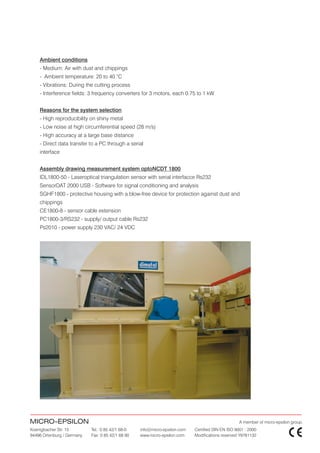
To maintain the quality criteria the radial deviation of the cutting disk is measured and
monitored during the production process with a non-contact laser triangulation sensor from
the Series optoNCDT 1800.
This means that high demands are made on the measurement system: Dust, chippings and a
shiny target surface must not affect the measurement accuracy.
The cutting disk has a diameter of 3200 mm and is fitted with 24 blades. The rotational speed is
180 to 210 rpm. optoNCDT 1800 supplies constant measurement results even under these
difficult conditions. A protective housing protects the laser beam from dust and chippings
which could impair the measurement result by casting shadows. The integrated high
performance optical system ensures precise results, even at the high speed and with the
strongly reflecting surface of the cutting disk. The measurement results are output directly to a
PC via a serial interface for further processing.


Measurement system requirements
- Measurement range: 50 mm
- Repeatability: 5 µm
- Measurement rate: 5 kHz

                                                                       cutter disk edge
Principle sketch
                                                         cutter disk carrier


                                                        Laser sensor


                                                                                                      A132_e
Ambient conditions
    - Medium: Air with dust and chippings
    - Ambient temperature: 20 to 40 °C
    - Vibrations: During the cutting process
    - Interference fields: 3 frequency converters for 3 motors, each 0.75 to 1 kW


    Reasons for the system selection
    - High reproducibility on shiny metal
    - Low noise at high circumferential speed (28 m/s)
    - High accuracy at a large base distance
    - Direct data transfer to a PC through a serial
    interface


    Assembly drawing measurement system optoNCDT 1800
    IDL1800-50 - Laseroptical triangulation sensor with serial interfacce Rs232
    SensorDAT 2000 USB - Software for signal conditioning and analysis
    SGHF1800 - protective housing with a blow-free device for protection against dust and
    chippings
    CE1800-8 - sensor cable extension
    PC1800-3/RS232 - supply/ output cable Rs232
    Ps2010 - power supply 230 VAC/ 24 VDC


MICRO-EPSILON                                                                                      A member of micro-epsilon group.
Koenigbacher Str. 15        Tel.: 0 85 42/1 68-0   info@micro-epsilon.com   Certified DIN EN ISO 9001 : 2000
94496 Ortenburg / Germany   Fax: 0 85 42/1 68 90   www.micro-epsilon.com    Modifications reserved Y9781132

App132 en measurement-radial-deviation-cutter-disk

  • 1.
    Measurement of theradial deviation of a cutter disk During the manufacture of veneer strips from laminated wood, the precision of the cutting disk APPLIC A T ION determines the quality of the final product. High demands are made on the veneer strips in terms of dimensional conformance. The thickness of the strips must be less than 1 mm and may only exhibit tolerances in the micrometer range. Thicker parts or splinters should never occur. These "fractions" are only inadequately plastified during the later pressing process of the veneer strips to form a plate material. Consequently, pores, which substantially reduce the quality and strength figures of the veneer strips, occur in the plate cross-section. The quality of wood plate materials is determined by the quality of the chips or veneer strips. The latter depends to a high degree on the precision of the cutting disk and the associated tolerances (cast body, blade holder, slicing blade) under production conditions and loads. To maintain the quality criteria the radial deviation of the cutting disk is measured and monitored during the production process with a non-contact laser triangulation sensor from the Series optoNCDT 1800. This means that high demands are made on the measurement system: Dust, chippings and a shiny target surface must not affect the measurement accuracy. The cutting disk has a diameter of 3200 mm and is fitted with 24 blades. The rotational speed is 180 to 210 rpm. optoNCDT 1800 supplies constant measurement results even under these difficult conditions. A protective housing protects the laser beam from dust and chippings which could impair the measurement result by casting shadows. The integrated high performance optical system ensures precise results, even at the high speed and with the strongly reflecting surface of the cutting disk. The measurement results are output directly to a PC via a serial interface for further processing. Measurement system requirements - Measurement range: 50 mm - Repeatability: 5 µm - Measurement rate: 5 kHz cutter disk edge Principle sketch cutter disk carrier Laser sensor A132_e
  • 2.
    Ambient conditions - Medium: Air with dust and chippings - Ambient temperature: 20 to 40 °C - Vibrations: During the cutting process - Interference fields: 3 frequency converters for 3 motors, each 0.75 to 1 kW Reasons for the system selection - High reproducibility on shiny metal - Low noise at high circumferential speed (28 m/s) - High accuracy at a large base distance - Direct data transfer to a PC through a serial interface Assembly drawing measurement system optoNCDT 1800 IDL1800-50 - Laseroptical triangulation sensor with serial interfacce Rs232 SensorDAT 2000 USB - Software for signal conditioning and analysis SGHF1800 - protective housing with a blow-free device for protection against dust and chippings CE1800-8 - sensor cable extension PC1800-3/RS232 - supply/ output cable Rs232 Ps2010 - power supply 230 VAC/ 24 VDC MICRO-EPSILON A member of micro-epsilon group. Koenigbacher Str. 15 Tel.: 0 85 42/1 68-0 info@micro-epsilon.com Certified DIN EN ISO 9001 : 2000 94496 Ortenburg / Germany Fax: 0 85 42/1 68 90 www.micro-epsilon.com Modifications reserved Y9781132