A147_e
2D/3D Laser-profile-sensor
scanCONTROL 2800


In-line inspection of wiper blade rubbers
Wiper blade rubbers are extruded in a production              In the second step the wiper blade rubber is inspec-
plant and inspected in the endless state by the               ted for defined material faults by one camera system
measurement system. Here, two different measure-              on the upper side and one on the bottom side of the
ment techniques are applied:                                  material. Principal features of a defect, which are
- laser-optical line scanner LLT2800-25                       used to assess the passed and failed ranges, are
- CCD camera                                                  geometrical changes to the material surface caused
                                                              by dimples or bubbles. In this respect the criteria
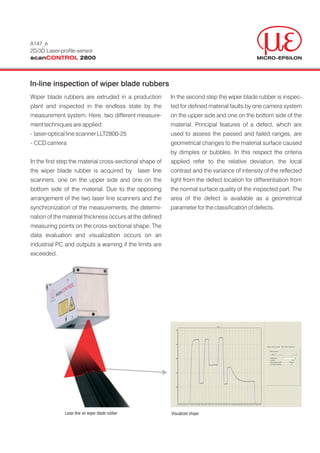
In the first step the material cross-sectional shape of       applied refer to the relative deviation, the local
the wiper blade rubber is acquired by            laser line   contrast and the variance of intensity of the reflected
scanners, one on the upper side and one on the                light from the defect location for differentiation from
bottom side of the material. Due to the opposing              the normal surface quality of the inspected part. The
arrangement of the two laser line scanners and the            area of the defect is available as a geometrical
synchronization of the measurements, the determi-             parameter for the classification of defects.
nation of the material thickness occurs at the defined
measuring points on the cross-sectional shape. The
data evaluation and visualization occurs on an
industrial PC and outputs a warning if the limits are
exceeded.


              Laser line on wiper blade rubber                Visualized shape
Application
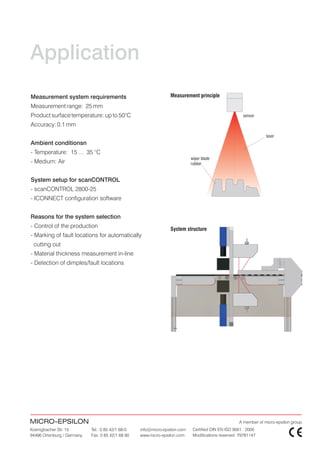
Measurement system requirements                                  Measurement principle
Measurement range: 25 mm
Product surface temperature: up to 50°C                                                               sensor

Accuracy: 0.1 mm
                                                                                                                 laser
Ambient conditionsn
- Temperature: 15 ... 35 °C
                                                                            wiper blade
- Medium: Air                                                               rubber


System setup for scanCONTROL
- scanCONTROL 2800-25
- ICONNECT configuration software


Reasons for the system selection
- Control of the production
                                                                 System structure
- Marking of fault locations for automatically
 cutting out
- Material thickness measurement in-line
- Detection of dimples/fault locations


MICRO-EPSILON                                                                                       A member of micro-epsilon group.
Koenigbacher Str. 15        Tel.: 0 85 42/1 68-0   info@micro-epsilon.com    Certified DIN EN ISO 9001 : 2000
94496 Ortenburg / Germany   Fax: 0 85 42/1 68 90   www.micro-epsilon.com     Modifications reserved Y9781147

App147 en in-line-inspection-wiper-blade-rubbers

  • 1.
    A147_e 2D/3D Laser-profile-sensor scanCONTROL 2800 In-lineinspection of wiper blade rubbers Wiper blade rubbers are extruded in a production In the second step the wiper blade rubber is inspec- plant and inspected in the endless state by the ted for defined material faults by one camera system measurement system. Here, two different measure- on the upper side and one on the bottom side of the ment techniques are applied: material. Principal features of a defect, which are - laser-optical line scanner LLT2800-25 used to assess the passed and failed ranges, are - CCD camera geometrical changes to the material surface caused by dimples or bubbles. In this respect the criteria In the first step the material cross-sectional shape of applied refer to the relative deviation, the local the wiper blade rubber is acquired by laser line contrast and the variance of intensity of the reflected scanners, one on the upper side and one on the light from the defect location for differentiation from bottom side of the material. Due to the opposing the normal surface quality of the inspected part. The arrangement of the two laser line scanners and the area of the defect is available as a geometrical synchronization of the measurements, the determi- parameter for the classification of defects. nation of the material thickness occurs at the defined measuring points on the cross-sectional shape. The data evaluation and visualization occurs on an industrial PC and outputs a warning if the limits are exceeded. Laser line on wiper blade rubber Visualized shape
  • 2.
    Application Measurement system requirements Measurement principle Measurement range: 25 mm Product surface temperature: up to 50°C sensor Accuracy: 0.1 mm laser Ambient conditionsn - Temperature: 15 ... 35 °C wiper blade - Medium: Air rubber System setup for scanCONTROL - scanCONTROL 2800-25 - ICONNECT configuration software Reasons for the system selection - Control of the production System structure - Marking of fault locations for automatically cutting out - Material thickness measurement in-line - Detection of dimples/fault locations MICRO-EPSILON A member of micro-epsilon group. Koenigbacher Str. 15 Tel.: 0 85 42/1 68-0 info@micro-epsilon.com Certified DIN EN ISO 9001 : 2000 94496 Ortenburg / Germany Fax: 0 85 42/1 68 90 www.micro-epsilon.com Modifications reserved Y9781147