API System 
By 
Dr. Nabil El Aila 
Assistant Professor of Molecular Microbiology 
Medical Technology Department 
Al -Aqsa University
API System 
•The analytical profile index or API is a classification of bacteria based on experiments, allowing fast identification. This system is developed for quick identification of clinically relevant bacteria. Because of this, only known bacteria can be identified.
API® Gram negative Identification 
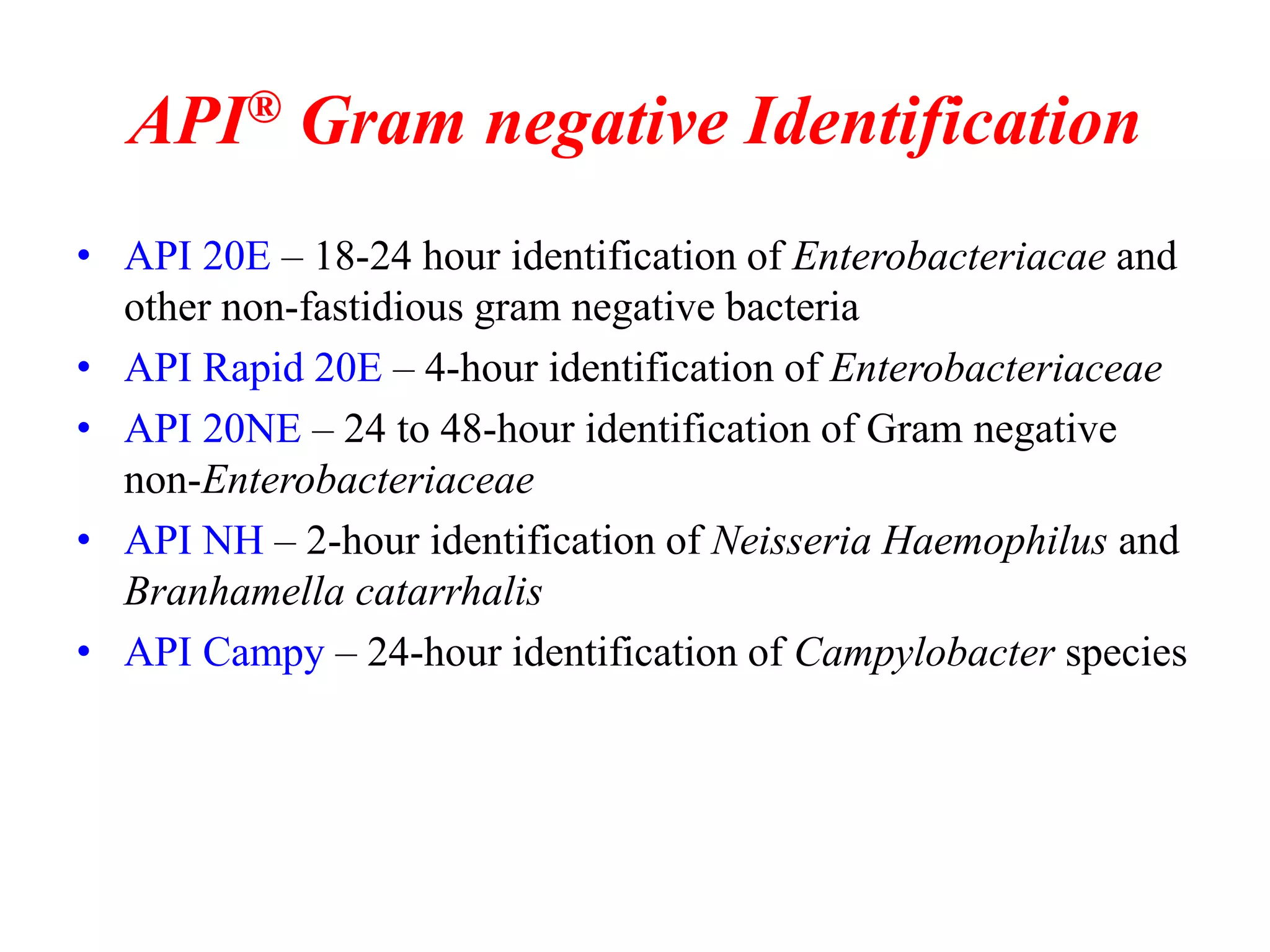
•API 20E – 18-24 hour identification of Enterobacteriacae and other non-fastidious gram negative bacteria 
•API Rapid 20E – 4-hour identification of Enterobacteriaceae 
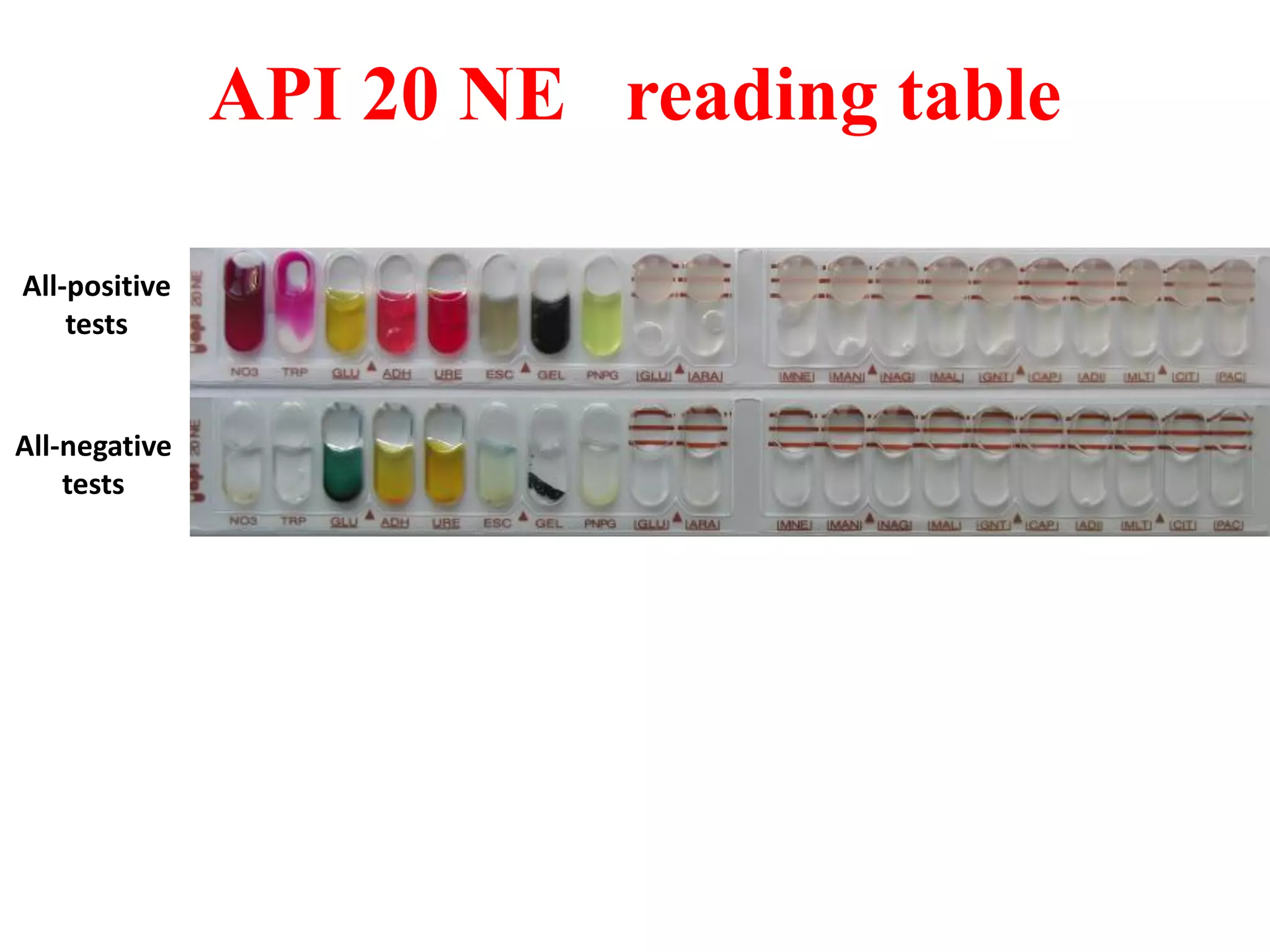
•API 20NE – 24 to 48-hour identification of Gram negative non-Enterobacteriaceae 
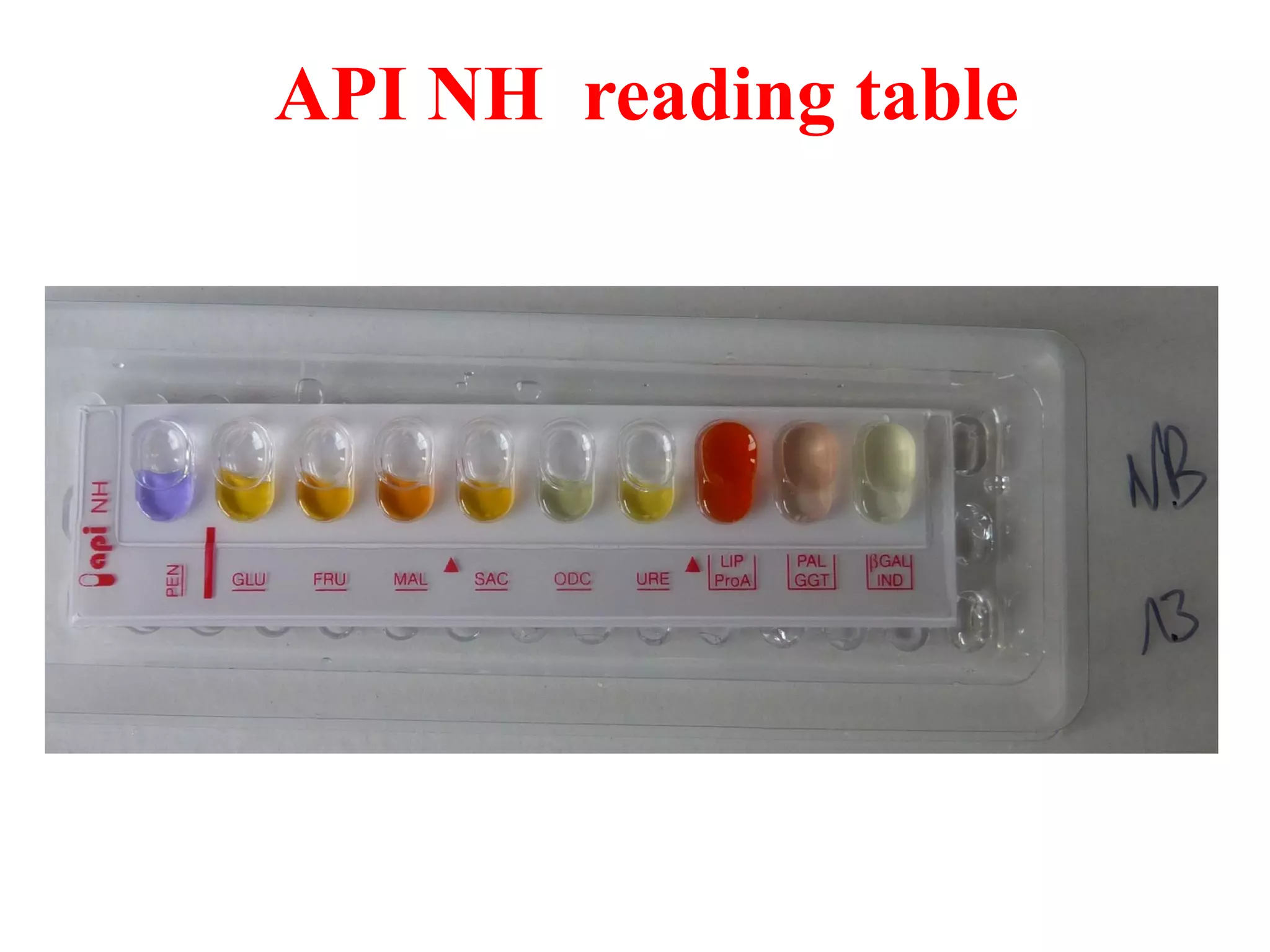
•API NH – 2-hour identification of Neisseria Haemophilus and Branhamella catarrhalis 
•API Campy – 24-hour identification of Campylobacter species
API® Gram positive Identification 
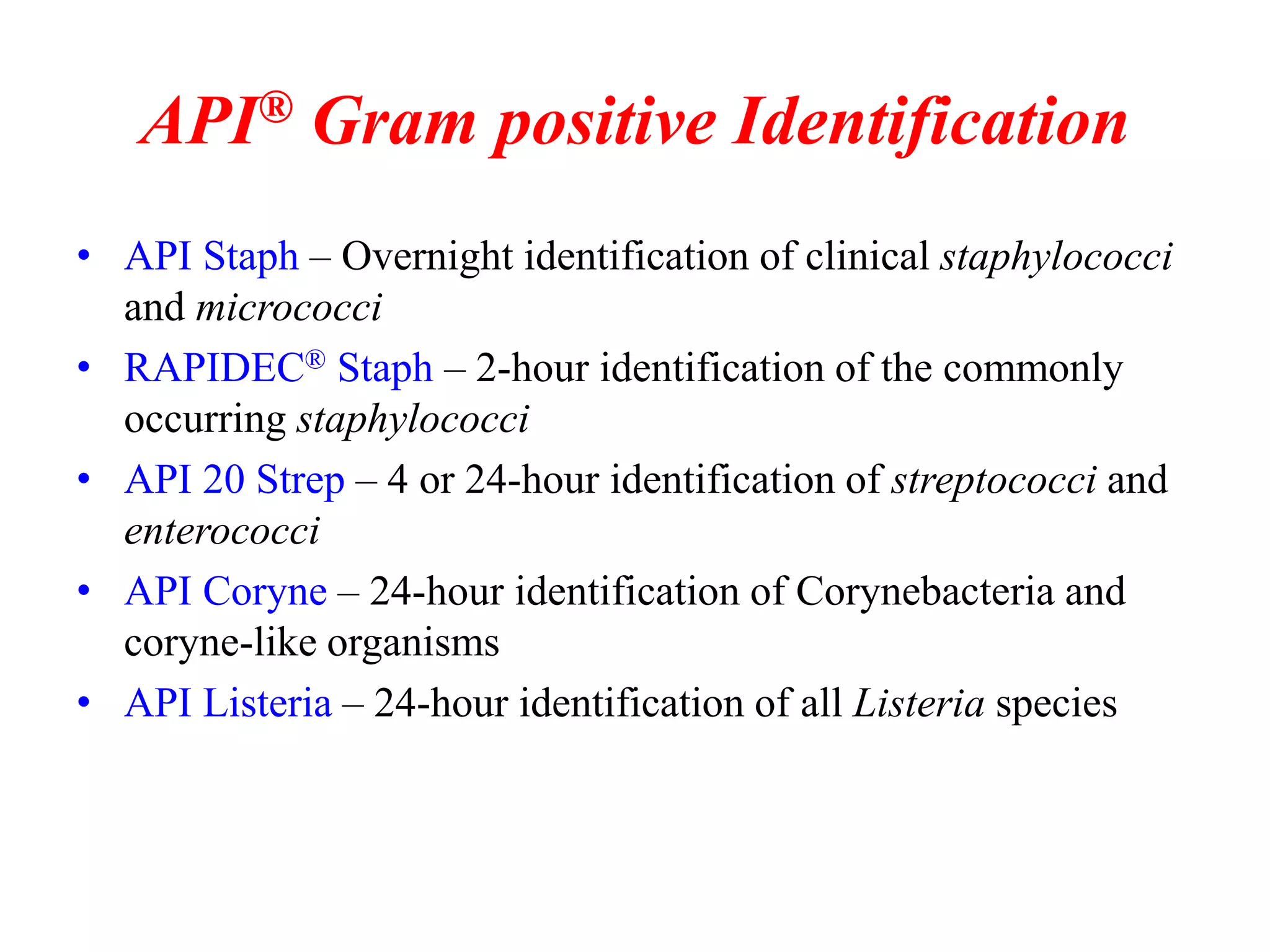
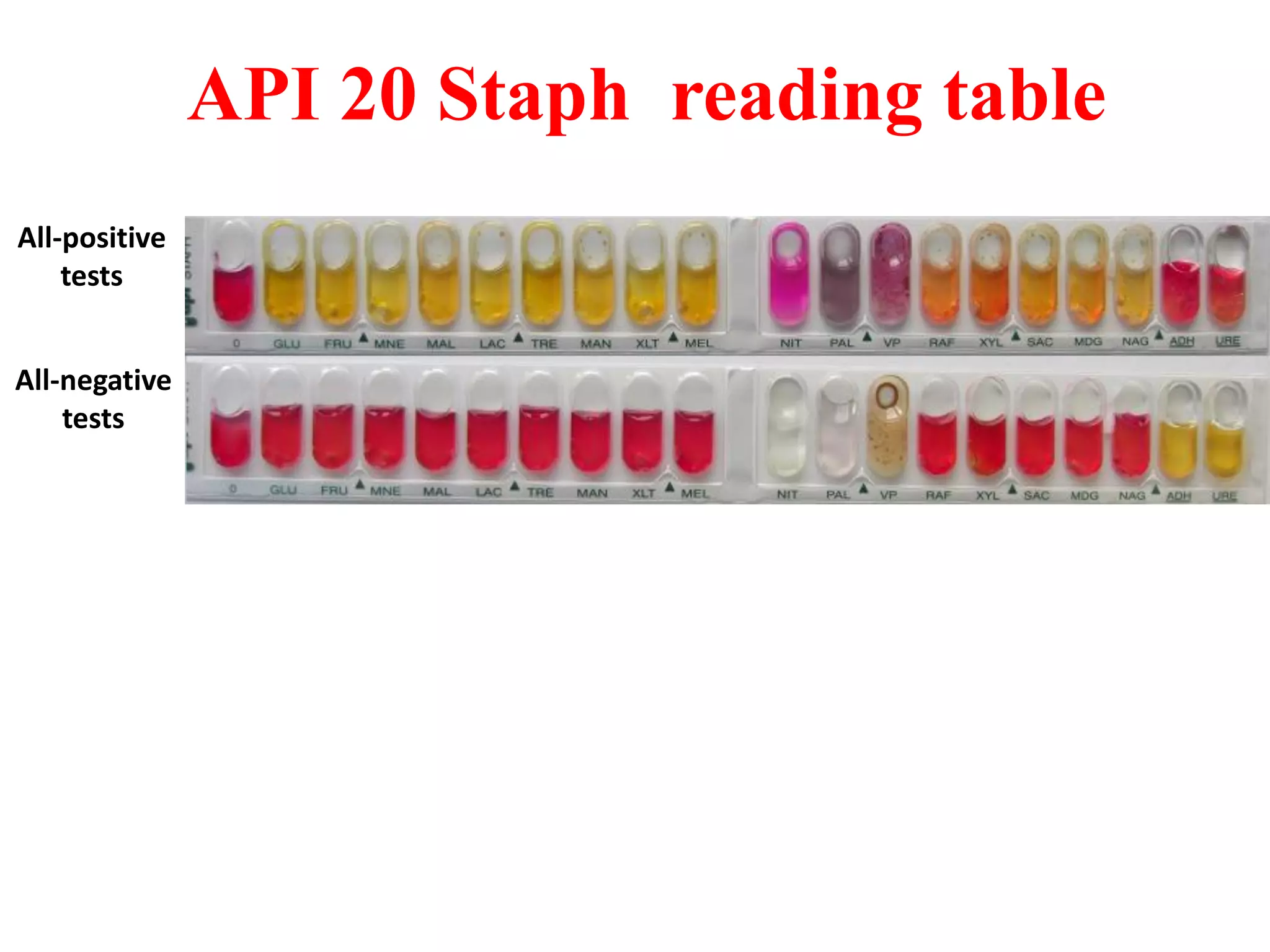
•API Staph – Overnight identification of clinical staphylococci and micrococci 
•RAPIDEC® Staph – 2-hour identification of the commonly occurring staphylococci 
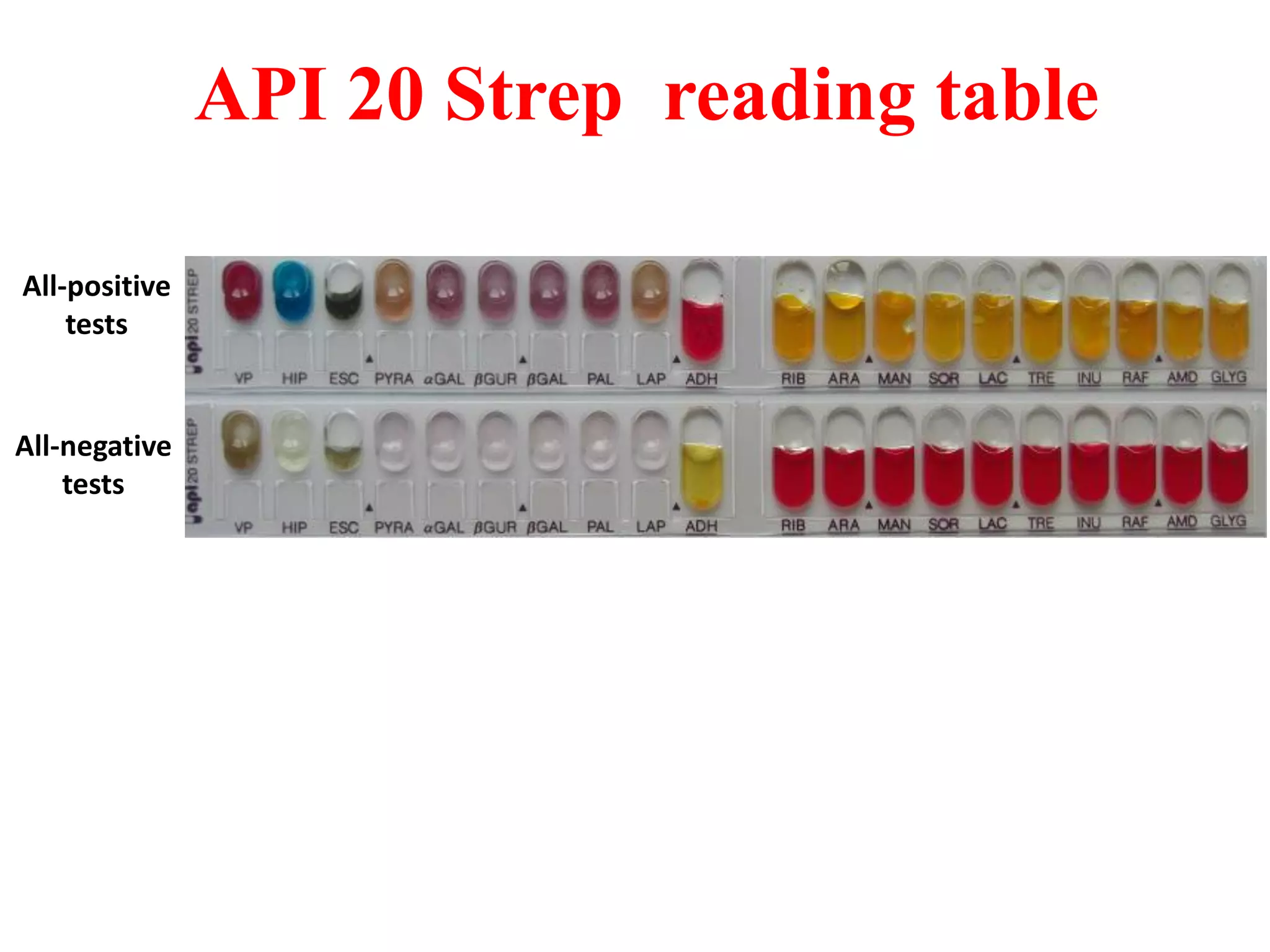
•API 20 Strep – 4 or 24-hour identification of streptococci and enterococci 
•API Coryne – 24-hour identification of Corynebacteria and coryne-like organisms 
•API Listeria – 24-hour identification of all Listeria species
Other API System 
API® Anaerobe Identification 
•API 20A® – 24-hour identification of anaerobes 
•Rapid ID 32A – 4-hour identification of anaerobes 
API® Yeast Identification 
•API 20C AUX – 48 to 72-hour identification of yeasts 
Others 
•API® 50 CH – Performance of carbohydrate metabolism tests 
•API ZYM® – Semiquantitation of enzymatic activities
API 20E 
•The API 20E Strip, For Identification Of The Enterobacteriaceae and other Gram negative rods, Consists of 20 microtubules containing dehydrated substrates. 
•These tests are inoculated with a bacterial suspension that reconstitute the media. 
• 
During incubation, the metabolism of the organism produces color changes that are either spontaneous or revealed by the addition of reagent.
API 20E 
•API 20E are contained in an aluminum pouch. Once opened the pouch should be re-sealed using the clip seal supplied with the kit. 
•The strips may then be kept for up to 10 months at 2- 8 C or untill the expiry date indicated on the packaging. 
•Reagent used in this procedure should also be strored at 2 -8 C and before their expiry date.
API 20E reagent 
•TDA reagent (API 70 400) 
•James reagent (API 70 540) 
•VPI reagent (API 70 420) 
•VP2 reagent ( API 70 430)
API 20E Procedure 
•prepare an incubation tray and lid and distribute 5 ml of sterile distilled water into the tray to create a humid chamber. 
•Record the strain reference on the tab of the tray. 
•Place the API 20 E strip in the tray. 
•Using a sterile disposable loop remove a single well- isolated colony from an isolation plate and carefully emulsify this in 5 ml of sterile distilled water.
API 20E Procedure 
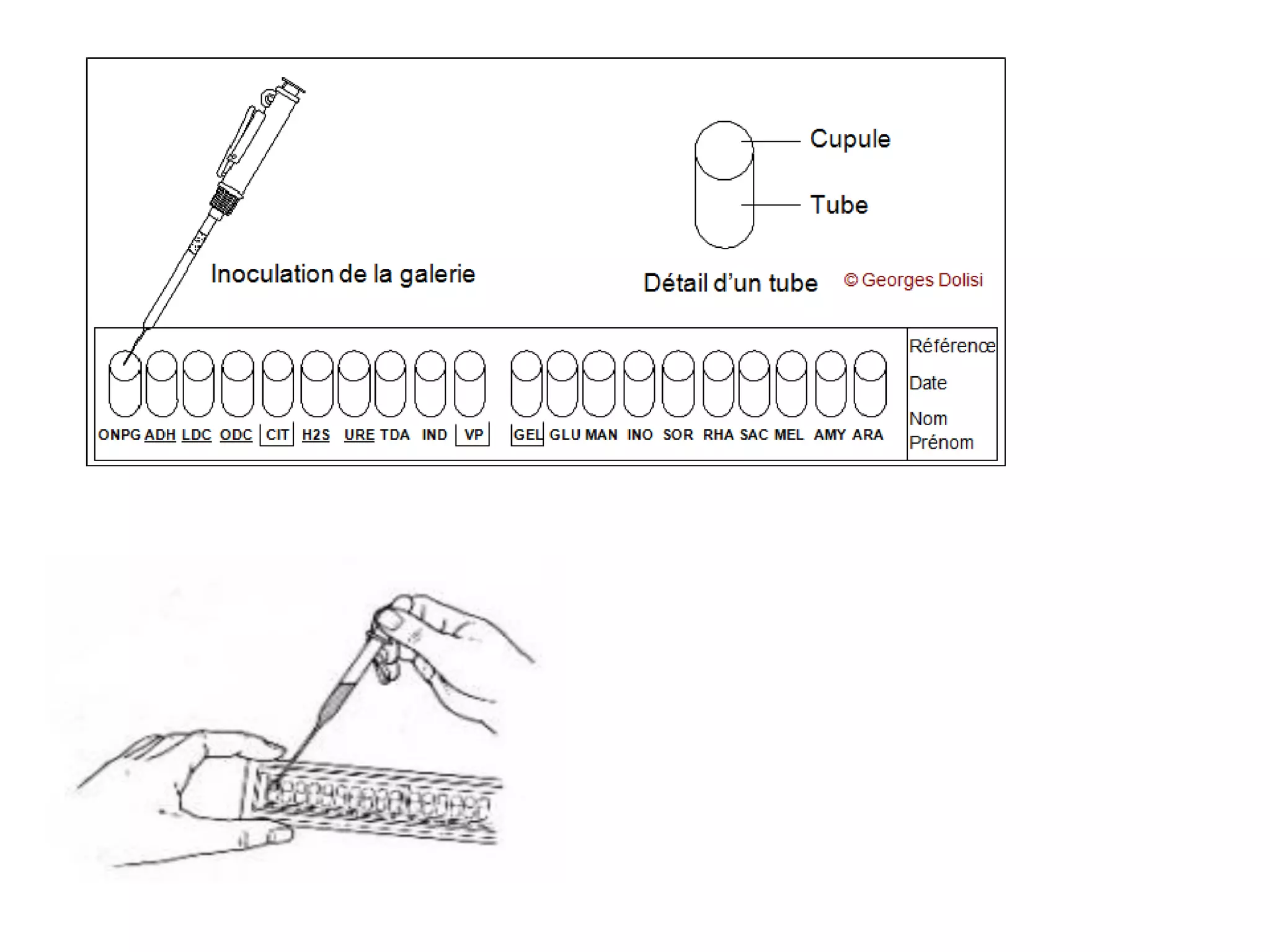
•With a sterile disposable pipette fill both the tube and cupule of the test CIT, VP and GGL with the bacterial suspension. 
•Using same pipette fill only the tubes of the other test. 
•Create anaerobic conditions in the tests ADH , LDC , ODC , URE and H2S by overlaying with mineral oil. 
•Inoculate and streak MacConkey agar plate.
API 20E Procedure 
•place a lid on the incubation tray and incubate both the strip and the MacConkey plate at 37 C for 18 – 24 hours.
Interpretation 
•Check the MacConkey purity plate to ensure.If the culture is mixed repeat the test 
•The following tests require the addition of reagent as follows: 
- Vp test: add one drop of VPI and VP2 reagent 
and wait for ten min for colour development. 
- TDA test: add one drop of TDA reagent. 
- IND test: add one drop of James reagent.
Interpretation 
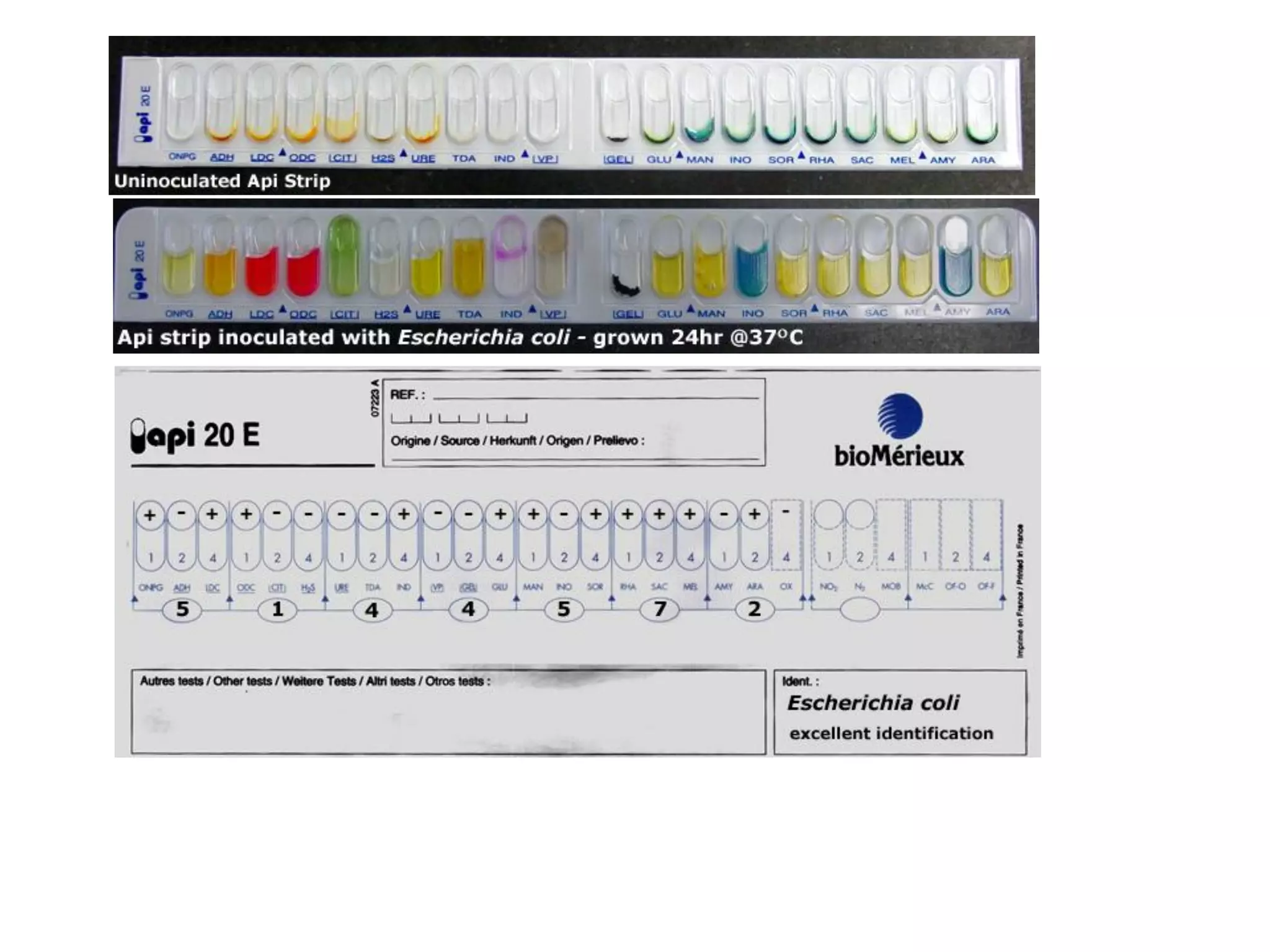
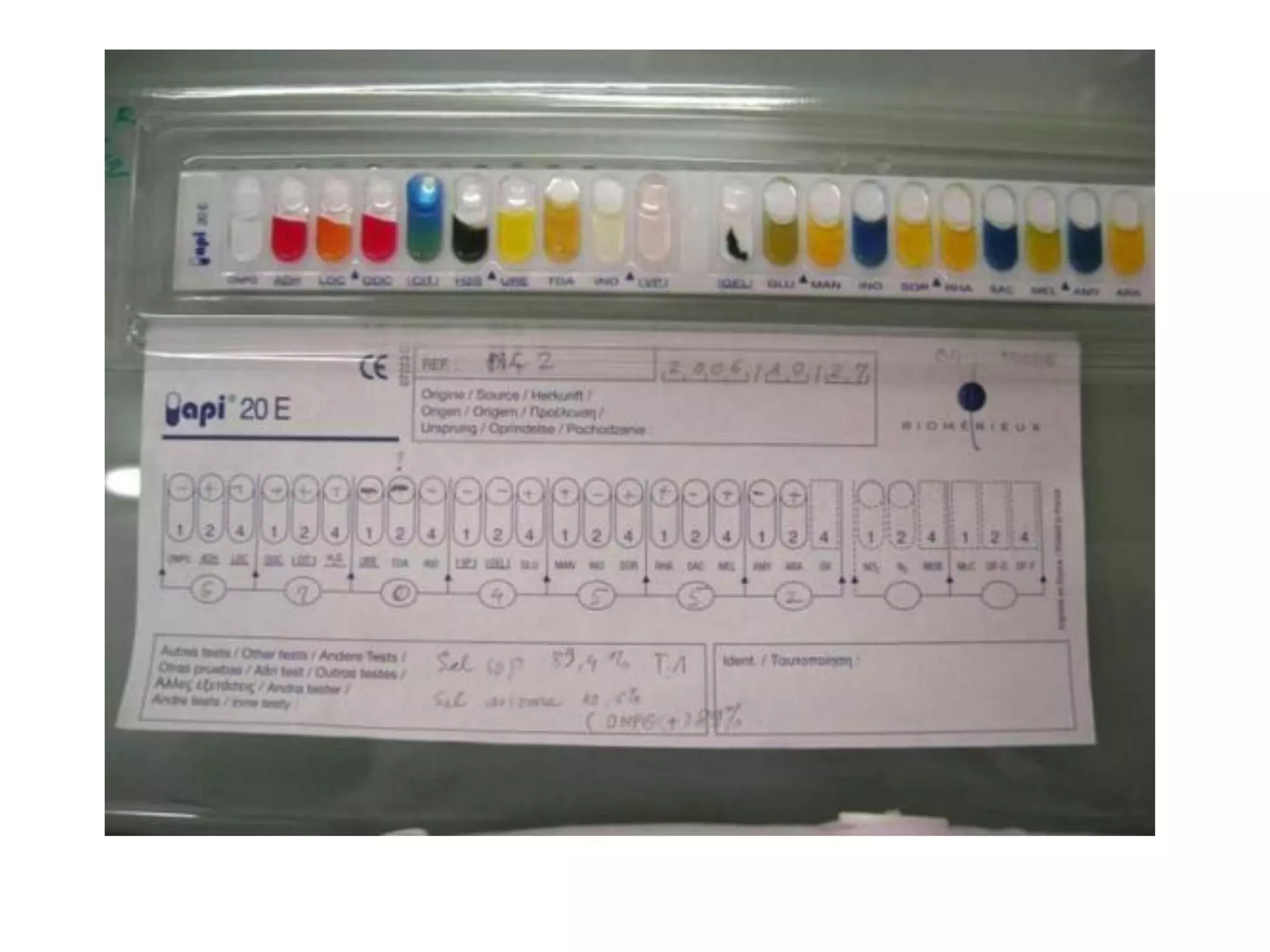
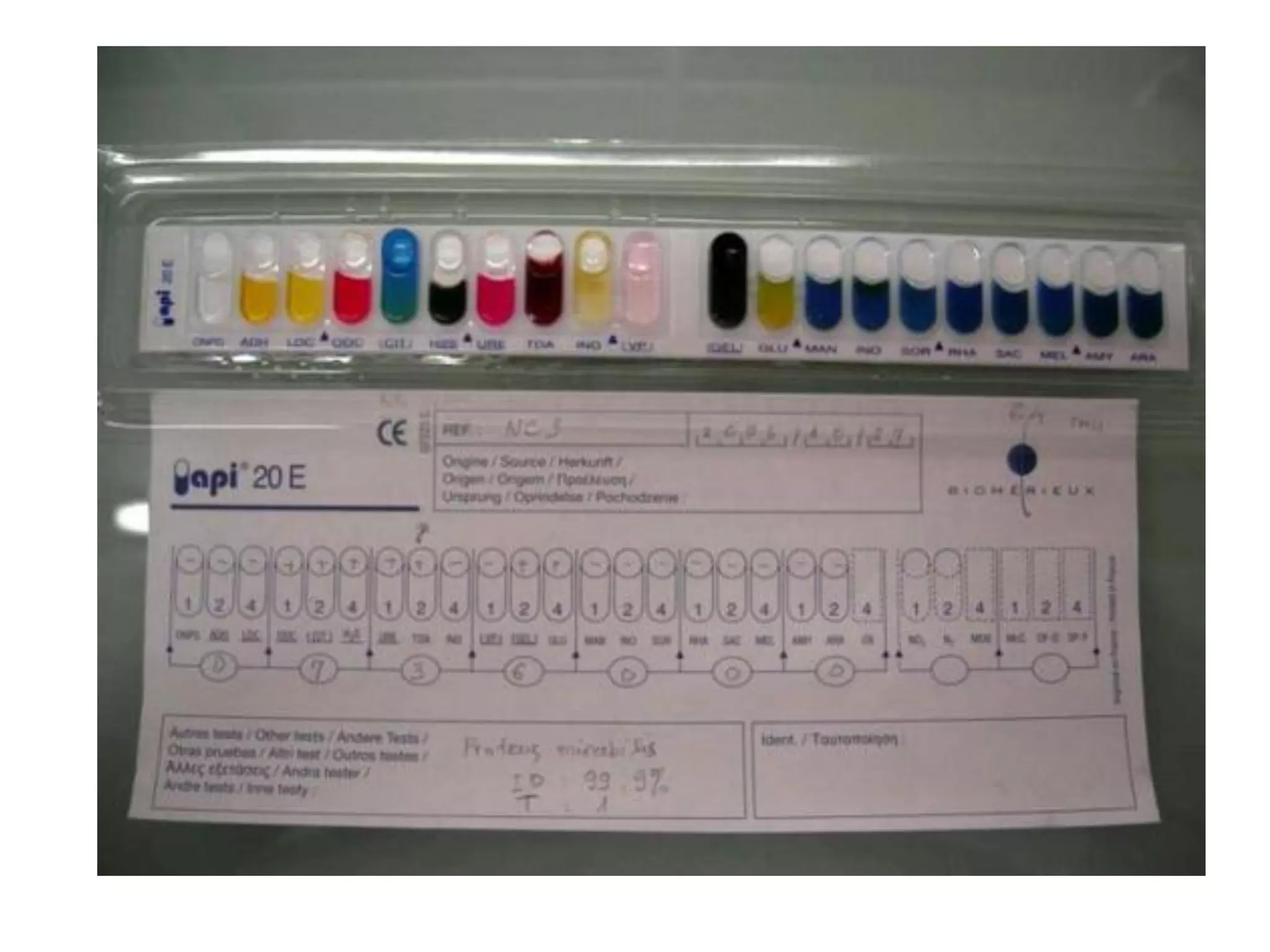
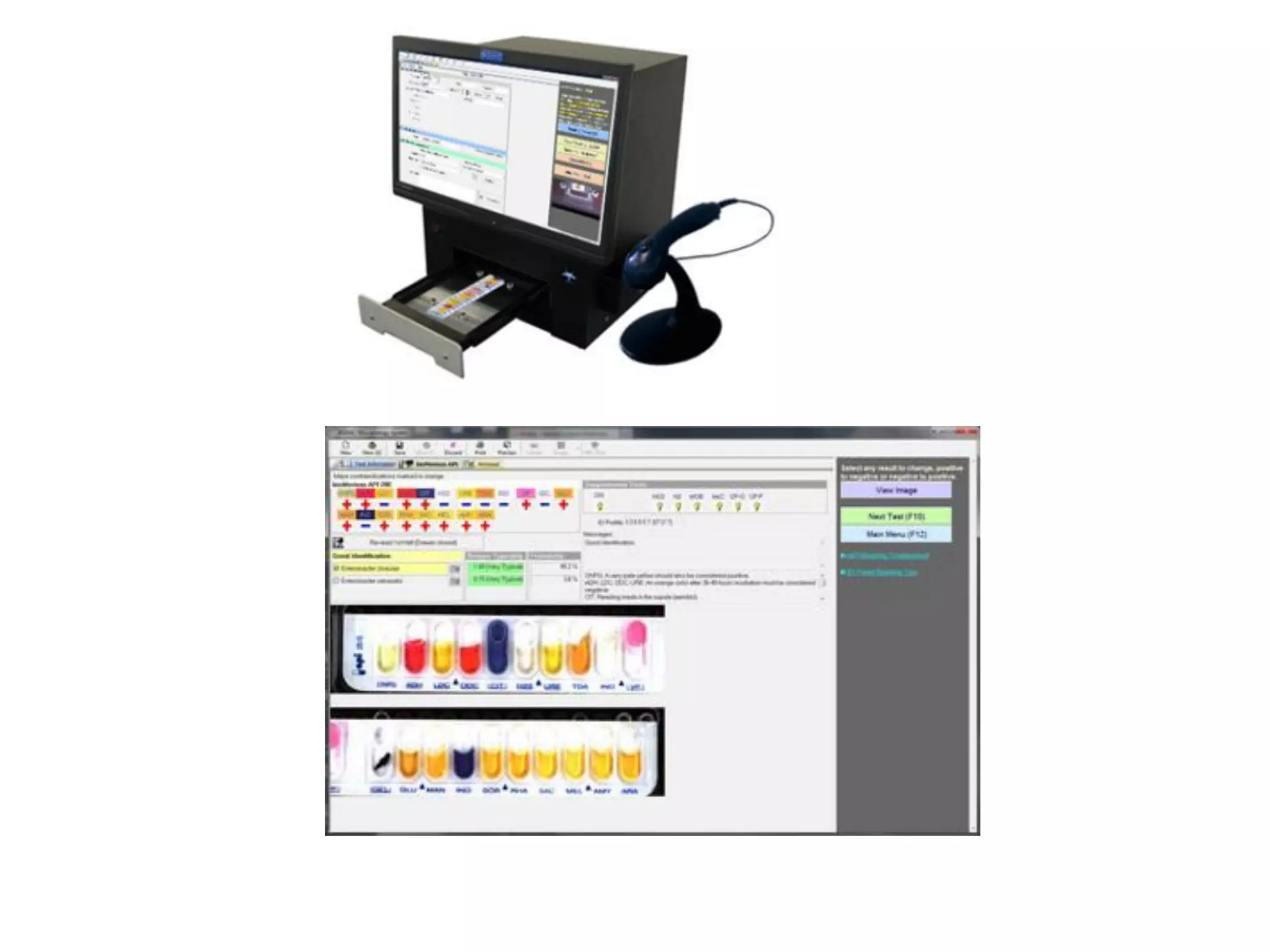
•Read the API strip according to the interpretation table, and record the result on the report sheet. 
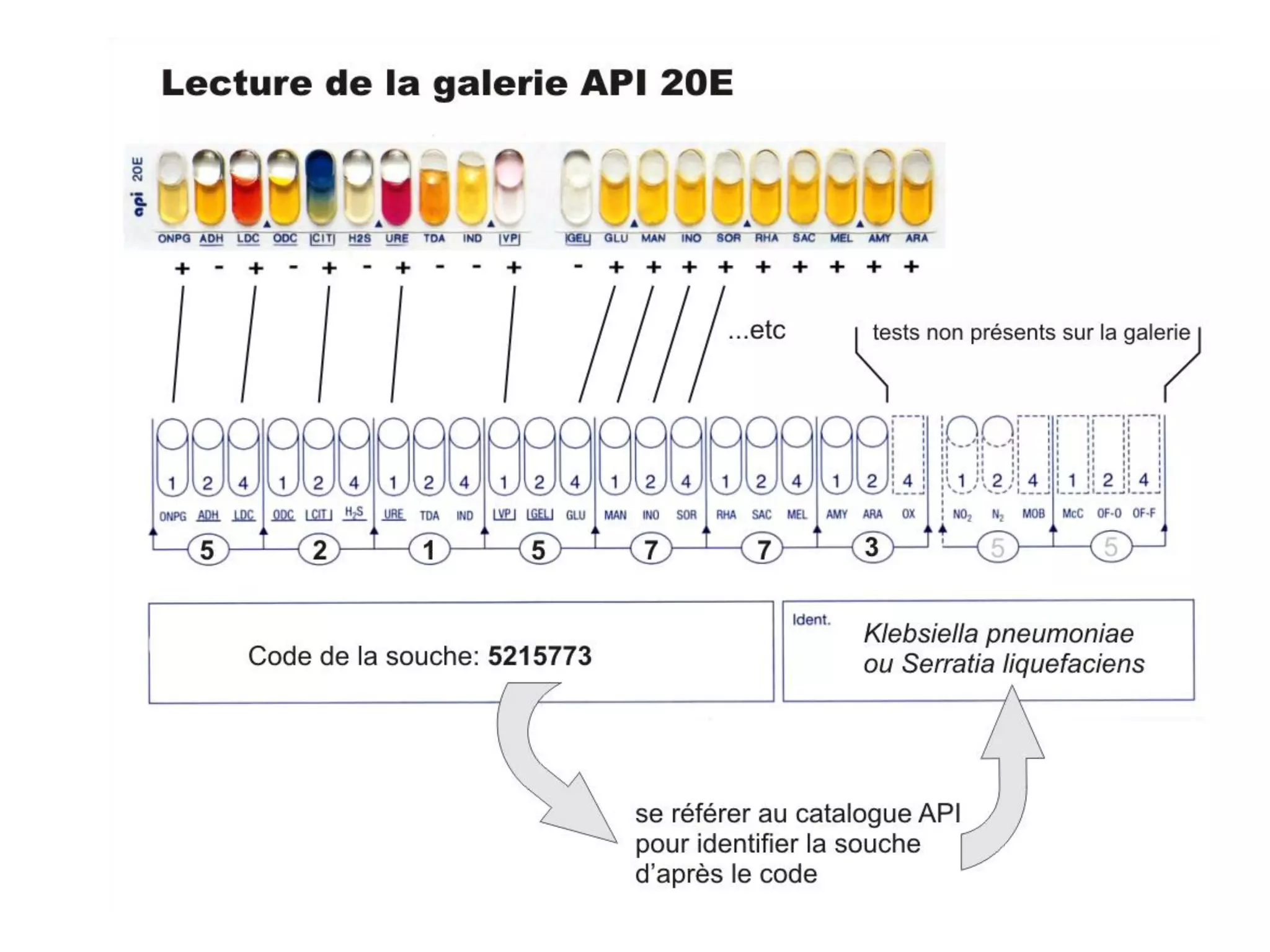
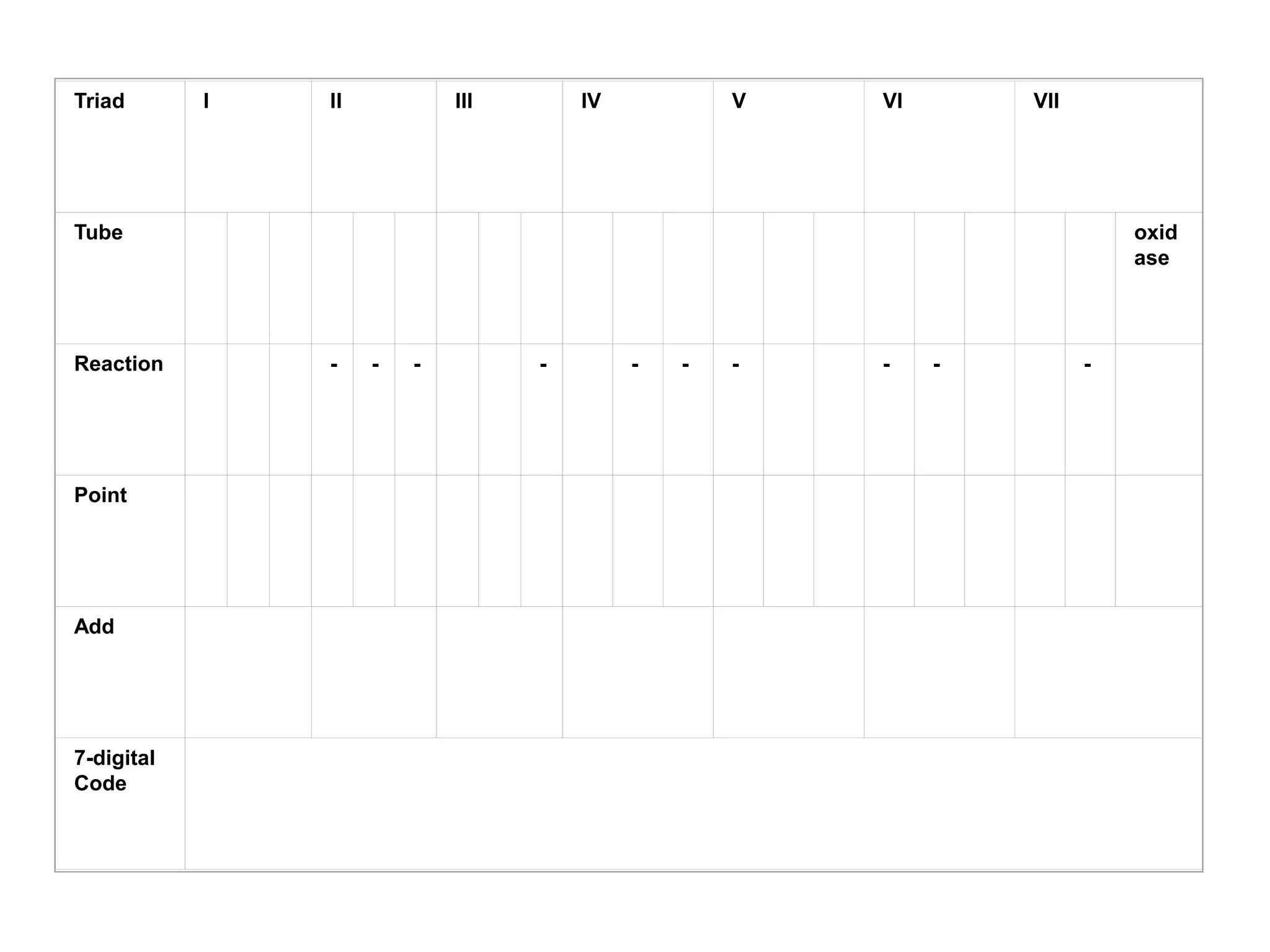
•On the report shhet, the test are separated into groups of three and number 1 , 2 or 4 is allocated for each test. By adding the numbers corresponding to the positive reaction within each groupe, a7- digit profile number is obtained for 20 tests of the API 20E strip.
Interpretation 
•The 7- digit profile is then compared with the numerical profile in the API 20 E analytical profile index book to obtain the organism identification.
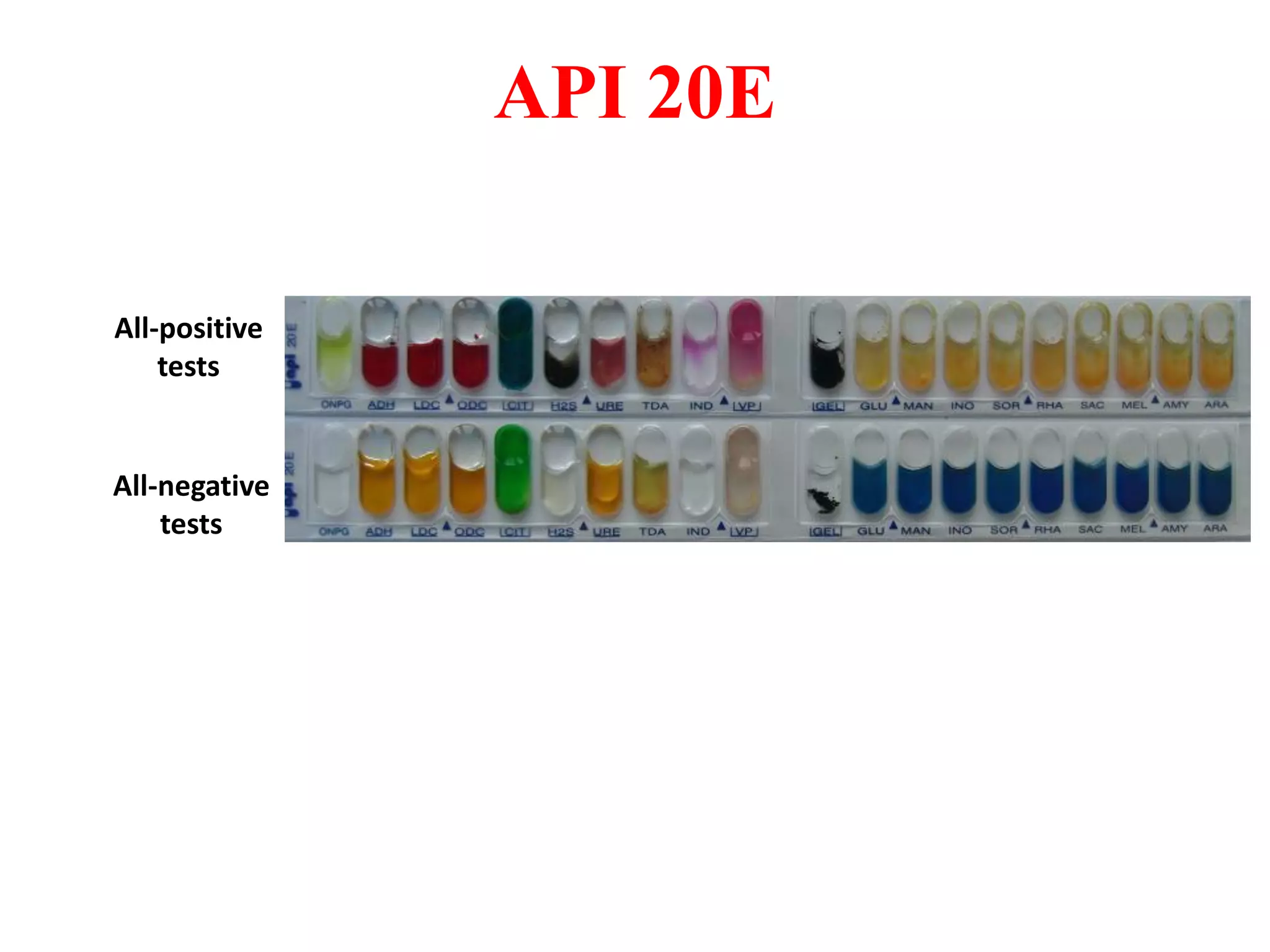
All-negative tests 
All-positive tests 
API 20E
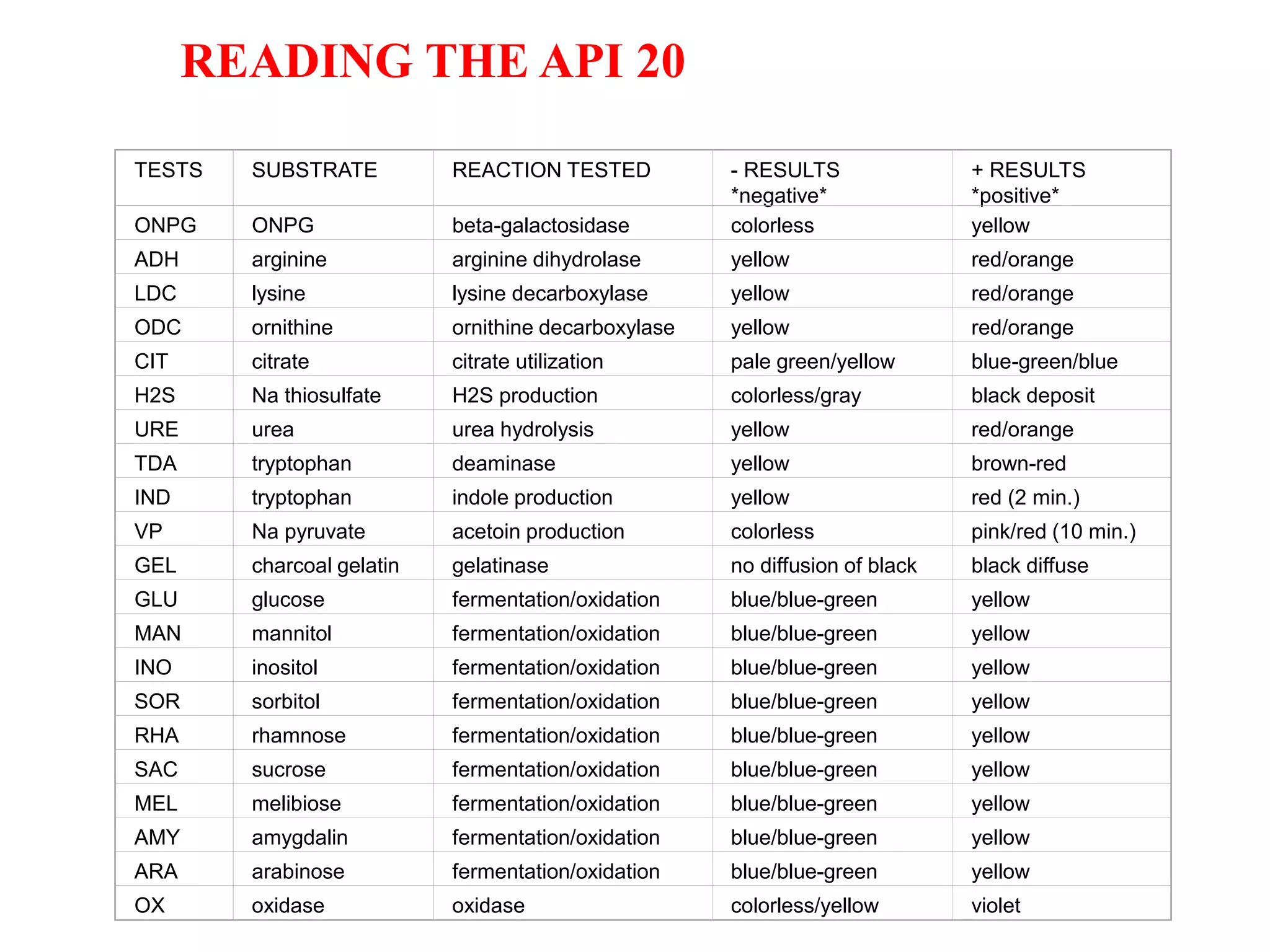
READING THE API 20 
TESTS 
SUBSTRATE 
REACTION TESTED 
- RESULTS *negative* 
+ RESULTS *positive* 
ONPG 
ONPG 
beta-galactosidase 
colorless 
yellow 
ADH 
arginine 
arginine dihydrolase 
yellow 
red/orange 
LDC 
lysine 
lysine decarboxylase 
yellow 
red/orange 
ODC 
ornithine 
ornithine decarboxylase 
yellow 
red/orange 
CIT 
citrate 
citrate utilization 
pale green/yellow 
blue-green/blue 
H2S 
Na thiosulfate 
H2S production 
colorless/gray 
black deposit 
URE 
urea 
urea hydrolysis 
yellow 
red/orange 
TDA 
tryptophan 
deaminase 
yellow 
brown-red 
IND 
tryptophan 
indole production 
yellow 
red (2 min.) 
VP 
Na pyruvate 
acetoin production 
colorless 
pink/red (10 min.) 
GEL 
charcoal gelatin 
gelatinase 
no diffusion of black 
black diffuse 
GLU 
glucose 
fermentation/oxidation 
blue/blue-green 
yellow 
MAN 
mannitol 
fermentation/oxidation 
blue/blue-green 
yellow 
INO 
inositol 
fermentation/oxidation 
blue/blue-green 
yellow 
SOR 
sorbitol 
fermentation/oxidation 
blue/blue-green 
yellow 
RHA 
rhamnose 
fermentation/oxidation 
blue/blue-green 
yellow 
SAC 
sucrose 
fermentation/oxidation 
blue/blue-green 
yellow 
MEL 
melibiose 
fermentation/oxidation 
blue/blue-green 
yellow 
AMY 
amygdalin 
fermentation/oxidation 
blue/blue-green 
yellow 
ARA 
arabinose 
fermentation/oxidation 
blue/blue-green 
yellow 
OX 
oxidase 
oxidase 
colorless/yellow 
violet
Triad 
I 
II 
III 
IV 
V 
VI 
VII 
Tube 
oxidase 
Reaction 
- 
- 
- 
- 
- 
- 
- 
- 
- 
- 
Point 
Add 
7-digital Code
API 20E 
•QUALITY CONTROL 
•Refer to laboratory Quality Control Manual for all Quality Control procedure. 
•SAFETY 
•Standard microbiological technique should be used in the performance of this test. After use, the strips should be placed in red plastic disposal bag.
API 20E Limitations 
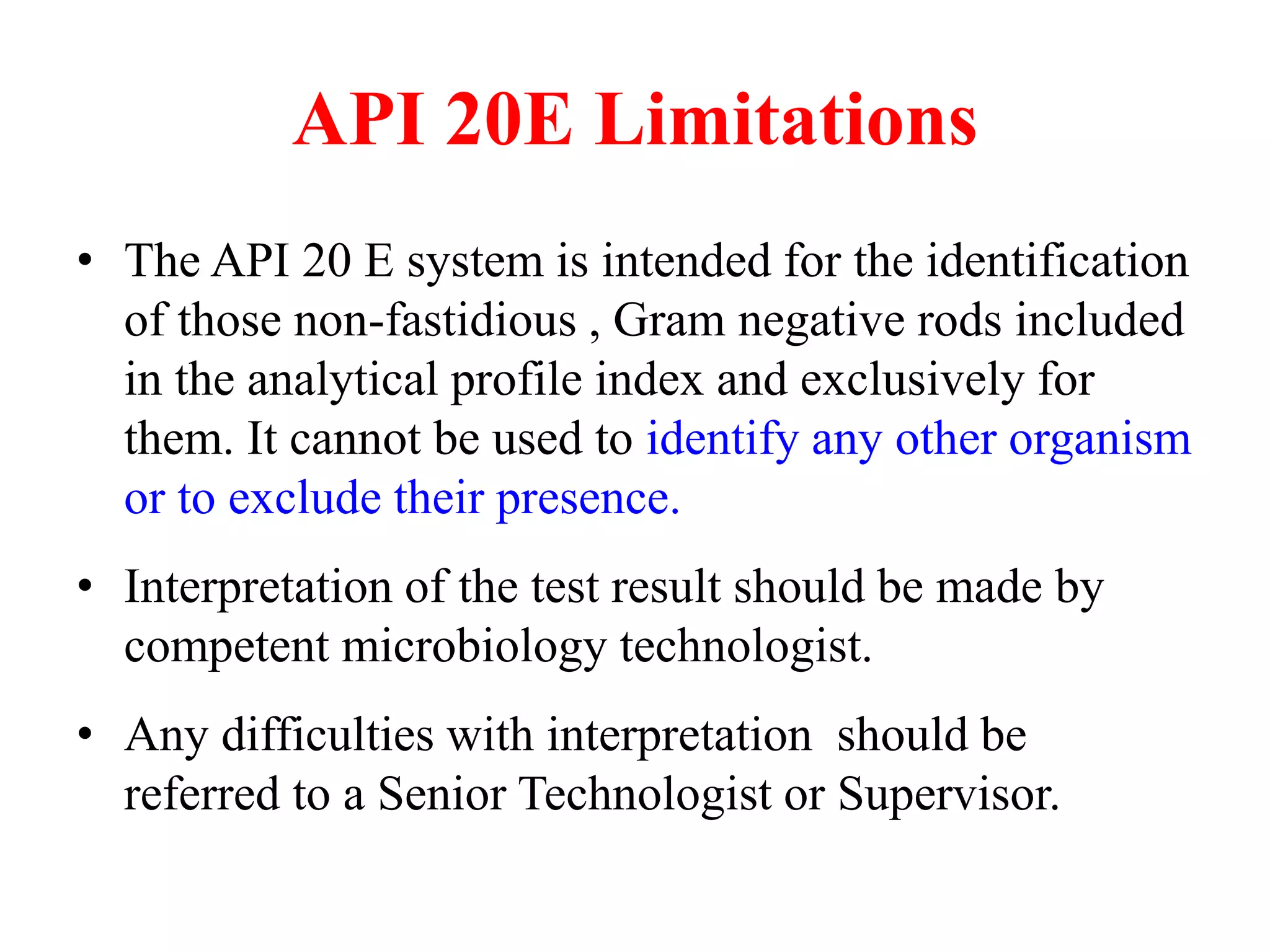
•The API 20 E system is intended for the identification of those non-fastidious , Gram negative rods included in the analytical profile index and exclusively for them. It cannot be used to identify any other organism or to exclude their presence. 
•Interpretation of the test result should be made by competent microbiology technologist. 
•Any difficulties with interpretation should be referred to a Senior Technologist or Supervisor.
API 20 NE reading table 
All-negative tests 
All-positive tests
API 20 Strep reading table 
All-positive tests 
All-negative tests
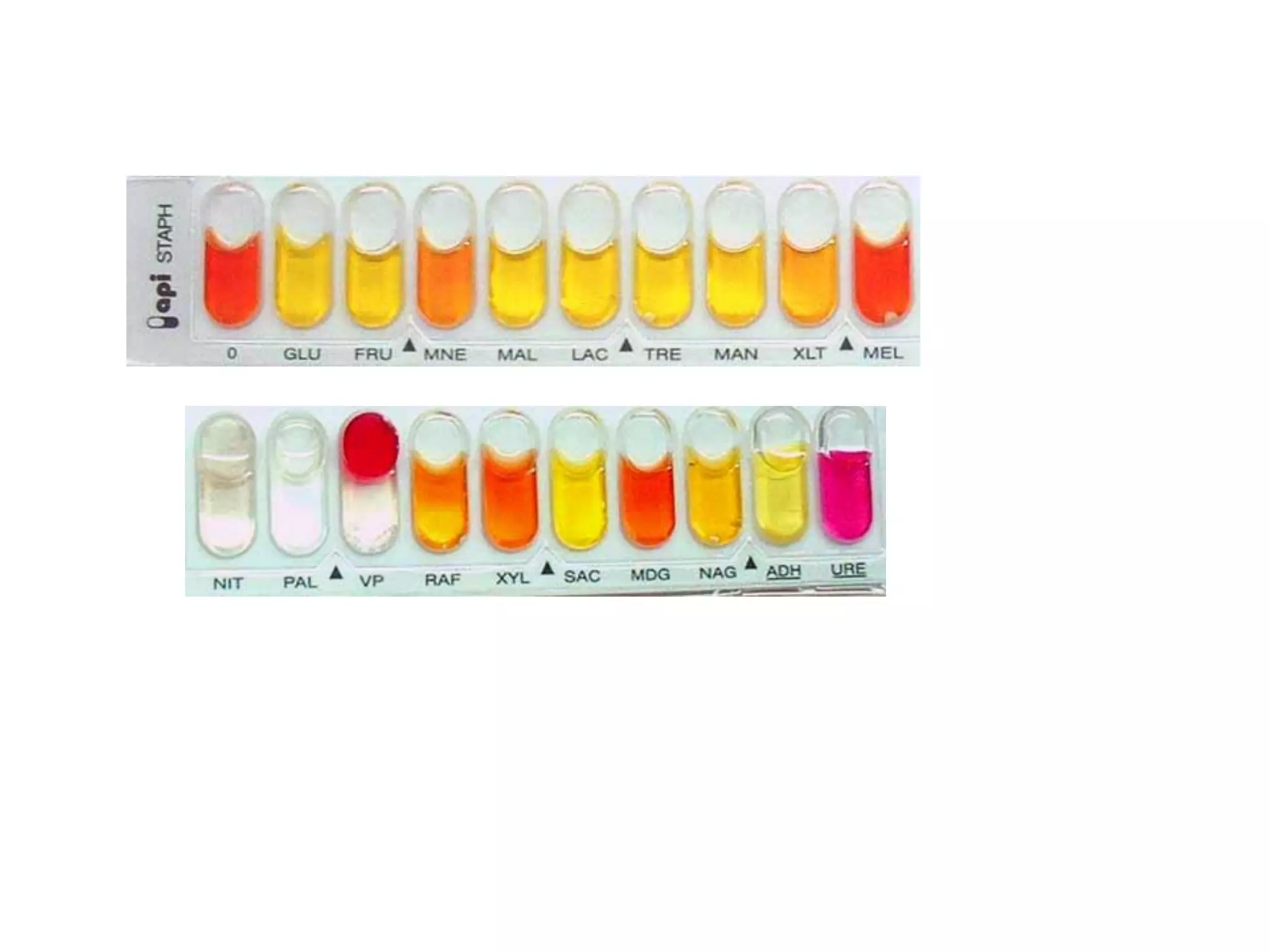
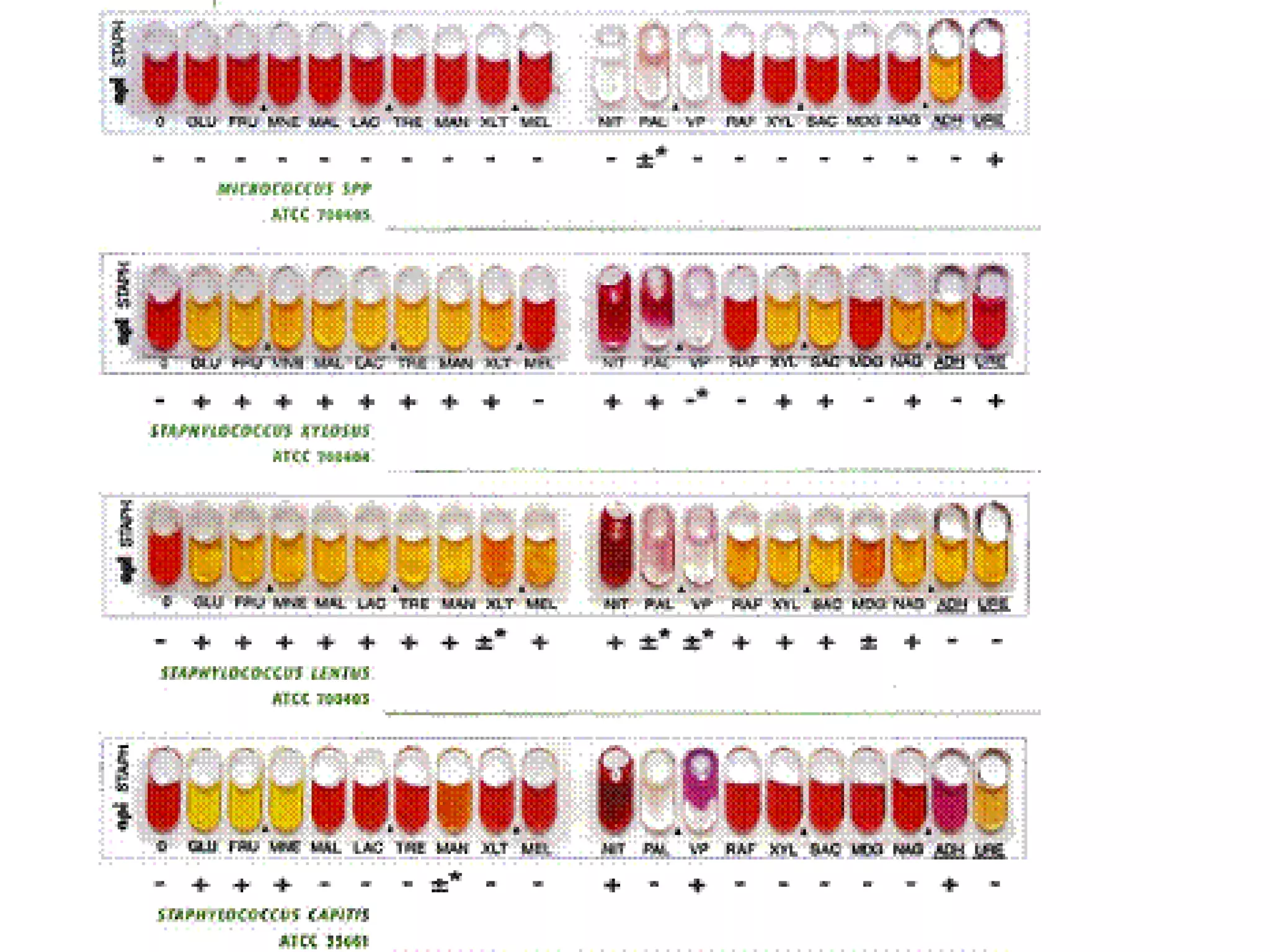
API 20 Staph reading table 
All-positive tests 
All-negative tests
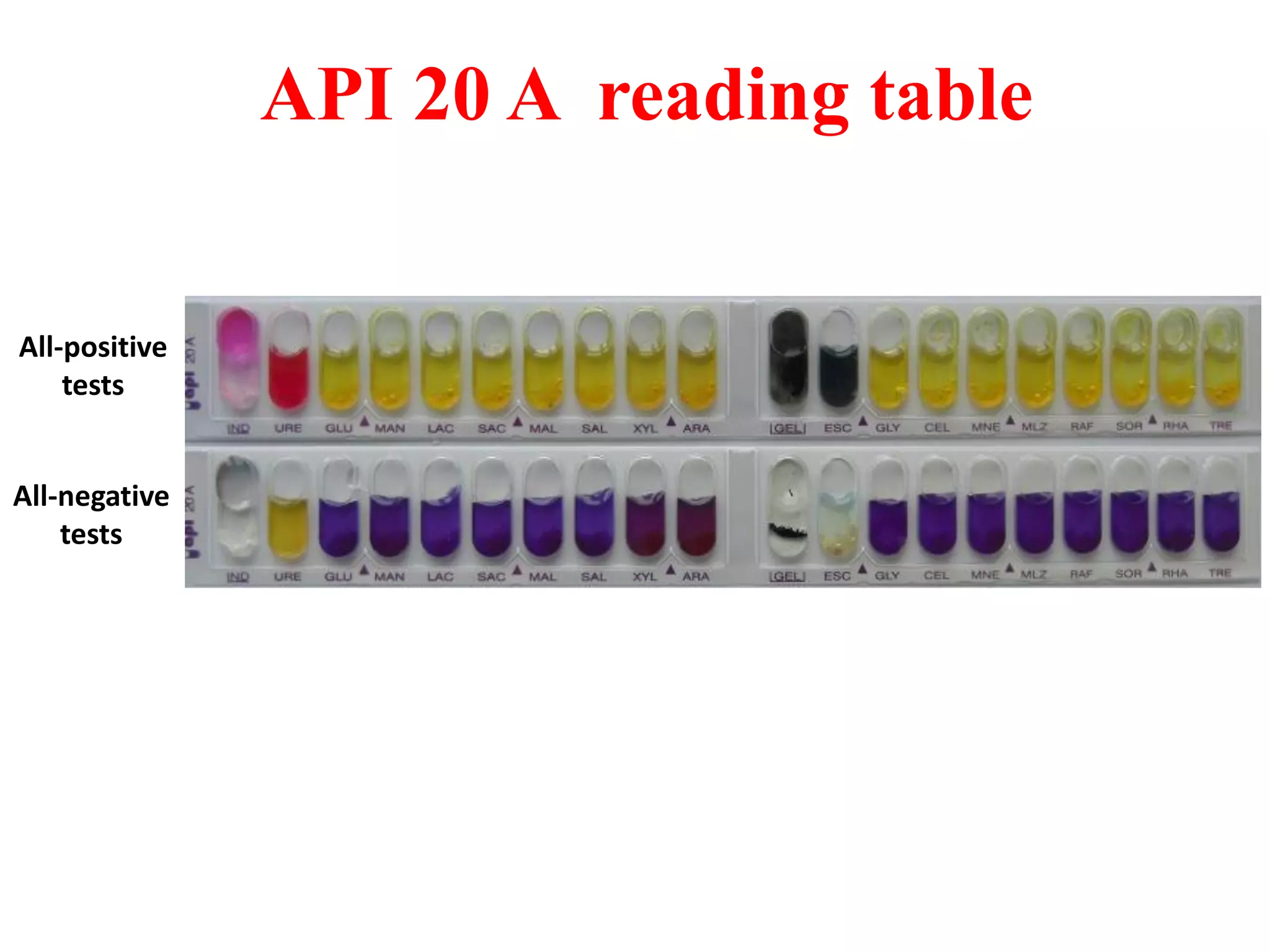
All-positive tests 
All-negative tests 
API 20 A reading table
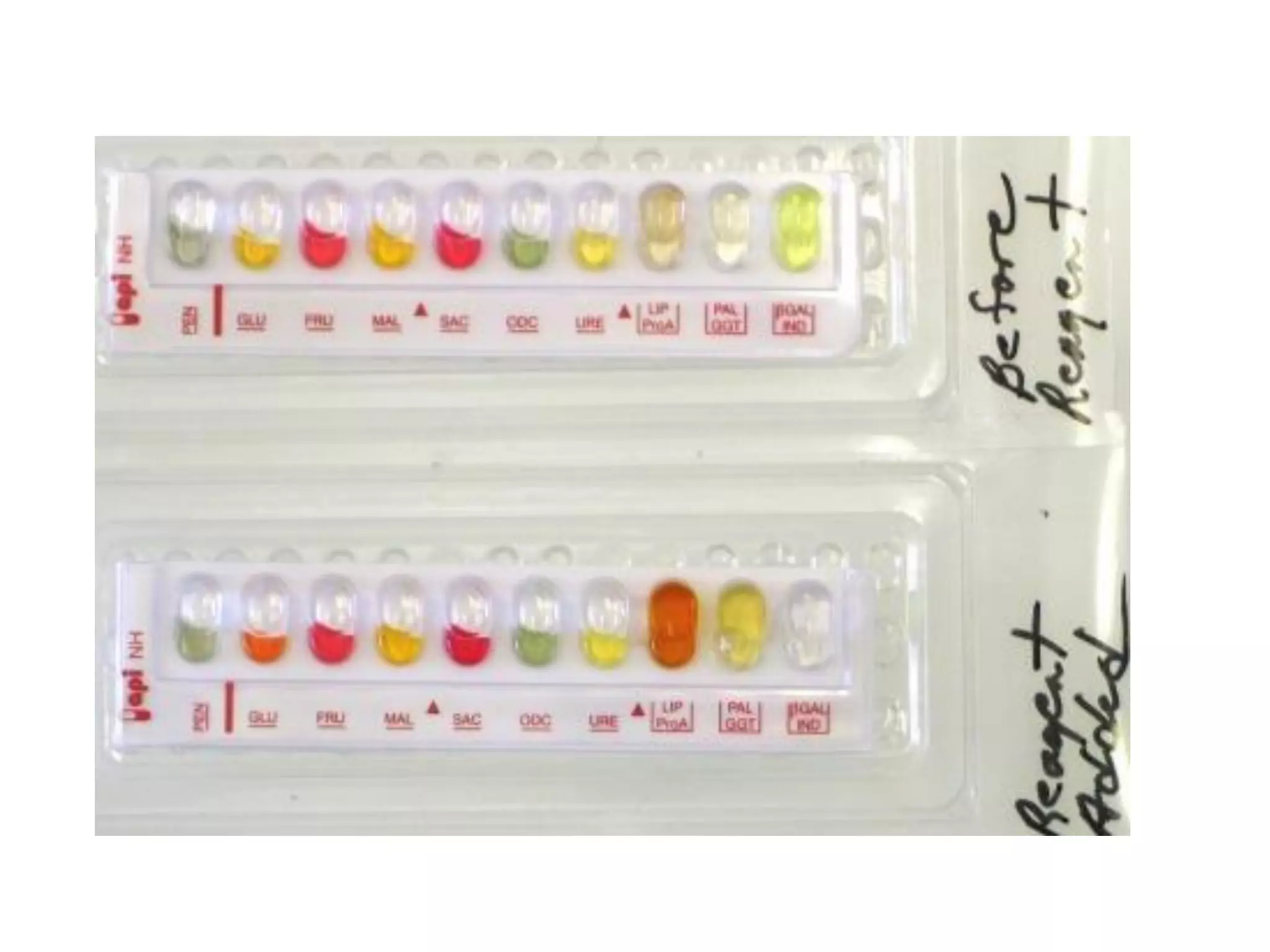
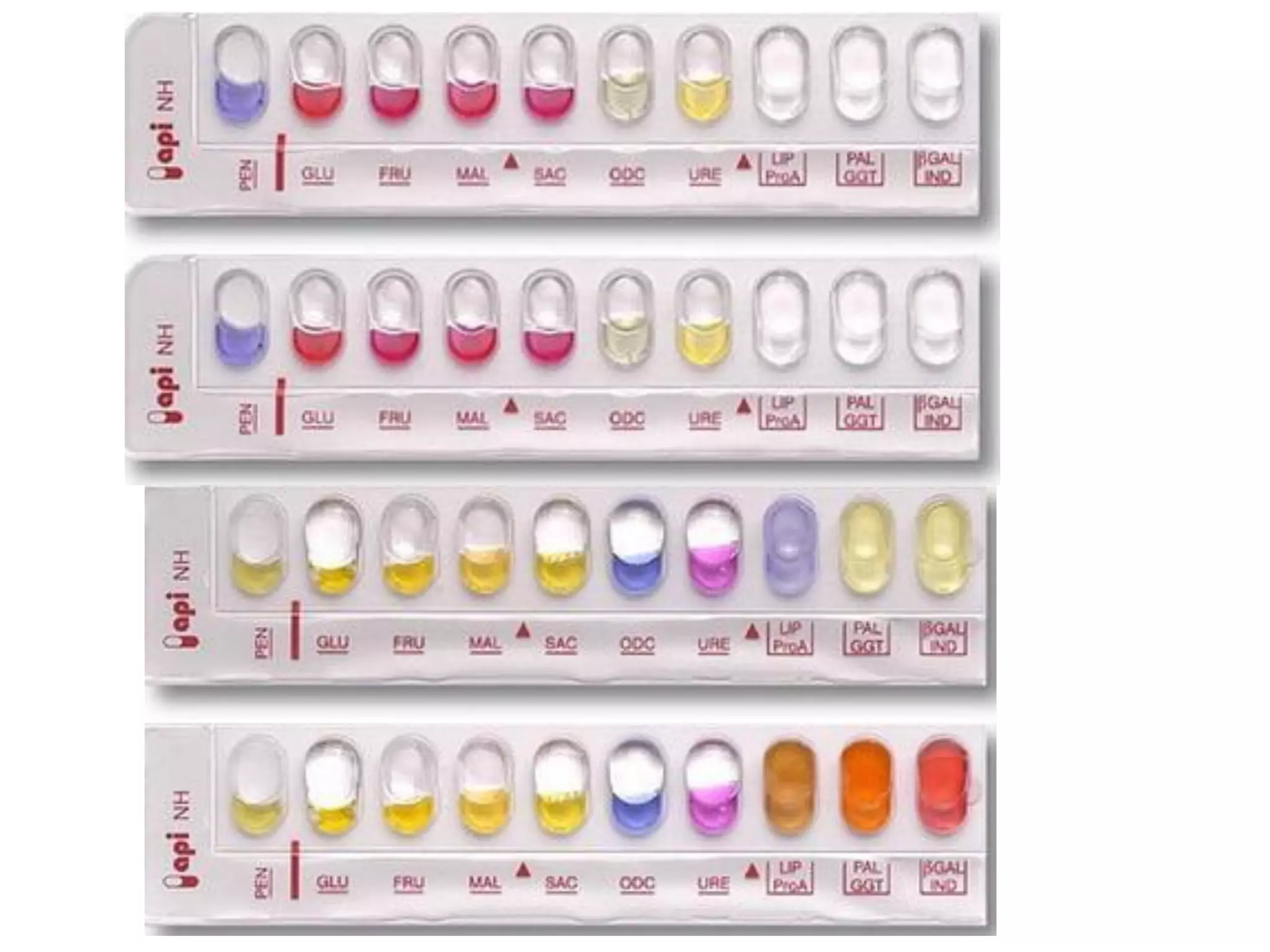
API NH reading table
Api test.........بكتريا عملي

Api test.........بكتريا عملي

  • 1.
    API System By Dr. Nabil El Aila Assistant Professor of Molecular Microbiology Medical Technology Department Al -Aqsa University
  • 2.
    API System •Theanalytical profile index or API is a classification of bacteria based on experiments, allowing fast identification. This system is developed for quick identification of clinically relevant bacteria. Because of this, only known bacteria can be identified.
  • 3.
    API® Gram negativeIdentification •API 20E – 18-24 hour identification of Enterobacteriacae and other non-fastidious gram negative bacteria •API Rapid 20E – 4-hour identification of Enterobacteriaceae •API 20NE – 24 to 48-hour identification of Gram negative non-Enterobacteriaceae •API NH – 2-hour identification of Neisseria Haemophilus and Branhamella catarrhalis •API Campy – 24-hour identification of Campylobacter species
  • 4.
    API® Gram positiveIdentification •API Staph – Overnight identification of clinical staphylococci and micrococci •RAPIDEC® Staph – 2-hour identification of the commonly occurring staphylococci •API 20 Strep – 4 or 24-hour identification of streptococci and enterococci •API Coryne – 24-hour identification of Corynebacteria and coryne-like organisms •API Listeria – 24-hour identification of all Listeria species
  • 5.
    Other API System API® Anaerobe Identification •API 20A® – 24-hour identification of anaerobes •Rapid ID 32A – 4-hour identification of anaerobes API® Yeast Identification •API 20C AUX – 48 to 72-hour identification of yeasts Others •API® 50 CH – Performance of carbohydrate metabolism tests •API ZYM® – Semiquantitation of enzymatic activities
  • 6.
    API 20E •TheAPI 20E Strip, For Identification Of The Enterobacteriaceae and other Gram negative rods, Consists of 20 microtubules containing dehydrated substrates. •These tests are inoculated with a bacterial suspension that reconstitute the media. • During incubation, the metabolism of the organism produces color changes that are either spontaneous or revealed by the addition of reagent.
  • 7.
    API 20E •API20E are contained in an aluminum pouch. Once opened the pouch should be re-sealed using the clip seal supplied with the kit. •The strips may then be kept for up to 10 months at 2- 8 C or untill the expiry date indicated on the packaging. •Reagent used in this procedure should also be strored at 2 -8 C and before their expiry date.
  • 8.
    API 20E reagent •TDA reagent (API 70 400) •James reagent (API 70 540) •VPI reagent (API 70 420) •VP2 reagent ( API 70 430)
  • 9.
    API 20E Procedure •prepare an incubation tray and lid and distribute 5 ml of sterile distilled water into the tray to create a humid chamber. •Record the strain reference on the tab of the tray. •Place the API 20 E strip in the tray. •Using a sterile disposable loop remove a single well- isolated colony from an isolation plate and carefully emulsify this in 5 ml of sterile distilled water.
  • 10.
    API 20E Procedure •With a sterile disposable pipette fill both the tube and cupule of the test CIT, VP and GGL with the bacterial suspension. •Using same pipette fill only the tubes of the other test. •Create anaerobic conditions in the tests ADH , LDC , ODC , URE and H2S by overlaying with mineral oil. •Inoculate and streak MacConkey agar plate.
  • 11.
    API 20E Procedure •place a lid on the incubation tray and incubate both the strip and the MacConkey plate at 37 C for 18 – 24 hours.
  • 13.
    Interpretation •Check theMacConkey purity plate to ensure.If the culture is mixed repeat the test •The following tests require the addition of reagent as follows: - Vp test: add one drop of VPI and VP2 reagent and wait for ten min for colour development. - TDA test: add one drop of TDA reagent. - IND test: add one drop of James reagent.
  • 14.
    Interpretation •Read theAPI strip according to the interpretation table, and record the result on the report sheet. •On the report shhet, the test are separated into groups of three and number 1 , 2 or 4 is allocated for each test. By adding the numbers corresponding to the positive reaction within each groupe, a7- digit profile number is obtained for 20 tests of the API 20E strip.
  • 15.
    Interpretation •The 7-digit profile is then compared with the numerical profile in the API 20 E analytical profile index book to obtain the organism identification.
  • 16.
  • 17.
    READING THE API20 TESTS SUBSTRATE REACTION TESTED - RESULTS *negative* + RESULTS *positive* ONPG ONPG beta-galactosidase colorless yellow ADH arginine arginine dihydrolase yellow red/orange LDC lysine lysine decarboxylase yellow red/orange ODC ornithine ornithine decarboxylase yellow red/orange CIT citrate citrate utilization pale green/yellow blue-green/blue H2S Na thiosulfate H2S production colorless/gray black deposit URE urea urea hydrolysis yellow red/orange TDA tryptophan deaminase yellow brown-red IND tryptophan indole production yellow red (2 min.) VP Na pyruvate acetoin production colorless pink/red (10 min.) GEL charcoal gelatin gelatinase no diffusion of black black diffuse GLU glucose fermentation/oxidation blue/blue-green yellow MAN mannitol fermentation/oxidation blue/blue-green yellow INO inositol fermentation/oxidation blue/blue-green yellow SOR sorbitol fermentation/oxidation blue/blue-green yellow RHA rhamnose fermentation/oxidation blue/blue-green yellow SAC sucrose fermentation/oxidation blue/blue-green yellow MEL melibiose fermentation/oxidation blue/blue-green yellow AMY amygdalin fermentation/oxidation blue/blue-green yellow ARA arabinose fermentation/oxidation blue/blue-green yellow OX oxidase oxidase colorless/yellow violet
  • 23.
    Triad I II III IV V VI VII Tube oxidase Reaction - - - - - - - - - - Point Add 7-digital Code
  • 24.
    API 20E •QUALITYCONTROL •Refer to laboratory Quality Control Manual for all Quality Control procedure. •SAFETY •Standard microbiological technique should be used in the performance of this test. After use, the strips should be placed in red plastic disposal bag.
  • 25.
    API 20E Limitations •The API 20 E system is intended for the identification of those non-fastidious , Gram negative rods included in the analytical profile index and exclusively for them. It cannot be used to identify any other organism or to exclude their presence. •Interpretation of the test result should be made by competent microbiology technologist. •Any difficulties with interpretation should be referred to a Senior Technologist or Supervisor.
  • 26.
    API 20 NEreading table All-negative tests All-positive tests
  • 27.
    API 20 Strepreading table All-positive tests All-negative tests
  • 28.
    API 20 Staphreading table All-positive tests All-negative tests
  • 31.
    All-positive tests All-negativetests API 20 A reading table
  • 32.