1  2nd
Year Nutrition 
Practical 7
Ms. Banan A. Atwah
1431 - 1432 H
IDENTIFICATION OF GRAM NEGATIVE BACTERIA
1. Objectives:
 To know the major biochemical tests used in microbiology.
 To be familiar with the basic principles of those biochemical tests.
 To be able to read the positive and negative tests results.
 To know the application of those tests in identification of gram negative
bacteria.
. Materials:2
1. Set of Gram stain
2. Glass slides
3. Wire loop
4. Normal saline
5. Culture of E.coli on blood agar
6. Culture of Klebsiella on blood agar
7. Culture of Pseudomonas species on blood agar
8. Culture of Proteus species on blood agar
9. 3% H2O2 (hydrogen peroxide) reagent
10. Wooden sticks
11. Human plasma and agglutination paper
2  2nd
Year Nutrition 
Practical 7
Ms. Banan A. Atwah
1431 - 1432 H
3. Method:
1. Oxidase test: Fig.1
This test is used to differentiate those bacteria that produce the enzyme
Oxidase from non-oxidase producer bacteria.
Method of the test:
1. Place a piece of filter paper in a clean petri dish.
2. Add 2 or 3 drops of oxidase reagent on the filter paper.
3. Using a wooden stick, smear a colony of the test organism across the
reagent on the filter paper.
4. Observe for a color change to a deep blue-purple within 10 seconds.
Results:
 If the filter paper shows deep blue-purple within 10 seconds 
positive (ignore any blue-purple color that develops after 10
seconds).
 If no color appears within 10 seconds the reaction is  Negative.
 Pseudomonas, Neisseria, Vibrio and Brucella species  Oxidase
positive.
 Escherichia coli and other Enterobacteriaceae  Oxidase negative.
Phenylenediamine Deep purple color
Oxidase Enz.
Figure 1: Oxidase test
3  2nd
Year Nutrition 
Practical 7
Ms. Banan A. Atwah
1431 - 1432 H
2. INDOLE TEST: Fig.2
It is important for identification of enterobacteria.
Principle:
The test organism is cultured in a medium which contains tryptophan.
This amino acid (Tryptophan) is broken down and indole is released. Indole
production is detected Kovac’s reagent which contains 4 (p)-
dimethylaminobenzaldehyde which reacts with the indole to produce
colored compound.
Method:
1. Prepare peptone water.
2. Inoculate the test colony to the tube containing peptone water.
3. Incubate overnight in 37 ˚C.
4. After incubation period, add drops of Kovac’s reagent to the tube.
5. Shake gently and then examine for a red color (red ring) in the
surface layer within 10 minutes.
Results:
 After adding kavoc’s reagent, if red ring appears  positive result
for indole production (e.g. E.coli).
 If the reagent remain as yellow ring  it is negative and no indole
produced.
.
Tryptophan Indole productionbacterial Enzyme
Figure 2: Indole test
+
v
_
4  2nd
Year Nutrition 
Practical 7
Ms. Banan A. Atwah
1431 - 1432 H
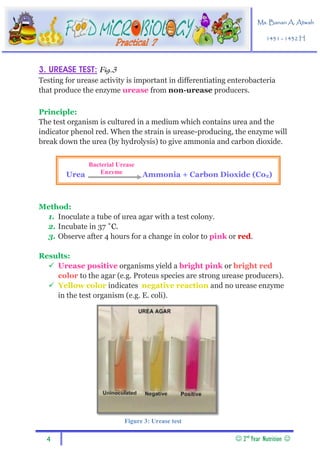
3. UREASE TEST: Fig.3
Testing for urease activity is important in differentiating enterobacteria
that produce the enzyme urease from non-urease producers.
Principle:
The test organism is cultured in a medium which contains urea and the
indicator phenol red. When the strain is urease-producing, the enzyme will
break down the urea (by hydrolysis) to give ammonia and carbon dioxide.
Method:
1. Inoculate a tube of urea agar with a test colony.
2. Incubate in 37 ˚C.
3. Observe after 4 hours for a change in color to pink or red.
Results:
 Urease positive organisms yield a bright pink or bright red
color to the agar (e.g. Proteus species are strong urease producers).
 Yellow color indicates negative reaction and no urease enzyme
in the test organism (e.g. E. coli).
Urea Ammonia + Carbon Dioxide (Co2)
Bacterial Urease
Enzyme
Figure 3: Urease test
5  2nd
Year Nutrition 
Practical 7
Ms. Banan A. Atwah
1431 - 1432 H
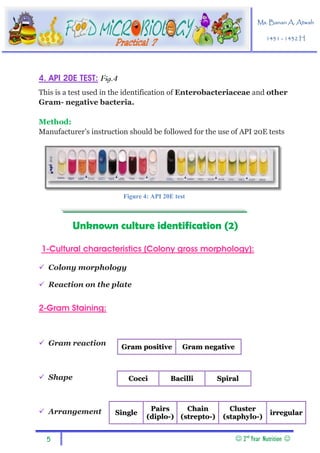
4. API 20E TEST: Fig.4
This is a test used in the identification of Enterobacteriaceae and other
Gram- negative bacteria.
Method:
Manufacturer’s instruction should be followed for the use of API 20E tests
Unknown culture identification (2)
Cultural characteristics (Colony gross morphology):-1
 Colony morphology
 Reaction on the plate
Gram Staining:-2
 Gram reaction
 Shape
 Arrangement
GGrraamm nneeggaattiivveeGGrraamm ppoossiittiivvee
CCooccccii BBaacciillllii SSppiirraall
SSiinnggllee
PPaaiirrss
((ddiipplloo--))
CChhaaiinn
((ssttrreeppttoo--))
CClluusstteerr
((ssttaapphhyylloo--))
iirrrreegguullaarr
Figure 4: API 20E test
6  2nd
Year Nutrition 
Practical 7
Ms. Banan A. Atwah
1431 - 1432 H
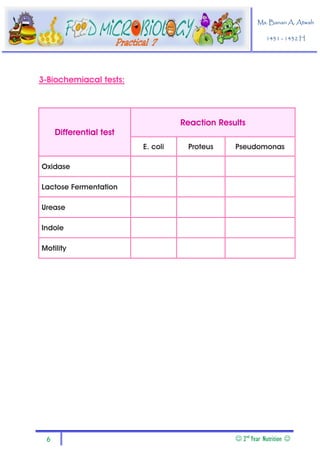
:sBiochemiacal test-3
Reaction Results
Differential test
PseudomonasProteusE. coli
Oxidase
Lactose Fermentation
Urease
Indole
Motility
7  2nd
Year Nutrition 
Practical 7
Ms. Banan A. Atwah
1431 - 1432 H
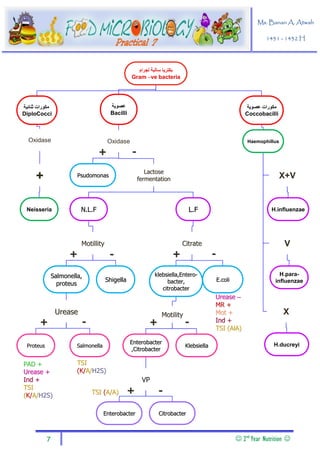
‫لجرام‬ ‫سالبة‬ ‫بكتريا‬
Gram –ve bacteria
‫ثنائية‬ ‫مكورات‬
DiploCocci
‫عصوية‬
Bacilli
‫عصوية‬ ‫مكورات‬
Coccobacilli
Oxidase
+
Neisseria
Oxidase Haemophillus
X+V
V
X
H.influenzae
H.para-
influenzae
H.ducreyi
--
--++
--
++
++
UUrreeaassee ––
MMRR ++
MMoott ++
IInndd ++
TTSSII ((AAllAA))
PPssuuddoommoonnaass
++
--
LLaaccttoossee
ffeerrmmeennttaattiioonn
NN..LL..FF LL..FF
CCiittrraattee
kklleebbssiieellllaa,,EEnntteerroo--
bbaacctteerr,,
cciittrroobbaacctteerr
EE..ccoollii
MMoottiilliittyy
EEnntteerroobbaacctteerr
,,CCiittrroobbaacctteerr
KKlleebbssiieellllaa
VVPP
MMoottiilllliittyy
EEnntteerroobbaacctteerr CCiittrroobbaacctteerr
SSaallmmoonneellllaa,,
pprrootteeuuss
SShhiiggeellllaa
UUrreeaassee
PPrrootteeuuss SSaallmmoonneellllaa
PPAADD ++
UUrreeaassee ++
IInndd ++
TTSSII
((KK//AA//HH22SS))
TTSSII
((KK//AA//HH22SS))
--
--++
++ --
TTSSII ((AA//AA))

Identification_of_gram_-ve_bacteria

  • 1.
    1  2nd YearNutrition  Practical 7 Ms. Banan A. Atwah 1431 - 1432 H IDENTIFICATION OF GRAM NEGATIVE BACTERIA 1. Objectives:  To know the major biochemical tests used in microbiology.  To be familiar with the basic principles of those biochemical tests.  To be able to read the positive and negative tests results.  To know the application of those tests in identification of gram negative bacteria. . Materials:2 1. Set of Gram stain 2. Glass slides 3. Wire loop 4. Normal saline 5. Culture of E.coli on blood agar 6. Culture of Klebsiella on blood agar 7. Culture of Pseudomonas species on blood agar 8. Culture of Proteus species on blood agar 9. 3% H2O2 (hydrogen peroxide) reagent 10. Wooden sticks 11. Human plasma and agglutination paper
  • 2.
    2  2nd YearNutrition  Practical 7 Ms. Banan A. Atwah 1431 - 1432 H 3. Method: 1. Oxidase test: Fig.1 This test is used to differentiate those bacteria that produce the enzyme Oxidase from non-oxidase producer bacteria. Method of the test: 1. Place a piece of filter paper in a clean petri dish. 2. Add 2 or 3 drops of oxidase reagent on the filter paper. 3. Using a wooden stick, smear a colony of the test organism across the reagent on the filter paper. 4. Observe for a color change to a deep blue-purple within 10 seconds. Results:  If the filter paper shows deep blue-purple within 10 seconds  positive (ignore any blue-purple color that develops after 10 seconds).  If no color appears within 10 seconds the reaction is  Negative.  Pseudomonas, Neisseria, Vibrio and Brucella species  Oxidase positive.  Escherichia coli and other Enterobacteriaceae  Oxidase negative. Phenylenediamine Deep purple color Oxidase Enz. Figure 1: Oxidase test
  • 3.
    3  2nd YearNutrition  Practical 7 Ms. Banan A. Atwah 1431 - 1432 H 2. INDOLE TEST: Fig.2 It is important for identification of enterobacteria. Principle: The test organism is cultured in a medium which contains tryptophan. This amino acid (Tryptophan) is broken down and indole is released. Indole production is detected Kovac’s reagent which contains 4 (p)- dimethylaminobenzaldehyde which reacts with the indole to produce colored compound. Method: 1. Prepare peptone water. 2. Inoculate the test colony to the tube containing peptone water. 3. Incubate overnight in 37 ˚C. 4. After incubation period, add drops of Kovac’s reagent to the tube. 5. Shake gently and then examine for a red color (red ring) in the surface layer within 10 minutes. Results:  After adding kavoc’s reagent, if red ring appears  positive result for indole production (e.g. E.coli).  If the reagent remain as yellow ring  it is negative and no indole produced. . Tryptophan Indole productionbacterial Enzyme Figure 2: Indole test + v _
  • 4.
    4  2nd YearNutrition  Practical 7 Ms. Banan A. Atwah 1431 - 1432 H 3. UREASE TEST: Fig.3 Testing for urease activity is important in differentiating enterobacteria that produce the enzyme urease from non-urease producers. Principle: The test organism is cultured in a medium which contains urea and the indicator phenol red. When the strain is urease-producing, the enzyme will break down the urea (by hydrolysis) to give ammonia and carbon dioxide. Method: 1. Inoculate a tube of urea agar with a test colony. 2. Incubate in 37 ˚C. 3. Observe after 4 hours for a change in color to pink or red. Results:  Urease positive organisms yield a bright pink or bright red color to the agar (e.g. Proteus species are strong urease producers).  Yellow color indicates negative reaction and no urease enzyme in the test organism (e.g. E. coli). Urea Ammonia + Carbon Dioxide (Co2) Bacterial Urease Enzyme Figure 3: Urease test
  • 5.
    5  2nd YearNutrition  Practical 7 Ms. Banan A. Atwah 1431 - 1432 H 4. API 20E TEST: Fig.4 This is a test used in the identification of Enterobacteriaceae and other Gram- negative bacteria. Method: Manufacturer’s instruction should be followed for the use of API 20E tests Unknown culture identification (2) Cultural characteristics (Colony gross morphology):-1  Colony morphology  Reaction on the plate Gram Staining:-2  Gram reaction  Shape  Arrangement GGrraamm nneeggaattiivveeGGrraamm ppoossiittiivvee CCooccccii BBaacciillllii SSppiirraall SSiinnggllee PPaaiirrss ((ddiipplloo--)) CChhaaiinn ((ssttrreeppttoo--)) CClluusstteerr ((ssttaapphhyylloo--)) iirrrreegguullaarr Figure 4: API 20E test
  • 6.
    6  2nd YearNutrition  Practical 7 Ms. Banan A. Atwah 1431 - 1432 H :sBiochemiacal test-3 Reaction Results Differential test PseudomonasProteusE. coli Oxidase Lactose Fermentation Urease Indole Motility
  • 7.
    7  2nd YearNutrition  Practical 7 Ms. Banan A. Atwah 1431 - 1432 H ‫لجرام‬ ‫سالبة‬ ‫بكتريا‬ Gram –ve bacteria ‫ثنائية‬ ‫مكورات‬ DiploCocci ‫عصوية‬ Bacilli ‫عصوية‬ ‫مكورات‬ Coccobacilli Oxidase + Neisseria Oxidase Haemophillus X+V V X H.influenzae H.para- influenzae H.ducreyi -- --++ -- ++ ++ UUrreeaassee –– MMRR ++ MMoott ++ IInndd ++ TTSSII ((AAllAA)) PPssuuddoommoonnaass ++ -- LLaaccttoossee ffeerrmmeennttaattiioonn NN..LL..FF LL..FF CCiittrraattee kklleebbssiieellllaa,,EEnntteerroo-- bbaacctteerr,, cciittrroobbaacctteerr EE..ccoollii MMoottiilliittyy EEnntteerroobbaacctteerr ,,CCiittrroobbaacctteerr KKlleebbssiieellllaa VVPP MMoottiilllliittyy EEnntteerroobbaacctteerr CCiittrroobbaacctteerr SSaallmmoonneellllaa,, pprrootteeuuss SShhiiggeellllaa UUrreeaassee PPrrootteeuuss SSaallmmoonneellllaa PPAADD ++ UUrreeaassee ++ IInndd ++ TTSSII ((KK//AA//HH22SS)) TTSSII ((KK//AA//HH22SS)) -- --++ ++ -- TTSSII ((AA//AA))