CultureCulture
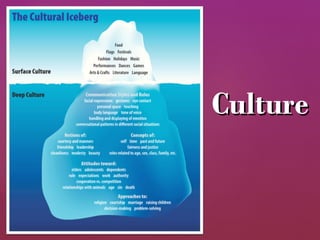
 Culture is a group of belief systems, normsCulture is a group of belief systems, norms
& values practiced by a people.& values practiced by a people.
 PervasivePervasive
 Difficult to perceive from “inside”Difficult to perceive from “inside”
 Have you ever said “I thought everyone did that.”Have you ever said “I thought everyone did that.”
 LearnedLearned
 Transmitted through socializationTransmitted through socialization
 SharedShared
 What makes “us” different from “them”What makes “us” different from “them”
 ContestedContested
 Culture includes forms of social control & oppression thatCulture includes forms of social control & oppression that
are resisted & negotiated by those in the subordinateare resisted & negotiated by those in the subordinate
positionposition
 ContestationContestation  occasional shifts in cultural normsoccasional shifts in cultural norms
CultureCulture
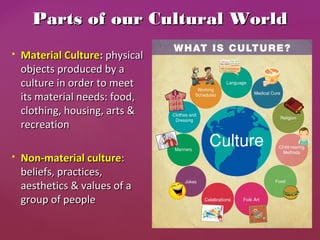
 Material CultureMaterial Culture:: physicalphysical
objects produced by aobjects produced by a
culture in order to meetculture in order to meet
its material needs: food,its material needs: food,
clothing, housing, arts &clothing, housing, arts &
recreationrecreation
 Non-material cultureNon-material culture::
beliefs, practices,beliefs, practices,
aesthetics & values of aaesthetics & values of a
group of peoplegroup of people
Parts of our Cultural WorldParts of our Cultural World
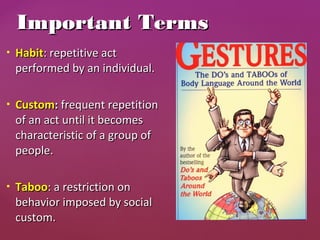
 HabitHabit: repetitive act: repetitive act
performed by an individual.performed by an individual.
 CustomCustom:: frequent repetitionfrequent repetition
of an act until it becomesof an act until it becomes
characteristic of a group ofcharacteristic of a group of
people.people.
 TabooTaboo: a restriction on: a restriction on
behavior imposed by socialbehavior imposed by social
custom.custom.
Important TermsImportant Terms
Folk andFolk and
PopularPopular
CultureCulture
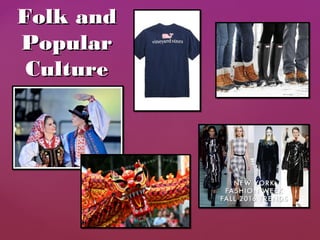
• Folk CultureFolk Culture: traditionally practiced: traditionally practiced
by a small, homogeneous, rural groupby a small, homogeneous, rural group
living in relative isolation.living in relative isolation.
• Popular CulturePopular Culture:: found in a large,found in a large,
heterogeneous society that sharesheterogeneous society that shares
certain habits despite differences incertain habits despite differences in
personal characteristics.personal characteristics.
Two Subdivisions ofTwo Subdivisions of
CultureCulture
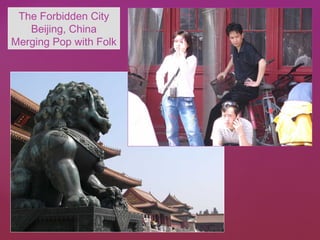
The Forbidden City
Beijing, China
Merging Pop with Folk
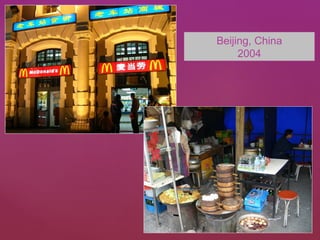
Beijing, China
2004
Folk Practices in the ModernFolk Practices in the Modern
WorldWorld
Modern Haka
Dance
Traditional
Haka Dance
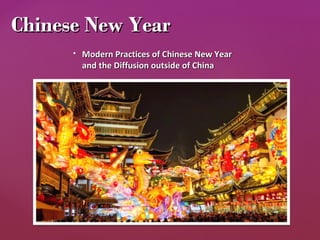
 Modern Practices of Chinese New YearModern Practices of Chinese New Year
and the Diffusion outside of Chinaand the Diffusion outside of China
Chinese New YearChinese New Year
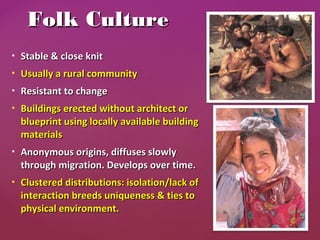
 Stable & close knitStable & close knit
 Usually a rural communityUsually a rural community
 Resistant to changeResistant to change
 Buildings erected without architect orBuildings erected without architect or
blueprint using locally available buildingblueprint using locally available building
materialsmaterials
 Anonymous origins, diffuses slowlyAnonymous origins, diffuses slowly
through migration. Develops over time.through migration. Develops over time.
 Clustered distributions: isolation/lack ofClustered distributions: isolation/lack of
interaction breeds uniqueness & ties tointeraction breeds uniqueness & ties to
physical environment.physical environment.
Folk CultureFolk Culture
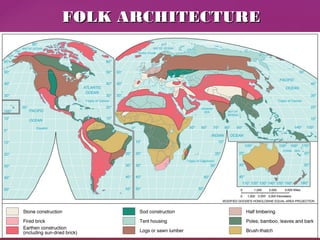
FOLK ARCHITECTUREFOLK ARCHITECTURE
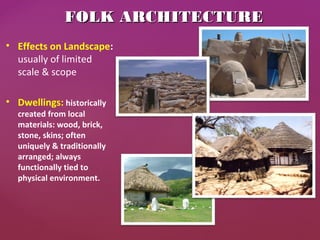
• Effects on Landscape:
usually of limited
scale & scope
• Dwellings: historically
created from local
materials: wood, brick,
stone, skins; often
uniquely & traditionally
arranged; always
functionally tied to
physical environment.
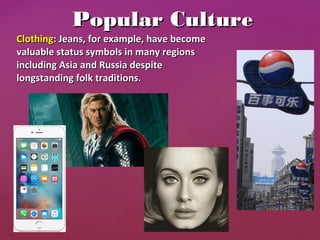
ClothingClothing: Jeans, for example, have become: Jeans, for example, have become
valuable status symbols in many regionsvaluable status symbols in many regions
including Asia and Russia despiteincluding Asia and Russia despite
longstanding folk traditions.longstanding folk traditions.
Popular CulturePopular Culture
Fashion Video ClipFashion Video Clip
100 Years of Fashion100 Years of Fashion
100 Years of Korean Beauty Trends100 Years of Korean Beauty Trends
Korean BeautyKorean Beauty
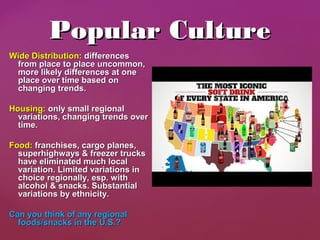
Wide Distribution:Wide Distribution: differencesdifferences
from place to place uncommon,from place to place uncommon,
more likely differences at onemore likely differences at one
place over time based onplace over time based on
changing trends.changing trends.
Housing:Housing: only small regionalonly small regional
variations, changing trends overvariations, changing trends over
time.time.
Food:Food: franchises, cargo planes,franchises, cargo planes,
superhighways & freezer truckssuperhighways & freezer trucks
have eliminated much localhave eliminated much local
variation. Limited variations invariation. Limited variations in
choice regionally, esp. withchoice regionally, esp. with
alcohol & snacks. Substantialalcohol & snacks. Substantial
variations by ethnicity.variations by ethnicity.
Can you think of any regionalCan you think of any regional
foods/snacks in the U.S.?foods/snacks in the U.S.?
Popular CulturePopular Culture
Pepsi in MongoliaPepsi in Mongolia
Video ClipVideo Clip
Food Capitals MapsFood Capitals Maps
Food Capitals of theFood Capitals of the
WorldWorld
According to InstagramAccording to Instagram
Effects on Landscape:Effects on Landscape:
creates homogenous,creates homogenous,
“placeless”“placeless” landscapelandscape
• Complex network ofComplex network of
roads and highwaysroads and highways
• CommercialCommercial
structures tendstructures tend
towards ‘boxes’towards ‘boxes’
PopularPopular
CultureCulture
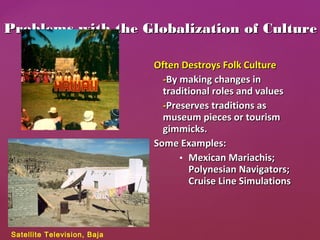
Often Destroys Folk CultureOften Destroys Folk Culture
--By making changes inBy making changes in
traditional roles and valuestraditional roles and values
--Preserves traditions asPreserves traditions as
museum pieces or tourismmuseum pieces or tourism
gimmicks.gimmicks.
Some Examples:Some Examples:
• Mexican Mariachis;Mexican Mariachis;
Polynesian Navigators;Polynesian Navigators;
Cruise Line SimulationsCruise Line Simulations
Problems with the Globalization of CultureProblems with the Globalization of Culture
Satellite Television, Baja

APHG Unit 3: Culture

  • 1.
  • 2.
     Culture isa group of belief systems, normsCulture is a group of belief systems, norms & values practiced by a people.& values practiced by a people.  PervasivePervasive  Difficult to perceive from “inside”Difficult to perceive from “inside”  Have you ever said “I thought everyone did that.”Have you ever said “I thought everyone did that.”  LearnedLearned  Transmitted through socializationTransmitted through socialization  SharedShared  What makes “us” different from “them”What makes “us” different from “them”  ContestedContested  Culture includes forms of social control & oppression thatCulture includes forms of social control & oppression that are resisted & negotiated by those in the subordinateare resisted & negotiated by those in the subordinate positionposition  ContestationContestation  occasional shifts in cultural normsoccasional shifts in cultural norms CultureCulture
  • 3.
     Material CultureMaterialCulture:: physicalphysical objects produced by aobjects produced by a culture in order to meetculture in order to meet its material needs: food,its material needs: food, clothing, housing, arts &clothing, housing, arts & recreationrecreation  Non-material cultureNon-material culture:: beliefs, practices,beliefs, practices, aesthetics & values of aaesthetics & values of a group of peoplegroup of people Parts of our Cultural WorldParts of our Cultural World
  • 4.
     HabitHabit: repetitiveact: repetitive act performed by an individual.performed by an individual.  CustomCustom:: frequent repetitionfrequent repetition of an act until it becomesof an act until it becomes characteristic of a group ofcharacteristic of a group of people.people.  TabooTaboo: a restriction on: a restriction on behavior imposed by socialbehavior imposed by social custom.custom. Important TermsImportant Terms
  • 5.
  • 6.
    • Folk CultureFolkCulture: traditionally practiced: traditionally practiced by a small, homogeneous, rural groupby a small, homogeneous, rural group living in relative isolation.living in relative isolation. • Popular CulturePopular Culture:: found in a large,found in a large, heterogeneous society that sharesheterogeneous society that shares certain habits despite differences incertain habits despite differences in personal characteristics.personal characteristics. Two Subdivisions ofTwo Subdivisions of CultureCulture
  • 7.
    The Forbidden City Beijing,China Merging Pop with Folk
  • 9.
  • 10.
    Folk Practices inthe ModernFolk Practices in the Modern WorldWorld Modern Haka Dance Traditional Haka Dance
  • 11.
     Modern Practicesof Chinese New YearModern Practices of Chinese New Year and the Diffusion outside of Chinaand the Diffusion outside of China Chinese New YearChinese New Year
  • 12.
     Stable &close knitStable & close knit  Usually a rural communityUsually a rural community  Resistant to changeResistant to change  Buildings erected without architect orBuildings erected without architect or blueprint using locally available buildingblueprint using locally available building materialsmaterials  Anonymous origins, diffuses slowlyAnonymous origins, diffuses slowly through migration. Develops over time.through migration. Develops over time.  Clustered distributions: isolation/lack ofClustered distributions: isolation/lack of interaction breeds uniqueness & ties tointeraction breeds uniqueness & ties to physical environment.physical environment. Folk CultureFolk Culture
  • 13.
  • 14.
    FOLK ARCHITECTUREFOLK ARCHITECTURE •Effects on Landscape: usually of limited scale & scope • Dwellings: historically created from local materials: wood, brick, stone, skins; often uniquely & traditionally arranged; always functionally tied to physical environment.
  • 15.
    ClothingClothing: Jeans, forexample, have become: Jeans, for example, have become valuable status symbols in many regionsvaluable status symbols in many regions including Asia and Russia despiteincluding Asia and Russia despite longstanding folk traditions.longstanding folk traditions. Popular CulturePopular Culture
  • 16.
    Fashion Video ClipFashionVideo Clip 100 Years of Fashion100 Years of Fashion
  • 17.
    100 Years ofKorean Beauty Trends100 Years of Korean Beauty Trends Korean BeautyKorean Beauty
  • 18.
    Wide Distribution:Wide Distribution:differencesdifferences from place to place uncommon,from place to place uncommon, more likely differences at onemore likely differences at one place over time based onplace over time based on changing trends.changing trends. Housing:Housing: only small regionalonly small regional variations, changing trends overvariations, changing trends over time.time. Food:Food: franchises, cargo planes,franchises, cargo planes, superhighways & freezer truckssuperhighways & freezer trucks have eliminated much localhave eliminated much local variation. Limited variations invariation. Limited variations in choice regionally, esp. withchoice regionally, esp. with alcohol & snacks. Substantialalcohol & snacks. Substantial variations by ethnicity.variations by ethnicity. Can you think of any regionalCan you think of any regional foods/snacks in the U.S.?foods/snacks in the U.S.? Popular CulturePopular Culture
  • 19.
    Pepsi in MongoliaPepsiin Mongolia Video ClipVideo Clip
  • 20.
    Food Capitals MapsFoodCapitals Maps Food Capitals of theFood Capitals of the WorldWorld According to InstagramAccording to Instagram
  • 21.
    Effects on Landscape:Effectson Landscape: creates homogenous,creates homogenous, “placeless”“placeless” landscapelandscape • Complex network ofComplex network of roads and highwaysroads and highways • CommercialCommercial structures tendstructures tend towards ‘boxes’towards ‘boxes’ PopularPopular CultureCulture
  • 22.
    Often Destroys FolkCultureOften Destroys Folk Culture --By making changes inBy making changes in traditional roles and valuestraditional roles and values --Preserves traditions asPreserves traditions as museum pieces or tourismmuseum pieces or tourism gimmicks.gimmicks. Some Examples:Some Examples: • Mexican Mariachis;Mexican Mariachis; Polynesian Navigators;Polynesian Navigators; Cruise Line SimulationsCruise Line Simulations Problems with the Globalization of CultureProblems with the Globalization of Culture Satellite Television, Baja