Cassandra
part 2
diegopacheco
@diego_pacheco
Diego Pacheco
@diego_pacheco
❏ Cat's Father
❏ Principal Software Architect
❏ Agile Coach
❏ SOA Expert
❏ DevOps Practitioner
❏ Speaker
❏ Author
diegopacheco
http://diego-pacheco.blogspot.com.br/
https://goo.gl/eEqvzl
About me...
Agenda
❏ RE-CAP
❏ Cassandra Write Path
❏ Tombstones
❏ Compaction Strategies
❏ Row Cache
❏ Bloom Filter
❏ SASI Index
❏ Materialized Views
❏ Counter Families
❏ Anti-Patterns
❏ Cassandra running at UBER in MESOS use case
❏ Q&A
http://cassandra.apache.org/
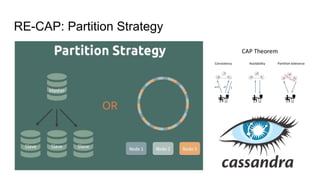
RE-CAP: Partition Strategy
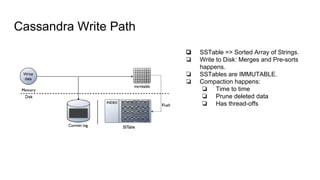
Cassandra Write Path
❏ SSTable => Sorted Array of Strings.
❏ Write to Disk: Merges and Pre-sorts
happens.
❏ SSTables are IMMUTABLE.
❏ Compaction happens:
❏ Time to time
❏ Prune deleted data
❏ Has thread-offs
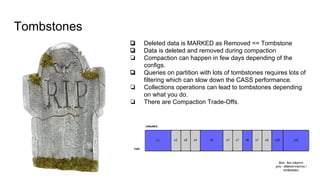
Tombstones
❏ Deleted data is MARKED as Removed == Tombstone
❏ Data is deleted and removed during compaction
❏ Compaction can happen in few days depending of the
configs.
❏ Queries on partition with lots of tombstones requires lots of
filtering which can slow down the CASS performance.
❏ Collections operations can lead to tombstones depending
on what you do.
❏ There are Compaction Trade-Offs.
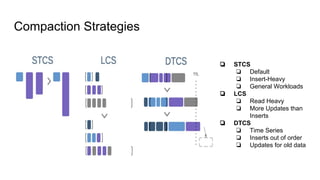
Compaction Strategies
❏ STCS
❏ Default
❏ Insert-Heavy
❏ General Workloads
❏ LCS
❏ Read Heavy
❏ More Updates than
Inserts
❏ DTCS
❏ Time Series
❏ Inserts out of order
❏ Updates for old data
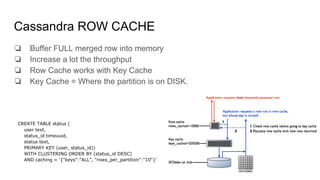
Cassandra ROW CACHE
❏ Buffer FULL merged row into memory
❏ Increase a lot the throughput
❏ Row Cache works with Key Cache
❏ Key Cache = Where the partition is on DISK.
CREATE TABLE status (
user text,
status_id timeuuid,
status text,
PRIMARY KEY (user, status_id))
WITH CLUSTERING ORDER BY (status_id DESC)
AND caching = '{"keys":"ALL", "rows_per_partition":"10"}'
Cassandra Bloom Filter
❏ Bloom Filter: Technique created on the 70s to filter db matches.
❏ Space Efficient
❏ Probabilistic Data Structures
❏ For each SSTable there is a Bloom Filter
❏ Used for Index scans - not used to range scans
❏ Stored OFF HEAP
❏ Tunable per TABLE
❏ Cassandra uses bloom filters to know if the data is on the ROW or not.
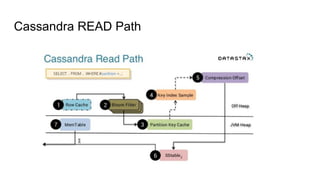
Cassandra READ Path
SASI
❏ Secondary Index: Not the primary key.
❏ Lookup tables: bySomething
❏ Distributed Index
❏ Search Like Capabilities: %diego%
❏ Great when:
❏ Multi fields Search
❏ You know the partition key
❏ Indexing static columns
❏ Issues:
❏ More than 1000 rows returned
❏ Searching in Large Partitions
❏ Aggressive Read SLOs
❏ Search for Analytics(Use Spark/Flink)
❏ Ordering Search is important
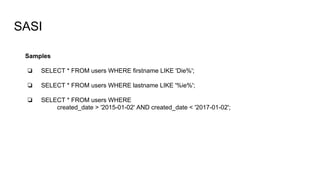
SASI
Samples
❏ SELECT * FROM users WHERE firstname LIKE 'Die%';
❏ SELECT * FROM users WHERE lastname LIKE '%ie%';
❏ SELECT * FROM users WHERE
created_date > '2015-01-02' AND created_date < '2017-01-02';
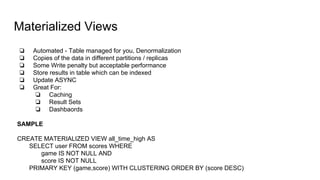
Materialized Views
❏ Automated - Table managed for you, Denormalization
❏ Copies of the data in different partitions / replicas
❏ Some Write penalty but acceptable performance
❏ Store results in table which can be indexed
❏ Update ASYNC
❏ Great For:
❏ Caching
❏ Result Sets
❏ Dashbaords
SAMPLE
CREATE MATERIALIZED VIEW all_time_high AS
SELECT user FROM scores WHERE
game IS NOT NULL AND
score IS NOT NULL
PRIMARY KEY (game,score) WITH CLUSTERING ORDER BY (score DESC)
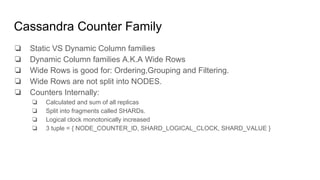
Cassandra Counter Family
❏ Static VS Dynamic Column families
❏ Dynamic Column families A.K.A Wide Rows
❏ Wide Rows is good for: Ordering,Grouping and Filtering.
❏ Wide Rows are not split into NODES.
❏ Counters Internally:
❏ Calculated and sum of all replicas
❏ Split into fragments called SHARDs.
❏ Logical clock monotonically increased
❏ 3 tuple = { NODE_COUNTER_ID, SHARD_LOGICAL_CLOCK, SHARD_VALUE }
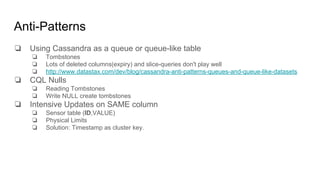
Anti-Patterns
❏ Using Cassandra as a queue or queue-like table
❏ Tombstones
❏ Lots of deleted columns(expiry) and slice-queries don't play well
❏ http://www.datastax.com/dev/blog/cassandra-anti-patterns-queues-and-queue-like-datasets
❏ CQL Nulls
❏ Reading Tombstones
❏ Write NULL create tombstones
❏ Intensive Updates on SAME column
❏ Sensor table (ID,VALUE)
❏ Physical Limits
❏ Solution: Timestamp as cluster key.
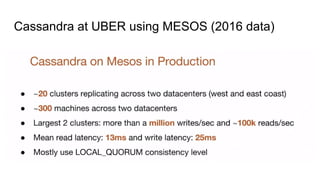
Cassandra at UBER using MESOS (2016 data)
Cassandra
part 2
diegopacheco
@diego_pacheco
Diego Pacheco

Apache Cassandra - part 2

  • 1.
  • 2.
    @diego_pacheco ❏ Cat's Father ❏Principal Software Architect ❏ Agile Coach ❏ SOA Expert ❏ DevOps Practitioner ❏ Speaker ❏ Author diegopacheco http://diego-pacheco.blogspot.com.br/ https://goo.gl/eEqvzl About me...
  • 3.
    Agenda ❏ RE-CAP ❏ CassandraWrite Path ❏ Tombstones ❏ Compaction Strategies ❏ Row Cache ❏ Bloom Filter ❏ SASI Index ❏ Materialized Views ❏ Counter Families ❏ Anti-Patterns ❏ Cassandra running at UBER in MESOS use case ❏ Q&A
  • 4.
  • 5.
  • 6.
    Cassandra Write Path ❏SSTable => Sorted Array of Strings. ❏ Write to Disk: Merges and Pre-sorts happens. ❏ SSTables are IMMUTABLE. ❏ Compaction happens: ❏ Time to time ❏ Prune deleted data ❏ Has thread-offs
  • 7.
    Tombstones ❏ Deleted datais MARKED as Removed == Tombstone ❏ Data is deleted and removed during compaction ❏ Compaction can happen in few days depending of the configs. ❏ Queries on partition with lots of tombstones requires lots of filtering which can slow down the CASS performance. ❏ Collections operations can lead to tombstones depending on what you do. ❏ There are Compaction Trade-Offs.
  • 8.
    Compaction Strategies ❏ STCS ❏Default ❏ Insert-Heavy ❏ General Workloads ❏ LCS ❏ Read Heavy ❏ More Updates than Inserts ❏ DTCS ❏ Time Series ❏ Inserts out of order ❏ Updates for old data
  • 9.
    Cassandra ROW CACHE ❏Buffer FULL merged row into memory ❏ Increase a lot the throughput ❏ Row Cache works with Key Cache ❏ Key Cache = Where the partition is on DISK. CREATE TABLE status ( user text, status_id timeuuid, status text, PRIMARY KEY (user, status_id)) WITH CLUSTERING ORDER BY (status_id DESC) AND caching = '{"keys":"ALL", "rows_per_partition":"10"}'
  • 10.
    Cassandra Bloom Filter ❏Bloom Filter: Technique created on the 70s to filter db matches. ❏ Space Efficient ❏ Probabilistic Data Structures ❏ For each SSTable there is a Bloom Filter ❏ Used for Index scans - not used to range scans ❏ Stored OFF HEAP ❏ Tunable per TABLE ❏ Cassandra uses bloom filters to know if the data is on the ROW or not.
  • 11.
  • 12.
    SASI ❏ Secondary Index:Not the primary key. ❏ Lookup tables: bySomething ❏ Distributed Index ❏ Search Like Capabilities: %diego% ❏ Great when: ❏ Multi fields Search ❏ You know the partition key ❏ Indexing static columns ❏ Issues: ❏ More than 1000 rows returned ❏ Searching in Large Partitions ❏ Aggressive Read SLOs ❏ Search for Analytics(Use Spark/Flink) ❏ Ordering Search is important
  • 13.
    SASI Samples ❏ SELECT *FROM users WHERE firstname LIKE 'Die%'; ❏ SELECT * FROM users WHERE lastname LIKE '%ie%'; ❏ SELECT * FROM users WHERE created_date > '2015-01-02' AND created_date < '2017-01-02';
  • 14.
    Materialized Views ❏ Automated- Table managed for you, Denormalization ❏ Copies of the data in different partitions / replicas ❏ Some Write penalty but acceptable performance ❏ Store results in table which can be indexed ❏ Update ASYNC ❏ Great For: ❏ Caching ❏ Result Sets ❏ Dashbaords SAMPLE CREATE MATERIALIZED VIEW all_time_high AS SELECT user FROM scores WHERE game IS NOT NULL AND score IS NOT NULL PRIMARY KEY (game,score) WITH CLUSTERING ORDER BY (score DESC)
  • 15.
    Cassandra Counter Family ❏Static VS Dynamic Column families ❏ Dynamic Column families A.K.A Wide Rows ❏ Wide Rows is good for: Ordering,Grouping and Filtering. ❏ Wide Rows are not split into NODES. ❏ Counters Internally: ❏ Calculated and sum of all replicas ❏ Split into fragments called SHARDs. ❏ Logical clock monotonically increased ❏ 3 tuple = { NODE_COUNTER_ID, SHARD_LOGICAL_CLOCK, SHARD_VALUE }
  • 16.
    Anti-Patterns ❏ Using Cassandraas a queue or queue-like table ❏ Tombstones ❏ Lots of deleted columns(expiry) and slice-queries don't play well ❏ http://www.datastax.com/dev/blog/cassandra-anti-patterns-queues-and-queue-like-datasets ❏ CQL Nulls ❏ Reading Tombstones ❏ Write NULL create tombstones ❏ Intensive Updates on SAME column ❏ Sensor table (ID,VALUE) ❏ Physical Limits ❏ Solution: Timestamp as cluster key.
  • 17.
    Cassandra at UBERusing MESOS (2016 data)
  • 18.