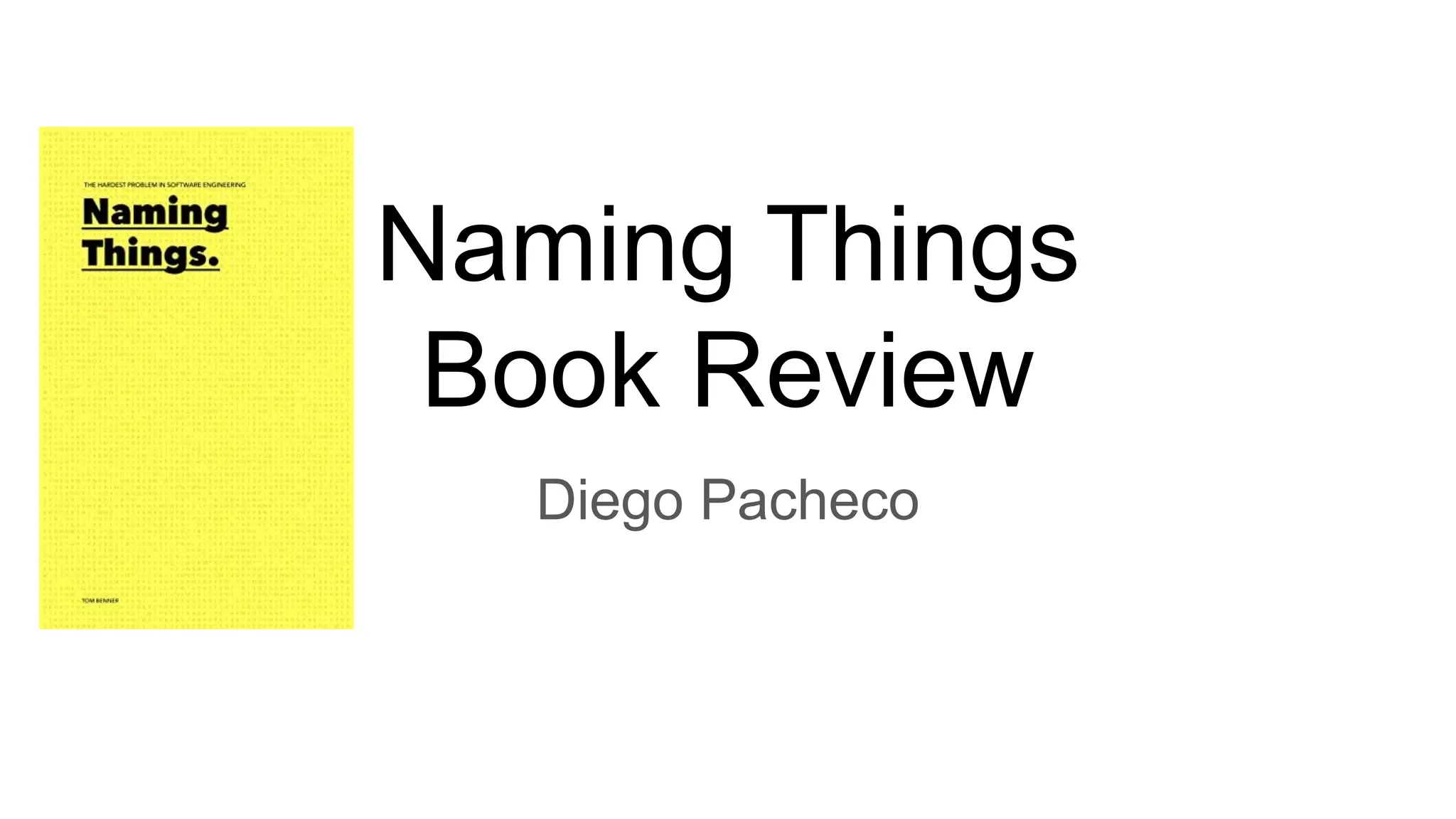
Naming Things
Book Review
Diego Pacheco
Book Scope / Impressions
❏ Name identifiers - classes, functions, and
variables
❏ “A bit of clean code feelings” but a bit better.
❏ Rules
❏ Samples
Understand code
❏ Maintenance takes 60-80% of the Code
❏ 40-60% of the time is spent trying to understand the Code
❏ 25-50% of the time is expended trying to make sense of software
❏ Identifiers (variables, classes, function names) are 70% of the code base.
❏ Identifiers influence:
❏ Comprehension: Engineer's ability to understand the Code's logic, structure, and purpose.
❏ Recall: Engineer's ability to remember the Code.
❏ Defer Resolution time: Engineers' time to fix a bug.
❏ Some research says fixing a bug with single-word identifiers vs multi-word identifiers: Multi-word people
were able to fix the bugs 14% faster.
❏ 19% found more defects faster when words were used as identifiers.
Understand code
Why naming is hard?
❏ Newly introduced concepts are often poorly described.
❏ Definitions often evolve over.
❏ Naming is bound to a domain that evolves over time
❏ Different engineers with different domain backgrounds will need to understand the naming
❏ Naming is a problem beyond software engineering (Brand Naming, Terminology Planning). Even
among the general public, there is little agreement on names.
❏ Studies say that the chance of two different people naming the same object the same is between
7-18%.
Naming Principles
❏ List of principles
❏ Understandability: A name should describe the concept that it represents.
❏ Conciseness: Only use the words necessary to express the concept.
❏ Consistency: Names should be used and formatted consistently.
❏ Distinguishability: The name should be visually and phonetically distinguishable from
another.
Rules :: Classes
Rules
❏ Include units in the measurement
❏ Avoid un-conventional single-letter names
❏ Avoid Abbreviations
❏ Avoid non-standard symbolic names “<<_>>”
❏ Avoid Cleverness (No Humor)
❏ The code should be boring
❏ Avoid the usage of temporary or irrelevant concepts (kill_em_all(processes))
❏ Consider if the audience is familiar with the term
Rules :: Conciseness
Conciseness
❏ Long identifiers take more time to read and process in your mind
❏ Rules
❏ Use the appropriate level of abstraction
❏ Details of implementation should not be present on the method name (because code
changes)
❏ Use words with rich meaning
❏ Omit metadata (name_string)
❏ Omit implementation details
❏ Omit Unnecessary words
Rules :: Consistency
Consistency
❏ Rules
❏ Obey popular conventions - Language conventions.
❏ Avoid synonyms
❏ Avoid abbreviations
❏ Use consistent antonyms (add/remove) - (install/uninstall)
Rules :: Distinguishability
Distinguishability
❏ Rules:
❏ Avoid homographs and near-homographs (multiple meanings), which are the same spelling
but have different meanings.
❏ invoice.check() # Bad
❏ invoice.validate() ; invoice.written_check() # Good
❏ Avoid Polysemy
❏ Avoid names with distinct technical and non-technical meanings (other examples: window,
event, transaction)
❏ class Class # BAD
❏ class Course #Good
Naming Things
Book Review
Diego Pacheco

Naming Things Book : Simple Book Review!

  • 1.
  • 2.
    Book Scope /Impressions ❏ Name identifiers - classes, functions, and variables ❏ “A bit of clean code feelings” but a bit better. ❏ Rules ❏ Samples
  • 3.
    Understand code ❏ Maintenancetakes 60-80% of the Code ❏ 40-60% of the time is spent trying to understand the Code ❏ 25-50% of the time is expended trying to make sense of software ❏ Identifiers (variables, classes, function names) are 70% of the code base. ❏ Identifiers influence: ❏ Comprehension: Engineer's ability to understand the Code's logic, structure, and purpose. ❏ Recall: Engineer's ability to remember the Code. ❏ Defer Resolution time: Engineers' time to fix a bug. ❏ Some research says fixing a bug with single-word identifiers vs multi-word identifiers: Multi-word people were able to fix the bugs 14% faster. ❏ 19% found more defects faster when words were used as identifiers.
  • 4.
  • 5.
    Why naming ishard? ❏ Newly introduced concepts are often poorly described. ❏ Definitions often evolve over. ❏ Naming is bound to a domain that evolves over time ❏ Different engineers with different domain backgrounds will need to understand the naming ❏ Naming is a problem beyond software engineering (Brand Naming, Terminology Planning). Even among the general public, there is little agreement on names. ❏ Studies say that the chance of two different people naming the same object the same is between 7-18%.
  • 6.
    Naming Principles ❏ Listof principles ❏ Understandability: A name should describe the concept that it represents. ❏ Conciseness: Only use the words necessary to express the concept. ❏ Consistency: Names should be used and formatted consistently. ❏ Distinguishability: The name should be visually and phonetically distinguishable from another.
  • 7.
  • 8.
    Rules ❏ Include unitsin the measurement ❏ Avoid un-conventional single-letter names ❏ Avoid Abbreviations ❏ Avoid non-standard symbolic names “<<_>>” ❏ Avoid Cleverness (No Humor) ❏ The code should be boring ❏ Avoid the usage of temporary or irrelevant concepts (kill_em_all(processes)) ❏ Consider if the audience is familiar with the term
  • 9.
    Rules :: Conciseness Conciseness ❏Long identifiers take more time to read and process in your mind ❏ Rules ❏ Use the appropriate level of abstraction ❏ Details of implementation should not be present on the method name (because code changes) ❏ Use words with rich meaning ❏ Omit metadata (name_string) ❏ Omit implementation details ❏ Omit Unnecessary words
  • 10.
    Rules :: Consistency Consistency ❏Rules ❏ Obey popular conventions - Language conventions. ❏ Avoid synonyms ❏ Avoid abbreviations ❏ Use consistent antonyms (add/remove) - (install/uninstall)
  • 11.
    Rules :: Distinguishability Distinguishability ❏Rules: ❏ Avoid homographs and near-homographs (multiple meanings), which are the same spelling but have different meanings. ❏ invoice.check() # Bad ❏ invoice.validate() ; invoice.written_check() # Good ❏ Avoid Polysemy ❏ Avoid names with distinct technical and non-technical meanings (other examples: window, event, transaction) ❏ class Class # BAD ❏ class Course #Good
  • 12.