Continuous Discovery Habits
Book Review
Diego Pacheco
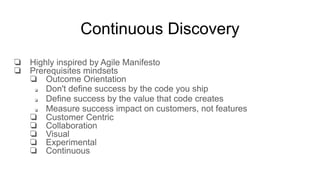
Continuous Discovery
❏ Highly inspired by Agile Manifesto
❏ Prerequisites mindsets
❏ Outcome Orientation
❏ Don't define success by the code you ship
❏ Define success by the value that code creates
❏ Measure success impact on customers, not features
❏ Customer Centric
❏ Collaboration
❏ Visual
❏ Experimental
❏ Continuous
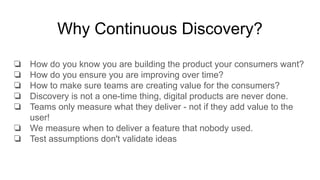
Why Continuous Discovery?
❏ How do you know you are building the product your consumers want?
❏ How do you ensure you are improving over time?
❏ How to make sure teams are creating value for the consumers?
❏ Discovery is not a one-time thing, digital products are never done.
❏ Teams only measure what they deliver - not if they add value to the
user!
❏ We measure when to deliver a feature that nobody used.
❏ Test assumptions don't validate ideas
How to do it?
❏ Product Trio: Manager, Designer, and Engineer (These are product people - this trio)
❏ Designers: Being visual and iterative ensures the users best know how to use the
system.
❏ Engineers: Make sure the product is reliable and stable
❏ Product Managers
The book is april 2021. Read my post feb 2020
http://diego-pacheco.blogspot.com/2020/02/multi-track-agile-with-tta.html
… or this one in 2019
http://diego-pacheco.blogspot.com/2019/09/modern-discovery-breaking-new-silos.html
Driving Outcomes
❏ "iLL-Structured-Problem"
❏ By definition have many solutions
❏ There are no right wrongs
❏ The customer-centric way by:
❏ Discover customer needs
❏ Pain Points
❏ Desires
❏ IF all addresses should drive business outcomes
❏ OST - Opportunity Solution Tree
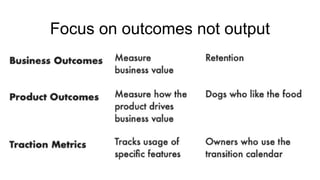
Focus on outcomes not output
❏ Avoid Anti-Patterns:
❏ Pursuing too many outcomes at once
❏ Ping-Pong from one outcome to another
❏ Setting individual outcomes rather than product trios outcomes
❏ Choosing an output over an outcome
❏ Focus on one outcome to determine all else
Workshops - Careful with groups…
Continuous Interviewing
❏ We do all fabricate reasons for your behaviors. (Santa Barbara, CA
research by Gazzaniga)
❏ So asking the customer to explain some behavior will get him some
reasonable fabricated answer to the real behavior.
❏ Primary interview questions should be:
❏ What are the needs of the customer
❏ What are the pain points for the customer
❏ What desires matter the most for the customer
❏ How to ask interview questions?
❏ Wrong: What criteria do you use to buy a pair of jeans?
❏ Right: What was the last time you bought a pair of jeans?
Ideation
❏ Researchers measure quality in 3 aspects:
❏ Fluency (the number of ideas we generate)
❏ Flexibility (how diverse the ideas are)
❏ Originality (how novel the idea is)
❏ Osborn 1953 brainstorm rules:
❏ Quantity: Generate as many ideas as you can.
❏ Defer judgment: Separate idea generation from judgment.
❏ Welcome unusual ideas, combine and improve
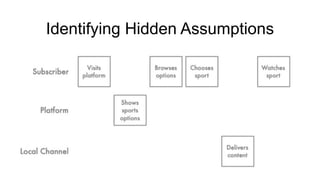
Identifying Hidden Assumptions
❏ For a 5 Story Map, we generate 20 assumptions. Think on:
❏ Desirability Assumptions
❏ Viability Assumptions
❏ Feasibility Assumptions
❏ Usability Assumptions
❏ Ethical Assumptions
❏ Conduct a Pre Mortem
❏ It's the opposite of the post-portem
❏ Generate Assumptions
❏ Testing Assumptions, not Ideas
Summary
❏ Backed by Agile manifesto ideas
❏ Lots of samples and data
❏ Practical advices
❏ Great book
Continuous Discovery Habits
Book Review
Diego Pacheco

Continuous Discovery Habits Book Review.pdf

  • 1.
  • 2.
    Continuous Discovery ❏ Highlyinspired by Agile Manifesto ❏ Prerequisites mindsets ❏ Outcome Orientation ❏ Don't define success by the code you ship ❏ Define success by the value that code creates ❏ Measure success impact on customers, not features ❏ Customer Centric ❏ Collaboration ❏ Visual ❏ Experimental ❏ Continuous
  • 3.
    Why Continuous Discovery? ❏How do you know you are building the product your consumers want? ❏ How do you ensure you are improving over time? ❏ How to make sure teams are creating value for the consumers? ❏ Discovery is not a one-time thing, digital products are never done. ❏ Teams only measure what they deliver - not if they add value to the user! ❏ We measure when to deliver a feature that nobody used. ❏ Test assumptions don't validate ideas
  • 4.
    How to doit? ❏ Product Trio: Manager, Designer, and Engineer (These are product people - this trio) ❏ Designers: Being visual and iterative ensures the users best know how to use the system. ❏ Engineers: Make sure the product is reliable and stable ❏ Product Managers The book is april 2021. Read my post feb 2020 http://diego-pacheco.blogspot.com/2020/02/multi-track-agile-with-tta.html … or this one in 2019 http://diego-pacheco.blogspot.com/2019/09/modern-discovery-breaking-new-silos.html
  • 5.
    Driving Outcomes ❏ "iLL-Structured-Problem" ❏By definition have many solutions ❏ There are no right wrongs ❏ The customer-centric way by: ❏ Discover customer needs ❏ Pain Points ❏ Desires ❏ IF all addresses should drive business outcomes ❏ OST - Opportunity Solution Tree
  • 6.
  • 7.
    Focus on outcomesnot output ❏ Avoid Anti-Patterns: ❏ Pursuing too many outcomes at once ❏ Ping-Pong from one outcome to another ❏ Setting individual outcomes rather than product trios outcomes ❏ Choosing an output over an outcome ❏ Focus on one outcome to determine all else
  • 8.
    Workshops - Carefulwith groups…
  • 9.
  • 10.
    Continuous Interviewing ❏ Wedo all fabricate reasons for your behaviors. (Santa Barbara, CA research by Gazzaniga) ❏ So asking the customer to explain some behavior will get him some reasonable fabricated answer to the real behavior. ❏ Primary interview questions should be: ❏ What are the needs of the customer ❏ What are the pain points for the customer ❏ What desires matter the most for the customer ❏ How to ask interview questions? ❏ Wrong: What criteria do you use to buy a pair of jeans? ❏ Right: What was the last time you bought a pair of jeans?
  • 11.
    Ideation ❏ Researchers measurequality in 3 aspects: ❏ Fluency (the number of ideas we generate) ❏ Flexibility (how diverse the ideas are) ❏ Originality (how novel the idea is) ❏ Osborn 1953 brainstorm rules: ❏ Quantity: Generate as many ideas as you can. ❏ Defer judgment: Separate idea generation from judgment. ❏ Welcome unusual ideas, combine and improve
  • 12.
  • 13.
    Identifying Hidden Assumptions ❏For a 5 Story Map, we generate 20 assumptions. Think on: ❏ Desirability Assumptions ❏ Viability Assumptions ❏ Feasibility Assumptions ❏ Usability Assumptions ❏ Ethical Assumptions ❏ Conduct a Pre Mortem ❏ It's the opposite of the post-portem ❏ Generate Assumptions ❏ Testing Assumptions, not Ideas
  • 14.
    Summary ❏ Backed byAgile manifesto ideas ❏ Lots of samples and data ❏ Practical advices ❏ Great book
  • 15.