Quoting, Paraphrasing and
      Summarizing

      An Introduction
What’s the difference?
Quotations must be identical
to the original. They must
match the source document
word for word and must be
attributed to the original
author.
What’s the difference?
Paraphrasing involves putting a
passage from source material into
your own words. A paraphrase must
also be attributed to the original
source. Paraphrased material is
usually shorter than the original
passage, taking a somewhat broader
segment of the source and
condensing it slightly.
What’s the difference?
Summarizing involves putting the
main idea(s) into your own words,
including only the main point(s).
Once again, it is necessary to
attribute summarized ideas to the
original source. Summaries are
significantly shorter than the
original and take a broad
overview of the source material.
Why should I use them?
provide support for claims or add
credibility to your writing
refer to work that leads up to the work
you are now doing
give examples of several points of
view on a subject
call attention to a position that you
wish to agree or disagree with
Why should I use them?
highlight a particularly striking phrase,
sentence, or passage by quoting the
original
distance yourself from the original by
quoting it in order to cue readers that
the words are not your own
expand the breadth or depth of your
writing
How do I start?
Read the entire text, noting the key
points and main ideas.
Summarize in your own words what
the single main idea of the essay is.
How do I start?
Paraphrase important supporting
points that come up in the essay.
Consider any words, phrases, or brief
passages that you believe should be
quoted directly
Paraphrasing
A paraphrase is...
  your own rendition of essential information and
  ideas expressed by someone else, presented in
  a new form.
  one legitimate way (when accompanied by
  accurate documentation) to borrow from a
  source.
  a more detailed restatement than a summary,
  which focuses concisely on a single main idea.
Paraphrasing
Paraphrasing is a valuable skill
 because...
 it is better than quoting information from
 an undistinguished passage.
 it helps you control the temptation to quote
 too much.
 the mental process required for successful
 paraphrasing helps you to grasp the full
 meaning of the original.
Paraphrasing
6 Steps to Effective Paraphrasing
 1. Reread the original passage until you
 understand its full meaning.
 2. Set the original aside, and write your
 paraphrase on a note card.
 3. Jot down a few words below your
 paraphrase to remind you later how you
 envision using this material. At the top of
 the note card, write a key word or phrase
 to indicate the subject of your paraphrase.
Paraphrasing
6 Steps to Effective Paraphrasing
 4. Check your rendition with the original to
 make sure that your version accurately
 expresses all the essential information in a
 new form.
 5. Use quotation marks to identify any
 unique term or phraseology you have
 borrowed exactly from the source.
 6. Record the source (including the page)
 on your note card so that you can credit it
 easily if you decide to incorporate the
 material into your paper.
Summarizing
A summary is much shorter than the
original text. It should communicate the
main idea of the text and the main
supporting points – written ‘in your own
words’. – in a very brief form. It should
give someone who has not read the
original a clear and accurate overview of
the text.
Summarizing
To summarize
 Record the author, title, year of publication and
 source of the text.
 Skim the text. Note any sub-headings, or try to
 divide the text into sections.
 Read the text carefully. Use a dictionary if
 necessary, and be prepared to read very difficult
 texts more than once.
 Pay special attention to the first and last
 paragraphs. Try to identify the main idea or
 argument.
Summarizing
To summarize
 Identify the topic sentence in each
 paragraph.
 Identify the main support for the topic
 sentence.
 Write the topic sentence of your summary.
  Include the author’s name, the title of the
 text, the year of publication and the
 author’s main idea or argument
What’s plagiarism?
Plagiarism is using others’ ideas and words without
clearly acknowledging the source of that information.

– To avoid plagiarism, you must give credit whenever you use:
another person’s idea, opinion, or theory;
any facts, statistics, graphs, drawings—any pieces of
information—that are not common knowledge;
quotations of another person’s actual spoken or written
words; or
paraphrase of another person’s spoken or written words.
Good or Bad?
Here’s the ORIGINAL text, from page 1 of Lizzie Borden:
A Case Book of Family and Crime in the 1890s by Joyce
Williams et al.:
The rise of industry, the growth of cities, and the
expansion of the population were the three great
developments of late nineteenth century American
history. As new, larger, steam-powered factories
became a feature of the American landscape in the
East, they transformed farm hands into industrial
laborers, and provided jobs for a rising tide of
immigrants. With industry came urbanization the
growth of large cities (like Fall River, Massachusetts,
where the Bordens lived) which became the centers
of production as well as of commerce and trade.
Good or Bad?
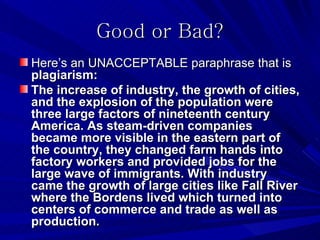
Here’s an UNACCEPTABLE paraphrase that is
plagiarism:
The increase of industry, the growth of cities,
and the explosion of the population were
three large factors of nineteenth century
America. As steam-driven companies
became more visible in the eastern part of
the country, they changed farm hands into
factory workers and provided jobs for the
large wave of immigrants. With industry
came the growth of large cities like Fall River
where the Bordens lived which turned into
centers of commerce and trade as well as
production.
WHY????
The preceding passage is considered
plagiarism for two reasons:
The writer has only changed around a few
words and phrases, or changed the order
of the original’s sentences.
WHY????
The writer has failed to cite a source for
any of the ideas or facts.
If you do either or both of these things,
you are plagiarizing.
Good or Bad?
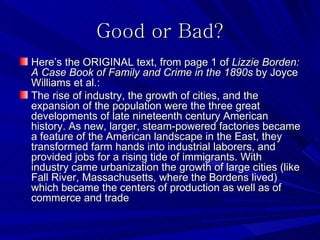
Here’s the ORIGINAL text, from page 1 of Lizzie Borden:
A Case Book of Family and Crime in the 1890s by Joyce
Williams et al.:
The rise of industry, the growth of cities, and the
expansion of the population were the three great
developments of late nineteenth century American
history. As new, larger, steam-powered factories became
a feature of the American landscape in the East, they
transformed farm hands into industrial laborers, and
provided jobs for a rising tide of immigrants. With
industry came urbanization the growth of large cities (like
Fall River, Massachusetts, where the Bordens lived)
which became the centers of production as well as of
commerce and trade
Good or Bad?
Here’s an ACCEPTABLE paraphrase:
Fall River, where the Borden family lived, was typical
of northeastern industrial cities of the nineteenth
century. Steam-powered production had shifted
labor from agriculture to manufacturing, and as
immigrants arrived in the US, they found work in
these new factories. As a result, populations grew,
and large urban areas arose. Fall River was one of
these manufacturing and commercial centers
(Williams 1).
WHY????
This is acceptable paraphrasing because
the writer:
accurately relays the information in the
original uses her own words.
lets the reader know the source of his/her
information.
Thank You

Quoting Paraphrasing And Summarizing

  • 1.
    Quoting, Paraphrasing and Summarizing An Introduction
  • 2.
    What’s the difference? Quotationsmust be identical to the original. They must match the source document word for word and must be attributed to the original author.
  • 3.
    What’s the difference? Paraphrasinginvolves putting a passage from source material into your own words. A paraphrase must also be attributed to the original source. Paraphrased material is usually shorter than the original passage, taking a somewhat broader segment of the source and condensing it slightly.
  • 4.
    What’s the difference? Summarizinginvolves putting the main idea(s) into your own words, including only the main point(s). Once again, it is necessary to attribute summarized ideas to the original source. Summaries are significantly shorter than the original and take a broad overview of the source material.
  • 5.
    Why should Iuse them? provide support for claims or add credibility to your writing refer to work that leads up to the work you are now doing give examples of several points of view on a subject call attention to a position that you wish to agree or disagree with
  • 6.
    Why should Iuse them? highlight a particularly striking phrase, sentence, or passage by quoting the original distance yourself from the original by quoting it in order to cue readers that the words are not your own expand the breadth or depth of your writing
  • 7.
    How do Istart? Read the entire text, noting the key points and main ideas. Summarize in your own words what the single main idea of the essay is.
  • 8.
    How do Istart? Paraphrase important supporting points that come up in the essay. Consider any words, phrases, or brief passages that you believe should be quoted directly
  • 9.
    Paraphrasing A paraphrase is... your own rendition of essential information and ideas expressed by someone else, presented in a new form. one legitimate way (when accompanied by accurate documentation) to borrow from a source. a more detailed restatement than a summary, which focuses concisely on a single main idea.
  • 10.
    Paraphrasing Paraphrasing is avaluable skill because... it is better than quoting information from an undistinguished passage. it helps you control the temptation to quote too much. the mental process required for successful paraphrasing helps you to grasp the full meaning of the original.
  • 11.
    Paraphrasing 6 Steps toEffective Paraphrasing 1. Reread the original passage until you understand its full meaning. 2. Set the original aside, and write your paraphrase on a note card. 3. Jot down a few words below your paraphrase to remind you later how you envision using this material. At the top of the note card, write a key word or phrase to indicate the subject of your paraphrase.
  • 12.
    Paraphrasing 6 Steps toEffective Paraphrasing 4. Check your rendition with the original to make sure that your version accurately expresses all the essential information in a new form. 5. Use quotation marks to identify any unique term or phraseology you have borrowed exactly from the source. 6. Record the source (including the page) on your note card so that you can credit it easily if you decide to incorporate the material into your paper.
  • 13.
    Summarizing A summary ismuch shorter than the original text. It should communicate the main idea of the text and the main supporting points – written ‘in your own words’. – in a very brief form. It should give someone who has not read the original a clear and accurate overview of the text.
  • 14.
    Summarizing To summarize Recordthe author, title, year of publication and source of the text. Skim the text. Note any sub-headings, or try to divide the text into sections. Read the text carefully. Use a dictionary if necessary, and be prepared to read very difficult texts more than once. Pay special attention to the first and last paragraphs. Try to identify the main idea or argument.
  • 15.
    Summarizing To summarize Identifythe topic sentence in each paragraph. Identify the main support for the topic sentence. Write the topic sentence of your summary. Include the author’s name, the title of the text, the year of publication and the author’s main idea or argument
  • 16.
    What’s plagiarism? Plagiarism isusing others’ ideas and words without clearly acknowledging the source of that information. – To avoid plagiarism, you must give credit whenever you use: another person’s idea, opinion, or theory; any facts, statistics, graphs, drawings—any pieces of information—that are not common knowledge; quotations of another person’s actual spoken or written words; or paraphrase of another person’s spoken or written words.
  • 17.
    Good or Bad? Here’sthe ORIGINAL text, from page 1 of Lizzie Borden: A Case Book of Family and Crime in the 1890s by Joyce Williams et al.: The rise of industry, the growth of cities, and the expansion of the population were the three great developments of late nineteenth century American history. As new, larger, steam-powered factories became a feature of the American landscape in the East, they transformed farm hands into industrial laborers, and provided jobs for a rising tide of immigrants. With industry came urbanization the growth of large cities (like Fall River, Massachusetts, where the Bordens lived) which became the centers of production as well as of commerce and trade.
  • 18.
    Good or Bad? Here’san UNACCEPTABLE paraphrase that is plagiarism: The increase of industry, the growth of cities, and the explosion of the population were three large factors of nineteenth century America. As steam-driven companies became more visible in the eastern part of the country, they changed farm hands into factory workers and provided jobs for the large wave of immigrants. With industry came the growth of large cities like Fall River where the Bordens lived which turned into centers of commerce and trade as well as production.
  • 19.
    WHY???? The preceding passageis considered plagiarism for two reasons: The writer has only changed around a few words and phrases, or changed the order of the original’s sentences.
  • 20.
    WHY???? The writer hasfailed to cite a source for any of the ideas or facts. If you do either or both of these things, you are plagiarizing.
  • 21.
    Good or Bad? Here’sthe ORIGINAL text, from page 1 of Lizzie Borden: A Case Book of Family and Crime in the 1890s by Joyce Williams et al.: The rise of industry, the growth of cities, and the expansion of the population were the three great developments of late nineteenth century American history. As new, larger, steam-powered factories became a feature of the American landscape in the East, they transformed farm hands into industrial laborers, and provided jobs for a rising tide of immigrants. With industry came urbanization the growth of large cities (like Fall River, Massachusetts, where the Bordens lived) which became the centers of production as well as of commerce and trade
  • 22.
    Good or Bad? Here’san ACCEPTABLE paraphrase: Fall River, where the Borden family lived, was typical of northeastern industrial cities of the nineteenth century. Steam-powered production had shifted labor from agriculture to manufacturing, and as immigrants arrived in the US, they found work in these new factories. As a result, populations grew, and large urban areas arose. Fall River was one of these manufacturing and commercial centers (Williams 1).
  • 23.
    WHY???? This is acceptableparaphrasing because the writer: accurately relays the information in the original uses her own words. lets the reader know the source of his/her information.
  • 24.