THE IRON COLT BECOMES an IRON HORSE
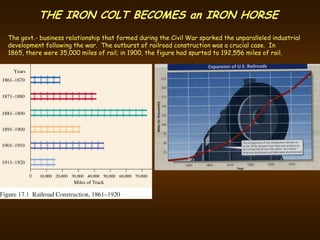
The govt.- business relationship that formed during the Civil War sparked the unparalleled industrial
development following the war. The outburst of railroad construction was a crucial case. In
1865, there were 35,000 miles of rail; in 1900, the figure had spurted to 192,556 miles of rail.
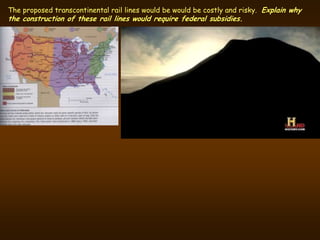
The proposed transcontinental rail lines would be would be costly and risky. Explain why
the construction of these rail lines would require federal subsidies.
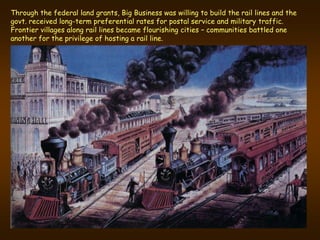
Through the federal land grants, Big Business was willing to build the rail lines and the
govt. received long-term preferential rates for postal service and military traffic.
Frontier villages along rail lines became flourishing cities – communities battled one
another for the privilege of hosting a rail line.
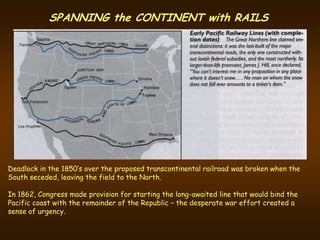
SPANNING the CONTINENT with RAILS


Deadlock in the 1850’s over the proposed transcontinental railroad was broken when the
South seceded, leaving the field to the North.

In 1862, Congress made provision for starting the long-awaited line that would bind the
Pacific coast with the remainder of the Republic – the desperate war effort created a
sense of urgency.
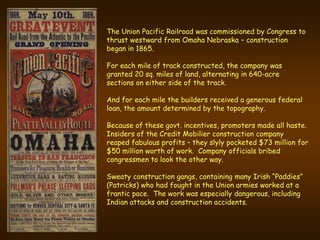
The Union Pacific Railroad was commissioned by Congress to
thrust westward from Omaha Nebraska – construction
began in 1865.

For each mile of track constructed, the company was
granted 20 sq. miles of land, alternating in 640-acre
sections on either side of the track.

And for each mile the builders received a generous federal
loan, the amount determined by the topography.

Because of these govt. incentives, promoters made all haste.
Insiders of the Credit Mobilier construction company
reaped fabulous profits – they slyly pocketed $73 million for
$50 million worth of work. Company officials bribed
congressmen to look the other way.

Sweaty construction gangs, containing many Irish “Paddies”
(Patricks) who had fought in the Union armies worked at a
frantic pace. The work was especially dangerous, including
Indian attacks and construction accidents.
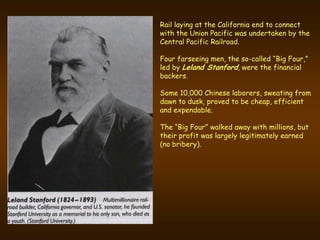
Rail laying at the California end to connect
with the Union Pacific was undertaken by the
Central Pacific Railroad.

Four farseeing men, the so-called “Big Four,”
led by Leland Stanford, were the financial
backers.

Some 10,000 Chinese laborers, sweating from
dawn to dusk, proved to be cheap, efficient
and expendable.

The “Big Four” walked away with millions, but
their profit was largely legitimately earned
(no bribery).
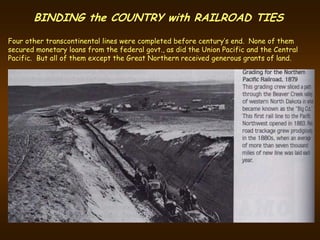
BINDING the COUNTRY with RAILROAD TIES
Four other transcontinental lines were completed before century’s end. None of them
secured monetary loans from the federal govt., as did the Union Pacific and the Central
Pacific. But all of them except the Great Northern received generous grants of land.
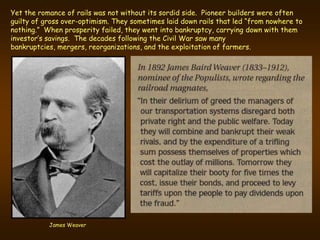
Yet the romance of rails was not without its sordid side. Pioneer builders were often
guilty of gross over-optimism. They sometimes laid down rails that led “from nowhere to
nothing.” When prosperity failed, they went into bankruptcy, carrying down with them
investor’s savings. The decades following the Civil War saw many
bankruptcies, mergers, reorganizations, and the exploitation of farmers.


           James Weaver
RAILROAD CONSOLIDATION and MECHANIZATION

               The success of the western lines was facilitated by
               welding together and expanding the older eastern
               networks, notably the New York Central.

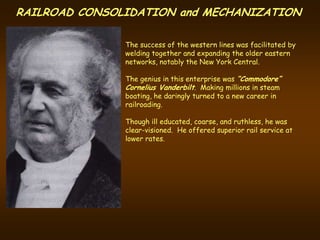
               The genius in this enterprise was “Commodore”
               Cornelius Vanderbilt. Making millions in steam
               boating, he daringly turned to a new career in
               railroading.

               Though ill educated, coarse, and ruthless, he was
               clear-visioned. He offered superior rail service at
               lower rates.
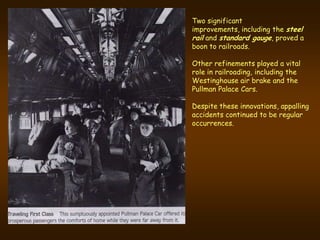
Two significant
improvements, including the steel
rail and standard gauge, proved a
boon to railroads.

Other refinements played a vital
role in railroading, including the
Westinghouse air brake and the
Pullman Palace Cars.

Despite these innovations, appalling
accidents continued to be regular
occurrences.
REVOLUTION by RAILWAYS
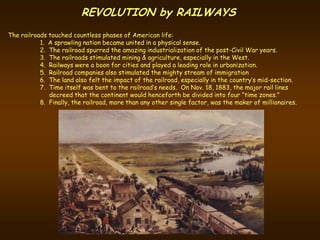
The railroads touched countless phases of American life:
           1. A sprawling nation became united in a physical sense.
           2. The railroad spurred the amazing industrialization of the post-Civil War years.
           3. The railroads stimulated mining & agriculture, especially in the West.
           4. Railways were a boon for cities and played a leading role in urbanization.
           5. Railroad companies also stimulated the mighty stream of immigration
           6. The land also felt the impact of the railroad, especially in the country’s mid-section.
           7. Time itself was bent to the railroad’s needs. On Nov. 18, 1883, the major rail lines
              decreed that the continent would henceforth be divided into four “time zones.”
           8. Finally, the railroad, more than any other single factor, was the maker of millionaires.
WRONGDOING in RAILROADING
             Corruption lurks when millions are at stake.
             The Credit Mobilier scandal was but the
             first of the first of the unsavory business
             practices employed by the railroad
             promoters.

             Jay Gould was the most adept of these
             rail promoters – he mastered the practice
             of stock watering – grossly inflating claims
             about a given line’s assets and profitability
             and sold stocks and bonds far in excess of
             the railroad’s actual value.

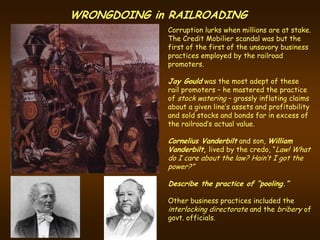
             Cornelius Vanderbilt and son, William
             Vanderbilt, lived by the credo, “Law! What
             do I care about the law? Hain’t I got the
             power?”

             Describe the practice of “pooling.”

             Other business practices included the
             interlocking directorate and the bribery of
             govt. officials.
GOVERNMENT BRIDLES the IRON HORSE

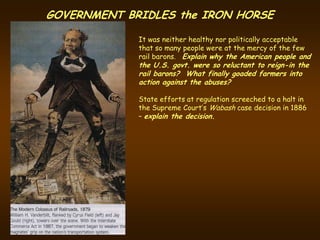
             It was neither healthy nor politically acceptable
             that so many people were at the mercy of the few
             rail barons. Explain why the American people and
             the U.S. govt. were so reluctant to reign-in the
             rail barons? What finally goaded farmers into
             action against the abuses?

             State efforts at regulation screeched to a halt in
             the Supreme Court’s Wabash case decision in 1886
             – explain the decision.
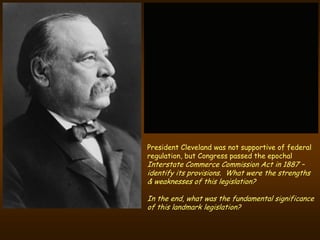
President Cleveland was not supportive of federal
regulation, but Congress passed the epochal
Interstate Commerce Commission Act in 1887 –
identify its provisions. What were the strengths
& weaknesses of this legislation?

In the end, what was the fundamental significance
of this landmark legislation?

A.p. ch 24 p.p (pt. 1)

  • 3.
    THE IRON COLTBECOMES an IRON HORSE The govt.- business relationship that formed during the Civil War sparked the unparalleled industrial development following the war. The outburst of railroad construction was a crucial case. In 1865, there were 35,000 miles of rail; in 1900, the figure had spurted to 192,556 miles of rail.
  • 4.
    The proposed transcontinentalrail lines would be would be costly and risky. Explain why the construction of these rail lines would require federal subsidies.
  • 5.
    Through the federalland grants, Big Business was willing to build the rail lines and the govt. received long-term preferential rates for postal service and military traffic. Frontier villages along rail lines became flourishing cities – communities battled one another for the privilege of hosting a rail line.
  • 6.
    SPANNING the CONTINENTwith RAILS Deadlock in the 1850’s over the proposed transcontinental railroad was broken when the South seceded, leaving the field to the North. In 1862, Congress made provision for starting the long-awaited line that would bind the Pacific coast with the remainder of the Republic – the desperate war effort created a sense of urgency.
  • 7.
    The Union PacificRailroad was commissioned by Congress to thrust westward from Omaha Nebraska – construction began in 1865. For each mile of track constructed, the company was granted 20 sq. miles of land, alternating in 640-acre sections on either side of the track. And for each mile the builders received a generous federal loan, the amount determined by the topography. Because of these govt. incentives, promoters made all haste. Insiders of the Credit Mobilier construction company reaped fabulous profits – they slyly pocketed $73 million for $50 million worth of work. Company officials bribed congressmen to look the other way. Sweaty construction gangs, containing many Irish “Paddies” (Patricks) who had fought in the Union armies worked at a frantic pace. The work was especially dangerous, including Indian attacks and construction accidents.
  • 9.
    Rail laying atthe California end to connect with the Union Pacific was undertaken by the Central Pacific Railroad. Four farseeing men, the so-called “Big Four,” led by Leland Stanford, were the financial backers. Some 10,000 Chinese laborers, sweating from dawn to dusk, proved to be cheap, efficient and expendable. The “Big Four” walked away with millions, but their profit was largely legitimately earned (no bribery).
  • 12.
    BINDING the COUNTRYwith RAILROAD TIES Four other transcontinental lines were completed before century’s end. None of them secured monetary loans from the federal govt., as did the Union Pacific and the Central Pacific. But all of them except the Great Northern received generous grants of land.
  • 13.
    Yet the romanceof rails was not without its sordid side. Pioneer builders were often guilty of gross over-optimism. They sometimes laid down rails that led “from nowhere to nothing.” When prosperity failed, they went into bankruptcy, carrying down with them investor’s savings. The decades following the Civil War saw many bankruptcies, mergers, reorganizations, and the exploitation of farmers. James Weaver
  • 14.
    RAILROAD CONSOLIDATION andMECHANIZATION The success of the western lines was facilitated by welding together and expanding the older eastern networks, notably the New York Central. The genius in this enterprise was “Commodore” Cornelius Vanderbilt. Making millions in steam boating, he daringly turned to a new career in railroading. Though ill educated, coarse, and ruthless, he was clear-visioned. He offered superior rail service at lower rates.
  • 15.
    Two significant improvements, includingthe steel rail and standard gauge, proved a boon to railroads. Other refinements played a vital role in railroading, including the Westinghouse air brake and the Pullman Palace Cars. Despite these innovations, appalling accidents continued to be regular occurrences.
  • 16.
    REVOLUTION by RAILWAYS Therailroads touched countless phases of American life: 1. A sprawling nation became united in a physical sense. 2. The railroad spurred the amazing industrialization of the post-Civil War years. 3. The railroads stimulated mining & agriculture, especially in the West. 4. Railways were a boon for cities and played a leading role in urbanization. 5. Railroad companies also stimulated the mighty stream of immigration 6. The land also felt the impact of the railroad, especially in the country’s mid-section. 7. Time itself was bent to the railroad’s needs. On Nov. 18, 1883, the major rail lines decreed that the continent would henceforth be divided into four “time zones.” 8. Finally, the railroad, more than any other single factor, was the maker of millionaires.
  • 18.
    WRONGDOING in RAILROADING Corruption lurks when millions are at stake. The Credit Mobilier scandal was but the first of the first of the unsavory business practices employed by the railroad promoters. Jay Gould was the most adept of these rail promoters – he mastered the practice of stock watering – grossly inflating claims about a given line’s assets and profitability and sold stocks and bonds far in excess of the railroad’s actual value. Cornelius Vanderbilt and son, William Vanderbilt, lived by the credo, “Law! What do I care about the law? Hain’t I got the power?” Describe the practice of “pooling.” Other business practices included the interlocking directorate and the bribery of govt. officials.
  • 19.
    GOVERNMENT BRIDLES theIRON HORSE It was neither healthy nor politically acceptable that so many people were at the mercy of the few rail barons. Explain why the American people and the U.S. govt. were so reluctant to reign-in the rail barons? What finally goaded farmers into action against the abuses? State efforts at regulation screeched to a halt in the Supreme Court’s Wabash case decision in 1886 – explain the decision.
  • 20.
    President Cleveland wasnot supportive of federal regulation, but Congress passed the epochal Interstate Commerce Commission Act in 1887 – identify its provisions. What were the strengths & weaknesses of this legislation? In the end, what was the fundamental significance of this landmark legislation?