BULL RUN ENDS the “NINETY-DAY WAR”
The Union Army of the Potomac marched out of Washington toward Bull Run on July 21,
1861. Was this army prepared for battle?
Describe the atmosphere surrounding
the battle.
Receiving reinforcements, Confederate
Gen. Thomas “Stonewall” Jackson rallied
his troops and routed the green Union
troops.
The “military picnic” at Bull Run, though
not decisive militarily, bore significant
psychological and political consequences,
many of them paradoxical.

Explain why victory was worse than
defeat for the South. Conversely, why
was defeat better than victory for the
Union?
“TARDY GEORGE” McCLELLAN and the
                   PENINSULA CAMPAIGN
Northern hopes brightened later in 1861, when Gen. George B. McClellan was given
command of the Army of the Potomac. Provide his profile – his personal attributes and
liabilities. What were his feelings toward the President Lincoln?
What did Lincoln think about McClellan’s attributes as a commanding general?
A reluctant McClellan finally
decided upon a waterborne
approach to Richmond, which lies at
the western base of a narrow
peninsula formed by the James and
York Rivers – hence the name: the
Peninsula Campaign.

What factors compromised
McClellan’s goal?
Gen. Robert E. Lee launched a devastating
counterattack, the Seven Days Battles (June 26-
July 2, 1862).

The Confederates drove McClellan back to the sea
and the Union forces abandoned the Peninsula
Campaign as a costly failure.

Lincoln replaced McClellan temporarily, although
Lee suffered twice the casualties.
Lee had achieved a brilliant, if bloody, victory. Explain the ironies of Lee’s
accomplishment.

Union strategy now turned toward total war. Describe the six components of the
Northern military plan.
THE WAR at SEA
The Northern navy had a formidable task in blockading 3,500 miles of Confederate
coastline. For practical purposes, explain the Union strategy for the blockade. What
was the reaction of Britain to the blockade?

Blockade-running became riskily profitable. Where was the leading rendezvous for
Confederate blockade-runners. How did the Union navy finally pinch-off this “leak?”


The most alarming Confederate threat to the
blockade came in 1862. What was this grave
threat? And explain the potential catastrophe
for the North.
After the Merrimack had sunk two Union warships and was threatening more, a tiny Union
ironclad, the Monitor, arrived on the scene. For four hours on March 9, 1862, the little
“Yankee cheese box on a raft” fought the Merrimack to a standstill. This historic battle
heralded the doom of the wooden warship.
THE PIVOTAL POINT: ANTIETAM
After defeating McClelland’s assault on Richmond, Lee inflicted a heavy defeat on Gen. John Pope at
the Second Battle of Bull Run (Aug. 29-30, 1862). Emboldened by this success, Lee daringly moved
into Maryland. What were his goals by striking into Maryland, a Border State?

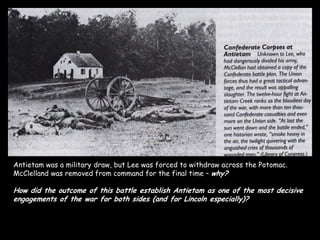
Events converged toward a critical battle at Antietam Creek, Maryland. McClelland had been
restored to command of the Northern army and two Union soldiers found a copy of Lee’s battle plans
wrapped around a packet of cigars. With this crucial intelligence, McClelland succeeded in halting
Lee at Antietam on September 17, 1862, in one of the bitterest and bloodiest days of the war.
Antietam was a military draw, but Lee was forced to withdraw across the Potomac.
McClelland was removed from command for the final time – why?

How did the outcome of this battle establish Antietam as one of the most decisive
engagements of the war for both sides (and for Lincoln especially)?
A PROCLAMATION WITHOUT EMANCIPATION
Lincoln’s Emancipation Proclamation of 1863 declared “forever free” the slaves in those
Confederate states still in rebellion.


Explain how the president’s pen did not formally strike the shackles from a single
slave. And despite the lack of formal freedom, what impact did Lincoln’s
proclamation have on slaves in the South?
Public reactions to the long-awaited
Proclamation of 1863 were varied.

Describe the various reactions
(foreign; abolitionist; southern)

What impact did the
Emancipation Proclamation
have on the Union war
effort?
BLACKS BATTLE BONDAGE
As Lincoln moved to emancipate the slaves, he also took steps to enlist blacks in the
armed forces.


                                            The War Department had initially refused to
                                            accept blacks who had volunteered, but as
                                            manpower ran low and emancipation was
                                            declared, black enlistees were accepted.

                                            Did the Confederacy enlist black soldiers?
                                            What type of tasks were they assigned
                                            upon being accepted?

                                            Why didn’t the great mass of Southern
                                            slaves help their Northern liberators?
Along with adding to Union manpower, Lincoln viewed enlisting black soldiers as a
demoralizing tactic in the psychological war. Did black soldiers distinguish themselves
in the Union military?
Black military casualties were extremely heavy for a variety of reasons. Describe the
fate of many captured Union black soldiers.
LEE’S LAST LUNGE at GETTYSBURG


                     Following two big victories at
                     Fredericksburg &
                     Chancellorsville, Lee prepared to
                     invade the North.

                     Why did he want to chance a
                     risky invasion of the North?
The battle seesawed across Gettysburg for 3
agonizing days (July 1-3, 1863), and the
outcome was in doubt until the very end.

What was considered the “high tide of the
Confederacy,” but also the “back breaker?”

Explain the significance of the battle’s
outcome.
THE WAR in the WEST

      Events in the western theater of the war at last
      provided Lincoln with an able general who did not
      have to be replaced after every setback. His
      name was Ulysses S. Grant.

      Describe Grant’s personal profile.

      What were Grant’s critics saying about him?

      What did Lincoln think of Grant?
The Union success in the West split
the Confederacy and tipped the
diplomatic scales in favor of the
North.
SHERMAN SCORCHES GEORGIA
               Georgia’s conquest was entrusted to
               Gen. William Tecumseh Sherman.

               He captured Atlanta in September
               1864 and burned the city in November.

               He then daringly left his supply base,
               lived off the country for some 250
               miles, and weeks later emerged at
               Savannah on the sea.

               Sherman’s hated “Blue Bellies,” some
               60,000 strong, cut a 60 mile swath of
               destruction through Georgia. What
               were his objectives in doing this?
Sherman was a pioneer practitioner of “total war.” Were his destructive methods
effective? Why was Sherman’s army especially destructive in South Carolina?
THE POLITICS of WAR
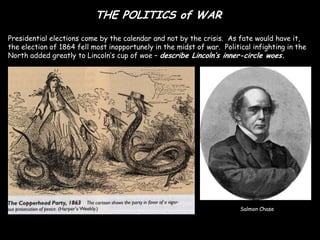
Presidential elections come by the calendar and not by the crisis. As fate would have it,
the election of 1864 fell most inopportunely in the midst of war. Political infighting in the
North added greatly to Lincoln’s cup of woe – describe Lincoln’s inner-circle woes.


                                                                        Salmon Chase
Most dangerous of all to the Union cause were the Northern Democrats. Why were the
Democrats divided? And explain how they were divided.

Who was Clement Vallandigham? What is the story behind him?


                                                                 Clement Vallandigham
THE ELECTION of 1864
As the election of 1864 approached, Lincoln’s precarious authority depended on his
retaining Republican support while spiking the threat from the Peace Democrats &
Copperheads. Fearing defeat, explain Lincoln’s re-nomination maneuver?


 Who was Lincoln’s running-mate in 1864? Why was he selected?
Embattled Democrats – regular and Copperhead – nominated the deposed and over
cautious war hero, Gen. McClellan – what was McClellan’s dilemma with the Democratic
platform?


Lincoln’s re-election was at first gravely in doubt, largely because the war was going badly.
But the atmosphere of gloom changed dramatically as balloting day neared, and Lincoln
pulled through. Identify the two factors that were keys to his re-election? Why
was Lincoln’s victory one of the most crushing losses suffered by the South? What
impact did it have on Southern morale?
GRANT OUTLASTS LEE
After Gettysburg, Grant was brought in from the West over Meade, who was blamed for not finishing-
off the Confederates after their defeat. What type of general was Lincoln seeking at this point?
What was Grant’s strategy to finish off Lee? Did the strategy work? Did Grant have his
critics?

In February 1865 the Confederates, tasting defeat, tried desperately to negotiate for peace between
the “two countries.” Lincoln could accept nothing short of Union & emancipation, and the Southerners
could accept nothing short of independence. So the war continued.
The end came with dramatic suddenness. Rapidly advancing Northern troops captured
Richmond and cornered Lee at Appomattox Courthouse in Virginia, in April 1865.
Grant met with Lee on the 9th, Palm Sunday, and granted generous terms of surrender.
What was amongst the most important concessions?
Tattered Southern veterans – “Lee’s Regamuffins” – wept as they took leave of their
beloved commander. The elated Union soldiers cheered, but they were silenced by Grant’s
stern admonition, “The war is over; the rebels are our countrymen again.”


Sadly, as many freed slaves were to discover, the hereafter of their full liberty was a
long time coming.
THE MARTYDOM of LINCOLN
The long, grueling war took a visibly physical toll on President Lincoln.
                                                          On the night of April 14, 1865 (Good
                                                          Friday), only 5 days after Lee’s
                                                          surrender, Ford’s Theater in
                                                          Washington witnessed its most
                                                          sensational drama.

                                                          A half-crazed, fanatically pro-
                                                          Southern actor, John Wilkes Booth,
                                                          slipped behind Lincoln as he sat in his
                                                          box and shot him in the head.

                                                          After lying unconscious all night, he
                                                          died the following morning.
Lincoln’s death was met with genuine sorrow, both at home and abroad.


Explain the full impact of Lincoln’s death, for Lincoln’s legacy and the country. Who
became president? And what would be his fate? Why would Lincoln have probably
fared better in the post-war period?
THE AFTERMATH of the NIGHTMARE
The Civil War took a grisly toll – over 600,000 men died in action or of disease, and in all
over a million were killed or seriously wounded. The nation lost the cream of its young
manhood and potential leadership.

Direct monetary costs of the conflict totaled about $15 billion. But this amount does not
include continuing expenses, tangible and intangible.

The extreme state’s righters were crushed. The national govt., tested in the fiery
furnace of war, emerged unbroken. Nullification and secession were laid to rest.

Beyond doubt, the Civil War was the supreme test of American democracy. The
preservation of democratic ideals, though not an officially war aim, was subconsciously one
of the major objectives of the North.

Victory for Union arms also provided inspiration to the champions of democracy and
liberalism the world over, especially in Britain.

The “Lost Cause” of the South was lost, but few Americans today would argue that the
result was not for the best. Superpower status probably could not have been achieved
with a permanent split.
CIVIL WAR QUIZZES


http://www.historyteacher.net/USProjects/USQuizzes/CivilWar1.htm
http://www.historyteacher.net/USProjects/USQuizzes/CivilWar2.htm

A.p. ch 21 p.p

  • 3.
    BULL RUN ENDSthe “NINETY-DAY WAR” The Union Army of the Potomac marched out of Washington toward Bull Run on July 21, 1861. Was this army prepared for battle?
  • 4.
    Describe the atmospheresurrounding the battle.
  • 5.
    Receiving reinforcements, Confederate Gen.Thomas “Stonewall” Jackson rallied his troops and routed the green Union troops.
  • 6.
    The “military picnic”at Bull Run, though not decisive militarily, bore significant psychological and political consequences, many of them paradoxical. Explain why victory was worse than defeat for the South. Conversely, why was defeat better than victory for the Union?
  • 8.
    “TARDY GEORGE” McCLELLANand the PENINSULA CAMPAIGN Northern hopes brightened later in 1861, when Gen. George B. McClellan was given command of the Army of the Potomac. Provide his profile – his personal attributes and liabilities. What were his feelings toward the President Lincoln?
  • 9.
    What did Lincolnthink about McClellan’s attributes as a commanding general?
  • 11.
    A reluctant McClellanfinally decided upon a waterborne approach to Richmond, which lies at the western base of a narrow peninsula formed by the James and York Rivers – hence the name: the Peninsula Campaign. What factors compromised McClellan’s goal?
  • 12.
    Gen. Robert E.Lee launched a devastating counterattack, the Seven Days Battles (June 26- July 2, 1862). The Confederates drove McClellan back to the sea and the Union forces abandoned the Peninsula Campaign as a costly failure. Lincoln replaced McClellan temporarily, although Lee suffered twice the casualties.
  • 13.
    Lee had achieveda brilliant, if bloody, victory. Explain the ironies of Lee’s accomplishment. Union strategy now turned toward total war. Describe the six components of the Northern military plan.
  • 14.
    THE WAR atSEA The Northern navy had a formidable task in blockading 3,500 miles of Confederate coastline. For practical purposes, explain the Union strategy for the blockade. What was the reaction of Britain to the blockade? Blockade-running became riskily profitable. Where was the leading rendezvous for Confederate blockade-runners. How did the Union navy finally pinch-off this “leak?” The most alarming Confederate threat to the blockade came in 1862. What was this grave threat? And explain the potential catastrophe for the North.
  • 15.
    After the Merrimackhad sunk two Union warships and was threatening more, a tiny Union ironclad, the Monitor, arrived on the scene. For four hours on March 9, 1862, the little “Yankee cheese box on a raft” fought the Merrimack to a standstill. This historic battle heralded the doom of the wooden warship.
  • 17.
    THE PIVOTAL POINT:ANTIETAM After defeating McClelland’s assault on Richmond, Lee inflicted a heavy defeat on Gen. John Pope at the Second Battle of Bull Run (Aug. 29-30, 1862). Emboldened by this success, Lee daringly moved into Maryland. What were his goals by striking into Maryland, a Border State? Events converged toward a critical battle at Antietam Creek, Maryland. McClelland had been restored to command of the Northern army and two Union soldiers found a copy of Lee’s battle plans wrapped around a packet of cigars. With this crucial intelligence, McClelland succeeded in halting Lee at Antietam on September 17, 1862, in one of the bitterest and bloodiest days of the war.
  • 18.
    Antietam was amilitary draw, but Lee was forced to withdraw across the Potomac. McClelland was removed from command for the final time – why? How did the outcome of this battle establish Antietam as one of the most decisive engagements of the war for both sides (and for Lincoln especially)?
  • 19.
    A PROCLAMATION WITHOUTEMANCIPATION Lincoln’s Emancipation Proclamation of 1863 declared “forever free” the slaves in those Confederate states still in rebellion. Explain how the president’s pen did not formally strike the shackles from a single slave. And despite the lack of formal freedom, what impact did Lincoln’s proclamation have on slaves in the South?
  • 20.
    Public reactions tothe long-awaited Proclamation of 1863 were varied. Describe the various reactions (foreign; abolitionist; southern) What impact did the Emancipation Proclamation have on the Union war effort?
  • 22.
    BLACKS BATTLE BONDAGE AsLincoln moved to emancipate the slaves, he also took steps to enlist blacks in the armed forces. The War Department had initially refused to accept blacks who had volunteered, but as manpower ran low and emancipation was declared, black enlistees were accepted. Did the Confederacy enlist black soldiers? What type of tasks were they assigned upon being accepted? Why didn’t the great mass of Southern slaves help their Northern liberators?
  • 23.
    Along with addingto Union manpower, Lincoln viewed enlisting black soldiers as a demoralizing tactic in the psychological war. Did black soldiers distinguish themselves in the Union military?
  • 24.
    Black military casualtieswere extremely heavy for a variety of reasons. Describe the fate of many captured Union black soldiers.
  • 25.
    LEE’S LAST LUNGEat GETTYSBURG Following two big victories at Fredericksburg & Chancellorsville, Lee prepared to invade the North. Why did he want to chance a risky invasion of the North?
  • 26.
    The battle seesawedacross Gettysburg for 3 agonizing days (July 1-3, 1863), and the outcome was in doubt until the very end. What was considered the “high tide of the Confederacy,” but also the “back breaker?” Explain the significance of the battle’s outcome.
  • 27.
    THE WAR inthe WEST Events in the western theater of the war at last provided Lincoln with an able general who did not have to be replaced after every setback. His name was Ulysses S. Grant. Describe Grant’s personal profile. What were Grant’s critics saying about him? What did Lincoln think of Grant?
  • 28.
    The Union successin the West split the Confederacy and tipped the diplomatic scales in favor of the North.
  • 29.
    SHERMAN SCORCHES GEORGIA Georgia’s conquest was entrusted to Gen. William Tecumseh Sherman. He captured Atlanta in September 1864 and burned the city in November. He then daringly left his supply base, lived off the country for some 250 miles, and weeks later emerged at Savannah on the sea. Sherman’s hated “Blue Bellies,” some 60,000 strong, cut a 60 mile swath of destruction through Georgia. What were his objectives in doing this?
  • 30.
    Sherman was apioneer practitioner of “total war.” Were his destructive methods effective? Why was Sherman’s army especially destructive in South Carolina?
  • 32.
    THE POLITICS ofWAR Presidential elections come by the calendar and not by the crisis. As fate would have it, the election of 1864 fell most inopportunely in the midst of war. Political infighting in the North added greatly to Lincoln’s cup of woe – describe Lincoln’s inner-circle woes. Salmon Chase
  • 33.
    Most dangerous ofall to the Union cause were the Northern Democrats. Why were the Democrats divided? And explain how they were divided. Who was Clement Vallandigham? What is the story behind him? Clement Vallandigham
  • 34.
    THE ELECTION of1864 As the election of 1864 approached, Lincoln’s precarious authority depended on his retaining Republican support while spiking the threat from the Peace Democrats & Copperheads. Fearing defeat, explain Lincoln’s re-nomination maneuver? Who was Lincoln’s running-mate in 1864? Why was he selected?
  • 35.
    Embattled Democrats –regular and Copperhead – nominated the deposed and over cautious war hero, Gen. McClellan – what was McClellan’s dilemma with the Democratic platform? Lincoln’s re-election was at first gravely in doubt, largely because the war was going badly. But the atmosphere of gloom changed dramatically as balloting day neared, and Lincoln pulled through. Identify the two factors that were keys to his re-election? Why was Lincoln’s victory one of the most crushing losses suffered by the South? What impact did it have on Southern morale?
  • 37.
    GRANT OUTLASTS LEE AfterGettysburg, Grant was brought in from the West over Meade, who was blamed for not finishing- off the Confederates after their defeat. What type of general was Lincoln seeking at this point? What was Grant’s strategy to finish off Lee? Did the strategy work? Did Grant have his critics? In February 1865 the Confederates, tasting defeat, tried desperately to negotiate for peace between the “two countries.” Lincoln could accept nothing short of Union & emancipation, and the Southerners could accept nothing short of independence. So the war continued.
  • 38.
    The end camewith dramatic suddenness. Rapidly advancing Northern troops captured Richmond and cornered Lee at Appomattox Courthouse in Virginia, in April 1865.
  • 39.
    Grant met withLee on the 9th, Palm Sunday, and granted generous terms of surrender. What was amongst the most important concessions?
  • 40.
    Tattered Southern veterans– “Lee’s Regamuffins” – wept as they took leave of their beloved commander. The elated Union soldiers cheered, but they were silenced by Grant’s stern admonition, “The war is over; the rebels are our countrymen again.” Sadly, as many freed slaves were to discover, the hereafter of their full liberty was a long time coming.
  • 42.
    THE MARTYDOM ofLINCOLN The long, grueling war took a visibly physical toll on President Lincoln. On the night of April 14, 1865 (Good Friday), only 5 days after Lee’s surrender, Ford’s Theater in Washington witnessed its most sensational drama. A half-crazed, fanatically pro- Southern actor, John Wilkes Booth, slipped behind Lincoln as he sat in his box and shot him in the head. After lying unconscious all night, he died the following morning.
  • 43.
    Lincoln’s death wasmet with genuine sorrow, both at home and abroad. Explain the full impact of Lincoln’s death, for Lincoln’s legacy and the country. Who became president? And what would be his fate? Why would Lincoln have probably fared better in the post-war period?
  • 45.
    THE AFTERMATH ofthe NIGHTMARE The Civil War took a grisly toll – over 600,000 men died in action or of disease, and in all over a million were killed or seriously wounded. The nation lost the cream of its young manhood and potential leadership. Direct monetary costs of the conflict totaled about $15 billion. But this amount does not include continuing expenses, tangible and intangible. The extreme state’s righters were crushed. The national govt., tested in the fiery furnace of war, emerged unbroken. Nullification and secession were laid to rest. Beyond doubt, the Civil War was the supreme test of American democracy. The preservation of democratic ideals, though not an officially war aim, was subconsciously one of the major objectives of the North. Victory for Union arms also provided inspiration to the champions of democracy and liberalism the world over, especially in Britain. The “Lost Cause” of the South was lost, but few Americans today would argue that the result was not for the best. Superpower status probably could not have been achieved with a permanent split.
  • 46.