Test Your Knowledge
The infamous MUD MARCH campaign (otherwise known as the 1863 Winter
Offensive) launched 150 years ago in January of 1863.
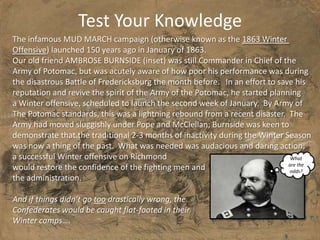
Our old friend AMBROSE BURNSIDE (inset) was still Commander in Chief of the
Army of Potomac, but was acutely aware of how poor his performance was during
the disastrous Battle of Fredericksburg the month before. In an effort to save his
reputation and revive the spirit of the Army of the Potomac, he started planning
a Winter offensive, scheduled to launch the second week of January. By Army of
The Potomac standards, this was a lightning rebound from a recent disaster. The
Army had moved sluggishly under Pope and McClellan; Burnside was keen to
demonstrate that the traditional 2-3 months of inactivity during the Winter Season
was now a thing of the past. What was needed was audacious and daring action;
a successful Winter offensive on Richmond                                     What
                                                                             are the
would restore the confidence of the fighting men and                         odds?
the administration.

And if things didn’t go too drastically wrong, the
Confederates would be caught flat-footed in their
Winter camps….
Feints and Bluffs
1.   The new offensive was reasonably daring by all accounts. Burnside planned
     to conduct feints at the fords upstream of Fredericksburg to distract
     Confederate attention away from his main body which would move across
     the Rappahannock seven miles south of Fredericksburg. In addition, he
     planned for a major cavalry operation on a grand scale, something of a
     novelty in the Eastern Theater, where Union cavalry had performed poorly
     heretofore.
2.   Burnside consolidated 1500 cavalry for this commando style raid. 500 of
     them would create a distracting feint in the Warrenton-Culpeper area, then
     withdraw back to Falmouth.
3.   Meanwhile, the main force was to cross at Kelly's Ford and move South and
     West in a wide arc, all the way around and south of Richmond to Union
     lines on the Peninsula. It was an imaginative plan, and one can only
     imagine the havoc it might have caused had it launched successfully, but
     Lincoln got wind of it through the perfidy of some of Burnsides’ own staff,
     and the Great Cavalry Raid was recalled before it went past Kelly’s Ford.
Backstabbing Staff cause a change in Plans
                                              ermath
• Burnside was befuddled how quickly the President had caught wind of his plans,
as he had not even briefed every one of his generals yet and had only shared the
framework with key staff officers.
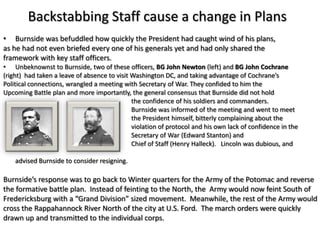
• Unbeknownst to Burnside, two of these officers, BG John Newton (left) and BG John Cochrane
(right) had taken a leave of absence to visit Washington DC, and taking advantage of Cochrane’s
Political connections, wrangled a meeting with Secretary of War. They confided to him the
Upcoming Battle plan and more importantly, the general consensus that Burnside did not hold
                                              the confidence of his soldiers and commanders.
                                              Burnside was informed of the meeting and went to meet
                                              the President himself, bitterly complaining about the
                                              violation of protocol and his own lack of confidence in the
                                              Secretary of War (Edward Stanton) and
                                              Chief of Staff (Henry Halleck). Lincoln was dubious, and

    advised Burnside to consider resigning.

Burnside’s response was to go back to Winter quarters for the Army of the Potomac and reverse
the formative battle plan. Instead of feinting to the North, the Army would now feint South of
Fredericksburg with a “Grand Division” sized movement. Meanwhile, the rest of the Army would
cross the Rappahannock River North of the city at U.S. Ford. The march orders were quickly
drawn up and transmitted to the individual corps.
Fiasco Time (Again)
                            Consequences
•During the night of the 20th, a drenching Winter rain began, and by the morning of
the 21st, the earth was soaked and the river banks were a quagmire. Already, fifteen
pontoons were on the river, nearly spanning it, and five more were amply sufficient.
•Burnside began at once to bring up his artillery, which had the effect of making the
roads into quicksand. Cannon began to mire up to their axles.
•Many artillery pieces were advanced near the ford, but the 22nd only added to the
storm, and the artillery, caissons and even wagons were swamped in the mud.
•The storm had delayed Burnside's movements and slowed infantry movement to a
crawl. Aside from the gunfire from the Confederates, The Union Army actually took
casualties from drowning and had to abandon artillery in the mire.
•Across the river, Lee had ample time to line the other shore with his army, though
there was no attempt to interfere with his crossing except from long ranged
shooting. On the Northern side of the river, the soldiers stoically attempted to
march on, but the mud had become many feet deep in places.
•Lee was likely eager to have Burnside attempt a crossing; with a swollen river in his
rear, it would have been a major fiasco for the Union Army to be caught between it
and the Confederate Army. Burnside finally became resigned to failure and gave the
order for the army to retire to its Winter quarters, and thus ended the famous MUD
MARCH of January 1863.
Epilogue: Exit Ambrose, Hello, Joe
“ As Burnsides men dragged back toward their camps, mud-coated regiments were indistinguishable one from another. The army had
become a disorganized crowd. And when the troops returned, they regretted the unthinking enthusiasm with which they had set out.
Many, assuming they were on their way to Richmond, had burned their huts to the ground, so not a plank was to be found. J. L. Smith of the
18th Pennsylvania wrote home about passing other outfits and asking," 'Say, did you see Burnsides stuck in the mud back there? They said
'h--l with Burnsides! . . . Burnsides has bad luck. The men have no confidence in him; they all remember the terrible bloody Fredericksburg.
If the troops don't have confidence, why the General may as well resign.“
That very day, the general did. . . . . “


-- Chancellorsville 1863, The Souls of the Brave" by Ernest B. Fergurson

                               Burnside tendered his resignation as Commander of the Army of the
                               Potomac as soon as the Army returned to Camp. Lincoln accepted it at
                               once, and appointed Joseph Hooker as the replacement commander. As
                               History will show, Burnside was not done with his military service, and we
                               will be seeing him again in the years to come…

The Mud March

  • 1.
    Test Your Knowledge Theinfamous MUD MARCH campaign (otherwise known as the 1863 Winter Offensive) launched 150 years ago in January of 1863. Our old friend AMBROSE BURNSIDE (inset) was still Commander in Chief of the Army of Potomac, but was acutely aware of how poor his performance was during the disastrous Battle of Fredericksburg the month before. In an effort to save his reputation and revive the spirit of the Army of the Potomac, he started planning a Winter offensive, scheduled to launch the second week of January. By Army of The Potomac standards, this was a lightning rebound from a recent disaster. The Army had moved sluggishly under Pope and McClellan; Burnside was keen to demonstrate that the traditional 2-3 months of inactivity during the Winter Season was now a thing of the past. What was needed was audacious and daring action; a successful Winter offensive on Richmond What are the would restore the confidence of the fighting men and odds? the administration. And if things didn’t go too drastically wrong, the Confederates would be caught flat-footed in their Winter camps….
  • 2.
    Feints and Bluffs 1. The new offensive was reasonably daring by all accounts. Burnside planned to conduct feints at the fords upstream of Fredericksburg to distract Confederate attention away from his main body which would move across the Rappahannock seven miles south of Fredericksburg. In addition, he planned for a major cavalry operation on a grand scale, something of a novelty in the Eastern Theater, where Union cavalry had performed poorly heretofore. 2. Burnside consolidated 1500 cavalry for this commando style raid. 500 of them would create a distracting feint in the Warrenton-Culpeper area, then withdraw back to Falmouth. 3. Meanwhile, the main force was to cross at Kelly's Ford and move South and West in a wide arc, all the way around and south of Richmond to Union lines on the Peninsula. It was an imaginative plan, and one can only imagine the havoc it might have caused had it launched successfully, but Lincoln got wind of it through the perfidy of some of Burnsides’ own staff, and the Great Cavalry Raid was recalled before it went past Kelly’s Ford.
  • 3.
    Backstabbing Staff causea change in Plans ermath • Burnside was befuddled how quickly the President had caught wind of his plans, as he had not even briefed every one of his generals yet and had only shared the framework with key staff officers. • Unbeknownst to Burnside, two of these officers, BG John Newton (left) and BG John Cochrane (right) had taken a leave of absence to visit Washington DC, and taking advantage of Cochrane’s Political connections, wrangled a meeting with Secretary of War. They confided to him the Upcoming Battle plan and more importantly, the general consensus that Burnside did not hold the confidence of his soldiers and commanders. Burnside was informed of the meeting and went to meet the President himself, bitterly complaining about the violation of protocol and his own lack of confidence in the Secretary of War (Edward Stanton) and Chief of Staff (Henry Halleck). Lincoln was dubious, and advised Burnside to consider resigning. Burnside’s response was to go back to Winter quarters for the Army of the Potomac and reverse the formative battle plan. Instead of feinting to the North, the Army would now feint South of Fredericksburg with a “Grand Division” sized movement. Meanwhile, the rest of the Army would cross the Rappahannock River North of the city at U.S. Ford. The march orders were quickly drawn up and transmitted to the individual corps.
  • 4.
    Fiasco Time (Again) Consequences •During the night of the 20th, a drenching Winter rain began, and by the morning of the 21st, the earth was soaked and the river banks were a quagmire. Already, fifteen pontoons were on the river, nearly spanning it, and five more were amply sufficient. •Burnside began at once to bring up his artillery, which had the effect of making the roads into quicksand. Cannon began to mire up to their axles. •Many artillery pieces were advanced near the ford, but the 22nd only added to the storm, and the artillery, caissons and even wagons were swamped in the mud. •The storm had delayed Burnside's movements and slowed infantry movement to a crawl. Aside from the gunfire from the Confederates, The Union Army actually took casualties from drowning and had to abandon artillery in the mire. •Across the river, Lee had ample time to line the other shore with his army, though there was no attempt to interfere with his crossing except from long ranged shooting. On the Northern side of the river, the soldiers stoically attempted to march on, but the mud had become many feet deep in places. •Lee was likely eager to have Burnside attempt a crossing; with a swollen river in his rear, it would have been a major fiasco for the Union Army to be caught between it and the Confederate Army. Burnside finally became resigned to failure and gave the order for the army to retire to its Winter quarters, and thus ended the famous MUD MARCH of January 1863.
  • 5.
    Epilogue: Exit Ambrose,Hello, Joe “ As Burnsides men dragged back toward their camps, mud-coated regiments were indistinguishable one from another. The army had become a disorganized crowd. And when the troops returned, they regretted the unthinking enthusiasm with which they had set out. Many, assuming they were on their way to Richmond, had burned their huts to the ground, so not a plank was to be found. J. L. Smith of the 18th Pennsylvania wrote home about passing other outfits and asking," 'Say, did you see Burnsides stuck in the mud back there? They said 'h--l with Burnsides! . . . Burnsides has bad luck. The men have no confidence in him; they all remember the terrible bloody Fredericksburg. If the troops don't have confidence, why the General may as well resign.“ That very day, the general did. . . . . “ -- Chancellorsville 1863, The Souls of the Brave" by Ernest B. Fergurson Burnside tendered his resignation as Commander of the Army of the Potomac as soon as the Army returned to Camp. Lincoln accepted it at once, and appointed Joseph Hooker as the replacement commander. As History will show, Burnside was not done with his military service, and we will be seeing him again in the years to come…