Mariam D. (B.Pharm, MSc in clinical pharmacy)
Email: yemariamju@gmail.com
Anxiety Disorder
Introduction
• Anxiety is a normal response to stressful or fearful circumst
ances.
• Most people experience some degree of anxiety in reactio
n to stressful situations, such as final exams or giving a spe
ech.
• Anxiety symptoms generally are short-lived and do not nec
essarily impair function.
• Anxiety that becomes excessive, causes irrational thinking
or behavior, and impairs a person’s functioning is considere
d an anxiety disorder.
2
Epidemiology
– Specific phobias … 9.1% (the most common anxiety disor
der)
– GAD…2.7%
– Panic disorder …2.7%
– SAD…7.1%
• Anxiety disorders develop …before age 30
• More common in ….
– Women, individuals with social issues,
– those with a family history of anxiety and depression.
3
Etiology
 Hypotheses on the etiology of anxiety disorders are based
on interactions between a combination of factors including
genetic predisposition and stress.
 Furthermore, anxiety disorders are associated with chronic
medical illness, drugs, substances of abuse.
4
Pathophysiology
• Pathologic anxiety states is associated with abnormal funct
ion in several neurotransmitter systems, including norepin
ephrine (NE), γ-aminobutyric acid (GABA), serotonin (5-HT)
, dopamine(DA),
5
Clinical presentation
• The characteristic features of these illnesses are anxiety an
d avoidance behavior.
• Anxiety symptoms must cause significant distress and impa
irment in social, occupational, or other areas of functioning
.
• Should not be secondary to a drug or illicit substance or a g
eneral medical disorder or occur solely as part of another p
sychiatric disorder
6
Subtypes of anxiety disorders/DSM IV TR
 Generalized anxiety disorder (GAD)
 Panic disorder (PD)
 Social anxiety disorder (SAD)
 Specific phobia
 Agoraphobia
 Obsessive-compulsive disorder (OCD)
 Posttraumatic stress disorder (PTSD)
7
GAD
• Excessive anxiety and worry about events or activities for m
ost days for at least 6 months.
• Accompanied by 3 or more of following symptoms
– restlessness
– easily fatigued,
– difficulty concentrating,
– irritability, muscle tension,
– sleep disturbance
• Social, occupational impairment; poor coping skills
8
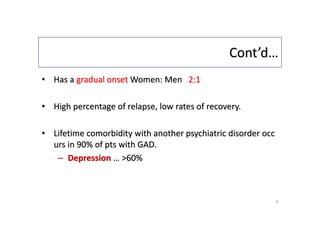
Cont’d…
• Has a gradual onset Women: Men 2:1
• High percentage of relapse, low rates of recovery.
• Lifetime comorbidity with another psychiatric disorder occ
urs in 90% of pts with GAD.
– Depression … >60%
9
10
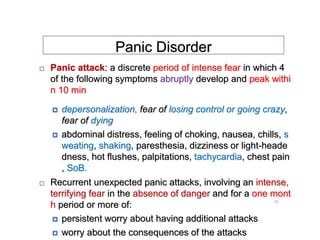
 Panic attack: a discrete period of intense fear in which 4
of the following symptoms abruptly develop and peak withi
n 10 min
 depersonalization, fear of losing control or going crazy,
fear of dying
 abdominal distress, feeling of choking, nausea, chills, s
weating, shaking, paresthesia, dizziness or light-heade
dness, hot flushes, palpitations, tachycardia, chest pain
, SoB.
 Recurrent unexpected panic attacks, involving an intense,
terrifying fear in the absence of danger and for a one mont
h period or more of:
 persistent worry about having additional attacks
 worry about the consequences of the attacks
Panic Disorder
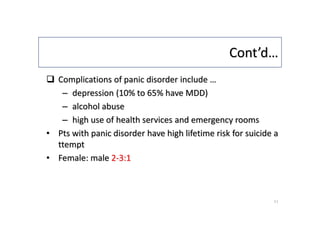
Cont’d…
 Complications of panic disorder include …
– depression (10% to 65% have MDD)
– alcohol abuse
– high use of health services and emergency rooms
• Pts with panic disorder have high lifetime risk for suicide a
ttempt
• Female: male 2-3:1
11
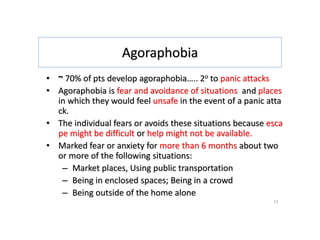
Agoraphobia
• ~ 70% of pts develop agoraphobia….. 2o to panic attacks
• Agoraphobia is fear and avoidance of situations and places
in which they would feel unsafe in the event of a panic atta
ck.
• The individual fears or avoids these situations because esca
pe might be difficult or help might not be available.
• Marked fear or anxiety for more than 6 months about two
or more of the following situations:
– Market places, Using public transportation
– Being in enclosed spaces; Being in a crowd
– Being outside of the home alone
12
SAD
• It is an intense, irrational & persistent fear of being negatively
evaluated in at least one social or performance situation; last
s more than 6 months.
– Exposure to the feared circumstance usually provokes an i
mmediate situation-related panic attack.
• Physical symptoms: Blushing, diarrhea, sweating, tachycardia,
– Blushing …main physical indicator used to distinguishes S
AD from other anxiety disorders.
• People with SAD can be reluctant to seek professional help
– perceived as feared social interaction
13
Cont’d…
• Generalized SAD ….
– fear and avoidance extend to various social situations
• Non-generalized SAD ….
– fear is confined to only one/two social situations
• Panic attacks occur in both SAD and panic disorder, but the distinctio
n between the two is the rationale behind fear.
– fear of anxiety symptoms is x/tic of panic disorder
– fear of embarrassment from social interaction typifies SAD.
14
Cont’d…
• Some feared situations in SAD
• Eating or writing in front of others
• Interacting with authority figures
• Speaking in public
• Talking with strangers
• Use of public toilet
Slightly higher in women than men
15
Specific Phobia
• Specific phobia is marked and persistent fear (>6 months) of a
specific object or situation (e.g., insects or heights).
– the patient is usually free of symptoms…when no contact
with the feared object or situation
– Most persons simply avoid the feared object and adjust to
certain restrictions on their activities.
– Up to 15% of general population
– Female: Male 2:1
16
PTSD
• Exposure to a traumatic event is required for a diagnosis of
PTSD
• The patient’s response to trauma must include intense fear
, helplessness or horror
• Resulting symptoms include
– Persistently re-experiencing of the traumatic event
– Avoidance of stimuli associated with trauma
17
Cont’d…
• Symptoms must be present longer than 1 month and cause
significant distress or impairment.
• One-third of patients with PTSD have a poor prognosis, and
about 80% have a concurrent depression or anxiety disord
er.
• Over half of men with PTSD have comorbid alcohol abuse o
r dependence, and about 20% of patients attempt suicide.
18
OCD
• Obsessions
– Repetitive thoughts, e.g., feeling contaminated after touchi
ng an object, doubting whether the stove was turned off
– Repeated doubts
– Intense need to have orderliness and symmetry
– Repeated sexual thoughts or images
• Compulsions
– Repetitive activities (e.g., hand washing, checking, ordering
)
– Repetitive mental acts (e.g., counting, repeating words sile
ntly) 19
Treatment Goals
• Short-term goals
– to reduce the severity, duration and frequency of the a
nxiety symptoms
– to improve overall functioning
• Long-term goals
– remission with minimal/no anxiety symptoms/no functi
onal impairment
– increased QOL
– prevention of recurrence
20
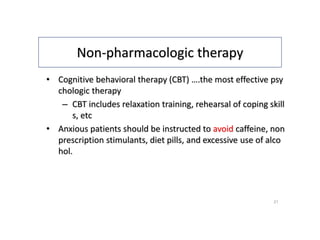
Non-pharmacologic therapy
• Cognitive behavioral therapy (CBT) ….the most effective psy
chologic therapy
– CBT includes relaxation training, rehearsal of coping skill
s, etc
• Anxious patients should be instructed to avoid caffeine, non
prescription stimulants, diet pills, and excessive use of alco
hol.
21
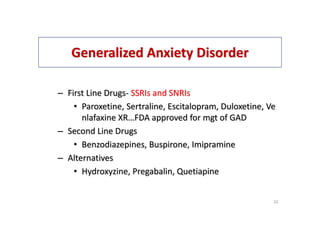
Generalized Anxiety Disorder
– First Line Drugs- SSRIs and SNRIs
• Paroxetine, Sertraline, Escitalopram, Duloxetine, Ve
nlafaxine XR…FDA approved for mgt of GAD
– Second Line Drugs
• Benzodiazepines, Buspirone, Imipramine
– Alternatives
• Hydroxyzine, Pregabalin, Quetiapine
22
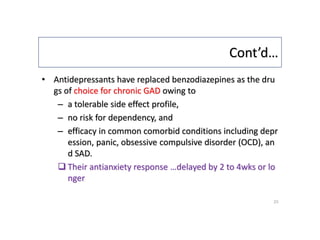
Cont’d…
• Antidepressants have replaced benzodiazepines as the dru
gs of choice for chronic GAD owing to
– a tolerable side effect profile,
– no risk for dependency, and
– efficacy in common comorbid conditions including depr
ession, panic, obsessive compulsive disorder (OCD), an
d SAD.
 Their antianxiety response …delayed by 2 to 4wks or lo
nger
23
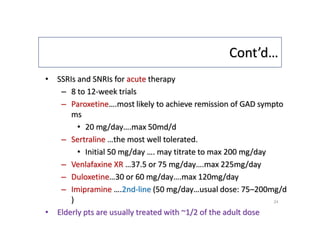
Cont’d…
• SSRIs and SNRIs for acute therapy
– 8 to 12-week trials
– Paroxetine….most likely to achieve remission of GAD sympto
ms
• 20 mg/day….max 50md/d
– Sertraline …the most well tolerated.
• Initial 50 mg/day …. may titrate to max 200 mg/day
– Venlafaxine XR …37.5 or 75 mg/day….max 225mg/day
– Duloxetine…30 or 60 mg/day….max 120mg/day
– Imipramine ….2nd-line (50 mg/day…usual dose: 75–200mg/d
)
• Elderly pts are usually treated with ~1/2 of the adult dose
24
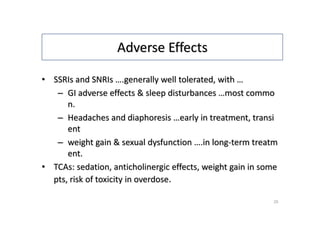
Adverse Effects
• SSRIs and SNRIs ….generally well tolerated, with …
– GI adverse effects & sleep disturbances …most commo
n.
– Headaches and diaphoresis …early in treatment, transi
ent
– weight gain & sexual dysfunction ….in long-term treatm
ent.
• TCAs: sedation, anticholinergic effects, weight gain in some
pts, risk of toxicity in overdose.
25
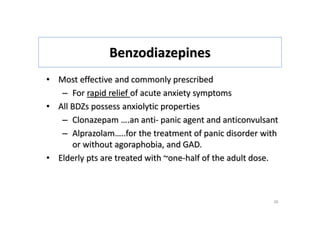
Benzodiazepines
• Most effective and commonly prescribed
– For rapid relief of acute anxiety symptoms
• All BDZs possess anxiolytic properties
– Clonazepam ….an anti- panic agent and anticonvulsant
– Alprazolam…..for the treatment of panic disorder with
or without agoraphobia, and GAD.
• Elderly pts are treated with ~one-half of the adult dose.
26
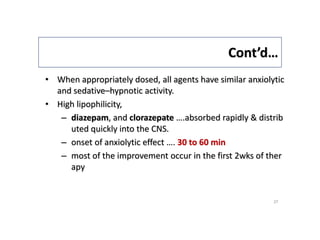
Cont’d…
• When appropriately dosed, all agents have similar anxiolytic
and sedative–hypnotic activity.
• High lipophilicity,
– diazepam, and clorazepate ….absorbed rapidly & distrib
uted quickly into the CNS.
– onset of anxiolytic effect …. 30 to 60 min
– most of the improvement occur in the first 2wks of ther
apy
27
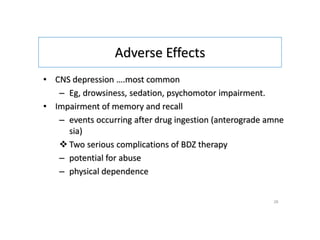
Adverse Effects
• CNS depression ….most common
– Eg, drowsiness, sedation, psychomotor impairment.
• Impairment of memory and recall
– events occurring after drug ingestion (anterograde amne
sia)
 Two serious complications of BDZ therapy
– potential for abuse
– physical dependence
28
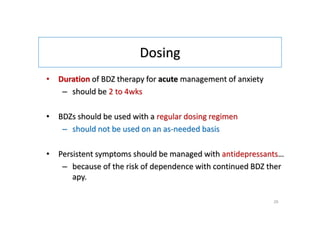
Dosing
• Duration of BDZ therapy for acute management of anxiety
– should be 2 to 4wks
• BDZs should be used with a regular dosing regimen
– should not be used on an as-needed basis
• Persistent symptoms should be managed with antidepressants…
– because of the risk of dependence with continued BDZ ther
apy.
29
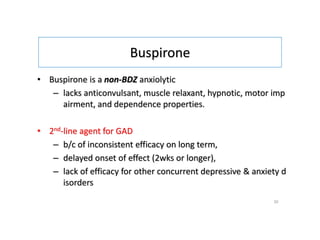
Buspirone
• Buspirone is a non-BDZ anxiolytic
– lacks anticonvulsant, muscle relaxant, hypnotic, motor imp
airment, and dependence properties.
• 2nd-line agent for GAD
– b/c of inconsistent efficacy on long term,
– delayed onset of effect (2wks or longer),
– lack of efficacy for other concurrent depressive & anxiety d
isorders
30
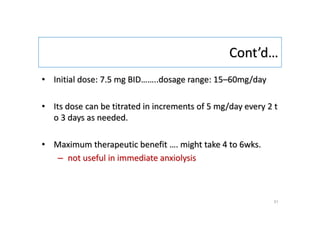
Cont’d…
• Initial dose: 7.5 mg BID……..dosage range: 15–60mg/day
• Its dose can be titrated in increments of 5 mg/day every 2 t
o 3 days as needed.
• Maximum therapeutic benefit …. might take 4 to 6wks.
– not useful in immediate anxiolysis
31
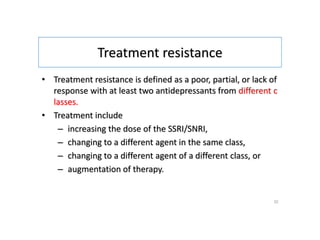
Treatment resistance
• Treatment resistance is defined as a poor, partial, or lack of
response with at least two antidepressants from different c
lasses.
• Treatment include
– increasing the dose of the SSRI/SNRI,
– changing to a different agent in the same class,
– changing to a different agent of a different class, or
– augmentation of therapy.
32
Panic disorder
• Drug choices for panic disorder
– First Line Drugs
• SSRIs and Venlafaxine XR…. similar response
• b/c of tolerability and efficacy in acute and long-ter
m studies
– Second Line Drugs
• Alprazolam, Clonazepam, Citalopram, Clomipramine,
Imipramine
• BDZs ….the most commonly used
– Alternative ….. phenelzine 33
Cont’d…
• All SSRIs are effective in panic disorder.
• Its anti-panic effect is delayed for at least 4wks, and some
pts do not respond for 8 to 12wks.
• Venlafaxine XR ….37.5 mg/day for the first 3 to 7 days
– then increase to a minimum of 75 mg/day
– Increasing the dose to 150 mg/day after initial nonresp
onse or partial response is recommended.
34
Imipramine (TCA)
• Alleviate panic attacks in 75% of pts …. 2nd-line agent
• blocks panic attacks within at least 4wks and maximal improve
ment (including anti-phobic response) takes 8 to 12wks.
• Initial dose10 mg/day….antipanic dosage range 75–250mg/d
– dose slowly by 10 mg every 2 to 4 days as tolerated.
35
Benzodiazepines
• 2nd-line…b/c of risk of dependency
• Should not be used as monotherapy in depressed pts or has
a history of depression.
– potential emergence of depressive symptoms during tre
atment
• The high-potency BDZs–clonazepam & alprazolam are prefer
red agents.
• Diazepam and lorazepam are effective at high doses.
36
Cont’d…
• Acute phase: main goal ….reduction of symptoms
– resolution of panic attacks
– reduction in anxiety and phobic fears
– resumption of the patient’s usual activities
• Duration …1 to 3 months depending on the choice of drug.
• Therapy should be altered …
– if no response after 6 to 8 weeks of an adequate dose.
37
Cont’d…
• The guiding principle for SSRIs and SNRIs in panic disorder
– start with low doses (~¼ to ½ of the starting doses for
depression), and treat for about 12 weeks.
• Maintenance phase & discontinuation
_The optimal length of therapy is unknown
– Total The dose used in the acute phase is continued
– When drugs are discontinued too early…high rate of re
lapse
• duration of therapy ….12 to 24 months before drug dis
continuation over 4 to 6 months is attempted.
38
Social Anxiety Disorder
– First line drugs
• Escitalopram, Fluvoxamine CR, Paroxetine, Sertraline,
Venlafaxine XR
• b/c of efficacy and tolerability
• safe for patients with substance abuse.
– Second line drugs: Clonazepam, Citalopram
• TCAs are not effective in SAD
• BDZs ..for pts intolerant or fail to respond to antidepressants
.
– not first-line therapy for SAD 39
Cont’d …
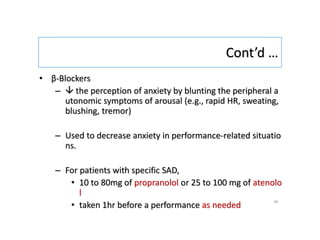
• β-Blockers
–  the perception of anxiety by blunting the peripheral a
utonomic symptoms of arousal (e.g., rapid HR, sweating,
blushing, tremor)
– Used to decrease anxiety in performance-related situatio
ns.
– For patients with specific SAD,
• 10 to 80mg of propranolol or 25 to 100 mg of atenolo
l
• taken 1hr before a performance as needed
40
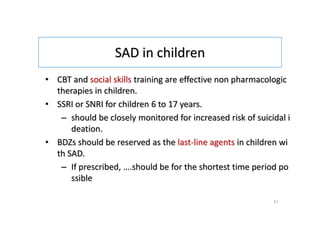
SAD in children
• CBT and social skills training are effective non pharmacologic
therapies in children.
• SSRI or SNRI for children 6 to 17 years.
– should be closely monitored for increased risk of suicidal i
deation.
• BDZs should be reserved as the last-line agents in children wi
th SAD.
– If prescribed, ….should be for the shortest time period po
ssible
41
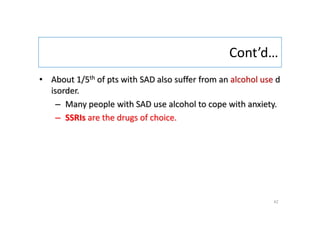
Cont’d…
• About 1/5th of pts with SAD also suffer from an alcohol use d
isorder.
– Many people with SAD use alcohol to cope with anxiety.
– SSRIs are the drugs of choice.
42
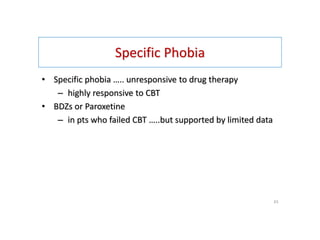
Specific Phobia
• Specific phobia ….. unresponsive to drug therapy
– highly responsive to CBT
• BDZs or Paroxetine
– in pts who failed CBT …..but supported by limited data
43
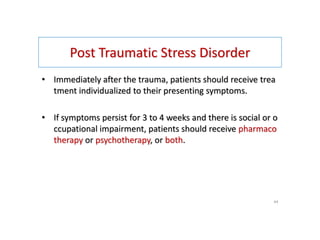
Post Traumatic Stress Disorder
• Immediately after the trauma, patients should receive trea
tment individualized to their presenting symptoms.
• If symptoms persist for 3 to 4 weeks and there is social or o
ccupational impairment, patients should receive pharmaco
therapy or psychotherapy, or both.
44
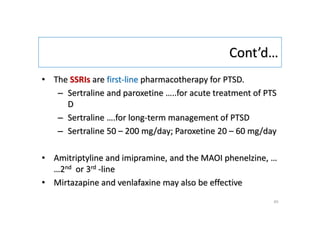
Cont’d…
• The SSRIs are first-line pharmacotherapy for PTSD.
– Sertraline and paroxetine …..for acute treatment of PTS
D
– Sertraline ….for long-term management of PTSD
– Sertraline 50 – 200 mg/day; Paroxetine 20 – 60 mg/day
• Amitriptyline and imipramine, and the MAOI phenelzine, …
…2nd or 3rd -line
• Mirtazapine and venlafaxine may also be effective
45
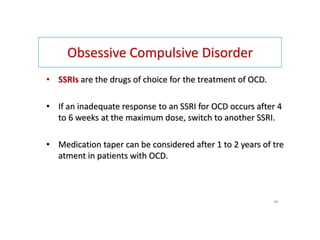
Obsessive Compulsive Disorder
• SSRIs are the drugs of choice for the treatment of OCD.
• If an inadequate response to an SSRI for OCD occurs after 4
to 6 weeks at the maximum dose, switch to another SSRI.
• Medication taper can be considered after 1 to 2 years of tre
atment in patients with OCD.
46
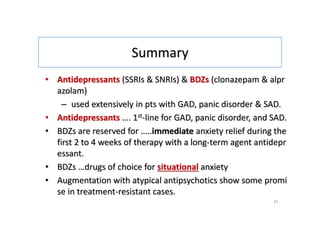
Summary
• Antidepressants (SSRIs & SNRIs) & BDZs (clonazepam & alpr
azolam)
– used extensively in pts with GAD, panic disorder & SAD.
• Antidepressants …. 1st-line for GAD, panic disorder, and SAD.
• BDZs are reserved for …..immediate anxiety relief during the
first 2 to 4 weeks of therapy with a long-term agent antidepr
essant.
• BDZs …drugs of choice for situational anxiety
• Augmentation with atypical antipsychotics show some promi
se in treatment-resistant cases.
47
Buspirone ….
• Buspirone is a treatment option for patients…
– with uncomplicated GAD
– who fail other anxiolytic therapies,
– with substance abuse
– without comorbid depression or other anxiety disorders
 It is effective for the psychic symptoms of anxiety, unl
ike BDZs
48
thanks..

Anxiety Disorders(1) (1).pptx

  • 1.
    Mariam D. (B.Pharm,MSc in clinical pharmacy) Email: yemariamju@gmail.com Anxiety Disorder
  • 2.
    Introduction • Anxiety isa normal response to stressful or fearful circumst ances. • Most people experience some degree of anxiety in reactio n to stressful situations, such as final exams or giving a spe ech. • Anxiety symptoms generally are short-lived and do not nec essarily impair function. • Anxiety that becomes excessive, causes irrational thinking or behavior, and impairs a person’s functioning is considere d an anxiety disorder. 2
  • 3.
    Epidemiology – Specific phobias… 9.1% (the most common anxiety disor der) – GAD…2.7% – Panic disorder …2.7% – SAD…7.1% • Anxiety disorders develop …before age 30 • More common in …. – Women, individuals with social issues, – those with a family history of anxiety and depression. 3
  • 4.
    Etiology  Hypotheses onthe etiology of anxiety disorders are based on interactions between a combination of factors including genetic predisposition and stress.  Furthermore, anxiety disorders are associated with chronic medical illness, drugs, substances of abuse. 4
  • 5.
    Pathophysiology • Pathologic anxietystates is associated with abnormal funct ion in several neurotransmitter systems, including norepin ephrine (NE), γ-aminobutyric acid (GABA), serotonin (5-HT) , dopamine(DA), 5
  • 6.
    Clinical presentation • Thecharacteristic features of these illnesses are anxiety an d avoidance behavior. • Anxiety symptoms must cause significant distress and impa irment in social, occupational, or other areas of functioning . • Should not be secondary to a drug or illicit substance or a g eneral medical disorder or occur solely as part of another p sychiatric disorder 6
  • 7.
    Subtypes of anxietydisorders/DSM IV TR  Generalized anxiety disorder (GAD)  Panic disorder (PD)  Social anxiety disorder (SAD)  Specific phobia  Agoraphobia  Obsessive-compulsive disorder (OCD)  Posttraumatic stress disorder (PTSD) 7
  • 8.
    GAD • Excessive anxietyand worry about events or activities for m ost days for at least 6 months. • Accompanied by 3 or more of following symptoms – restlessness – easily fatigued, – difficulty concentrating, – irritability, muscle tension, – sleep disturbance • Social, occupational impairment; poor coping skills 8
  • 9.
    Cont’d… • Has agradual onset Women: Men 2:1 • High percentage of relapse, low rates of recovery. • Lifetime comorbidity with another psychiatric disorder occ urs in 90% of pts with GAD. – Depression … >60% 9
  • 10.
    10  Panic attack:a discrete period of intense fear in which 4 of the following symptoms abruptly develop and peak withi n 10 min  depersonalization, fear of losing control or going crazy, fear of dying  abdominal distress, feeling of choking, nausea, chills, s weating, shaking, paresthesia, dizziness or light-heade dness, hot flushes, palpitations, tachycardia, chest pain , SoB.  Recurrent unexpected panic attacks, involving an intense, terrifying fear in the absence of danger and for a one mont h period or more of:  persistent worry about having additional attacks  worry about the consequences of the attacks Panic Disorder
  • 11.
    Cont’d…  Complications ofpanic disorder include … – depression (10% to 65% have MDD) – alcohol abuse – high use of health services and emergency rooms • Pts with panic disorder have high lifetime risk for suicide a ttempt • Female: male 2-3:1 11
  • 12.
    Agoraphobia • ~ 70%of pts develop agoraphobia….. 2o to panic attacks • Agoraphobia is fear and avoidance of situations and places in which they would feel unsafe in the event of a panic atta ck. • The individual fears or avoids these situations because esca pe might be difficult or help might not be available. • Marked fear or anxiety for more than 6 months about two or more of the following situations: – Market places, Using public transportation – Being in enclosed spaces; Being in a crowd – Being outside of the home alone 12
  • 13.
    SAD • It isan intense, irrational & persistent fear of being negatively evaluated in at least one social or performance situation; last s more than 6 months. – Exposure to the feared circumstance usually provokes an i mmediate situation-related panic attack. • Physical symptoms: Blushing, diarrhea, sweating, tachycardia, – Blushing …main physical indicator used to distinguishes S AD from other anxiety disorders. • People with SAD can be reluctant to seek professional help – perceived as feared social interaction 13
  • 14.
    Cont’d… • Generalized SAD…. – fear and avoidance extend to various social situations • Non-generalized SAD …. – fear is confined to only one/two social situations • Panic attacks occur in both SAD and panic disorder, but the distinctio n between the two is the rationale behind fear. – fear of anxiety symptoms is x/tic of panic disorder – fear of embarrassment from social interaction typifies SAD. 14
  • 15.
    Cont’d… • Some fearedsituations in SAD • Eating or writing in front of others • Interacting with authority figures • Speaking in public • Talking with strangers • Use of public toilet Slightly higher in women than men 15
  • 16.
    Specific Phobia • Specificphobia is marked and persistent fear (>6 months) of a specific object or situation (e.g., insects or heights). – the patient is usually free of symptoms…when no contact with the feared object or situation – Most persons simply avoid the feared object and adjust to certain restrictions on their activities. – Up to 15% of general population – Female: Male 2:1 16
  • 17.
    PTSD • Exposure toa traumatic event is required for a diagnosis of PTSD • The patient’s response to trauma must include intense fear , helplessness or horror • Resulting symptoms include – Persistently re-experiencing of the traumatic event – Avoidance of stimuli associated with trauma 17
  • 18.
    Cont’d… • Symptoms mustbe present longer than 1 month and cause significant distress or impairment. • One-third of patients with PTSD have a poor prognosis, and about 80% have a concurrent depression or anxiety disord er. • Over half of men with PTSD have comorbid alcohol abuse o r dependence, and about 20% of patients attempt suicide. 18
  • 19.
    OCD • Obsessions – Repetitivethoughts, e.g., feeling contaminated after touchi ng an object, doubting whether the stove was turned off – Repeated doubts – Intense need to have orderliness and symmetry – Repeated sexual thoughts or images • Compulsions – Repetitive activities (e.g., hand washing, checking, ordering ) – Repetitive mental acts (e.g., counting, repeating words sile ntly) 19
  • 20.
    Treatment Goals • Short-termgoals – to reduce the severity, duration and frequency of the a nxiety symptoms – to improve overall functioning • Long-term goals – remission with minimal/no anxiety symptoms/no functi onal impairment – increased QOL – prevention of recurrence 20
  • 21.
    Non-pharmacologic therapy • Cognitivebehavioral therapy (CBT) ….the most effective psy chologic therapy – CBT includes relaxation training, rehearsal of coping skill s, etc • Anxious patients should be instructed to avoid caffeine, non prescription stimulants, diet pills, and excessive use of alco hol. 21
  • 22.
    Generalized Anxiety Disorder –First Line Drugs- SSRIs and SNRIs • Paroxetine, Sertraline, Escitalopram, Duloxetine, Ve nlafaxine XR…FDA approved for mgt of GAD – Second Line Drugs • Benzodiazepines, Buspirone, Imipramine – Alternatives • Hydroxyzine, Pregabalin, Quetiapine 22
  • 23.
    Cont’d… • Antidepressants havereplaced benzodiazepines as the dru gs of choice for chronic GAD owing to – a tolerable side effect profile, – no risk for dependency, and – efficacy in common comorbid conditions including depr ession, panic, obsessive compulsive disorder (OCD), an d SAD.  Their antianxiety response …delayed by 2 to 4wks or lo nger 23
  • 24.
    Cont’d… • SSRIs andSNRIs for acute therapy – 8 to 12-week trials – Paroxetine….most likely to achieve remission of GAD sympto ms • 20 mg/day….max 50md/d – Sertraline …the most well tolerated. • Initial 50 mg/day …. may titrate to max 200 mg/day – Venlafaxine XR …37.5 or 75 mg/day….max 225mg/day – Duloxetine…30 or 60 mg/day….max 120mg/day – Imipramine ….2nd-line (50 mg/day…usual dose: 75–200mg/d ) • Elderly pts are usually treated with ~1/2 of the adult dose 24
  • 25.
    Adverse Effects • SSRIsand SNRIs ….generally well tolerated, with … – GI adverse effects & sleep disturbances …most commo n. – Headaches and diaphoresis …early in treatment, transi ent – weight gain & sexual dysfunction ….in long-term treatm ent. • TCAs: sedation, anticholinergic effects, weight gain in some pts, risk of toxicity in overdose. 25
  • 26.
    Benzodiazepines • Most effectiveand commonly prescribed – For rapid relief of acute anxiety symptoms • All BDZs possess anxiolytic properties – Clonazepam ….an anti- panic agent and anticonvulsant – Alprazolam…..for the treatment of panic disorder with or without agoraphobia, and GAD. • Elderly pts are treated with ~one-half of the adult dose. 26
  • 27.
    Cont’d… • When appropriatelydosed, all agents have similar anxiolytic and sedative–hypnotic activity. • High lipophilicity, – diazepam, and clorazepate ….absorbed rapidly & distrib uted quickly into the CNS. – onset of anxiolytic effect …. 30 to 60 min – most of the improvement occur in the first 2wks of ther apy 27
  • 28.
    Adverse Effects • CNSdepression ….most common – Eg, drowsiness, sedation, psychomotor impairment. • Impairment of memory and recall – events occurring after drug ingestion (anterograde amne sia)  Two serious complications of BDZ therapy – potential for abuse – physical dependence 28
  • 29.
    Dosing • Duration ofBDZ therapy for acute management of anxiety – should be 2 to 4wks • BDZs should be used with a regular dosing regimen – should not be used on an as-needed basis • Persistent symptoms should be managed with antidepressants… – because of the risk of dependence with continued BDZ ther apy. 29
  • 30.
    Buspirone • Buspirone isa non-BDZ anxiolytic – lacks anticonvulsant, muscle relaxant, hypnotic, motor imp airment, and dependence properties. • 2nd-line agent for GAD – b/c of inconsistent efficacy on long term, – delayed onset of effect (2wks or longer), – lack of efficacy for other concurrent depressive & anxiety d isorders 30
  • 31.
    Cont’d… • Initial dose:7.5 mg BID……..dosage range: 15–60mg/day • Its dose can be titrated in increments of 5 mg/day every 2 t o 3 days as needed. • Maximum therapeutic benefit …. might take 4 to 6wks. – not useful in immediate anxiolysis 31
  • 32.
    Treatment resistance • Treatmentresistance is defined as a poor, partial, or lack of response with at least two antidepressants from different c lasses. • Treatment include – increasing the dose of the SSRI/SNRI, – changing to a different agent in the same class, – changing to a different agent of a different class, or – augmentation of therapy. 32
  • 33.
    Panic disorder • Drugchoices for panic disorder – First Line Drugs • SSRIs and Venlafaxine XR…. similar response • b/c of tolerability and efficacy in acute and long-ter m studies – Second Line Drugs • Alprazolam, Clonazepam, Citalopram, Clomipramine, Imipramine • BDZs ….the most commonly used – Alternative ….. phenelzine 33
  • 34.
    Cont’d… • All SSRIsare effective in panic disorder. • Its anti-panic effect is delayed for at least 4wks, and some pts do not respond for 8 to 12wks. • Venlafaxine XR ….37.5 mg/day for the first 3 to 7 days – then increase to a minimum of 75 mg/day – Increasing the dose to 150 mg/day after initial nonresp onse or partial response is recommended. 34
  • 35.
    Imipramine (TCA) • Alleviatepanic attacks in 75% of pts …. 2nd-line agent • blocks panic attacks within at least 4wks and maximal improve ment (including anti-phobic response) takes 8 to 12wks. • Initial dose10 mg/day….antipanic dosage range 75–250mg/d – dose slowly by 10 mg every 2 to 4 days as tolerated. 35
  • 36.
    Benzodiazepines • 2nd-line…b/c ofrisk of dependency • Should not be used as monotherapy in depressed pts or has a history of depression. – potential emergence of depressive symptoms during tre atment • The high-potency BDZs–clonazepam & alprazolam are prefer red agents. • Diazepam and lorazepam are effective at high doses. 36
  • 37.
    Cont’d… • Acute phase:main goal ….reduction of symptoms – resolution of panic attacks – reduction in anxiety and phobic fears – resumption of the patient’s usual activities • Duration …1 to 3 months depending on the choice of drug. • Therapy should be altered … – if no response after 6 to 8 weeks of an adequate dose. 37
  • 38.
    Cont’d… • The guidingprinciple for SSRIs and SNRIs in panic disorder – start with low doses (~¼ to ½ of the starting doses for depression), and treat for about 12 weeks. • Maintenance phase & discontinuation _The optimal length of therapy is unknown – Total The dose used in the acute phase is continued – When drugs are discontinued too early…high rate of re lapse • duration of therapy ….12 to 24 months before drug dis continuation over 4 to 6 months is attempted. 38
  • 39.
    Social Anxiety Disorder –First line drugs • Escitalopram, Fluvoxamine CR, Paroxetine, Sertraline, Venlafaxine XR • b/c of efficacy and tolerability • safe for patients with substance abuse. – Second line drugs: Clonazepam, Citalopram • TCAs are not effective in SAD • BDZs ..for pts intolerant or fail to respond to antidepressants . – not first-line therapy for SAD 39
  • 40.
    Cont’d … • β-Blockers – the perception of anxiety by blunting the peripheral a utonomic symptoms of arousal (e.g., rapid HR, sweating, blushing, tremor) – Used to decrease anxiety in performance-related situatio ns. – For patients with specific SAD, • 10 to 80mg of propranolol or 25 to 100 mg of atenolo l • taken 1hr before a performance as needed 40
  • 41.
    SAD in children •CBT and social skills training are effective non pharmacologic therapies in children. • SSRI or SNRI for children 6 to 17 years. – should be closely monitored for increased risk of suicidal i deation. • BDZs should be reserved as the last-line agents in children wi th SAD. – If prescribed, ….should be for the shortest time period po ssible 41
  • 42.
    Cont’d… • About 1/5thof pts with SAD also suffer from an alcohol use d isorder. – Many people with SAD use alcohol to cope with anxiety. – SSRIs are the drugs of choice. 42
  • 43.
    Specific Phobia • Specificphobia ….. unresponsive to drug therapy – highly responsive to CBT • BDZs or Paroxetine – in pts who failed CBT …..but supported by limited data 43
  • 44.
    Post Traumatic StressDisorder • Immediately after the trauma, patients should receive trea tment individualized to their presenting symptoms. • If symptoms persist for 3 to 4 weeks and there is social or o ccupational impairment, patients should receive pharmaco therapy or psychotherapy, or both. 44
  • 45.
    Cont’d… • The SSRIsare first-line pharmacotherapy for PTSD. – Sertraline and paroxetine …..for acute treatment of PTS D – Sertraline ….for long-term management of PTSD – Sertraline 50 – 200 mg/day; Paroxetine 20 – 60 mg/day • Amitriptyline and imipramine, and the MAOI phenelzine, … …2nd or 3rd -line • Mirtazapine and venlafaxine may also be effective 45
  • 46.
    Obsessive Compulsive Disorder •SSRIs are the drugs of choice for the treatment of OCD. • If an inadequate response to an SSRI for OCD occurs after 4 to 6 weeks at the maximum dose, switch to another SSRI. • Medication taper can be considered after 1 to 2 years of tre atment in patients with OCD. 46
  • 47.
    Summary • Antidepressants (SSRIs& SNRIs) & BDZs (clonazepam & alpr azolam) – used extensively in pts with GAD, panic disorder & SAD. • Antidepressants …. 1st-line for GAD, panic disorder, and SAD. • BDZs are reserved for …..immediate anxiety relief during the first 2 to 4 weeks of therapy with a long-term agent antidepr essant. • BDZs …drugs of choice for situational anxiety • Augmentation with atypical antipsychotics show some promi se in treatment-resistant cases. 47
  • 48.
    Buspirone …. • Buspironeis a treatment option for patients… – with uncomplicated GAD – who fail other anxiolytic therapies, – with substance abuse – without comorbid depression or other anxiety disorders  It is effective for the psychic symptoms of anxiety, unl ike BDZs 48
  • 49.