![Antiderivatives - A Summary
The indefinite integral of f (x) is the collection of all its
antiderivatives:
f (x) dx = F (x) + C
where F (x) = f (x) and C is any constant
Properties:
→ c f (x) dx = c f (x) dx
→ [f (x) ± g (x)] dx = f (x) dx ± g (x) dx](https://image.slidesharecdn.com/antiderivatives-100519114754-phpapp02/75/Antiderivatives-1-2048.jpg)
![Antiderivatives Table
1
√ dx = sin−1 x + C
1 − x2
1
dx = tan−1 x + C
1 + x2
1 1 x
[More generally: dx = · tan−1 ( ) + C ]
a2 + x 2 a a
sec2 x dx = tan x + C csc2 x dx = − cot x + C
sec x ·tan x dx = sec x +C csc x ·cot x dx = − csc x +C](https://image.slidesharecdn.com/antiderivatives-100519114754-phpapp02/75/Antiderivatives-3-2048.jpg)
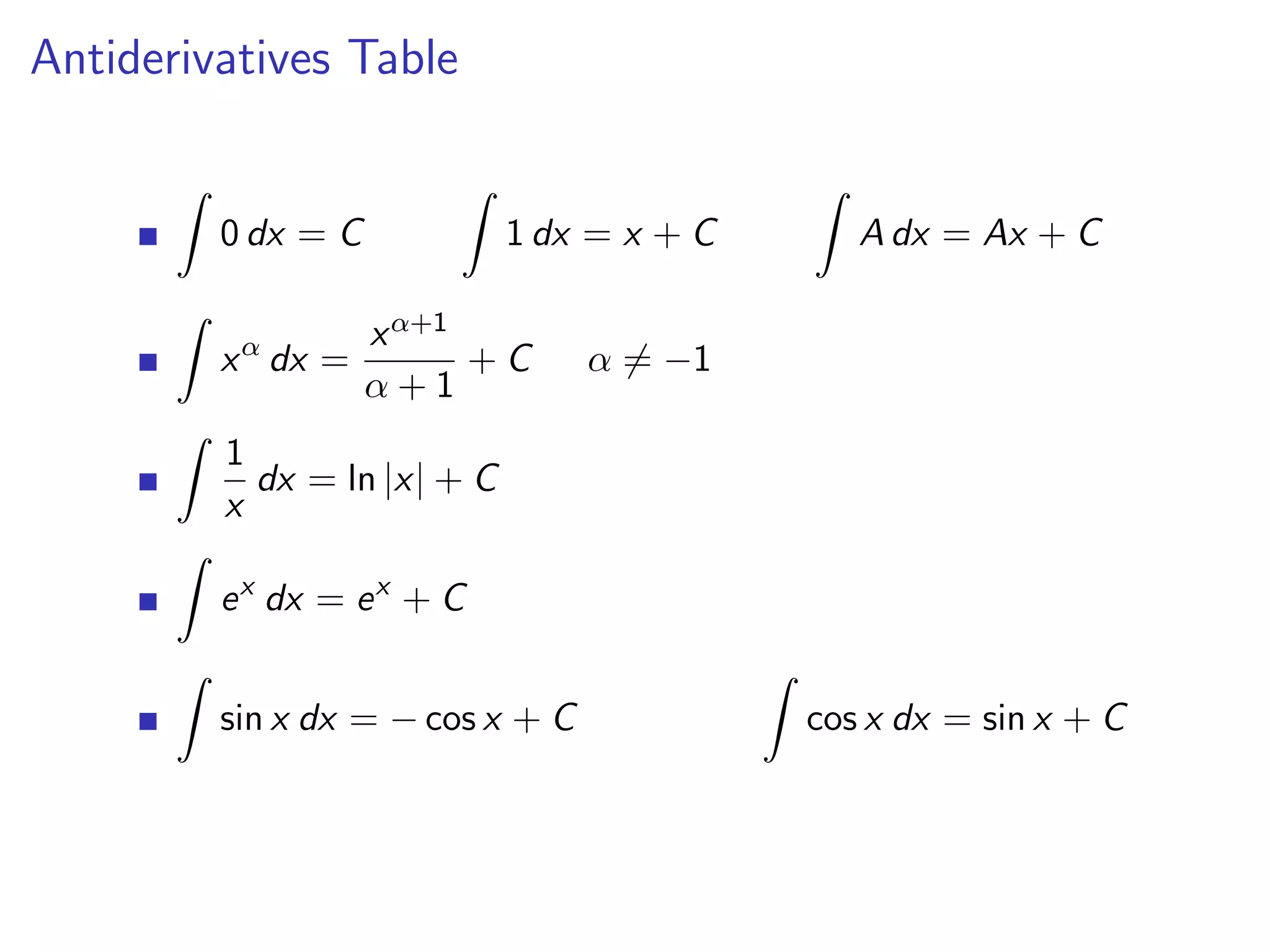
The indefinite integral of a function f(x) represents the collection of that function's antiderivatives. The general form of an antiderivative is F(x) + C, where F(x) is any function whose derivative is f(x) and C is an arbitrary constant. Some key properties are that the antiderivative of cf(x) is c times the antiderivative of f(x) and the antiderivative of f(x) ± g(x) is the antiderivative of f(x) plus/minus the antiderivative of g(x). Tables are also provided listing the antiderivatives of common functions.


