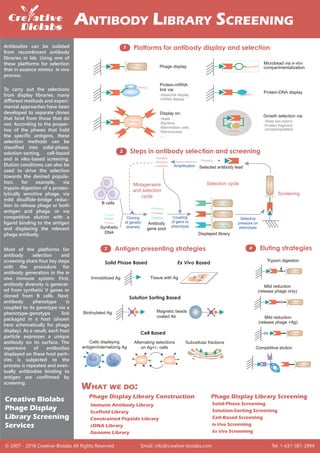
Antibodies can be isolated
from recombinant antibody
libraries in lab. Using one of
these platforms for selection
that in essence mimics in vivo
process.
Platforms for antibody display and selection1
Antigen presenting strategies3
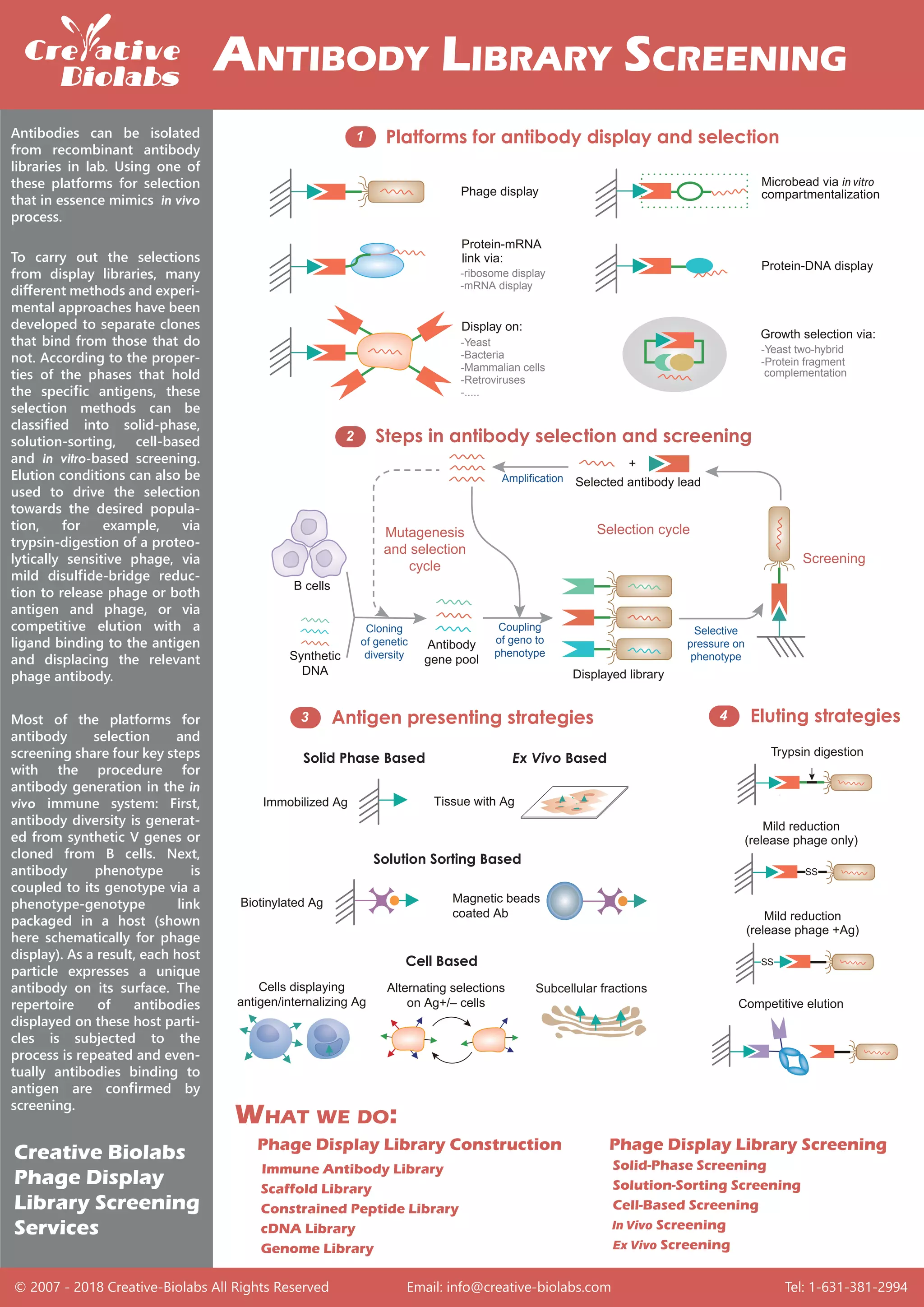
To carry out the selections
from display libraries, many
different methods and experi-
mental approaches have been
developed to separate clones
that bind from those that do
not. According to the proper-
ties of the phases that hold
the specific antigens, these
selection methods can be
classified into solid-phase,
solution-sorting, cell-based
and in vitro-based screening.
Elution conditions can also be
used to drive the selection
towards the desired popula-
tion, for example, via
trypsin-digestion of a proteo-
lytically sensitive phage, via
mild disulfide-bridge reduc-
tion to release phage or both
antigen and phage, or via
competitive elution with a
ligand binding to the antigen
and displacing the relevant
phage antibody.
Phage Display Library Construction
Immune Antibody Library
Scaffold Library
Constrained Peptide Library
cDNA Library
Genome Library
ANTIBODY LIBRARY SCREENING
Creative Biolabs
Phage Display
Library Screening
Services
WHAT WE DO:
© 2007 - 2018 Creative-Biolabs All Rights Reserved Email: info@creative-biolabs.com Tel: 1-631-381-2994
Phage display
Protein-mRNA
link via:
Display on:
-ribosome display
-mRNA display
-Yeast
-Bacteria
-Mammalian cells
-Retroviruses
-.....
Protein-DNA display
Growth selection via:
Microbead via
compartmentalization
-Yeast two-hybrid
-Protein fragment
complementation
Immobilized Ag
Biotinylated Ag
Cells displaying
antigen/internalizing Ag
Eluting strategies4
Mild reduction
(release phage only)
SS
Trypsin digestion
Mild reduction
(release phage +Ag)
SS
Competitive elution
Alternating selections
on Ag+/– cells
Subcellular fractions
Phage Display Library Screening
Solid-Phase Screening
Solution-Sorting Screening
Cell-Based Screening
Screening
Screening
Solid Phase Based
Solution Sorting Based
Cell Based
Tissue with Ag
Ex Vivo Based
Most of the platforms for
antibody selection and
screening share four key steps
with the procedure for
antibody generation in the in
vivo immune system: First,
antibody diversity is generat-
ed from synthetic V genes or
cloned from B cells. Next,
antibody phenotype is
coupled to its genotype via a
phenotype-genotype link
packaged in a host (shown
here schematically for phage
display). As a result, each host
particle expresses a unique
antibody on its surface. The
repertoire of antibodies
displayed on these host parti-
cles is subjected to the
process is repeated and even-
tually antibodies binding to
antigen are confirmed by
screening.
Magnetic beads
coated Ab
Steps in antibody selection and screening2
Coupling
of geno to
phenotype
Selective
pressure on
phenotype
Screening
Antibody
gene pool
Displayed library
Selected antibody lead
Synthetic
DNA
Cloning
of genetic
diversity
B cells
Selection cycle
+
Amplification
Mutagenesis
and selection
cycle

Antibody library screening

  • 1.
    Antibodies can beisolated from recombinant antibody libraries in lab. Using one of these platforms for selection that in essence mimics in vivo process. Platforms for antibody display and selection1 Antigen presenting strategies3 To carry out the selections from display libraries, many different methods and experi- mental approaches have been developed to separate clones that bind from those that do not. According to the proper- ties of the phases that hold the specific antigens, these selection methods can be classified into solid-phase, solution-sorting, cell-based and in vitro-based screening. Elution conditions can also be used to drive the selection towards the desired popula- tion, for example, via trypsin-digestion of a proteo- lytically sensitive phage, via mild disulfide-bridge reduc- tion to release phage or both antigen and phage, or via competitive elution with a ligand binding to the antigen and displacing the relevant phage antibody. Phage Display Library Construction Immune Antibody Library Scaffold Library Constrained Peptide Library cDNA Library Genome Library ANTIBODY LIBRARY SCREENING Creative Biolabs Phage Display Library Screening Services WHAT WE DO: © 2007 - 2018 Creative-Biolabs All Rights Reserved Email: info@creative-biolabs.com Tel: 1-631-381-2994 Phage display Protein-mRNA link via: Display on: -ribosome display -mRNA display -Yeast -Bacteria -Mammalian cells -Retroviruses -..... Protein-DNA display Growth selection via: Microbead via compartmentalization -Yeast two-hybrid -Protein fragment complementation Immobilized Ag Biotinylated Ag Cells displaying antigen/internalizing Ag Eluting strategies4 Mild reduction (release phage only) SS Trypsin digestion Mild reduction (release phage +Ag) SS Competitive elution Alternating selections on Ag+/– cells Subcellular fractions Phage Display Library Screening Solid-Phase Screening Solution-Sorting Screening Cell-Based Screening Screening Screening Solid Phase Based Solution Sorting Based Cell Based Tissue with Ag Ex Vivo Based Most of the platforms for antibody selection and screening share four key steps with the procedure for antibody generation in the in vivo immune system: First, antibody diversity is generat- ed from synthetic V genes or cloned from B cells. Next, antibody phenotype is coupled to its genotype via a phenotype-genotype link packaged in a host (shown here schematically for phage display). As a result, each host particle expresses a unique antibody on its surface. The repertoire of antibodies displayed on these host parti- cles is subjected to the process is repeated and even- tually antibodies binding to antigen are confirmed by screening. Magnetic beads coated Ab Steps in antibody selection and screening2 Coupling of geno to phenotype Selective pressure on phenotype Screening Antibody gene pool Displayed library Selected antibody lead Synthetic DNA Cloning of genetic diversity B cells Selection cycle + Amplification Mutagenesis and selection cycle