Antibody Methods and Protocols 1st Edition Hilmar Ebersbach
1.
Antibody Methods andProtocols 1st Edition
Hilmar Ebersbach pdf download
https://ebookfinal.com/download/antibody-methods-and-
protocols-1st-edition-hilmar-ebersbach/
Explore and download more ebooks or textbooks
at ebookfinal.com
2.
We have selectedsome products that you may be interested in
Click the link to download now or visit ebookfinal.com
for more options!.
Antibody Engineering Methods and Protocols 1st Edition
Benny K. C. Lo
https://ebookfinal.com/download/antibody-engineering-methods-and-
protocols-1st-edition-benny-k-c-lo/
Antibody Phage Display Methods and Protocols 1st Edition
Hennie R. Hoogenboom (Auth.)
https://ebookfinal.com/download/antibody-phage-display-methods-and-
protocols-1st-edition-hennie-r-hoogenboom-auth/
Dengue Methods and Protocols 1st Edition Radhakrishnan
Padmanabhan
https://ebookfinal.com/download/dengue-methods-and-protocols-1st-
edition-radhakrishnan-padmanabhan/
Immunoproteomics Methods and Protocols 1st Edition Scott
Mccomb
https://ebookfinal.com/download/immunoproteomics-methods-and-
protocols-1st-edition-scott-mccomb/
3.
Glycosyltransferases Methods andProtocols 1st Edition
Wenjie Peng
https://ebookfinal.com/download/glycosyltransferases-methods-and-
protocols-1st-edition-wenjie-peng/
Phytoplasma Methods and Protocols 1st Edition Matt
Dickinson
https://ebookfinal.com/download/phytoplasma-methods-and-protocols-1st-
edition-matt-dickinson/
Hypertension Methods and Protocols 1st Edition Delyth
Graham
https://ebookfinal.com/download/hypertension-methods-and-
protocols-1st-edition-delyth-graham/
Mucins Methods and Protocols 1st Edition Karine Rousseau
https://ebookfinal.com/download/mucins-methods-and-protocols-1st-
edition-karine-rousseau/
Connexin Methods and Protocols 1st Edition. Edition
Roberto Bruzzone
https://ebookfinal.com/download/connexin-methods-and-protocols-1st-
edition-edition-roberto-bruzzone/
ME T HO D S I N MO L E C U L A R BI O L O G Y ™
Series Editor
John M. Walker
School of Life Sciences
University of Hertfordshire
Hatfield, Hertfordshire, AL10 9AB, UK
For further volumes:
http://www.springer.com/series/7651
8.
Antibody Methods andProtocols
Edited by
Gabriele Proetzel
TheJacksonLaboratory,BarHarbor,ME,USA
Hilmar Ebersbach
NIBR Biologics Center, Novartis Institutes for BioMedical Research, Basel, Switzerland
v
Preface
Antibodies play sucha central role in research and development due to their high versatility
and universal applicability that research without them would be inconceivable. Their use
ranges from protein localization, cell separation, and screening to functional assays being
applied in many formats including high-throughput assays. With the breakthrough in the
generation of monoclonal antibodies, the practical potential of antibodies due to their
almost-designer specificities was immediately recognized, especially regarding their applica-
tions in diagnostics and therapeutics. However, surprisingly it still took until the 1990s for
antibodies to begin to make a substantial impact in drug development and to be applied as
effective therapeutics. The industry has since grown into a multibillion-dollar market, and
34 therapeutic antibodies have been FDA approved, most of them still being on the market
in 2012. Additionally, literally hundreds of antibodies are now in the development pipeline.
These are being generated by a variety of platforms incorporating many technical enhance-
ments, such as improved half-life and effector functions. This rapidly growing field is the
result of many advancing technologies allowing current developments to take advantage of
molecular engineering to create tailor-made antibodies. New antibody formats and scaf-
folds are being explored, exemplified by bispecifics and antibody drug conjugates.
This volume, Antibody Methods and Protocols, attempts to provide insight into the gen-
eration of antibodies using in vitro and in vivo approaches, as well as technical aspects for
screening, analysis, and modification of antibodies and antibody fragments. Even though
this volume covers subjects as diverse as classical methods, such as hybridoma technology
and phage display, to the more recent developments including Fc engineering, it is still
beyond the scope of any single volume to present the multitude of techniques now available
for antibody isolation, screening, and modification. Instead, we have focused on basic pro-
tocols for isolating antibodies and, at the same time, selected a range of specific areas with
the aim of providing guides for the overall process of antibody isolation and characteriza-
tion as well as protocols for enhancing classical antibodies and antibody fragments. The
antibody process begins with antigen generation and presentation; this is discussed in the
first chapter. An overview of in vitro approaches is presented in the chapters by Ron Geyer,
Dev Sidhu, Konstantin Petropoulos, Christoph Rader, Georg Thom, and Elisabetta
Traggiai. These cover phage display, ribosome display, as well the use of human B cells for
antibody isolation. Chapters by E-Chiang Lee, Michel Cogné, and Chonghui Zhang dis-
cuss the usefulness of mice in the development of antibodies, in particular genetically engi-
neered mice to develop human and humanized antibodies directly in the mouse. We touch
upon biophysical and biochemical characterization, affinity measurements by surface plas-
mon resonance, and glycosylation analysis with chapters by Michael Schräml and Christiane
Jäger. Further, we have included a description of antibody fragments, cloning approaches,
and modification by pegylation presented in chapters by Christoph Rader and Simona
Jevševar. More recent developments in the field of antibody engineering addressing half-life
extension, effector function modulation, and the rising field of bispecific antibodies, as well
as approaches for antibody decoration including antibody drug conjugates, are covered in
11.
vi Preface
chapters byUlrich Brinkmann, Gloria Meng, and Michel Cogné. While we cannot address
all the new and exciting developments in this fast-developing field, we believe that this volume
provides a broad and useful background to support ongoing efforts and encourages the
development of new imaginative approaches.
The assembly of this volume would not have happened without the commitment of all
contributors, their discussions and rapid responses, making this a valuable and relevant
contribution to antibody methods and protocols. We are also grateful to Dr. Michael V. Wiles
for his help in editing of this volume and providing many dinners.
We like to thank Dr. John Walker for the opportunity to assemble this work and his
encouragement and help throughout the process. We wish to thank also the team from
Humana Press, especially David Casey, for continuous support.
We hope that this volume will provide useful insights for both experts and novices and
that it will stimulate further development of antibody approaches and encourage the com-
munity to continuously share ideas and protocols.
Bar Harbor, ME, USA Gabriele Proetzel
Basel, Switzerland Hilmar Ebersbach
12.
vii
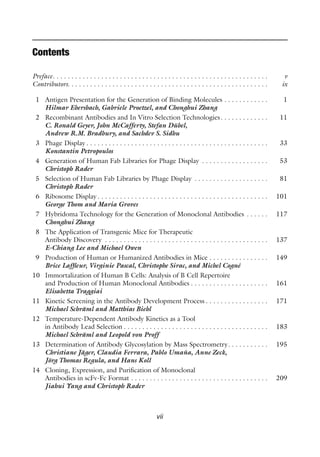
Contents
Preface. . .. . . . . . . . . . . . . . . . . . . . . . . . . . . . . . . . . . . . . . . . . . . . . . . . . . . . . . . v
Contributors. . . . . . . . . . . . . . . . . . . . . . . . . . . . . . . . . . . . . . . . . . . . . . . . . . . . . . ix
1 Antigen Presentation for the Generation of Binding Molecules . . . . . . . . . . . . 1
Hilmar Ebersbach, Gabriele Proetzel, and Chonghui Zhang
2 Recombinant Antibodies and In Vitro Selection Technologies. . . . . . . . . . . . . 11
C. Ronald Geyer, John McCafferty, Stefan Dübel,
Andrew R.M. Bradbury, and Sachdev S. Sidhu
3 Phage Display . . . . . . . . . . . . . . . . . . . . . . . . . . . . . . . . . . . . . . . . . . . . . . . . . 33
Konstantin Petropoulos
4 Generation of Human Fab Libraries for Phage Display . . . . . . . . . . . . . . . . . . 53
Christoph Rader
5 Selection of Human Fab Libraries by Phage Display . . . . . . . . . . . . . . . . . . . . 81
Christoph Rader
6 Ribosome Display . . . . . . . . . . . . . . . . . . . . . . . . . . . . . . . . . . . . . . . . . . . . . . 101
George Thom and Maria Groves
7 Hybridoma Technology for the Generation of Monoclonal Antibodies . . . . . . 117
Chonghui Zhang
8 The Application of Transgenic Mice for Therapeutic
Antibody Discovery . . . . . . . . . . . . . . . . . . . . . . . . . . . . . . . . . . . . . . . . . . . . 137
E-Chiang Lee and Michael Owen
9 Production of Human or Humanized Antibodies in Mice . . . . . . . . . . . . . . . . 149
Brice Laffleur, Virginie Pascal, Christophe Sirac, and Michel Cogné
10 Immortalization of Human B Cells: Analysis of B Cell Repertoire
and Production of Human Monoclonal Antibodies . . . . . . . . . . . . . . . . . . . . . 161
Elisabetta Traggiai
11 Kinetic Screening in the Antibody Development Process . . . . . . . . . . . . . . . . . 171
Michael Schräml and Matthias Biehl
12 Temperature-Dependent Antibody Kinetics as a Tool
in Antibody Lead Selection . . . . . . . . . . . . . . . . . . . . . . . . . . . . . . . . . . . . . . . 183
Michael Schräml and Leopold von Proff
13 Determination of Antibody Glycosylation by Mass Spectrometry. . . . . . . . . . . 195
Christiane Jäger, Claudia Ferrara, Pablo Umaña, Anne Zeck,
Jörg Thomas Regula, and Hans Koll
14 Cloning, Expression, and Purification of Monoclonal
Antibodies in scFv-Fc Format . . . . . . . . . . . . . . . . . . . . . . . . . . . . . . . . . . . . . 209
Jiahui Yang and Christoph Rader
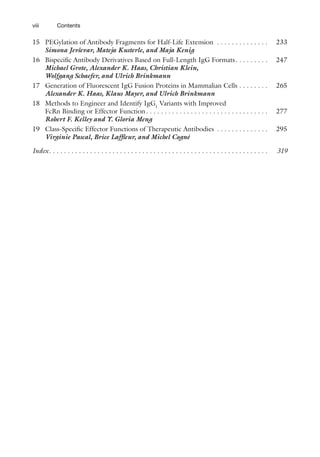
13.
viii Contents
15 PEGylationof Antibody Fragments for Half-Life Extension . . . . . . . . . . . . . . 233
Simona Jevševar, Mateja Kusterle, and Maja Kenig
16 Bispecific Antibody Derivatives Based on Full-Length IgG Formats. . . . . . . . . 247
Michael Grote, Alexander K. Haas, Christian Klein,
Wolfgang Schaefer, and Ulrich Brinkmann
17 Generation of Fluorescent IgG Fusion Proteins in Mammalian Cells . . . . . . . . 265
Alexander K. Haas, Klaus Mayer, and Ulrich Brinkmann
18 Methods to Engineer and Identify IgG1
Variants with Improved
FcRn Binding or Effector Function. . . . . . . . . . . . . . . . . . . . . . . . . . . . . . . . . 277
Robert F. Kelley and Y. Gloria Meng
19 Class-Specific Effector Functions of Therapeutic Antibodies . . . . . . . . . . . . . . 295
Virginie Pascal, Brice Laffleur, and Michel Cogné
Index. . . . . . . . . . . . . . . . . . . . . . . . . . . . . . . . . . . . . . . . . . . . . . . . . . . . . . . . . . . 319
14.
ix
Contributors
MATTHIAS BIEHL •Roche Diagnostics GmbH, Penzberg, Germany
ANDREW R.M. BRADBURY • Los Alamos National Laboratory, Los Alamos, NM, USA
ULRICH BRINKMANN • Large Molecule Research, Roche Pharma Research
and Early Development, Penzberg, Germany
MICHEL COGNÉ • CNRS UMR6101, Contrôle des Réponses Immunes
B et Lymphoproliférations, Université de Limoges, Limoges, France
STEFAN DÜBEL • Technische Universität Braunschweig, Braunschweig, Germany
HILMAR EBERSBACH • NIBR Biologics Center, Novartis Institutes for BioMedical
Research, Basel, Switzerland
CLAUDIA FERRARA • pRED, Pharma Research and Early Development,
Roche Glycart AG, Schlieren, Switzerland
C. RONALD GEYER • University of Saskatchewan, Saskatoon, SK, Canada
MICHAEL GROTE • Large Molecule Research, Roche Pharma Research and Early
Development, Penzberg, Germany
MARIA GROVES • MedImmune Ltd, Cambridge, UK
ALEXANDER K. HAAS • Large Molecule Research, Roche Pharma Research
and Early Development, Penzberg, Germany
CHRISTIANE JÄGER • pRED, Pharma Research and Early Development,
Roche Glycart AG, Schlieren, Switzerland
SIMONA JEVŠEVAR • Sandoz Biopharmaceuticals, Mengeš, Lek Pharmaceuticals d.d,
Mengeš, Slovenia
ROBERT F. KELLEY • Antibody Engineering, Genentech Inc, South San Francisco,
CA, USA
MAJA KENIG • Sandoz Biopharmaceuticals, Mengeš, Lek Pharmaceuticals d.d,
Mengeš, Slovenia
CHRISTIAN KLEIN • Large Molecule Research, Roche Pharma Research
and Early Development, Schlieren, Switzerland
HANS KOLL • pRED, Pharma Research and Early Development,
Roche Diagnostics GmbH, Penzberg, Germany
MATEJA KUSTERLE • Sandoz Biopharmaceuticals, Mengeš, Lek Pharmaceuticals d.d,
Mengeš, Slovenia
BRICE LAFFLEUR • CNRS UMR6101, Contrôle des Réponses Immunes
B et Lymphoproliférations, Université de Limoges, Limoges, France
E-CHIANG LEE • Kymab Ltd, Meditrina, Cambridge, UK
KLAUS MAYER • Large Molecule Research, Roche Pharma Research and Early
Development, Penzberg, Germany
JOHN MCCAFFERTY • University of Cambridge, Cambridge, UK
15.
x Contributors
Y. GLORIAMENG • Biochemical and Cellular Pharmacology, Genentech Inc,
South San Francisco, CA, USA
MICHAEL OWEN • Kymab Ltd, Meditrina, Cambridge, UK
VIRGINIE PASCAL • CNRS UMR6101, Contrôle des Réponses Immunes
B et Lymphoproliférations, Université de Limoges, Limoges, France
KONSTANTIN PETROPOULOS • MorphoSys AG, Martinsried/Planegg, Germany
GABRIELE PROETZEL • The Jackson Laboratory, Bar Harbor, ME, USA
LEOPOLD VON PROFF • Roche Diagnostics GmbH, Penzberg, Germany
CHRISTOPH RADER • Experimental Transplantation and Immunology Branch,
Center for Cancer Research, National Cancer Institute, National Institutes
of Health, Bethesda, MD, USA; Department of Cancer Biology
and Department of Molecular Therapeutics, The Scripps Research Institute,
Scripps Florida Jupiter, FL, USA
JÖRG THOMAS REGULA • pRED, Pharma Research and Early Development,
Roche Diagnostics GmbH, Penzberg, Germany
WOLFGANG SCHAEFER • Large Molecule Research, Roche Pharma Research
and Early Development, Penzberg, Germany
MICHAEL SCHRÄML • Roche Diagnostics GmbH, Penzberg, Germany
SACHDEV S. SIDHU • University of Toronto, Toronto, ON, Canada
CHRISTOPHE SIRAC • CNRS UMR6101, Contrôle des Réponses Immunes
B et Lymphoproliférations, Université de Limoges, Limoges, France
GEORGE THOM • MedImmune Ltd, Cambridge, UK
ELISABETTA TRAGGIAI • Translational Science, Novartis Institute
for Biomedical Research, Basel, Switzerland
PABLO UMAÑA • pRED, Pharma Research and Early Development,
Roche Glycart AG, Schlieren, Switzerland
JIAHUI YANG • Experimental Transplantation and Immunology Branch,
Center for Cancer Research, National Cancer Institute, National Institutes
of Health, Bethesda, MD, USA
ANNE ZECK • NMI, Naturwissenschaftliches und Medizinisches Institut,
Universität Tübingen, Reutlingen, Germany
CHONGHUI ZHANG • NIBR Biologics Center, Novartis Institutes for BioMedical
Research, Cambridge, MA, Switzerland
2 H. Ebersbachet al.
condition in the later application. If this is done correctly, this will
dramatically increase the value and applicability of the isolated anti-
bodies. This chapter describes approaches for the preparation of
different forms of immunogens, including synthetic peptides,
proteins, and cell-based antigens for immunization and in vitro
display systems.
The use of peptides as immunogens for hybridoma generation
is fast and straightforward. Peptides can be used as surrogates for
protein domains or even complete proteins. This is especially use-
ful when the required amount of functional antigen is difficult to
produce by protein expression or other means. Cell surface recep-
tors are of high interest currently representing a class of immuno-
gens for which peptide antigens have been successfully used in
immunization or phage display (1, 2). However, immunization
with peptide antigens derived of cell surface targets may pose spe-
cial challenges. This type of immunization depends not only on
how well an appropriate immunogenic peptide sequence is selected
from the target protein, but also on whether the anti-peptide mAbs
generated by this approach subsequently recognize the native anti-
gen on the cell surface. The successful generation of mAbs to pep-
tide antigens usually requires coupling of the peptide to a carrier
protein, for example, keyhole limpet hemocyanin (KLH) or bovine
serum albumin (BSA) (see Note 1).
In vitro display systems require also the use of carrier proteins
due to the small size of peptide antigens. The coating of the plastic
surface of microtiter plates with unconjugated peptides will render
them masked and inaccessible, during the blocking of free binding
sites of the plastic surface with BSA or milk.
Peptide antigens can also be biotinylated either at the C or N
terminus or via endogenous lysines. This allows for the addition of
antigen to displayed binding molecules and facilitates capture of
the full binding complex via streptavidin or NeutrAvidin, following
a standard panning cycle (3, 4).
Soluble proteins can be either complete proteins, for example,
cytokines, or protein domains thereof, or soluble expressible extra-
cellular domains of receptors, for example, GPCRs. Overall, the
methodologies applied are similar to those used for peptide anti-
gens. It is however, important that proteins used are homogenous,
properly folded and presented such that the critical epitopes are
accessible. Protein oxidation, aggregation, and degradation are
known issues which can affect the outcome of antibody generation
severely. Therefore, there is a need to carefully monitor, for exam-
ple, by mass spectroscopy or functional assays the quality of the
antigen. In case of recombinant protein preparation, posttransla-
tional modification such as deamidation may be critical to the suc-
cessful isolation of antibodies and needs to be appreciated (5, 6).
For example, abnormal glycosylation could lead to the obscuring
of an epitope as known for hyperglycosylation in yeast (7). In the
case of E. coli derived antigens which lack glycosylation, antibodies
18.
3
1 Antigen Presentationfor the Generation of Binding Molecules
may be generated against epitopes that are not accessible in the
mammalian system and hence of little value (8). For antigen pre-
sentation by means of in vitro display applications, proteins can be
directly coated on to plastic surfaces, or immobilized to the plastic
via biotin and streptavidin or NeutrAvidin. In case of immuniza-
tion, peptide or protein antigens are usually formulated with an
adjuvant. The use of an adjuvant, such as Freund’s adjuvant, not
only lowers the amount of antigen required but also prolongs the
antigen stimulation of the immune host. Even though in recent
years there is a growing number of new adjuvant reagents available,
Freund’s adjuvant has remained the first choice for working
with antigens that have poor immunogenicity in the immune host
(9–11). Freund’s adjuvant contains heat-inactivated bacterial ele-
ments, which enhances the immune response by directly stimulating
the activity of antigen-presenting cells; however, it also elicits a
local inflammatory reaction that may cause a necrotic appearance
at the site of injection in the animal. To minimize or eliminate this
side effect of Freund’s adjuvant, it is necessary to utilize a minimal
dose of the antigen and complete Freund’s adjuvant mixture in the
first injection and subsequent injections (see Notes 2, 3 and 4).
Instead of defined polypeptides, whole cells can be used for
immunization and in vitro display. This is of special use for the
identification and characterization of novel cell surface biomarkers,
where normal or cancerous human cells are potent immunogens
for the generation of mAbs (12–14). In contrast to soluble anti-
gens such as proteins and peptides, whole cells are a particular type
of antigen presenting vehicle. They are also considerably more
immunogenic and result in the production of a stronger immune
response in animals. For cell-based immunization, cells can be col-
lected from tissue culture or isolated from tissue samples. For tis-
sue culture derived material, it is necessary that they are washed
thoroughly to eliminate any unwanted antigenic proteins from the
culture medium (see Note 5).
In vitro display systems often use human cells or peripheral
blood mononuclear cells (PBMC) as antigen source. Besides a high
level of endogenous expressed target all other surface expressed
proteins are potential antigens as well. Here, one needs to choose
a cell type that overexpresses a large amount of the antigen in ques-
tion and in addition it is necessary to have low endogenous level or
no antigen expressing cell line for counter selection. Overall exten-
sive screening is required to be successful in isolating highly specific
binding molecules (15, 16). But often endogenous expressed anti-
gens are the only valuable source due to their presence and func-
tionality in complexes with other proteins.
Another strategy makes use of transfected cells or cell lines,
which helps to overcome the difficulty of purifying cell membrane-
bound proteins for use as immunogens and the inefficiency of
screening for mAbs that recognize the native antigens. In contrast
to human cells or PBMC these are recombinantly expressed target
19.
4 H. Ebersbachet al.
proteins which have to be proven for their functionality in chosen
cell line. To maximize the specific antibody response in the mouse,
human target antigens are cloned into and overexpressed on the
surface of mouse cell lines derived from a strain syngeneic to the
immunization host strain, e.g., BALB/c mice. The stably trans-
fected cells are used for immunizing the syngeneic mouse strain
and for the subsequent screening of hybridoma clones derived
from cell fusions while the non transfected cell serves as the nega-
tive control (Fig. 1). In comparison to using human cells, trans-
fected murine cells will typically have a significantly reduced
background response when using the syngeneic inbred mouse
strain, as the cells are genetically identical to the mouse strain apart
for the transfected and expressed target molecule. The key benefits
of the transfected cell-based immunization strategy are (1) dra-
matic improvement in the immune response of animals to cell sur-
face antigens, (2) significant increase in the yield of mAbs that
identify the native form of antigens expressed by the cells, and
(3) obviation of lengthy protocols for the purification of membrane-
bound proteins. In addition, it is also possible to use cell-based
immunization to generate mAbs against the secreted forms of anti-
gens by tethering the secreted proteins, such as serum proteins and
cytokines, to the cell surface as antigens for immunization.
The technical platform which has been established for cell-
based immunization enables effective generation of high-quality
mAbs to cell surface targets. The procedure for immunizing mice
with stably transfected cells is similar to that used for human and
other cell lines. Another advantage of this approach, which is also
Fig. 1. Transfected cells as antigen for immunization and for the subsequent mAb screening. A human target antigen is
overexpressed on the surface of a mouse cell line derived from the BALB/c strain. The stably transfected cells are used as
an antigen for immunizing BALB/c mice and for the differential screening of hybridoma supernatants of the transfected
versus nontransfected cells by flow cytometry. Example expression profiles of antigen on transfected and nontransfected
cells are shown.
20.
5
1 Antigen Presentationfor the Generation of Binding Molecules
reflected by increasing use of such cell lines in phage display, is the
ease of generation of a counter selection cell line in exactly identi-
cal genetic background. Parental cell lines without any expression
of desired antigen are used for isolation of highly specific antibod-
ies, as described above.
Another option for antigen immunogen presentation is the use
of virus-like particles (VLPs). This has been shown to be especially
effective for cell receptor or ion channel antigens. A number of dif-
ferent approaches exist; however, they all follow the same principle
of co-overexpressing the antigen with a virus coat protein for
encapsulation of the antigen into a so-called VLP. The main benefit
of this approach over transfected cells is a higher expression or
concentration of the antigen combined with a better defined sur-
face, i.e., less presentation of irrelevant proteins from the parental
cell line. It is also very easy to produce “null” particles in an identical
parental cell line which do not express the target antigen allowing
for counter selection (17, 18).
A strategy for dealing with difficult to express antigens is to use
a DNA immunization approach. This method exploits the flexibility
and ease of working with DNA, allowing the generation of many
different DNA constructs encoding peptides, protein domains or
full proteins. DNA can also be delivered by many different means,
including injection (hypodermic needle), gene gun using DNA-
coated gold beads, pneumatic injection, and lipid formulations
(19) become routine when immunizing rodents in the laboratory.
A further specialized technique uses in vivo phage display, where
antibody libraries are injected into animals. The phage enriched to
bind to the target is then recovered by isolation of cells or even tis-
sues of interest, for example, to specific cancer cell targets (20).
Other more specialized techniques to address identification of
novel biomarkers or to adapt the screening to optimize the intended
purpose of the binding protein are not addressed here as they are
beyond the scope of this chapter. All the above-described techniques
should be properly considered in advance of any antibody genera-
tion campaign to aim for a highly valuable binding molecule.
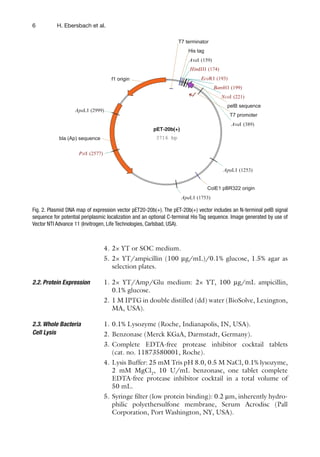
1. Vector for periplasmatic expression in E. coli: pet20b(+)
(Novagen, Merck KGaA, Darmstadt, Germany) (Fig. 2) (see
Note 6).
2. Competent Cells: BL21 (DE3) chemical competent cells
(Invitrogen, Life Technologies).
3. Purified DNA (DNA plasmid purification kit; Qiagen, Hilden,
Germany) of the construct that includes a His6
-Tag (see Note 7).
2. Materials
2.1. Transformation
of DNA
21.
6 H. Ebersbachet al.
4. 2× YT or SOC medium.
5. 2× YT/ampicillin (100 μg/mL)/0.1% glucose, 1.5% agar as
selection plates.
1. 2× YT/Amp/Glu medium: 2× YT, 100 μg/mL ampicillin,
0.1% glucose.
2. 1 M IPTG in double distilled (dd) water (BioSolve, Lexington,
MA, USA).
1. 0.1% Lysozyme (Roche, Indianapolis, IN, USA).
2. Benzonase (Merck KGaA, Darmstadt, Germany).
3. Complete EDTA-free protease inhibitor cocktail tablets
(cat. no. 11873580001, Roche).
4. Lysis Buffer: 25 mM Tris pH 8.0, 0.5 M NaCl, 0.1% lysozyme,
2 mM MgCl2
, 10 U/mL benzonase, one tablet complete
EDTA-free protease inhibitor cocktail in a total volume of
50 mL.
5. Syringe filter (low protein binding): 0.2 μm, inherently hydro-
philic polyethersulfone membrane, Serum Acrodisc (Pall
Corporation, Port Washington, NY, USA).
2.2. Protein Expression
2.3. Whole Bacteria
Cell Lysis
pET-20b(+)
3716 bp
bla (Ap) sequence
T7 promoter
His tag
ColE1 pBR322 origin
f1 origin
T7 terminator
pelB sequence
BamHI (199)
EcoRI (193)
HindIII (174)
NcoI (221)
PstI (2577)
AvaI (159)
AvaI (389)
ApaLI (1253)
ApaLI (1753)
ApaLI (2999)
Fig. 2. Plasmid DNA map of expression vector pET20-20b(+). The pET-20b(+) vector includes an N-terminal pelB signal
sequence for potential periplasmic localization and an optional C-terminal His·Tag sequence. Image generated by use of
Vector NTI Advance 11 (Invitrogen, Life Technologies, Carlsbad, USA).
22.
7
1 Antigen Presentationfor the Generation of Binding Molecules
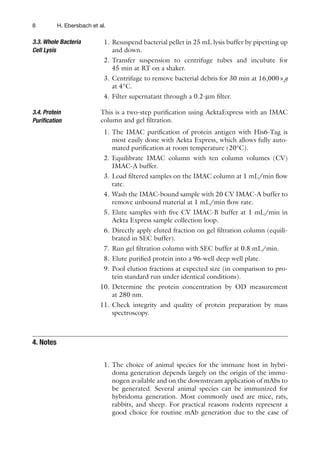
1. Aekta Express (GE Healthcare, UK).
2. IMAC column: HiTrap 1 mL chelating HP (GE Healthcare).
3. IMAC-A buffer: 20 mM Na-Phosphate buffer pH 7.4, 500 mM
NaCl, 20 mM imidazole.
4. IMAC-B buffer: 20 mM Na-Phosphate buffer pH 7.4, 500 mM
NaCl, and 300 mM imidazole.
5. Gel filtration column (SEC): HiLoad 16/60 Superdex 75 (GE
Healthcare).
6. SEC buffer: 1× PBS, pH 7.2.
7. 96-Well, 1.2 ml deep well plate, polypropylene (Greiner,
Frickenhausen, Germany).
1. Use 20 μL BL21 (DE3) chemical competent cells per
transformation.
2. Add 1.5 μL of a 10 ng/μL dilution of vector DNA, purified via
DNA plasmid purification kit.
3. Incubate for 30 min on ice.
4. Incubate for 45 s at 42°C.
5. Incubate for 2 min on ice.
6. Add 100 μL 2× YT or SOC medium.
7. Incubate for 1.5 h at 37°C by 220 rpm shaking.
8. Plate each sample on a small agar selection plates.
9. Incubate at 37°C overnight (O/N).
1. Inoculate a preculture of 10 mL 2× YT/Amp/Glu, using a
single colony from the transformation plate and incubate for
3 h at 30°C.
2. Transfer the preculture to 500 mL culture in 2× YT/Amp/
Glu in a 5-L flask (ratio volume 1:10), nonbaffled, cotton
stopper.
3. Incubate until OD600nm
reaches 0.5 at 30°C. (This takes about
3–4 h.)
4. For induction of expression add IPTG to a final concentration
of 0.75 mM (375 μL of 1 M solution).
5. Express protein at 30°C O/N shaking at 220 rpm shaking.
6. Pellet bacteria at 5,000´ g for 30 min at 4°C.
7. Freeze pellet at −20°C.
2.4. Protein
Purification
3. Methods
3.1. Transformation
of DNA
3.2. Protein Expression
(500 mL)
23.
8 H. Ebersbachet al.
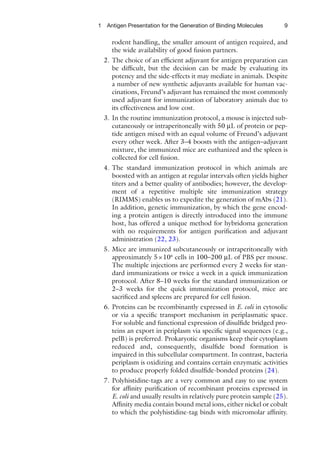
1. Resuspend bacterial pellet in 25 mL lysis buffer by pipetting up
and down.
2. Transfer suspension to centrifuge tubes and incubate for
45 min at RT on a shaker.
3. Centrifuge to remove bacterial debris for 30 min at 16,000×g
at 4°C.
4. Filter supernatant through a 0.2-μm filter.
This is a two-step purification using AektaExpress with an IMAC
column and gel filtration.
1. The IMAC purification of protein antigen with His6-Tag is
most easily done with Aekta Express, which allows fully auto-
mated purification at room temperature (20°C).
2. Equilibrate IMAC column with ten column volumes (CV)
IMAC-A buffer.
3. Load filtered samples on the IMAC column at 1 mL/min flow
rate.
4. Wash the IMAC-bound sample with 20 CV IMAC-A buffer to
remove unbound material at 1 mL/min flow rate.
5. Elute samples with five CV IMAC-B buffer at 1 mL/min in
Aekta Express sample collection loop.
6. Directly apply eluted fraction on gel filtration column (equili-
brated in SEC buffer).
7. Run gel filtration column with SEC buffer at 0.8 mL/min.
8. Elute purified protein into a 96-well deep well plate.
9. Pool elution fractions at expected size (in comparison to pro-
tein standard run under identical conditions).
10. Determine the protein concentration by OD measurement
at 280 nm.
11. Check integrity and quality of protein preparation by mass
spectroscopy.
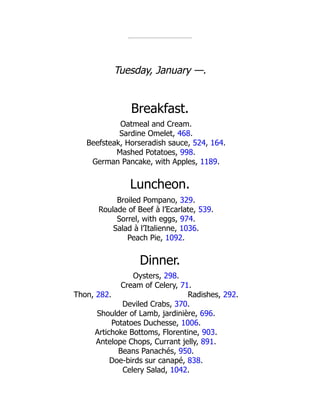
1. The choice of animal species for the immune host in hybri-
doma generation depends largely on the origin of the immu-
nogen available and on the downstream application of mAbs to
be generated. Several animal species can be immunized for
hybridoma generation. Most commonly used are mice, rats,
rabbits, and sheep. For practical reasons rodents represent a
good choice for routine mAb generation due to the ease of
3.3. Whole Bacteria
Cell Lysis
3.4. Protein
Purification
4. Notes
24.
9
1 Antigen Presentationfor the Generation of Binding Molecules
rodent handling, the smaller amount of antigen required, and
the wide availability of good fusion partners.
2. The choice of an efficient adjuvant for antigen preparation can
be difficult, but the decision can be made by evaluating its
potency and the side-effects it may mediate in animals. Despite
a number of new synthetic adjuvants available for human vac-
cinations, Freund’s adjuvant has remained the most commonly
used adjuvant for immunization of laboratory animals due to
its effectiveness and low cost.
3. In the routine immunization protocol, a mouse is injected sub-
cutaneously or intraperitoneally with 50 μL of protein or pep-
tide antigen mixed with an equal volume of Freund’s adjuvant
every other week. After 3–4 boosts with the antigen–adjuvant
mixture, the immunized mice are euthanized and the spleen is
collected for cell fusion.
4. The standard immunization protocol in which animals are
boosted with an antigen at regular intervals often yields higher
titers and a better quality of antibodies; however, the develop-
ment of a repetitive multiple site immunization strategy
(RIMMS) enables us to expedite the generation of mAbs (21).
In addition, genetic immunization, by which the gene encod-
ing a protein antigen is directly introduced into the immune
host, has offered a unique method for hybridoma generation
with no requirements for antigen purification and adjuvant
administration (22, 23).
5. Mice are immunized subcutaneously or intraperitoneally with
approximately 5×10⁶
cells in 100–200 μL of PBS per mouse.
The multiple injections are performed every 2 weeks for stan-
dard immunizations or twice a week in a quick immunization
protocol. After 8–10 weeks for the standard immunization or
2–3 weeks for the quick immunization protocol, mice are
sacrificed and spleens are prepared for cell fusion.
6. Proteins can be recombinantly expressed in E. coli in cytosolic
or via a specific transport mechanism in periplasmatic space.
For soluble and functional expression of disulfide bridged pro-
teins an export in periplasm via specific signal sequences (e.g.,
pelB) is preferred. Prokaryotic organisms keep their cytoplasm
reduced and, consequently, disulfide bond formation is
impaired in this subcellular compartment. In contrast, bacteria
periplasm is oxidizing and contains certain enzymatic activities
to produce properly folded disulfide-bonded proteins (24).
7. Polyhistidine-tags are a very common and easy to use system
for affinity purification of recombinant proteins expressed in
E. coli and usually results in relatively pure protein sample (25).
Affinity media contain bound metal ions, either nickel or cobalt
to which the polyhistidine-tag binds with micromolar affinity.
25.
10 H. Ebersbachet al.
High concentrations of imidazole or EDTA in elution fraction
of samples can be removed by subsequent application of a size-
exclusion chromatography.
References
1. Axelsen TV, Holm A, Christiansen G et al
(2011) Identification of the shortest Abeta-
peptide generating highly specific antibodies
against the C-terminal end of amyloid-beta42.
Vaccine 29:3260–3269
2. Huang L, Sato AK, Sachdeva M et al (2005)
Discovery of human antibodies against the
C5aR target using phage display technology.
J Mol Recognit 18:327–333
3. Zahnd C, Sarkar CA, Pluckthun A (2010)
Computational analysis of off-rate selection
experiments to optimize affinity maturation by
directed evolution. Protein Eng Des Sel
23:175–184
4. Derda R, Tang SK, Li SC et al (2011) Diversity
of phage-displayed libraries of peptides during
panning and amplification. Molecules 16:
1776–1803
5. Srebalus Barnes CA, Lim A (2007) Applications
of mass spectrometry for the structural charac-
terization of recombinant protein pharmaceuti-
cals. Mass Spectrom Rev 26:370–388
6. Jenkins N, Murphy L, Tyther R (2008) Post-
translational modifications of recombinant pro-
teins: significance for biopharmaceuticals. Mol
Biotechnol 39:113–118
7. Singh MB, Bhalla PL (2006) Recombinant
expression systems for allergen vaccines.
Inflamm Allergy Drug Targets 5:53–59
8. Konthur Z, Hust M, Dubel S (2005)
Perspectives for systematic in vitro antibody
generation. Gene 364:19–29
9. Sanchez Y, Ionescu-Matiu I, Dreesman GR
et al (1980) Humoral and cellular immunity to
hepatitis B virus-derived antigens: comparative
activity of Freund complete adjuvant alum, and
liposomes. Infect Immun 30:728–733
10. Billiau A, Matthys P (2001) Modes of action of
Freund’s adjuvants in experimental models of
autoimmune diseases. J Leukoc Biol 70:849–860
11. Odunsi K, Qian F, Matsuzaki J et al (2007)
Vaccination with an NY-ESO-1 peptide of
HLA class I/II specificities induces integrated
humoral and T cell responses in ovarian cancer.
Proc Natl Acad Sci USA 104:12837–12842
12. Kung P, Goldstein G, Reinherz EL et al (1979)
Monoclonalantibodiesdefiningdistinctivehuman
T cell surface antigens. Science 206:347–349
13. Zhang C, Xu Y, Gu J et al (1998) A cell surface
receptor defined by a mAb mediates a unique
type of cell death similar to oncosis. Proc Natl
Acad Sci USA 95:6290–6295
14. Zhang CH, Davis WC, Grunig G et al (1998)
The equine homologue of LFA-1 (CD11a/
CD18): cellular distribution and differential
determinants. Vet Immunol Immunopathol
62:167–183
15. Jahnichen S, Blanchetot C, Maussang D
et al (2010) CXCR4 nanobodies (VHH-based
single variable domains) potently inhibit
chemotaxis and HIV-1 replication and mobi-
lize stem cells. Proc Natl Acad Sci USA
107:20565–20570
16. Popkov M, Rader C, Barbas CF (2004)
Isolation of human prostate cancer cell reactive
antibodies using phage display technology.
J Immunol Methods 291:137–151
17. Willis S, Davidoff C, Schilling J et al (2008)
Virus-like particles as quantitative probes of
membrane protein interactions. Biochemistry
47:6988–6990
18. Yao Q, Bu Z, Vzorov A et al (2003) Virus-like
particle and DNA-based candidate AIDS vac-
cines. Vaccine 21:638–643
19. Robinson HL, Pertmer TM (2001) Nucleic
acid immunizations. Curr Protoc Immunol
Chapter 2:Unit 2.14
20. Rivinoja A, Laakkonen P (2011) Identification of
homing peptides using the in vivo phage display
technology. Methods Mol Biol 683:401–415
21. Kilpatrick KE, Wring SA, Walker DH et al
(1997) Rapid development of affinity matured
monoclonal antibodies using RIMMS.
Hybridoma 16:381–389
22. Bates MK, Zhang G, Sebestyen MG et al
(2006) Genetic immunization for antibody
generation in research animals by intravenous
delivery of plasmid DNA. Biotechniques
40:199–208
23. Tang DC, DeVit M, Johnston SA (1992)
Genetic immunization is a simple method for
eliciting an immune response. Nature 356:
152–154
24. de Marco A (2009) Strategies for successful
recombinant expression of disulfide bond-
dependent proteins in Escherichia coli. Microb
Cell Fact 8:26
25. Hengen P (1995) Purification of His-Tag
fusion proteins from Escherichia coli. Trends
Biochem Sci 20:285–286
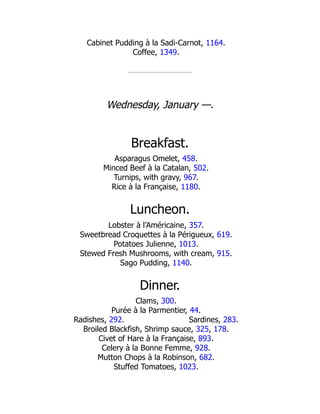
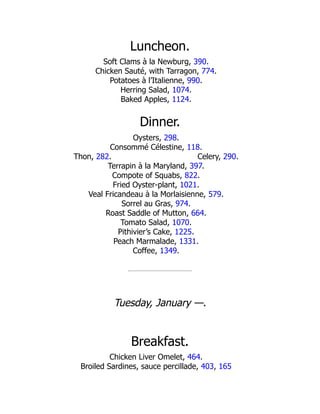
Celery, 290.
Monday, January—.
Breakfast.
Eggs à l’Aurore, 444.
Mackerel aux Fines Herbes, 331.
Minced Beef à la Provençale, 500.
Sweet Potatoes Soufflées, 1010.
Corn Fritters, 965.
Luncheon.
Broiled Florida Shad, maître d’hôtel, 326.
Cucumber Salad, 289.
Beef Tongue, with risotto, 537.
Macaroni and Cream, 954.
Cream Renversée, 1252.
Dinner.
Clams, 300.
Chicken à la Portugaise, 66.
Radishes, 292.
Lobster au Curry, 358.
Pork Chops, sauce piquante, 745.
Cauliflower, with butter, 925.
Croquettes of Chicken à la Reine, 758.
Stuffed Lettuce, 953.
Roast Turkey, Cranberry sauce, 800, 1329.
Barbe de Capucine Salad, 1038.
Omelet Soufflée, 474.
Kümmel Jelly, 1323.
Coffee, 1349.
28.
Radishes, 292.
Tuesday, January—.
Breakfast.
Oatmeal and Cream.
Sardine Omelet, 468.
Beefsteak, Horseradish sauce, 524, 164.
Mashed Potatoes, 998.
German Pancake, with Apples, 1189.
Luncheon.
Broiled Pompano, 329.
Roulade of Beef à l’Ecarlate, 539.
Sorrel, with eggs, 974.
Salad à l’Italienne, 1036.
Peach Pie, 1092.
Dinner.
Oysters, 298.
Cream of Celery, 71.
Thon, 282.
Deviled Crabs, 370.
Shoulder of Lamb, jardinière, 696.
Potatoes Duchesse, 1006.
Artichoke Bottoms, Florentine, 903.
Antelope Chops, Currant jelly, 891.
Beans Panachés, 950.
Doe-birds sur canapé, 838.
Celery Salad, 1042.
29.
Sardines, 283.
Cabinet Puddingà la Sadi-Carnot, 1164.
Coffee, 1349.
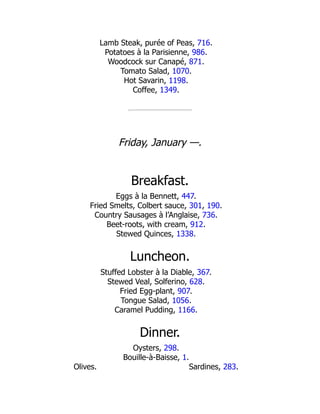
Wednesday, January —.
Breakfast.
Asparagus Omelet, 458.
Minced Beef à la Catalan, 502.
Turnips, with gravy, 967.
Rice à la Française, 1180.
Luncheon.
Lobster à l’Américaine, 357.
Sweetbread Croquettes à la Périgueux, 619.
Potatoes Julienne, 1013.
Stewed Fresh Mushrooms, with cream, 915.
Sago Pudding, 1140.
Dinner.
Clams, 300.
Purée à la Parmentier, 44.
Radishes, 292.
Broiled Blackfish, Shrimp sauce, 325, 178.
Civet of Hare à la Française, 893.
Celery à la Bonne Femme, 928.
Mutton Chops à la Robinson, 682.
Stuffed Tomatoes, 1023.
30.
Olives.
Roast Red-head Ducks,876.
Lettuce Salad, 1059.
Charlotte Panachée, 1300.
Coffee, 1349.
Thursday, January —.
Breakfast.
Eggs, with brown butter, 414.
Mutton Hash à la Zingara, 652.
Lima Beans, 952.
Small Brioches, 1202.
Luncheon.
Oysters à la Poulette, 383.
Corned Beef and Cabbage, 490.
Macaroni Napolitaine, 957.
Chicken Salad, 1044.
Cherry Tarts, 1111.
Dinner.
Oysters, 298.
Busecca, 7.
Celery, 290.
Salmon à la Génoise, 306.
Boiled Turkey, Oyster sauce, 797.
Spinach à l’Anglaise, 940.
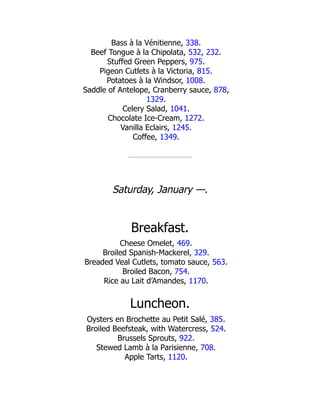
31.
Sardines, 283.
Lamb Steak,purée of Peas, 716.
Potatoes à la Parisienne, 986.
Woodcock sur Canapé, 871.
Tomato Salad, 1070.
Hot Savarin, 1198.
Coffee, 1349.
Friday, January —.
Breakfast.
Eggs à la Bennett, 447.
Fried Smelts, Colbert sauce, 301, 190.
Country Sausages à l’Anglaise, 736.
Beet-roots, with cream, 912.
Stewed Quinces, 1338.
Luncheon.
Stuffed Lobster à la Diable, 367.
Stewed Veal, Solferino, 628.
Fried Egg-plant, 907.
Tongue Salad, 1056.
Caramel Pudding, 1166.
Dinner.
Oysters, 298.
Bouille-à-Baisse, 1.
Olives.
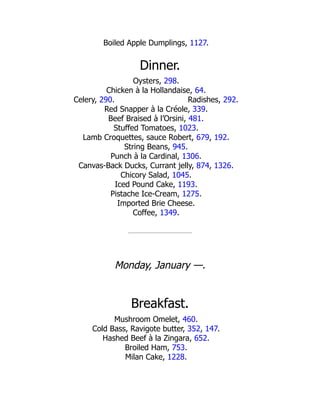
32.
Bass à laVénitienne, 338.
Beef Tongue à la Chipolata, 532, 232.
Stuffed Green Peppers, 975.
Pigeon Cutlets à la Victoria, 815.
Potatoes à la Windsor, 1008.
Saddle of Antelope, Cranberry sauce, 878,
1329.
Celery Salad, 1041.
Chocolate Ice-Cream, 1272.
Vanilla Eclairs, 1245.
Coffee, 1349.
Saturday, January —.
Breakfast.
Cheese Omelet, 469.
Broiled Spanish-Mackerel, 329.
Breaded Veal Cutlets, tomato sauce, 563.
Broiled Bacon, 754.
Rice au Lait d’Amandes, 1170.
Luncheon.
Oysters en Brochette au Petit Salé, 385.
Broiled Beefsteak, with Watercress, 524.
Brussels Sprouts, 922.
Stewed Lamb à la Parisienne, 708.
Apple Tarts, 1120.
33.
Celery, 290.
Dinner.
Clams, 300.
Sorrel,with Asparagus tops, 41.
Lyon Sausage, 286.
Fried Eels, sauce tartare, 301, 207.
Potatoes, Saratoga, 1011.
Garnished Sour-krout, 924.
Salmi of Duck, with olives, 827.
Celery, with cream, 929.
Roast Leg of Lamb, 648.
Lettuce Salad, 1057.
Pineapple Pudding, 1148.
Coffee, 1349.
Sunday, January —.
Breakfast.
Eggs à la Meyerbeer, 437.
Veal Kidneys, sauce madère, 662.
Stuffed Pig’s Feet, 732.
Potatoes à la Rice, 1007.
Fried Hominy, 1035.
Luncheon.
Lobster Croquettes à la Victoria, 365.
Broiled Grouse, bread sauce, 854, 162.
Broiled Fresh Mushrooms on Toast, 916.
34.
Radishes, 292.
Boiled AppleDumplings, 1127.
Dinner.
Oysters, 298.
Chicken à la Hollandaise, 64.
Celery, 290.
Red Snapper à la Créole, 339.
Beef Braised à l’Orsini, 481.
Stuffed Tomatoes, 1023.
Lamb Croquettes, sauce Robert, 679, 192.
String Beans, 945.
Punch à la Cardinal, 1306.
Canvas-Back Ducks, Currant jelly, 874, 1326.
Chicory Salad, 1045.
Iced Pound Cake, 1193.
Pistache Ice-Cream, 1275.
Imported Brie Cheese.
Coffee, 1349.
Monday, January —.
Breakfast.
Mushroom Omelet, 460.
Cold Bass, Ravigote butter, 352, 147.
Hashed Beef à la Zingara, 652.
Broiled Ham, 753.
Milan Cake, 1228.
35.
Celery, 290.
Luncheon.
Soft Clamsà la Newburg, 390.
Chicken Sauté, with Tarragon, 774.
Potatoes à l’Italienne, 990.
Herring Salad, 1074.
Baked Apples, 1124.
Dinner.
Oysters, 298.
Consommé Célestine, 118.
Thon, 282.
Terrapin à la Maryland, 397.
Compote of Squabs, 822.
Fried Oyster-plant, 1021.
Veal Fricandeau à la Morlaisienne, 579.
Sorrel au Gras, 974.
Roast Saddle of Mutton, 664.
Tomato Salad, 1070.
Pithivier’s Cake, 1225.
Peach Marmalade, 1331.
Coffee, 1349.
Tuesday, January —.
Breakfast.
Chicken Liver Omelet, 464.
Broiled Sardines, sauce percillade, 403, 165
36.
Olives.
Hashed Mutton auGratin, 653.
Oyster-plant à la Poulette, 1019.
Wheat Cakes, 1184.
Luncheon.
Sheep’s-head, sauce Hollandaise, 309, 160.
Beefsteak Pie à l’Américaine, 488.
Cauliflower au Gratin, 926.
Lemon Pie, meringué, 1102.
Dinner.
Oysters, 298.
Mulligatawney, 34.
Tomatoes, 288.
Crawfish à la Bordelaise, 360.
Piloff of Chicken à la Turque, 782.
Succotash, 1022.
Sweetbreads Piqués à la Financière, 603.
Spaghetti à l’Italienne, 960.
Roast Quails, with Watercress, 834.
Escarole Salad, 1055.
Cocoanut Pudding, 1147.
Camembert Cheese.
Coffee, 1349.
37.
Celery, 290.
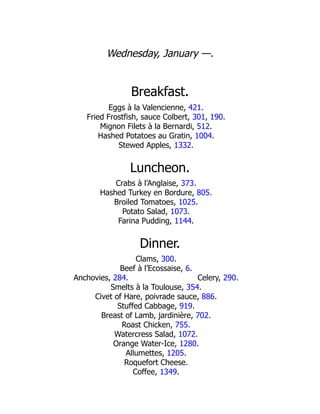
Wednesday, January—.
Breakfast.
Eggs à la Valencienne, 421.
Fried Frostfish, sauce Colbert, 301, 190.
Mignon Filets à la Bernardi, 512.
Hashed Potatoes au Gratin, 1004.
Stewed Apples, 1332.
Luncheon.
Crabs à l’Anglaise, 373.
Hashed Turkey en Bordure, 805.
Broiled Tomatoes, 1025.
Potato Salad, 1073.
Farina Pudding, 1144.
Dinner.
Clams, 300.
Beef à l’Ecossaise, 6.
Anchovies, 284.
Smelts à la Toulouse, 354.
Civet of Hare, poivrade sauce, 886.
Stuffed Cabbage, 919.
Breast of Lamb, jardinière, 702.
Roast Chicken, 755.
Watercress Salad, 1072.
Orange Water-Ice, 1280.
Allumettes, 1205.
Roquefort Cheese.
Coffee, 1349.
38.
Lyon Sausage, 286.
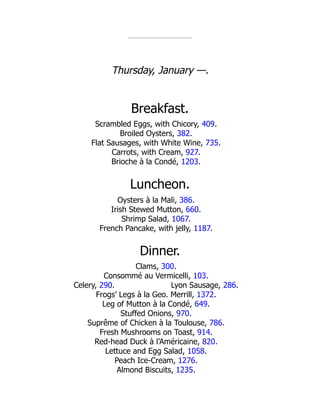
Thursday,January —.
Breakfast.
Scrambled Eggs, with Chicory, 409.
Broiled Oysters, 382.
Flat Sausages, with White Wine, 735.
Carrots, with Cream, 927.
Brioche à la Condé, 1203.
Luncheon.
Oysters à la Mali, 386.
Irish Stewed Mutton, 660.
Shrimp Salad, 1067.
French Pancake, with jelly, 1187.
Dinner.
Clams, 300.
Consommé au Vermicelli, 103.
Celery, 290.
Frogs’ Legs à la Geo. Merrill, 1372.
Leg of Mutton à la Condé, 649.
Stuffed Onions, 970.
Suprême of Chicken à la Toulouse, 786.
Fresh Mushrooms on Toast, 914.
Red-head Duck à l’Américaine, 820.
Lettuce and Egg Salad, 1058.
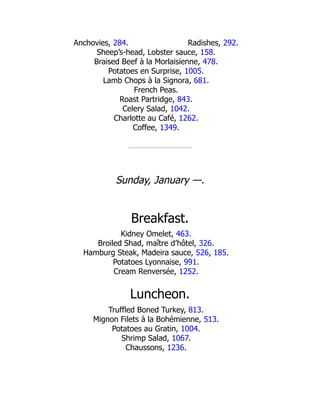
Peach Ice-Cream, 1276.
Almond Biscuits, 1235.
39.
Thon, 282.
Coffee, 1349.
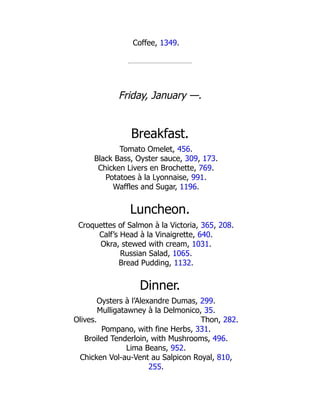
Friday,January —.
Breakfast.
Tomato Omelet, 456.
Black Bass, Oyster sauce, 309, 173.
Chicken Livers en Brochette, 769.
Potatoes à la Lyonnaise, 991.
Waffles and Sugar, 1196.
Luncheon.
Croquettes of Salmon à la Victoria, 365, 208.
Calf’s Head à la Vinaigrette, 640.
Okra, stewed with cream, 1031.
Russian Salad, 1065.
Bread Pudding, 1132.
Dinner.
Oysters à l’Alexandre Dumas, 299.
Mulligatawney à la Delmonico, 35.
Olives.
Pompano, with fine Herbs, 331.
Broiled Tenderloin, with Mushrooms, 496.
Lima Beans, 952.
Chicken Vol-au-Vent au Salpicon Royal, 810,
255.
40.
Artichokes à laBarigoul, 897.
Roast Woodcock, 871.
Chicory Salad, 1045.
Iced Timbale of Rice, 1175.
Swiss Cheese.
Coffee, 1349.
Saturday, January —.
Breakfast.
Oatmeal and Cream.
Eggs à la Provençale, 422.
Cod’s Tongues, black butter, 349.
Fried Calf’s Brains, sauce tartare, 559.
Oyster Plant, with butter, 1018.
Baked Apples, 1124.
Luncheon.
Crabs à la St. Laurent, 372.
Broiled Chicken on Toast, 756.
Brussels Sprouts, 922.
Timbales à la Schultze, 263.
Rum Omelet, 476
Dinner.
Oysters, 298.
Cream of Chicken, 82.
41.
Radishes, 292.
Anchovies, 284.
Sheep’s-head,Lobster sauce, 158.
Braised Beef à la Morlaisienne, 478.
Potatoes en Surprise, 1005.
Lamb Chops à la Signora, 681.
French Peas.
Roast Partridge, 843.
Celery Salad, 1042.
Charlotte au Café, 1262.
Coffee, 1349.
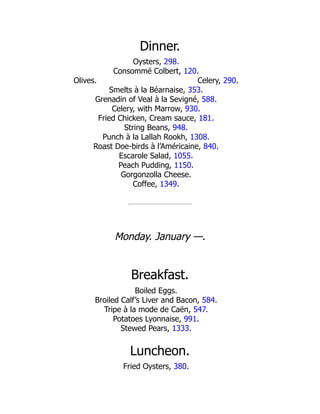
Sunday, January —.
Breakfast.
Kidney Omelet, 463.
Broiled Shad, maître d’hôtel, 326.
Hamburg Steak, Madeira sauce, 526, 185.
Potatoes Lyonnaise, 991.
Cream Renversée, 1252.
Luncheon.
Truffled Boned Turkey, 813.
Mignon Filets à la Bohémienne, 513.
Potatoes au Gratin, 1004.
Shrimp Salad, 1067.
Chaussons, 1236.
42.
Celery, 290.
Dinner.
Oysters, 298.
ConsomméColbert, 120.
Olives.
Smelts à la Béarnaise, 353.
Grenadin of Veal à la Sevigné, 588.
Celery, with Marrow, 930.
Fried Chicken, Cream sauce, 181.
String Beans, 948.
Punch à la Lallah Rookh, 1308.
Roast Doe-birds à l’Américaine, 840.
Escarole Salad, 1055.
Peach Pudding, 1150.
Gorgonzolla Cheese.
Coffee, 1349.
Monday. January —.
Breakfast.
Boiled Eggs.
Broiled Calf’s Liver and Bacon, 584.
Tripe à la mode de Caën, 547.
Potatoes Lyonnaise, 991.
Stewed Pears, 1333.
Luncheon.
Fried Oysters, 380.
43.
Radishes, 292.
Veal, stewedwith Peas, 631.
Cauliflower Salad, 1040.
Pineapple Pie, 1087.
Dinner.
Clams, 300.
Julienne, 27.
Celery, 290.
Turbot, sauce aurore, 309, 182.
Bouchées à la Reine, 270.
Flageolets, 1365.
Epigrammes of Lamb, with Asparagus tops,
690.
Spaghetti à l’Italienne, 960.
Roast Beef, 527.
Tomato, Mayonnaise Salad, 1071.
Champagne Jelly, 1322.
Lady Fingers, 1231.
Coffee, 1349.
Tuesday, January —.
Breakfast.
Scrambled Eggs, with truffles, 407.
Boiled Haddock, Cream sauce, 352, 181.
Brochettes of Lamb à la Dumas, 674.
Potatoes Parisienne, 986.
Crême en Mousse au Café, 1253.
44.
Radishes, 292.
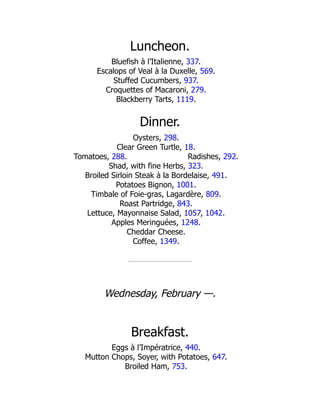
Luncheon.
Bluefish àl’Italienne, 337.
Escalops of Veal à la Duxelle, 569.
Stuffed Cucumbers, 937.
Croquettes of Macaroni, 279.
Blackberry Tarts, 1119.
Dinner.
Oysters, 298.
Clear Green Turtle, 18.
Tomatoes, 288.
Shad, with fine Herbs, 323.
Broiled Sirloin Steak à la Bordelaise, 491.
Potatoes Bignon, 1001.
Timbale of Foie-gras, Lagardère, 809.
Roast Partridge, 843.
Lettuce, Mayonnaise Salad, 1057, 1042.
Apples Meringuées, 1248.
Cheddar Cheese.
Coffee, 1349.
Wednesday, February —.
Breakfast.
Eggs à l’Impératrice, 440.
Mutton Chops, Soyer, with Potatoes, 647.
Broiled Ham, 753.
45.
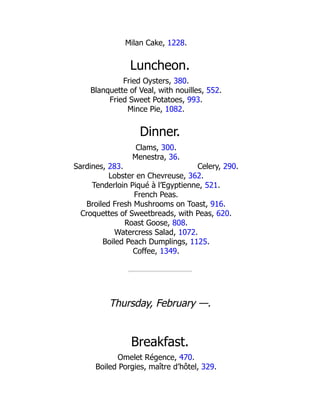
Celery, 290.
Milan Cake,1228.
Luncheon.
Fried Oysters, 380.
Blanquette of Veal, with nouilles, 552.
Fried Sweet Potatoes, 993.
Mince Pie, 1082.
Dinner.
Clams, 300.
Menestra, 36.
Sardines, 283.
Lobster en Chevreuse, 362.
Tenderloin Piqué à l’Egyptienne, 521.
French Peas.
Broiled Fresh Mushrooms on Toast, 916.
Croquettes of Sweetbreads, with Peas, 620.
Roast Goose, 808.
Watercress Salad, 1072.
Boiled Peach Dumplings, 1125.
Coffee, 1349.
Thursday, February —.
Breakfast.
Omelet Régence, 470.
Boiled Porgies, maître d’hôtel, 329.
46.
Tomatoes, 288.
Minced Vealà la Biscaënne, 576.
Turnips and Gravy, 967.
Preserved Cherries, 1347.
Luncheon.
Oysters en Brochette au Petit Salé, 385.
Chicken Pot Pie, 757.
Tomatoes à la Marseillaise, 1029.
Beef Salad, 1039.
Stewed Pears, 1333.
Dinner.
Oysters, 298.
Consommé, with Italian paste, 103.
Olives.
Broiled Spanish-Mackerel, 329.
Cucumber Salad, 289.
Beef Tongue à la Gendarme, 532.
Fried Oyster Plant, 1021.
Salmi of Woodcock à la Chasseur, 873.
Roast Veal, 585.
Lettuce Salad, 1057.
Pistache Ice Cream, 1275.
Bitter Almond Macaroons, 1209.
Coffee, 1349.
47.
Salmon, en papillotes,302.
Friday, February —.
Breakfast.
Eggs à la Chipolata, 442.
Picked-up Codfish, 346.
Lamb en Brochette, Colbert sauce, 674, 190.
Stewed Potatoes, 995.
Rice and Milk, 1177.
Luncheon.
Fillets of Sole à la Vénitienne, 338.
Breaded Veal Cutlets, Tomato sauce, 563.
String Beans, 946.
Crab Salad, 1047.
Plum Pudding, 1163.
Dinner.
Oysters, 298.
Bisque of Lobster, 10.
Sardines, 283.
Olives.
Tenderloin à la Hussarde, 519.
Succotash, 1022.
Coquilles of Chicken, with Mushrooms, 271.
Roast English Snipe sur canapé, 868.
Celery Salad, 1041.
Baba, 1216.
Pont l’Evêque Cheese.
Coffee, 1349.
48.
Celery, 290.
Saturday, February—.
Breakfast.
Omelet Bonne Femme, 466.
Tripe Sauté à la Lyonnaise, 548.
Beefsteak, with Watercress, 524.
Hashed Potatoes, with Cream, 1003.
Corn Fritters, 965.
Luncheon.
Canapé Lorenzo, 391.
Lamb Chops à la Robinson, 682.
French Peas.
Anchovy Salad, 1037.
Diplomatic Pudding, 1129.
Dinner.
Oysters, 298.
Consommé Tapioca, 104.
Thon, 282.
Boiled Sheep’s-head, with fine Herbs, 352, 323.
Pig’s Cheek, Apple sauce, 726, 168.
Oyster Plant à la Paulette, 1019.
Piloff of Chicken à la Creole, 783.
Beans à l’Anglaise, 948.
Roast Mutton, 585.
Barbe de Capucine Salad, 1038.
Charlotte Russe, 1261.
49.
Lyons Sausage, 286.
Coffee,1349.
Sunday, February —.
Breakfast.
Eggs à la Turque, 439.
Hashed Lamb, 700.
Sausages, with White Wine, 735.
Potatoes Julienne, 1013.
Peach Marmalade, 1331.
Luncheon.
Broiled Spanish Mackerel, maître d’hôtel, 329.
Cucumber Salad, 289.
Stewed Veal à la Marengo, 624.
Rhubarb Pie, 1085.
Dinner.
Oysters, 298.
Consommé Douglas, 114.
Celery, 290.
Croquettes of Lobster, sauce Colbert, 365, 190.
Sweetbreads à la Duxelle, 608.
Broiled Tomatoes, 1025.
Chicken Sauté à l’Hongroise, 772.
Spinach, with croûtons, 943.
Romaine Punch, 1304.
50.
Caviare, 281.
Roast EnglishSnipe, 868.
Watercress Salad, 1072.
Croustade of Rice, 1176.
Imported Brie Cheese.
Coffee, 1349.
Monday, February —.
Breakfast.
Omelet Mexicaine, 473.
Broiled English Breakfast Bacon, 754.
Calf’s Liver Sauté à l’Italienne, 580.
Stewed Tomatoes, 1027.
Preserved Plums, 1343.
Luncheon.
Soft Clams à la Merrill, 389.
Curry of Chicken à l’Indienne, 792.
French Peas.
Salad Suèdoise, 1069.
Mille-feuilles, 1223.
Dinner.
Clams, 300.
Consommé Printanier, 109.
Celery, 290.
Broiled Smelts, Béarnaise, 353.
Radishes, 292.
Dinner.
Oysters, 298.
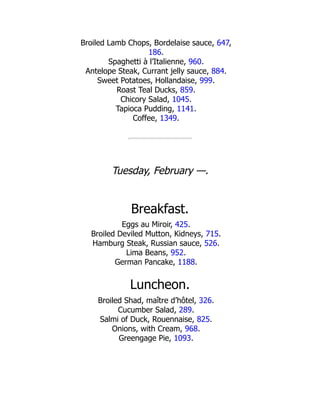
Chickenà la Richmond, 62.
Celery, 290.
Stuffed Lobster, 367.
Tenderloin, piqué à la Portugaise, 517.
Potatoes Duchesse, 1006.
Squabs en Crapaudine, 819.
Brussels Sprouts sautés au beurre, 922.
Roast Chicken, 755.
Celery, Mayonnaise Salad, 1042.
Sponge Cake, 1195.
English Cheese.
Coffee, 1349.
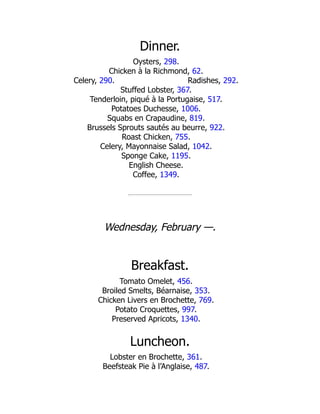
Wednesday, February —.
Breakfast.
Tomato Omelet, 456.
Broiled Smelts, Béarnaise, 353.
Chicken Livers en Brochette, 769.
Potato Croquettes, 997.
Preserved Apricots, 1340.
Luncheon.
Lobster en Brochette, 361.
Beefsteak Pie à l’Anglaise, 487.
53.
Celery, 290.
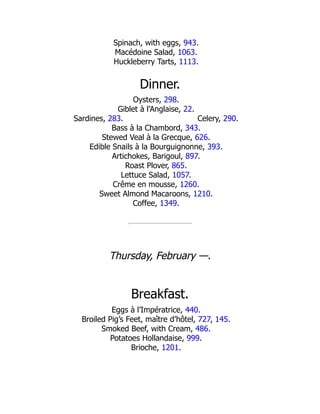
Spinach, witheggs, 943.
Macédoine Salad, 1063.
Huckleberry Tarts, 1113.
Dinner.
Oysters, 298.
Giblet à l’Anglaise, 22.
Sardines, 283.
Bass à la Chambord, 343.
Stewed Veal à la Grecque, 626.
Edible Snails à la Bourguignonne, 393.
Artichokes, Barigoul, 897.
Roast Plover, 865.
Lettuce Salad, 1057.
Crême en mousse, 1260.
Sweet Almond Macaroons, 1210.
Coffee, 1349.
Thursday, February —.
Breakfast.
Eggs à l’Impératrice, 440.
Broiled Pig’s Feet, maître d’hôtel, 727, 145.
Smoked Beef, with Cream, 486.
Potatoes Hollandaise, 999.
Brioche, 1201.
54.
Olives.
Luncheon.
Oyster Patties, 387.
SirloinSteak à la Duchesse, 494.
Potatoes Château, 1009.
Lobster Salad à la Plummer, 1062.
Vanilla Eclairs, 1245
Dinner.
Clams, 300.
Consommé Rachel, 123.
Radishes, 292.
Crabs, St. Laurent, 372.
Panpiette of Veal, purée of Chestnuts, 594.
Fried Oyster-plant, 1021.
Chicken Sauté, with tarragon, 774.
Asparagus à la Tessinoise, 906.
Roast Beef, 527.
Celery, Mayonnaise Salad, 1042.
Parfait au Café, 1295.
Coffee, 1349.
Friday, February —.
Breakfast.
Omelet, with fine Herbs, 451.
Haddock, Cream sauce, 352, 181.
Brochette of Lamb à la Colbert, 674, 190.
55.
Olives.
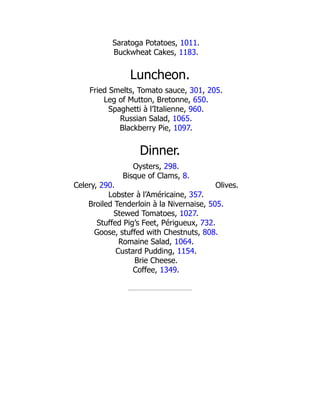
Saratoga Potatoes, 1011.
BuckwheatCakes, 1183.
Luncheon.
Fried Smelts, Tomato sauce, 301, 205.
Leg of Mutton, Bretonne, 650.
Spaghetti à l’Italienne, 960.
Russian Salad, 1065.
Blackberry Pie, 1097.
Dinner.
Oysters, 298.
Bisque of Clams, 8.
Celery, 290.
Lobster à l’Américaine, 357.
Broiled Tenderloin à la Nivernaise, 505.
Stewed Tomatoes, 1027.
Stuffed Pig’s Feet, Périgueux, 732.
Goose, stuffed with Chestnuts, 808.
Romaine Salad, 1064.
Custard Pudding, 1154.
Brie Cheese.
Coffee, 1349.
56.
Radishes, 292.
Saturday, February—.
Breakfast.
Eggs à la Reine, 438.
Broiled Fresh Herrings, anchovy butter, 329,
146.
Minced Veal à la Catalan, 575.
Stewed Carrots, and Cream, 927.
Peach Marmalade, 1331.
Luncheon.
Broiled Lobster, Tomato sauce, 364, 205.
Stewed Lamb, and Potatoes, 708.
Broiled Fresh Mushrooms on Toast, 916.
Apples, with Rice, 1169.
Dinner.
Oysters, 298.
Cream of Cauliflower, 73.
Celery, 290.
Bluefish à l’Icarienne, 336.
Roast Suckling Pig, Apple sauce, 720.
Stuffed Green Peppers, 975.
Turkey’s Legs à la Diable, 766.
Beans Panachés, 950.
Roast Spring Lamb, Mint sauce, 1361, 169.
Lettuce Salad, 1058.
Charlotte Russe, 1261.
Coffee, 1349.
57.
Welcome to ourwebsite – the ideal destination for book lovers and
knowledge seekers. With a mission to inspire endlessly, we offer a
vast collection of books, ranging from classic literary works to
specialized publications, self-development books, and children's
literature. Each book is a new journey of discovery, expanding
knowledge and enriching the soul of the reade
Our website is not just a platform for buying books, but a bridge
connecting readers to the timeless values of culture and wisdom. With
an elegant, user-friendly interface and an intelligent search system,
we are committed to providing a quick and convenient shopping
experience. Additionally, our special promotions and home delivery
services ensure that you save time and fully enjoy the joy of reading.
Let us accompany you on the journey of exploring knowledge and
personal growth!
ebookfinal.com