ANTH326 Peoples and Cultures of Sub-Saharan Africa Meeting 13, December 3, 2007
Tomorrow Wrap-Up Prepare Week-by-week Themes, threads Questions Freebie question
Final Exam Friday (December 7, H433, 2 p.m. to 5 p.m.) Answer five out of seven questions Blue book No documentation is allowed
Final Paper Due Wednesday 23:59 (December 5) No penalty until Monday 23:59 (December 10) Connect with course, explicitly Format is open Submitted as attachment on Moodle Text, RTF, Word, PDF
Chabal/Daloz
Chabal/Daloz Themes
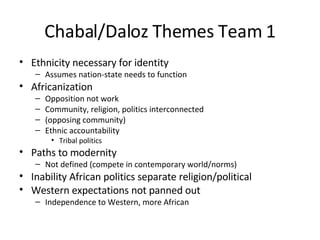
Chabal/Daloz Themes Team 1 Ethnicity necessary for identity Assumes nation-state needs to function Africanization Opposition not work Community, religion, politics interconnected (opposing community) Ethnic accountability Tribal politics Paths to modernity Not defined (compete in contemporary world/norms) Inability African politics separate religion/political Western expectations not panned out Independence to Western, more African
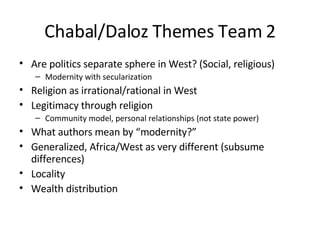
Chabal/Daloz Themes Team 2 Are politics separate sphere in West? (Social, religious) Modernity with secularization Religion as irrational/rational in West Legitimacy through religion Community model, personal relationships (not state power) What authors mean by “modernity?” Generalized, Africa/West as very different (subsume differences) Locality Wealth distribution
Chabal/Daloz Themes Team 3 Difficult to represent multiple ethnicity Importance of the dead/ancestors “ Karma” with political parties, political failure as punishment, witchcraft Accepting of outside notions (churches less accepting) Rural Equal redistribution of wealth in local community
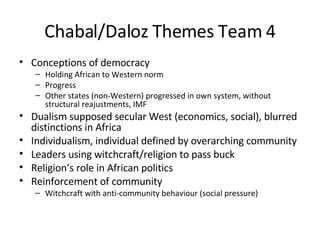
Chabal/Daloz Themes Team 4 Conceptions of democracy Holding African to Western norm Progress Other states (non-Western) progressed in own system, without structural reajustments, IMF Dualism supposed secular West (economics, social), blurred distinctions in Africa Individualism, individual defined by overarching community Leaders using witchcraft/religion to pass buck Religion’s role in African politics Reinforcement of community Witchcraft with anti-community behaviour (social pressure)
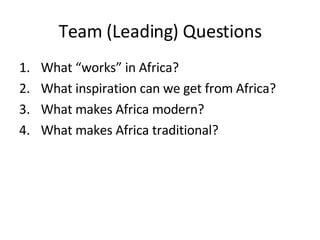
Team (Leading) Questions What “works” in Africa? What inspiration can we get from Africa? What makes Africa modern? What makes Africa traditional?
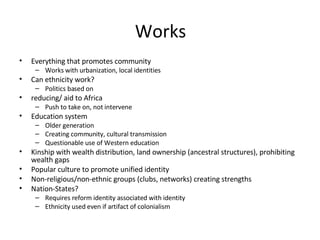
Works Everything that promotes community Works with urbanization, local identities Can ethnicity work? Politics based on reducing/ aid to Africa Push to take on, not intervene Education system Older generation Creating community, cultural transmission Questionable use of Western education Kinship with wealth distribution, land ownership (ancestral structures), prohibiting wealth gaps Popular culture to promote unified identity Non-religious/non-ethnic groups (clubs, networks) creating strengths Nation-States? Requires reform identity associated with identity Ethnicity used even if artifact of colonialism
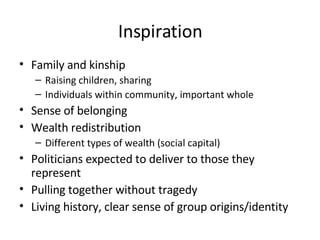
Inspiration Family and kinship Raising children, sharing Individuals within community, important whole Sense of belonging Wealth redistribution Different types of wealth (social capital) Politicians expected to deliver to those they represent Pulling together without tragedy Living history, clear sense of group origins/identity
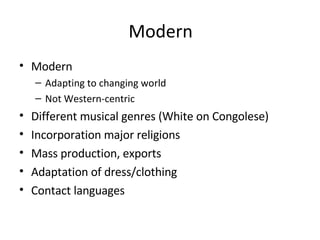
Modern Modern Adapting to changing world Not Western-centric Different musical genres (White on Congolese) Incorporation major religions Mass production, exports Adaptation of dress/clothing Contact languages
Traditional Defining traditional Existed within Africa, persevered Adapted, answered needs By opposition to modernization Urban/rural Backwardness? Unchanging, lack of contact, resist change (if ain’t broken why fix it) Stability (changing) Inside knowledge Preservation local/historical customs, conservativism Every culture is traditional: defining itself by its past Historicity, origins Worldview based on (perceived) past Scapegoat for failure of development projects despite expectations Outside perception Modernization, change filtered through tradition Imposed political structure are localized
Political Africa
Political Science Governance and government Development Cultural awareness Determinism vs. ethnography Embedded evolutionism (progress) Ethnic multiplicity Mono-ethnic countries Lesotho, Swaziland, Somalia
Post-Colonial African State Distinct from pre-colonial states Countries Borders, flag, anthem, airline and beer (Zappa) International status Political representation (groups) Heads of States “ Big Man” Geshiere
Processes Westernization “ Acculturation” Africanization Local adaptation Hammer theory
Democracy Appiah’s “Golden nugget” In configuration (state system, market economy, citizenship...) Adapted to conditions Ideology of egalitarianism
Government Issues Corruption Cronyism Authoritarian regimes Dictators Lifetime presidents Civil war
Identities Ethnic “ Tribal” National Local Religious Degree of Westernization Social (gender, age, class...)
Senses of place Local, regional, national (Russian dolls) Local community Land ownership Ancestors
Group Labels Toponyms, glossonyms, ethnonyms Not coextensive Identity claims by use/explanation of Colonial constructs (perhaps unwittingly) Apply through contact/conflict
Postmodernism (PoMo) Reaction to modernism/modernity Implied historicity Cross boundaries Deconstruct identities Multiplicity of identities/viewpoints Flexibility/fluidity/informality/chaos Recognise anything?
Chabal/Daloz Notes
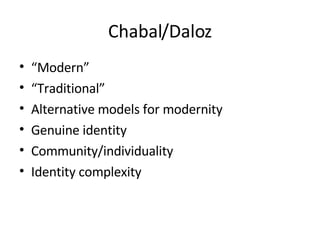
Chabal/Daloz “ Modern” “ Traditional” Alternative models for modernity Genuine identity Community/individuality Identity complexity
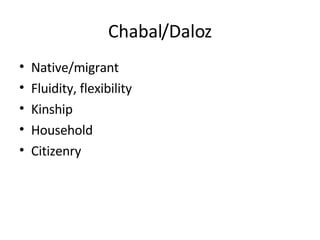
Chabal/Daloz Native/migrant Fluidity, flexibility Kinship Household Citizenry

ANTH326 Meeting 13 (Final)

  • 1.
    ANTH326 Peoples andCultures of Sub-Saharan Africa Meeting 13, December 3, 2007
  • 2.
    Tomorrow Wrap-Up PrepareWeek-by-week Themes, threads Questions Freebie question
  • 3.
    Final Exam Friday(December 7, H433, 2 p.m. to 5 p.m.) Answer five out of seven questions Blue book No documentation is allowed
  • 4.
    Final Paper DueWednesday 23:59 (December 5) No penalty until Monday 23:59 (December 10) Connect with course, explicitly Format is open Submitted as attachment on Moodle Text, RTF, Word, PDF
  • 5.
  • 6.
  • 7.
    Chabal/Daloz Themes Team1 Ethnicity necessary for identity Assumes nation-state needs to function Africanization Opposition not work Community, religion, politics interconnected (opposing community) Ethnic accountability Tribal politics Paths to modernity Not defined (compete in contemporary world/norms) Inability African politics separate religion/political Western expectations not panned out Independence to Western, more African
  • 8.
    Chabal/Daloz Themes Team2 Are politics separate sphere in West? (Social, religious) Modernity with secularization Religion as irrational/rational in West Legitimacy through religion Community model, personal relationships (not state power) What authors mean by “modernity?” Generalized, Africa/West as very different (subsume differences) Locality Wealth distribution
  • 9.
    Chabal/Daloz Themes Team3 Difficult to represent multiple ethnicity Importance of the dead/ancestors “ Karma” with political parties, political failure as punishment, witchcraft Accepting of outside notions (churches less accepting) Rural Equal redistribution of wealth in local community
  • 10.
    Chabal/Daloz Themes Team4 Conceptions of democracy Holding African to Western norm Progress Other states (non-Western) progressed in own system, without structural reajustments, IMF Dualism supposed secular West (economics, social), blurred distinctions in Africa Individualism, individual defined by overarching community Leaders using witchcraft/religion to pass buck Religion’s role in African politics Reinforcement of community Witchcraft with anti-community behaviour (social pressure)
  • 11.
    Team (Leading) QuestionsWhat “works” in Africa? What inspiration can we get from Africa? What makes Africa modern? What makes Africa traditional?
  • 12.
    Works Everything thatpromotes community Works with urbanization, local identities Can ethnicity work? Politics based on reducing/ aid to Africa Push to take on, not intervene Education system Older generation Creating community, cultural transmission Questionable use of Western education Kinship with wealth distribution, land ownership (ancestral structures), prohibiting wealth gaps Popular culture to promote unified identity Non-religious/non-ethnic groups (clubs, networks) creating strengths Nation-States? Requires reform identity associated with identity Ethnicity used even if artifact of colonialism
  • 13.
    Inspiration Family andkinship Raising children, sharing Individuals within community, important whole Sense of belonging Wealth redistribution Different types of wealth (social capital) Politicians expected to deliver to those they represent Pulling together without tragedy Living history, clear sense of group origins/identity
  • 14.
    Modern Modern Adaptingto changing world Not Western-centric Different musical genres (White on Congolese) Incorporation major religions Mass production, exports Adaptation of dress/clothing Contact languages
  • 15.
    Traditional Defining traditionalExisted within Africa, persevered Adapted, answered needs By opposition to modernization Urban/rural Backwardness? Unchanging, lack of contact, resist change (if ain’t broken why fix it) Stability (changing) Inside knowledge Preservation local/historical customs, conservativism Every culture is traditional: defining itself by its past Historicity, origins Worldview based on (perceived) past Scapegoat for failure of development projects despite expectations Outside perception Modernization, change filtered through tradition Imposed political structure are localized
  • 16.
  • 17.
    Political Science Governanceand government Development Cultural awareness Determinism vs. ethnography Embedded evolutionism (progress) Ethnic multiplicity Mono-ethnic countries Lesotho, Swaziland, Somalia
  • 18.
    Post-Colonial African StateDistinct from pre-colonial states Countries Borders, flag, anthem, airline and beer (Zappa) International status Political representation (groups) Heads of States “ Big Man” Geshiere
  • 19.
    Processes Westernization “Acculturation” Africanization Local adaptation Hammer theory
  • 20.
    Democracy Appiah’s “Goldennugget” In configuration (state system, market economy, citizenship...) Adapted to conditions Ideology of egalitarianism
  • 21.
    Government Issues CorruptionCronyism Authoritarian regimes Dictators Lifetime presidents Civil war
  • 22.
    Identities Ethnic “Tribal” National Local Religious Degree of Westernization Social (gender, age, class...)
  • 23.
    Senses of placeLocal, regional, national (Russian dolls) Local community Land ownership Ancestors
  • 24.
    Group Labels Toponyms,glossonyms, ethnonyms Not coextensive Identity claims by use/explanation of Colonial constructs (perhaps unwittingly) Apply through contact/conflict
  • 25.
    Postmodernism (PoMo) Reactionto modernism/modernity Implied historicity Cross boundaries Deconstruct identities Multiplicity of identities/viewpoints Flexibility/fluidity/informality/chaos Recognise anything?
  • 26.
  • 27.
    Chabal/Daloz “ Modern”“ Traditional” Alternative models for modernity Genuine identity Community/individuality Identity complexity
  • 28.
    Chabal/Daloz Native/migrant Fluidity,flexibility Kinship Household Citizenry