UCSP
Understanding Culture, Society and Politics
Nature and Goals of Anthropology,
Sociology and Political Science
Nature and Goals of Anthropology,
Sociology and Political Science
LESSON 1: Articulation of Cultural variation, Social
Differences and Political Identities.
After going through this module, you are
expected to:
1.articulate observations on human cultural
variation, social differences, social change, and
political identities;
2. demonstrate curiosity and an openness to explore
the origins and dynamics of culture and society,
and political identities;
3. analyze social, political, and cultural change;
After going through this module, you are
expected to:
4. recognize the common concerns or intersections
of anthropology, sociology, and political science
with respect to the phenomenon of change; and
5. identify the subjects of inquiry and goals of
Anthropology, Sociology, and Political Science.
LESSON 1
Articulation of Cultural variation,
Social Differences and Political
Identities
After the lesson you will be able to
articulate observations on human cultural
variation, social differences, social change,
and political identities.
– not about how we differ.
– is about embracing one
another’s uniqueness.
DIVERSITY
ACTIVITY 1
INSTRUCTION: Complete the missing letters
to form a word that describe from
three clue words.
1. R _ _ I _ I O _
pray Bible conviction
R E L I G I O N
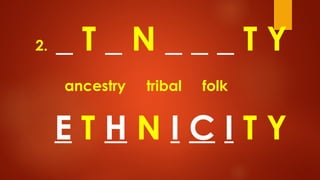
2. _ T _ N _ _ _ T Y
ancestry tribal folk
E T H N I C I T Y
3. T _ _ D I _ _ _ _
belief culture conventional
T R A D I T I O N
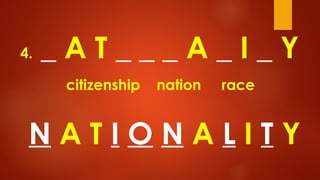
4. _ A T _ _ _ A _ I _ Y
citizenship nation race
N A T I O N A L I T Y
5. _ U _ T _ R _
art way of life heritage
C U L T U R E
QUESTION
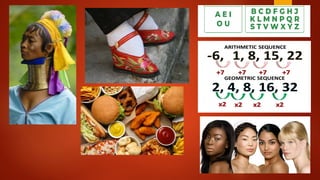
What is common to the pictures?
DIFFERENCES
QUESTION
Make a group of 5. Discuss and
answer the following questions
QUESTION
What makes us different?
Why do we have to understand
our differences?
QUESTION
Do you believe that people who are
differently abled and underpreviledge are
still able to contribute to society? Explain
your answer.
CULTURAL VARIATIONS
Refers to the differences in social
behaviors that different cultures exhibit
around the world.
TYPES OF CULTURAL
VARIATIONS
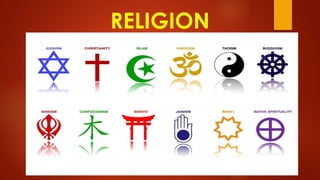
1. RELIGION
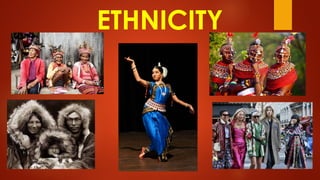
2. ETHNICITY
3. NATIONALITY
RELIGION
It is a system of beliefs and practices as
well as systems of actions directed
toward entities which are above man.
It is an organized system of ideas
about the spiritual sphere or the
supernatural.
RELIGION
ETHNICITY
It refers to individual’s culture.
It is the expression of the art of cultural
ideas held by a distinct ethics or
indigenous group.
ETHNICITY
NATIONALITY
NATIONALITY
Is the legal relationship that bands a
person and a country.
It allows the state to protect and have
jurisdiction over a person.
SOCIAL DIFFERENCES
Are the differences among the
individuals on the basis of social
characteristics and qualities.
TYPES OF SOCIAL
DIFFERENCES
1. GENDER
2. SOCIO-ECONOMIC STATUS
3. EXCEPTIONALITY
GENDER
Is the socially - constructed
characteristics of being male or
female.
It serves us guide on how males and
females think and act about
themselves.
SOCIO-ECONOMIC STATUS
Refers to the category of persons who
have more or less the same socio-
economic priviledges.
These are Upper Class, Middle Class
and Lower Class.
EXCEPTIONALITY
Refers to the state of being intellectually
gifted and / or having physically or
mentally challenged conditions.
EXAMPLES OF EXCEPTIONALITY
a. Personality/ behavior
b. Communication (learning disability,
speech impairment & hearing
problems)
c. Intellect (mild intellectual & mental
development disabilities)
EXAMPLES OF EXCEPTIONALITY
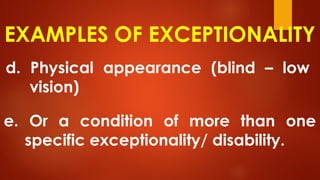
d. Physical appearance (blind – low
vision)
e. Or a condition of more than one
specific exceptionality/ disability.
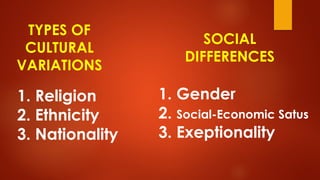
TYPES OF
CULTURAL
VARIATIONS
1. Religion
2. Ethnicity
3. Nationality
SOCIAL
DIFFERENCES
1. Gender
2. Social-Economic Satus
3. Exeptionality
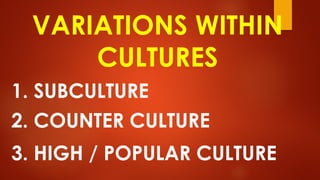
VARIATIONS WITHIN
CULTURES
1. SUBCULTURE
2. COUNTER CULTURE
3. HIGH / POPULAR CULTURE
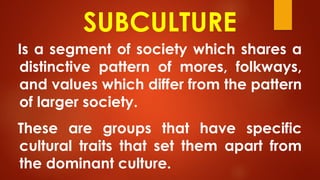
SUBCULTURE
Is a segment of society which shares a
distinctive pattern of mores, folkways,
and values which differ from the pattern
of larger society.
These are groups that have specific
cultural traits that set them apart from
the dominant culture.
SUBCULTURE
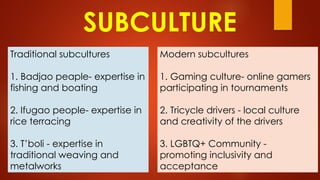
Traditional subcultures
1. Badjao peaple- expertise in
fishing and boating
2. Ifugao people- expertise in
rice terracing
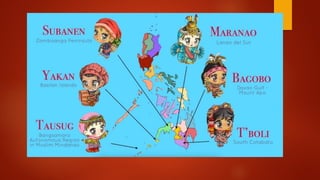
3. T’boli - expertise in
traditional weaving and
metalworks
Modern subcultures
1. Gaming culture- online gamers
participating in tournaments
2. Tricycle drivers - local culture
and creativity of the drivers
3. LGBTQ+ Community -
promoting inclusivity and
acceptance
COUNTER CULTURE
Is a group whose values and norms
place it at odds with mainstream
society or a group that actively rejects
dominant cultural values and norms.
COUNTER CULTURE
In most Western countries, the 1960s saw
the rise of different countercultural groups
and social movements that sought to
dismantle the different inequalities that
were then part of the dominant culture,
such as racism (Civil Rights movement),
sexism (modern Feminist movement) and
homophobia (Gay rights movement).
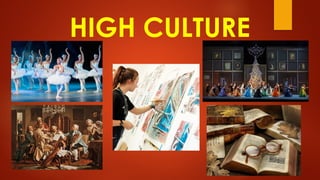
HIGH CULTURE
Is a term now used in a number of
different ways in academic discourse
most common meaning is the set of
cultural products, mainly in the arts,
held in the highest esteem by a culture.
HIGH CULTURE
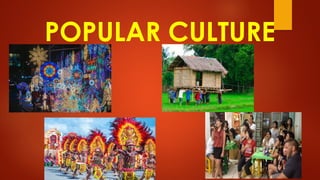
POPULAR CULTURE
encompasses the shared experiences,
beliefs, and practices that are widely
accepted and enjoyed by a majority of
people within a society at a given time.
POPULAR CULTURE
POLITICAL IDENTITY
Is almost always associated with a
group affiliation and describes the
ways in which being a member of a
particular group might express specific
political opinions and attitudes.
TYPES OF POLITICAL IDENTITY
1. PARTISAN POLITICS
2. RACE & IDENTITY
3. CLASS & IDENTITY
4. COLONIALISM & IDENTITY
PARTISAN POLITICS
Refers to a specific political party
affiliation or partisan identity.
1. Federal Party of the Philippines
2. Lakas CMD
3. Partido Demokratiko Pilipino
4. Liberal Party
Race and Identity
Refer to how a person’s racial
background and sense of self can
shape their political beliefs, affiliations,
and activism.
Class and Identity
center on how a person’s
socioeconomic position (like their
income, education, or occupation)
shapes their political beliefs, affiliations,
and actions.
Colonialism and Identity
How the experience or legacy of being
colonized shapes a group’s sense of self
and fuels their political beliefs, struggles,
and actions for recognition,
independence, or justice.
SUMMARY
Cultural variations refer to the
differences in social behaviors that
different cultures exhibit around the
world. These are religion, ethnicity,
and nationality.
SUMMARY
Social differences are the differences
among the individuals on the
basis of social characteristics
and qualities. These are gender,
socio-economic status, and
exceptionality.
SUMMARY
• Variation within cultures is segmented
into subcultures, counter culture,
high culture, and popular culture.
SUMMARY
Political identity is almost always
associated with a group affiliation
and describes the ways in which
being a member of a particular
group might express specific
political opinions and attitudes.
LESSON 2
Dynamism of Cultural, Social,
and Political Change
After the lesson you will be able to cite
and analyze the social, cultural, and
political change.
ANTHROPOLOGY
Is the study of humans and human behavior
and societies in the past and present. It is a
wide-ranging, including, fossil remains,
non-human primate anatomy and
behavior, artifacts from past cultures, past
and present languages, and all the
prehistoric and contemporary cultures of
the world.
SOCIOLOGY
Is the scientific study of society, patterns of
social relationships, social interaction, and
culture. It is the systematic interpretation of
codes and conducts in the form of
language, symbols, face expressions,
dress, food, music etc. used by people in
society.
The Birth of Social Sciences as a Response
to the Social Turmoil of the Modern Period:
SOCIOLOGY :
Auguste Comte, was a French philosopher.
He was a founder of the discipline of
sociology and of the doctrine of positivism.
He is sometimes regarded as the first
philosopher of science in the modern sense
of the term.
Harriet Martineau, is a self-taught expert in
political economic theory, and wrote
prolifically about the relations between
politics, economics, morals, and social life
throughout her career. Her intellectual work
was centered by a staunchly moral
perspective that stemmed from her Unitarian
faith. She was fiercely critical of the inequality
and injustice faced by girls and women,
slaves, wage slaves, and the working.
Karl Marx, a philosopher, social scientist,
historian and revolutionary, Karl Marx, is
without a doubt the most influential socialist
thinker to emerge in the 19th century. The
Father of Modern Socialism, communism
and conflict theory.
Emile Durkleim was a French sociologist,
social psychologist and philosopher. He
formally established the academic
discipline and with Karl Marx and Max
Weber, is commonly cited as the principal
architect of modern social science and
father of sociology.
Max Weber was a German sociologist,
philosopher, jurist, and political economist
whose ideas profoundly influenced social
theory and social research.
ANTHROPOLOGY :
Franz Boas was a German- American
anthropologist and a pioneer of modern
anthropology who has been called the
"Father of American Anthropology” His work
is associated with the movement of
anthropological historicism.
Bronislaw Malinowski was a Polish
anthropologist, one of the most important
20th-century anthropologists. He has also
been referred to as a sociologist and
ethnographer. He is considered the father
of ethnographic methodology by most field
working anthropologist because of his
ideas on participant observation.
Alfred Reginald Radcliffe Brown was an
English social anthropologist who
developed the theory of structural
functionalism and coadaptation.
POLITICAL SCIENCE :
Walter Lippmann was an American writer,
reporter, and political commentator famous
for being among the first to introduce the
concept of Cold War, coining the term
"stereotype" in the modern psychological
meaning, and critiquing media and
democracy in his newspaper column and
several books.
SOCIAL CHANGE
Refers to an alteration of mechanism within
the social structure, characterized by
changes in cultural symbols, rules of
behavior, social organizations, or value
systems.
CULTURAL CHANGE
Is the modification of a society through
innovation, invention, discovery, or contact
with other societies.
POLICAL CHANGE
Refers to a subject matter that is in constant
flux. It deals not only with the major
processes of growth, decay and
breakdown but also with a ceaseless
ferment of adaptation and adjustment of
political systems. It highlights the
magnitude and variety of the changes that
occurred in the world’s political systems.
SUMMARY
Organizations differ from one another
for three reasons: interaction isolates
and differentiates them, their histories
are unique, and the problems with
which their social patterns must deal
are different and this influences what
patterns are in turn developed.
SUMMARY
The Birth of Social Sciences as a
Response to the Social Turmoil of the
Modern Period such as Auguste Comte,
Harriet Martineau, Karl Marx, Emile
Durkleim, Max Weber, Franz Boas,
Bronislaw Malinowski, Alfred Reginald
Radcliffe Brown, and Walter Lippmann.
SUMMARY
Social change refers to an alteration of
mechanism within the social structure,
characterized by changes in cultural
symbols, rules of behavior, social
organizations, or value systems.
SUMMARY
Cultural Change is the modification of a
society through innovation, invention,
discovery, or contact with other
societies.
SUMMARY
Political change highlights the
magnitude and variety of the changes
that occurred in the world’s political
systems.
SUMMARY
Sources/ Agents of Change are
innovation, action of leaders, and
Social Conflicts.
LESSON 3
Intersections, Inquiry and Importance
of Anthropology, Sociology and
Political Sciences.
After the lesson you will be able to focus on
more detailed descriptions of these
important social sciences particularly on
each subject’s inquiry and importance.
SOCIAL SCIENCE
Is a division of science that deal with
the functions and structure of human
society, as well as the interpersonal
relationship of individuals as members
of society.
THREE BRANCHES OF
SOCIAL SCIENCE
1. ANTHROPOLOGY
2. SOCIOLOGY
3. POLITICAL SCIENCE
EMPIRICAL PROOF
Is a rational proof laid the foundation for
modern science, the idea of thinking
developed into a proof.
ANTHROPOLOGY
Is the scientific study of the origins of
humans, how we have changed over
the years, and how we relate to each
other, both within our own culture and
with people from other cultures.
RATIONAL PROOF
The use of logical reasoning and evidence
to support an argument or claim. Instead of
relying on emotions, beliefs, or traditions,
rational proof emphasizes facts, critical
thinking, and sound reasoning.
ANTHROPOLOGY
Anthropos is the Greek word for
“human being” and the suffix –logos
means “the study of” .
SOCIOLOGY
Is the scientific study of society.
Sociology is derived from the Latin word
socius which means “associate or
companion” and the Greek word logos
which means “the study of” .
POLITICAL SCIENCE
Is the systematic study of the state,
government and politics.
POLITICAL SCIENCE
The word politics is derived from the
Greek word polis which means “city-
state” or what today would be
equivalent to sovereign state. The word
“science” comes from the Latin word
scire which means “to know” .
SUMMARY
Sociology is the scientific study of
society. It seek to provide an analysis of
human society and culture with a
sociological perspective.
SUMMARY
Anthropology is the scientific study of
the origins of humans, how we have
changed over the years, and how we
relate to each other, both within our
own culture and with people from other
cultures.
SUMMARY
Political science is one important
branch of social science and its
concern is with the political behavior of
individuals, groups of individuals,
agencies, institutions and organizations,
among others.

Lesson 1-3(Learners' copy).pptxucspctopi

  • 1.
    UCSP Understanding Culture, Societyand Politics Nature and Goals of Anthropology, Sociology and Political Science
  • 2.
    Nature and Goalsof Anthropology, Sociology and Political Science LESSON 1: Articulation of Cultural variation, Social Differences and Political Identities.
  • 3.
    After going throughthis module, you are expected to: 1.articulate observations on human cultural variation, social differences, social change, and political identities; 2. demonstrate curiosity and an openness to explore the origins and dynamics of culture and society, and political identities; 3. analyze social, political, and cultural change;
  • 4.
    After going throughthis module, you are expected to: 4. recognize the common concerns or intersections of anthropology, sociology, and political science with respect to the phenomenon of change; and 5. identify the subjects of inquiry and goals of Anthropology, Sociology, and Political Science.
  • 5.
    LESSON 1 Articulation ofCultural variation, Social Differences and Political Identities After the lesson you will be able to articulate observations on human cultural variation, social differences, social change, and political identities.
  • 6.
    – not abouthow we differ. – is about embracing one another’s uniqueness. DIVERSITY
  • 7.
    ACTIVITY 1 INSTRUCTION: Completethe missing letters to form a word that describe from three clue words.
  • 8.
    1. R __ I _ I O _ pray Bible conviction R E L I G I O N
  • 9.
    2. _ T_ N _ _ _ T Y ancestry tribal folk E T H N I C I T Y
  • 10.
    3. T __ D I _ _ _ _ belief culture conventional T R A D I T I O N
  • 11.
    4. _ AT _ _ _ A _ I _ Y citizenship nation race N A T I O N A L I T Y
  • 12.
    5. _ U_ T _ R _ art way of life heritage C U L T U R E
  • 14.
    QUESTION What is commonto the pictures? DIFFERENCES
  • 15.
    QUESTION Make a groupof 5. Discuss and answer the following questions
  • 16.
    QUESTION What makes usdifferent? Why do we have to understand our differences?
  • 17.
    QUESTION Do you believethat people who are differently abled and underpreviledge are still able to contribute to society? Explain your answer.
  • 18.
    CULTURAL VARIATIONS Refers tothe differences in social behaviors that different cultures exhibit around the world.
  • 19.
    TYPES OF CULTURAL VARIATIONS 1.RELIGION 2. ETHNICITY 3. NATIONALITY
  • 20.
    RELIGION It is asystem of beliefs and practices as well as systems of actions directed toward entities which are above man. It is an organized system of ideas about the spiritual sphere or the supernatural.
  • 21.
  • 22.
    ETHNICITY It refers toindividual’s culture. It is the expression of the art of cultural ideas held by a distinct ethics or indigenous group.
  • 23.
  • 24.
  • 25.
    NATIONALITY Is the legalrelationship that bands a person and a country. It allows the state to protect and have jurisdiction over a person.
  • 26.
    SOCIAL DIFFERENCES Are thedifferences among the individuals on the basis of social characteristics and qualities.
  • 27.
    TYPES OF SOCIAL DIFFERENCES 1.GENDER 2. SOCIO-ECONOMIC STATUS 3. EXCEPTIONALITY
  • 28.
    GENDER Is the socially- constructed characteristics of being male or female. It serves us guide on how males and females think and act about themselves.
  • 29.
    SOCIO-ECONOMIC STATUS Refers tothe category of persons who have more or less the same socio- economic priviledges. These are Upper Class, Middle Class and Lower Class.
  • 30.
    EXCEPTIONALITY Refers to thestate of being intellectually gifted and / or having physically or mentally challenged conditions.
  • 31.
    EXAMPLES OF EXCEPTIONALITY a.Personality/ behavior b. Communication (learning disability, speech impairment & hearing problems) c. Intellect (mild intellectual & mental development disabilities)
  • 32.
    EXAMPLES OF EXCEPTIONALITY d.Physical appearance (blind – low vision) e. Or a condition of more than one specific exceptionality/ disability.
  • 33.
    TYPES OF CULTURAL VARIATIONS 1. Religion 2.Ethnicity 3. Nationality SOCIAL DIFFERENCES 1. Gender 2. Social-Economic Satus 3. Exeptionality
  • 34.
    VARIATIONS WITHIN CULTURES 1. SUBCULTURE 2.COUNTER CULTURE 3. HIGH / POPULAR CULTURE
  • 35.
    SUBCULTURE Is a segmentof society which shares a distinctive pattern of mores, folkways, and values which differ from the pattern of larger society. These are groups that have specific cultural traits that set them apart from the dominant culture.
  • 36.
    SUBCULTURE Traditional subcultures 1. Badjaopeaple- expertise in fishing and boating 2. Ifugao people- expertise in rice terracing 3. T’boli - expertise in traditional weaving and metalworks Modern subcultures 1. Gaming culture- online gamers participating in tournaments 2. Tricycle drivers - local culture and creativity of the drivers 3. LGBTQ+ Community - promoting inclusivity and acceptance
  • 37.
    COUNTER CULTURE Is agroup whose values and norms place it at odds with mainstream society or a group that actively rejects dominant cultural values and norms.
  • 38.
    COUNTER CULTURE In mostWestern countries, the 1960s saw the rise of different countercultural groups and social movements that sought to dismantle the different inequalities that were then part of the dominant culture, such as racism (Civil Rights movement), sexism (modern Feminist movement) and homophobia (Gay rights movement).
  • 39.
    HIGH CULTURE Is aterm now used in a number of different ways in academic discourse most common meaning is the set of cultural products, mainly in the arts, held in the highest esteem by a culture.
  • 40.
  • 41.
    POPULAR CULTURE encompasses theshared experiences, beliefs, and practices that are widely accepted and enjoyed by a majority of people within a society at a given time.
  • 42.
  • 43.
    POLITICAL IDENTITY Is almostalways associated with a group affiliation and describes the ways in which being a member of a particular group might express specific political opinions and attitudes.
  • 44.
    TYPES OF POLITICALIDENTITY 1. PARTISAN POLITICS 2. RACE & IDENTITY 3. CLASS & IDENTITY 4. COLONIALISM & IDENTITY
  • 45.
    PARTISAN POLITICS Refers toa specific political party affiliation or partisan identity. 1. Federal Party of the Philippines 2. Lakas CMD 3. Partido Demokratiko Pilipino 4. Liberal Party
  • 46.
    Race and Identity Referto how a person’s racial background and sense of self can shape their political beliefs, affiliations, and activism.
  • 47.
    Class and Identity centeron how a person’s socioeconomic position (like their income, education, or occupation) shapes their political beliefs, affiliations, and actions.
  • 48.
    Colonialism and Identity Howthe experience or legacy of being colonized shapes a group’s sense of self and fuels their political beliefs, struggles, and actions for recognition, independence, or justice.
  • 49.
    SUMMARY Cultural variations referto the differences in social behaviors that different cultures exhibit around the world. These are religion, ethnicity, and nationality.
  • 50.
    SUMMARY Social differences arethe differences among the individuals on the basis of social characteristics and qualities. These are gender, socio-economic status, and exceptionality.
  • 51.
    SUMMARY • Variation withincultures is segmented into subcultures, counter culture, high culture, and popular culture.
  • 52.
    SUMMARY Political identity isalmost always associated with a group affiliation and describes the ways in which being a member of a particular group might express specific political opinions and attitudes.
  • 53.
    LESSON 2 Dynamism ofCultural, Social, and Political Change After the lesson you will be able to cite and analyze the social, cultural, and political change.
  • 54.
    ANTHROPOLOGY Is the studyof humans and human behavior and societies in the past and present. It is a wide-ranging, including, fossil remains, non-human primate anatomy and behavior, artifacts from past cultures, past and present languages, and all the prehistoric and contemporary cultures of the world.
  • 55.
    SOCIOLOGY Is the scientificstudy of society, patterns of social relationships, social interaction, and culture. It is the systematic interpretation of codes and conducts in the form of language, symbols, face expressions, dress, food, music etc. used by people in society.
  • 56.
    The Birth ofSocial Sciences as a Response to the Social Turmoil of the Modern Period: SOCIOLOGY : Auguste Comte, was a French philosopher. He was a founder of the discipline of sociology and of the doctrine of positivism. He is sometimes regarded as the first philosopher of science in the modern sense of the term.
  • 57.
    Harriet Martineau, isa self-taught expert in political economic theory, and wrote prolifically about the relations between politics, economics, morals, and social life throughout her career. Her intellectual work was centered by a staunchly moral perspective that stemmed from her Unitarian faith. She was fiercely critical of the inequality and injustice faced by girls and women, slaves, wage slaves, and the working.
  • 58.
    Karl Marx, aphilosopher, social scientist, historian and revolutionary, Karl Marx, is without a doubt the most influential socialist thinker to emerge in the 19th century. The Father of Modern Socialism, communism and conflict theory.
  • 59.
    Emile Durkleim wasa French sociologist, social psychologist and philosopher. He formally established the academic discipline and with Karl Marx and Max Weber, is commonly cited as the principal architect of modern social science and father of sociology.
  • 60.
    Max Weber wasa German sociologist, philosopher, jurist, and political economist whose ideas profoundly influenced social theory and social research.
  • 61.
    ANTHROPOLOGY : Franz Boaswas a German- American anthropologist and a pioneer of modern anthropology who has been called the "Father of American Anthropology” His work is associated with the movement of anthropological historicism.
  • 62.
    Bronislaw Malinowski wasa Polish anthropologist, one of the most important 20th-century anthropologists. He has also been referred to as a sociologist and ethnographer. He is considered the father of ethnographic methodology by most field working anthropologist because of his ideas on participant observation.
  • 63.
    Alfred Reginald RadcliffeBrown was an English social anthropologist who developed the theory of structural functionalism and coadaptation.
  • 64.
    POLITICAL SCIENCE : WalterLippmann was an American writer, reporter, and political commentator famous for being among the first to introduce the concept of Cold War, coining the term "stereotype" in the modern psychological meaning, and critiquing media and democracy in his newspaper column and several books.
  • 65.
    SOCIAL CHANGE Refers toan alteration of mechanism within the social structure, characterized by changes in cultural symbols, rules of behavior, social organizations, or value systems.
  • 66.
    CULTURAL CHANGE Is themodification of a society through innovation, invention, discovery, or contact with other societies.
  • 67.
    POLICAL CHANGE Refers toa subject matter that is in constant flux. It deals not only with the major processes of growth, decay and breakdown but also with a ceaseless ferment of adaptation and adjustment of political systems. It highlights the magnitude and variety of the changes that occurred in the world’s political systems.
  • 68.
    SUMMARY Organizations differ fromone another for three reasons: interaction isolates and differentiates them, their histories are unique, and the problems with which their social patterns must deal are different and this influences what patterns are in turn developed.
  • 69.
    SUMMARY The Birth ofSocial Sciences as a Response to the Social Turmoil of the Modern Period such as Auguste Comte, Harriet Martineau, Karl Marx, Emile Durkleim, Max Weber, Franz Boas, Bronislaw Malinowski, Alfred Reginald Radcliffe Brown, and Walter Lippmann.
  • 70.
    SUMMARY Social change refersto an alteration of mechanism within the social structure, characterized by changes in cultural symbols, rules of behavior, social organizations, or value systems.
  • 71.
    SUMMARY Cultural Change isthe modification of a society through innovation, invention, discovery, or contact with other societies.
  • 72.
    SUMMARY Political change highlightsthe magnitude and variety of the changes that occurred in the world’s political systems.
  • 73.
    SUMMARY Sources/ Agents ofChange are innovation, action of leaders, and Social Conflicts.
  • 74.
    LESSON 3 Intersections, Inquiryand Importance of Anthropology, Sociology and Political Sciences. After the lesson you will be able to focus on more detailed descriptions of these important social sciences particularly on each subject’s inquiry and importance.
  • 75.
    SOCIAL SCIENCE Is adivision of science that deal with the functions and structure of human society, as well as the interpersonal relationship of individuals as members of society.
  • 76.
    THREE BRANCHES OF SOCIALSCIENCE 1. ANTHROPOLOGY 2. SOCIOLOGY 3. POLITICAL SCIENCE
  • 77.
    EMPIRICAL PROOF Is arational proof laid the foundation for modern science, the idea of thinking developed into a proof.
  • 78.
    ANTHROPOLOGY Is the scientificstudy of the origins of humans, how we have changed over the years, and how we relate to each other, both within our own culture and with people from other cultures.
  • 79.
    RATIONAL PROOF The useof logical reasoning and evidence to support an argument or claim. Instead of relying on emotions, beliefs, or traditions, rational proof emphasizes facts, critical thinking, and sound reasoning.
  • 80.
    ANTHROPOLOGY Anthropos is theGreek word for “human being” and the suffix –logos means “the study of” .
  • 81.
    SOCIOLOGY Is the scientificstudy of society. Sociology is derived from the Latin word socius which means “associate or companion” and the Greek word logos which means “the study of” .
  • 82.
    POLITICAL SCIENCE Is thesystematic study of the state, government and politics.
  • 83.
    POLITICAL SCIENCE The wordpolitics is derived from the Greek word polis which means “city- state” or what today would be equivalent to sovereign state. The word “science” comes from the Latin word scire which means “to know” .
  • 84.
    SUMMARY Sociology is thescientific study of society. It seek to provide an analysis of human society and culture with a sociological perspective.
  • 85.
    SUMMARY Anthropology is thescientific study of the origins of humans, how we have changed over the years, and how we relate to each other, both within our own culture and with people from other cultures.
  • 86.
    SUMMARY Political science isone important branch of social science and its concern is with the political behavior of individuals, groups of individuals, agencies, institutions and organizations, among others.