Anterior Knee Pain: A Diagnostic Conundrum Brian Sabb, DO J. David Blaha, MD  Department of Orthopaedic Surgery
Disclosure of Commercial Interest Neither I nor my immediate family members have a financial relationship with a commercial organization that may have a direct or indirect interest in the content.
Objectives Improve the participant’s understanding of the radiologic diagnosis of anterior knee pain The participant will know specific imaging findings of anterior knee pathology Understand the biomechanics and pathophysiology of the patellofemoral joint and how they should be applied to the imaging evaluation
Anterior Knee Pain Anatomical Categorization Prepatellar Soft Tissues Quadriceps Fat Pad Infrapatellar Fat Pad of Hoffa Extensor Mechanism Patellofemoral Joint Patella
Prepatellar Bursitis Inflammation of the prepatellar bursa In more severe cases one will see formation of a discrete fluid collection Can become infected, i.e. septic bursitis In chronic cases, may contain multiple calcified bodies US may show hyperemia; suggesting inflammation, infection, or acute trauma
Prepatellar Bursitis PD PD FAT SAT
Prepatellar Bursitis PD PD FAT SAT T2 FAT SAT
Quadriceps Fat Pad Edema Shown in a recent study to clinically mimic meniscal tear in 55% of patients and to present with anterior knee pain in 28% of patients Present in about 4-12 % of knee MRIs Edema may be present with or without mass effect Shabshin, Skeletal Radiology. 2006 May; 35(5): 269-74  Roth, AJR. 2004 Jun;182(6):1383-7
Quadriceps Fat Pad Edema PD PD FAT SAT T2 FAT SAT
Infrapatellar Fat Pad of Hoffa Hoffa’s disease Localized nodular synovitis Pigmented villonodular synovitis (PVNS) Intraarticular chondroma Infrapatellar plica syndrome
Hoffa’s Disease A syndrome of fat pad impingement Acute or repetitive trauma causes inflammatory changes in the  infrapatellar fat The resulting pain, swelling, and fat hypertrophy limits range of motion Over time, fibrotic tissue is formed
Hoffa’s Disease PD PD FAT SAT
Localized Nodular Synovitis Benign proliferative disease Most commonly affects the tendon sheaths of the hands, e.g. giant cell tumor of tendon sheath MRI demonstrates a well defined mass in Hoffa’s fat pad Typically low SI on T1 and variable  SI on T2
Localized Nodular Synovitis PD PD FAT SAT T2 FAT SAT
Pigmented Villonodular Synovitis (PVNS) Benign proliferative disorder of the synovium Usually involves large joints 80% of cases affect the knee Synovial deposition of hemosiderin results in irregular synovial masses that show a significant amount of hypointensity on all sequences
Pigmented Villonodular Synovitis (PVNS) PD PD FAT SAT T2 FAT SAT
Intraarticular Chondroma Although a rare lesion; they overwhelmingly  occur around the knee, typically the infrapatellar fat pad May calcify and even ossify May erode the lower pole of the patella  May displace the patellar tendon
Intraarticular Chondroma PD PD FAT SAT T2 FAT SAT
Infrapatellar Plica Injury A thin fold of synovial tissue, extending from the inferior pole of the patella through Hoffa’s fat to the intercondylar notch anterior to the anterior cruciate ligament High signal along the course of the plica indicates injury to the plica Thickening of the plica even in the absence of edema or fluid suggests a chronic injury Cothran, AJR 2003; 180(5): 1443-1447
Infrapatellar Plica Injury PD PD FAT SAT T2 FAT SAT
Extensor Mechanism Pathology Traumatic Tendinosis Patellar tendon tear Quadriceps tendon tear Intrinsic patellar tendon lesions, e.g. gout Patellar enthesopathy Osteochondroses, e.g. Osgood-Schlatter Disease
Patellar Tendinosis Pain in the infrapatellar region Commonly seen in athletes MRI demonstrates thickening of the patellar tendon with intermediate T1 or PD signal and increased signal on T2 especially with fat suppression Ultrasound demonstrates thickening, hypoechogenicity, and increased color flow
Patellar Tendinosis PD PD FAT SAT T2 FAT SAT
Patellar Tendon Tear MRI Fluid signal is seen at site of tear; decreased T1 and increased T2 signal A tendon gap is seen along with diastasis of tendon fibers in full thickness tear US Hypoechoic foci Posterior shadowing is seen at ends of the retracted tendon in full thickness tear Patella alta
Complete Patellar Tendon Tear PD FAT SAT Longitudinal Ultrasound
Quadriceps Tendon Tear MRI Partial thickness tear reveals small pockets of fluid indicating tear often superimposed on the more diffuse increased T2 signal of tendinosis  Ultrasound Partial thickness tears demonstrate hypoechogenicity and swelling By both modalities, tendon retraction and discontinuity of fibers indicates full thickness tear
Quadriceps Tendon Tear Full thickness tear by MR with diastasis of fibers filled by  high T2  fluid and and by longitudinal US with  hypoechoic  fluid PD FAT SAT
PD FAT SAT Complete Quadriceps Tendon Tear PD Note: patella baja
Intrinsic Patellar Tendon  Lesion: Gout MRI reveals low T1 and mildly high T2 signal.  There is an infiltrating mass present Ultrasound reveals hyperechogenicity, acoustic shadowing, and calcifications.  Employing color flow imaging is important since peripheral hyperemia is expected
Gout of The Patellar Tendon PD PD FAT SAT T2 FAT SAT T2 FAT SAT T2 FAT SAT
Gout of The Patellar Tendon by US Intratendinous Crystals Peripheral hyperemia Shadowing
Enthesopathy of The Patella May be related to a degenerative process One must also consider inflammatory arthropathies Psoriasis Ankylosing spondylitis Reactive arthritis
Psoriasis PD PD FAT SAT PD FAT SAT
Ankylosing Spondylitis
Ankylosing Spondylitis PD PD FAT SAT T2 FAT SAT T1 Extensive bone marrow edema and associated enthesitis
Reactive Arthritis
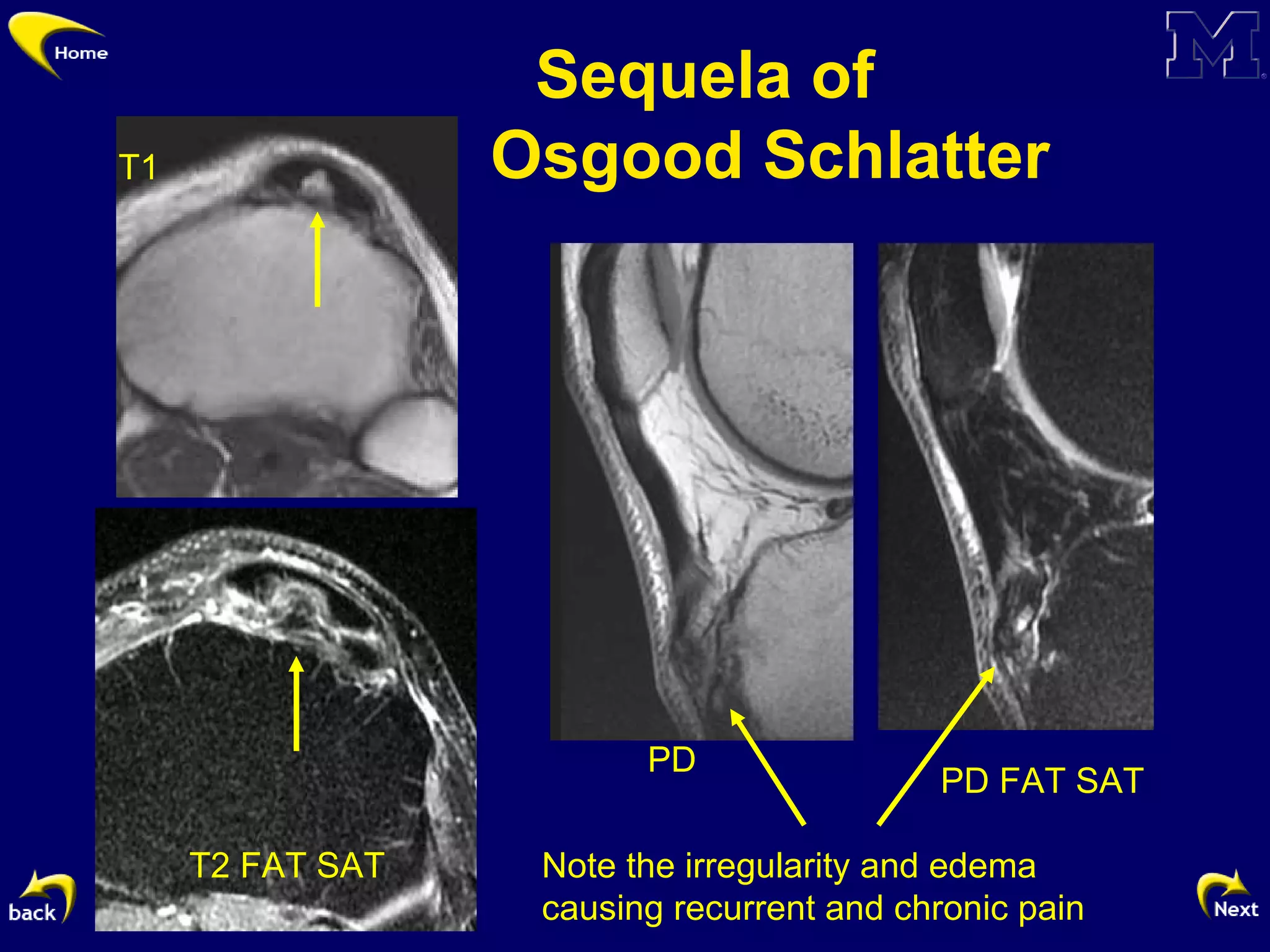
Osgood Schlatter Disease An osteochondrosis of the tibial tubercle manifesting as anterior knee pain in adolescents The fragmentation can persist into adulthood and cause continued or recurrent symptoms
Sequela of  Osgood Schlatter PD PD FAT SAT T2 FAT SAT T1 Note the irregularity and edema causing recurrent and chronic pain
Patellar Malalignment Transient Patellar Dislocation Excessive Lateral Pressure Syndrome (ELPS) Patellar Tendon Lateral Femoral Condyle Friction Syndrome
Transient Patellar Dislocation The medial patellar facet impacts against the lateral femoral condyle, producing bone bruises or microfractures.  The pattern is nearly pathognomonic Injury to the medial patellar retinaculum is very common Predisposing factors include dysplastic trochlea, patella alta, lateralized tibial tubercle, and tight lateral retinaculum Treatment for recurrent dislocation often includes lateral retinacular release to decrease lateralization force on the patella
Transient Patellar Dislocation Lateral femoral condyle T2 FAT SAT Medial patella
Excessive Lateral Pressure    Syndrome (ELPS) Classically categorized as tilt without subluxation.  Look for narrowing at the lateral aspect of the patellofemoral joint, especially in young patients with anterior knee pain However, only rarely see advanced tilt without subluxation Surgical treatment includes lateral retinacular release to decrease the translational force on the patella Attempt to make the diagnosis before advanced osteoarthritis (OA) ensues
January 2001 at 27 years old August 2005  at 31 years old Excessive Lateral Pressure Syndrome T2 FAT SAT T2 FAT SAT The OA renders treatment/surgery less effective Suggest the diagnosis based on the tilt; prior to OA Images courtesy of Mark Schweitzer, MD
Patellar Tendon-Lateral Femoral Condyle Friction Syndrome Presents as anterior knee pain exacerbated by hyperextension MRI reveals edema in the superolateral aspect of Hoffa’s fat pad between the patellar tendon and the lateral femoral condyle Likely related to, or a form of patellar malalignment Associated with patella alta Chung, Skeletal Radiology 2001 Nov; 39: 694-697
Patellar Tendon Lateral Femoral  Condyle Friction Syndrome PD FAT SAT Cor FAT SAT T2 FAT SAT The alta allows for the contact between the tendon and the femoral condyle
Patellar Abnormalities Bipartite patella Multipartite patella Patellar fracture
Bipartite Patella Painful bipartite patella is a cause of anterior knee pain Any bipartite or multipartite bone can develop a pseudarthrosis The pseudarthrosis is manifested on MRI as bone marrow edema and as fluid between the osseous fragments Initial treatment includes physical therapy, rest, and pain control When initial therapy fails, surgery is often performed Surgical options include: Resection of the painful fragment Lateral retinacular release Detachment of the insertion site of the vastus lateralis
Bipartite Patella PD FAT SAT T2 FAT SAT Cor T2 FAT SAT Note the accessory ossicle is typically  superolateral Bone marrow edema and cystic changes correlate with pain Cor T1
Multipartite Patella T2 FAT SAT Cor T2 FAT SAT Cor T2 FAT SAT T1 Note the typical  superolateral  fragments
Patellar Fracture Susceptible to fracture because of its superficial location and lack of protection Two-thirds are horizontal fractures Next most frequent are comminuted and vertical fractures Look for sharp fracture lines, joint effusion, and location of fracture lines away from the typical superolateral location of an accessory ossicle
Patellar Fracture
Patellar Fracture Axial CT showing a lipohemarthrosis
Corresponding Author: Brian Sabb [email_address]

Anterior Knee Pain By Dr. Brian Sabb

  • 1.
    Anterior Knee Pain:A Diagnostic Conundrum Brian Sabb, DO J. David Blaha, MD Department of Orthopaedic Surgery
  • 2.
    Disclosure of CommercialInterest Neither I nor my immediate family members have a financial relationship with a commercial organization that may have a direct or indirect interest in the content.
  • 3.
    Objectives Improve theparticipant’s understanding of the radiologic diagnosis of anterior knee pain The participant will know specific imaging findings of anterior knee pathology Understand the biomechanics and pathophysiology of the patellofemoral joint and how they should be applied to the imaging evaluation
  • 4.
    Anterior Knee PainAnatomical Categorization Prepatellar Soft Tissues Quadriceps Fat Pad Infrapatellar Fat Pad of Hoffa Extensor Mechanism Patellofemoral Joint Patella
  • 5.
    Prepatellar Bursitis Inflammationof the prepatellar bursa In more severe cases one will see formation of a discrete fluid collection Can become infected, i.e. septic bursitis In chronic cases, may contain multiple calcified bodies US may show hyperemia; suggesting inflammation, infection, or acute trauma
  • 6.
  • 7.
    Prepatellar Bursitis PDPD FAT SAT T2 FAT SAT
  • 8.
    Quadriceps Fat PadEdema Shown in a recent study to clinically mimic meniscal tear in 55% of patients and to present with anterior knee pain in 28% of patients Present in about 4-12 % of knee MRIs Edema may be present with or without mass effect Shabshin, Skeletal Radiology. 2006 May; 35(5): 269-74 Roth, AJR. 2004 Jun;182(6):1383-7
  • 9.
    Quadriceps Fat PadEdema PD PD FAT SAT T2 FAT SAT
  • 10.
    Infrapatellar Fat Padof Hoffa Hoffa’s disease Localized nodular synovitis Pigmented villonodular synovitis (PVNS) Intraarticular chondroma Infrapatellar plica syndrome
  • 11.
    Hoffa’s Disease Asyndrome of fat pad impingement Acute or repetitive trauma causes inflammatory changes in the infrapatellar fat The resulting pain, swelling, and fat hypertrophy limits range of motion Over time, fibrotic tissue is formed
  • 12.
  • 13.
    Localized Nodular SynovitisBenign proliferative disease Most commonly affects the tendon sheaths of the hands, e.g. giant cell tumor of tendon sheath MRI demonstrates a well defined mass in Hoffa’s fat pad Typically low SI on T1 and variable SI on T2
  • 14.
    Localized Nodular SynovitisPD PD FAT SAT T2 FAT SAT
  • 15.
    Pigmented Villonodular Synovitis(PVNS) Benign proliferative disorder of the synovium Usually involves large joints 80% of cases affect the knee Synovial deposition of hemosiderin results in irregular synovial masses that show a significant amount of hypointensity on all sequences
  • 16.
    Pigmented Villonodular Synovitis(PVNS) PD PD FAT SAT T2 FAT SAT
  • 17.
    Intraarticular Chondroma Althougha rare lesion; they overwhelmingly occur around the knee, typically the infrapatellar fat pad May calcify and even ossify May erode the lower pole of the patella May displace the patellar tendon
  • 18.
    Intraarticular Chondroma PDPD FAT SAT T2 FAT SAT
  • 19.
    Infrapatellar Plica InjuryA thin fold of synovial tissue, extending from the inferior pole of the patella through Hoffa’s fat to the intercondylar notch anterior to the anterior cruciate ligament High signal along the course of the plica indicates injury to the plica Thickening of the plica even in the absence of edema or fluid suggests a chronic injury Cothran, AJR 2003; 180(5): 1443-1447
  • 20.
    Infrapatellar Plica InjuryPD PD FAT SAT T2 FAT SAT
  • 21.
    Extensor Mechanism PathologyTraumatic Tendinosis Patellar tendon tear Quadriceps tendon tear Intrinsic patellar tendon lesions, e.g. gout Patellar enthesopathy Osteochondroses, e.g. Osgood-Schlatter Disease
  • 22.
    Patellar Tendinosis Painin the infrapatellar region Commonly seen in athletes MRI demonstrates thickening of the patellar tendon with intermediate T1 or PD signal and increased signal on T2 especially with fat suppression Ultrasound demonstrates thickening, hypoechogenicity, and increased color flow
  • 23.
    Patellar Tendinosis PDPD FAT SAT T2 FAT SAT
  • 24.
    Patellar Tendon TearMRI Fluid signal is seen at site of tear; decreased T1 and increased T2 signal A tendon gap is seen along with diastasis of tendon fibers in full thickness tear US Hypoechoic foci Posterior shadowing is seen at ends of the retracted tendon in full thickness tear Patella alta
  • 25.
    Complete Patellar TendonTear PD FAT SAT Longitudinal Ultrasound
  • 26.
    Quadriceps Tendon TearMRI Partial thickness tear reveals small pockets of fluid indicating tear often superimposed on the more diffuse increased T2 signal of tendinosis Ultrasound Partial thickness tears demonstrate hypoechogenicity and swelling By both modalities, tendon retraction and discontinuity of fibers indicates full thickness tear
  • 27.
    Quadriceps Tendon TearFull thickness tear by MR with diastasis of fibers filled by high T2 fluid and and by longitudinal US with hypoechoic fluid PD FAT SAT
  • 28.
    PD FAT SATComplete Quadriceps Tendon Tear PD Note: patella baja
  • 29.
    Intrinsic Patellar Tendon Lesion: Gout MRI reveals low T1 and mildly high T2 signal. There is an infiltrating mass present Ultrasound reveals hyperechogenicity, acoustic shadowing, and calcifications. Employing color flow imaging is important since peripheral hyperemia is expected
  • 30.
    Gout of ThePatellar Tendon PD PD FAT SAT T2 FAT SAT T2 FAT SAT T2 FAT SAT
  • 31.
    Gout of ThePatellar Tendon by US Intratendinous Crystals Peripheral hyperemia Shadowing
  • 32.
    Enthesopathy of ThePatella May be related to a degenerative process One must also consider inflammatory arthropathies Psoriasis Ankylosing spondylitis Reactive arthritis
  • 33.
    Psoriasis PD PDFAT SAT PD FAT SAT
  • 34.
  • 35.
    Ankylosing Spondylitis PDPD FAT SAT T2 FAT SAT T1 Extensive bone marrow edema and associated enthesitis
  • 36.
  • 37.
    Osgood Schlatter DiseaseAn osteochondrosis of the tibial tubercle manifesting as anterior knee pain in adolescents The fragmentation can persist into adulthood and cause continued or recurrent symptoms
  • 38.
    Sequela of Osgood Schlatter PD PD FAT SAT T2 FAT SAT T1 Note the irregularity and edema causing recurrent and chronic pain
  • 39.
    Patellar Malalignment TransientPatellar Dislocation Excessive Lateral Pressure Syndrome (ELPS) Patellar Tendon Lateral Femoral Condyle Friction Syndrome
  • 40.
    Transient Patellar DislocationThe medial patellar facet impacts against the lateral femoral condyle, producing bone bruises or microfractures. The pattern is nearly pathognomonic Injury to the medial patellar retinaculum is very common Predisposing factors include dysplastic trochlea, patella alta, lateralized tibial tubercle, and tight lateral retinaculum Treatment for recurrent dislocation often includes lateral retinacular release to decrease lateralization force on the patella
  • 41.
    Transient Patellar DislocationLateral femoral condyle T2 FAT SAT Medial patella
  • 42.
    Excessive Lateral Pressure Syndrome (ELPS) Classically categorized as tilt without subluxation. Look for narrowing at the lateral aspect of the patellofemoral joint, especially in young patients with anterior knee pain However, only rarely see advanced tilt without subluxation Surgical treatment includes lateral retinacular release to decrease the translational force on the patella Attempt to make the diagnosis before advanced osteoarthritis (OA) ensues
  • 43.
    January 2001 at27 years old August 2005 at 31 years old Excessive Lateral Pressure Syndrome T2 FAT SAT T2 FAT SAT The OA renders treatment/surgery less effective Suggest the diagnosis based on the tilt; prior to OA Images courtesy of Mark Schweitzer, MD
  • 44.
    Patellar Tendon-Lateral FemoralCondyle Friction Syndrome Presents as anterior knee pain exacerbated by hyperextension MRI reveals edema in the superolateral aspect of Hoffa’s fat pad between the patellar tendon and the lateral femoral condyle Likely related to, or a form of patellar malalignment Associated with patella alta Chung, Skeletal Radiology 2001 Nov; 39: 694-697
  • 45.
    Patellar Tendon LateralFemoral Condyle Friction Syndrome PD FAT SAT Cor FAT SAT T2 FAT SAT The alta allows for the contact between the tendon and the femoral condyle
  • 46.
    Patellar Abnormalities Bipartitepatella Multipartite patella Patellar fracture
  • 47.
    Bipartite Patella Painfulbipartite patella is a cause of anterior knee pain Any bipartite or multipartite bone can develop a pseudarthrosis The pseudarthrosis is manifested on MRI as bone marrow edema and as fluid between the osseous fragments Initial treatment includes physical therapy, rest, and pain control When initial therapy fails, surgery is often performed Surgical options include: Resection of the painful fragment Lateral retinacular release Detachment of the insertion site of the vastus lateralis
  • 48.
    Bipartite Patella PDFAT SAT T2 FAT SAT Cor T2 FAT SAT Note the accessory ossicle is typically superolateral Bone marrow edema and cystic changes correlate with pain Cor T1
  • 49.
    Multipartite Patella T2FAT SAT Cor T2 FAT SAT Cor T2 FAT SAT T1 Note the typical superolateral fragments
  • 50.
    Patellar Fracture Susceptibleto fracture because of its superficial location and lack of protection Two-thirds are horizontal fractures Next most frequent are comminuted and vertical fractures Look for sharp fracture lines, joint effusion, and location of fracture lines away from the typical superolateral location of an accessory ossicle
  • 51.
  • 52.
    Patellar Fracture AxialCT showing a lipohemarthrosis
  • 53.
    Corresponding Author: BrianSabb [email_address]

Editor's Notes

  • #43 Decrease the lateralization of the patella