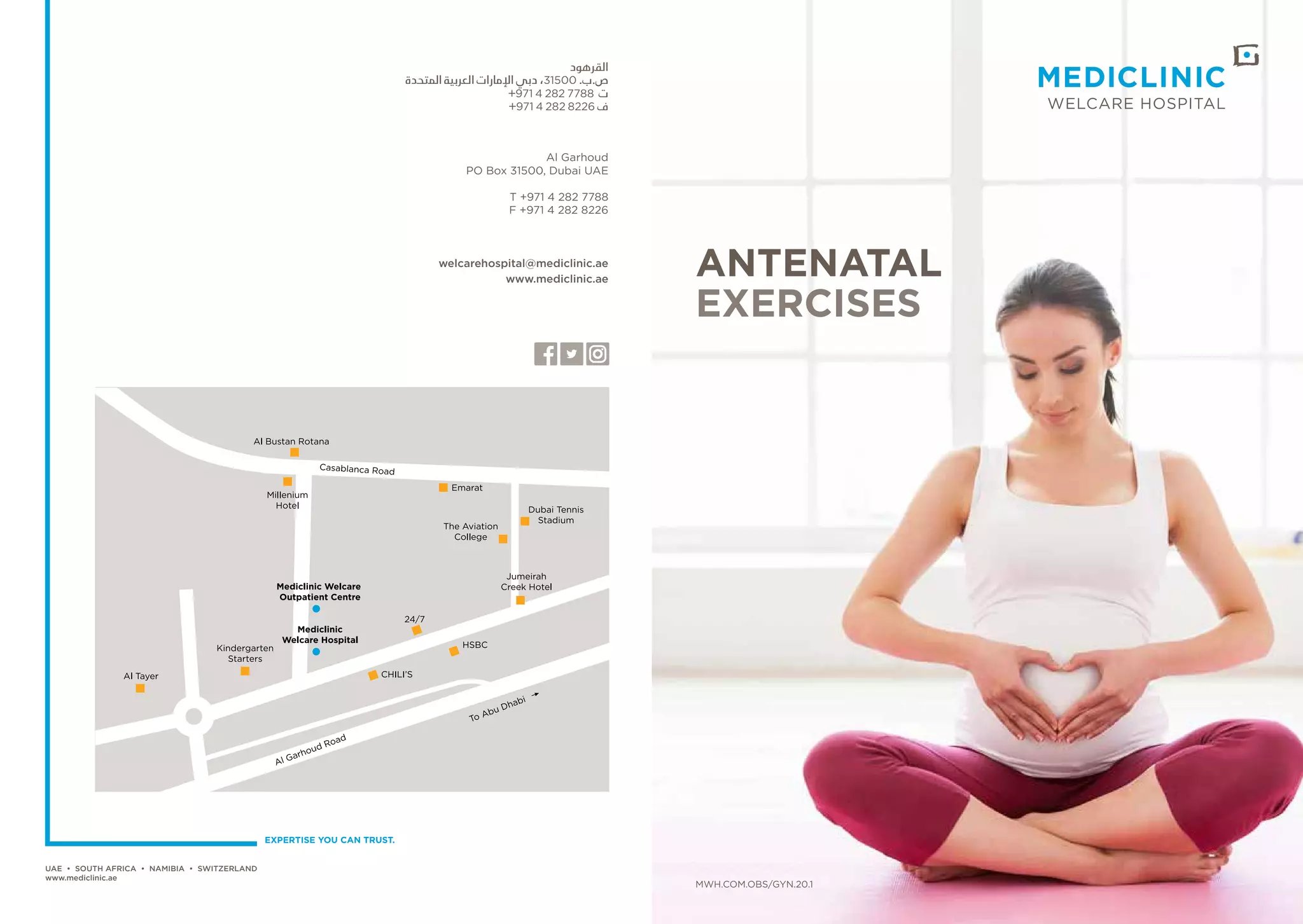
ANTENATAL
EXERCISES
MWH.COM.OBS/GYN.20.1
UAE • SOUTH AFRICA • NAMIBIA • SWITZERLAND
www.mediclinic.ae
EXPERTISE YOU CAN TRUST.
welcarehospital@mediclinic.ae
www.mediclinic.ae
Al Garhoud
PO Box 31500, Dubai UAE
T +971 4 282 7788
F +971 4 282 8226
‫القرهود‬
‫المتحدة‬ ‫العربية‬ ‫اإلمارات‬ ‫دبي‬ ،31500 .‫ب‬.‫ص‬
+971 4 282 7788 ‫ت‬
+971 4 282 8226 ‫ف‬
Each day you need to do:
• Slow exercises – tighten, hold (aim
for up to 10 seconds) and relax
• Fast exercises – tighten and relax
quickly. Repeat up to 10 times
How often?
Always do a mixture of fast and slow
exercises while seated on the loo after
you have emptied your bladder. Make
this a lifetime habit.
You can exercise in the shower, as you
wash your hands, while ironing, etc.
Protect your pelvic floor:
Make a habit of always pulling up your
pelvic floor before you lift, carry, push
or pull light to moderate weights.
Lift and squeeze as you cough or
sneeze.
Your abdominal muscles – “Nature’s
perfect corset”
You have four pairs of muscles
arranged in four layers (it is only
possible to show two layers in the
diagram: the rectus and transversus
muscles).
• The rectus muscles run vertically up
and down the centre of your tummy
very elastic muscles which act like a
small trampoline to support your baby
during pregnancy. These muscles may
become weak, leading to a leakage of
urine when you cough or sneeze. Many
women experience this problem during
pregnancy. Exercise now to strengthen
your pelvic floor. Do at least 80
exercises each day.
Strong pelvic floor muscles stop leaks
from both your bladder and bowel.
Strong pelvic floor muscles enable you
and your partner to continue to enjoy
intercourse.
How to do pelvic floor exercises
• Sit with your knees apart
• Don’t hold your breath
• Don’t clench your buttocks
Tighten your back passage as if you
were trying to stop passing wind. Now
tighten the muscles you would use to
stop a flow of urine. Do both together
and you should feel your back passage,
vagina and front passage all lift and
close at the same time.
Now you know what to do, you can do
this exercise while standing, sitting or
lying down.
Deep breathing exercises
• Breathe in deeply through your nose
• Sigh out through your mouth
• Repeat five times
• Do this exercise six times a day
Foot and ankle exercise
Keep your knees relaxed for both
exercises.
• Bend and stretch your ankles
vigorously up and down for 30
seconds
• Circle both feet 10 times in each
direction
• Repeat both of these exercises 10
times a day
This will help to reduce swollen ankles
and varicose veins.
Strengthen your pelvic floor muscles
The floor of your pelvis is formed by
Antenatal exercises
This leaflet explains several exercises
that will help you look after yourself
during pregnancy. It has been
designed using what you have learned
from your physiotherapist during
your antenatal classes, however it
will also be useful if you haven’t had
the opportunity to attend antenatal
classes.
They will help you to:
• Improve your circulation
• Strengthen your pelvic floor muscles
• Prevent backache
Please consult your doctor before
undertaking these exercises if you have
a history of backache or other health
problems.
Deep breathing and foot and ankle
exercises
Exercise and relaxation are essential to
help you feel good in mind and body
at any time.
These gentle exercises help to improve
you circulation as the amount of
fluid in your body increases during
pregnancy. This creates extra work for
your heart and veins, especially the
veins in your legs, through which blood
is pumped back to your heart. Poor
circulation can lead to varicose veins,
vuval veins and cramps.
ALWAYS rest with your legs up as
illustrated.
Womb
Bladder
Bowel
Vagina
Pubic bone
Back bone
Pelvic floor
muscles
• The transversus muscles are
the deepest horizontal muscles
encircling your waist
• The oblique muscles crisscross
diagonally on your sides
These muscles work together to hold
your spine firm, tilt your pelvis upward
and to pull your tummy in tight. These
muscles bend and twist your spine.
During pregnancy, your tummy
muscles will soften, separate and
lengthen to accommodate your
growing baby. This is a natural change
due to pregnancy hormones circulating
in your body. The gap (linea alba) will
gradually close after birth. Tummy
exercises prevent over-stretching and
encourage closure of the separation
after birth.
Weight gain
Excessive weight gained during
pregnancy is difficult to lose after the
birth. On avergage, it is advised that
you gain between 12 and 15kg over
the entire pregnancy if you are normal
weight (which breaks down to 7kg
during the first 20 weeks and then
a ½ kg a week thereafter). If you are
overweight, it is recommended that
you gain no more than 8kg over the
entire pregnancy.
Exercise to prevent backache
Bad posture, stretched tummy
muscles and a growing baby can
lead to backache during pregnancy.
Overstretched tummy muscles
can contribute to back pain and
constipation.
Good posture
• Stand tall
• Bottom tucked in
• Tummy in – always
• Relaxed knees
• Pelvic floor up
These exercises can be done when
kneeling, sitting and standing
• Transversus abdominus –
“Nature’s belt”
Lift your tummy button in and
up towards your spine. Hold 3-4
seconds. (Your shoulders, ribs and
spine do not move). Repeat 5-10
times twice a day.
• Pelvic tilting
Lift your tummy button in and up
towards your spine. Tighten your
buttocks, hump up your back and
tuck your “tail” under. Hold 3-4
seconds. Repeat 5-10 times a day.
Simple ways of caring for your body
DO
Rest as often as you can with your feet
raised slightly higher than the level of
your hips.
To get out of bed, draw your tummy in,
keep knees together, roll on your side
and push up on your arms.
Take some exercise every day. Walk
briskly for 20-30 minutes, if able.
Swimming is a very good exercise –
swim at a comfortable pace. Stop and
rest often. Women with painful pelvic
joints should avoid doing breaststroke
as this action may increase your pain.
DON’T
Do not stand still or sit for long
periods.
Do not stoop. When lifting, you should
bend your knees, keep your back
straight and pull up your pelvic floor as
you take the weight of the object.
Do not lift or carry heavy weights.
Toddlers can be too heavy to carry.
Encourage them to be independent.
Bad posture
During pregnancy
Linea
alba
Rectus
abdominus
Transversus
abdominus
Good posture
Stress, tension and relaxation
Some women feel extremely tired.
Others develop aches and pains which
are not due to specific illness, but are
related to tension. Tension causes an
increase in blood pressure, heart rate
and rate of breathing which can lead to
feelings of panic as well as overloading
the systems of the body. Knowing how
to prevent tension is a valuable skill
which everyone could use when life is
more challenging than usual.
Learning a relaxation technique and
using it regularly has been shown
to reduce mildly increased blood
pressure. Women who learn and use
it during labour generally cope better
with pain and feel more in control.
During pregnancy, practising relaxation
will help you to rest more effectively
and can also help you to get sleep
again if you wake during the night.
Relaxation
You can relax in either a sitting or lying
position. Using a pillow, make sure
your head is supported, as well as your
arms and legs.
Go through the following movements
Complete one movement, let go or
stop the movement, then check that
the joint is resting in a comfortable
position.
• Pull your shoulders down towards
your feet. Let go
• Move your elbows outwards from
you sides. Let go
• Stretch all your fingers out. Let go
• Roll your knees outwards. Let go
• Point your feet downwards. Let go
• Raise and separate your eyebrows.
Let go
• Look up towards your hairline. Let go
• Drag your bottom jaw downwards.
Let go
• Focus on your breathing
Take some time to enjoy this sensation.
Focus your thoughts on something
pleasant.
If you get up too quickly after a
period of relaxation, you may feel
dizzy.
Helpful positions for labour and birth
During contractions, stay upright and
change your position frequently.
Your baby will be moved through your
pelvis more easily if you stay upright.
Breathing awareness for labour
• Relaxed breathing:
• Helps you concentrate
• Helps you cope
• Encourages relaxation all over your
body
• Reduces pain
• Early labour
Sigh out slowly as each contraction
begins (SOS). When you feel
ready, breathe in deeply but gently
through your nose. Sigh out slowly.
Repeat until the contraction fades.
Concentrate hard on breathing out.
Closing your eyes will help you focus
on your breathing.
• Advanced labour
Once contractions are very strong,
sigh out slowly as each contraction
begins. At the peak of each
contraction, change to light upper
chest breathing. Again concentrate
on breathing out. Return to relaxed,
deep breathing as soon as the pain
starts to fade and continue until the
contraction is over.
During delivery, help your midwife to
protect your pelvic floor
Listen carefully to your midwife, she
will tell you NOT to push as your
baby’s head emerges. Pant lightly
with your mouth open. This will stop
you pushing and will allow your
baby’s head to come out gently.
Minor problems during pregnancy
Swollen ankles and varicose veins
Regular exercise will reduce symptoms.
Consider wearing support tights.
Numb/swollen fingers
For safety reasons, rings should
be removed if your fingers have a
tendency to swell. This may be a
problem first thing in the morning
and is due to extra fluid in the body,
increasing pressure at the wrist. Your
physiotherapist may supply you with
wrist supports to wear at night which
may solve the problem.
If swollen ankles and/or fingers
are accompanied by a puffy face,
headaches or flashing lights, seek
medical advice at once.
Rib flare
This problem is due to the growing
baby pushing the ribs out of their
normal position. Try to change position
frequently and avoid sitting on low
chairs and other positions which bring
your ribs close to your pelvis. You
may get temporary relief by lifting the
arm on the affected side and bending
sideways away from the ache. Sitting
cross-legged (tailor fashion) with
hands on head also provides some
relief.
Emotional changes
The hormone changes during
pregnancy lead to emotional “ups and
downs” and sometimes forgetfulness.
After birth, these problems will
gradually improve.

Antenatal Exercises.pdf

  • 1.
    ANTENATAL EXERCISES MWH.COM.OBS/GYN.20.1 UAE • SOUTHAFRICA • NAMIBIA • SWITZERLAND www.mediclinic.ae EXPERTISE YOU CAN TRUST. welcarehospital@mediclinic.ae www.mediclinic.ae Al Garhoud PO Box 31500, Dubai UAE T +971 4 282 7788 F +971 4 282 8226 ‫القرهود‬ ‫المتحدة‬ ‫العربية‬ ‫اإلمارات‬ ‫دبي‬ ،31500 .‫ب‬.‫ص‬ +971 4 282 7788 ‫ت‬ +971 4 282 8226 ‫ف‬
  • 2.
    Each day youneed to do: • Slow exercises – tighten, hold (aim for up to 10 seconds) and relax • Fast exercises – tighten and relax quickly. Repeat up to 10 times How often? Always do a mixture of fast and slow exercises while seated on the loo after you have emptied your bladder. Make this a lifetime habit. You can exercise in the shower, as you wash your hands, while ironing, etc. Protect your pelvic floor: Make a habit of always pulling up your pelvic floor before you lift, carry, push or pull light to moderate weights. Lift and squeeze as you cough or sneeze. Your abdominal muscles – “Nature’s perfect corset” You have four pairs of muscles arranged in four layers (it is only possible to show two layers in the diagram: the rectus and transversus muscles). • The rectus muscles run vertically up and down the centre of your tummy very elastic muscles which act like a small trampoline to support your baby during pregnancy. These muscles may become weak, leading to a leakage of urine when you cough or sneeze. Many women experience this problem during pregnancy. Exercise now to strengthen your pelvic floor. Do at least 80 exercises each day. Strong pelvic floor muscles stop leaks from both your bladder and bowel. Strong pelvic floor muscles enable you and your partner to continue to enjoy intercourse. How to do pelvic floor exercises • Sit with your knees apart • Don’t hold your breath • Don’t clench your buttocks Tighten your back passage as if you were trying to stop passing wind. Now tighten the muscles you would use to stop a flow of urine. Do both together and you should feel your back passage, vagina and front passage all lift and close at the same time. Now you know what to do, you can do this exercise while standing, sitting or lying down. Deep breathing exercises • Breathe in deeply through your nose • Sigh out through your mouth • Repeat five times • Do this exercise six times a day Foot and ankle exercise Keep your knees relaxed for both exercises. • Bend and stretch your ankles vigorously up and down for 30 seconds • Circle both feet 10 times in each direction • Repeat both of these exercises 10 times a day This will help to reduce swollen ankles and varicose veins. Strengthen your pelvic floor muscles The floor of your pelvis is formed by Antenatal exercises This leaflet explains several exercises that will help you look after yourself during pregnancy. It has been designed using what you have learned from your physiotherapist during your antenatal classes, however it will also be useful if you haven’t had the opportunity to attend antenatal classes. They will help you to: • Improve your circulation • Strengthen your pelvic floor muscles • Prevent backache Please consult your doctor before undertaking these exercises if you have a history of backache or other health problems. Deep breathing and foot and ankle exercises Exercise and relaxation are essential to help you feel good in mind and body at any time. These gentle exercises help to improve you circulation as the amount of fluid in your body increases during pregnancy. This creates extra work for your heart and veins, especially the veins in your legs, through which blood is pumped back to your heart. Poor circulation can lead to varicose veins, vuval veins and cramps. ALWAYS rest with your legs up as illustrated. Womb Bladder Bowel Vagina Pubic bone Back bone Pelvic floor muscles
  • 3.
    • The transversusmuscles are the deepest horizontal muscles encircling your waist • The oblique muscles crisscross diagonally on your sides These muscles work together to hold your spine firm, tilt your pelvis upward and to pull your tummy in tight. These muscles bend and twist your spine. During pregnancy, your tummy muscles will soften, separate and lengthen to accommodate your growing baby. This is a natural change due to pregnancy hormones circulating in your body. The gap (linea alba) will gradually close after birth. Tummy exercises prevent over-stretching and encourage closure of the separation after birth. Weight gain Excessive weight gained during pregnancy is difficult to lose after the birth. On avergage, it is advised that you gain between 12 and 15kg over the entire pregnancy if you are normal weight (which breaks down to 7kg during the first 20 weeks and then a ½ kg a week thereafter). If you are overweight, it is recommended that you gain no more than 8kg over the entire pregnancy. Exercise to prevent backache Bad posture, stretched tummy muscles and a growing baby can lead to backache during pregnancy. Overstretched tummy muscles can contribute to back pain and constipation. Good posture • Stand tall • Bottom tucked in • Tummy in – always • Relaxed knees • Pelvic floor up These exercises can be done when kneeling, sitting and standing • Transversus abdominus – “Nature’s belt” Lift your tummy button in and up towards your spine. Hold 3-4 seconds. (Your shoulders, ribs and spine do not move). Repeat 5-10 times twice a day. • Pelvic tilting Lift your tummy button in and up towards your spine. Tighten your buttocks, hump up your back and tuck your “tail” under. Hold 3-4 seconds. Repeat 5-10 times a day. Simple ways of caring for your body DO Rest as often as you can with your feet raised slightly higher than the level of your hips. To get out of bed, draw your tummy in, keep knees together, roll on your side and push up on your arms. Take some exercise every day. Walk briskly for 20-30 minutes, if able. Swimming is a very good exercise – swim at a comfortable pace. Stop and rest often. Women with painful pelvic joints should avoid doing breaststroke as this action may increase your pain. DON’T Do not stand still or sit for long periods. Do not stoop. When lifting, you should bend your knees, keep your back straight and pull up your pelvic floor as you take the weight of the object. Do not lift or carry heavy weights. Toddlers can be too heavy to carry. Encourage them to be independent. Bad posture During pregnancy Linea alba Rectus abdominus Transversus abdominus Good posture
  • 4.
    Stress, tension andrelaxation Some women feel extremely tired. Others develop aches and pains which are not due to specific illness, but are related to tension. Tension causes an increase in blood pressure, heart rate and rate of breathing which can lead to feelings of panic as well as overloading the systems of the body. Knowing how to prevent tension is a valuable skill which everyone could use when life is more challenging than usual. Learning a relaxation technique and using it regularly has been shown to reduce mildly increased blood pressure. Women who learn and use it during labour generally cope better with pain and feel more in control. During pregnancy, practising relaxation will help you to rest more effectively and can also help you to get sleep again if you wake during the night. Relaxation You can relax in either a sitting or lying position. Using a pillow, make sure your head is supported, as well as your arms and legs. Go through the following movements Complete one movement, let go or stop the movement, then check that the joint is resting in a comfortable position. • Pull your shoulders down towards your feet. Let go • Move your elbows outwards from you sides. Let go • Stretch all your fingers out. Let go • Roll your knees outwards. Let go • Point your feet downwards. Let go • Raise and separate your eyebrows. Let go • Look up towards your hairline. Let go • Drag your bottom jaw downwards. Let go • Focus on your breathing Take some time to enjoy this sensation. Focus your thoughts on something pleasant. If you get up too quickly after a period of relaxation, you may feel dizzy. Helpful positions for labour and birth During contractions, stay upright and change your position frequently. Your baby will be moved through your pelvis more easily if you stay upright. Breathing awareness for labour • Relaxed breathing: • Helps you concentrate • Helps you cope • Encourages relaxation all over your body • Reduces pain • Early labour Sigh out slowly as each contraction begins (SOS). When you feel ready, breathe in deeply but gently through your nose. Sigh out slowly. Repeat until the contraction fades. Concentrate hard on breathing out. Closing your eyes will help you focus on your breathing. • Advanced labour Once contractions are very strong, sigh out slowly as each contraction begins. At the peak of each contraction, change to light upper chest breathing. Again concentrate on breathing out. Return to relaxed, deep breathing as soon as the pain starts to fade and continue until the contraction is over. During delivery, help your midwife to protect your pelvic floor Listen carefully to your midwife, she will tell you NOT to push as your baby’s head emerges. Pant lightly with your mouth open. This will stop you pushing and will allow your baby’s head to come out gently. Minor problems during pregnancy Swollen ankles and varicose veins Regular exercise will reduce symptoms. Consider wearing support tights. Numb/swollen fingers For safety reasons, rings should be removed if your fingers have a tendency to swell. This may be a problem first thing in the morning and is due to extra fluid in the body, increasing pressure at the wrist. Your physiotherapist may supply you with wrist supports to wear at night which may solve the problem. If swollen ankles and/or fingers are accompanied by a puffy face, headaches or flashing lights, seek medical advice at once. Rib flare This problem is due to the growing baby pushing the ribs out of their normal position. Try to change position frequently and avoid sitting on low chairs and other positions which bring your ribs close to your pelvis. You may get temporary relief by lifting the arm on the affected side and bending sideways away from the ache. Sitting cross-legged (tailor fashion) with hands on head also provides some relief. Emotional changes The hormone changes during pregnancy lead to emotional “ups and downs” and sometimes forgetfulness. After birth, these problems will gradually improve.