Maj RehanaYasmin
ANTENATALCARE
It is planned examination, observation
and guidance given to the pregnant
woman from conception till the time of
labor.
Antenatal Care
Aims
1. To screen the high risk cases.
2. To prevent or to detect and treat at the
earliest any complications.
3. To ensure continued risk assessment and to
provide ongoing primary preventive health
care.
4. To educate the mother about the physiology
of pregnancy and labour by demonstration,
charts and diagrams so that fear is removed
and psychology is improved.
5. T
o discuss the couple about the
place, time and mode of delivery,
provisionally and care of the newborn.
6. To motivate the couple about the
appropriate
need of family planning and also
advice to couple seeking
medical termination of pregnancy.
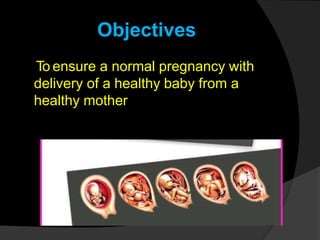
Objectives
To ensure a normal pregnancy with
delivery of a healthy baby from a
healthy mother
Antenatal care comprises of-
1. Registration of pregnancy
2. History taking
3.Antenatal examinations
[general and obstetrical]
4. Laboratory investigations
5. Health education
The First Visit
History taking
Examination
Investigation
History taking
1. Particulars of the patient
2. Chief complaints with duration
3. Past history
4. Obstetric history
5. Menstrual history
6. Family history
7. Drug History
8. History of immunization
9. Socio-economic history
10. Contraceptive history
11. History of allergy
Elderly primi (30 yr. and above)
Short statured primi (140 cm and
below)
Mal presentations
APH, threatened abortion Pre
– eclampsia, eclampsia
High Risk Pregnancy
Anaemia
Twins, hydramnios
IUFD, Still birth
Elderly grand multiparas
Prolonged pregnancy
H/o past caesarean or instrumental
delivery
Treatment for infertility
Risk Approach
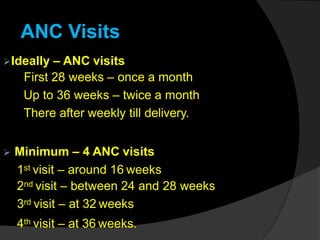
Ideally – ANC visits
First 28 weeks – once a month
Up to 36 weeks – twice a month
There after weekly till delivery.
 Minimum – 4 ANC visits
1st visit – around 16 weeks
2nd visit – between 24 and 28 weeks
3rd visit – at 32 weeks
4th visit – at 36 weeks.
ANC Visits
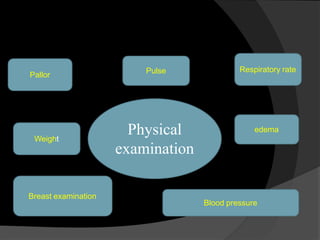
Physical
examination
Pallor
Pulse Respiratory rate
Weight
edema
Blood pressure
Breast examination
Pallor – Examine palpebral conjunctiva, nails,
tongue, oral mucosa, palms
Pulse – 60-90 / min.
R.R. – 18-20 breaths / min.
Edema
Examination
CONT.D
B.P. – Two consecutive
readings – systolic >140 mmHg and / or
diastolic > 90 mmHg
Check urine for the presence of albumin
Pre eclampsia – Hypertension + albuminuria
Imminent eclampsia – D.B.P. > 110 mmHg.
Eclampsia – Hypertension+ albuminuria +
Convulsions
Regular weight monitoring at
each visit
11 kg. wt. gain entire pregnancy
After first trimester, wt. gain 2
Kg. / month
Breast examination
Measurement of fundal height
Fetal heart sounds
Fetal movements
Fetal parts
Multiple pregnancy
Fetal lie and presentation
Inspection of abdominal scar or any other
relevant findings
Abdominal Examination
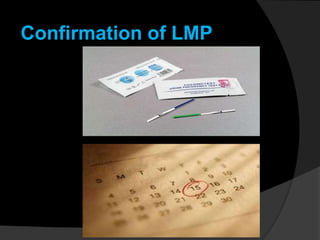
Confirmation of LMP
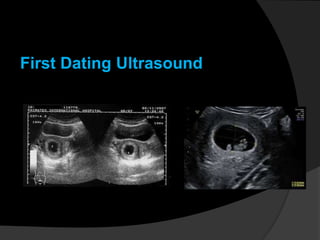
First Dating Ultrasound
Folic Acid Supplement
Specific Advice : 1st Trimester
Advise
Healthy food
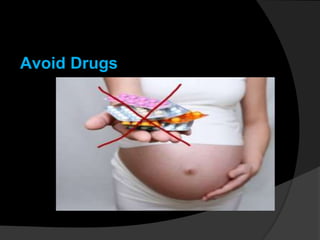
Avoid Drugs
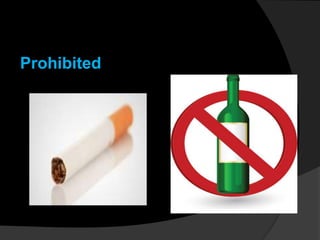
Prohibited
Chorionic Villus Sampling For
Familial Disorders
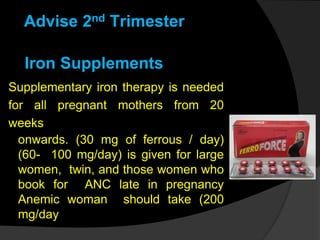
Iron Supplements
Supplementary iron therapy is needed
for all pregnant mothers from 20
weeks
onwards. (30 mg of ferrous / day)
(60- 100 mg/day) is given for large
women, twin, and those women who
book for ANC late in pregnancy
Anemic woman should take (200
mg/day
Advise 2nd Trimester
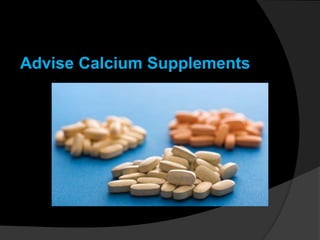
Advise Calcium Supplements
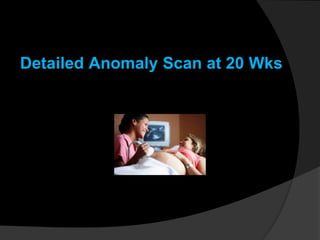
Detailed Anomaly Scan at 20 Wks
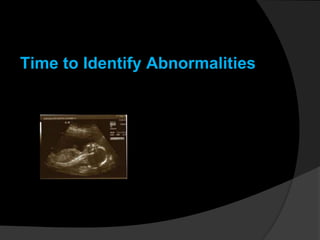
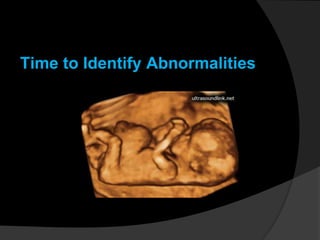
Time to Identify Abnormalities
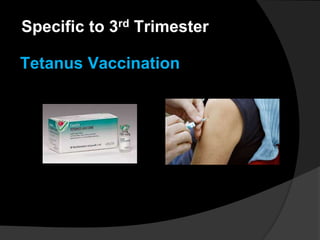
Tetanus Vaccination
Specific to 3rd Trimester
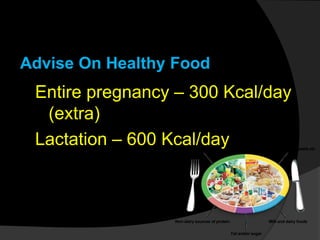
Advise On Healthy Food
Entire pregnancy – 300 Kcal/day
(extra)
Lactation – 600 Kcal/day
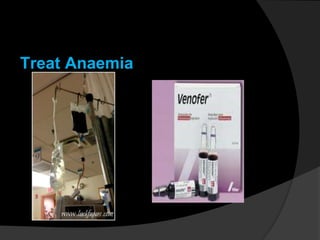
Treat Anaemia
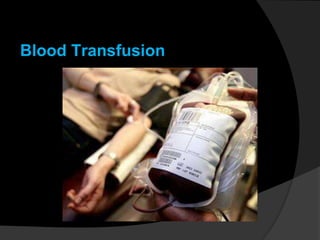
Blood Transfusion
Every Week Antenatal Check Up
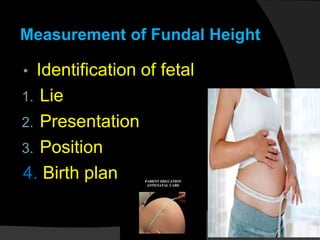
Measurement of Fundal Height
• Identification of fetal
1. Lie
2. Presentation
3. Position
4. Birth plan
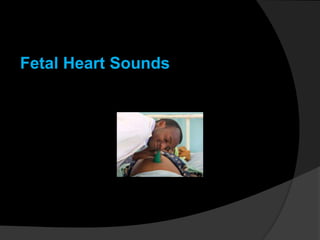
Fetal Heart Sounds
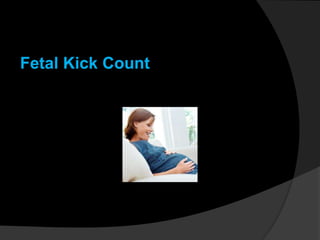
Fetal Kick Count
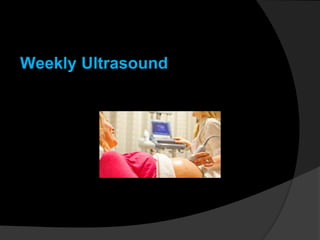
Weekly Ultrasound
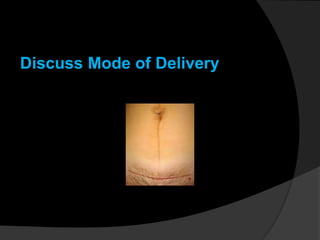
Discuss Mode of Delivery
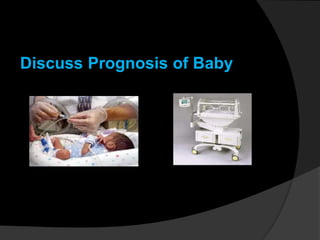
Discuss Prognosis of Baby
Discuss Transportation
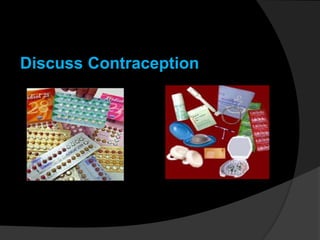
Discuss Contraception
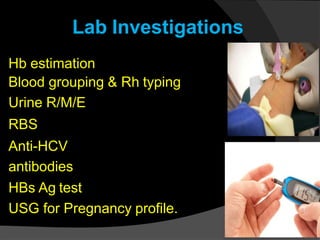
Lab Investigations
Hb estimation
Blood grouping & Rh typing
Urine R/M/E
RBS
Anti-HCV
antibodies
HBs Ag test
USG for Pregnancy profile.
In subsequent visit
• Patient complains
• General examination
• Gestational age to be calculated
• Identification of problem
• Foetal movement
• SFH measurement
• Health education
• Prophylaxis & treatment of anemia
• Developing individualized birth plan
Screen for-
1. Preeclampsia
2. Multiple pregnancy
3. anemia
4. IUGR
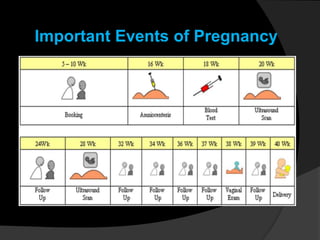
Important Events of Pregnancy
Hygiene
Daily bath is recommended, as it stimulation
refreshing and relaxing.
Avoid hot water bath.
Bowel care
As there is increase chance of constipation,
regular bowel movement may be facilitated by
regulation of diet taking plenty of fluids,
vegetables and milk.
Breast Care
Wash the breast with clean tap water.
Exercise
Walk in moderation. Avoid lifting
heavy things. Avoid long time
standing.
Avoid sitting with crossed
legs as this may impede circulation.
Dressing:
Tight clothes and belts are avoided
The patient should wear
loose but comfortable dresses. High
heel shoes are better avoided.
Alcohol, smoking and drugs should
be avoided as the may affect the
fetal wellbeing
Rest and sleep
8 hour sleep at night
At least 2 hour sleep after mid-day meal
Hard strenuous work should be avoided in first
trimester and last 4 weeks
Coitus
Should be avoided in
• 1st trimester
• last 6 weeks
Warning sign
1. Headache
2. Blurring of vision
3. Convulsion
4. Vaginal bleeding
5. Fever
PRECONCEPTIONAL COUNSELLING
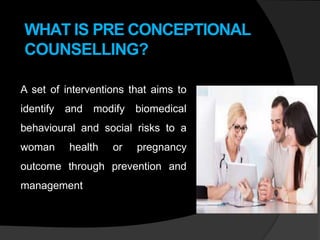
WHAT IS PRE CONCEPTIONAL
COUNSELLING?
A set of interventions that aims to
identify and modify biomedical
behavioural and social risks to a
woman health or pregnancy
outcome through prevention and
management
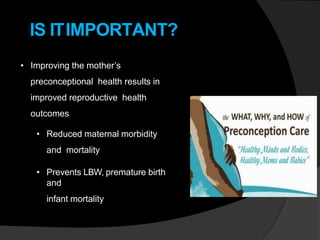
IS ITIMPORTANT?
• Improving the mother’s
preconceptional health results in
improved reproductive health
outcomes
• Reduced maternal morbidity
and mortality
• Prevents LBW, premature birth
and
infant mortality
WHEN TOINITIATE
PRECONCEPTIONALCARE
• Any visit to a doctor in the reproductive
years
• Annual health check up
• Postpartum check up
• A visit for a pregnancy test (esp if test
negative)
• Emergency visit
• Visit for infertility treatment
• Premarital Counselling
GOALS OF PRECONCEPTIONAL
CARE
• Screening for high risk factors
• Medical and surgical history
• Previous Obstetric History
• Personal history
• Family history
• Physical examination
• Laboratary screening
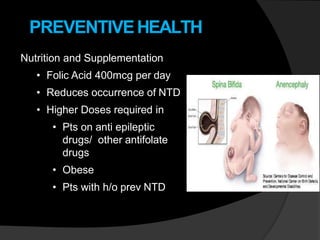
PREVENTIVEHEALTH
Nutrition and Supplementation
• Folic Acid 400mcg per day
• Reduces occurrence of NTD
• Higher Doses required in
• Pts on anti epileptic
drugs/ other antifolate
drugs
• Obese
• Pts with h/o prev NTD
PREVENTIVEHEALTH
• Optimizing Weight in Overweight and
obese women
• Reduces risk of of NTD
• preterm deliveries
• Diabetes, Hypertension
• Cesarean Section
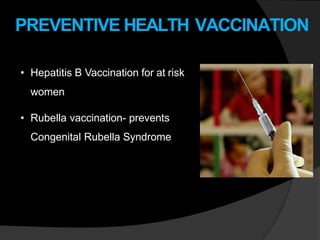
PREVENTIVE HEALTH VACCINATION
• Hepatitis B Vaccination for at risk
women
• Rubella vaccination- prevents
Congenital Rubella Syndrome
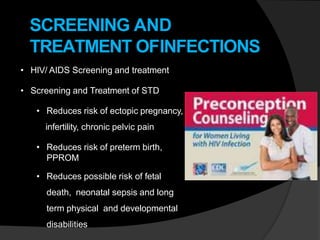
SCREENING AND
TREATMENT OFINFECTIONS
• HIV/ AIDS Screening and treatment
• Screening and Treatment of STD
• Reduces risk of ectopic pregnancy,
infertility, chronic pelvic pain
• Reduces risk of preterm birth,
PPROM
• Reduces possible risk of fetal
death, neonatal sepsis and long
term physical and developmental
disabilities
SPECIFIC INDUVIDUALISSUES
• Chronic Diseases
• Medications
• Addictions
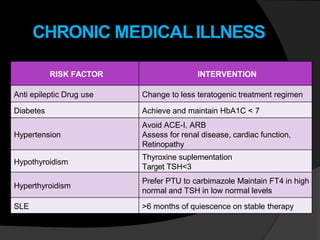
CHRONIC MEDICAL ILLNESS
RISK FACTOR INTERVENTION
Anti epileptic Drug use Change to less teratogenic treatment regimen
Diabetes Achieve and maintain HbA1C < 7
Hypertension
Avoid ACE-I, ARB
Assess for renal disease, cardiac function,
Retinopathy
Hypothyroidism
Thyroxine suplementation
Target TSH<3
Hyperthyroidism
Prefer PTU to carbimazole Maintain FT4 in high
normal and TSH in low normal levels
SLE >6 months of quiescence on stable therapy
CHRONIC MEDICAL ILLNESS
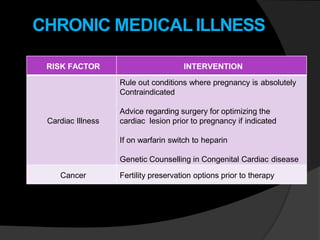
RISK FACTOR INTERVENTION
Cardiac Illness
Rule out conditions where pregnancy is absolutely
Contraindicated
Advice regarding surgery for optimizing the
cardiac lesion prior to pregnancy if indicated
If on warfarin switch to heparin
Genetic Counselling in Congenital Cardiac disease
Cancer Fertility preservation options prior to therapy
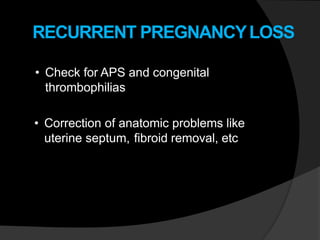
RECURRENT PREGNANCYLOSS
• Check for APS and congenital
thrombophilias
• Correction of anatomic problems like
uterine septum, fibroid removal, etc
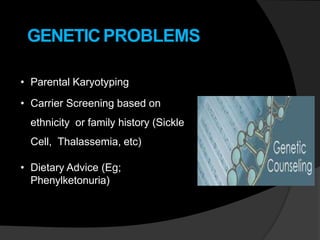
GENETICPROBLEMS
• Parental Karyotyping
• Carrier Screening based on
ethnicity or family history (Sickle
Cell, Thalassemia, etc)
• Dietary Advice (Eg;
Phenylketonuria)
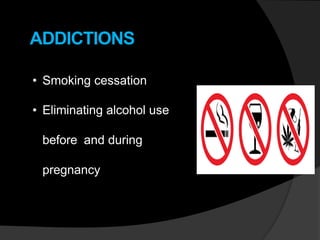
ADDICTIONS
• Smoking cessation
• Eliminating alcohol use
before and during
pregnancy
TERATOGENICITY
• Any agent that that acts during embryonic or
fetal development to produce a permanent
alteration of form or function
• Drugs
• Chemicals
• Radiation
• maternal medical conditions,
• Infectious agents
• Genetic factors
Thank you

Antenatal_Care_15-02-21.pptx

  • 1.
  • 2.
    It is plannedexamination, observation and guidance given to the pregnant woman from conception till the time of labor. Antenatal Care
  • 3.
    Aims 1. To screenthe high risk cases. 2. To prevent or to detect and treat at the earliest any complications. 3. To ensure continued risk assessment and to provide ongoing primary preventive health care. 4. To educate the mother about the physiology of pregnancy and labour by demonstration, charts and diagrams so that fear is removed and psychology is improved.
  • 4.
    5. T o discussthe couple about the place, time and mode of delivery, provisionally and care of the newborn. 6. To motivate the couple about the appropriate need of family planning and also advice to couple seeking medical termination of pregnancy.
  • 5.
    Objectives To ensure anormal pregnancy with delivery of a healthy baby from a healthy mother
  • 6.
    Antenatal care comprisesof- 1. Registration of pregnancy 2. History taking 3.Antenatal examinations [general and obstetrical] 4. Laboratory investigations 5. Health education
  • 7.
    The First Visit Historytaking Examination Investigation
  • 8.
    History taking 1. Particularsof the patient 2. Chief complaints with duration 3. Past history 4. Obstetric history 5. Menstrual history 6. Family history 7. Drug History 8. History of immunization 9. Socio-economic history 10. Contraceptive history 11. History of allergy
  • 9.
    Elderly primi (30yr. and above) Short statured primi (140 cm and below) Mal presentations APH, threatened abortion Pre – eclampsia, eclampsia High Risk Pregnancy
  • 10.
    Anaemia Twins, hydramnios IUFD, Stillbirth Elderly grand multiparas Prolonged pregnancy H/o past caesarean or instrumental delivery Treatment for infertility Risk Approach
  • 11.
    Ideally – ANCvisits First 28 weeks – once a month Up to 36 weeks – twice a month There after weekly till delivery.  Minimum – 4 ANC visits 1st visit – around 16 weeks 2nd visit – between 24 and 28 weeks 3rd visit – at 32 weeks 4th visit – at 36 weeks. ANC Visits
  • 12.
  • 13.
    Pallor – Examinepalpebral conjunctiva, nails, tongue, oral mucosa, palms Pulse – 60-90 / min. R.R. – 18-20 breaths / min. Edema Examination
  • 14.
    CONT.D B.P. – Twoconsecutive readings – systolic >140 mmHg and / or diastolic > 90 mmHg Check urine for the presence of albumin Pre eclampsia – Hypertension + albuminuria Imminent eclampsia – D.B.P. > 110 mmHg. Eclampsia – Hypertension+ albuminuria + Convulsions
  • 15.
    Regular weight monitoringat each visit 11 kg. wt. gain entire pregnancy After first trimester, wt. gain 2 Kg. / month Breast examination
  • 16.
    Measurement of fundalheight Fetal heart sounds Fetal movements Fetal parts Multiple pregnancy Fetal lie and presentation Inspection of abdominal scar or any other relevant findings Abdominal Examination
  • 17.
  • 18.
  • 19.
    Folic Acid Supplement SpecificAdvice : 1st Trimester
  • 20.
  • 21.
  • 22.
  • 23.
    Chorionic Villus SamplingFor Familial Disorders
  • 24.
    Iron Supplements Supplementary irontherapy is needed for all pregnant mothers from 20 weeks onwards. (30 mg of ferrous / day) (60- 100 mg/day) is given for large women, twin, and those women who book for ANC late in pregnancy Anemic woman should take (200 mg/day Advise 2nd Trimester
  • 25.
  • 26.
  • 27.
    Time to IdentifyAbnormalities
  • 28.
    Time to IdentifyAbnormalities
  • 29.
  • 30.
    Advise On HealthyFood Entire pregnancy – 300 Kcal/day (extra) Lactation – 600 Kcal/day
  • 31.
  • 32.
  • 33.
  • 34.
    Measurement of FundalHeight • Identification of fetal 1. Lie 2. Presentation 3. Position 4. Birth plan
  • 35.
  • 36.
  • 37.
  • 38.
  • 39.
  • 40.
  • 41.
  • 42.
    Lab Investigations Hb estimation Bloodgrouping & Rh typing Urine R/M/E RBS Anti-HCV antibodies HBs Ag test USG for Pregnancy profile.
  • 43.
    In subsequent visit •Patient complains • General examination • Gestational age to be calculated • Identification of problem • Foetal movement • SFH measurement • Health education • Prophylaxis & treatment of anemia • Developing individualized birth plan
  • 44.
    Screen for- 1. Preeclampsia 2.Multiple pregnancy 3. anemia 4. IUGR
  • 45.
    Important Events ofPregnancy Important Events of Pregnancy
  • 46.
    Hygiene Daily bath isrecommended, as it stimulation refreshing and relaxing. Avoid hot water bath. Bowel care As there is increase chance of constipation, regular bowel movement may be facilitated by regulation of diet taking plenty of fluids, vegetables and milk.
  • 47.
    Breast Care Wash thebreast with clean tap water. Exercise Walk in moderation. Avoid lifting heavy things. Avoid long time standing. Avoid sitting with crossed legs as this may impede circulation.
  • 48.
    Dressing: Tight clothes andbelts are avoided The patient should wear loose but comfortable dresses. High heel shoes are better avoided. Alcohol, smoking and drugs should be avoided as the may affect the fetal wellbeing
  • 49.
    Rest and sleep 8hour sleep at night At least 2 hour sleep after mid-day meal Hard strenuous work should be avoided in first trimester and last 4 weeks Coitus Should be avoided in • 1st trimester • last 6 weeks
  • 50.
    Warning sign 1. Headache 2.Blurring of vision 3. Convulsion 4. Vaginal bleeding 5. Fever
  • 51.
  • 52.
    WHAT IS PRECONCEPTIONAL COUNSELLING? A set of interventions that aims to identify and modify biomedical behavioural and social risks to a woman health or pregnancy outcome through prevention and management
  • 53.
    IS ITIMPORTANT? • Improvingthe mother’s preconceptional health results in improved reproductive health outcomes • Reduced maternal morbidity and mortality • Prevents LBW, premature birth and infant mortality
  • 54.
    WHEN TOINITIATE PRECONCEPTIONALCARE • Anyvisit to a doctor in the reproductive years • Annual health check up • Postpartum check up • A visit for a pregnancy test (esp if test negative) • Emergency visit • Visit for infertility treatment • Premarital Counselling
  • 55.
    GOALS OF PRECONCEPTIONAL CARE •Screening for high risk factors • Medical and surgical history • Previous Obstetric History • Personal history • Family history • Physical examination • Laboratary screening
  • 56.
    PREVENTIVEHEALTH Nutrition and Supplementation •Folic Acid 400mcg per day • Reduces occurrence of NTD • Higher Doses required in • Pts on anti epileptic drugs/ other antifolate drugs • Obese • Pts with h/o prev NTD
  • 57.
    PREVENTIVEHEALTH • Optimizing Weightin Overweight and obese women • Reduces risk of of NTD • preterm deliveries • Diabetes, Hypertension • Cesarean Section
  • 58.
    PREVENTIVE HEALTH VACCINATION •Hepatitis B Vaccination for at risk women • Rubella vaccination- prevents Congenital Rubella Syndrome
  • 59.
    SCREENING AND TREATMENT OFINFECTIONS •HIV/ AIDS Screening and treatment • Screening and Treatment of STD • Reduces risk of ectopic pregnancy, infertility, chronic pelvic pain • Reduces risk of preterm birth, PPROM • Reduces possible risk of fetal death, neonatal sepsis and long term physical and developmental disabilities
  • 60.
    SPECIFIC INDUVIDUALISSUES • ChronicDiseases • Medications • Addictions
  • 61.
    CHRONIC MEDICAL ILLNESS RISKFACTOR INTERVENTION Anti epileptic Drug use Change to less teratogenic treatment regimen Diabetes Achieve and maintain HbA1C < 7 Hypertension Avoid ACE-I, ARB Assess for renal disease, cardiac function, Retinopathy Hypothyroidism Thyroxine suplementation Target TSH<3 Hyperthyroidism Prefer PTU to carbimazole Maintain FT4 in high normal and TSH in low normal levels SLE >6 months of quiescence on stable therapy
  • 62.
    CHRONIC MEDICAL ILLNESS RISKFACTOR INTERVENTION Cardiac Illness Rule out conditions where pregnancy is absolutely Contraindicated Advice regarding surgery for optimizing the cardiac lesion prior to pregnancy if indicated If on warfarin switch to heparin Genetic Counselling in Congenital Cardiac disease Cancer Fertility preservation options prior to therapy
  • 63.
    RECURRENT PREGNANCYLOSS • Checkfor APS and congenital thrombophilias • Correction of anatomic problems like uterine septum, fibroid removal, etc
  • 64.
    GENETICPROBLEMS • Parental Karyotyping •Carrier Screening based on ethnicity or family history (Sickle Cell, Thalassemia, etc) • Dietary Advice (Eg; Phenylketonuria)
  • 65.
    ADDICTIONS • Smoking cessation •Eliminating alcohol use before and during pregnancy
  • 66.
    TERATOGENICITY • Any agentthat that acts during embryonic or fetal development to produce a permanent alteration of form or function • Drugs • Chemicals • Radiation • maternal medical conditions, • Infectious agents • Genetic factors
  • 67.