PRESENTED BY-
ANJALI
Msc. (previous)
Fabric And Apparel Science
3D WEAVING
CONTENT
• Introduction of 2D weaving
• What is 3D weaving
• Process of 3D weaving
• Devices being used
• Structures
• Types of fibers used and their properties
• Applications
• conclusion
INTRODUCTION OF 2D WEAVING
• 2D weaving is a process of producing fabric by
interlacing two sets of yarn known as warp and weft
at 90 degree cross-over points.
• Drape-able, flexible, warmth, strong.
• Can have technical applications when high
performance fibers used.
• Example- plain, twill,etc.
WHAT IS 3D WEAVING
• The process of weaving in
which yarns are arranged into
complex three-dimensional
structures.
• Substantial dimension in
thickness direction
• 3 directions – X (longitudinal),
Y (cross), Z (vertical)
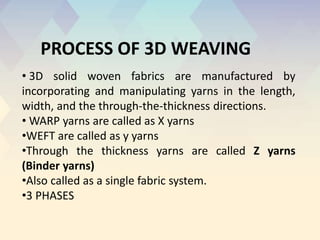
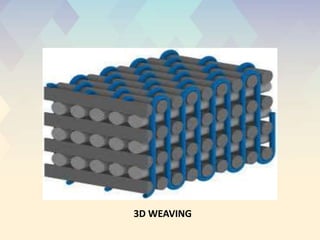
• 3D solid woven fabrics are manufactured by
incorporating and manipulating yarns in the length,
width, and the through-the-thickness directions.
• WARP yarns are called as X yarns
•WEFT are called as y yarns
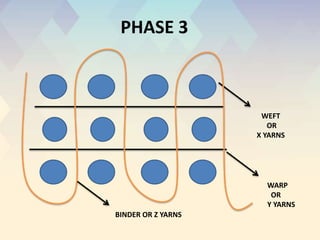
•Through the thickness yarns are called Z yarns
(Binder yarns)
•Also called as a single fabric system.
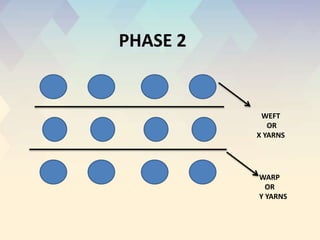
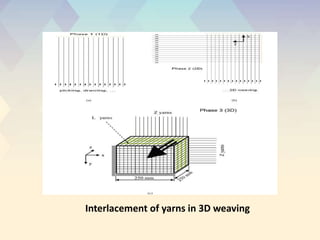
•3 PHASES
PROCESS OF 3D WEAVING
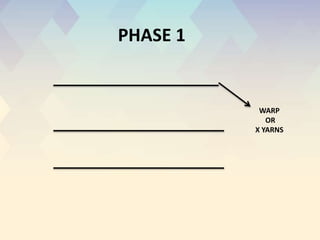
PHASE 1
WARP
OR
X YARNS
PHASE 2
WEFT
OR
X YARNS
WARP
OR
Y YARNS
WEFT
OR
X YARNS
WARP
OR
Y YARNS
BINDER OR Z YARNS
PHASE 3
3D WEAVING
Interlacement of yarns in 3D weaving
DEVICES
•Many of these structures can be made on the
conventional weaving machines with little or
no modification.
•There have been successful attempts in
developing new weaving devices, particularly
for making 3D woven fabrics
Conventional weaving machines
3 Methods -
• By effective utilization of warp and weft in
single layer.
• By the use of multi-layer warp and weft or
multi-layer ground warp, binder
• Conventional 2D process can also produce pile
fabrics by utilizing three sets of yarns, namely,
single-layer ground warp, pile yarns
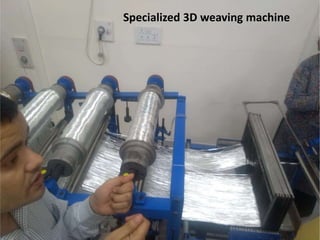
New weaving devices
These new technologies arrange warp yarns in a 3D
form and allow weft yarns to be inserted at
different levels in one or two directions example-
Non interlacing weaving device.
Specialized 3D weaving machine
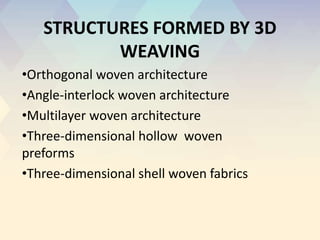
STRUCTURES FORMED BY 3D
WEAVING
•Orthogonal woven architecture
•Angle-interlock woven architecture
•Multilayer woven architecture
•Three-dimensional hollow woven
preforms
•Three-dimensional shell woven fabrics
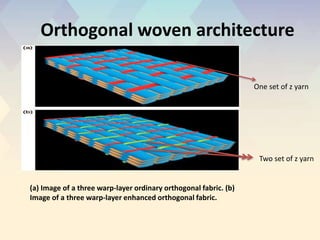
Orthogonal woven architecture
(a) Image of a three warp-layer ordinary orthogonal fabric. (b)
Image of a three warp-layer enhanced orthogonal fabric.
One set of z yarn
Two set of z yarn
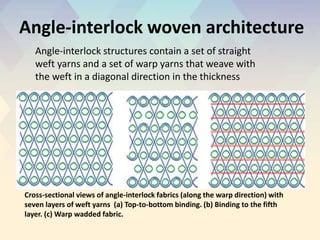
Angle-interlock woven architecture
Angle-interlock structures contain a set of straight
weft yarns and a set of warp yarns that weave with
the weft in a diagonal direction in the thickness
Cross-sectional views of angle-interlock fabrics (along the warp direction) with
seven layers of weft yarns (a) Top-to-bottom binding. (b) Binding to the fifth
layer. (c) Warp wadded fabric.
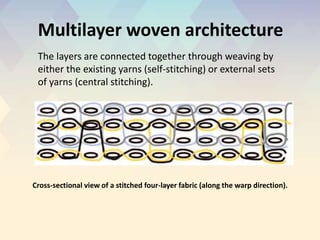
Multilayer woven architecture
The layers are connected together through weaving by
either the existing yarns (self-stitching) or external sets
of yarns (central stitching).
Cross-sectional view of a stitched four-layer fabric (along the warp direction).
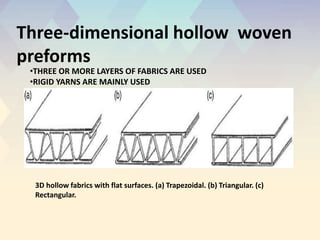
Three-dimensional hollow woven
preforms
3D hollow fabrics with flat surfaces. (a) Trapezoidal. (b) Triangular. (c)
Rectangular.
•THREE OR MORE LAYERS OF FABRICS ARE USED
•RIGID YARNS ARE MAINLY USED
TYPES OF FIBERS USED
• GLASS FIBERS
• ARAMID FIBERS
• CARBON FIBERS
• STEEL FIBERS
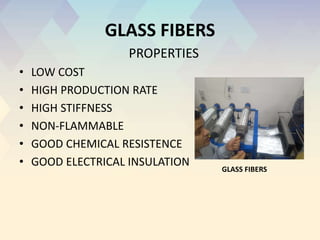
GLASS FIBERS
PROPERTIES
• LOW COST
• HIGH PRODUCTION RATE
• HIGH STIFFNESS
• NON-FLAMMABLE
• GOOD CHEMICAL RESISTENCE
• GOOD ELECTRICAL INSULATION GLASS FIBERS
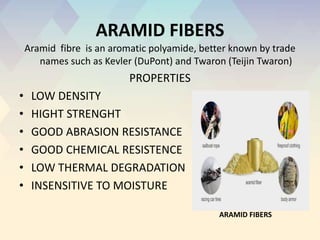
ARAMID FIBERS
Aramid fibre is an aromatic polyamide, better known by trade
names such as Kevler (DuPont) and Twaron (Teijin Twaron)
PROPERTIES
• LOW DENSITY
• HIGHT STRENGHT
• GOOD ABRASION RESISTANCE
• GOOD CHEMICAL RESISTENCE
• LOW THERMAL DEGRADATION
• INSENSITIVE TO MOISTURE
ARAMID FIBERS
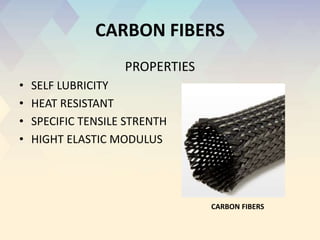
CARBON FIBERS
PROPERTIES
• SELF LUBRICITY
• HEAT RESISTANT
• SPECIFIC TENSILE STRENTH
• HIGHT ELASTIC MODULUS
CARBON FIBERS
APPLICATIONS
• AEROSPACE INDUSTRY
• FILTERATION, PAPERMAKING AND GEOTEXTILES
• MEDICAL FIELD
• SPORTS AND LEASURE
• PROTECTION
AEROSPACE INDUSTRY
• Albany is weaving 3D composite fan blades for the
LEAP turbofan aero-engine
• NASA- next-generation heat-shielding material
(Orion compression pads)
• IIT DELHI- Airplane wings
FILTERATION, PAPERMAKING AND
GEOTEXTILES
Although single layer fabrics are used as filters-
cheesecloth is a notable example- adding layers
often improves performance . Filtration is one of the
most successful commercial applications of the
nanofibre assemblies.
MEDICAL FIELD
• vascular prosthesis ( implant is an artificial device )
• Materials such as nylon, Teflon, stainless steel, glass,
and Dacron polyester fibers have been found to be
highly suitable.
• These materials were found to be significantly stable
with regard to resistance to degradation, strength,
and were not adversely affected by other factors
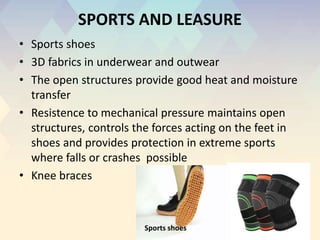
SPORTS AND LEASURE
• Sports shoes
• 3D fabrics in underwear and outwear
• The open structures provide good heat and moisture
transfer
• Resistence to mechanical pressure maintains open
structures, controls the forces acting on the feet in
shoes and provides protection in extreme sports
where falls or crashes possible
• Knee braces
Sports shoes
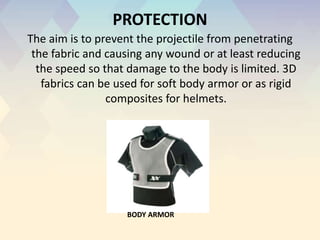
PROTECTION
The aim is to prevent the projectile from penetrating
the fabric and causing any wound or at least reducing
the speed so that damage to the body is limited. 3D

fabrics can be used for soft body armor or as rigid
composites for helmets.
BODY ARMOR
CONCLUSION
3D weaving is a growing technology . Whilst
specialized machines are capable of making
3D woven fabric with considerable sizes, the
availability of such devices is much limited in
comparison to the prevalence of the
conventional weaving machines.
Anjali 3 d weaving

Anjali 3 d weaving

  • 1.
    PRESENTED BY- ANJALI Msc. (previous) FabricAnd Apparel Science 3D WEAVING
  • 2.
    CONTENT • Introduction of2D weaving • What is 3D weaving • Process of 3D weaving • Devices being used • Structures • Types of fibers used and their properties • Applications • conclusion
  • 3.
    INTRODUCTION OF 2DWEAVING • 2D weaving is a process of producing fabric by interlacing two sets of yarn known as warp and weft at 90 degree cross-over points. • Drape-able, flexible, warmth, strong. • Can have technical applications when high performance fibers used. • Example- plain, twill,etc.
  • 4.
    WHAT IS 3DWEAVING • The process of weaving in which yarns are arranged into complex three-dimensional structures. • Substantial dimension in thickness direction • 3 directions – X (longitudinal), Y (cross), Z (vertical)
  • 5.
    • 3D solidwoven fabrics are manufactured by incorporating and manipulating yarns in the length, width, and the through-the-thickness directions. • WARP yarns are called as X yarns •WEFT are called as y yarns •Through the thickness yarns are called Z yarns (Binder yarns) •Also called as a single fabric system. •3 PHASES PROCESS OF 3D WEAVING
  • 6.
  • 7.
  • 8.
  • 9.
  • 10.
  • 11.
    DEVICES •Many of thesestructures can be made on the conventional weaving machines with little or no modification. •There have been successful attempts in developing new weaving devices, particularly for making 3D woven fabrics
  • 12.
    Conventional weaving machines 3Methods - • By effective utilization of warp and weft in single layer. • By the use of multi-layer warp and weft or multi-layer ground warp, binder • Conventional 2D process can also produce pile fabrics by utilizing three sets of yarns, namely, single-layer ground warp, pile yarns
  • 13.
    New weaving devices Thesenew technologies arrange warp yarns in a 3D form and allow weft yarns to be inserted at different levels in one or two directions example- Non interlacing weaving device.
  • 14.
  • 15.
    STRUCTURES FORMED BY3D WEAVING •Orthogonal woven architecture •Angle-interlock woven architecture •Multilayer woven architecture •Three-dimensional hollow woven preforms •Three-dimensional shell woven fabrics
  • 16.
    Orthogonal woven architecture (a)Image of a three warp-layer ordinary orthogonal fabric. (b) Image of a three warp-layer enhanced orthogonal fabric. One set of z yarn Two set of z yarn
  • 17.
    Angle-interlock woven architecture Angle-interlockstructures contain a set of straight weft yarns and a set of warp yarns that weave with the weft in a diagonal direction in the thickness Cross-sectional views of angle-interlock fabrics (along the warp direction) with seven layers of weft yarns (a) Top-to-bottom binding. (b) Binding to the fifth layer. (c) Warp wadded fabric.
  • 18.
    Multilayer woven architecture Thelayers are connected together through weaving by either the existing yarns (self-stitching) or external sets of yarns (central stitching). Cross-sectional view of a stitched four-layer fabric (along the warp direction).
  • 19.
    Three-dimensional hollow woven preforms 3Dhollow fabrics with flat surfaces. (a) Trapezoidal. (b) Triangular. (c) Rectangular. •THREE OR MORE LAYERS OF FABRICS ARE USED •RIGID YARNS ARE MAINLY USED
  • 20.
    TYPES OF FIBERSUSED • GLASS FIBERS • ARAMID FIBERS • CARBON FIBERS • STEEL FIBERS
  • 21.
    GLASS FIBERS PROPERTIES • LOWCOST • HIGH PRODUCTION RATE • HIGH STIFFNESS • NON-FLAMMABLE • GOOD CHEMICAL RESISTENCE • GOOD ELECTRICAL INSULATION GLASS FIBERS
  • 22.
    ARAMID FIBERS Aramid fibreis an aromatic polyamide, better known by trade names such as Kevler (DuPont) and Twaron (Teijin Twaron) PROPERTIES • LOW DENSITY • HIGHT STRENGHT • GOOD ABRASION RESISTANCE • GOOD CHEMICAL RESISTENCE • LOW THERMAL DEGRADATION • INSENSITIVE TO MOISTURE ARAMID FIBERS
  • 23.
    CARBON FIBERS PROPERTIES • SELFLUBRICITY • HEAT RESISTANT • SPECIFIC TENSILE STRENTH • HIGHT ELASTIC MODULUS CARBON FIBERS
  • 24.
    APPLICATIONS • AEROSPACE INDUSTRY •FILTERATION, PAPERMAKING AND GEOTEXTILES • MEDICAL FIELD • SPORTS AND LEASURE • PROTECTION
  • 25.
    AEROSPACE INDUSTRY • Albanyis weaving 3D composite fan blades for the LEAP turbofan aero-engine • NASA- next-generation heat-shielding material (Orion compression pads) • IIT DELHI- Airplane wings
  • 26.
    FILTERATION, PAPERMAKING AND GEOTEXTILES Althoughsingle layer fabrics are used as filters- cheesecloth is a notable example- adding layers often improves performance . Filtration is one of the most successful commercial applications of the nanofibre assemblies.
  • 27.
    MEDICAL FIELD • vascularprosthesis ( implant is an artificial device ) • Materials such as nylon, Teflon, stainless steel, glass, and Dacron polyester fibers have been found to be highly suitable. • These materials were found to be significantly stable with regard to resistance to degradation, strength, and were not adversely affected by other factors
  • 28.
    SPORTS AND LEASURE •Sports shoes • 3D fabrics in underwear and outwear • The open structures provide good heat and moisture transfer • Resistence to mechanical pressure maintains open structures, controls the forces acting on the feet in shoes and provides protection in extreme sports where falls or crashes possible • Knee braces Sports shoes
  • 29.
    PROTECTION The aim isto prevent the projectile from penetrating the fabric and causing any wound or at least reducing the speed so that damage to the body is limited. 3D fabrics can be used for soft body armor or as rigid composites for helmets. BODY ARMOR
  • 30.
    CONCLUSION 3D weaving isa growing technology . Whilst specialized machines are capable of making 3D woven fabric with considerable sizes, the availability of such devices is much limited in comparison to the prevalence of the conventional weaving machines.