Lab # 4
Angular
Measurement
ML 312
Instrumentation & Measurement Lab
2
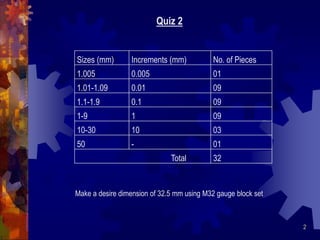
Sizes (mm) Increments (mm) No. of Pieces
1.005 0.005 01
1.01-1.09 0.01 09
1.1-1.9 0.1 09
1-9 1 09
10-30 10 03
50 - 01
Total 32
Make a desire dimension of 32.5 mm using M32 gauge block set
Quiz 2
3
Angular Measurement
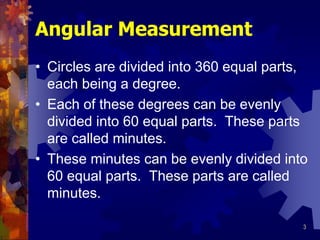
• Circles are divided into 360 equal parts,
each being a degree.
• Each of these degrees can be evenly
divided into 60 equal parts. These parts
are called minutes.
• These minutes can be evenly divided into
60 equal parts. These parts are called
minutes.
4
Angular Measurement
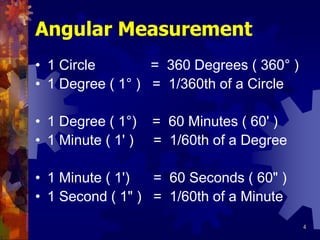
• 1 Circle = 360 Degrees ( 360° )
• 1 Degree ( 1° ) = 1/360th of a Circle
• 1 Degree ( 1°) = 60 Minutes ( 60' )
• 1 Minute ( 1' ) = 1/60th of a Degree
• 1 Minute ( 1') = 60 Seconds ( 60" )
• 1 Second ( 1" ) = 1/60th of a Minute
5
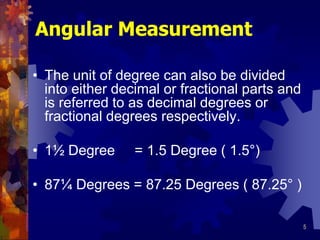
Angular Measurement
• The unit of degree can also be divided
into either decimal or fractional parts and
is referred to as decimal degrees or
fractional degrees respectively.
• 1½ Degree = 1.5 Degree ( 1.5°)
• 87¼ Degrees = 87.25 Degrees ( 87.25° )
6
Angular Measurement
• Minutes and seconds can each be
expressed as decimal or fractional
degrees.
• 1 Minute ( 1' ) = 1/60th of a Degree =
0.01667°
• 1 Second ( 1" ) = 1/60th of a Minute =
0.01667'
7
Angular Measurement
Change 5°25' to decimal degrees
Divide the minutes by 60
Add 0.4167 to 5 = 5.4167°
5°25' = 5.4167°
25 divided by 60 = 0.4167
8
Angular Measurement
Change 27°52'35" to decimal degrees
Divide the seconds by 60, add to minutes
Divide the minutes by 60, add to degrees
27°52'35" = 27.8764°
35 divided by 60 = 0.5833
Added to the 52 minutes, it becomes 52.5833'
52.5833 divided by 60 = .8764
Added to the 27 degrees, it becomes 27.8764°
9
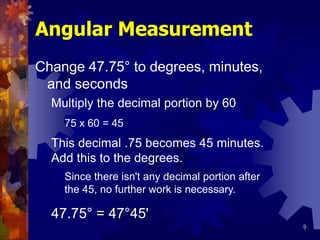
Angular Measurement
Change 47.75° to degrees, minutes,
and seconds
Multiply the decimal portion by 60
This decimal .75 becomes 45 minutes.
Add this to the degrees.
47.75° = 47°45'
75 x 60 = 45
Since there isn't any decimal portion after
the 45, no further work is necessary.
10
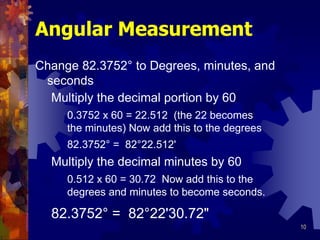
Angular Measurement
Change 82.3752° to Degrees, minutes, and
seconds
Multiply the decimal portion by 60
Multiply the decimal minutes by 60
82.3752° = 82°22'30.72"
0.3752 x 60 = 22.512 (the 22 becomes
the minutes) Now add this to the degrees
0.512 x 60 = 30.72 Now add this to the
degrees and minutes to become seconds.
82.3752° = 82°22.512'
11
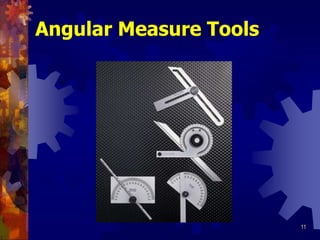
Angular Measure Tools
12
Angular Measurement
• Most common tools
• Simple Protractor
• Multi-Use Gage
• Combination Set
• Universal bevel protractor
• Sine bar
• Sine plate
13
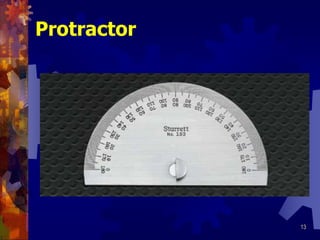
Protractor
14
Protractor
Whole degree increments
15
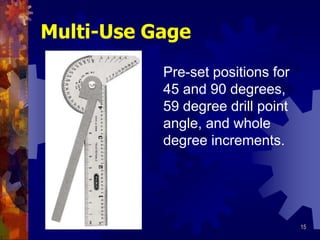
Multi-Use Gage
Pre-set positions for
45 and 90 degrees,
59 degree drill point
angle, and whole
degree increments.
16
Multi-Use Gage
Pre-set position for 90 degrees.
17
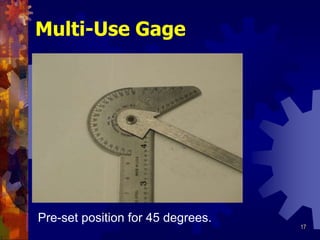
Multi-Use Gage
Pre-set position for 45 degrees.
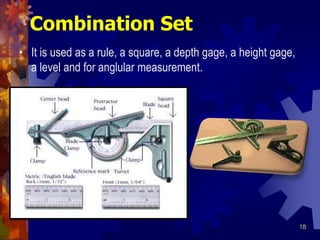
Combination Set
18
• It is used as a rule, a square, a depth gage, a height gage,
a level and for anglular measurement.
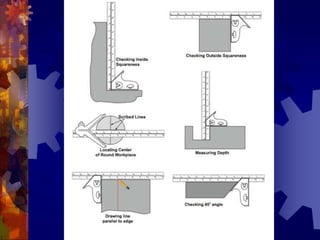
USING A COMBINATION SQUARE
• Using as a center head
to find the diameter of
a cylinder
Using as a protractor head to
determine an angle
• 1. • 3.
• 2. • 4.
23
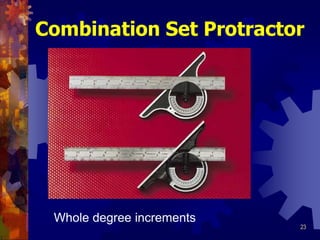
Combination Set Protractor
Whole degree increments
24
Combination Set
Protractor
Angular
Measure
with
Protract
or Head
25
26
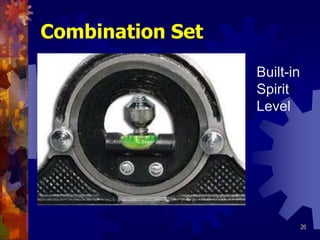
Combination Set
Built-in
Spirit
Level
27
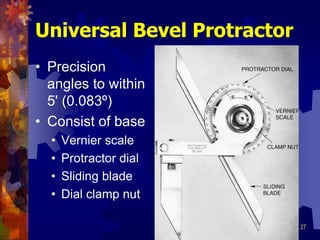
• Precision
angles to within
5' (0.083º)
• Consist of base
• Vernier scale
• Protractor dial
• Sliding blade
• Dial clamp nut
Universal Bevel Protractor
28
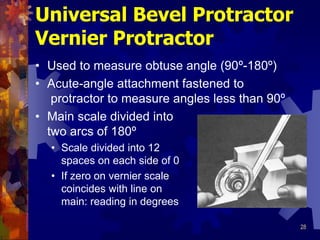
Universal Bevel Protractor
Vernier Protractor
• Used to measure obtuse angle (90º-180º)
• Acute-angle attachment fastened to
protractor to measure angles less than 90º
• Main scale divided into
two arcs of 180º
• Scale divided into 12
spaces on each side of 0
• If zero on vernier scale
coincides with line on
main: reading in degrees
29
Reading a Vernier
Protractor
• Note number of whole degrees between zero
on main scale and zero on vernier scale
• Proceeding in same direction, note which
vernier line coincides with main scale line
50º
Fourth
• Multiply number by 5' and add to
degrees on protractor dial
4 x 5'= 20'
Reading =
50º 20'
Example
30
• The reading is 46° - 20‘
31
Inclinometer
32
Sine Bars
• Used when accuracy of angle must be
checked to less than 5 minutes
• Consists of steel bar with two cylinders
of equal diameter fastened near ends
• Centers of cylinders exactly 90º to edge
• Distance between centers usually 5 or 10
inches and 100 or 200 millimeters.
• Made of stabilized tool hardened steel
Sine bars
33
• A sine bar is a tool used to measure angles in
metalworking.
• It consists of a hardened, precision ground body with two
precision ground cylinders fixed at each end, the rollers are
positioned at a precise distance and the top of the bar is
parallel to the center line of the rollers.
• The dimension between the two rollers is chosen to be a
whole number (for ease of later calculations)
34
Sine Bar
Sine bars
35
36
Sine Bars
• Used on surface plates and any angle by raising
one end of bar with gage blocks
• Made 5 inch or in multiples of 5 or 100
millimeters or multiple of 100
• Distance between lapped cylinders.
• Face accurate to within .00005 in.
in 5 inches or 0.001 mm in 100 mm.
37
Sine Bars

Angular Measurement tools in instrumentation

  • 1.
    Lab # 4 Angular Measurement ML312 Instrumentation & Measurement Lab
  • 2.
    2 Sizes (mm) Increments(mm) No. of Pieces 1.005 0.005 01 1.01-1.09 0.01 09 1.1-1.9 0.1 09 1-9 1 09 10-30 10 03 50 - 01 Total 32 Make a desire dimension of 32.5 mm using M32 gauge block set Quiz 2
  • 3.
    3 Angular Measurement • Circlesare divided into 360 equal parts, each being a degree. • Each of these degrees can be evenly divided into 60 equal parts. These parts are called minutes. • These minutes can be evenly divided into 60 equal parts. These parts are called minutes.
  • 4.
    4 Angular Measurement • 1Circle = 360 Degrees ( 360° ) • 1 Degree ( 1° ) = 1/360th of a Circle • 1 Degree ( 1°) = 60 Minutes ( 60' ) • 1 Minute ( 1' ) = 1/60th of a Degree • 1 Minute ( 1') = 60 Seconds ( 60" ) • 1 Second ( 1" ) = 1/60th of a Minute
  • 5.
    5 Angular Measurement • Theunit of degree can also be divided into either decimal or fractional parts and is referred to as decimal degrees or fractional degrees respectively. • 1½ Degree = 1.5 Degree ( 1.5°) • 87¼ Degrees = 87.25 Degrees ( 87.25° )
  • 6.
    6 Angular Measurement • Minutesand seconds can each be expressed as decimal or fractional degrees. • 1 Minute ( 1' ) = 1/60th of a Degree = 0.01667° • 1 Second ( 1" ) = 1/60th of a Minute = 0.01667'
  • 7.
    7 Angular Measurement Change 5°25'to decimal degrees Divide the minutes by 60 Add 0.4167 to 5 = 5.4167° 5°25' = 5.4167° 25 divided by 60 = 0.4167
  • 8.
    8 Angular Measurement Change 27°52'35"to decimal degrees Divide the seconds by 60, add to minutes Divide the minutes by 60, add to degrees 27°52'35" = 27.8764° 35 divided by 60 = 0.5833 Added to the 52 minutes, it becomes 52.5833' 52.5833 divided by 60 = .8764 Added to the 27 degrees, it becomes 27.8764°
  • 9.
    9 Angular Measurement Change 47.75°to degrees, minutes, and seconds Multiply the decimal portion by 60 This decimal .75 becomes 45 minutes. Add this to the degrees. 47.75° = 47°45' 75 x 60 = 45 Since there isn't any decimal portion after the 45, no further work is necessary.
  • 10.
    10 Angular Measurement Change 82.3752°to Degrees, minutes, and seconds Multiply the decimal portion by 60 Multiply the decimal minutes by 60 82.3752° = 82°22'30.72" 0.3752 x 60 = 22.512 (the 22 becomes the minutes) Now add this to the degrees 0.512 x 60 = 30.72 Now add this to the degrees and minutes to become seconds. 82.3752° = 82°22.512'
  • 11.
  • 12.
    12 Angular Measurement • Mostcommon tools • Simple Protractor • Multi-Use Gage • Combination Set • Universal bevel protractor • Sine bar • Sine plate
  • 13.
  • 14.
  • 15.
    15 Multi-Use Gage Pre-set positionsfor 45 and 90 degrees, 59 degree drill point angle, and whole degree increments.
  • 16.
  • 17.
  • 18.
    Combination Set 18 • Itis used as a rule, a square, a depth gage, a height gage, a level and for anglular measurement.
  • 19.
  • 20.
    USING A COMBINATIONSQUARE • Using as a center head to find the diameter of a cylinder
  • 22.
    Using as aprotractor head to determine an angle • 1. • 3. • 2. • 4.
  • 23.
  • 24.
  • 25.
  • 26.
  • 27.
    27 • Precision angles towithin 5' (0.083º) • Consist of base • Vernier scale • Protractor dial • Sliding blade • Dial clamp nut Universal Bevel Protractor
  • 28.
    28 Universal Bevel Protractor VernierProtractor • Used to measure obtuse angle (90º-180º) • Acute-angle attachment fastened to protractor to measure angles less than 90º • Main scale divided into two arcs of 180º • Scale divided into 12 spaces on each side of 0 • If zero on vernier scale coincides with line on main: reading in degrees
  • 29.
    29 Reading a Vernier Protractor •Note number of whole degrees between zero on main scale and zero on vernier scale • Proceeding in same direction, note which vernier line coincides with main scale line 50º Fourth • Multiply number by 5' and add to degrees on protractor dial 4 x 5'= 20' Reading = 50º 20'
  • 30.
  • 31.
  • 32.
    32 Sine Bars • Usedwhen accuracy of angle must be checked to less than 5 minutes • Consists of steel bar with two cylinders of equal diameter fastened near ends • Centers of cylinders exactly 90º to edge • Distance between centers usually 5 or 10 inches and 100 or 200 millimeters. • Made of stabilized tool hardened steel
  • 33.
    Sine bars 33 • Asine bar is a tool used to measure angles in metalworking. • It consists of a hardened, precision ground body with two precision ground cylinders fixed at each end, the rollers are positioned at a precise distance and the top of the bar is parallel to the center line of the rollers. • The dimension between the two rollers is chosen to be a whole number (for ease of later calculations)
  • 34.
  • 35.
  • 36.
    36 Sine Bars • Usedon surface plates and any angle by raising one end of bar with gage blocks • Made 5 inch or in multiples of 5 or 100 millimeters or multiple of 100 • Distance between lapped cylinders. • Face accurate to within .00005 in. in 5 inches or 0.001 mm in 100 mm.
  • 37.