ANESTHETIC
CONSIDERATIONS IN SPINE
SURGERY
Dr. Chaula Doshi
HOD & Professor, Department of
Anesthesiology
SPINE SURGERY: AN OVERVIEW
• With Clinical innovation and technological advancement the paradigm of
surgical procedures on the spine and their perioperative management are
rapidly evolving.
• At present the spectrum of surgeries on the spine ranges from single level
decompression to multi-level extensive reconstructions.
• With advent of newer techniques like 3D microscopes and Navigation
procedures, surgeries like awake endoscopic TLIF & MIS- TLIF have become
precise and safer.
2
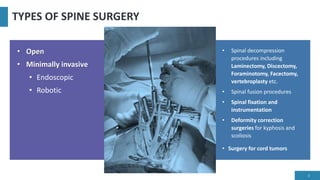
TYPES OF SPINE SURGERY
• Spinal decompression
procedures including
Laminectomy, Discectomy,
Foraminotomy, Facectomy,
vertebroplasty etc.
• Spinal fusion procedures
• Spinal fixation and
instrumentation
• Deformity correction
surgeries for kyphosis and
scoliosis
• Surgery for cord tumors
• Open
• Minimally invasive
• Endoscopic
• Robotic
3
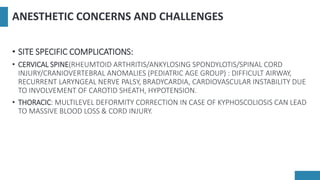
ANESTHETIC CONCERNS AND CHALLENGES
• SITE SPECIFIC COMPLICATIONS:
• CERVICAL SPINE(RHEUMTOID ARTHRITIS/ANKYLOSING SPONDYLOTIS/SPINAL CORD
INJURY/CRANIOVERTEBRAL ANOMALIES (PEDIATRIC AGE GROUP) : DIFFICULT AIRWAY,
RECURRENT LARYNGEAL NERVE PALSY, BRADYCARDIA, CARDIOVASCULAR INSTABILITY DUE
TO INVOLVEMENT OF CAROTID SHEATH, HYPOTENSION.
• THORACIC: MULTILEVEL DEFORMITY CORRECTION IN CASE OF KYPHOSCOLIOSIS CAN LEAD
TO MASSIVE BLOOD LOSS & CORD INJURY.
NAVIGATING THROUGH THE
COMPLICATIONS & ITS SOLUTIONS
INTRAOPERATIVE POSTOPERATIVE
PRONE POSITIONING DURING
SPINE SURGERY
6
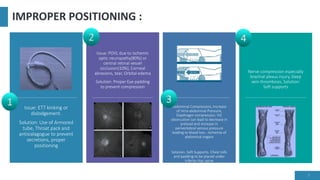
IMPROPER POSITIONING :
Issue: ETT kinking or
dislodgement.
Solution: Use of Armored
tube, Throat pack and
antisialagogue to prevent
secretions, proper
positioning
Issue: POVL due to Ischemic
optic neuropathy(80%) or
central retinal vessel
occlusion(10%), Corneal
abrasions, tear, Orbital edema
Solution: Proper Eye padding
to prevent compression
Abdominal Compression, Increase
of intra-abdominal Pressure,
Diaphragm compression, IVC
obstrcution can lead to decrease in
preload and increase in
perivertebral venous pressure
leading to blood loss , Ischemia of
abdominal organs
Solution: Soft Supports. Chest rolls
and padding to be placed under
Inferior iliac spine
Nerve compression especially
brachial plexus injury, Deep
vein thrombosis, Solution:
Soft supports
7
1
2
3
4
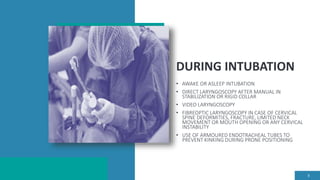
DURING INTUBATION
• AWAKE OR ASLEEP INTUBATION
• DIRECT LARYNGOSCOPY AFTER MANUAL IN
STABILIZATION OR RIGID COLLAR
• VIDEO LARYNGOSCOPY
• FIBREOPTIC LARYNGOSCOPY IN CASE OF CERVICAL
SPINE DEFORMITIES, FRACTURE, LIMITED NECK
MOVEMENT OR MOUTH OPENING OR ANY CERVICAL
INSTABILITY
• USE OF ARMOURED ENDOTRACHEAL TUBES TO
PREVENT KINKING DURING PRONE POSITIONING
8
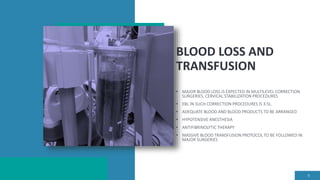
BLOOD LOSS AND
TRANSFUSION
• MAJOR BLOOD LOSS IS EXPECTED IN MULTILEVEL CORRECTION
SURGERIES, CERVICAL STABILIZATION PROCEDURES
• EBL IN SUCH CORRECTION PROCEDURES IS 3-5L.
• ADEQUATE BLOOD AND BLOOD PRODUCTS TO BE ARRANGED
• HYPOTENSIVE ANESTHESIA
• ANTIFIBRINOLYTIC THERAPY
• MASSIVE BLOOD TRANSFUSION PROTOCOL TO BE FOLLOWED IN
MAJOR SURGERIES
9
MEASURES TO DECREASE BLOOD LOSS DURING SPINE SURGERY
• HEMODILUTION
• PROPER POSITIONING
• HYPOTENSIVE ANESTHESIA
• ANTIFIBRINOLYTIC THERAPY
• AUTOTRANSFUSION
• CELL SALVAGE THERAPY
• SURGICAL HEMOSTASIS
Prevention of Eye injuries during prone position
• Proper positioning
• MAP>70mm Hg
• Maintenance of adequate perfusion pressure with IV fluids /colloids
• Vasopressors if needed to maintain
• Correction of anemia
11
HYPOTHERMIA AND ITS EFFECTS
• Hypothermia affects over 60% of patients intraoperatively, and its effects are
noteworthy.
• It adversely impacts blood loss, infection risk, and cardiac events, potentially
increasing length of hospital stay.
• It reduces the speed of drug metabolism and may alter pharmacodynamics,
thus contributing to increased post anesthesia care unit (PACU) recovery
time.
12
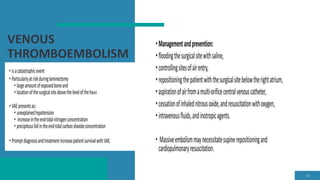
VENOUS
THROMBOEMBOLISM
13
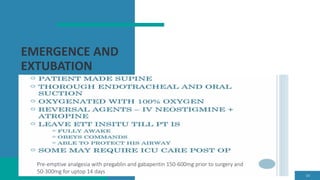
EMERGENCE AND
EXTUBATION
14
Pre-emptive analgesia with pregablin and gabapentin 150-600mg prior to surgery and
50-300mg for uptop 14 days
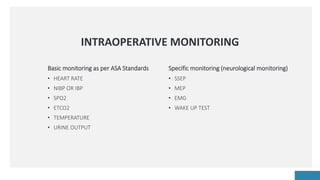
INTRAOPERATIVE MONITORING
Specific monitoring (neurological monitoring)
• SSEP
• MEP
• EMG
• WAKE UP TEST
Basic monitoring as per ASA Standards
• HEART RATE
• NIBP OR IBP
• SPO2
• ETCO2
• TEMPERATURE
• URINE OUTPUT
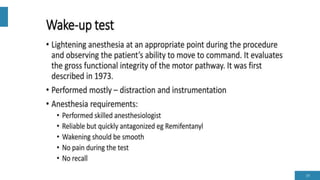
NEUROLOGICAL MONITORING
16
SOMATOSENSORY
EVOKED POTENTIAL
MOTOR EVOKED
POTENTIAL
ELECTROMYOGRAPHY WAKEUP TEST
Indications: Scoliosis, spinal
instrumentation, Cord
surgeries and Aortic surgeries
17
STEPS OF SSEP
• Electrodes are attached to the skin over the scalp or spine. These electrodes
sense when signals are sent and received from the central nervous system.
• A second set of electrodes are placed on the skin over the wrist, the back of
the knee, or another location. These electrodes measure when signals are
sent and received from peripheral nerves.
• A mild electrical current is transmitted to the electrodes on the wrist, knee or
other peripheral area.
• The duration taken for the current to be sensed by the peripheral nerves and
communicated to the central nervous system is recorded.
• The test is considered safe and can take anywhere from 20 to 90 minutes.
18
19
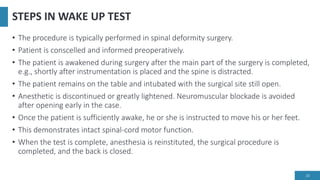
STEPS IN WAKE UP TEST
• The procedure is typically performed in spinal deformity surgery.
• Patient is conscelled and informed preoperatively.
• The patient is awakened during surgery after the main part of the surgery is completed,
e.g., shortly after instrumentation is placed and the spine is distracted.
• The patient remains on the table and intubated with the surgical site still open.
• Anesthetic is discontinued or greatly lightened. Neuromuscular blockade is avoided
after opening early in the case.
• Once the patient is sufficiently awake, he or she is instructed to move his or her feet.
• This demonstrates intact spinal-cord motor function.
• When the test is complete, anesthesia is reinstituted, the surgical procedure is
completed, and the back is closed.
20
21
IMMEDIATE POSTOPERATIVE COMPLICATIONS
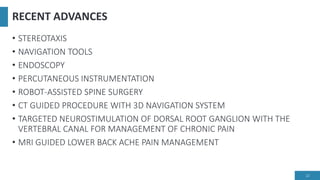
RECENT ADVANCES
• STEREOTAXIS
• NAVIGATION TOOLS
• ENDOSCOPY
• PERCUTANEOUS INSTRUMENTATION
• ROBOT-ASSISTED SPINE SURGERY
• CT GUIDED PROCEDURE WITH 3D NAVIGATION SYSTEM
• TARGETED NEUROSTIMULATION OF DORSAL ROOT GANGLION WITH THE
VERTEBRAL CANAL FOR MANAGEMENT OF CHRONIC PAIN
• MRI GUIDED LOWER BACK ACHE PAIN MANAGEMENT
22
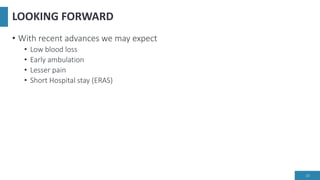
LOOKING FORWARD
• With recent advances we may expect
• Low blood loss
• Early ambulation
• Lesser pain
• Short Hospital stay (ERAS)
23
FUTURE OF ANESTHESTIC PRACTICES WITH
RECENT ADVANCES IN SURGERY
• USE OF REGIONAL ANESTHESIA LIKE
FLUROSCOPIC GUIDED EPIDURAL
ANESTHESIA WITH CONSCIOUS
SEDATION IN HIGH RISK SURGICAL
PATIENTS (ASA-III)
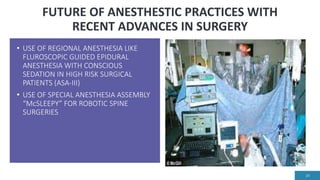
• USE OF SPECIAL ANESTHESIA ASSEMBLY
“McSLEEPY” FOR ROBOTIC SPINE
SURGERIES
24
References
• J Clin Orthop Trauma. 2020 Sep-Oct; 11(5): 742–748.
• Published online 2020 May 11. doi: 10.1016/j.jcot.2020.05.005
• RT Journal Article, A1 Nowicki, Robert WA, T1 Anaesthesia for major spinal
surgery, JF Continuing Education in Anaesthesia Critical Care & Pain, JO Contin
Educ Anaesth Crit Care Pain, YR 2013
• DOI: 10.1093/bjaceaccp/mkt041
• Ackwoledgements:
• Dr.Ranjani Ramachandran (JR1, Anesthesia)
25
26

anesthetic considerations in spine surgery

  • 1.
    ANESTHETIC CONSIDERATIONS IN SPINE SURGERY Dr.Chaula Doshi HOD & Professor, Department of Anesthesiology
  • 2.
    SPINE SURGERY: ANOVERVIEW • With Clinical innovation and technological advancement the paradigm of surgical procedures on the spine and their perioperative management are rapidly evolving. • At present the spectrum of surgeries on the spine ranges from single level decompression to multi-level extensive reconstructions. • With advent of newer techniques like 3D microscopes and Navigation procedures, surgeries like awake endoscopic TLIF & MIS- TLIF have become precise and safer. 2
  • 3.
    TYPES OF SPINESURGERY • Spinal decompression procedures including Laminectomy, Discectomy, Foraminotomy, Facectomy, vertebroplasty etc. • Spinal fusion procedures • Spinal fixation and instrumentation • Deformity correction surgeries for kyphosis and scoliosis • Surgery for cord tumors • Open • Minimally invasive • Endoscopic • Robotic 3
  • 4.
    ANESTHETIC CONCERNS ANDCHALLENGES • SITE SPECIFIC COMPLICATIONS: • CERVICAL SPINE(RHEUMTOID ARTHRITIS/ANKYLOSING SPONDYLOTIS/SPINAL CORD INJURY/CRANIOVERTEBRAL ANOMALIES (PEDIATRIC AGE GROUP) : DIFFICULT AIRWAY, RECURRENT LARYNGEAL NERVE PALSY, BRADYCARDIA, CARDIOVASCULAR INSTABILITY DUE TO INVOLVEMENT OF CAROTID SHEATH, HYPOTENSION. • THORACIC: MULTILEVEL DEFORMITY CORRECTION IN CASE OF KYPHOSCOLIOSIS CAN LEAD TO MASSIVE BLOOD LOSS & CORD INJURY.
  • 5.
    NAVIGATING THROUGH THE COMPLICATIONS& ITS SOLUTIONS INTRAOPERATIVE POSTOPERATIVE
  • 6.
  • 7.
    IMPROPER POSITIONING : Issue:ETT kinking or dislodgement. Solution: Use of Armored tube, Throat pack and antisialagogue to prevent secretions, proper positioning Issue: POVL due to Ischemic optic neuropathy(80%) or central retinal vessel occlusion(10%), Corneal abrasions, tear, Orbital edema Solution: Proper Eye padding to prevent compression Abdominal Compression, Increase of intra-abdominal Pressure, Diaphragm compression, IVC obstrcution can lead to decrease in preload and increase in perivertebral venous pressure leading to blood loss , Ischemia of abdominal organs Solution: Soft Supports. Chest rolls and padding to be placed under Inferior iliac spine Nerve compression especially brachial plexus injury, Deep vein thrombosis, Solution: Soft supports 7 1 2 3 4
  • 8.
    DURING INTUBATION • AWAKEOR ASLEEP INTUBATION • DIRECT LARYNGOSCOPY AFTER MANUAL IN STABILIZATION OR RIGID COLLAR • VIDEO LARYNGOSCOPY • FIBREOPTIC LARYNGOSCOPY IN CASE OF CERVICAL SPINE DEFORMITIES, FRACTURE, LIMITED NECK MOVEMENT OR MOUTH OPENING OR ANY CERVICAL INSTABILITY • USE OF ARMOURED ENDOTRACHEAL TUBES TO PREVENT KINKING DURING PRONE POSITIONING 8
  • 9.
    BLOOD LOSS AND TRANSFUSION •MAJOR BLOOD LOSS IS EXPECTED IN MULTILEVEL CORRECTION SURGERIES, CERVICAL STABILIZATION PROCEDURES • EBL IN SUCH CORRECTION PROCEDURES IS 3-5L. • ADEQUATE BLOOD AND BLOOD PRODUCTS TO BE ARRANGED • HYPOTENSIVE ANESTHESIA • ANTIFIBRINOLYTIC THERAPY • MASSIVE BLOOD TRANSFUSION PROTOCOL TO BE FOLLOWED IN MAJOR SURGERIES 9
  • 10.
    MEASURES TO DECREASEBLOOD LOSS DURING SPINE SURGERY • HEMODILUTION • PROPER POSITIONING • HYPOTENSIVE ANESTHESIA • ANTIFIBRINOLYTIC THERAPY • AUTOTRANSFUSION • CELL SALVAGE THERAPY • SURGICAL HEMOSTASIS
  • 11.
    Prevention of Eyeinjuries during prone position • Proper positioning • MAP>70mm Hg • Maintenance of adequate perfusion pressure with IV fluids /colloids • Vasopressors if needed to maintain • Correction of anemia 11
  • 12.
    HYPOTHERMIA AND ITSEFFECTS • Hypothermia affects over 60% of patients intraoperatively, and its effects are noteworthy. • It adversely impacts blood loss, infection risk, and cardiac events, potentially increasing length of hospital stay. • It reduces the speed of drug metabolism and may alter pharmacodynamics, thus contributing to increased post anesthesia care unit (PACU) recovery time. 12
  • 13.
  • 14.
    EMERGENCE AND EXTUBATION 14 Pre-emptive analgesiawith pregablin and gabapentin 150-600mg prior to surgery and 50-300mg for uptop 14 days
  • 15.
    INTRAOPERATIVE MONITORING Specific monitoring(neurological monitoring) • SSEP • MEP • EMG • WAKE UP TEST Basic monitoring as per ASA Standards • HEART RATE • NIBP OR IBP • SPO2 • ETCO2 • TEMPERATURE • URINE OUTPUT
  • 16.
    NEUROLOGICAL MONITORING 16 SOMATOSENSORY EVOKED POTENTIAL MOTOREVOKED POTENTIAL ELECTROMYOGRAPHY WAKEUP TEST Indications: Scoliosis, spinal instrumentation, Cord surgeries and Aortic surgeries
  • 17.
  • 18.
    STEPS OF SSEP •Electrodes are attached to the skin over the scalp or spine. These electrodes sense when signals are sent and received from the central nervous system. • A second set of electrodes are placed on the skin over the wrist, the back of the knee, or another location. These electrodes measure when signals are sent and received from peripheral nerves. • A mild electrical current is transmitted to the electrodes on the wrist, knee or other peripheral area. • The duration taken for the current to be sensed by the peripheral nerves and communicated to the central nervous system is recorded. • The test is considered safe and can take anywhere from 20 to 90 minutes. 18
  • 19.
  • 20.
    STEPS IN WAKEUP TEST • The procedure is typically performed in spinal deformity surgery. • Patient is conscelled and informed preoperatively. • The patient is awakened during surgery after the main part of the surgery is completed, e.g., shortly after instrumentation is placed and the spine is distracted. • The patient remains on the table and intubated with the surgical site still open. • Anesthetic is discontinued or greatly lightened. Neuromuscular blockade is avoided after opening early in the case. • Once the patient is sufficiently awake, he or she is instructed to move his or her feet. • This demonstrates intact spinal-cord motor function. • When the test is complete, anesthesia is reinstituted, the surgical procedure is completed, and the back is closed. 20
  • 21.
  • 22.
    RECENT ADVANCES • STEREOTAXIS •NAVIGATION TOOLS • ENDOSCOPY • PERCUTANEOUS INSTRUMENTATION • ROBOT-ASSISTED SPINE SURGERY • CT GUIDED PROCEDURE WITH 3D NAVIGATION SYSTEM • TARGETED NEUROSTIMULATION OF DORSAL ROOT GANGLION WITH THE VERTEBRAL CANAL FOR MANAGEMENT OF CHRONIC PAIN • MRI GUIDED LOWER BACK ACHE PAIN MANAGEMENT 22
  • 23.
    LOOKING FORWARD • Withrecent advances we may expect • Low blood loss • Early ambulation • Lesser pain • Short Hospital stay (ERAS) 23
  • 24.
    FUTURE OF ANESTHESTICPRACTICES WITH RECENT ADVANCES IN SURGERY • USE OF REGIONAL ANESTHESIA LIKE FLUROSCOPIC GUIDED EPIDURAL ANESTHESIA WITH CONSCIOUS SEDATION IN HIGH RISK SURGICAL PATIENTS (ASA-III) • USE OF SPECIAL ANESTHESIA ASSEMBLY “McSLEEPY” FOR ROBOTIC SPINE SURGERIES 24
  • 25.
    References • J ClinOrthop Trauma. 2020 Sep-Oct; 11(5): 742–748. • Published online 2020 May 11. doi: 10.1016/j.jcot.2020.05.005 • RT Journal Article, A1 Nowicki, Robert WA, T1 Anaesthesia for major spinal surgery, JF Continuing Education in Anaesthesia Critical Care & Pain, JO Contin Educ Anaesth Crit Care Pain, YR 2013 • DOI: 10.1093/bjaceaccp/mkt041 • Ackwoledgements: • Dr.Ranjani Ramachandran (JR1, Anesthesia) 25
  • 26.