Geriatric
anaesthesia
Special consideration
By Dr Petrus S.I. Iitula
Content
• Definition
• The issue at hand
• Factors contributing to poor outcome in elderly patients
• Pre-operative assessment
• Post-operative assessment
• Conclusion
• Reference
Definition
• Defines old age as 60 years and over (WHO).
• Aging is the progressive intrinsic universally prevalent
physiological process producing measurable changes in
the structure and function of tissues and organs, thus it is
major predictor of perioperative morbidity and mortality
in the elderly.
The issue at hand
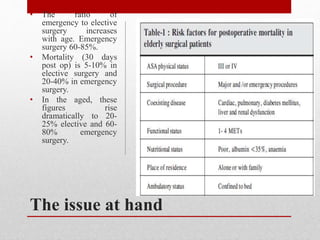
• The ratio of
emergency to elective
surgery increases
with age. Emergency
surgery 60-85%.
• Mortality (30 days
post op) is 5-10% in
elective surgery and
20-40% in emergency
surgery.
• In the aged, these
figures rise
dramatically to 20-
25% elective and 60-
80% emergency
surgery.
Factors contributing to
poor outcome in elderly
patients
Cardiovascular system
• Physiological changes in the CVS are related directly to
stiffening and decreased distensibility of systemic arteries
and cardiac wall.
• Age related changes include.
- Decreased cardiac output and stroke volume
- Reduced arterial elasticity and peripheral sclerosis
- Decreased size of sino atrial and atrioventicular nodes
- Increased sympathetic nervous systems activity and
- Sclerosis of the coronary arteries
Cardiovascular system
• Heart muscle is gradually replaced with fibrosis and
senile amyloid
• Valvular calcification (Aortic and Mitral)
• Overall there is a fall in CO of 1%/year from the mid-50s.
Thus in the 74-84 year age group the fall will be 80%
meaning there is little reserve to meet stresses.
• Conduction defects are common. There is an increased
risk of sick sinus, BBB,AF.
Respiratory system
1.ANATOMICAL:
• Loss of muscular pharyngeal support→ ↓in function of
pharyngeal and laryngeal function = upper airway obstruction
• Loss of ciliary function (coughing) = microaspiration
• Barrel chest deformity (Kyphosis = Increased AP diameter)
• Flattening of diaphgram + periodic breathing = sleep apnoa &
airway obstruction
• Chostochondral joint calcification making chest less compliant
Respiratory system
2.PHYSIOLOGICAL:
• ↑ incidence of upper airway obstruction → more prone to have apnea
and airway obstruction
• Loss of elastic tissue +↓surfactant - more airways collapse during
expiration leading to V/Q mismatch (↑ alveolar dead space)
• Volume of pulmonary vascular bed ↓→↑ in pulmonary vascular
resistance by 80%
• Impaired response to hypoxia, hypercapnia and mechanical stress →
more sensitive to depressant effects of opioids and BZDs. Thus ↑
FiO2 and tidal volume
• ↓VC and↑ RV
• FEV1 decreases by 6-8%/decade
• Hypoxic pulmonary vasoconstriction is blunted
Renal System
• GFR is normally 120ml/min/1.73m²; falls by 8ml every 10
years after the age of 20.
• 30% ↓ renal mass > 80y/o - ↓ in glomeruli and nephrons by
40% (± 60% functioning nephrons)
• ↓ Renal blood flow approx 10% /decade after 40 years →
↓GFR
• Serum creatinine level →poor indicator of GFR
• Alterations in response to abnormal electrolyte concentration
→ ↓renal capacity to conserve sodium → fluid and electrolyte
imbalances; F&E status should be carefully monitored - 1/5th
of geriatric peri-anesthetic surgical mortality due to ARF
Hepatobiliary System
• Hepatic tissue ↓ by 40% by 80 yrs →↓ hepatic function
→ delayed drug metabolism and earlier saturation of
metabolic pathways.
Nervous system
• 20% ↓ brain size 80 yrs→ ↓ cerebral blood flow and ↓
oxygen consumption
• Continual loss of neuronal substance → ↓ dopamine,
norepinephrine, tyrosine and serotonin → depression,
loss of memory and motor dysfunction
CNS
Autonomic nervous system:
• ↓sensitivity of baroreceptor → orthostatic hypotension
and syncope
• ↓ no of receptors, reduced affinity of agonist molecules
e.g ↓ability of beta adrenergic agonists to enhance
velocity and force of cardiac conduction
• Thermoregulation is affected→↑ heat loss and↓ heat
tolerance making them vulnerable to hypothermia and
heat stroke
CNS
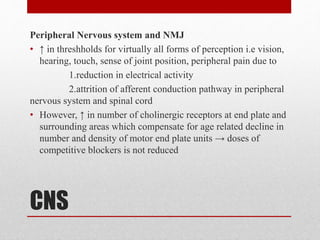
Peripheral Nervous system and NMJ
• ↑ in threshholds for virtually all forms of perception i.e vision,
hearing, touch, sense of joint position, peripheral pain due to
1.reduction in electrical activity
2.attrition of afferent conduction pathway in peripheral
nervous system and spinal cord
• However, ↑ in number of cholinergic receptors at end plate and
surrounding areas which compensate for age related decline in
number and density of motor end plate units → doses of
competitive blockers is not reduced
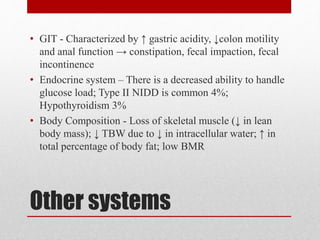
Other systems
• GIT - Characterized by ↑ gastric acidity, ↓colon motility
and anal function → constipation, fecal impaction, fecal
incontinence
• Endocrine system – There is a decreased ability to handle
glucose load; Type II NIDD is common 4%;
Hypothyroidism 3%
• Body Composition - Loss of skeletal muscle (↓ in lean
body mass); ↓ TBW due to ↓ in intracellular water; ↑ in
total percentage of body fat; low BMR
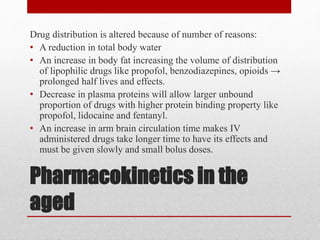
Pharmacokinetics in the
aged
Drug distribution is altered because of number of reasons:
• A reduction in total body water
• An increase in body fat increasing the volume of distribution
of lipophilic drugs like propofol, benzodiazepines, opioids →
prolonged half lives and effects.
• Decrease in plasma proteins will allow larger unbound
proportion of drugs with higher protein binding property like
propofol, lidocaine and fentanyl.
• An increase in arm brain circulation time makes IV
administered drugs take longer time to have its effects and
must be given slowly and small bolus doses.
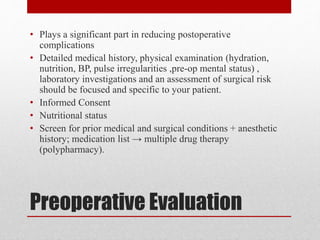
Preoperative Evaluation
• Plays a significant part in reducing postoperative
complications
• Detailed medical history, physical examination (hydration,
nutrition, BP, pulse irregularities ,pre-op mental status) ,
laboratory investigations and an assessment of surgical risk
should be focused and specific to your patient.
• Informed Consent
• Nutritional status
• Screen for prior medical and surgical conditions + anesthetic
history; medication list → multiple drug therapy
(polypharmacy).
Systemic evaluation
• Directed towards identifying physiologic deficits and
comorbid conditions that may increase the chances of
postoperative complications
• Various comorbid conditions that should be predicted in
elderly are as follows:
1.CVS:
• a. Hypertension: DBP >110 mm Hg requires control
• b. CHF: H/O chronic CHF → established predictor of
adverse perioperative cardiac events.
C. Arrhythmias: sinus node cells are reduced; risk of
bradycardia and sick sinus syndrome; AF is too high
D. Diastolic Dysfunction:
• ECG findings or ejection fraction are normal
• Cardiac output does not increase with stress and CHF
may be precipitated with atrial fibrillation.
2. Diabetes Mellitus:
• stress of surgery will increase hyperglycemia
• discontinue the oral hypoglycemic regimes during the
preoperative preparation and start insulin regime
• American Diabetic Association (ADA) recommends: pre
prandial blood glucose
levels between 80 – 120 mg/dl (4.4 - 6.7mmol/l,
bed time concentration between 100 – 140
mg/dl (5.6 – 7.8mmol/l) and
haemoglobin A1C levels < 7%.
3. Pulmonary disease:
Patients with active pulmonary disease (bronchial asthma,
COPD) should undergo vigorous preoperative management
and optimization before subjecting them for surgery
• Smoking:→ functional anaemia from
carboxyhemoglobin; increased airway complication due
to hyper reactive airway, bronchospasm, atelectasis
Intraoperative
management
• Preoxygenation: desaturation occurs faster in older
patients; 8 deep breaths of 100% oxygen within 60
seconds with an oxygen flow of 10 L/min
• Induction of Anaesthesia: Use of aspiration prophylaxis
and rapid sequence intubation (RSI) w concurrent use of
propofol, midazolam & opioids, increase the depth of
anaesthesia
• Hypotension and hypothermia is very common
• Peak effects of drugs administered is delayed: midazolam
5 min, fentanyl 6-8min,
Post op complications
Neurological – exam or GCS.
• delirium commonest (15%-53%).
• Use of haloperidol reduce severity (1.5 mg/day);
• adequate post-op pain management and avoid Pethidine;
• Sedatives (Benzos – risk factor for ICU pts);
• Underdiagnosed alcohol abuse (post-op delirium and cognitive
decline)
• Depression,
• Stroke; peripheral nerve injury.
• Watch out for hypothermia.
Post op complications
• Pulmonary system (30%) -pneumonia, PE, p.oedema
- Avoid long acting muscle relaxant intra-op.
(pancuronium)
- Good pain management.
- Avoid atelactasis and aspiration (high index of suspicion)
Post op complications
• Cardiac (10%) –
• Control hypertension. Rx Hypotension. Watch out for
arrhythmias.
• Prevent DVTs and PE.
• High index of suspicion for MI (50% are silent). Monitor high
risk patients with ECG.
Others
• Bloods: U/E, WCC, CRP, Hb, Urine dipstick
• early mobilization
• Appropriate and adequate nutrition.
• urinary incontinence, falling
Lastly
• The choice of administering anesthesia matter. Regionl vs GA.
Difference in outcome is not clear. However regional
anesthesia may provide some benefits.
1. affects coagulation system by preventing post op inhibition of
fibrinolysis→ ↓ incidence of DVT or pulmonary embolism
2.haemodynamic effects may be associated with ↓blood loss in
lower extremity surgeries
3.does not necessitate instrumentation of airway→ lowers risk of
hypoxemia
4.opiate sparing effect.
Conclusion
• This is us soon, so I would love to be taken seriously.
• Although, for many years, evidence has shown that
elderly patients have poorer outcomes, there are specific
strategies that hospitals and teams can develop to improve
the care received by this vulnerable group.
• Clinicians need awareness of factors contributing to poor
outcome in elderly patients and tools to aid accurate and
timely identification and correction of some of these
factors to drive up standards.
Reference
1. Wilkinson K, Martin I, Gough M, et al. An age old problem: A review of the
care received by elderly patients undergoing surgery. London: NCE-POD;
2010. [Accessed August 13, 2015]. Available from:1.
http://www.ncepod.org.uk/2010report3/downloads/EESE_fullReport.pdf.
[Google Scholar]
2. Kumra, V.P., (2008) issues in geriatric anaesthesia. KSAUAMRRCA J .:
AISnSaUesEtSh . I2N0 0G8E; R1I (A1T) R: 3IC9 -A 4N9AESTHESIA
3. Sieber F.E., Barnett S.R. (2012). Preventing postoperative complications in the
elderly . NCBI. Available from:
https://www.ncbi.nlm.nih.gov/pmc/articles/PMC3073675/
4. https://www.ncbi.nlm.nih.gov/pmc/articles/PMC4806808/
5. https://www.slideshare.net/mubarakkerim/surgery-in-the-
elderly?from_action=save
Thank you
• For listening.

Geriatric anesthesia with special consideration Petrus Iitula

  • 1.
  • 2.
    Content • Definition • Theissue at hand • Factors contributing to poor outcome in elderly patients • Pre-operative assessment • Post-operative assessment • Conclusion • Reference
  • 3.
    Definition • Defines oldage as 60 years and over (WHO). • Aging is the progressive intrinsic universally prevalent physiological process producing measurable changes in the structure and function of tissues and organs, thus it is major predictor of perioperative morbidity and mortality in the elderly.
  • 4.
    The issue athand • The ratio of emergency to elective surgery increases with age. Emergency surgery 60-85%. • Mortality (30 days post op) is 5-10% in elective surgery and 20-40% in emergency surgery. • In the aged, these figures rise dramatically to 20- 25% elective and 60- 80% emergency surgery.
  • 5.
    Factors contributing to pooroutcome in elderly patients
  • 6.
    Cardiovascular system • Physiologicalchanges in the CVS are related directly to stiffening and decreased distensibility of systemic arteries and cardiac wall. • Age related changes include. - Decreased cardiac output and stroke volume - Reduced arterial elasticity and peripheral sclerosis - Decreased size of sino atrial and atrioventicular nodes - Increased sympathetic nervous systems activity and - Sclerosis of the coronary arteries
  • 7.
    Cardiovascular system • Heartmuscle is gradually replaced with fibrosis and senile amyloid • Valvular calcification (Aortic and Mitral) • Overall there is a fall in CO of 1%/year from the mid-50s. Thus in the 74-84 year age group the fall will be 80% meaning there is little reserve to meet stresses. • Conduction defects are common. There is an increased risk of sick sinus, BBB,AF.
  • 8.
    Respiratory system 1.ANATOMICAL: • Lossof muscular pharyngeal support→ ↓in function of pharyngeal and laryngeal function = upper airway obstruction • Loss of ciliary function (coughing) = microaspiration • Barrel chest deformity (Kyphosis = Increased AP diameter) • Flattening of diaphgram + periodic breathing = sleep apnoa & airway obstruction • Chostochondral joint calcification making chest less compliant
  • 9.
    Respiratory system 2.PHYSIOLOGICAL: • ↑incidence of upper airway obstruction → more prone to have apnea and airway obstruction • Loss of elastic tissue +↓surfactant - more airways collapse during expiration leading to V/Q mismatch (↑ alveolar dead space) • Volume of pulmonary vascular bed ↓→↑ in pulmonary vascular resistance by 80% • Impaired response to hypoxia, hypercapnia and mechanical stress → more sensitive to depressant effects of opioids and BZDs. Thus ↑ FiO2 and tidal volume • ↓VC and↑ RV • FEV1 decreases by 6-8%/decade • Hypoxic pulmonary vasoconstriction is blunted
  • 10.
    Renal System • GFRis normally 120ml/min/1.73m²; falls by 8ml every 10 years after the age of 20. • 30% ↓ renal mass > 80y/o - ↓ in glomeruli and nephrons by 40% (± 60% functioning nephrons) • ↓ Renal blood flow approx 10% /decade after 40 years → ↓GFR • Serum creatinine level →poor indicator of GFR • Alterations in response to abnormal electrolyte concentration → ↓renal capacity to conserve sodium → fluid and electrolyte imbalances; F&E status should be carefully monitored - 1/5th of geriatric peri-anesthetic surgical mortality due to ARF
  • 11.
    Hepatobiliary System • Hepatictissue ↓ by 40% by 80 yrs →↓ hepatic function → delayed drug metabolism and earlier saturation of metabolic pathways.
  • 12.
    Nervous system • 20%↓ brain size 80 yrs→ ↓ cerebral blood flow and ↓ oxygen consumption • Continual loss of neuronal substance → ↓ dopamine, norepinephrine, tyrosine and serotonin → depression, loss of memory and motor dysfunction
  • 13.
    CNS Autonomic nervous system: •↓sensitivity of baroreceptor → orthostatic hypotension and syncope • ↓ no of receptors, reduced affinity of agonist molecules e.g ↓ability of beta adrenergic agonists to enhance velocity and force of cardiac conduction • Thermoregulation is affected→↑ heat loss and↓ heat tolerance making them vulnerable to hypothermia and heat stroke
  • 14.
    CNS Peripheral Nervous systemand NMJ • ↑ in threshholds for virtually all forms of perception i.e vision, hearing, touch, sense of joint position, peripheral pain due to 1.reduction in electrical activity 2.attrition of afferent conduction pathway in peripheral nervous system and spinal cord • However, ↑ in number of cholinergic receptors at end plate and surrounding areas which compensate for age related decline in number and density of motor end plate units → doses of competitive blockers is not reduced
  • 15.
    Other systems • GIT- Characterized by ↑ gastric acidity, ↓colon motility and anal function → constipation, fecal impaction, fecal incontinence • Endocrine system – There is a decreased ability to handle glucose load; Type II NIDD is common 4%; Hypothyroidism 3% • Body Composition - Loss of skeletal muscle (↓ in lean body mass); ↓ TBW due to ↓ in intracellular water; ↑ in total percentage of body fat; low BMR
  • 16.
    Pharmacokinetics in the aged Drugdistribution is altered because of number of reasons: • A reduction in total body water • An increase in body fat increasing the volume of distribution of lipophilic drugs like propofol, benzodiazepines, opioids → prolonged half lives and effects. • Decrease in plasma proteins will allow larger unbound proportion of drugs with higher protein binding property like propofol, lidocaine and fentanyl. • An increase in arm brain circulation time makes IV administered drugs take longer time to have its effects and must be given slowly and small bolus doses.
  • 17.
    Preoperative Evaluation • Playsa significant part in reducing postoperative complications • Detailed medical history, physical examination (hydration, nutrition, BP, pulse irregularities ,pre-op mental status) , laboratory investigations and an assessment of surgical risk should be focused and specific to your patient. • Informed Consent • Nutritional status • Screen for prior medical and surgical conditions + anesthetic history; medication list → multiple drug therapy (polypharmacy).
  • 18.
    Systemic evaluation • Directedtowards identifying physiologic deficits and comorbid conditions that may increase the chances of postoperative complications • Various comorbid conditions that should be predicted in elderly are as follows: 1.CVS: • a. Hypertension: DBP >110 mm Hg requires control • b. CHF: H/O chronic CHF → established predictor of adverse perioperative cardiac events.
  • 19.
    C. Arrhythmias: sinusnode cells are reduced; risk of bradycardia and sick sinus syndrome; AF is too high D. Diastolic Dysfunction: • ECG findings or ejection fraction are normal • Cardiac output does not increase with stress and CHF may be precipitated with atrial fibrillation.
  • 20.
    2. Diabetes Mellitus: •stress of surgery will increase hyperglycemia • discontinue the oral hypoglycemic regimes during the preoperative preparation and start insulin regime • American Diabetic Association (ADA) recommends: pre prandial blood glucose levels between 80 – 120 mg/dl (4.4 - 6.7mmol/l, bed time concentration between 100 – 140 mg/dl (5.6 – 7.8mmol/l) and haemoglobin A1C levels < 7%.
  • 21.
    3. Pulmonary disease: Patientswith active pulmonary disease (bronchial asthma, COPD) should undergo vigorous preoperative management and optimization before subjecting them for surgery • Smoking:→ functional anaemia from carboxyhemoglobin; increased airway complication due to hyper reactive airway, bronchospasm, atelectasis
  • 22.
    Intraoperative management • Preoxygenation: desaturationoccurs faster in older patients; 8 deep breaths of 100% oxygen within 60 seconds with an oxygen flow of 10 L/min • Induction of Anaesthesia: Use of aspiration prophylaxis and rapid sequence intubation (RSI) w concurrent use of propofol, midazolam & opioids, increase the depth of anaesthesia • Hypotension and hypothermia is very common • Peak effects of drugs administered is delayed: midazolam 5 min, fentanyl 6-8min,
  • 23.
    Post op complications Neurological– exam or GCS. • delirium commonest (15%-53%). • Use of haloperidol reduce severity (1.5 mg/day); • adequate post-op pain management and avoid Pethidine; • Sedatives (Benzos – risk factor for ICU pts); • Underdiagnosed alcohol abuse (post-op delirium and cognitive decline) • Depression, • Stroke; peripheral nerve injury. • Watch out for hypothermia.
  • 24.
    Post op complications •Pulmonary system (30%) -pneumonia, PE, p.oedema - Avoid long acting muscle relaxant intra-op. (pancuronium) - Good pain management. - Avoid atelactasis and aspiration (high index of suspicion)
  • 25.
    Post op complications •Cardiac (10%) – • Control hypertension. Rx Hypotension. Watch out for arrhythmias. • Prevent DVTs and PE. • High index of suspicion for MI (50% are silent). Monitor high risk patients with ECG. Others • Bloods: U/E, WCC, CRP, Hb, Urine dipstick • early mobilization • Appropriate and adequate nutrition. • urinary incontinence, falling
  • 26.
    Lastly • The choiceof administering anesthesia matter. Regionl vs GA. Difference in outcome is not clear. However regional anesthesia may provide some benefits. 1. affects coagulation system by preventing post op inhibition of fibrinolysis→ ↓ incidence of DVT or pulmonary embolism 2.haemodynamic effects may be associated with ↓blood loss in lower extremity surgeries 3.does not necessitate instrumentation of airway→ lowers risk of hypoxemia 4.opiate sparing effect.
  • 27.
    Conclusion • This isus soon, so I would love to be taken seriously. • Although, for many years, evidence has shown that elderly patients have poorer outcomes, there are specific strategies that hospitals and teams can develop to improve the care received by this vulnerable group. • Clinicians need awareness of factors contributing to poor outcome in elderly patients and tools to aid accurate and timely identification and correction of some of these factors to drive up standards.
  • 28.
    Reference 1. Wilkinson K,Martin I, Gough M, et al. An age old problem: A review of the care received by elderly patients undergoing surgery. London: NCE-POD; 2010. [Accessed August 13, 2015]. Available from:1. http://www.ncepod.org.uk/2010report3/downloads/EESE_fullReport.pdf. [Google Scholar] 2. Kumra, V.P., (2008) issues in geriatric anaesthesia. KSAUAMRRCA J .: AISnSaUesEtSh . I2N0 0G8E; R1I (A1T) R: 3IC9 -A 4N9AESTHESIA 3. Sieber F.E., Barnett S.R. (2012). Preventing postoperative complications in the elderly . NCBI. Available from: https://www.ncbi.nlm.nih.gov/pmc/articles/PMC3073675/ 4. https://www.ncbi.nlm.nih.gov/pmc/articles/PMC4806808/ 5. https://www.slideshare.net/mubarakkerim/surgery-in-the- elderly?from_action=save
  • 29.

Editor's Notes

  • #3 This is the table of content for the presentation. We are gonna define old age, look at issues at hand. Then we are gonna look at Factors contributing to poor outcome in elderly patients. This will include normal physiological changes in an elderly patient as well as some pharmacokinetics and metabolic changes in these age group. We are then briefly going to discuss pre and post operative care or assessment. And that’s the outline of the entire presentation basically.
  • #4 . So what is old age?.... Old age as defined by The World Health Organization, as any age age 60 years and over, although in poorer countries with lower life expectancy than in developed countries, ages as low as 50–55 years can be used. . It is one of the fastest growing segments globally due to improved sanitation, access to education and health. . More than 50% of them require two or more surgeries in lifetime.
  • #5 1. Moving on to look at the issue that’s at hand; although Improvements in anaesthesia and surgical techniques have considerably reduced surgical mortality in general population, anaesthesia related mortality in older patients is still quite high. The ratio of emergency to elective surgery increases with age. Emergencies surgeries in the elderly can be as high as 60-85%. 2. Mortality within 30 days post-op, is 5-10% in elective surgery and 20-40% in emergency surgery in the general population. 3. However, in the aged, these figures rise dramatically to 20-25% elective and 60-80% emergency surgery.
  • #6 Next, we are gonna look at factors contributing to poor outcome in the elderly surgical patients. Keeping in mind that they have been carrying their organs for over 60+ years, so we expect there to be some functional decline in some of this organs which in turn affects their physiological reserves, the pharmacokinetics and so forth.
  • #8 That is to say that old patients especially men, over 80 years have a protein called transthyretin that has accumulated in the heart muscle fibres, causing thickening of the heart muscles. Older patients might also have Valvular calcification, especially those of the Aortic and Mitral valves. To meet stresses encountered with surgery.
  • #9 Moving on to the respiratory system, there is both anatomical and physiological changes that may decrease the ability to deliver more oxygen to the tissues. Kyphosis of the thoracic spine is the first change seen and is mainly due to osteoporotic vertebral collapse.
  • #11 Cardiac output is Grossly responsible for decrease in renal function, which is responsible for prolonged action of muscle relaxants. Estimation of creatinine clearance by Cockroft and Gault formula can be a better guide to assess excretion of drugs: (140 – age in years) x (weight in kg) —————————————————— 72 x serum creatinine in mg/dl The results need to be adjusted in very sick patients and females.
  • #16 Regarding metabolism, There is a decreased ability to handle glucose load. Mainly due to the development of insulin resistance by the body. Additionally, Type II Non Iinsulin Dependent Diabetes is common in up to 4% of the geriatric population. 3% might have hypothyroidism And Intra-op and post-op core temperature are generally lower in elderly.
  • #18 Regular medication is consumed by up to 75% of elderly patients. And this is mainly due to their multiple lifestyle diseases (HTN, DM) and also analgesia given for arthritis, MSK pain or medications given for palliation in cancer patients, etc, hence 30% of these guys take 4 or more drugs/day (polypharmacy). And with Polypharmacy, they are prone to be non compliant when it comes to taking their meds. And this can be as high as 60%. Adverse drug reaction also increases from 20% in middle age to 30% in the elderly.
  • #22 Smoking - Longer period of abstinence of more than 8–10 weeks will reduce the perioperative complications.
  • #23 1. anaesthetic induced altered thermoregulatory mechanisms and low BMR. Prepping preoperatively and cleaning postoperatively with warm solutions, using warming systems, warming IV fluids, keeping the environmental temperature warmer, Covering the patients with blankets before and after the surgery
  • #24 Always always assess your CNS. Do a neurological exam and give a Glasgow Coma Score, as delirium is the most common complication in the elderly post-operatively with rates as high as 53%. The use of low dose haloperidol has been shown to reduce the severity of delirium in these patients, but it however doesn’t prevent it from occurring. A study by Morrison et al., found that in the hip fracture population, with intact cognition, individuals with poorly controlled pain were 9 times more likely to become delirious. Thus poor pain control can lead to slow recovery and life threatening complications. 4.HYPOTHERMIA:  Manifests as altered mental status, delayed recovery from anaesthesia and slow respiratory pattern  Leads to metabolic disturbances ↓liver and kidney perfusion; induce coagulopathies
  • #25 Also assess their respiratory system, as it is responsible for up to 30% of post op complications attributed to pneumonias, PE and pulmonary oedema. Avoid long acting muscle relaxant intra-op. (pancuronium) have good pain management especially with patients who had abdominal and thoracic surgeries to help them breathe easily and to Avoid atelactasis and have a high index of suspicion for aspiration
  • #26 The cardiovascular system is responsible for up to 10% of post-op complications. b.HYPOTENSION → safer to administer volume in small intermittent boluses watching response of CVP,BP and urine output. Be careful of hypotonic fluids as the result in cerebral oedema. d.ARRYTHMIAS:may represent disturbances due to pre existing cardiac disease,hypokalemia,hypomagnesemia,hypocalcemia, hypoxiaor hypercarbia.