HEMATOLOGICAL DISEASE
BY,
P.DAKSHINESH
HEMATOLOGIC DISEASE
 Disorder which primarily affect the blood &
blood-forming organs.
 Hematologic disease include genetic disorders,
anemia, HIV.
ANEMIA
 A Condition in which the blood does not have
enough healthy red blood cells.
 Anemia results from lack of RBC or dysfunctional
RBC in body.
 This leads to reduced oxygen flow to body’s
organs.
ANEMIA
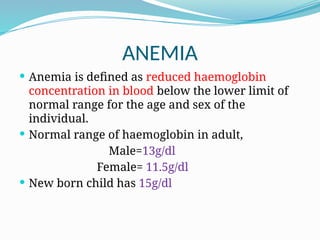
 Anemia is defined as reduced haemoglobin
concentration in blood below the lower limit of
normal range for the age and sex of the
individual.
 Normal range of haemoglobin in adult,
Male=13g/dl
Female= 11.5g/dl
 New born child has 15g/dl
CLASSIFICATION OF ANAEMIA
 IRON DEFICIENCY ANAEMIA
 MEGALOBLASTIC ANAEMIA
 SICKLE CELL ANAEMIA
 THALASEMIA
 HEREDITARY AQUIRED ANAEMIA
 HEMOPHILIA
IRON DEFICIENCY ANAEMIA
 The commonest nutritional deficiency disorder
present throughout the world is iron deficiency but
its prevalence is higher in the developing countries.
 The amount of iron obtained from the diet should
replace the losses from the skin, bowel and
genitourinary tract.
 These losses together are about 1 mg daily in an
adult male or in a non-menstruating female, while
in a menstruating woman there is an additional
iron loss of 0.5-1 mg daily.
PATHOGENESIS OF IRON DEFICIENCY
ANAEMIA
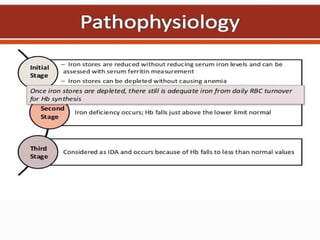
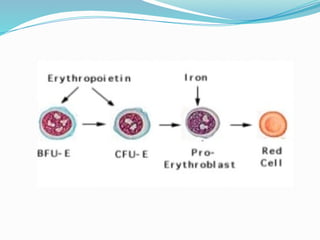
 Iron deficiency anaemia develops when the supply
of iron is inadequate for the requirement of
haemoglobin synthesis.
 Initially, negative iron balance is covered by
mobilisation from the tissue stores so as to
maintain haemoglobin synthesis.
 It is only after the tissue stores of iron are
exhausted that the supply of iron to the marrow
becomes insufficient for haemoglobin formation
and thus a state of iron deficiency anaemia
develops.
 The development of iron deficiency depends
upon one or more of the following factors:
1. Increased blood loss
2. Increased requirements
3. Inadequate dietary intake
4. Decreased intestinal absorption.
ETIOLOGY OF IRON DEFICIENCY ANAEMIA
I. INCREASED BLOOD LOSS
1. Uterine e.g. excessive menstruation in
reproductive years, repeated miscarriages, at onset
of menarche, post-menopausal uterine bleeding.
2. Gastrointestinal e.g. peptic ulcer,
haemorrhoids, hookworm infestation, cancer of
stomach.
3. Renal tract e.g. haematuria, haemoglobinuria.
4. Nose e.g. repeated epistaxis.
5. Lungs e.g. haemoptysis.
II. INCREASED REQUIREMENTS
1. Spurts of growth in infancy, childhood
and adolescence.
2. Prematurity.
3. Pregnancy and lactation.
III. INADEQUATE DIETARY INTAKE
1. Poor economic status.
2. Anorexia e.g. in pregnancy.
3. Elderly individuals due to poor dentition,
apathy and financial constraints.
IV. DECREASED ABSORPTION
1. Partial or total gastrectomy
2. Achlorhydria
3. Intestinal malabsorption such as in
coeliac disease.
RISK FACTORS / COMLICATIONS
 Infants and children growth
 Vegetarians
 Heart problems
 Problem during pregnancy
 Frequent blood donor
SIGNS AND SYMPTOMS
 Extreme fatigue
 Weakness
 Pale skin
 Chest pain, fast heartbeat or shortness of breath
 Headache, dizziness or light headedness
 Cold hands and feet
 Inflammation or soreness of your tongue
 Brittle nails
 Poor appetite
DIAGNOSIS
 Red blood cell size and colour.
 Hematocrit. This is the percentage of your blood
volume made up by red blood cells.
 Hemoglobin. Lower than normal hemoglobin
levels indicate anemia.
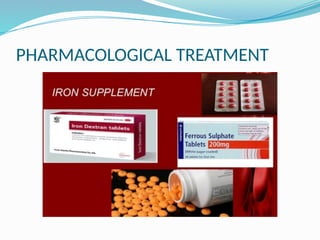
PHARMACOLOGICAL TREATMENT
MEGALOBLASTIC ANEMIA
 Megaloblastic anemia is an anemia that results
from inhibition of DNA synthesis during RBC
production.
 When DNA synthesis is impaired, the cell cycle
cannot progress from the G2 growth stage to the
mitosis (M) stage. This leads to continuing cell
growth without division, which presents as
macrocytosis.
PATHOGENESIS OF MEGALOBLASTIC
ANEMIA
 The anemia which is characterized by the
formation of morphologically abnormal
nucleated red cell precursor called megaloblats
in the bone marrow due to megaloblastic
erythropoisis.
 The changes occurs due to deficiency of vitamin
B12 or folic acid.
ETIOLOGY OF MEGALOBLASTIC ANEMIA
 The two most common causes of megaloblastic
anemia are deficiencies of vitamin B-12 or folate.
 These two nutrients are necessary for producing
healthy red blood cells.
 When you don’t get enough of them, it affects the
makeup of your red blood cells.
 This leads to cells that don’t divide and
reproduce.
RISK FACTORS / COMPLICATIONS
 Lack of intensic factor
 Auto immune disorder
 Nervous system disorders. While vitamin B-12
is important for the production of red blood cells,
it's also important for a healthy nervous system
SIGNS AND SYMPTOMS
 Fatigue
 Shortness of breath
 Dizziness
 Pale or yellowish skin
 Weight loss
 Numbness or tingling in your hands and feet
 Muscle weakness
 Personality changes
 Mental confusion or forgetfulness
DIAGNOSIS
 The number and appearance of red blood
cells.
 The amount of folate, vitamin B-12 and
vitamin C in your blood.
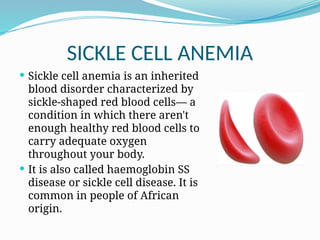
SICKLE CELL ANEMIA
 Sickle cell anemia is an inherited
blood disorder characterized by
sickle-shaped red blood cells— a
condition in which there aren't
enough healthy red blood cells to
carry adequate oxygen
throughout your body.
 It is also called haemoglobin SS
disease or sickle cell disease. It is
common in people of African
origin.
ETIOLOGY OF SICKEL CELL ANIMEA
 Destruction of red bone marrow caused by
toxins, gamma radiation, and certain
medications that inhibit enzymes needed for
hemopoiesis.
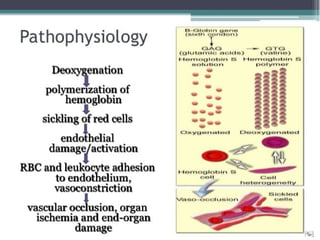
 Sickle cell anemia is caused by a mutation in the
gene that tells your body to make the red, iron-
rich compound that gives blood its red color
(hemoglobin).
RISK FACTORS / COMPLICATIONS
 Stroke
 Acute chest syndrome
 Pulmonary hypertension
 Organ damage
 Blindness
 Leg ulcers
 Gallstones
 Priapism
SIGNS AND SYMPTOMS
 Fatigue
 Pain in chest and bones
 Painful swelling of hands and feet
 Frequent infections
 Infant and children delayed growth
 Vision problems
 Pale skin
DIGNOSIS
 A blood test can check for hemoglobin S — the
defective form of hemoglobin that underlies
sickle cell anemia.

Anemia-Hematologic Disease-Pathophysiology

  • 1.
  • 2.
    HEMATOLOGIC DISEASE  Disorderwhich primarily affect the blood & blood-forming organs.  Hematologic disease include genetic disorders, anemia, HIV.
  • 3.
    ANEMIA  A Conditionin which the blood does not have enough healthy red blood cells.  Anemia results from lack of RBC or dysfunctional RBC in body.  This leads to reduced oxygen flow to body’s organs.
  • 4.
    ANEMIA  Anemia isdefined as reduced haemoglobin concentration in blood below the lower limit of normal range for the age and sex of the individual.  Normal range of haemoglobin in adult, Male=13g/dl Female= 11.5g/dl  New born child has 15g/dl
  • 5.
    CLASSIFICATION OF ANAEMIA IRON DEFICIENCY ANAEMIA  MEGALOBLASTIC ANAEMIA  SICKLE CELL ANAEMIA  THALASEMIA  HEREDITARY AQUIRED ANAEMIA  HEMOPHILIA
  • 6.
    IRON DEFICIENCY ANAEMIA The commonest nutritional deficiency disorder present throughout the world is iron deficiency but its prevalence is higher in the developing countries.  The amount of iron obtained from the diet should replace the losses from the skin, bowel and genitourinary tract.  These losses together are about 1 mg daily in an adult male or in a non-menstruating female, while in a menstruating woman there is an additional iron loss of 0.5-1 mg daily.
  • 7.
    PATHOGENESIS OF IRONDEFICIENCY ANAEMIA  Iron deficiency anaemia develops when the supply of iron is inadequate for the requirement of haemoglobin synthesis.  Initially, negative iron balance is covered by mobilisation from the tissue stores so as to maintain haemoglobin synthesis.  It is only after the tissue stores of iron are exhausted that the supply of iron to the marrow becomes insufficient for haemoglobin formation and thus a state of iron deficiency anaemia develops.
  • 8.
     The developmentof iron deficiency depends upon one or more of the following factors: 1. Increased blood loss 2. Increased requirements 3. Inadequate dietary intake 4. Decreased intestinal absorption.
  • 10.
    ETIOLOGY OF IRONDEFICIENCY ANAEMIA I. INCREASED BLOOD LOSS 1. Uterine e.g. excessive menstruation in reproductive years, repeated miscarriages, at onset of menarche, post-menopausal uterine bleeding. 2. Gastrointestinal e.g. peptic ulcer, haemorrhoids, hookworm infestation, cancer of stomach. 3. Renal tract e.g. haematuria, haemoglobinuria. 4. Nose e.g. repeated epistaxis. 5. Lungs e.g. haemoptysis.
  • 11.
    II. INCREASED REQUIREMENTS 1.Spurts of growth in infancy, childhood and adolescence. 2. Prematurity. 3. Pregnancy and lactation. III. INADEQUATE DIETARY INTAKE 1. Poor economic status. 2. Anorexia e.g. in pregnancy. 3. Elderly individuals due to poor dentition, apathy and financial constraints.
  • 12.
    IV. DECREASED ABSORPTION 1.Partial or total gastrectomy 2. Achlorhydria 3. Intestinal malabsorption such as in coeliac disease.
  • 14.
    RISK FACTORS /COMLICATIONS  Infants and children growth  Vegetarians  Heart problems  Problem during pregnancy  Frequent blood donor
  • 15.
    SIGNS AND SYMPTOMS Extreme fatigue  Weakness  Pale skin  Chest pain, fast heartbeat or shortness of breath  Headache, dizziness or light headedness  Cold hands and feet  Inflammation or soreness of your tongue  Brittle nails  Poor appetite
  • 16.
    DIAGNOSIS  Red bloodcell size and colour.  Hematocrit. This is the percentage of your blood volume made up by red blood cells.  Hemoglobin. Lower than normal hemoglobin levels indicate anemia.
  • 17.
  • 18.
    MEGALOBLASTIC ANEMIA  Megaloblasticanemia is an anemia that results from inhibition of DNA synthesis during RBC production.  When DNA synthesis is impaired, the cell cycle cannot progress from the G2 growth stage to the mitosis (M) stage. This leads to continuing cell growth without division, which presents as macrocytosis.
  • 19.
    PATHOGENESIS OF MEGALOBLASTIC ANEMIA The anemia which is characterized by the formation of morphologically abnormal nucleated red cell precursor called megaloblats in the bone marrow due to megaloblastic erythropoisis.  The changes occurs due to deficiency of vitamin B12 or folic acid.
  • 21.
    ETIOLOGY OF MEGALOBLASTICANEMIA  The two most common causes of megaloblastic anemia are deficiencies of vitamin B-12 or folate.  These two nutrients are necessary for producing healthy red blood cells.  When you don’t get enough of them, it affects the makeup of your red blood cells.  This leads to cells that don’t divide and reproduce.
  • 22.
    RISK FACTORS /COMPLICATIONS  Lack of intensic factor  Auto immune disorder  Nervous system disorders. While vitamin B-12 is important for the production of red blood cells, it's also important for a healthy nervous system
  • 23.
    SIGNS AND SYMPTOMS Fatigue  Shortness of breath  Dizziness  Pale or yellowish skin  Weight loss  Numbness or tingling in your hands and feet  Muscle weakness  Personality changes  Mental confusion or forgetfulness
  • 24.
    DIAGNOSIS  The numberand appearance of red blood cells.  The amount of folate, vitamin B-12 and vitamin C in your blood.
  • 25.
    SICKLE CELL ANEMIA Sickle cell anemia is an inherited blood disorder characterized by sickle-shaped red blood cells— a condition in which there aren't enough healthy red blood cells to carry adequate oxygen throughout your body.  It is also called haemoglobin SS disease or sickle cell disease. It is common in people of African origin.
  • 27.
    ETIOLOGY OF SICKELCELL ANIMEA  Destruction of red bone marrow caused by toxins, gamma radiation, and certain medications that inhibit enzymes needed for hemopoiesis.  Sickle cell anemia is caused by a mutation in the gene that tells your body to make the red, iron- rich compound that gives blood its red color (hemoglobin).
  • 28.
    RISK FACTORS /COMPLICATIONS  Stroke  Acute chest syndrome  Pulmonary hypertension  Organ damage  Blindness  Leg ulcers  Gallstones  Priapism
  • 29.
    SIGNS AND SYMPTOMS Fatigue  Pain in chest and bones  Painful swelling of hands and feet  Frequent infections  Infant and children delayed growth  Vision problems  Pale skin
  • 30.
    DIGNOSIS  A bloodtest can check for hemoglobin S — the defective form of hemoglobin that underlies sickle cell anemia.