Heamatological Disorders
Pharmacotherapeutics
D.Pharm Second Year
Sudipta Roy
Associate Professor
East Point College Of Pharmacy Bangalore
Anemia
• Anemia comes from the Greek which means lack of
blood.
• Anemia is defined as decrease in total amount of the red
blood cell (RBCs) or heamoglobin in blood.
• It is also defined as lower ability of blood to carry oxygen.
• Anemia is defined as a heamoglobin concentration in the
blood below the lower limit of the normal range.
• Normal Heamoglobin (Hb) value :
• In Male individuals : 13 gm/dl
• In female individuals : 11.5 gm/dl
• In newborn infants:15 gm/dl
• At 3 months :9.5 gm/dl
• The tissue of the human body need a regular of
oxygen to remain healthy. Red blood cells that
contains hemoglobin , deliver oxygen to the body
and lives for 120 days.
• When they die the iron , they contain is returned to
the bone marrow and is used to create new red
blood cells. Anemia develops when heavy bleeding
causes a significant iron loss or when the
production of red blood cells slows done or they
are destroyed at fast rates.
• In anemia , the body does not get enough oxygen
rich blood. As a result , the person may feel tired
Causes of Aneamia.
• Aneamia is caused by the following reasons.
• 1. Blood loss
• Decreae in rate of RBC Production
• High rate of RBC destruction
• 1. Blood loss :
• Blood loss may be due to the following reasons:
• Heavy menstrual period in women
• Surgery
• Trauma
• Cancer
• 2. Decrease in Rate of RBC Production :
• Mainly two factors can prevent the body from making enough red blood
cells. These are - Acquired cause and Inherited cause.
• Acquired Cause include.
• Poor diet (especially poor in iron folic acid.)
• Hormonal imbalance (poor secretion of
erythropoietin from the kidneys)
• 3. High Rate of RBC Destruction.
• In various conditions the rate of RBC destruction
becomes high. These conditions may also be
inherited or acquired.
• When spleen gets diseased/enlarged the rate of
RBC destruction becomes high.
• Samples of inherited conditions that can cause the
body to destroy too many red blood cells include
sickle cell anemia , thalassemia , hemolytic anemia.
• Symptoms of Aneamia.
• Symptoms may include.
• Fatigue
• Pale or yellwish skin
• Shortness of breath
• Light headedness
• Dizziness
• Weakness
• Irregular heartbeats
• Chest Pain
• Cold hands and feet
Iron deficiency Aneamia.
• Iron deficiency anemia is a common type of anemia
in which blood lacks adequate healthy red blood
cells due to deficiency of iron.Iron is an essential
mineral that is needed to form hemoglobin (an
oxygen carrying protein) inside the red blood cells.
• Definition - Iron deficiency anemia (IDA) is a
condition in which the body lack enough red blood
cells to transport oxygen to the whole body as a
result iron deficiency anemia produces tiredness
and shortness of breath.
• Aneamia is defined as a heamoglobin concentration
below a specified cut off point that cut off point
depends on the age , gender , physiological status ,
smoking habits and altitude at which the population
being assessed lives.
• WHO defines aneamia in heamoglobin concentration
below a specified cut offf point that cut off point
depends on the age , gender , physiological status ,
smoking habits and altitude at which the population
being assessed lives.
• WHO defines aneamia in children aged under 5 years
and pregnant women as a heamoglobin concentration
<110 g /L at sea level and aneamia in non-pregnant
women as a heamoglobin concentration <120 g/L
Distribution of Iron in Body.
• Iron is distributed in active metabolic and storage
pools . Total body iron is about 3-4 gm . This
amount of iron is available in two forms :
• 1. Funtional Form of Iron (75 %) :
• Hemoglobin : 2 g (in men ) and 1.5 g (in women)
• Myoglobin : 200 mg
• Respiratory Enzymes (as cytochromes) : 150 mg
• Non-Functional Form of Iron (25 %) : Free iron is very toxic . So , iron is
bound to proteins (non-heme metaloproteins) that allows it to be
transported and stored in non toxic forms.
• Transferrin : 250-300 mg (For transport of iron in blood)
• Ferritin : 1 g (in men ) and 0.6 g (in women - For storage of iron in
tissues.
• Functions of Iron :
• Iron performs several functions in human body . These are -
• 1. It is carrier of oxygen from lung to tissues.
• 2. It transports electrons within cells.
• 3. It acts as a co-factor for essential enzymatic reaction such as :
• Neurotransmission
• Synthesis of steroidal hormones
• Synthesis of bile salts
• Detoxification process in the liver
Etiology
• Iron deficiency anemia is usually due to :
• 1. Blood loss :
• Blood loss may be due to following reasons
• Menorrhagia abnormally heavy or prolonged
bleeding
• Chronic internal bleeding
• Surgery
• Trauma
• Cancer
Decrease Iron Absorption :
• Absorption of iron can be decreased due to :
• Intestinal disorders such as Crohn's disease , celiac
disease
• Regular use of stomach acid blockers
• Certain foods like milk , tea , coffee etc.
• 4. Increased Iron Requirements : It may be due to :
• Juvenile age
• Pregnancy
• Lactation
Pathophysiology
• Iron deficiency occurs when the body's iron stores
are depleted and a restricted supply of iron to
various tissues becomes apparent. If not corrected ,
iron deficiency can lead to iron deficiency anemia,
which is a condition defined by a low hemoglobin
concentration in the blood.
• Iron deficiency commonly occurs in three stages.
• Diminished Total Body Iron Content : This stage is
identified by a reduction in bone marrow iron
stores. Level of iron in hemoglobin and serum
remain normal but serum ferritin level falls to <20
ng/ml. Serum ferritin concentration typically
• Stage 2.
• Reduced Red Blood Cell Formation:
• This stage occurs when the iron supply is
insufficient to support the formation of red blood
cells. So, in this stage erythropoiesis is impaired.
Erythropoiesis is impaired when serum iron falls to
below 50 microgram/dl and transferrin saturation
to less than 16 %. High levels of blood marker
called zinc protophyrin (ZPP) can indicate this stage.
When iron is not readily available , zinc is used in its
place producing ZPP .
• Iron Deficiency Anemia.
• In this final stage , hemoglobin concentration is
affected and drops below the normal range, which
is typically 12 to 15 grams per deciliter for women
and 14 to 16.5 grams per deciliter for men. The
normal range , however will be slightly higher for
athletes living at higher altitudes.
• Clinical Manifesrations.
• The symptoms of moderate to severe iron deficiency anemia can include.
• Brittle nails
• Cracks in the sides of mouth
• Extreme Fatigue (tiredness)
• Chest Pain
• Pale Skin
• Shortness of breath
• Dizziness or light headedness
• Fast or irregular heartbeat
• Headaches
• Strange cravings to eat items with no nutritional value
• A tingling or crawling feeling in the legs
• Tongue swelling or soreness
• Cold hands and feet.
Diagnosis
• Iron deficiency anemia can be diagnosed with
blood tests. These include.
• 1. Complete Blood Count (CBC) Test.
• A CBC test measures the amount of cellular or cell
related components in the blood, including :
• Red blood cells
• White blood cells
• Heamoglobin
• Hematocrit
• Platelets
Treatment.
• Non-Pharmacological Treatment.
• Diets that include the following foods can help treat
or prevent iron deficiency .
• Red meat
• Green , Leafy vegetables
• Dried fruits
• Nuts
• Iron fortified cereals , breads and pastas
• Peas
• Beans
Pharmacological Treatment
• Iron Supplements.
• Iron tablets can help to restore iron levels in your
body . Take iron tablets on an empty stomach , that
helps the body absorb them better . If they upset
your stomach , you can take them with meals . You
may need to take the supplements for several
months. Iron supplements may cause constipation
or black stools.
Megaloblastic Anemia.
• Megaloblastic Anemia is also known as Folate
deficiency anemia, folic acid deficiency anemia and
Vitamin B12 deficiency Anemia.
• Megaloblastic anemia is a red blood cell disorder
due to the inhibition of DNA synthesis during
erythropoiesis (red blood cell production).
• Bone marrow.
• The soft , spongy material found inside certain
bones (ribs , vertebrate , sternum , hip , shoulder ,
bones and bones of the pelvis ) produces the main
blood cells of the body.
• DNA synthesis .
• Vit. B12 and folic acid play important role as
cofactor in the synthesis of DNA . Vitamin B12 , also
known as cobalamin , is an important cofactor in
the homocysteine metabolism, heamoglobin
synthesis and myelination. Vitamin B12 is required
for the action methionine synthese , that converts
homocysteine to the essential amino acid
methionine. Methionine is converted to S-
adenosyl-methionine. which is involved in
methylation of tetrahydrofolic acid (THF) in the
body. This conversion is necessary for normal
• Any factor that results in the deficiency of vit B12 or folic acid will
lead to defective DNA synthesis. Inadequate DNA synthesis
results in defective nuclear maturation. However , the synthesis
of RNA and protein is not altered so cytoplasmic maturation
proceeds in advance of nuclear maturation.
• Vit B12 is a nutrient found in some foods like meat , fish , eggs
and milk . Some people cannot absorb enough vit. B12 from their
food , leading to megaloblastic anemia. Megaloblastic anemia
caused by vit B12 deficiency is referred to as pernicious anemia.
• Folate is another nutrient that's important for the development
of healthy red blood cells. Folate is found in food like beef liver ,
spinach and sprouts . Folate deficiency can also be caused by
chronic alcohol abuse , since alcohol interferes with body's ability
to absorb folic acid . Pregnant women are likely to have folate
deficiency, because of high amounts of folate needed by
developing foetus.
Etiology (Causes ) of
Megaloblastic Anemia.
• It is usually caused due to the deficiency of vitamin
B12 or folate in the body as these two vitamins are
the building blocks in the formation of healthy red
blood cells.
• Deficiency of Cobalamine or Vitamin B12.
• Vitamin B12 is an essential requirement for the
formation of red blood cells . It is absorbed from
the diet by the digestive tract. It may become
deficient in the body due to following reasons.
• Inadequate dietary intake
• Failure of the body to absorb the vitamin B12
Deficiency of Folate.
• Folate may be deficient due to following reasons.
• Inadequate dietary intake or malabsorption
• Over cooked food especially vegetables
• Increased requirements of body
• Pregnancy and lactating mothers need more folic
acid.
• Drugs : Certatin like methotrexate and
trimethoprim effect folate metabolism.
• Drugs like phenytoin can prevent the absorption of
folate .
Pathophysiology.
• When Vitamin B12 or folate is deficient , thymidine
synthase function is impaired and DNA synthesis is
interrupted but RNA synthesis remains unimpaired. The
inability to synthesize DNA leads to ineffectual
erythropoiesis resulting in excess hemoglobin and
enlarged erythroid precursors being produced. The
developing red cells has difficulty in undergoing cell
division but RNA continues to translated and
trsnscribed into protein leading to growth of the
cytoplasm while nucleus lags behind. often one or
more cell division are skipped leading to a larger than
normal cell. There is often erythroid hyperplasia in the
marrow but most of these immature cells die before
reaching maturity leading leading to elevated Lactate
Dehydrogenase (LDH) and Hyperbilirunemia.
Complications.
• However , megaloblastic anemias can cause long
term complications if left untreated . These
complications can include : permanent damage to
nervous system . Extreme vitamin B12 may cause
long-term neurologic complications. They include
peripheral neuropathy and dementia.
Clinical Manifestations.
• The most common symptom of megaloblastic
anemia is fatigue. Symptoms can vary from person
to person . Common symptoms include.
• Shortness of breath
• Muscle Weakness
• Abnormal paleness of the skin (pallor)
• Loss of appetite
• Nausea, Diarrohea
• Tingling in hands and feet
Diagnosis.
• Some diagnostic tests or megaloblastic anemia and
vitamin B12 and folate deficiency are as follows.
• Peripheral Blood Smear.
• Examination of a peripheral blood smear show the
presence of enlarged , irregular and abnormally shaped
red blood cells.
• Bone marrow Biopsy.
• Enlarged and immature red blood cells are found in bone
marrow and they confirm the diagnosis.
• Serum Cobalamin.
• This is measured by ELISA (Enzyme Linked Immuno
Sorbent Assay ) . Levels less than 100 ng/L is diagnostic of
a deficiency.
• Serum Methylmalonate and Homocysteine.
• In patients with cobalamin deficiency , serum
methylmalonate and homocysteine levels are
raised. This method is employed for early detection
of cobalamin deficiency even in the absence of
blood cell abnormalities.
• Routine Blood Count.
• MCV or Mean Corpuscular Volume is this disease ,
that is , the cell size is increased . Many
sympomless patients are detected through the
finding of a raised MCV on a routine blood count.
Treatment.
• The first line of treatment for many people is correcting nutrient deficiencies.This can be done
with supplements or foods like spinach and red meat . The patient may take supplements that
include folate and other B vitamins. Vitamin B-12 injections are also available if the absorption
of oral vitamin B-12 is not done properly.
• Foods high in Vitamin B12 include.
• Chicken
• Fortified grains and cereals
• Eggs
• Red Meat
• Shelfish
• Fish
• Foods high in folate include.
• Dark leafy greens
• Foods high in Folat include.
• Dark leafy greens such as kale and spinach
• Beans , peanuts , soybean , rice , barley , sprouts
• lentils
• Enriched grains
• Oranges
Multiple choice Question.
1. Which of the following signifies anemia?
a. A low white blood cell count
b. A low platelet counts
c. A low hemoglobin level
d. A low sodium level
2.Anemia arises due to deficiency of -
a. Iron b. Vitamin B12 c. Folic Acid d.Any of the above
3. Consequence of Vit B12 deficiency is impaired ----
a. Absorption of Iron
b. Folic Acid Synthesis
c. Production of intrinsic factor
d. DNA Synthesis
4. The intrinsic factor is required for the absorption of -
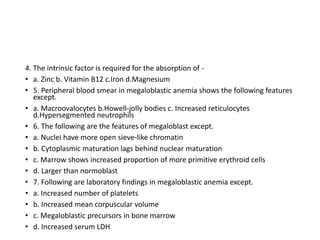
• a. Zinc b. Vitamin B12 c.Iron d.Magnesium
• 5. Peripheral blood smear in megaloblastic anemia shows the following features
except.
• a. Macroovalocytes b.Howell-jolly bodies c. Increased reticulocytes
d.Hypersegmented neutrophils
• 6. The following are the features of megaloblast except.
• a. Nuclei have more open sieve-like chromatin
• b. Cytoplasmic maturation lags behind nuclear maturation
• c. Marrow shows increased proportion of more primitive erythroid cells
• d. Larger than normoblast
• 7. Following are laboratory findings in megaloblastic anemia except.
• a. Increased number of platelets
• b. Increased mean corpuscular volume
• c. Megaloblastic precursors in bone marrow
• d. Increased serum LDH
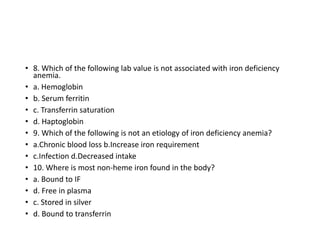
• 8. Which of the following lab value is not associated with iron deficiency
anemia.
• a. Hemoglobin
• b. Serum ferritin
• c. Transferrin saturation
• d. Haptoglobin
• 9. Which of the following is not an etiology of iron deficiency anemia?
• a.Chronic blood loss b.Increase iron requirement
• c.Infection d.Decreased intake
• 10. Where is most non-heme iron found in the body?
• a. Bound to IF
• d. Free in plasma
• c. Stored in silver
• d. Bound to transferrin
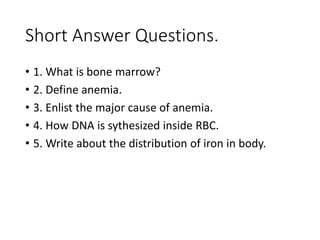
Short Answer Questions.
• 1. What is bone marrow?
• 2. Define anemia.
• 3. Enlist the major cause of anemia.
• 4. How DNA is sythesized inside RBC.
• 5. Write about the distribution of iron in body.
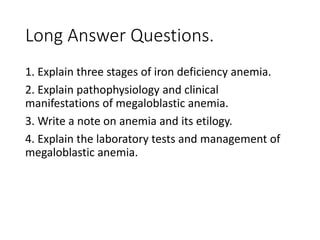
Long Answer Questions.
1. Explain three stages of iron deficiency anemia.
2. Explain pathophysiology and clinical
manifestations of megaloblastic anemia.
3. Write a note on anemia and its etilogy.
4. Explain the laboratory tests and management of
megaloblastic anemia.

Heamatological Disorder-WPS Office.pptx

  • 1.
    Heamatological Disorders Pharmacotherapeutics D.Pharm SecondYear Sudipta Roy Associate Professor East Point College Of Pharmacy Bangalore
  • 2.
    Anemia • Anemia comesfrom the Greek which means lack of blood. • Anemia is defined as decrease in total amount of the red blood cell (RBCs) or heamoglobin in blood. • It is also defined as lower ability of blood to carry oxygen. • Anemia is defined as a heamoglobin concentration in the blood below the lower limit of the normal range. • Normal Heamoglobin (Hb) value : • In Male individuals : 13 gm/dl • In female individuals : 11.5 gm/dl • In newborn infants:15 gm/dl • At 3 months :9.5 gm/dl
  • 3.
    • The tissueof the human body need a regular of oxygen to remain healthy. Red blood cells that contains hemoglobin , deliver oxygen to the body and lives for 120 days. • When they die the iron , they contain is returned to the bone marrow and is used to create new red blood cells. Anemia develops when heavy bleeding causes a significant iron loss or when the production of red blood cells slows done or they are destroyed at fast rates. • In anemia , the body does not get enough oxygen rich blood. As a result , the person may feel tired
  • 4.
    Causes of Aneamia. •Aneamia is caused by the following reasons. • 1. Blood loss • Decreae in rate of RBC Production • High rate of RBC destruction • 1. Blood loss : • Blood loss may be due to the following reasons: • Heavy menstrual period in women • Surgery • Trauma • Cancer • 2. Decrease in Rate of RBC Production : • Mainly two factors can prevent the body from making enough red blood cells. These are - Acquired cause and Inherited cause. • Acquired Cause include. • Poor diet (especially poor in iron folic acid.)
  • 5.
    • Hormonal imbalance(poor secretion of erythropoietin from the kidneys) • 3. High Rate of RBC Destruction. • In various conditions the rate of RBC destruction becomes high. These conditions may also be inherited or acquired. • When spleen gets diseased/enlarged the rate of RBC destruction becomes high. • Samples of inherited conditions that can cause the body to destroy too many red blood cells include sickle cell anemia , thalassemia , hemolytic anemia.
  • 6.
    • Symptoms ofAneamia. • Symptoms may include. • Fatigue • Pale or yellwish skin • Shortness of breath • Light headedness • Dizziness • Weakness • Irregular heartbeats • Chest Pain • Cold hands and feet
  • 7.
    Iron deficiency Aneamia. •Iron deficiency anemia is a common type of anemia in which blood lacks adequate healthy red blood cells due to deficiency of iron.Iron is an essential mineral that is needed to form hemoglobin (an oxygen carrying protein) inside the red blood cells. • Definition - Iron deficiency anemia (IDA) is a condition in which the body lack enough red blood cells to transport oxygen to the whole body as a result iron deficiency anemia produces tiredness and shortness of breath.
  • 8.
    • Aneamia isdefined as a heamoglobin concentration below a specified cut off point that cut off point depends on the age , gender , physiological status , smoking habits and altitude at which the population being assessed lives. • WHO defines aneamia in heamoglobin concentration below a specified cut offf point that cut off point depends on the age , gender , physiological status , smoking habits and altitude at which the population being assessed lives. • WHO defines aneamia in children aged under 5 years and pregnant women as a heamoglobin concentration <110 g /L at sea level and aneamia in non-pregnant women as a heamoglobin concentration <120 g/L
  • 9.
    Distribution of Ironin Body. • Iron is distributed in active metabolic and storage pools . Total body iron is about 3-4 gm . This amount of iron is available in two forms : • 1. Funtional Form of Iron (75 %) : • Hemoglobin : 2 g (in men ) and 1.5 g (in women) • Myoglobin : 200 mg • Respiratory Enzymes (as cytochromes) : 150 mg
  • 10.
    • Non-Functional Formof Iron (25 %) : Free iron is very toxic . So , iron is bound to proteins (non-heme metaloproteins) that allows it to be transported and stored in non toxic forms. • Transferrin : 250-300 mg (For transport of iron in blood) • Ferritin : 1 g (in men ) and 0.6 g (in women - For storage of iron in tissues. • Functions of Iron : • Iron performs several functions in human body . These are - • 1. It is carrier of oxygen from lung to tissues. • 2. It transports electrons within cells. • 3. It acts as a co-factor for essential enzymatic reaction such as : • Neurotransmission • Synthesis of steroidal hormones • Synthesis of bile salts • Detoxification process in the liver
  • 11.
    Etiology • Iron deficiencyanemia is usually due to : • 1. Blood loss : • Blood loss may be due to following reasons • Menorrhagia abnormally heavy or prolonged bleeding • Chronic internal bleeding • Surgery • Trauma • Cancer
  • 12.
    Decrease Iron Absorption: • Absorption of iron can be decreased due to : • Intestinal disorders such as Crohn's disease , celiac disease • Regular use of stomach acid blockers • Certain foods like milk , tea , coffee etc. • 4. Increased Iron Requirements : It may be due to : • Juvenile age • Pregnancy • Lactation
  • 13.
    Pathophysiology • Iron deficiencyoccurs when the body's iron stores are depleted and a restricted supply of iron to various tissues becomes apparent. If not corrected , iron deficiency can lead to iron deficiency anemia, which is a condition defined by a low hemoglobin concentration in the blood. • Iron deficiency commonly occurs in three stages. • Diminished Total Body Iron Content : This stage is identified by a reduction in bone marrow iron stores. Level of iron in hemoglobin and serum remain normal but serum ferritin level falls to <20 ng/ml. Serum ferritin concentration typically
  • 14.
    • Stage 2. •Reduced Red Blood Cell Formation: • This stage occurs when the iron supply is insufficient to support the formation of red blood cells. So, in this stage erythropoiesis is impaired. Erythropoiesis is impaired when serum iron falls to below 50 microgram/dl and transferrin saturation to less than 16 %. High levels of blood marker called zinc protophyrin (ZPP) can indicate this stage. When iron is not readily available , zinc is used in its place producing ZPP .
  • 15.
    • Iron DeficiencyAnemia. • In this final stage , hemoglobin concentration is affected and drops below the normal range, which is typically 12 to 15 grams per deciliter for women and 14 to 16.5 grams per deciliter for men. The normal range , however will be slightly higher for athletes living at higher altitudes.
  • 16.
    • Clinical Manifesrations. •The symptoms of moderate to severe iron deficiency anemia can include. • Brittle nails • Cracks in the sides of mouth • Extreme Fatigue (tiredness) • Chest Pain • Pale Skin • Shortness of breath • Dizziness or light headedness • Fast or irregular heartbeat • Headaches • Strange cravings to eat items with no nutritional value • A tingling or crawling feeling in the legs • Tongue swelling or soreness • Cold hands and feet.
  • 17.
    Diagnosis • Iron deficiencyanemia can be diagnosed with blood tests. These include. • 1. Complete Blood Count (CBC) Test. • A CBC test measures the amount of cellular or cell related components in the blood, including : • Red blood cells • White blood cells • Heamoglobin • Hematocrit • Platelets
  • 18.
    Treatment. • Non-Pharmacological Treatment. •Diets that include the following foods can help treat or prevent iron deficiency . • Red meat • Green , Leafy vegetables • Dried fruits • Nuts • Iron fortified cereals , breads and pastas • Peas • Beans
  • 19.
    Pharmacological Treatment • IronSupplements. • Iron tablets can help to restore iron levels in your body . Take iron tablets on an empty stomach , that helps the body absorb them better . If they upset your stomach , you can take them with meals . You may need to take the supplements for several months. Iron supplements may cause constipation or black stools.
  • 20.
    Megaloblastic Anemia. • MegaloblasticAnemia is also known as Folate deficiency anemia, folic acid deficiency anemia and Vitamin B12 deficiency Anemia. • Megaloblastic anemia is a red blood cell disorder due to the inhibition of DNA synthesis during erythropoiesis (red blood cell production). • Bone marrow. • The soft , spongy material found inside certain bones (ribs , vertebrate , sternum , hip , shoulder , bones and bones of the pelvis ) produces the main blood cells of the body.
  • 21.
    • DNA synthesis. • Vit. B12 and folic acid play important role as cofactor in the synthesis of DNA . Vitamin B12 , also known as cobalamin , is an important cofactor in the homocysteine metabolism, heamoglobin synthesis and myelination. Vitamin B12 is required for the action methionine synthese , that converts homocysteine to the essential amino acid methionine. Methionine is converted to S- adenosyl-methionine. which is involved in methylation of tetrahydrofolic acid (THF) in the body. This conversion is necessary for normal
  • 22.
    • Any factorthat results in the deficiency of vit B12 or folic acid will lead to defective DNA synthesis. Inadequate DNA synthesis results in defective nuclear maturation. However , the synthesis of RNA and protein is not altered so cytoplasmic maturation proceeds in advance of nuclear maturation. • Vit B12 is a nutrient found in some foods like meat , fish , eggs and milk . Some people cannot absorb enough vit. B12 from their food , leading to megaloblastic anemia. Megaloblastic anemia caused by vit B12 deficiency is referred to as pernicious anemia. • Folate is another nutrient that's important for the development of healthy red blood cells. Folate is found in food like beef liver , spinach and sprouts . Folate deficiency can also be caused by chronic alcohol abuse , since alcohol interferes with body's ability to absorb folic acid . Pregnant women are likely to have folate deficiency, because of high amounts of folate needed by developing foetus.
  • 23.
    Etiology (Causes )of Megaloblastic Anemia. • It is usually caused due to the deficiency of vitamin B12 or folate in the body as these two vitamins are the building blocks in the formation of healthy red blood cells. • Deficiency of Cobalamine or Vitamin B12. • Vitamin B12 is an essential requirement for the formation of red blood cells . It is absorbed from the diet by the digestive tract. It may become deficient in the body due to following reasons. • Inadequate dietary intake • Failure of the body to absorb the vitamin B12
  • 24.
    Deficiency of Folate. •Folate may be deficient due to following reasons. • Inadequate dietary intake or malabsorption • Over cooked food especially vegetables • Increased requirements of body • Pregnancy and lactating mothers need more folic acid. • Drugs : Certatin like methotrexate and trimethoprim effect folate metabolism. • Drugs like phenytoin can prevent the absorption of folate .
  • 25.
    Pathophysiology. • When VitaminB12 or folate is deficient , thymidine synthase function is impaired and DNA synthesis is interrupted but RNA synthesis remains unimpaired. The inability to synthesize DNA leads to ineffectual erythropoiesis resulting in excess hemoglobin and enlarged erythroid precursors being produced. The developing red cells has difficulty in undergoing cell division but RNA continues to translated and trsnscribed into protein leading to growth of the cytoplasm while nucleus lags behind. often one or more cell division are skipped leading to a larger than normal cell. There is often erythroid hyperplasia in the marrow but most of these immature cells die before reaching maturity leading leading to elevated Lactate Dehydrogenase (LDH) and Hyperbilirunemia.
  • 26.
    Complications. • However ,megaloblastic anemias can cause long term complications if left untreated . These complications can include : permanent damage to nervous system . Extreme vitamin B12 may cause long-term neurologic complications. They include peripheral neuropathy and dementia.
  • 27.
    Clinical Manifestations. • Themost common symptom of megaloblastic anemia is fatigue. Symptoms can vary from person to person . Common symptoms include. • Shortness of breath • Muscle Weakness • Abnormal paleness of the skin (pallor) • Loss of appetite • Nausea, Diarrohea • Tingling in hands and feet
  • 28.
    Diagnosis. • Some diagnostictests or megaloblastic anemia and vitamin B12 and folate deficiency are as follows. • Peripheral Blood Smear. • Examination of a peripheral blood smear show the presence of enlarged , irregular and abnormally shaped red blood cells. • Bone marrow Biopsy. • Enlarged and immature red blood cells are found in bone marrow and they confirm the diagnosis. • Serum Cobalamin. • This is measured by ELISA (Enzyme Linked Immuno Sorbent Assay ) . Levels less than 100 ng/L is diagnostic of a deficiency.
  • 29.
    • Serum Methylmalonateand Homocysteine. • In patients with cobalamin deficiency , serum methylmalonate and homocysteine levels are raised. This method is employed for early detection of cobalamin deficiency even in the absence of blood cell abnormalities. • Routine Blood Count. • MCV or Mean Corpuscular Volume is this disease , that is , the cell size is increased . Many sympomless patients are detected through the finding of a raised MCV on a routine blood count.
  • 30.
    Treatment. • The firstline of treatment for many people is correcting nutrient deficiencies.This can be done with supplements or foods like spinach and red meat . The patient may take supplements that include folate and other B vitamins. Vitamin B-12 injections are also available if the absorption of oral vitamin B-12 is not done properly. • Foods high in Vitamin B12 include. • Chicken • Fortified grains and cereals • Eggs • Red Meat • Shelfish • Fish • Foods high in folate include. • Dark leafy greens • Foods high in Folat include. • Dark leafy greens such as kale and spinach • Beans , peanuts , soybean , rice , barley , sprouts • lentils • Enriched grains • Oranges
  • 31.
    Multiple choice Question. 1.Which of the following signifies anemia? a. A low white blood cell count b. A low platelet counts c. A low hemoglobin level d. A low sodium level 2.Anemia arises due to deficiency of - a. Iron b. Vitamin B12 c. Folic Acid d.Any of the above 3. Consequence of Vit B12 deficiency is impaired ---- a. Absorption of Iron b. Folic Acid Synthesis c. Production of intrinsic factor d. DNA Synthesis
  • 32.
    4. The intrinsicfactor is required for the absorption of - • a. Zinc b. Vitamin B12 c.Iron d.Magnesium • 5. Peripheral blood smear in megaloblastic anemia shows the following features except. • a. Macroovalocytes b.Howell-jolly bodies c. Increased reticulocytes d.Hypersegmented neutrophils • 6. The following are the features of megaloblast except. • a. Nuclei have more open sieve-like chromatin • b. Cytoplasmic maturation lags behind nuclear maturation • c. Marrow shows increased proportion of more primitive erythroid cells • d. Larger than normoblast • 7. Following are laboratory findings in megaloblastic anemia except. • a. Increased number of platelets • b. Increased mean corpuscular volume • c. Megaloblastic precursors in bone marrow • d. Increased serum LDH
  • 33.
    • 8. Whichof the following lab value is not associated with iron deficiency anemia. • a. Hemoglobin • b. Serum ferritin • c. Transferrin saturation • d. Haptoglobin • 9. Which of the following is not an etiology of iron deficiency anemia? • a.Chronic blood loss b.Increase iron requirement • c.Infection d.Decreased intake • 10. Where is most non-heme iron found in the body? • a. Bound to IF • d. Free in plasma • c. Stored in silver • d. Bound to transferrin
  • 34.
    Short Answer Questions. •1. What is bone marrow? • 2. Define anemia. • 3. Enlist the major cause of anemia. • 4. How DNA is sythesized inside RBC. • 5. Write about the distribution of iron in body.
  • 35.
    Long Answer Questions. 1.Explain three stages of iron deficiency anemia. 2. Explain pathophysiology and clinical manifestations of megaloblastic anemia. 3. Write a note on anemia and its etilogy. 4. Explain the laboratory tests and management of megaloblastic anemia.