Presented By…
Mr. Gautam B. Khillare
DEPARTMENT OF COMPUTER SCIENCE AND ENGINEERING
COLLEGE OF ENGINEERING AND TECHNOLOGY, AKOLA
Sant Gadge Baba Amravati University, Amravati
[2015-2016]
ANDROID OPERATING
SYSTEM
Content
• History
• Introduction Of Android
• Android Version
• Android Architecture
• Features of Android
• Advantages of Android
• Disadvantages of Android
• Conclusion
History
 Android was found way back in 2003.
 It was developed in Palo Alto, California.
 Android was developed by the Andy Rubin, Rich Miner, Nick
Sears and Chris White.
 Android was purchased by the GOOGLE in AUGUST,2005 for
50 million $.
 Google acquires mobile software startup Android™ in 2005.
 Open Handset Alliance officially starts on November 5th, 2007
 Android™ 1.0 source and SDK released in Fall 2008
Operating System Based on Linux kernel and now
developed by Google,it was designed for a touch
screen mobile.
Android is powerfull Operating system
supporting a large number of application in smart
phones
 A Software platform and operating system for
mobile.
 Based on the Linux kernel.

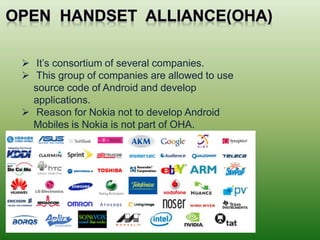
 It’s consortium of several companies.
 This group of companies are allowed to use
source code of Android and develop
applications.
 Reason for Nokia not to develop Android
Mobiles is Nokia is not part of OHA.
Android is not a single piece of hardware.
Android supports wireless communication
using:-
 Android is a multi-process system, in
which each application (and parts of
the system) runs in its own process.
 3G Networks
 4G Networks
 802.11 Wi-Fi Networks
 Bluetooth Connectivity
FEATURES OF ANDROID
Interface that is better then the previous
touch screen mobiles.
User gets millions of applications that user
can not get in any other mobile operating
system.
 Android supports advanced audio/video/still
media formats such as MPEG-4, H.264, MP3,
and AAC, AMR, JPEG, PNG, GIF.
 Developing an android application is not
tough using SDK(standard development
kit) and java emulator we can easily
develop applications that we want.
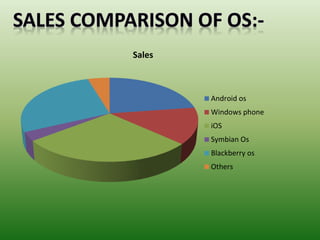
Sales
Android os
Windows phone
iOS
Symbian Os
Blackberry os
Others
 First Version of Android.
 The focus of Android beta is testing incorporating usability.
 Android beta will generally have many more problems on speed and
performance.
 First full version of android.
 Released on September 23, 2008.
 Wi-Fi and Bluetooth support.
 Quite slow in operating.
 copy and paste feature in the web browser is
not present.
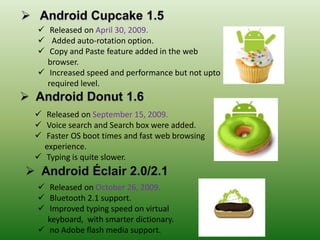
 Released on April 30, 2009.
 Added auto-rotation option.
 Copy and Paste feature added in the web
browser.
 Increased speed and performance but not upto
required level.
 Released on September 15, 2009.
 Voice search and Search box were added.
 Faster OS boot times and fast web browsing
experience.
 Typing is quite slower.
 Released on October 26, 2009.
 Bluetooth 2.1 support.
 Improved typing speed on virtual
keyboard, with smarter dictionary.
 no Adobe flash media support.
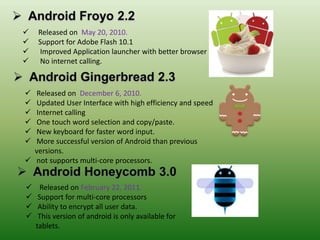
 Released on May 20, 2010.
 Support for Adobe Flash 10.1
 Improved Application launcher with better browser
 No internet calling.
 Released on December 6, 2010.
 Updated User Interface with high efficiency and speed
 Internet calling
 One touch word selection and copy/paste.
 New keyboard for faster word input.
 More successful version of Android than previous
versions.
 not supports multi-core processors.
 Released on February 22, 2011.
 Support for multi-core processors
 Ability to encrypt all user data.
 This version of android is only available for
tablets.
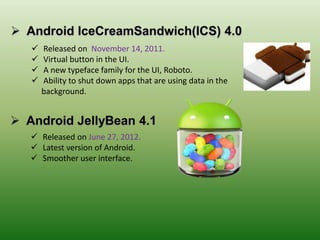
 Released on November 14, 2011.
 Virtual button in the UI.
 A new typeface family for the UI, Roboto.
 Ability to shut down apps that are using data in the
background.
 Released on June 27, 2012.
 Latest version of Android.
 Smoother user interface.
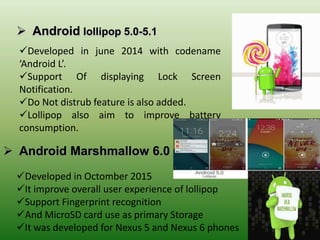
 Android lollipop 5.0-5.1
 Android Marshmallow 6.0
Developed in june 2014 with codename
‘Android L’.
Support Of displaying Lock Screen
Notification.
Do Not distrub feature is also added.
Lollipop also aim to improve battery
consumption.
Developed in Octomber 2015
It improve overall user experience of lollipop
Support Fingerprint recognition
And MicroSD card use as primary Storage
It was developed for Nexus 5 and Nexus 6 phones
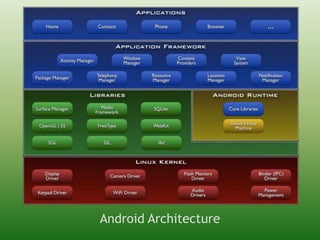
Android Architecture
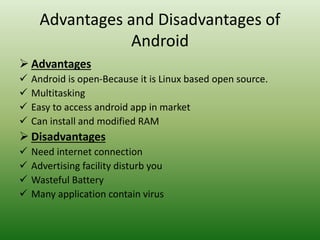
Advantages and Disadvantages of
Android
 Advantages
 Android is open-Because it is Linux based open source.
 Multitasking
 Easy to access android app in market
 Can install and modified RAM
 Disadvantages
 Need internet connection
 Advertising facility disturb you
 Wasteful Battery
 Many application contain virus
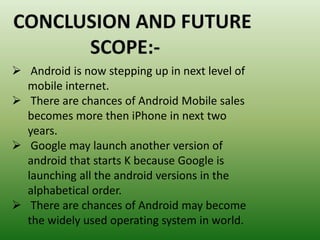
 Android is now stepping up in next level of
mobile internet.
 There are chances of Android Mobile sales
becomes more then iPhone in next two
years.
 Google may launch another version of
android that starts K because Google is
launching all the android versions in the
alphabetical order.
 There are chances of Android may become
the widely used operating system in world.
Android technology gk1

Android technology gk1

  • 1.
    Presented By… Mr. GautamB. Khillare DEPARTMENT OF COMPUTER SCIENCE AND ENGINEERING COLLEGE OF ENGINEERING AND TECHNOLOGY, AKOLA Sant Gadge Baba Amravati University, Amravati [2015-2016] ANDROID OPERATING SYSTEM
  • 2.
    Content • History • IntroductionOf Android • Android Version • Android Architecture • Features of Android • Advantages of Android • Disadvantages of Android • Conclusion
  • 3.
    History  Android wasfound way back in 2003.  It was developed in Palo Alto, California.  Android was developed by the Andy Rubin, Rich Miner, Nick Sears and Chris White.  Android was purchased by the GOOGLE in AUGUST,2005 for 50 million $.  Google acquires mobile software startup Android™ in 2005.  Open Handset Alliance officially starts on November 5th, 2007  Android™ 1.0 source and SDK released in Fall 2008
  • 4.
    Operating System Basedon Linux kernel and now developed by Google,it was designed for a touch screen mobile. Android is powerfull Operating system supporting a large number of application in smart phones  A Software platform and operating system for mobile.  Based on the Linux kernel. 
  • 5.
     It’s consortiumof several companies.  This group of companies are allowed to use source code of Android and develop applications.  Reason for Nokia not to develop Android Mobiles is Nokia is not part of OHA.
  • 6.
    Android is nota single piece of hardware. Android supports wireless communication using:-  Android is a multi-process system, in which each application (and parts of the system) runs in its own process.  3G Networks  4G Networks  802.11 Wi-Fi Networks  Bluetooth Connectivity
  • 7.
    FEATURES OF ANDROID Interfacethat is better then the previous touch screen mobiles. User gets millions of applications that user can not get in any other mobile operating system.  Android supports advanced audio/video/still media formats such as MPEG-4, H.264, MP3, and AAC, AMR, JPEG, PNG, GIF.  Developing an android application is not tough using SDK(standard development kit) and java emulator we can easily develop applications that we want.
  • 8.
  • 9.
     First Versionof Android.  The focus of Android beta is testing incorporating usability.  Android beta will generally have many more problems on speed and performance.  First full version of android.  Released on September 23, 2008.  Wi-Fi and Bluetooth support.  Quite slow in operating.  copy and paste feature in the web browser is not present.
  • 10.
     Released onApril 30, 2009.  Added auto-rotation option.  Copy and Paste feature added in the web browser.  Increased speed and performance but not upto required level.  Released on September 15, 2009.  Voice search and Search box were added.  Faster OS boot times and fast web browsing experience.  Typing is quite slower.  Released on October 26, 2009.  Bluetooth 2.1 support.  Improved typing speed on virtual keyboard, with smarter dictionary.  no Adobe flash media support.
  • 11.
     Released onMay 20, 2010.  Support for Adobe Flash 10.1  Improved Application launcher with better browser  No internet calling.  Released on December 6, 2010.  Updated User Interface with high efficiency and speed  Internet calling  One touch word selection and copy/paste.  New keyboard for faster word input.  More successful version of Android than previous versions.  not supports multi-core processors.  Released on February 22, 2011.  Support for multi-core processors  Ability to encrypt all user data.  This version of android is only available for tablets.
  • 12.
     Released onNovember 14, 2011.  Virtual button in the UI.  A new typeface family for the UI, Roboto.  Ability to shut down apps that are using data in the background.  Released on June 27, 2012.  Latest version of Android.  Smoother user interface.
  • 13.
     Android lollipop5.0-5.1  Android Marshmallow 6.0 Developed in june 2014 with codename ‘Android L’. Support Of displaying Lock Screen Notification. Do Not distrub feature is also added. Lollipop also aim to improve battery consumption. Developed in Octomber 2015 It improve overall user experience of lollipop Support Fingerprint recognition And MicroSD card use as primary Storage It was developed for Nexus 5 and Nexus 6 phones
  • 14.
  • 15.
    Advantages and Disadvantagesof Android  Advantages  Android is open-Because it is Linux based open source.  Multitasking  Easy to access android app in market  Can install and modified RAM  Disadvantages  Need internet connection  Advertising facility disturb you  Wasteful Battery  Many application contain virus
  • 16.
     Android isnow stepping up in next level of mobile internet.  There are chances of Android Mobile sales becomes more then iPhone in next two years.  Google may launch another version of android that starts K because Google is launching all the android versions in the alphabetical order.  There are chances of Android may become the widely used operating system in world.