BBELT 2013 workshop
Scaffolding Reading Experiences:
Easing The Trauma Of Tackling
English Literature
F it P a ge

F u ll S c r e e n O n /O ff

C lo s e B o o k

Mexico DF, 25th January 2013
andrew.watson@britishcouncil.org.mx
CH A P T E R I .
D OW N

A L I CE

TH E

R A B B I T -H O L E

.

w a s b eg in n in g t o g et v er y t ir ed of
Reading Comprehension
Comprehension is the process of simultaneously
extracting and constructing meaning through
interaction and involvement with written
language.
It consists of three elements:
 The text
 The reader
 The activity or
purpose for reading

 Before
 During
 After
Why Scaffold Reading?
• Assist students in comprehending texts (Graves
and Graves, 2003)
The theory comes from:

• scaffolding (Wood, Bruner, & Ross, 1976)
• zone of proximal development (Vygotsky, 1978)
• notion of success (Pressley, 2006).
• gradual release of responsibility (Campione,
1981; Pearson & Gallagher, 1983)
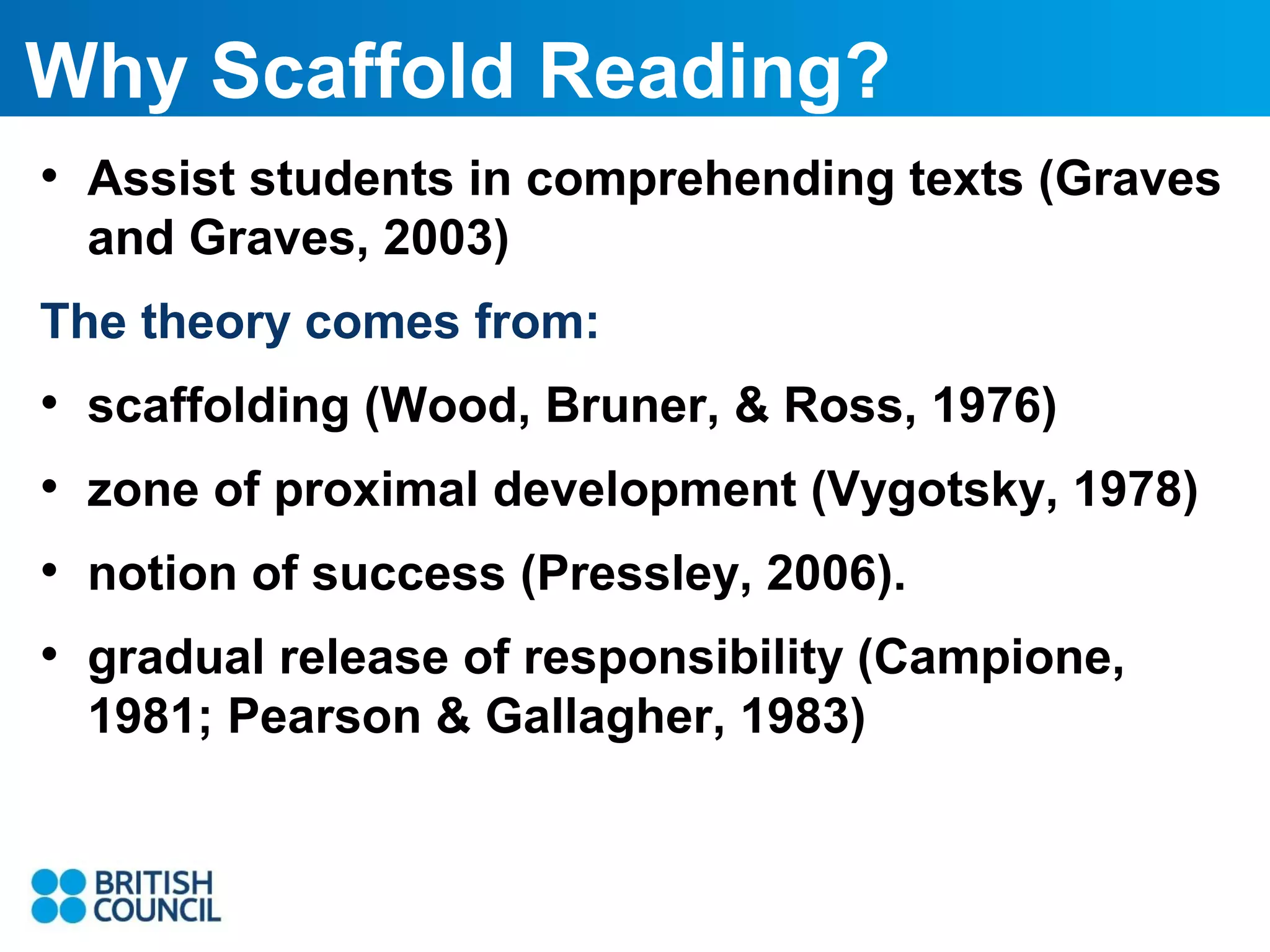
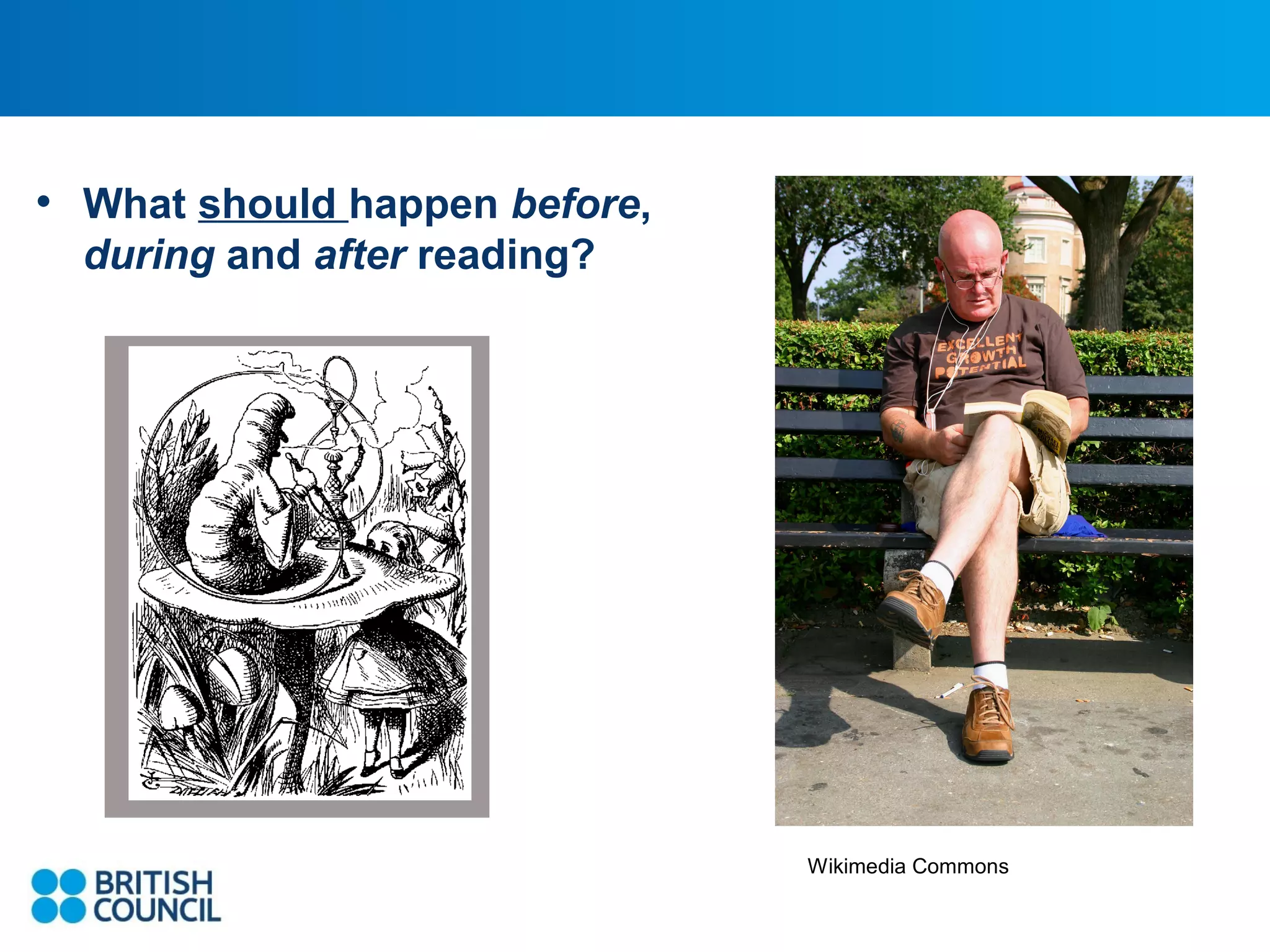
• What should happen before,
O n /O ff

during and after reading?
C lo se B o o k

CH A P T E R V.
A D V ICE

FR OM

A

CA T E R P IL L A R

Wikimedia Commons
.
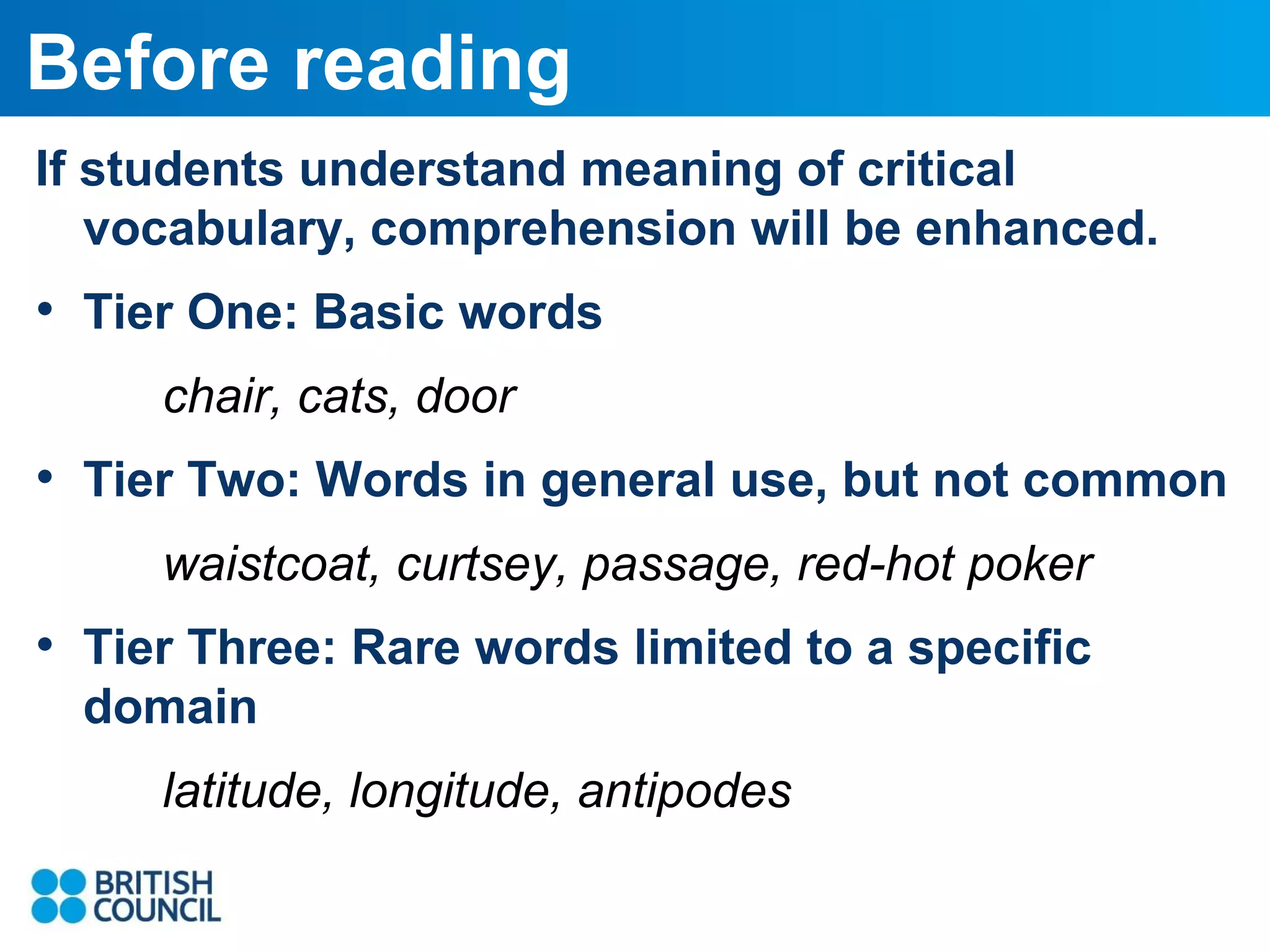
Before reading
If students understand meaning of critical
vocabulary, comprehension will be enhanced.

• Tier One: Basic words
chair, cats, door

• Tier Two: Words in general use, but not common
waistcoat, curtsey, passage, red-hot poker

• Tier Three: Rare words limited to a specific
domain
latitude, longitude, antipodes
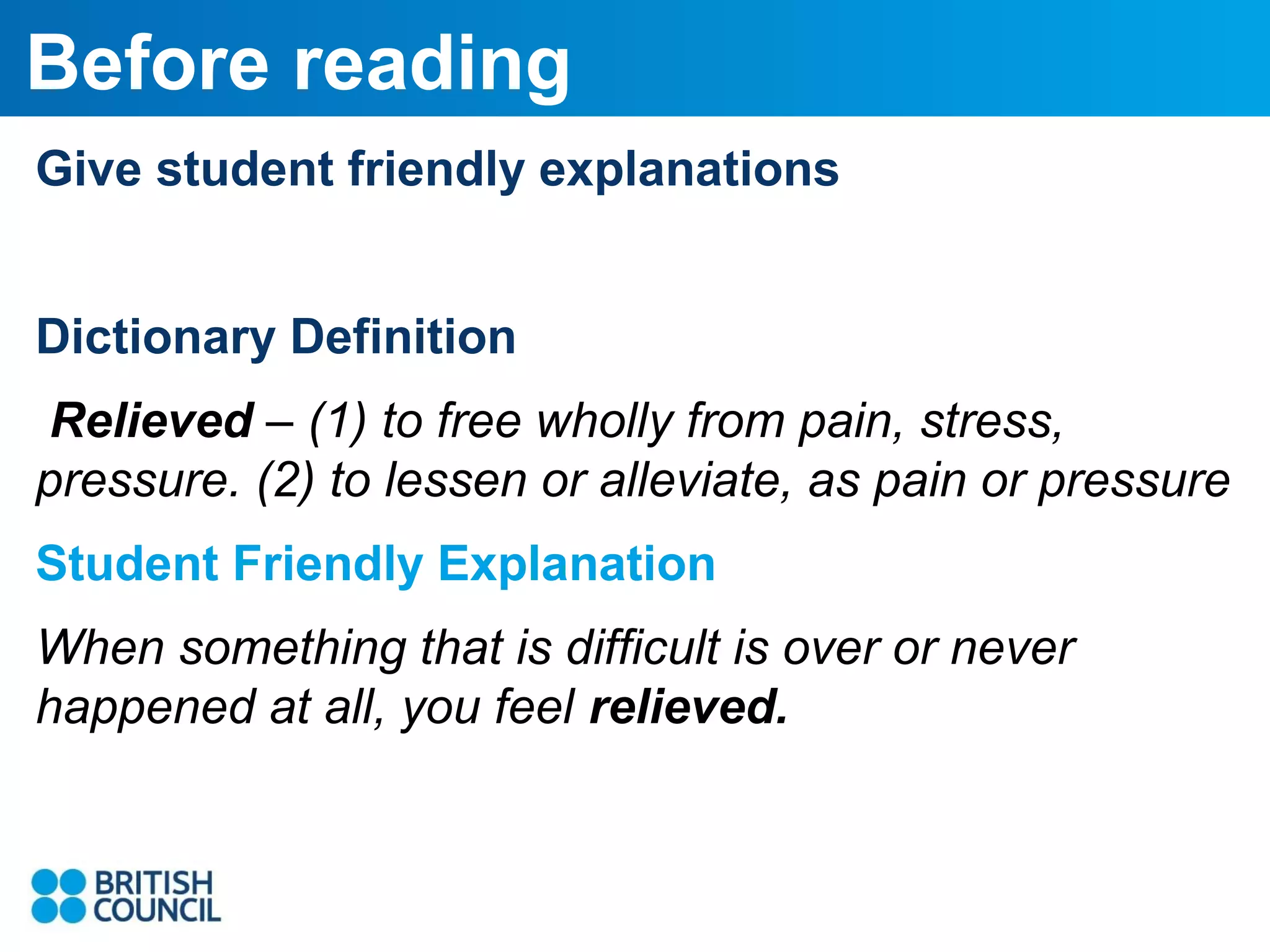
Before reading
Give student friendly explanations
Dictionary Definition
Relieved – (1) to free wholly from pain, stress,
pressure. (2) to lessen or alleviate, as pain or pressure
Student Friendly Explanation
When something that is difficult is over or never
happened at all, you feel relieved.
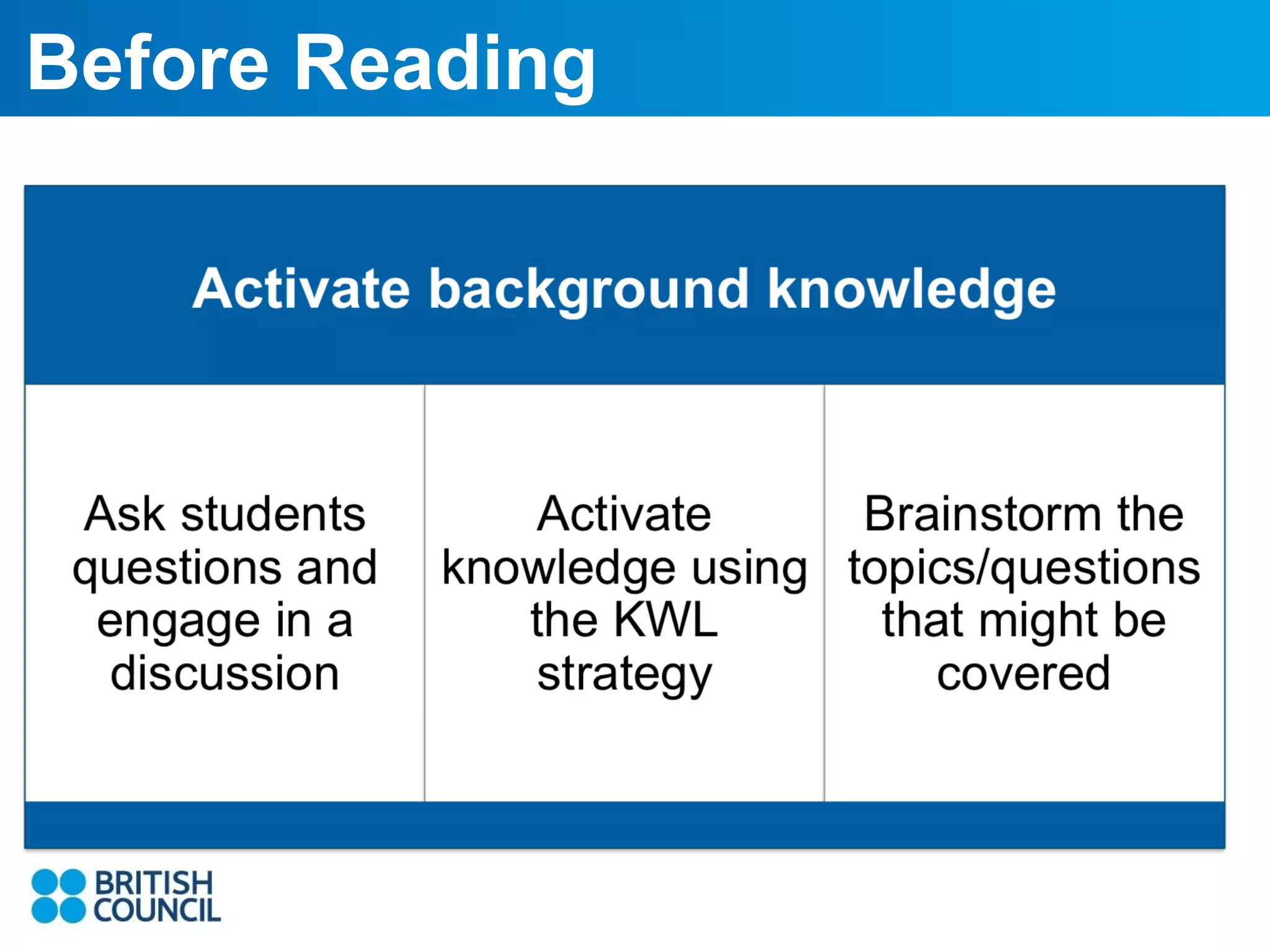
Before Reading
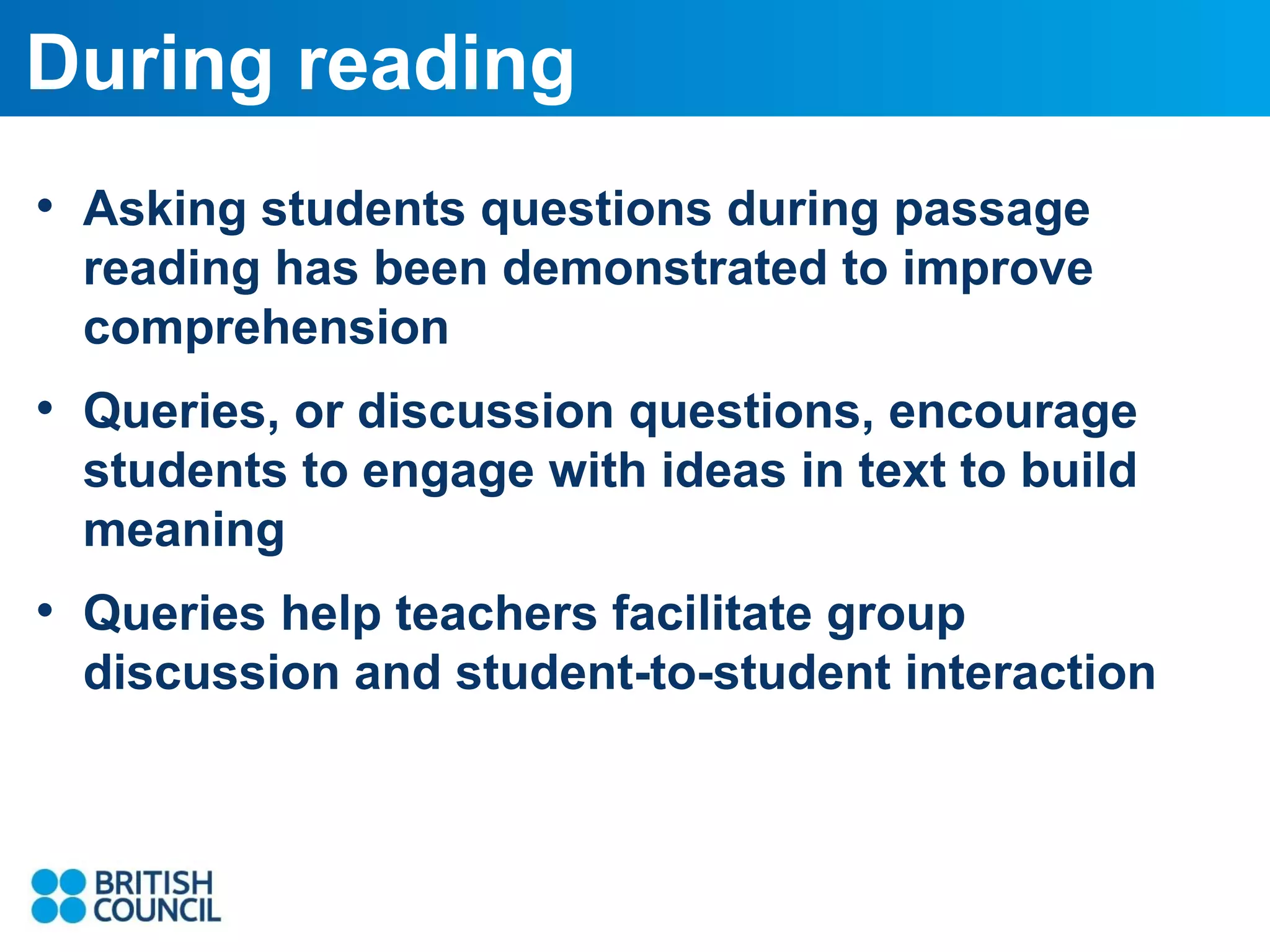
During reading
• Asking students questions during passage
reading has been demonstrated to improve
comprehension

• Queries, or discussion questions, encourage
students to engage with ideas in text to build
meaning

• Queries help teachers facilitate group
discussion and student-to-student interaction
During reading
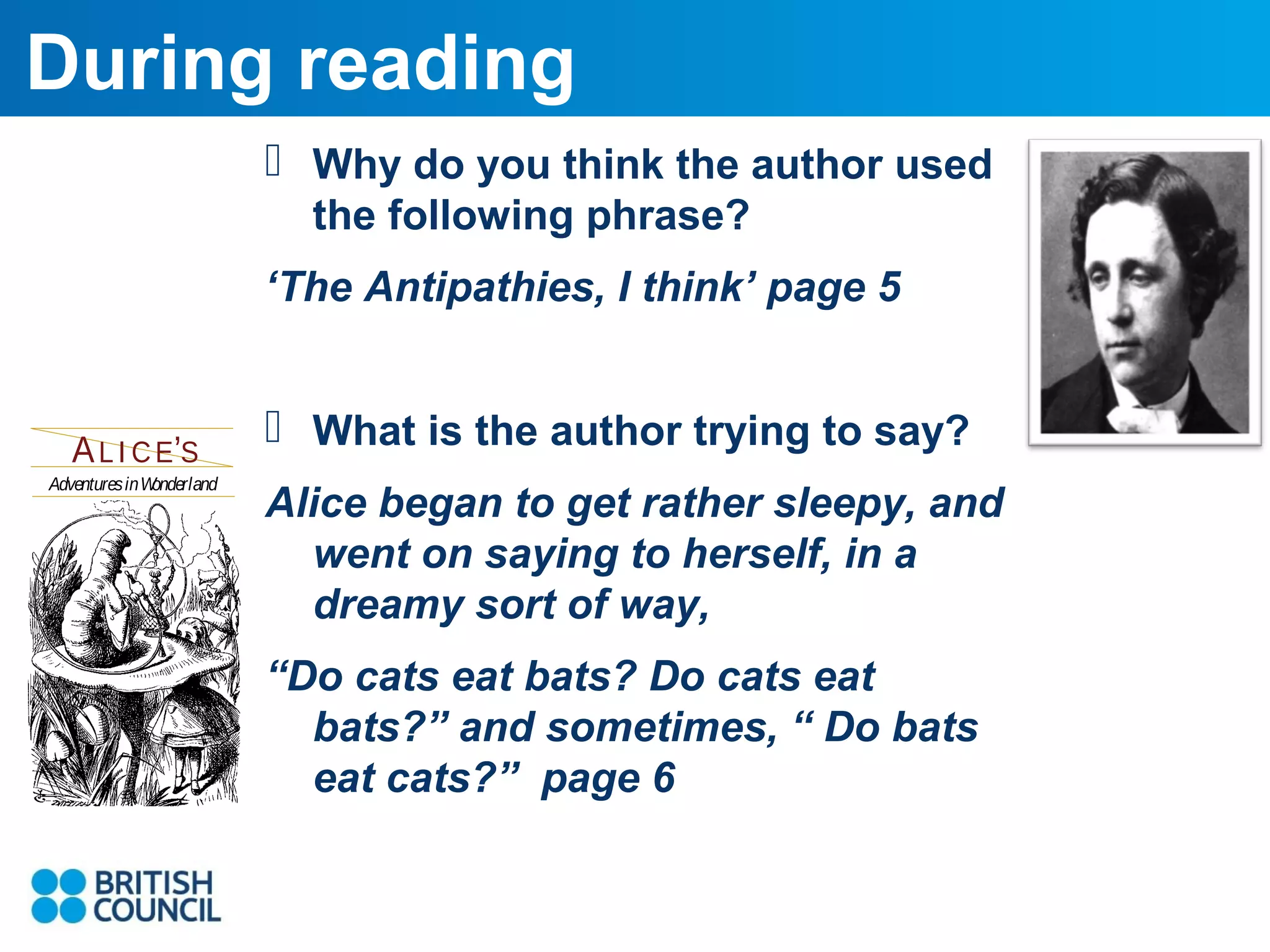
 Why do you think the author used
the following phrase?
‘The Antipathies, I think’ page 5

A L I C E’S
Adventures inW
onderland

s

 What is the author trying to say?
digital edition to that of the
original. After weeks of toil he
created an exact replica of the
original! The book was added
to VolumeOne’s print-ondemand offering. While a PDF
version is offered on various
portals of the Net, BookVirtual
took the project to heart and
added its interface designs and
programming. Welcome to the
world’s most precise all-digital
replica of the world’s most
famous children’s book. Thank
you, Peter.

Alice began to get rather sleepy, and
went on saying to herself, in a
dreamy sort of way,
BookVirtual ™

Books made Virtual. Books made well.

s

www.bookvirtual.com

“Do cats eat bats? Do cats eat
bats?” and sometimes, “ Do bats
eat cats?” page 6
NAVIGATE

s
s

CONTROL

e

CLOSE THE BOOK
TURN THE PAGE

BY LEWIS CARROLL

I LLUSTRATED BY JOHN TENNIEL
During Reading
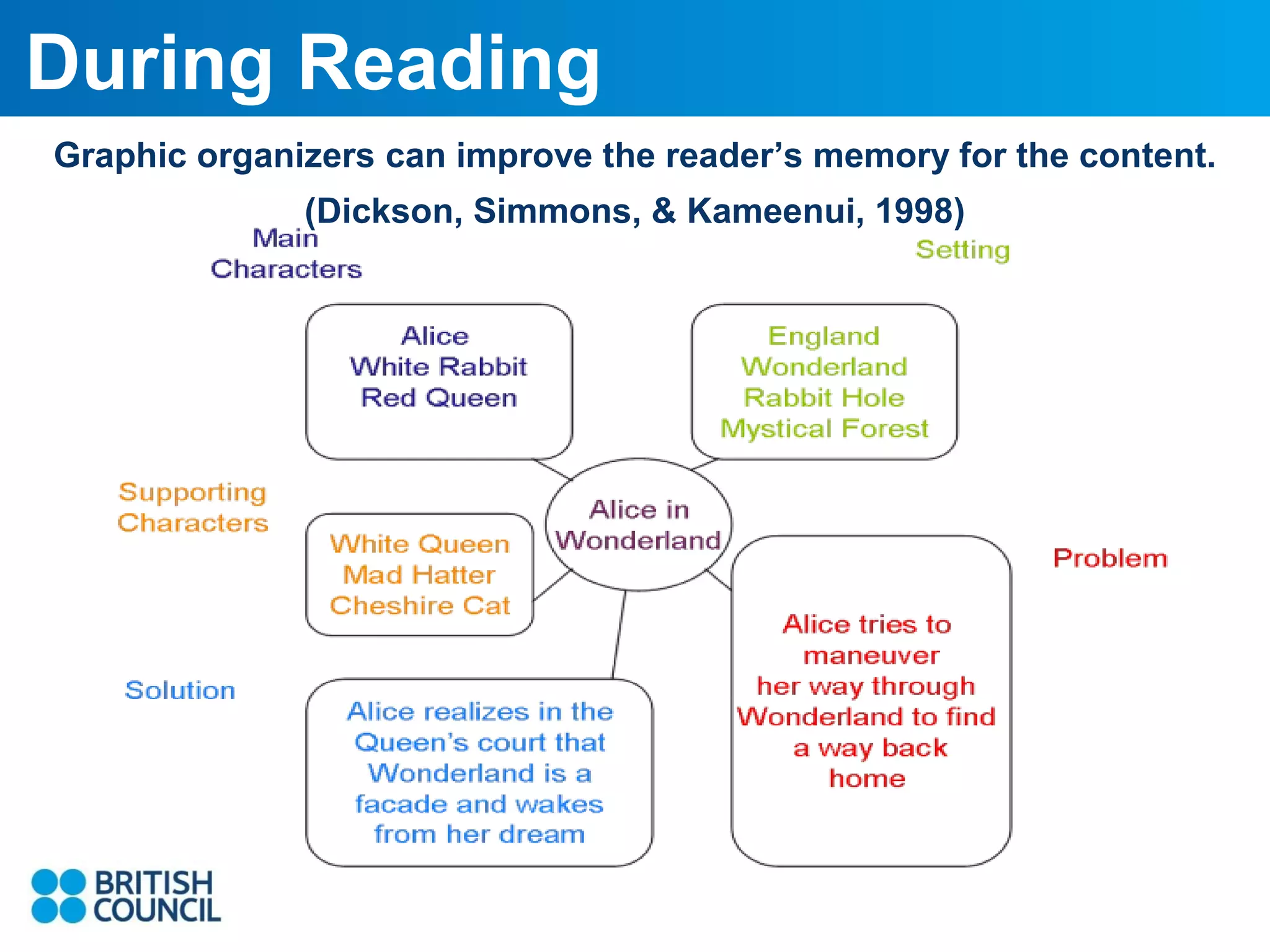
Graphic organizers can improve the reader’s memory for the content.
(Dickson, Simmons, & Kameenui, 1998)
After reading
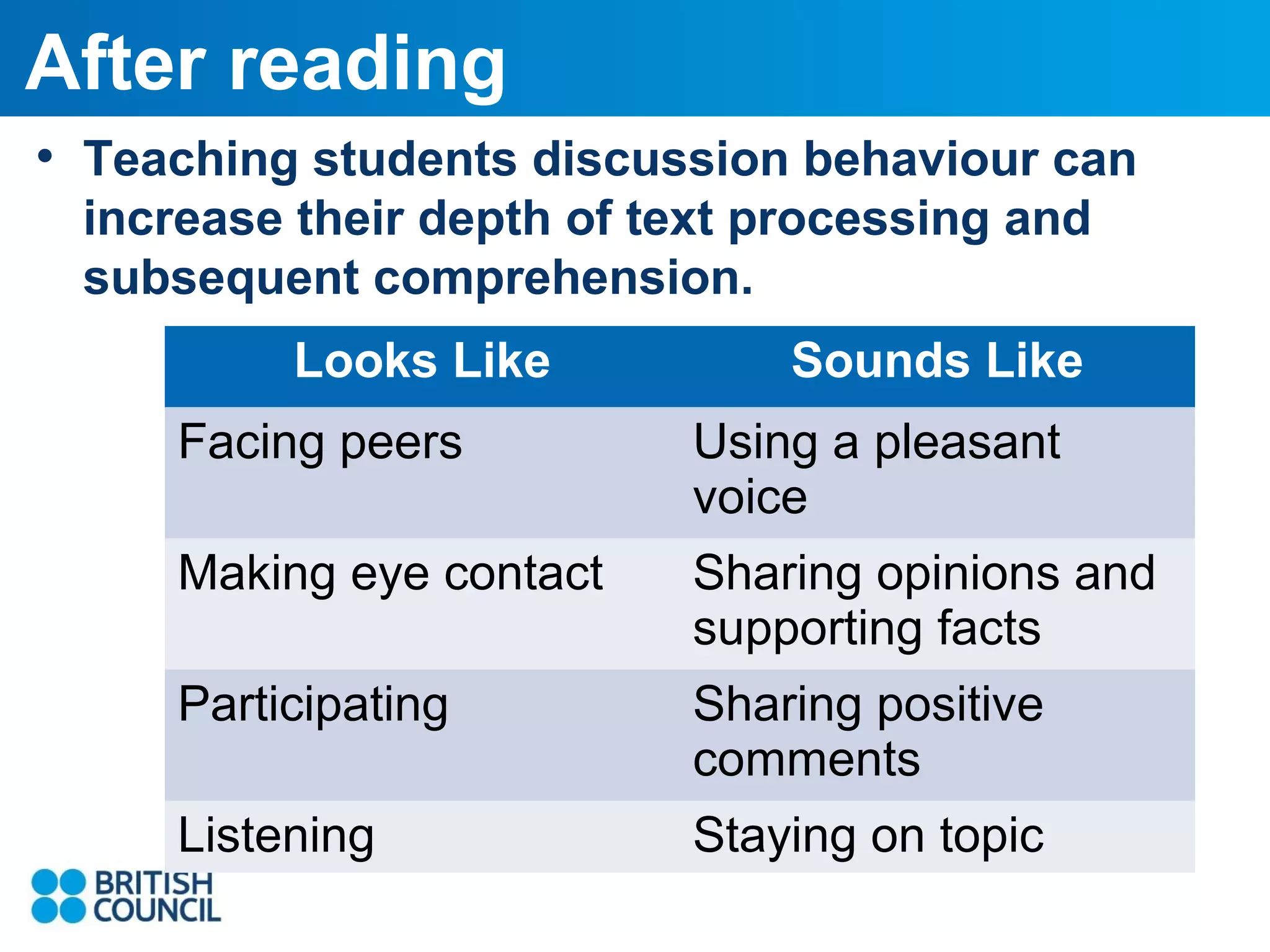
• Teaching students discussion behaviour can
increase their depth of text processing and
subsequent comprehension.
Looks Like

Sounds Like

Facing peers

Using a pleasant
voice

Making eye contact

Sharing opinions and
supporting facts

Participating

Sharing positive
comments

Listening

Staying on topic
After reading
• Writing about what you have read can improve
comprehension.

• Expressing ideas in writing helps the reader
organize ideas.
e.g., Short Tale / Tall Tale
How would your life be different if you were very
tall or very small? What kind of adjustments
would you have to make, if it happened to you
very suddenly, like Alice?
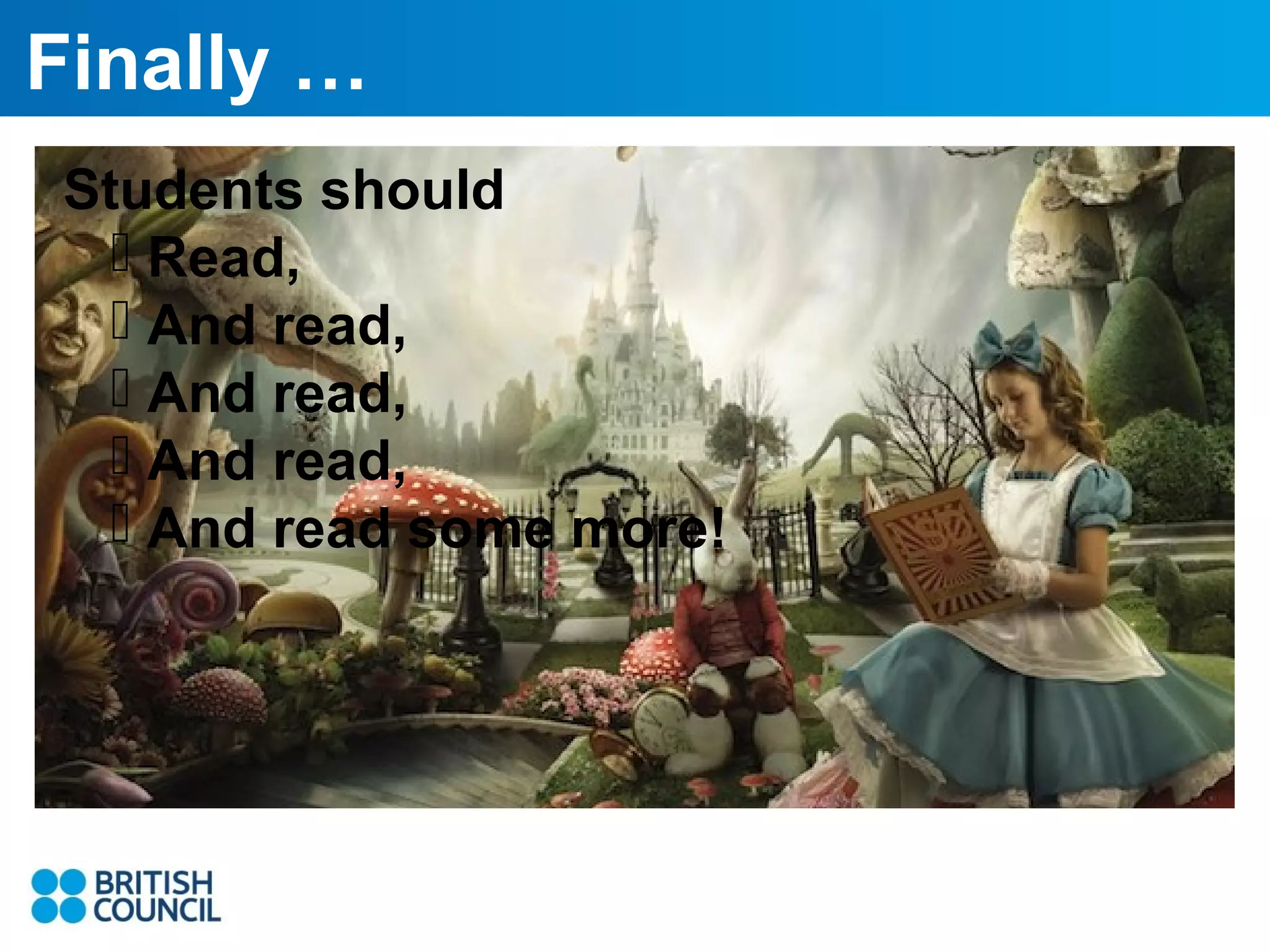
Finally …
Students should
 Read,
 And read,
 And read,
 And read,
 And read some more!

Andrew watson scaffolding reading 2013

  • 1.
    BBELT 2013 workshop ScaffoldingReading Experiences: Easing The Trauma Of Tackling English Literature F it P a ge F u ll S c r e e n O n /O ff C lo s e B o o k Mexico DF, 25th January 2013 andrew.watson@britishcouncil.org.mx CH A P T E R I . D OW N A L I CE TH E R A B B I T -H O L E . w a s b eg in n in g t o g et v er y t ir ed of
  • 2.
    Reading Comprehension Comprehension isthe process of simultaneously extracting and constructing meaning through interaction and involvement with written language. It consists of three elements:  The text  The reader  The activity or purpose for reading  Before  During  After
  • 3.
    Why Scaffold Reading? •Assist students in comprehending texts (Graves and Graves, 2003) The theory comes from: • scaffolding (Wood, Bruner, & Ross, 1976) • zone of proximal development (Vygotsky, 1978) • notion of success (Pressley, 2006). • gradual release of responsibility (Campione, 1981; Pearson & Gallagher, 1983)
  • 4.
    • What shouldhappen before, O n /O ff during and after reading? C lo se B o o k CH A P T E R V. A D V ICE FR OM A CA T E R P IL L A R Wikimedia Commons .
  • 5.
    Before reading If studentsunderstand meaning of critical vocabulary, comprehension will be enhanced. • Tier One: Basic words chair, cats, door • Tier Two: Words in general use, but not common waistcoat, curtsey, passage, red-hot poker • Tier Three: Rare words limited to a specific domain latitude, longitude, antipodes
  • 6.
    Before reading Give studentfriendly explanations Dictionary Definition Relieved – (1) to free wholly from pain, stress, pressure. (2) to lessen or alleviate, as pain or pressure Student Friendly Explanation When something that is difficult is over or never happened at all, you feel relieved.
  • 7.
  • 8.
    During reading • Askingstudents questions during passage reading has been demonstrated to improve comprehension • Queries, or discussion questions, encourage students to engage with ideas in text to build meaning • Queries help teachers facilitate group discussion and student-to-student interaction
  • 9.
    During reading  Whydo you think the author used the following phrase? ‘The Antipathies, I think’ page 5 A L I C E’S Adventures inW onderland s  What is the author trying to say? digital edition to that of the original. After weeks of toil he created an exact replica of the original! The book was added to VolumeOne’s print-ondemand offering. While a PDF version is offered on various portals of the Net, BookVirtual took the project to heart and added its interface designs and programming. Welcome to the world’s most precise all-digital replica of the world’s most famous children’s book. Thank you, Peter. Alice began to get rather sleepy, and went on saying to herself, in a dreamy sort of way, BookVirtual ™ Books made Virtual. Books made well. s www.bookvirtual.com “Do cats eat bats? Do cats eat bats?” and sometimes, “ Do bats eat cats?” page 6 NAVIGATE s s CONTROL e CLOSE THE BOOK TURN THE PAGE BY LEWIS CARROLL I LLUSTRATED BY JOHN TENNIEL
  • 10.
    During Reading Graphic organizerscan improve the reader’s memory for the content. (Dickson, Simmons, & Kameenui, 1998)
  • 11.
    After reading • Teachingstudents discussion behaviour can increase their depth of text processing and subsequent comprehension. Looks Like Sounds Like Facing peers Using a pleasant voice Making eye contact Sharing opinions and supporting facts Participating Sharing positive comments Listening Staying on topic
  • 12.
    After reading • Writingabout what you have read can improve comprehension. • Expressing ideas in writing helps the reader organize ideas. e.g., Short Tale / Tall Tale How would your life be different if you were very tall or very small? What kind of adjustments would you have to make, if it happened to you very suddenly, like Alice?
  • 13.
    Finally … Students should Read,  And read,  And read,  And read,  And read some more!

Editor's Notes

  • #3 There are very explicit processes, strategies and routines used before students read, while they read, and after they read. During this session we’ll provide an overview of the elements of effective before, during and reading instruction.
  • #4 Can anyone tell me what their idea is what scaffolding is about (andamiaje)? Bruner (1978) believed that for learning to take place, teachers or carers must provide appropriate social interactional frameworks. In the case of the young child learning language, the instructional component consists of the caregiver (normally the mother) providing a framework to allow the child to learn. To do this, constructivist educators argue caregiver must always be one step ahead of the child. According to Vygotsky,children have a circumscribed zone of proximal development, a range within which they can learn, and by using contexts that are extremely familiar and routinized the caregiver can facilitate the child’s learning Scaffolded reading can assist learners understanding, enjoying and learning from the selections they read. Successful experiences will produce more avid and better readers. The gradual release of responsibillity involves a progression in which students gradually assume responsibility for their learning from the teacher.
  • #5 You are going to be matching teaching activities according to whether they would be carried out before, during or after reading. Read each statement to them and ask them to hold up 1, 2 or 3 fingers to indicate whether each instructional practice would occur before (1), during (2), or after (3) reading. Engage students in a discussion based on themes in the text (3) Teach the meaning of important unknown vocabulary words (1) Use graphic organizers to enhance comprehension (2)
  • #6 Here are some tips you might find useful when preparing before-reading activities. It’s a good ideaselect words for pre-teaching that are unknown (tier two) and very important for students’ understanding of the passage. You may also decide to select words students are likely to encounter in their future studies (for example, in the Alice in Wonderland chapter, you might choose ‘latitude’ and ‘longitude’ for geography)
  • #7 Avoid dry dictionary definitions
  • #8 Review the three strategies on the slide. What’s the KWL strategy? It’s a way of activating students’ knowledge and get them to anticipate what’s coming What I know What I want to know What I learned Alice in Wonderland: Know Alice drinks There are characters called the Red Queen, the Mad Hatter, and the Dormouse Want to Know What appointment the White Rabbit is late for
  • #9 We should teach students that text is simply someone’s written ideas which may or may not be clearly expressed. This knowledge gives students “permission” to question the text and place responsibility for building the text on students.
  • #10 It’s a humorous play on words. Lewis Carroll was very fond of language games, Antipathies are strong feelngs of dislike, whereas Antipodes is a way of referring to Australia and New Zealand; often used in a humorous way.
  • #11 The main effect of graphic organizers appears to be on the improvement of the reader’s memory for the content that has been read.
  • #12 Engaging students in a discussion can increase their depth of text processing and subsequent comprehension. It is important to teach students the behaviors of discussion.