SCAFFOLDING
READING
COMPREHENSION
OFFICE OF SPECIAL PROGRAMS
Comprehension is the process of
simultaneously extracting and constructing
meaning through interaction and
involvement with written language. It
consists of three elements:
 The reader
 The text
 The activity or purpose for reading
(Rand Reading Study Group, 2002)
OFFICE OF SPECIAL PROGRAMS, EXTENDED AND EARLY LEARNING
Before
During
After
OFFICE OF SPECIAL PROGRAMS, EXTENDED AND EARLY LEARNING
What should
happen
before, during
and after
reading?
SCAFFOLDING READING IN
THE ELEMENTARY GRADES
The Scaffolding Reading in the
Elementary Grades modules
provide the instructional
routines and strategies teachers
need to help students extract
and construct meaning.
OFFICE OF SPECIAL PROGRAMS, EXTENDED AND EARLY LEARNING
BEFORE READING
 Teach the pronunciation of difficult to
read words
 Teach the meaning of critical,
unknown vocabulary words
 Teach or activate any necessary
background knowledge
 Preview the story or the article
OFFICE OF SPECIAL PROGRAMS, EXTENDED AND EARLY LEARNING
Module
Contents
DURING READING
 Utilize passage reading procedures that
provide adequate reading practice
 Ask appropriate questions during passage
reading
 Teach strategies that can be applied to
passage reading
 Use graphic organizers to enhance
comprehension
OFFICE OF SPECIAL PROGRAMS, EXTENDED AND EARLY LEARNING
Module
Contents
AFTER READING
 Provide intentional fluency building
practice
 Engage students in a discussion
 Have students answer written questions
 Provide engaging vocabulary practice
 Have students write summaries of what
they have read
OFFICE OF SPECIAL PROGRAMS, EXTENDED AND EARLY LEARNING
Module
Contents
OFFICE OF SPECIAL PROGRAMS, EXTENDED AND EARLY LEARNING
SNAPSHOTS OF THE INSTRUCTIONAL
PRACTICES AND ROUTINES
BEFORE READING
OFFICE OF SPECIAL PROGRAMS,
EXTENDED AND EARLY LEARNING
BEFORE READING
If students can read the
words in a passage accurately
and fluently, their reading
comprehension will be
enhanced.
OFFICE OF SPECIAL PROGRAMS, EXTENDED AND EARLY LEARNING
BIG
IDEA
TEACH THE PRONUNCIATION OF
DIFFICULT TO READ WORDS.
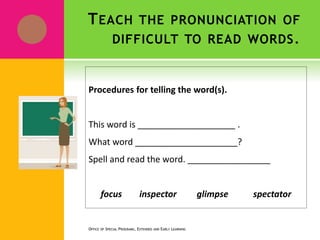
Procedures for telling the word(s).
This word is ____________________ .
What word _____________________?
Spell and read the word. _________________
focus inspector glimpse spectator
OFFICE OF SPECIAL PROGRAMS, EXTENDED AND EARLY LEARNING
A STRATEGY MODELED
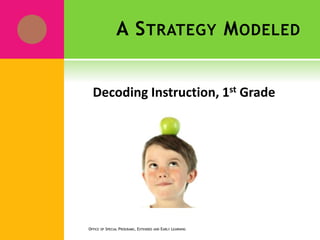
Decoding Instruction, 1st Grade
OFFICE OF SPECIAL PROGRAMS, EXTENDED AND EARLY LEARNING
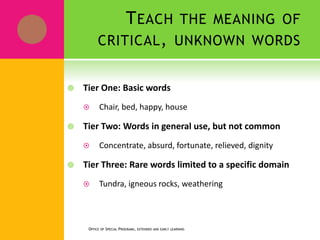
If students understand the
meaning of critical
vocabulary in the passage,
their comprehension will be
enhanced.
OFFICE OF SPECIAL PROGRAMS, EXTENDED AND EARLY LEARNING
BIG
IDEA
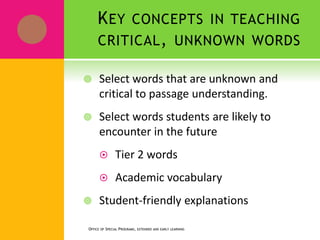
TEACH THE MEANING OF
CRITICAL, UNKNOWN WORDS
 Tier One: Basic words
 Chair, bed, happy, house
 Tier Two: Words in general use, but not common
 Concentrate, absurd, fortunate, relieved, dignity
 Tier Three: Rare words limited to a specific domain
 Tundra, igneous rocks, weathering
OFFICE OF SPECIAL PROGRAMS, EXTENDED AND EARLY LEARNING
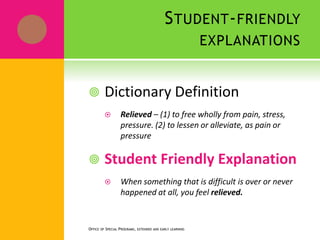
KEY CONCEPTS IN TEACHING
CRITICAL, UNKNOWN WORDS
 Select words that are unknown and
critical to passage understanding.
 Select words students are likely to
encounter in the future
 Tier 2 words
 Academic vocabulary
 Student-friendly explanations
OFFICE OF SPECIAL PROGRAMS, EXTENDED AND EARLY LEARNING
EXAMPLE: TEACHING
CRITICAL, UNKNOWN WORDS
Reading Level: 2nd
Series: Harcourt Trophies
Passage: Lemonade for Sale
announced members neighborhood
arrived rebuild lemonade
glum squawked clubhouse
OFFICE OF SPECIAL PROGRAMS, EXTENDED AND EARLY LEARNING
Select three words for robust explicit instruction.
STUDENT-FRIENDLY
EXPLANATIONS
OFFICE OF SPECIAL PROGRAMS, EXTENDED AND EARLY LEARNING
 Dictionary Definition
 Relieved – (1) to free wholly from pain, stress,
pressure. (2) to lessen or alleviate, as pain or
pressure
 Student Friendly Explanation
 When something that is difficult is over or never
happened at all, you feel relieved.
STUDENT FRIENDLY
DEFINITIONS
Dictionary Definition Student-Friendly Definition
Disgusting – to cause to feel
disgust; be sickening, repulsive, or
very distasteful to
Fragile – easily broken, damaged,
or destroyed
Gratitude – a feeling of thankful
appreciation for favors or benefits
received
Loitering- to linger in an aimless
way; spend time idly
OFFICE OF SPECIAL PROGRAMS, EXTENDED AND EARLY LEARNING
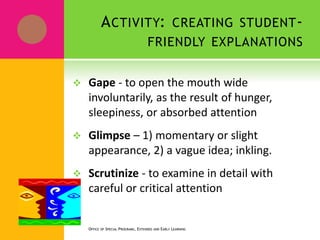
ACTIVITY: CREATING STUDENT-
FRIENDLY EXPLANATIONS
 Gape - to open the mouth wide
involuntarily, as the result of hunger,
sleepiness, or absorbed attention
 Glimpse – 1) momentary or slight
appearance, 2) a vague idea; inkling.
 Scrutinize - to examine in detail with
careful or critical attention
OFFICE OF SPECIAL PROGRAMS, EXTENDED AND EARLY LEARNING
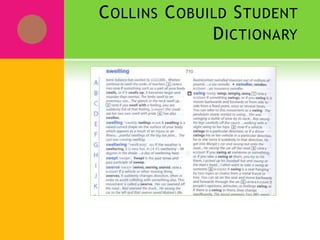
COLLINS COBUILD STUDENT
DICTIONARY
http://www.elearnaid.com/coconewstdis.html
A STRATEGY
Vocabulary Instruction, 2nd Grade
OFFICE OF SPECIAL PROGRAMS, EXTENDED AND EARLY LEARNING
If students have the
background knowledge
required by a passage, their
comprehension will be
enhanced.
OFFICE OF SPECIAL PROGRAMS, EXTENDED AND EARLY LEARNING
BIG
IDEA
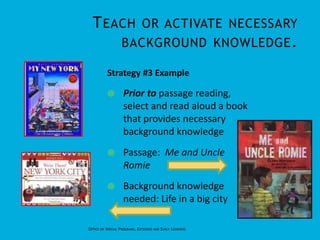
Strategy #3 Example
 Prior to passage reading,
select and read aloud a book
that provides necessary
background knowledge
 Passage: Me and Uncle
Romie
 Background knowledge
needed: Life in a big city
OFFICE OF SPECIAL PROGRAMS, EXTENDED AND EARLY LEARNING
TEACH OR ACTIVATE NECESSARY
BACKGROUND KNOWLEDGE.
ACTIVATING BACKGROUND
KNOWLEDGE
OFFICE OF SPECIAL PROGRAMS, EXTENDED AND EARLY LEARNING
Activate background knowledge using a
research validated strategy
Ask students
questions and
engage in a
discussion
Activate
knowledge using
the KWL strategy
Brainstorm the
topics/questions
that might be
covered
BACKGROUND KNOWLEDGE
OFFICE OF SPECIAL PROGRAMS, EXTENDED AND EARLY LEARNING
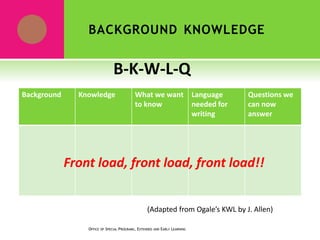
B-K-W-L-Q
Background Knowledge What we want
to know
Language
needed for
writing
Questions we
can now
answer
Front load, front load, front load!!
(Adapted from Ogale’s KWL by J. Allen)
If students preview a
passage, their
comprehension is
enhanced.
OFFICE OF SPECIAL PROGRAMS, EXTENDED AND EARLY LEARNING
BIG
IDEA
DURING READING
OFFICE OF SPECIAL PROGRAMS,
EXTENDED AND EARLY LEARNING
Asking students questions
during passage reading has
proven effectiveness in
improving the comprehension
of students.
OFFICE OF SPECIAL PROGRAMS, EXTENDED AND EARLY LEARNING
BIG
IDEA
QUESTIONING THE AUTHOR: AN
APPROACH FOR ENHANCING STUDENT
ENGAGEMENT WITH TEXT
(BECK, MCKEOWN, HAMILTON & KUCAN, 1997)
 Comprehension strategy to teach
students to construct meaning during
reading
 Queries, or discussion questions,
encourage students to engage with ideas
in text to build meaning
 Queries help teachers facilitate group
discussion and student-to-student
interaction
OFFICE OF SPECIAL PROGRAMS, EXTENDED AND EARLY LEARNING
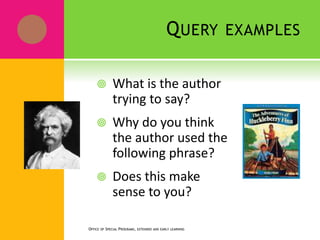
QUERY EXAMPLES
 What is the author
trying to say?
 Why do you think
the author used the
following phrase?
 Does this make
sense to you?
OFFICE OF SPECIAL PROGRAMS, EXTENDED AND EARLY LEARNING
Instruction in specific cognitive
strategies can improve reading
comprehension for all students
and, most particularly, can assist
struggling readers.
(RAND Reading Study Group, 2002)
OFFICE OF SPECIAL PROGRAMS, EXTENDED AND EARLY LEARNING
BIG
IDEA
COGNITIVE STRATEGIES
 Competent Readers Strategies
 Text Structure Strategies
 Fix-Up Strategies
 Reread
 Look back
 Read ahead
 Restate in your own words
OFFICE OF SPECIAL PROGRAMS, EXTENDED AND EARLY LEARNING
The ability to identify and take
advantage of text
organization can contribute
to students’ comprehension.
(Dickson, Simmons, & Kameenui, 1998)
OFFICE OF SPECIAL PROGRAMS, EXTENDED AND EARLY LEARNING
BIG
IDEA
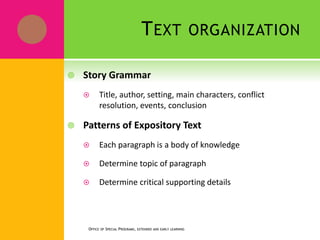
TEXT ORGANIZATION
 Story Grammar
 Title, author, setting, main characters, conflict
resolution, events, conclusion
 Patterns of Expository Text
 Each paragraph is a body of knowledge
 Determine topic of paragraph
 Determine critical supporting details
OFFICE OF SPECIAL PROGRAMS, EXTENDED AND EARLY LEARNING
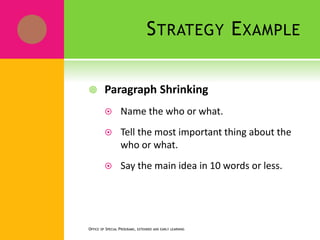
STRATEGY EXAMPLE
 Paragraph Shrinking
 Name the who or what.
 Tell the most important thing about the
who or what.
 Say the main idea in 10 words or less.
OFFICE OF SPECIAL PROGRAMS, EXTENDED AND EARLY LEARNING
The main effect of graphic
organizers appears to be on
the improvement of the
reader’s memory for the
content that has been read.
(Dickson, Simmons, & Kameenui, 1998)
OFFICE OF SPECIAL PROGRAMS, EXTENDED AND EARLY LEARNING
BIG
IDEA
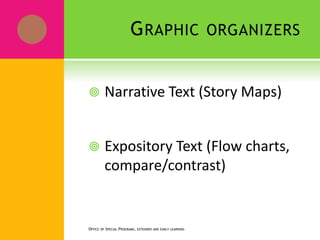
GRAPHIC ORGANIZERS
 Narrative Text (Story Maps)
 Expository Text (Flow charts,
compare/contrast)
OFFICE OF SPECIAL PROGRAMS, EXTENDED AND EARLY LEARNING
AFTER READING
OFFICE OF SPECIAL PROGRAMS,
EXTENDED AND EARLY LEARNING
Fluency is related to
reading comprehension.
(Cunningham & Stanovich, 1998; Fuchs, Fuchs, & Maxwell, 1988)
OFFICE OF SPECIAL PROGRAMS, EXTENDED AND EARLY LEARNING
BIG
IDEA
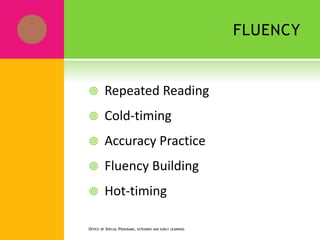
FLUENCY
 Repeated Reading
 Cold-timing
 Accuracy Practice
 Fluency Building
 Hot-timing
OFFICE OF SPECIAL PROGRAMS, EXTENDED AND EARLY LEARNING
Engaging students in a
discussion can increase
their depth of text
processing and subsequent
comprehension.
OFFICE OF SPECIAL PROGRAMS, EXTENDED AND EARLY LEARNING
BIG
IDEA
DISCUSSION
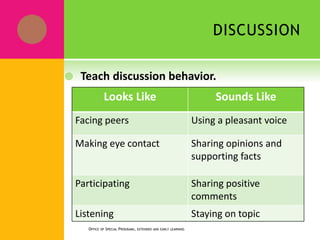
 Teach discussion behavior.
OFFICE OF SPECIAL PROGRAMS, EXTENDED AND EARLY LEARNING
Looks Like Sounds Like
Facing peers Using a pleasant voice
Making eye contact Sharing opinions and
supporting facts
Participating Sharing positive
comments
Listening Staying on topic
 Writing about what you have
read can improve your
comprehension.
 Expressing your ideas in
writing helps the reader
organize ideas.
OFFICE OF SPECIAL PROGRAMS, EXTENDED AND EARLY LEARNING
BIG
IDEA
 Writing about what you have
read can improve your
comprehension.
 Expressing your ideas in
writing helps the reader
organize ideas.
OFFICE OF SPECIAL PROGRAMS, EXTENDED AND EARLY LEARNING
BIG
IDEA
Students must
 Read,
 And read,
 And read,
 And read,
 And read some more!
OFFICE OF SPECIAL PROGRAMS, EXTENDED AND EARLY LEARNING
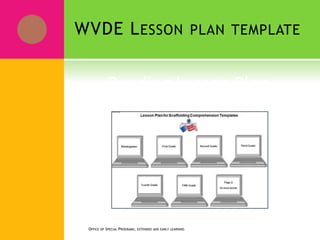
WVDE LESSON PLAN TEMPLATE
Reading Lesson Plan
OFFICE OF SPECIAL PROGRAMS, EXTENDED AND EARLY LEARNING
CONTACT INFORMATION
Phyllis Veith, Assistant Director, Office of Special
Programs
pveith@access.k12.wv.us
Linda Palenchar, Coordinator, Office of Special
Programs
lpalench@access.k12.wv.us
OFFICE OF SPECIAL PROGRAMS, EXTENDED AND EARLY LEARNING

Scaffolding Reading Comprehension ENG101A.ppt

  • 1.
  • 2.
    Comprehension is theprocess of simultaneously extracting and constructing meaning through interaction and involvement with written language. It consists of three elements:  The reader  The text  The activity or purpose for reading (Rand Reading Study Group, 2002) OFFICE OF SPECIAL PROGRAMS, EXTENDED AND EARLY LEARNING Before During After
  • 3.
    OFFICE OF SPECIALPROGRAMS, EXTENDED AND EARLY LEARNING What should happen before, during and after reading?
  • 4.
    SCAFFOLDING READING IN THEELEMENTARY GRADES The Scaffolding Reading in the Elementary Grades modules provide the instructional routines and strategies teachers need to help students extract and construct meaning. OFFICE OF SPECIAL PROGRAMS, EXTENDED AND EARLY LEARNING
  • 5.
    BEFORE READING  Teachthe pronunciation of difficult to read words  Teach the meaning of critical, unknown vocabulary words  Teach or activate any necessary background knowledge  Preview the story or the article OFFICE OF SPECIAL PROGRAMS, EXTENDED AND EARLY LEARNING Module Contents
  • 6.
    DURING READING  Utilizepassage reading procedures that provide adequate reading practice  Ask appropriate questions during passage reading  Teach strategies that can be applied to passage reading  Use graphic organizers to enhance comprehension OFFICE OF SPECIAL PROGRAMS, EXTENDED AND EARLY LEARNING Module Contents
  • 7.
    AFTER READING  Provideintentional fluency building practice  Engage students in a discussion  Have students answer written questions  Provide engaging vocabulary practice  Have students write summaries of what they have read OFFICE OF SPECIAL PROGRAMS, EXTENDED AND EARLY LEARNING Module Contents
  • 8.
    OFFICE OF SPECIALPROGRAMS, EXTENDED AND EARLY LEARNING SNAPSHOTS OF THE INSTRUCTIONAL PRACTICES AND ROUTINES
  • 9.
    BEFORE READING OFFICE OFSPECIAL PROGRAMS, EXTENDED AND EARLY LEARNING
  • 10.
    BEFORE READING If studentscan read the words in a passage accurately and fluently, their reading comprehension will be enhanced. OFFICE OF SPECIAL PROGRAMS, EXTENDED AND EARLY LEARNING BIG IDEA
  • 11.
    TEACH THE PRONUNCIATIONOF DIFFICULT TO READ WORDS. Procedures for telling the word(s). This word is ____________________ . What word _____________________? Spell and read the word. _________________ focus inspector glimpse spectator OFFICE OF SPECIAL PROGRAMS, EXTENDED AND EARLY LEARNING
  • 12.
    A STRATEGY MODELED DecodingInstruction, 1st Grade OFFICE OF SPECIAL PROGRAMS, EXTENDED AND EARLY LEARNING
  • 13.
    If students understandthe meaning of critical vocabulary in the passage, their comprehension will be enhanced. OFFICE OF SPECIAL PROGRAMS, EXTENDED AND EARLY LEARNING BIG IDEA
  • 14.
    TEACH THE MEANINGOF CRITICAL, UNKNOWN WORDS  Tier One: Basic words  Chair, bed, happy, house  Tier Two: Words in general use, but not common  Concentrate, absurd, fortunate, relieved, dignity  Tier Three: Rare words limited to a specific domain  Tundra, igneous rocks, weathering OFFICE OF SPECIAL PROGRAMS, EXTENDED AND EARLY LEARNING
  • 15.
    KEY CONCEPTS INTEACHING CRITICAL, UNKNOWN WORDS  Select words that are unknown and critical to passage understanding.  Select words students are likely to encounter in the future  Tier 2 words  Academic vocabulary  Student-friendly explanations OFFICE OF SPECIAL PROGRAMS, EXTENDED AND EARLY LEARNING
  • 16.
    EXAMPLE: TEACHING CRITICAL, UNKNOWNWORDS Reading Level: 2nd Series: Harcourt Trophies Passage: Lemonade for Sale announced members neighborhood arrived rebuild lemonade glum squawked clubhouse OFFICE OF SPECIAL PROGRAMS, EXTENDED AND EARLY LEARNING Select three words for robust explicit instruction.
  • 17.
    STUDENT-FRIENDLY EXPLANATIONS OFFICE OF SPECIALPROGRAMS, EXTENDED AND EARLY LEARNING  Dictionary Definition  Relieved – (1) to free wholly from pain, stress, pressure. (2) to lessen or alleviate, as pain or pressure  Student Friendly Explanation  When something that is difficult is over or never happened at all, you feel relieved.
  • 18.
    STUDENT FRIENDLY DEFINITIONS Dictionary DefinitionStudent-Friendly Definition Disgusting – to cause to feel disgust; be sickening, repulsive, or very distasteful to Fragile – easily broken, damaged, or destroyed Gratitude – a feeling of thankful appreciation for favors or benefits received Loitering- to linger in an aimless way; spend time idly OFFICE OF SPECIAL PROGRAMS, EXTENDED AND EARLY LEARNING
  • 19.
    ACTIVITY: CREATING STUDENT- FRIENDLYEXPLANATIONS  Gape - to open the mouth wide involuntarily, as the result of hunger, sleepiness, or absorbed attention  Glimpse – 1) momentary or slight appearance, 2) a vague idea; inkling.  Scrutinize - to examine in detail with careful or critical attention OFFICE OF SPECIAL PROGRAMS, EXTENDED AND EARLY LEARNING
  • 20.
  • 21.
    A STRATEGY Vocabulary Instruction,2nd Grade OFFICE OF SPECIAL PROGRAMS, EXTENDED AND EARLY LEARNING
  • 22.
    If students havethe background knowledge required by a passage, their comprehension will be enhanced. OFFICE OF SPECIAL PROGRAMS, EXTENDED AND EARLY LEARNING BIG IDEA
  • 23.
    Strategy #3 Example Prior to passage reading, select and read aloud a book that provides necessary background knowledge  Passage: Me and Uncle Romie  Background knowledge needed: Life in a big city OFFICE OF SPECIAL PROGRAMS, EXTENDED AND EARLY LEARNING TEACH OR ACTIVATE NECESSARY BACKGROUND KNOWLEDGE.
  • 24.
    ACTIVATING BACKGROUND KNOWLEDGE OFFICE OFSPECIAL PROGRAMS, EXTENDED AND EARLY LEARNING Activate background knowledge using a research validated strategy Ask students questions and engage in a discussion Activate knowledge using the KWL strategy Brainstorm the topics/questions that might be covered
  • 25.
    BACKGROUND KNOWLEDGE OFFICE OFSPECIAL PROGRAMS, EXTENDED AND EARLY LEARNING B-K-W-L-Q Background Knowledge What we want to know Language needed for writing Questions we can now answer Front load, front load, front load!! (Adapted from Ogale’s KWL by J. Allen)
  • 26.
    If students previewa passage, their comprehension is enhanced. OFFICE OF SPECIAL PROGRAMS, EXTENDED AND EARLY LEARNING BIG IDEA
  • 27.
    DURING READING OFFICE OFSPECIAL PROGRAMS, EXTENDED AND EARLY LEARNING
  • 28.
    Asking students questions duringpassage reading has proven effectiveness in improving the comprehension of students. OFFICE OF SPECIAL PROGRAMS, EXTENDED AND EARLY LEARNING BIG IDEA
  • 29.
    QUESTIONING THE AUTHOR:AN APPROACH FOR ENHANCING STUDENT ENGAGEMENT WITH TEXT (BECK, MCKEOWN, HAMILTON & KUCAN, 1997)  Comprehension strategy to teach students to construct meaning during reading  Queries, or discussion questions, encourage students to engage with ideas in text to build meaning  Queries help teachers facilitate group discussion and student-to-student interaction OFFICE OF SPECIAL PROGRAMS, EXTENDED AND EARLY LEARNING
  • 30.
    QUERY EXAMPLES  Whatis the author trying to say?  Why do you think the author used the following phrase?  Does this make sense to you? OFFICE OF SPECIAL PROGRAMS, EXTENDED AND EARLY LEARNING
  • 31.
    Instruction in specificcognitive strategies can improve reading comprehension for all students and, most particularly, can assist struggling readers. (RAND Reading Study Group, 2002) OFFICE OF SPECIAL PROGRAMS, EXTENDED AND EARLY LEARNING BIG IDEA
  • 32.
    COGNITIVE STRATEGIES  CompetentReaders Strategies  Text Structure Strategies  Fix-Up Strategies  Reread  Look back  Read ahead  Restate in your own words OFFICE OF SPECIAL PROGRAMS, EXTENDED AND EARLY LEARNING
  • 33.
    The ability toidentify and take advantage of text organization can contribute to students’ comprehension. (Dickson, Simmons, & Kameenui, 1998) OFFICE OF SPECIAL PROGRAMS, EXTENDED AND EARLY LEARNING BIG IDEA
  • 34.
    TEXT ORGANIZATION  StoryGrammar  Title, author, setting, main characters, conflict resolution, events, conclusion  Patterns of Expository Text  Each paragraph is a body of knowledge  Determine topic of paragraph  Determine critical supporting details OFFICE OF SPECIAL PROGRAMS, EXTENDED AND EARLY LEARNING
  • 35.
    STRATEGY EXAMPLE  ParagraphShrinking  Name the who or what.  Tell the most important thing about the who or what.  Say the main idea in 10 words or less. OFFICE OF SPECIAL PROGRAMS, EXTENDED AND EARLY LEARNING
  • 36.
    The main effectof graphic organizers appears to be on the improvement of the reader’s memory for the content that has been read. (Dickson, Simmons, & Kameenui, 1998) OFFICE OF SPECIAL PROGRAMS, EXTENDED AND EARLY LEARNING BIG IDEA
  • 37.
    GRAPHIC ORGANIZERS  NarrativeText (Story Maps)  Expository Text (Flow charts, compare/contrast) OFFICE OF SPECIAL PROGRAMS, EXTENDED AND EARLY LEARNING
  • 38.
    AFTER READING OFFICE OFSPECIAL PROGRAMS, EXTENDED AND EARLY LEARNING
  • 39.
    Fluency is relatedto reading comprehension. (Cunningham & Stanovich, 1998; Fuchs, Fuchs, & Maxwell, 1988) OFFICE OF SPECIAL PROGRAMS, EXTENDED AND EARLY LEARNING BIG IDEA
  • 40.
    FLUENCY  Repeated Reading Cold-timing  Accuracy Practice  Fluency Building  Hot-timing OFFICE OF SPECIAL PROGRAMS, EXTENDED AND EARLY LEARNING
  • 41.
    Engaging students ina discussion can increase their depth of text processing and subsequent comprehension. OFFICE OF SPECIAL PROGRAMS, EXTENDED AND EARLY LEARNING BIG IDEA
  • 42.
    DISCUSSION  Teach discussionbehavior. OFFICE OF SPECIAL PROGRAMS, EXTENDED AND EARLY LEARNING Looks Like Sounds Like Facing peers Using a pleasant voice Making eye contact Sharing opinions and supporting facts Participating Sharing positive comments Listening Staying on topic
  • 43.
     Writing aboutwhat you have read can improve your comprehension.  Expressing your ideas in writing helps the reader organize ideas. OFFICE OF SPECIAL PROGRAMS, EXTENDED AND EARLY LEARNING BIG IDEA
  • 44.
     Writing aboutwhat you have read can improve your comprehension.  Expressing your ideas in writing helps the reader organize ideas. OFFICE OF SPECIAL PROGRAMS, EXTENDED AND EARLY LEARNING BIG IDEA
  • 45.
    Students must  Read, And read,  And read,  And read,  And read some more! OFFICE OF SPECIAL PROGRAMS, EXTENDED AND EARLY LEARNING
  • 46.
    WVDE LESSON PLANTEMPLATE Reading Lesson Plan OFFICE OF SPECIAL PROGRAMS, EXTENDED AND EARLY LEARNING
  • 47.
    CONTACT INFORMATION Phyllis Veith,Assistant Director, Office of Special Programs pveith@access.k12.wv.us Linda Palenchar, Coordinator, Office of Special Programs lpalench@access.k12.wv.us OFFICE OF SPECIAL PROGRAMS, EXTENDED AND EARLY LEARNING

Editor's Notes

  • #3 There are very explicit processes, strategies and routines used before students read, while they read, and after they read. During this session we’ll provide an overview of the elements of effective before, during and reading instruction.
  • #4 Introduce the ACTIVITY by telling participants you will present a series of instructional activities used before, during and after reading. Read each statement to them and ask them to hold up 1, 2 or 3 fingers to indicate whether each instructional practice would occur before (1), during (2), or after (3) reading. Provide the correct answers (listed on notes pages) as you go.
  • #13  Activity: In this clip participants will watch Dr. Anita Archer modeling pronunciation strategies just presented. Ask participants to take notes on the teaching procedure as they watch. Debrief at conclusion of video. (Click on the photo to launch the video.)
  • #20 Give participants 5 minutes to create three student friendly explanations. Time permitting, ask #1’s to share examples for each word.
  • #21 This is a great resource for use in generating your student friendly explanations. It is NOT for students as it published in Great Britain and contains British terms, etc. It is, however, an easy reference tool for you to use as you plan your vocabulary procedures work. Cost is $28.95.
  • #22 This is the same video we watched at the beginning of this session. Watch it again and use your new knowledge about teaching vocabulary to expand your original lists of effective instructional strategies for preparing students to read.
  • #24 Me and Uncle Romie brings the world of art to life for children, through Claire Hartfield's story based on the life and work of world-renowned African-American collage artist, Romare Bearden. This fictional tale follows a young boy as he travels by train from his smalltown home in North Carolina for a visit with his Uncle Romie, an artist in New York City. Through the boy's experiences, readers will discover the City's wonders and learn, in a lively and personal way, about the connection between life experiences and art. Students likely need more background information on NYC. Selecting and reading aloud to students prior to having them read Me and Uncle Romie gives them necessary information for understanding and enjoying the book. Without this “front loading”, children may encounter difficulty in their reading due to lack of background knowledge.
  • #25 Review the three strategies on the slide.
  • #26 Using this strategy helps level the playing field for students with limited background knowledge and gives students universal knowledge.
  • #30 Students are taught that text is simply someone’s written ideas which may or may not be clearly expressed. This knowledge gives students “permission” to question the text and place responsibility for building the text on students.
  • #31 To introduce the strategy, display a short passage to students along with one or two queries you have designed ahead of time. Model for your students how you think through the queries. Invite individual students or small groups to read and work through the queries you have prepared for their readings. Remember that your role as the teacher during this strategy is to facilitate the discussion, not lead it. When students ask questions that go unanswered, try to restate them and encourage students to work to determine the answer. (http://www.adlit.org/strategies/19796 )
  • #35 story grammar" addresses the elements of a story. These include but are not limited to: the title, author, setting, main characters, conflict and resolution, events, and conclusion. Some additional elements that may be specified under "events" are: the initiating event, internal response, attempt, consequence, and reaction.
  • #40 When students read fluently, decoding requires less attention. Attention, therefore, can be given to comprehension. Additionally, reading begets reading behavior – an accurate fluency reader will read more! What are the benefits of more reading?
  • #41 We must provide intentional fluency building practice. It’s easily managed in the well-designed reading classroom and students love it. Some specific strategies are noted. Cold timing = 1 minute timing without practice Accuracy Practice = Chorally read the material with your students. Fluency Building = Have students whisper-read as you time them for one minute. Hot-timing = Students exchange papers with partners. First reader reads for 1 minute, second student marks errors and circles last word read. Repeat for second reader. Have partners determine the number of correct words read for their partner. Have students graph their cold and hot timings.
  • #42 It is important to teach students the behaviors of discussion.