
Informal  Writing for Critical Thinking Mary E. Hillis Kansai Gaidai University
“ Writing is both a process of doing critical thinking  and a product communicating the results of critical thinking.” Bean (2001)
What is informal writing? Write for 1 minute
Exchange papers Read and respond to your partners writing.  Do you agree, disagree, or have something to add?
Characteristics of Informal Writing Used to develop critical thinking skills Used to actively involve students with the material and to personalize the learning process Integrated into the lesson and linked to other informal or formal assignments Ungraded, or minimally marked writing
Why use Informal Writing Assignments? Develop critical thinking skills Involve students in the lesson Offer students more opportunities to use and improve their language skills Give students freedom to explore thoughts, ideas, and reactions to course material
Assignment Types Journals Summary and Response Questions Letters Dialogues
Journals Students find and develop personal connections to course Students can explore ideas that may not emerge in class discussion Use of journals can be time consuming
Summary and Response Students select main points and identify overall themes Students write about their ideas and reaction to course material Use to encourage critical thinking, deepen understanding of course material, and “prime the pump” for further course work
Questions Students write their own discussion questions Students write sample quiz questions Students write questions for further research or to ask an expert Use to encourage critical thinking and inquiry
Letters Students write letters to the author Students write letters to an expert Use to give students the chance to “try on” the language of the author or subject
Dialogues Students explore issues  from different points of view Students can use a variety of communication styles Use to develop critical and creative thinking skills
Other informal writing assignments Freewrites Connections Quick writes Frame sentences or paragraphs
Discussion What informal writing assignment(s) would you design for “Jamie Oliver’s School Dinners”? Source: Anderson, N. (2007).  Active Skills for Reading, Book 1.   (2nd ed.) Boston: Thomson.
Lessons using Informal Writing Assignments and Student Examples
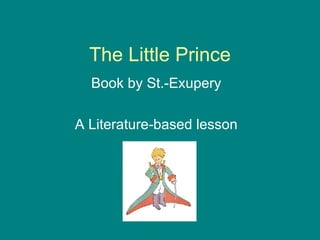
The Little Prince Book by St.-Exupery A Literature-based lesson
Students read assigned pages Students prepare summaries Students write discussion questions
Summary … The seventh planet is the Earth.  At first, the Little Prince thought the Earth is peculiar.  He met a fox and he started to think about his rose.  The Fox made the Little Prince aware of his important things.  He said, “Anything essential is invisible to the eyes.”… (by Mina IES-F)
Discussion Questions  Written by Students Questions about The Little Prince: The Fox said, “Anything essential is invisible to the eyes.”  What does he mean?  Do you agree with him? What is your essential thing?
The Environment A News-based lesson
Students read a newspaper article Students do a quick write Students discuss Students write response to group discussion
Quick Write Agree: Many developed countries have failed to prevent  environmental degradation. Disagree: Richer countries have to take charge of saving the environment. My Idea: This problem can’t be solved with money, but with people’s minds.  Money will only work to a certain degree. (by Masaru ESL 1)
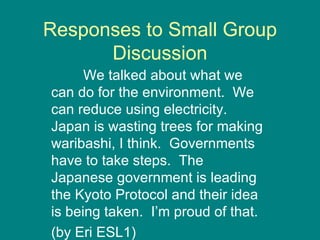
Responses to Small Group Discussion We talked about what we can do for the environment.  We can reduce using electricity.  Japan is wasting trees for making waribashi, I think.  Governments have to take steps.  The Japanese government is leading the Kyoto Protocol and their idea is being taken.  I’m proud of that.  (by Eri ESL1)
School Violence A Listening-based lesson Adapted from  Face the Issues
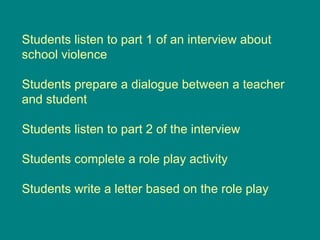
Students listen to part 1 of an interview about school violence Students prepare a dialogue between a teacher and student Students listen to part 2 of the interview Students complete a role play activity Students write a letter based on the role play
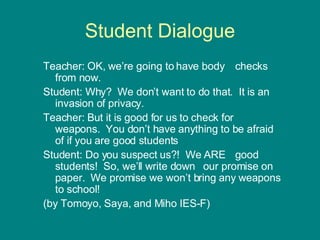
Teacher: OK, we’re going to have body  checks from now. Student: Why?  We don’t want to do that.  It is an invasion of privacy. Teacher: But it is good for us to check for  weapons.  You don’t have anything to be afraid of if you are good students Student: Do you suspect us?!  We ARE  good students!  So, we’ll write down  our promise on paper.  We promise we won’t bring any weapons to school! (by Tomoyo, Saya, and Miho IES-F) Student Dialogue
Dear School Board: We want to practice two activities to reduce the crime problem. First, we want to have more security measures at school.  We can easily find if students have weapons by getting security measures.  Please hire more guards and police officers.  We know it costs money, so you can hire them only in the morning and after school.
Second, we want to have after school sports activities.  What about having “Midnight Basket-ball?  It avoids students to spend the entire night on the streets.  It’s also good opportunity for the entire community to know each other.  We can protect ourselves by ourselves!  Then, it is also cheap and good for health, especially over-weight people.  Thank you.  Sincerely, Teacher, Student, Parent, and Community Member (by Ayaka, Saya, Miho, Syujiro, and Minami  IES-F)
Discussion How would you integrate your informal writing assignment(s) for “Jamie Oliver’s School Dinners” into a lesson plan?
Adaptations using Technology
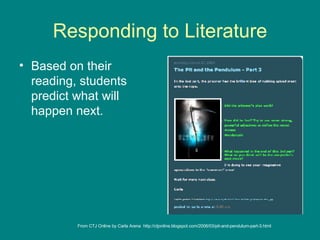
Responding to Literature Based on their reading, students predict what will happen next. From CTJ Online by Carla Arena  http://ctjonline.blogspot.com/2006/03/pit-and-pendulum-part-3.html
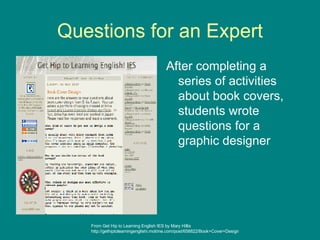
Questions for an Expert After completing a series of activities about book covers, students wrote questions for a graphic designer From Get Hip to Learning English IES by Mary Hillis http://gethiptolearningenglishi.motime.com/post/658822/Book+Cover+Design
Conclusion Reasons to use informal writing Informal writing assignment types Integrating informal writing into lessons Adaptations
Thank you for your participation! Informal Writing for Critical Thinking Presented by Mary E. Hillis Kansai Gaidai University [email_address] Class Blog: http://gethiptolearningenglishi.motime.com/
References Arena, C. (2006)  CTJ Online . Retreived June 10, 2007 from  http://ctjonline.blogspot.com/2006/03/pit-and-pendulum-part-3.html Bean, J. C. (2001)  Engaging Ideas: The Professor’s Guide to Integrating Writing, Critical Thinking, and Active Learning in the Classroom . San Francisco: Jossey-Bass Publishers. Hillis, M. (2007)  Get Hip to Learning English . Retreived June 10, 2007 from  http://gethiptolearningenglishi.motime.com
Lesson Materials Anderson, N. (2007).  Active Skills for Reading, Book 1.   (2 nd   ed.) Boston: Thomson.  De Saint-Exupery, A. (1971)  The Little Prince  (R. Howard,  Trans.)  San Diego: Harvest.  (Original work  published 1943). “ Developing countries say rich countries must take  responsibility for climate change.” (2007).  International Herald Tribune .  Retreived June 10,  2007 from  http://www.iht.com/articles/ap/2007/02/27/europe/EU -GEN-UN-Climate-Change.php Numrich, C. (1997).  Face the Issues: Intermediate  Listening and Critical Thinking Skills . (2 nd  ed.)  White Plains: Longman.

Informal Writing

  • 1.
    Informal Writingfor Critical Thinking Mary E. Hillis Kansai Gaidai University
  • 2.
    “ Writing isboth a process of doing critical thinking and a product communicating the results of critical thinking.” Bean (2001)
  • 3.
    What is informalwriting? Write for 1 minute
  • 4.
    Exchange papers Readand respond to your partners writing. Do you agree, disagree, or have something to add?
  • 5.
    Characteristics of InformalWriting Used to develop critical thinking skills Used to actively involve students with the material and to personalize the learning process Integrated into the lesson and linked to other informal or formal assignments Ungraded, or minimally marked writing
  • 6.
    Why use InformalWriting Assignments? Develop critical thinking skills Involve students in the lesson Offer students more opportunities to use and improve their language skills Give students freedom to explore thoughts, ideas, and reactions to course material
  • 7.
    Assignment Types JournalsSummary and Response Questions Letters Dialogues
  • 8.
    Journals Students findand develop personal connections to course Students can explore ideas that may not emerge in class discussion Use of journals can be time consuming
  • 9.
    Summary and ResponseStudents select main points and identify overall themes Students write about their ideas and reaction to course material Use to encourage critical thinking, deepen understanding of course material, and “prime the pump” for further course work
  • 10.
    Questions Students writetheir own discussion questions Students write sample quiz questions Students write questions for further research or to ask an expert Use to encourage critical thinking and inquiry
  • 11.
    Letters Students writeletters to the author Students write letters to an expert Use to give students the chance to “try on” the language of the author or subject
  • 12.
    Dialogues Students exploreissues from different points of view Students can use a variety of communication styles Use to develop critical and creative thinking skills
  • 13.
    Other informal writingassignments Freewrites Connections Quick writes Frame sentences or paragraphs
  • 14.
    Discussion What informalwriting assignment(s) would you design for “Jamie Oliver’s School Dinners”? Source: Anderson, N. (2007). Active Skills for Reading, Book 1. (2nd ed.) Boston: Thomson.
  • 15.
    Lessons using InformalWriting Assignments and Student Examples
  • 16.
    The Little PrinceBook by St.-Exupery A Literature-based lesson
  • 17.
    Students read assignedpages Students prepare summaries Students write discussion questions
  • 18.
    Summary … Theseventh planet is the Earth. At first, the Little Prince thought the Earth is peculiar. He met a fox and he started to think about his rose. The Fox made the Little Prince aware of his important things. He said, “Anything essential is invisible to the eyes.”… (by Mina IES-F)
  • 19.
    Discussion Questions Written by Students Questions about The Little Prince: The Fox said, “Anything essential is invisible to the eyes.” What does he mean? Do you agree with him? What is your essential thing?
  • 20.
    The Environment ANews-based lesson
  • 21.
    Students read anewspaper article Students do a quick write Students discuss Students write response to group discussion
  • 22.
    Quick Write Agree:Many developed countries have failed to prevent environmental degradation. Disagree: Richer countries have to take charge of saving the environment. My Idea: This problem can’t be solved with money, but with people’s minds. Money will only work to a certain degree. (by Masaru ESL 1)
  • 23.
    Responses to SmallGroup Discussion We talked about what we can do for the environment. We can reduce using electricity. Japan is wasting trees for making waribashi, I think. Governments have to take steps. The Japanese government is leading the Kyoto Protocol and their idea is being taken. I’m proud of that. (by Eri ESL1)
  • 24.
    School Violence AListening-based lesson Adapted from Face the Issues
  • 25.
    Students listen topart 1 of an interview about school violence Students prepare a dialogue between a teacher and student Students listen to part 2 of the interview Students complete a role play activity Students write a letter based on the role play
  • 26.
    Teacher: OK, we’regoing to have body checks from now. Student: Why? We don’t want to do that. It is an invasion of privacy. Teacher: But it is good for us to check for weapons. You don’t have anything to be afraid of if you are good students Student: Do you suspect us?! We ARE good students! So, we’ll write down our promise on paper. We promise we won’t bring any weapons to school! (by Tomoyo, Saya, and Miho IES-F) Student Dialogue
  • 27.
    Dear School Board:We want to practice two activities to reduce the crime problem. First, we want to have more security measures at school. We can easily find if students have weapons by getting security measures. Please hire more guards and police officers. We know it costs money, so you can hire them only in the morning and after school.
  • 28.
    Second, we wantto have after school sports activities. What about having “Midnight Basket-ball? It avoids students to spend the entire night on the streets. It’s also good opportunity for the entire community to know each other. We can protect ourselves by ourselves! Then, it is also cheap and good for health, especially over-weight people. Thank you. Sincerely, Teacher, Student, Parent, and Community Member (by Ayaka, Saya, Miho, Syujiro, and Minami IES-F)
  • 29.
    Discussion How wouldyou integrate your informal writing assignment(s) for “Jamie Oliver’s School Dinners” into a lesson plan?
  • 30.
  • 31.
    Responding to LiteratureBased on their reading, students predict what will happen next. From CTJ Online by Carla Arena http://ctjonline.blogspot.com/2006/03/pit-and-pendulum-part-3.html
  • 32.
    Questions for anExpert After completing a series of activities about book covers, students wrote questions for a graphic designer From Get Hip to Learning English IES by Mary Hillis http://gethiptolearningenglishi.motime.com/post/658822/Book+Cover+Design
  • 33.
    Conclusion Reasons touse informal writing Informal writing assignment types Integrating informal writing into lessons Adaptations
  • 34.
    Thank you foryour participation! Informal Writing for Critical Thinking Presented by Mary E. Hillis Kansai Gaidai University [email_address] Class Blog: http://gethiptolearningenglishi.motime.com/
  • 35.
    References Arena, C.(2006) CTJ Online . Retreived June 10, 2007 from http://ctjonline.blogspot.com/2006/03/pit-and-pendulum-part-3.html Bean, J. C. (2001) Engaging Ideas: The Professor’s Guide to Integrating Writing, Critical Thinking, and Active Learning in the Classroom . San Francisco: Jossey-Bass Publishers. Hillis, M. (2007) Get Hip to Learning English . Retreived June 10, 2007 from http://gethiptolearningenglishi.motime.com
  • 36.
    Lesson Materials Anderson,N. (2007). Active Skills for Reading, Book 1. (2 nd ed.) Boston: Thomson. De Saint-Exupery, A. (1971) The Little Prince (R. Howard, Trans.) San Diego: Harvest. (Original work published 1943). “ Developing countries say rich countries must take responsibility for climate change.” (2007). International Herald Tribune . Retreived June 10, 2007 from http://www.iht.com/articles/ap/2007/02/27/europe/EU -GEN-UN-Climate-Change.php Numrich, C. (1997). Face the Issues: Intermediate Listening and Critical Thinking Skills . (2 nd ed.) White Plains: Longman.