Chapter 14 Power and Politics TWELFTH EDITION
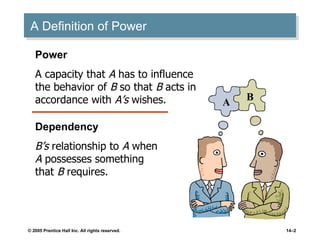
A Definition of Power A B Power A capacity that  A  has to influence the behavior of  B  so that  B  acts in accordance with  A’s  wishes. Dependency B’s  relationship to  A  when  A  possesses something that  B  requires.
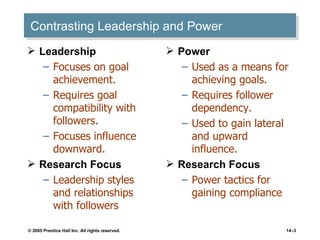
Contrasting Leadership and Power Leadership Focuses on goal achievement. Requires goal compatibility with followers. Focuses influence downward. Research Focus Leadership styles and relationships with followers Power Used as a means for achieving goals. Requires follower dependency. Used to gain lateral and upward influence. Research Focus Power tactics for gaining compliance
Bases of Power: Formal Power Coercive Power A power base dependent on fear. Reward Power Compliance achieved based on the ability to distribute rewards that others view as valuable Formal Power Is established by an individual’s position in an organization; conveys the ability to coerce or reward, from formal authority, or from control of information.
Bases of Power: Formal Power (cont’d) Legitimate Power The power a person receives as a result of his or her position in the formal hierarchy of an organization. Information Power Power that comes from access to and control over information.
Bases of Power: Personal Power Expert Power Influence based on special skills or knowledge. Referent Power Influence based on possession by an individual of desirable resources or personal traits. Charismatic Power An extension of referent power stemming from an individual’s personality and interpersonal style.
Dependency: The Key To Power The General Dependency Postulate The greater B’s dependency on A, the greater the power A has over B. Possession/control of scarce organizational resources that others need makes a manager powerful. Access to optional resources (e.g., multiple suppliers) reduces the resource holder’s power. What Creates Dependency Importance  of the resource to the organization Scarcity  of the resource Nonsubstitutability  of the resource
Power Tactics Influence Tactics : Legitimacy Rational persuasion Inspirational appeals Consultation Exchange Personal appeals Ingratiation Pressure Coalitions Power Tactics Ways in which individuals translate power bases into specific actions.
Power in Groups: Coalitions Seek to maximize their size to attain influence. Seek a broad and diverse constituency for support of their objectives. Occur more frequently in organizations with high task and resource interdependencies. Occur more frequently if tasks are standardized and routine. Coalitions Clusters of individuals who temporarily come together to a achieve a specific purpose.
Sexual Harassment: Unequal Power in the Workplace  Sexual Harassment Unwelcome advances, requests for sexual favors, and other verbal or physical conduct of a sexual nature.
Politics: Power in Action Political Behavior Activities that are not required as part of one’s formal role in the organization, but that influence, or attempt to influence, the distribution of advantages or disadvantages within the organization. Legitimate Political Behavior Normal everyday politics. Illegitimate Political Behavior Extreme political behavior that violates the implied rules of the game.
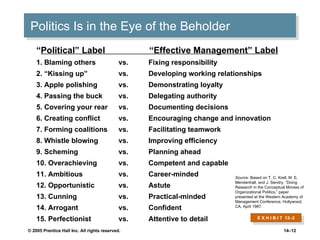
Politics Is in the Eye of the Beholder E X H I B I T  13 –3 “ Political” Label    “Effective Management” Label   1. Blaming others  vs.  Fixing responsibility 2. “Kissing up”  vs.  Developing working relationships 3. Apple polishing  vs.  Demonstrating loyalty  4. Passing the buck  vs.  Delegating authority  5. Covering your rear  vs.  Documenting decisions  6. Creating conflict  vs.  Encouraging change and innovation 7. Forming coalitions  vs.  Facilitating teamwork  8. Whistle blowing  vs.  Improving efficiency  9. Scheming  vs.  Planning ahead  10. Overachieving  vs.  Competent and capable  11. Ambitious  vs.  Career-minded  12. Opportunistic  vs.  Astute  13. Cunning  vs.  Practical-minded  14. Arrogant  vs.  Confident  15. Perfectionist  vs.  Attentive to detail  Source:  Based on T. C. Krell, M. E. Mendenhall, and J. Sendry, “Doing Research in the Conceptual Morass of Organizational Politics,” paper presented at the Western Academy of Management Conference, Hollywood, CA, April 1987.
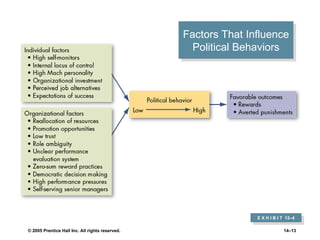
Factors That Influence Political Behaviors E X H I B I T  13 –4
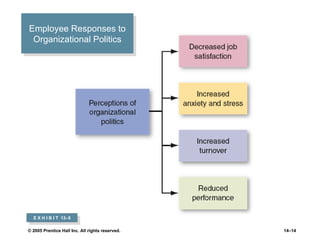
Employee Responses to Organizational Politics E X H I B I T  13 –5
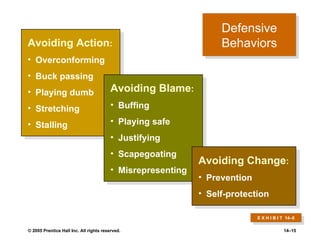
Defensive Behaviors Avoiding Action : Overconforming Buck passing Playing dumb Stretching Stalling Avoiding Blame : Buffing Playing safe Justifying Scapegoating Misrepresenting Avoiding Change : Prevention Self-protection E X H I B I T  14 –6
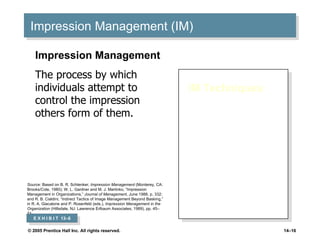
Impression Management (IM) IM Techniques : Conformity Excuses Apologies Self-Promotion Flattery Favors Association Impression Management The process by which individuals attempt to control the impression others form of them. Source:  Based on B. R. Schlenker,  Impression Management  (Monterey, CA: Brooks/Cole, 1980); W. L. Gardner and M. J. Martinko, “Impression Management in Organizations,”  Journal of Management , June 1988, p. 332; and R. B. Cialdini, “Indirect Tactics of Image Management Beyond Basking,” in R. A. Giacalone and P. Rosenfeld (eds.),  Impression Management in the Organization  (Hillsdale, NJ: Lawrence Erlbaum Associates, 1989), pp. 45–71. E X H I B I T  13 –6
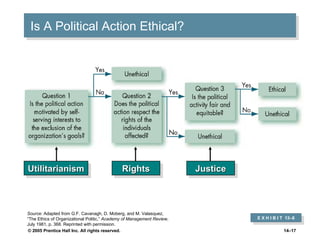
Is A Political Action Ethical? Utilitarianism Rights Justice E X H I B I T  13 –8 Source:  Adapted from G.F. Cavanagh, D. Moberg, and M. Valasquez, “The Ethics of Organizational Politic,”  Academy of Management Review , July 1981, p. 368. Reprinted with permission.

Session 9 power and politics

  • 1.
    Chapter 14 Powerand Politics TWELFTH EDITION
  • 2.
    A Definition ofPower A B Power A capacity that A has to influence the behavior of B so that B acts in accordance with A’s wishes. Dependency B’s relationship to A when A possesses something that B requires.
  • 3.
    Contrasting Leadership andPower Leadership Focuses on goal achievement. Requires goal compatibility with followers. Focuses influence downward. Research Focus Leadership styles and relationships with followers Power Used as a means for achieving goals. Requires follower dependency. Used to gain lateral and upward influence. Research Focus Power tactics for gaining compliance
  • 4.
    Bases of Power:Formal Power Coercive Power A power base dependent on fear. Reward Power Compliance achieved based on the ability to distribute rewards that others view as valuable Formal Power Is established by an individual’s position in an organization; conveys the ability to coerce or reward, from formal authority, or from control of information.
  • 5.
    Bases of Power:Formal Power (cont’d) Legitimate Power The power a person receives as a result of his or her position in the formal hierarchy of an organization. Information Power Power that comes from access to and control over information.
  • 6.
    Bases of Power:Personal Power Expert Power Influence based on special skills or knowledge. Referent Power Influence based on possession by an individual of desirable resources or personal traits. Charismatic Power An extension of referent power stemming from an individual’s personality and interpersonal style.
  • 7.
    Dependency: The KeyTo Power The General Dependency Postulate The greater B’s dependency on A, the greater the power A has over B. Possession/control of scarce organizational resources that others need makes a manager powerful. Access to optional resources (e.g., multiple suppliers) reduces the resource holder’s power. What Creates Dependency Importance of the resource to the organization Scarcity of the resource Nonsubstitutability of the resource
  • 8.
    Power Tactics InfluenceTactics : Legitimacy Rational persuasion Inspirational appeals Consultation Exchange Personal appeals Ingratiation Pressure Coalitions Power Tactics Ways in which individuals translate power bases into specific actions.
  • 9.
    Power in Groups:Coalitions Seek to maximize their size to attain influence. Seek a broad and diverse constituency for support of their objectives. Occur more frequently in organizations with high task and resource interdependencies. Occur more frequently if tasks are standardized and routine. Coalitions Clusters of individuals who temporarily come together to a achieve a specific purpose.
  • 10.
    Sexual Harassment: UnequalPower in the Workplace Sexual Harassment Unwelcome advances, requests for sexual favors, and other verbal or physical conduct of a sexual nature.
  • 11.
    Politics: Power inAction Political Behavior Activities that are not required as part of one’s formal role in the organization, but that influence, or attempt to influence, the distribution of advantages or disadvantages within the organization. Legitimate Political Behavior Normal everyday politics. Illegitimate Political Behavior Extreme political behavior that violates the implied rules of the game.
  • 12.
    Politics Is inthe Eye of the Beholder E X H I B I T 13 –3 “ Political” Label “Effective Management” Label 1. Blaming others vs. Fixing responsibility 2. “Kissing up” vs. Developing working relationships 3. Apple polishing vs. Demonstrating loyalty 4. Passing the buck vs. Delegating authority 5. Covering your rear vs. Documenting decisions 6. Creating conflict vs. Encouraging change and innovation 7. Forming coalitions vs. Facilitating teamwork 8. Whistle blowing vs. Improving efficiency 9. Scheming vs. Planning ahead 10. Overachieving vs. Competent and capable 11. Ambitious vs. Career-minded 12. Opportunistic vs. Astute 13. Cunning vs. Practical-minded 14. Arrogant vs. Confident 15. Perfectionist vs. Attentive to detail Source: Based on T. C. Krell, M. E. Mendenhall, and J. Sendry, “Doing Research in the Conceptual Morass of Organizational Politics,” paper presented at the Western Academy of Management Conference, Hollywood, CA, April 1987.
  • 13.
    Factors That InfluencePolitical Behaviors E X H I B I T 13 –4
  • 14.
    Employee Responses toOrganizational Politics E X H I B I T 13 –5
  • 15.
    Defensive Behaviors AvoidingAction : Overconforming Buck passing Playing dumb Stretching Stalling Avoiding Blame : Buffing Playing safe Justifying Scapegoating Misrepresenting Avoiding Change : Prevention Self-protection E X H I B I T 14 –6
  • 16.
    Impression Management (IM)IM Techniques : Conformity Excuses Apologies Self-Promotion Flattery Favors Association Impression Management The process by which individuals attempt to control the impression others form of them. Source: Based on B. R. Schlenker, Impression Management (Monterey, CA: Brooks/Cole, 1980); W. L. Gardner and M. J. Martinko, “Impression Management in Organizations,” Journal of Management , June 1988, p. 332; and R. B. Cialdini, “Indirect Tactics of Image Management Beyond Basking,” in R. A. Giacalone and P. Rosenfeld (eds.), Impression Management in the Organization (Hillsdale, NJ: Lawrence Erlbaum Associates, 1989), pp. 45–71. E X H I B I T 13 –6
  • 17.
    Is A PoliticalAction Ethical? Utilitarianism Rights Justice E X H I B I T 13 –8 Source: Adapted from G.F. Cavanagh, D. Moberg, and M. Valasquez, “The Ethics of Organizational Politic,” Academy of Management Review , July 1981, p. 368. Reprinted with permission.