The United Kingdom Compiled by Roma Važgėlienė ,  2008 romavazg @gmail.com
Content One country? Who are the British? England Symbols of England In the Street (London) Famous People of Britain Royal Guards Famous Landmarks 1 Famous Landmarks 2 Wales Symbols of Wales Scotland Symbols of Scotland 1 Symbols of Scotland 2 Northern Ireland Symbols of Northern Ireland Try to guess! Symbols of England found on the tea cosy  (Answers) References
One country? The British Isles ,   the name for a collection of about 4,000 islands (the Channel Islands and the Isle of Man), two  sovereign state s the  United Kingdom of Great Britain and Northern Ireland  and  Ireland .  A  geographical name.  Great Britain (GB) ;  known as Britain ,  the name for the largest of the islands .   I t includes England, Scotland and Wales, but  not  Northern Ireland or the Republik of Ireland. The United Kingdom (the UK) ,  a political term . It  includes  England, Scotland, Wales and Northern Ireland.  All of these countries are represented in parl i ament in London.   Several islands (the Isle of Wight, the Orkneys, Hebrides and Shetlands, and the Isles of Scilly) are also part of the UK.
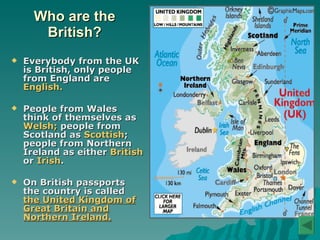
Who are the British? Everybody from the UK is British, only people from England are  English.   People from Wales think of themselves as  Welsh;  people from Scotland as  Scottish ; people from Northern Ireland as either  British  or  Irish . On British passports the country is called  the United Kingdom of Great Britain and Northern Ireland.
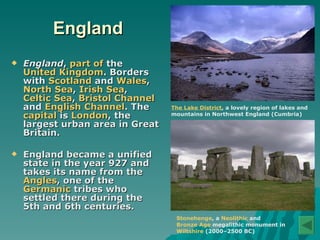
England England ,  part of  the  United Kingdom . Borders with  Scotland  and  Wales ,  North Sea ,  Irish Sea ,  Celtic Sea ,  Bristol Channel  and  English Channel . The  capital  is  London , the largest urban area in Great Britain. England became a unified state in the year 927 and takes its name from the  Angles , one of the  Germanic  tribes who settled there during the 5th and 6th centuries.  Stonehenge , a  Neolithic  and  Bronze Age  megalithic monument in  Wiltshire   (2000–2500 BC) The Lake District , a lovely region of lakes and mountains in Northwest England (Cumbria)
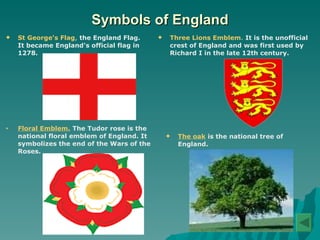
Symbols of England St George's Flag ,  the England Flag. It became England's official flag in 1278. Three Lions Emblem .  It is the unofficial crest of England and was first used by Richard I in the late 12th century. Floral Emblem.   The Tudor rose is the   national floral emblem of England. It symbolizes the end of the Wars of   the   Roses.  The oak   is the national tree of England.
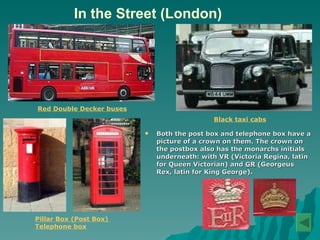
In the Street (London) Both the post box and telephone box have a picture of a crown on them. The crown on the postbox also has the monarchs initials underneath: with  VR  (Victoria Regina, latin for Queen Victorian) and  GR  (Georgeus Rex, latin for King George).  Red Double Decker buses   Black taxi cabs   Pillar Box (Post Box)   Telephone box
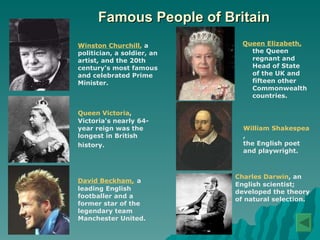
Famous People of Britain Winston Churchill ,  a politician, a soldier, an artist, and the 20th century's most famous and celebrated Prime Minister.   Queen Victoria ,   Victoria's nearly 64-year reign was the longest in British history.   David Beckham,   a leading English footballer and a former star of the legendary team Manchester United.  Queen Elizabeth,  the Queen regnant and Head of State of the UK and fifteen other Commonwealth countries.  William Shakespeare ,  the English poet and playwright.   Charles Darwin , an English scientist; developed the theory of natural selection.
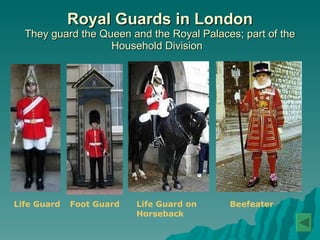
Royal Guards in London They guard the Queen and the Royal Palaces; part of the Household Division  Life Guard   Foot Guard   Life Guard on  Horseback   Beefeater
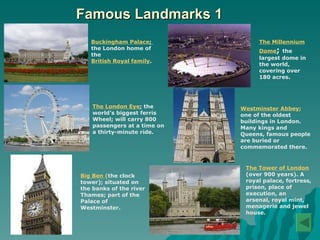
Famous Landmarks 1 Buckingham Palace ;  the London home of the  British Royal family . The London Eye ;  the  world’s biggest ferris  Wheel; will carry 800 passengers at a time on  a thirty-minute ride.   Big Ben  ( the clock tower); situated on the banks of the river Thames; part of the Palace of Westminster.   Westminster Abbey ;  one of the oldest buildings in London. Many kings and Queens, famous people are buried or commemorated there.   The Tower of London   (over 900 years). A royal palace, fortress, prison, place of execution, an arsenal, royal mint, menagerie and jewel house.   The Millennium Dome ;  the largest dome in the world, covering over 180 acres.
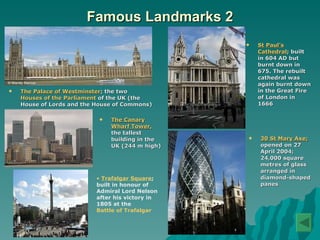
Famous Landmarks 2 The Palace of Westminster ; the two  Houses of the Parliament  of the UK (the House of Lords and the House of Commons) St Paul's Cathedral ; built in 604 AD but burnt down in 675. The rebuilt cathedral was again burnt down in the Great Fire of London in 1666  The Canary Wharf Tower,   the tallest building in the UK (244 m high) 30 St Mary Axe;  opened on 27 April 2004;   24,000 square metres of glass arranged in diamond-shaped panes Trafalgar Square ; built in honour of Admiral Lord Nelson after his victory in 1805 at the  Battle of Trafalgar  
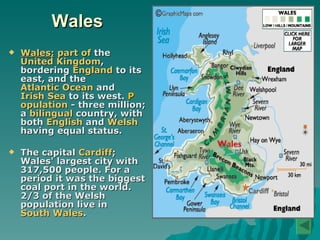
Wales Wales;   part of  the  United Kingdom , bordering  England  to its east, and the  Atlantic Ocean  and  Irish Sea  to its west.  P opulation   -  three million; a  bilingual  country, with both  English  and  Welsh  having equal status. The capital  Cardiff ; Wales' largest city with 317,500 people. For a period it was the biggest coal port in the world. 2/3 of the Welsh population live in  South Wales .
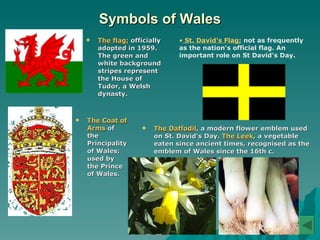
Symbols of Wales The flag;  officially adopted in 1959. The green and white background stripes represent the House of Tudor, a Welsh dynasty. The Coat of Arms  of the Principality of Wales; used by the Prince of Wales.   The Daffodil , a modern flower emblem used on St. David's Day.  The Leek , a vegetable eaten since ancient times, recognised as the emblem of Wales since the 16th c.   St. David's Flag;   not as frequently as the nation's official flag. An important role on St David's Day.
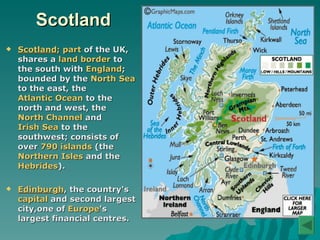
Scotland Scotland ;   part  of the UK, shares a  land border  to the south with  England ; bounded by the  North Sea  to the east, the  Atlantic Ocean  to the north and west, the  North Channel  and  Irish Sea  to the southwest; consists of over  790 islands  (the  Northern Isles  and the  Hebrides ). Edinburgh , the country's  capital  and second largest city,one of  Europe 's largest financial centres.
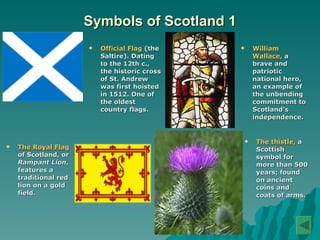
Symbols of Scotland 1 Official Flag  (the Saltire). Dating to the 12th c., the historic cross of St. Andrew was first hoisted in 1512. One of the oldest country flags.   William Wallace,  a brave and patriotic national hero, an example of the unbending commitment to Scotland’s independence.  The Royal Flag  of Scotland, or  Rampant Lion , features a traditional red lion on a gold field.  The thistle,  a Scottish symbol for more than 500 years; found on ancient coins and coats of arms.
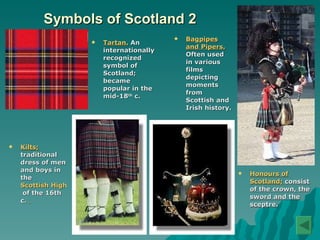
Symbols of Scotland 2 Tartan.   An internationally recognized symbol of Scotland; became popular in the mid-18 th  c.   Bagpipes and Pipers.   Often used in various films depicting moments from Scottish and Irish history.   Kilts;  traditional dress of men and boys in the  Scottish Highlands  of the 16th c.   Honours of Scotland;  consist of the crown, the sword and the sceptre.
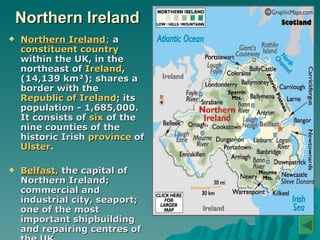
Northern Ireland Northern Ireland ;  a  constituent country  within the UK, in the northeast of  Ireland , (14,139 km²); shares a border with the  Republic of Ireland ; its population - 1,685,000. It consists of  six  of the nine counties of the historic Irish  province  of  Ulster . Belfast ,  the capital of Northern Ireland; commercial and industrial   city, seaport; one of the most important shipbuilding and repairing centres of the UK.
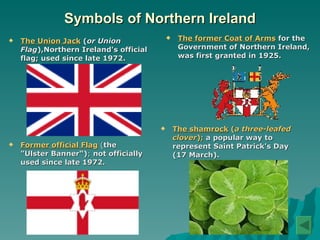
Symbols of Northern Ireland The Union Jack  ( or Union Flag ),Northern Ireland's official flag; used since late 1972.   The former Coat of Arms   for the Government of Northern Ireland, was first granted in 1925.  Former official Flag  ( the "Ulster Banner“) ;  not officially used since late 1972.   The shamrock   ( a three-leafed clover );  a popular way to represent Saint Patrick's Day (17 March).
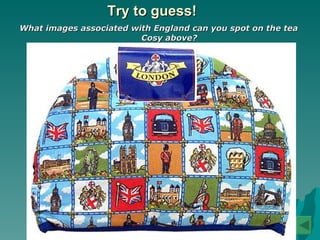
Try to guess! What images associated with England can you spot on the tea Cosy above?
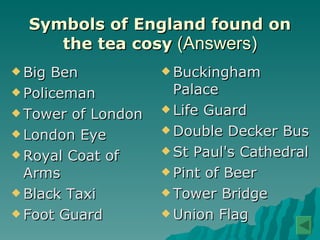
Symbols of England found on the tea cosy  (Answers) Big Ben  Policeman Tower of London London Eye Royal Coat of Arms Black Taxi Foot Guard  Buckingham Palace Life Guard Double Decker Bus St Paul's Cathedral  Pint of Beer Tower Bridge Union Flag
References Carini, E., Dolman, J., Smith, G. 2000 .  English and American Civilization .  Vilnius: Alma littera. Sheerin, S., Seat, J., White, G.,  1992.  Sportlight on Britain .  OUP.   Symbols of England, 2007. [as of 30 September, 2008] at < www.woodlands-junior.kent.sch.uk/customs/questions/symbols.html > England Symbols Flag Seal and more (Scotland, Wales and Northern Ireland Maps), 2007. [as of 1 October, 2008] at < www.worldatlas.com/webimage/countrys/europe/ukesymbols.htm > Symbols of Scotland, 2008. [as of 5 October, 2008] at < www.rampantscotland.com/symbols/blsymbols_index.htm > The British Isles, 2008.  [as of 2 October, 2008] at  < en.wikipedia.org/wiki/British_Isles >

The United Kingdom

  • 1.
    The United KingdomCompiled by Roma Važgėlienė , 2008 romavazg @gmail.com
  • 2.
    Content One country?Who are the British? England Symbols of England In the Street (London) Famous People of Britain Royal Guards Famous Landmarks 1 Famous Landmarks 2 Wales Symbols of Wales Scotland Symbols of Scotland 1 Symbols of Scotland 2 Northern Ireland Symbols of Northern Ireland Try to guess! Symbols of England found on the tea cosy (Answers) References
  • 3.
    One country? TheBritish Isles , the name for a collection of about 4,000 islands (the Channel Islands and the Isle of Man), two sovereign state s the United Kingdom of Great Britain and Northern Ireland and Ireland . A geographical name. Great Britain (GB) ; known as Britain , the name for the largest of the islands . I t includes England, Scotland and Wales, but not Northern Ireland or the Republik of Ireland. The United Kingdom (the UK) , a political term . It includes England, Scotland, Wales and Northern Ireland. All of these countries are represented in parl i ament in London. Several islands (the Isle of Wight, the Orkneys, Hebrides and Shetlands, and the Isles of Scilly) are also part of the UK.
  • 4.
    Who are theBritish? Everybody from the UK is British, only people from England are English. People from Wales think of themselves as Welsh; people from Scotland as Scottish ; people from Northern Ireland as either British or Irish . On British passports the country is called the United Kingdom of Great Britain and Northern Ireland.
  • 5.
    England England , part of the United Kingdom . Borders with Scotland and Wales , North Sea , Irish Sea , Celtic Sea , Bristol Channel and English Channel . The capital is London , the largest urban area in Great Britain. England became a unified state in the year 927 and takes its name from the Angles , one of the Germanic tribes who settled there during the 5th and 6th centuries. Stonehenge , a Neolithic and Bronze Age megalithic monument in Wiltshire (2000–2500 BC) The Lake District , a lovely region of lakes and mountains in Northwest England (Cumbria)
  • 6.
    Symbols of EnglandSt George's Flag , the England Flag. It became England's official flag in 1278. Three Lions Emblem . It is the unofficial crest of England and was first used by Richard I in the late 12th century. Floral Emblem. The Tudor rose is the national floral emblem of England. It symbolizes the end of the Wars of the Roses. The oak is the national tree of England.
  • 7.
    In the Street(London) Both the post box and telephone box have a picture of a crown on them. The crown on the postbox also has the monarchs initials underneath: with VR (Victoria Regina, latin for Queen Victorian) and GR (Georgeus Rex, latin for King George). Red Double Decker buses Black taxi cabs Pillar Box (Post Box) Telephone box
  • 8.
    Famous People ofBritain Winston Churchill , a politician, a soldier, an artist, and the 20th century's most famous and celebrated Prime Minister. Queen Victoria , Victoria's nearly 64-year reign was the longest in British history. David Beckham, a leading English footballer and a former star of the legendary team Manchester United. Queen Elizabeth, the Queen regnant and Head of State of the UK and fifteen other Commonwealth countries. William Shakespeare , the English poet and playwright. Charles Darwin , an English scientist; developed the theory of natural selection.
  • 9.
    Royal Guards inLondon They guard the Queen and the Royal Palaces; part of the Household Division Life Guard Foot Guard Life Guard on Horseback Beefeater
  • 10.
    Famous Landmarks 1Buckingham Palace ; the London home of the British Royal family . The London Eye ; the world’s biggest ferris Wheel; will carry 800 passengers at a time on a thirty-minute ride. Big Ben ( the clock tower); situated on the banks of the river Thames; part of the Palace of Westminster. Westminster Abbey ; one of the oldest buildings in London. Many kings and Queens, famous people are buried or commemorated there. The Tower of London (over 900 years). A royal palace, fortress, prison, place of execution, an arsenal, royal mint, menagerie and jewel house. The Millennium Dome ; the largest dome in the world, covering over 180 acres.
  • 11.
    Famous Landmarks 2The Palace of Westminster ; the two Houses of the Parliament of the UK (the House of Lords and the House of Commons) St Paul's Cathedral ; built in 604 AD but burnt down in 675. The rebuilt cathedral was again burnt down in the Great Fire of London in 1666 The Canary Wharf Tower, the tallest building in the UK (244 m high) 30 St Mary Axe; opened on 27 April 2004; 24,000 square metres of glass arranged in diamond-shaped panes Trafalgar Square ; built in honour of Admiral Lord Nelson after his victory in 1805 at the Battle of Trafalgar  
  • 12.
    Wales Wales; part of the United Kingdom , bordering England to its east, and the Atlantic Ocean and Irish Sea to its west. P opulation - three million; a bilingual country, with both English and Welsh having equal status. The capital Cardiff ; Wales' largest city with 317,500 people. For a period it was the biggest coal port in the world. 2/3 of the Welsh population live in South Wales .
  • 13.
    Symbols of WalesThe flag; officially adopted in 1959. The green and white background stripes represent the House of Tudor, a Welsh dynasty. The Coat of Arms of the Principality of Wales; used by the Prince of Wales. The Daffodil , a modern flower emblem used on St. David's Day. The Leek , a vegetable eaten since ancient times, recognised as the emblem of Wales since the 16th c. St. David's Flag; not as frequently as the nation's official flag. An important role on St David's Day.
  • 14.
    Scotland Scotland ; part of the UK, shares a land border to the south with England ; bounded by the North Sea to the east, the Atlantic Ocean to the north and west, the North Channel and Irish Sea to the southwest; consists of over 790 islands (the Northern Isles and the Hebrides ). Edinburgh , the country's capital and second largest city,one of Europe 's largest financial centres.
  • 15.
    Symbols of Scotland1 Official Flag (the Saltire). Dating to the 12th c., the historic cross of St. Andrew was first hoisted in 1512. One of the oldest country flags. William Wallace, a brave and patriotic national hero, an example of the unbending commitment to Scotland’s independence. The Royal Flag of Scotland, or Rampant Lion , features a traditional red lion on a gold field. The thistle, a Scottish symbol for more than 500 years; found on ancient coins and coats of arms.
  • 16.
    Symbols of Scotland2 Tartan. An internationally recognized symbol of Scotland; became popular in the mid-18 th c. Bagpipes and Pipers. Often used in various films depicting moments from Scottish and Irish history. Kilts; traditional dress of men and boys in the Scottish Highlands of the 16th c. Honours of Scotland; consist of the crown, the sword and the sceptre.
  • 17.
    Northern Ireland NorthernIreland ; a constituent country within the UK, in the northeast of Ireland , (14,139 km²); shares a border with the Republic of Ireland ; its population - 1,685,000. It consists of six of the nine counties of the historic Irish province of Ulster . Belfast , the capital of Northern Ireland; commercial and industrial city, seaport; one of the most important shipbuilding and repairing centres of the UK.
  • 18.
    Symbols of NorthernIreland The Union Jack ( or Union Flag ),Northern Ireland's official flag; used since late 1972. The former Coat of Arms for the Government of Northern Ireland, was first granted in 1925. Former official Flag ( the &quot;Ulster Banner“) ; not officially used since late 1972. The shamrock ( a three-leafed clover ); a popular way to represent Saint Patrick's Day (17 March).
  • 19.
    Try to guess!What images associated with England can you spot on the tea Cosy above?
  • 20.
    Symbols of Englandfound on the tea cosy (Answers) Big Ben Policeman Tower of London London Eye Royal Coat of Arms Black Taxi Foot Guard Buckingham Palace Life Guard Double Decker Bus St Paul's Cathedral Pint of Beer Tower Bridge Union Flag
  • 21.
    References Carini, E.,Dolman, J., Smith, G. 2000 . English and American Civilization . Vilnius: Alma littera. Sheerin, S., Seat, J., White, G., 1992. Sportlight on Britain . OUP. Symbols of England, 2007. [as of 30 September, 2008] at < www.woodlands-junior.kent.sch.uk/customs/questions/symbols.html > England Symbols Flag Seal and more (Scotland, Wales and Northern Ireland Maps), 2007. [as of 1 October, 2008] at < www.worldatlas.com/webimage/countrys/europe/ukesymbols.htm > Symbols of Scotland, 2008. [as of 5 October, 2008] at < www.rampantscotland.com/symbols/blsymbols_index.htm > The British Isles, 2008. [as of 2 October, 2008] at < en.wikipedia.org/wiki/British_Isles >