Ancient Athens
The center for the arts, learning, philosophy
and the birthplace of Democracy
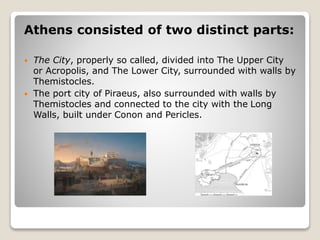
Athens consisted of two distinct parts:
 The City, properly so called, divided into The Upper City
or Acropolis, and The Lower City, surrounded with walls by
Themistocles.
 The port city of Piraeus, also surrounded with walls by
Themistocles and connected to the city with the Long
Walls, built under Conon and Pericles.
Peloponnesian War (431–404 BC)
 Resentment by other cities at the
hegemony of Athens led to
the Peloponnesian War in 431.
 The two sides were, Athens against a
coalition of states led by Sparta.
 The war ended with the complete defeat
of Athens in 404.
Corinthian War and the Second
Athenian League (395–355 BC)
 Sparta's imperialist policies led to turning
against former allies.
 Athens formed alliances with former enemies,
including Thebes and Corinth.
 Argos, Thebes, and Corinth fought against
Sparta.
 Athens established the Second Athenian
League in response to Sparta's actions.
 Thebes defeated Sparta in the Battle of
Leuctra (371 BC).
Athenian Democracy
 Athenian democracy developed in the 6th century BC
 Participation was open to adult, free male citizens,
constituting around 30% of the adult population.
 Solon, Cleisthenes, and Ephialtes contributed to the
development of Athenian democracy.
 Cleisthenes reformed the power of the nobility by
organizing citizens into ten groups based on
residency.
 Pericles was a prominent leader of Athenian
democracy.
The impact of the Athenian Culture
 Dramatists Aeschylus, Aristophanes, Euripides,
and Sophocles contributed to Greek theatre.
 Philosophers Aristotle, Plato, and Socrates
shaped Western intellectual history.
 Historians Herodotus, Thucydides, and Xenophon
provided significant historical works.
 Poet Simonides and sculptor Phidias made
notable contributions.
 Monumental structures like the Parthenon were
built.
 Pericles referred to Athens as an "education for
Hellas" or "the school of Hellas."

Ancient Athens

  • 1.
    Ancient Athens The centerfor the arts, learning, philosophy and the birthplace of Democracy
  • 2.
    Athens consisted oftwo distinct parts:  The City, properly so called, divided into The Upper City or Acropolis, and The Lower City, surrounded with walls by Themistocles.  The port city of Piraeus, also surrounded with walls by Themistocles and connected to the city with the Long Walls, built under Conon and Pericles.
  • 3.
    Peloponnesian War (431–404BC)  Resentment by other cities at the hegemony of Athens led to the Peloponnesian War in 431.  The two sides were, Athens against a coalition of states led by Sparta.  The war ended with the complete defeat of Athens in 404.
  • 4.
    Corinthian War andthe Second Athenian League (395–355 BC)  Sparta's imperialist policies led to turning against former allies.  Athens formed alliances with former enemies, including Thebes and Corinth.  Argos, Thebes, and Corinth fought against Sparta.  Athens established the Second Athenian League in response to Sparta's actions.  Thebes defeated Sparta in the Battle of Leuctra (371 BC).
  • 5.
    Athenian Democracy  Atheniandemocracy developed in the 6th century BC  Participation was open to adult, free male citizens, constituting around 30% of the adult population.  Solon, Cleisthenes, and Ephialtes contributed to the development of Athenian democracy.  Cleisthenes reformed the power of the nobility by organizing citizens into ten groups based on residency.  Pericles was a prominent leader of Athenian democracy.
  • 6.
    The impact ofthe Athenian Culture  Dramatists Aeschylus, Aristophanes, Euripides, and Sophocles contributed to Greek theatre.  Philosophers Aristotle, Plato, and Socrates shaped Western intellectual history.  Historians Herodotus, Thucydides, and Xenophon provided significant historical works.  Poet Simonides and sculptor Phidias made notable contributions.  Monumental structures like the Parthenon were built.  Pericles referred to Athens as an "education for Hellas" or "the school of Hellas."