
Essay Writing

Courtesy of Warren Hierl
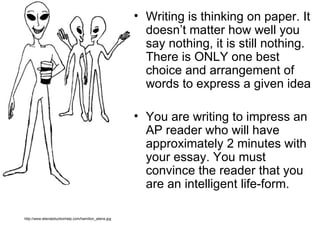
• Writing is thinking on paper. It
                                                          doesn’t matter how well you
                                                          say nothing, it is still nothing.
                                                          There is ONLY one best
                                                          choice and arrangement of
                                                          words to express a given idea

                                                        • You are writing to impress an
                                                          AP reader who will have
                                                          approximately 2 minutes with
                                                          your essay. You must
                                                          convince the reader that you
                                                          are an intelligent life-form.

http://www.alienabductionhelp.com/hamilton_aliens.jpg
• Read the question carefully and focus your
  discussion on directly answering that
  question. Emphasize the following
  – Analyze or assess the DEGREE to which a statement is true
  – Analyze or assess the IMPACT of an event or concept on
    some aspect of American society
  – Analyze or assess the RELATIVE IMPORTANCE of various
    factors on an event or concept.
  – Analyze or assess the EXTENT to which a historical
    stereotype is true for a given period or concept
  – Analyze or assess the REASONS that cause a particular
    mov’t to develop
  – COMPARING and CONTRASTING differing attitudes toward
    a general concept or policy or different factors over time.
• Analyze means: examine HOW and
  WHY

• Use the core structure (let me go over
  this with you)
“Hit ‘em with a brick” Begin with a well-
              developed thesis statement that does more
              than repeat the question. It should
         2. ANSWER THE QUESTION
         3. TAKE A POSITION
         4. ESTABLISH ORGANIZATIONAL
              CATERGORIES

http://www1.istockphoto.com/file_thumbview_approve/1060063/2/istockphoto_1060063_single_brick.jpg
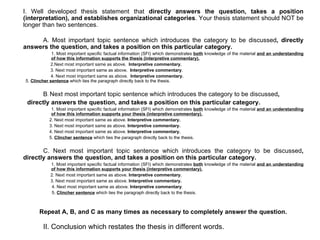
I. Well developed thesis statement that directly answers the question, takes a position
(interpretation), and establishes organizational categories. Your thesis statement should NOT be
longer than two sentences.

     A. Most important topic sentence which introduces the category to be discussed, directly
answers the question, and takes a position on this particular category.
             1. Most important specific factual information (SFI) which demonstrates both knowledge of the material and an understanding
             of how this information supports the thesis (interpretive commentary).
            2.Next most important same as above. Interpretive commentary.
            3. Next most important same as above. Interpretive commentary.
             4. Next most important same as above. Interpretive commentary.
5. Clincher sentence which ties the paragraph directly back to the thesis.


       B. Next most important topic sentence which introduces the category to be discussed,
 directly answers the question, and takes a position on this particular category.
            1. Most important specific factual information (SFI) which demonstrates both knowledge of the material and an understanding
            of how this information supports your thesis (interpretive commentary).
           2. Next most important same as above. Interpretive commentary.
           3. Next most important same as above. Interpretive commentary.
           4. Next most important same as above. Interpretive commentary.
           5. Clincher sentence which ties the paragraph directly back to the thesis.


       C. Next most important topic sentence which introduces the category to be discussed,
directly answers the question, and takes a position on this particular category.
            1. Most important specific factual information (SFI) which demonstrates both knowledge of the material and an understanding
            of how this information supports your thesis (interpretive commentary).
            2. Next most important same as above. Interpretive commentary.
            3. Next most important same as above. Interpretive commentary.
            4. Next most important same as above. Interpretive commentary.
            5. Clincher sentence which ties the paragraph directly back to the thesis.


      Repeat A, B, and C as many times as necessary to completely answer the question.

        II. Conclusion which restates the thesis in different words.
Begin each paragraph with a
  topic sentence which
  defends your thesis and
  directly answers the
  question and support it with
  as much specific factual
  information as you can. Do
  not merely list or describe
  information but use it to
  prove your thesis. Explain
  how and why the specific
  information supports your
  point of view (interpretative
  commentary) Avoid “vomit”
  essays in which you merely
  throw-up information in a
  random matter without
                                  http://asuartmuseum.asu.edu/cuba/vomit.jpg


  relating it back to your
  thesis.
“Kill the damn dog”
                                      Keep your essay
                                        focused on answering
                                        the question.
                                      The reader knows how
                                        this will turn out so
                                        just kill the dog

                                      Example:
                                      "See Spot run. Spot runs past Dick. The grass
                                          is wet. See Spot run past Jane. Dick has a
                                          stick. The sun is shining. Hear Baby cry.
                                          Spot runs into the road. Spot gets hit by a
                                          car."

                                          "While running across the yard to avoid
                                          being hit by a stick that Dick was swinging,
                                          Spot was blinded by the morning sun
                                          reflecting off the dewy grass, ran into the
http://xrlq.com/Images/ugly_sam.jpg       road, and was hit by a car.”
End each paragraph with a clincher
        sentence that ties the entire paragraph
        directly back to the thesis statement.


http://www1.istockphoto.com/file_thumbview_approve/2418881/2/istockphoto_2418881_important_remember_ribbon_tied_on_finger_as_reminder_close_up.jpg
Always focus on the
 complexity         of
 history.
 Demonstrate     that
 you understand the
 concept of multi-
 causation/     multi-
 effect.    Bring as
 much depth and
 breadth into the
 essay as possible.
                         http://www.tml.tkk.fi/~pnr/FAT/Cellular-Complexity.gif
http://upload.wikimedia.org/wikipedia/commons/1/1d/Unclesamwantyou.


Essays must always be written in dark blue or
 dark black ink. Penmanship, spelling, and
 grammar make a difference because they
 subconsciously affect the ability of the reader to
 extract information from your essay and they
 interfere with the logical flow of the essay. Use
 only past tense and DO NOT attempt to make
 your essay relevant to today's world. Use only
 third person. Avoid starting sentences with
 pronouns.
The question every reader asks themselves at
 the end of an essay is, "How sophisticated a
 knowledge of history has this student
 demonstrated in this essay?"             The
 demonstrated level of sophistication will
 ultimately determine the grade.

• REMEMBER THE CORE STRUCTURE

Apush essay writing

  • 1.
  • 2.
    • Writing isthinking on paper. It doesn’t matter how well you say nothing, it is still nothing. There is ONLY one best choice and arrangement of words to express a given idea • You are writing to impress an AP reader who will have approximately 2 minutes with your essay. You must convince the reader that you are an intelligent life-form. http://www.alienabductionhelp.com/hamilton_aliens.jpg
  • 3.
    • Read thequestion carefully and focus your discussion on directly answering that question. Emphasize the following – Analyze or assess the DEGREE to which a statement is true – Analyze or assess the IMPACT of an event or concept on some aspect of American society – Analyze or assess the RELATIVE IMPORTANCE of various factors on an event or concept. – Analyze or assess the EXTENT to which a historical stereotype is true for a given period or concept – Analyze or assess the REASONS that cause a particular mov’t to develop – COMPARING and CONTRASTING differing attitudes toward a general concept or policy or different factors over time.
  • 4.
    • Analyze means:examine HOW and WHY • Use the core structure (let me go over this with you)
  • 5.
    “Hit ‘em witha brick” Begin with a well- developed thesis statement that does more than repeat the question. It should 2. ANSWER THE QUESTION 3. TAKE A POSITION 4. ESTABLISH ORGANIZATIONAL CATERGORIES http://www1.istockphoto.com/file_thumbview_approve/1060063/2/istockphoto_1060063_single_brick.jpg
  • 6.
    I. Well developedthesis statement that directly answers the question, takes a position (interpretation), and establishes organizational categories. Your thesis statement should NOT be longer than two sentences. A. Most important topic sentence which introduces the category to be discussed, directly answers the question, and takes a position on this particular category. 1. Most important specific factual information (SFI) which demonstrates both knowledge of the material and an understanding of how this information supports the thesis (interpretive commentary). 2.Next most important same as above. Interpretive commentary. 3. Next most important same as above. Interpretive commentary. 4. Next most important same as above. Interpretive commentary. 5. Clincher sentence which ties the paragraph directly back to the thesis. B. Next most important topic sentence which introduces the category to be discussed, directly answers the question, and takes a position on this particular category. 1. Most important specific factual information (SFI) which demonstrates both knowledge of the material and an understanding of how this information supports your thesis (interpretive commentary). 2. Next most important same as above. Interpretive commentary. 3. Next most important same as above. Interpretive commentary. 4. Next most important same as above. Interpretive commentary. 5. Clincher sentence which ties the paragraph directly back to the thesis. C. Next most important topic sentence which introduces the category to be discussed, directly answers the question, and takes a position on this particular category. 1. Most important specific factual information (SFI) which demonstrates both knowledge of the material and an understanding of how this information supports your thesis (interpretive commentary). 2. Next most important same as above. Interpretive commentary. 3. Next most important same as above. Interpretive commentary. 4. Next most important same as above. Interpretive commentary. 5. Clincher sentence which ties the paragraph directly back to the thesis. Repeat A, B, and C as many times as necessary to completely answer the question. II. Conclusion which restates the thesis in different words.
  • 7.
    Begin each paragraphwith a topic sentence which defends your thesis and directly answers the question and support it with as much specific factual information as you can. Do not merely list or describe information but use it to prove your thesis. Explain how and why the specific information supports your point of view (interpretative commentary) Avoid “vomit” essays in which you merely throw-up information in a random matter without http://asuartmuseum.asu.edu/cuba/vomit.jpg relating it back to your thesis.
  • 8.
    “Kill the damndog” Keep your essay focused on answering the question. The reader knows how this will turn out so just kill the dog Example: "See Spot run. Spot runs past Dick. The grass is wet. See Spot run past Jane. Dick has a stick. The sun is shining. Hear Baby cry. Spot runs into the road. Spot gets hit by a car." "While running across the yard to avoid being hit by a stick that Dick was swinging, Spot was blinded by the morning sun reflecting off the dewy grass, ran into the http://xrlq.com/Images/ugly_sam.jpg road, and was hit by a car.”
  • 9.
    End each paragraphwith a clincher sentence that ties the entire paragraph directly back to the thesis statement. http://www1.istockphoto.com/file_thumbview_approve/2418881/2/istockphoto_2418881_important_remember_ribbon_tied_on_finger_as_reminder_close_up.jpg
  • 10.
    Always focus onthe complexity of history. Demonstrate that you understand the concept of multi- causation/ multi- effect. Bring as much depth and breadth into the essay as possible. http://www.tml.tkk.fi/~pnr/FAT/Cellular-Complexity.gif
  • 11.
    http://upload.wikimedia.org/wikipedia/commons/1/1d/Unclesamwantyou. Essays must alwaysbe written in dark blue or dark black ink. Penmanship, spelling, and grammar make a difference because they subconsciously affect the ability of the reader to extract information from your essay and they interfere with the logical flow of the essay. Use only past tense and DO NOT attempt to make your essay relevant to today's world. Use only third person. Avoid starting sentences with pronouns.
  • 12.
    The question everyreader asks themselves at the end of an essay is, "How sophisticated a knowledge of history has this student demonstrated in this essay?" The demonstrated level of sophistication will ultimately determine the grade. • REMEMBER THE CORE STRUCTURE