EWRT 1C
CLASS 11
AGENDA
The Thesis
Introductions
Conclusions
THE INTRODUCTION
The writer of the academic essay aims to
persuade readers of an idea based on
evidence. The beginning of the essay is a
crucial first step in this process. In order to
engage readers and establish your authority,
the beginning of your essay has to
accomplish certain business. Your beginning
should introduce the essay, focus it, and
orient readers.
INTRODUCE THE ESSAY
The beginning lets your readers know what the
essay is about, the topic. The essay's topic does
not exist in a vacuum, however; part of letting
readers know what your essay is about means
establishing the essay's context, the frame within
which you will approach your topic.
ORIENT READERS
Orienting readers means providing the information and
explanations necessary for your readers to understand your
argument. Orienting is important throughout your essay, but it is
crucial in the beginning. Readers who don't have the information
they need to follow your discussion will get lost and quit reading.
Supplying the necessary information to orient your readers may be
as simple as answering the basic questions of who, what, where,
when, how, and why. It may mean including a short summary of the
text you'll be analyzing.
At the minimum, the Introductory paragraph should briefly
introduce the author, the style of poem (sonnet, blank verse, free
verse), and the basic topic/theme the poem addresses. Do make
sure it leads up to the thesis; don’t begin your argument in the
introduction.
THESIS STATEMENT
The thesis of the essay will be your statement of
interpretation about what a particular poem means. There
are two related questions that you should consider in order
to come up with the thesis for your poetry essay:
1. What is this poem about? (determined through a close
reading)
2. Why did the writer choose to use the words, images,
metaphors and perhaps the particular kind of rhythm
scheme; what effect do they achieve?
Your thesis statement should contain answers to these
questions. Often thesis statements are complex enough to
require two or even three sentences. If you need multiple
sentences to express your idea, use them.
WHY A STRONG THESIS?
A paper needs a strong thesis
statement so that it can make a
strong argument. Weak thesis
statements can result in papers
with no clear direction or in papers
that rely on summary to fill their
pages. A good thesis statement
predicts limits and organizes the
content of the essay. In other
words, it notifies your reader about
the scope of the paper, telling him
or her exactly what your paper will
cover and in what order.
EXAMPLES OF
POETRY THESES
• Theodore Roethke’s “My Papa’s Waltz” uses robust imagery and
a profoundly ironic tone to illustrate the paradoxical nature of
the speaker’s childhood relationship with his father, suggesting
that a father’s love is not always expressed through a gentle
caress.
• Theodore Roethke’s “My Papa’s Waltz” juxtaposes imagery of
playfulness and violence to evoke an ambiguous tone of
reverence mixed with fear, illustrating the speaker’s attempt to
reconcile his paradoxical childhood relationship with his father.
• The waltzing ritual in Theodore Roethke’s “My Papa’s Waltz” is
not about dancing; it is about a man who asserts and maintains
physical control over his son even as he loses control over
himself.
WRITING CONCLUSIONS
The conclusion is your last chance to persuade your
readers to accept your point of view, and to impress
yourself upon them as a writer and thinker. The
impression you create in your conclusion will stay with
readers after they have finished the essay.
The end of an essay should therefore convey a sense
of completeness and closure as well as a sense of the
lingering possibilities of the topic, its larger meaning,
its implications: the final paragraph should close the
discussion without closing it off.
TO ESTABLISH A SENSE OF CLOSURE,
YOU MIGHT DO ONE OR MORE OF THE
FOLLOWING:
1. Conclude by framing your essay, that is linking the last
paragraph to the first, perhaps by reiterating a word or
phrase you used at the beginning.
2. Conclude with a sentence that's compound or parallel in
structure; such sentences can establish a sense of balance
or order that may feel just right at the end of a complex
discussion.
3. Conclude by setting your discussion into a different,
perhaps larger, context.
4. Conclude by considering the implications of your
argument (or analysis or discussion). What does your
argument imply, or involve, or suggest?
HOW NOT TO END YOUR ESSAY
1. Don't simply summarize your essay. A brief summary of
your argument may be useful, especially if your essay is
long, but shorter essays tend not to require a restatement
of your main ideas.
2. Avoid phrases like "in conclusion," "to conclude," "in
summary," and "to sum up." These phrases can be useful
in oral presentations. But readers can see when an essay
is about to end. You'll irritate your audience if you
belabor the obvious.
3. Don't undercut your authority by making statements like,
"this is just one approach to the subject; or, there may be
other, better approaches”; or, “this is just my opinion.”
HOMEWORK
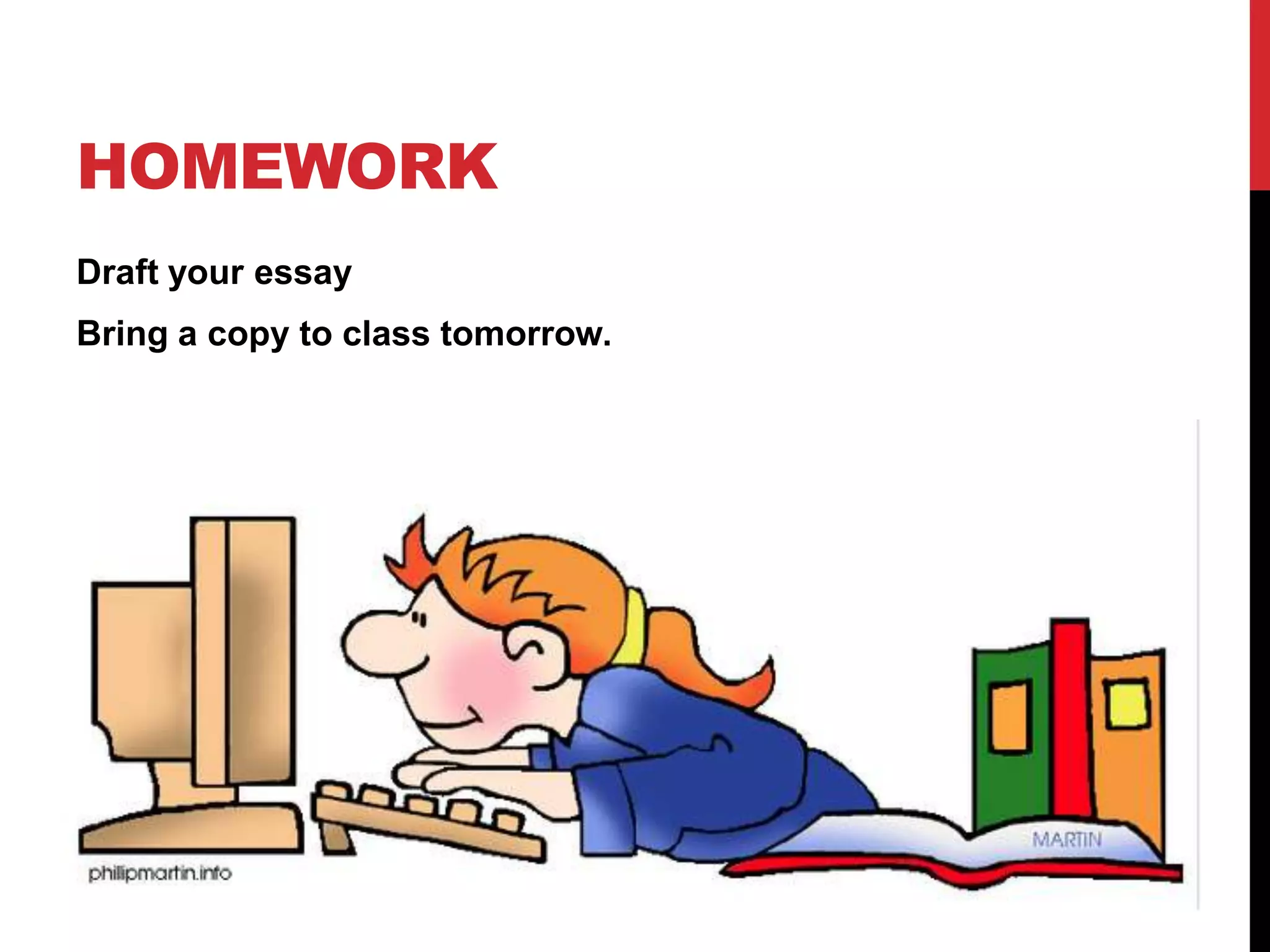
Draft your essay
Bring a copy to class tomorrow.

Ewrt 1 c class 11

  • 1.
  • 2.
  • 3.
    THE INTRODUCTION The writerof the academic essay aims to persuade readers of an idea based on evidence. The beginning of the essay is a crucial first step in this process. In order to engage readers and establish your authority, the beginning of your essay has to accomplish certain business. Your beginning should introduce the essay, focus it, and orient readers.
  • 4.
    INTRODUCE THE ESSAY Thebeginning lets your readers know what the essay is about, the topic. The essay's topic does not exist in a vacuum, however; part of letting readers know what your essay is about means establishing the essay's context, the frame within which you will approach your topic.
  • 5.
    ORIENT READERS Orienting readersmeans providing the information and explanations necessary for your readers to understand your argument. Orienting is important throughout your essay, but it is crucial in the beginning. Readers who don't have the information they need to follow your discussion will get lost and quit reading. Supplying the necessary information to orient your readers may be as simple as answering the basic questions of who, what, where, when, how, and why. It may mean including a short summary of the text you'll be analyzing. At the minimum, the Introductory paragraph should briefly introduce the author, the style of poem (sonnet, blank verse, free verse), and the basic topic/theme the poem addresses. Do make sure it leads up to the thesis; don’t begin your argument in the introduction.
  • 6.
    THESIS STATEMENT The thesisof the essay will be your statement of interpretation about what a particular poem means. There are two related questions that you should consider in order to come up with the thesis for your poetry essay: 1. What is this poem about? (determined through a close reading) 2. Why did the writer choose to use the words, images, metaphors and perhaps the particular kind of rhythm scheme; what effect do they achieve? Your thesis statement should contain answers to these questions. Often thesis statements are complex enough to require two or even three sentences. If you need multiple sentences to express your idea, use them.
  • 7.
    WHY A STRONGTHESIS? A paper needs a strong thesis statement so that it can make a strong argument. Weak thesis statements can result in papers with no clear direction or in papers that rely on summary to fill their pages. A good thesis statement predicts limits and organizes the content of the essay. In other words, it notifies your reader about the scope of the paper, telling him or her exactly what your paper will cover and in what order.
  • 8.
    EXAMPLES OF POETRY THESES •Theodore Roethke’s “My Papa’s Waltz” uses robust imagery and a profoundly ironic tone to illustrate the paradoxical nature of the speaker’s childhood relationship with his father, suggesting that a father’s love is not always expressed through a gentle caress. • Theodore Roethke’s “My Papa’s Waltz” juxtaposes imagery of playfulness and violence to evoke an ambiguous tone of reverence mixed with fear, illustrating the speaker’s attempt to reconcile his paradoxical childhood relationship with his father. • The waltzing ritual in Theodore Roethke’s “My Papa’s Waltz” is not about dancing; it is about a man who asserts and maintains physical control over his son even as he loses control over himself.
  • 9.
    WRITING CONCLUSIONS The conclusionis your last chance to persuade your readers to accept your point of view, and to impress yourself upon them as a writer and thinker. The impression you create in your conclusion will stay with readers after they have finished the essay. The end of an essay should therefore convey a sense of completeness and closure as well as a sense of the lingering possibilities of the topic, its larger meaning, its implications: the final paragraph should close the discussion without closing it off.
  • 10.
    TO ESTABLISH ASENSE OF CLOSURE, YOU MIGHT DO ONE OR MORE OF THE FOLLOWING: 1. Conclude by framing your essay, that is linking the last paragraph to the first, perhaps by reiterating a word or phrase you used at the beginning. 2. Conclude with a sentence that's compound or parallel in structure; such sentences can establish a sense of balance or order that may feel just right at the end of a complex discussion. 3. Conclude by setting your discussion into a different, perhaps larger, context. 4. Conclude by considering the implications of your argument (or analysis or discussion). What does your argument imply, or involve, or suggest?
  • 11.
    HOW NOT TOEND YOUR ESSAY 1. Don't simply summarize your essay. A brief summary of your argument may be useful, especially if your essay is long, but shorter essays tend not to require a restatement of your main ideas. 2. Avoid phrases like "in conclusion," "to conclude," "in summary," and "to sum up." These phrases can be useful in oral presentations. But readers can see when an essay is about to end. You'll irritate your audience if you belabor the obvious. 3. Don't undercut your authority by making statements like, "this is just one approach to the subject; or, there may be other, better approaches”; or, “this is just my opinion.”
  • 12.
    HOMEWORK Draft your essay Bringa copy to class tomorrow.