“APPLICATION OF E-BANKING IN BANGLADESH”
A CASE ANALYSIS OF ISLAMI BANK BANGLADESH LIMITED
GROUP MEMBERS
1)Mohammad Wahidul Haque
 111-11-1906
2)Abul kalam Azad
 111-11-1770
3)Faruqul Islam
 111-11-1779
4)Sohag Parvez
 111-11-1772
5)Monjur Morshed Rahat
 111-11-1774
6) G.M. Reyad Hossain
 111-11-1866
BANK OVERVIEW
PORTER’S FIVE FORCES MODEL
 Porter’s five forces model helps in accessing
where the power lies in a business situation.
 Porters Model is considered an important part of
planning tool set.
THREAT OF NEW COMPETITION
 The threat of new entry or competition of Islami
Bank Bangladesh Limited is high because :
 The starting capital requirement is less
 Few economies of scale are in place
 The switching cost or sunk cost is comparatively
low than the other banks so customer can easily
switch
 The key technology is protected but is hard to
acquire
 Brand Equity is satisfactory
THREAT OF SUBSTITUTE PRODUCTS OR SERVICES
 Here the threat of IBBL on substitute products or
services is also high due to the below factors:
 There are many substitute products available
 Customer can easily find the product or service that the
competitors are offering at the same or less price
 Substandard product is available
 Ease of substitution. Information-based products are
more prone to substitution, as online product can easily
replace material product.
BARGAINING POWER OF SUPPLIERS
 IBBL’s suppliers are more powerful because:
 Suppliers are concentrated and well organized
 a few substitutes available to supplies
 Their product is most effective or unique
 Switching cost, from one suppliers to another, is
high
 IBBL is an important customer to Supplier
 Strength of distribution channel
BARGAINING POWER OF CUSTOMERS (BUYERS)
 IBBL’s Buyer has low bargaining power due to
below issues:
• Offering differentiated product
• Buyer purchases in bulk quantities
• Product is differentiated
• Shopping cost is medium
• Buyers are price sensitive
• Buyer information availability
• Differential advantage (uniqueness) of industry
products
INTENSITY OF COMPETITIVE RIVALRY
 IBBL’s Industry rivalry is high because
 There are number of small or equal competitors
and less when there’s a clear market leader.
 Customers have low switching costs
 Industry is growing
 Exit barriers are high and rivals stay and compete
 Fixed cost are high resulting huge production and
reduction in prices
 Level of advertising expense
 Powerful competitive strategy
BANK ANALYSIS
 IBBL was established on the 13th March 1983 as
the first Islamic Bank in the South East Asia.
Mission
 To establish a welfare oriented banking system
 To ensure equity & justice in the field of economics
 To encourage socio-economic uplift
 To provide financial assistance in rural areas
 To achieve balanced growth & equitable
development through diversified investment
VISION
 To establish and maintain the modern banking
techniques
 To ensure soundness and development of the
financial system based on Islamic principles
 To become the strong and efficient organization
with highly motivated professional
 To work for the benefit of people
 To encourage savings in the form of direct
investment
 To encourage investment particularly in projects
which are more likely to lead to higher employment.
CORE VALUES
 Trust in Almighty Allah
 Strict observance of Islamic Shari’ah
 Highest standard of Honesty, Integrity & Morale
 Welfare Banking
 Equity and Justice
 Environmental Consciousness
 Personalized Service
 Adoption of Changed Technology
 Proper Delegation, Transparency & Accountability
PRODUCT
 Al-Wadeah Current Account (AWCA)
 Mudaraba Savings Account (MSA)
 Mudaraba Term Deposit Account (MTDR)
 Mudaraba Special Notice Account (MSNA)
 Mudaraba Hajj Savings Account (MHSA)
 Mudaraba Special Savings (Pension) Account (MSSA)
 Mudaraba Savings Bond (MSB)
 Mudaraba Monthly Profit Deposit Account (MMPDA)
 Mudaraba Muhor Savings Account (MMSA)
 Mudaraba Waqf Cash Deposit Account (MWCDA)
 Mudaraba NRB Savings Bond (MNSB) Account
 Mudaraba Foreign Currency Deposit Account (MFCD)
 Students Mudaraba Savings Account (SMSA)
 Mudaraba Farmers Savings Account (MFSA)
SERVICE
 NRB (Non Resident Bangladeshi) Entrepreneurs
Services
 Remittance Card
 Investment Scheme for Foreign Expatriate
 Mudaraba NRB Saving Bond
 SME Service
1. Manufacturing
2. Trading
3. Services
 Foreign Exchange Service
o Import
o Export
o Remittance
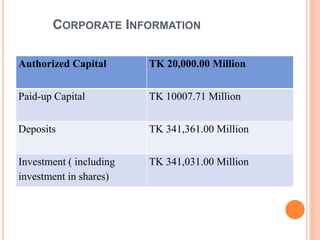
CORPORATE INFORMATION
Authorized Capital TK 20,000.00 Million
Paid-up Capital TK 10007.71 Million
Deposits TK 341,361.00 Million
Investment ( including
investment in shares)
TK 341,031.00 Million
FOREIGN EXCHANGE BUSINESS
Import TK 301,207.00 Million
Export TK 178,244.00 Million
Remittance TK 236,607.00 Million
SWOT ANALYSIS
 SWOT analysis (alternately SWOT Matrix) is a
structured planning method used to evaluate the
Strengths, Weaknesses, Opportunities, and Threats
involved in a project or in a business venture.
 Strengths: characteristics of the business, or project
team that give it an advantage over others
 Weaknesses: are characteristics that place the
team at a disadvantage relative to others
 Opportunities: external chances to improve
performance (e.g. make greater profits) in the
environment
 Threats: external elements in the environment that
could cause trouble for the business or project
STRENGTHS
 interest-free banking system according to Islamic
Shariah
 income of the Bank is shared with the depositors
 welfare oriented banking system
 equity and justice in the field of all economic activities.
 financial services to the poor, helpless
 human resource development
 achieve balanced growth
 ICAB awarded IBBL for presenting best Annual Report
 IBBL is enlisted in the TOP 1000 banks in the world
WEAKNESSES
 lack of expert employees
 insufficient advertisement
 emphasize only developed sectors
 feeble modern technology
 deficiency of expertise
 number of ATM booth
OPPORTUNITIES
 Huge chance of depositing & investment due to islamic
shariah based operation
 Development of the financial system based on Islamic
Principles
 Innovative as well as modern customer service
 Encourage savings in the form of direct investment
 Investing developed sectors
 Transactions with NRB (Non Resident Bangladeshi)
 Lending SME sectors
 Enriching Foreign Exchange Business
 Providing Locker service
 Distribution of offshore services
THREATS
 Establishment of Competitors
 Advancement of Modern Technology
 The switching cost or sunk cost is comparatively
low than the other banks so customer can easily
switch
 There are many substitute products available
 Different kinds of facilities from other banks
 Improved advertisement from others
 Online Banking is satisfactory
RATIO ANALYSIS
&
TREND ANALYSIS
LIQUIDITY RATIO:
Liquidity Ratio 2007-08 2008-09 2009-10 2010-11 2011-12
Liquid Asset
Current
Liabilities
47743111949
22167444018
= 2.15
51235982040
21369827458
= 2.40
55369875318
21584679280
= 2.57
62035742189
22654789123
= 2.73
78951258456
25369741852
= 3.11
0
0.5
1
1.5
2
2.5
3
3.5
2007-08 2008-09 2009-10 2010-11 2011-12
Liquidity Ratio
Liquidity Ratio
DECISION
 The ratio indicates that Islami Bank Bangladesh
Limited can cover only 3.11(Current year) percent
of their existing debt obligations with their current
liquid assets. Clearly, Islami Bank Bangladesh
Limited plans to meet the debt obligations from their
income, but the ratio suggests that their liquid funds
do not provide a large production.
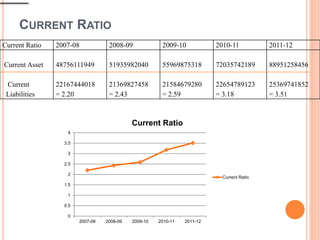
CURRENT RATIO
Current Ratio 2007-08 2008-09 2009-10 2010-11 2011-12
Current Asset
Current
Liabilities
48756111949
22167444018
= 2.20
51935982040
21369827458
= 2.43
55969875318
21584679280
= 2.59
72035742189
22654789123
= 3.18
88951258456
25369741852
= 3.51
0
0.5
1
1.5
2
2.5
3
3.5
4
2007-08 2008-09 2009-10 2010-11 2011-12
Current Ratio
Current Ratio
DECISION
 The higher the current ratio, the more liquid the firm
is considered to be. The more predictable a firm’s
cash flows, the lower acceptable current ratio. And
the lower the current ratio, the less liquid the firm is
considered to be.
QUICK RATIO
Quick Ratio 2007-08 2008-09 2009-10 2010-11 2011-12
Current assets –
Inventory
Current
Liabilities
19895413697
22167444018
= 0.90
31835982040
21369827458
= 1.49
35969875316
21584679280
= 1.66
42035542189
22654789123
= 1.86
63951258456
25369741852
= 2.52
0
0.5
1
1.5
2
2.5
3
2007-08 2008-09 2009-10 2010-11 2011-12
Quick Ratio
Quick Ratio
DECISION
 A quick ratio of 1.0 or greater is occasionally
recommended, but as with the current ratio, what
value is acceptable depends largely on the firm. But
in the year of 2007-08 the quick ratio is less than
1.00. All depend on the firm though the quick ratio
is less than 1.00.
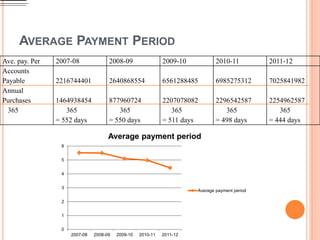
AVERAGE PAYMENT PERIOD
Ave. pay. Per 2007-08 2008-09 2009-10 2010-11 2011-12
Accounts
Payable
Annual
Purchases
365
2216744401
1464938454
365
= 552 days
2640868554
877960724
365
= 550 days
6561288485
2207078082
365
= 511 days
6985275312
2296542587
365
= 498 days
7025841982
2254962587
365
= 444 days
0
1
2
3
4
5
6
2007-08 2008-09 2009-10 2010-11 2011-12
Average payment period
DECISION
 As the average payment period indicates that the
time needed to pay accounts payable. Here it is
clearly seen that the Islami Bank Bangladesh
Limited needs less time relating to the previous
year to pay accounts payable.
DEBT RATIO
Debt Ratio 2007-08 2008-09 2009-10 2010-11 2011-12
Total Liabilities
Total Assets
48756111949
321674440180
= 0.15 X 100
= 15%
51935982040
413698274587
= 0.14 X100
= 14%
55969875318
455846792802
= 0.145 X 100
= 14.5%
30709186251
530586118271
= 0.13 X 100
= 13%
88951258456
653697418525
= 0.11 X 100
= 11%
0
2
4
6
8
10
12
14
16
2007-08 2008-09 2009-10 2010-11 2011-12
Debt ratio
Debt ratio
DECISION
 The higher this ratio, the greater the firm’s degree
of indebtedness and the more financial leverage it
has. Again, the lower ratio refers to the fewer
degree of indebtedness and the less financial
leverage it has.
DEBT EQUITY RATIO
Debt Equity
Ratio
2007-08 2008-09 2009-10 2010-11 2011-12
Total Liability
Shareholders
Equity
48756111949
121674440182
= 0.27 X 100
= 27%
51935982040
213698274587
= 0.24 X 100
= 24 %
55969875318
315846792808
= 0.23 X 100
= 23 %
72035742189
326547891237
= 0.20 X 100
= 20 %
88951258456
453697418529
= 0.19 X 100
= 19 %
0
5
10
15
20
25
30
2007-08 2008-09 2009-10 2010-11 2011-12
Debt Equity Ratio
Debt Equity Ratio
TIME INTEREST EARNED RATIO
T.I.E.R 2007-08 2008-09 2009-10 2010-11 2011-12
EBIT
Interest
8489792032
258951753
= 4.71
8895478512
256987412
= 4.58
9008547892
265879215
= 4.78
9215248895
278954621
= 4.86
9625846987
289563487
= 4.94
4.4
4.5
4.6
4.7
4.8
4.9
5
2007-08 2008-09 2009-10 2010-11 2011-12
T.I.E.R.
T.I.E.R.
DECISION
 The higher the value, the better able the firm is to
fulfill its interest obligations. The lower the value,
the less able the firm is to fulfill its interest
obligations.
RETURN ON ASSET:
Return on Asset 2007-08 2008-09 2009-10 2010-11 2011-12
Earnings
available for
common stock
holders
Total Assets
47743111949
22167444018
= 25%
51235982040
21369827458
= 26.50%
55369875318
21584679280
= 27%
62035742189
22654789123
= 28%
78951258456
25369741852
= 30.20%
0
5
10
15
20
25
30
35
2007-08 2008-09 2009-10 2010-11 2011-12
Return on Asset
Return on Asset
DECISION
 The higher the firm’s return on total assets, the
better effectiveness of management in generating
profits with its available assets. The lower the firm’s
return on total assets, the less effectiveness of
management in generating profits with its available
assets.
RETURN ON EQUITY
Return on
Equity
2007-08 2008-09 2009-10 2010-11 2011-12
Earnings
available for
common stock
holders
Common stock
equity
47743111949
332167444018
= 28%
51235982040
51369827458
= 29.50%
55369875318
641584679280
= 30%
62035742189
652654789123
= 32%
78951258456
685369741852
= 33.10%
25
26
27
28
29
30
31
32
33
34
2007-08 2008-09 2009-10 2010-11 2011-12
Return on Equity
Return on Equity
DECISION
 The higher this return, the better off are the owners
in terms of earning on the common stockholders
investment in the firm. The lower this return, the
less better off are the owners.
PRICE EARNINGS RATIO
Price Earnings
Ratio
2007-08 2008-09 2009-10 2010-11 2011-12
Market price
per share of
common stock
Earnings per
share
298.72
12.03
= 9.56
330.45
31.10
= 8.27
410.27
45.91
= 8.94
620.36
60.21
= 10.30
702.18
78.12
= 8.99
0
2
4
6
8
10
12
2007-08 2008-09 2009-10 2010-11 2011-12
Price Earnings Ratio
DECISION
 The higher the price earnings ratio, the greater the
investor confidence. The lower the price earnings
ratio, the less the investor confidence.
DIVIDEND PAYOUT RATIO
Dividend Payout
ratio
2007-08 2008-09 2009-10 2010-11 2011-12
Yearly Dividend
per share
No. of share
282889600
5090300
= 55.57
3012569874
10369524
= 60.36
3269528445
15698456
= 62.48
4025698458
19568546
= 65.07
4802365287
20136952
= 67.25
0
10
20
30
40
50
60
70
80
2007-08 2008-09 2009-10 2010-11 2011-12
Dividend Payout Ratio
DECISION
 The higher the ratio, the more chance to gain profit.
And the lower the ratio, the less chance to gain the
profit.
EARNINGS PER SHARE
EPS 2007-08 2008-09 2009-10 2010-11 2011-12
Earnings after
Tax
No.of share
1025497621
5090300
= 12.03
2565489521
10369524
= 31.10
3698527458
15698456
= 45.91
4203574218
20568546
= 60.21
5895125845
29136952
= 78.12
0
10
20
30
40
50
60
70
80
2007-08 2008-09 2009-10 2010-11 2011-12
EPS
EPS
DECISION
 The higher the EPS, the greater chance of profit of
the firm. Whereas the lower EPS indicates the
lower chance of profit of the firm.
OTHER TRENDS
166325
202115
244292
291935
310225
0
50000
100000
150000
200000
250000
300000
350000
2007 2008 2009 2010 2011
Trend of Deposit
Trend of Deposit
Amount in MillionTaka
0
50000
100000
150000
200000
250000
300000
2007 2008 2009 2010 2011
144921
180054
214616
263225
297113
Trend of Investment
Trend of Investment
Sector wise Investment
Industrial
Commercial
Real Estate
Agriculture
Transport
SME
Others
FOREIGN EXCHANGE BUSINESS
96870
137086
168329
161230
246281
53819
84143
93962
106424
148421
51133
66690
140404
194716
214629
0
50000
100000
150000
200000
250000
300000
2007 2008 2009 2010 2011
Import
Export
Remittance
ELECTRONIC BANKING
E-BANKING
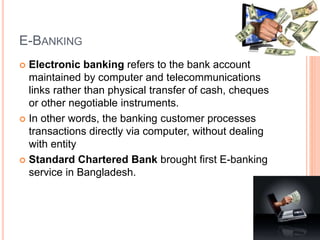
 Electronic banking refers to the bank account
maintained by computer and telecommunications
links rather than physical transfer of cash, cheques
or other negotiable instruments.
 In other words, the banking customer processes
transactions directly via computer, without dealing
with entity
 Standard Chartered Bank brought first E-banking
service in Bangladesh.
TYPES OF E-BANKING
ATM (Automated Teller Machine)
 Using an ATM, customers can access their
bank accounts in order to
make cash withdrawals, debit card cash advances,
and check their account balances as well as
purchase pre-paid mobile phone credit.
 Authentication is provided by the customer entering
a personal identification number (PIN)
ELECTRONIC FUNDS TRANSFER (EFT)
 the electronic exchange
 transfer of money from one account to another
 either within a single financial institution or across
multiple institutions, through computer-based
systems.
DEBIT CARD
 make purchases
 Make payments
 occur at a store or business, online, or by phone.
CREDIT CARDS
 a customer can avail various facilities or buy
products/services without making
immediate payment and that could be made at
later stage of time.
PERSONAL COMPUTER BANKING
 To handle many banking transactions via your
personal computer
 To view your account balance request transfers
between accounts, and pay bills electronically.
MOBILE BANKING
 Mobile banking provides customer to access their
account on mobile phone screen.
 Routine banking transactions can be performed by
just punching a few buttons on the mobile.
SMS BANKING
 SMS banking uses short text messages sent
through the client’s mobile phone
 A client can automatically receive information about
his account balance
ELECTRONIC BANKING
OF
ISLAMI BANK
BANGLADESH LIMITED
 IBBL has introduced its Online Banking service
since 2006
 Now more than 60,000 of existing ATM card
holders can use IBBL’s own 48 ATMs & 157 ATMs
of shared ATM network.
 About 5000 transactions with withdrawal of more
than Tk. 4 crores are now done per day.
THE ATM PROJECT
 Since 2001, IBBL started providing ATM service to its
customers from 55 branches through a consortium of 9
financial organizations using a 3rd party ATM service
provider.
SERVICES
 Cash Withdraw
 Fund Transfer
 Mini Account Statement
 Balance Inquiry
Transaction Limit
 For Cash Withdrawal maximum amount is Tk. 50,000 in
a calendar date.
Charges
 Tk.300 Yearly fees is applicable.
SMS BANKING
 Through SMS push-pull service, clients can see their
latest balance information and last three transactions in
their mobiles from anywhere in the world.
 At present more than one lac clients have been
registered in SMS banking and on average 6500
requests are being received per day.
Services
 Multiple Account Registration
 International Push- Pull Facility
 Account Balance (BAL )
 Mini Account Statement (STM)
 Account Information (ACI)
INTERNET BANKING
 Through iBanking, Foreign Remittance Houses &
valued clients can check account details at IBBL’s
web portal. So far, nearly 20000 clients have
registered for taking the internet banking services.
Services
 Transfer funds (iTransfer) between IBBL accounts
 Purchase airtime / Recharge account ( iRecharge)
from all mobile operators in Bangladesh, except
teletalk.
 Wimax Recharge
OTHER TYPES OF E-BANKING
 Shariah based Credit card
 Remittance Card
 VISA facility
 SWIFT service(Society for Worldwide Inter-Bank
Financial Telecommunication)
COMPARISON
Factors of E-Banking IBBL BRAC Bank DBBL
ATM   
DEBIT CARD X  
SHARIAH BASED
CREDIT CARD
 x x
CREDIT CARD x  
REMITTANCE CARD   
VISA   
SMS BANKING   
INTERNET BANKING   
MOBILE BANKING x x 
MIS  x x
SWIFT SERVICE  x x
MAIL BANKING   
PC BANKING   
EFT SYSTEM   
WAP SERVICE   
RECOMMENDATION
 After all IBBL needs some steps to be taken to improve
the E-Banking which are as follows-
 To expand the number of ATM booths
 To place ATM booths in good areas
 To update the ATM machines
 To update the software of ATM
 To provide security to the ATM user like cc camera in ATM
booth
 To develop SMS Banking
 To reduce I-Banking charge
 To give more facilities on remittance card user specially
foreigners
 To improve SWIFT service
 To start Mobile Banking as early as possible
 To construct a developed MIS
 To establish core banking system like BACH,BEFTN,MIS
 To facilitate PC Banking
 To improve the WAP service
 To improve the web page adding more features
 To store the E-banking transactions in secured place
 To accomplish the E-banking transactions quickly
 To establish electronic integrated banking system
 To equip more IT expert employees for the development
of E-Banking
 To implement the core objectives for the development of
E-banking
THANK YOU ALL !!!

Analysis of e banking

  • 2.
    “APPLICATION OF E-BANKINGIN BANGLADESH” A CASE ANALYSIS OF ISLAMI BANK BANGLADESH LIMITED
  • 3.
    GROUP MEMBERS 1)Mohammad WahidulHaque  111-11-1906 2)Abul kalam Azad  111-11-1770 3)Faruqul Islam  111-11-1779 4)Sohag Parvez  111-11-1772 5)Monjur Morshed Rahat  111-11-1774 6) G.M. Reyad Hossain  111-11-1866
  • 4.
  • 5.
    PORTER’S FIVE FORCESMODEL  Porter’s five forces model helps in accessing where the power lies in a business situation.  Porters Model is considered an important part of planning tool set.
  • 6.
    THREAT OF NEWCOMPETITION  The threat of new entry or competition of Islami Bank Bangladesh Limited is high because :  The starting capital requirement is less  Few economies of scale are in place  The switching cost or sunk cost is comparatively low than the other banks so customer can easily switch  The key technology is protected but is hard to acquire  Brand Equity is satisfactory
  • 7.
    THREAT OF SUBSTITUTEPRODUCTS OR SERVICES  Here the threat of IBBL on substitute products or services is also high due to the below factors:  There are many substitute products available  Customer can easily find the product or service that the competitors are offering at the same or less price  Substandard product is available  Ease of substitution. Information-based products are more prone to substitution, as online product can easily replace material product.
  • 8.
    BARGAINING POWER OFSUPPLIERS  IBBL’s suppliers are more powerful because:  Suppliers are concentrated and well organized  a few substitutes available to supplies  Their product is most effective or unique  Switching cost, from one suppliers to another, is high  IBBL is an important customer to Supplier  Strength of distribution channel
  • 9.
    BARGAINING POWER OFCUSTOMERS (BUYERS)  IBBL’s Buyer has low bargaining power due to below issues: • Offering differentiated product • Buyer purchases in bulk quantities • Product is differentiated • Shopping cost is medium • Buyers are price sensitive • Buyer information availability • Differential advantage (uniqueness) of industry products
  • 10.
    INTENSITY OF COMPETITIVERIVALRY  IBBL’s Industry rivalry is high because  There are number of small or equal competitors and less when there’s a clear market leader.  Customers have low switching costs  Industry is growing  Exit barriers are high and rivals stay and compete  Fixed cost are high resulting huge production and reduction in prices  Level of advertising expense  Powerful competitive strategy
  • 11.
  • 12.
     IBBL wasestablished on the 13th March 1983 as the first Islamic Bank in the South East Asia. Mission  To establish a welfare oriented banking system  To ensure equity & justice in the field of economics  To encourage socio-economic uplift  To provide financial assistance in rural areas  To achieve balanced growth & equitable development through diversified investment
  • 13.
    VISION  To establishand maintain the modern banking techniques  To ensure soundness and development of the financial system based on Islamic principles  To become the strong and efficient organization with highly motivated professional  To work for the benefit of people  To encourage savings in the form of direct investment  To encourage investment particularly in projects which are more likely to lead to higher employment.
  • 14.
    CORE VALUES  Trustin Almighty Allah  Strict observance of Islamic Shari’ah  Highest standard of Honesty, Integrity & Morale  Welfare Banking  Equity and Justice  Environmental Consciousness  Personalized Service  Adoption of Changed Technology  Proper Delegation, Transparency & Accountability
  • 15.
    PRODUCT  Al-Wadeah CurrentAccount (AWCA)  Mudaraba Savings Account (MSA)  Mudaraba Term Deposit Account (MTDR)  Mudaraba Special Notice Account (MSNA)  Mudaraba Hajj Savings Account (MHSA)  Mudaraba Special Savings (Pension) Account (MSSA)  Mudaraba Savings Bond (MSB)  Mudaraba Monthly Profit Deposit Account (MMPDA)  Mudaraba Muhor Savings Account (MMSA)  Mudaraba Waqf Cash Deposit Account (MWCDA)  Mudaraba NRB Savings Bond (MNSB) Account  Mudaraba Foreign Currency Deposit Account (MFCD)  Students Mudaraba Savings Account (SMSA)  Mudaraba Farmers Savings Account (MFSA)
  • 16.
    SERVICE  NRB (NonResident Bangladeshi) Entrepreneurs Services  Remittance Card  Investment Scheme for Foreign Expatriate  Mudaraba NRB Saving Bond  SME Service 1. Manufacturing 2. Trading 3. Services  Foreign Exchange Service o Import o Export o Remittance
  • 17.
    CORPORATE INFORMATION Authorized CapitalTK 20,000.00 Million Paid-up Capital TK 10007.71 Million Deposits TK 341,361.00 Million Investment ( including investment in shares) TK 341,031.00 Million
  • 18.
    FOREIGN EXCHANGE BUSINESS ImportTK 301,207.00 Million Export TK 178,244.00 Million Remittance TK 236,607.00 Million
  • 19.
  • 20.
     SWOT analysis(alternately SWOT Matrix) is a structured planning method used to evaluate the Strengths, Weaknesses, Opportunities, and Threats involved in a project or in a business venture.  Strengths: characteristics of the business, or project team that give it an advantage over others  Weaknesses: are characteristics that place the team at a disadvantage relative to others  Opportunities: external chances to improve performance (e.g. make greater profits) in the environment  Threats: external elements in the environment that could cause trouble for the business or project
  • 21.
    STRENGTHS  interest-free bankingsystem according to Islamic Shariah  income of the Bank is shared with the depositors  welfare oriented banking system  equity and justice in the field of all economic activities.  financial services to the poor, helpless  human resource development  achieve balanced growth  ICAB awarded IBBL for presenting best Annual Report  IBBL is enlisted in the TOP 1000 banks in the world
  • 22.
    WEAKNESSES  lack ofexpert employees  insufficient advertisement  emphasize only developed sectors  feeble modern technology  deficiency of expertise  number of ATM booth
  • 23.
    OPPORTUNITIES  Huge chanceof depositing & investment due to islamic shariah based operation  Development of the financial system based on Islamic Principles  Innovative as well as modern customer service  Encourage savings in the form of direct investment  Investing developed sectors  Transactions with NRB (Non Resident Bangladeshi)  Lending SME sectors  Enriching Foreign Exchange Business  Providing Locker service  Distribution of offshore services
  • 24.
    THREATS  Establishment ofCompetitors  Advancement of Modern Technology  The switching cost or sunk cost is comparatively low than the other banks so customer can easily switch  There are many substitute products available  Different kinds of facilities from other banks  Improved advertisement from others  Online Banking is satisfactory
  • 25.
  • 26.
    LIQUIDITY RATIO: Liquidity Ratio2007-08 2008-09 2009-10 2010-11 2011-12 Liquid Asset Current Liabilities 47743111949 22167444018 = 2.15 51235982040 21369827458 = 2.40 55369875318 21584679280 = 2.57 62035742189 22654789123 = 2.73 78951258456 25369741852 = 3.11 0 0.5 1 1.5 2 2.5 3 3.5 2007-08 2008-09 2009-10 2010-11 2011-12 Liquidity Ratio Liquidity Ratio
  • 27.
    DECISION  The ratioindicates that Islami Bank Bangladesh Limited can cover only 3.11(Current year) percent of their existing debt obligations with their current liquid assets. Clearly, Islami Bank Bangladesh Limited plans to meet the debt obligations from their income, but the ratio suggests that their liquid funds do not provide a large production.
  • 28.
    CURRENT RATIO Current Ratio2007-08 2008-09 2009-10 2010-11 2011-12 Current Asset Current Liabilities 48756111949 22167444018 = 2.20 51935982040 21369827458 = 2.43 55969875318 21584679280 = 2.59 72035742189 22654789123 = 3.18 88951258456 25369741852 = 3.51 0 0.5 1 1.5 2 2.5 3 3.5 4 2007-08 2008-09 2009-10 2010-11 2011-12 Current Ratio Current Ratio
  • 29.
    DECISION  The higherthe current ratio, the more liquid the firm is considered to be. The more predictable a firm’s cash flows, the lower acceptable current ratio. And the lower the current ratio, the less liquid the firm is considered to be.
  • 30.
    QUICK RATIO Quick Ratio2007-08 2008-09 2009-10 2010-11 2011-12 Current assets – Inventory Current Liabilities 19895413697 22167444018 = 0.90 31835982040 21369827458 = 1.49 35969875316 21584679280 = 1.66 42035542189 22654789123 = 1.86 63951258456 25369741852 = 2.52 0 0.5 1 1.5 2 2.5 3 2007-08 2008-09 2009-10 2010-11 2011-12 Quick Ratio Quick Ratio
  • 31.
    DECISION  A quickratio of 1.0 or greater is occasionally recommended, but as with the current ratio, what value is acceptable depends largely on the firm. But in the year of 2007-08 the quick ratio is less than 1.00. All depend on the firm though the quick ratio is less than 1.00.
  • 32.
    AVERAGE PAYMENT PERIOD Ave.pay. Per 2007-08 2008-09 2009-10 2010-11 2011-12 Accounts Payable Annual Purchases 365 2216744401 1464938454 365 = 552 days 2640868554 877960724 365 = 550 days 6561288485 2207078082 365 = 511 days 6985275312 2296542587 365 = 498 days 7025841982 2254962587 365 = 444 days 0 1 2 3 4 5 6 2007-08 2008-09 2009-10 2010-11 2011-12 Average payment period Average payment period
  • 33.
    DECISION  As theaverage payment period indicates that the time needed to pay accounts payable. Here it is clearly seen that the Islami Bank Bangladesh Limited needs less time relating to the previous year to pay accounts payable.
  • 34.
    DEBT RATIO Debt Ratio2007-08 2008-09 2009-10 2010-11 2011-12 Total Liabilities Total Assets 48756111949 321674440180 = 0.15 X 100 = 15% 51935982040 413698274587 = 0.14 X100 = 14% 55969875318 455846792802 = 0.145 X 100 = 14.5% 30709186251 530586118271 = 0.13 X 100 = 13% 88951258456 653697418525 = 0.11 X 100 = 11% 0 2 4 6 8 10 12 14 16 2007-08 2008-09 2009-10 2010-11 2011-12 Debt ratio Debt ratio
  • 35.
    DECISION  The higherthis ratio, the greater the firm’s degree of indebtedness and the more financial leverage it has. Again, the lower ratio refers to the fewer degree of indebtedness and the less financial leverage it has.
  • 36.
    DEBT EQUITY RATIO DebtEquity Ratio 2007-08 2008-09 2009-10 2010-11 2011-12 Total Liability Shareholders Equity 48756111949 121674440182 = 0.27 X 100 = 27% 51935982040 213698274587 = 0.24 X 100 = 24 % 55969875318 315846792808 = 0.23 X 100 = 23 % 72035742189 326547891237 = 0.20 X 100 = 20 % 88951258456 453697418529 = 0.19 X 100 = 19 % 0 5 10 15 20 25 30 2007-08 2008-09 2009-10 2010-11 2011-12 Debt Equity Ratio Debt Equity Ratio
  • 37.
    TIME INTEREST EARNEDRATIO T.I.E.R 2007-08 2008-09 2009-10 2010-11 2011-12 EBIT Interest 8489792032 258951753 = 4.71 8895478512 256987412 = 4.58 9008547892 265879215 = 4.78 9215248895 278954621 = 4.86 9625846987 289563487 = 4.94 4.4 4.5 4.6 4.7 4.8 4.9 5 2007-08 2008-09 2009-10 2010-11 2011-12 T.I.E.R. T.I.E.R.
  • 38.
    DECISION  The higherthe value, the better able the firm is to fulfill its interest obligations. The lower the value, the less able the firm is to fulfill its interest obligations.
  • 39.
    RETURN ON ASSET: Returnon Asset 2007-08 2008-09 2009-10 2010-11 2011-12 Earnings available for common stock holders Total Assets 47743111949 22167444018 = 25% 51235982040 21369827458 = 26.50% 55369875318 21584679280 = 27% 62035742189 22654789123 = 28% 78951258456 25369741852 = 30.20% 0 5 10 15 20 25 30 35 2007-08 2008-09 2009-10 2010-11 2011-12 Return on Asset Return on Asset
  • 40.
    DECISION  The higherthe firm’s return on total assets, the better effectiveness of management in generating profits with its available assets. The lower the firm’s return on total assets, the less effectiveness of management in generating profits with its available assets.
  • 41.
    RETURN ON EQUITY Returnon Equity 2007-08 2008-09 2009-10 2010-11 2011-12 Earnings available for common stock holders Common stock equity 47743111949 332167444018 = 28% 51235982040 51369827458 = 29.50% 55369875318 641584679280 = 30% 62035742189 652654789123 = 32% 78951258456 685369741852 = 33.10% 25 26 27 28 29 30 31 32 33 34 2007-08 2008-09 2009-10 2010-11 2011-12 Return on Equity Return on Equity
  • 42.
    DECISION  The higherthis return, the better off are the owners in terms of earning on the common stockholders investment in the firm. The lower this return, the less better off are the owners.
  • 43.
    PRICE EARNINGS RATIO PriceEarnings Ratio 2007-08 2008-09 2009-10 2010-11 2011-12 Market price per share of common stock Earnings per share 298.72 12.03 = 9.56 330.45 31.10 = 8.27 410.27 45.91 = 8.94 620.36 60.21 = 10.30 702.18 78.12 = 8.99 0 2 4 6 8 10 12 2007-08 2008-09 2009-10 2010-11 2011-12 Price Earnings Ratio Price Earnings Ratio
  • 44.
    DECISION  The higherthe price earnings ratio, the greater the investor confidence. The lower the price earnings ratio, the less the investor confidence.
  • 45.
    DIVIDEND PAYOUT RATIO DividendPayout ratio 2007-08 2008-09 2009-10 2010-11 2011-12 Yearly Dividend per share No. of share 282889600 5090300 = 55.57 3012569874 10369524 = 60.36 3269528445 15698456 = 62.48 4025698458 19568546 = 65.07 4802365287 20136952 = 67.25 0 10 20 30 40 50 60 70 80 2007-08 2008-09 2009-10 2010-11 2011-12 Dividend Payout Ratio Dividend Payout Ratio
  • 46.
    DECISION  The higherthe ratio, the more chance to gain profit. And the lower the ratio, the less chance to gain the profit.
  • 47.
    EARNINGS PER SHARE EPS2007-08 2008-09 2009-10 2010-11 2011-12 Earnings after Tax No.of share 1025497621 5090300 = 12.03 2565489521 10369524 = 31.10 3698527458 15698456 = 45.91 4203574218 20568546 = 60.21 5895125845 29136952 = 78.12 0 10 20 30 40 50 60 70 80 2007-08 2008-09 2009-10 2010-11 2011-12 EPS EPS
  • 48.
    DECISION  The higherthe EPS, the greater chance of profit of the firm. Whereas the lower EPS indicates the lower chance of profit of the firm.
  • 49.
  • 50.
    0 50000 100000 150000 200000 250000 300000 2007 2008 20092010 2011 144921 180054 214616 263225 297113 Trend of Investment Trend of Investment
  • 51.
    Sector wise Investment Industrial Commercial RealEstate Agriculture Transport SME Others
  • 52.
  • 53.
  • 54.
    E-BANKING  Electronic bankingrefers to the bank account maintained by computer and telecommunications links rather than physical transfer of cash, cheques or other negotiable instruments.  In other words, the banking customer processes transactions directly via computer, without dealing with entity  Standard Chartered Bank brought first E-banking service in Bangladesh.
  • 55.
    TYPES OF E-BANKING ATM(Automated Teller Machine)  Using an ATM, customers can access their bank accounts in order to make cash withdrawals, debit card cash advances, and check their account balances as well as purchase pre-paid mobile phone credit.  Authentication is provided by the customer entering a personal identification number (PIN)
  • 56.
    ELECTRONIC FUNDS TRANSFER(EFT)  the electronic exchange  transfer of money from one account to another  either within a single financial institution or across multiple institutions, through computer-based systems.
  • 57.
    DEBIT CARD  makepurchases  Make payments  occur at a store or business, online, or by phone.
  • 58.
    CREDIT CARDS  acustomer can avail various facilities or buy products/services without making immediate payment and that could be made at later stage of time.
  • 59.
    PERSONAL COMPUTER BANKING To handle many banking transactions via your personal computer  To view your account balance request transfers between accounts, and pay bills electronically.
  • 60.
    MOBILE BANKING  Mobilebanking provides customer to access their account on mobile phone screen.  Routine banking transactions can be performed by just punching a few buttons on the mobile.
  • 61.
    SMS BANKING  SMSbanking uses short text messages sent through the client’s mobile phone  A client can automatically receive information about his account balance
  • 62.
  • 63.
     IBBL hasintroduced its Online Banking service since 2006  Now more than 60,000 of existing ATM card holders can use IBBL’s own 48 ATMs & 157 ATMs of shared ATM network.  About 5000 transactions with withdrawal of more than Tk. 4 crores are now done per day.
  • 64.
    THE ATM PROJECT Since 2001, IBBL started providing ATM service to its customers from 55 branches through a consortium of 9 financial organizations using a 3rd party ATM service provider. SERVICES  Cash Withdraw  Fund Transfer  Mini Account Statement  Balance Inquiry Transaction Limit  For Cash Withdrawal maximum amount is Tk. 50,000 in a calendar date. Charges  Tk.300 Yearly fees is applicable.
  • 65.
    SMS BANKING  ThroughSMS push-pull service, clients can see their latest balance information and last three transactions in their mobiles from anywhere in the world.  At present more than one lac clients have been registered in SMS banking and on average 6500 requests are being received per day. Services  Multiple Account Registration  International Push- Pull Facility  Account Balance (BAL )  Mini Account Statement (STM)  Account Information (ACI)
  • 66.
    INTERNET BANKING  ThroughiBanking, Foreign Remittance Houses & valued clients can check account details at IBBL’s web portal. So far, nearly 20000 clients have registered for taking the internet banking services. Services  Transfer funds (iTransfer) between IBBL accounts  Purchase airtime / Recharge account ( iRecharge) from all mobile operators in Bangladesh, except teletalk.  Wimax Recharge
  • 67.
    OTHER TYPES OFE-BANKING  Shariah based Credit card  Remittance Card  VISA facility  SWIFT service(Society for Worldwide Inter-Bank Financial Telecommunication)
  • 68.
  • 69.
    Factors of E-BankingIBBL BRAC Bank DBBL ATM    DEBIT CARD X   SHARIAH BASED CREDIT CARD  x x CREDIT CARD x   REMITTANCE CARD    VISA    SMS BANKING    INTERNET BANKING    MOBILE BANKING x x  MIS  x x SWIFT SERVICE  x x MAIL BANKING    PC BANKING    EFT SYSTEM    WAP SERVICE   
  • 70.
  • 71.
     After allIBBL needs some steps to be taken to improve the E-Banking which are as follows-  To expand the number of ATM booths  To place ATM booths in good areas  To update the ATM machines  To update the software of ATM  To provide security to the ATM user like cc camera in ATM booth  To develop SMS Banking  To reduce I-Banking charge  To give more facilities on remittance card user specially foreigners  To improve SWIFT service  To start Mobile Banking as early as possible  To construct a developed MIS
  • 72.
     To establishcore banking system like BACH,BEFTN,MIS  To facilitate PC Banking  To improve the WAP service  To improve the web page adding more features  To store the E-banking transactions in secured place  To accomplish the E-banking transactions quickly  To establish electronic integrated banking system  To equip more IT expert employees for the development of E-Banking  To implement the core objectives for the development of E-banking
  • 73.