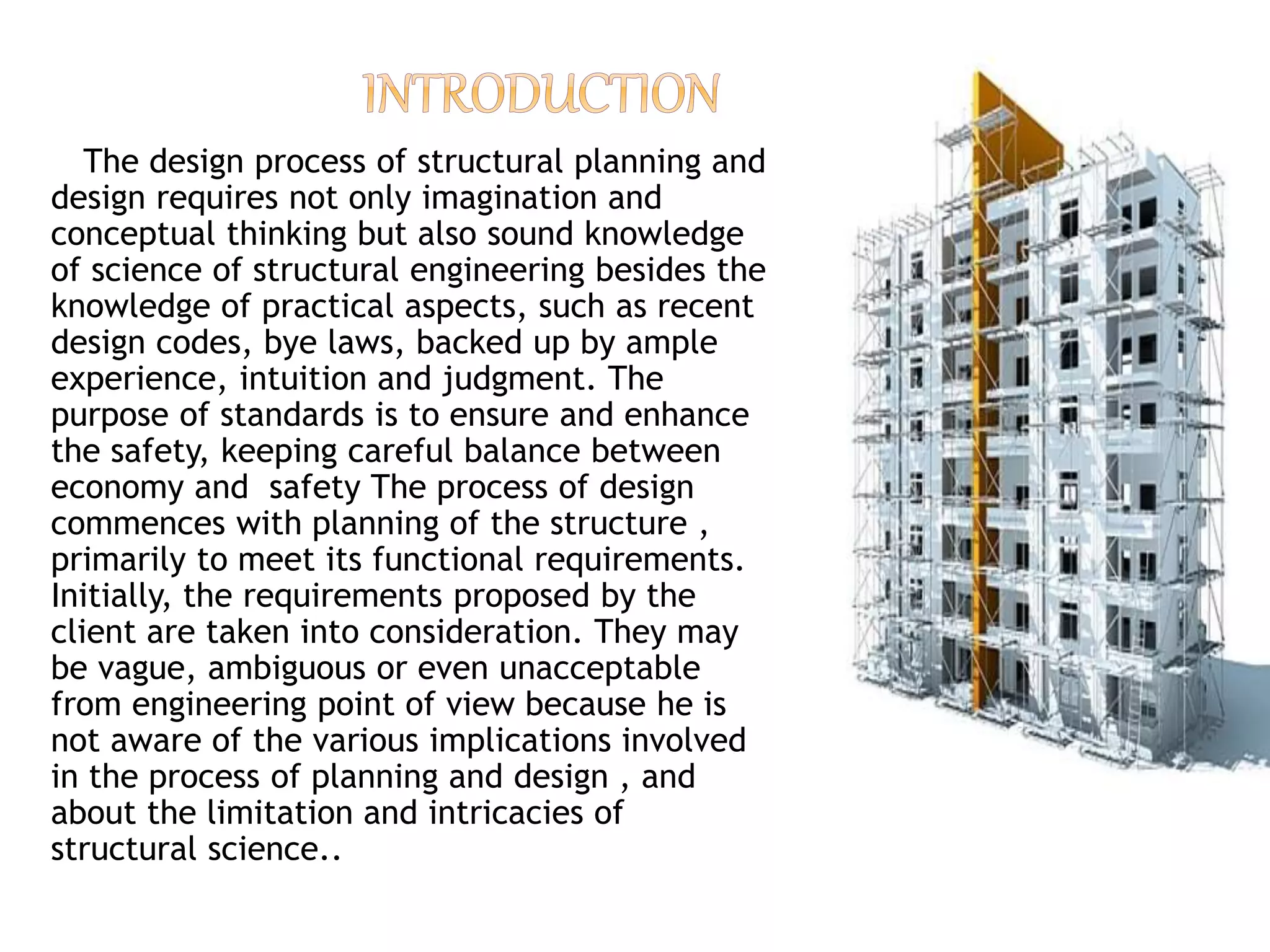
The design process of structural planning and
design requires not only imagination and
conceptual thinking but also sound knowledge
of science of structural engineering besides the
knowledge of practical aspects, such as recent
design codes, bye laws, backed up by ample
experience, intuition and judgment. The
purpose of standards is to ensure and enhance
the safety, keeping careful balance between
economy and safety The process of design
commences with planning of the structure ,
primarily to meet its functional requirements.
Initially, the requirements proposed by the
client are taken into consideration. They may
be vague, ambiguous or even unacceptable
from engineering point of view because he is
not aware of the various implications involved
in the process of planning and design , and
about the limitation and intricacies of
structural science..
STAGES IN STRUCTURAL DESIGN
 The process of structural design involves the
following stages :
 1) structural planning
 2) action of forces and computation of loads
 3) methods of analysis
 4) member design
 5) detailing, drawing and preparation of schedules
SLAB
BEAM
COLUMN
FOOTING
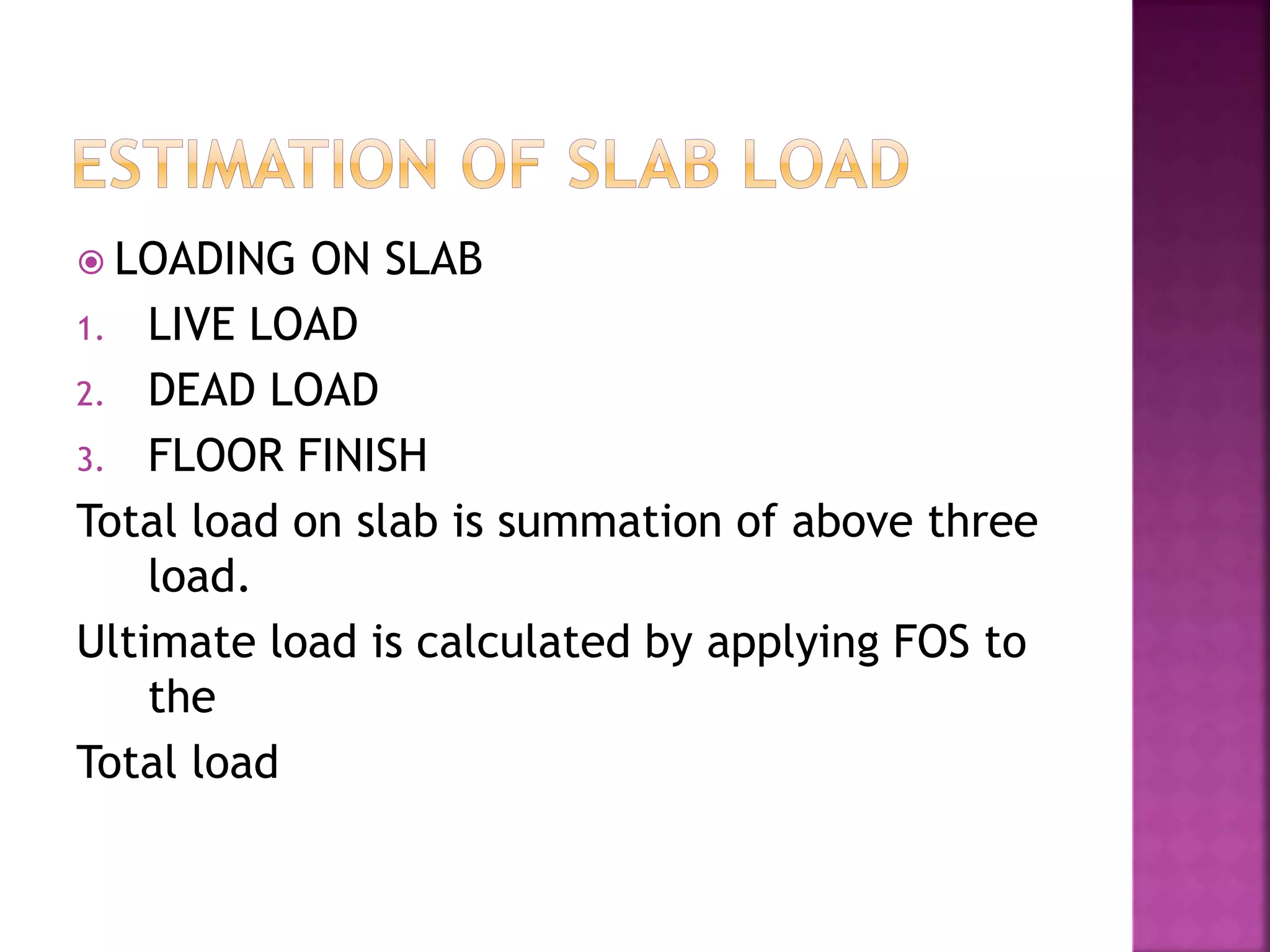
 LOADING ON SLAB
1. LIVE LOAD
2. DEAD LOAD
3. FLOOR FINISH
Total load on slab is summation of above three
load.
Ultimate load is calculated by applying FOS to
the
Total load
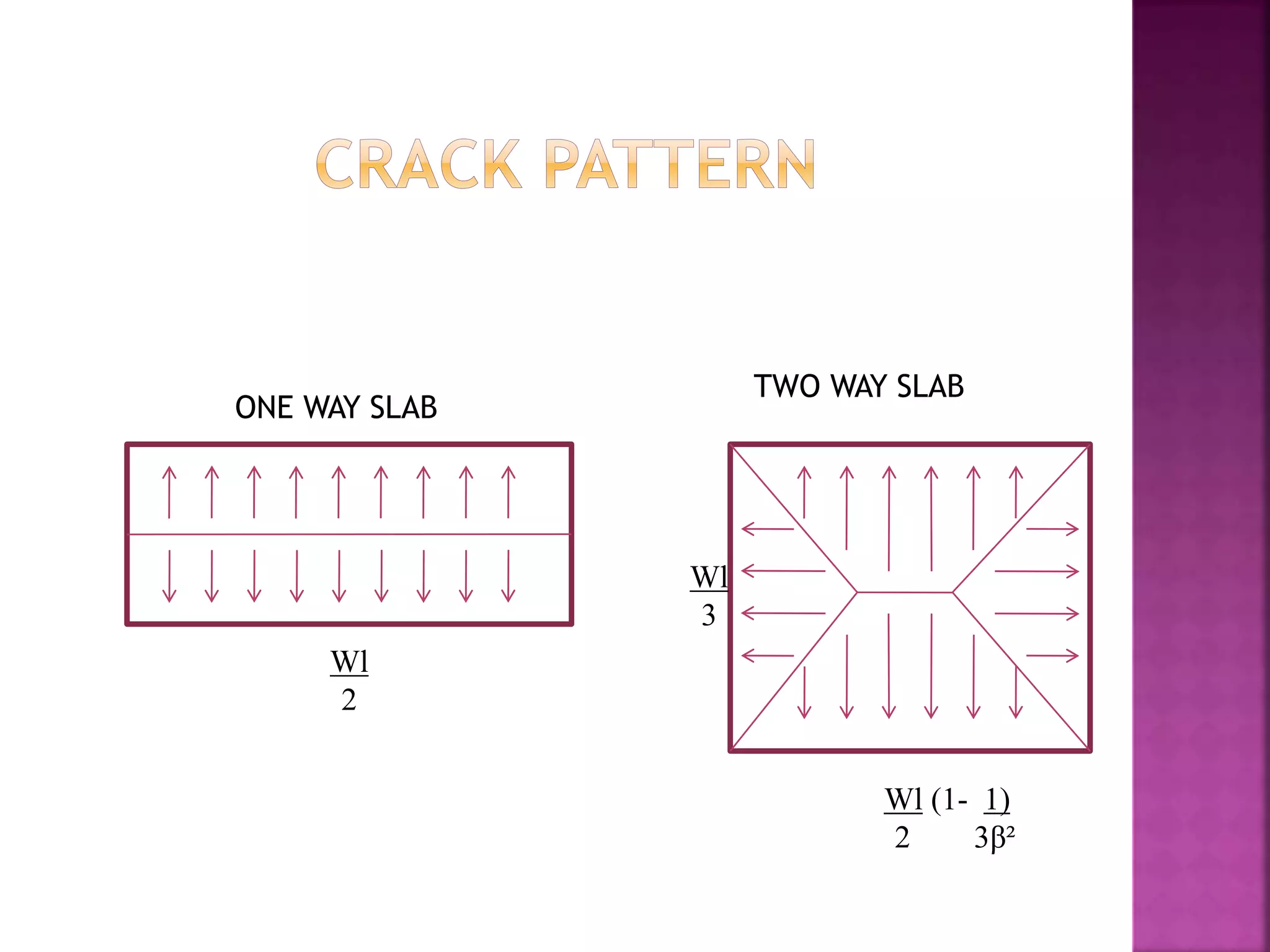
ONE WAY SLAB
Wl
2
Wl
3
Wl (1- 1)
2 3β²
TWO WAY SLAB
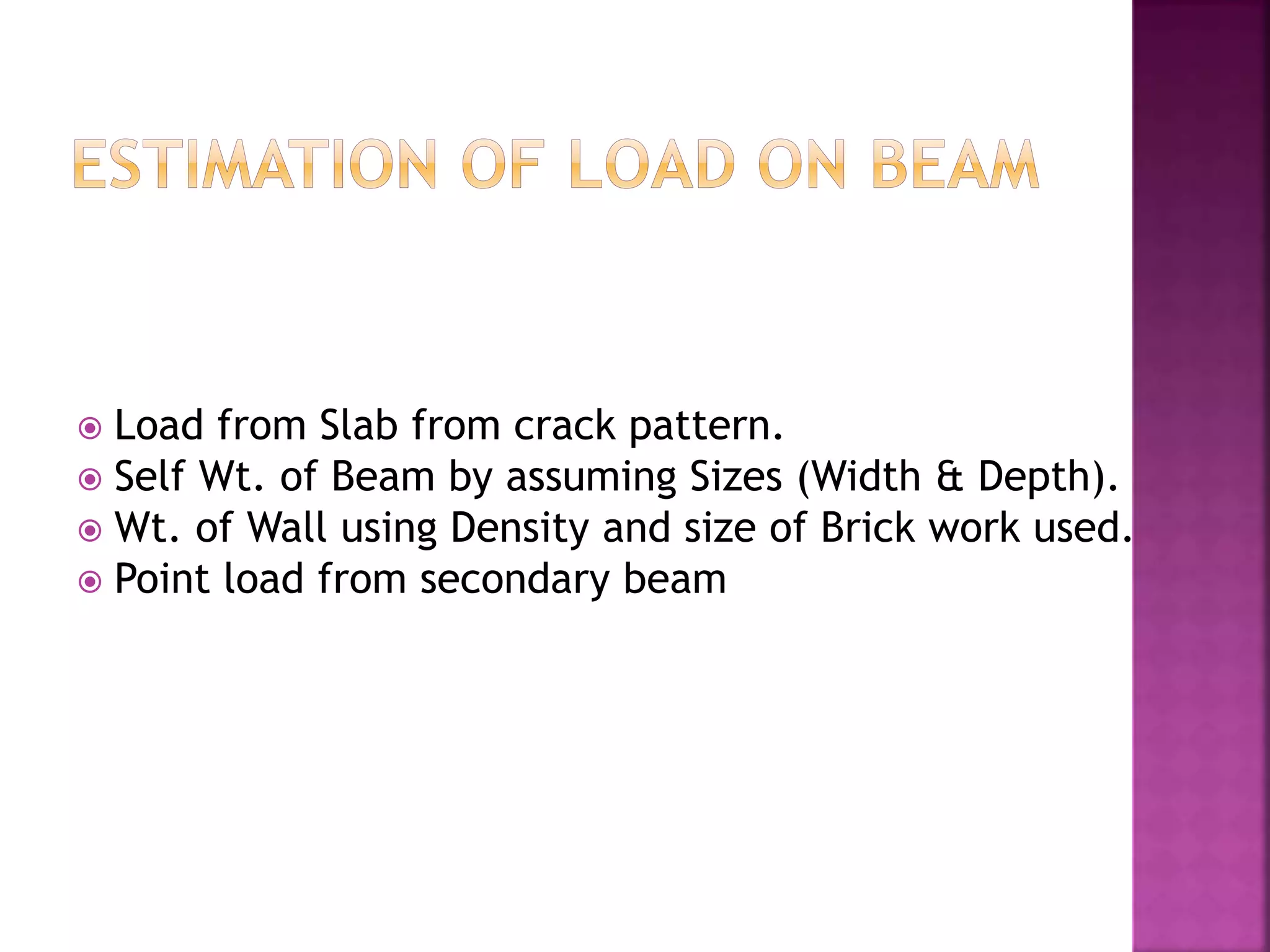
 Load from Slab from crack pattern.
 Self Wt. of Beam by assuming Sizes (Width & Depth).
 Wt. of Wall using Density and size of Brick work used.
 Point load from secondary beam
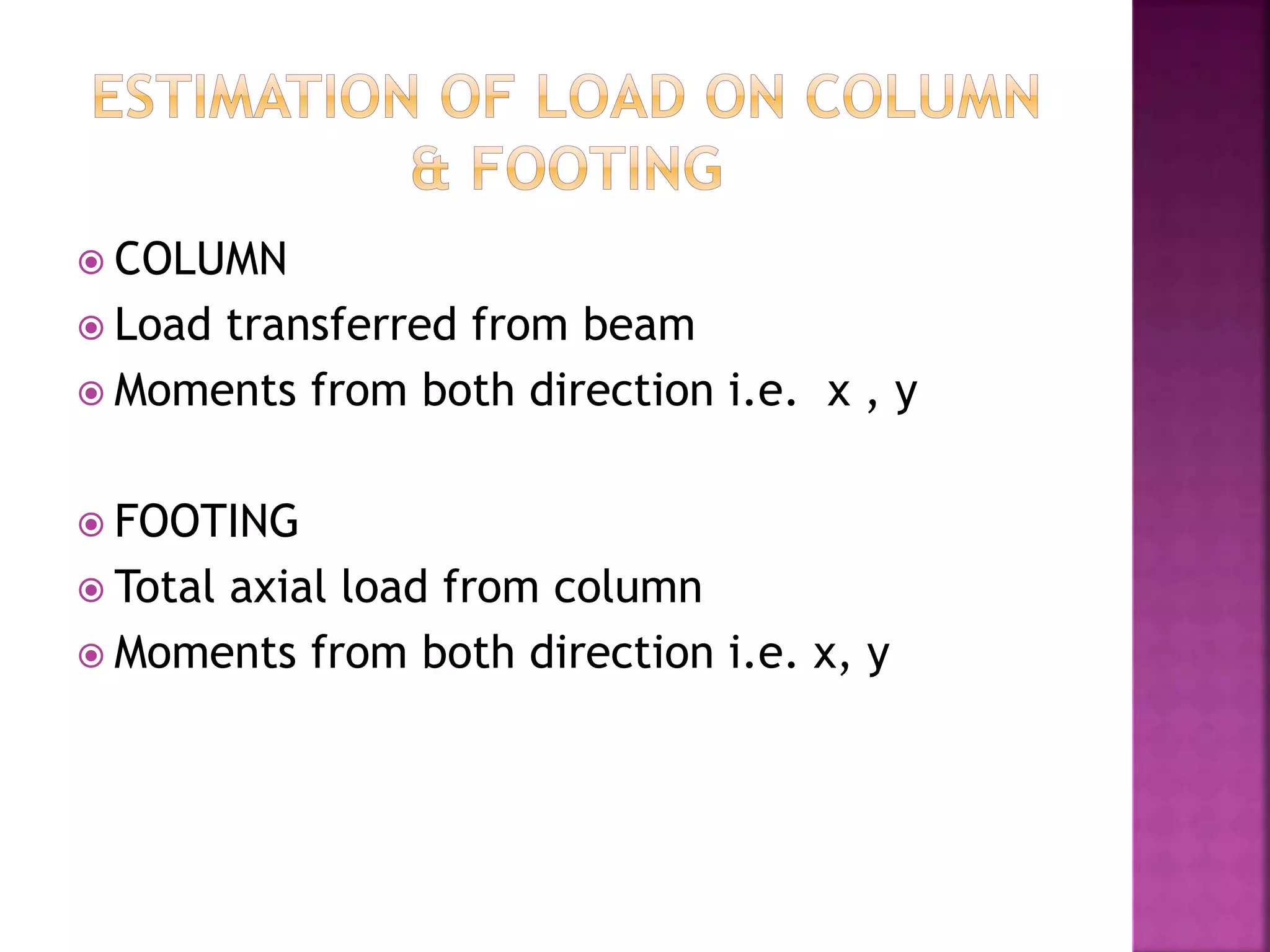
 COLUMN
 Load transferred from beam
 Moments from both direction i.e. x , y
 FOOTING
 Total axial load from column
 Moments from both direction i.e. x, y
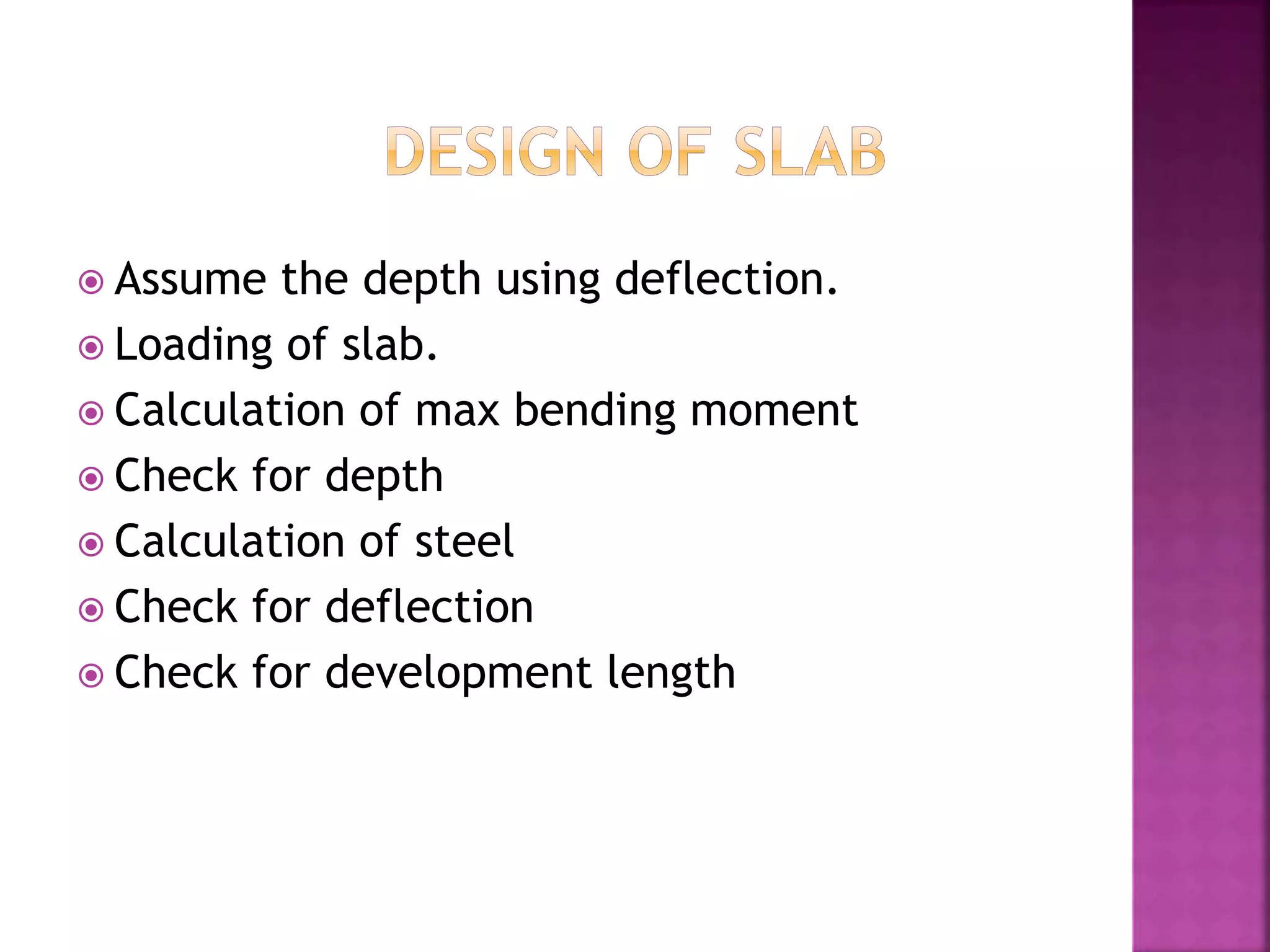
 Assume the depth using deflection.
 Loading of slab.
 Calculation of max bending moment
 Check for depth
 Calculation of steel
 Check for deflection
 Check for development length
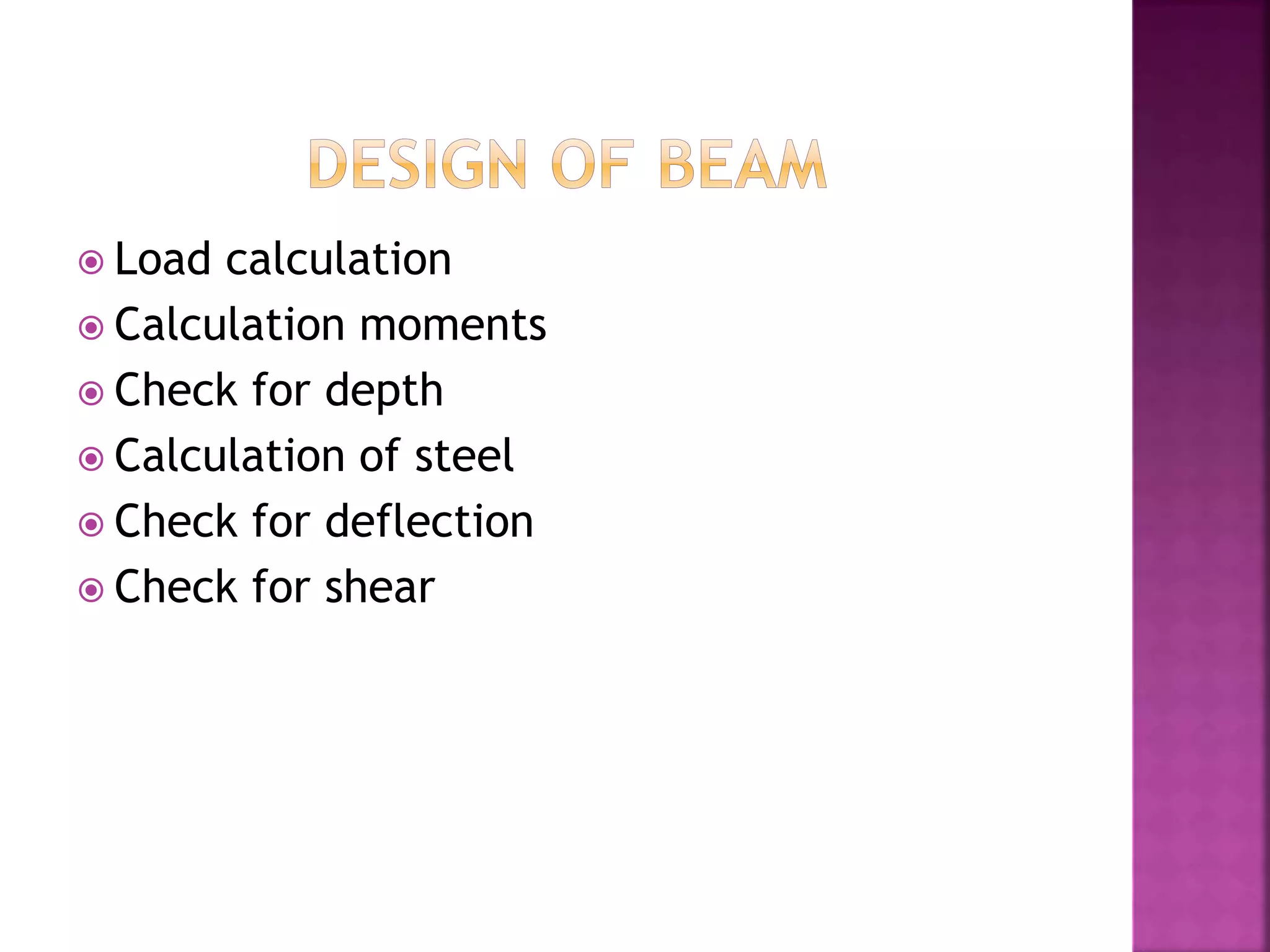
 Load calculation
 Calculation moments
 Check for depth
 Calculation of steel
 Check for deflection
 Check for shear
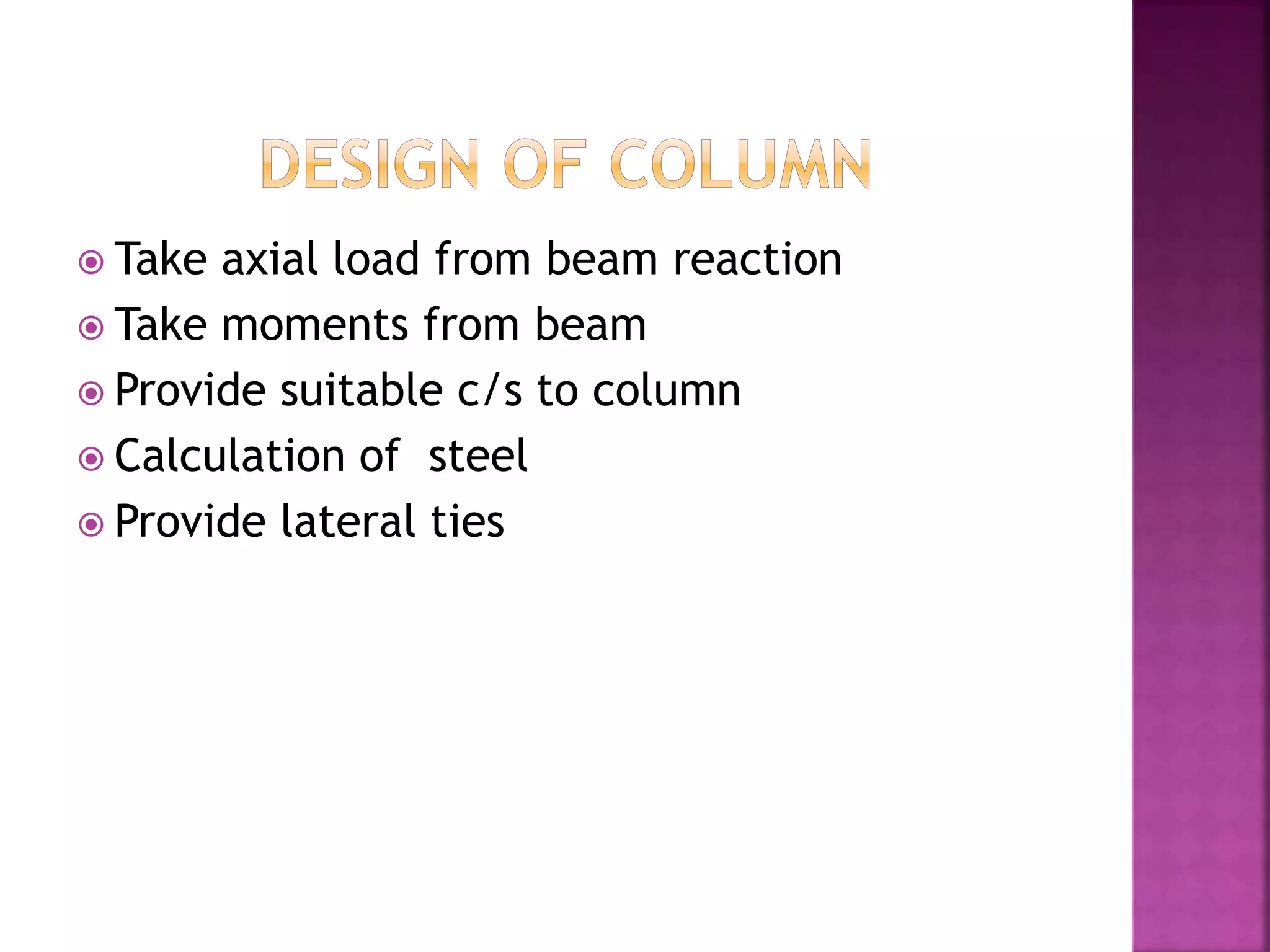
 Take axial load from beam reaction
 Take moments from beam
 Provide suitable c/s to column
 Calculation of steel
 Provide lateral ties
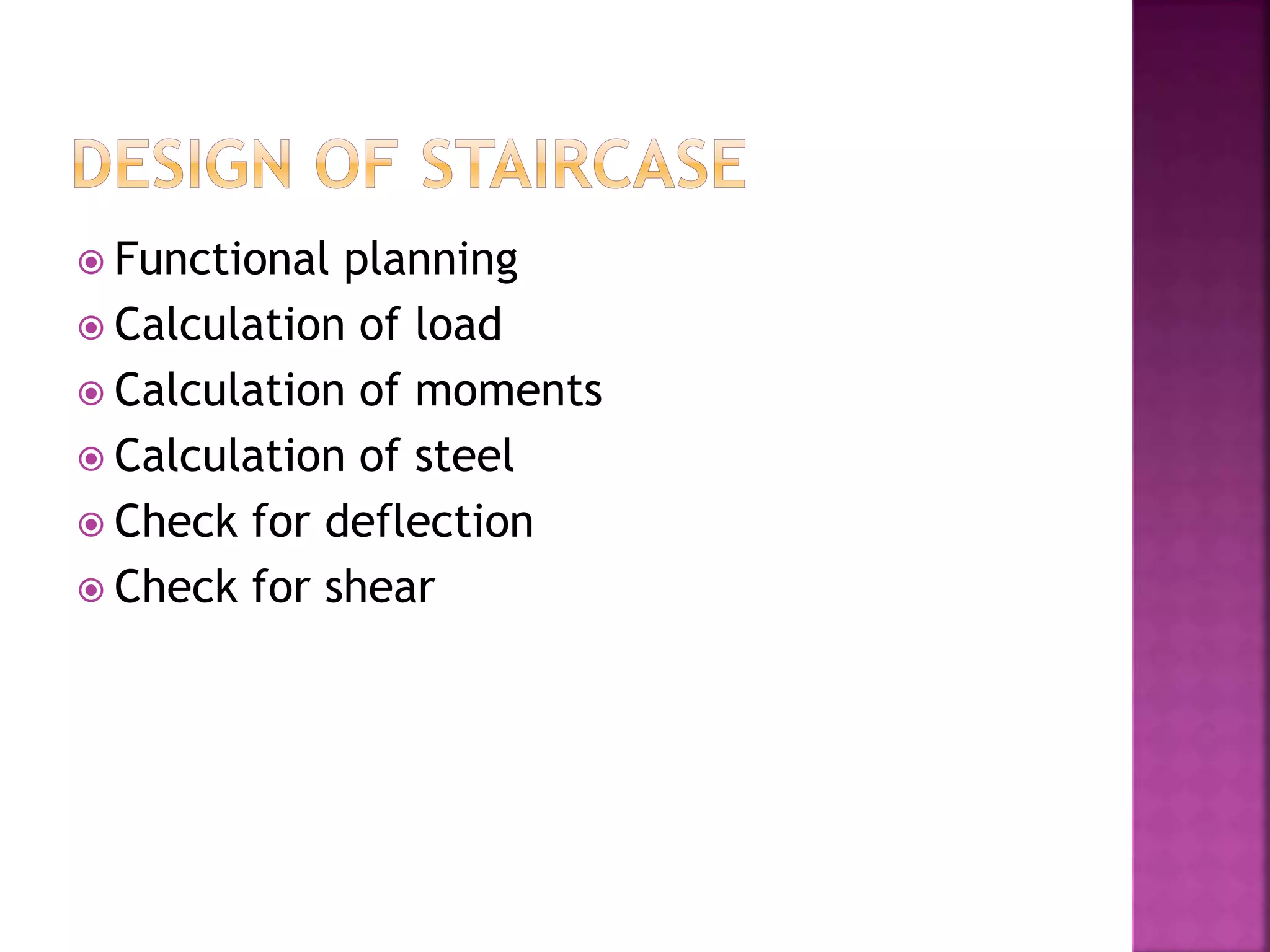
 Functional planning
 Calculation of load
 Calculation of moments
 Calculation of steel
 Check for deflection
 Check for shear
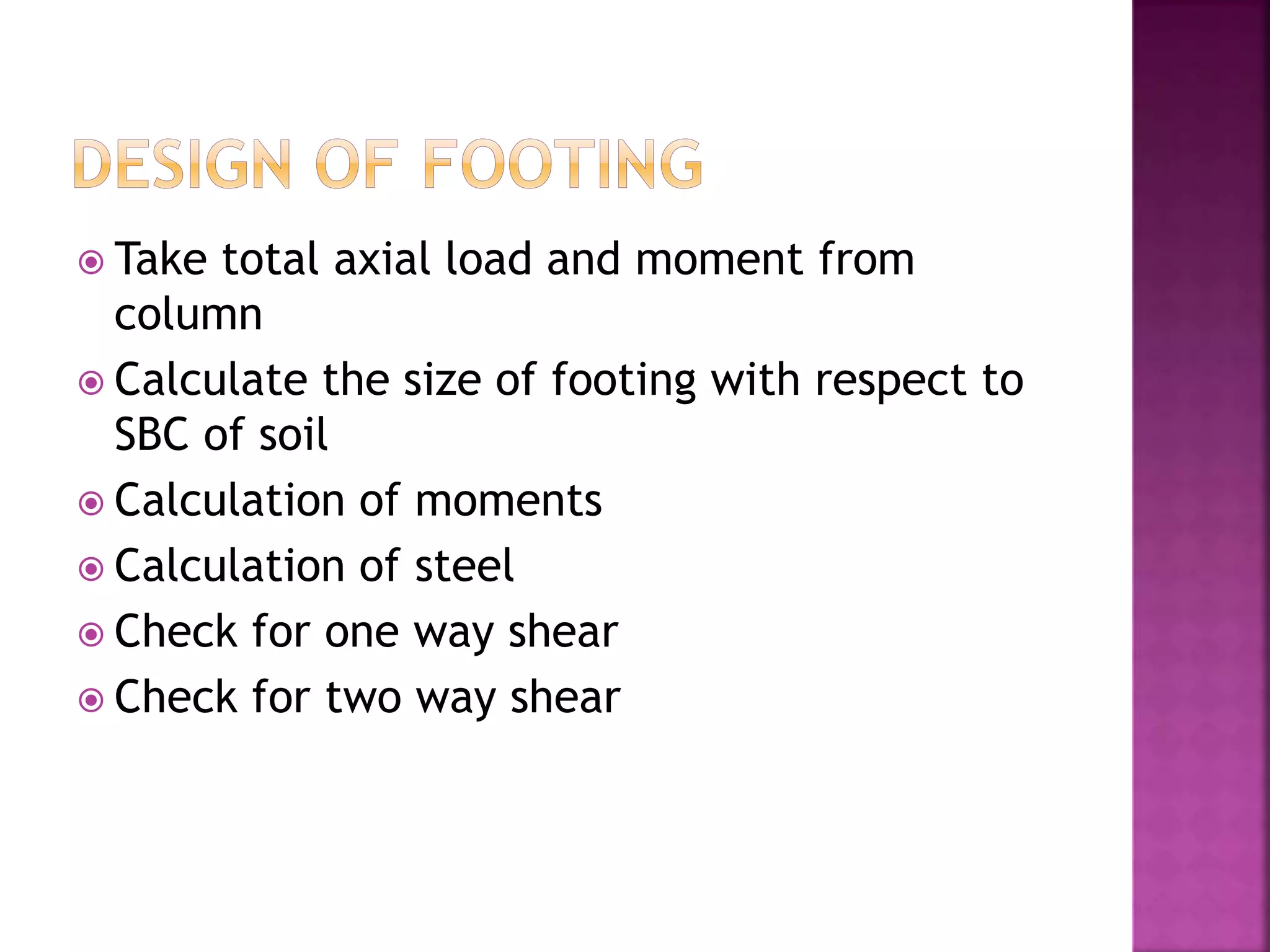
 Take total axial load and moment from
column
 Calculate the size of footing with respect to
SBC of soil
 Calculation of moments
 Calculation of steel
 Check for one way shear
 Check for two way shear

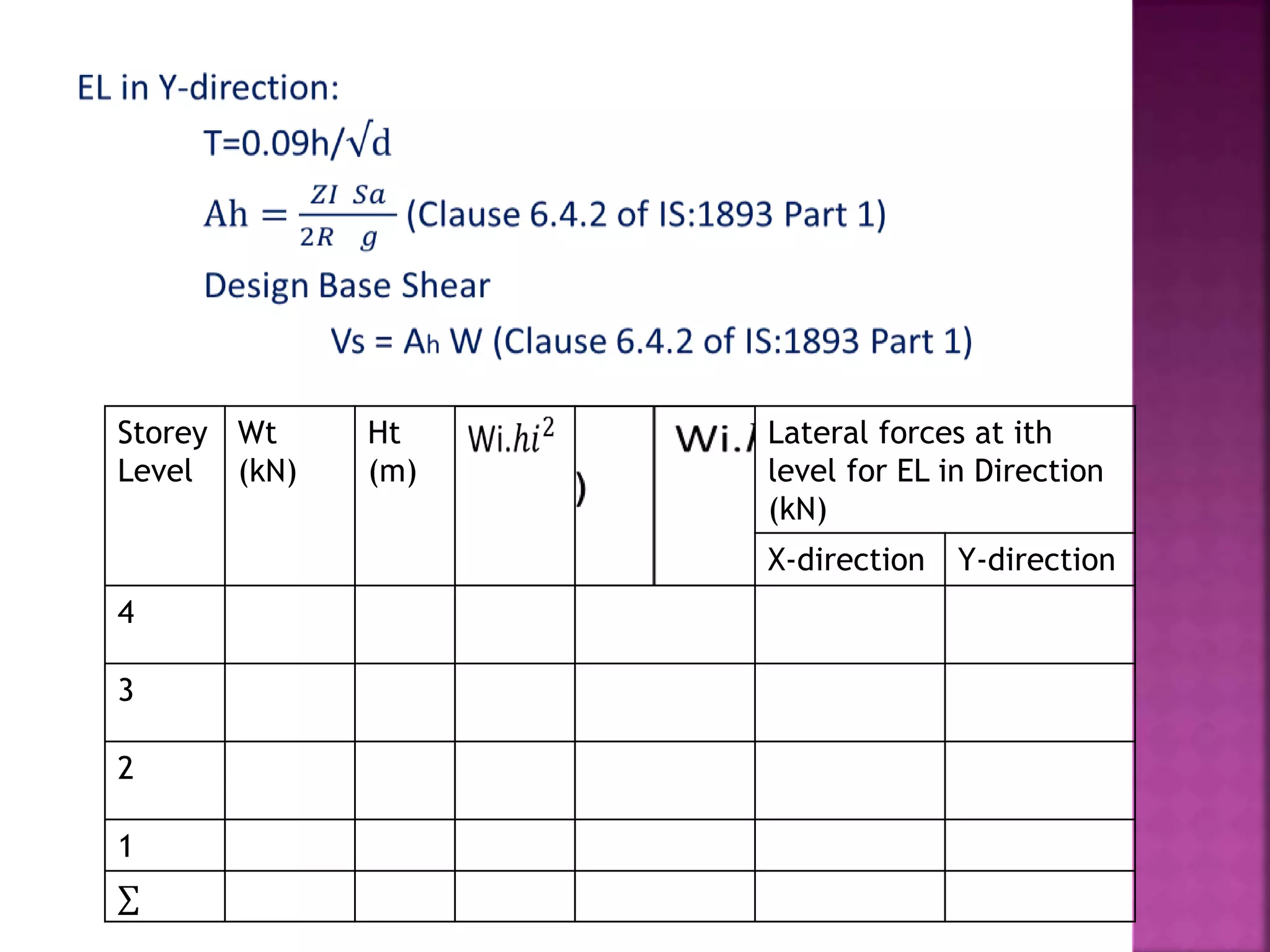
Storey
Level
Wt
(kN)
Ht
(m)
Lateral forces at ith
level for EL in Direction
(kN)
X-direction Y-direction
4
3
2
1
∑
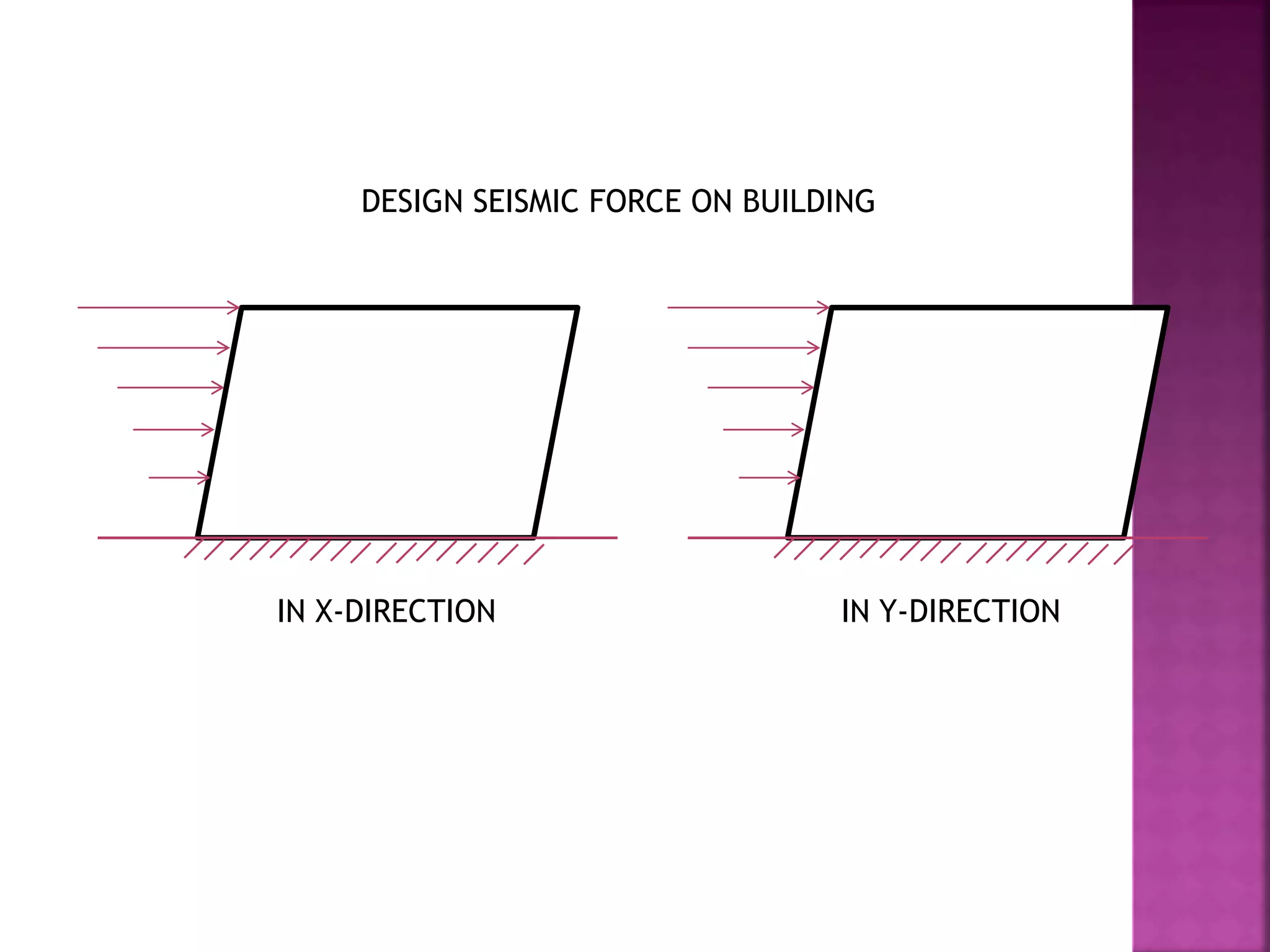
DESIGN SEISMIC FORCE ON BUILDING
IN X-DIRECTION IN Y-DIRECTION
• Location of Site: (city)
• Basic Wind Velocity from Appendix A (clause5.2
IS:875 Part 3)
• Designed Wind Speed (clause5.3 IS:875 Part 3)
Vz = Vb.k1.k2.k3
Vb = basic wind velocity
k1 = Probability factor (clause5.3.1) Table 1
k2 = Terrain, height, structure size factor
(clause5.3.2) Table 2
k3 = Topography factor (clause5.3.3)
Appendix C

 DIESIGN OF UNDERGROUND WATER TANK
 DIESIGN OF OVERHEAD (ELEVATED) WATER
TANK
DESIGN OF UNDERGROUND WATER TANK
CAPACITY OF TANK = 31.5 m³
PROVIDED SIZE OF TANK = 4.5m× 3.5m × 2m
CHECK FOR (L/B) RATIO
As per above ratio condition for design of Short & long wall is
applied.
 Design of roof slab is done as normal slab
 Design of short and long wall
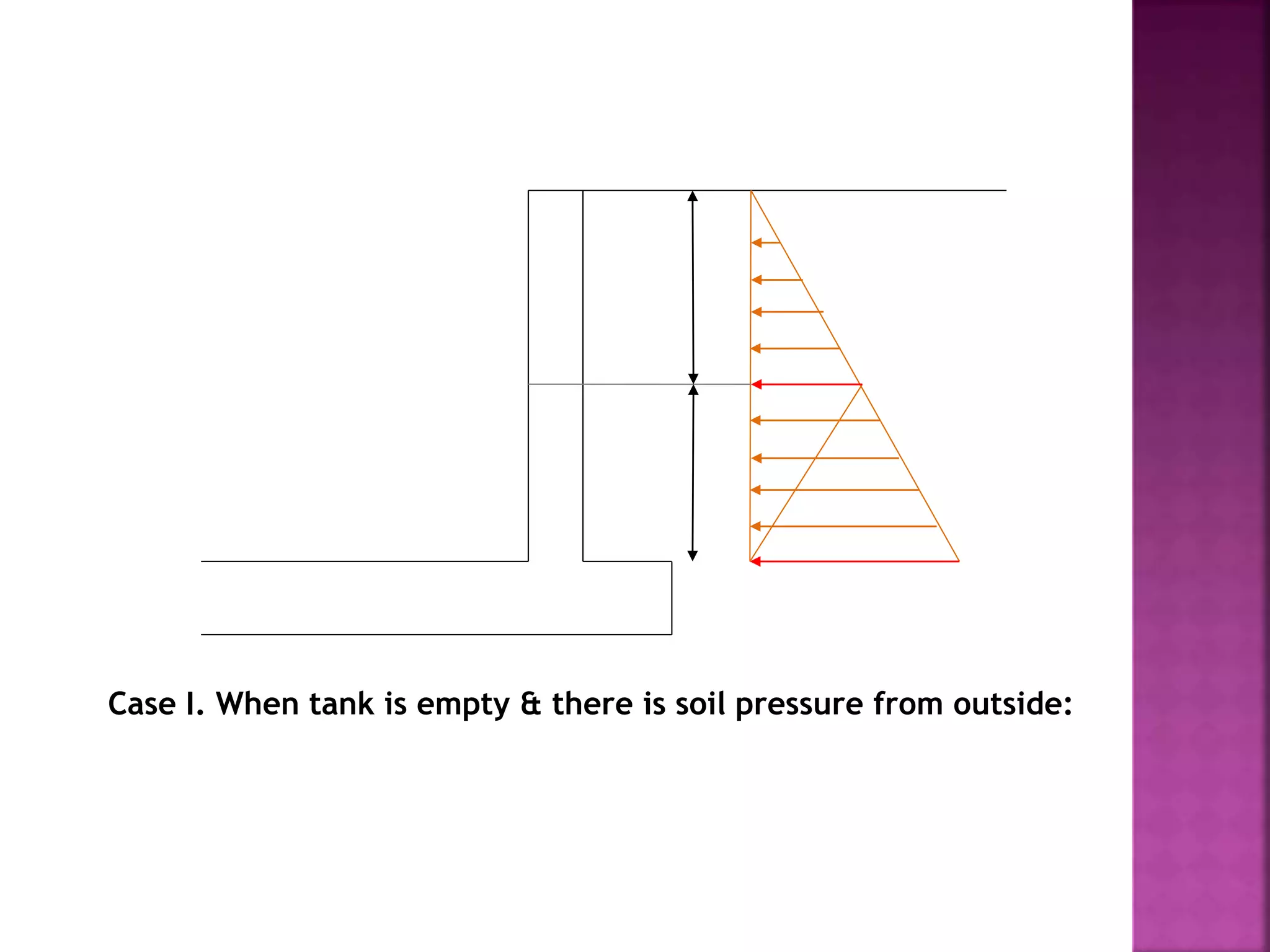
CASE I = WHEN TANK IS EMPTY
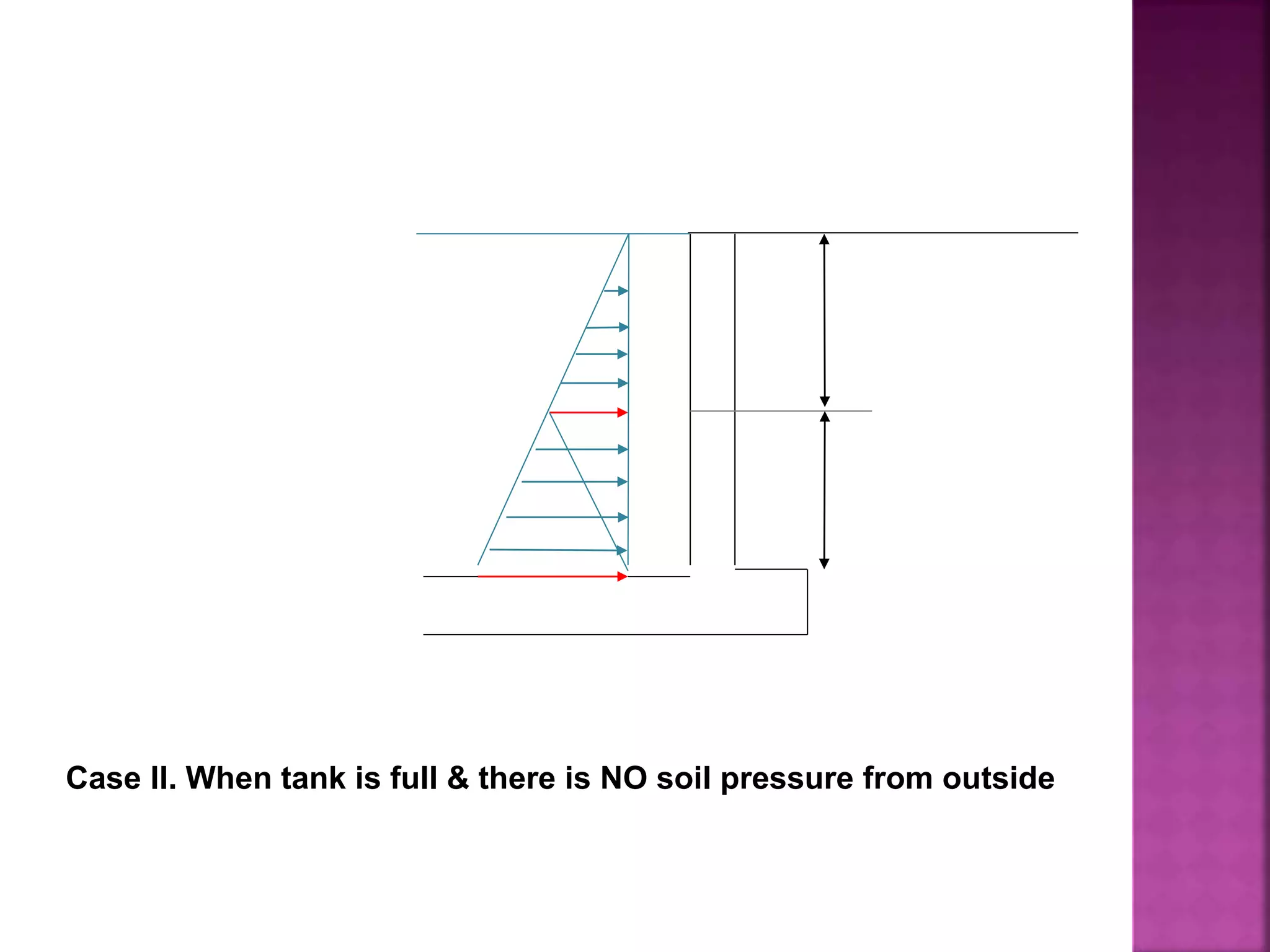
CASE II = WHEN TANK IS FULL.
Case I. When tank is empty & there is soil pressure from outside:
Case II. When tank is full & there is NO soil pressure from outside
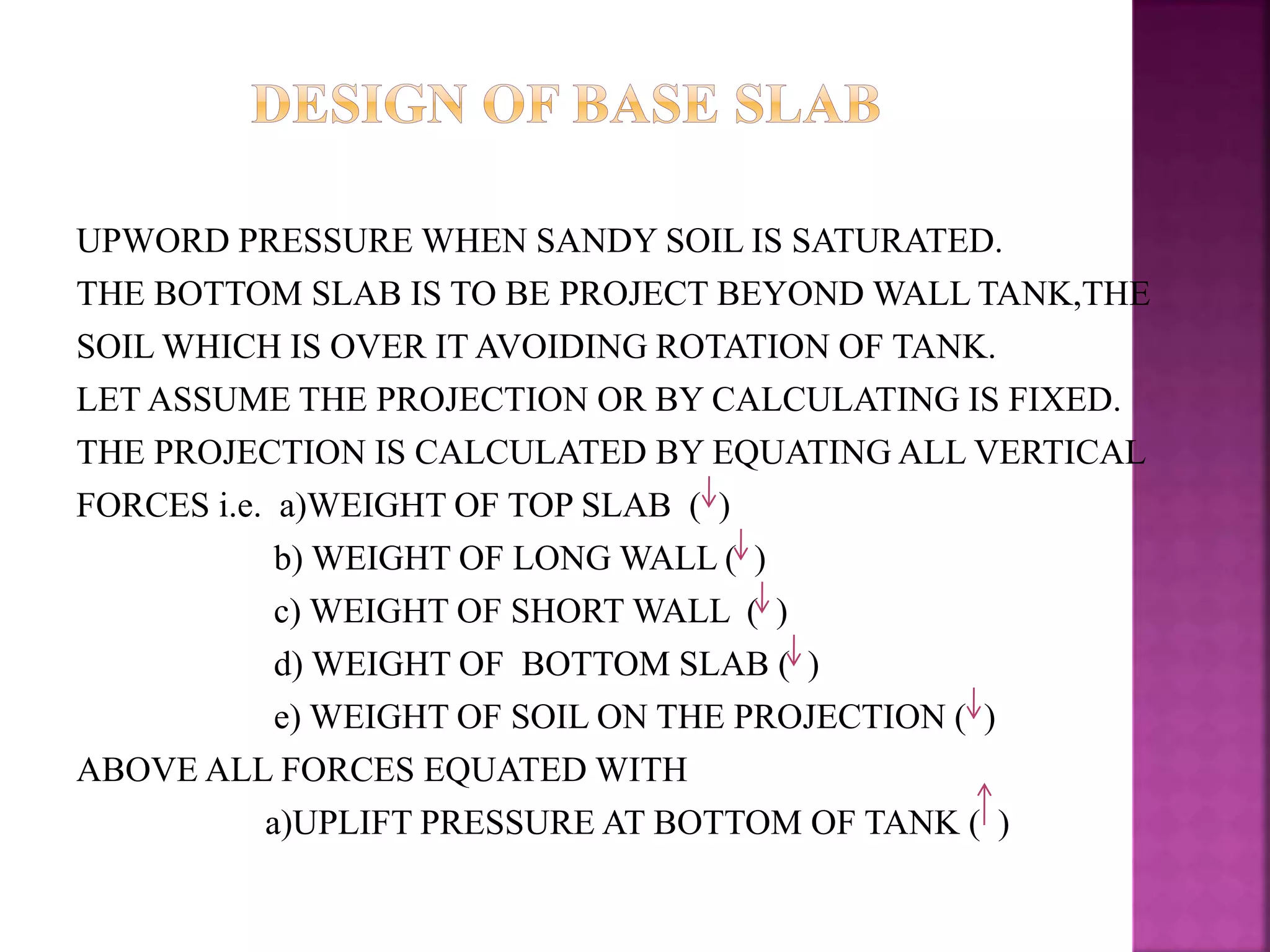
UPWORD PRESSURE WHEN SANDY SOIL IS SATURATED.
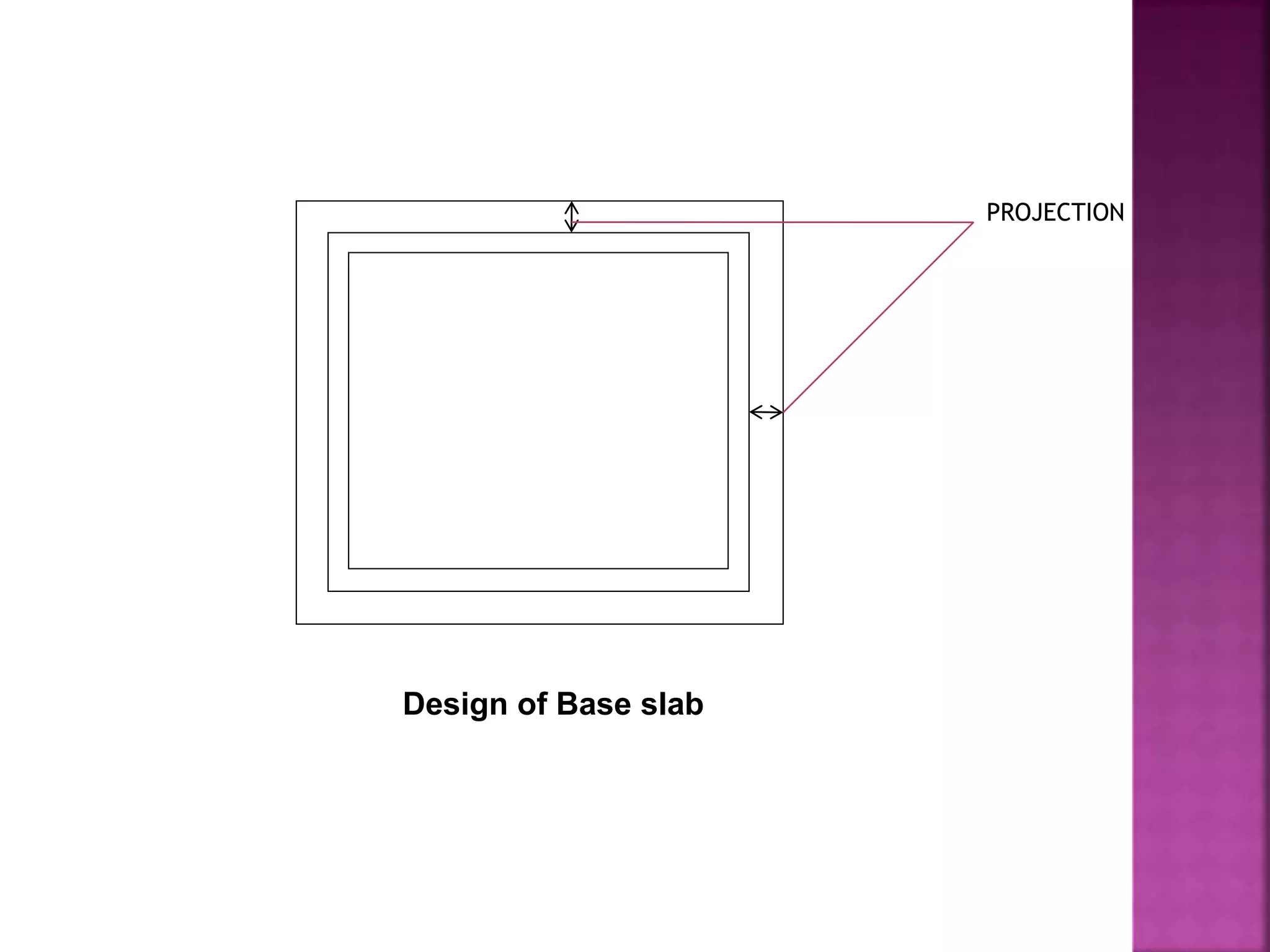
THE BOTTOM SLAB IS TO BE PROJECT BEYOND WALL TANK,THE
SOIL WHICH IS OVER IT AVOIDING ROTATION OF TANK.
LET ASSUME THE PROJECTION OR BY CALCULATING IS FIXED.
THE PROJECTION IS CALCULATED BY EQUATING ALL VERTICAL
FORCES i.e. a)WEIGHT OF TOP SLAB ( )
b) WEIGHT OF LONG WALL ( )
c) WEIGHT OF SHORT WALL ( )
d) WEIGHT OF BOTTOM SLAB ( )
e) WEIGHT OF SOIL ON THE PROJECTION ( )
ABOVE ALL FORCES EQUATED WITH
a)UPLIFT PRESSURE AT BOTTOM OF TANK ( )
PROJECTION
Design of Base slab
STAAD / PRO is a suite of inter – related structural software,
offering a complete solution for the professional structural
engineer.
1. Creating a structural model from scratch, along with loads
supports.
2. Members properties, Analysis / Design, Specifications, etc.
3. Visualization and verification of the model geometry.
4. Running STAAD analysis engine to perform Analysis and
Design.
5. Verification of Results – both graphically and numerically.
6. Report generation and printing.
 STAAD - Pro is comprehensive structural software that
addresses all aspects of structural engineering – model
development, analysis, design, verification and
visualization. STAAD is based on the principals of
“concurrent engineering”.
 We can Build your model, verify it graphically,
perform analysis / design, review the results, sort /
search the data to create a report – all within the
same graphics based environment
1. Create the STAAD- III input file with EDIT INPUT
options, or with the STMD-PRE graphical modelling
options.
2. Enter the STAAD – Pre option with partially complete
input file or the STAAD – post option with complete
input files or the STAAD –post option with complete
input files to check the model graphically.
3. Perform STAAD- III analysis & design with the STAAD-
III option on the main menu screen or with the RUN-
STAAD item in the STAAD- POST option.
4. Verify the analysis results & designs reported in the
text output file. This can be done with the VIEW
OUTPUT option on the main screen or with the
RESULT & QUERY items in the STAAD- POST option.
5. Verify the analysis & design results graphically with
the results, report query & icon items in the STAAD-
post option.
6. Generate necessary plots using the STAAD- POST
facility.
ILLUSTRATED REINFORCED CONCRETE DESIGN
- V. L. SHAH
- S. R. KARVE
REINFORCED CONCRETE (VOL.II)
- H. J. SHAH
EARTHQUAKE RESISTING STRUCTURE
-ISSE PUBLICATION
REINFORCED AND PRESTRESSED CONCRETE
-SAYAL & GOYEL
 IS 456 : 2000 (Part 1)
 IS 875 :2000 Part 1,2,3,4,5
 IS 1893 : 2002 (Part 1)
 IS 13920 : 1993
 SP 16
Analysis and Design of RCC Residential Building in StaadPro

Analysis and Design of RCC Residential Building in StaadPro

  • 1.
    The design processof structural planning and design requires not only imagination and conceptual thinking but also sound knowledge of science of structural engineering besides the knowledge of practical aspects, such as recent design codes, bye laws, backed up by ample experience, intuition and judgment. The purpose of standards is to ensure and enhance the safety, keeping careful balance between economy and safety The process of design commences with planning of the structure , primarily to meet its functional requirements. Initially, the requirements proposed by the client are taken into consideration. They may be vague, ambiguous or even unacceptable from engineering point of view because he is not aware of the various implications involved in the process of planning and design , and about the limitation and intricacies of structural science..
  • 2.
    STAGES IN STRUCTURALDESIGN  The process of structural design involves the following stages :  1) structural planning  2) action of forces and computation of loads  3) methods of analysis  4) member design  5) detailing, drawing and preparation of schedules
  • 5.
  • 6.
     LOADING ONSLAB 1. LIVE LOAD 2. DEAD LOAD 3. FLOOR FINISH Total load on slab is summation of above three load. Ultimate load is calculated by applying FOS to the Total load
  • 7.
    ONE WAY SLAB Wl 2 Wl 3 Wl(1- 1) 2 3β² TWO WAY SLAB
  • 8.
     Load fromSlab from crack pattern.  Self Wt. of Beam by assuming Sizes (Width & Depth).  Wt. of Wall using Density and size of Brick work used.  Point load from secondary beam
  • 9.
     COLUMN  Loadtransferred from beam  Moments from both direction i.e. x , y  FOOTING  Total axial load from column  Moments from both direction i.e. x, y
  • 10.
     Assume thedepth using deflection.  Loading of slab.  Calculation of max bending moment  Check for depth  Calculation of steel  Check for deflection  Check for development length
  • 11.
     Load calculation Calculation moments  Check for depth  Calculation of steel  Check for deflection  Check for shear
  • 12.
     Take axialload from beam reaction  Take moments from beam  Provide suitable c/s to column  Calculation of steel  Provide lateral ties
  • 13.
     Functional planning Calculation of load  Calculation of moments  Calculation of steel  Check for deflection  Check for shear
  • 14.
     Take totalaxial load and moment from column  Calculate the size of footing with respect to SBC of soil  Calculation of moments  Calculation of steel  Check for one way shear  Check for two way shear
  • 15.
  • 17.
    Storey Level Wt (kN) Ht (m) Lateral forces atith level for EL in Direction (kN) X-direction Y-direction 4 3 2 1 ∑
  • 18.
    DESIGN SEISMIC FORCEON BUILDING IN X-DIRECTION IN Y-DIRECTION
  • 19.
    • Location ofSite: (city) • Basic Wind Velocity from Appendix A (clause5.2 IS:875 Part 3) • Designed Wind Speed (clause5.3 IS:875 Part 3) Vz = Vb.k1.k2.k3 Vb = basic wind velocity k1 = Probability factor (clause5.3.1) Table 1 k2 = Terrain, height, structure size factor (clause5.3.2) Table 2 k3 = Topography factor (clause5.3.3) Appendix C
  • 20.
  • 21.
     DIESIGN OFUNDERGROUND WATER TANK  DIESIGN OF OVERHEAD (ELEVATED) WATER TANK DESIGN OF UNDERGROUND WATER TANK CAPACITY OF TANK = 31.5 m³ PROVIDED SIZE OF TANK = 4.5m× 3.5m × 2m CHECK FOR (L/B) RATIO As per above ratio condition for design of Short & long wall is applied.  Design of roof slab is done as normal slab  Design of short and long wall CASE I = WHEN TANK IS EMPTY CASE II = WHEN TANK IS FULL.
  • 22.
    Case I. Whentank is empty & there is soil pressure from outside:
  • 23.
    Case II. Whentank is full & there is NO soil pressure from outside
  • 24.
    UPWORD PRESSURE WHENSANDY SOIL IS SATURATED. THE BOTTOM SLAB IS TO BE PROJECT BEYOND WALL TANK,THE SOIL WHICH IS OVER IT AVOIDING ROTATION OF TANK. LET ASSUME THE PROJECTION OR BY CALCULATING IS FIXED. THE PROJECTION IS CALCULATED BY EQUATING ALL VERTICAL FORCES i.e. a)WEIGHT OF TOP SLAB ( ) b) WEIGHT OF LONG WALL ( ) c) WEIGHT OF SHORT WALL ( ) d) WEIGHT OF BOTTOM SLAB ( ) e) WEIGHT OF SOIL ON THE PROJECTION ( ) ABOVE ALL FORCES EQUATED WITH a)UPLIFT PRESSURE AT BOTTOM OF TANK ( )
  • 25.
  • 26.
    STAAD / PROis a suite of inter – related structural software, offering a complete solution for the professional structural engineer. 1. Creating a structural model from scratch, along with loads supports. 2. Members properties, Analysis / Design, Specifications, etc. 3. Visualization and verification of the model geometry. 4. Running STAAD analysis engine to perform Analysis and Design. 5. Verification of Results – both graphically and numerically. 6. Report generation and printing.
  • 27.
     STAAD -Pro is comprehensive structural software that addresses all aspects of structural engineering – model development, analysis, design, verification and visualization. STAAD is based on the principals of “concurrent engineering”.  We can Build your model, verify it graphically, perform analysis / design, review the results, sort / search the data to create a report – all within the same graphics based environment
  • 28.
    1. Create theSTAAD- III input file with EDIT INPUT options, or with the STMD-PRE graphical modelling options. 2. Enter the STAAD – Pre option with partially complete input file or the STAAD – post option with complete input files or the STAAD –post option with complete input files to check the model graphically. 3. Perform STAAD- III analysis & design with the STAAD- III option on the main menu screen or with the RUN- STAAD item in the STAAD- POST option.
  • 29.
    4. Verify theanalysis results & designs reported in the text output file. This can be done with the VIEW OUTPUT option on the main screen or with the RESULT & QUERY items in the STAAD- POST option. 5. Verify the analysis & design results graphically with the results, report query & icon items in the STAAD- post option. 6. Generate necessary plots using the STAAD- POST facility.
  • 30.
    ILLUSTRATED REINFORCED CONCRETEDESIGN - V. L. SHAH - S. R. KARVE REINFORCED CONCRETE (VOL.II) - H. J. SHAH EARTHQUAKE RESISTING STRUCTURE -ISSE PUBLICATION REINFORCED AND PRESTRESSED CONCRETE -SAYAL & GOYEL  IS 456 : 2000 (Part 1)  IS 875 :2000 Part 1,2,3,4,5  IS 1893 : 2002 (Part 1)  IS 13920 : 1993  SP 16