CNS
STIMULANTS
Dharanitharan M
 These are drugs whose primary action is to stimulate the
CNS globally or to improve specific brain functions.
 CNS stimulants are the psychoactive drugs that induce
temporary improvement in either mental or physical
function or both.
 The CNS stimulants mostly produce a generalized action
which may, at high doses, result in convulsions.
Introduction
2
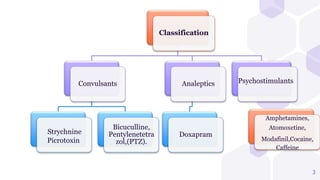
Classification
Convulsants
Strychnine
Picrotoxin
Bicuculline,
Pentylenetetra
zol,(PTZ).
Analeptics
Doxapram
Psychostimulants
Amphetamines,
Atomoxetine,
Modafinil,Cocaine,
Caffeine
3
STRYCHNINE
• It is an alkaloid from the seeds of Strychnos nux-
vomica, and a potent convulsant.
• The convulsions are reflex, tonic-clonic and symmetrical.
• It has been labelled as a spinal convulsant because the dose
producing convulsions is the same in spinal animals as in
intact animals; actually it stimulates the whole
cerebrospinal axis.
4
Mechanism of Action
5
Strychnine is a neurotoxin act as a antagonist of
glycine,which is a inhibitory neurotransmitter.
and reversibly inhibit
at postsynaptic neuronal
Strychnine competitively
neurotransmitter glycine
sites in the spinal cord.
1
Picrotoxin
❖ Obtained from ‘fish berries’ of East Indies Anamirta cocculus. It is a
potent convulsant— convulsions are clonic, spontaneous and asymmetrical.
❖ The convulsions are accompanied by vomiting, respiratory and vasomotor
stimulation.
❖ Picrotoxin acts by blocking presynaptic inhibition mediated through GABA.
However, it is not a competitive antagonist; does not act on GABA receptor
itself, but on a distinct site and prevents Cl¯ channel opening.
1
Bicuculline
 This synthetic convulsant has picrotoxin like actions.
 It is a competitive GABAA receptor (intrinsic Cl¯ channel
receptor) antagonist, while GABAB receptor (G-protein
coupled receptor) is insensitive to it.
 It is only a research tool.
1
• Low doses cause excitation, larger doses produce convulsions
which are similar in pattern to those caused by picrotoxin.
• Antagonism of PTZ induced convulsions is an established method
of testing anticonvulsant drugs in laboratory animals.
• It is specifically a GABA-a receptor antagonist it acts at
the picrotoxin (PTX) site of the gamma-aminobutyric
acid type A (GABA(A)) receptor.
Pentylenetetrazol (PTZ, Metrazol,
Leptazol)
ANALEPTICS (Respiratory stimulants)
9
These are drugs which stimulate respiration and can have resuscitative
value in coma or fainting.
The role of analeptics in therapeutics is very limited.
Situations in which they may be employed are:
❖ As an expedient measure in hypnotic drug poisoning
ventilation is instituted.
❖ Suffocation on drowning, acute respiratory insufficiency.
❖ Apnoea in premature infant.
❖ Failure to ventilate spontaneously after general anesthesia.
Doxapram
10
• It acts by promoting excitation of central neurones.
At low doses it is more selective for the respiratory centre than other
. analeptics.
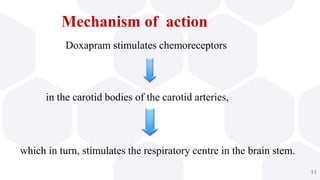
Mechanism of action
in the carotid bodies of the carotid arteries,
which in turn, stimulates the respiratory centre in the brain stem.
11
Doxapram stimulates chemoreceptors
Uses
12
A. Doxapramstimulate the respiratory rate in patients with
respiratory failure.
B. It may be useful for treating respiratory depression in
patients who have taken excessive doses of drugs such
as buprenorphine.
C. Also used for recovery after anesthesia.
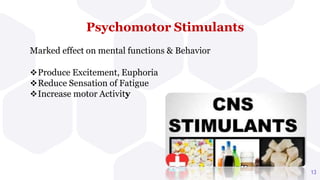
Psychomotor Stimulants
Marked effect on mental functions & Behavior
Produce Excitement, Euphoria
Reduce Sensation of Fatigue
Increase motor Activity
13
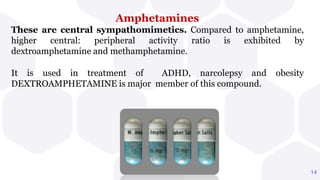
Amphetamines
These are central sympathomimetics. Compared to amphetamine,
higher central: peripheral activity ratio is exhibited by
dextroamphetamine and methamphetamine.
It is used in treatment of ADHD, narcolepsy and obesity
DEXTROAMPHETAMINE is major member of this compound.
14
15
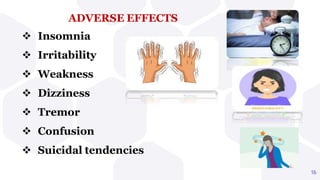
ADVERSE EFFECTS
 Insomnia
 Irritability
 Weakness
 Dizziness
 Tremor
 Confusion
 Suicidal tendencies
16
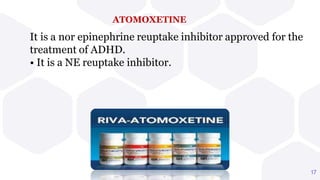
ATOMOXETINE
It is a nor epinephrine reuptake inhibitor approved for the
treatment of ADHD.
• It is a NE reuptake inhibitor.
17
METHYLPHENIDATE
 It is a CNS stimulants of phenethylamine and piperidine classes that
is used in treatment of ADHD and narcolepsy.
 Less potential for abuse than cocaine.
 Properties similar to amphetamine and may also lead to abuse.
18
Modafinil
19
 This newer psychostimulant is popular with night-shift (call centre)
workers and other professionals who want to improve alertness and
keep awake.
 Although, modafinil has been shown to inhibit NA and DA uptake
as well as alter junctional concentration of glutamate and
GABA, its actual mechanism of action is not known.
 It has also been found to reduce euphoria produced by cocaine and to
suppress cocaine withdrawal symptoms.
Cocaine
20
• Cocaine increases mental alertness & produce a feeling of
wellbeing & euphoria.
• It produces hallucinations, delusion & paranoia.
• It increases motor activity & at high doses causes tremors,
convulsion & followed by respiratory & vasomotor depression.
Uses
• Cocaine has a local anesthetic action for the therapeutic use.
It is applied topically as a local anesthetic for eye, ear & nose &
throat surgery.
Caffeine
Out of the three naturally occurring
methylxanthines , only caffeine is used as a CNS
stimulant.
Adverse effects
• Toxic effects of caffeine are extensions of its
pharmacological actions.
• Gastric irritation, nausea and vomiting may occur as side
effects.
• Excitatory and motor effects such as nervousness,
insomnia, agitation, muscular twitching, rigidity, rise in
body temperature, delirium and convulsions are produced
at toxic doses.
29
Uses
1) In analgesic mixture: caffeine benefits headache probably
by allaying fatigue and boredom. It has no analgesic action
of its own.
2) Migraine: Caffeine is used in combination with ergotamine
for treatment of migraine attack. It appears to benefit by
augmenting constriction of cranial vessels and by enhancing
absorption of ergotamine from the g.i.t.
3) Apnoea in premature infants: as alternative to theophylline.
23
24

Cnsstimulants.pptx

  • 1.
  • 2.
     These aredrugs whose primary action is to stimulate the CNS globally or to improve specific brain functions.  CNS stimulants are the psychoactive drugs that induce temporary improvement in either mental or physical function or both.  The CNS stimulants mostly produce a generalized action which may, at high doses, result in convulsions. Introduction 2
  • 3.
  • 4.
    STRYCHNINE • It isan alkaloid from the seeds of Strychnos nux- vomica, and a potent convulsant. • The convulsions are reflex, tonic-clonic and symmetrical. • It has been labelled as a spinal convulsant because the dose producing convulsions is the same in spinal animals as in intact animals; actually it stimulates the whole cerebrospinal axis. 4
  • 5.
    Mechanism of Action 5 Strychnineis a neurotoxin act as a antagonist of glycine,which is a inhibitory neurotransmitter. and reversibly inhibit at postsynaptic neuronal Strychnine competitively neurotransmitter glycine sites in the spinal cord.
  • 6.
    1 Picrotoxin ❖ Obtained from‘fish berries’ of East Indies Anamirta cocculus. It is a potent convulsant— convulsions are clonic, spontaneous and asymmetrical. ❖ The convulsions are accompanied by vomiting, respiratory and vasomotor stimulation. ❖ Picrotoxin acts by blocking presynaptic inhibition mediated through GABA. However, it is not a competitive antagonist; does not act on GABA receptor itself, but on a distinct site and prevents Cl¯ channel opening.
  • 7.
    1 Bicuculline  This syntheticconvulsant has picrotoxin like actions.  It is a competitive GABAA receptor (intrinsic Cl¯ channel receptor) antagonist, while GABAB receptor (G-protein coupled receptor) is insensitive to it.  It is only a research tool.
  • 8.
    1 • Low dosescause excitation, larger doses produce convulsions which are similar in pattern to those caused by picrotoxin. • Antagonism of PTZ induced convulsions is an established method of testing anticonvulsant drugs in laboratory animals. • It is specifically a GABA-a receptor antagonist it acts at the picrotoxin (PTX) site of the gamma-aminobutyric acid type A (GABA(A)) receptor. Pentylenetetrazol (PTZ, Metrazol, Leptazol)
  • 9.
    ANALEPTICS (Respiratory stimulants) 9 Theseare drugs which stimulate respiration and can have resuscitative value in coma or fainting. The role of analeptics in therapeutics is very limited. Situations in which they may be employed are: ❖ As an expedient measure in hypnotic drug poisoning ventilation is instituted. ❖ Suffocation on drowning, acute respiratory insufficiency. ❖ Apnoea in premature infant. ❖ Failure to ventilate spontaneously after general anesthesia.
  • 10.
    Doxapram 10 • It actsby promoting excitation of central neurones. At low doses it is more selective for the respiratory centre than other . analeptics.
  • 11.
    Mechanism of action inthe carotid bodies of the carotid arteries, which in turn, stimulates the respiratory centre in the brain stem. 11 Doxapram stimulates chemoreceptors
  • 12.
    Uses 12 A. Doxapramstimulate therespiratory rate in patients with respiratory failure. B. It may be useful for treating respiratory depression in patients who have taken excessive doses of drugs such as buprenorphine. C. Also used for recovery after anesthesia.
  • 13.
    Psychomotor Stimulants Marked effecton mental functions & Behavior Produce Excitement, Euphoria Reduce Sensation of Fatigue Increase motor Activity 13
  • 14.
    Amphetamines These are centralsympathomimetics. Compared to amphetamine, higher central: peripheral activity ratio is exhibited by dextroamphetamine and methamphetamine. It is used in treatment of ADHD, narcolepsy and obesity DEXTROAMPHETAMINE is major member of this compound. 14
  • 15.
  • 16.
    ADVERSE EFFECTS  Insomnia Irritability  Weakness  Dizziness  Tremor  Confusion  Suicidal tendencies 16
  • 17.
    ATOMOXETINE It is anor epinephrine reuptake inhibitor approved for the treatment of ADHD. • It is a NE reuptake inhibitor. 17
  • 18.
    METHYLPHENIDATE  It isa CNS stimulants of phenethylamine and piperidine classes that is used in treatment of ADHD and narcolepsy.  Less potential for abuse than cocaine.  Properties similar to amphetamine and may also lead to abuse. 18
  • 19.
    Modafinil 19  This newerpsychostimulant is popular with night-shift (call centre) workers and other professionals who want to improve alertness and keep awake.  Although, modafinil has been shown to inhibit NA and DA uptake as well as alter junctional concentration of glutamate and GABA, its actual mechanism of action is not known.  It has also been found to reduce euphoria produced by cocaine and to suppress cocaine withdrawal symptoms.
  • 20.
    Cocaine 20 • Cocaine increasesmental alertness & produce a feeling of wellbeing & euphoria. • It produces hallucinations, delusion & paranoia. • It increases motor activity & at high doses causes tremors, convulsion & followed by respiratory & vasomotor depression. Uses • Cocaine has a local anesthetic action for the therapeutic use. It is applied topically as a local anesthetic for eye, ear & nose & throat surgery.
  • 21.
    Caffeine Out of thethree naturally occurring methylxanthines , only caffeine is used as a CNS stimulant.
  • 22.
    Adverse effects • Toxiceffects of caffeine are extensions of its pharmacological actions. • Gastric irritation, nausea and vomiting may occur as side effects. • Excitatory and motor effects such as nervousness, insomnia, agitation, muscular twitching, rigidity, rise in body temperature, delirium and convulsions are produced at toxic doses. 29
  • 23.
    Uses 1) In analgesicmixture: caffeine benefits headache probably by allaying fatigue and boredom. It has no analgesic action of its own. 2) Migraine: Caffeine is used in combination with ergotamine for treatment of migraine attack. It appears to benefit by augmenting constriction of cranial vessels and by enhancing absorption of ergotamine from the g.i.t. 3) Apnoea in premature infants: as alternative to theophylline. 23
  • 24.