Nasal decongestant
Presented by:
Ms. Shubhangi A. Bhagat
Department of Pharmacology
DRGIOP, Amravati
Nasal Decongestant
• Congestion: An excessive accumulation especially of blood
or mucus in (as an organ or body part)
• 2. To block by filling too full
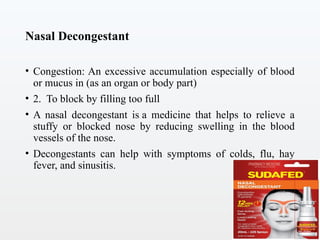
• A nasal decongestant is a medicine that helps to relieve a
stuffy or blocked nose by reducing swelling in the blood
vessels of the nose.
• Decongestants can help with symptoms of colds, flu, hay
fever, and sinusitis.
Types of decongestants
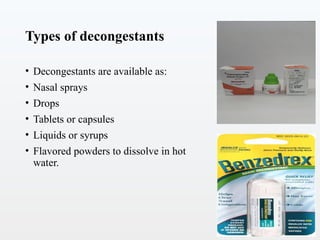
• Decongestants are available as:
• Nasal sprays
• Drops
• Tablets or capsules
• Liquids or syrups
• Flavored powders to dissolve in hot
water.
Classifications
A. Depends upon duration of action;
1. Short acting decongestants administered topically;
Ex-Phenylephrine, Phenylpropanolamine.
2. Long acting decongestants administered orally ; Ex-
Ephedrine, Pseudoephedrine, Naphazoline.
3. Long acting topical decongestants; Ex- Xylometazoline,
Oxymetazoline
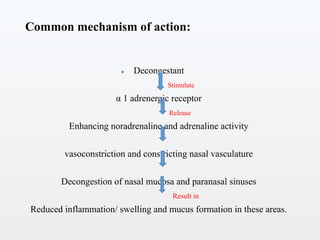
Common mechanism of action:
Decongestant
Stimulate
α 1 adrenergic receptor
Release
Enhancing noradrenaline and adrenaline activity
vasoconstriction and constricting nasal vasculature
Decongestion of nasal mucosa and paranasal sinuses
Result in
Reduced inflammation/ swelling and mucus formation in these areas.
Uses
• Nasal decongestants are used to temporarily relieve a stuffy
or blocked nose.
Side effects of decongestants
Side effects can include:
• Feeling sleepy (look for non-drowsy medicines)
• Irritation of the lining of your nose
• Headaches
• Feeling of being sick
• A dry mouth
• Feeling restless or agitated
• A rash
Respiratory stimulant(Analeptics)
• These are drugs which stimulate respiration and can have
resuscitative value (property to restore the consciousness) in
coma or fainting.
• They may also help by stimulating coughing and thus
helping the patient to expel secretions.
• At low doses they stimulate respiration, but margin of safety
is narrow; at high dose the patient may get convulsions
while still in coma.
Role of Analeptics:
• Overdose with sedatives or hypnotic until mechanical
ventilation is instituted.
• Suffocation on drowning, acute respiratory insufficiency or
in post-anesthetic respiratory depression.
• Apnea in premature infant.
• Failure to ventilate spontaneously after general anesthesia.
• Idiopathic hypoventilation.
Drugs:
1) Doxapram
2) Prethcamide
3) Nikethamide
4) Almitrine
1) Doxapram :
• Short acting analeptic.
• Acts by promoting excitation of central neurons.
• At low doses it is more selective for the respiratory center than
other analeptics.
• The respiratory stimulant action is manifested by an increase in
tidal volume associated with a slight increase in respiratory rate.
• Provided there is no impairment of cardiac function, the presser
effect is more marked in hypovolemic than in normovolemic
states.
• Following doxapram administration, an increased release of
catecholamine's has been noted.
Pharmacokinetics:
• The mean half-life from 4-12 h
• Route of administration: I.V./ I.M.
• Excreted rapidly. Continuous I.V. infusion of doxapram has
been found to abolish episodes of apnoea in the premature
infant not responding to Theophylline
ADR:
• Nausea
• Coughing
• Restlessness
• Headache
• Fever etc.
• DOSE:
• 40-80 mg I.M.
• 0.5-2 mg/kg/hr. I.V. infusion.
• USES:
• Acute respiratory failure
• Acute hypercapnia
• COPD
2) Prethcamide :
• It s a respiratory stimulant composed of two related drugs,
cropropamide and crotethamide.
• MOA:
• Acts by stimulation of peripheral chemoreceptors and central
respiratory centers. It has presser effects and may also
increase catecholamine release.
• ADR:
• Dyspnea
• Muscular and GI effects.
3) Nikethamide :
• It is a stimulant which mainly affects the respiratory cycle.
• It is also known as nicotinic acid diethylamide.
• Antidotes to barbiturate overdose.
• It increase the stimulation of CNS, especially stimulate
medulla oblongata respiratory center, carotid body and aortic
chemoreceptor and then stimulate respiratory center
reflectivity.
• A single I.V. bolus can maintain 5-10 mins.
ADR :
• Tachycardia
• Cough
• Vomiting
• Perspiration
• Convulsion.
• USES :
• Neonatal asphyxia
• CO2 intoxication
• Respiratory depression.
4) Almitrine :
• It enhances respiration by acting as an agonist of peripheral
chemoreceptors located on the carotid bodies.
• The drug increases arterial oxygen tension while decreasing
arterial carbon dioxide tension in patients with chronic
obstructive pulmonary disease.
• It may also prove useful in the treatment of nocturnal
oxygen desaturation without impairing the quality of sleep.
uses
• Emphysema
• Asthama
• Chronic bronchitis
• Coma