Stuck Pipe Prevention Prentice & Hill, LLC Second Day
Differential Sticking Causes High Differential Pressures Excessive Mud Weight Drawn Down Formations Poor Well Planning Well Bore Contact Poor Filter Cake Little or No Pipe Motion
Solids Induced Pack-off Formation Loose w/ Little or No Bonding  Insufficient Hydrostatic to Hold Back Formation UNCONSOLIDATED FORMATIONS Causes
Pack-off Due to  Unconsolidated Formations Prevention Gel up Mud / Run Hi Vis Sweeps Control Drill Spot Gel Pill Prior to TOH Plan / Anticipate:
Solids Induced Pack-off Increase Mud Weight, if possible Use Under-saturated Water Base Mud Pump Fresh Water Sweeps Design Casing to Handle Collapse Loads Causes MOBILE / PLASTIC FORMATIONS Formation Extrudes Into Well Bore Due to  Overburden Forces. Prevention Proper Well Planning:
Solids Induced Pack-off Causes Control Drill & Ream Connections Anticipate Reaming on Trips FRACTURED / FAULTED FORMATIONS Prevention Loose Chunks of Rock Fall into Well Bore Plan / Anticipate
Solids Induced Pack-off Causes Raise Mud Weight, if possible Set Casing Appropriately OVER-PRESSURED SHALE COLLAPSE Prevention Shale “Pops” Off Wall Due to Pressure Plan / Anticipate
Solids Induced Pack-off Causes Use Inhibited Mud System Minimize Exposure Time Be Prepared for “Gumbo Attack” REACTIVE FORMATIONS Prevention Mud Filtrate Reacts Chemically with Formation Plan / Anticipate
Solids Induced Pack-off Causes Increase Annular Velocities Better Mud Properties Subject of another section POOR HOLE CLEANING Prevention Not Removing Cuttings From Well Bore
Mechanical / Wellbore Geometry Sticking   Causes   KEYSEATING Minimize Dog Leg Severity Case Off Curves Soon After Building Use Keyseat Wiper Make Frequent Wiper Trips Back Ream Out of Hole Abrupt Change in Well Bore Path (Dog Leg) Long Hole Section Below Dog Leg Prevention
Mechanical / Wellbore Geometry Sticking   Causes   UNDERGAUGE HOLE Always Gauge Bit & Stabilizers IN and OUT Run Gauge Protected Bits & Stabilizers Ream Suspected Undergauge Sections Undergauge Bit and/or Stabilizers Coring (Core heads slightly U.G.) Prevention
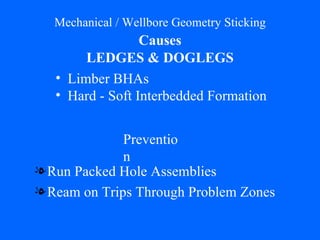
Mechanical / Wellbore Geometry Sticking   Causes   LEDGES & DOGLEGS Run Packed Hole Assemblies Ream on Trips Through Problem Zones Limber BHAs Hard - Soft Interbedded Formation Prevention
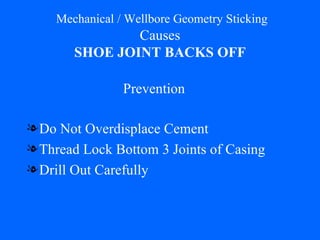
  Mechanical / Wellbore Geometry Sticking Causes SHOE JOINT BACKS OFF Do Not Overdisplace Cement Thread Lock Bottom 3 Joints of Casing Drill Out Carefully Prevention
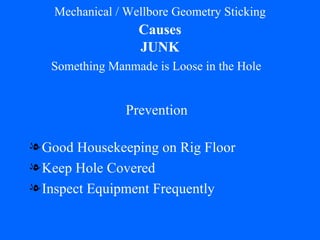
Mechanical / Wellbore Geometry Sticking   Causes   JUNK Good Housekeeping on Rig Floor Keep Hole Covered Inspect Equipment Frequently Prevention Something Manmade is Loose in the Hole
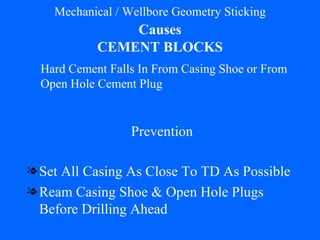
Mechanical / Wellbore Geometry Sticking   Causes   CEMENT BLOCKS Set All Casing As Close To TD As Possible Ream Casing Shoe & Open Hole Plugs Before Drilling Ahead Hard Cement Falls In From Casing Shoe or From Open Hole Cement Plug Prevention
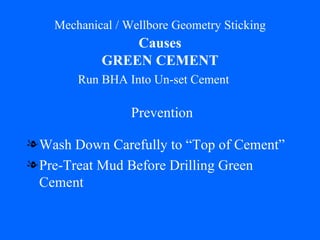
Mechanical / Wellbore Geometry Sticking   Causes   GREEN CEMENT Wash Down Carefully to “Top of Cement” Pre-Treat Mud Before Drilling Green Cement Prevention Run BHA Into Un-set Cement
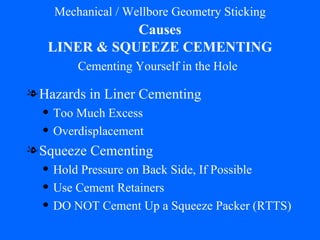
Mechanical / Wellbore Geometry Sticking   Causes   LINER & SQUEEZE CEMENTING Hazards in Liner Cementing Too Much Excess Overdisplacement Squeeze Cementing Hold Pressure on Back Side, If Possible Use Cement Retainers DO NOT Cement Up a Squeeze Packer (RTTS) Cementing Yourself in the Hole
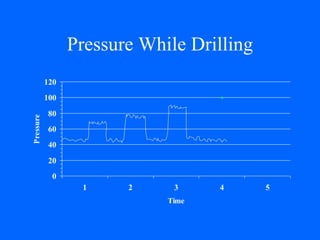
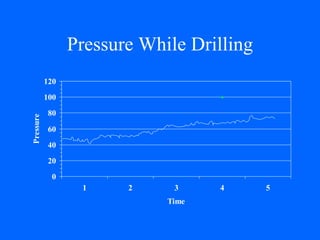
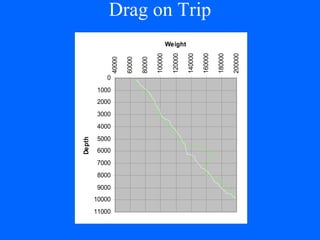
Trend Analysis Plot Property -vs- Depth or Time and Analyze Drag on each Connection Torque -vs- Depth PWD -vs- Time Soap Box
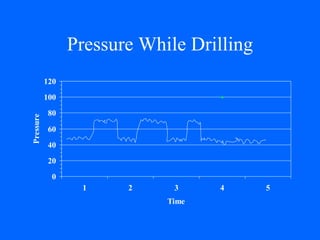
Pressure While Drilling
Drag on Trip
Recovery Our Best Preventive Efforts Have FAILED WE’RE STUCK !! What  Do We Do Now?
Identifying the Problem:   “Why are we stuck?” Stuck Pipe Handbook Flowcharts
Problem Diagnosis Computer Intelligent System on Network at Cambridge Facility Charts in Front of Sedco Forex Handbook
Solving the Problem:   “What do we do now?” First Actions
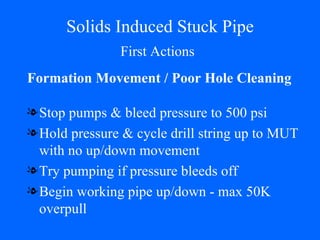
Solids Induced Stuck Pipe Stop pumps & bleed pressure to 500 psi Hold pressure & cycle drill string up to MUT with no up/down movement Try pumping if pressure bleeds off Begin working pipe up/down - max 50K overpull Formation Movement / Poor Hole Cleaning First Actions
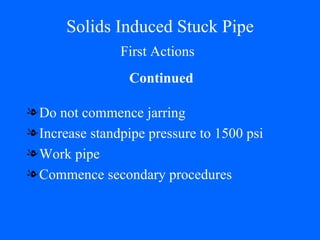
Solids Induced Stuck Pipe Do not commence jarring Increase standpipe pressure to 1500 psi Work pipe Commence secondary procedures Continued First Actions
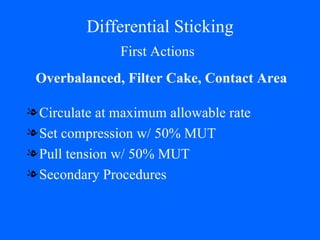
Differential Sticking Circulate at maximum allowable rate Set compression w/ 50% MUT  Pull tension w/ 50% MUT Secondary Procedures Overbalanced, Filter Cake, Contact Area First Actions
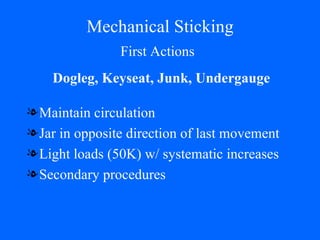
Mechanical Sticking Maintain circulation Jar in opposite direction of last movement Light loads (50K) w/ systematic increases Secondary procedures Dogleg, Keyseat, Junk, Undergauge First Actions
Locating the Problem:    “Where are we stuck? Pipe Stretch Measurements
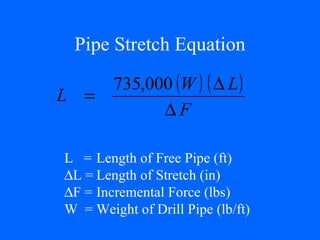
Pipe Stretch Equation L  = Length of Free Pipe (ft)  L = Length of Stretch (in)  F = Incremental Force (lbs) W  = Weight of Drill Pipe (lb/ft)
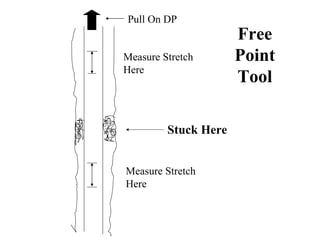
Locating the Problem:    “Where are we stuck? Pipe Stretch Measurements “Free Point” Tool Review Stuck Pipe Handbook Procedures
Stuck Here Pull On DP Measure Stretch  Here Measure Stretch Here Free Point Tool
Solids Induced Stuck Pipe Jarring Back off and wash over Secondary Procedures
Differential Sticking Attack Filter Cake -- Spotting Fluid  Spot within 4 hrs of sticking Omit after 16 hrs Rule of Thumb - Soak minimum 20 hrs and a maximum 40 hrs Secondary Procedures
Pipe Releasing Agents Spotting Fluids Pump “shear thinning” spacer Viscosity: 100 rpm value > drilling mud 50 to 100 bbl spacer Calculate volume of PRA - Example Spot at highest allowable pump rate Work pipe (up/down, torque) while soaking
Differential Sticking Reduce Hydrostatic Cut Mud Weight “U Tube” - Kick it free Caution - Well May Come In Back Off and Wash Over Secondary Procedures
Mechanical Sticking Jar in opposite direction of last pipe movement Back Off and Wash Over Secondary Procedures
Acid Pills Calcium Formations, Strip Filter Cake Typically 7.5% to 15% HCl Cover stuck zone Pump acid quickly to bit Large water spacers Work pipe while soaking Circulate out after 5 minutes Secondary Procedures
Fresh Water Pills Mobile Salt Cover stuck zone plus 20 bbl inside drill string OBM - Viscous weighted spacer Maintain overpull while soaking Repeat after 2 hrs Secondary Procedures
Drilling Jars - Benefits Jar stuck pipe immediately Minimize fishing / sidetrack potential Minimize surface loads (safety) Something to do while waiting on tools
Mechanical Jars Most basic type of jar Sliding sleeve inside shoulder sleeve Holding mechanism locks hammer Overpull stretches drill string Sudden release when holding mechanism is overcome
Mechanical Jars - Advantages Remain locked until loaded More freedom of placement in string No special tripping procedures Do not jar unexpectedly Short jar cycle Cost Availability
Mechanical Jars - Disadvantages Load may not be varied Jarring immediate once load is reached Large shock to hoisting equipment Rig may not pull over holding force Difficult to load in deviated wellbores
Hydraulic Jars Oil reservoir w/ orifice & bypass valve Oil bleeds slowly until piston reaches bypass valve Hydraulic delay
Hydraulic Jars - Advantages Allows time to set drilling brake No torque needed to operate Torque does not affect load Varied impact force Use in deviated holes
Hydraulic Jars - Disadvantages May jar unexpectedly Tripping more time consuming Longer jar cycle More expensive Availability
Reasons Jars Fail to Fire Incorrect weight - calculation incorrect Pump open force exceeds compression force Stuck above jar Jar mechanism failed Jar not cocked Drag too high to load jar
Reasons Jars Fail to Fire (cont.) Jar firing not felt at surface Torque trapped in mechanical jar No patience
Accelerators - Functions Compensate for short string Compensate for hole drag slowing contraction Act as a reflector to jar shock wave Intensify jar blow
Jar / Accelerator Placement Considerations Sticking point Jar direction required Differential risk Neutral point of tension / compression Buckling point  Drag in the hole section Depth of hole section
Placement - Vertical Holes Above buckling point at maximum WOB Two DC’s above jars No stabilizers above jars Accelerators needed in shallow hole sections
Placement - Deviated Holes Do not run jars buckled Avoid tension / compression neutral point Calculate measured weight reading required Account for hole drag
Jar Placement Programs Do not typically account for buckling Accurately calculate and account for pump open forces Maximize jar impact at stuck point Example - Griffith Oil Tools
Fishing - Overshots Catches OD of fish Right hand torque operated Always run a bumper sub Circulating sub  Basket grapple More sturdy, Easier to release Spiral grapple Stronger hold, Use in slim hole Wall hooks
Fishing - Spears Catches ID of pipe Consider stop ring Risk back off of wash pipe  Rope spears
Fishing - Taps Use when overshot or spear cannot be used Taper Tap - Screws inside fish Box Tap - Screws over fish Cannot be released & subject to breakage String shot cannot be run through taper tap Excessive torque will split box tap
Fishing - Junk Magnets Junk Baskets “Confusion Blocks” Mills Pilot, Tapered, Concave, Flat-Bottom, Section, Fluted, Watermelon
Fishing - Milling Pilot Tapered Concave Flat-Bottom Section Fluted Watermelon
Washover Operations Run minimum size required - ¼” clearance inside, ½" clearance outside Maximum length 600' drill pipe, 300'  BHA Conditioning trip Easy to differentially stick Run jars in deeper hole sections Steady feed when cutting formation “Jerky” feed when going over tool joints
Washover Shoes Short tooth mills (mill tooth) for medium to hard formations Long tooth mills for soft formations Cut faster Hang easier Harder to get over top of fish Flat bottom for stabilizers, reamers, tool joints, etc.
Solving the Problem:   “What do we do now?” THE OTHER OPTION: S I D E T R A C K Free Point and Back Off as Deep as Possible Go Around the Fish
What Do We Do Now?   Sidetrack or Fish? It’s Purely a Matter of Economics Sidetrack is a good choice when: Fish Inexpensive or Recovery Unlikely Hole is Cheap (read Fast) to Drill Soft Formation - Easy to Kick Off Spread Rate (Total Daily Cost) is HIGH

Anadrill -_2_days_stuck_pipe_2nd

  • 1.
    Stuck Pipe PreventionPrentice & Hill, LLC Second Day
  • 2.
    Differential Sticking CausesHigh Differential Pressures Excessive Mud Weight Drawn Down Formations Poor Well Planning Well Bore Contact Poor Filter Cake Little or No Pipe Motion
  • 3.
    Solids Induced Pack-offFormation Loose w/ Little or No Bonding Insufficient Hydrostatic to Hold Back Formation UNCONSOLIDATED FORMATIONS Causes
  • 4.
    Pack-off Due to Unconsolidated Formations Prevention Gel up Mud / Run Hi Vis Sweeps Control Drill Spot Gel Pill Prior to TOH Plan / Anticipate:
  • 5.
    Solids Induced Pack-offIncrease Mud Weight, if possible Use Under-saturated Water Base Mud Pump Fresh Water Sweeps Design Casing to Handle Collapse Loads Causes MOBILE / PLASTIC FORMATIONS Formation Extrudes Into Well Bore Due to Overburden Forces. Prevention Proper Well Planning:
  • 6.
    Solids Induced Pack-offCauses Control Drill & Ream Connections Anticipate Reaming on Trips FRACTURED / FAULTED FORMATIONS Prevention Loose Chunks of Rock Fall into Well Bore Plan / Anticipate
  • 7.
    Solids Induced Pack-offCauses Raise Mud Weight, if possible Set Casing Appropriately OVER-PRESSURED SHALE COLLAPSE Prevention Shale “Pops” Off Wall Due to Pressure Plan / Anticipate
  • 8.
    Solids Induced Pack-offCauses Use Inhibited Mud System Minimize Exposure Time Be Prepared for “Gumbo Attack” REACTIVE FORMATIONS Prevention Mud Filtrate Reacts Chemically with Formation Plan / Anticipate
  • 9.
    Solids Induced Pack-offCauses Increase Annular Velocities Better Mud Properties Subject of another section POOR HOLE CLEANING Prevention Not Removing Cuttings From Well Bore
  • 10.
    Mechanical / WellboreGeometry Sticking Causes KEYSEATING Minimize Dog Leg Severity Case Off Curves Soon After Building Use Keyseat Wiper Make Frequent Wiper Trips Back Ream Out of Hole Abrupt Change in Well Bore Path (Dog Leg) Long Hole Section Below Dog Leg Prevention
  • 11.
    Mechanical / WellboreGeometry Sticking Causes UNDERGAUGE HOLE Always Gauge Bit & Stabilizers IN and OUT Run Gauge Protected Bits & Stabilizers Ream Suspected Undergauge Sections Undergauge Bit and/or Stabilizers Coring (Core heads slightly U.G.) Prevention
  • 12.
    Mechanical / WellboreGeometry Sticking Causes LEDGES & DOGLEGS Run Packed Hole Assemblies Ream on Trips Through Problem Zones Limber BHAs Hard - Soft Interbedded Formation Prevention
  • 13.
    Mechanical/ Wellbore Geometry Sticking Causes SHOE JOINT BACKS OFF Do Not Overdisplace Cement Thread Lock Bottom 3 Joints of Casing Drill Out Carefully Prevention
  • 14.
    Mechanical / WellboreGeometry Sticking Causes JUNK Good Housekeeping on Rig Floor Keep Hole Covered Inspect Equipment Frequently Prevention Something Manmade is Loose in the Hole
  • 15.
    Mechanical / WellboreGeometry Sticking Causes CEMENT BLOCKS Set All Casing As Close To TD As Possible Ream Casing Shoe & Open Hole Plugs Before Drilling Ahead Hard Cement Falls In From Casing Shoe or From Open Hole Cement Plug Prevention
  • 16.
    Mechanical / WellboreGeometry Sticking Causes GREEN CEMENT Wash Down Carefully to “Top of Cement” Pre-Treat Mud Before Drilling Green Cement Prevention Run BHA Into Un-set Cement
  • 17.
    Mechanical / WellboreGeometry Sticking Causes LINER & SQUEEZE CEMENTING Hazards in Liner Cementing Too Much Excess Overdisplacement Squeeze Cementing Hold Pressure on Back Side, If Possible Use Cement Retainers DO NOT Cement Up a Squeeze Packer (RTTS) Cementing Yourself in the Hole
  • 18.
    Trend Analysis PlotProperty -vs- Depth or Time and Analyze Drag on each Connection Torque -vs- Depth PWD -vs- Time Soap Box
  • 19.
  • 20.
  • 21.
  • 22.
  • 23.
    Recovery Our BestPreventive Efforts Have FAILED WE’RE STUCK !! What Do We Do Now?
  • 24.
    Identifying the Problem: “Why are we stuck?” Stuck Pipe Handbook Flowcharts
  • 25.
    Problem Diagnosis ComputerIntelligent System on Network at Cambridge Facility Charts in Front of Sedco Forex Handbook
  • 26.
    Solving the Problem: “What do we do now?” First Actions
  • 27.
    Solids Induced StuckPipe Stop pumps & bleed pressure to 500 psi Hold pressure & cycle drill string up to MUT with no up/down movement Try pumping if pressure bleeds off Begin working pipe up/down - max 50K overpull Formation Movement / Poor Hole Cleaning First Actions
  • 28.
    Solids Induced StuckPipe Do not commence jarring Increase standpipe pressure to 1500 psi Work pipe Commence secondary procedures Continued First Actions
  • 29.
    Differential Sticking Circulateat maximum allowable rate Set compression w/ 50% MUT Pull tension w/ 50% MUT Secondary Procedures Overbalanced, Filter Cake, Contact Area First Actions
  • 30.
    Mechanical Sticking Maintaincirculation Jar in opposite direction of last movement Light loads (50K) w/ systematic increases Secondary procedures Dogleg, Keyseat, Junk, Undergauge First Actions
  • 31.
    Locating the Problem: “Where are we stuck? Pipe Stretch Measurements
  • 32.
    Pipe Stretch EquationL = Length of Free Pipe (ft)  L = Length of Stretch (in)  F = Incremental Force (lbs) W = Weight of Drill Pipe (lb/ft)
  • 33.
    Locating the Problem: “Where are we stuck? Pipe Stretch Measurements “Free Point” Tool Review Stuck Pipe Handbook Procedures
  • 34.
    Stuck Here PullOn DP Measure Stretch Here Measure Stretch Here Free Point Tool
  • 35.
    Solids Induced StuckPipe Jarring Back off and wash over Secondary Procedures
  • 36.
    Differential Sticking AttackFilter Cake -- Spotting Fluid Spot within 4 hrs of sticking Omit after 16 hrs Rule of Thumb - Soak minimum 20 hrs and a maximum 40 hrs Secondary Procedures
  • 37.
    Pipe Releasing AgentsSpotting Fluids Pump “shear thinning” spacer Viscosity: 100 rpm value > drilling mud 50 to 100 bbl spacer Calculate volume of PRA - Example Spot at highest allowable pump rate Work pipe (up/down, torque) while soaking
  • 38.
    Differential Sticking ReduceHydrostatic Cut Mud Weight “U Tube” - Kick it free Caution - Well May Come In Back Off and Wash Over Secondary Procedures
  • 39.
    Mechanical Sticking Jarin opposite direction of last pipe movement Back Off and Wash Over Secondary Procedures
  • 40.
    Acid Pills CalciumFormations, Strip Filter Cake Typically 7.5% to 15% HCl Cover stuck zone Pump acid quickly to bit Large water spacers Work pipe while soaking Circulate out after 5 minutes Secondary Procedures
  • 41.
    Fresh Water PillsMobile Salt Cover stuck zone plus 20 bbl inside drill string OBM - Viscous weighted spacer Maintain overpull while soaking Repeat after 2 hrs Secondary Procedures
  • 42.
    Drilling Jars -Benefits Jar stuck pipe immediately Minimize fishing / sidetrack potential Minimize surface loads (safety) Something to do while waiting on tools
  • 43.
    Mechanical Jars Mostbasic type of jar Sliding sleeve inside shoulder sleeve Holding mechanism locks hammer Overpull stretches drill string Sudden release when holding mechanism is overcome
  • 44.
    Mechanical Jars -Advantages Remain locked until loaded More freedom of placement in string No special tripping procedures Do not jar unexpectedly Short jar cycle Cost Availability
  • 45.
    Mechanical Jars -Disadvantages Load may not be varied Jarring immediate once load is reached Large shock to hoisting equipment Rig may not pull over holding force Difficult to load in deviated wellbores
  • 46.
    Hydraulic Jars Oilreservoir w/ orifice & bypass valve Oil bleeds slowly until piston reaches bypass valve Hydraulic delay
  • 47.
    Hydraulic Jars -Advantages Allows time to set drilling brake No torque needed to operate Torque does not affect load Varied impact force Use in deviated holes
  • 48.
    Hydraulic Jars -Disadvantages May jar unexpectedly Tripping more time consuming Longer jar cycle More expensive Availability
  • 49.
    Reasons Jars Failto Fire Incorrect weight - calculation incorrect Pump open force exceeds compression force Stuck above jar Jar mechanism failed Jar not cocked Drag too high to load jar
  • 50.
    Reasons Jars Failto Fire (cont.) Jar firing not felt at surface Torque trapped in mechanical jar No patience
  • 51.
    Accelerators - FunctionsCompensate for short string Compensate for hole drag slowing contraction Act as a reflector to jar shock wave Intensify jar blow
  • 52.
    Jar / AcceleratorPlacement Considerations Sticking point Jar direction required Differential risk Neutral point of tension / compression Buckling point Drag in the hole section Depth of hole section
  • 53.
    Placement - VerticalHoles Above buckling point at maximum WOB Two DC’s above jars No stabilizers above jars Accelerators needed in shallow hole sections
  • 54.
    Placement - DeviatedHoles Do not run jars buckled Avoid tension / compression neutral point Calculate measured weight reading required Account for hole drag
  • 55.
    Jar Placement ProgramsDo not typically account for buckling Accurately calculate and account for pump open forces Maximize jar impact at stuck point Example - Griffith Oil Tools
  • 56.
    Fishing - OvershotsCatches OD of fish Right hand torque operated Always run a bumper sub Circulating sub Basket grapple More sturdy, Easier to release Spiral grapple Stronger hold, Use in slim hole Wall hooks
  • 57.
    Fishing - SpearsCatches ID of pipe Consider stop ring Risk back off of wash pipe Rope spears
  • 58.
    Fishing - TapsUse when overshot or spear cannot be used Taper Tap - Screws inside fish Box Tap - Screws over fish Cannot be released & subject to breakage String shot cannot be run through taper tap Excessive torque will split box tap
  • 59.
    Fishing - JunkMagnets Junk Baskets “Confusion Blocks” Mills Pilot, Tapered, Concave, Flat-Bottom, Section, Fluted, Watermelon
  • 60.
    Fishing - MillingPilot Tapered Concave Flat-Bottom Section Fluted Watermelon
  • 61.
    Washover Operations Runminimum size required - ¼” clearance inside, ½" clearance outside Maximum length 600' drill pipe, 300' BHA Conditioning trip Easy to differentially stick Run jars in deeper hole sections Steady feed when cutting formation “Jerky” feed when going over tool joints
  • 62.
    Washover Shoes Shorttooth mills (mill tooth) for medium to hard formations Long tooth mills for soft formations Cut faster Hang easier Harder to get over top of fish Flat bottom for stabilizers, reamers, tool joints, etc.
  • 63.
    Solving the Problem: “What do we do now?” THE OTHER OPTION: S I D E T R A C K Free Point and Back Off as Deep as Possible Go Around the Fish
  • 64.
    What Do WeDo Now? Sidetrack or Fish? It’s Purely a Matter of Economics Sidetrack is a good choice when: Fish Inexpensive or Recovery Unlikely Hole is Cheap (read Fast) to Drill Soft Formation - Easy to Kick Off Spread Rate (Total Daily Cost) is HIGH