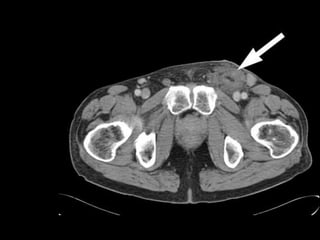
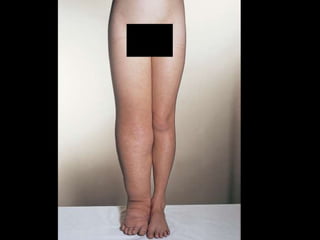
Lymphatic System
 Subdivision of the circulatory system
 Removes foreign material and cell debris
 Destroy cells through action of lymphocytes
 Returns tissue fluid from intercellular spaces
to venous system
 Usually not palpable
 Vessels are lined with a single layer of
epithelial cells
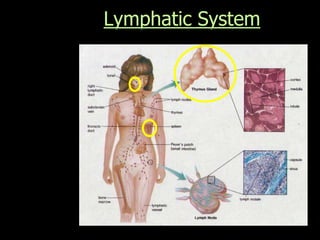
 Comprises: lymph capillaries, vessels, lymph
nodes, aggregation of lymph tissue (spleen,
thymus & tonsils)
 Collects from tissue via:
lymphatic capillaries vessels ducts
Lymphatic System
Lymphatic System
Lymph nodes
 Small
 Prevent infections
 F1: production of lymphocytes
 F2: Production of antibodies and antitoxins
 F3: Filters bacteria & foreign material
 Bean-shaped
 Fibrous capsule
 Network of reticular fibers
 Dense arrangement of lymphocytes
Lymphatic System
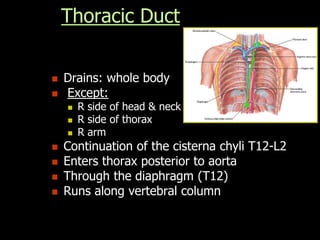
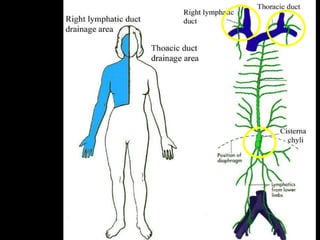
Thoracic Duct
 Drains: whole body
 Except:
 R side of head & neck
 R side of thorax
 R arm
 Continuation of the cisterna chyli T12-L2
 Enters thorax posterior to aorta
 Through the diaphragm (T12)
 Runs along vertebral column
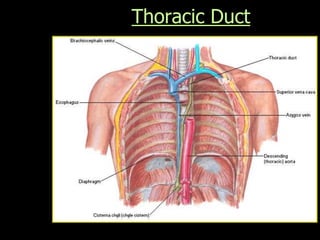
Thoracic Duct
 Ascends through posterior mediastinum
 Between thoracic aorta & azygos vein
 Crosses from right to left posterior to
oesophagus T5 – T7
 Enters superior mediastinum
 Runs to the root of neck
 C7 arches left, opens in venous angle
 Subclavian & internal jugular unite
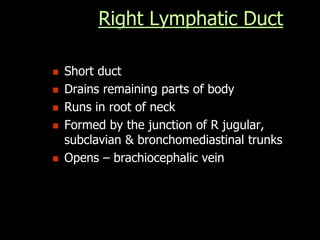
Right Lymphatic Duct
 Short duct
 Drains remaining parts of body
 Runs in root of neck
 Formed by the junction of R jugular,
subclavian & bronchomediastinal trunks
 Opens – brachiocephalic vein
Thorax
Lymphatic Drainage Thoracic
Wall
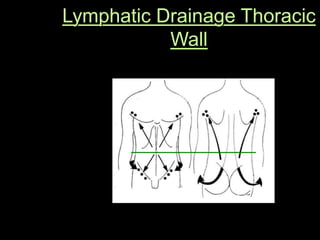
 Skin (superficial to deep fascia)
 Superior to plane of umblicus drain to the anterior
& posterior axillary lymph nodes
 Inferior to plane of umblicus drain to the inguinal
lymph nodes
 Muscular wall & pleura (deep to deep fascia)
 3 groups – parasternal, posterior intercostal
& diaphragmatic nodes
Lymphatic Drainage Thoracic
Wall
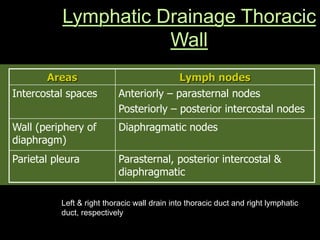
Areas Lymph nodes
Intercostal spaces Anteriorly – parasternal nodes
Posteriorly – posterior intercostal nodes
Wall (periphery of
diaphragm)
Diaphragmatic nodes
Parietal pleura Parasternal, posterior intercostal &
diaphragmatic
Lymphatic Drainage Thoracic
Wall
Left & right thoracic wall drain into thoracic duct and right lymphatic
duct, respectively
Lymphatic Drainage Thoracic
Contents
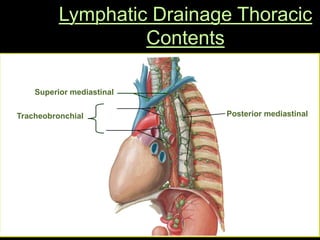
 3 groups of lymph nodes
 Superior mediastinal lymph nodes
 Posterior mediastinal lymph nodes
 Tracheobronchial lymph nodes
Superior mediastinal
Posterior mediastinal
Tracheobronchial
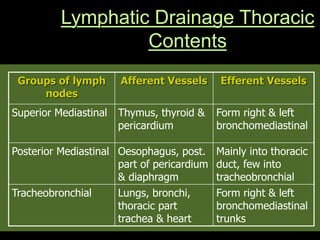
Groups of lymph
nodes
Afferent Vessels Efferent Vessels
Superior Mediastinal Thymus, thyroid &
pericardium
Form right & left
bronchomediastinal
Posterior Mediastinal Oesophagus, post.
part of pericardium
& diaphragm
Mainly into thoracic
duct, few into
tracheobronchial
Tracheobronchial Lungs, bronchi,
thoracic part
trachea & heart
Form right & left
bronchomediastinal
trunks
Lymphatic Drainage Thoracic
Contents
Lymphatic Drainage Thoracic
Contents
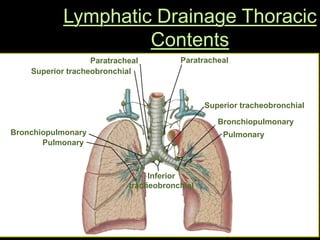
 Tracheobronchial nodes – 5 groups
 Paratracheal
 Superior tracheobronchial
 Inferior tracheobronchial
 Bronchopulmonary
 Pulmonary
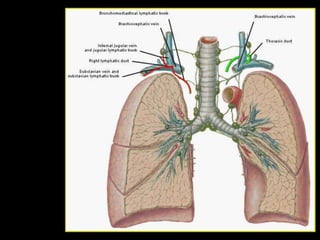
 Left & right bronchomediastinal trunks drain
into thoracic duct & right lymphatic duct
Paratracheal Paratracheal
Inferior
tracheobronchial
Superior tracheobronchial
Bronchiopulmonary
Bronchiopulmonary
Pulmonary
Pulmonary
Superior tracheobronchial
Upper limb
& Axilla
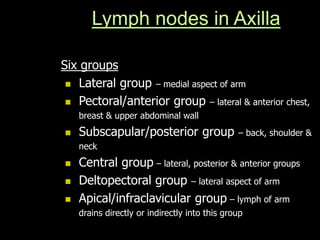
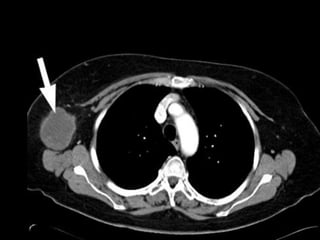
Lymph nodes in Axilla
Six groups
 Lateral group – medial aspect of arm
 Pectoral/anterior group – lateral & anterior chest,
breast & upper abdominal wall
 Subscapular/posterior group – back, shoulder &
neck
 Central group – lateral, posterior & anterior groups
 Deltopectoral group – lateral aspect of arm
 Apical/infraclavicular group – lymph of arm
drains directly or indirectly into this group
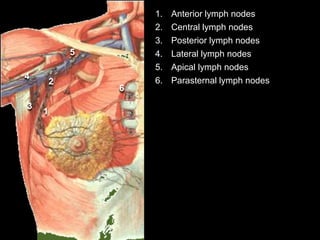
1. Anterior lymph nodes
2. Central lymph nodes
3. Posterior lymph nodes
4. Lateral lymph nodes
5. Apical lymph nodes
6. Parasternal lymph nodes
5
4
3
1
6
2
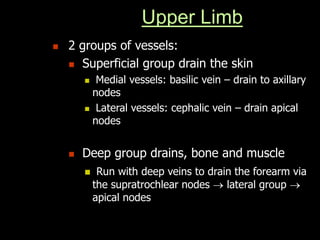
Upper Limb
 2 groups of vessels:
 Superficial group drain the skin
 Medial vessels: basilic vein – drain to axillary
nodes
 Lateral vessels: cephalic vein – drain apical
nodes
 Deep group drains, bone and muscle
 Run with deep veins to drain the forearm via
the supratrochlear nodes  lateral group 
apical nodes
Lymph nodes in Axilla
 All the lymph nodes eventually drain into:
Right
 Into the right subclavian lymphatic trunk then into
the right lymphatic duct
Left
 Into the left subclavian lymphatic trunk then into
the thoracic duct
The Breast
 Lymph is drained directly/indirectly via:
Seven groups: (7th parasternal nodes)
The Breast
Breast tissue..1
 Drain along vascular tributaries to Sappey’s
subareolar lymph plexus
 Medial border – drains to parasternal nodes
 Inferiomedial quadrant – drains to
abdominal lymph nodes
 75% of lymph drains to axillary nodes – tail
of Spence via pectoral nodes
Breast tissue..2
 Lateral border – drains via lateral branches
of intercostal a. – parasternal or posterior
intercostal nodes
 Deep surface drains through pectoralis major
terminates in apical nodes
The Breast
Skin of Breast
 Drains radially to surrounding glands
 e.g. laterally to axillary nodes, medially to
parasternal nodes
 Lymphatic drainage from left and right
breast do communicate
 Axillary nodes  infraclavicular nodes 
subclavian lymphatic trunk  R lymphatic
duct or thoracic duct
The Breast
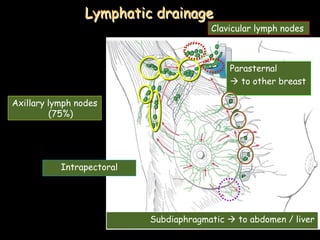
Lymphatic drainage
Subdiaphragmatic  to abdomen / liver
Parasternal
 to other breast
Axillary lymph nodes
(75%)
Clavicular lymph nodes
Intrapectoral
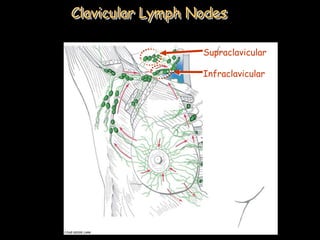
Clavicular Lymph Nodes
Infraclavicular
Supraclavicular
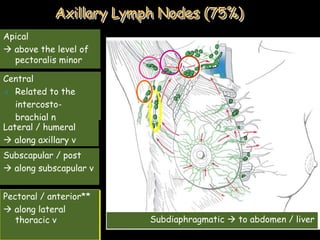
Axillary Lymph Nodes (75%)
Subdiaphragmatic  to abdomen / liver
Pectoral / anterior**
 along lateral
thoracic v
Subscapular / post
 along subscapular v
Lateral / humeral
 along axillary v
Central
 Related to the
intercosto-
brachial n
Apical
 above the level of
pectoralis minor
Head & Neck
Lymphatic Drainage of H&N
 No lymphatics in CNS
 Only superficial nodes in head
 Superficial & Deep nodes in neck
 Associated with veins & organized around
fascia
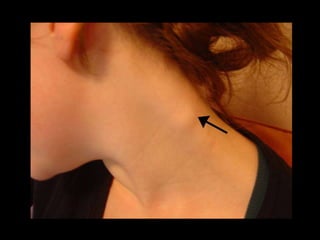
Lymphatic Drainage of the Head and Neck
Deep cervical lymph nodes
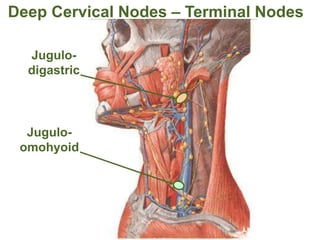
Terminal lymph nodes
Superior eg. Jugulo-digastric or Inferior eg. Jugulo-omohyoid
Regional lymph nodes
for superficial structures
Occipital, Pre and Posterior auricular,
parotid and Buccal, Superficial cervical,
submandibular and Submental, Anterior
jugular, External jugular
Regional lymph nodes
for deep structures
Prelaryngeal, pretracheal, paratracheal,
infrahyoid, retropharyngeal
Scalp
Eyelids
Nose
Lips
Nasal cavity, paranasal air sinuses,
nasopharynx, middle ear, larynx, thyroid
gland, oral cavity, teeth, tonsil, tongue,
pharynx, cervical oesophagus
Deep structures
Superficial structures
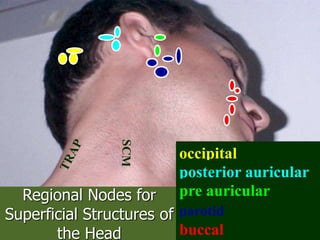
Regional Nodes for
Superficial Structures of
the Head
occipital
posterior auricular
pre auricular
parotid
buccal
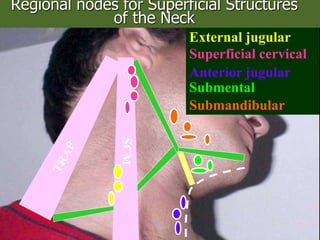
Submental
Superficial cervical
Anterior jugular
Submandibular
External jugular
Regional nodes for Superficial Structures
of the Neck
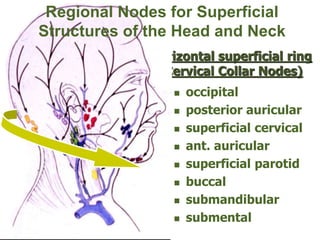
 occipital
 posterior auricular
 superficial cervical
 ant. auricular
 superficial parotid
 buccal
 submandibular
 submental
Horizontal superficial ring
(Cervical Collar Nodes)
Regional Nodes for Superficial
Structures of the Head and Neck
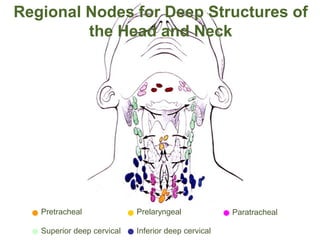
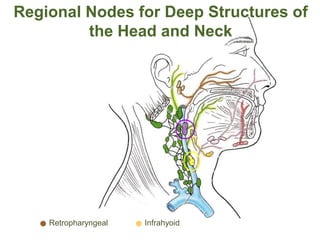
Regional Nodes for Deep Structures of
the Head and Neck
Pretracheal
Superior deep cervical
Prelaryngeal Paratracheal
Inferior deep cervical
Regional Nodes for Deep Structures of
the Head and Neck
Retropharyngeal Infrahyoid
Jugulo-
digastric
Jugulo-
omohyoid
Deep Cervical Nodes – Terminal Nodes
Lymphatic Drainage of H&N
 Deep cervical (terminal) nodes
 Efferent lymph vessels unite – jugular lymph
trunks
 Right open – brachiocephalic vein
 Left open – thoracic duct
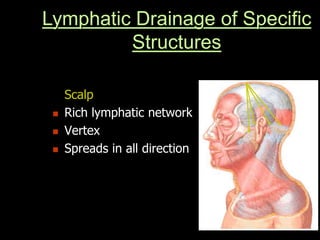
Lymphatic Drainage of Specific
Structures
Scalp
 Rich lymphatic network
 Vertex
 Spreads in all direction
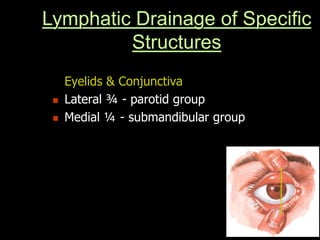
Eyelids & Conjunctiva
 Lateral ¾ - parotid group
 Medial ¼ - submandibular group
Lymphatic Drainage of Specific
Structures
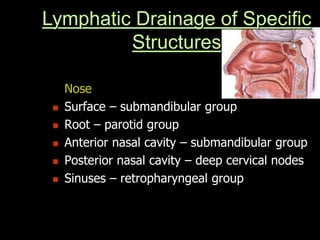
Nose
 Surface – submandibular group
 Root – parotid group
 Anterior nasal cavity – submandibular group
 Posterior nasal cavity – deep cervical nodes
 Sinuses – retropharyngeal group
Lymphatic Drainage of Specific
Structures
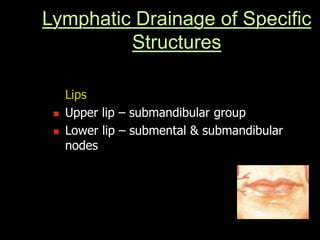
Lips
 Upper lip – submandibular group
 Lower lip – submental & submandibular
nodes
Lymphatic Drainage of Specific
Structures
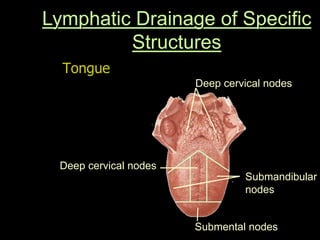
Submandibular
nodes
Deep cervical nodes
Submental nodes
Deep cervical nodes
Tongue
Lymphatic Drainage of Specific
Structures
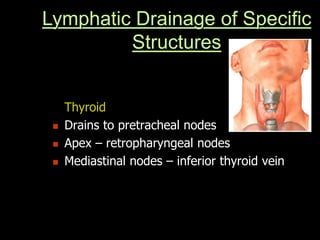
Thyroid
 Drains to pretracheal nodes
 Apex – retropharyngeal nodes
 Mediastinal nodes – inferior thyroid vein
Lymphatic Drainage of Specific
Structures
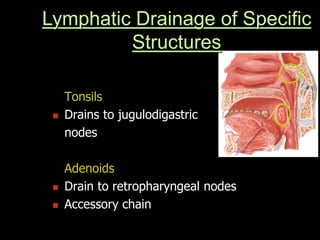
Tonsils
 Drains to jugulodigastric
nodes
Adenoids
 Drain to retropharyngeal nodes
 Accessory chain
Lymphatic Drainage of Specific
Structures
Abdomen
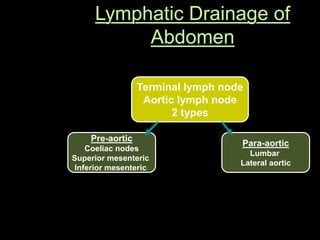
Lymphatic Drainage of
Abdomen
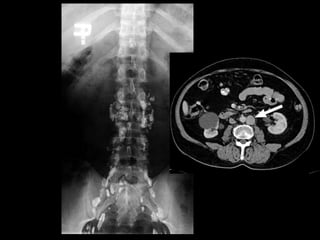
Terminal lymph node
Aortic lymph node
2 types
Pre-aortic
Coeliac nodes
Superior mesenteric
Inferior mesenteric
Para-aortic
Lumbar
Lateral aortic
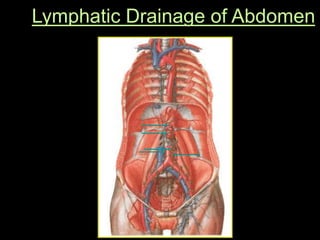
Lymphatic Drainage of Abdomen
Lymphatic Drainage of Anterior &
Posterior Abdominal Wall
 Skin
 Superior to plane of umblicus drain to the anterior
& posterior axillary lymph nodes
 Inferior to plane of umblicus drain to the
superficial inguinal lymph nodes
 Skin of scrotum drain to superficial inguinal
lymph nodes
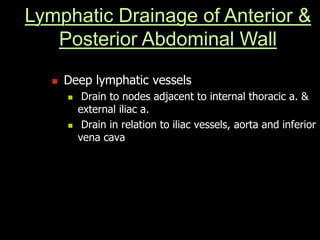
 Deep lymphatic vessels
 Drain to nodes adjacent to internal thoracic a. &
external iliac a.
 Drain in relation to iliac vessels, aorta and inferior
vena cava
Lymphatic Drainage of Anterior &
Posterior Abdominal Wall
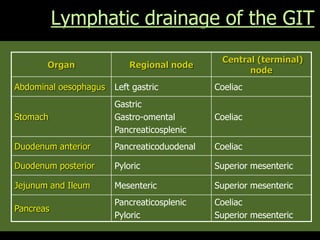
Lymphatic drainage of the GIT
Organ Regional node
Central (terminal)
node
Abdominal oesophagus Left gastric Coeliac
Stomach
Gastric
Gastro-omental
Pancreaticosplenic
Coeliac
Duodenum anterior Pancreaticoduodenal Coeliac
Duodenum posterior Pyloric Superior mesenteric
Jejunum and Ileum Mesenteric Superior mesenteric
Pancreas
Pancreaticosplenic
Pyloric
Coeliac
Superior mesenteric
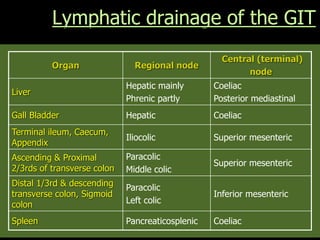
Organ Regional node
Central (terminal)
node
Liver
Hepatic mainly
Phrenic partly
Coeliac
Posterior mediastinal
Gall Bladder Hepatic Coeliac
Terminal ileum, Caecum,
Appendix
Iliocolic Superior mesenteric
Ascending & Proximal
2/3rds of transverse colon
Paracolic
Middle colic
Superior mesenteric
Distal 1/3rd & descending
transverse colon, Sigmoid
colon
Paracolic
Left colic
Inferior mesenteric
Spleen Pancreaticosplenic Coeliac
Lymphatic drainage of the GIT
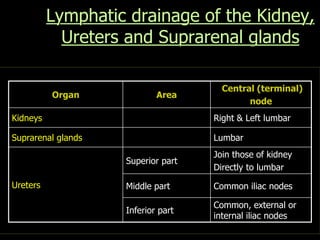
Organ Area
Central (terminal)
node
Kidneys Right & Left lumbar
Suprarenal glands Lumbar
Ureters
Superior part
Join those of kidney
Directly to lumbar
Middle part Common iliac nodes
Inferior part
Common, external or
internal iliac nodes
Lymphatic drainage of the Kidney,
Ureters and Suprarenal glands
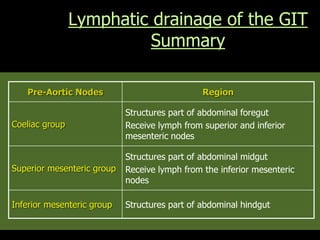
Pre-Aortic Nodes Region
Coeliac group
Structures part of abdominal foregut
Receive lymph from superior and inferior
mesenteric nodes
Superior mesenteric group
Structures part of abdominal midgut
Receive lymph from the inferior mesenteric
nodes
Inferior mesenteric group Structures part of abdominal hindgut
Lymphatic drainage of the GIT
Summary
Pelvis
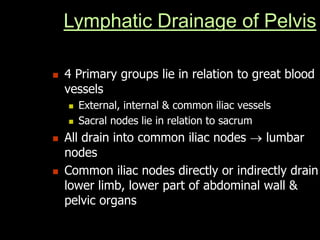
Lymphatic Drainage of Pelvis
 4 Primary groups lie in relation to great blood
vessels
 External, internal & common iliac vessels
 Sacral nodes lie in relation to sacrum
 All drain into common iliac nodes  lumbar
nodes
 Common iliac nodes directly or indirectly drain
lower limb, lower part of abdominal wall &
pelvic organs
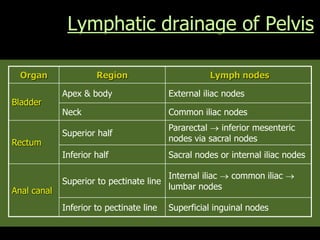
Organ Region Lymph nodes
Bladder
Apex & body External iliac nodes
Neck Common iliac nodes
Rectum
Superior half
Pararectal  inferior mesenteric
nodes via sacral nodes
Inferior half Sacral nodes or internal iliac nodes
Anal canal
Superior to pectinate line
Internal iliac  common iliac 
lumbar nodes
Inferior to pectinate line Superficial inguinal nodes
Lymphatic drainage of Pelvis
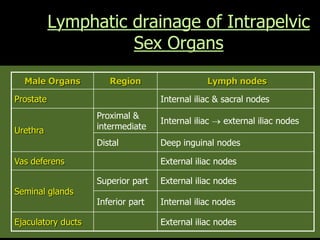
Male Organs Region Lymph nodes
Prostate Internal iliac & sacral nodes
Urethra
Proximal &
intermediate
Internal iliac  external iliac nodes
Distal Deep inguinal nodes
Vas deferens External iliac nodes
Seminal glands
Superior part External iliac nodes
Inferior part Internal iliac nodes
Ejaculatory ducts External iliac nodes
Lymphatic drainage of Intrapelvic
Sex Organs
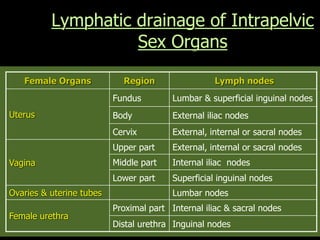
Female Organs Region Lymph nodes
Uterus
Fundus Lumbar & superficial inguinal nodes
Body External iliac nodes
Cervix External, internal or sacral nodes
Vagina
Upper part External, internal or sacral nodes
Middle part Internal iliac nodes
Lower part Superficial inguinal nodes
Ovaries & uterine tubes Lumbar nodes
Female urethra
Proximal part Internal iliac & sacral nodes
Distal urethra Inguinal nodes
Lymphatic drainage of Intrapelvic
Sex Organs
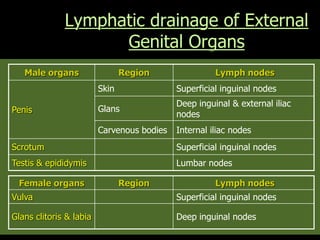
Lymphatic drainage of External
Genital Organs
Male organs Region Lymph nodes
Penis
Skin Superficial inguinal nodes
Glans
Deep inguinal & external iliac
nodes
Carvenous bodies Internal iliac nodes
Scrotum Superficial inguinal nodes
Testis & epididymis Lumbar nodes
Female organs Region Lymph nodes
Vulva Superficial inguinal nodes
Glans clitoris & labia Deep inguinal nodes
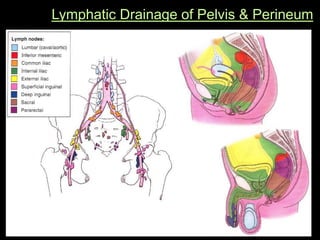
Lymphatic Drainage of Pelvis & Perineum
Lower limb
Lymphatic Drainage
 Lymph passes from lower limb 
intermediate nodes  inguinal nodes 
external iliac nodes
 Inguinal nodes - divided into 2 groups:
 Superficial groups
 Deep groups
Superficial Inguinal Nodes
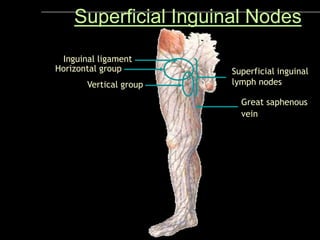
Subdivided further into 2:
 Horizontal chain - inferior inguinal ligament
 Vertical chain - along great saphenous vein
Superficial Inguinal Nodes
 Drains lymph from the following regions:
 Gluteal region
 Lower abdominal wall
 External genitalia and perineum
 Vagina
 Anal canal
 Uterus via round ligament
 Surface lower limb
 Skin of thigh
 Medial leg and foot
Great saphenous
vein
Superficial inguinal
lymph nodes
Vertical group
Horizontal group
Superficial Inguinal Nodes
Inguinal ligament
Deep Inguinal Nodes
 Vary in number between 1-3
 Lie medial to femoral vein
 Nodes located as follows:
 Great saphenous vein join femoral vein
 In femoral sheath
 Lateral part of femoral ring
Deep Inguinal Nodes
 Receive afferent vessels  deeper structures
 Glans of penis
 Connection with superficial inguinal groups
also exists
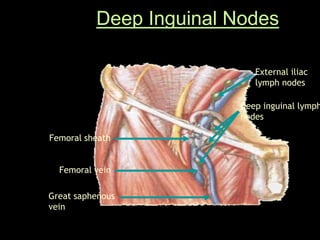
Great saphenous
vein
Femoral sheath
Femoral vein
Deep inguinal lymph
nodes
External iliac
lymph nodes
Deep Inguinal Nodes
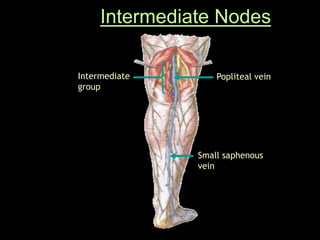
Intermediate Nodes
 5-6 nodes surround popliteal vessels - fossa
 Drain deep inguinal nodes  external iliac
nodes
 1 lies below deep fascia
 Next to small saphenous vein
 Drains same area as small saphenous vein
Intermediate
group
Popliteal vein
Small saphenous
vein
Intermediate Nodes
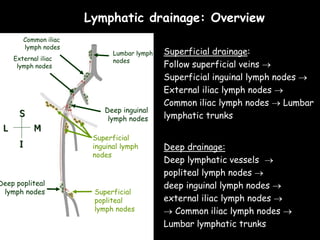
Lymphatic drainage: Overview
Superficial
popliteal
lymph nodes
Deep popliteal
lymph nodes
Superficial
inguinal lymph
nodes
Deep inguinal
lymph nodes
External iliac
lymph nodes
Common iliac
lymph nodes
Lumbar lymph
nodes
Superficial drainage:
Follow superficial veins 
Superficial inguinal lymph nodes 
External iliac lymph nodes 
Common iliac lymph nodes  Lumbar
lymphatic trunks
Deep drainage:
Deep lymphatic vessels 
popliteal lymph nodes 
deep inguinal lymph nodes 
external iliac lymph nodes 
 Common iliac lymph nodes 
Lumbar lymphatic trunks
GSV
LSV
Femoral
v
Popliteal
v
S
I
M
L
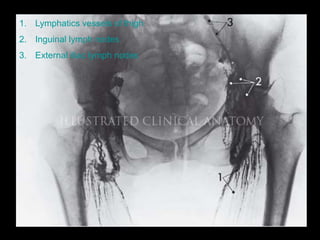
1. Lymphatics vessels of thigh
2. Inguinal lymph nodes
3. External iliac lymph nodes
ANA809Lymphatic System lim pics.ppt

ANA809Lymphatic System lim pics.ppt

  • 1.
    Lymphatic System  Subdivisionof the circulatory system  Removes foreign material and cell debris  Destroy cells through action of lymphocytes  Returns tissue fluid from intercellular spaces to venous system
  • 2.
     Usually notpalpable  Vessels are lined with a single layer of epithelial cells  Comprises: lymph capillaries, vessels, lymph nodes, aggregation of lymph tissue (spleen, thymus & tonsils)  Collects from tissue via: lymphatic capillaries vessels ducts Lymphatic System
  • 3.
  • 4.
    Lymph nodes  Small Prevent infections  F1: production of lymphocytes  F2: Production of antibodies and antitoxins  F3: Filters bacteria & foreign material  Bean-shaped  Fibrous capsule  Network of reticular fibers  Dense arrangement of lymphocytes Lymphatic System
  • 5.
    Thoracic Duct  Drains:whole body  Except:  R side of head & neck  R side of thorax  R arm  Continuation of the cisterna chyli T12-L2  Enters thorax posterior to aorta  Through the diaphragm (T12)  Runs along vertebral column
  • 6.
    Thoracic Duct  Ascendsthrough posterior mediastinum  Between thoracic aorta & azygos vein  Crosses from right to left posterior to oesophagus T5 – T7  Enters superior mediastinum  Runs to the root of neck  C7 arches left, opens in venous angle  Subclavian & internal jugular unite
  • 7.
    Right Lymphatic Duct Short duct  Drains remaining parts of body  Runs in root of neck  Formed by the junction of R jugular, subclavian & bronchomediastinal trunks  Opens – brachiocephalic vein
  • 10.
  • 11.
    Lymphatic Drainage Thoracic Wall Skin (superficial to deep fascia)  Superior to plane of umblicus drain to the anterior & posterior axillary lymph nodes  Inferior to plane of umblicus drain to the inguinal lymph nodes  Muscular wall & pleura (deep to deep fascia)  3 groups – parasternal, posterior intercostal & diaphragmatic nodes
  • 12.
  • 13.
    Areas Lymph nodes Intercostalspaces Anteriorly – parasternal nodes Posteriorly – posterior intercostal nodes Wall (periphery of diaphragm) Diaphragmatic nodes Parietal pleura Parasternal, posterior intercostal & diaphragmatic Lymphatic Drainage Thoracic Wall Left & right thoracic wall drain into thoracic duct and right lymphatic duct, respectively
  • 14.
    Lymphatic Drainage Thoracic Contents 3 groups of lymph nodes  Superior mediastinal lymph nodes  Posterior mediastinal lymph nodes  Tracheobronchial lymph nodes Superior mediastinal Posterior mediastinal Tracheobronchial
  • 15.
    Groups of lymph nodes AfferentVessels Efferent Vessels Superior Mediastinal Thymus, thyroid & pericardium Form right & left bronchomediastinal Posterior Mediastinal Oesophagus, post. part of pericardium & diaphragm Mainly into thoracic duct, few into tracheobronchial Tracheobronchial Lungs, bronchi, thoracic part trachea & heart Form right & left bronchomediastinal trunks Lymphatic Drainage Thoracic Contents
  • 16.
    Lymphatic Drainage Thoracic Contents Tracheobronchial nodes – 5 groups  Paratracheal  Superior tracheobronchial  Inferior tracheobronchial  Bronchopulmonary  Pulmonary  Left & right bronchomediastinal trunks drain into thoracic duct & right lymphatic duct Paratracheal Paratracheal Inferior tracheobronchial Superior tracheobronchial Bronchiopulmonary Bronchiopulmonary Pulmonary Pulmonary Superior tracheobronchial
  • 18.
  • 19.
    Lymph nodes inAxilla Six groups  Lateral group – medial aspect of arm  Pectoral/anterior group – lateral & anterior chest, breast & upper abdominal wall  Subscapular/posterior group – back, shoulder & neck  Central group – lateral, posterior & anterior groups  Deltopectoral group – lateral aspect of arm  Apical/infraclavicular group – lymph of arm drains directly or indirectly into this group
  • 20.
    1. Anterior lymphnodes 2. Central lymph nodes 3. Posterior lymph nodes 4. Lateral lymph nodes 5. Apical lymph nodes 6. Parasternal lymph nodes 5 4 3 1 6 2
  • 21.
    Upper Limb  2groups of vessels:  Superficial group drain the skin  Medial vessels: basilic vein – drain to axillary nodes  Lateral vessels: cephalic vein – drain apical nodes  Deep group drains, bone and muscle  Run with deep veins to drain the forearm via the supratrochlear nodes  lateral group  apical nodes
  • 22.
    Lymph nodes inAxilla  All the lymph nodes eventually drain into: Right  Into the right subclavian lymphatic trunk then into the right lymphatic duct Left  Into the left subclavian lymphatic trunk then into the thoracic duct
  • 24.
    The Breast  Lymphis drained directly/indirectly via: Seven groups: (7th parasternal nodes)
  • 25.
    The Breast Breast tissue..1 Drain along vascular tributaries to Sappey’s subareolar lymph plexus  Medial border – drains to parasternal nodes  Inferiomedial quadrant – drains to abdominal lymph nodes  75% of lymph drains to axillary nodes – tail of Spence via pectoral nodes
  • 26.
    Breast tissue..2  Lateralborder – drains via lateral branches of intercostal a. – parasternal or posterior intercostal nodes  Deep surface drains through pectoralis major terminates in apical nodes The Breast
  • 27.
    Skin of Breast Drains radially to surrounding glands  e.g. laterally to axillary nodes, medially to parasternal nodes  Lymphatic drainage from left and right breast do communicate  Axillary nodes  infraclavicular nodes  subclavian lymphatic trunk  R lymphatic duct or thoracic duct The Breast
  • 28.
    Lymphatic drainage Subdiaphragmatic to abdomen / liver Parasternal  to other breast Axillary lymph nodes (75%) Clavicular lymph nodes Intrapectoral
  • 29.
  • 30.
    Axillary Lymph Nodes(75%) Subdiaphragmatic  to abdomen / liver Pectoral / anterior**  along lateral thoracic v Subscapular / post  along subscapular v Lateral / humeral  along axillary v Central  Related to the intercosto- brachial n Apical  above the level of pectoralis minor
  • 32.
  • 33.
    Lymphatic Drainage ofH&N  No lymphatics in CNS  Only superficial nodes in head  Superficial & Deep nodes in neck  Associated with veins & organized around fascia
  • 34.
    Lymphatic Drainage ofthe Head and Neck Deep cervical lymph nodes Terminal lymph nodes Superior eg. Jugulo-digastric or Inferior eg. Jugulo-omohyoid Regional lymph nodes for superficial structures Occipital, Pre and Posterior auricular, parotid and Buccal, Superficial cervical, submandibular and Submental, Anterior jugular, External jugular Regional lymph nodes for deep structures Prelaryngeal, pretracheal, paratracheal, infrahyoid, retropharyngeal Scalp Eyelids Nose Lips Nasal cavity, paranasal air sinuses, nasopharynx, middle ear, larynx, thyroid gland, oral cavity, teeth, tonsil, tongue, pharynx, cervical oesophagus Deep structures Superficial structures
  • 35.
    Regional Nodes for SuperficialStructures of the Head occipital posterior auricular pre auricular parotid buccal
  • 36.
    Submental Superficial cervical Anterior jugular Submandibular Externaljugular Regional nodes for Superficial Structures of the Neck
  • 37.
     occipital  posteriorauricular  superficial cervical  ant. auricular  superficial parotid  buccal  submandibular  submental Horizontal superficial ring (Cervical Collar Nodes) Regional Nodes for Superficial Structures of the Head and Neck
  • 38.
    Regional Nodes forDeep Structures of the Head and Neck Pretracheal Superior deep cervical Prelaryngeal Paratracheal Inferior deep cervical
  • 39.
    Regional Nodes forDeep Structures of the Head and Neck Retropharyngeal Infrahyoid
  • 40.
  • 42.
    Lymphatic Drainage ofH&N  Deep cervical (terminal) nodes  Efferent lymph vessels unite – jugular lymph trunks  Right open – brachiocephalic vein  Left open – thoracic duct
  • 43.
    Lymphatic Drainage ofSpecific Structures Scalp  Rich lymphatic network  Vertex  Spreads in all direction
  • 44.
    Eyelids & Conjunctiva Lateral ¾ - parotid group  Medial ¼ - submandibular group Lymphatic Drainage of Specific Structures
  • 45.
    Nose  Surface –submandibular group  Root – parotid group  Anterior nasal cavity – submandibular group  Posterior nasal cavity – deep cervical nodes  Sinuses – retropharyngeal group Lymphatic Drainage of Specific Structures
  • 46.
    Lips  Upper lip– submandibular group  Lower lip – submental & submandibular nodes Lymphatic Drainage of Specific Structures
  • 47.
    Submandibular nodes Deep cervical nodes Submentalnodes Deep cervical nodes Tongue Lymphatic Drainage of Specific Structures
  • 48.
    Thyroid  Drains topretracheal nodes  Apex – retropharyngeal nodes  Mediastinal nodes – inferior thyroid vein Lymphatic Drainage of Specific Structures
  • 49.
    Tonsils  Drains tojugulodigastric nodes Adenoids  Drain to retropharyngeal nodes  Accessory chain Lymphatic Drainage of Specific Structures
  • 50.
  • 51.
    Lymphatic Drainage of Abdomen Terminallymph node Aortic lymph node 2 types Pre-aortic Coeliac nodes Superior mesenteric Inferior mesenteric Para-aortic Lumbar Lateral aortic
  • 52.
  • 53.
    Lymphatic Drainage ofAnterior & Posterior Abdominal Wall  Skin  Superior to plane of umblicus drain to the anterior & posterior axillary lymph nodes  Inferior to plane of umblicus drain to the superficial inguinal lymph nodes  Skin of scrotum drain to superficial inguinal lymph nodes
  • 54.
     Deep lymphaticvessels  Drain to nodes adjacent to internal thoracic a. & external iliac a.  Drain in relation to iliac vessels, aorta and inferior vena cava Lymphatic Drainage of Anterior & Posterior Abdominal Wall
  • 55.
    Lymphatic drainage ofthe GIT Organ Regional node Central (terminal) node Abdominal oesophagus Left gastric Coeliac Stomach Gastric Gastro-omental Pancreaticosplenic Coeliac Duodenum anterior Pancreaticoduodenal Coeliac Duodenum posterior Pyloric Superior mesenteric Jejunum and Ileum Mesenteric Superior mesenteric Pancreas Pancreaticosplenic Pyloric Coeliac Superior mesenteric
  • 56.
    Organ Regional node Central(terminal) node Liver Hepatic mainly Phrenic partly Coeliac Posterior mediastinal Gall Bladder Hepatic Coeliac Terminal ileum, Caecum, Appendix Iliocolic Superior mesenteric Ascending & Proximal 2/3rds of transverse colon Paracolic Middle colic Superior mesenteric Distal 1/3rd & descending transverse colon, Sigmoid colon Paracolic Left colic Inferior mesenteric Spleen Pancreaticosplenic Coeliac Lymphatic drainage of the GIT
  • 57.
    Organ Area Central (terminal) node KidneysRight & Left lumbar Suprarenal glands Lumbar Ureters Superior part Join those of kidney Directly to lumbar Middle part Common iliac nodes Inferior part Common, external or internal iliac nodes Lymphatic drainage of the Kidney, Ureters and Suprarenal glands
  • 58.
    Pre-Aortic Nodes Region Coeliacgroup Structures part of abdominal foregut Receive lymph from superior and inferior mesenteric nodes Superior mesenteric group Structures part of abdominal midgut Receive lymph from the inferior mesenteric nodes Inferior mesenteric group Structures part of abdominal hindgut Lymphatic drainage of the GIT Summary
  • 60.
  • 61.
    Lymphatic Drainage ofPelvis  4 Primary groups lie in relation to great blood vessels  External, internal & common iliac vessels  Sacral nodes lie in relation to sacrum  All drain into common iliac nodes  lumbar nodes  Common iliac nodes directly or indirectly drain lower limb, lower part of abdominal wall & pelvic organs
  • 62.
    Organ Region Lymphnodes Bladder Apex & body External iliac nodes Neck Common iliac nodes Rectum Superior half Pararectal  inferior mesenteric nodes via sacral nodes Inferior half Sacral nodes or internal iliac nodes Anal canal Superior to pectinate line Internal iliac  common iliac  lumbar nodes Inferior to pectinate line Superficial inguinal nodes Lymphatic drainage of Pelvis
  • 63.
    Male Organs RegionLymph nodes Prostate Internal iliac & sacral nodes Urethra Proximal & intermediate Internal iliac  external iliac nodes Distal Deep inguinal nodes Vas deferens External iliac nodes Seminal glands Superior part External iliac nodes Inferior part Internal iliac nodes Ejaculatory ducts External iliac nodes Lymphatic drainage of Intrapelvic Sex Organs
  • 64.
    Female Organs RegionLymph nodes Uterus Fundus Lumbar & superficial inguinal nodes Body External iliac nodes Cervix External, internal or sacral nodes Vagina Upper part External, internal or sacral nodes Middle part Internal iliac nodes Lower part Superficial inguinal nodes Ovaries & uterine tubes Lumbar nodes Female urethra Proximal part Internal iliac & sacral nodes Distal urethra Inguinal nodes Lymphatic drainage of Intrapelvic Sex Organs
  • 65.
    Lymphatic drainage ofExternal Genital Organs Male organs Region Lymph nodes Penis Skin Superficial inguinal nodes Glans Deep inguinal & external iliac nodes Carvenous bodies Internal iliac nodes Scrotum Superficial inguinal nodes Testis & epididymis Lumbar nodes Female organs Region Lymph nodes Vulva Superficial inguinal nodes Glans clitoris & labia Deep inguinal nodes
  • 66.
    Lymphatic Drainage ofPelvis & Perineum
  • 67.
  • 68.
    Lymphatic Drainage  Lymphpasses from lower limb  intermediate nodes  inguinal nodes  external iliac nodes  Inguinal nodes - divided into 2 groups:  Superficial groups  Deep groups
  • 69.
    Superficial Inguinal Nodes Subdividedfurther into 2:  Horizontal chain - inferior inguinal ligament  Vertical chain - along great saphenous vein
  • 70.
    Superficial Inguinal Nodes Drains lymph from the following regions:  Gluteal region  Lower abdominal wall  External genitalia and perineum  Vagina  Anal canal  Uterus via round ligament  Surface lower limb  Skin of thigh  Medial leg and foot
  • 71.
    Great saphenous vein Superficial inguinal lymphnodes Vertical group Horizontal group Superficial Inguinal Nodes Inguinal ligament
  • 72.
    Deep Inguinal Nodes Vary in number between 1-3  Lie medial to femoral vein  Nodes located as follows:  Great saphenous vein join femoral vein  In femoral sheath  Lateral part of femoral ring
  • 73.
    Deep Inguinal Nodes Receive afferent vessels  deeper structures  Glans of penis  Connection with superficial inguinal groups also exists
  • 74.
    Great saphenous vein Femoral sheath Femoralvein Deep inguinal lymph nodes External iliac lymph nodes Deep Inguinal Nodes
  • 75.
    Intermediate Nodes  5-6nodes surround popliteal vessels - fossa  Drain deep inguinal nodes  external iliac nodes  1 lies below deep fascia  Next to small saphenous vein  Drains same area as small saphenous vein
  • 76.
  • 77.
    Lymphatic drainage: Overview Superficial popliteal lymphnodes Deep popliteal lymph nodes Superficial inguinal lymph nodes Deep inguinal lymph nodes External iliac lymph nodes Common iliac lymph nodes Lumbar lymph nodes Superficial drainage: Follow superficial veins  Superficial inguinal lymph nodes  External iliac lymph nodes  Common iliac lymph nodes  Lumbar lymphatic trunks Deep drainage: Deep lymphatic vessels  popliteal lymph nodes  deep inguinal lymph nodes  external iliac lymph nodes   Common iliac lymph nodes  Lumbar lymphatic trunks GSV LSV Femoral v Popliteal v S I M L
  • 78.
    1. Lymphatics vesselsof thigh 2. Inguinal lymph nodes 3. External iliac lymph nodes