MUDHARABAH
1
CONTENT
• DEFINITION
• EVIDENCE
• PILLARS OF MUDHARABAH
• CATEGORIES OF MUDHARABAH
• CONDITION OF MUDHARABAH
• DIFFERENCES BETWEEN MUDHARABAH &
MUSHARAKAH
2
DEFINITION
• Literally:
– Derived from the phrase “dharaba fi al-ard” which means
to make a journey and it is called this because the agent
(entrepreneur) gets profit by virtue of his hard work and
efforts in performing long journeys.
• Technically:
– A contract or a partnership where one provides the capital
and the other the entrepreneurship with the profit being
shared among them with a predetermined condition
– Partnership in profit whereby one party (rabb al-mal)
provides capital and the other party (mudharib) provides
labor.
3
NATURE OF MUDHARABAH
• The term Mudharabah was widely known in the classical
literature as Qiradh and muqharadhah.
• Both terms derived from the word qarada which means to
cut off (al-qat’). This is simply because the capital provider
(rabb al-mal) need to cuts off some of his money to be
utilized by the mudharib in business activities.
• Imam Nawawi says: A joint-stock company is called Qiradh
or Mudharabah
• It exists between two persons, one of whom supplies fund
to the other to trade with, on condition that the former has
a share in the profit.
4
CHARACTERISTIC OF MUDHARABAH
1. The profit will be shared between the two parties
according to the terms of their agreement
2. The losses will be borne by the capital provider
alone who is the financier.
3. The entrepreneur only suffers the frustration of a
fruitless effort.
5
EVIDENCE
• Al-Quran:
– Although this verses do not directly address the legality of mudharabah, they
have been interpreted to include those who travel for the purpose of trading
and seeking permissible income.
6
EVIDENCE
• Hadith:
– Reported By Hakim Bin Hizam that he had stipulated to
a man that if he gave him certain asset to be utilized
for Muqaradah (Mudharabah, Qiradh) , he must not
use it to purchase livestock, or carries it (travel)
through the sea, or drop by at the oasis, if the man
committed any of the above, he is considered to be the
guarantor of my property
7
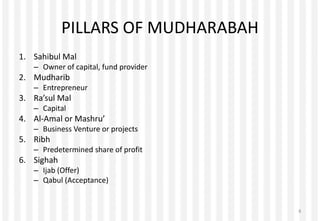
PILLARS OF MUDHARABAH
1. Sahibul Mal
– Owner of capital, fund provider
2. Mudharib
– Entrepreneur
3. Ra’sul Mal
– Capital
4. Al-Amal or Mashru’
– Business Venture or projects
5. Ribh
– Predetermined share of profit
6. Sighah
– Ijab (Offer)
– Qabul (Acceptance)
8
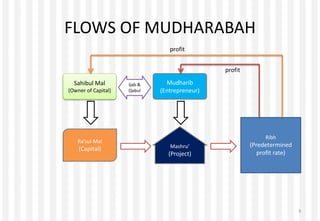
FLOWS OF MUDHARABAH
9
Ra’sul-Mal
(Capital) Mashru’
(Project)
Mudharib
(Entrepreneur)
Sahibul Mal
(Owner of Capital)
Ribh
(Predetermined
profit rate)
profit
profit
Ijab &
Qabul
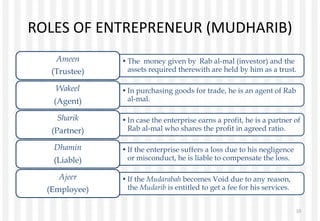
ROLES OF ENTREPRENEUR (MUDHARIB)
•The money given by Rab al-mal (investor) and the
assets required therewith are held by him as a trust.
Ameen
(Trustee)
•In purchasing goods for trade, he is an agent of Rab
al-mal.
Wakeel
(Agent)
•In case the enterprise earns a profit, he is a partner of
Rab al-mal who shares the profit in agreed ratio.
Sharik
(Partner)
•If the enterprise suffers a loss due to his negligence
or misconduct, he is liable to compensate the loss.
Dhamin
(Liable)
•If the Mudarabah becomes Void due to any reason,
the Mudarib is entitled to get a fee for his services.
Ajeer
(Employee)
10
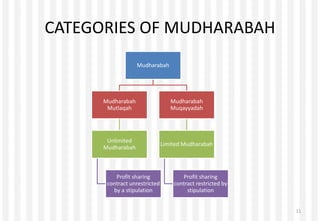
CATEGORIES OF MUDHARABAH
Mudharabah
Mudharabah
Mutlaqah
Unlimited
Mudharabah
Profit sharing
contract unrestricted
by a stipulation
Mudharabah
Muqayyadah
Limited Mudharabah
Profit sharing
contract restricted by
stipulation
11
MUDHARABAH MUTLAQAH
• The entrepreneur (mudharib) may buy and/or sell all types of
merchandise as he sees fit, hire helpers as needed, rent equipment and
travel with the equipment etc.
• The business is run according to entrepreneur (mudharib) expertise and
experience based on his discretion
• The capital provider (rabb al-mal) authorizes the entrepreneur
(mudharib) to act completely at the latter’s discretion in all business
matter.
• Mudharib’s liberty to transact the capital:
– All matters which are commonly practiced in business - the authorization to
transact with the capital is unlimited
– All matters which are not commonly practiced in business - free to transact
with the capital provided with permission from rabb al-mal. Eg: giving the
capital as donations or loans
12
MUDHARABAH MUQAYYADAH
• The capital provider (rabb al-mal) makes certain
limitations to the activities to be conducted by the
entrepreneur (mudharib) with regards to the capital
given
• The business is subject to capital provider’s (rabb al-
mal) instruction in term of type, location, time etc.
• Mudharib’s liberty to transact the capital:
– The mudarib is subjected to certain limitations in the form
of territorial limits, or time limitation and limitation in
terms of kind of goods or person with whom trade may be
conducted
13
CONDITION OF MUDHARABAH
• Conditions of Work/ Subject Matter
1. The work or business venture under Mudharabah
must be conducted solely by the entrepreneur
(mudharib). It is not legal if the capital provider
(rabbulmal) was also required to conduct the daily
operation.
2. The project must be legal and permissible(halal)
3. All the expenses will be taken from the capital
provided that is not more than the justified expenses
required in the venture
14
CONDITION OF MUDHARABAH
• Conditions of Capital
1. Must be in the form of money and not commodities
since commodities fluctuate in price and cause
uncertainty and ignorance
2. The capital must be clearly specified, determined and
known at the time of the contract
3. Must be available cash-present during the conclusion
of contract
4. Must be delivered to the possession of the mudharib
entirely
15
CONDITION OF MUDHARABAH
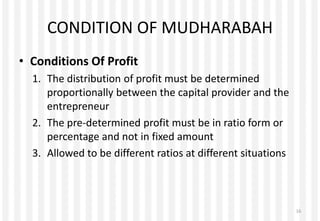
• Conditions Of Profit
1. The distribution of profit must be determined
proportionally between the capital provider and the
entrepreneur
2. The pre-determined profit must be in ratio form or
percentage and not in fixed amount
3. Allowed to be different ratios at different situations
16
ISSUES IN PROFIT
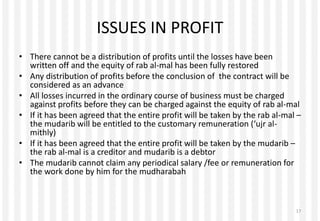
• There cannot be a distribution of profits until the losses have been
written off and the equity of rab al-mal has been fully restored
• Any distribution of profits before the conclusion of the contract will be
considered as an advance
• All losses incurred in the ordinary course of business must be charged
against profits before they can be charged against the equity of rab al-mal
• If it has been agreed that the entire profit will be taken by the rab al-mal –
the mudarib will be entitled to the customary remuneration (‘ujr al-
mithly)
• If it has been agreed that the entire profit will be taken by the mudarib –
the rab al-mal is a creditor and mudarib is a debtor
• The mudarib cannot claim any periodical salary /fee or remuneration for
the work done by him for the mudharabah
17
TERMINATION OF MUDHARABAH CONTRACT
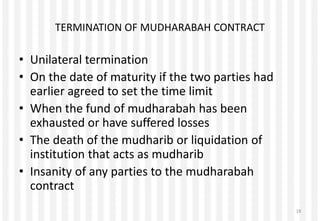
• Unilateral termination
• On the date of maturity if the two parties had
earlier agreed to set the time limit
• When the fund of mudharabah has been
exhausted or have suffered losses
• The death of the mudharib or liquidation of
institution that acts as mudharib
• Insanity of any parties to the mudharabah
contract
18
DIFFERENCE BETWEEN MUDHARABAH AND MUSHARAKAH
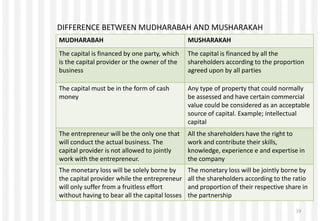
MUDHARABAH MUSHARAKAH
The capital is financed by one party, which
is the capital provider or the owner of the
business
The capital is financed by all the
shareholders according to the proportion
agreed upon by all parties
The capital must be in the form of cash
money
Any type of property that could normally
be assessed and have certain commercial
value could be considered as an acceptable
source of capital. Example; intellectual
capital
The entrepreneur will be the only one that
will conduct the actual business. The
capital provider is not allowed to jointly
work with the entrepreneur.
All the shareholders have the right to
work and contribute their skills,
knowledge, experience e and expertise in
the company
The monetary loss will be solely borne by
the capital provider while the entrepreneur
will only suffer from a fruitless effort
without having to bear all the capital losses
The monetary loss will be jointly borne by
all the shareholders according to the ratio
and proportion of their respective share in
the partnership
19
MODERN APPLICATION
• Project financing
• Import/export financing
• Working capital financing
• Saving/Current/Investment account
• Interbank lending/borrowing
• Sukuk
20
END OF CHAPTER
21

Topic 5 mudharabah

  • 1.
  • 2.
    CONTENT • DEFINITION • EVIDENCE •PILLARS OF MUDHARABAH • CATEGORIES OF MUDHARABAH • CONDITION OF MUDHARABAH • DIFFERENCES BETWEEN MUDHARABAH & MUSHARAKAH 2
  • 3.
    DEFINITION • Literally: – Derivedfrom the phrase “dharaba fi al-ard” which means to make a journey and it is called this because the agent (entrepreneur) gets profit by virtue of his hard work and efforts in performing long journeys. • Technically: – A contract or a partnership where one provides the capital and the other the entrepreneurship with the profit being shared among them with a predetermined condition – Partnership in profit whereby one party (rabb al-mal) provides capital and the other party (mudharib) provides labor. 3
  • 4.
    NATURE OF MUDHARABAH •The term Mudharabah was widely known in the classical literature as Qiradh and muqharadhah. • Both terms derived from the word qarada which means to cut off (al-qat’). This is simply because the capital provider (rabb al-mal) need to cuts off some of his money to be utilized by the mudharib in business activities. • Imam Nawawi says: A joint-stock company is called Qiradh or Mudharabah • It exists between two persons, one of whom supplies fund to the other to trade with, on condition that the former has a share in the profit. 4
  • 5.
    CHARACTERISTIC OF MUDHARABAH 1.The profit will be shared between the two parties according to the terms of their agreement 2. The losses will be borne by the capital provider alone who is the financier. 3. The entrepreneur only suffers the frustration of a fruitless effort. 5
  • 6.
    EVIDENCE • Al-Quran: – Althoughthis verses do not directly address the legality of mudharabah, they have been interpreted to include those who travel for the purpose of trading and seeking permissible income. 6
  • 7.
    EVIDENCE • Hadith: – ReportedBy Hakim Bin Hizam that he had stipulated to a man that if he gave him certain asset to be utilized for Muqaradah (Mudharabah, Qiradh) , he must not use it to purchase livestock, or carries it (travel) through the sea, or drop by at the oasis, if the man committed any of the above, he is considered to be the guarantor of my property 7
  • 8.
    PILLARS OF MUDHARABAH 1.Sahibul Mal – Owner of capital, fund provider 2. Mudharib – Entrepreneur 3. Ra’sul Mal – Capital 4. Al-Amal or Mashru’ – Business Venture or projects 5. Ribh – Predetermined share of profit 6. Sighah – Ijab (Offer) – Qabul (Acceptance) 8
  • 9.
    FLOWS OF MUDHARABAH 9 Ra’sul-Mal (Capital)Mashru’ (Project) Mudharib (Entrepreneur) Sahibul Mal (Owner of Capital) Ribh (Predetermined profit rate) profit profit Ijab & Qabul
  • 10.
    ROLES OF ENTREPRENEUR(MUDHARIB) •The money given by Rab al-mal (investor) and the assets required therewith are held by him as a trust. Ameen (Trustee) •In purchasing goods for trade, he is an agent of Rab al-mal. Wakeel (Agent) •In case the enterprise earns a profit, he is a partner of Rab al-mal who shares the profit in agreed ratio. Sharik (Partner) •If the enterprise suffers a loss due to his negligence or misconduct, he is liable to compensate the loss. Dhamin (Liable) •If the Mudarabah becomes Void due to any reason, the Mudarib is entitled to get a fee for his services. Ajeer (Employee) 10
  • 11.
    CATEGORIES OF MUDHARABAH Mudharabah Mudharabah Mutlaqah Unlimited Mudharabah Profitsharing contract unrestricted by a stipulation Mudharabah Muqayyadah Limited Mudharabah Profit sharing contract restricted by stipulation 11
  • 12.
    MUDHARABAH MUTLAQAH • Theentrepreneur (mudharib) may buy and/or sell all types of merchandise as he sees fit, hire helpers as needed, rent equipment and travel with the equipment etc. • The business is run according to entrepreneur (mudharib) expertise and experience based on his discretion • The capital provider (rabb al-mal) authorizes the entrepreneur (mudharib) to act completely at the latter’s discretion in all business matter. • Mudharib’s liberty to transact the capital: – All matters which are commonly practiced in business - the authorization to transact with the capital is unlimited – All matters which are not commonly practiced in business - free to transact with the capital provided with permission from rabb al-mal. Eg: giving the capital as donations or loans 12
  • 13.
    MUDHARABAH MUQAYYADAH • Thecapital provider (rabb al-mal) makes certain limitations to the activities to be conducted by the entrepreneur (mudharib) with regards to the capital given • The business is subject to capital provider’s (rabb al- mal) instruction in term of type, location, time etc. • Mudharib’s liberty to transact the capital: – The mudarib is subjected to certain limitations in the form of territorial limits, or time limitation and limitation in terms of kind of goods or person with whom trade may be conducted 13
  • 14.
    CONDITION OF MUDHARABAH •Conditions of Work/ Subject Matter 1. The work or business venture under Mudharabah must be conducted solely by the entrepreneur (mudharib). It is not legal if the capital provider (rabbulmal) was also required to conduct the daily operation. 2. The project must be legal and permissible(halal) 3. All the expenses will be taken from the capital provided that is not more than the justified expenses required in the venture 14
  • 15.
    CONDITION OF MUDHARABAH •Conditions of Capital 1. Must be in the form of money and not commodities since commodities fluctuate in price and cause uncertainty and ignorance 2. The capital must be clearly specified, determined and known at the time of the contract 3. Must be available cash-present during the conclusion of contract 4. Must be delivered to the possession of the mudharib entirely 15
  • 16.
    CONDITION OF MUDHARABAH •Conditions Of Profit 1. The distribution of profit must be determined proportionally between the capital provider and the entrepreneur 2. The pre-determined profit must be in ratio form or percentage and not in fixed amount 3. Allowed to be different ratios at different situations 16
  • 17.
    ISSUES IN PROFIT •There cannot be a distribution of profits until the losses have been written off and the equity of rab al-mal has been fully restored • Any distribution of profits before the conclusion of the contract will be considered as an advance • All losses incurred in the ordinary course of business must be charged against profits before they can be charged against the equity of rab al-mal • If it has been agreed that the entire profit will be taken by the rab al-mal – the mudarib will be entitled to the customary remuneration (‘ujr al- mithly) • If it has been agreed that the entire profit will be taken by the mudarib – the rab al-mal is a creditor and mudarib is a debtor • The mudarib cannot claim any periodical salary /fee or remuneration for the work done by him for the mudharabah 17
  • 18.
    TERMINATION OF MUDHARABAHCONTRACT • Unilateral termination • On the date of maturity if the two parties had earlier agreed to set the time limit • When the fund of mudharabah has been exhausted or have suffered losses • The death of the mudharib or liquidation of institution that acts as mudharib • Insanity of any parties to the mudharabah contract 18
  • 19.
    DIFFERENCE BETWEEN MUDHARABAHAND MUSHARAKAH MUDHARABAH MUSHARAKAH The capital is financed by one party, which is the capital provider or the owner of the business The capital is financed by all the shareholders according to the proportion agreed upon by all parties The capital must be in the form of cash money Any type of property that could normally be assessed and have certain commercial value could be considered as an acceptable source of capital. Example; intellectual capital The entrepreneur will be the only one that will conduct the actual business. The capital provider is not allowed to jointly work with the entrepreneur. All the shareholders have the right to work and contribute their skills, knowledge, experience e and expertise in the company The monetary loss will be solely borne by the capital provider while the entrepreneur will only suffer from a fruitless effort without having to bear all the capital losses The monetary loss will be jointly borne by all the shareholders according to the ratio and proportion of their respective share in the partnership 19
  • 20.
    MODERN APPLICATION • Projectfinancing • Import/export financing • Working capital financing • Saving/Current/Investment account • Interbank lending/borrowing • Sukuk 20
  • 21.