Nursing as a
profession
Prepared by :-
Mrs. Neha Bharti Tomar
Professor
Radharaman Institute of Nursing ,
Bhopal
Nursing as a profession
Nursing is a helping profession
focused on the care and support
of individuals, families, and
communities, aiming to promote
health, prevent illness, and
facilitate healing. It involves a
range of activities, from direct
patient care to health education
and research. Nurses utilize
specialized knowledge and
skills, adhere to ethical
standards, and are accountable
for their actions.
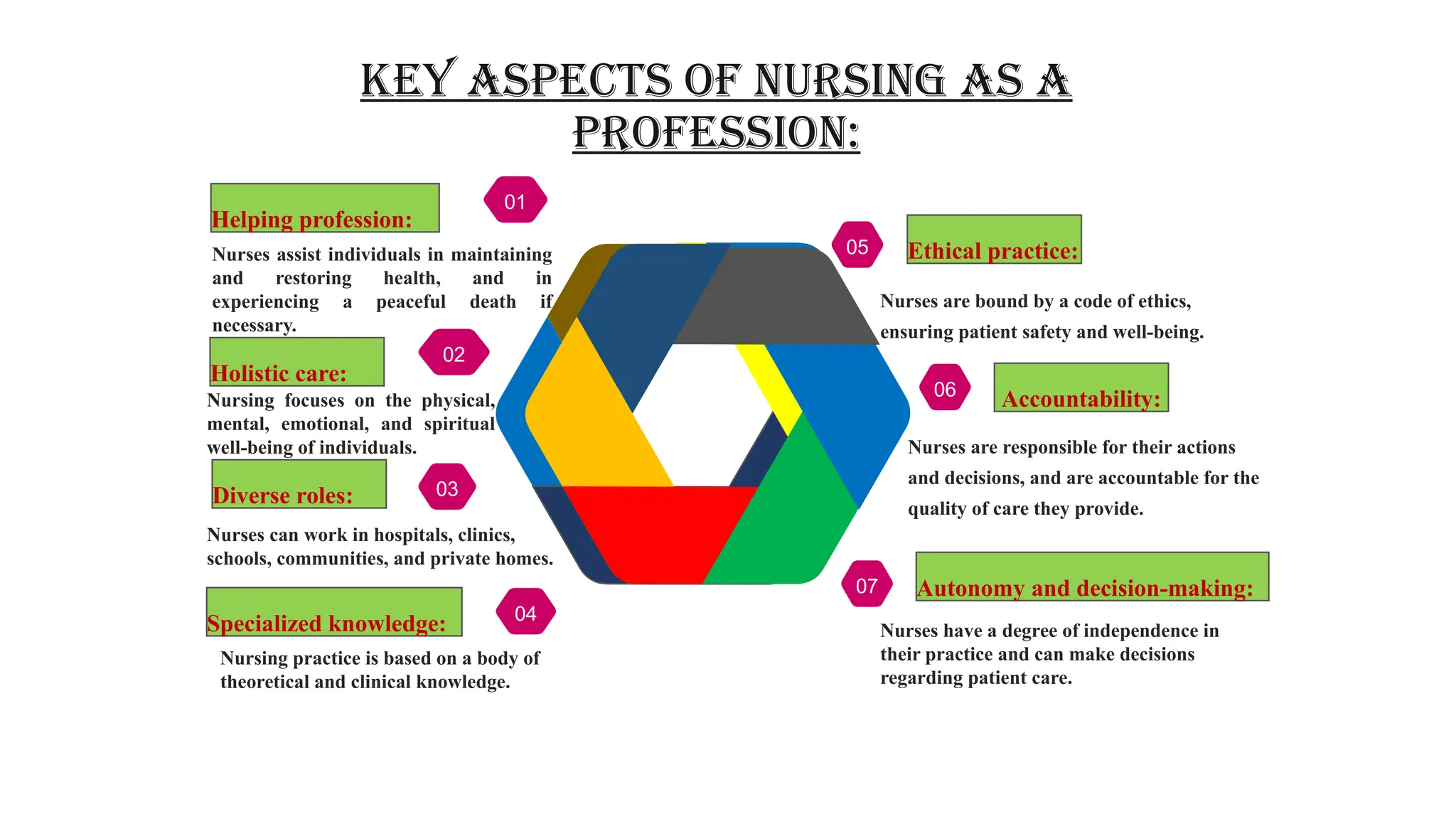
Key aspects of nursing as a
profession:
Ethical practice:
Nursing practice is based on a body of
theoretical and clinical knowledge.
Accountability:
Nurses are responsible for their actions
and decisions, and are accountable for the
quality of care they provide.
Autonomy and decision-making:
Nurses have a degree of independence in
their practice and can make decisions
regarding patient care.
Helping profession:
Nurses assist individuals in maintaining
and restoring health, and in
experiencing a peaceful death if
necessary.
Holistic care:
Nursing focuses on the physical,
mental, emotional, and spiritual
well-being of individuals.
Diverse roles:
Nurses can work in hospitals, clinics,
schools, communities, and private homes.
01
02
03
05
06
07
Specialized knowledge:
Nurses are bound by a code of ethics,
ensuring patient safety and well-being.
.
04
characteristics of nursing
profession
A professional nurse demonstrates
characteristics like compassion, empathy,
communication skills, critical thinking,
and dedication to patient advocacy, along
with a strong ethical foundation and a
commitment to lifelong learning. They
also exhibit qualities like organization,
attention to detail, problem-solving skills,
and the ability to work effectively in
teams.
Core Values and Attitudes:
A genuine concern for
patients' well-being and
the ability to
understand and share
their feelings.
Compassion and Empathy:
01
Actively advocating for
patients' rights and
needs, ensuring they
receive the best possible
care.
Patient Advocacy:
02
Treating all patients with
respect, regardless of
their background or
circumstances.
Respect for Human Dignity:
03
Maintaining composure
and professionalism
even in stressful
situations.
Emotional Regulation:
04
Adhering to ethical
principles and acting
with honesty and
accountability.
Strong Ethics and
Integrity:
05
Compassion and Empathy: Patient Advocacy: Respect for Human Dignity:
Essential Skills and
Abilities:
Effectively
communicating
with patients,
families, and
healthcare team
members.
Analyzing
situations,
making sound
judgments, and
finding
effective
solutions.
Managing
multiple tasks,
prioritizing
effectively, and
paying close
attention to
patient needs.
Adjusting to
changing
situations and
embracing new
technologies
and
approaches.
Excellent
Communication
Skills:
Critical
Thinking and
Problem-
Solving:
Organization
and
Attention to
Detail:
Adaptability
and
Flexibility:
Essential Skills and
Abilities Cont.:
Working
effectively
with other
healthcare
professionals
to deliver
coordinated
care.
Efficiently
organizing and
prioritizing
tasks to ensure
timely and
quality care.
Staying
current with
advancements
in nursing
practice
through
continuous
education.
Teamwork and
Collaboration:
Time
Management:
Lifelong
Learning:
Professionalism:
DEMONSTRATES PROFESSIONALISM:
 By adhering to professional standards, maintaining a positive
attitude, and upholding the integrity of the profession.
01
ACCOUNTABILITY:
 Taking responsibility for their actions and decisions.
02
COLLABORATION AND MENTORSHIP
 Working effectively with others and providing guidance to
less experienced nurses.
03
04 CONFIDENTIALITY:
 Maintaining the privacy and confidentiality of patient
information.
05 UPHOLDS THE STANDARD OF CARE:
 Providing care that meets or exceeds established
standards and guidelines.
VALUES
INTRODUCTION :
Values are individual beliefs that motivate
people to act one way or another. They serve
as a guide for human behavior. Generally,
people are predisposed to adopt the values that
they are raised with. People also tend to
believe that those values are “right” because
they are the values of their particular culture.
DEFINITION :
 Values are deeply held beliefs and
principles that shape an individual's or
group's perception of what is important and
desirable.
 They serve as a guide for behavior,
influencing choices and actions.
 Values can be personal, cultural, or societal,
and they can be either terminal (end states
of existence) or instrumental (modes of
conduct).
EXAMPLES :
 Honesty: Believing in telling the truth and
being truthful in all interactions.
 Integrity: Acting with honesty and moral
principles, maintaining a strong ethical
compass.
 Kindness: Showing compassion, empathy,
and consideration for others.
 Respect: Recognizing the worth and dignity
of individuals and valuing their opinions.
 Courage: Facing challenges and fears with
bravery and determination.
EXAMPLES CONT. :
 Confidence: Having faith in one's abilities and
self-worth.
 Happiness: Desiring a state of joy and
contentment.
 Self-respect: Having a positive regard for oneself
and one's worth.
 Recognition: Seeking acknowledgment and
appreciation for one's efforts.
 Inner peace: Striving for a state of tranquility
and serenity.
 Professional success: Aiming for advancement
and achievement in one's career.
IMPORTANCE :
Values are
crucial for
personal
development
and well-being.
01
They guide
decision-making
and help
individuals
navigate ethical
dilemmas.
02
Values can
shape a person's
sense of identity
and purpose.
03
They play a vital
role in social
cohesion and
cultural identity.
04
NURSING
VALUES
Nursing values are the ethical principles and
standards that guide nurses' actions and decisions,
shaping their practice and influencing the quality
of care they provide. They are crucial for ensuring
patient well-being, promoting ethical conduct, and
fostering a positive nursing environment. These
values are not just a set of beliefs; they are a
framework that helps nurses navigate complex
situations, make sound judgments, and advocate
for their patients.
introduction :
Nursing values are the principles and standards
that guide nurses in their ethical practice. They
represent the beliefs and behaviors that define the
nursing profession.
definition :
Core values
Altruism: Putting the needs of others before
one's own, prioritizing patient well-being.
Human Dignity: Respecting the inherent worth
and uniqueness of each individual, regardless of
their condition or background.
Integrity: Acting honestly and ethically,
maintaining professional standards, and
upholding commitments.
Social Justice: Advocating for fair and
equitable healthcare access and opportunities for
all.
Importance of core values:
 These values are essential for: Providing
ethical and compassionate care.
 Building strong nurse-patient
relationships.
 Promoting patient safety and well-being.
 Fostering a culture of professionalism
and teamwork.
 Guiding ethical decision-making in
challenging situations.
Nursing Values:
Ethical
Framework:
• Nursing values
provide a
framework for
nurses to make
ethical decisions
and ensure their
actions align with
the principles of
the profession.
Professional
Identity:
• These values help
nurses define their
professional
identity and
understand their
role in providing
care.
Guidance in
Practice:
• Values guide
nurses in their
daily interactions
with patients,
families, and
colleagues,
ensuring that care
is always delivered
with respect and
compassion.
Importance of nursing values:
Quality of Care:
Nursing values are crucial for delivering high-quality, safe, and
effective patient care.
Patient Safety:
Adhering to these values helps minimize errors and ensure
patient safety.
Professionalism:
Nursing values are essential for maintaining professionalism and
upholding the standards of the profession.
Importance of nursing values cont. :
Teamwork:
Shared values promote collaboration and teamwork among
healthcare professionals, leading to better patient outcomes.
Advocacy:
Nurses who embrace these values are better equipped to
advocate for their patients and ensure their needs are met.
THANKS

unit -3 nursing as a profession and nursing values.pptx

  • 1.
    Nursing as a profession Preparedby :- Mrs. Neha Bharti Tomar Professor Radharaman Institute of Nursing , Bhopal
  • 2.
    Nursing as aprofession Nursing is a helping profession focused on the care and support of individuals, families, and communities, aiming to promote health, prevent illness, and facilitate healing. It involves a range of activities, from direct patient care to health education and research. Nurses utilize specialized knowledge and skills, adhere to ethical standards, and are accountable for their actions.
  • 3.
    Key aspects ofnursing as a profession: Ethical practice: Nursing practice is based on a body of theoretical and clinical knowledge. Accountability: Nurses are responsible for their actions and decisions, and are accountable for the quality of care they provide. Autonomy and decision-making: Nurses have a degree of independence in their practice and can make decisions regarding patient care. Helping profession: Nurses assist individuals in maintaining and restoring health, and in experiencing a peaceful death if necessary. Holistic care: Nursing focuses on the physical, mental, emotional, and spiritual well-being of individuals. Diverse roles: Nurses can work in hospitals, clinics, schools, communities, and private homes. 01 02 03 05 06 07 Specialized knowledge: Nurses are bound by a code of ethics, ensuring patient safety and well-being. . 04
  • 4.
    characteristics of nursing profession Aprofessional nurse demonstrates characteristics like compassion, empathy, communication skills, critical thinking, and dedication to patient advocacy, along with a strong ethical foundation and a commitment to lifelong learning. They also exhibit qualities like organization, attention to detail, problem-solving skills, and the ability to work effectively in teams.
  • 5.
    Core Values andAttitudes: A genuine concern for patients' well-being and the ability to understand and share their feelings. Compassion and Empathy: 01 Actively advocating for patients' rights and needs, ensuring they receive the best possible care. Patient Advocacy: 02 Treating all patients with respect, regardless of their background or circumstances. Respect for Human Dignity: 03 Maintaining composure and professionalism even in stressful situations. Emotional Regulation: 04 Adhering to ethical principles and acting with honesty and accountability. Strong Ethics and Integrity: 05 Compassion and Empathy: Patient Advocacy: Respect for Human Dignity:
  • 6.
    Essential Skills and Abilities: Effectively communicating withpatients, families, and healthcare team members. Analyzing situations, making sound judgments, and finding effective solutions. Managing multiple tasks, prioritizing effectively, and paying close attention to patient needs. Adjusting to changing situations and embracing new technologies and approaches. Excellent Communication Skills: Critical Thinking and Problem- Solving: Organization and Attention to Detail: Adaptability and Flexibility:
  • 7.
    Essential Skills and AbilitiesCont.: Working effectively with other healthcare professionals to deliver coordinated care. Efficiently organizing and prioritizing tasks to ensure timely and quality care. Staying current with advancements in nursing practice through continuous education. Teamwork and Collaboration: Time Management: Lifelong Learning:
  • 8.
    Professionalism: DEMONSTRATES PROFESSIONALISM:  Byadhering to professional standards, maintaining a positive attitude, and upholding the integrity of the profession. 01 ACCOUNTABILITY:  Taking responsibility for their actions and decisions. 02 COLLABORATION AND MENTORSHIP  Working effectively with others and providing guidance to less experienced nurses. 03 04 CONFIDENTIALITY:  Maintaining the privacy and confidentiality of patient information. 05 UPHOLDS THE STANDARD OF CARE:  Providing care that meets or exceeds established standards and guidelines.
  • 9.
  • 10.
    INTRODUCTION : Values areindividual beliefs that motivate people to act one way or another. They serve as a guide for human behavior. Generally, people are predisposed to adopt the values that they are raised with. People also tend to believe that those values are “right” because they are the values of their particular culture.
  • 11.
    DEFINITION :  Valuesare deeply held beliefs and principles that shape an individual's or group's perception of what is important and desirable.  They serve as a guide for behavior, influencing choices and actions.  Values can be personal, cultural, or societal, and they can be either terminal (end states of existence) or instrumental (modes of conduct).
  • 12.
    EXAMPLES :  Honesty:Believing in telling the truth and being truthful in all interactions.  Integrity: Acting with honesty and moral principles, maintaining a strong ethical compass.  Kindness: Showing compassion, empathy, and consideration for others.  Respect: Recognizing the worth and dignity of individuals and valuing their opinions.  Courage: Facing challenges and fears with bravery and determination.
  • 13.
    EXAMPLES CONT. : Confidence: Having faith in one's abilities and self-worth.  Happiness: Desiring a state of joy and contentment.  Self-respect: Having a positive regard for oneself and one's worth.  Recognition: Seeking acknowledgment and appreciation for one's efforts.  Inner peace: Striving for a state of tranquility and serenity.  Professional success: Aiming for advancement and achievement in one's career.
  • 14.
    IMPORTANCE : Values are crucialfor personal development and well-being. 01 They guide decision-making and help individuals navigate ethical dilemmas. 02 Values can shape a person's sense of identity and purpose. 03 They play a vital role in social cohesion and cultural identity. 04
  • 15.
  • 16.
    Nursing values arethe ethical principles and standards that guide nurses' actions and decisions, shaping their practice and influencing the quality of care they provide. They are crucial for ensuring patient well-being, promoting ethical conduct, and fostering a positive nursing environment. These values are not just a set of beliefs; they are a framework that helps nurses navigate complex situations, make sound judgments, and advocate for their patients. introduction :
  • 17.
    Nursing values arethe principles and standards that guide nurses in their ethical practice. They represent the beliefs and behaviors that define the nursing profession. definition :
  • 18.
    Core values Altruism: Puttingthe needs of others before one's own, prioritizing patient well-being. Human Dignity: Respecting the inherent worth and uniqueness of each individual, regardless of their condition or background. Integrity: Acting honestly and ethically, maintaining professional standards, and upholding commitments. Social Justice: Advocating for fair and equitable healthcare access and opportunities for all.
  • 19.
    Importance of corevalues:  These values are essential for: Providing ethical and compassionate care.  Building strong nurse-patient relationships.  Promoting patient safety and well-being.  Fostering a culture of professionalism and teamwork.  Guiding ethical decision-making in challenging situations.
  • 20.
    Nursing Values: Ethical Framework: • Nursingvalues provide a framework for nurses to make ethical decisions and ensure their actions align with the principles of the profession. Professional Identity: • These values help nurses define their professional identity and understand their role in providing care. Guidance in Practice: • Values guide nurses in their daily interactions with patients, families, and colleagues, ensuring that care is always delivered with respect and compassion.
  • 21.
    Importance of nursingvalues: Quality of Care: Nursing values are crucial for delivering high-quality, safe, and effective patient care. Patient Safety: Adhering to these values helps minimize errors and ensure patient safety. Professionalism: Nursing values are essential for maintaining professionalism and upholding the standards of the profession.
  • 22.
    Importance of nursingvalues cont. : Teamwork: Shared values promote collaboration and teamwork among healthcare professionals, leading to better patient outcomes. Advocacy: Nurses who embrace these values are better equipped to advocate for their patients and ensure their needs are met.
  • 23.