“EHTHICAL ASPECTS OF
NURSING”
INTRODUCTION
Ethics is the science relating to moral actions and one’s value
system. Many nurses visualize ethics as dealing with principles
or morality and what is right or wrong. Ethics is concerned
with motives and attitudes and the relationship of these
attitudes to good of the individual.
 ETHICS is the science that deals with the rightness and
wrongness of actions. (Aiken 2004)
 BIOETHICS is the term applied to these principles when they
refer to concepts within the scope of medicine, nursing and
allied health.
DEFINITIONS
 ETHIC: An ethic is a standard of behavior or a belief valued by an
individual or a group. It describes what ought to be, rather than what is-a
goal to which an individual inspires. These standards are learned through
socialization, growth and experience. Ethical standards, guidelines and
principles are not legally enforceable unless they have been incorporated
into the law.
 MORAL BEHAVIOR: is defined as conduct that results from serious
critical thinking about how individuals ought to treat others. It reflects
the way a person interprets basic respect for others.
 VALUES: are ideals or concepts that give meaning to the individual’s life.
 RIGHT: a right is defined as a “valid, legally recognized claim or
entitlement, encompassing both freedom from government interference or
discriminatory treatment and entitlement to a benefit or service.
CODE OF ETHICS
 Professional codes of ethics are
system of rules and principles by
which that profession is expected to
regulate its members and
demonstrates its responsibility to
society.
 Nursing ethics provide the standards
for professional behavior and is the
study of principles of right and
wrong conduct for nurses.
In India, nurses are following the
international council for Nurses 1993 as given
below:
 The fundamental responsibility of the nurse is 4 fold: to
promote health, to prevent illness, to restore health and
to alleviate suffering.
 The need for nursing is universal; inherent in nursing is
respect for life, dignity and rights of man. It is untreated
by consideration of nationality, race, creed, colour, age
sex, politics or social status.
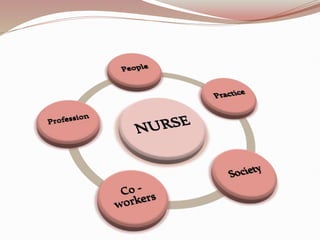
 Nurses render health services to the individual, the
family, and the community and co-ordinate their services
with those of related group.
The Florence Nightingale pledge, prepared
by Gretter
It included the basic principles governing ethical practices as
given below:
 I solemnly pledge myself before God and in the presence of assembly;
to pass my life in purity and to practice my profession faithfully;
 I will abstain from whatever is deleterious and mischievous and will
not take or knowingly administer any harmful drug;
 I will do all in my power to maintain and elevate the standard of my
profession, and will hold in confidence all personal matters
committed to my keeping and all family affairs coming to my
knowledge in the practice of my calling;
 With loyalty I will endeavour to aid the physician in the work, and
devote myself to the welfare of those committed to my care.
ETHICAL PRINCIPLES
Principles are the norms that nursing, as a profession, both demands
and strives to implement to everyday clinical practice. Ethical
principles, that nurse should consider when making decisions are as
follows:
1. Respect for persons
2. Respect for autonomy
3. Respect for freedom
4. Respect for beneficence (doing good)
5. Respect for non-maleficence (avoiding harm to others)
6. Respect for veracity (truth telling)
7. Respect for justice (fair and equal treatment)
8. Respect for rights
9. Respect for fidelity (fulfilling promises)
10. Confidentiality (protecting privileged information)
Respect for persons
This principles not only applied to clinical situations,
but it applies to all life situations. It directs individuals
to treat themselves and other, with a respect to
inherent to man’s humanness. It requires recognition
on a sense that all share a common human destiny.
The respects to persons need to be simplified as it
affects nursing practice.

Autonomy
It refers to the person’s right to self-determination and
independence. Autonomy means that individuals are
able to act for themselves to the level own purposes
and reason. The legal doctrine of informed consent is
direct reflection autonomy.
There are three types of autonomy:
i. freedom for action
ii. freedom for choice
iii. freedom for effective deliberation.
Freedom
This principle of individual freedom decreases that
patients be exempt from control by others to select and
pursue personal health goals. This principle should be
observed by staff nurses when planning patient care;
and by nurse manager when leading subordinates.
Beneficence
It refers to one’s duty to benefit or promote good for
others. It dictates that a person is obliged to help others to
advance their legitimate and important interest. It
requires the balancing of harms and benefits.
Professional education provides awareness that most
nursing interventions are capable of producing
undesirable, as well as desirable, patient outcomes.
Non-maleficence
It is the requirement to do no harm to others
intentionally or unintentionally. This principle states
one should do no harm. The nurse should interpret
the term ‘harm’ to mean emotional and social as well
as physical injury.
Example: A good nurse manager performing
evaluation of subordinates should emphasize their
good qualities and give positive direction for growth.
Destroying the employees self-esteem and self-worth
would be considered doing harm their principles.
Veracity
It is the duty to be honest or truthful. Veracity
concerns truth and incorporates the concept that
individuals should always tell the truth. It requires
professional care-givers to provide with accurate and
reality based information about their health status and
care or treatment prospection. Truth is the basis for
mutual trust between patient and the nurse
Example: Nurse Managers use this principle when
they give all the facts of a situation, truthfully and
assist their employees to make decisions.
Justice
 This principle of justice requires treating others fairly,
equally and giving persons their due. When there are
resources to distribute in health care, nurses should
allocate them in such a way that equal shares go to equal
recipients. The following problems complicate the
application of justice.
 Not everyone is equal in every way, sometimes there are
situations in which it seems that one person should receive
a greater or lesser share than another.
 Resources are limited. There is not always enough for each
person to receive an equal share.
Fidelity
 It refers to the obligation to honor commitments and
contracts. Fidelity is keeping one’s promises or commitments.
 This principle of fidelity holds that a person faithfully fulfills
his duties and obligations.
 Fidelity is important in a nurse because a patient’s hope for
relief and recovery rests on evidence of care-givers
conscientiousness.
 Nurse Managers abide by this principle when they follow
through on any promise they have previously made to
employees, such as promised leave, a certain shift to be
worked or a promotion to perception within the unit.
Rights
 Right is an entitlement to behave in a certain way under
circumstances, such as nurse’s entitlement to freely
express personal beliefs and preferences by voting in a
political election.
 The right may be mental rights or legal rights related to
respective profession. The patient has right to privacy
concerning medical care programme, to be examined
and regarding the rules and regulations of the hospital.
Confidentiality
 Confidentiality is the duty to respect privileged
information. The principle of confidentiality provides
that care-givers should respect a patient need for
privacy and use personal information about hi, or her
only to improve care.
 Nurses should practice confidentiality to decrease
patient vulnerability and share from widespread
knowledge of personal information divulged during
care.
ETHICAL DILEMMAS
Ethical dilemma exists when moral claims conflict with one
another. Usually the dilemmas occur when opposing views are
seen for the solution of an issue and a decision must be made.
There are no easy answers for how ethical dilemma should be
resolved.
It can be defined as:
 A difficult problem that seems to have no satisfactory solution.
 A choice between equally unsatisfactory alternatives.
 An ethical dilemma is a situation that requires an individual to
make a choice between two equally unfavorable alternatives.
- (Catalano,
2003)
SITUATIONS IN WHICH NURSES
FACE DILEMMA
 Need to compute patient care to conserve scarce resources.
 Need to make treatment and care decisions for terminally ill
patients.
 Need to obtain patients’ request for euthanasia.
 Need to balance the patients need for confidentiality and
privacy against society’s needs for protection from
unreasonable risk.
 Need to protect autonomy rights of children and
incompetent adults concerning consent for research
participation.
 Need to protect justice rights of patients who participate in
random trials of experimental treatment.
ETHICAL DECISION MAKING
Ethical decision making involves trying to distinguish right
from wrong in situation without clear guidelines. A
decision- making model can help identify factors and
principles that affect a decision.
There are various models for ethical decision-making:
1. Traditional model of ethical decision-making
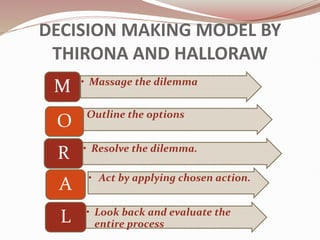
2. MORAL-Decision making model by Thirona and
Halloraw
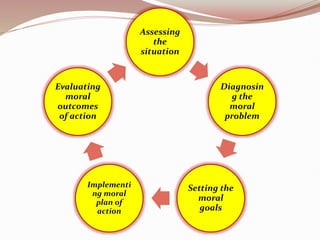
3. Decision making model by Johnstone
(1) TRADITIONAL MODEL OF
ETHICAL DECISION-MAKING
1. Identify the problem
2. Gather data to analyse the causes and
consequences of the problem.
3. Explore the optional solutions to the problem.
4. Evaluate these optional solutions to the problem.
5. Select the appropriate solution from all the
options.
6. Implement the selected solution.
7. Evaluate the results.
DECISION MAKING MODEL BY
THIRONA AND HALLORAW
• Massage the dilemma
M
• Outline the options
O
• Resolve the dilemma.
R
• Act by applying chosen action.
A
• Look back and evaluate the
entire process
L
(2) DECISION MAKING MODEL
BY JOHNSTONE
Assessing
the
situation
Diagnosin
g the
moral
problem
Setting the
moral
goals
Implementi
ng moral
plan of
action
Evaluating
moral
outcomes
of action
Use of a decision making model, in working
through ethical issues, allows the nurse to
consider all factors, when ethical dilemmas
require decisions to be made that affect the
client, the family, the nurse and the employing
agency. This decision making model is
consistent with the standards of practice
involves aspects of the nursing process.
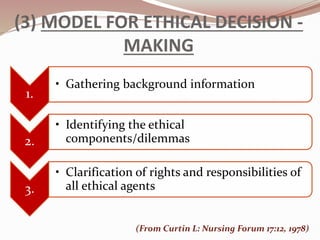
(3) MODEL FOR ETHICAL DECISION -
MAKING
1.
• Gathering background information
2.
• Identifying the ethical
components/dilemmas
3.
• Clarification of rights and responsibilities of
all ethical agents
(From Curtin L: Nursing Forum 17:12, 1978)
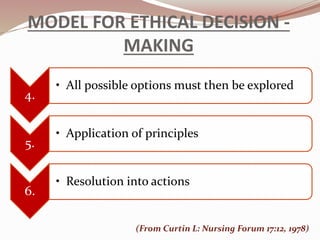
MODEL FOR ETHICAL DECISION -
MAKING
4.
• All possible options must then be explored
5.
• Application of principles
6.
• Resolution into actions
(From Curtin L: Nursing Forum 17:12, 1978)
“ROLE OF ADMINISTRATOR IN
ETHICAL ISSUES”
 The leadership roles and management functions of an
administrator in ethics are as follows:
 He or she is self aware regarding own values and basic
beliefs about the rights, duties and goals of human
beings.
 Accepts that some ambiguity and uncertainty must b a
part of all ethical decision-making.
“ROLE OF ADMINISTRATOR IN
ETHICAL ISSUES”
 Accepts that negative outcomes occur in ethical
decision-making despite high quality problem-solving
and decision-making.
 Demonstrates risk taking decision-making.
 Roles models ethical decision-making, which are
congruent with the code of ethics and inter respective
statements.
“ROLE OF ADMINISTRATOR IN
ETHICAL ISSUES”
 Actively advocates for clients, subordinates and the profession.
 Clearly communicate expected ethical standards of behaviour.
 Uses a systematic approach to problem-solving or decision-
making when faced with management problems with ethical
ramifications.
 Uses established ethical frameworks to clarify values and
beliefs.
“ROLE OF ADMINISTRATOR IN
ETHICAL ISSUES”
 Identify outcomes in ethical decision-making that
should always be sought or avoided.
 Applies principles of ethical reasoning to define what
beliefs or values form the basis of decision-making.
 Is aware of legal precedents that may guide ethical
decision-making and is accountable for possible
liabilities should they go against the legal precedent.
“ROLE OF ADMINISTRATOR IN
ETHICAL ISSUES”
 Continuously re-evaluate quality of own ethical decision-
making based on the process of decision-making problem-
solving used.
 Recognizes and rewards ethical conduct of subordinates.
 Takes appropriate action when subordinate use ethical
conduct of subordinates.
 Takes appropriate action when subordinates use unethical
conduct.
REFERENCES
 B T Basavanthappa, Nursing administration, 1st edition,
Jaypee Brothers Medical Publishers; 474 – 510.
 Merry C. Townsend, psychiatry mental health nursing,
5th edition, Jaypee Brothers Medical Publishers; 76-88.
 Steuart W.Gail; Laraia T Michele, principles of psychiatry
nursing, 8th edition, Mosby publication; 140-168.
 http://jrn.sagepub.com/cgi/content/abstract/1/3/175
REFERENCES
 Patricia A. Potter; Perry Anne Griffin: Fundamentals of
nursing, 6th Ed, MOSBY An imprint of Elsevier; 45-49.
 www.googles.com
 Susan Westrick Killion, Katherine McCormack
Dempski; Legal and ethical issues in nursing.
 Charles C Sharpe; Nursing Malpractice: Liability and
risk management.

27-a Code of ethics.pptx nursing research

  • 1.
  • 2.
    INTRODUCTION Ethics is thescience relating to moral actions and one’s value system. Many nurses visualize ethics as dealing with principles or morality and what is right or wrong. Ethics is concerned with motives and attitudes and the relationship of these attitudes to good of the individual.  ETHICS is the science that deals with the rightness and wrongness of actions. (Aiken 2004)  BIOETHICS is the term applied to these principles when they refer to concepts within the scope of medicine, nursing and allied health.
  • 3.
    DEFINITIONS  ETHIC: Anethic is a standard of behavior or a belief valued by an individual or a group. It describes what ought to be, rather than what is-a goal to which an individual inspires. These standards are learned through socialization, growth and experience. Ethical standards, guidelines and principles are not legally enforceable unless they have been incorporated into the law.  MORAL BEHAVIOR: is defined as conduct that results from serious critical thinking about how individuals ought to treat others. It reflects the way a person interprets basic respect for others.  VALUES: are ideals or concepts that give meaning to the individual’s life.  RIGHT: a right is defined as a “valid, legally recognized claim or entitlement, encompassing both freedom from government interference or discriminatory treatment and entitlement to a benefit or service.
  • 4.
    CODE OF ETHICS Professional codes of ethics are system of rules and principles by which that profession is expected to regulate its members and demonstrates its responsibility to society.  Nursing ethics provide the standards for professional behavior and is the study of principles of right and wrong conduct for nurses.
  • 5.
    In India, nursesare following the international council for Nurses 1993 as given below:  The fundamental responsibility of the nurse is 4 fold: to promote health, to prevent illness, to restore health and to alleviate suffering.  The need for nursing is universal; inherent in nursing is respect for life, dignity and rights of man. It is untreated by consideration of nationality, race, creed, colour, age sex, politics or social status.  Nurses render health services to the individual, the family, and the community and co-ordinate their services with those of related group.
  • 7.
    The Florence Nightingalepledge, prepared by Gretter It included the basic principles governing ethical practices as given below:  I solemnly pledge myself before God and in the presence of assembly; to pass my life in purity and to practice my profession faithfully;  I will abstain from whatever is deleterious and mischievous and will not take or knowingly administer any harmful drug;  I will do all in my power to maintain and elevate the standard of my profession, and will hold in confidence all personal matters committed to my keeping and all family affairs coming to my knowledge in the practice of my calling;  With loyalty I will endeavour to aid the physician in the work, and devote myself to the welfare of those committed to my care.
  • 8.
    ETHICAL PRINCIPLES Principles arethe norms that nursing, as a profession, both demands and strives to implement to everyday clinical practice. Ethical principles, that nurse should consider when making decisions are as follows: 1. Respect for persons 2. Respect for autonomy 3. Respect for freedom 4. Respect for beneficence (doing good) 5. Respect for non-maleficence (avoiding harm to others) 6. Respect for veracity (truth telling) 7. Respect for justice (fair and equal treatment) 8. Respect for rights 9. Respect for fidelity (fulfilling promises) 10. Confidentiality (protecting privileged information)
  • 9.
    Respect for persons Thisprinciples not only applied to clinical situations, but it applies to all life situations. It directs individuals to treat themselves and other, with a respect to inherent to man’s humanness. It requires recognition on a sense that all share a common human destiny. The respects to persons need to be simplified as it affects nursing practice.
  • 10.
    Autonomy It refers tothe person’s right to self-determination and independence. Autonomy means that individuals are able to act for themselves to the level own purposes and reason. The legal doctrine of informed consent is direct reflection autonomy. There are three types of autonomy: i. freedom for action ii. freedom for choice iii. freedom for effective deliberation.
  • 11.
    Freedom This principle ofindividual freedom decreases that patients be exempt from control by others to select and pursue personal health goals. This principle should be observed by staff nurses when planning patient care; and by nurse manager when leading subordinates.
  • 12.
    Beneficence It refers toone’s duty to benefit or promote good for others. It dictates that a person is obliged to help others to advance their legitimate and important interest. It requires the balancing of harms and benefits. Professional education provides awareness that most nursing interventions are capable of producing undesirable, as well as desirable, patient outcomes.
  • 13.
    Non-maleficence It is therequirement to do no harm to others intentionally or unintentionally. This principle states one should do no harm. The nurse should interpret the term ‘harm’ to mean emotional and social as well as physical injury. Example: A good nurse manager performing evaluation of subordinates should emphasize their good qualities and give positive direction for growth. Destroying the employees self-esteem and self-worth would be considered doing harm their principles.
  • 14.
    Veracity It is theduty to be honest or truthful. Veracity concerns truth and incorporates the concept that individuals should always tell the truth. It requires professional care-givers to provide with accurate and reality based information about their health status and care or treatment prospection. Truth is the basis for mutual trust between patient and the nurse Example: Nurse Managers use this principle when they give all the facts of a situation, truthfully and assist their employees to make decisions.
  • 15.
    Justice  This principleof justice requires treating others fairly, equally and giving persons their due. When there are resources to distribute in health care, nurses should allocate them in such a way that equal shares go to equal recipients. The following problems complicate the application of justice.  Not everyone is equal in every way, sometimes there are situations in which it seems that one person should receive a greater or lesser share than another.  Resources are limited. There is not always enough for each person to receive an equal share.
  • 16.
    Fidelity  It refersto the obligation to honor commitments and contracts. Fidelity is keeping one’s promises or commitments.  This principle of fidelity holds that a person faithfully fulfills his duties and obligations.  Fidelity is important in a nurse because a patient’s hope for relief and recovery rests on evidence of care-givers conscientiousness.  Nurse Managers abide by this principle when they follow through on any promise they have previously made to employees, such as promised leave, a certain shift to be worked or a promotion to perception within the unit.
  • 17.
    Rights  Right isan entitlement to behave in a certain way under circumstances, such as nurse’s entitlement to freely express personal beliefs and preferences by voting in a political election.  The right may be mental rights or legal rights related to respective profession. The patient has right to privacy concerning medical care programme, to be examined and regarding the rules and regulations of the hospital.
  • 18.
    Confidentiality  Confidentiality isthe duty to respect privileged information. The principle of confidentiality provides that care-givers should respect a patient need for privacy and use personal information about hi, or her only to improve care.  Nurses should practice confidentiality to decrease patient vulnerability and share from widespread knowledge of personal information divulged during care.
  • 19.
    ETHICAL DILEMMAS Ethical dilemmaexists when moral claims conflict with one another. Usually the dilemmas occur when opposing views are seen for the solution of an issue and a decision must be made. There are no easy answers for how ethical dilemma should be resolved. It can be defined as:  A difficult problem that seems to have no satisfactory solution.  A choice between equally unsatisfactory alternatives.  An ethical dilemma is a situation that requires an individual to make a choice between two equally unfavorable alternatives. - (Catalano, 2003)
  • 20.
    SITUATIONS IN WHICHNURSES FACE DILEMMA  Need to compute patient care to conserve scarce resources.  Need to make treatment and care decisions for terminally ill patients.  Need to obtain patients’ request for euthanasia.  Need to balance the patients need for confidentiality and privacy against society’s needs for protection from unreasonable risk.  Need to protect autonomy rights of children and incompetent adults concerning consent for research participation.  Need to protect justice rights of patients who participate in random trials of experimental treatment.
  • 21.
  • 22.
    ETHICAL DECISION MAKING Ethicaldecision making involves trying to distinguish right from wrong in situation without clear guidelines. A decision- making model can help identify factors and principles that affect a decision. There are various models for ethical decision-making: 1. Traditional model of ethical decision-making 2. MORAL-Decision making model by Thirona and Halloraw 3. Decision making model by Johnstone
  • 23.
    (1) TRADITIONAL MODELOF ETHICAL DECISION-MAKING 1. Identify the problem 2. Gather data to analyse the causes and consequences of the problem. 3. Explore the optional solutions to the problem. 4. Evaluate these optional solutions to the problem. 5. Select the appropriate solution from all the options. 6. Implement the selected solution. 7. Evaluate the results.
  • 24.
    DECISION MAKING MODELBY THIRONA AND HALLORAW • Massage the dilemma M • Outline the options O • Resolve the dilemma. R • Act by applying chosen action. A • Look back and evaluate the entire process L
  • 25.
    (2) DECISION MAKINGMODEL BY JOHNSTONE
  • 26.
  • 27.
    Use of adecision making model, in working through ethical issues, allows the nurse to consider all factors, when ethical dilemmas require decisions to be made that affect the client, the family, the nurse and the employing agency. This decision making model is consistent with the standards of practice involves aspects of the nursing process.
  • 28.
    (3) MODEL FORETHICAL DECISION - MAKING 1. • Gathering background information 2. • Identifying the ethical components/dilemmas 3. • Clarification of rights and responsibilities of all ethical agents (From Curtin L: Nursing Forum 17:12, 1978)
  • 29.
    MODEL FOR ETHICALDECISION - MAKING 4. • All possible options must then be explored 5. • Application of principles 6. • Resolution into actions (From Curtin L: Nursing Forum 17:12, 1978)
  • 30.
    “ROLE OF ADMINISTRATORIN ETHICAL ISSUES”  The leadership roles and management functions of an administrator in ethics are as follows:  He or she is self aware regarding own values and basic beliefs about the rights, duties and goals of human beings.  Accepts that some ambiguity and uncertainty must b a part of all ethical decision-making.
  • 31.
    “ROLE OF ADMINISTRATORIN ETHICAL ISSUES”  Accepts that negative outcomes occur in ethical decision-making despite high quality problem-solving and decision-making.  Demonstrates risk taking decision-making.  Roles models ethical decision-making, which are congruent with the code of ethics and inter respective statements.
  • 32.
    “ROLE OF ADMINISTRATORIN ETHICAL ISSUES”  Actively advocates for clients, subordinates and the profession.  Clearly communicate expected ethical standards of behaviour.  Uses a systematic approach to problem-solving or decision- making when faced with management problems with ethical ramifications.  Uses established ethical frameworks to clarify values and beliefs.
  • 33.
    “ROLE OF ADMINISTRATORIN ETHICAL ISSUES”  Identify outcomes in ethical decision-making that should always be sought or avoided.  Applies principles of ethical reasoning to define what beliefs or values form the basis of decision-making.  Is aware of legal precedents that may guide ethical decision-making and is accountable for possible liabilities should they go against the legal precedent.
  • 34.
    “ROLE OF ADMINISTRATORIN ETHICAL ISSUES”  Continuously re-evaluate quality of own ethical decision- making based on the process of decision-making problem- solving used.  Recognizes and rewards ethical conduct of subordinates.  Takes appropriate action when subordinate use ethical conduct of subordinates.  Takes appropriate action when subordinates use unethical conduct.
  • 35.
    REFERENCES  B TBasavanthappa, Nursing administration, 1st edition, Jaypee Brothers Medical Publishers; 474 – 510.  Merry C. Townsend, psychiatry mental health nursing, 5th edition, Jaypee Brothers Medical Publishers; 76-88.  Steuart W.Gail; Laraia T Michele, principles of psychiatry nursing, 8th edition, Mosby publication; 140-168.  http://jrn.sagepub.com/cgi/content/abstract/1/3/175
  • 36.
    REFERENCES  Patricia A.Potter; Perry Anne Griffin: Fundamentals of nursing, 6th Ed, MOSBY An imprint of Elsevier; 45-49.  www.googles.com  Susan Westrick Killion, Katherine McCormack Dempski; Legal and ethical issues in nursing.  Charles C Sharpe; Nursing Malpractice: Liability and risk management.