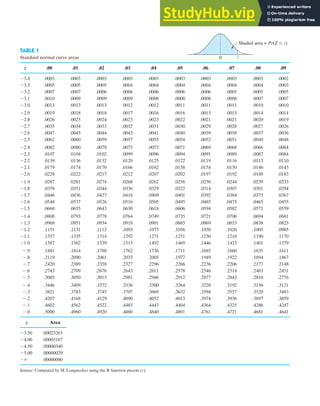
TABLE 1
Standard normal curve areas
z .00 .01 .02 .03 .04 .05 .06 .07 .08 .09
⫺3.4 .0003 .0003 .0003 .0003 .0003 .0003 .0003 .0003 .0003 .0002
⫺3.3 .0005 .0005 .0005 .0004 .0004 .0004 .0004 .0004 .0004 .0003
⫺3.2 .0007 .0007 .0006 .0006 .0006 .0006 .0006 .0005 .0005 .0005
⫺3.1 .0010 .0009 .0009 .0009 .0008 .0008 .0008 .0008 .0007 .0007
⫺3.0 .0013 .0013 .0013 .0012 .0012 .0011 .0011 .0011 .0010 .0010
⫺2.9 .0019 .0018 .0018 .0017 .0016 .0016 .0015 .0015 .0014 .0014
⫺2.8 .0026 .0025 .0024 .0023 .0023 .0022 .0021 .0021 .0020 .0019
⫺2.7 .0035 .0034 .0033 .0032 .0031 .0030 .0029 .0028 .0027 .0026
⫺2.6 .0047 .0045 .0044 .0043 .0041 .0040 .0039 .0038 .0037 .0036
⫺2.5 .0062 .0060 .0059 .0057 .0055 .0054 .0052 .0051 .0049 .0048
⫺2.4 .0082 .0080 .0078 .0075 .0073 .0071 .0069 .0068 .0066 .0064
⫺2.3 .0107 .0104 .0102 .0099 .0096 .0094 .0091 .0089 .0087 .0084
⫺2.2 .0139 .0136 .0132 .0129 .0125 .0122 .0119 .0116 .0113 .0110
⫺2.1 .0179 .0174 .0170 .0166 .0162 .0158 .0154 .0150 .0146 .0143
⫺2.0 .0228 .0222 .0217 .0212 .0207 .0202 .0197 .0192 .0188 .0183
⫺1.9 .0287 .0281 .0274 .0268 .0262 .0256 .0250 .0244 .0239 .0233
⫺1.8 .0359 .0351 .0344 .0336 .0329 .0322 .0314 .0307 .0301 .0294
⫺1.7 .0446 .0436 .0427 .0418 .0409 .0401 .0392 .0384 .0375 .0367
⫺1.6 .0548 .0537 .0526 .0516 .0505 .0495 .0485 .0475 .0465 .0455
⫺1.5 .0668 .0655 .0643 .0630 .0618 .0606 .0594 .0582 .0571 .0559
⫺1.4 .0808 .0793 .0778 .0764 .0749 .0735 .0721 .0708 .0694 .0681
⫺1.3 .0968 .0951 .0934 .0918 .0901 .0885 .0869 .0853 .0838 .0823
⫺1.2 .1151 .1131 .1112 .1093 .1075 .1056 .1038 .1020 .1003 .0985
⫺1.1 .1357 .1335 .1314 .1292 .1271 .1251 .1230 .1210 .1190 .1170
⫺1.0 .1587 .1562 .1539 .1515 .1492 .1469 .1446 .1423 .1401 .1379
⫺.9 .1841 .1814 .1788 .1762 .1736 .1711 .1685 .1660 .1635 .1611
⫺.8 .2119 .2090 .2061 .2033 .2005 .1977 .1949 .1922 .1894 .1867
⫺.7 .2420 .2389 .2358 .2327 .2296 .2266 .2236 .2206 .2177 .2148
⫺.6 .2743 .2709 .2676 .2643 .2611 .2578 .2546 .2514 .2483 .2451
⫺.5 .3085 .3050 .3015 .2981 .2946 .2912 .2877 .2843 .2810 .2776
⫺.4 .3446 .3409 .3372 .3336 .3300 .3264 .3228 .3192 .3156 .3121
⫺.3 .3821 .3783 .3745 .3707 .3669 .3632 .3594 .3557 .3520 .3483
⫺.2 .4207 .4168 .4129 .4090 .4052 .4013 .3974 .3936 .3897 .3859
⫺.1 .4602 .4562 .4522 .4483 .4443 .4404 .4364 .4325 .4286 .4247
⫺.0 .5000 .4960 .4920 .4880 .4840 .4801 .4761 .4721 .4681 .4641
z Area
⫺3.50 .00023263
⫺4.00 .00003167
⫺4.50 .00000340
⫺5.00 .00000029
.00000000
Source: Computed by M. Longnecker using the R function pnorm (z).
⫺⬁
Shaded area = Pr(Z z)
0 z
TABLE 1
(continued)
z .00 .01 .02 .03 .04 .05 .06 .07 .08 .09
.0 .5000 .5040 .5080 .5120 .5160 .5199 .5239 .5279 .5319 .5359
.1 .5398 .5438 .5478 .5517 .5557 .5596 .5636 .5675 .5714 .5753
.2 .5793 .5832 .5871 .5910 .5948 .5987 .6026 .6064 .6103 .6141
.3 .6179 .6217 .6255 .6293 .6331 .6368 .6406 .6443 .6480 .6517
.4 .6554 .6591 .6628 .6664 .6700 .6736 .6772 .6808 .6844 .6879
.5 .6915 .6950 .6985 .7019 .7054 .7088 .7123 .7157 .7190 .7224
.6 .7257 .7291 .7324 .7357 .7389 .7422 .7454 .7486 .7517 .7549
.7 .7580 .7611 .7642 .7673 .7704 .7734 .7764 .7794 .7823 .7852
.8 .7881 .7910 .7939 .7967 .7995 .8023 .8051 .8078 .8106 .8133
.9 .8159 .8186 .8212 .8238 .8264 .8289 .8315 .8340 .8365 .8389
1.0 .8413 .8438 .8461 .8485 .8508 .8531 .8554 .8577 .8599 .8621
1.1 .8643 .8665 .8686 .8708 .8729 .8749 .8770 .8790 .8810 .8830
1.2 .8849 .8869 .8888 .8907 .8925 .8944 .8962 .8980 .8997 .9015
1.3 .9032 .9049 .9066 .9082 .9099 .9115 .9131 .9147 .9162 .9177
1.4 .9192 .9207 .9222 .9236 .9251 .9265 .9279 .9292 .9306 .9319
1.5 .9332 .9345 .9357 .9370 .9382 .9394 .9406 .9418 .9429 .9441
1.6 .9452 .9463 .9474 .9484 .9495 .9505 .9515 .9525 .9535 .9545
1.7 .9554 .9564 .9573 .9582 .9591 .9599 .9608 .9616 .9625 .9633
1.8 .9641 .9649 .9656 .9664 .9671 .9678 .9686 .9693 .9699 .9706
1.9 .9713 .9719 .9726 .9732 .9738 .9744 .9750 .9756 .9761 .9767
2.0 .9772 .9778 .9783 .9788 .9793 .9798 .9803 .9808 .9812 .9817
2.1 .9821 .9826 .9830 .9834 .9838 .9842 .9846 .9850 .9854 .9857
2.2 .9861 .9864 .9868 .9871 .9875 .9878 .9881 .9884 .9887 .9890
2.3 .9893 .9896 .9898 .9901 .9904 .9906 .9909 .9911 .9913 .9916
2.4 .9918 .9920 .9922 .9925 .9927 .9929 .9931 .9932 .9934 .9936
2.5 .9938 .9940 .9941 .9943 .9945 .9946 .9948 .9949 .9951 .9952
2.6 .9953 .9955 .9956 .9957 .9959 .9960 .9961 .9962 .9963 .9964
2.7 .9965 .9966 .9967 .9968 .9969 .9970 .9971 .9972 .9973 .9974
2.8 .9974 .9975 .9976 .9977 .9977 .9978 .9979 .9979 .9980 .9981
2.9 .9981 .9982 .9982 .9983 .9984 .9984 .9985 .9985 .9986 .9986
3.0 .9987 .9987 .9987 .9988 .9988 .9989 .9989 .9989 .9990 .9990
3.1 .9990 .9991 .9991 .9991 .9992 .9992 .9992 .9992 .9993 .9993
3.2 .9993 .9993 .9994 .9994 .9994 .9994 .9994 .9995 .9995 .9995
3.3 .9995 .9995 .9995 .9996 .9996 .9996 .9996 .9996 .9996 .9997
3.4 .9997 .9997 .9997 .9997 .9997 .9997 .9997 .9997 .9997 .9998
z Area
3.50 .99976737
4.00 .99996833
4.50 .99999660
5.00 .99999971
1.0
⬁
An Introduction to Statistical
Methods and Data Analysis
This page intentionally left blank
An Introduction to Statistical
Methods and Data Analysis
Sixth Edition
R. Lyman Ott
Michael Longnecker
Texas A&M University
Australia • Brazil • Japan • Korea • Mexico • Singapore • Spain • United Kingdom • United States
An Introduction to Statistical Methods
and Data Analysis, Sixth Edition
R. Lyman Ott, Michael Longnecker
Senior Acquiring Sponsoring Editor:
Molly Taylor
Assistant Editor: Dan Seibert
Editorial Assistant: Shaylin Walsh
Media Manager: Catie Ronquillo
Marketing Manager: Greta Kleinert
Marketing Assistant: Angela Kim
Marketing Communications Manager:
Mary Anne Payumo
Project Manager, Editorial Production:
Jennifer Risden
Creative Director: Rob Hugel
Art Director: Vernon Boes
Print Buyer: Judy Inouye
Permissions Editor: Roberta Broyer
Production Service: Macmillan Publishing
Solutions
Text Designer: Helen Walden
Copy Editor: Tami Taliferro
Illustrator: Macmillan Publishing Solutions
Cover Designer: Hiroko Chastain/
Cuttriss & Hambleton
Cover Images: Professor with medical
model of head educating students: Scott
Goldsmith/Getty Images; dollar diagram:
John Foxx/Getty Images; multi-ethnic
business people having meeting:
Jon Feingersh/Getty Images;
technician working in a laboratory:
© istockphoto.com/Rich Legg; physical
background with graphics and formulas:
© istockphoto.com/Ivan Dinev; students
engrossed in their books in the college
library: © istockphoto.com/Chris
Schmidt; group of colleagues
working together on a project:
© istockphoto.com/Chris Schmidt;
mathematical assignment on a
chalkboard: © istockphoto.com/Bart
Coenders
Compositor: Macmillan Publishing Solutions
© 2010, 2001 Brooks/Cole, Cengage Learning
ALL RIGHTS RESERVED. No part of this work covered by the copyright
herein may be reproduced, transmitted, stored, or used in any form or by
any means graphic, electronic, or mechanical, including but not limited to
photocopying, recording, scanning, digitizing, taping, Web distribution,
information networks, or information storage and retrieval systems, except
as permitted under Section 107 or 108 of the 1976 United States Copyright
Act, without the prior written permission of the publisher.
Library of Congress Control Number: 2008931280
ISBN-13: 978-0-495-01758-5
ISBN-10: 0-495-01758-2
Brooks/Cole
10 Davis Drive
Belmont, CA 94002-3098
USA
Cengage Learning is a leading provider of customized learning solutions
with office locations around the globe, including Singapore, the United
Kingdom, Australia, Mexico, Brazil, and Japan. Locate your local office at
www.cengage.com/international.
Cengage Learning products are represented in Canada by Nelson
Education, Ltd.
To learn more about Brooks/Cole, visit
www.cengage.com/brookscole
Purchase any of our products at your local college store or at our preferred
online store www.ichapters.com.
For product information and technology assistance, contact us at
Cengage Learning Customer & Sales Support, 1-800-354-9706.
For permission to use material from this text or product,
submit all requests online at www.cengage.com/permissions.
Further permissions questions can be e-mailed to
permissionrequest@cengage.com.
Printed in Canada
1 2 3 4 5 6 7 12 11 10 09 08
v
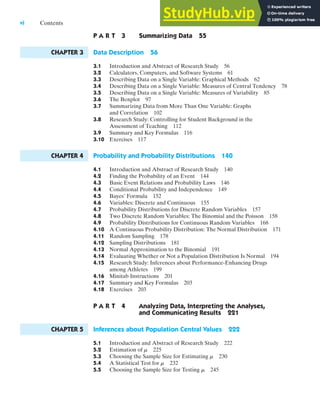
Contents
Preface xi
P A R T 1 Introduction 1
CHAPTER 1 Statistics and the Scientific Method 2
1.1 Introduction 2
1.2 Why Study Statistics? 6
1.3 Some Current Applications of Statistics 8
1.4 A Note to the Student 12
1.5 Summary 13
1.6 Exercises 13
P A R T 2 Collecting Data 15
CHAPTER 2 Using Surveys and Experimental Studies
to Gather Data 16
2.1 Introduction and Abstract of Research Study 16
2.2 Observational Studies 18
2.3 Sampling Designs for Surveys 24
2.4 Experimental Studies 30
2.5 Designs for Experimental Studies 35
2.6 Research Study: Exit Polls versus Election Results 46
2.7 Summary 47
2.8 Exercises 48
P A R T 3 Summarizing Data 55
CHAPTER 3 Data Description 56
3.1 Introduction and Abstract of Research Study 56
3.2 Calculators, Computers, and Software Systems 61
3.3 Describing Data on a Single Variable: Graphical Methods 62
3.4 Describing Data on a Single Variable: Measures of Central Tendency 78
3.5 Describing Data on a Single Variable: Measures of Variability 85
3.6 The Boxplot 97
3.7 Summarizing Data from More Than One Variable: Graphs
and Correlation 102
3.8 Research Study: Controlling for Student Background in the
Assessment of Teaching 112
3.9 Summary and Key Formulas 116
3.10 Exercises 117
CHAPTER 4 Probability and Probability Distributions 140
4.1 Introduction and Abstract of Research Study 140
4.2 Finding the Probability of an Event 144
4.3 Basic Event Relations and Probability Laws 146
4.4 Conditional Probability and Independence 149
4.5 Bayes’ Formula 152
4.6 Variables: Discrete and Continuous 155
4.7 Probability Distributions for Discrete Random Variables 157
4.8 Two Discrete Random Variables: The Binomial and the Poisson 158
4.9 Probability Distributions for Continuous Random Variables 168
4.10 A Continuous Probability Distribution: The Normal Distribution 171
4.11 Random Sampling 178
4.12 Sampling Distributions 181
4.13 Normal Approximation to the Binomial 191
4.14 Evaluating Whether or Not a Population Distribution Is Normal 194
4.15 Research Study: Inferences about Performance-Enhancing Drugs
among Athletes 199
4.16 Minitab Instructions 201
4.17 Summary and Key Formulas 203
4.18 Exercises 203
P A R T 4 Analyzing Data, Interpreting the Analyses,
and Communicating Results 221
CHAPTER 5 Inferences about Population Central Values 222
5.1 Introduction and Abstract of Research Study 222
5.2 Estimation of m 225
5.3 Choosing the Sample Size for Estimating m 230
5.4 A Statistical Test for m 232
5.5 Choosing the Sample Size for Testing m 245
vi Contents
5.6 The Level of Significance of a Statistical Test 246
5.7 Inferences about m for a Normal Population, s Unknown 250
5.8 Inferences about m When Population Is Nonnormal and n Is
Small: Bootstrap Methods 259
5.9 Inferences about the Median 265
5.10 Research Study: Percent Calories from Fat 270
5.11 Summary and Key Formulas 273
5.12 Exercises 275
CHAPTER 6 Inferences Comparing Two Population Central Values 290
6.1 Introduction and Abstract of Research Study 290
6.2 Inferences about m1 ⫺ m2: Independent Samples 293
6.3 A Nonparametric Alternative: The Wilcoxon Rank Sum Test 305
6.4 Inferences about m1 ⫺ m2: Paired Data 314
6.5 A Nonparametric Alternative: The Wilcoxon Signed-Rank Test 319
6.6 Choosing Sample Sizes for Inferences about m1 ⫺ m2 323
6.7 Research Study: Effects of Oil Spill on Plant Growth 325
6.8 Summary and Key Formulas 330
6.9 Exercises 333
CHAPTER 7 Inferences about Population Variances 360
7.1 Introduction and Abstract of Research Study 360
7.2 Estimation and Tests for a Population Variance 362
7.3 Estimation and Tests for Comparing Two Population Variances 369
7.4 Tests for Comparing t ⬎ 2 Population Variances 376
7.5 Research Study: Evaluation of Method for Detecting E. coli 381
7.6 Summary and Key Formulas 386
7.7 Exercises 387
CHAPTER 8 Inferences about More Than Two Population Central Values 402
8.1 Introduction and Abstract of Research Study 402
8.2 A Statistical Test about More Than Two Population Means: An Analysis
of Variance 405
8.3 The Model for Observations in a Completely Randomized Design 414
8.4 Checking on the AOV Conditions 416
8.5 An Alternative Analysis: Transformations of the Data 421
8.6 A Nonparametric Alternative: The Kruskal–Wallis Test 428
8.7 Research Study: Effect of Timing on the Treatment of Port-Wine
Stains with Lasers 431
8.8 Summary and Key Formulas 436
8.9 Exercises 438
CHAPTER 9 Multiple Comparisons 451
9.1 Introduction and Abstract of Research Study 451
9.2 Linear Contrasts 454
Contents vii
viii Contents
9.3 Which Error Rate Is Controlled? 460
9.4 Fisher’s Least Significant Difference 463
9.5 Tukey’s W Procedure 468
9.6 Student–Newman–Keuls Procedure 471
9.7 Dunnett’s Procedure: Comparison of Treatments to a Control 474
9.8 Scheffé’s S Method 476
9.9 A Nonparametric Multiple-Comparison Procedure 478
9.10 Research Study: Are Interviewers’ Decisions Affected by Different
Handicap Types? 482
9.11 Summary and Key Formulas 488
9.12 Exercises 490
CHAPTER 10 Categorical Data 499
10.1 Introduction and Abstract of Research Study 499
10.2 Inferences about a Population Proportion p 500
10.3 Inferences about the Difference between Two Population
Proportions, p1 ⫺ p2 507
10.4 Inferences about Several Proportions: Chi-Square
Goodness-of-Fit Test 513
10.5 Contingency Tables: Tests for Independence and Homogeneity 521
10.6 Measuring Strength of Relation 528
10.7 Odds and Odds Ratios 530
10.8 Combining Sets of 2 ⫻ 2 Contingency Tables 535
10.9 Research Study: Does Gender Bias Exist in the Selection of Students
for Vocational Education? 538
10.10 Summary and Key Formulas 545
10.11 Exercises 546
CHAPTER 11 Linear Regression and Correlation 572
11.1 Introduction and Abstract of Research Study 572
11.2 Estimating Model Parameters 581
11.3 Inferences about Regression Parameters 590
11.4 Predicting New y Values Using Regression 594
11.5 Examining Lack of Fit in Linear Regression 598
11.6 The Inverse Regression Problem (Calibration) 605
11.7 Correlation 608
11.8 Research Study: Two Methods for Detecting E. coli 616
11.9 Summary and Key Formulas 621
11.10 Exercises 623
CHAPTER 12 Multiple Regression and the General Linear Model 664
12.1 Introduction and Abstract of Research Study 664
12.2 The General Linear Model 674
12.3 Estimating Multiple Regression Coefficients 675
12.4 Inferences in Multiple Regression 683
12.5 Testing a Subset of Regression Coefficients 691
12.6 Forecasting Using Multiple Regression 695
12.7 Comparing the Slopes of Several Regression Lines 697
12.8 Logistic Regression 701
12.9 Some Multiple Regression Theory (Optional) 708
12.10 Research Study: Evaluation of the Performance of an Electric Drill 715
12.11 Summary and Key Formulas 722
12.12 Exercises 724
CHAPTER 13 Further Regression Topics 763
13.1 Introduction and Abstract of Research Study 763
13.2 Selecting the Variables (Step 1) 764
13.3 Formulating the Model (Step 2) 781
13.4 Checking Model Assumptions (Step 3) 797
13.5 Research Study: Construction Costs for Nuclear Power Plants 817
13.6 Summary and Key Formulas 824
13.7 Exercises 825
CHAPTER 14 Analysis of Variance for Completely Randomized Designs 878
14.1 Introduction and Abstract of Research Study 878
14.2 Completely Randomized Design with a Single Factor 880
14.3 Factorial Treatment Structure 885
14.4 Factorial Treatment Structures with an Unequal Number
of Replications 910
14.5 Estimation of Treatment Differences and Comparisons
of Treatment Means 917
14.6 Determining the Number of Replications 921
14.7 Research Study: Development of a Low-Fat Processed Meat 926
14.8 Summary and Key Formulas 931
14.9 Exercises 932
CHAPTER 15 Analysis of Variance for Blocked Designs 950
15.1 Introduction and Abstract of Research Study 950
15.2 Randomized Complete Block Design 951
15.3 Latin Square Design 963
15.4 Factorial Treatment Structure in a Randomized Complete
Block Design 974
15.5 A Nonparametric Alternative—Friedman’s Test 978
15.6 Research Study: Control of Leatherjackets 982
15.7 Summary and Key Formulas 987
15.8 Exercises 989
CHAPTER 16 The Analysis of Covariance 1009
16.1 Introduction and Abstract of Research Study 1009
16.2 A Completely Randomized Design with One Covariate 1012
16.3 The Extrapolation Problem 1023
16.4 Multiple Covariates and More Complicated Designs 1026
Contents ix
16.5 Research Study: Evaluation of Cool-Season Grasses for Putting Greens 1028
16.6 Summary 1034
16.7 Exercises 1034
CHAPTER 17 Analysis of Variance for Some Fixed-, Random-,
and Mixed-Effects Models 1041
17.1 Introduction and Abstract of Research Study 1041
17.2 A One-Factor Experiment with Random Treatment Effects 1044
17.3 Extensions of Random-Effects Models 1048
17.4 Mixed-Effects Models 1056
17.5 Rules for Obtaining Expected Mean Squares 1060
17.6 Nested Factors 1070
17.7 Research Study: Factors Affecting Pressure Drops Across
Expansion Joints 1075
17.8 Summary 1080
17.9 Exercises 1081
CHAPTER 18 Split-Plot, Repeated Measures, and Crossover Designs 1091
18.1 Introduction and Abstract of Research Study 1091
18.2 Split-Plot Designed Experiments 1095
18.3 Single-Factor Experiments with Repeated Measures 1101
18.4 Two-Factor Experiments with Repeated Measures on
One of the Factors 1105
18.5 Crossover Designs 1112
18.6 Research Study: Effects of Oil Spill on Plant Growth 1120
18.7 Summary 1122
18.8 Exercises 1122
CHAPTER 19 Analysis of Variance for Some Unbalanced Designs 1135
19.1 Introduction and Abstract of Research Study 1135
19.2 A Randomized Block Design with One or More
Missing Observations 1137
19.3 A Latin Square Design with Missing Data 1143
19.4 Balanced Incomplete Block (BIB) Designs 1148
19.5 Research Study: Evaluation of the Consistency of
Property Assessments 1155
19.6 Summary and Key Formulas 1159
19.7 Exercises 1160
Appendix: Statistical Tables 1169
Answers to Selected Exercises 1210
References 1250
Index 1254
x Contents
xi
Preface
Intended Audience
An Introduction to Statistical Methods and Data Analysis, Sixth Edition, provides a
broad overview of statistical methods for advanced undergraduate and graduate
students from a variety of disciplines. This book is intended to prepare students to
solve problems encountered in research projects, to make decisions based on data
in general settings both within and beyond the university setting, and finally to be-
come critical readers of statistical analyses in research papers and in news reports.
The book presumes that the students have a minimal mathematical background
(high school algebra) and no prior course work in statistics. The first eleven chap-
ters of the textbook present the material typically covered in an introductory statis-
tics course. However, this book provides research studies and examples that connect
the statistical concepts to data analysis problems, which are often encountered in
undergraduate capstone courses. The remaining chapters of the book cover regres-
sion modeling and design of experiments. We develop and illustrate the statistical
techniques and thought processes needed to design a research study or experiment
and then analyze the data collected using an intuitive and proven four-step approach.
This should be especially helpful to graduate students conducting their MS thesis
and PhD dissertation research.
Major Features of Textbook
Learning from Data
In this text, we approach the study of statistics by considering a four-step process
by which we can learn from data:
1. Designing the Problem
2. Collecting the Data
3. Summarizing the Data
4. Analyzing Data, Interpreting the Analyses, and Communicating the
Results
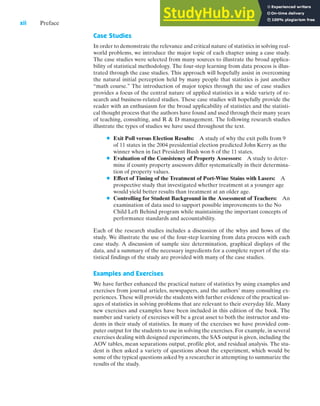
Case Studies
In order to demonstrate the relevance and critical nature of statistics in solving real-
world problems, we introduce the major topic of each chapter using a case study.
The case studies were selected from many sources to illustrate the broad applica-
bility of statistical methodology. The four-step learning from data process is illus-
trated through the case studies. This approach will hopefully assist in overcoming
the natural initial perception held by many people that statistics is just another
“math course.’’ The introduction of major topics through the use of case studies
provides a focus of the central nature of applied statistics in a wide variety of re-
search and business-related studies. These case studies will hopefully provide the
reader with an enthusiasm for the broad applicability of statistics and the statisti-
cal thought process that the authors have found and used through their many years
of teaching, consulting, and R & D management. The following research studies
illustrate the types of studies we have used throughout the text.
● Exit Poll versus Election Results: A study of why the exit polls from 9
of 11 states in the 2004 presidential election predicted John Kerry as the
winner when in fact President Bush won 6 of the 11 states.
● Evaluation of the Consistency of Property Assessors: A study to deter-
mine if county property assessors differ systematically in their determina-
tion of property values.
● Effect of Timing of the Treatment of Port-Wine Stains with Lasers: A
prospective study that investigated whether treatment at a younger age
would yield better results than treatment at an older age.
● Controlling for Student Background in the Assessment of Teachers: An
examination of data used to support possible improvements to the No
Child Left Behind program while maintaining the important concepts of
performance standards and accountability.
Each of the research studies includes a discussion of the whys and hows of the
study. We illustrate the use of the four-step learning from data process with each
case study. A discussion of sample size determination, graphical displays of the
data, and a summary of the necessary ingredients for a complete report of the sta-
tistical findings of the study are provided with many of the case studies.
Examples and Exercises
We have further enhanced the practical nature of statistics by using examples and
exercises from journal articles, newspapers, and the authors’ many consulting ex-
periences. These will provide the students with further evidence of the practical us-
ages of statistics in solving problems that are relevant to their everyday life. Many
new exercises and examples have been included in this edition of the book. The
number and variety of exercises will be a great asset to both the instructor and stu-
dents in their study of statistics. In many of the exercises we have provided com-
puter output for the students to use in solving the exercises. For example, in several
exercises dealing with designed experiments, the SAS output is given, including the
AOV tables, mean separations output, profile plot, and residual analysis. The stu-
dent is then asked a variety of questions about the experiment, which would be
some of the typical questions asked by a researcher in attempting to summarize the
results of the study.
xii Preface
Topics Covered
This book can be used for either a one-semester or two-semester course. Chapters
1 through 11 would constitute a one-semester course. The topics covered would
include:
Chapter 1—Statistics and the scientific method
Chapter 2—Using surveys and experimental studies to gather data
Chapters 3 & 4—Summarizing data and probability distributions
Chapters 5–7—Analyzing data: inferences about central values and
variances
Chapters 8 & 9—One way analysis of variance and multiple comparisons
Chapter 10—Analyzing data involving proportions
Chapter 11—Linear regression and correlation
The second semester of a two-semester course would then include model building
and inferences in multiple regression analysis, logistic regression, design of exper-
iments, and analysis of variance:
Chapters 11, 12, & 13—Regression methods and model building: multiple
regression and the general linear model, logistic regression, and building
regression models with diagnostics
Chapters 14–18—Design of experiments and analysis of variance: design
concepts, analysis of variance for standard designs, analysis of covariance,
random and mixed effects models, split-plot designs, repeated measures
designs, crossover designs, and unbalanced designs.
Emphasis on Interpretation, not Computation
In the book are examples and exercises that allow the student to study how to
calculate the value of statistical estimators and test statistics using the definitional
form of the procedure. After the student becomes comfortable with the aspects of
the data the statistical procedure is reflecting, we then emphasize the use of com-
puter software in making computations in the analysis of larger data sets. We pro-
vide output from three major statistical packages: SAS, Minitab, and SPSS. We
find that this approach provides the student with the experience of computing the
value of the procedure using the definition; hence the student learns the basics
behind each procedure. In most situations beyond the statistics course, the stu-
dent should be using computer software in making the computations for both
expedience and quality of calculation. In many exercises and examples the use of
the computer allows for more time to emphasize the interpretation of the results
of the computations without having to expend enormous time and effort in the
actual computations.
In numerous examples and exercises the importance of the following aspects
of hypothesis testing are demonstrated:
1. The statement of the research hypothesis through the summarization
of the researcher’s goals into a statement about population parameters.
2. The selection of the most appropriate test statistic, including sample
size computations for many procedures.
Preface xiii
3. The necessity of considering both Type I and Type II error rates (a and
b) when discussing the results of a statistical test of hypotheses.
4. The importance of considering both the statistical significance of a test
result and the practical significance of the results. Thus, we illustrate
the importance of estimating effect sizes and the construction of confi-
dence intervals for population parameters.
5. The statement of the results of the statistical in nonstatistical jargon
that goes beyond the statements ‘‘reject H0’’ or ‘‘fail to reject H0.’’
New to the Sixth Edition
● A research study is included in each chapter to assist students to appreci-
ate the role applied statistics plays in the solution of practical problems.
Emphasis is placed on illustrating the steps in the learning from data
process.
● An expanded discussion on the proper methods to design studies and
experiments is included in Chapter 2.
● Emphasis is placed on interpreting results and drawing conclusions from
studies used in exercises and examples.
● The formal test of normality and normal probability plots are included in
Chapter 4.
● An expanded discussion of logistic regression is included in Chapter 12.
● Techniques for the calculation of sample sizes and the probability of
Type II errors for the t test and F test, including designs involving the
one-way AOV and factorial treatment structure, are provided in
Chapters 5, 6, and 14.
● Expanded and updated exercises are provided; examples and exercises
are drawn from various disciplines, including many practical real-life
problems.
● Discussion of discrete distributions and data analysis of proportions has
been expanded to include the Poisson distribution, Fisher exact test, and
methodology for combining 2 ⫻ 2 contingency tables.
● Exercises are now placed at the end of each chapter for ease of usage.
Additional Features Retained from Previous Editions
● Many practical applications of statistical methods and data analysis from
agriculture, business, economics, education, engineering, medicine, law,
political science, psychology, environmental studies, and sociology have
been included.
● Review exercises are provided in each chapter.
● Computer output from Minitab, SAS, and SPSS is provided in numerous
examples and exercises. The use of computers greatly facilitates the use
of more sophisticated graphical illustrations of statistical results.
● Attention is paid to the underlying assumptions. Graphical procedures
and test procedures are provided to determine if assumptions have been
violated. Furthermore, in many settings, we provide alternative proce-
dures when the conditions are not met.
xiv Preface
● The first chapter provides a discussion of “What is statistics?” We pro-
vide a discussion of why students should study statistics along with a dis-
cussion of several major studies which illustrate the use of statistics in the
solution of real-life problems.
Ancillaries
● Student Solutions Manual (ISBN-10: 0-495-10915-0;
ISBN-13: 978-0-495-10915-0), containing select worked solutions
for problems in the textbook.
● A Companion Website at www.cengage.com/statistics/ott, containing
downloadable data sets for Excel, Minitab, SAS, SPSS, and others,
plus additional resources for students and faculty.
● Solution Builder, available to instructors who adopt the book at
www.cengage.com/solutionbuilder. This online resource contains
complete worked solutions for the text available in customizable
format outputted to PDF or to a password-protected class website.
Acknowledgments
There are many people who have made valuable constructive suggestions for the
development of the original manuscript and during the preparation of the subse-
quent editions. Carolyn Crockett, our editor at Brooks/Cole, has been a tremendous
motivator throughout the writing of this edition of the book. We are very apprecia-
tive of the insightful and constructive comments from the following reviewers:
Mark Ecker, University of Northern Iowa
Yoon G. Kim, Humboldt State University
Monnie McGee, Southern Methodist University
Ofer Harel, University of Connecticut
Mosuk Chow, Pennsylvania State University
Juanjuan Fan, San Diego State University
Robert K. Smidt, California Polytechnic State University
Mark Rizzardi, Humboldt State University
Soloman W. Harrar, University of Montana
Bruce Trumbo, California State University—East Bay
Preface xv
This page intentionally left blank
P A R T
1
Introduction
1 Statistics and the Scientific
Method
2
CHAPTER 1
Statistics and the Scientific
Method
1.1 Introduction
1.2 Why Study Statistics?
1.3 Some Current
Applications of
Statistics
1.4 A Note to the Student
1.5 Summary
1.6 Exercises
1.1 Introduction
Statistics is the science of designing studies or experiments, collecting data and
modeling/analyzing data for the purpose of decision making and scientific discov-
ery when the available information is both limited and variable. That is, statistics is
the science of Learning from Data.
Almost everyone—including corporate presidents, marketing representa-
tives, social scientists, engineers, medical researchers, and consumers—deals with
data. These data could be in the form of quarterly sales figures, percent increase in
juvenile crime, contamination levels in water samples, survival rates for patients un-
dergoing medical therapy, census figures, or information that helps determine which
brand of car to purchase. In this text, we approach the study of statistics by consid-
ering the four-step process in Learning from Data: (1) defining the problem, (2) col-
lecting the data, (3) summarizing the data, and (4) analyzing data, interpreting the
analyses, and communicating results. Through the use of these four steps in Learn-
ing from Data, our study of statistics closely parallels the Scientific Method, which is
a set of principles and procedures used by successful scientists in their pursuit of
knowledge. The method involves the formulation of research goals, the design of
observational studies and/or experiments, the collection of data, the modeling/
analyzing of the data in the context of research goals, and the testing of hypotheses.
The conclusions of these steps is often the formulation of new research goals for
another study. These steps are illustrated in the schematic given in Figure 1.1.
This book is divided into sections corresponding to the four-step process in
Learning from Data. The relationship among these steps and the chapters of the
book is shown in Table 1.1. As you can see from this table, much time is spent dis-
cussing how to analyze data using the basic methods presented in Chapters 5–18.
However, you must remember that for each data set requiring analysis, someone
has defined the problem to be examined (Step 1), developed a plan for collecting
data to address the problem (Step 2), and summarized the data and prepared the
data for analysis (Step 3). Then following the analysis of the data, the results of the
analysis must be interpreted and communicated either verbally or in written form
to the intended audience (Step 4).
All four steps are important in Learning from Data; in fact, unless the problem
to be addressed is clearly defined and the data collection carried out properly, the in-
terpretation of the results of the analyses may convey misleading information be-
cause the analyses were based on a data set that did not address the problem or that
1.1 Introduction 3
was incomplete and contained improper information. Throughout the text, we will
try to keep you focused on the bigger picture of Learning from Data through the
four-step process. Most chapters will end with a summary section that emphasizes
how the material of the chapter fits into the study of statistics—Learning from Data.
To illustrate some of the above concepts, we will consider four situations in
which the four steps in Learning from Data could assist in solving a real-world
problem.
1. Problem: Monitoring the ongoing quality of a lightbulb manufacturing
facility. A lightbulb manufacturer produces approximately half a million
bulbs per day. The quality assurance department must monitor the
TABLE 1.1
Organization of the text
The Four-Step Process Chapters
1 Introduction 1 Statistics and the Scientific Method
2 Collecting Data 2 Using Surveys and Experimental Studies to Gather Data
3 Summarizing Data 3 Data Description
4 Probability and Probability Distributions
4 Analyzing Data, Interpreting 5 Inferences about Population Central Values
the Analyses, and 6 Inferences Comparing Two Population Central Values
Communicating Results 7 Inferences about Population Variances
8 Inferences about More Than Two Population Central Values
9 Multiple Comparisons
10 Categorical Data
11 Linear Regression and Correlation
12 Multiple Regression and the General Linear Model
13 Further Regression Topics
14 Analysis of Variance for Completely Randomized Designs
15 Analysis of Variance for Blocked Designs
16 The Analysis of Covariance
17 Analysis of Variance for Some Fixed-, Random-, and
Mixed-Effects Models
18 Split-Plot, Repeated Measures, and Crossover Designs
19 Analysis of Variance for Some Unbalanced Designs
FIGURE 1.1
Scientific Method Schematic
Decisions:
written conclusions,
oral presentations
Formulate new
research goals:
new models,
new hypotheses
Inferences:
graphs, estimation,
hypotheses testing,
model assessment
Collect data:
data management
Formulate research goal:
research hypotheses, models
Plan study:
sample size, variables,
experimental units,
sampling mechanism
defect rate of the bulbs. It could accomplish this task by testing each bulb,
but the cost would be substantial and would greatly increase the price per
bulb. An alternative approach is to select 1,000 bulbs from the daily
production of 500,000 bulbs and test each of the 1,000. The fraction of
defective bulbs in the 1,000 tested could be used to estimate the fraction
defective in the entire day’s production, provided that the 1,000 bulbs were
selected in the proper fashion. We will demonstrate in later chapters that
the fraction defective in the tested bulbs will probably be quite close to the
fraction defective for the entire day’s production of 500,000 bulbs.
2. Problem: Is there a relationship between quitting smoking and gaining
weight? To investigate the claim that people who quit smoking often
experience a subsequent weight gain, researchers selected a random
sample of 400 participants who had successfully participated in pro-
grams to quit smoking. The individuals were weighed at the beginning
of the program and again 1 year later. The average change in weight of
the participants was an increase of 5 pounds. The investigators con-
cluded that there was evidence that the claim was valid. We will develop
techniques in later chapters to assess when changes are truly significant
changes and not changes due to random chance.
3. Problem: What effect does nitrogen fertilizer have on wheat production?
For a study of the effects of nitrogen fertilizer on wheat production, a
total of 15 fields were available to the researcher. She randomly assigned
three fields to each of the five nitrogen rates under investigation. The
same variety of wheat was planted in all 15 fields. The fields were culti-
vated in the same manner until harvest, and the number of pounds of
wheat per acre was then recorded for each of the 15 fields. The experi-
menter wanted to determine the optimal level of nitrogen to apply to
any wheat field, but, of course, she was limited to running experiments
on a limited number of fields. After determining the amount of nitrogen
that yielded the largest production of wheat in the study fields, the
experimenter then concluded that similar results would hold for wheat
fields possessing characteristics somewhat the same as the study fields.
Is the experimenter justified in reaching this conclusion?
4. Problem: Determining public opinion toward a question, issue, product,
or candidate. Similar applications of statistics are brought to mind
by the frequent use of the New York Times/CBS News, Washington
Post/ABC News, CNN, Harris, and Gallup polls. How can these poll-
sters determine the opinions of more than 195 million Americans who
are of voting age? They certainly do not contact every potential voter in
the United States. Rather, they sample the opinions of a small number
of potential voters, perhaps as few as 1,500, to estimate the reaction of
every person of voting age in the country. The amazing result of this
process is that if the selection of the voters is done in an unbiased way
and voters are asked unambiguous, nonleading questions, the fraction
of those persons contacted who hold a particular opinion will closely
match the fraction in the total population holding that opinion at a
particular time. We will supply convincing supportive evidence of this
assertion in subsequent chapters.
These problems illustrate the four-step process in Learning from Data. First,
there was a problem or question to be addressed. Next, for each problem a study
4 Chapter 1 Statistics and the Scientific Method
or experiment was proposed to collect meaningful data to answer the problem.
The quality assurance department had to decide both how many bulbs needed to
be tested and how to select the sample of 1,000 bulbs from the total production of
bulbs to obtain valid results. The polling groups must decide how many voters to
sample and how to select these individuals in order to obtain information that is
representative of the population of all voters. Similarly, it was necessary to care-
fully plan how many participants in the weight-gain study were needed and how
they were to be selected from the list of all such participants. Furthermore, what
variables should the researchers have measured on each participant? Was it neces-
sary to know each participant’s age, sex, physical fitness, and other health-related
variables, or was weight the only important variable? The results of the study may
not be relevant to the general population if many of the participants in the study
had a particular health condition. In the wheat experiment, it was important to
measure both the soil characteristics of the fields and the environmental condi-
tions, such as temperature and rainfall, to obtain results that could be generalized
to fields not included in the study. The design of a study or experiment is crucial to
obtaining results that can be generalized beyond the study.
Finally, having collected, summarized, and analyzed the data, it is important
to report the results in unambiguous terms to interested people. For the lightbulb
example, management and technical staff would need to know the quality of their
production batches. Based on this information, they could determine whether
adjustments in the process are necessary. Therefore, the results of the statistical
analyses cannot be presented in ambiguous terms; decisions must be made from a
well-defined knowledge base. The results of the weight-gain study would be of vital
interest to physicians who have patients participating in the smoking-cessation
program. If a significant increase in weight was recorded for those individuals who
had quit smoking, physicians may have to recommend diets so that the former
smokers would not go from one health problem (smoking) to another (elevated
blood pressure due to being overweight). It is crucial that a careful description of
the participants—that is, age, sex, and other health-related information—be in-
cluded in the report. In the wheat study, the experiment would provide farmers
with information that would allow them to economically select the optimum
amount of nitrogen required for their fields. Therefore, the report must contain
information concerning the amount of moisture and types of soils present on the
study fields. Otherwise, the conclusions about optimal wheat production may not
pertain to farmers growing wheat under considerably different conditions.
To infer validly that the results of a study are applicable to a larger group
than just the participants in the study, we must carefully define the population
(see Definition 1.1) to which inferences are sought and design a study in which the
sample (see Definition 1.2) has been appropriately selected from the designated
population. We will discuss these issues in Chapter 2.
population
sample
1.1 Introduction 5
DEFINITION 1.1 A population is the set of all measurements of interest to the sample collec-
tor. (See Figure 1.2.)
DEFINITION 1.2 A sample is any subset of measurements selected from the population. (See
Figure 1.2.)
1.2 Why Study Statistics?
We can think of many reasons for taking an introductory course in statistics. One
reason is that you need to know how to evaluate published numerical facts. Every
person is exposed to manufacturers’ claims for products; to the results of sociolog-
ical, consumer, and political polls; and to the published results of scientific re-
search. Many of these results are inferences based on sampling. Some inferences
are valid; others are invalid. Some are based on samples of adequate size; others
are not. Yet all these published results bear the ring of truth. Some people (partic-
ularly statisticians) say that statistics can be made to support almost anything.
Others say it is easy to lie with statistics. Both statements are true. It is easy,
purposely or unwittingly, to distort the truth by using statistics when presenting the
results of sampling to the uninformed. It is thus crucial that you become an
informed and critical reader of data-based reports and articles.
A second reason for studying statistics is that your profession or employment
may require you to interpret the results of sampling (surveys or experimentation)
or to employ statistical methods of analysis to make inferences in your work. For
example, practicing physicians receive large amounts of advertising describing
the benefits of new drugs. These advertisements frequently display the numerical
results of experiments that compare a new drug with an older one. Do such data
really imply that the new drug is more effective, or is the observed difference in
results due simply to random variation in the experimental measurements?
Recent trends in the conduct of court trials indicate an increasing use of
probability and statistical inference in evaluating the quality of evidence. The use
of statistics in the social, biological, and physical sciences is essential because all
these sciences make use of observations of natural phenomena, through sample
surveys or experimentation, to develop and test new theories. Statistical methods
are employed in business when sample data are used to forecast sales and profit. In
addition, they are used in engineering and manufacturing to monitor product qual-
ity. The sampling of accounts is a useful tool to assist accountants in conducting au-
dits. Thus, statistics plays an important role in almost all areas of science, business,
and industry; persons employed in these areas need to know the basic concepts,
strengths, and limitations of statistics.
The article “What Educated Citizens Should Know About Statistics and
Probability,” by J. Utts, in The American Statistician, May 2003, contains a number
6 Chapter 1 Statistics and the Scientific Method
FIGURE 1.2
Population and sample Set of all measurements:
the population
Set of measurements
selected from the
population:
the sample
of statistical ideas that need to be understood by users of statistical methodology
in order to avoid confusion in the use of their research findings. Misunderstandings
of statistical results can lead to major errors by government policymakers, medical
workers, and consumers of this information. The article selected a number of top-
ics for discussion. We will summarize some of the findings in the article. A com-
plete discussion of all these topics will be given throughout the book.
1. One of the most frequent misinterpretations of statistical findings is
when a statistically significant relationship is established between two
variables and it is then concluded that a change in the explanatory
variable causes a change in the response variable. As will be discussed
in the book, this conclusion can be reached only under very restrictive
constraints on the experimental setting. Utts examined a recent
Newsweek article discussing the relationship between the strength
of religious beliefs and physical healing. Utts’ article discussed the
problems in reaching the conclusion that the stronger a patient’s reli-
gious beliefs, the more likely patients would be cured of their ailment.
Utts shows that there are numerous other factors involved in a patient’s
health, and the conclusion that religious beliefs cause a cure can not be
validly reached.
2. A common confusion in many studies is the difference between (statisti-
cally) significant findings in a study and (practically) significant findings.
This problem often occurs when large data sets are involved in a study
or experiment. This type of problem will be discussed in detail through-
out the book. We will use a number of examples that will illustrate how
this type of confusion can be avoided by the researcher when reporting
the findings of their experimental results. Utts’ article illustrated this
problem with a discussion of a study that found a statistically significant
difference in the average heights of military recruits born in the spring
and in the fall. There were 507,125 recruits in the study and the differ-
ence in average height was about 1兾4 inch. So, even though there may
be a difference in the actual average height of recruits in the spring and
the fall, the difference is so small (1兾4 inch) that it is of no practical
importance.
3. The size of the sample also may be a determining factor in studies in
which statistical significance is not found. A study may not have
selected a sample size large enough to discover a difference between
the several populations under study. In many government-sponsored
studies, the researchers do not receive funding unless they are able
to demonstrate that the sample sizes selected for their study are of an
appropriate size to detect specified differences in populations if in fact
they exist. Methods to determine appropriate sample sizes will be pro-
vided in the chapters on hypotheses testing and experimental design.
4. Surveys are ubiquitous, especially during the years in which national
elections are held. In fact, market surveys are nearly as widespread as
political polls. There are many sources of bias that can creep into the
most reliable of surveys. The manner in which people are selected for
inclusion in the survey, the way in which questions are phrased, and
even the manner in which questions are posed to the subject may affect
the conclusions obtained from the survey. We will discuss these issues
in Chapter 2.
1.2 Why Study Statistics? 7
5. Many students find the topic of probability to be very confusing. One of
these confusions involves conditional probability where the probability of
an event occurring is computed under the condition that a second event
has occurred with certainty. For example, a new diagnostic test for the
pathogen Eschervichis coli in meat is proposed to the U.S. Department of
Agriculture (USDA). The USDA evaluates the test and determines that
the test has both a low false positive rate and a low false negative rate. That
is, it is very unlikely that the test will declare the meat contains E. coli
when in fact it does not contain E. coli. Also, it is very unlikely that the test
will declare the meat does not contain E. coli when in fact it does contain
E. coli. Although the diagnostic test has a very low false positive rate and
a very low false negative rate, the probability that E. coli is in fact present
in the meat when the test yields a positive test result is very low for those
situations in which a particular strain of E. coli occurs very infrequently.
In Chapter 4, we will demonstrate how this probability can be computed in
order to provide a true assessment of the performance of a diagnostic test.
6. Another concept that is often misunderstood is the role of the degree of
variability in interpreting what is a “normal” occurrence of some natu-
rally occurring event. Utts’ article provided the following example. A
company was having an odor problem with its wastewater treatment
plant. They attributed the problem to “abnormal” rainfall during the
period in which the odor problem was occurring. A company official
stated the facility experienced 170% to 180% of its “normal” rainfall
during this period, which resulted in the water in the holding ponds
taking longer to exit for irrigation. Thus, there was more time for the
pond to develop an odor. The company official did not point out that
yearly rainfall in this region is extremely variable. In fact, the historical
range for rainfall is between 6.1 and 37.4 inches with a median rainfall of
16.7 inches. The rainfall for the year of the odor problem was 29.7 inches,
which was well within the “normal” range for rainfall. There was a con-
fusion between the terms “average” and “normal” rainfall. The concept
of natural variability is crucial to correct interpretation of statistical
results. In this example, the company official should have evaluated the
percentile for an annual rainfall of 29.7 inches in order to demonstrate
the abnormality of such a rainfall. We will discuss the ideas of data sum-
maries and percentiles in Chapter 3.
The types of problems expressed above and in Utts’ article represent common
and important misunderstandings that can occur when researchers use statistics in
interpreting the results of their studies. We will attempt throughout the book to dis-
cuss possible misinterpretations of statistical results and how to avoid them in your
data analyses. More importantly, we want the reader of this book to become a dis-
criminating reader of statistical findings, the results of surveys, and project reports.
1.3 Some Current Applications of Statistics
Defining the Problem: Reducing the Threat of Acid Rain
to Our Environment
The accepted causes of acid rain are sulfuric and nitric acids; the sources of these
acidic components of rain are hydrocarbon fuels, which spew sulfur and nitric
8 Chapter 1 Statistics and the Scientific Method
oxide into the atmosphere when burned. Here are some of the many effects of
acid rain:
● Acid rain, when present in spring snow melts, invades breeding areas
for many fish, which prevents successful reproduction. Forms of life
that depend on ponds and lakes contaminated by acid rain begin to
disappear.
● In forests, acid rain is blamed for weakening some varieties of trees,
making them more susceptible to insect damage and disease.
● In areas surrounded by affected bodies of water, vital nutrients are
leached from the soil.
● Man-made structures are also affected by acid rain. Experts from the
United States estimate that acid rain has caused nearly $15 billion of
damage to buildings and other structures thus far.
Solutions to the problems associated with acid rain will not be easy. The
National Science Foundation (NSF) has recommended that we strive for a 50%
reduction in sulfur-oxide emissions. Perhaps that is easier said than done. High-
sulfur coal is a major source of these emissions, but in states dependent on coal for
energy, a shift to lower sulfur coal is not always possible. Instead, better scrubbers
must be developed to remove these contaminating oxides from the burning process
before they are released into the atmosphere. Fuels for internal combustion
engines are also major sources of the nitric and sulfur oxides of acid rain. Clearly,
better emission control is needed for automobiles and trucks.
Reducing the oxide emissions from coal-burning furnaces and motor vehicles
will require greater use of existing scrubbers and emission control devices as well
as the development of new technology to allow us to use available energy sources.
Developing alternative, cleaner energy sources is also important if we are to meet
the NSF’s goal. Statistics and statisticians will play a key role in monitoring atmos-
phere conditions, testing the effectiveness of proposed emission control devices,
and developing new control technology and alternative energy sources.
Defining the Problem: Determining the Effectiveness
of a New Drug Product
The development and testing of the Salk vaccine for protection against po-
liomyelitis (polio) provide an excellent example of how statistics can be used in
solving practical problems. Most parents and children growing up before 1954 can
recall the panic brought on by the outbreak of polio cases during the summer
months. Although relatively few children fell victim to the disease each year, the
pattern of outbreak of polio was unpredictable and caused great concern because
of the possibility of paralysis or death. The fact that very few of today’s youth have
even heard of polio demonstrates the great success of the vaccine and the testing
program that preceded its release on the market.
It is standard practice in establishing the effectiveness of a particular drug
product to conduct an experiment (often called a clinical trial) with human partici-
pants. For some clinical trials, assignments of participants are made at random, with
half receiving the drug product and the other half receiving a solution or tablet that
does not contain the medication (called a placebo). One statistical problem con-
cerns the determination of the total number of participants to be included in the
1.3 Some Current Applications of Statistics 9
clinical trial. This problem was particularly important in the testing of the Salk vac-
cine because data from previous years suggested that the incidence rate for polio
might be less than 50 cases for every 100,000 children. Hence, a large number of par-
ticipants had to be included in the clinical trial in order to detect a difference in the
incidence rates for those treated with the vaccine and those receiving the placebo.
With the assistance of statisticians, it was decided that a total of 400,000 chil-
dren should be included in the Salk clinical trial begun in 1954, with half of them ran-
domly assigned the vaccine and the remaining children assigned the placebo. No
other clinical trial had ever been attempted on such a large group of participants.
Through a public school inoculation program, the 400,000 participants were treated
and then observed over the summer to determine the number of children contracting
polio. Although fewer than 200 cases of polio were reported for the 400,000 partici-
pants in the clinical trial, more than three times as many cases appeared in the group
receiving the placebo. These results, together with some statistical calculations, were
sufficient to indicate the effectiveness of the Salk polio vaccine. However, these con-
clusions would not have been possible if the statisticians and scientists had not
planned for and conducted such a large clinical trial.
The development of the Salk vaccine is not an isolated example of the use of
statistics in the testing and developing of drug products. In recent years, the Food
and Drug Administration (FDA) has placed stringent requirements on pharma-
ceutical firms to establish the effectiveness of proposed new drug products. Thus,
statistics has played an important role in the development and testing of birth con-
trol pills, rubella vaccines, chemotherapeutic agents in the treatment of cancer, and
many other preparations.
Defining the Problem: Use and Interpretation of Scientific
Data in Our Courts
Libel suits related to consumer products have touched each one of us; you may
have been involved as a plaintiff or defendant in a suit or you may know of some-
one who was involved in such litigation. Certainly we all help to fund the costs of
this litigation indirectly through increased insurance premiums and increased costs
of goods. The testimony in libel suits concerning a particular product (automobile,
drug product, and so on) frequently leans heavily on the interpretation of data
from one or more scientific studies involving the product. This is how and why
statistics and statisticians have been pulled into the courtroom.
For example, epidemiologists have used statistical concepts applied to data to
determine whether there is a statistical “association’’ between a specific character-
istic, such as the leakage in silicone breast implants, and a disease condition, such
as an autoimmune disease. An epidemiologist who finds an association should try
to determine whether the observed statistical association from the study is due to
random variation or whether it reflects an actual association between the charac-
teristic and the disease. Courtroom arguments about the interpretations of these
types of associations involve data analyses using statistical concepts as well as a
clinical interpretation of the data. Many other examples exist in which statistical
models are used in court cases. In salary discrimination cases, a lawsuit is filed
claiming that an employer underpays employees on the basis of age, ethnicity, or sex.
Statistical models are developed to explain salary differences based on many fac-
tors, such as work experience, years of education, and work performance. The ad-
justed salaries are then compared across age groups or ethnic groups to determine
10 Chapter 1 Statistics and the Scientific Method
whether significant salary differences exist after adjusting for the relevant work
performance factors.
Defining the Problem: Estimating Bowhead Whale Population Size
Raftery and Zeh (1998) discuss the estimation of the population size and rate of
increase in bowhead whales, Balaena mysticetus. The importance of such a study
derives from the fact that bowheads were the first species of great whale for
which commercial whaling was stopped; thus, their status indicates the recovery
prospects of other great whales. Also, the International Whaling Commission uses
these estimates to determine the aboriginal subsistence whaling quota for Alaskan
Eskimos. To obtain the necessary data, researchers conducted a visual and
acoustic census off Point Barrow, Alaska. The researchers then applied statistical
models and estimation techniques to the data obtained in the census to determine
whether the bowhead population had increased or decreased since commercial
whaling was stopped. The statistical estimates showed that the bowhead popu-
lation was increasing at a healthy rate, indicating that stocks of great whales
that have been decimated by commercial hunting can recover after hunting is
discontinued.
Defining the Problem: Ozone Exposure and Population Density
Ambient ozone pollution in urban areas is one of the nation’s most pervasive envi-
ronmental problems. Whereas the decreasing stratospheric ozone layer may lead
to increased instances of skin cancer, high ambient ozone intensity has been shown
to cause damage to the human respiratory system as well as to agricultural crops
and trees. The Houston, Texas, area has ozone concentrations rated second only to
Los Angeles that exceed the National Ambient Air Quality Standard. Carroll et al.
(1997) describe how to analyze the hourly ozone measurements collected in
Houston from 1980 to 1993 by 9 to 12 monitoring stations. Besides the ozone level,
each station also recorded three meteorological variables: temperature, wind
speed, and wind direction.
The statistical aspect of the project had three major goals:
1. Provide information (and/or tools to obtain such information) about
the amount and pattern of missing data, as well as about the quality
of the ozone and the meteorological measurements.
2. Build a model of ozone intensity to predict the ozone concentration at
any given location within Houston at any given time between 1980 and
1993.
3. Apply this model to estimate exposure indices that account for either
a long-term exposure or a short-term high-concentration exposure;
also, relate census information to different exposure indices to achieve
population exposure indices.
The spatial–temporal model the researchers built provided estimates
demonstrating that the highest ozone levels occurred at locations with relatively
small populations of young children. Also, the model estimated that the exposure
of young children to ozone decreased by approximately 20% from 1980 to 1993.
An examination of the distribution of population exposure had several policy im-
plications. In particular, it was concluded that the current placement of monitors is
1.3 Some Current Applications of Statistics 11
not ideal if one is concerned with assessing population exposure. This project in-
volved all four components of Learning from Data: planning where the monitoring
stations should be placed within the city, how often data should be collected, and
what variables should be recorded; conducting spatial–temporal graphing of the
data; creating spatial–temporal models of the ozone data, meteorological data,
and demographic data; and finally, writing a report that could assist local and fed-
eral officials in formulating policy with respect to decreasing ozone levels.
Defining the Problem: Assessing Public Opinion
Public opinion, consumer preference, and election polls are commonly used to
assess the opinions or preferences of a segment of the public for issues, products,
or candidates of interest. We, the American public, are exposed to the results of
these polls daily in newspapers, in magazines, on the radio, and on television. For
example, the results of polls related to the following subjects were printed in local
newspapers over a 2-day period:
● Consumer confidence related to future expectations about the economy
● Preferences for candidates in upcoming elections and caucuses
● Attitudes toward cheating on federal income tax returns
● Preference polls related to specific products (for example, foreign vs.
American cars, Coke vs. Pepsi, McDonald’s vs. Wendy’s)
● Reactions of North Carolina residents toward arguments about the
morality of tobacco
● Opinions of voters toward proposed tax increases and proposed changes
in the Defense Department budget
A number of questions can be raised about polls. Suppose we consider a poll
on the public’s opinion toward a proposed income tax increase in the state of
Michigan. What was the population of interest to the pollster? Was the pollster
interested in all residents of Michigan or just those citizens who currently pay in-
come taxes? Was the sample in fact selected from this population? If the population
of interest was all persons currently paying income taxes, did the pollster make
sure that all the individuals sampled were current taxpayers? What questions were
asked and how were the questions phrased? Was each person asked the same ques-
tion? Were the questions phrased in such a manner as to bias the responses? Can
we believe the results of these polls? Do these results “represent’’ how the general
public currently feels about the issues raised in the polls?
Opinion and preference polls are an important, visible application of statis-
tics for the consumer. We will discuss this topic in more detail in Chapter 10. We
hope that after studying this material you will have a better understanding of how
to interpret the results of these polls.
1.4 A Note to the Student
We think with words and concepts. A study of the discipline of statistics requires us
to memorize new terms and concepts (as does the study of a foreign language).
Commit these definitions, theorems, and concepts to memory.
Also, focus on the broader concept of making sense of data. Do not let details
obscure these broader characteristics of the subject. The teaching objective of this
text is to identify and amplify these broader concepts of statistics.
12 Chapter 1 Statistics and the Scientific Method
1.5 Summary
The discipline of statistics and those who apply the tools of that discipline deal
with Learning from Data. Medical researchers, social scientists, accountants, agron-
omists, consumers, government leaders, and professional statisticians are all in-
volved with data collection, data summarization, data analysis, and the effective
communication of the results of data analysis.
1.6 Exercises
1.1 Introduction
Bio. 1.1 Selecting the proper diet for shrimp or other sea animals is an important aspect of sea farm-
ing. A researcher wishes to estimate the mean weight of shrimp maintained on a specific diet for a
period of 6 months. One hundred shrimp are randomly selected from an artificial pond and each is
weighed.
a. Identify the population of measurements that is of interest to the researcher.
b. Identify the sample.
c. What characteristics of the population are of interest to the researcher?
d. If the sample measurements are used to make inferences about certain characteristics
of the population, why is a measure of the reliability of the inferences important?
Env. 1.2 Radioactive waste disposal as well as the production of radioactive material in some mining
operations are creating a serious pollution problem in some areas of the United States. State
health officials have decided to investigate the radioactivity levels in one suspect area. Two hun-
dred points in the area are randomly selected and the level of radioactivity is measured at each
point. Answer questions (a), (b), (c), and (d) in Exercise 1.1 for this sampling situation.
Soc. 1.3 A social researcher in a particular city wishes to obtain information on the number of chil-
dren in households that receive welfare support. A random sample of 400 households is selected
from the city welfare rolls. A check on welfare recipient data provides the number of children in
each household. Answer questions (a), (b), (c), and (d) in Exercise 1.1 for this sample survey.
Gov. 1.4 Because of a recent increase in the number of neck injuries incurred by high school football
players,theDepartmentof Commercedesigned a study to evaluatethestrengthof football helmets
worn by high school players in the United States. A total of 540 helmets were collected from the five
companies that currently produce helmets. The agency then sent the helmets to an independent
testing agency to evaluate the impact cushioning of the helmet and the amount of shock transmitted
to the neck when the face mask was twisted.
a. What is the population of interest?
b. What is the sample?
c. What variables should be measured?
d. What are some of the major limitations of this study in regard to the safety of helmets
worn by high school players? For example, is the neck strength of the player related to
the amount of shock transmitted to the neck and whether the player will be injured?
Pol. Sci. 1.5 During the 2004 senatorial campaign in a large southwestern state, the issue of illegal im-
migration was a major issue. One of the candidates argued that illegal immigrants made use of ed-
ucational and social services without having to pay property taxes. The other candidate pointed
out that the cost of new homes in their state was 20 –30% less than the national average due to the
low wages received by the large number of illegal immigrants working on new home construction.
A random sample of 5,000 registered voters were asked the question, “Are illegal immigrants
generally a benefit or a liability to the state’s economy?” The results were 3,500 people responded
“liability,” 1,500 people responded “benefit,” and 500 people responded “uncertain.”
a. What is the population of interest?
b. What is the population from which the sample was selected?
1.6 Exercises 13
c. Does the sample adequately represent the population?
d. If a second random sample of 5,000 registered voters was selected, would the results be
nearly the same as the results obtained from the initial sample of 5,000 voters? Explain
your answer.
Edu. 1.6 An American History professor at a major university is interested in knowing the history lit-
eracy of college freshmen. In particular, he wanted to find what proportion of college freshman
at the university knew which country controlled the original 13 states prior to the American Rev-
olution. The professor sent a questionnaire to all freshmen students enrolled in HIST 101 and re-
ceived responses from 318 students out of the 7,500 students who were sent the questionnaire.
One of the questions was, “What country controlled the original 13 states prior to the American
Revolution?”
a. What is the population of interest to the professor?
b. What is the sampled population?
c. Is there a major difference in the two populations. Explain your answer.
d. Suppose that several lectures on the American Revolution had been given in HIST 101
prior to the students receiving the questionnaire. What possible source of bias has the
professor introduced into the study relative to the population of interest?
14 Chapter 1 Statistics and the Scientific Method
P A R T
2
Collecting Data
2 Using Surveys and Experimental
Studies to Gather Data
16
CHAPTER 2
Using Surveys and
Experimental Studies
to Gather Data
2.1 Introduction and
Abstract of Research
Study
2.2 Observational Studies
2.3 Sampling Designs for
Surveys
2.4 Experimental Studies
2.5 Designs for
Experimental Studies
2.6 Research Study:
Exit Polls versus
Election Results
2.7 Summary
2.8 Exercises
2.1 Introduction and Abstract of Research Study
As mentioned in Chapter 1, the first step in Learning from Data is to define the
problem. The design of the data collection process is the crucial step in intelligent
data gathering. The process takes a conscious, concerted effort focused on the
following steps:
● Specifying the objective of the study, survey, or experiment
● Identifying the variable(s) of interest
● Choosing an appropriate design for the survey or experimental study
● Collecting the data
To specify the objective of the study, you must understand the problem being ad-
dressed. For example, the transportation department in a large city wants to assess
the public’s perception of the city’s bus system in order to increase the use of buses
within the city. Thus, the department needs to determine what aspects of the bus
system determine whether or not a person will ride the bus. The objective of the
study is to identify factors that the transportation department can alter to increase
the number of people using the bus system.
To identify the variables of interest, you must examine the objective of the
study. For the bus system, some major factors can be identified by reviewing studies
conducted in other cities and by brainstorming with the bus system employees.
Some of the factors may be safety, cost, cleanliness of the buses, whether or not
there is a bus stop close to the person’s home or place of employment, and how often
the bus fails to be on time. The measurements to be obtained in the study would con-
sist of importance ratings (very important, important, no opinion, somewhat unim-
portant, very unimportant) of the identified factors. Demographic information,
such as age, sex, income, and place of residence, would also be measured. Finally,
the measurement of variables related to how frequently a person currently rides the
buses would be of importance. Once the objectives are determined and the variables
2.1 Introduction and Abstract of Research Study 17
of interest are specified, you must select the most appropriate method to collect
the data. Data collection processes include surveys, experiments, and the exami-
nation of existing data from business records, censuses, government records, and
previous studies. The theory of sample surveys and the theory of experimental
designs provide excellent methodology for data collection. Usually surveys are
passive. The goal of the survey is to gather data on existing conditions, attitudes, or
behaviors. Thus, the transportation department would need to construct a ques-
tionnaire and then sample current riders of the buses and persons who use other
forms of transportation within the city.
Experimental studies, on the other hand, tend to be more active: The person
conducting the study varies the experimental conditions to study the effect of
the conditions on the outcome of the experiment. For example, the transportation
department could decrease the bus fares on a few selected routes and assess
whether the use of its buses increased. However, in this example, other factors not
under the bus system’s control may also have changed during this time period.
Thus, an increase in bus use may have taken place because of a strike of subway
workers or an increase in gasoline prices. The decrease in fares was only one
of several factors that may have “caused” the increase in the number of persons
riding the buses.
In most experimental studies, as many as possible of the factors that affect
the measurements are under the control of the experimenter. A floriculturist wants
to determine the effect of a new plant stimulator on the growth of a commercially
produced flower. The floriculturist would run the experiments in a greenhouse,
where temperature, humidity, moisture levels, and sunlight are controlled. An
equal number of plants would be treated with each of the selected quantities of the
growth stimulator, including a control—that is, no stimulator applied. At the con-
clusion of the experiment, the size and health of the plants would be measured.
The optimal level of the plant stimulator could then be determined, because ide-
ally all other factors affecting the size and health of the plants would be the same
for all plants in the experiment.
In this chapter, we will consider some sampling designs for surveys and
some designs for experimental studies. We will also make a distinction between an
experimental study and an observational study.
Abstract of Research Study: Exit Poll versus Election Results
As the 2004 presidential campaign approached election day, the Democratic Party
was very optimistic that their candidate, John Kerry, would defeat the incumbent,
George Bush. Many Americans arrived home the evening of Election Day to
watch or listen to the network coverage of the election with the expectation that
John Kerry would be declared the winner of the presidential race, because
throughout Election Day, radio and television reporters had provided exit poll re-
sults showing John Kerry ahead in nearly every crucial state, and in many of these
states leading by substantial margins. The Democratic Party, being better organ-
ized with a greater commitment and focus than in many previous presidential elec-
tions, had produced an enormous number of Democratic loyalists for this election.
But, as the evening wore on, in one crucial state after another the election returns
showed results that differed greatly from what the exit polls had predicted.
The data shown in Table 2.1 are from a University of Pennsylvania technical
report by Steven F. Freeman entitled “The Unexplained Exit Poll Discrepancy.”
Freeman obtained exit poll data and the actual election results for 11 states that
were considered by many to be the crucial states for the 2004 presidential election.
The exit poll results show the number of voters polled as they left the voting booth
for each state along with the corresponding percentage favoring Bush or Kerry,
and the predicted winner. The election results give the actual outcomes and winner
for each state as reported by the state’s election commission. The final column of
the table shows the difference between the predicted winning percentage from the
exit polls and the actual winning percentage from the election.
This table shows that the exit polls predicted George Bush to win in only 2 of
the 11 crucial states, and this is why the media were predicting that John Kerry
would win the election even before the polls were closed. In fact, Bush won 6 of the
11 crucial states, and, perhaps more importantly, we see in the final column that in
10 of these 11 states the difference between the election percentage margin from the
actual results and the predicted margin of victory from the exit polls favored Bush.
At the end of this chapter, we will discuss some of the cautions one must take
in using exit poll data to predict actual election outcomes.
2.2 Observational Studies
A study may be either observational or experimental. In an observational study, the
researcher records information concerning the subjects under study without any in-
terference with the process that is generating the information. The researcher is a
passive observer of the transpiring events. In an experimental study (which will be
discussed in detail in Sections 2.4 and 2.5), the researcher actively manipulates cer-
tain variables associated with the study, called the explanatory variables, and then
records their effects on the response variables associated with the experimental
subjects. A severe limitation of observational studies is that the recorded values
of the response variables may be affected by variables other than the explanatory
variables. These variables are not under the control of the researcher. They are
called confounding variables. The effects of the confounding variables and the ex-
planatory variables on the response variable cannot be separated due to the lack of
18 Chapter 2 Using Surveys and Experimental Studies to Gather Data
observational study
experimental study
explanatory variables
response variables
confounding variables
TABLE 2.1
Crucial
Exit Poll Results Election Results
Election
State Sample Bush Kerry Difference Bush Kerry Difference vs. Exit
Colorado 2515 49.9% 48.1% Bush 1.8% 52.0% 46.8% Bush 5.2% Bush 3.4%
Florida 2223 48.8% 49.2% Kerry 0.4% 49.4% 49.8% Kerry 0.4% No Diff.
Iowa 2846 49.8% 49.7% Bush 0.1% 52.1% 47.1% Bush 5.0% Bush 4.9%
Michigan 2502 48.4% 49.7% Kerry 1.3% 50.1% 49.2% Bush 0.9% Bush 2.2%
Minnesota 2452 46.5% 51.1% Kerry 4.6% 47.8% 51.2% Kerry 3.4% Kerry 1.2%
Nevada 2178 44.5% 53.5% Kerry 9.0% 47.6% 51.1% Kerry 3.5% Kerry 5.5%
New Hampshire 2116 47.9% 49.2% Kerry 1.3% 50.5% 47.9% Bush 2.6% Bush 3.9%
New Mexico 1849 44.1% 54.9% Kerry 10.8% 49.0% 50.3% Kerry 1.3% Kerry 9.5%
Ohio 1951 47.5% 50.1% Kerry 2.6% 50.0% 48.9% Bush 1.1% Bush 3.7%
Pennsylvania 1963 47.9% 52.1% Kerry 4.2% 51.0% 48.5% Bush 2.5% Bush 6.7%
Wisconsin 1930 45.4% 54.1% Kerry 8.7% 48.6% 50.8% Kerry 2.2% Kerry 6.5%
control the researcher has over the physical setting in which the observations are
made. In an experimental study, the researcher attempts to maintain control over
all variables that may have an effect on the response variables.
Observational studies may be dichotomized into either a comparative study
or descriptive study. In a comparative study, two or more methods of achieving a
result are compared for effectiveness. For example, three types of healthcare de-
livery methods are compared based on cost effectiveness. Alternatively, several
groups are compared based on some common attribute. For example, the starting
income of engineers are contrasted from a sample of new graduates from private
and public universities. In a descriptive study, the major purpose is to characterize
a population or process based on certain attributes in that population or process—
for example, studying the health status of children under the age of 5 years old
in families without health insurance or assessing the number of overcharges by
companies hired under federal military contracts.
Observational studies in the form of polls, surveys, and epidemiological
studies, for example, are used in many different settings to address questions
posed by researchers. Surveys are used to measure the changing opinion of the
nation with respect to issues such as gun control, interest rates, taxes, the mini-
mum wage, Medicare, and the national debt. Similarly, we are informed on a daily
basis through newspapers, magazines, television, radio, and the Internet of the re-
sults of public opinion polls concerning other relevant (and sometimes irrelevant)
political, social, educational, financial, and health issues.
In an observational study, the factors (treatments) of interest are not manip-
ulated while making measurements or observations. The researcher in an environ-
mental impact study is attempting to establish the current state of a natural setting
from which subsequent changes may be compared. Surveys are often used by natu-
ral scientists as well. In order to determine the proper catch limits of commercial and
recreational fishermen in the Gulf of Mexico, the states along the Gulf of Mexico
must sample the Gulf to determine the current fish density.
There are many biases and sampling problems that must be addressed in
order for the survey to be a reliable indicator of the current state of the sampled
population. A problem that may occur in observational studies is assigning cause-
and-effect relationships to spurious associations between factors. For example, in
many epidemiological studies we study various environmental, social, and ethnic
factors and their relationship with the incidence of certain diseases. A public
health question of considerable interest is the relationship between heart disease
and the amount of fat in one’s diet. It would be unethical to randomly assign vol-
unteers to one of several high-fat diets and then monitor the people over time to
observe whether or not heart disease develops.
Without being able to manipulate the factor of interest (fat content of the
diet), the scientist must use an observational study to address the issue. This could
be done by comparing the diets of a sample of people with heart disease with the
diets of a sample of people without heart disease. Great care would have to be
taken to record other relevant factors such as family history of heart disease, smok-
ing habits, exercise routine, age, and gender for each person, along with other
physical characteristics. Models could then be developed so that differences be-
tween the two groups could be adjusted to eliminate all factors except fat content
of the diet. Even with these adjustments, it would be difficult to assign a cause-and-
effect relationship between high fat content of a diet and the development of heart
disease. In fact, if the dietary fat content for the heart disease group tended to be
higher than that for the group free of heart disease after adjusting for relevant
2.2 Observational Studies 19
comparative study
descriptive study
cause-and-effect
relationships
factors, the study results would be reported as an association between high dietary
fat content and heart disease, not a causal relationship.
Stated differently, in observational studies we are sampling from populations
where the factors (or treatments) are already present and we compare samples with
respect to the factors (treatments) of interest to the researcher. In contrast, in the
controlled environment of an experimental study, we are able to randomly assign
the people as objects under study to the factors (or treatments) and then observe the
response of interest. For our heart disease example, the distinction is shown here:
Observational study: We sample from the heart disease population and
heart disease–free population and compare the fat content of the diets
for the two groups.
Experimental study: Ignoring ethical issues, we would assign volunteers to
one of several diets with different levels of dietary fat (the treatments)
and compare the different treatments with respect to the response of in-
terest (incidence of heart disease) after a period of time.
Observational studies are of three basic types:
● A sample survey is a study that provides information about a population
at a particular point in time (current information).
● A prospective study is a study that observes a population in the present
using a sample survey and proceeds to follow the subjects in the sample
forward in time in order to record the occurrence of specific outcomes.
● A retrospective study is a study that observes a population in the present
using a sample survey and also collects information about the subjects
in the sample regarding the occurrence of specific outcomes that have
already taken place.
In the health sciences, a sample survey would be referred to as a cross-sectional or
prevalence study. All individuals in the survey would be asked about their current
disease status and any past exposures to the disease. A prospective study would
identify a group of disease-free subjects and then follow them over a period of time
until some of the individuals develop the disease. The development or nondevel-
opment of the disease would then be related to other variables measured on the
subjects at the beginning of the study, often referred to as exposure variables.
A retrospective study identifies two groups of subjects: cases—subjects with the
disease—and controls—subjects without the disease. The researcher then attempts
to correlate the subjects prior health habits to their current health status.
Although prospective and retrospective studies are both observational stud-
ies, there are some distinct differences.
● Retrospective studies are generally cheaper and can be completed more
rapidly than prospective studies.
● Retrospective studies have problems due to inaccuracies in data due to
recall errors.
● Retrospective studies have no control over variables that may affect dis-
ease occurrence.
● In prospective studies subjects can keep careful records of their daily
activities
● In prospective studies subjects can be instructed to avoid certain activities
that may bias the study
20 Chapter 2 Using Surveys and Experimental Studies to Gather Data
association
causal
sample survey
prospective study
retrospective study
● Although prospective studies reduce some of the problems of retrospec-
tive studies, they are still observational studies and hence the potential in-
fluences of confounding variables may not be completely controlled. It is
possible to somewhat reduce the influence of the confounding variables
by restricting the study to matched subgroups of subjects.
Both prospective and retrospective studies are often comparative in nature. Two
specific types of such studies are cohort studies and case-control studies. In a co-
hort study, a group of subjects is followed forward in time to observe the differ-
ences in characteristics of subjects who develop a disease with those who do not.
Similarly, we could observe which subjects commit crimes while also recording in-
formation about their educational and social backgrounds. In case-control studies,
two groups of subjects are identified, one with the disease and one without the dis-
ease. Next, information is gathered about the subjects from their past concerning
risk factors that are associated with the disease. Distinctions are then drawn about
the two groups based on these characteristics.
EXAMPLE 2.1
A study was conducted to determine if women taking oral contraceptives had a
greater propensity to develop heart disease. A group of 5,000 women currently
using oral contraceptives and another group of 5,000 women not using oral contra-
ceptives were selected for the study. At the beginning of the study, all 10,000 women
were given physicals and were found to have healthy hearts. The women’s health
was then tracked for a 3-year period. At the end of the study, 15 of the 5,000 users
had developed a heart disease, whereas only 3 of the nonusers had any evidence of
heart disease. What type of design was this observational study?
Solution This study is an example of a prospective observational study. All
women were free of heart disease at the beginning of the study and their exposure
(oral contraceptive use) measured at that time. The women were then under ob-
servation for 3 years, with the onset of heart disease recorded if it occurred during
the observation period. A comparison of the frequency of occurrence of the
disease is made between the two groups of women, users and nonusers of oral
contraceptives.
EXAMPLE 2.2
A study was designed to determine if people who use public transportation to travel
to work are more politically active than people who use their own vehicle to travel to
work. A sample of 100 people in a large urban city was selected from each group
and then all 200 individuals were interviewed concerning their political activities over
the past 2 years. Out of the 100 people who used public transportation, 18 reported
that they had actively assisted a candidate in the past 2 years, whereas only 9 of the
100 persons who used their own vehicles stated they had participated in a political
campaign. What type of design was this study?
Solution This study is an example of a retrospective observational study. The in-
dividuals in both groups were interviewed about their past experiences with the po-
litical process. A comparison of the degree of participation of the individuals was
made across the two groups.
2.2 Observational Studies 21
cohort studies
case-control studies
In Example 2.2, many of the problems with using observational studies are present.
There are many factors that may affect whether or not an individual decides to par-
ticipate in a political campaign. Some of these factors may be confounded with rid-
ership on public transportation—for example, awareness of the environmental
impact of vehicular exhaust on air pollution, income level, and education level.
These factors need to be taken into account when designing an observational
study.
The most widely used observational study is the survey. Information from
surveys impact nearly every facet of our daily lives. Government agencies use sur-
veys to make decisions about the economy and many social programs. News agen-
cies often use opinion polls as a basis of news reports. Ratings of television shows,
which come from surveys, determine which shows will be continued for the next
television season.
Who conducts surveys? The various news organizations all use public opin-
ion polls: Such surveys include the New York Times/CBS News, Washington
Post/ABC News, Wall Street Journal/NBC News, Harris, Gallup/Newsweek, and
CNN/Time polls. However, the vast majority of surveys are conducted for a spe-
cific industrial, governmental, administrative, political, or scientific purpose. For
example, auto manufacturers use surveys to find out how satisfied customers are
with their cars. Frequently we are asked to complete a survey as part of the war-
ranty registration process following the purchase of a new product. Many impor-
tant studies involving health issues are determined using surveys—for example,
amount of fat in a diet, exposure to secondhand smoke, condom use and the
prevention of AIDS, and the prevalence of adolescent depression.
The U.S. Bureau of the Census is required by the U.S. Constitution to enu-
merate the population every 10 years. With the growing involvement of the gov-
ernment in the lives of its citizens, the Census Bureau has expanded its role beyond
just counting the population. An attempt is made to send a census questionnaire
in the mail to every household in the United States. Since the 1940 census, in ad-
dition to the complete count information, further information has been obtained
from representative samples of the population. In the 2000 census, variable sam-
pling rates were employed. For most of the country, approximately five of six
households were asked to answer the 14 questions on the short version of the
form. The remaining households responded to a longer version of the form con-
taining an additional 45 questions. Many agencies and individuals use the resulting
information for many purposes. The federal government uses it to determine allo-
cations of funds to states and cities. Businesses use it to forecast sales, to manage
personnel, and to establish future site locations. Urban and regional planners use
it to plan land use, transportation networks, and energy consumption. Social sci-
entists use it to study economic conditions, racial balance, and other aspects of the
quality of life.
The U.S. Bureau of Labor Statistics (BLS) routinely conducts more than 20
surveys. Some of the best known and most widely used are the surveys that estab-
lish the consumer price index (CPI). The CPI is a measure of price change for a
fixed market basket of goods and services over time. It is a measure of inflation and
serves as an economic indicator for government policies. Businesses tie wage rates
and pension plans to the CPI. Federal health and welfare programs, as well as
many state and local programs, tie their bases of eligibility to the CPI. Escalator
clauses in rents and mortgages are based on the CPI. This one index, determined
on the basis of sample surveys, plays a fundamental role in our society.
22 Chapter 2 Using Surveys and Experimental Studies to Gather Data
Many other surveys from the BLS are crucial to society. The monthly Current
Population Survey establishes basic information on the labor force, employment,
and unemployment. The consumer expenditure surveys collect data on family
expenditures for goods and services used in day-to-day living. The Establishment
Survey collects information on employment hours and earnings for nonagricul-
tural business establishments. The survey on occupational outlook provides infor-
mation on future employment opportunities for a variety of occupations, projecting
to approximately 10 years ahead. Other activities of the BLS are addressed in the
BLS Handbook of Methods (web version: www.bls.gov/opub/hom).
Opinion polls are constantly in the news, and the names of Gallup and Harris
have become well known to everyone. These polls, or sample surveys, reflect the atti-
tudes and opinions of citizens on everything from politics and religion to sports and
entertainment. The Nielsen ratings determine the success or failure of TV shows.
How do you figure out the ratings? Nielsen Media Research (NMR) continu-
ally measures television viewing with a number of different samples all across the
United States. The first step is to develop representative samples. This must be
done with a scientifically drawn random selection process. No volunteers can be ac-
cepted or the statistical accuracy of the sample would be in jeopardy. Nationally,
there are 5,000 television households in which electronic meters (called People
Meters) are attached to every TV set, VCR, cable converter box, satellite dish, or
other video equipment in the home. The meters continually record all set tunings.
In addition, NMR asks each member of the household to let them know when they
are watching by pressing a pre-assigned button on the People Meter. By matching
this button activity to the demographic information (age/gender) NMR collected at
the time the meters were installed, NMR can match the set tuning—what is being
watched—with who is watching. All these data are transmitted to NMR’s comput-
ers, where they are processed and released to customers each day. In addition to
this national service, NMR has a slightly different metering system in 55 local mar-
kets. In each of those markets, NMR gathers just the set-tuning information each
day from more than 20,000 additional homes. NMR then processes the data and re-
leases what are called “household ratings” daily. In this case, the ratings report what
channel or program is being watched, but they do not have the “who” part of the
picture. To gather that local demographic information, NMR periodically (at least
four times per year) ask another group of people to participate in diary surveys. For
these estimates, NMR contacts approximately 1 million homes each year and ask
them to keep track of television viewing for 1 week, recording their TV-viewing
activity in a diary. This is done for all 210 television markets in the United States
in November, February, May, and July and is generally referred to as the “sweeps.”
For more information on the Nielsen ratings, go the NMR website (www.
nielsenmedia.com) and click on the “What TV Ratings Really Mean” button.
Businesses conduct sample surveys for their internal operations in addition
to using government surveys for crucial management decisions. Auditors estimate
account balances and check on compliance with operating rules by sampling
accounts. Quality control of manufacturing processes relies heavily on sampling
techniques.
Another area of business activity that depends on detailed sampling activities
is marketing. Decisions on which products to market, where to market them, and
how to advertise them are often made on the basis of sample survey data. The data
may come from surveys conducted by the firm that manufactures the product or
may be purchased from survey firms that specialize in marketing data.
2.2 Observational Studies 23
2.3 Sampling Designs for Surveys
A crucial element in any survey is the manner in which the sample is selected from
the population. If the individuals included in the survey are selected based on con-
venience alone, there may be biases in the sample survey, which would prevent the
survey from accurately reflecting the population as a whole. For example, a mar-
keting graduate student developed a new approach to advertising and, to evaluate
this new approach, selected the students in a large undergraduate business course
to assess whether the new approach is an improvement over standard advertise-
ments. Would the opinions of this class of students be representative of the general
population of people to which the new approach to advertising would be applied?
The income levels, ethnicity, education levels, and many other socioeconomic char-
acteristics of the students may differ greatly from the population of interest. Fur-
thermore, the students may be coerced into participating in the study by their
instructor and hence may not give the most candid answers to questions on a sur-
vey. Thus, the manner in which a sample is selected is of utmost importance to the
credibility and applicability of the study’s results.
In order to precisely describe the components that are necessary for a sample
to be effective, the following definitions are required.
Target population: The complete collection of objects whose description is
the major goal of the study. Designating the target population is a crucial
but often difficult part of the first step in an observational or experimen-
tal study. For example, in a survey to decide if a new storm-water
drainage tax should be implemented, should the target population be all
persons over the age of 18 in the county, all registered voters, or all per-
sons paying property taxes? The selection of the target population may
have a profound effect on the results of the study.
Sample: A subset of the target population.
Sampled population: The complete collection of objects that have the
potential of being selected in the sample; the population from which
the sample is actually selected. In many studies, the sampled population
and the target population are very different. This may lead to very
erroneous conclusions based on the information collected in the sample.
For example, in a telephone survey of people who are on the property
tax list (the target population), a subset of this population may not
answer their telephone if the caller is unknown, as viewed through caller
ID. Thus, the sampled population may be quite different from the target
population with respect to some important characteristics such as income
and opinion on certain issues.
Observation unit: The object upon which data are collected. In studies in-
volving human populations, the observation unit is a specific individual
in the sampled population. In ecological studies, the observation unit
may be a sample of water from a stream or an individual plant on a plot
of land.
Sampling unit: The object that is actually sampled. We may want to sample
the person who pays the property tax but may only have a list of tele-
phone numbers. Thus, the households in the sampled population serve as
the sampled units, and the observation units are the individuals residing
in the sampled household. In an entomology study, we may sample 1-acre
plots of land and then count the number of insects on individual plants
24 Chapter 2 Using Surveys and Experimental Studies to Gather Data
observation unit
sampling unit
target population
sample
sampled population
residing on the sampled plot. The sampled unit is the plot of land, the
observation unit would be the individual plants.
Sampling frame: The list of sampling units. For a mailed survey, it may be a
list of addresses of households in a city. For an ecological study, it may be
a map of areas downstream from power plants.
In a perfect survey, the target population would be the same as the sampled popu-
lation. This type of survey rarely happens. There are always difficulties in obtain-
ing a sampling frame or being able to identify all elements within the target
population. A particular aspect of this problem is nonresponse. Even if the re-
searcher was able to obtain a list of all individuals in the target population, there
may be a distinct subset of the target population which refuses to fill out the survey
or allow themselves to be observed. Thus, the sampled population becomes a sub-
set of the target population. An attempt at characterizing the nonresponders is
very crucial in attempting to use a sample to describe a population. The group of
nonresponders may have certain demographics or a particular political leaning
that if not identified could greatly distort the results of the survey. An excellent dis-
cussion of this topic can be found in the textbook, Sampling: Design and Analysis
by Sharon L. Lohr (1999), Pacific Grove, CA: Duxbury Press.
The basic design (simple random sampling) consists of selecting a group of n
units in such a way that each sample of size n has the same chance of being selected.
Thus,wecanobtainarandomsampleofeligiblevotersinabond-issuepollbydrawing
names from the list of registered voters in such a way that each sample of size n has the
same probability of selection. The details of simple random sampling are discussed in
Section 4.11. At this point, we merely state that a simple random sample will contain
as much information on community preference as any other sample survey design,
provided all voters in the community have similar socioeconomic backgrounds.
Suppose, however, that the community consists of people in two distinct in-
come brackets, high and low. Voters in the high-income bracket may have opinions
on the bond issue that are quite different from the opinions of low-income bracket
voters. Therefore, to obtain accurate information about the population, we want
to sample voters from each bracket. We can divide the population elements into
two groups, or strata, according to income and select a simple random sample
from each group. The resulting sample is called a stratified random sample. (See
Chapter 5 of Scheaffer et al., 2006.) Note that stratification is accomplished by
using knowledge of an auxiliary variable, namely, personal income. By stratifying
on high and low values of income, we increase the accuracy of our estimator.
Ratio estimation is a second method for using the information contained in an aux-
iliary variable. Ratio estimators not only use measurements on the response of
interest but they also incorporate measurements on an auxiliary variable. Ratio
estimation can also be used with stratified random sampling.
Although individual preferences are desired in the survey, a more economi-
cal procedure, especially in urban areas, may be to sample specific families, apart-
ment buildings, or city blocks rather than individual voters. Individual preferences
can then be obtained from each eligible voter within the unit sampled. This tech-
nique is called cluster sampling. Although we divide the population into groups for
both cluster sampling and stratified random sampling, the techniques differ. In
stratified random sampling, we take a simple random sample within each group,
whereas in cluster sampling, we take a simple random sample of groups and then
sample all items within the selected groups (clusters). (See Chapters 8 and 9 of
Scheaffer et al., 2006, for details.)
2.3 Sampling Designs for Surveys 25
simple random sampling
sampling frame
stratified random sample
ratio estimation
cluster sampling
Sometimes, the names of persons in the population of interest are available
in a list, such as a registration list, or on file cards stored in a drawer. For this situ-
ation, an economical technique is to draw the sample by selecting one name near
the beginning of the list and then selecting every tenth or fifteenth name thereafter.
If the sampling is conducted in this manner, we obtain a systematic sample. As you
might expect, systematic sampling offers a convenient means of obtaining sample
information; unfortunately, we do not necessarily obtain the most information for
a specified amount of money. (Details are given in Chapter 7 of Scheaffer et al.,
2006.)
The following example will illustrate how the goal of the study or the infor-
mation available about the elements of the population determine which type of
sampling design to use in a particular study.
EXAMPLE 2.3
Identify the type of sampling design in each of the following situations.
a. The selection of 200 people to serve as potential jurors in a medical
malpractice trial is conducted by assigning a number to each of 140,000
registered voters in the county. A computer software program is used to
randomly select 200 numbers from the numbers 1 to 140,000. The people
having these 200 numbers are sent a postcard notifying them of their
selection for jury duty.
b. Suppose you are selecting microchips from a production line for inspec-
tion for bent probes. As the chips proceed past the inspection point,
every 100th chip is selected for inspection.
c. The Internal Revenue Service wants to estimate the amount of personal
deductions taxpayers made based on the type of deduction: home office,
state income tax, property taxes, property losses, and charitable contri-
butions. The amount claimed in each of these categories varies greatly
depending on the adjusted gross income of the taxpayer. Therefore, a
simple random sample would not be an efficient design. The IRS decides
to divide taxpayers into five groups based on their adjusted gross incomes
and then takes a simple random sample of taxpayers from each of the
five groups.
d. The USDA inspects produce for E. coli contamination. As trucks carry-
ing produce cross the border, the truck is stopped for inspection. A ran-
dom sample of five containers is selected for inspection from the
hundreds of containers on the truck. Every apple in each of the five con-
tainers is then inspected for E. coli.
Solution
a. A simple random sample is selected using the list of registered voters as
the sampling frame.
b. This is an example of systematic random sampling. This type of inspec-
tion should provide a representative sample of chips because there is no
reason to presume that there exists any cyclic variation in the production
of the chips. It would be very difficult in this situation to perform simple
random sampling because no sampling frame exists.
c. This is an example of stratified random sampling with the five levels of
personal deductions serving as the strata. Overall the personal deductions
of taxpayers increase with income. This results in the stratified random
26 Chapter 2 Using Surveys and Experimental Studies to Gather Data
systematic sample
sample having a much smaller total sample size than would be required
in a simple random sample to achieve the same level of precision in its
estimators.
d. This is a cluster sampling design with the clusters being the containers
and the individual apples being the measurement unit.
The important point to understand is that there are different kinds of surveys
that can be used to collect sample data. For the surveys discussed in this text, we
will deal with simple random sampling and methods for summarizing and analyz-
ing data collected in such a manner. More complicated surveys lead to even more
complicated problems at the summarization and analysis stages of statistics.
The American Statistical Association (http://www.amstat.org) publishes a
series of brochures on surveys: What Is a Survey? How to Plan a Survey, How to
Collect Survey Data, Judging the Quality of a Survey, How to Conduct Pretesting,
What Are Focus Groups? and More about Mail Surveys. These describe many
of the elements crucial to obtaining a valid and useful survey. They list many of
the potential sources of errors commonly found in surveys with guidelines on how
to avoid these pitfalls. A discussion of some of the issues raised in these brochures
follows.
Problems Associated with Surveys
Even when the sample is selected properly, there may be uncertainty about
whether the survey represents the population from which the sample was selected.
Two of the major sources of uncertainty are nonresponse, which occurs when a
portion of the individuals sampled cannot or will not participate in the survey, and
measurement problems, which occur when the respondent’s answers to questions
do not provide the type of data that the survey was designed to obtain.
Survey nonresponse may result in a biased survey because the sample is not
representative of the population. It is stated in Judging the Quality of a Survey that
in surveys of the general population women are more likely to participate than
men; that is, the nonresponse rate for males is higher than for females. Thus, a po-
litical poll may be biased if the percentage of women in the population in favor of
a particular issue is larger than the percentage of men in the population supporting
the issue. The poll would overestimate the percentage of the population in favor of
the issue because the sample had a larger percentage of women than their percent-
age in the population. In all surveys, a careful examination of the nonresponse
group must be conducted to determine whether a particular segment of the popu-
lation may be either under- or overrepresented in the sample. Some of the remedies
for nonresponse are
1. Offering an inducement for participating in the survey
2. Sending reminders or making follow-up telephone calls to the individuals
who did not respond to the first contact
3. Using statistical techniques to adjust the survey findings to account for
the sample profile differing from the population profile
Measurement problems are the result of the respondents not providing the in-
formation that the survey seeks. These problems often are due to the specific word-
ing of questions in a survey, the manner in which the respondent answers the survey
2.3 Sampling Designs for Surveys 27
survey nonresponse
measurement problems
questions, and the fashion in which an interviewer phrases questions during the in-
terview. Examples of specific problems and possible remedies are as follows:
1. Inability to recall answers to questions: The interviewee is asked how
many times he or she visited a particular city park during the past year.
This type of question often results in an underestimate of the average
number of times a family visits the park during a year because people
often tend to underestimate the number of occurrences of a common
event or an event occurring far from the time of the interview. A possible
remedy is to request respondents to use written records or to consult
with other family members before responding.
2. Leading questions: The fashion in which an opinion question is posed may
result in a response that does not truly represent the interviewee’s opinion.
Thus, the survey results may be biased in the direction in which the ques-
tion is slanted. For example, a question concerning whether the state
should impose a large fine on a chemical company for environmental
violations is phrased as, “Do you support the state fining the chemical
company, which is the major employer of people in our community, con-
sidering that this fine may result in their moving to another state?” This
type of question tends to elicit a “no” response and thus produces a dis-
torted representation of the community’s opinion on the imposition of the
fine. The remedy is to write questions carefully in an objective fashion.
3. Unclear wording of questions: An exercise club attempted to determine the
number of times a person exercises per week. The question asked of
the respondent was, “How many times in the last week did you exercise?”
The word exercise has different meanings to different individuals. The
result of allowing different definitions of important words or phrases
in survey questions is to greatly reduce the accuracy of survey results.
Several remedies are possible: The questions should be tested on a
variety of individuals prior to conducting the survey to determine
whether there are any confusing or misleading terms in the questions.
During the training of the interviewer, all interviewers should have the
“correct” definitions of all key words and be advised to provide these
definitions to the respondents.
Many other issues, problems, and remedies are provided in the brochures from
the ASA.
The stages in designing, conducting, and analyzing a survey are contained in
Figure 2.1, which has been reproduced from an earlier version of What Is a Survey?
in Cryer and Miller (1991), Statistics for Business: Data Analysis and Modeling,
Boston, PWS-Kent. This diagram provides a guide for properly conducting a suc-
cessful survey.
Data Collection Techniques
Having chosen a particular sample survey, how does one actually collect the data?
The most commonly used methods of data collection in sample surveys are personal
interviews and telephone interviews. These methods, with appropriately trained
interviewers and carefully planned callbacks, commonly achieve response rates of
60% to 75% and sometimes even higher. A mailed questionnaire sent to a specific
group of interested persons can sometimes achieve good results, but generally the
28 Chapter 2 Using Surveys and Experimental Studies to Gather Data
response rates for this type of data collection are so low that all reported results are
suspect. Frequently, objective information can be found from direct observation
rather than from an interview or mailed questionnaire.
Data are frequently obtained by personal interviews. For example, we can
use personal interviews with eligible voters to obtain a sample of public sentiment
toward a community bond issue. The procedure usually requires the interviewer
to ask prepared questions and to record the respondent’s answers. The primary
advantage of these interviews is that people will usually respond when confronted
in person. In addition, the interviewer can note specific reactions and eliminate
misunderstandings about the questions asked. The major limitations of the per-
sonal interview (aside from the cost involved) concern the interviewers. If they
are not thoroughly trained, they may deviate from the required protocol, thus in-
troducing a bias into the sample data. Any movement, facial expression, or state-
ment by the interviewer can affect the response obtained. For example, a leading
question such as “Are you also in favor of the bond issue?” may tend to elicit a
positive response. Finally, errors in recording the responses can lead to erroneous
results.
Information can also be obtained from persons in the sample through
telephone interviews. With the competition among telephone service providers,
an interviewer can place any number of calls to specified areas of the country
relatively inexpensively. Surveys conducted through telephone interviews are
frequently less expensive than personal interviews, owing to the elimination of
travel expenses. The investigator can also monitor the interviews to be certain that
the specified interview procedure is being followed.
A major problem with telephone surveys is that it is difficult to find a list or
directory that closely corresponds to the population. Telephone directories have
many numbers that do not belong to households, and many households have unlisted
numbers. A technique that avoids the problem of unlisted numbers is random-digit
dialing. In this method, a telephone exchange number (the first three digits of a
seven-digit number) is selected, and then the last four digits are dialed randomly
until a fixed number of households of a specified type are reached. This technique
produces samples from the target population but most random digit-dialing samples
include only landline numbers. Thus, the increasing number of households with cell
phones only are excluded. Also, many people screen calls before answering a call.
These two problems are creating potentially large biases in telephone surveys.
Telephone interviews generally must be kept shorter than personal inter-
views because responders tend to get impatient more easily when talking over the
telephone. With appropriately designed questionnaires and trained interviewers,
telephone interviews can be as successful as personal interviews.
2.3 Sampling Designs for Surveys 29
personal interviews
Original
study idea
Report
preparation
Interviewer
hiring
Interviewer
training
Questionnaire
preparation
Pretest
Revision of
operational
plan
Questionnaire
revision
Data
collection
Data
processing
Data
analysis
Final report
outline
Preliminary
operational
plan
Interviewer
hiring
Final sample
design
Listing
work
Sample
selection
FIGURE 2.1
Stages of
a survey
telephone interviews
Another useful method of data collection is the self-administered question-
naire, to be completed by the respondent. These questionnaires usually are mailed
to the individuals included in the sample, although other distribution methods can
be used. The questionnaire must be carefully constructed if it is to encourage par-
ticipation by the respondents.
The self-administered questionnaire does not require interviewers, and thus
its use results in savings in the survey cost. This savings in cost is usually bought at
the expense of a lower response rate. Nonresponse can be a problem in any form of
data collection, but since we have the least contact with respondents in a mailed
questionnaire, we frequently have the lowest rate of response. The low response
rate can introduce a bias into the sample because the people who answer question-
naires may not be representative of the population of interest. To eliminate some
of the bias, investigators frequently contact the nonrespondents through follow-up
letters, telephone interviews, or personal interviews.
The fourth method for collecting data is direct observation. If we were in-
terested in estimating the number of trucks that use a particular road during
the 4 –6 P.M. rush hours, we could assign a person to count the number of trucks
passing a specified point during this period, or electronic counting equipment
could be used. The disadvantage in using an observer is the possibility of error in
observation.
Direct observation is used in many surveys that do not involve measurements
on people. The USDA measures certain variables on crops in sections of fields in
order to produce estimates of crop yields. Wildlife biologists may count animals,
animal tracks, eggs, or nests to estimate the size of animal populations.
A closely related notion to direct observation is that of getting data from
objective sources not affected by the respondents themselves. For example, health
information can sometimes be obtained from hospital records, and income infor-
mation from employer’s records (especially for state and federal government work-
ers). This approach may take more time but can yield large rewards in important
surveys.
2.4 Experimental Studies
An experimental study may be conducted in many different ways. In some studies,
the researcher is interested in collecting information from an undisturbed natural
process or setting. An example would be a study of the differences in reading scores
of second-grade students in public, religious, and private schools. In other studies,
the scientist is working within a highly controlled laboratory, a completely artificial
setting for the study. For example, the study of the effect of humidity and tempera-
ture on the length of the life cycles of ticks would be conducted in a laboratory since
it would be impossible to control the humidity or temperature in the tick’s natural
environment. This control of the factors under study allows the entomologist to
obtain results that can then be more easily attributed to differences in the levels
of the temperature and humidity, since nearly all other conditions remain constant
throughout the experiment. In a natural setting, many other factors are varying
and they may also result in changes in the life cycles of the ticks. However, the
greater the control in these artificial settings, the less likely the experiment is por-
traying the true state of nature. A careful balance between control of conditions
and depiction of a reality must be maintained in order for the experiments to be
useful. In this section and the next one, we will present some standard designs of
30 Chapter 2 Using Surveys and Experimental Studies to Gather Data
self-administered
questionnaire
direct observation
experiments. In experimental studies, the researcher controls the crucial factors by
one of two methods.
Method 1: The subjects in the experiment are randomly assigned to
the treatments. For example, ten rats are randomly assigned to each
of the four dose levels of an experimental drug under investigation.
Method 2: Subjects are randomly selected from different populations
of interest. For example, 50 male and 50 female dogs are randomly
selected from animal shelters in large and small cities and tested for
the presence of heart worms.
In Method 1, the researcher randomly selects experimental units from a homoge-
neous population of experimental units and then has complete control over the as-
signment of the units to the various treatments. In Method 2, the researcher has
control over the random sampling from the treatment populations but not over the
assignment of the experimental units to the treatments.
In experimental studies, it is crucial that the scientist follows a systematic
plan established prior to running the experiment. The plan includes how all ran-
domization is conducted, either the assignment of experimental units to treat-
ments or the selection of units from the treatment populations. There may be
extraneous factors present that may affect the experimental units. These factors
may be present as subtle differences in the experimental units or slight differences
in the surrounding environment during the conducting of the experiment. The ran-
domization process ensures that, on the average, any large differences observed
in the responses of the experimental units in different treatment groups can be
attributed to the differences in the groups and not to factors that were not con-
trolled during the experiment. The plan should also include many other aspects on
how to conduct the experiment. A list of some of the items that should be included
in such a plan are listed here:
1. The research objectives of the experiment
2. The selection of the factors that will be varied (the treatments)
3. The identification of extraneous factors that may be present in the ex-
perimental units or in the environment of the experimental setting (the
blocking factors)
4. The characteristics to be measured on the experimental units (response
variable)
5. The method of randomization, either randomly selecting from treatment
populations or the random assignment of experimental units to treatments
6. The procedures to be used in recording the responses from the experi-
mental units
7. The selection of the number of experimental units assigned to each
treatment may require designating the level of significance and power of
tests or the precision and reliability of confidence intervals
8. A complete listing of available resources and materials
Terminology
A designed experiment is an investigation in which a specified framework is pro-
vided in order to observe, measure, and evaluate groups with respect to a desig-
nated response. The researcher controls the elements of the framework during the
2.4 Experimental Studies 31
designed experiment
experiment in order to obtain data from which statistical inferences can provide
valid comparisons of the groups of interest.
There are two types of variables in a experimental study. Controlled vari-
ables called factors are selected by the researchers for comparison. Response vari-
ables are measurements or observations that are recorded but not controlled by the
researcher. The controlled variables form the comparison groups defined by the
research hypothesis.
The treatments in an experimental study are the conditions constructed from
the factors. The factors are selected by examining the questions raised by the re-
search hypothesis. In some experiments, there may only be a single factor, and
hence the treatments and levels of the factor would be the same. In most cases, we
will have several factors and the treatments are formed by combining levels of the
factors. This type of treatment design is called a factorial treatment design.
We will illustrate these ideas in the following example.
EXAMPLE 2.4
A researcher is studying the conditions under which commercially raised shrimp
reach maximum weight gain. Three water temperatures (25°, 30°, 35°) and four
water salinity levels (10%, 20%, 30%, 40%) were selected for study. Shrimp were
raised in containers with specified water temperatures and salinity levels. The
weight gain of the shrimp in each container was recorded after a 6-week study
period. There are many other factors that may affect weight gain, such as, density
of shrimp in the containers, variety of shrimp, size of shrimp, type of feeding, and
so on. The experiment was conducted as follows: 24 containers were available for
the study. A specific variety and size of shrimp was selected for study. The density
of shrimp in the container was fixed at a given amount. One of the three water tem-
peratures and one of the four salinity levels were randomly assigned to each of the
24 containers. All other identifiable conditions were specified to be maintained at
the same level for all 24 containers for the duration of the study. In reality, there
will be some variation in the levels of these variables. After 6 weeks in the tanks,
the shrimp were harvested and weighed. Identify the response variable, factors,
and treatments in this example.
Solution The response variable is weight of the shrimp at the end of the 6-week
study. There are two factors: water temperature at three levels (25°, 30°, and 35°)
and water salinity at four levels (10%, 20%, 30%, and 40%). We can thus create
3 ⭈ 4 ⫽ 12 treatments from the combination of levels of the two factors. These factor-
level combinations representing the 12 treatments are shown here:
(25°, 10%) (25°, 20%) (25°, 30%) (25°, 40%)
(30°, 10%) (30°, 20%) (30°, 30%) (30°, 40%)
(35°, 10%) (35°, 20%) (35°, 30%) (35°, 40%)
Following proper experimental procedures, 2 of the 24 containers would be ran-
domly assigned to each of the 12 treatments.
In other circumstances, there may be a large number of factors and hence the
number of treatments may be so large that only a subset of all possible treatments
would be examined in the experiment. For example, suppose we were investigating
the effect of the following factors on the yield per acre of soybeans: Factor 1—Five
Varieties of Soybeans, Factor 2—Three Planting Densities, Factor 3—Four Levels
of Fertilization, Factor 4—Six Locations within Texas, and Factor 5—Three
32 Chapter 2 Using Surveys and Experimental Studies to Gather Data
factors
measurements or
observations
treatments
treatment design
factorial treatment design
Irrigation Rates. From the five factors, we can form 5 ⭈ 3 ⭈ 4 ⭈ 6 ⭈ 3 ⫽ 1,080 distinct
treatments. This would make for a very large and expensive experiment. In this
type of situation, a subset of the 1,080 possible treatments would be selected for
studying the relationship between the five factors and the yield of soybeans. This
type of experiment has a fractional factorial treatment structure since only a fraction
of the possible treatments are actually used in the experiment. A great deal of care
must be taken in selecting which treatments should be used in the experiment so as
to be able to answer as many of the researcher’s questions as possible.
A special treatment is called the control treatment. This treatment is the
benchmark to which the effectiveness of the remaining treatments are compared.
There are three situations in which a control treatment is particularly necessary.
First, the conditions under which the experiments are conducted may prevent gen-
erally effective treatments from demonstrating their effectiveness. In this case, the
control treatment consisting of no treatment may help to demonstrate that the ex-
perimental conditions are keeping the treatments from demonstrating the differ-
ences in their effectiveness. For example, an experiment is conducted to determine
the most effective level of nitrogen in a garden growing tomatoes. If the soil used
in the study has a high level of fertility prior to adding nitrogen to the soil, all lev-
els of nitrogen will appear to be equally effective. However, if a treatment consist-
ing of adding no nitrogen—the control—is used in the study, the high fertility of
the soil will be revealed since the control treatment will be just as effective as the
nitrogen-added treatments.
A second type of control is the standard method treatment to which all other
treatments are compared. In this situation, several new procedures are proposed
to replace an already existing well-established procedure. A third type of control
is the placebo control. In this situation, a response may be obtained from the sub-
ject just by the manipulation of the subject during the experiment. A person may
demonstrate a temporary reduction in pain level just by visiting with the physician
and having a treatment prescribed. Thus, in evaluating several different methods
of reducing pain level in patients, a treatment with no active ingredients, the
placebo, is given to a set of patients without the patients’ knowledge. The treat-
ments with active ingredients are then compared to the placebo to determine their
true effectiveness.
The experimental unit is the physical entity to which the treatment is ran-
domly assigned or the subject that is randomly selected from one of the treatment
populations. For the shrimp study of Example 2.4, the experimental unit is the
container.
Consider another experiment in which a researcher is testing various dose
levels (treatments) of a new drug on laboratory rats. If the researcher randomly
assigned a single dose of the drug to each rat, then the experimental unit would be
the individual rat. Once the treatment is assigned to an experimental unit, a single
replication of the treatment has occurred. In general, we will randomly assign sev-
eral experimental units to each treatment. We will thus obtain several independent
observations on any particular treatment and hence will have several replications
of the treatments. In Example 2.4, we had two replications of each treatment.
Distinct from the experimental unit is the measurement unit. This is the
physical entity upon which a measurement is taken. In many experiments, the ex-
perimental and measurement unit are identical. In Example 2.4, the measurement
unit is the container, the same as the experimental unit. However, if the individual
shrimp were weighed as opposed to obtaining the total weight of all the shrimp in
each container, the experimental unit would be the container, but the measure-
ment unit would be the individual shrimp.
2.4 Experimental Studies 33
fractional factorial
treatment structure
control treatment
experimental unit
replication
measurement unit
EXAMPLE 2.5
Consider the following experiment. Four types of protective coatings for frying
pans are to be evaluated. Five frying pans are randomly assigned to each of the four
coatings. A measure of the abrasion resistance of the coating is measured at three
locations on each of the 20 pans. Identify the following items for this study: exper-
imental design, treatments, replications, experimental unit, measurement unit, and
total number of measurements.
Solution
Experimental design: Completely randomized design.
Treatments: Four types of protective coatings.
Replication: There are five frying pans (replications) for each treatment.
Experimental unit: Frying pan, because coatings (treatments) are randomly
assigned to the frying pans.
Measurement unit: Particular locations on the frying pan.
Totalnumberofmeasurements:4 ⭈ 5 ⭈ 3⫽60measurementsinthisexperiment.
The experimental unit is the frying pan since the treatment was randomly
assigned to a coating. The measurement unit is a location on the frying pan.
The term experimental error is used to describe the variation in the responses
among experimental units that are assigned the same treatment and are observed
under the same experimental conditions. The reasons that the experimental error
is not zero include (a) the natural differences in the experimental units prior to
their receiving the treatment, (b) the variation in the devices that record the meas-
urements, (c) the variation in setting the treatment conditions, and (d) the effect
on the response variable of all extraneous factors other than the treatment factors.
EXAMPLE 2.6
Refer to the previously discussed laboratory experiment in which the researcher
randomly assigns a single dose of the drug to each of 10 rats and then measures the
level of drug in the rats bloodstream after 2 hours. For this experiment the experi-
mental unit and measurement unit are the same: the rat.
Identify the four possible sources of experimental error for this study. (See
(a) to (d) in the last paragraph before this example.)
Solution We can address these sources as follows:
(a) Natural differences in experimental units prior to receiving the treat-
ment. There will be slight physiological differences among rats, so two
rats receiving the exact same dose level (treatment) will have slightly
different blood levels 2 hours after receiving the treatment.
(b) Variation in the devices used to record the measurements. There will be
differences in the responses due to the method by which the quantity of
the drug in the rat is determined by the laboratory technician. If several
determinations of drug level were made in the blood of the same rat,
there may be differences in the amount of drug found due to equipment
variation, technician variation, or conditions in the laboratory.
(c) Variation in setting the treatment conditions. If there is more than
one replication per treatment, the treatment may not be exactly the
same from one rat to another. Suppose, for example, that we had ten
34 Chapter 2 Using Surveys and Experimental Studies to Gather Data
experimental error
replications of each dose (treatment). It is highly unlikely that each of the
ten rats receives exactly the same dose of drug specified by the treatment.
There could be slightly different amounts of the drug in the syringes and
slightly different amounts could be injected and enter the bloodstreams.
(d) The effect on the response (blood level) of all extraneous factors other
than the treatment factors. Presumably, the rats are all placed in cages
and given the same amount of food and water prior to determining the
amount of drug in their blood. However, the temperature, humidity,
external stimulation, and other conditions may be somewhat different in
the ten cages. This may have an effect on the responses of the ten rats.
Thus, these differences and variation in the external conditions within the labora-
tory during the experiment all contribute to the size of the experimental error in
the experiment.
EXAMPLE 2.7
Refer to Example 2.4. Suppose that each treatment is assigned to two containers
and that 40 shrimp are placed in each container. After 6 weeks, the individual
shrimp are weighed. Identify the experimental units, measurement units, factors,
treatments, number of replications, and possible sources of experimental error.
Solution This is a factorial treatment design with two factors: temperature and
salinity level. The treatments are constructed by selecting a temperature and salin-
ity level to be assigned to a particular container. We would have a total of 3 ⭈ 4 ⫽ 12
possible treatments for this experiment. The 12 treatments are
(25°, 10%) (25°, 20%) (25°, 30%) (25°, 40%)
(30°, 10%) (30°, 20%) (30°, 30%) (30°, 40%)
(35°, 10%) (35°, 20%) (35°, 30%) (35°, 40%)
We next randomly assign two containers to each of the 12 treatments. This
results in two replications of each treatment. The experimental unit is the container
since the individual containers are randomly assigned to a treatment. Forty shrimp
are placed in the containers and after 6 weeks the weights of the individual shrimps
are recorded. The measurement unit is the individual shrimp since this is the physical
entity upon which an observation is made. Thus, in this experiment the experimental
and measurement unit are different. Several possible sources of experimental error
include the difference in the weights of the shrimp prior to being placed in the con-
tainer, how accurately the temperature and salinity levels are maintained over the
6-week study period, how accurately the shrimp are weighed at the conclusion of the
study, the consistency of the amount of food fed to the shrimp (was each shrimp given
exactly the same quantity of food over the 6 weeks), and the variation in any other
conditions which may affect shrimp growth.
2.5 Designs for Experimental Studies
The subject of designs for experimental studies cannot be given much justice at the
beginning of a statistical methods course—entire courses at the undergraduate and
graduate levels are needed to get a comprehensive understanding of the methods
and concepts of experimental design. Even so, we will attempt to give you a brief
2.5 Designs for Experimental Studies 35
overview of the subject because much data requiring summarization and analysis
arise from experimental studies involving one of a number of designs. We will work
by way of examples.
A consumer testing agency decides to evaluate the wear characteristics of
four major brands of tires. For this study, the agency selects four cars of a standard
car model and four tires of each brand. The tires will be placed on the cars and then
driven 30,000 miles on a 2-mile racetrack. The decrease in tread thickness over the
30,000 miles is the variable of interest in this study. Four different drivers will drive
the cars, but the drivers are professional drivers with comparable training and
experience. The weather conditions, smoothness of track, and the maintenance of
the four cars will be essentially the same for all four brands over the study period.
All extraneous factors that may affect the tires are nearly the same for all four
brands. Thus, the testing agency feels confident that if there is a difference in wear
characteristics between the brands at the end of the study, then this is truly a
difference in the four brands and not a difference due to the manner in which the
study was conducted. The testing agency is interested in recording other factors,
such as the cost of the tires, the length of warranty offered by the manufacturer,
whether the tires go out of balance during the study, and the evenness of wear
across the width of the tires. In this example, we will only consider tread wear.
There should be a recorded tread wear for each of the sixteen tires, four tires for
each brand. The methods presented in Chapters 8 and 15 could be used to summa-
rize and analyze the sample tread wear data in order to make comparisons (infer-
ences) among the four tire brands. One possible inference of interest could be the
selection of the brand having minimum tread wear. Can the best-performing tire
brand in the sample data be expected to provide the best tread wear if the same
study is repeated? Are the results of the study applicable to the driving habits of
the typical motorist?
Experimental Designs
There are many ways in which the tires can be assigned to the four cars. We will
consider one running of the experiment in which we have four tires of each of the
four brands. First, we need to decide how to assign the tires to the cars. We could
randomly assign a single brand to each car, but this would result in a design having
the unit of measurement the total loss of tread for all four tires on the car and not
the individual tire loss. Thus, we must randomly assign the sixteen tires to the four
cars. In Chapter 15, we will demonstrate how this randomization is conducted. One
possible arrangement of the tires on the cars is shown in Table 2.2.
In general, a completely randomized design is used when we are interested in
comparing t “treatments” (in our case, t ⫽ 4, the treatments are brand of tire). For
each of the treatments, we obtain a sample of observations. The sample sizes could
be different for the individual treatments. For example, we could test 20 tires from
Brands A, B, and C but only 12 tires from Brand D. The sample of observations from
a treatment is assumed to be the result of a simple random sample of observations
36 Chapter 2 Using Surveys and Experimental Studies to Gather Data
TABLE 2.2
Completely randomized
design of tire wear
Car 1 Car 2 Car 3 Car 4
Brand B Brand A Brand A Brand D
Brand B Brand A Brand B Brand D
Brand B Brand C Brand C Brand D
Brand C Brand C Brand A Brand D
completely randomized
design
from the hypothetical population of possible values that could have resulted from
that treatment. In our example, the sample of four tire-wear thicknesses from Brand
A was considered to be the outcome of a simple random sample of four observations
selected from the hypothetical population of possible tire-wear thicknesses for stan-
dard model cars traveling 30,000 miles using Brand A.
The experimental design could be altered to accommodate the effect of a
variable related to how the experiment is conducted. In our example, we assumed
that the effect of the different cars, weather, drivers, and various other factors was
the same for all four brands. Now, if the wear on tires imposed by Car 4 was less
severe than that of the other three cars, would our design take this effect into
account? Because Car 4 had all four tires of Brand D placed on it, the wear ob-
served for Brand D may be less than the wear observed for the other three brands
because all four tires of Brand D were on the “best” car. In some situations, the ob-
jects being observed have existing differences prior to their assignment to the
treatments. For example, in an experiment evaluating the effectiveness of several
drugs for reducing blood pressure, the age or physical condition of the participants
in the study may decrease the effectiveness of the drug. To avoid masking the ef-
fectiveness of the drugs, we would want to take these factors into account. Also, the
environmental conditions encountered during the experiment may reduce the effec-
tiveness of the treatment.
In our example, we would want to avoid having the comparison of the tire
brands distorted by the differences in the four cars. The experimental design
used to accomplish this goal is called a randomized block design because we want
to “block” out any differences in the four cars to obtain a precise comparison of
the four brands of tires. In a randomized block design, each treatment appears in
every block. In the blood pressure example, we would group the patients accord-
ing to the severity of their blood pressure problem and then randomly assign the
drugs to the patients within each group. Thus, the randomized block design is
similar to a stratified random sample used in surveys. In the tire wear example,
we would use the four cars as the blocks and randomly assign one tire of each
brand to each of the four cars, as shown in Table 2.3. Now, if there are any differ-
ences in the cars that may affect tire wear, that effect will be equally applied to all
four brands.
What happens if the position of the tires on the car affects the wear on the
tire? The positions on the car are right front (RF), left front (LF), right rear (RR),
and left rear (LR). In Table 2.3, suppose that all four tires from Brand A are placed
on the RF position, Brand B on RR, Brand C on LF, and Brand D on LR. Now, if
the greatest wear occurs for tires placed on the RF, then Brand A would be at a
great disadvantage when compared to the other three brands. In this type of situa-
tion we would state that the effect of brand and the effect of position on the car
were confounded; that is, using the data in the study, the effects of two or more fac-
tors cannot be unambiguously attributed to a single factor. If we observed a large
difference in the average wear among the four brands, is this difference due to dif-
ferences in the brands or differences due to the position of the tires on the car?
2.5 Designs for Experimental Studies 37
TABLE 2.3
Randomized block design
of tire wear
Car 1 Car 2 Car 3 Car 4
Brand A Brand A Brand A Brand A
Brand B Brand B Brand B Brand B
Brand C Brand C Brand C Brand C
Brand D Brand D Brand D Brand D
randomized block design
Using the design given in Table 2.3, this question cannot be answered. Thus, we
now need two blocking variables: the “car” the tire is placed on and the “position”
on the car. A design having two blocking variables is called a Latin square design.
A Latin square design for our example is shown in Table 2.4.
Note that with this design, each brand is placed in each of the four positions
and on each of the four cars. Thus, if position or car has an effect on the wear of the
tires, the position effect and/or car effect will be equalized across the four brands.
The observed differences in wear can now be attributed to differences in the brand
of the car.
The randomized block and Latin square designs are both extensions of the
completely randomized design in which the objective is to compare t treatments.
The analysis of data for a completely randomized design and for block designs and
the inferences made from such analyses are discussed further in Chapters 14, 15,
and 17. A special case of the randomized block design is presented in Chapter 6,
where the number of treatments is t ⫽ 2 and the analysis of data and the inferences
from these analyses are discussed.
Factorial Treatment Structure in a Completely Randomized Design
In this section, we will discuss how treatments are constructed from several factors
rather than just being t levels of a single factor. These types of experiments are in-
volved with examining the effect of two or more independent variables on a re-
sponse variable y. For example, suppose a company has developed a new adhesive
for use in the home and wants to examine the effects of temperature and humidity
on the bonding strength of the adhesive. Several treatment design questions arise
in any study. First, we must consider what factors (independent variables) are of
greatest interest. Second, the number of levels and the actual settings of these lev-
els must be determined for each factor. Third, having separately selected the levels
for each factor, we must choose the factor-level combinations (treatments) that
will be applied to the experimental units.
The ability to choose the factors and the appropriate settings for each of the
factors depends on budget, time to complete the study, and, most important, the
experimenter’s knowledge of the physical situation under study. In many cases,
this will involve conducting a detailed literature review to determine the current
state of knowledge in the area of interest. Then, assuming that the experimenter
has chosen the levels of each independent variable, he or she must decide which
factor-level combinations are of greatest interest and are viable. In some situations,
certain factor-level combinations will not produce an experimental setting that can
elicit a reasonable response from the experimental unit. Certain combinations may
not be feasible due to toxicity or practicality issues.
One approach for examining the effects of two or more factors on a response
is called the one-at-a-time approach. To examine the effect of a single variable, an
experimenter varies the levels of this variable while holding the levels of the other
38 Chapter 2 Using Surveys and Experimental Studies to Gather Data
factors
one-at-a-time approach
TABLE 2.4
Latin square design
of tire wear
Position Car 1 Car 2 Car 3 Car 4
RF Brand A Brand B Brand C Brand D
RR Brand B Brand C Brand D Brand A
LF Brand C Brand D Brand A Brand B
LR Brand D Brand A Brand B Brand C
Latin square design
independent variables fixed. This process is continued until the effect of each
variable on the response has been examined.
For example, suppose we want to determine the combination of nitrogen and
phosphorus that produces the maximum amount of corn per plot. We would select
a level of phosphorus, say, 20 pounds, vary the levels of nitrogen, and observe
which combination gives maximum yield in terms of bushels of corn per acre. Next,
we would use the level of nitrogen producing the maximum yield, vary the amount
of phosphorus, and observe the combination of nitrogen and phosphorus that pro-
duces the maximum yield. This combination would be declared the “best” treat-
ment. The problem with this approach will be illustrated using the hypothetical
yield values given in Table 2.5. These values would be unknown to the experi-
menter. We will assume that many replications of the treatments are used in the ex-
periment so that the experimental results are nearly the same as the true yields.
Initially, we run experiments with 20 pounds of phosphorus and the levels of
nitrogen at 40, 50, and 60. We would determine that using 60 pounds of nitrogen
with 20 pounds of phosphorus produces the maximum production, 160 bushels per
acre. Next, we set the nitrogen level at 60 pounds and vary the phosphorus levels.
This would result in the 10 level of phosphorus producing the highest yield, 175
bushels, when combined with 60 pounds of nitrogen. Thus, we would determine
that 10 pounds of phosphorus with 60 pounds of nitrogen produces the maximum
yield. The results of these experiments are summarized in Table 2.6.
Based on the experimental results using the one-factor-at-a-time methodol-
ogy, we would conclude that the 60 pounds of nitrogen and 10 pounds of phospho-
rus is the optimal combination. An examination of the yields in Table 2.5 reveals
that the true optimal combination was 40 pounds of nitrogen with 30 pounds of
phosphorus producing a yield of 190 bushels per acre. Thus, this type of experi-
mentation may produce incorrect results whenever the effect of one factor on the
response does not remain the same at all levels of the second factor. In this situa-
tion, the factors are said to interact. Figure 2.2 depicts the interaction between
nitrogen and phosphorus in the production of corn. Note that as the amount of
nitrogen is increased from 40 to 60 there is an increase in the yield when using the
10 level of phosphorus. At the 20 level of phosphorus, increasing the amount of
nitrogen also produces an increase in yield but with smaller increments. At the
20 level of phosphorus, the yield increases 15 bushels when the nitrogen level is
changed from 40 to 60. However, at the 10 level of phosphorus, the yield increases
50 bushels when the level of nitrogen is increased from 40 to 60. Furthermore,
at the 30 level of phosphorus, increasing the level of nitrogen actually causes the
2.5 Designs for Experimental Studies 39
TABLE 2.5
Hypothetical population
yields (bushels per acre)
Phosphorus
Nitrogen 10 20 30
40 125 145 190
50 155 150 140
60 175 160 125
TABLE 2.6
Yields for the experimental
results
Phosphorus 20 20 20 10 30
Nitrogen 40 50 60 60 60
Yield 145 155 160 175 125
interact
yield to decrease. When there is no interaction between the factors, increasing the
nitrogen level would have produced identical changes in the yield at all levels of
phosphorus.
Table 2.7 and Figure 2.3 depict a situation in which the two factors do not in-
teract. In this situation, the effect of phosphorus on the corn yield is the same for
all three levels of nitrogen; that is, as we increase the amount of phosphorus, the
change in corn yield is exactly the same for all three levels of nitrogen. Note that
the change in yield is the same at all levels of nitrogen for a given change in phos-
phorus. However, the yields are larger at the higher levels of nitrogen. Thus, in the
profile plots we have three different lines but the lines are parallel. When interac-
tion exists among the factors, the lines will either cross or diverge.
40 Chapter 2 Using Surveys and Experimental Studies to Gather Data
TABLE 2.7
Hypothetical population
yields (no interaction)
Phosphorus
Nitrogen 10 20 30
40 125 145 150
50 145 165 170
60 165 185 190
FIGURE 2.2
Yields from
nitrogen–phosphorus
treatments (interaction
is present).
N-40
N-50
N-60
10 20 30
200
180
160
140
120
100
110
130
150
170
190
Phosphorus level
Corn
yield
FIGURE 2.3
Yields from
nitrogen–phosphorus
treatments (no nteraction)
N-40
N-50
N-60
10 20 30
200
180
160
140
120
100
Phosphorus level
190
170
150
130
110
From Figure 2.3 we can observe that the one-at-a-time approach is appropri-
ate for a situation in which the two factors do not interact. No matter what level is
selected for the initial level of phosphorus, the one-at-a-time approach will pro-
duce the optimal yield. However, in most situations, prior to running the experi-
ments it is not known whether the two factors will interact. If it is assumed that the
factors do not interact and the one-at-a-time approach is implemented when in fact
the factors do interact, the experiment will produce results that will often fail to
identify the best treatment.
Factorial treatment structures are useful for examining the effects of two or
more factors on a response, whether or not interaction exists. As before, the choice
of the number of levels of each variable and the actual settings of these variables
is important. When the factor-level combinations are assigned to experimental
units at random, we have a completely randomized design with treatments being
the factor-level combinations.
Using our previous example, we are interested in examining the effect of
nitrogen and phosphorus levels on the yield of a corn crop. The nitrogen levels are
40, 50, and 60 pounds per plot and the phosphorus levels are 10, 20, and 30 pounds
per plot. We could use a completely randomized design where the nine factor-level
combinations (treatments) of Table 2.8 are assigned at random to the experimental
units (the plots of land planted with corn).
It is not necessary to have the same number of levels of both factors. For ex-
ample, we could run an experiment with two levels of phosphorus and three levels
of nitrogen, a 2 ⫻ 3 factorial structure. Also, the number of factors can be more
than two. The corn yield experiment could have involved treatments consisting of
four levels of potassium along with the three levels of phosphorus and nitrogen, a
4 ⫻ 3 ⫻ 3 factorial structure. Thus, we would have 4 ⭈ 3 ⭈ 3 ⫽ 36 factor combina-
tions or treatments. The methodology of randomization, analysis, and inferences
for data obtained from factorial treatment structures in various experimental designs
is discussed in Chapters 14, 15, 17, and 18.
More Complicated Designs
Sometimes the objectives of a study are such that we wish to investigate the effects
of certain factors on a response while blocking out certain other extraneous sources
of variability. Such situations require a block design with treatments from a factorial
treatment structure and can be illustrated with the following example.
An investigator wants to examine the effectiveness of two drugs (A and B)
for controlling heartworms in puppies. Veterinarians have conjectured that the
effectiveness of the drugs may depend on a puppy’s diet. Three different diets
(Factor 1) are combined with the two drugs (Factor 2) and we have a 3 ⫻ 2 factorial
treatment structure consisting of six treatments. Also, the effectiveness of the
drugs may depend on a transmitted inherent protection against heartworm
obtained from the puppy’s mother. Thus, four litters of puppies consisting of six
puppies each were selected to serve as a blocking factor in the experiment because
all puppies within a given litter have the same mother. The six factor-level com-
binations (treatments) were randomly assigned to the six puppies within each of
2.5 Designs for Experimental Studies 41
TABLE 2.8
Factor-level combinations for
the 3 ⫻ 3 factorial treatment
structure
Treatment 1 2 3 4 5 6 7 8 9
Phosphorus 10 10 10 20 20 20 30 30 30
Nitrogen 40 50 60 40 50 60 40 50 60
factorial treatment
structures
the four litters. The design is shown in Table 2.9. Note that this design is really a
randomized block design in which the blocks are litters and the treatments are the
six factor-level combinations of the 3 ⫻ 2 factorial treatment structure.
Other more complicated combinations of block designs and factorial treat-
ment structures are possible. As with sample surveys, however, we will deal only
with the simplest experimental designs in this text. The point we want to make is that
there are many different experimental designs that can be used in scientific studies
for designating the collection of sample data. Each has certain advantages and dis-
advantages. We expand our discussion of experimental designs in Chapters 14 –18,
where we concentrate on the analysis of data generated from these designs. In
those situations that require more complex designs, a professional statistician
needs to be consulted to obtain the most appropriate design for the survey or
experimental setting.
Controlling Experimental Error
As we observed in Examples 2.4 and 2.5, there are many potential sources of ex-
perimental error in an experiment. When the variance of experimental errors is
large, the precision of our inferences will be greatly compromised. Thus, any tech-
niques that can be implemented to reduce experimental error will lead to a much
improved experiment and more precise inferences.
The researcher may be able to control many of the potential sources of ex-
perimental errors. Some of these sources are (1) the procedures under which the
experiment is conducted, (2) the choice of experimental units and measurement
units, (3) the procedure by which measurements are taken and recorded, (4) the
blocking of the experimental units, (5) the type of experimental design, and (6) the
use of ancillary variables (called covariates). We will now address how each of
these sources may affect experimental error and how the researcher may minimize
the effect of these sources on the size of the variance of experimental error.
Experimental Procedures
When the individual procedures required to conduct an experiment are not done
in a careful, precise manner, the result is an increase in the variance of the response
variable. This involves not only the personnel used to conduct the experiments and
to measure the response variable but also the equipment used in their procedures.
Personnel must be trained properly in constructing the treatments and carrying
out the experiments. The consequences of their performance on the success of the
experiment should be emphasized. The researcher needs to provide the technicians
with equipment that will produce the most precise measurements within budget
42 Chapter 2 Using Surveys and Experimental Studies to Gather Data
block design
covariates
TABLE 2.9
Block design for
heartworm experiment
Litter
Puppy 1 2 3 4
1 A-D1 A-D3 B-D3 B-D2
2 A-D3 B-D1 A-D2 A-D2
3 B-D1 A-D1 B-D2 A-D1
4 A-D2 B-D2 B-D1 B-D3
5 B-D3 B-D3 A-D1 A-D3
6 B-D2 A-D2 A-D2 B-D1
constraints. It is crucial that equipment be maintained and calibrated at frequent
intervals throughout the experiment. The conditions under which the experiments
are run must be as nearly constant as possible during the duration of the experiment.
Otherwise, differences in the responses may be due to changes in the experimental
conditions and not due to treatment differences.
When experimental procedures are not of high quality, the variance of the re-
sponse variable may be inflated. Improper techniques used when taking measure-
ments, improper calibration of instruments, or uncontrolled conditions within a
laboratory may result in extreme observations that are not truly reflective of the
effect of the treatment on the response variable. Extreme observations may also
occur due to recording errors by the laboratory technician or the data manager. In
either case, the researcher must investigate the circumstances surrounding ex-
treme observations and then decide whether to delete the observations from the
analysis. If an observation is deleted, an explanation of why the data value was not
included should be given in the appendix of the final report.
When experimental procedures are not uniformly conducted throughout the
study period, two possible outcomes are an inflation in the variance of the re-
sponse variable and a bias in the estimation of the treatment mean. For example,
suppose we are measuring the amount of drug in the blood of rats injected with one
of four possible doses of a drug. The equipment used to measure the precise
amount of drug to be injected is not working properly. For a given dosage of the
drug, the first rats injected were given a dose that was less than the prescribed dose,
whereas the last rats injected were given more than the prescribed amount. Thus,
when the amount of drug in the blood is measured, there will be an increase in the
variance in these measurements but the treatment mean may be estimated without
bias because the overdose and underdose may cancel each other. On the other
hand, if all the rats receiving the lowest dose level are given too much of the drug
and all the rats receiving the highest dose level are not given enough of the drug,
then the estimation of the treatment means will be biased. The treatment mean for
the low dose will be overestimated, whereas the high dose will have an underesti-
mated treatment mean. Thus, it is crucial to the success of the study that experi-
mental procedures are conducted uniformly across all experimental units. The
same is true concerning the environmental conditions within a laboratory or in a
field study. Extraneous factors such as temperature, humidity, amount of sunlight,
exposure to pollutants in the air, and other uncontrolled factors when not uni-
formly applied to the experimental units may result in a study with both an inflated
variance and a biased estimation of treatment means.
Selecting Experimental and Measurement Units
When the experimental units used in an experiment are not similar with respect to
those characteristics that may affect the response variable, the experimental error
variance will be inflated. One of the goals of a study is to determine whether there is
a difference in the mean responses of experimental units receiving different treat-
ments. The researcher must determine the population of experimental units that are
of interest. The experimental units are randomly selected from that population and
then randomly assigned to the treatments. This is of course the idealized situation.
In practice, the researcher is somewhat limited in the selection of experimental units
by cost, availability, and ethical considerations. Thus, the inferences that can be
drawn from the experimental data may be somewhat restricted. When examining
the pool of potential experimental units, sets of units that are more similar in char-
acteristics will yield more precise comparisons of the treatment means. However, if
2.5 Designs for Experimental Studies 43
the experimental units are overly uniform, then the population to which inferences
may be properly made will be greatly restricted. Consider the following example.
EXAMPLE 2.8
A sales campaign to market children’s products will use television commercials as
its central marketing technique. A marketing firm hired to determine whether the
attention span of children is different depending on the type of product being ad-
vertised decided to examine four types of products: sporting equipment, healthy
snacks, shoes, and video games. The firm selected 100 fourth-grade students from
a New York City public school to participate in the study. Twenty-five students were
randomly assigned to view a commercial for each of the four types of products. The
attention spans of the 100 children were then recorded. The marketing firm
thought that by selecting participants of the same grade level and from the same
school system it would achieve a homogeneous group of subjects. What problems
exist with this selection procedure?
Solution The marketing firm was probably correct in assuming that by selecting
the students from the same grade level and school system it would achieve a more
homogeneous set of experimental units than by using a more general selection pro-
cedure. However, this procedure has severely limited the inferences that can be
made from the study. The results may be relevant only to students in the fourth
grade and residing in a very large city. A selection procedure involving other grade
levels and children from smaller cities would provide a more realistic study.
Reducing Experimental Error through Blocking
When we are concerned that the pool of available experimental units has large dif-
ferences with respect to important characteristics, the use of blocking may prove to
be highly effective in reducing the experimental error variance. The experimental
units are placed into groups based on their similarity with respect to characteristics
that may affect the response variable. This results in sets or blocks of experimental
units that are homogeneous within the block, but there is a broad coverage of im-
portant characteristics when considering the entire unit. The treatments are ran-
domly assigned separately within each block. The comparison of the treatments is
within the groups of homogeneous units and hence yields a comparison of the treat-
ments that is not masked by the large differences in the original set of experimental
units. The blocking design will enable us to separate the variability associated with
the characteristics used to block the units from the experimental error.
There are many criteria used to group experimental units into blocks; they
include the following:
1. Physical characteristics such as age, weight, sex, health, and education
of the subjects
2. Units that are related such as twins or animals from the same litter
3. Spatial location of experimental units such as neighboring plots of land
or position of plants on a laboratory table
4. Time at which experiment is conducted such as the day of the week,
because the environmental conditions may change from day to day
5. Person conducting the experiment, because if several operators or tech-
nicians are involved in the experiment they may have some differences
in how they make measurements or manipulate the experimental units
44 Chapter 2 Using Surveys and Experimental Studies to Gather Data
In all of these examples, we are attempting to observe all the treatments at
each of the levels of the blocking criterion. Thus, if we were studying the number
of cars with a major defect coming off each of three assembly lines, we might want
to use day of the week as a blocking variable and be certain to compare each of the
assembly lines on all 5 days of the work week.
Using Covariates to Reduce Variability
A covariate is a variable that is related to the response variable. Physical char-
acteristics of the experimental units are used to create blocks of homogeneous
units. For example, in a study to compare the effectiveness of a new diet to a
control diet in reducing the weight of dogs, suppose the pool of dogs available
for the study varied in age from 1 year to 12 years. We could group the dogs into
three blocks: B1—under 3 years, B2—3 years to 8 years, B3—over 8 years. A
more exacting methodology records the age of the dog and then incorporates
the age directly into the model when attempting to assess the effectiveness of the
diet. The response variable would be adjusted for the age of the dog prior to
comparing the new diet to the control diet. Thus, we have a more exact compar-
ison of the diets. Instead of using a range of ages as is done in blocking, we are
using the exact age of the dog, which reduces the variance of the experimental
error.
Candidates for covariates in a given experiment depend on the particular ex-
periment. The covariate needs to have a relationship to the response variable, it
must be measurable, and it cannot be affected by the treatment. In most cases, the
covariate is measured on the experimental unit before the treatment is given to the
unit. Examples of covariates are soil fertility, amount of impurity in a raw material,
weight of an experimental unit, SAT score of student, cholesterol level of subject,
and insect density in the field. The following example will illustrate the use of a
covariate.
EXAMPLE 2.9
In this study, the effects of two treatments, supplemental lighting (SL) and partial
shading (PS), on the yield of soybean plants were compared with normal lighting
(NL). Normal lighting will serve as a control. Each type of lighting was randomly
assigned to 15 soybean plants and the plants were grown in a greenhouse study.
When setting up the experiment, the researcher recognized that the plants were of
differing size and maturity. Consequently, the height of the plant, a measurable
characteristic of plant vigor, was determined at the start of the experiment and will
serve as a covariate. This will allow the researcher to adjust the yields of the indi-
vidual soybean plants depending on the initial size of the plant. On each plant we
record two variables, (x, y) where x is the height of the plant at the beginning of the
study and y is the yield of soybeans at the conclusion of the study. To determine
whether the covariate has an effect on the response variable, we plot the two
variables to assess any possible relationship. If no relationship exists, then the co-
variate need not be used in the analysis. If the two variables are related, then we
must use the techniques of analysis of covariance to properly adjust the response
variable prior to comparing the mean yields of the three treatments. An initial as-
sessment of the viability of the relationship is simply to plot the response variable
versus the covariate with a separate plotting characteristic for each treatment.
Figure 2.4 contains this plot for the soybean data.
2.5 Designs for Experimental Studies 45
analysis of covariance
From Figure 2.4, we observe that there appears to be an increasing relation-
ship between the covariate—initial plant height—and the response variable—
yield. Also, the three treatments appear to have differing yields; some of the
variation in the response variable is related to the initial height as well as to the dif-
ference in the amount of lighting the plant received. Thus, we must identify the
amount of variation associated with initial height prior to testing for differences in
the average yields of the three treatment. We can accomplish this using the tech-
niques of analysis of variance. The analysis of covariance procedures will be
discussed in detail in Chapter 16.
2.6 Research Study: Exit Polls versus Election Results
In the beginning of this chapter, we discussed the apparent “discrepancy” between
exit polls and the actual voter count during the 2004 presidential election. We will
now attempt to answer the following question.
Why were there discrepancies between the exit polls and the election results
obtained for the 11 “crucial” states? We will not be able to answer this question
definitely, but we can look at some of the issues that pollsters must address when
relying on exit polls to accurately predict election results.
First, we need to understand how an exit poll is conducted. We will examine
the process as implemented by one such polling company, Edison Media Research
and Mitofsky International, as reported on their website. They conducted exit
polls in each state. The state exit poll was conducted at a random sample of polling
places among Election Day voters. The polling places are a stratified probability
sample of a state. Within each polling place, an interviewer approached every nth
voter as he or she exited the polling place. Approximately 100 voters completed
a questionnaire at each polling place. The exact number depends on voter turnout
and the willingness of selected voters to cooperate.
In addition, absentee and/or early voters were interviewed in pre-election
telephone polls in a number of states. All samples were random-digit dialing
46 Chapter 2 Using Surveys and Experimental Studies to Gather Data
FIGURE 2.4
Plot of plant height versus
yield: S ⫽ Supplemental
Lighting, C ⫽ Normal
Lighting, P ⫽ Partial
Shading
30
8
9
10
11
12
13
14
15
16
17
40
PP
C
C
C
S S
S S
S SS
S
S
S
S
S
C
C C
C
C
C C C
C
C
C
P
P
P
P P P PP
P
PP
P
50
HEIGHT
YIELD
60 70
(RDD) selections except for Oregon, which used both RDD and some followup
calling. Absentee or early voters were asked the same questions as voters at the
polling place on Election Day. Results from the phone poll were combined with
results from voters interviewed at the polling places. The combination reflects
approximately the correct proportion of absentee/early voters and Election Day
voters.
The first step in addressing the discrepancies between the exit poll results and
actual election tabulation numbers would be to examine the results for all states,
not just those thought to be crucial in determining the outcome of the election.
These data are not readily available. Next we would have to make certain that
voter fraud was not the cause for the discrepancies. That is the job of the state voter
commissions. What can go wrong with exit polls? A number of possibilities exist,
including the following:
1. Nonresponse: How are the results adjusted for sampled voters refusing
to complete the survey? How are the RDD results adjusted for those
screening their calls and refusing to participate?
2. Wording of the questions on the survey: How were the questions
asked? Were they worded in an unbiased neutral way without leading
questions?
3. Timing of the exit poll: Were the polls conducted throughout the day
at each polling station or just during one time frame?
4. Interviewer bias: Were the interviewers unbiased in the way they
approached sampled voters?
5. Influence of election officials: Did the election officials at location
evenly enforce election laws at the polling booths? Did the officials have
an impact on the exit pollsters?
6. Voter validity: Did those voters who agreed to be polled, give accurate
answers to the questions asked?
7. Agreement with similar pre-election Surveys: Finally, when the exit polls
were obtained, did they agree with the most recent pre-election surveys?
If not, why not?
Raising these issues is not meant to say that exit polls cannot be of use in predict-
ing actual election results, but they should be used with discretion and with safe-
guards to mitigate the issues we have addressed as well as other potential problems.
But, in the end, it is absolutely essential that no exit poll results be made public
until the polls across the country are closed. Otherwise, there is a significant, seri-
ous chance that potential voters may be influenced by the results, thus affecting
their vote or, worse, causing them to decide not to vote based on the conclusions
derived from the exit polls.
2.7 Summary
The first step in Learning from Data involves defining the problem. This was dis-
cussed in Chapter 1. Next, we discussed intelligent data gathering, which involves
specifying the objectives of the data-gathering exercise, identifying the variables of
interest, and choosing an appropriate design for the survey or experimental study.
In this chapter, we discussed various survey designs and experimental designs for
scientific studies. Armed with a basic understanding of some design considerations
2.7 Summary 47
for conducting surveys or scientific studies, you can address how to collect data
on the variables of interest in order to address the stated objectives of the data-
gathering exercise.
We also drew a distinction between observational and experimental studies
in terms of the inferences (conclusions) that can be drawn from the sample data.
Differences found between treatment groups from an observational study are said
to be associated with the use of the treatments; on the other hand, differences
found between treatments in a scientific study are said to be due to the treatments.
In the next chapter, we will examine the methods for summarizing the data we
collect.
2.8 Exercises
2.2 Observational Studies
2.1 In the following descriptions of a study, confounding is present. Describe the explanatory
and confounding variable in the study and how the confounding may invalidate the conclusions of
the study. Furthermore, suggest how you would change the study to eliminate the effect of the
confounding variable.
a. A prospective study is conducted to study the relationship between incidence of
lung cancer and level of alcohol drinking. The drinking status of 5,000 subjects is
determined and the health of the subjects is then followed for 10 years. The results
are given below.
Lung Cancer
Drinking Status Yes No Total
Heavy Drinker 50 2150 2200
Light Drinker 30 2770 2800
Total 80 4920 5000
b. A study was conducted to examine the possible relationship between coronary disease
and obesity. The study found that the proportion of obese persons having developed
coronary disease was much higher than the proportion of nonobese persons. A medical
researcher states that the population of obese persons generally have higher incidences
of hypertension and diabetes than the population of nonobese persons.
2.2 In the following descriptions of a study, confounding is present. Describe the explanatory
and confounding variable in the study and how the confounding may invalidate the conclusions of
the study. Furthermore, suggest how you would change the study to eliminate the effect of the
confounding variable.
a. A hospital introduces a new screening procedure to identify patients suffering from
a stroke so that a new blood clot medication can be given to the patient during the
crucial period of 12 hours after stroke begins. The procedure appears to be very suc-
cessful because in the first year of its implementation there is a higher rate of total
recovery by the patients in comparison to the rate in the previous year for patients
admitted to the hospital.
b. A high school mathematics teacher is convinced that a new software program will
improve math scores for students taking the SAT. As a method of evaluating her
theory, she offers the students an opportunity to use the software on the school’s
computers during a 1-hour period after school. The teacher concludes the software
48 Chapter 2 Using Surveys and Experimental Studies to Gather Data
is effective because the students using the software had significantly higher scores on
the SAT than did the students who did not use the software.
2.3 A news report states that minority children who take advanced mathematics courses in high
school have a first-year GPA in college that is equivalent to white students. The newspaper
columnist suggested that the lack of advanced mathematics courses in high school curriculums in
inner city schools was a major cause of inner city schools having a low success rate in college.
What confounding variables may be present that invalidate the columnist’s conclusion?
2.4 A study was conducted to determine if the inclusion of a foreign language requirement in
high schools may have a positive effect on a students’ performance on standardized English
exams. From a sample of 100 high schools, 50 of which had a foreign language requirement and
50 that did not, it was found that the average score on the English proficiency exam was 25%
higher for the students having a foreign language requirement. What confounding variables may
be present that would invalidate the conclusion that requiring a foreign language in high school
increases English language proficiency?
2.3 Sampling Designs for Surveys
Soc. 2.5 An experimenter wants to estimate the average water consumption per family in a city.
Discuss the relative merits of choosing individual families, dwelling units (single-family houses,
apartment buildings, etc.), and city blocks as sampling units.
H.R. 2.6 An industry consists of many small plants located throughout the United States. An execu-
tive wants to survey the opinions of employees on the industry vacation policy. What would you
suggest she sample?
Pol. Sci. 2.7 A political scientist wants to estimate the proportion of adult residents of a state who favor
a unicameral legislature. What could be sampled? Also, discuss the relative merits of personal
interviews, telephone interviews, and mailed questionnaires as methods of data collection.
Bus. 2.8 Two surveys were conducted to measure the effectiveness of an advertising campaign for a
low-fat brand of peanut butter. In one of the surveys, the interviewers visited the home and asked
whether the low-fat brand was purchased. In the other survey, the interviewers asked the person
to show them the peanut butter container when the interviewee stated he or she had purchased
low-fat peanut butter.
a. Do you think the two types of surveys will yield similar results on the percentage of
households using the product?
b. What types of biases may be introduced into each of the surveys?
Edu. 2.9 Time magazine, in an article in the late 1950s, stated that “the average Yaleman, class of
1924, makes $25,111 a year,” which, in today’s dollars, would be over $150,000. Time’s estimate
was based on replies to a sample survey questionnaire mailed to those members of the Yale class
of 1924 whose addresses were on file with the Yale administration in the late 1950s.
a. What is the survey’s population of interest?
b. Were the techniques used in selecting the sample likely to produce a sample that was
representative of the population of interest?
c. What are the possible sources of bias in the procedures used to obtain the sample?
d. Based on the sources of bias, do you believe that Time’s estimate of the salary of a 1924
Yale graduate in the late 1950s is too high, too low, or nearly the correct value?
2.10 The New York City school district is planning a survey of 1,000 of its 250,000 parents or
guardians who have students currently enrolled. They want to assess the parents’ opinion about
mandatory drug testing of all students participating in any extracurricular activities, not just
sports. An alphabetical listing of all parents or guardians is available for selecting the sample. In
each of the following descriptions of the method of selecting the 1,000 participants in the survey,
identify the type of sampling method used (simple random sampling, stratified sampling, or clus-
ter sampling).
a. Each name is randomly assigned a number. The names with numbers 1 through 1,000
are selected for the survey.
2.8 Exercises 49
b. The schools are divided into five groups according to grade level taught at the school:
K–2, 3–5, 6–7, 8–9, 10–12. Five separate sampling frames are constructed, one for each
group. A simple random sample of 200 parents or guardians is selected from each group.
c. The school district is also concerned that the parent or guardian’s opinion may differ
depending on the age and sex of the student. Each name is randomly assigned a num-
ber. The names with numbers 1 through 1,000 are selected for the survey. The parent
is asked to fill out a separate survey for each of their currently enrolled children.
2.11 A professional society, with a membership of 45,000, is designing a study to evaluate their
membership’s satisfaction with the type of sessions presented at the society’s annual meeting.
In each of the following descriptions of the method of selecting participants in the survey, iden-
tify the type of sampling method used (simple random sampling, stratified sampling, or cluster
sampling).
a. The society has an alphabetical listing of all its members. They assign a number to
each name and then using a computer software program they generate 1,250 numbers
between 1 and 45,000. They select these 1,250 members for the survey.
b. The society is interested in regional differences in its membership’s opinion. Therefore,
they divide the United States into nine regions with approximately 5,000 members per
region. They then randomly select 450 members from each region for inclusion in the
survey.
c. The society is composed of doctors, nurses, and therapists, all working in hospitals.
There are a total of 450 distinct hospitals. The society decides to conduct onsite
in-person interviews, so they randomly select 20 hospitals and interview all members
working at the selected hospital.
2.12 For each of the following situations, decide what sampling method you would use. Provide
an explanation of why you selected a particular method of sampling.
a. A large automotive company wants to upgrade the software on its notebook computers.
A survey of 1,500 employees will request information concerning frequently used soft-
ware applications such as spreadsheets, word processing, e-mail, Internet access, statisti-
cal data processing, and so on. A list of employees with their job categories is available.
b. A hospital is interested in what types of patients make use of their emergency room
facilities. It is decided to sample 10% of all patients arriving at the emergency room
for the next month and record their demographic information along with type of service
required, the amount of time patient waits prior to examination, and the amount of time
needed for the doctor to assess the patient’s problem.
2.13 For each of the following situations, decide what sampling method you would use. Provide
an explanation of why you selected a particular method of sampling.
a. The major state university in the state is attempting to lobby the state legislator for a bill
that would allow the university to charge a higher tuition rate than the other universities
in the state. To provide a justification, the university plans to conduct a mail survey of
its alumni to collect information concerning their current employment status. The
university grants a wide variety of different degrees and wants to make sure that
information is obtained about graduates from each of the degree types. A 5%
sample of alumni is considered sufficient.
b. The Environmental Protection Agency (EPA) is required to inspect landfills in the
United States for the presence of certain types of toxic material. The materials were
sealed in containers and placed in the landfills. The exact location of the containers
is no longer known. The EPA wants to inspect a sample of 100 containers from the
4,000 containers know to be in the landfills to determine if leakage from the contain-
ers has occurred.
2.5 Designs for Experimental Studies
Engin. 2.14 Researchers ran a quality control study to evaluate the quality of plastic irrigation pipes.
The study design involved a total of 24 pipes, with 12 pipes randomly selected from each of two
manufacturing plants. The pipes were manufactured using one of two water temperatures and one
50 Chapter 2 Using Surveys and Experimental Studies to Gather Data
of three types of hardeners. The compressive strength of each pipe was determined for analysis.
The experimental conditions are as follows:
Pipe No. Plant Temperature (°F) Hardener
1 1 200 H1
2 1 175 H2
3 2 200 H1
4 2 175 H2
5 1 200 H1
6 1 175 H2
7 2 200 H1
8 2 175 H2
9 1 200 H3
10 1 175 H3
11 2 200 H3
12 2 175 H3
13 1 200 H3
14 1 175 H3
15 2 200 H3
16 2 175 H3
17 1 200 H2
18 1 175 H1
19 2 200 H2
20 2 175 H1
21 1 200 H2
22 1 175 H1
23 2 200 H2
24 2 175 H1
Identify each of the following components of the experimental design.
a. factors
b. factor levels
c. blocks
d. experimental unit
e. measurement unit
f. replications
g. treatments
2.15 In each of the following descriptions of experiments, identify the important features of
each design. Include as many of the components from Exercise 2.14 as needed to adequately de-
scribe the design.
a. A horticulturalist is measuring the vitamin C concentration in oranges in an orchard
on a research farm in south Texas. He is interested in the variation in vitamin C con-
centration across the orchard, across the productive months, and within each tree. He
divides the orchard into eight sections and randomly selects a tree from each section
during October through May, the months in which the trees are in production. During
each month, from eight trees he selects 10 oranges near the top of the tree, 10 oranges
near the middle of the tree, and 10 oranges near the bottom of the tree. The horticul-
turalist wants to monitor the vitamin C concentration across the productive season
and determine whether there is a substantial difference in vitamin C concentration in
oranges at various locations in the tree.
2.8 Exercises 51
b. A medical specialist wants to compare two different treatments (T1, T2) for treating
a particular illness. She will use eight hospitals for the study. She believes there may
be differences in the response among hospitals. Each hospital has four wards of
patients. She will randomly select four patients in each ward to participate in the
study. Within each hospital, two wards are randomly assigned to get T1; the other
two wards will receive T2. All patients in a ward will get the same treatment. A single
response variable is measured on each patient.
c. In the design described in (b) make the following change. Within each hospital, the
two treatments will be randomly assigned to the patients, with two patients in each
ward receiving T1 and two patients receiving T2.
d. An experiment is planned to compare three types of schools—public, private-
nonparochial, and parochial—all with respect to the reading abilities of students in
sixth-grade classes. The researcher selects two large cities in each of five geographical
regions of the United States for the study. In each city, she randomly selects one school
of each of the three types and randomly selects a single sixth-grade class within each
school. The scores on a standardized test are recorded for each of 20 students in each
classroom. The researcher is concerned about differences in family income levels
among the 30 schools, so she obtains the family income for each of the students who
participated in the study.
Bio. 2.16 A research specialist for a large seafood company plans to investigate bacterial growth on
oysters and mussels subjected to three different storage temperatures. Nine cold-storage units are
available. She plans to use three storage units for each of the three temperatures. One package of
oysters and one package of mussels will be stored in each of the storage units for 2 weeks. At the end
of the storage period, the packages will be removed and the bacterial count made for two samples
fromeachpackage.Thetreatmentfactorsofinterestaretemperature(levels:0,5,10°C)andseafood
(levels: oysters, mussels). She will also record the bacterial count for each package prior to placing
seafood in thecooler.Identifyeach of thefollowing components of theexperimental design.
a. factors
b. factor levels
c. blocks
d. experimental unit
e. measurement unit
f. replications
g. treatments
2.17 In each of the following situations, identify whether the design is a completely randomized
design, randomized block design, or Latin square. If there is a factorial structure of treatments,
specify whether it has a two-factor or three-factor structure. If the experiment’s measurement
unit is different from the experimental unit, identify both.
a. The 48 treatments comprised 3, 4, and 4 levels of fertilizers N, P, and K, respectively,
in all possible combinations. Five peanut farms were randomly selected and the 48 treat-
ments assigned at random at each farm to 48 plots of peanut plants.
b. Ten different software packages were randomly assigned to 30 graduate students. The
time to complete a specified task was determined.
c. Four different glazes are applied to clay pots at two different thicknesses. The kiln
used in the glazing can hold eight pots at a time, and it takes 1 day to apply the glazes.
The experimenter wants eight replications of the experiment. Because the conditions
in the kiln vary somewhat from day to day, the experiment is conducted over an 8-day
period. Each combination of a thickness and type of glaze is randomly assigned to
one pot in the kiln each day.
Bus. 2.18 A colleague has approached you for help with an experiment she is conducting. The ex-
periment consists of asking a sample of consumers to taste five different recipes for meat loaf.
When a consumer tastes a sample, he or she will give scores to several characteristics and these
scores will be combined into a single overall score. Hence, there will be one value for each recipe
for a consumer. The literature indicates that in this kind of study some consumers tend to give low
scores to all samples; others tend to give high scores to all samples.
52 Chapter 2 Using Surveys and Experimental Studies to Gather Data
a. There are two possible experimental designs. Design A would use a random sample
of 100 consumers. From this group, 20 would be randomly assigned to each of the five
recipes, so that each consumer tastes only one recipe. Design B would use a random
sample of 100 consumers, with each consumer tasting all five recipes, the recipes being
presented in a random order for each consumer. Which design would you recommend?
Justify your answer.
b. When asked how the experiment is going, the researcher replies that one recipe smelled
so bad that she eliminated it from the analysis. Is this a problem for the analysis if design
B was used? Why or why not? Is it a problem if design A was used? Why or why not?
Supplementary Exercises
H.R. 2.19 A large health care corporation is interested in the number of employees who devote a
substantial amount of time providing care for elderly relatives. The corporation wants to develop
a policy with respect to the number of sick days an employee could use to provide care to elderly
relatives. The corporation has thousands of employees, so it decides to have a sample of employees
fill out a questionnaire.
a. How would you define employee? Should only full-time workers be considered?
b. How would you select the sample of employees?
c. What information should be collected from the workers?
Bus. 2.20 The school of nursing at a university is developing a long-term plan to determine the num-
ber of faculty members that may be needed in future years. Thus, it needs to determine the future
demand for nurses in the areas in which many of the graduates find employment. The school
decides to survey medical facilities and private doctors to assist in determining the future nursing
demand.
a. How would you obtain a list of private doctors and medical facilities so that a sample
of doctors could be selected to fill out a questionnaire?
b. What are some of the questions that should be included on the questionnaire?
c. How would you determine the number of nurses who are licensed but not currently
employed?
d. What are some possible sources for determining the population growth and health
risk factors for the areas in which many of the nurses find employment?
e. How could you sample the population of health care facilities and types of private
doctors so as to not exclude any medical specialties from the survey?
2.21 Consider the yields given in Table 2.7. In this situation, there is no interaction. Show that
the one-at-a-time approach would result in the experimenter finding the best combination of
nitrogen and phosphorus—that is, the combination producing maximum yield. Your solution
should include the five combinations you would use in the experiment.
2.22 The population values that would result from running a 2 ⫻ 3 factorial treatment structure
are given in the following table. Note that two values are missing. If there is no interaction between
the two factors, determine the missing values.
Factor 2
Factor 1 I II III
A 25 45
B 30 50
Vet. 2.23 An experiment is designed to evaluate the effect of different levels of exercise on the health
of dogs. The two levels are L1—daily 2-mile walk and L2—1-mile walk every other day. At the end
of a 3-month study period, each dog will undergo measurements of respiratory and cardiovascular
fitness from which a fitness index will be computed. There are 16 dogs available for the study. They
are all in good health and are of the same general size, which is within the normal range for their
breed. The following table provides information about the sex and age of the 16 dogs.
2.8 Exercises 53
Dog Sex Age Dog Sex Age
1 F 5 9 F 8
2 F 3 10 F 9
3 M 4 11 F 6
4 M 7 12 M 8
5 M 2 13 F 2
6 M 3 14 F 1
7 F 5 15 M 6
8 M 9 16 M 3
a. How would you group the dogs prior to assigning the treatments to obtain a study
having as small an experimental error as possible? List the dogs in each of your groups.
b. Describe your procedure for assigning the treatments to the individual dogs using a
random number generator.
Bus. 2.24 Four cake recipes are to be compared for moistness. The researcher will conduct the ex-
periment by preparing and then baking the cake. Each preparation of a recipe makes only one
cake. All recipes require the same cooking temperature and the same length of cooking time. The
oven is large enough that four cakes may be baked during any one baking period, in positions P1
through P4, as shown here.
54 Chapter 2 Using Surveys and Experimental Studies to Gather Data
P1 P2
P3 P4
a. Discuss an appropriate experimental design and randomization procedure if there are
to be r cakes for each recipe.
b. Suppose the experimenter is concerned that significant differences could exist due to
the four baking positions in the oven (front vs. back, left side vs. right side). Is your
design still appropriate? If not, describe an appropriate design.
c. For the design or designs described in (b), suggest modifications if there are five
recipes to be tested but only four cakes may be cooked at any one time.
Env. 2.25 A forester wants to estimate the total number of trees on a tree farm that have diameters
exceeding 12 inches. A map of the farm is available. Discuss the problem of choosing what to
sample and how to select the sample.
Engin. 2.26 A safety expert is interested in estimating the proportion of automobile tires with unsafe
treads.Shouldheuseindividualcarsorcollectionsofcars,suchasthoseinparkinglots,inhissample?
Ag. 2.27 A state department of agriculture wants to estimate the number of acres planted in corn
within the state. How might one conduct such a survey?
2.28 Discuss the relative merits of using personal interviews, telephone interviews, and mailed
questionnaires as data collection methods for each of the following situations:
a. A television executive wants to estimate the proportion of viewers in the country who
are watching the network at a certain hour.
b. A newspaper editor wants to survey the attitudes of the public toward the type of
news coverage offered by the paper.
c. A city commissioner is interested in determining how homeowners feel about a proposed
zoning change.
d. A county health department wants to estimate the proportion of dogs that have had
rabies shots within the last year.
Soc. 2.29 A Yankelovich, Skelly, and White poll taken in the fall of 1984 showed that one-fifth of the
2,207 people surveyed admitted to having cheated on their federal income taxes. Do you think
that this fraction is close to the actual proportion who cheated? Why? (Discuss the difficulties of
obtaining accurate information on a question of this type.)
P A R T
3
Summarizing
Data
3 Data Description
4 Probability and Probability
Distributions
56
CHAPTER 3
Data Description
3.1 Introduction and
Abstract of Research
Study
3.2 Calculators, Computers,
and Software Systems
3.3 Describing Data on a
Single Variable:
Graphical Methods
3.4 Describing Data on a
Single Variable:
Measures of Central
Tendency
3.5 Describing Data on a
Single Variable:
Measures of Variability
3.6 The Boxplot
3.7 Summarizing Data from
More Than One Variable:
Graphs and Correlation
3.8 Research Study:
Controlling for Student
Background in the
Assessment of Teaching
3.9 Summary and Key
Formulas
3.10 Exercises
3.1 Introduction and Abstract of Research Study
In the previous chapter, we discussed how to gather data intelligently for an exper-
iment or survey, Step 2 in Learning from Data. We turn now to Step 3, summariz-
ing the data.
The field of statistics can be divided into two major branches: descriptive sta-
tistics and inferential statistics. In both branches, we work with a set of measure-
ments. For situations in which data description is our major objective, the set of
measurements available to us is frequently the entire population. For example,
suppose that we wish to describe the distribution of annual incomes for all families
registered in the 2000 census. Because all these data are recorded and are available
on computer tapes, we do not need to obtain a random sample from the popula-
tion; the complete set of measurements is at our disposal. Our major problem is in
organizing, summarizing, and describing these data—that is, making sense of the
data. Similarly, vast amounts of monthly, quarterly, and yearly data of medical costs
are available for the managed health care industry, HMOs. These data are broken
down by type of illness, age of patient, inpatient or outpatient care, prescription
3.1 Introduction and Abstract of Research Study 57
costs, and out-of-region reimbursements, along with many other types of expenses.
However, in order to present such data in formats useful to HMO managers, con-
gressional staffs, doctors, and the consuming public, it is necessary to organize,
summarize, and describe the data. Good descriptive statistics enable us to make
sense of the data by reducing a large set of measurements to a few summary meas-
ures that provide a good, rough picture of the original measurements.
In situations in which we are unable to observe all units in the population, a
sample is selected from the population and the appropriate measurements are
made. We use the information in the sample to draw conclusions about the popu-
lation from which the sample was drawn. However, in order for these inferences
about the population to have a valid interpretation, the sample should be a random
sample of one of the forms discussed in Chapter 2. During the process of making
inferences, we also need to organize, summarize, and describe the data.
For example, the tragedy surrounding isolated incidents of product tamper-
ing has brought about federal legislation requiring tamper-resistant packaging for
certain drug products sold over the counter. These same incidents also brought
about increased industry awareness of the need for rigid standards of product and
packaging quality that must be maintained while delivering these products to the
store shelves. In particular, one company is interested in determining the propor-
tion of packages out of total production that are improperly sealed or have been
damaged in transit. Obviously, it would be impossible to inspect all packages at all
stores where the product is sold, but a random sample of the production could be
obtained, and the proportion defective in the sample could be used to estimate the
actual proportion of improperly sealed or damaged packages.
Similarly, in order to monitor changes in the purchasing power of consumer’s
income, the federal government uses the Consumer Price Index (CPI) to measure
the average change in prices over time in a market of goods and services purchased
by urban wage earners. The current CPI is based on prices of food, clothing, shel-
ter, fuels, transportation fares, charges for doctors’ and dentists’ services, drugs,
and so on, purchased for day-to-day living. Prices are sampled from 85 areas across
the country from over 57,000 housing units and 19,000 business establishments.
Forecasts and inferences are then made using this information.
A third situation involves an experiment in which a drug company wants to
study the effects of two factors on the level of blood sugar in diabetic patients. The
factors are the type of drug (a new drug and two drugs currently being used) and
the method of administering (two different delivery modes) the drug to the diabetic
patient. The experiment involves randomly selecting a method of administering
the drug and randomly selecting a type of drug then giving the drug to the patient.
The fasting blood sugar of the patient is then recorded for at the time the patient
receives the drug and at 6 hours intervals over a 2-day period of time. The six
unique combinations of a type of drug and method of delivery are given to 10 dif-
ferent patients. In this experiment, the drug company wants to make inferences
from the results of the experiment to determine if the new drug is commercially
viable. In many experiments of this type, the use of the proper graphical displays
provides valuable insights to the scientists with respect to unusual occurrences and
in making comparisons of the responses to the different treatment combinations.
Whether we are describing an observed population or using sampled data to
draw an inference from the sample to the population, an insightful description of
the data is an important step in drawing conclusions from it. No matter what our
objective, statistical inference or population description, we must first adequately
describe the set of measurements at our disposal.
The two major methods for describing a set of measurements are graphical
techniques and numerical descriptive techniques. Section 3.3 deals with graphical
methods for describing data on a single variable. In Sections 3.4, 3.5, and 3.6, we
discuss numerical techniques for describing data. The final topics on data descrip-
tion are presented in Section 3.7, in which we consider a few techniques for de-
scribing (summarizing) data on more than one variable. A research study involving
the evaluation of primary school teachers will be used to illustrate many of the
summary statistics and graphs introduced in this chapter.
Abstract of Research Study: Controlling for Student Background
in the Assessment of Teachers
By way of background, there was a movement to introduce achievement standards
and school/teacher accountability in the public schools of our nation long before the
“No Child Left Behind” bill was passed by the Congress during the first term of
President George W. Bush. However, even after an important federal study entitled
“A Nation at Risk” (1983) spelled out the grave trend toward mediocrity in our schools
and the risk this poses for the future, neither Presidents Reagan, H. W. Bush, nor
Clinton ventured into this potentially sensitive area to champion meaningful change.
Many politicians, teachers, and educational organizations have criticized the
No Child Left Behind (NCLB) legislation, which requires rigid testing standards in
exchange for money to support low-income students. A recent survey conducted
by the Educational Testing Service (ETS) with bipartisan sponsorship from the
Congress showed the following:
● Those surveyed identified the value of our education as the most important
source of America’s success in the world. (Also included on the list of alter-
natives were our military strength, our geographical and natural resources,
our democratic system of government, our entrepreneurial spirit, etc.)
● 45% of the parents surveyed viewed the NCLB reforms favorably; 34%
viewed it unfavorably.
● Only 19% of the high school teachers surveyed viewed the NCLB
reforms favorably, while 75% viewed it unfavorably.
Given the importance placed on education, the difference or gap between the
responses of parents and those of educators is troubling. The tone of much of the
criticism seems to run against the empirical results seen to date with the NCLB
program. For example, in 2004 the Center on Education Policy, an independent
research organization, reported that 36 of 49 (73.5%) schools surveyed showed
improvement in student achievement.
One of the possible sources of criticism coming from the educators is that
there is a risk of being placed on a “watch list” if the school does not meet the per-
formance standards set. This would reflect badly on the teacher, the school, and
the community. But another important source of the criticism by the teachers and
of the gap between what parents and teachers favor relates to the performance
standards themselves. In the previously mentioned ETS survey, those polled were
asked whether the same standard should be used for all students of a given grade,
regardless of their background, because of the view that it is wrong to have lower
expectations for students from disadvantaged backgrounds. The opposing view is
that it is not reasonable to expect teachers to be able to bring the level of achieve-
ment for disadvantaged students to the same level as students from more affluent
areas. While more than 50% of the parents favored a single standards, only 25% of
the teachers suggested this view.
58 Chapter 3 Data Description
Next we will examine some data that may offer some way to improve the NCLB
program while maintaining the important concepts of performance standards and
accountability.
In an article in the Spring 2004 issue of Journal of Educational and Behav-
ioral Statistics, “An empirical comparison of statistical models for value-added
assessment of school performance,” data were presented from three elementary
school grade cohorts (3rd–5th grades) in 1999 in a medium-sized Florida school
district with 22 elementary schools. The data are given in Table 3.1. The minority
status of a student was defined as black or non-black race. In this school district, al-
most all students are non-Hispanic blacks or whites. Most of the relatively small
numbers of Hispanic students are white. Most students of other races are Asian
but are relatively few in number. They were grouped in the minority category be-
cause of the similarity of their test score profiles. Poverty status was based on
whether or not the student received free or reduced lunch subsidy. The math and
reading scores are from the Iowa Test of Basic Skills. The number of students by
class in each school is given by N in the table.
The superintendent of the schools presented the school board members with
the data and they wanted an assessment of whether poverty and minority status
had any effect on the math and reading scores. Just looking at the data in the table
presented very little insight to answering this question. At the end of this chapter,
we will present a discussion of what types of graphs and summary statistics would
be beneficial to the school board in reaching a conclusion about the impact of these
two variables on student performance.
3.1 Introduction and Abstract of Research Study 59
Third Grade
School Math Reading % Minority % Poverty N
1 166.4 165.0 79.2 91.7 48
2 159.6 157.2 73.8 90.2 61
3 159.1 164.4 75.4 86.0 57
4 155.5 162.4 87.4 83.9 87
5 164.3 162.5 37.3 80.4 51
6 169.8 164.9 76.5 76.5 68
7 155.7 162.0 68.0 76.0 75
8 165.2 165.0 53.7 75.8 95
9 175.4 173.7 31.3 75.6 45
10 178.1 171.0 13.9 75.0 36
11 167.1 169.4 36.7 74.7 79
12 177.1 172.9 26.5 63.2 68
13 174.2 172.7 28.3 52.9 191
14 175.6 174.9 23.7 48.5 97
15 170.8 174.9 14.5 39.1 110
16 175.1 170.1 25.6 38.4 86
17 182.8 181.4 22.9 34.3 70
18 180.3 180.6 15.8 30.3 165
19 178.8 178.0 14.6 30.3 89
20 181.4 175.9 28.6 29.6 98
21 182.8 181.6 21.4 26.5 98
22 186.1 183.8 12.3 13.8 130
TABLE 3.1
Assessment of elementary
school performance
(continued)
60 Chapter 3 Data Description
Fourth Grade
School Math Reading % Minority % Poverty N
1 181.1 177.0 78.9 89.5 38
2 181.1 173.8 75.9 79.6 54
3 180.9 175.5 64.1 71.9 64
4 169.9 166.9 94.4 91.7 72
5 183.6 178.7 38.6 61.4 57
6 178.6 170.3 67.9 83.9 56
7 182.7 178.8 65.8 63.3 79
8 186.1 180.9 48.0 64.7 102
9 187.2 187.3 33.3 62.7 51
10 194.5 188.9 11.1 77.8 36
11 180.3 181.7 47.4 70.5 78
12 187.6 186.3 19.4 59.7 72
13 194.0 189.8 21.6 46.2 171
14 193.1 189.4 28.8 36.9 111
15 195.5 188.0 20.2 38.3 94
16 191.3 186.6 39.7 47.4 78
17 200.1 199.7 23.9 23.9 67
18 196.5 193.5 22.4 32.8 116
19 203.5 204.7 16.0 11.7 94
20 199.6 195.9 31.1 33.3 90
21 203.3 194.9 23.3 25.9 116
22 206.9 202.5 13.1 14.8 122
Fifth Grade
School Math Reading % Minority % Poverty N
1 197.1 186.6 81.0 92.9 42
2 194.9 200.1 83.3 88.1 42
3 192.9 194.5 56.0 80.0 50
4 193.3 189.9 92.6 75.9 54
5 197.7 199.6 21.7 67.4 46
6 193.2 193.6 70.4 76.1 71
7 198.0 200.9 64.1 67.9 78
8 205.2 203.5 45.5 61.0 77
9 210.2 223.3 34.7 73.5 49
10 204.8 199.0 29.4 55.9 34
11 205.7 202.8 42.3 71.2 52
12 201.2 207.8 15.8 51.3 76
13 205.2 203.3 19.8 41.2 131
14 212.7 211.4 26.7 41.6 101
15 — — — — —
16 209.6 206.5 22.4 37.3 67
17 223.5 217.7 14.3 30.2 63
18 222.8 218.0 16.8 24.8 137
19 — — — — —
20 228.1 222.4 20.6 23.5 102
21 221.0 221.0 10.5 13.2 114
22 — — — — —
TABLE 3.1
Assessment of elementary
school performance
(continued)
3.2 Calculators, Computers, and Software Systems
Electronic calculators can be great aids in performing some of the calculations
mentioned later in this chapter, especially for small data sets. For larger data sets,
even hand-held calculators are of little use because of the time required to enter
data. A computer can help in these situations. Specific programs or more general
software systems can be used to perform statistical analyses almost instanta-
neously even for very large data sets after the data are entered into the computer.
It is not necessary to know computer programming to make use of specific pro-
grams or software systems for planned analyses—most have user’s manuals that
give detailed directions for their use or provide pull-down menus that lead the user
through the analysis of choice.
Many statistical software packages are available. A few of the more com-
monly used are SAS, SPSS, Minitab, R, JMP, and STATA. Because a software sys-
tem is a group of programs that work together, it is possible to obtain plots, data
descriptions, and complex statistical analyses in a single job. Most people find that
they can use any particular system easily, although they may be frustrated by minor
errors committed on the first few tries. The ability of such packages to perform
complicated analyses on large amounts of data more than repays the initial invest-
ment of time and irritation.
In general, to use a system you need to learn about only the programs in
which you are interested. Typical steps in a job involve describing your data to the
software system, manipulating your data if they are not in the proper format or if
you want a subset of your original data set, and then calling the appropriate set of
programs or procedures using the key words particular to the software system you
are using. The results obtained from calling a program are then displayed at your
terminal or sent to your printer.
If you have access to a computer and are interested in using it, find out how
to obtain an account, what programs and software systems are available for doing
statistical analyses, and where to obtain instruction on data entry for these programs
and software systems.
Because computer configurations, operating systems, and text editors vary
from site to site, it is best to talk to someone knowledgeable about gaining access to
a software system. Once you have mastered the commands to begin executing pro-
grams in a software system, you will find that running a job within a given software
system is similar from site to site.
Because this isn’t a text on computer use, we won’t spend additional time and
space on the mechanics, which are best learned by doing. Our main interest is in in-
terpreting the output from these programs. The designers of these programs tend
to include in the output everything that a user could conceivably want to know; as
a result, in any particular situation, some of the output is irrelevant. When reading
computer output look for the values you want; if you don’t need or don’t under-
stand an output statistic, don’t worry. Of course, as you learn more about statistics,
more of the output will be meaningful. In the meantime, look for what you need
and disregard the rest.
There are dangers in using such packages carelessly. A computer is a mindless
beast, and will do anything asked of it, no matter how absurd the result might be. For
instance, suppose that the data include age, gender (1 ⫽ female, 2 ⫽ male), religion
(1 ⫽ Catholic, 2 ⫽ Jewish, 3 ⫽ Protestant, 4 ⫽ other or none), and monthly income
of a group of people. If we asked the computer to calculate averages, we would get
averages for the variables gender and religion, as well as for age and monthly income,
3.2 Calculators, Computers, and Software Systems 61
even though these averages are meaningless. Used intelligently, these packages are
convenient, powerful, and useful—but be sure to examine the output from any com-
puter run to make certain the results make sense. Did anything go wrong? Was some-
thing overlooked? In other words, be skeptical. One of the important acronyms of
computer technology still holds; namely, GIGO: garbage in, garbage out.
Throughout the textbook, we will use computer software systems to do most
of the more tedious calculations of statistics after we have explained how the cal-
culations can be done. Used in this way, computers (and associated graphical and
statistical analysis packages) will enable us to spend additional time on interpret-
ing the results of the analyses rather than on doing the analyses.
3.3 Describing Data on a Single Variable: Graphical Methods
After the measurements of interest have been collected, ideally the data are organ-
ized, displayed, and examined by using various graphical techniques. As a general
rule, the data should be arranged into categories so that each measurement is classi-
fied into one, and only one, of the categories. This procedure eliminates any ambiguity
that might otherwise arise when categorizing measurements. For example, suppose a
sex discrimination lawsuit is filed. The law firm representing the plaintiffs needs to
summarize the salaries of all employees in a large corporation. To examine possible
inequities in salaries, the law firm decides to summarize the 2005 yearly income
rounded to the nearest dollar for all female employees into the categories listed in
Table 3.2.
62 Chapter 3 Data Description
TABLE 3.3
Format for summarizing
salary data
Income Level Salary
1 less than $20,000
2 $20,000 to $40,000
3 $40,000 to $60,000
4 $60,000 to $80,000
5 $80,000 to $100,000
6 $100,000 or more
TABLE 3.2
Format for summarizing
salary data
Income Level Salary
1 less than $20,000
2 $20,000 to $39,999
3 $40,000 to $59,999
4 $60,000 to $79,999
5 $80,000 to $99,999
6 $100,000 or more
The yearly salary of each female employee falls into one, and only one, income cat-
egory. However, if the income categories had been defined as shown in Table 3.3,
then there would be confusion as to which category should be checked. For exam-
ple, an employee earning $40,000 could be placed in either category 2 or 3. To
reiterate: If the data are organized into categories, it is important to define the
categories so that a measurement can be placed into only one category.
When data are organized according to this general rule, there are several
ways to display the data graphically. The first and simplest graphical procedure for
data organized in this manner is the pie chart. It is used to display the percentage
of the total number of measurements falling into each of the categories of the vari-
able by partitioning a circle (similar to slicing a pie).
The data of Table 3.4 represent a summary of a study to determine which types
of employment may be the most dangerous to their employees. Using data from the
National Safety Council, it was reported that in 1999, approximately 3,240,000
workers suffered disabling injuries (an injury that results in death, some degree of
physical impairment, or renders the employee unable to perform regular activities
for a full day beyond the day of the injury). Each of the 3,240,000 disabled workers
was classified according to the industry group in which they were employed.
Although you can scan the data in Table 3.4, the results are more easily inter-
preted by using a pie chart. From Figure 3.1, we can make certain inferences about
which industries have the highest number of injured employees and thus may
require a closer scrutiny of their practices. For example, the services industry had
nearly one-quarter, 24.3%, of all disabling injuries during 1999, whereas, govern-
ment employees constituted only 14.9%. At this point, we must carefully consider
what is being displayed in both Table 3.4 and Figure 3.1. These are the number of
disabling injuries, and these figures do not take into account the number of work-
ers employed in the various industry groups. To realistically reflect the risk of a dis-
abling injury to the employees in each of the industry groups, we need to take into
account the total number of employees in each of the industries. A rate of disabling
injury could then be computed that would be a more informative index of the risk
to a worked employed in each of the groups. For example, although the services
group had the highest percentage of workers with a disabling injury, it had also the
3.3 Describing Data on a Single Variable: Graphical Methods 63
TABLE 3.4
Disabling injuries
by industry group
Number of Disabling Percent
Industry Group Injuries (in 1,000s) of Total
Agriculture 130 3.4
Construction 470 12.1
Manufacturing 630 16.2
Transportation & Utilities 300 9.8
Trade 380 19.3
Services 750 24.3
Government 580 14.9
Source: Statistical Abstract of the United States—2002, 122nd Edition.
pie chart
FIGURE 3.1
Pie chart for the data
of Table 3.4 Category
Services
24.3
14.9
12.1
9.8
3.4
19.3
16.2
Trade
Manufacturing
Government
Construction
Transportation and utilities
Agriculture
A second graphical technique is the bar chart, or bar graph. Figure 3.3 dis-
plays the number of workers in the Cincinnati, Ohio, area for the largest five for-
eign investors. There are many variations of the bar chart. Sometimes the bars are
largest number of workers. Taking into account the number of workers employed
in each of the industry groups, the services group had the lowest rate of disabling
injuries in the seven groups. This illustrates the necessity of carefully examining
tables of numbers and graphs prior to drawing conclusions.
Another variation of the pie chart is shown in Figure 3.2. It shows the loss of
market share by PepsiCo as a result of the switch by a major fast-food chain from
Pepsi to Coca-Cola for its fountain drink sales. In summary, the pie chart can be
used to display percentages associated with each category of the variable. The fol-
lowing guidelines should help you to obtain clarity of presentation in pie charts.
64 Chapter 3 Data Description
FIGURE 3.2
Estimated U.S. market share
before and after switch in
soft drink accounts
Before switch After switch
Coke
Others
Pepsi
65%
60%
14%
21%
14%
26%
FIGURE 3.3
Number of workers by major
foreign investors
Great
Britain
West
Germany
Japan Netherlands Ireland
7,000
6,000
5,000
4,000
3,000
2,000
1,000
138
200
1,200
1,450
6,500
Number
of
workers
Guidelines for Constructing
Pie Charts
1. Choose a small number (five or six) of categories for the variable because
too many make the pie chart difficult to interpret.
2. Whenever possible, construct the pie chart so that percentages are in
either ascending or descending order.
bar chart
3.3 Describing Data on a Single Variable: Graphical Methods 65
FIGURE 3.4
Greatest per capita
consumption by country
Ireland
Great Britain
Australia
U.S.
Canada
Denmark
West Germany
France
Spain
U.S.
Denmark
Sweden
Great Britain
France
Norway
Netherlands
West Germany
Switzerland
15.4
12.8
12.3
9.8
8.7
4.6
2.0
1.1
0.4
92.4
53.9
51.7
48.2
40.5
38.3
34.8
33.4
33.2
(a) Breakfast cereals (in pounds) (b) Frozen foods (in pounds)
FIGURE 3.5
Estimated direct and indirect
costs for developing a new
drug by selected years
1976 1982 1987 1990
$54 million
$87 million
$125 million
$231 million
Direct cost
Indirect cost
250
200
150
100
50
0
Year of estimate
Millions
$
Guidelines for Constructing
Bar Charts
1. Label frequencies on one axis and categories of the variable on the
other axis.
2. Construct a rectangle at each category of the variable with a height
equal to the frequency (number of observations) in the category.
3. Leave a space between each category to connote distinct, separate
categories and to clarify the presentation.
displayed horizontally, as in Figures 3.4(a) and (b). They can also be used to display
data across time, as in Figure 3.5. Bar charts are relatively easy to construct if you
use the following guidelines.
The next two graphical techniques that we will discuss are the frequency
histogram and the relative frequency histogram. Both of these graphical techniques
are applicable only to quantitative (measured) data. As with the pie chart, we must
organize the data before constructing a graph.
Gulf Coast ticks are significant pests of grazing cattle that require new strate-
gies of population control. Some particular species of ticks are not only the source of
considerableeconomiclossestothecattleindustryduetoweightlossinthecattle,but
also are recognized vectors for a number of diseases in cattle. An entomologist car-
ries out an experiment to investigate whether a new repellant for ticks is effective in
preventing ticks from attaching to grazing cattle. The researcher determines that 100
cows will provide sufficient information to validate the results of the experiment and
frequency histogram,
relative frequency
histogram
66 Chapter 3 Data Description
Guidelines for Constructing
Class Intervals
1. Divide the range of the measurements (the difference between the largest
and the smallest measurements) by the approximate number of class
intervals desired. Generally, we want to have from 5 to 20 class intervals.
2. After dividing the range by the desired number of subintervals, round
the resulting number to a convenient (easy to work with) unit. This unit
represents a common width for the class intervals.
3. Choose the first class interval so that it contains the smallest measure-
ment. It is also advisable to choose a starting point for the first interval
so that no measurement falls on a point of division between two subin-
tervals, which eliminates any ambiguity in placing measurements into
the class intervals. (One way to do this is to choose boundaries to one
more decimal place than the data).
TABLE 3.5
Number of attached ticks
17 18 19 20 20 20 21 21 21 22 22 22 22 23 23
23 24 24 24 24 24 25 25 25 25 25 25 25 26 26
27 27 27 27 27 27 28 28 28 28 28 28 28 28 28
28 28 29 29 29 29 29 29 29 29 29 29 30 30 30
30 30 30 30 30 31 31 31 31 31 31 32 32 32 32
32 32 32 32 33 33 33 34 34 34 34 35 35 35 36
36 36 36 37 37 38 39 40 41 42
convince a commercial enterprise to manufacture and market the repellant. (In
Chapter5,wewillpresenttechniquesfordeterminingtheappropriatesamplesizefor
a study to achieve specified goals.) The scientist will expose the cows to a specified
number of ticks in a laboratory setting and then record the number of attached ticks
after 1 hour of exposure. The average number of attached ticks on cows using a cur-
rently marketed repellant is 34 ticks. The scientist wants to demonstrate that using
the new repellant will result in a reduction of the number of attached ticks. The num-
bers of attached ticks for the 100 cows are presented in Table 3.5.
An initial examination of the tick data reveals that the largest number of
ticks is 42 and the smallest is 17. Although we might examine the table very closely
to determine whether the number of ticks per cow is substantially less than 34, it is
difficult to describe how the measurements are distributed along the interval 17 to
42. One way to obtain the answers to these questions is to organize the data in a
frequency table.
To construct a frequency table, we begin by dividing the range from 17 to 42
into an arbitrary number of subintervals called class intervals. The number of
subintervals chosen depends on the number of measurements in the set, but we
generally recommend using from 5 to 20 class intervals. The more data we have,
the larger the number of classes we tend to use. The guidelines given here can be
used for constructing the appropriate class intervals.
frequency table
class intervals
For the data in Table 3.5,
range ⫽ 42 ⫺ 17 ⫽ 25
Assume that we want to have approximately 10 subintervals. Dividing the range by
10 and rounding to a convenient unit, we have 25兾10 ⫽ 2.5. Thus, the class interval
width is 2.5.
It is convenient to choose the first interval to be 16.25–18.75, the second to
be 18.75–21.25, and so on. Note that the smallest measurement, 17, falls in the first
interval and that no measurement falls on the endpoint of a class interval. (See
Tables 3.5 and 3.6.)
Having determined the class interval, we construct a frequency table for the
data. The first column labels the classes by number and the second column indicates
the class intervals. We then examine the 100 measurements of Table 3.5, keeping a
tally of the number of measurements falling in each interval. The number of meas-
urements falling in a given class interval is called the class frequency. These data are
recorded in the third column of the frequency table. (See Table 3.6.)
The relative frequency of a class is defined to be the frequency of the class di-
vided by the total number of measurements in the set (total frequency). Thus, if we
let fi denote the frequency for class i and let n denote the total number of mea-
surements, the relative frequency for class i is fi兾n. The relative frequencies for all
the classes are listed in the fourth column of Table 3.6.
The data of Table 3.5 have been organized into a frequency table, which can
now be used to construct a frequency histogram or a relative frequency histogram.
To construct a frequency histogram, draw two axes: a horizontal axis labeled with
the class intervals and a vertical axis labeled with the frequencies. Then construct a
rectangleovereachclassintervalwithaheightequaltothenumberofmeasurements
falling in a given subinterval. The frequency histogram for the data of Table 3.6 is
shown in Figure 3.6(a).
The relative frequency histogram is constructed in much the same way as a fre-
quency histogram. In the relative frequency histogram, however, the vertical axis is
labeled as relative frequency, and a rectangle is constructed over each class interval
with a height equal to the class relative frequency (the fourth column of Table 3.6).
The relative frequency histogram for the data of Table 3.6 is shown in Figure 3.6(b).
Clearly, the two histograms of Figures 3.6(a) and (b) are of the same shape and
would be identical if the vertical axes were equivalent. We will frequently refer to
either one as simply a histogram.
There are several comments that should be made concerning histograms.
First, the distinction between bar charts and histograms is based on the distinction
between qualitative and quantitative variables. Values of qualitative variables vary
in kind but not degree and hence are not measurements. For example, the variable
political party affiliation can be categorized as Republican, Democrat, or other,
3.3 Describing Data on a Single Variable: Graphical Methods 67
TABLE 3.6
Frequency table for number of
attached ticks
Class Class Interval Frequency fi Relative Frequency fi兾n
1 16.25–18.75 2 .02
2 18.75–21.25 7 .07
3 21.25–23.75 7 .07
4 23.75–26.25 14 .14
5 26.25–28.75 17 .17
6 28.75–31.25 24 .24
7 31.25–33.75 11 .11
8 33.75–36.25 11 .11
9 36.25–38.75 3 .03
10 38.75– 41.25 3 .03
11 41.25– 43.75 1 .01
Totals n ⫽ 100 1.00
class frequency
relative frequency
histogram
and, although we could label the categories as one, two, or three, these values are
only codes and have no quantitative interpretation. In contrast, quantitative vari-
ables have actual units of measure. For example, the variable yield (in bushels) per
acre of corn can assume specific values. Pie charts and bar charts are used to display
frequency data from qualitative variables; histograms are appropriate for displaying
frequency data for quantitative variables.
Second, the histogram is the most important graphical technique we will pres-
ent because of the role it plays in statistical inference, a subject we will discuss in
later chapters. Third, if we had an extremely large set of measurements, and if we
constructed a histogram using many class intervals, each with a very narrow width,
the histogram for the set of measurements would be, for all practical purposes, a
smooth curve. Fourth, the fraction of the total number of measurements in an inter-
val is equal to the fraction of the total area under the histogram over the interval.
For example, suppose we consider those intervals having cows with fewer num-
bers of ticks than the average under the previously used repellant. That is, the inter-
vals containing cows having a number of attached ticks less than 34. From Table 3.6,
we observe that exactly 82 of the 100 cows had fewer than 34 attached ticks. Thus, the
proportion of the total measurements falling in those intervals—82兾100 ⫽ .82—is
equal to the proportion of the total area under the histogram over those intervals.
68 Chapter 3 Data Description
FIGURE 3.6(a)
Frequency histogram for the
tick data of Table 3.6
Frequency
25
20
15
10
5
0
20 25 30 35 40
Number of attached ticks
FIGURE 3.6(b)
Relative frequency histogram
for the tick data of Table 3.6
Relative
frequency
.25
.20
.15
.10
.05
0
20 25 30 35 40
Number of attached ticks
Fifth, if a single measurement is selected at random from the set of sample
measurements, the chance, or probability, that the selected measurement lies in a
particular interval is equal to the fraction of the total number of sample measure-
ments falling in that interval. This same fraction is used to estimate the probability
that a measurement selected from the population lies in the interval of interest.
For example, from the sample data of Table 3.5, the chance or probability of se-
lecting a cow with less than 34 attached ticks is .82. The value .82 is an approxima-
tion of the proportion of all cows treated with new repellant that would have fewer
than 34 attached ticks after exposure to a similar tick population as was used in the
study. In Chapters 5 and 6, we will introduce the process by which we can make a
statement of our certainty that the new repellant is a significant improvement over
the old repellant.
Because of the arbitrariness in the choice of number of intervals, starting
value, and length of intervals, histograms can be made to take on different shapes
for the same set of data, especially for small data sets. Histograms are most useful
for describing data sets when the number of data points is fairly large, say 50 or
more. In Figures 3.7(a)–(d), a set of histograms for the tick data constructed using
5, 9, 13, and 18 class intervals illustrates the problems that can be encountered in
attempting to construct a histogram. These graphs were obtained using the Minitab
software program.
3.3 Describing Data on a Single Variable: Graphical Methods 69
probability
FIGURE 3.7(a)
Relative frequency histogram
for tick data (5 intervals)
Relative
frequency
.50
.40
.30
.20
.10
0
18 24 30 36 42
Number of attached ticks
FIGURE 3.7(b)
Relative frequency histogram
for tick data (9 intervals)
18
Relative
frequency
.25
.20
.15
.10
.05
0
24 30 36 42
Number of attached ticks
70 Chapter 3 Data Description
FIGURE 3.7(c)
Relative frequency histogram
for tick data (13 intervals)
20 24 28 36
32 40
Number of attached ticks
16
Relative
frequency
.20
.15
.10
.05
0
FIGURE 3.7(d)
Relative frequency histogram
for tick data (18 intervals)
18.0 22.5 27.0 31.5 36.0 40.5
Number of attached ticks
Relative
frequency
.20
.15
.10
.05
0
When the number of data points is relatively small and the number of inter-
vals is large, the histogram fluctuates too much—that is, responds to a very few data
values; see Figure 3.7(d). This results in a graph that is not a realistic depiction of
the histogram for the whole population. When the number of class intervals is too
small, most of the patterns or trends in the data are not displayed; see Figure 3.7(a).
In the set of graphs in Figure 3.7, the histogram with 13 class intervals appears to be
the most appropriate graph.
Finally, because we use proportions rather than frequencies in a relative
frequency histogram, we can compare two different samples (or populations) by
examining their relative frequency histograms even if the samples (populations)
are of different sizes. When describing relative frequency histograms and compar-
ing the plots from a number of samples, we examine the overall shape in the his-
togram. Figure 3.8 depicts many of the common shapes for relative frequency
histograms.
A histogram with one major peak is called unimodal, see Figures 3.8(b), (c),
and (d). When the histogram has two major peaks, such as in Figures 3.8(e) and (f),
we state that the histogram is bimodal. In many instances, bimodal histograms
are an indication that the sampled data are in fact from two distinct populations.
Finally, when every interval has essentially the same number of observations, the
histogram is called a uniform histogram; see Figure 3.8(a).
unimodal
bimodal
uniform
3.3 Describing Data on a Single Variable: Graphical Methods 71
(e) Bimodal distribution
Frequency
400
300
200
100
0
–2 0 2
y
4 6 8
(f) Bimodal distribution skewed to left
Frequency
400
300
200
100
0
20 15 10
y
5 0
500
(c) Right-skewed distribution
Frequency
400
300
200
100
0
500
600
0 5 10
y
15 20
(d) Left-skewed distribution
Frequency
400
300
200
100
0
500
600
0 5 10
y
15 20
(b) Symmetric, unimodal (normal) distribution
f
(y)
400
300
200
100
0
2 0 2
y
FIGURE 3.8 Some common shapes of distributions
(a) Uniform distribution
Frequency
200
150
100
50
0
0.0 0.2 0.4
y
0.6 0.8 1.0
72 Chapter 3 Data Description
TABLE 3.7
Maximum ozone
readings (ppb)
60 61 61 64 64 64 64 66 66 68
68 68 69 71 71 71 71 71 71 72
72 73 75 75 80 80 80 80 80 80
82 82 83 85 86 86 87 87 87 89
91 92 94 94 98 99 99 100 101 103
103 103 108 111 113 113 114 118 119 119
122 122 124 124 124 125 125 131 133 134
136 141 142 143 146 150 152 155 169 169
A histogram is symmetric in shape if the right and left sides have essentially
the same shape. Thus, Figures 3.8(a), (b), and (e) have symmetric shapes. When
the right side of the histogram, containing the larger half of the observations in the
data, extends a greater distance than the left side, the histogram is referred to as
skewed to the right; see Figure 3.8 (c). The histogram is skewed to the left when its
left side extends a much larger distance than the right side; see Figure 3.8(d). We
will see later in the text that knowing the shape of the distribution will help us
choose the appropriate measures to summarize the data (Sections 3.4 –3.7) and the
methods for analyzing the data (Chapter 5 and beyond).
The next graphical technique presented in this section is a display technique
taken from an area of statistics called exploratory data analysis (EDA). Professor
John Tukey (1977) has been the leading proponent of this practical philosophy of
data analysis aimed at exploring and understanding data.
The stem-and-leaf plot is a clever, simple device for constructing a his-
togramlike picture of a frequency distribution. It allows us to use the information
contained in a frequency distribution to show the range of scores, where the scores
are concentrated, the shape of the distribution, whether there are any specific val-
ues or scores not represented, and whether there are any stray or extreme scores.
The stem-and-leaf plot does not follow the organization principles stated previ-
ously for histograms. We will use the data shown in Table 3.7 to illustrate how to
construct a stem-and-leaf plot.
The data in Table 3.7 are the maximum ozone readings (in parts per billion
(ppb)) taken on 80 summer days in a large city. The readings are either two- or three-
digit numbers. We will use the first digit of the two-digit numbers and the first two
digits of the three-digit numbers as the stem number (see Figure 3.9) and the
remaining digits as the leaf number. For example, one of the readings was 85. Thus,
8 will be recorded as the stem number and 5 as the leaf number. A second maximum
ozone reading was 111. Thus, 11 will be recorded as the stem number and 1 as the
leaf number. If our data had been recorded in different units and resulted in, say, six-
digit numbers such as 104,328, we might use the first two digits as stem numbers, the
second digits as the leaf numbers, and ignore the last two digits. This would result in
some loss of information but would produce a much more useful graph.
For the data on maximum ozone readings, the smallest reading was 60 and the
largest was 169. Thus, the stem numbers will be 6, 7, 8, . . . , 15, 16. In the same way
that a class interval determines where a measurement is placed in a frequency table,
the leading digits (stem of a measurement) determine the row in which a measure-
ment is placed in a stem-and-leaf graph. The trailing digits for a measurement are
then written in the appropriate row. In this way, each measurement is recorded in
the stem-and-leaf plot, as in Figure 3.9 for the ozone data. The stem-and-leaf plot in
symmetric
skewed to the right
skewed to the left
exploratory data analysis
stem-and-leaf plot
Figure 3.9 was obtained using Minitab. Note that most of the stems are repeated
twice, with leaf digits split into two groups: 0 to 4 and 5 to 9.
We can see that each stem defines a class interval and that the limits of each
interval are the largest and smallest possible scores for the class. The values repre-
sented by each leaf must be between the lower and upper limits of the interval.
Note that a stem-and-leaf plot is a graph that looks much like a histogram
turned sideways, as in Figure 3.9. The plot can be made a bit more useful by ordering
the data (leaves) within a row (stem) from lowest to highest as we did in Figure 3.9.
The advantage of such a graph over the histogram is that it reflects not only frequen-
cies, concentration(s) of scores, and shapes of the distribution but also the actual
scores. The disadvantage is that for large data sets, the stem-and-leaf plot can be
more unwieldy than the histogram.
3.3 Describing Data on a Single Variable: Graphical Methods 73
FIGURE 3.9
Stem-and-leaf plot
for maximum ozone
readings (ppb) of Table 3.7
6
6
7
7
8
8
9
9
10
10
11
11
12
12
13
13
14
14
15
15
16
16
0114444
668889
111111223
55
000000223
5667779
1244
899
01333
8
1334
899
22444
55
134
6
123
6
02
5
99
Guidelines for Constructing
Stem-and-Leaf Plots
1. Split each score or value into two sets of digits. The first or leading set of
digits is the stem and the second or trailing set of digits is the leaf.
2. List all possible stem digits from lowest to highest.
3. For each score in the mass of data, write the leaf values on the line
labeled by the appropriate stem number.
4. If the display looks too cramped and narrow, stretch the display by using
two lines per stem so that, for example, leaf digits 0, 1, 2, 3, and 4 are
placed on the first line of the stem and leaf digits 5, 6, 7, 8, and 9 are
placed on the second line.
5. If too many digits are present, such as in a six- or seven-digit score, drop
the right-most trailing digit(s) to maximize the clarity of the display.
6. The rules for developing a stem-and-leaf plot are somewhat different
from the rules governing the establishment of class intervals for the
traditional frequency distribution and for a variety of other procedures
that we will consider in later sections of the text. Class intervals for
stem-and-leaf plots are, then, in a sense slightly atypical.
74 Chapter 3 Data Description
Data Display
Trade
322 317 319 323 327 328 325 326 330 334
337 341 322 318 320 326 332 334 335 336
335 338 342 348 330 325 329 337 345 350
351 354 355 357 362 368 348 345 349 355
362 367 366 370 371 375 380 385 361 354
357 367 376 381 381 383 384 387 392 396
The following data display and stem and leaf plot (Figure 3.10) is obtained
from Minitab. The data consist of the number of employees in the wholesale and
retail trade industries in Wisconsin measured each month for a 5-year period.
time series
Note that most of the stems are repeated twice, with the leaf digits split into two
groups: 0 to 4 and 5 to 9.
The last graphical technique to be presented in this section deals with how
certain variables change over time. For macroeconomic data such as disposable
income and microeconomic data such as weekly sales data of one particular
product at one particular store, plots of data over time are fundamental to busi-
ness management. Similarly, social researchers are often interested in showing
how variables change over time. They might be interested in changes with
time in attitudes toward various racial and ethnic groups, changes in the rate of
savings in the United States, or changes in crime rates for various cities. A
pictorial method of presenting changes in a variable over time is called a time
series. Figure 3.11 is a time series showing the number of homicides, forcible
rapes, robberies, and aggravated assaults included in the Uniform Crime Reports
of the FBI.
Usually, time points are labeled chronologically across the horizontal axis
(abscissa), and the numerical values (frequencies, percentages, rates, etc.) of the
FIGURE 3.10
Character stem-and-leaf
display for trade data
Stem-and-leaf of Trade N 60
Leaf Unit 1.0
31 789
32 0223
32 5666789
33 00244
33 556778
34 12
34 55889
35 0144
35 5577
36 122
36 6778
37 01
37 56
38 01134
38 57
39 2
39 6
3.3 Describing Data on a Single Variable: Graphical Methods 75
variable of interest are labeled along the vertical axis (ordinate). Time can be
measured in days, months, years, or whichever unit is most appropriate. As a rule
of thumb, a time series should consist of no fewer than four or five time points; typ-
ically, these time points are equally spaced. Many more time points than this are
desirable, though, in order to show a more complete picture of changes in a vari-
able over time.
How we display the time axis in a time series frequently depends on the time
intervals at which data are available. For example, the U.S. Census Bureau reports
average family income in the United States only on a yearly basis. When informa-
tion about a variable of interest is available in different units of time, we must
decide which unit or units are most appropriate for the research. In an election
year, a political scientist would most likely examine weekly or monthly changes in
candidate preferences among registered voters. On the other hand, a manufacturer
of machine-tool equipment might keep track of sales (in dollars and number of
units) on a monthly, quarterly, and yearly basis. Figure 3.12 shows the quarterly
FIGURE 3.11
Total violent crimes in the
United States, 1973–2002
.7
1972 1976 1980 1984
Year
Total
violent
crimes
(millions
of
victims)
1988 1992 1996 2000
.8
.9
1.0
1.1
1.2
1.3
1.4
1.5
1.6
1.7
FIGURE 3.12
Quarterly sales (in thousands)
130
125
120
115
110
105
Quarter/year
Units
sold
(in
1,000s)
100
1 2 3 4 1 2 3 4 1 2 3 4
2002 2003 2004
sales (in thousands of units) of a machine-tool product over the past 3 years. Note
that from this time series it is clear that the company has experienced a gradual but
steady growth in the number of units over the past 3 years.
Time-series plots are useful for examining general trends and seasonal or
cyclic patterns. For example, the “Money and Investing” section of the Wall Street
Journal gives the daily workday values for the Dow Jones Industrials Averages.
The values given in the April 8, 2005, issue are displayed in Figure 3.13. Exercise 3.58
provides more details on how the Dow Industrial Average is computed. An exami-
nation of the plot reveals a somewhat increasing trend from July to November, fol-
lowed by a sharp increase from November through January 8. In order to detect
seasonal or cyclical patterns, it is necessary to have daily, weekly, or monthly data
over a large number of years.
Sometimes it is important to compare trends over time in a variable for two
or more groups. Figure 3.14 reports the values of two ratios from 1985 to 2000: the
ratio of the median family income of African Americans to the median income of
Anglo-Americans and the ratio of the median income of Hispanics to the median
income of Anglo-Americans.
76 Chapter 3 Data Description
FIGURE 3.14
Ratio of African American
and Hispanic median family
income to Anglo-American
median family income.
Source: U.S. Census Bureau
.50
1985 1987 1989 1991 1993
Year
1995 1997 1999
.55
.60
.65
.70
.75
.80
.85
.90
Median
family
income
ratios
African American
Hispanic
Text not available due to copyright restrictions
3.3 Describing Data on a Single Variable: Graphical Methods 77
Median family income represents the income amount that divides family in-
comes into two groups—the top half and the bottom half. For example, in 1987, the
median family income for African Americans was $18,098, meaning that 50% of all
African American families had incomes above $18,098, and 50% had incomes
below $18,098. The median, one of several measures of central tendency, is dis-
cussed more fully later in this chapter.
Figure 3.14 shows that the ratio of African American to Anglo-American
family income and the ratio of Hispanic to Anglo-American family income
remained fairly constant from 1985 to 1991. From 1995 to 2000, there was an
increase in both ratios and a narrowing of the difference between the ratio for
African American family income and the ratio of Hispanic family income. We
can interpret this trend to mean that the income of African American and
Hispanic families has generally increased relative to the income of Anglo-American
families.
Sometimes information is not available in equal time intervals. For example,
polling organizations such as Gallup or the National Opinion Research Center do
not necessarily ask the American public the same questions about their attitudes
or behavior on a yearly basis. Sometimes there is a time gap of more than 2 years
before a question is asked again.
When information is not available in equal time intervals, it is important
for the interval width between time points (the horizontal axis) to reflect this
fact. If, for example, a social researcher is plotting values of a variable for 1995,
1996, 1997, and 2000, the interval width between 1997 and 2000 on the horizontal
axis should be three times the width of that between the other years. If these
interval widths were spaced evenly, the resulting trend line could be seriously
misleading.
Before leaving graphical methods for describing data, there are several gen-
eral guidelines that can be helpful in developing graphs with an impact. These
guidelines pay attention to the design and presentation techniques and should help
you make better, more informative graphs.
General Guidelines for
Successful Graphics
1. Before constructing a graph, set your priorities. What messages should
the viewer get?
2. Choose the type of graph (pie chart, bar graph, histogram, and so on).
3. Pay attention to the title. One of the most important aspects of a graph is
its title. The title should immediately inform the viewer of the point of the
graph and draw the eye toward the most important elements of the graph.
4. Fight the urge to use many type sizes, styles, and color changes. The
indiscriminate and excessive use of different type sizes, styles, and
colors will confuse the viewer. Generally, we recommend using only
two typefaces; color changes and italics should be used in only one
or two places.
5. Convey the tone of your graph by using colors and patterns. Intense,
warm colors (yellows, oranges, reds) are more dramatic than the
blues and purples and help to stimulate enthusiasm by the viewer.
On the other hand, pastels (particularly grays) convey a conservative,
businesslike tone. Similarly, simple patterns convey a conservative
tone, whereas busier patterns stimulate more excitement.
6. Don’t underestimate the effectiveness of a simple, straightforward graph.
3.4 Describing Data on a Single Variable:
Measures of Central Tendency
Numerical descriptive measures are commonly used to convey a mental image of
pictures, objects, and other phenomena. There are two main reasons for this. First,
graphical descriptive measures are inappropriate for statistical inference, because
it is difficult to describe the similarity of a sample frequency histogram and the
corresponding population frequency histogram. The second reason for using nu-
merical descriptive measures is one of expediency—we never seem to carry the
appropriate graphs or histograms with us, and so must resort to our powers of ver-
bal communication to convey the appropriate picture. We seek several numbers,
called numerical descriptive measures, that will create a mental picture of the
frequency distribution for a set of measurements.
The two most common numerical descriptive measures are measures of
central tendency and measures of variability; that is, we seek to describe the center
of the distribution of measurements and also how the measurements vary about
the center of the distribution. We will draw a distinction between numerical de-
scriptive measures for a population, called parameters, and numerical descriptive
measures for a sample, called statistics. In problems requiring statistical inference,
we will not be able to calculate values for various parameters, but we will be able
to compute corresponding statistics from the sample and use these quantities to
estimate the corresponding population parameters.
In this section, we will consider various measures of central tendency, fol-
lowed in Section 3.5 by a discussion of measures of variability.
The first measure of central tendency we consider is the mode.
78 Chapter 3 Data Description
central tendency
variability
parameters
statistics
mode
DEFINITION 3.1 The mode of a set of measurements is defined to be the measurement that
occurs most often (with the highest frequency).
We illustrate the use and determination of the mode in an example.
EXAMPLE 3.1
A consumer investigator is interested in the differences in the selling prices of a new
popular compact automobile at various dealers in a 100 mile radius of Houston,
Texas. She asks for a quote from 25 dealers for this car with exactly the same options.
The selling prices (in $1,000) are given here.
26.6 25.3 23.8 24.0 27.5
21.1 25.9 22.6 23.8 25.1
22.6 27.5 26.8 23.4 27.5
20.8 20.4 22.4 27.5 23.7
22.2 23.8 23.2 28.7 27.5
Determine the modal selling price.
Solution For these data, the price 23.8 occurred three times in the sample but the
price 27.5 occurred five times. Because no other value occurred more than once,
we would state the data had a modal selling price of $27,500.
3.4 Describing Data on a Single Variable: Measures of Central Tendency 79
Identification of the mode for Example 3.1 was quite easy because we were
able to count the number of times each measurement occurred. When dealing with
grouped data—data presented in the form of a frequency table—we can define the
modal interval to be the class interval with the highest frequency. However, be-
cause we would not know the actual measurements but only how many measure-
ments fall into each interval, the mode is taken as the midpoint of the modal
interval; it is an approximation to the mode of the actual sample measurements.
The mode is also commonly used as a measure of popularity that reflects cen-
tral tendency or opinion. For example, we might talk about the most preferred
stock, a most preferred model of washing machine, or the most popular candidate.
In each case, we would be referring to the mode of the distribution. In Figure 3.8
of the previous section, frequency histograms (b), (c), and (d) had a single mode
with the mode located at the center of the class having the highest frequency. Thus,
the modes would be ⫺.25 for histogram (b), 3 for histogram (c), and 17 for his-
togram (d). It should be noted that some distributions have more than one mea-
surement that occurs with the highest frequency. Thus, we might encounter
bimodal, trimodal, and so on, distributions. In Figure 3.8, histogram (e) is essen-
tially bimodal, with nearly equal peaks at y ⫽ 0.5 and y ⫽ 5.5.
The second measure of central tendency we consider is the median.
median
DEFINITION 3.2 The median of a set of measurements is defined to be the middle value when
the measurements are arranged from lowest to highest.
The median is most often used to measure the midpoint of a large set of
measurements. For example, we may read about the median wage increase won by
union members, the median age of persons receiving Social Security benefits, and
the median weight of cattle prior to slaughter during a given month. Each of these
situations involves a large set of measurements, and the median would reflect the
central value of the data—that is, the value that divides the set of measurements
into two groups, with an equal number of measurements in each group.
However, we may use the definition of median for small sets of measure-
ments by using the following convention: The median for an even number of meas-
urements is the average of the two middle values when the measurements are
arranged from lowest to highest. When there are an odd number of measurements,
the median is still the middle value. Thus, whether there are an even or odd num-
ber of measurements, there are an equal number of measurements above and
below the median.
EXAMPLE 3.2
After the third-grade classes in a school district received low overall scores on a
statewide reading test, a supplemental reading program was implemented in order
to provide extra help to those students who were below expectations with respect to
their reading proficiency. Six months after implementing the program, the 10
third-grade classes in the district were reexamined. For each of the 10 schools,
the percentage of students reading above the statewide standard was determined.
These data are shown here.
95 86 78 90 62 73 89 92 84 76
Determine the median percentage of the 10 schools.
Solution First we must arrange the percentage in order of magnitude.
62 73 76 78 84 86 89 90 92 95
Because there are an even number of measurements, the median is the average of
the two midpoint scores.
EXAMPLE 3.3
An experiment was conducted to measure the effectiveness of a new procedure for
pruning grapes. Each of 13 workers was assigned the task of pruning an acre
of grapes. The productivity, measured in worker-hours/acre, is recorded for each
person.
4.4 4.9 4.2 4.4 4.8 4.9 4.8 4.5 4.3 4.8 4.7 4.4 4.2
Determine the mode and median productivity for the group.
Solution First arrange the measurements in order of magnitude:
4.2 4.2 4.3 4.4 4.4 4.4 4.5 4.7 4.8 4.8 4.8 4.9 4.9
For these data, we have two measurements appearing three times each. Hence, the
data are bimodal, with modes of 4.4 and 4.8. The median for the odd number of
measurements is the middle score, 4.5.
The median for grouped data is slightly more difficult to compute. Because the ac-
tual values of the measurements are unknown, we know that the median occurs in
a particular class interval, but we do not know where to locate the median within
the interval. If we assume that the measurements are spread evenly throughout the
interval, we get the following result. Let
L ⫽ lower class limit of the interval that contains the median
n ⫽ total frequency
cfb ⫽ the sum of frequencies (cumulative frequency) for all classes before
the median class
fm ⫽ frequency of the class interval containing the median
w ⫽ interval width
Then, for grouped data,
The next example illustrates how to find the median for grouped data.
EXAMPLE 3.4
Table 3.8 is a repeat of the frequency table (Table 3.6) with some additional
columns for the tick data of Table 3.5. Compute the median number of ticks per
cow for these data.
median ⫽ L ⫹
w
fm
(.5n ⫺ cfb)
median ⫽
84 ⫹ 86
2
⫽ 85
80 Chapter 3 Data Description
grouped data median
3.4 Describing Data on a Single Variable: Measures of Central Tendency 81
Solution Let the cumulative relative frequency for class j equal the sum of the rel-
ative frequencies for class 1 through class j. To determine the interval that contains
the median, we must find the first interval for which the cumulative relative fre-
quency exceeds .50. This interval is the one containing the median. For these data,
the interval from 28.75 to 31.25 is the first interval for which the cumulative relative
frequency exceeds .50, as shown in Table 3.8, Class 6. So this interval contains the
median. Then
L ⫽ 28.75 fm ⫽ 24
n ⫽ 100 w ⫽ 2.5
cfb ⫽ 47
and
Note that the value of the median from the ungrouped data of Table 3.5 is 29. Thus,
the approximated value and the value from the ungrouped data are nearly equal.
The difference between the two values for the sample median decreases as the
number of class intervals increases.
The third, and last, measure of central tendency we will discuss in this text is
the arithmetic mean, known simply as the mean.
median ⫽ L ⫹
w
fm
(.5n ⫺ cfb) ⫽ 28.75 ⫹
2.5
24
(50 ⫺ 47) ⫽ 29.06
TABLE 3.8
Frequency table for number
of attached ticks, Table 3.5
Class Class Interval fi Cumulative fi fi兾n Cumulative fi兾n
1 16.25–18.75 2 2 .02 .02
2 18.75–21.25 7 9 .07 .09
3 21.25–23.75 7 16 .07 .16
4 23.75–26.25 14 30 .14 .30
5 26.25–28.75 17 47 .17 .47
6 28.75–31.25 24 71 .24 .71
7 31.25–33.75 11 82 .11 .82
8 33.75–36.25 11 93 .11 .93
9 36.25–38.75 3 96 .03 .96
10 38.75– 41.25 3 99 .03 .99
11 41.25– 43.75 1 100 .01 1.00
DEFINITION 3.3 The arithmetic mean, or mean, of a set of measurements is defined to be the
sum of the measurements divided by the total number of measurements.
When people talk about an “average,’’ they quite often are referring to the mean. It
is the balancing point of the data set. Because of the important role that the mean
will play in statistical inference in later chapters, we give special symbols to the pop-
ulation mean and the sample mean. The population mean is denoted by the Greek
letter ␮ (read “mu’’), and the sample mean is denoted by the symbol (read “y-bar’’).
As indicated in Chapter 1, a population of measurements is the complete set of
y
mean
␮
y
measurements of interest to us; a sample of measurements is a subset of measure-
ments selected from the population of interest. If we let y1, y2, . . . , yn denote the
measurements observed in a sample of size n, then the sample mean can be
written as
where the symbol appearing in the numerator, , is the notation used to desig-
nate a sum of n measurements, yi:
The corresponding population mean is m.
In most situations, we will not know the population mean; the sample will be
usedtomakeinferencesaboutthecorrespondingunknownpopulationmean.Forex-
ample, the accounting department of a large department store chain is conducting an
examinationofitsoverdueaccounts.Thestorehasthousandsofsuchaccounts,which
would yield a population of overdue values having a mean value, m. The value of m
could only be determined by conducting a large-scale audit that would take several
days to complete. The accounting department monitors the overdue accounts on a
daily basis by taking a random sample of n overdue accounts and computing the sam-
ple mean, . The sample mean, , is then used as an estimate of the mean value, m, in
all overdue accounts for that day. The accuracy of the estimate and approaches for
determining the appropriate sample size will be discussed in Chapter 5.
EXAMPLE 3.5
A sample of n ⫽ 15 overdue accounts in a large department store yields the fol-
lowing amounts due:
$55.20 $ 4.88 $271.95
18.06 180.29 365.29
28.16 399.11 807.80
44.14 97.47 9.98
61.61 56.89 82.73
a. Determine the mean amount due for the 15 accounts sampled.
b. If there are a total of 150 overdue accounts, use the sample mean to
predict the total amount overdue for all 150 accounts.
Solution
a. The sample mean is computed as follows:
b. From part (a), we found that the 15 accounts sampled averaged $165.57
overdue. Using this information, we would predict, or estimate, the total
amount overdue for the 150 accounts to be 150(165.57) ⫽ $24,835.50.
The sample mean formula for grouped data is only slightly more complicated
than the formula just presented for ungrouped data. In certain situations, the orig-
inal data will be presented in a frequency table or a histogram. Thus, we will not
know the individual sample measurements, only the interval to which a measure-
ment is assigned. In this type of situation, the formula for the mean from the
grouped data will be an approximation to the actual sample mean. Hence, when
y ⫽
aiyi
15
⫽
55.20 ⫹ 18.06 ⫹ . . . ⫹ 82.73
15
⫽
2,483.56
15
⫽ $165.57
y
y
a
i
yi ⫽ y1 ⫹ y2 ⫹ . . . ⫹ yn
ai yi
y ⫽
ai yi
n
y
82 Chapter 3 Data Description
3.4 Describing Data on a Single Variable: Measures of Central Tendency 83
the sample measurements are known, the formula for ungrouped data should be
used. If there are k class intervals and
yi ⫽ midpoint of the ith class interval
fi ⫽ frequency associated with the ith class interval
n ⫽ the total number of measurements
then
,
where ⬵ denotes “is approximately equal to.’’
EXAMPLE 3.6
The data of Example 3.4 are reproduced in Table 3.9, along with three additional
columns: yi, fiyi, These values will be needed in order to compute
approximations to the sample mean and the sample standard deviation. Using the
information in Table 3.9, compute an approximation to the sample mean for this
set of grouped data.
fi(yi ⫺ y)2
.
y 艑
ai fi yi
n
TABLE 3.9
Class information for number
of attached ticks
Class Class Interval fi yi fiyi fi(yi ⴚ )2
1 16.25–18.75 2 17.5 35.0 258.781
2 18.75–21.25 7 20.0 140.0 551.359
3 21.25–23.75 7 22.5 157.5 284.484
4 23.75–26.25 14 25.0 350.0 210.219
5 26.25–28.75 17 27.5 467.5 32.141
6 28.75–31.25 24 30.0 720.0 30.375
7 31.25–33.75 11 32.5 357.5 144.547
8 33.75–36.25 11 35.0 385.0 412.672
9 36.25–38.75 3 37.5 112.5 223.172
10 38.75– 41.25 3 40.0 120.0 371.297
11 41.25– 43.75 1 42.5 42.5 185.641
Totals 100 2,887.5 2,704.688
y
Solution After adding the entries in the column and substituting into the for-
mula, we determine that an approximation to the sample mean is
Using the 100 values, , from Table 3.5, the actual value of the sample mean is
which demonstrates that the approximation from the grouped data formula can be
very close to the actual value. When the number of class intervals is relatively large,
the approximation from the grouped data formula will be very close to the actual
sample mean.
The mean is a useful measure of the central value of a set of measurements,
but it is subject to distortion due to the presence of one or more extreme values in
the set. In these situations, the extreme values (called outliers) pull the mean in the
direction of the outliers to find the balancing point, thus distorting the mean as a
measure of the central value. A variation of the mean, called a trimmed mean,
y ⫽
a
100
i⫽1 yi
100
⫽
2,881
100
⫽ 28.81
y⬘
is
y 艑
a
11
i⫽1 fi yi
100
⫽
2,887.5
100
⫽ 28.875
fiyi
outliers
trimmed mean
drops the highest and lowest extreme values and averages the rest. For example, a
5% trimmed mean drops the highest 5% and the lowest 5% of the measurements
and averages the rest. Similarly, a 10% trimmed mean drops the highest and the
lowest 10% of the measurements and averages the rest. In Example 3.5, a 10%
trimmed mean would drop the smallest and largest account, resulting in a mean of
By trimming the data, we are able to reduce the impact of very large (or small) val-
ues on the mean, and thus get a more reliable measure of the central value of the
set. This will be particularly important when the sample mean is used to predict the
corresponding population central value.
Note that in a limiting sense the median is a 50% trimmed mean. Thus, the me-
dian is often used in place of the mean when there are extreme values in the data set.
In Example 3.5, the value $807.80 is considerably larger than the other values in the
data set. This results in 10 of the 15 accounts having values less than the mean and
only 5 having values larger than the mean. The median value for the 15 accounts is
$61.61. There are 7 accounts less than the median and 7 accounts greater than the me-
dian. Thus, in selecting a typical overdue account, the median is a more appropriate
value than the mean. However, if we want to estimate the total amount overdue in all
150 accounts, we would want to use the mean and not the median. When estimating
the sum of all measurements in a population, we would not want to exclude the ex-
tremes in the sample. Suppose a sample contains a few extremely large values. If the
extremes are trimmed, then the population sum will be grossly underestimated
using the sample trimmed mean or sample median in place of the sample mean.
In this section, we discussed the mode, median, mean, and trimmed mean. How
are these measures of central tendency related for a given set of measurements? The
answer depends on the skewness of the data. If the distribution is mound-shaped and
symmetrical about a single peak, the mode (Mo), median (Md), mean (m), and
trimmedmean(TM)willallbethesame.Thisisshownusingasmoothcurveandpop-
ulation quantities in Figure 3.15(a). If the distribution is skewed, having a long tail in
y ⫽
2,483.56 ⫺ 4.88 ⫺ 807.8
13
⫽ $128.53
84 Chapter 3 Data Description
skewness
FIGURE 3.15
Relation among the mean m,
the trimmed mean TM, the
median Md, and the mode Mo
Mo
Md
TM
(a) A mound-shaped distribution
Mo
Md
TM
(b) A distribution skewed to the left
Mo Md
TM
(c) A distribution skewed to the right
3.5 Describing Data on a Single Variable: Measures of Variability 85
one direction and a single peak, the mean is pulled in the direction of the tail; the me-
dianfallsbetweenthemodeandthemean;anddependingonthedegreeoftrimming,
the trimmed mean usually falls between the median and the mean. Figures 3.15(b)
and (c) illustrate this for distributions skewed to the left and to the right.
The important thing to remember is that we are not restricted to using only
one measure of central tendency. For some data sets, it will be necessary to use more
than one of these measures to provide an accurate descriptive summary of central
tendency for the data.
Major Characteristics
of Each Measure of
Central Tendency
Mode
1. It is the most frequent or probable measurement in the data set.
2. There can be more than one mode for a data set.
3. It is not influenced by extreme measurements.
4. Modes of subsets cannot be combined to determine the mode
of the complete data set.
5. For grouped data its value can change depending on the categories
used.
6. It is applicable for both qualitative and quantitative data.
Median
1. It is the central value; 50% of the measurements lie above it and
50% fall below it.
2. There is only one median for a data set.
3. It is not influenced by extreme measurements.
4. Medians of subsets cannot be combined to determine the median
of the complete data set.
5. For grouped data, its value is rather stable even when the data are
organized into different categories.
6. It is applicable to quantitative data only.
Mean
1. It is the arithmetic average of the measurements in a data set.
2. There is only one mean for a data set.
3. Its value is influenced by extreme measurements; trimming can
help to reduce the degree of influence.
4. Means of subsets can be combined to determine the mean of the
complete data set.
5. It is applicable to quantitative data only.
Measures of central tendency do not provide a complete mental picture of
the frequency distribution for a set of measurements. In addition to determining
the center of the distribution, we must have some measure of the spread of the
data. In the next section, we discuss measures of variability, or dispersion.
3.5 Describing Data on a Single Variable:
Measures of Variability
It is not sufficient to describe a data set using only measures of central tendency,
such as the mean or the median. For example, suppose we are monitoring the pro-
duction of plastic sheets that have a nominal thickness of 3 mm. If we randomly
86 Chapter 3 Data Description
select 100 sheets from the daily output of the plant and find that the average thick-
ness of the 100 sheets is 3 mm, does this indicate that all 100 sheets have the desired
thickness of 3 mm? We may have a situation in which 50 sheets have a thickness of
1 mm and the remaining 50 sheets have a thickness of 5 mm. This would result in
an average thickness of 3 mm, but none of the 100 sheets would have a thickness
close to the specified 3 mm. Thus, we need to determine how dispersed are the
sheet thicknesses about the mean of 3 mm.
Graphically, we can observe the need for some measure of variability by ex-
amining the relative frequency histograms of Figure 3.16. All the histograms have
the same mean but each has a different spread, or variability, about the mean. For
illustration, we have shown the histograms as smooth curves. Suppose the three
histograms represent the amount of PCB (ppb) found in a large number of 1-liter
samples taken from three lakes that are close to chemical plants. The average
amount of PCB, m, in a 1-liter sample is the same for all three lakes. However, the
variability in the PCB quantity is considerably different. Thus, the lake with PCB
quantity depicted in histogram (a) would have fewer samples containing very small
or large quantities of PCB as compared to the lake with PCB values depicted in
histogram (c). Knowing only the mean PCB quantity in the three lakes would mis-
lead the investigator concerning the level of PCB present in all three lakes.
The simplest but least useful measure of data variation is the range, which we
alluded to in Section 3.2. We now present its definition.
variability
range
FIGURE 3.16
Relative frequency histograms
with different variabilities but
the same mean
y
(a) Relative frequency
(c) Relative frequency
(b) Relative frequency
y
y
DEFINITION 3.4 The range of a set of measurements is defined to be the difference between
the largest and the smallest measurements of the set.
EXAMPLE 3.7
Determine the range of the 15 overdue accounts of Example 3.5.
Solution The smallest measurement is $4.88 and the largest is $807.80. Hence, the
range is
807.80 ⫺ 4.88 ⫽ $802.92
3.5 Describing Data on a Single Variable: Measures of Variability 87
percentiles
DEFINITION 3.5 The pth percentile of a set of n measurements arranged in order of magni-
tude is that value that has at most p% of the measurements below it and at
most (100 ⫺ p)% above it.
For grouped data, because we do not know the individual measurements, the range
is taken to be the difference between the upper limit of the last interval and the
lower limit of the first interval.
Although the range is easy to compute, it is sensitive to outliers because it
dependsonthemostextremevalues.Itdoesnotgivemuchinformationaboutthepat-
tern of variability. Referring to the situation described in Example 3.5, if in the cur-
rent budget period the 15 overdue accounts consisted of 10 accounts having a value of
$4.88, 3 accounts of $807.80, and 1 account of $11.36, then the mean value would be
$165.57 and the range would be $802.92. The mean and range would be identical to
the mean and range calculated for the data of Example 3.5. However, the data in the
current budget period are more spread out about the mean than the data in the ear-
lier budget period. What we seek is a measure of variability that discriminates be-
tween data sets having different degrees of concentration of the data about the mean.
A second measure of variability involves the use of percentiles.
grouped data
Forexample,Figure3.17illustratesthe60thpercentileofasetofmeasurements.Per-
centiles are frequently used to describe the results of achievement test scores and the
ranking of a person in comparison to the rest of the people taking an examination.
Specific percentiles of interest are the 25th, 50th, and 75th percentiles, often called
the lower quartile, the middle quartile (median), and the upper quartile, respectively
(see Figure 3.18).
The computation of percentiles is accomplished as follows: Each data value
corresponds to a percentile for the percentage of the data values that are less than
or equal to it. Let y(1), y(2), . . . , y(n) denote the ordered observations for a data set;
that is,
y(1) ⱕ y(2) ⱕ . . . ⱕ y(n)
FIGURE 3.17
The 60th percentile of a set
of measurements
y
Relative frequency 60%
below
40% above
60th percentile
FIGURE 3.18
Quartiles of a distribution
y
Median
25%
25% 25%
25%
IQR
Lower quartile Upper quartile
Relative frequency
88 Chapter 3 Data Description
The ith ordered observation, y(i), corresponds to the 100(i ⫺ .5)兾n percentile. We use
this formula in place of assigning the percentile 100i兾n so that we avoid assigning the
100th percentile to y(n), which would imply that the largest possible data value in the
population was observed in the data set, an unlikely happening. For example, a study
of serum total cholesterol (mg/l) levels recorded the levels given in Table 3.10 for
20 adult patients. Thus, each ordered observation is a data percentile corresponding
to a multiple of the fraction 100(i ⫺ .5)兾n ⫽ 100(2i ⫺ 1)兾2n ⫽ 100(2i ⫺ 1)兾40.
Observation (j) Cholesterol (mg/l) Percentile
1 133 2.5
2 137 7.5
3 148 12.5
4 149 17.5
5 152 22.5
6 167 27.5
7 174 32.5
8 179 37.5
9 189 42.5
10 192 47.5
11 201 52.5
12 209 57.5
13 210 62.5
14 211 67.5
15 218 72.5
16 238 77.5
17 245 82.5
18 248 87.5
19 253 92.5
20 257 97.5
The 22.5th percentile is 152 (mg/l). Thus, 22.5% of persons in the study have a
serum cholesterol less than or equal to 152. Also, the median of the above data
set, which is the 50th percentile, is halfway between 192 and 201; that is, median ⫽
(192 ⫹ 201)兾2 ⫽ 196.5. Thus, approximately half of the persons in the study have a
serum cholesterol level less than 196.5 and half have a level greater than 196.5.
When dealing with large data sets, the percentiles are generalized to quantiles,
where a quantile, denoted Q(u), is a number that divides a sample of n data values
into two groups so that the specified fraction u of the data values is less than or equal
to the value of the quantile, Q(u). Plots of the quantiles Q(u) versus the data fraction
u provide a method of obtaining estimated quantiles for the population from which
the data were selected. We can obtain a quantile plot using the following steps:
1. Place a scale on the horizontal axis of a graph covering the interval (0, 1).
2. Place a scale on the vertical axis covering the range of the observed data,
y1 to yn.
3. Plot y(i) versus ui ⫽ (i ⫺ .5)兾n ⫽ (2i ⫺ 1)兾2n, for i ⫽ 1, . . . , n.
Using the Minitab software, we obtain the plot shown in Figure 3.19 for the choles-
teroldata.Notethat,withMinitab,theverticalaxisislabeledQ(u)ratherthany(i).We
plot y(i) versus u to obtain a quantile plot. Specific quantiles can be read from the plot.
We can obtain the quantile, Q(u), for any value of u as follows. First, place a
smooth curve through the plotted points in the quantile plot and then read the
value off the graph corresponding to the desired value of u.
TABLE 3.10
Serum cholesterol levels
3.5 Describing Data on a Single Variable: Measures of Variability 89
To illustrate the calculations, suppose we want to determine the 80th per-
centile for the cholesterol data—that is, the cholesterol level such that 80% of the
persons in the population have a cholesterol level less than this value, Q(.80).
Referring to Figure 3.19, locate the point u ⫽ .8 on the horizontal axis and
draw a perpendicular line up to the quantile plot and then a horizontal line over to
the vertical axis. The point where this line touches the vertical axis is our estimate
of the 80th quantile. (See Figure 3.20.) Roughly 80% of the population have a
cholesterol level less than 243.
When the data are grouped, the following formula can be used to approxi-
mate the percentiles for the original data. Let
P ⫽ percentile of interest
L ⫽ lower limit of the class interval that includes percentile of interest
n ⫽ total frequency
cfb ⫽ cumulative frequency for all class intervals before the percentile class
fp ⫽ frequency of the class interval that includes the percentile of interest
w ⫽ interval width
FIGURE 3.19
Quantile plot of
cholesterol data
.2
.1
0 .3 .4 .5 .6 .7 .8 .9 1.0
250
200
150
Q(u),
mg/l
u
FIGURE 3.20
80th quantile of
cholesterol data
.2
.1
0 .3 .4 .5 .6 .7 .8 .9 1.0
250
200
150
Q(u),
mg/l
u
90 Chapter 3 Data Description
Then, for example, the 65th percentile for a set of grouped data would be computed
using the formula
To determine L, fp, and cfb, begin with the lowest interval and find the first interval
for which the cumulative relative frequency exceeds .65. This interval would con-
tain the 65th percentile.
EXAMPLE 3.8
Refer to the tick data of Table 3.8. Compute the 90th percentile.
Solution Because the eighth interval is the first interval for which the cumulative
relative frequency exceeds .90, we have
L ⫽ 33.75
n ⫽ 100
cfb ⫽ 82
f90 ⫽ 11
w ⫽ 2.5
Thus, the 90th percentile is
This means that 90% of the cows have 35 or fewer attached ticks and 10% of the
cows have 36 or more attached ticks.
The second measure of variability, the interquartile range, is now defined. A
slightly different definition of the interquartile range is given along with the boxplot
(Section 3.6).
P90 ⫽ 33.75 ⫹
2.5
11
[.9(100) ⫺ 82] ⫽ 35.57
P ⫽ L ⫹
w
fp
(.65n ⫺ cfb)
DEFINITION 3.6 The interquartile range (IQR) of a set of measurements is defined to be the
difference between the upper and lower quartiles; that is,
IQR ⫽ 75th percentile ⫺ 25th percentile
interquartile range
The interquartile range, although more sensitive to data pileup about the midpoint
than the range, is still not sufficient for our purposes. In fact, the IQR can be very
misleading when the data set is highly concentrated about the median. For exam-
ple, suppose we have a sample consisting of 10 data values:
20, 50, 50, 50, 50, 50, 50, 50, 50, 80
The mean, median, lower quartile, and upper quartile would all equal 50. Thus,
IQR equals 50 ⫺ 50 ⫽ 0. This is very misleading because a measure of variability
equal to 0 should indicate that the data consist of n identical values, which is not the
case in our example. The IQR ignores the extremes in the data set completely. In
fact, the IQR only measures the distance needed to cover the middle 50% of the
data values and, hence, totally ignores the spread in the lower and upper 25% of
the data. In summary, the IQR does not provide a lot of useful information about
the variability of a single set of measurements, but it can be quite useful when
3.5 Describing Data on a Single Variable: Measures of Variability 91
comparing the variabilities of two or more data sets. This is especially true when
the data sets have some skewness. The IQR will be discussed further as part of the
boxplot (Section 3.6).
In most data sets, we would typically need a minimum of five summary values
to provide a minimal description of the data set: smallest value, y(1), lower quartile,
Q(.25), median, upper quartile, Q(.75), and the largest value, y(n). When the data
set has a unimodal, bell-shaped, and symmetric relative frequency histogram, just
the sample mean and a measure of variability, the sample variance, can represent
the data set. We will now develop the sample variance.
We seek now a sensitive measure of variability, not only for comparing the
variabilities of two sets of measurements but also for interpreting the variability of
a single set of measurements. To do this, we work with the deviation of a
measurement y from the mean of the set of measurements.
To illustrate, suppose we have five sample measurements y1 ⫽ 68, y2 ⫽ 67,
y3 ⫽ 66, y4 ⫽ 63, and y5 ⫽ 61, which represent the percentages of registered voters
in five cities who exercised their right to vote at least once during the past year. These
measurements are shown in the dot diagram of Figure 3.21. Each measurement is
located by a dot above the horizontal axis of the diagram. We use the sample mean
to locate the center of the set and we construct horizontal lines in Figure 3.21
to represent the deviations of the sample measurements from their mean. The
deviations of the measurements are computed by using the formula . The five
measurements and their deviations are shown in Figure 3.21.
A data set with very little variability would have most of the measurements
located near the center of the distribution. Deviations from the mean for a more
variable set of measurements would be relatively large.
Many different measures of variability can be constructed by using the devi-
ations . A first thought is to use the mean deviation, but this will always equal
zero, as it does for our example. A second possibility is to ignore the minus signs
and compute the average of the absolute values. However, a more easily inter-
preted function of the deviations involves the sum of the squared deviations of the
measurements from their mean. This measure is called the variance.
y ⫺ y
y ⫺ y
y ⫽
ai yi
n
⫽
325
5
⫽ 65
y
y ⫺ y
deviation
FIGURE 3.21
Dot diagram of the
percentages of registered
voters in five cities
61 62 63 64 65 66 67 68 69
•
•
•
•
•
–2
–4
1
2
3
DEFINITION 3.7 The variance of a set of n measurements y1, y2, . . . , yn with mean is the sum
of the squared deviations divided by n ⫺ 1:
a
i
(yi ⫺ y)2
n ⫺ 1
y
variance
92 Chapter 3 Data Description
As with the sample and population means, we have special symbols to denote
the sample and population variances. The symbol s2
represents the sample vari-
ance, and the corresponding population variance is denoted by the symbol ␴2
.
The definition for the variance of a set of measurements depends on whether
the data are regarded as a sample or population of measurements. The definition
we have given here assumes we are working with the sample, because the popula-
tion measurements usually are not available. Many statisticians define the sample
variance to be the average of the squared deviations, . However, the
use of (n ⫺ 1) as the denominator of s2
is not arbitrary. This definition of the sample
variance makes it an unbiased estimator of the population variance s2
. This means
roughly that if we were to draw a very large number of samples, each of size n, from
the population of interest and if we computed s2
for each sample, the average sam-
ple variance would equal the population variance s2
. Had we divided by n in the
definition of the sample variance s2
, the average sample variance computed from a
large number of samples would be less than the population variance; hence, s2
would tend to underestimate s2
.
Another useful measure of variability, the standard deviation, involves the
square root of the variance. One reason for defining the standard deviation is that
it yields a measure of variability having the same units of measurement as the orig-
inal data, whereas the units for variance are the square of the measurement units.
a (y ⫺ y)2
兾n
We then have s denoting the sample standard deviation and ␴ denoting the corre-
sponding population standard deviation.
EXAMPLE 3.9
The time between an electric light stimulus and a bar press to avoid a shock was
noted for each of five conditioned rats. Use the given data to compute the sample
variance and standard deviation.
Shock avoidance times (seconds): 5, 4, 3, 1, 3
Solution The deviations and the squared deviations are shown in Table 3.11. The
sample mean is 3.2.
yi yi ⴚ (yi ⴚ )2
5 1.8 3.24
4 .8 .64
3 ⫺.2 .04
1 ⫺2.2 4.84
3 ⫺.2 .04
Totals 16 0 8.80
Using the total of the squared deviations column, we find the sample variance to be
s2
⫽
ai(yi ⫺ y)2
n ⫺ 1
⫽
8.80
4
⫽ 2.2
y
y
y
standard deviation
s2
␴2
DEFINITION 3.8 The standard deviation of a set of measurements is defined to be the positive
square root of the variance.
s
␴
TABLE 3.11
Shock avoidance data
3.5 Describing Data on a Single Variable: Measures of Variability 93
We can make a simple modification of our formula for the sample variance to
approximate the sample variance if only grouped data are available. Recall that
in approximating the sample mean for grouped data, we let yi and fi denote the
midpoint and frequency, respectively, for the ith class interval. With this notation,
the sample variance for grouped data is . The sample
standard deviation is .
EXAMPLE 3.10
Refer to the tick data from Table 3.9 of Example 3.6. Calculate the sample variance
and standard deviation for these data.
Solution From Table 3.9, the sum of the calculations is 2,704.688. Using
this value, we can approximate s2
and s.
If we compute s from the original 100 data values, the value of s (using Minitab) is
computed to be 5.212. The values of s computed from the original data and from
the grouped data are very close. However, when the frequency table has a small
number of classes, the approximation of s from the frequency table values will not
generally be as close as in this example.
We have now discussed several measures of variability, each of which can be
used to compare the variabilities of two or more sets of measurements. The stan-
dard deviation is particularly appealing for two reasons: (1) we can compare the
variabilities of two or more sets of data using the standard deviation, and (2) we
can also use the results of the rule that follows to interpret the standard deviation
of a single set of measurements. This rule applies to data sets with roughly a
“mound-shaped’’ histogram—that is, a histogram that has a single peak, is sym-
metrical, and tapers off gradually in the tails. Because so many data sets can be
classified as mound-shaped, the rule has wide applicability. For this reason, it is
called the Empirical Rule.
s 艑 127.32008 ⫽ 5.227
s2
艑
1
n ⫺ 1
a
i
fi(yi ⫺ y)2
⫽
1
99
(2,704.688) ⫽ 27.32008
fi(yi ⫺ y)2
1s2
s2
⫽ ai fi(yi ⫺ y)2
兾(n ⫺ 1)
EMPIRICAL RULE Give a set of n measurements possessing a mound-shaped histogram, then
the interval contains approximately 68% of the measurements
the interval contains approximately 95% of the measurements
the interval contains approximately 99.7% of the measurements.
y ⫾ 3s
y ⫾ 2s
y ⫾ s
EXAMPLE 3.11
The yearly report from a particular stockyard gives the average daily wholesale
price per pound for steers as $.61, with a standard deviation of $.07. What conclu-
sions can we reach about the daily steer prices for the stockyard? Because the orig-
inal daily price data are not available, we are not able to provide much further
information about the daily steer prices. However, from past experience it is
known that the daily price measurements have a mound-shaped relative frequency
histogram. Applying the Empirical Rule, what conclusions can we reach about the
distribution of daily steer prices?
94 Chapter 3 Data Description
Solution Applying the Empirical Rule, the interval
or $.54 to $.68
contains approximately 68% of the measurements. The interval
or $.47 to $.75
contains approximately 95% of the measurements. The interval
or $.40 to $.82
contains approximately 99.7% of the measurements.
In English, approximately two-thirds of the steers sold for between $.54 and
$.68 per pound; and 95% sold for between $.47 and $.75 per pound, with minimum
and maximum prices being approximately $.40 and $.82.
To increase our confidence in the Empirical Rule, let us see how well it de-
scribes the five frequency distributions of Figure 3.22. We calculated the mean and
standard deviation for each of the five data sets (not given), and these are shown
next to each frequency distribution. Figure 3.22(a) shows the frequency distribution
.61 ⫾ .21
.61 ⫾ .14
.61 ⫾ .07
FIGURE 3.22 A demonstration of the utility of the Empirical Rule
.30
.20
.10
0
1 2 3 4 5 6 7 8 9 10
Relative
frequency
y = 5.50
s = 1.49
–
2s 2s
y
–
(a)
.20
.10
0
1 2 3 4 5 6 7 8 9 10
Relative
frequency
y = 5.50
s = 2.07
–
2s 2s
y
–
(b)
.20
.10
0
1 2 3 4 5 6 7 8 9 10
Relative
frequency
s = 2.89
y = 5.50
–
2s 2s
y
–
(c)
.30
.20
.10
0
1 2 3 4 5 6 7 8 9 10
Relative
frequency
y = 2.57
s = 1.87
–
2s 2s
y
–
(e)
.30
.20
.10
0
1 2 3 4 5 6 7 8 9 10
Relative
frequency
s = 1.87
y = 3.49
–
2s 2s
y
–
(d)
y
–
3.5 Describing Data on a Single Variable: Measures of Variability 95
for measurements made on a variable that can take values y ⫽ 0, 1, 2, . . . , 10. The
mean and standard deviation and s ⫽ 1.49 for this symmetric mound-
shaped distribution were used to calculate the interval , which is marked
below the horizontal axis of the graph. We found 94% of the measurements falling
in this interval—that is, lying within two standard deviations of the mean. Note that
this percentage is very close to the 95% specified in the Empirical Rule. We also cal-
culated the percentage of measurements lying within one standard deviation of the
mean. We found this percentage to be 60%, a figure that is not too far from the 68%
specified by the Empirical Rule. Consequently, we think the Empirical Rule pro-
vides an adequate description for Figure 3.22(a).
Figure 3.22(b) shows another mound-shaped frequency distribution, but one
that is less peaked than the distribution of Figure 3.22(a). The mean and standard
deviation for this distribution, shown to the right of the figure, are 5.50 and 2.07,
respectively. The percentages of measurements lying within one and two standard
deviations of the mean are 64% and 96%, respectively. Once again, these percent-
ages agree very well with the Empirical Rule.
Now let us look at three other distributions. The distribution in Figure 3.22(c)
is perfectly flat, whereas the distributions of Figures 3.22(d) and (e) are nonsym-
metric and skewed to the right. The percentages of measurements that lie within
two standard deviations of the mean are 100%, 96%, and 95%, respectively, for
these three distributions. All these percentages are reasonably close to the 95%
specified by the Empirical Rule. The percentages that lie within one standard de-
viation of the mean (60%, 75%, and 87%, respectively) show some disagreement
with the 68% of the Empirical Rule.
To summarize, you can see that the Empirical Rule accurately forecasts the
percentage of measurements falling within two standard deviations of the mean for
all five distributions of Figure 3.22, even for the distributions that are flat, as in
Figure 3.22(c), or highly skewed to the right, as in Figure 3.22(e). The Empirical
Rule is less accurate in forecasting the percentages within one standard deviation
of the mean, but the forecast, 68%, compares reasonably well for the three distri-
butions that might be called mound-shaped, Figures 3.22(a), (b), and (d).
The results of the Empirical Rule enable us to obtain a quick approximation
to the sample standard deviation s. The Empirical Rule states that approximately
95% of the measurements lie in the interval . The length of this interval is,
therefore, 4s. Because the range of the measurements is approximately 4s, we obtain
an approximate value for s by dividing the range by 4:
approximate value of
Some people might wonder why we did not equate the range to 6s, because
the interval should contain almost all the measurements. This procedure
would yield an approximate value for s that is smaller than the one obtained by the
preceding procedure. If we are going to make an error (as we are bound to do with
any approximation), it is better to overestimate the sample standard deviation so
that we are not led to believe there is less variability than may be the case.
EXAMPLE 3.12
The Texas legislature planned on expanding the items on which the state sales tax
was imposed. In particular, groceries were previously exempt from sales tax. A con-
sumer advocate argued that low-income families would be impacted because they
spend a much larger percentage of their income on groceries than do middle- and
y ⫾ 3s
s ⫽
range
4
y ⫾ 2s
y ⫾ 2s
y ⫽ 5.50
approximating s
upper-income families. The U.S. Bureau of Labor Statistics publication Consumer
Expenditures in 2000 reported that an average family in Texas spent approximately
14% of their family income on groceries. The consumer advocate randomly selected
30 families with income below the poverty level and obtained the following percent-
ages of family incomes allocated to groceries.
26 28 30 37 33 30
29 39 49 31 38 36
33 24 34 40 29 41
40 29 35 44 32 45
35 26 42 36 37 35
For these data, and . Compute the mean,
variance, and standard deviation of the percentage of income spent on food. Check
your calculation of s.
Solution The sample mean is
The corresponding sample variance and standard deviation are
We can check our calculation of s by using the range approximation. The
largest measurement is 49 and the smallest is 24. Hence, an approximate value of s is
Note how close the approximation is to our computed value.
Although there will not always be the close agreement found in Example 3.12,
the range approximation provides a useful and quick check on the calculation of s.
The standard deviation can be deceptive when comparing the amount of vari-
ability of different types of populations. A unit of variation in one population might
be considered quite small, whereas that same amount of variability in a different pop-
ulation would be considered excessive. For example, suppose we want to compare
two production processes that fill containers with products. Process A is filling fertil-
izer bags, which have a nominal weight of 80 pounds. The process produces bags hav-
ing a mean weight of 80.6 pounds with a standard deviation of 1.2 pounds. Process B
is filling 24-ounce cornflakes boxes, which have a nominal weight of 24 ounces.
Process B produces boxes having a mean weight of 24.3 ounces with a standard devi-
ation of 0.4 ounces. Is process A much more variable than process B because 1.2
is three times larger than 0.4? To compare the variability in two considerably differ-
ent processes or populations, we need to define another measure of variability. The
coefficient of variation measures the variability in the values in a population relative
to the magnitude of the population mean. In a process or population with mean m
and standard deviation s, the coefficient of variation is defined as
CV ⫽
s
冷m冷
s ⬇
range
4
⫽
49 ⫺ 24
4
⫽ 6.25
s ⫽ 136.8747 ⫽ 6.07
⫽
1
29
(1,069.3667) ⫽ 36.8747
s2
⫽
1
n ⫺ 1
a(yi ⫺ y)2
y ⫽
ai yi
30
⫽
1,043
30
⫽ 34.77
a (yi ⫺ y)2
⫽ 1,069.3667
a yi ⫽ 1,043
96 Chapter 3 Data Description
coefficient of variation
3.6 The Boxplot 97
provided . Thus, the coefficient of variation is the standard deviation of the
population or process expressed in units of m. The two filling processes would have
equivalent degrees of variability if the two processes had the same CV. For the fer-
tilizer process, the CV ⫽ 1.2兾80 ⫽ .015. The cornflakes process has CV ⫽ 0.4兾24 ⫽
.017. Hence, the two processes have very similar variability relative to the size of
their means. The CV is a unit-free number because the standard deviation and
mean are measured using the same units. Hence, the CV is often used as an index
of process or population variability. In many applications, the CV is expressed as a
percentage: CV ⫽ 100(s兾|m|)%. Thus, if a process has a CV of 15%, the standard
deviation of the output of the process is 15% of the process mean. Using sampled
data from the population, we estimate CV with .
3.6 The Boxplot
As mentioned earlier in this chapter, a stem-and-leaf plot provides a graphical rep-
resentation of a set of scores that can be used to examine the shape of the distri-
bution, the range of scores, and where the scores are concentrated. The boxplot,
which builds on the information displayed in a stem-and-leaf plot, is more con-
cerned with the symmetry of the distribution and incorporates numerical measures
of central tendency and location to study the variability of the scores and the con-
centration of scores in the tails of the distribution.
Before we show how to construct and interpret a boxplot, we need to intro-
duce several new terms that are peculiar to the language of exploratory data analy-
sis (EDA).We are familiar with the definitions for the first, second (median), and
third quartiles of a distribution presented earlier in this chapter. The boxplot uses
the median and quartiles of a distribution.
We can now illustrate a skeletal boxplot using an example.
EXAMPLE 3.13
A criminologist is studying whether there are wide variations in violent crime rates
across the United States. Using Department of Justice data from 2000, the crime
rates in 90 cities selected from across the United States were obtained. Use the data
given in Table 3.12 to construct a skeletal boxplot to demonstrate the degree of
variability in crime rates.
100(s兾|y|)%
m ⫽ 0
TABLE 3.12
Violent crime rates for 90
standard metropolitan
statistical areas selected from
around the United States
South Rate North Rate West Rate
Albany, GA 876 Allentown, PA 189 Abilene, TX 570
Anderson, SC 578 Battle Creek, MI 661 Albuquerque, NM 928
Anniston, AL 718 Benton Harbor, MI 877 Anchorage, AK 516
Athens, GA 388 Bridgeport, CT 563 Bakersfield, CA 885
Augusta, GA 562 Buffalo, NY 647 Brownsville, TX 751
Baton Rouge, LA 971 Canton, OH 447 Denver, CO 561
Charleston, SC 698 Cincinnati, OH 336 Fresno, CA 1,020
Charlottesville, VA 298 Cleveland, OH 526 Galveston, TX 592
Chattanooga, TN 673 Columbus, OH 624 Houston, TX 814
Columbus, GA 537 Dayton, OH 605 Kansas City, MO 843
(continued)
boxplot
quartiles
98 Chapter 3 Data Description
TABLE 3.12
Violent crime rates for 90
standard metropolitan
statistical areas selected from
around the United States
(continued)
South Rate North Rate West Rate
Dothan, AL 642 Des Moines, IA 496 Lawton, OK 466
Florence, SC 856 Dubuque, IA 296 Lubbock, TX 498
Fort Smith, AR 376 Gary, IN 628 Merced, CA 562
Gadsden, AL 508 Grand Rapids, MI 481 Modesto, CA 739
Greensboro, NC 529 Janesville, WI 224 Oklahoma City, OK 562
Hickery, NC 393 Kalamazoo, MI 868 Reno, NV 817
Knoxville, TN 354 Lima, OH 804 Sacramento, CA 690
Lake Charles, LA 735 Madison, WI 210 St. Louis, MO 720
Little Rock, AR 811 Milwaukee, WI 421 Salinas, CA 758
Macon, GA 504 Minneapolis, MN 435 San Diego, CA 731
Monroe, LA 807 Nassau, NY 291 Santa Ana, CA 480
Nashville, TN 719 New Britain, CT 393 Seattle, WA 559
Norfolk, VA 464 Philadelphia, PA 605 Sioux City, IA 505
Raleigh, NC 410 Pittsburgh, PA 341 Stockton, CA 703
Richmond, VA 491 Portland, ME 352 Tacoma, WA 809
Savannah, GA 557 Racine, WI 374 Tucson, AZ 706
Shreveport, LA 771 Reading, PA 267 Victoria, TX 631
Washington, DC 685 Saginaw, MI 684 Waco, TX 626
Wilmington, DE 448 Syracuse, NY 685 Wichita Falls, TX 639
Wilmington, NC 571 Worcester, MA 460 Yakima, WA 585
Note: Rates represent the number of violent crimes (murder, forcible rape, robbery, and aggravated assault)
per 100,000 inhabitants, rounded to the nearest whole number.
Source: Department of Justice, Crime Reports and the United States, 2000.
Solution The data were summarized using a stem-and-leaf plot as depicted in
Figure 3.23. Use this plot to construct a skeletal boxplot.
FIGURE 3.23
Stem-and-leaf plot
of crime data
1
1
2
2
3
3
4
4
5
5
6
6
7
7
8
8
9
9
10
10
40
63
11
60
12
50
03
51
21
55
10
57
17
54
71
25
73
64
45
20
61
26
54
05
53
22
64
25
60
54
72
44
98
94
21
64
30
57
13
63
23
68
37
76
61
87
46
85
39
58
15
65
28
71
45
89
72
97
43
67
18
65
28
74
46
92
73
44
68
26
70
49
76
49
92
97
27
77
79
98
28
77
84
47
86 90 94 96 97 98
When the scores are ordered from lowest to highest, the median is computed
by averaging the 45th and 46th scores. For these data, the 45th score (counting
from the lowest to the highest in Figure 3.23) is 497 and the 46th is 498, hence, the
median is
To find the lower and upper quartiles for this distribution of scores, we need to
determine the 25th and 75th percentiles. We can use the method given on page 87
to compute Q(.25) and Q(.75). A quick method that yields essentially the same val-
ues for the two quartiles consists of the following steps:
1. Order the data from smallest to largest value.
2. Divide the ordered data set into two data sets using the median as the
dividing value.
3. Let the lower quartile be the median of the set of values consisting of
the smaller values.
4. Let the upper quartile be the median of the set of values consisting of
the larger values.
In the example, the data set has 90 values. Thus, we create two data sets, one con-
taining the smallest values and the other containing the 45 largest values.
The lower quartile is the (45 ⫹ 1)兾2 ⫽ 23rd smallest value and the upper quartile is
the 23rd value counting from the largest value in the data set. The 23rd-lowest score
and 23rd-highest scores are 397 and 660.
lower quartile,
upper quartile,
These three descriptive measures and the smallest and largest values in a data set
are used to construct a skeletal boxplot (see Figure 3.24). The skeletal boxplot is
constructed by drawing a box between the lower and upper quartiles with a solid
line drawn across the box to locate the median. A straight line is then drawn con-
necting the box to the largest value; a second line is drawn from the box to the
smallest value. These straight lines are sometimes called whiskers, and the entire
graph is called a box-and-whiskers plot.
Q3 ⫽ 660
Q1 ⫽ 397
90兾2 ⫽ 45
M ⫽
497 ⫹ 498
2
⫽ 497.5
3.6 The Boxplot 99
FIGURE 3.24
Skeletal boxplot for the
data of Figure 3.23
200 400 600 800 1,000
Q1 Q2
M
Q3
0
With a quick glance at a skeletal boxplot, it is easy to obtain an impression
about the following aspects of the data:
1. The lower and upper quartiles, Q1 and Q3
2. The interquartile range (IQR), the distance between the lower and
upper quartiles
3. The most extreme (lowest and highest) values
4. The symmetry or asymmetry of the distribution of scores
skeletal boxplot
box-and-whiskers plot
100 Chapter 3 Data Description
If we were presented with Figure 3.24 without having seen the original data,
we would have observed that
most extreme values: 140 and 1,075
Also, because the median is closer to the lower quartile than the upper quartile
and because the upper whisker is a little longer than the lower whisker, the distri-
bution is slightly nonsymmetrical. To see that this conclusion is true, construct a
frequency histogram for these data.
The skeletal boxplot can be expanded to include more information about
extreme values in the tails of the distribution. To do so, we need the following
additional quantities:
lower inner fence: Q1 ⫺ 1.5(IQR)
upper inner fence: Q3 ⫹ 1.5(IQR)
lower outer fence: Q1 ⫺ 3(IQR)
upper outer fence: Q3 ⫹ 3(IQR)
Any data value beyond an inner fence on either side is called a mild outlier,
and a data value beyond an outer fence on either side is called an extreme outlier.
The smallest and largest data values that are not outliers are called the lower adja-
cent value and upper adjacent value, respectively.
EXAMPLE 3.14
Compute the inner and outer fences for the data of Example 3.13. Identify any
mild and extreme outliers.
Solution For these data, we found the lower and upper quartiles to be 397 and
660, respectively; IQR ⫽ 660 ⫺ 397 ⫽ 263. Then
lower inner fence ⫽ 397 ⫺ 1.5(263) ⫽ 2.5
upper inner fence ⫽ 660 ⫹ 1.5(263) ⫽ 1,054.5
lower outer fence ⫽ 397 ⫺ 3(263) ⫽ ⫺392
upper outer fence ⫽ 660 ⫹ 3(263) ⫽ 1,449
Also, from the stem-and-leaf plot we can determine that the lower and upper adja-
cent values are 140 and 998. There are two mild outliers, 1,064 and 1,094, because
both values fall between the upper inner fence, 1054.5, and upper outer fence, 1449.
We now have all the quantities necessary for constructing a boxplot.
M ⬇ 500
IQR ⬇ 675 ⫺ 400 ⫽ 275
Q3 ⬇ 675
Q1 ⬇ 400
Steps in Constructing
a Boxplot
1. As with a skeletal boxplot, mark off a box from the lower quartile to the
upper quartile.
2. Draw a solid line across the box to locate the median.
3. Mark the location of the upper and lower adjacent values with an x.
4. Draw a line between each quartile and its adjacent value.
5. Mark each outlier with the symbol o.
3.6 The Boxplot 101
EXAMPLE 3.15
Construct a boxplot for the data of Example 3.13.
Solution The boxplot is shown in Figure 3.25.
What information can be drawn from a boxplot? First, the center of the distri-
bution of scores is indicated by the median line (Q2) in the boxplot. Second, a mea-
sure of the variability of the scores is given by the interquartile range, the length of
the box. Recall that the box is constructed between the lower and upper quartiles so
it contains the middle 50% of the scores in the distribution, with 25% on either side
of the median line inside the box. Third, by examining the relative position of the
median line, we can gauge the symmetry of the middle 50% of the scores. For exam-
ple, if the median line is closer to the lower quartile than the upper, there is a greater
concentration of scores on the lower side of the median within the box than on the
upper side; a symmetric distribution of scores would have the median line located in
the center of the box. Fourth, additional information about skewness is obtained
from the lengths of the whiskers; the longer one whisker is relative to the other one,
the more skewness there is in the tail with the longer whisker. Fifth, a general
assessment can be made about the presence of outliers by examining the number of
scores classified as mild outliers and the number classified as extreme outliers.
Boxplots provide a powerful graphical technique for comparing samples
from several different treatments or populations. We will illustrate these concepts
using the following example. Several new filtration systems have been proposed
for use in small city water systems. The three systems under consideration have
very similar initial and operating costs, and will be compared on the basis of the
amount of impurities that remain in the water after passing through the system.
After careful assessment, it is determined that monitoring 20 days of operation will
provide sufficient information to determine any significant difference among the
three systems. Water samples are collected on a hourly basis. The amount of im-
purities, in ppm, remaining in the water after the water passes through the filter is
recorded. The average daily values for the three systems are plotted using a side-
by-side boxplot, as presented in Figure 3.26.
An examination of the boxplots in Figure 3.26 reveals the shapes of the rela-
tive frequency histograms for the three types of filters based on their boxplots.
Filter A has a symmetric distribution, filter B is skewed to the right, and filter C is
skewed to the left. Filters A and B have nearly equal medians. However, filter B is
much more variable than both filters A and C. Filter C has a larger median than
both filters A and B but smaller variability than A with the exception of the two
very small values obtained using filter C. The extreme values obtained by filters C
and B, identified by *, would be examined to make sure that they are valid mea-
surements. These measurements could be either recording errors or operational
FIGURE 3.25
Skeletal boxplot for the data
of Example 3.13
200 400 600 800 1,000
Q1 Q2
M
Q3
0
errors. They must be carefully checked because they have such a large influence on
the summary statistics. Filter A would produce a more consistent filtration than
filter B. Filter A generally filters the water more thoroughly than filter C. We will
introduce statistical techniques in Chapter 8 that will provide us with ways to dif-
ferentiate among the three filter types.
3.7 Summarizing Data from More Than One Variable:
Graphs and Correlation
In the previous sections, we’ve discussed graphical methods and numerical descrip-
tive methods for summarizing data from a single variable. Frequently, more than
one variable is being studied at the same time, and we might be interested in sum-
marizing the data on each variable separately, and also in studying relations among
the variables. For example, we might be interested in the prime interest rate and in
the consumer price index, as well as in the relation between the two. In this section,
we’ll discuss a few techniques for summarizing data from two (or more) variables.
Material in this section will provide a brief preview and introduction to contingency
tables (Chapter 10), analysis of variance (Chapters 8 and 14 –18), and regression
(Chapters 11, 12, and 13).
Consider first the problem of summarizing data from two qualitative variables.
Cross-tabulations can be constructed to form a contingency table. The rows of the
table identify the categories of one variable, and the columns identify the categories
of the other variable. The entries in the table are the number of times each value of
one variable occurs with each possible value of the other. For example, a study of
episodicor“binge”drinking—theconsumptionoflargequantitiesofalcoholatasin-
gle session resulting in intoxication—among eighteen-to-twenty-four-year-olds can
have a wide range of adverse effects—medical, personal, and social. A survey was
conductedon917eighteen-to-twenty-four-year-oldsbytheInstituteofAlcoholStud-
ies.Eachindividualsurveyedwasaskedquestionsabouttheiralcoholconsumptionin
the prior 6 months. The criminal background of the individuals was also obtained
fromapolicedatabase.TheresultsofthesurveyaredisplayedinTable3.13.Fromthis
table, it is observed that 114 of binge drinkers were involved in violent crimes,
whereas, 27 occasional drinkers and 7 nondrinkers were involved in violent crimes.
One method for examining the relationships between variables in a contin-
gency table is a percentage comparison based on row totals, column totals, or the
overall total. If we calculate percentages within each column, we can compare the
102 Chapter 3 Data Description
FIGURE 3.26
Removing impurities using
three filter types
*
*
C
A
0
300
400
TYPE OF FILTER
IMPURITIES
(PPM)
200
100
*
*
B
contingency table
3.7 Summarizing Data from More Than One Variable: Graphs and Correlation 103
distribution of criminal activity within each level of drinking. A percentage com-
parison based on column totals is shown in Table 3.14.
For all three types of criminal activities, the binge/regular drinkers had more
than double the level of activity than did the occassional or nondrinkers. For
binge/regular drinkers, 32.1% had committed a violent crime, whereas, only 7.1%
of occasional drinkers and 3.9% of nondrinkers had committed a violent crime.
This pattern is repeated across the other two levels of criminal activity. In fact,
85.9% of binge/regular drinkers had committed some form of criminal violation.
The level of criminal activity among occasional drinkers was 28.1%, and only 16%
for nondrinkers. In Chapter 10, we will use statistical methods to explore further
relations between two (or more) qualitative variables.
An extension of the bar graph provides a convenient method for displaying
data from a pair of qualitative variables. Figure 3.27 is a stacked bar graph, which
displays the data in Table 3.14.
The graph represents the distribution of criminal activity for three levels of
alcohol consumption by young adults. This type of information is useful in making
youths aware of the dangers involved in the consumption of large amounts of alco-
hol. While the heaviest drinkers are at the greatest risk of committing a criminal
offense, the risk of increased criminal behavior is also present for the occasional
drinker when compared to those youths who are nondrinkers. This type of data
may lead to programs that advocate prevention policies and assistance from the
beer/alcohol manufacturers to include messages about appropriate consumption
in their advertising.
A second extension of the bar graph provides a convenient method fordisplay-
ing the relationship between a single quantitative and a qualitative variable. A food
scientist is studying the effects of combining different types of fats with different
TABLE 3.14
Comparing the distribution of
criminal activity for each level
of alcohol consumption
Level of Drinking
Binge/Regular Occasional Never
Criminal Offenses Drinker Drinker Drinks
Violent Crime 32.1% 7.1% 3.9%
Theft/Property Damage 14.9% 7.1% 3.9%
Other Criminal Offenses 38.9% 13.9% 8.2%
No Criminal Offenses 14.1% 71.9% 84.0%
Total 100% 100% 100%
(n ⫽ 355) (n ⫽ 381) (n ⫽ 181)
TABLE 3.13
Data from a survey of
drinking behavior of
eighteen-to-twenty-four-year-
old youths
Level of Drinking
Binge/Regular Occasional Never
Criminal Offenses Drinker Drinker Drinks Total
Violent Crime 114 27 7 148
Theft/Property Damage 53 27 7 87
Other Criminal Offenses 138 53 15 206
No Criminal Offenses 50 274 152 476
Total 355 381 181 917
Stacked bar graph
surfactants on the specific volume of baked bread loaves. The experiment is de-
signed with three levels of surfactant and three levels of fat, a 3 ⫻ 3 factorial experi-
ment with varying number of loaves baked from each of the nine treatments. She
bakes bread from dough mixed from the nine different combinations of the types of
fat and types of surfactants and then measures the specific volume of the bread. The
data and summary statistics are displayed in Table 3.15.
In this experiment, the scientist wants to make inferences from the results of
the experiment to the commercial production process. Figure 3.28 is a cluster bar
graph from the baking experiment. This type of graph allows the experimenter to
examine the simultaneous effects of two factors, type of fat and type of surfactant, on
the specific volume of the bread. Thus, the researcher can examine the differences in
the specific volumes of the nine different ways in which the bread was formulated. A
quantitative assessment of the effects of fat type and type of surfactant on the mean
specific volume will be addressed in Chapter 15.
We can also construct data plots to summarize the relation between two
quantitative variables. Consider the following example. A manager of a small
104 Chapter 3 Data Description
TABLE 3.15
Descriptive statistics
with the dependent variable,
specific volume
Fat Surfactant Mean Standard Deviation N
1 1 5.567 1.206 3
2 6.200 .794 3
3 5.900 .458 3
Total 5.889 .805 9
2 1 6.800 .794 3
2 6.200 .849 2
3 6.000 .606 4
Total 6.311 .725 9
3 1 6.500 .849 2
2 7.200 .668 4
3 8.300 1.131 2
Total 7.300 .975 8
Total 1 6.263 1.023 8
2 6.644 .832 9
3 6.478 1.191 9
Total 6.469 .997 26
FIGURE 3.27
Chart of cell percentages
versus level of drinking,
criminal activity
0
Binge/regular Occasional
Level of drinking
Cell
percentages
Nondrinker
20
40
60
80
100
Violent crime
Criminal activity
Theft/property damage
Other criminal offenses
No criminal offenses
cluster bar graph
3.7 Summarizing Data from More Than One Variable: Graphs and Correlation 105
machine shop examined the starting hourly wage y offered to machinists with x
years of experience. The data are shown here:
y (dollars) 8.90 8.70 9.10 9.00 9.79 9.45 10.00 10.65 11.10 11.05
x ( years) 1.25 1.50 2.00 2.00 2.75 4.00 5.00 6.00 8.00 12.00
Is there a relationship between hourly wage offered and years of experience? One
way to summarize these data is to use a scatterplot, as shown in Figure 3.29. Each
point on the plot represents a machinist with a particular starting wage and years
of experience. The smooth curve fitted to the data points, called the least squares
line, represents a summarization of the relationship between y and x. This line al-
lows the prediction of hourly starting wages for a machinist having years of experi-
ence not represented in the data set. How this curve is obtained will be discussed
in Chapters 11 and 12. In general, the fitted curve indicates that, as the years of
experience x increases, the hourly starting wage increases to a point and then levels
off. The basic idea of relating several quantitative variables is discussed in the
chapters on regression (11–13).
FIGURE 3.28
Specific volumes from
baking experiment
Surfactant
1
2
3
1 2 3
Fat type
Mean
specific
volume
8.5
8.0
7.5
7.0
6.5
6.0
5.5
5.0
FIGURE 3.29
Scatterplot of starting
hourly wage and years
of experience
Hourly
start
Years experience
9
10
11
0 2 4 6 8 10 12
Y=8.09218+0.544505X–2.44E-02X"2
R-Sq=93.0%
scatterplot
Using a scatterplot, the general shape and direction of the relationship be-
tween two quantitative variables can be displayed. In many instances the relation-
ship can be summarized by fitting a straight line through the plotted points. Thus,
the strength of the relationship can be described in the following manner. There is a
strong relationship if the plotted points are positioned close to the line, and a weak
relationship if the points are widely scattered about the line. It is fairly difficult to
“eyeball” the strength using a scatterplot. In particular, if we wanted to compare two
different scatterplots, a numerical measure of the strength of the relationship would
be advantagous. The following example will illustrate the difficulty of using scatter-
plots to compare the strength of relationship between two quantitative variables.
Several major cities in the United States are now considering allowing gam-
bling casinos to operate under their jurisdiction. A major argument in opposition
to casino gambling is the perception that there will be a subsequent increase in the
crime rate. Data were collected over a 10-year period in a major city where casino
gambling had been legalized. The results are listed in Table 3.16 and plotted in
Figure 3.30. The two scatterplots are depicting exactly the same data, but the scales
of the plots differ considerably. This results in one scatterplot appearing to show a
stronger relationship than the other scatterplot.
Because of the difficulty of determining the strength of relationship between
two quantitative variables by visually examining a scatterplot, a numerical measure
of the strength of relationship will be defined as a supplement to a graphical dis-
play. The correlation coefficient was first introduced by Francis Galton in 1888. He
applied the correlation coefficient to study the relationship between forearm
length and the heights of particular groups of people.
106 Chapter 3 Data Description
TABLE 3.16
Crime rate as a function
of number of casino
employees
Number of Casino Crime Rate y (Number of crimes)
Year Employees x (thousands) per 1,000 population)
1994 20 1.32
1995 23 1.67
1996 29 2.17
1997 27 2.70
1998 30 2.75
1999 34 2.87
2000 35 3.65
2001 37 2.86
2002 40 3.61
2003 43 4.25
FIGURE 3.30
Crime rate as a function
of number of casino
employees
1.5
20 25
Casino employees (thousands) Casino employees (thousands)
Crime
rate
(crimes
per
1,000
population)
30 35 40 45
2.5
3.5
4.5
Crime
rate
(crimes
per
1,000
population)
100
90
80
70
60
50
40
30
20
10
0
10
9
8
7
6
5
4
3
2
1
0
3.7 Summarizing Data from More Than One Variable: Graphs and Correlation 107
TABLE 3.17
Data and calculations
for computing r
DEFINITION 3.9 The correlation coefficient measures the strength of the linear relationship
between two quantitative variables. The correlation coefficient is usually
denoted as r.
Suppose we have data on two variables x and y collected from n individuals or objects
withmeansandstandarddeviationsofthevariablesgivenas andsx forthex-variable
and and sy for the y-variable. The correlation r between x and y is computed as
In computing the correlation coefficient, the two variables x and y are stan-
dardized to be unit-free variables. The standardized x-variable for the ith individual,
, measures how many standard deviations xi is above or below the x-mean.
Thus, the correlation coefficient, r, is a unit-free measure of the strength of linear
relationship between the quantitative variables, x and y.
EXAMPLE 3.16
For the data in Table 3.16, compute the value of the correlation coefficient.
Solution The computation of r can be obtained from any of the statistical soft-
ware packages or from Excel. The required calculations in obtaining the value of r
for the data in Table 3.16 are given in Table 3.17, with and .
The first row is computed as
x y
20 1.32 ⫺11.8 ⫺1.465 17.287 139.24 2.14623
23 1.67 ⫺8.8 ⫺1.115 9.812 77.44 1.24323
29 2.17 ⫺2.8 ⫺0.615 1.722 7.84 0.37823
27 2.70 ⫺4.8 ⫺0.085 0.408 23.04 0.00722
30 2.75 ⫺1.8 ⫺0.035 0.063 3.24 0.00123
34 2.87 2.2 0.085 0.187 4.84 0.00722
35 3.65 3.2 0.865 2.768 10.24 0.74822
37 2.86 5.2 0.075 0.390 27.04 0.00562
40 3.61 8.2 0.825 6.765 67.24 0.68062
43 4.25 11.2 1.465 16.408 125.44 2.14622
Total 318 27.85 0 0 55.810 485.60 7.3641
Mean 31.80 2.785
A form of r that is somewhat more direct in its calculation is given by
The above calculations depict a positive correlation between the number of casino
employees and the crime rate. However, this result does not prove that an increase
r ⫽
gn
i⫽1(xi ⫺ x) (yi ⫺ y)
1gn
i⫽1(xi ⫺ x)2 gn
i⫽1(yi ⫺ y)2
⫽
55.810
1(485.6)(7.3641)
⫽ .933
(y ⫺ y)2
(x ⫺ x)2
(y ⫺ y)
(x ⫺ x)
y ⫺ y
x ⫺ x
(x ⫺ x)2
⫽ (⫺11.8)2
⫽ 139.24, (y ⫺ y)2
⫽ (⫺1.465)2
⫽ 2.14623
(x ⫺ x)(y ⫺ y) ⫽ (⫺11.8)(⫺1.465) ⫽ 17.287,
x ⫺ x ⫽ 20 ⫺ 31.8 ⫽ ⫺11.8, y ⫺ y ⫽ 1.32 ⫺ 2.785 ⫽ ⫺1.465,
y ⫽ 2.785
x ⫽ 31.80
Axi ⫺ x
sx
B
r ⫽
1
n ⫺ 1 a
n
i⫽1
冢
xi ⫺ x
sx
冣冢
yi ⫺ y
sy
冣
y
x
in the number of casino workers causes an increase in the crime rate. There may be
many other associated factors involved in the increase of the crime rate.
Generally, the correlation coefficient, r, is a positive number if y tends to
increase as x increases; r is negative if y tends to decrease as x increases; and r is
nearly zero if there is either no relation between changes in x and changes in y or
there is a nonlinear relation between x and y such that the patterns of increase and
decrease in y (as x increases) cancel each other.
Some properties of r that assist us in the interpretation of relationship be-
tween two variables include the following:
1. A positive value for r indicates a positive association between the two
variables, and a negative value for r indicates a negative association
between the two variables.
2. The value of r is a number between ⫺1 and ⫹1. When the value of r is very
close to ⫾1, the points in the scatterplot will lie close to a straight line.
3. Because the two variables are standardized in the calculation of r, the
value of r does not change if we alter the units of x or y. The same value
of r will be obtained no matter what units are used for x and y. Correla-
tion is a unit-free measure of association.
4. Correlation measures the degree of straight line relationship between
two variables. The correlation coefficient does not describe the closeness
of the points (x, y) to a curved relationship, no matter how strong the
relationship.
What values of r indicate a “strong” relationship between y and x? Figure 3.31 dis-
plays 15 scatterplots obtained by randomly selecting 1,000 pairs (xi, yi) from 15
populations having bivariate normal distributions with correlations ranging from
⫺.99 to .99. We can observe that unless is greater than .6, there is very little
trend in the scatterplot.
Finally, we can construct data plots for summarizing the relation between
several quantitative variables. Consider the following example. Thall and Vail
(1990) described a study to evaluate the effectiveness of the anti-epileptic drug
progabide as an adjuvant to standard chemotherapy. A group of 59 epileptics was
selected to be used in the clinical trial. The patients suffering from simple or com-
plex partial seizures were randomly assigned to receive either the anti-epileptic
drug progabide or a placebo. At each of four successive postrandomization clinic
visits, the number of seizures occurring over the previous 2 weeks was reported.
The measured variables were yi (i ⫽ 1, 2, 3, 4—the seizure counts recorded at the
four clinic visits); Trt (x1)—0 is the placebo, 1 is progabide; Base (x2), the baseline
seizure rate; Age (x3), the patient’s age in years. The data and summary statistics
are given in Tables 3.18 and 3.19.
The first plots are side-by-side boxplots that compare the base number of
seizures and ages of the treatment patients to the patients assigned to the placebo.
These plots provide a visual assessment of whether the treatment patients and
placebo patients had similar distributions of age and base seizure counts prior to
the start of the clinical trials. An examination of Figure 3.32(a) reveals that the
number of seizures prior to the beginning of the clinical trials has similar patterns
for the two groups of patients. There is a single patient with a base seizure count
greater than 100 in both groups. The base seizure count for the placebo group
is somewhat more variable than for the treatment group—its box is wider than
the box for the treatment group. The descriptive statistics table contradicts this
冷r冷
108 Chapter 3 Data Description
side-by-side boxplots
3.7 Summarizing Data from More Than One Variable: Graphs and Correlation 109
observation. The sample standard deviation is 26.10 for the placebo group and
27.37 for the treatment group. This seemingly inconsistent result occurs due to the
large base count for a single patient in the treatment group. The median number of
base seizures is higher for the treatment group than for the placebo group. The
means are nearly identical for the two groups. The means are in greater agreement
than are the medians due to the skewed-to-the-right distribution of the middle
50% of the data for the placebo group, whereas the treatment group is nearly sym-
metric for the middle 50% of its data. Figure 3.32(b) displays the nearly identical
distribution of age for the two treatment groups; the only difference is that the
treatment group has a slightly smaller median age and is slightly more variable
than the placebo group. Thus, the two groups appear to have similar age and base-
seizure distributions prior to the start of the clinical trials.
FIGURE 3.31
Scatterplots showing various
values for r 2
0
–2
y
2
0
–2
x
2
0
–2
y
2
0
–2
x
4
2
0
–2
y
2 3
1
0
–3 –1
x
2
0
–2
y
2
1 3
–3 –1
x
2
4
0
–2
y
2 4
0
–2
x
2
3
1
0
–3
–1
y
2
1 3
0
–3 –1
x
2
0
–2
y
2
0
–2
x
2
1
0
0
–3
–1
–2
y
2 3
1
–3 –1
x
2
3
1
–1
–3
y
2 4
0
–2
x
2
1
3
0
–3
–1
y
2 3
1
0
–3 –1
x
2
3
1
0
–2
–1
y
2
0
–2
x
2
0
0
–2
y
2
1 3
–3 –2
x
2
3
1
–3
–1
y
2
0
–2
x
2
0
–2
y
2 4
0
–2
x
2
1
3
0
0
–3
–1
–2
y
1 2 3
–3 –1
x
Correlation = –.99
Correlation = –.8
Correlation = –.2
Correlation = .4
Correlation = .9 Correlation = .95
Correlation = .6
Correlation = 0
Correlation = –.6
Correlation = –.95 Correlation = –.9
Correlation = –.4
Correlation = .2
Correlation = .8
Correlation = .99
0
110 Chapter 3 Data Description
TABLE 3.18
Data for epilepsy study:
successive 2-week seizure
counts for 59 epileptics.
Covariates are adjuvant
treatment (0 ⫽ placebo,
1 ⫽ Progabide), 8-week
baseline seizure counts,
and age (in years)
ID y1 y2 y3 y4 Trt Base Age
104 5 3 3 3 0 11 31
106 3 5 3 3 0 11 30
107 2 4 0 5 0 6 25
114 4 4 1 4 0 8 36
116 7 18 9 21 0 66 22
118 5 2 8 7 0 27 29
123 6 4 0 2 0 12 31
126 40 20 23 12 0 52 42
130 5 6 6 5 0 23 37
135 14 13 6 0 0 10 28
141 26 12 6 22 0 52 36
145 12 6 8 4 0 33 24
201 4 4 6 2 0 18 23
202 7 9 12 14 0 42 36
205 16 24 10 9 0 87 26
206 11 0 0 5 0 50 26
210 0 0 3 3 0 18 28
213 37 29 28 29 0 111 31
215 3 5 2 5 0 18 32
217 3 0 6 7 0 20 21
219 3 4 3 4 0 12 29
220 3 4 3 4 0 9 21
222 2 3 3 5 0 17 32
226 8 12 2 8 0 28 25
227 18 24 76 25 0 55 30
230 2 1 2 1 0 9 40
234 3 1 4 2 0 10 19
238 13 15 13 12 0 47 22
101 11 14 9 8 1 76 18
102 8 7 9 4 1 38 32
103 0 4 3 0 1 19 20
108 3 6 1 3 1 10 30
110 2 6 7 4 1 19 18
111 4 3 1 3 1 24 24
112 22 17 19 16 1 31 30
113 5 4 7 4 1 14 35
117 2 4 0 4 1 11 27
121 3 7 7 7 1 67 20
122 4 18 2 5 1 41 22
124 2 1 1 0 1 7 28
128 0 2 4 0 1 22 23
129 5 4 0 3 1 13 40
137 11 14 25 15 1 46 33
139 10 5 3 8 1 36 21
143 19 7 6 7 1 38 35
147 1 1 2 3 1 7 25
203 6 10 8 8 1 36 26
204 2 1 0 0 1 11 25
207 102 65 72 63 1 151 22
208 4 3 2 4 1 22 32
209 8 6 5 7 1 41 25
211 1 3 1 5 1 32 35
214 18 11 28 13 1 56 21
218 6 3 4 0 1 24 41
221 3 5 4 3 1 16 32
225 1 23 19 8 1 22 26
228 2 3 0 1 1 25 21
232 0 0 0 0 1 13 36
236 1 4 3 2 1 12 37
3.7 Summarizing Data from More Than One Variable: Graphs and Correlation 111
TABLE 3.19
Descriptive statistics:
Minitab output for
epilepsy example (worksheet
size: 100,000 cells)
0=PLACEBO
1=TREATED
Variable TREATMENT N Mean Median Tr Mean StDev SE Mean
Y1 0 28 9.36 5.00 8.54 10.14 1.92
1 31 8.58 4.00 5.26 18.24 3.28
Y2 0 28 8.29 4.50 7.81 8.16 1.54
1 31 8.42 5.00 6.37 11.86 2.13
Y3 0 28 8.79 5.00 6.54 14.67 2.77
1 31 8.13 4.00 5.63 13.89 2.50
Y4 0 28 7.96 5.00 7.46 7.63 1.44
1 31 6.71 4.00 4.78 11.26 2.02
BASE 0 28 30.79 19.00 28.65 26.10 4.93
1 31 31.61 24.00 27.37 27.98 5.03
AGE 0 28 29.00 29.00 28.88 6.00 1.13
1 31 27.74 26.00 27.52 6.60 1.19
Variable TREATMENT Min Max Q1 Q3
Y1 0 0.00 40.00 3.00 12.75
1 0.00 102.00 2.00 8.00
Y2 0 0.00 29.00 3.00 12.75
1 0.00 65.00 3.00 10.00
Y3 0 0.00 76.00 2.25 8.75
1 0.00 72.00 1.00 8.00
Y4 0 0.00 29.00 3.00 11.25
1 0.00 63.00 2.00 8.00
BASE 0 6.00 111.00 11.00 49.25
1 7.00 151.00 13.00 38.00
AGE 0 19.00 42.00 24.25 32.00
1 18.00 41.00 22.00 33.00
FIGURE 3.32(a)
Boxplot of base
by treatment *
*
*
1
0
0
50
100
150
TREATMENT
BASE
3.8 Research Study: Controlling for Student Background
in the Assessment of Teaching
At the beginning of this chapter, we described a situation faced by many school ad-
ministrators having a large minority population in their school and/or a large pro-
portion of their students classified as from a low-income family. The implications of
such demographics on teacher evaluations through the performance of their stu-
dents on standardized reading and math tests generates much controversy in the
educational community. The task of achieving goals set by the national Leave no
student behind mandate are much more difficult for students from disadvantaged
backgrounds. Requiring teachers and administrators from school districts with a
high proportion of disadvantaged students to meet the same standards as those
from schools with a more advantaged student body is inherently unfair. This type of
policy may prove to be counterproductive. It may lead to the alienation of teachers
and administrators and the flight of the most qualified and most productive educators
from disadvantaged school districts, resulting in a staff with only those educators with
an overwhelming commitment to students with a disadvantaged background and/or
educators who lack the qualifications to move to the higher-rated schools. A policy
that mandates that educators should be held accountable for the success of their
students without taking into account the backgrounds of those students is destined
for failure.
The data from a medium-sized Florida school district with 22 elementary
schools were presented at the beginning of this chapter. The minority status of a
student was defined as black or non-black race. In this school district, almost all
students are non-Hispanic blacks or whites. Most of the relatively small numbers of
Hispanic students are white. Most students of other races are Asian but they are
relatively few in number. They were grouped in the minority category because of
the similarity of their test score profiles. Poverty status was based on whether or
not the student received free or reduced lunch subsidy. The math and reading
scores are from the Iowa Test of Basic Skills. The number of students by class in
each school is given by N in Table 3.20.
The superintendent of schools presented the school board with the data, and
they wanted an assessment of whether poverty and minority status had any effect on
the math and reading scores. Just looking at the data presented very little insight
in reaching an answer to this question. Using a number of the graphs and summary
statistics introduced in this chapter, we will attempt to assist the superintendent in
112 Chapter 3 Data Description
FIGURE 3.32(b)
Boxplot of age
by treatment
1
0
20
30
40
TREATMENT
AGE
3.8 Research Study: Controlling for Student Background in the Assessment of Teaching 113
providing insight to the school board concerning the impact of poverty and minority
status on student performance.
In order to access the degree of variability in the mean math and reading
scores between the 22 schools, a boxplot of the math and reading scores for each of
the three grade levels is given in Figure 3.33. There are 22 third- and fourth-grade
classes, and only 19 fifth-grade classes.
From these plots, we observe that for each of the three grade levels there is a
wide variation in mean math and reading scores. However, the level of variability
within a grade appears to be about the same for math and reading scores but with
a wide level of variability for fourth and fifth grades in comparison to third graders.
Furthermore, there is an increase in the median scores from the third to the fifth
grades. A detailed summary of the data is given in Table 3.20.
For the third-grade classes, the scores for math and reading had similar
ranges: 155 to 185. The range for the 22 schools increased to 170 to 205 for the
FIGURE 3.33
Boxplot of math and reading
scores for each grade
150
Grade
3 4
Math
Data
Reading
5 3 4 5
160
170
180
190
200
210
220
230
TABLE 3.20
Summary statistics for reading
scores and math scores by
grade level
Variable Grade N Mean St. Dev Minimum Q1 Median Q3 Maximum
Math 3 22 171.87 9.16 155.50 164.98 174.65 179.18 186.10
4 22 189.88 9.64 169.90 181.10 189.45 197.28 206.90
5 19 206.16 11.14 192.90 197.10 205.20 212.70 228.10
Reading 3 22 171.10 7.46 157.20 164.78 171.85 176.43 183.80
4 22 185.96 10.20 166.90 178.28 186.95 193.85 204.70
5 19 205.36 11.04 186.60 199.00 203.30 217.70 223.30
%Minority 3 22 39.43 25.32 12.30 20.00 28.45 69.45 87.40
4 22 40.22 24.19 11.10 21.25 32.20 64.53 94.40
5 19 40.42 26.37 10.50 19.80 29.40 64.10 92.60
%Poverty 3 22 58.76 24.60 13.80 33.30 68.95 77.48 91.70
4 22 54.00 24.20 11.70 33.18 60.55 73.38 91.70
5 19 56.47 23.48 13.20 37.30 61.00 75.90 92.90
fourth-grade students in both math and reading. This size of the range for the fifth-
grade students was similar to the fourth graders: 190 to 225 for both math and read-
ing. Thus, the level of variability in reading and math scores is increasing from third
grade to fourth grade to fifth grade. This is confirmed by examining the standard
deviations for the three grades. Also, the median scores for both math and reading
are increasing across the three grades. The school board then asked the superin-
tendent to identify possible sources of differences in the 22 schools that may help
explain the differences in the mean math and reading scores.
In order to simplify the analysis somewhat, it was proposed to analyze just the
reading scores because it would appear that the math and reading scores had a sim-
ilar variation between the 22 schools. To help justify this choice in analysis, a scat-
terplot of the 63 pairs of math and reading scores (recall there were only 19
fifth-grade classes) was generated (see Figure 3.34). From this plot we can observe a
strong correlation between the reading and math scores for the 64 schools. In fact,
the correlation coefficient between math and reading scores is computed to be .97.
Thus, there is a very strong relationship between reading and math scores at the 22
schools. The remainder of the analysis will be with respect to the reading scores.
The next step in the process of examining if minority or poverty status are as-
sociated with the reading scores. Figure 3.35 is a scatterplot of reading versus
%poverty and reading versus %minority.
Although there appears to be a general downward trend in reading scores as
the level of %poverty and %minority in the schools increases, there is a wide scat-
tering of individual scores about the fitted line. The correlation between reading
and %poverty is ⫺.45 and between reading and %minority is ⫺.53. However, re-
call that there is a general upward shift in reading scores from the third grade to the
fifth grade. Therefore, a more appropriate plot of the data would be to fit a sepa-
rate line for each of the three grades. This plot is given in Figure 3.36.
From these plots, we can observe a much stronger association between reading
scores and both %poverty and %minority. In fact, if we compute the correlation be-
tween the variables separately for each grade level, we will note a dramatic increase
in the value of the correlation coefficient. The values are given in Table 3.21.
114 Chapter 3 Data Description
FIGURE 3.34
Scatterplot of reading scores
versus math scores
150
150
160
170
180
190
200
210
220
230
160 170 180
Reading
Fitted line plot
Math ⫽ 5.316 ⫹ 0.9816 reading
Math
190 200 210 220
S
R-Sq
R-Sq(adj)
4.27052
93.8%
93.7%
230
3.8 Research Study: Controlling for Student Background in the Assessment of Teaching 115
FIGURE 3.35
Scatterplot of reading scores
versus %minority
and %poverty
0
150
160
170
180
190
200
210
220
230
10 20 30 40
%Poverty
Reading
50 60 70 80 90
0
150
160
170
180
190
200
210
220
230
10 20 30 40
%Minority
Reading
50 60 70 80 90
From Figure 3.36 and the values of the correlation coefficients, we can
observe that as the proportion of minority students in the schools increases there
is a steady decline in reading scores. The same pattern is observed with respect to
the proportion of students who are classified as being from a low-income family.
What can we conclude from the information presented above? First, it would
appear that scores on reading exams tend to decrease as the values of %poverty and
%minority increase. Thus, we may be inclined to conclude that increasing values of
%poverty and %minority cause a decline in reading scores and hence that the teach-
ers in schools with high levels of %poverty and %minority should have special con-
siderations when teaching evaluations are conducted. This type of thinking often
leads to very misleading conclusions. There may be many other variables involved
other than %poverty and %minority that may be impacting the reading scores. To
conclude that the high levels %poverty and %minority in a school will often result
in low reading scores cannot be supported by this data. Much more information is
needed to reach any conclusion having this type of certainty.
3.9 Summary and Key Formulas
Thischapterwasconcernedwithgraphicalandnumericaldescriptionofdata.Thepie
chart and bar graph are particularly appropriate for graphically displaying data ob-
tained from a qualitative variable. The frequency and relative frequency histograms
andstem-and-leafplotsaregraphicaltechniquesapplicableonlytoquantitativedata.
Numerical descriptive measures of data are used to convey a mental image
of the distribution of measurements. Measures of central tendency include the mode,
the median, and the arithmetic mean. Measures of variability include the range, the
interquartilerange,thevariance,andthestandarddeviationofasetofmeasurements.
116 Chapter 3 Data Description
TABLE 3.21
Correlation between reading
scores and %poverty and
%minority
Correlation between 3rd Grade 4th Grade 5th Grade
Reading scores and
%minority ⫺.83 ⫺.87 ⫺.75
%poverty ⫺.89 ⫺.92 ⫺.76
FIGURE 3.36
Scatterplot of reading scores
versus %minority
and %poverty with separate
lines for each grade
0
150
160
170
180
190
200
210
220
230
Grade
3
4
5
10 20 30 40
%Poverty
Reading
60
50 70 80 90
0
150
160
170
180
190
200
210
220
230
Grade
3
4
5
10 20 30 40
%Minority
Reading
60
50 70 80 90
3.10 Exercises 117
We extended the concept of data description to summarize the relations
between two qualitative variables. Here cross-tabulations were used to develop
percentage comparisons. We examined plots for summarizing the relations between
quantitative and qualitative variables and between two quantitative variables.
Material presented here (namely, summarizing relations among variables) will be
discussed and expanded in later chapters on chi-square methods, on the analysis of
variance, and on regression.
Key Formulas
1. Median, grouped data
2. Sample mean
3. Sample mean, grouped data
4. Sample variance
s2
⫽
1
n ⫺ 1 a
i
(yi ⫺ y)2
y 艑
ai fi yi
n
y ⫽
ai yi
n
Median ⫽ L ⫹
w
fm
(.5n ⫺ cfb)
5. Sample variance, grouped data
6. Sample standard deviation
7. Sample coefficient of variation
8. Correlation coefficient
r ⫽ a
n
i⫽1
冢
xi ⫺ x
sx
冣冢
yi ⫺ y
sy
冣
CV ⫽
s
|y|
s ⫽ 1s2
s2
艑
1
n ⫺ 1 a
i
fi(yi ⫺ y)2
3.10 Exercises
3.3 Describing Data on a Single Variable: Graphical Methods
Gov. 3.1 The U.S. government spent more than $2.5 trillion in the 2006 fiscal year. How is this in-
credible sum of money spent? The following table provides broad categories which demonstrate
the expenditures of the Federal government for domestic and defense programs.
2006 Expenditures
Federal Program (Billions of Dollars)
National Defense $525
Social Security $500
Medicare & Medicaid $500
National Debt Interest $300
Major Social-Aid Programs $200
Other $475
a. Construct a pie chart for these data.
b. Construct a bar chart for these data.
c. Construct a pie chart and bar chart using percentages in place of dollars.
d. Which of the four charts is more informative to the tax-paying public?
Bus. 3.2 A major change appears to be taking place with respect to the type of vehicle the U.S. pub-
lic is purchasing. The U.S. Bureau of Economic Analysis in their publication Survey of Current
Business (February 2002) provide the data given in the following table. The numbers reported are
in thousands of units—that is, 9,436 represents 9,436,000 vehicles sold in 1990.
Year
Type of Vehicle 1990 1995 1997 1998 1999 2000 2001 2002
Passenger Car 9,436 8,687 8,273 8,142 8,697 8,852 8,422 8,082
SUV/Light Truck 4,733 6,517 7,226 7,821 8,717 8,965 9,050 9,036
a. Would pie charts be appropriate graphical summaries for displaying these data? Why
or why not?
b. Construct a bar chart that would display the changes across the 12 years in the public’s
choice in vehicle.
c. Do you observe a trend in the type of vehicles purchased? Do you feel this trend will
continue if there was a substantial rise in gasoline prices?
Med. 3.3 It has been reported that there has been a change in the type of practice physicians are
selecting for their career. In particular, there is concern that there will be a shortage of family
practice physicians in future years. The following table contains data on the total number of office-
based physicians and the number of those physicians declaring themselves to be family practice
physicians. The numbers in the table are given in thousands of physicians. (Source: Statistical
Abstract of the United States: 2003)
Year
1980 1990 1995 1998 1999 2000 2001
Family Practice 47.8 57.6 59.9 64.6 66.2 67.5 70.0
Total Office-Based Physicians 271.3 359.9 427.3 468.8 473.2 490.4 514.0
a. Use a bar chart to display the increase in the number of family practice physicians
from 1990 to 2002.
b. Calculate the percent of office-based physicians who are family practice physicians and
then display this data in a bar chart.
c. Is there a major difference in the trend displayed by the two bar charts?
Env. 3.4 The regulations of the board of health in a particular state specify that the fluoride level
must not exceed 1.5 parts per million (ppm). The 25 measurements given here represent the
fluoride levels for a sample of 25 days. Although fluoride levels are measured more than once per
day, these data represent the early morning readings for the 25 days sampled.
.75 .86 .84 .85 .97
.94 .89 .84 .83 .89
.88 .78 .77 .76 .82
.72 .92 1.05 .94 .83
.81 .85 .97 .93 .79
a. Determine the range of the measurements.
b. Dividing the range by 7, the number of subintervals selected, and rounding, we have a
class interval width of .05. Using .705 as the lower limit of the first interval, construct a
frequency histogram.
c. Compute relative frequencies for each class interval and construct a relative frequency
histogram. Note that the frequency and relative frequency histograms for these data
have the same shape.
d. If one of these 25 days were selected at random, what would be the chance (probability)
that the fluoride reading would be greater than .90 ppm? Guess (predict) what propor-
tion of days in the coming year will have a fluoride reading greater than .90 ppm.
118 Chapter 3 Data Description
3.10 Exercises 119
Gov. 3.5 The National Highway Traffic Safety Administration has studied the use of rear-seat auto-
mobile lap and shoulder seat belts. The number of lives potentially saved with the use of lap and
shoulder seat belts is shown for various percentages of use.
Lives Saved Wearing
Percentage
of Use Lap Belt Only Lap and Shoulder Belt
100 529 678
80 423 543
60 318 407
40 212 271
20 106 136
10 85 108
Suggest several different ways to graph these data. Which one seems more appropriate and why?
Soc. 3.6 As the mobility of the population in the United States has increased and with the increase
in home-based employment, there is an inclination to assume that the personal income in the
United States would become fairly uniform across the country. The following table provides the
per capita personal income for each of the 50 states and the District of Columbia.
Income
(thousands of dollars) Number of States
22.0 –24.9 5
25.0 –27.9 13
28.0 –30.9 16
31.0 –33.9 9
34.0 –36.9 4
37.0 –39.9 2
40.0 – 42.9 2
Total 51
a. Construct a relative frequency histogram for the income data.
b. Describe the shape of the histogram using the standard terminology of histograms.
c. Would you describe per capita income as being fairly homogenous across the
United States?
Med. 3.7 The survival times (in months) for two treatments for patients with severe chronic left-
ventricular heart failure are given in the following tables.
Standard Therapy New Therapy
4 15 24 10 1 27 31 5 20 29 15 7 32 36
14 2 16 32 7 13 36 17 15 19 35 10 16 39
29 6 12 18 14 15 18 27 14 10 16 12 13 16
6 13 21 20 8 3 24 9 18 33 30 29 31 27
a. Construct separate relative frequency histograms for the survival times of both the
therapies.
b. Compare the two histograms. Does the new therapy appear to generate a longer
survival time? Explain your answer.
3.8 Combine the data from the separate therapies in Exercise 3.7 into a single data set and con-
struct a relative frequency histogram for this combined data set. Does the plot indicate that the
data are from two separate populations? Explain your answer.
Gov. 3.9 Liberal members of Congress have asserted that the U.S. federal government has been
expending an increasing portion of the nation’s resources on the military and intelligence agencies.
The following table contains the outlays (in billions of dollars) for the Defense Department and
associated intelligence agencies since 1980. The data are also given as a percentage of gross
national product (% GNP).
Year Expenditure %GNP Year Expenditure %GNP
1980 134 4.9 1993 291 4.4
1981 158 5.2 1994 282 4.1
1982 185 5.8 1995 272 3.7
1983 210 6.1 1996 266 3.5
1984 227 6.0 1997 271 3.3
1985 253 6.1 1998 269 3.1
1986 273 6.2 1999 275 3.0
1987 282 6.1 2000 295 3.0
1988 290 5.9 2001 306 3.0
1989 304 5.7 2002 349 3.4
1990 299 5.2 2003 376 3.5
1991 273 4.6 2004 391 3.5
1992 298 4.8
Source: Statistical Abstract of the United States, 2003
a. Plot the defense expenditures time-series data and describe any trends across the time
1980 to 2004.
b. Plot the %GNP time-series data and describe any trends across the time 1980 to 2004.
c. Do the two time series have similar trends? Do either of the plots support the mem-
bers of Congress assertions?
Gov. 3.10 There has been an increasing emphasis in recent years to make sure that young women are
given the same opportunities to develop their mathematical skills as males in U.S. educational
systems. The following table provides the average SAT scores for male and female students over
the past 35 years. Plot the four separate time series.
Year
Gender/Type 1967 1970 1975 1980 1985 1990 1993 1994 1995 1996 2000 2001 2002
Male/Verbal 540 536 515 506 514 505 504 501 505 507 507 509 507
Female/Verbal 545 538 509 498 503 496 497 497 502 503 504 502 502
Male/Math 535 531 518 515 522 521 524 523 525 527 533 533 534
Female/Math 495 493 479 473 480 483 484 487 490 492 498 498 500
Source: Statistical Abstract of the United States, 2003
a. Plot the four separate time series and describe any trends in the separate time
series.
b. Do the trends appear to imply a narrowing in the differences between male and
female math scores?
c. Do the trends appear to imply a narrowing in the differences between male and
female verbal scores?
120 Chapter 3 Data Description
3.10 Exercises 121
Soc. 3.11 The following table presents the homeownership rates, in percentages, by state for the
years 1985, 1996 and 2002. These values represent the proportion of homes owned by the occu-
pant to the total number of occupied homes.
State 1985 1996 2002 State 1985 1996 2002
Alabama 70.4 71.0 73.5 Montana 66.5 68.6 69.3
Alaska 61.2 62.9 67.3 Nebraska 68.5 66.8 68.4
Arizona 64.7 62.0 65.9 Nevada 57.0 61.1 65.5
Arkansas 66.6 66.6 70.2 New Hampshire 65.5 65.0 69.5
California 54.2 55.0 58.0 New Jersey 62.3 64.6 67.2
Colorado 63.6 64.5 69.1 New Mexico 68.2 67.1 70.3
Connecticut 69.0 69.0 71.6 New York 50.3 52.7 55.0
Delaware 70.3 71.5 75.6 North Carolina 68.0 70.4 70.0
Dist. of Columbia 37.4 40.4 44.1 North Dakota 69.9 68.2 69.5
Florida 67.2 67.1 68.7 Ohio 67.9 69.2 72.0
Georgia 62.7 69.3 71.7 Oklahoma 70.5 68.4 69.4
Hawaii 51.0 50.6 57.4 Oregon 61.5 63.1 66.2
Idaho 71.0 71.4 73.0 Pennsylvania 71.6 71.7 74.0
Illinois 60.6 68.2 70.2 Rhode Island 61.4 56.6 59.6
Indiana 67.6 74.2 75.0 South Carolina 72.0 72.9 77.3
Iowa 69.9 72.8 73.9 South Dakota 67.6 67.8 71.5
Kansas 68.3 67.5 70.2 Tennessee 67.6 68.8 70.1
Kentucky 68.5 73.2 73.5 Texas 60.5 61.8 63.8
Louisiana 70.2 64.9 67.1 Utah 71.5 72.7 72.7
Maine 73.7 76.5 73.9 Vermont 69.5 70.3 70.2
Maryland 65.6 66.9 72.0 Virginia 68.5 68.5 74.3
Massachusetts 60.5 61.7 62.7 Washington 66.8 63.1 67.0
Michigan 70.7 73.3 76.0 West Virginia 75.9 74.3 77.0
Minnesota 70.0 75.4 77.3 Wisconsin 63.8 68.2 72.0
Mississippi 69.6 73.0 74.8 Wyoming 73.2 68.0 72.8
Missouri 69.2 70.2 74.6
Source: U.S. Bureau of the Census, Internet site: http://www.census.gov/ftp/pub/hhes/www/hvs.html
a. Construct a relative frequency histogram plot for the homeownership data given in the
table for the years 1985, 1996, and 2002.
b. What major differences exist between the plots for the three years?
c. Why do you think the plots have changed over these 17 years?
d. How could Congress use the information in these plots for writing tax laws that allow
major tax deductions for homeownership?
3.12 Construct a stem-and-leaf plot for the data of Exercise 3.11.
3.13 Describe the shape of the stem-and-leaf plot and histogram for the homeownership
data in Exercises 3.11 and 3.12, using the terms modality, skewness, and symmetry in your
description.
Bus. 3.14 A supplier of high-quality audio equipment for automobiles accumulates monthly sales
data on speakers and receiver–amplifier units for 5 years. The data (in thousands of units per
month) are shown in the following table. Plot the sales data. Do you see any overall trend in the
data? Do there seem to be any cyclic or seasonal effects?
Year J F M A M J J A S O N D
1 101.9 93.0 93.5 93.9 104.9 94.6 105.9 116.7 128.4 118.2 107.3 108.6
2 109.0 98.4 99.1 110.7 100.2 112.1 123.8 135.8 124.8 114.1 114.9 112.9
3 115.5 104.5 105.1 105.4 117.5 106.4 118.6 130.9 143.7 132.2 120.8 121.3
4 122.0 110.4 110.8 111.2 124.4 112.4 124.9 138.0 151.5 139.5 127.7 128.0
5 128.1 115.8 116.0 117.2 130.7 117.5 131.8 145.5 159.3 146.5 134.0 134.2
3.4 Describing Data on a Single Variable: Measures of Central Tendency
Basic 3.15 Compute the mean, median, and mode for the following data:
55 85 90 50 110 115 75 85 8 23
70 65 50 60 90 90 55 70 5 31
Basic 3.16 Refer to the data in Exercise 3.15 with the measurements 110 and 115 replaced by 345 and
467. Recompute the mean, median, and mode. Discuss the impact of these extreme measure-
ments on the three measures of central tendency.
Basic 3.17 Refer to the data in Exercise 3.15 and 3.16. Compute a 10% trimmed mean for both
data sets—that is, the original and the one with the two extreme values. Do the extreme values
affect the 10% trimmed mean? Would a 5% trimmed mean be affected by the two extreme
values?
Basic 3.18 Determine the mean, median, and mode for the data presented in the following frequency
table.
Class Interval Frequency
2.0 – 4.9 5
5.0 –7.9 13
8.0 –10.9 16
11.0 –13.9 9
14.0 –16.9 4
17.0 –19.9 2
20.0 –22.9 2
Engin. 3.19 A study of the reliability of buses [“Large sample simultaneous confidence intervals for
the multinominal probabilities on transformations of the cell frequencies,” Technometrics
(1980) 22:588] examined the reliability of 191 buses. The distance traveled (in 1,000s of miles)
prior to the first major motor failure was classified into intervals. A modified form of the table
follows.
Distance Traveled
(1,000 miles) Frequency
0 –20.0 6
20.1– 40.0 11
40.1–60.0 16
60.1–100.0 59
100.1–120.0 46
120.1–140.0 33
140.1–160.0 16
160.1–200.0 4
a. Sketch the relative frequency histogram for the distance data and describe its shape.
b. Estimate the mode, median, and mean for the distance traveled by the 191 buses.
c. What does the relationship among the three measures of center indicate about the
shape of the histogram for these data?
d. Which of the three measures would you recommend as the most appropriate repre-
sentative of the distance traveled by one of the 191 buses? Explain your answer.
Med. 3.20 In a study of 1,329 American men reported in American Statistician [(1974) 28:115–122]
the men were classified by serum cholesterol and blood pressure. The group of 408 men who had
122 Chapter 3 Data Description
3.10 Exercises 123
blood pressure readings less than 127 mm Hg were then classified according to their serum
cholesterol level.
Serum Cholesterol
(mg/100cc) Frequency
0.0 –199.9 119
200.0 –219.9 88
220.0 –259.9 127
greater than 259 74
a. Estimate the mode, median, and mean for the serum cholesterol readings (if possible).
b. Which of the three summary statistics is more informative concerning a typical serum
cholesterol level for the group of men? Explain your answer.
Env. 3.21 The ratio of DDE (related to DDT) to PCB concentrations in bird eggs has been shown
to have had a number of biological implications. The ratio is used as an indication of the move-
ment of contamination through the food chain. The paper “The ratio of DDE to PCB concentra-
tions in Great Lakes herring gull eggs and its use in interpreting contaminants data’’ [Journal
of Great Lakes Research (1998) 24(1):12–31] reports the following ratios for eggs collected at
13 study sites from the five Great Lakes. The eggs were collected from both terrestrial- and
aquatic-feeding birds.
DDE to PCB Ratio
Terrestrial Feeders 76.50 6.03 3.51 9.96 4.24 7.74 9.54 41.70 1.84 2.50 1.54
Aquatic Feeders 0.27 0.61 0.54 0.14 0.63 0.23 0.56 0.48 0.16 0.18
a. Compute the mean and median for the 21 ratios, ignoring the type of feeder.
b. Compute the mean and median separately for each type of feeder.
c. Using your results from parts (a) and (b), comment on the relative sensitivity of the
mean and median to extreme values in a data set.
d. Which measure, mean or median, would you recommend as the most appropriate
measure of the DDE to PCB level for both types of feeders? Explain your answer.
Med. 3.22 A study of the survival times, in days, of skin grafts on burn patients was examined in
Woolson and Lachenbruch [Biometrika (1980) 67:597–606]. Two of the patients left the study
prior to the failure of their grafts. The survival time for these individuals is some number greater
than the reported value.
Survival time (days): 37, 19, 57*, 93, 16, 22, 20, 18, 63, 29, 60*
(The “*’’ indicates that the patient left the study prior to failure of the graft; values given are for
the day the patient left the study.)
a. Calculate the measures of center (if possible) for the 11 patients.
b. If the survival times of the two patients who left the study were obtained, how would
these new values change the values of the summary statistics calculated in (a)?
Engin. 3.23 Astudyofthereliabilityofdieselengineswasconductedon14engines.Theengineswererun
in a test laboratory. The time (in days) until the engine failed is given here. The study was terminated
after 300 days. For those engines that did not fail during the study period, an asterisk is placed by the
number 300. Thus, for these engines, the time to failure is some value greater than 300.
Failure time (days): 130, 67, 300*, 234, 90, 256, 87, 120, 201, 178, 300*, 106, 289, 74
a. Calculate the measures of center for the 14 engines.
b. What are the implications of computing the measures of center when some of the
exact failure times are not known?
Gov. 3.24 Effective tax rates (per $100) on residential property for three groups of large cities,
ranked by residential property tax rate, are shown in the following table.
Group 1 Rate Group 2 Rate Group 3 Rate
Detroit, MI 4.10 Burlington, VT 1.76 Little Rock, AR 1.02
Milwaukee, WI 3.69 Manchester, NH 1.71 Albuquerque, NM 1.01
Newark, NJ 3.20 Fargo, ND 1.62 Denver, CO .94
Portland, OR 3.10 Portland ME 1.57 Las Vegas, NV .88
Des Moines, IA 2.97 Indianapolis, IN 1.57 Oklahoma City, OK .81
Baltimore, MD 2.64 Wilmington, DE 1.56 Casper, WY .70
Sioux Falls, IA 2.47 Bridgeport, CT 1.55 Birmingham, AL .70
Providence, RI 2.39 Chicago, IL 1.55 Phoenix, AZ .68
Philadelphia, PA 2.38 Houston, TX 1.53 Los Angeles, CA .64
Omaha, NE 2.29 Atlanta, GA 1.50 Honolulu, HI .59
Source: Government of the District of Columbia, Department of Finance and Revenue, Tax Rates and Tax
Burdens in the District of Columbia: A Nationwide Comparison, annual.
a. Compute the mean, median, and mode separately for the three groups.
b. Compute the mean, median, and mode for the complete set of 30 measurements.
c. What measure or measures best summarize the center of these distributions?
Explain.
3.25 Refer to Exercise 3.24. Average the three group means, the three group medians,
and the three group modes, and compare your results to those of part (b). Comment on
your findings.
3.5 Describing Data on a Single Variable: Measures of Variability
Engin. 3.26 Pushing economy and wheelchair-propulsion technique were examined for eight
wheelchair racers on a motorized treadmill in a paper by Goosey and Campbell [Adapted
Physical Activity Quarterly (1998) 15:36 –50]. The eight racers had the following years of racing
experience:
Racing experience (years): 6, 3, 10, 4, 4, 2, 4, 7
a. Verify that the mean years’ experience is 5 years. Does this value appear to ade-
quately represent the center of the data set?
b. Verify that
c. Calculate the sample variance and standard deviation for the experience data.
How would you interpret the value of the standard deviation relative to the
sample mean?
3.27 In the study described in Exercise 3.26, the researchers also recorded the ages of the eight
racers.
Age (years): 39, 38, 31, 26, 18, 36, 20, 31
a. Calculate the sample standard deviation of the eight racers’ ages.
b. Why would you expect the standard deviation of the racers’ ages to be larger than the
standard deviation of their years of experience?
Engin. 3.28 For the data in Exercise 3.26,
a. Calculate the coefficient of variation (CV) for both the racer’s age and their years of
experience. Are the two CVs relatively the same? Compare their relative sizes to the
relative sizes of their standard deviations.
b. Estimate the standard deviations for both the racer’s age and their years of experience
by dividing the ranges by 4. How close are these estimates to the standard deviations
calculated in Exercise 3.27?
ai(y ⫺ y)2
⫽ ai(y ⫺ 5)2
⫽ 46.
124 Chapter 3 Data Description
3.10 Exercises 125
Med. 3.29 The treatment times (in minutes) for patients at a health clinic are as follows:
21 20 31 24 15 21 24 18 33 8
26 17 27 29 24 14 29 41 15 11
13 28 22 16 12 15 11 16 18 17
29 16 24 21 19 7 16 12 45 24
21 12 10 13 20 35 32 22 12 10
Construct the quantile plot for the treatment times for the patients at the health clinic.
a. Find the 25th percentile for the treatment times and interpret this value.
b. The health clinic advertises that 90% of all its patients have a treatment time of
40 minutes or less. Do the data support this claim?
Env. 3.30 To assist in estimating the amount of lumber in a tract of timber, an owner decided to
count the number of trees with diameters exceeding 12 inches in randomly selected 50 ⫻ 50-foot
squares. Seventy 50 ⫻ 50 squares were randomly selected from the tract and the number of trees
(with diameters in excess of 12 inches) were counted for each. The data are as follows:
7 8 6 4 9 11 9 9 9 10
9 8 11 5 8 5 8 8 7 8
3 5 8 7 10 7 8 9 8 11
10 8 9 8 9 9 7 8 13 8
9 6 7 9 9 7 9 5 6 5
6 9 8 8 4 4 7 7 8 9
10 2 7 10 8 10 6 7 7 8
a. Construct a relative frequency histogram to describe these data.
b. Calculate the sample mean as an estimate of m, the mean number of timber trees
with diameter exceeding 12 inches for all 50 ⫻ 50 squares in the tract.
c. Calculate s for the data. Construct the intervals .
Count the percentages of squares falling in each of the three intervals, and
compare these percentages with the corresponding percentages given by the
Empirical Rule.
Bus. 3.31 Consumer Reports in its June 1998 issue reports on the typical daily room rate at six luxury
and nine budget hotels. The room rates are given in the following table.
Luxury Hotel $175 $180 $120 $150 $120 $125
Budget Hotel $50 $50 $49 $45 $36 $45 $50 $50 $40
a. Compute the mean and standard deviation of the room rates for both luxury and
budget hotels.
b. Verify that luxury hotels have a more variable room rate than budget hotels.
c. Give a practical reason why the luxury hotels are more variable than the budget hotels.
d. Might another measure of variability be better to compare luxury and budget hotel
rates? Explain.
Env. 3.32 Many marine phanerogam species are highly sensitive to changes in environmental con-
ditions. In the article “Posidonia oceanica: A biological indicator of past and present mercury
contamination in the Mediterranean Sea’’ [Marine Environmental Research, 45:101–111], the
researchers report the mercury concentrations over a period of about 20 years at several locations
in the Mediterranean Sea. Samples of Posidonia oceanica were collected by scuba diving at a
depth of 10 meters. For each site, 45 orthotropic shoots were sampled and the mercury concen-
tration was determined. The average mercury concentration is recorded in the following table for
each of the sampled years.
(y ⫾ s), ( y ⫾ 2s), and ( y ⫾ 3s)
y
Mercury Concentration (ng/g dry weight)
Site 1 Site 2
Year Calvi Marseilles-Coriou
1992 14.8 70.2
1991 12.9 160.5
1990 18.0 102.8
1989 8.7 100.3
1988 18.3 103.1
1987 10.3 129.0
1986 19.3 156.2
1985 12.7 117.6
1984 15.2 170.6
1983 24.6 139.6
1982 21.5 147.8
1981 18.2 197.7
1980 25.8 262.1
1979 11.0 123.3
1978 16.5 363.9
1977 28.1 329.4
1976 50.5 542.6
1975 60.1 369.9
1974 96.7 705.1
1973 100.4 462.0
1972 * 556.1
1971 * 461.4
1970 * 628.8
1969 * 489.2
a. Generate a time-series plot of the mercury concentrations and place lines for both
sites on the same graph. Comment on any trends in the lines across the years of data.
Are the trends similar for both sites?
b. Select the most appropriate measure of center for the mercury concentrations. Compare
the center for the two sites.
c. Compare the variability in mercury concentrations at the two sites. Use the CV in
your comparison and explain why it is more appropriate than using the standard
deviations.
d. When comparing the center and variability of the two sites, should the years
1969–1972 be used for site 2?
3.6 The Boxplot
Basic 3.33 Find the median and the lower and upper quartiles for the following measurements:
13, 21, 9, 15, 13, 17, 21, 9, 19, 23, 11, 9, 21.
Med. 3.34 The number of persons who volunteered to give a pint of blood at a central donor center
was recorded for each of 20 successive Fridays. The data are shown here:
320 370 386 334 325 315 334 301 270 310
274 308 315 368 332 260 295 356 333 250
a. Construct a stem-and-leaf plot.
b. Construct a boxplot and describe the shape of the distribution of the number of
persons donating blood.
126 Chapter 3 Data Description
3.10 Exercises 127
Bus. 3.35 Consumer Reports in its May 1998 issue provides cost per daily feeding for 28 brands of
dry dog food and 23 brands of canned dog food. Using the Minitab computer program, the side-
by-side boxplot for these data follow.
a. From these graphs, determine the median, lower quartile, and upper quartile for the
daily costs of both dry and canned dog food.
b. Comment on the similarities and differences in the distributions of daily costs for the
two types of dog food.
3.7 Summarizing Data from More Than One Variable: Graphs and Correlation
Soc. 3.36 For the homeownership rates given in Exercise 3.11, construct separate boxplots for the
years 1985, 1996, and 2002.
a. Describe the distributions of homeownership rates for each of the 3 years.
b. Compare the descriptions given in part (a) to the descriptions given in
Exercise 3.11.
Soc. 3.37 Compute the mean, median, and standard deviation for the homeownership rates given in
Exercise 3.11.
a. Compare the mean and median for the 3 years of data. Which value, mean or median,
is most appropriate for these data sets? Explain your answers.
b. Compare the degree of variability in homeownership rates over the 3 years.
Soc. 3.38 For the boxplots constructed for the homeownership rates given in Exercise 3.36, place the
three boxplots on the same set of axes.
a. Use this side-by-side boxplot to discuss changes in the median homeownership rate
over the 3 years.
b. Use this side-by-side boxplot to discuss changes in the variation in these rates over the
3 years.
c. Are there any states that have extremely low homeownership rates?
d. Are there any states that have extremely high homeownership rates?
Soc. 3.39 In the paper “Demographic implications of socioeconomic transition among the tribal
populations of Manipur, India’’ [Human Biology (1998) 70(3): 597–619], the authors describe the
tremendous changes that have taken place in all the tribal populations of Manipur, India, since
the beginning of the twentieth century. The tribal populations of Manipur are in the process of
socioeconomic transition from a traditional subsistence economy to a market-oriented economy.
The following table displays the relation between literacy level and subsistence group for a sam-
ple of 614 married men and women in Manipur, India.
*
*
*
DRY
CAN
0
.5
2.5
3.5
TYPE
COST
3.0
2.0
1.5
1.0
DOG FOOD COSTS BY TYPE OF FOOD
Literacy Level
At Least
Subsistence Group Illiterate Primary Schooling Middle School
Shifting cultivators 114 10 45
Settled agriculturists 76 2 53
Town dwellers 93 13 208
a. Graphically depict the data in the table using a stacked bar graph.
b. Do a percentage comparison based on the row and column totals. What conclusions
do you reach with respect to the relation between literacy and subsistence group?
Engin. 3.40 In the manufacture of soft contact lenses, the power (the strength) of the lens needs to
be very close to the target value. In the paper “An ANOM-type test for variances from normal
populations’’ [Technometrics (1997) 39:274 –283], a comparison of several suppliers is made
relative to the consistency of the power of the lens. The following table contains the deviations
from the target power value of lenses produced using materials from three different suppliers:
Supplier Deviations from Target Power Value
1 189.9 191.9 190.9 183.8 185.5 190.9 192.8 188.4 189.0
2 156.6 158.4 157.7 154.1 152.3 161.5 158.1 150.9 156.9
3 218.6 208.4 187.1 199.5 202.0 211.1 197.6 204.4 206.8
a. Compute the mean and standard deviation for the deviations of each supplier.
b. Plot the sample deviation data.
c. Describe the deviation from specified power for the three suppliers.
d. Which supplier appears to provide material that produces lenses having power closest
to the target value?
Bus. 3.41 The federal government keeps a close watch on money growth versus targets that have been
set for that growth. We list two measures of the money supply in the United States, M2 (private
checking deposits, cash, and some savings) and M3 (M2 plus some investments), which are given
here for 20 consecutive months.
Money Supply Money Supply
(in trillions (in trillions
of dollars) of dollars)
Month M2 M3 Month M2 M3
1 2.25 2.81 11 2.43 3.05
2 2.27 2.84 12 2.42 3.05
3 2.28 2.86 13 2.44 3.08
4 2.29 2.88 14 2.47 3.10
5 2.31 2.90 15 2.49 3.10
6 2.32 2.92 16 2.51 3.13
7 2.35 2.96 17 2.53 3.17
8 2.37 2.99 18 2.53 3.18
9 2.40 3.02 19 2.54 3.19
10 2.42 3.04 20 2.55 3.20
a. Would a scatterplot describe the relation between M2 and M3?
b. Construct a scatterplot. Is there an obvious relation?
3.42 Refer to Exercise 3.41. What other data plot might be used to describe and summarize
these data? Make the plot and interpret your results.
128 Chapter 3 Data Description
3.10 Exercises 129
Supplementary Exercises
Env. 3.43 To control the risk of severe core damage during a commercial nuclear power station
blackout accident, the reliability of the emergency diesel generators to start on demand must be
maintained at a high level. The paper “Empirical Bayes estimation of the reliability of nuclear-
power emergency diesel generators” [Technometrics (1996) 38:11–23] contains data on the failure
history of seven nuclear power plants. The following data are the number of successful demands
between failures for the diesel generators at one of these plants from 1982 to 1988.
28 50 193 55 4 7 147 76 10 0 10 84 0 9 1 0 62
26 15 226 54 46 128 4 105 40 4 273 164 7 55 41 26 6
(Note: The failure of the diesel generator does not necessarily result in damage to the nuclear
core because all nuclear power plants have several emergency diesel generators.)
a. Calculate the mean and median of the successful demands between failures.
b. Which measure appears to best represent the center of the data?
c. Calculate the range and standard deviation, s.
d. Use the range approximation to estimate s. How close is the approximation to the
true value?
e. Construct the intervals
Count the number of demands between failures falling in each of the three intervals.
Convert these numbers to percentages and compare your results to the Empirical Rule.
f. Why do you think the Empirical Rule and your percentages do not match well?
Edu. 3.44 The College of Dentistry at the University of Florida has made a commitment to develop
its entire curriculum around the use of self-paced instructional materials such as videotapes, slide
tapes, and syllabi. It is hoped that each student will proceed at a pace commensurate with his
or her ability and that the instructional staff will have more free time for personal consultation in
student–faculty interaction. One such instructional module was developed and tested on the first
50 students proceeding through the curriculum. The following measurements represent the num-
ber of hours it took these students to complete the required modular material.
16 8 33 21 34 17 12 14 27 6
33 25 16 7 15 18 25 29 19 27
5 12 29 22 14 25 21 17 9 4
12 15 13 11 6 9 26 5 16 5
9 11 5 4 5 23 21 10 17 15
a. Calculate the mode, the median, and the mean for these recorded completion times.
b. Guess the value of s.
c. Compute s by using the shortcut formula and compare your answers to that of part (b).
d. Would you expect the Empirical Rule to describe adequately the variability of these
data? Explain.
Bus. 3.45 The February 1998 issue of Consumer Reports provides data on the price of 24 brands of
paper towels. The prices are given in both cost per roll and cost per sheet because the brands had
varying numbers of sheets per roll.
Brand Price per Roll Number of Sheets per Roll Cost per Sheet
1 1.59 50 .0318
2 0.89 55 .0162
3 0.97 64 .0152
4 1.49 96 .0155
5 1.56 90 .0173
6 0.84 60 .0140
y ⫾ s y ⫾ 2s y ⫾ 3s
(continued)
Brand Price per Roll Number of Sheets per Roll Cost per Sheet
7 0.79 52 .0152
8 0.75 72 .0104
9 0.72 80 .0090
10 0.53 52 .0102
11 0.59 85 .0069
12 0.89 80 .0111
13 0.67 85 .0079
14 0.66 80 .0083
15 0.59 80 .0074
16 0.76 80 .0095
17 0.85 85 .0100
18 0.59 85 .0069
19 0.57 78 .0073
20 1.78 180 .0099
21 1.98 180 .0011
22 0.67 100 .0067
23 0.79 100 .0079
24 0.55 90 .0061
a. Compute the standard deviation for both the price per roll and the price per sheet.
b. Which is more variable, price per roll or price per sheet?
c. In your comparison in part (b), should you use s or CV? Justify your answer.
3.46 Refer to Exercise 3.45. Use a scatterplot to plot the price per roll and number of sheets
per roll.
a. Do the 24 points appear to fall on a straight line?
b. If not, is there any other relation between the two prices?
c. What factors may explain why the ratio of price per roll to number of sheets is not
a constant?
3.47 Construct boxplots for both price per roll and number of sheets per roll. Are there any
“unusual” brands in the data?
Env. 3.48 The paper “Conditional simulation of waste-site performance” [Technometrics (1994) 36:
129–161]discussestheevaluationofapilotfacilityfordemonstratingthesafemanagement,storage,
and disposal of defense-generated, radioactive, transuranic waste. Researchers have determined
that one potential pathway for release of radionuclides is through contaminant transport in ground-
water. Recent focus has been on the analysis of transmissivity, a function of the properties and the
thickness of an aquifer that reflects the rate at which water is transmitted through the aquifer. The
following table contains 41 measurements of transmissivity, T, made at the pilot facility.
9.354 6.302 24.609 10.093 0.939 354.81 15399.27 88.17 1253.43 0.75 312.10
1.94 3.28 1.32 7.68 2.31 16.69 2772.68 0.92 10.75 0.000753
1.08 741.99 3.23 6.45 2.69 3.98 2876.07 12201.13 4273.66 207.06
2.50 2.80 5.05 3.01 462.38 5515.69 118.28 10752.27 956.97 20.43
a. Draw a relative frequency histogram for the 41 values of T.
b. Describe the shape of the histogram.
c. When the relative frequency histogram is highly skewed to the right, the Empirical
Rule may not yield very accurate results. Verify this statement for the data given.
d. Data analysts often find it easier to work with mound-shaped relative frequency his-
tograms. A transformation of the data will sometimes achieve this shape. Replace the
given 41 T values with the logarithm base 10 of the values and reconstruct the relative
frequency histogram. Is the shape more mound-shaped than the original data? Apply
130 Chapter 3 Data Description
3.10 Exercises 131
the Empirical Rule to the transformed data and verify that it yields more accurate
results than it did with the original data.
Soc. 3.49 A random sample of 90 standard metropolitan statistical areas (SMSAs) was studied to
obtain information on murder rates. The murder rate (number of murders per 100,000 people)
was recorded, and these data are summarized in the following frequency table.
Class Interval fi Class Interval fi
⫺.5–1.5 2 13.5–15.5 9
1.5–3.5 18 15.5–17.5 4
3.5–5.5 15 17.5–19.5 2
5.5–7.5 13 19.5–21.5 1
7.5–9.5 9 21.5–23.5 1
9.5–11.5 8 23.5–25.5 1
11.5–13.5 7
Construct a relative frequency histogram for these data.
3.50 Refer to the data of Exercise 3.49.
a. Compute the sample median and the mode.
b. Compute the sample mean.
c. Which measure of central tendency would you use to describe the center of the distri-
bution of murder rates?
3.51 Refer to the data of Exercise 3.49.
a. Compute the interquartile range.
b. Compute the sample standard deviation.
3.52 Using the homeownership data in Exercise 3.11, construct a quantile plot for both years.
a. Find the 20th percentile for the homeownership percentage and interpret this value
for the 1996 data.
b. Congress wants to designate those states that have the highest homeownership percent-
age in 1996. Which states fall into the upper 10th percentile of homeownership rates?
c. Similarly identify those states that fall into the upper 10th percentile of homeownership
rates during 1985. Are these states different from the states in this group during 1996?
Gov. 3.53 Per capita expenditure (dollars) for health and hospital services by state are shown here.
Dollars f
45–59 1
60 –74 4
75–89 9
90 –104 9
105–119 12
120 –134 6
135–149 4
150 –164 1
165–179 3
180 –194 0
195–209 1
Total 50
a. Construct a relative frequency histogram.
b. Compute approximate values for and s from the grouped expenditure data.
y
Engin. 3.54 The Insurance Institute for Highway Safety published data on the total damage suffered
by compact automobiles in a series of controlled, low-speed collisions. The data, in dollars, with
brand names removed are as follows:
361 393 430 543 566 610 763 851
886 887 976 1,039 1,124 1,267 1,328 1,415
1,425 1,444 1,476 1,542 1,544 2,048 2,197
a. Draw a histogram of the data using six or seven categories.
b. On the basis of the histogram, what would you guess the mean to be?
c. Calculate the median and mean.
d. What does the relation between the mean and median indicate about the shape of
the data?
Soc. 3.55 Data are collected on the weekly expenditures of a sample of urban households on food
(including restaurant expenditures). The data, obtained from diaries kept by each household, are
grouped by number of members of the household. The expenditures are as follows:
1 member: 67 62 168 128 131 118 80 53 99 68
76 55 84 77 70 140 84 65 67 183
2 members: 129 116 122 70 141 102 120 75 114 81 106 95
94 98 85 81 67 69 119 105 94 94 92
3 members: 79 99 171 145 86 100 116 125
82 142 82 94 85 191 100 116
4 members: 139 251 93 155 158 114 108
111 106 99 132 62 129 91
5⫹ members: 121 128 129 140 206 111 104 109 135 136
a. Calculate the mean expenditure separately for each number of members.
b. Calculate the median expenditure separately for each number of members.
3.56 Answer the following for the data in Exercise 3.55:
a. Calculate the mean of the combined data, using the raw data.
b. Can the combined mean be calculated from the means for each number of members?
c. Calculate the median of the combined data using the raw data.
d. Can the combined median be calculated from the medians for each number of members?
Gov. 3.57 Federal authorities have destroyed considerable amounts of wild and cultivated marijuana
plants. The following table shows the number of plants destroyed and the number of arrests for a
12-month period for 15 states.
State Plants Arrests
1 110,010 280
2 256,000 460
3 665 6
4 367,000 66
5 4,700,000 15
6 4,500 8
7 247,000 36
8 300,200 300
9 3,100 9
10 1,250 4
11 3,900,200 14
12 68,100 185
13 450 5
14 2,600 4
15 205,844 33
132 Chapter 3 Data Description
3.10 Exercises 133
a. Discuss the appropriateness of using the sample mean to describe these two
variables.
b. Compute the sample mean, 10% trimmed mean, and 20% trimmed mean. Which
trimmed mean seems more appropriate for each variable? Why?
c. Does there appear to be a relation between the number of plants destroyed and the
number of arrests? How might you examine this question? What other variable(s)
might be related to the number of plants destroyed?
Bus. 3.58 The most widely reported index of the performance of the New York Stock Exchange
(NYSE) is the Dow Jones Industrial Average (DJIA). This index is computed from the stock
prices of 30 companies. When the DJIA was invented in 1896, the index was the average price of
12 stocks. The index was modified over the years as new companies were added and dropped
from the index and was also altered to reflect when a company splits its stock. The closing New
York Stock Exchange (NYSE) prices for the 30 components (as of May 2004) of the DJIA are
given in the following table.
a. Compute the average price of the 30 stock prices in the DJIA.
b. Compute the range of the 30 stock prices in the DJIA.
c. The DJIA is no longer an average; the name includes the word “average” only for his-
torical reasons. The index is computed by summing the stock prices and dividing by a
constant, which is changed as stocks are added or removed from the index and when
stocks split.
where yi is the closing price for stock i, and C ⫽ .1409017. Using the stock prices given,
compute the DJIA for May 27, 2004.
d. The DJIA is a summary of data. Does the DJIA provide information about a popula-
tion using sampled data? If so, to what population? Is the sample a random sample?
Components of DJIA
NYSE Stock
Company Percent of DJIA Price (5/27/04)
3M Co. 5.9078 84.95
Alcoa Inc. 2.1642 31.12
Altria Group Inc. 3.3673 48.42
American Express Co. 3.5482 51.02
American International Group Inc. 5.0628 72.8
Boeing Co. 3.213 46.2
Caterpillar Inc. 5.2277 75.17
Citigroup Inc. 3.2352 46.52
Coca-Cola Co. 3.569 51.32
E.I. DuPont de Numours & Co. 3.0057 43.22
Exxon Mobil Corp. 3.0161 43.37
General Electric Co. 2.174 31.26
General Motors Corp. 3.1601 45.44
Hewlett-Packard Co. 1.4702 21.14
Home Depot Inc. 2.4925 35.84
Honeywell International Inc. 2.3499 33.79
Intel Corp. 1.9785 28.45
International Business Machines Corp. 6.1609 88.59
J.P. Morgan Chase & Co. 2.5697 36.95
Johnson & Johnson 3.8799 55.79
McDonald’s Corp. 1.8269 26.27
Merck & Co. Inc. 3.2985 47.43
DJIA ⫽
a
30
i⫽1 yi
C
(continued)
Components of DJIA
NYSE Stock
Company Percent of DJIA Price (5/27/04)
Microsoft Corp. 1.8214 26.19
Pfizer Inc. 2.4619 35.4
Procter & Gamble Co. 7.5511 108.58
SBC Communications Inc. 1.6586 23.85
United Technologies Corp. 5.848 84.09
Verizon Communications Inc. 2.4396 35.08
Wal-Mart Stores Inc. 3.8924 55.97
Walt Disney Co. 1.6489 23.71
H.R. 3.59 As one part of a review of middle-manager selection procedures, a study was made of the
relation between hiring source (promoted from within, hired from related business, hired from
unrelated business) and the 3-year job history (additional promotion, same position, resigned,
dismissed). The data for 120 middle managers follow.
Source
Job History Within Firm Related Business Unrelated Business Total
Promoted 13 4 10 27
Same position 32 8 18 58
Resigned 9 6 10 25
Dismissed 3 3 4 10
Total 57 21 42 120
a. Calculate job-history percentages within each source.
b. Would you say that there is a strong dependence between source and job history?
Env. 3.60 A survey was taken of 150 residents of major coal-producing states, 200 residents of major
oil- and natural-gas–producing states, and 450 residents of other states. Each resident chose a
most preferred national energy policy. The results are shown in the following SPSS printout.
134 Chapter 3 Data Description
STATE
COUNT
ROW PCT COAL OIL AND OTHER ROW
COL PCT GAS TOTAL
TOT PCT
OPINION 62 25 102 189
COAL ENCOURAGED 32.8 13.2 54.0 23.6
41.3 12.5 22.7
7.8 3.1 12.8
3 12 26 41
FUSION DEVELOP 7.3 29.3 63.4 5.1
2.0 6.0 5.8
0.4 1.5 3.3
8 6 22 36
NUCLEAR DEVELOP 22.2 16.7 61.1 4.5
5.3 3.0 4.9
1.0 0.8 2.8
19 79 53 151
OIL DEREGULATION 12.6 52.3 35.1 18.9
12.7 39.5 11.8
2.4 9.9 6.6
3.10 Exercises 135
58 78 247 383
SOLAR DEVELOP 15.1 20.4 64.5 47.9
38.7 39.0 54.9
7.3 9.8 30.9
COLUMN 150 200 450 800
TOTAL 18.8 25.0 56.3 100.0
CHI SQUARE 106.19406 WITH 8 DEGREES OF FREEDOM SIGNIFICANCE 0.0000
CRAMER’S V 0.25763
CONTINGENCY COEFFICIENT 0.34233
LAMBDA 0.01199 WITH OPINION DEPENDENT, 0.07429 WITH STATE DEPENDENT.
a. Interpret the values 62, 32.8, 41.3, and 7.8 in the upper left cell of the cross tabulation.
Note the labels COUNT, ROW PCT, COL PCT, and TOT PCT at the upper left corner.
b. Which of the percentage calculations seems most meaningful to you?
c. According to the percentage calculations you prefer, does there appear to be a strong
dependence between state and opinion?
Bus. 3.61 A municipal workers’ union that represents sanitation workers in many small midwestern
cities studied the contracts that were signed in the previous years. The contracts were subdivided
into those settled by negotiation without a strike, those settled by arbitration without a strike,
and all those settled after a strike. For each contract, the first-year percentage wage increase was
determined. Summary figures follow.
Contract Type Negotation Arbitration Poststrike
Mean percentage wage increase 8.20 9.42 8.40
Variance 0.87 1.04 1.47
Standard deviation 0.93 1.02 1.21
Sample size 38 16 6
Does there appear to be a relationship between contract type and mean percent wage
increase? If you were management rather than union affiliated, which posture would you take in
future contract negotiations?
Med. 3.62 Refer to the epilepsy study data in Table 3.18. Examine the scatterplots of Y1, Y2, Y3, and
Y4 versus baseline counts and age given here.
a. Does there appear to be a difference in the relationships between the seizure counts
(Y1 ⫺ Y4) and either the baseline counts or age when considering the two groups
(treatment and placebo)?
b. Describe the type of apparent differences, if any, that you found in (a).
0
0 40 80
Base
120 160
25
Y4
50
0
25
50
100
50
Trt
0
1
20 25
Seizure counts versus age and baseline counts
30 35 40
0
80
40
0
Y3
Y2
Y1
Age
Med. 3.63 The correlations computed for the six variables in the epilepsy study are given here. Do
the sizes of the correlation coefficients reflect the relationships displayed in the graphs given in
Exercise 3.62? Explain your answer.
Placebo Group
Y1 Y2 Y3 Y4 Base
Y2 .782
Y3 .507 .661
Y4 .675 .780 .676
Base .744 .831 .493 .818
Age .326 .108 .113 .117 .033
Treatment Group
Y1 Y2 Y3 Y4 Base
Y2 .907
Y3 .912 .925
Y4 .971 .947 .952
Base .854 .845 .834 .876
Age ⫺.141 ⫺.243 ⫺.194 ⫺.197 ⫺.343
Med. 3.64 An examination of the scatterplots reveals one patient with a very large value for baseline
count and all subsequent counts. The patient has ID 207.
a. Predict the effect of removing the patient with ID 207 from the data set on the size of
the correlations in the treatment group.
b. Using a computer program, compute the correlations with patient ID 207 removed
from the data. Do the values confirm your predictions?
Med. 3.65 Refer to the research study concerning the effect of social factors on reading and math
scores. We justified studying just the reading scores because there was a strong correlation be-
tween reading and math scores. Construct the same plots for the math scores as were constructed
for the reading scores.
a. Is there support for the same conclusions for the math scores as obtained for the read-
ing scores?
b. If the conclusions are different, why do you suppose this has happened?
Med. 3.66 In the research study concerning the effect of social factors on reading and math scores, we
found a strong negative correlation between %minority and %poverty and reading scores.
a. Why is it not possible to conclude that large relative values for %minority and
%poverty in a school results in lower reading scores for children in these social classes?
b. List several variables related to the teachers and students in the schools which may be
important in explaining why low reading scores were strongly associated with schools
having large values of %minority and %poverty.
Soc. 3.67 In the January 2004 issue of Consumer Reports an article titled “Cut the fat” described
some of the possible problems in the diets of the U.S. public. The following table gives data on the
increase in daily calories in the food supply per person. Construct a time-series plot to display the
increase in calorie intake.
Year 1970 1975 1980 1985 1990 1995 2000
Calories 3,300 3,200 3,300 3,500 3,600 3,700 3,900
a. Describe the trend in calorie intake over the 30 years.
b. What would you predict the calorie intake was in 2005? Justify your answer by
explaining any assumptions you are making about calorie intake.
136 Chapter 3 Data Description
3.10 Exercises 137
Soc. 3.68 In the January 2004 issue of Consumer Reports an article titled “Cut the fat” described
some of the possible problems in the diets of the U.S. public. The following table gives data on the
increase in pounds of added sugar produced per person. Construct a time-series plot to display
the increase in sugar production.
Year 1970 1975 1980 1985 1990 1995 2000
Pounds of Sugar 119 114 120 128 132 144 149
a. Describe the trend in sugar production over the 30 years.
b. Compute the correlation coefficient between calorie intake (using the data in
Exercise 3.67) and sugar production. Is there strong evidence that the increase in
sugar production is causing the increased calorie intake by the U.S. public?
Med. 3.69 Certain types of diseases tend to occur in clusters. In particular, persons affected with
AIDS, syphilis, and tuberculosis may have some common characteristics and associations which
increase their chances of contracting these diseases. The following table lists the number of re-
ported cases by state in 2001.
State AIDS Syphilis Tuber. State AIDS Syphilis Tuber.
AL 438 720 265 MT 15 0 20
AK 18 9 54 NE 74 16 40
AZ 540 1147 289 NV 252 62 96
AR 199 239 162 NH 40 20 20
CA 4315 3050 3332 NJ 1756 1040 530
CO 288 149 138 NM 143 73 54
CT 584 165 121 NY 7476 3604 1676
DE 248 79 33 NC 942 1422 398
DC 870 459 74 ND 3 2 6
FL 5138 2914 1145 OH 581 297 306
GA 1745 1985 575 OK 243 288 194
HI 124 41 151 OR 259 48 123
ID 19 11 9 PA 1840 726 350
IL 1323 1541 707 RI 103 39 60
IN 378 529 115 SC 729 913 263
IA 90 44 43 SD 25 1 13
KS 98 88 63 TN 602 1478 313
KY 333 191 152 TX 2892 3660 1643
LA 861 793 294 UT 124 25 35
ME 48 16 20 VT 25 8 7
MD 1860 937 262 VA 951 524 306
MA 765 446 270 WA 532 174 261
MI 548 1147 330 WV 100 7 32
MN 157 132 239 WI 193 131 86
MS 418 653 154 WY 5 4 3
MO 445 174 157 All States 41,868 32,221 15,989
a. Construct a scatterplot of the number of AIDS cases versus the number of syphilis cases.
b. Compute the correlation between the number of AIDS cases and the number of
syphilis cases.
c. Does the value of the correlation coefficient reflect the degree of association shown in
the scatterplot?
d. Why do you think there may be a correlation between these two diseases?
Med. 3.70 Refer to the data in Exercise 3.69.
a. Construct a scatterplot of the number of AIDS cases versus the number of tuberculo-
sis cases.
b. Compute the correlation between the number of AIDS cases and the number of
tuberculosis cases.
c. Why do you think there may be a correlation between these two diseases?
Med. 3.71 Refer to the data in Exercise 3.69.
a. Construct a scatterplot of the number of syphilis cases versus the number of
tuberculosis cases.
b. Compute the correlation between the number of syphilis cases and the number of
tuberculosis cases.
c. Why do you think there may be a correlation between these two diseases?
Med. 3.72 Refer to the data in Exercise 3.69.
a. Construct a quantile plot of the number of syphilis cases.
b. From the quantile plot, determine the 90th percentile for the number of syphilis cases.
c. Identify the states having number of syphilis cases that are above the 90th percentile.
Med. 3.73 Refer to the data in Exercise 3.69.
a. Construct a quantile plot of the number of tuberculosis cases.
b. From the quantile plot, determine the 90th percentile for the number of tuberculosis
cases.
c. Identify the states having number of tuberculosis cases that are above the 90th
percentile.
Med. 3.74 Refer to the data in Exercise 3.69.
a. Construct a quantile plot of the number of AIDS cases.
b. From the quantile plot, determine the 90th percentile for the number of AIDS cases.
c. Identify the states having number of AIDS cases that are above the 90th percentile.
Med. 3.75 Refer to the results from Exercises 3.72–3.74.
a. How many states had number of AIDS, tuberculosis, and syphilis cases all above the
90th percentiles?
b. Identify these states and comment on any common elements between the states.
c. How could the U.S. government apply the results from Exercises 3.69–3.75 in making
public health policy?
Med. 3.76 In the article “Viral load and heterosexual transmission of human immunodeficiency virus
type 1” [New England Journal of Medicine (2000) 342:921–929], studied the question of whether
people with high levels of HIV-1 are significantly more likely to transmit HIV to their uninfected
partners. Measurements follow of the amount of HIV-1 RNA levels in the group whose partners
who were initially uninfected became HIV positive during the course of the study: values are
given in units of RNA copies/mL.
79725, 12862, 18022, 76712, 256440, 14013, 46083, 6808, 85781, 1251,
6081, 50397, 11020, 13633 1064, 496433, 25308, 6616, 11210, 13900
a. Determine the mean, median, and standard deviation.
b. Find the 25th, 50th, and 75th percentiles.
c. Plot the data in a boxplot and histogram.
d. Describe the shape of the distribution.
Med. 3.77 In many statistical procedures, it is often advantageous to have a symmetric distribution.
When the data have a histogram that is highly right-skewed, it is often possible to obtain a sym-
metric distribution by taking a transformation of the data. For the data in Exercise 3.76, take the
natural logarithm of the data and answer the following questions.
a. Determine the mean, median, and standard deviation.
b. Find the 25th, 50th, and 75th percentiles.
c. Plot the data in a boxplot and histogram.
d. Did the logarithm transformation result in a somewhat symmetric distribution?
138 Chapter 3 Data Description
3.10 Exercises 139
Env. 3.78 PCBs are a class of chemicals often found near the disposal of electrical devices. PCBs
tend to concentrate in human fat and have been associated with numerous health problems. In
the article “Some other persistent organochlorines in Japanese human adipose tissue” [Environ-
mental Health Perspective, Vol. 108, pp. 599–603], researchers examined the concentrations of
PCB (ng/g) in the fat of a group of adults. They detected the following concentrations:
1800, 1800, 2600, 1300, 520, 3200, 1700, 2500, 560, 930, 2300, 2300, 1700, 720
a. Determine the mean, median, and standard deviation.
b. Find the 25th, 50th, and 75th percentiles.
c. Plot the data in a boxplot.
d. Would it be appropriate to apply the Empirical Rule to these data? Why or why not?
Agr. 3.79 The focal point of an agricultural research study was the relationship between when a crop
is planted and the amount of crop harvested. If a crop is planted too early or too late, farmers may
fail to obtain optimal yield and hence not make a profit. An ideal date for planting is set by the
researchers, and the farmers then record the number of days either before or after the designated
date. In the following data set, D is the number of days from the ideal planting date and Y is the
yield (in bushels per acre) of a wheat crop:
D ⫺19 ⫺18 ⫺15 ⫺12 ⫺9 ⫺6 ⫺4 ⫺3 ⫺1 0
Y 30.7 29.7 44.8 41.4 48.1 42.8 49.9 46.9 46.4 53.5
D 1 3 6 8 12 15 17 19 21 24
Y 55.0 46.9 44.1 50.2 41.0 42.8 36.5 35.8 32.2 23.3
a. Plot the data in a scatterplot.
b. Describe the relationship between the number of days from the optimal planting date
and the wheat yield.
c. Calculate the correlation coefficient between days from optimal planting and yield.
d. Explain why the correlation coefficient is relatively small for this data set.
Con. 3.80 Although an exhaust fan is present in nearly every bathroom, they often are not used due
to the high noise level. This is an unfortunate practice because regular use of the fan results in a
reduction of indoor moisture. Excessive indoor moisture often results in the development of mold
which may lead to adverse health consequences. Consumer Reports in its January 2004 issue
reports on a wide variety of bathroom fans. The following table displays the price (P) in dollars of
the fans and the quality of the fan measured in airflow (AF), cubic feet per minute (cfm).
P 95 115 110 15 20 20 75 150 60 60
AF 60 60 60 55 55 55 85 80 80 75
P 160 125 125 110 130 125 30 60 110 85
AF 90 90 100 110 90 90 90 110 110 60
a. Plot the data in a scatterplot and comment on the relationship between price and
airflow.
b. Compute the correlation coefficient for this data set. Is there a strong or weak rela-
tionship between price and airflow of the fans?
c. Is your conclusion in part (b) consistent with your answer in part (a)?
d. Based on your answers in parts (a) and (b), would it be reasonable to conclude that
higher priced fans generate greater airflow?
140
CHAPTER 4
Probability
and Probability
Distributions
4.1 Introduction and Abstract
of Research Study
4.2 Finding the Probability
of an Event
4.3 Basic Event Relations and
Probability Laws
4.4 Conditional Probability
and Independence
4.5 Bayes’ Formula
4.6 Variables: Discrete and
Continuous
4.7 Probability Distributions
for Discrete Random
Variables
4.8 Two Discrete Random
Variables: The Binomial
and the Poisson
4.9 Probability Distributions
for Continuous Random
Variables
4.10 A Continuous Probability
Distribution: The Normal
Distribution
4.11 Random Sampling
4.12 Sampling Distributions
4.13 Normal Approximation
to the Binomial
4.14 Evaluating Whether
or Not a Population
Distribution Is Normal
4.15 Research Study:
Inferences about
Performance-Enhancing
Drugs among Athletes
4.16 Minitab Instructions
4.17 Summary and
Key Formulas
4.18 Exercises
4.1 Introduction and Abstract of Research Study
We stated in Chapter 1 that a scientist uses inferential statistics to make state-
ments about a population based on information contained in a sample of units
selected from that population. Graphical and numerical descriptive techniques
were presented in Chapter 3 as a means to summarize and describe a sample.
4.1 Introduction and Abstract of Research Study 141
However, a sample is not identical to the population from which it was selected.
We need to assess the degree of accuracy to which the sample mean, sample stan-
dard deviation, or sample proportion represent the corresponding population
values.
Most management decisions must be made in the presence of uncertainty.
Prices and designs for new automobiles must be selected on the basis of shaky fore-
casts of consumer preference, national economic trends, and competitive actions.
The size and allocation of a hospital staff must be decided with limited information
on patient load. The inventory of a product must be set in the face of uncertainty
about demand. Probability is the language of uncertainty. Now let us examine
probability, the mechanism for making inferences. This idea is probably best illus-
trated by an example.
Newsweek, in its June 20, 1998, issue, asks the question, “Who Needs Doctors?
The Boom in Home Testing.” The article discusses the dramatic increase in med-
ical screening tests for home use. The home-testing market has expanded beyond
the two most frequently used tests, pregnancy and diabetes glucose monitoring, to
a variety of diagnostic tests that were previously used only by doctors and certified
laboratories. There is a DNA test to determine whether twins are fraternal or iden-
tical, a test to check cholesterol level, a screening test for colon cancer, and tests to
determine whether your teenager is a drug user. However, the major question that
needs to be addressed is, How reliable are the testing kits? When a test indicates
that a woman is not pregnant, what is the chance that the test is incorrect and the
woman is truly pregnant? This type of incorrect result from a home test could
translate into a woman not seeking the proper prenatal care in the early stages of
her pregnancy.
Suppose a company states in its promotional materials that its pregnancy test
provides correct results in 75% of its applications by pregnant women. We want to
evaluate the claim, and so we select 20 women who have been determined by their
physicians, using the best possible testing procedures, to be pregnant. The test is
taken by each of the 20 women, and for all 20 women the test result is negative, in-
dicating that none of the 20 is pregnant. What do you conclude about the com-
pany’s claim on the reliability of its test? Suppose you are further assured that each
of the 20 women was in fact pregnant, as was determined several months after the
test was taken.
If the company’s claim of 75% reliability was correct, we would have
expected somewhere near 75% of the tests in the sample to be positive. However,
none of the test results was positive. Thus, we would conclude that the company’s
claim is probably false. Why did we fail to state with certainty that the company’s
claim was false? Consider the possible setting. Suppose we have a large popula-
tion consisting of millions of units, and 75% of the units are Ps for positives and
25% of the units are Ns for negatives. We randomly select 20 units from the pop-
ulation and count the number of units in the sample that are Ps. Is it possible to
obtain a sample consisting of 0 Ps and 20 Ns? Yes, it is possible, but it is highly
improbable. Later in this chapter we will compute the probability of such a sam-
ple occurrence.
To obtain a better view of the role that probability plays in making infer-
ences from sample results to conclusions about populations, suppose the 20 tests
result in 14 tests being positive—that is, a 70% correct response rate. Would you
consider this result highly improbable and reject the company’s claim of a 75%
correct response rate? How about 12 positives and 8 negatives, or 16 positives and
4 negatives? At what point do we decide that the result of the observed sample is
so improbable, assuming the company’s claim is correct, that we disagree with
its claim? To answer this question, we must know how to find the probability
of obtaining a particular sample outcome. Knowing this probability, we can then
determine whether we agree or disagree with the company’s claim. Probability is
the tool that enables us to make an inference. Later in this chapter we will dis-
cuss in detail how the FDA and private companies determine the reliability of
screening tests.
Because probability is the tool for making inferences, we need to define
probability. In the preceding discussion, we used the term probability in its every-
day sense. Let us examine this idea more closely.
Observations of phenomena can result in many different outcomes, some
of which are more likely than others. Numerous attempts have been made to
give a precise definition for the probability of an outcome. We will cite three of
these.
The first interpretation of probability, called the classical interpretation of
probability, arose from games of chance. Typical probability statements of this
type are, for example, “the probability that a flip of a balanced coin will show
‘heads’ is 1兾2” and “the probability of drawing an ace when a single card is drawn
from a standard deck of 52 cards is 4兾52.” The numerical values for these proba-
bilities arise from the nature of the games. A coin flip has two possible outcomes
(a head or a tail); the probability of a head should then be 1兾2 (1 out of 2). Simi-
larly, there are 4 aces in a standard deck of 52 cards, so the probability of drawing
an ace in a single draw is 4兾52, or 4 out of 52.
In the classical interpretation of probability, each possible distinct result is
called an outcome; an event is identified as a collection of outcomes. The proba-
bility of an event E under the classical interpretation of probability is computed by
taking the ratio of the number of outcomes, Ne, favorable to event E to the total
number N of possible outcomes:
The applicability of this interpretation depends on the assumption that all out-
comes are equally likely. If this assumption does not hold, the probabilities indi-
cated by the classical interpretation of probability will be in error.
A second interpretation of probability is called the relative frequency
concept of probability; this is an empirical approach to probability. If an experi-
ment is repeated a large number of times and event E occurs 30% of the time, then
.30 should be a very good approximation to the probability of event E. Symboli-
cally, if an experiment is conducted n different times and if event E occurs on ne of
these trials, then the probability of event E is approximately
We say “approximate” because we think of the actual probability P(event E) as the
relative frequency of the occurrence of event E over a very large number of obser-
vations or repetitions of the phenomenon. The fact that we can check probabilities
that have a relative frequency interpretation (by simulating many repetitions of
the experiment) makes this interpretation very appealing and practical.
The third interpretation of probability can be used for problems in which it is
difficult to imagine a repetition of an experiment. These are “one-shot” situations.
For example, the director of a state welfare agency who estimates the probability that
P(even E) ⬵
ne
n
P(even E) ⫽
Ne
N
142 Chapter 4 Probability and Probability Distributions
classical interpretation
outcome
event
relative frequency
interpretation
a proposed revision in eligibility rules will be passed by the state legislature would not
bethinkingintermsofalongseriesoftrials.Rather,thedirectorwoulduseapersonal
or subjective probability to make a one-shot statement of belief regarding the likeli-
hood of passage of the proposed legislative revision. The problem with subjective
probabilities is that they can vary from person to person and they cannot be checked.
Of the three interpretations presented, the relative frequency concept seems
to be the most reasonable one because it provides a practical interpretation of the
probability for most events of interest. Even though we will never run the neces-
sary repetitions of the experiment to determine the exact probability of an event,
the fact that we can check the probability of an event gives meaning to the relative
frequency concept. Throughout the remainder of this text we will lean heavily on
this interpretation of probability.
Abstract of Research Study: Inferences about Performance-
Enhancing Drugs among Athletes
The Associated Press reported the following in an April 28, 2005, article:
CHICAGO—The NBA and its players union are discussing expanded testing for
performance-enhancing drugs, and commissioner David Stern said Wednesday he is
optimistic it will be part of the new labor agreement. The league already tests for
recreational drugs and more than a dozen types of steroids. But with steroid use by
professional athletes and the impact they have on children under increasing scrutiny,
Stern said he believes the NBA should do more.
An article in USA Today (April 27, 2005) by Dick Patrick reports,
Just before the House Committee on Government Reform hearing on steroids and
the NFL ended Wednesday, ranking minority member Henry Waxman, D-Calif.,
expressed his ambiguity about the effectiveness of the NFL testing system. He spoke
to a witness panel that included NFL Commissioner Paul Tagliabue and NFL Players
Association executive director Gene Upshaw, both of whom had praised the NFL
system and indicated there was no performance-enhancing drug problem in the
league. “There’s still one thing that puzzles me,” Waxman said, “and that’s the fact
that there are a lot of people who are very credible in sports who tell me privately that
there’s a high amount of steroid use in football. When I look at the testing results, it
doesn’t appear that’s the case. It’s still nagging at me.”
Finally, we have a report from ABC News (April 27, 2005) in which the drug issue
in major league sports is discussed:
A law setting uniform drug-testing rules for major U.S. sports would be a mistake,
National Football League Commissioner Paul Tagliabue said Wednesday under
questioning from House lawmakers skeptical that professional leagues are doing
enough. “We don’t feel that there is rampant cheating in our sport,” Tagliabue told
the House Government Reform Committee. Committee members were far less
adversarial than they were last month, when Mark McGwire, Jose Canseco and
other current and former baseball stars were compelled to appear and faced tough
questions about steroid use. Baseball commissioner Bud Selig, who also appeared
at that hearing, was roundly criticized for the punishments in his sport’s policy,
which lawmakers said was too lenient.
One of the major reasons the union leaders of professional sports athletes are
so concerned about drug testing is that failing a drug test can devastate an athlete’s
career. The controversy over performance-enhancing drugs has seriously brought
into question the reliability of the tests for these drugs. Some banned substances,
4.1 Introduction and Abstract of Research Study 143
subjective interpretation
such as stimulants like cocaine and artificial steroids, are relatively easy to deal
with because they are not found naturally in the body. If these are detected at all,
the athlete is banned. Nandrolone, a close chemical cousin of testosterone, was
thought to be in this category until recently. But a study has since shown that nor-
mal people can have a small but significant level in their bodies—0.6 nanograms
per milliliter of urine. The International Olympic Committee has set a limit of
2 nanograms per milliliter. But expert Mike Wheeler, a doctor at St Thomas’ Hos-
pital, states that this is “awfully close” to the level at which an unacceptable num-
ber (usually more than .01%) of innocent athletes might produce positive tests.
The article, “Inferences about testosterone abuse among athletes,” in a 2004
issue of Chance (vol. 17, pp. 5–8), discusses some of the issues involved with the
drug testing of athletes. In particular, they discuss the issues involved in determin-
ing the reliability of drug tests. The article reports, “The diagnostic accuracy of
any laboratory test is defined as the ability to discriminate between two types of
individuals—in this case, users and nonusers. Specificity and sensitivity characterize
diagnostic tests. . . . Estimating these proportions requires collecting and tabulat-
ing data from the two reference samples, users and nonusers, . . . Bayes’ rule is a
necessary tool for relating experimental evidence to conclusions, such as whether
someone has a disease or has used a particular substance. Applying Bayes’ rule
requires determining the test’s sensitivity and specificity. It also requires a pre-test
(or prior) probability that the athlete has used a banned substance.”
Any drug test can result in a false positive due to the variability in the testing
procedure, biologic variability, or inadequate handling of the material to be tested.
Even if a test is highly reliable and produces only 1% false positives but the test is
widely used, with 80,000 tests run annually, the result would be that 800 athletes
would be falsely identified as using a banned substance. The result is that innocent
people will be punished. The trade-off between determining that an athlete is a
drug user and convincing the public that the sport is being conducted fairly is not
obvious. The authors’ state, “Drug testing of athletes has two purposes: to prevent
artificial performance enhancement (known as doping) and to discourage the use
of potentially harmful substances.” Thus, there is a need to be able to assess the
reliability of any testing procedure.
In this chapter, we will explicitly define the terms specificity, sensitivity, and
prior probability. We will then formulate Bayes’ rule (which we will designate as
Bayes’ Formula). At the end of the chapter, we will return to this article and dis-
cuss the issues of false positives and false negatives in drug testing and how they are
computed from our knowledge of the specificity and sensitivity of a drug test along
with the prior probability that a person is a user.
4.2 Finding the Probability of an Event
In the preceding section, we discussed three different interpretations of probability.
In this section, we will use the classical interpretation and the relative frequency
concept to illustrate the computation of the probability of an outcome or event.
Consider an experiment that consists of tossing two coins, a penny and then a dime,
and observing the upturned faces. There are four possible outcomes:
TT: tails for both coins
TH: a tail for the penny, a head for the dime
HT: a head for the penny, a tail for the dime
HH: heads for both coins
144 Chapter 4 Probability and Probability Distributions
What is the probability of observing the event exactly one head from the two
coins?
This probability can be obtained easily if we can assume that all four out-
comes are equally likely. In this case, that seems quite reasonable. There
are N ⫽ 4 possible outcomes, and Ne ⫽ 2 of these are favorable for the event
of interest, observing exactly one head. Hence, by the classical interpretation of
probability,
Because the event of interest has a relative frequency interpretation, we
could also obtain this same result empirically, using the relative frequency concept.
To demonstrate how relative frequency can be used to obtain the probability of an
event, we will use the ideas of simulation. Simulation is a technique that produces
outcomes having the same probability of occurrence as the real situation events.
The computer is a convenient tool for generating these outcomes. Suppose we
wanted to simulate 1,000 tosses of the two coins. We can use a computer program
such as SAS or Minitab to simulate the tossing of a pair of coins. The program has
a random number generator. We will designate an even number as H and an odd
number as T. Since there are five even and five odd single-digit numbers, the prob-
ability of obtaining an even number is 5兾10 ⫽ .5, which is the same as the proba-
bility of obtaining an odd number. Thus, we can request 500 pairs of single-digit
numbers. This set of 500 pairs of numbers will represent 500 tosses of the two coins,
with the first digit representing the outcome of tossing the penny and the second
digit representing the outcome of tossing the dime. For example, the pair (3, 6)
would represent a tail for the penny and a head for the dime. Using version 14 of
Minitab, the following steps will generate 1,000 randomly selected numbers from
0 to 9:
1. Select Calc from the toolbar
2. Select Random Data from list
3. Select Integer from list
4. Generate 20 rows of data
5. Store in column(s): c1–c50
6. Minimum value: 0
7. Maximum value: 9
The preceding steps will produce 1,000 random single-digit numbers that can then
be paired to yield 500 pairs of single-digit numbers. (Most computer packages
contain a random number generator that can be used to produce similar results.)
Table 4.1(a) contains the results of the simulation of 500 pairs/tosses, while
Table 4.1(b) summarizes the results.
Note that this approach yields simulated probabilities that are nearly in
agreement with our intuition; that is, intuitively we might expect these outcomes to
be equally likely. Thus, each of the four outcomes should occur with a probability
equal to 1兾4, or .25. This assumption was made for the classical interpretation. We
will show in Chapter 10 that in order to be 95% certain that the simulated proba-
bilities are within .01 of the true probabilities, the number of tosses should be at
least 7,500 and not 500 as we used previously.
P(exactly 1 head) ⫽
2
4
⫽
1
2
4.2 Finding the Probability of an Event 145
25 32 70 15 96 87 80 43 15 77 89 51 08 36 29 55 42 86 45 93 68 72 49 99 37
82 81 58 50 85 27 99 41 10 31 42 35 50 02 68 33 50 93 73 62 15 15 90 97 24
46 86 89 82 20 23 63 59 50 40 32 72 59 62 58 53 01 85 49 27 31 48 53 07 78
15 81 39 83 79 21 88 57 35 33 49 37 85 42 28 38 50 43 82 47 01 55 42 02 52
66 44 15 40 29 73 11 06 79 81 49 64 32 06 07 31 07 78 73 07 26 36 39 20 14
48 20 27 73 53 21 44 16 00 33 43 95 21 08 19 60 68 30 99 27 22 74 65 22 05
26 79 54 64 94 01 21 47 86 94 24 41 06 81 16 07 30 34 99 54 68 37 38 71 79
86 12 83 09 27 60 49 54 21 92 64 57 07 39 04 66 73 76 74 93 50 56 23 41 23
18 87 21 48 75 63 09 97 96 86 85 68 65 35 92 40 57 87 82 71 04 16 01 03 45
52 79 14 12 94 51 39 40 42 17 32 94 42 34 68 17 39 32 38 03 75 56 79 79 57
07 40 96 46 22 04 12 90 80 71 46 11 18 81 54 95 47 72 06 07 66 05 59 34 81
66 79 83 82 62 20 75 71 73 79 48 86 83 74 04 13 36 87 96 11 39 81 59 41 70
21 47 34 02 05 73 71 57 64 58 05 16 57 27 66 92 97 68 18 52 09 45 34 80 57
87 22 18 65 66 18 84 31 09 38 05 67 10 45 03 48 52 48 33 36 00 49 39 55 35
70 84 50 37 58 41 08 62 42 64 02 29 33 68 87 58 52 39 98 78 72 13 13 15 96
57 32 98 05 83 39 13 39 37 08 17 01 35 13 98 66 89 40 29 47 37 65 86 73 42
85 65 78 05 24 65 24 92 03 46 67 48 90 60 02 61 21 12 80 70 35 15 40 52 76
29 11 45 22 38 33 32 52 17 20 03 26 34 18 85 46 52 66 63 30 84 53 76 47 21
42 97 56 38 41 87 14 43 30 35 99 06 76 67 00 47 83 32 52 42 48 51 69 15 18
08 30 37 89 17 89 23 58 13 93 17 44 09 08 61 05 35 44 91 89 35 15 06 39 27
146 Chapter 4 Probability and Probability Distributions
TABLE 4.1(b)
Summary of the simulation
TABLE 4.1(a) Simulation of tossing a penny and a dime 500 times
Event Outcome of Simulation Frequency Relative Frequency
TT (Odd, Odd) 129 129兾500 ⫽ .258
TH (Odd, Even) 117 117兾500 ⫽ .234
HT (Even, Odd) 125 125兾500 ⫽ .250
HH (Even, Even) 129 129兾500 ⫽ .258
If we wish to find the probability of tossing two coins and observing exactly
one head, we have, from Table 4.1(b),
This is very close to the theoretical probability, which we have shown to be .5.
Note that we could easily modify our example to accommodate the tossing of
an unfair coin. Suppose we are tossing a penny that is weighted so that the proba-
bility of a head occurring in a toss is .70 and the probability of a tail is .30. We could
designate an H outcome whenever one of the random digits 0, 1, 2, 3, 4, 5, or 6 oc-
curs and a T outcome whenever one of the digits 7, 8, or 9 occurs. The same simu-
lation program can be run as before, but we would interpret the output differently.
4.3 Basic Event Relations and Probability Laws
The probability of an event, say event A, will always satisfy the property
that is, the probability of an event lies anywhere in the interval from 0 (the occur-
rence of the event is impossible) to 1 (the occurrence of an event is a “sure thing”).
0 ⱕ P(A) ⱕ 1
P(exactly 1 head) ⬵
117 ⫹ 125
500
⫽ .484
Suppose A and B represent two experimental events and you are interested
in a new event, the event that either A or B occurs. For example, suppose that we
toss a pair of dice and define the following events:
A: A total of 7 shows
B: A total of 11 shows
Then the event “either A or B occurs” is the event that you toss a total of either 7
or 11 with the pair of dice.
Note that, for this example, the events A and B are mutually exclusive; that
is, if you observe event A (a total of 7), you could not at the same time observe
event B (a total of 11). Thus, if A occurs, B cannot occur (and vice versa).
4.3 Basic Event Relations and Probability Laws 147
either A or B occurs
DEFINITION 4.1 Two events A and B are said to be mutually exclusive if (when the experi-
ment is performed a single time) the occurrence of one of the events excludes
the possibility of the occurrence of the other event.
DEFINITION 4.2 If two events, A and B, are mutually exclusive, the probability that either
event occurs is P(either A or B) ⫽ P(A) ⫹ P(B).
The concept of mutually exclusive events is used to specify a second property
that the probabilities of events must satisfy. When two events are mutually exclu-
sive, then the probability that either one of the events will occur is the sum of the
event probabilities.
mutually exclusive
Definition 4.2 is a special case of the union of two events, which we will soon
define.
The definition of additivity of probabilities for mutually exclusive events can be
extended beyond two events. For example, when we toss a pair of dice, the sum S of
the numbers appearing on the dice can assume any one of the values S ⫽ 2, 3, 4, . . . ,
11,12.Onasingletossofthedice,wecanobserveonlyoneofthesevalues.Therefore,
the values 2, 3, . . . , 12 represent mutually exclusive events. If we want to find the
probability of tossing a sum less than or equal to 4, this probability is
For this particular experiment, the dice can fall in 36 different equally likely
ways. We can observe a 1 on die 1 and a 1 on die 2, denoted by the symbol (1, 1).
We can observe a 1 on die 1 and a 2 on die 2, denoted by (1, 2). In other words, for
this experiment, the possible outcomes are
(1, 1) (2, 1) (3, 1) (4, 1) (5, 1) (6, 1)
(1, 2) (2, 2) (3, 2) (4, 2) (5, 2) (6, 2)
(1, 3) (2, 3) (3, 3) (4, 3) (5, 3) (6, 3)
(1, 4) (2, 4) (3, 4) (4, 4) (5, 4) (6, 4)
(1, 5) (2, 5) (3, 5) (4, 5) (5, 5) (6, 5)
(1, 6) (2, 6) (3, 6) (4, 6) (5, 6) (6, 6)
P(S ⱕ 4) ⫽ P(2) ⫹ P(3) ⫹ P(4)
As you can see, only one of these events, (1, 1), will result in a sum equal to 2.
Therefore, we would expect a 2 to occur with a relative frequency of 1兾36 in a long
series of repetitions of the experiment, and we let P(2) ⫽ 1兾36. The sum S ⫽ 3 will
occur if we observe either of the outcomes (1, 2) or (2, 1). Therefore,
P(3) ⫽ 2兾36 ⫽ 1兾18. Similarly, we find P(4) ⫽ 3兾36 ⫽ 1兾12. It follows that
A third property of event probabilities concerns an event and its complement.
P(S ⱕ 4) ⫽ P(2) ⫹ P(3) ⫹ P(4) ⫽
1
36
⫹
1
18
⫹
1
12
⫽
1
6
148 Chapter 4 Probability and Probability Distributions
complement
DEFINITION 4.3 The complement of an event A is the event that A does not occur. The
complement of A is denoted by the symbol .
A
Thus, if we define the complement of an event A as a new event—namely, “A does
not occur”—it follows that
For an example, refer again to the two-coin-toss experiment. If, in many repe-
titions of the experiment, the proportion of times you observe event A, “two
heads show,” is 1兾4, then it follows that the proportion of times you observe the
event , “two heads do not show,” is 3兾4. Thus, P(A) and P( ) will always
sum to 1.
We can summarize the three properties that the probabilities of events must
satisfy as follows:
A
A
P(A) ⫹ P(A) ⫽ 1
Properties of Probabilities If A and B are any two mutually exclusive events associated with an experi-
ment, then P(A) and P(B) must satisfy the following properties:
1. and
2.
3. P(A) ⫹ P(A) ⫽ 1 and P(B) ⫹ P(B) ⫽ 1
P(either A or B) ⫽ P(A) ⫹ P(B)
0 ⱕ P(B) ⱕ 1
0 ⱕ P(A) ⱕ 1
DEFINITION 4.4 The union of two events A and B is the set of all outcomes that are included
in either A or B (or both). The union is denoted as .
A 艛 B
DEFINITION 4.5 The intersection of two events A and B is the set of all outcomes that are
included in both A and B. The intersection is denoted as .
A 傽 B
union
intersection
We can now define two additional event relations: the union and the intersection
of two events.
These definitions along with the definition of the complement of an event formal-
ize some simple concepts. The event occurs when A does not; occurs
when either A or B occurs; occurs when A and B occur.
The additivity of probabilities for mutually exclusive events, called the addition
law for mutually exclusive events, can be extended to give the general addition law.
A 傽 B
A 艛 B
A
4.4 Conditional Probability and Independence 149
DEFINITION 4.6 Consider two events A and B; the probability of the union of A and B is
P(A 艛 B) ⫽ P(A) ⫹ P(B) ⫺ P(A 傽 B)
EXAMPLE 4.1
Events and event probabilities are shown in the Venn diagram in Figure 4.1. Use
this diagram to determine the following probabilities:
a.
b.
c.
d. P(A 艛 B)
P(A 傽 B)
P(B), P(B)
P(A), P(A)
FIGURE 4.1
Probabilities for events
A and B
A B
.05
.45 .15
Solution From the Venn diagram, we are able to determine the following proba-
bilities:
a.
b.
c.
d.
4.4 Conditional Probability and Independence
Consider the following situation: The examination of a large number of insurance
claims, categorized according to type of insurance and whether the claim was
fraudulent, produced the results shown in Table 4.2. Suppose you are responsible
for checking insurance claims—in particular, for detecting fraudulent claims—and
you examine the next claim that is processed. What is the probability of the event
F, “the claim is fraudulent”? To answer the question, you examine Table 4.2 and
note that 10% of all claims are fraudulent. Thus, assuming that the percentages
given in the table are reasonable approximations to the true probabilities of re-
ceiving specific types of claims, it follows that P(F) ⫽ .10. Would you say that the
risk that you face a fraudulent claim has probability .10? We think not, because you
have additional information that may affect the assessment of P(F). This additional
information concerns the type of policy you were examining (fire, auto, or other).
P(A 艛 B) ⫽ P(A) ⫹ P(B) ⫺ P(A 傽 B) ⫽ .5 ⫹ .2 ⫺ .05 ⫽ .65
P(A 傽 B) ⫽ .05
P(B) ⫽ .2, therefore P(B) ⫽ 1 ⫺ .2 ⫽ .8
P(A) ⫽ .5, therefore P(A) ⫽ 1 ⫺ .5 ⫽ .5
This definition for conditional probabilities gives rise to what is referred to as the
multiplication law.
Suppose that you have the additional information that the claim was associ-
ated with a fire policy. Checking Table 4.2, we see that 20% (or .20) of all claims are
associated with a fire policy and that 6% (or .06) of all claims are fraudulent fire
policy claims. Therefore, it follows that the probability that the claim is fraudulent,
given that you know the policy is a fire policy, is
This probability, P(F兩fire policy), is called a conditional probability of the event
F—that is, the probability of event F given the fact that the event “fire policy” has
already occurred. This tells you that 30% of all fire policy claims are fraudulent.
The vertical bar in the expression P(F兩fire policy) represents the phrase “given
that,” or simply “given.” Thus, the expression is read, “the probability of the event
F given the event fire policy.”
The probability P(F) ⫽ .10, called the unconditional or marginal probability
of the event F, gives the proportion of times a claim is fraudulent—that is, the pro-
portion of times event F occurs in a very large (infinitely large) number of repeti-
tions of the experiment (receiving an insurance claim and determining whether the
claim is fraudulent). In contrast, the conditional probability of F, given that the
claim is for a fire policy, P(F兩fire policy), gives the proportion of fire policy claims
that are fraudulent. Clearly, the conditional probabilities of F, given the types of
policies, will be of much greater assistance in measuring the risk of fraud than the
unconditional probability of F.
⫽
.06
.20
⫽ .30
P(F 冷 fire policy) ⫽
proportion of claims that are fraudulent fire policy claims
proportion of claims that are against fire policies
150 Chapter 4 Probability and Probability Distributions
TABLE 4.2
Categorization of
insurance claims
Type of Policy (%)
Category Fire Auto Other Total %
Fraudulent 6 1 3 10
Nonfraudulent 14 29 47 90
Total 20 30 50 100
conditional probability
unconditional
probability
DEFINITION 4.7 Consider two events A and B with nonzero probabilities, P(A) and P(B). The
conditional probability of event A given event B is
The conditional probability of event B given event A is
P(B冷 A) ⫽
P(A 傽 B)
P(A)
P(A冷B) ⫽
P(A 傽 B)
P(B)
DEFINITION 4.8 The probability of the intersection of two events A and B is
⫽ P(B)P(A冷B)
P(A 傽 B) ⫽ P(A)P(B冷A)
4.4 Conditional Probability and Independence 151
The only difference between Definitions 4.7 and 4.8, both of which involve condi-
tional probabilities, relates to what probabilities are known and what needs to be
calculated. When the intersection probability and the individual proba-
bility P(A) are known, we can compute . When we know P(A) and ,
we can compute .
EXAMPLE 4.2
A corporation is proposing to select two of its current regional managers as vice pres-
idents. In the history of the company, there has never been a female vice president.
The corporation has six male regional managers and four female regional managers.
Make the assumption that the 10 regional managers are equally qualified and hence
all possible groups of two managers should have the same chance of being selected as
the vice presidents. Now find the probability that both vice presidents are male.
Solution Let A be the event that the first vice president selected is male and let B
be the event that the second vice president selected is also male. The event that
represents both selected vice presidents are male is the event (A and B)—that is,
the event . Therefore, we want to calculate , using
Definition 4.8.
For this example,
and
Thus,
Thus, the probability that both vice presidents are male is 1兾3, under the condition
that all candidates are equally qualified and that each group of two managers has
the same chance of being selected. Thus, there is a relatively large probability of
selecting two males as the vice presidents under the condition that all candidates
are equally likely to be selected.
Suppose that the probability of event A is the same whether event B has or
has not occurred; that is, suppose
Then we say that the occurrence of event A is not dependent on the occurrence of
event B, or, simply, that A and B are independent events. When , the
occurrence of A depends on the occurrence of B, and events A and B are said to be
dependent events.
P(A冷B)⫽P(A)
P(A冷B) ⫽ P(A冷B) ⫽ P(A)
P(A 傽 B) ⫽ P(A)P(B冷A) ⫽
6
10 冢
5
9冣 ⫽
30
90
⫽
1
3
⫽
# of male managers after one male manager was selected
# of managers after one male manager was selected
⫽
5
9
P(B冷 A) ⫽ P(second selection is male given first selection was male)
P(A) ⫽ P(first selection is male) ⫽
# of male managers
# of managers
⫽
6
10
P(A 傽 B) ⫽ P(B冷 A)P(A)
A傽 B
P(A 傽 B)
P(B冷 A)
P(B冷 A)
P(A 傽 B)
independent events
dependent events
DEFINITION 4.9 Two events A and B are independent events if
(Note: You can show that if , then , and vice
versa.)
P(B冷A) ⫽ P(B)
P(A冷B) ⫽ P(A)
P(A冷B) ⫽ P(A) or P(B冷A) ⫽ P(B)
Definition 4.9 leads to a special case of . When events A and B are
independent, it follows that
The concept of independence is of particular importance in sampling. Later
in the text, we will discuss drawing samples from two (or more) populations to
compare the population means, variances, or some other population parameters.
For most of these applications, we will select samples in such a way that the ob-
served values in one sample are independent of the values that appear in another
sample. We call these independent samples.
4.5 Bayes’ Formula
In this section, we will show how Bayes’ Formula can be used to update conditional
probabilities by using sample data when available. These “updated” conditional
probabilities are useful in decision making. A particular application of these tech-
niques involves the evaluation of diagnostic tests. Suppose a meat inspector must
decide whether a randomly selected meat sample contains E. coli bacteria. The
inspector conducts a diagnostic test. Ideally, a positive result (Pos) would mean that
the meat sample actuallyhas E.coli, and anegativeresult(Neg) would implythatthe
meat sample is free of E. coli. However, the diagnostic test is occasionally in error.
The results of the test may be a false positive, for which the test’s indication of
E. coli presence is incorrect, or a false negative, for which the test’s conclusion
of E. coli absence is incorrect. Large-scale screening tests are conducted to evalu-
ate the accuracy of a given diagnostic test. For example, E. coli (E) is placed in
10,000 meat samples, and the diagnostic test yields a positive result for 9,500 sam-
ples and a negative result for 500 samples; that is, there are 500 false negatives out
of the 10,000 tests. Another 10,000 samples have all traces of E. coli (NE) removed,
and the diagnostic test yields a positive result for 100 samples and a negative result
for 9,900 samples. There are 100 false positives out of the 10,000 tests. We can sum-
marize the results in Table 4.3.
Evaluation of test results is as follows:
False negative rate ⫽ P(Neg冷NE) ⫽
500
10,000
⫽ .05
True negative rate ⫽ P(Neg冷 NE) ⫽
9,900
10,000
⫽ .99
False positive rate ⫽ P(Pos冷 NE) ⫽
100
10,000
⫽ .01
True positive rate ⫽ P(Pos冷E) ⫽
9,500
10,000
⫽ .95
P(A 傽 B) ⫽ P(A)P(B|A) ⫽ P(A)P(B)
P(A 傽 B)
152 Chapter 4 Probability and Probability Distributions
independent samples
false positive
false negative
TABLE 4.3
E. coli test data
Meat Sample Status
Diagnostic
Test Result E NE
Positive 9,500 100
Negative 500 9,900
Total 10,000 10,000
The sensitivity of the diagnostic test is the true positive rate—that is, P(test is
positive兩disease is present). The specificity of the diagnostic test is the true negative
rate—that is, P(test is negative兩disease is not present).
The primary question facing the inspector is to evaluate the probability of
E. coli being present in the meat sample when the test yields a positive result—that
is, the inspector needs to know P(E兩Pos). Bayes’ Formula provides us with a
method to obtain this probability.
4.5 Bayes’ Formula 153
Bayes’ Formula If A and B are any events whose probabilities are not 0 or 1, then
P(A冷B) ⫽
P(B冷A)P(A)
P(B冷A)P(A) ⫹ P(B冷 A)P(A)
The above formula was developed by Thomas Bayes in a book published in 1763.
We will illustrate the application of Bayes’ Formula by returning to the meat in-
spection example. We can use Bayes’ Formula to compute P(E兩Pos) for the meat
inspection example. To make this calculation, we need to know the rate of E. coli
in the type of meat being inspected. For this example, suppose that E. coli is pres-
ent in 4.5% of all meat samples; that is, E. coli has prevalence P(E) ⫽ .045. We can
then compute P(E兩Pos) as follows:
Thus, E. coli is truly present in 81.7% of the tested samples in which a positive test
result occurs. Also, we can conclude that 18.3% of the tested samples indicated
E. coli was present when in fact there was no E. coli in the meat sample.
EXAMPLE 4.3
A book club classifies members as heavy, medium, or light purchasers, and sepa-
rate mailings are prepared for each of these groups. Overall, 20% of the members
are heavy purchasers, 30% medium, and 50% light. A member is not classified into
a group until 18 months after joining the club, but a test is made of the feasibility
of using the first 3 months’ purchases to classify members. The following percent-
ages are obtained from existing records of individuals classified as heavy, medium,
or light purchasers (Table 4.4):
⫽
(.95)(.045)
(.95)(.045) ⫹ (.01)(1 ⫺ .045)
⫽ .817
P(E冷Pos) ⫽
P(Pos冷E)P(E)
P(Pos冷E)P(E) ⫹ P(Pos冷NE)P(NE)
sensitivity
specificity
TABLE 4.4
Book club membership
classifications
Group (%)
First 3 Months’
Purchases Heavy Medium Light
0 5 15 60
1 10 30 20
2 30 40 15
3⫹ 55 15 5
If a member purchases no books in the first 3 months, what is the probability that
the member is a light purchaser? (Note: This table contains “conditional” percent-
ages for each column.)
Solution Using the conditional probabilities in the table, the underlying pur-
chase probabilities, and Bayes’ Formula, we can compute this conditional
probability.
These examples indicate the basic idea of Bayes’ Formula. There is some
number k of possible, mutually exclusive, underlying events A1, . . . , Ak, which are
sometimes called the states of nature. Unconditional probabilities P(A1), . . . ,
P(Ak), often called prior probabilities, are specified. There are m possible, mutu-
ally exclusive, observable events B1, . . . , Bm. The conditional probabilities of
each observable event given each state of nature, P(Bi兩Ai), are also specified, and
these probabilities are called likelihoods. The problem is to find the posterior
probabilities P(Ai兩Bi). Prior and posterior refer to probabilities before and after
observing an event Bi.
⫽ .845
⫽
(.60)(.50)
(.60)(.50) ⫹ (.15)(.30) ⫹ (.05)(.20)
⫽
P(0冷light)P(light)
P(0冷light)P(light) ⫹ P(0冷 medium)P(medium) ⫹ P(0冷 heavy)P(heavy)
P(light冷0)
154 Chapter 4 Probability and Probability Distributions
Bayes’ Formula If A1, . . . , Ak are mutually exclusive states of nature, and if B1, . . . , Bm are m
possible mutually exclusive observable events, then
⫽
P(Bj 冷Ai)P(Ai)
ai P(Bj冷 Ai)P(Ai)
P(Ai冷Bj) ⫽
P(Bj冷 Ai)P(Ai)
P(Bj 冷 A1)P(A1) ⫹ P(Bj | A2)P(A2) ⫹ … ⫹ P(Bj |Ak)P(Ak)
states of nature
prior probabilities
observable events
likelihoods
posterior probabilities
EXAMPLE 4.4
In the manufacture of circuit boards, there are three major types of defective
boards. The types of defects, along with the percentage of all circuit boards hav-
ing these defects, are (1) improper electrode coverage (D1), 2.8%; (2) plating sep-
aration (D2), 1.2%; and (3) etching problems (D3), 3.2%. A circuit board will
contain at most one of the three defects. Defects can be detected with certainty
using destructive testing of the finished circuit boards; however, this is not a very
practical method for inspecting a large percentage of the circuit boards. A nonde-
structive inspection procedure has been developed, which has the following out-
comes: A1, which indicates the board has only defect D1; A2, which indicates the
board has only defect D2; A3, which indicates the board has only defect D3; and
A4, which indicates the board has no defects. The respective likelihoods for the
four outcomes of the nondestructive test determined by evaluating a large number
of boards known to have exactly one of the three types of defects are given in
Table 4.5.
If a circuit board is tested using the nondestructive test and the outcome indicates
no defects (A4), what are the probabilities that the board has no defect or a D1, D2,
or D3 type of defect?
Let D4 represent the situation in which the circuit board has no defects.
Thus, if the new test indicates that none of the three types of defects is present in
the circuit board, there is a very high probability, .9945, that the circuit board in
fact is free of defects. In Exercise 4.31, we will ask you to assess the sensitivity of
the test for determining the three types of defects.
4.6 Variables: Discrete and Continuous
The basic language of probability developed in this chapter deals with many different
kindsofevents.Weareinterestedincalculatingtheprobabilitiesassociatedwithboth
quantitativeandqualitativeevents.Forexample,wedevelopedtechniquesthatcould
be used to determine the probability that a machinist selected at random from the
workers in a large automotive plant would suffer an accident during an 8-hour shift.
These same techniques are also applicable to finding the probability that a machinist
selected at random would work more than 80 hours without suffering an accident.
These qualitative and quantitative events can be classified as events (or out-
comes) associated with qualitative and quantitative variables. For example, in the
automotive accident study, the randomly selected machinist’s accident report
⫽
(.95)(.928)
(.02)(.028) ⫹ (.09)(.012) ⫹ (.10)(.032) ⫹ (.95)(.928)
⫽
.8816
.88644
⫽ .9945
P(D4冷 A4) ⫽
P(A4 冷 D4)P(D4)
P(A4冷D1)P(D1) ⫹ P(A4冷D2)P(D2) ⫹ P(A4冷D3)P(D3) ⫹ P(A4冷D4)P(D4)
⫽
(.10)(.032)
(.02)(.028) ⫹ (.09)(.012) ⫹ (.10)(.032) ⫹ (.95)(.928)
⫽
.0032
.88644
⫽ .0036
P(D3冷 A4) ⫽
P(A4 冷 D3)P(D3)
P(A4冷D1)P(D1) ⫹ P(A4冷D2)P(D2) ⫹ P(A4冷D3)P(D3) ⫹ P(A4冷D4)P(D4)
⫽
(.09)(.012)
(.02)(.028) ⫹ (.09)(.012) ⫹ (.10)(.032) ⫹ (.95)(.928)
⫽
.00108
.88644
⫽ .00122
P(D2冷 A4) ⫽
P(A4 冷D2)P(D2)
P(A4冷D1)P(D1) ⫹ P(A4冷D2)P(D2) ⫹ P(A4冷D3)P(D3) ⫹ P(A4冷D4)P(D4)
⫽
(.02)(.028)
(.02)(.028) ⫹ (.09)(.012) ⫹ (.10)(.032) ⫹ (.95)(.928)
⫽
.00056
.88644
⫽ .00063
P(D1冷 A4) ⫽
P(A4 冷 D1)P(D1)
P(A4冷D1)P(D1) ⫹ P(A4冷D2)P(D2) ⫹ P(A4冷D3)P(D3) ⫹ P(A4冷D4)P(D4)
4.6 Variables: Discrete and Continuous 155
TABLE 4.5
Circuit board defect data Test
Type of Defect
Outcome D1 D2 D3 None
A1 .90 .06 .02 .02
A2 .05 .80 .06 .01
A3 .03 .05 .82 .02
A4 (no defects) .02 .09 .10 .95
would consist of checking one of the following: No Accident, Minor Accident, or
Major Accident. Thus, the data on 100 machinists in the study would be observa-
tions on a qualitative variable, because the possible responses are the different cat-
egories of accident and are not different in any measurable, numerical amount.
Because we cannot predict with certainty what type of accident a particular ma-
chinist will suffer, the variable is classified as a qualitative random variable. Other
examples of qualitative random variables that are commonly measured are politi-
cal party affiliation, socioeconomic status, the species of insect discovered on an
apple leaf, and the brand preferences of customers. There are a finite (and typi-
cally quite small) number of possible outcomes associated with any qualitative
variable. Using the methods of this chapter, it is possible to calculate the probabil-
ities associated with these events.
Many times the events of interest in an experiment are quantitative outcomes
associated with a quantitative random variable, since the possible responses vary in
numerical magnitude. For example, in the automotive accident study, the number
of consecutive 8-hour shifts between accidents for a randomly selected machinist is
an observation on a quantitative random variable. Events of interest, such as the
number of 8-hour shifts between accidents for a randomly selected machinist, are
observations on a quantitative random variable. Other examples of quantitative
random variables are the change in earnings per share of a stock over the next
quarter, the length of time a patient is in remission after a cancer treatment, the
yield per acre of a new variety of wheat, and the number of persons voting for the
incumbent in an upcoming election. The methods of this chapter can be applied to
calculate the probability associated with any particular event.
There are major advantages to dealing with quantitative random variables.
The numerical yardstick underlying a quantitative variable makes the mean and
standard deviation (for instance) sensible. With qualitative random variables the
methods of this chapter can be used to calculate the probabilities of various events,
and that’s about all. With quantitative random variables, we can do much more: we
can average the resulting quantities, find standard deviations, and assess probable
errors, among other things. Hereafter, we use the term random variable to mean
quantitative random variable.
Most events of interest result in numerical observations or measurements. If
a quantitative variable measured (or observed) in an experiment is denoted by the
symbol y, we are interested in the values that y can assume. These values are called
numerical outcomes. The number of different plant species per acre in a coal strip
mine after a reclamation project is a numerical outcome. The percentage of regis-
tered voters who cast ballots in a given election is also a numerical outcome. The
quantitative variable y is called a random variable because the value that y assumes
in a given experiment is a chance or random outcome.
156 Chapter 4 Probability and Probability Distributions
qualitative random
variable
quantitative random
variable
random variable
DEFINITION 4.10 When observations on a quantitative random variable can assume only a
countable number of values, the variable is called a discrete random variable.
Examples of discrete variables are these:
1. Number of bushels of apples per tree of a genetically altered apple variety
2. Change in the number of accidents per month at an intersection after a
new signaling device has been installed
3. Number of “dead persons” voting in the last mayoral election in a major
midwest city
Note that it is possible to count the number of values that each of these random
variables can assume.
4.7 Probability Distributions for Discrete Random Variables 157
DEFINITION 4.11 When observations on a quantitative random variable can assume any one of
the uncountable number of values in a line interval, the variable is called a
continuous random variable.
For example, the daily maximum temperature in Rochester, New York, can assume
any of the infinitely many values on a line interval. It can be 89.6, 89.799, or
89.7611114. Typical continuous random variables are temperature, pressure,
height, weight, and distance.
The distinction between discrete and continuous random variables is perti-
nent when we are seeking the probabilities associated with specific values of a ran-
dom variable. The need for the distinction will be apparent when probability
distributions are discussed in later sections of this chapter.
4.7 Probability Distributions for Discrete Random Variables
As previously stated, we need to know the probability of observing a particular
sample outcome in order to make an inference about the population from which
the sample was drawn. To do this, we need to know the probability associated with
each value of the variable y. Viewed as relative frequencies, these probabilities
generate a distribution of theoretical relative frequencies called the probability
distribution of y. Probability distributions differ for discrete and continuous ran-
dom variables. For discrete random variables, we will compute the probability of
specific individual values occurring. For continuous random variables, the proba-
bility of an interval of values is the event of interest.
The probability distribution for a discrete random variable displays the prob-
ability P(y) associated with each value of y. This display can be presented as a
table, a graph, or a formula. To illustrate, consider the tossing of two coins in
Section 4.2 and let y be the number of heads observed. Then y can take the values
0, 1, or 2. From the data of Table 4.1, we can determine the approximate proba-
bility for each value of y, as given in Table 4.6. We point out that the relative fre-
quencies in the table are very close to the theoretical relative frequencies
(probabilities), which can be shown to be .25, .50, and .25 using the classical inter-
pretation of probability. If we had employed 2,000,000 tosses of the coins instead of
500, the relative frequencies for y ⫽ 0, 1, and 2 would be indistinguishable from the
theoretical probabilities.
The probability distribution for y, the number of heads in the toss of two
coins, is shown in Table 4.7 and is presented graphically in Figure 4.2.
TABLE 4.6
Empirical sampling results
for y: the number of heads
in 500 tosses of two coins
Relative
y Frequency Frequency
0 129 .258
1 242 .484
2 129 .258
TABLE 4.7
Probability distribution for
the number of heads when
two coins are tossed
y P(y)
0 .25
1 .50
2 .25
probability distribution
The probability distribution for this simple discrete random variable illus-
trates three important properties of discrete random variables.
158 Chapter 4 Probability and Probability Distributions
FIGURE 4.2
Probability distribution for
the number of heads when
two coins are tossed
0
0
.1
.2
P(y)
.3
.4
.5
.5 1.0
y
1.5 2.0
Properties of Discrete
Random Variables
1. The probability associated with every value of y lies between 0 and 1.
2. The sum of the probabilities for all values of y is equal to 1.
3. The probabilities for a discrete random variable are additive. Hence, the
probability that y ⫽ 1 or 2 is equal to P(1) ⫹ P(2).
The relevance of the probability distribution to statistical inference will be
emphasized when we discuss the probability distribution for the binomial random
variable.
4.8 Two Discrete Random Variables:
The Binomial and the Poisson
Manypopulationsofinteresttobusinesspersonsandscientistscanbeviewedaslarge
sets of 0s and 1s. For example, consider the set of responses of all adults in the United
States to the question, “Do you favor the development of nuclear energy?” If we
disallow “no opinion,” the responses will constitute a set of “yes” responses and “no”
responses. If we assign a 1 to each yes and a 0 to each no, the population will consist
of a set of 0s and 1s, and the sum of the 1s will equal the total number of persons
favoring the development. The sum of the 1s divided by the number of adults in the
United States will equal the proportion of people who favor the development.
Gallup and Harris polls are examples of the sampling of 0, 1 populations.
People are surveyed, and their opinions are recorded. Based on the sample re-
sponses, Gallup and Harris estimate the proportions of people in the population
who favor some particular issue or possess some particular characteristic.
Similar surveys are conducted in the biological sciences, engineering, and
business, but they may be called experiments rather than polls. For example, exper-
iments are conducted to determine the effect of new drugs on small animals, such as
rats or mice, before progressing to larger animals and, eventually, to human partici-
pants. Many of these experiments bear a marked resemblance to a poll in that the
experimenter records only whether the drug was effective. Thus, if 300 rats are in-
jected with a drug and 230 show a favorable response, the experimenter has con-
ducted a “poll”—a poll of rat reaction to the drug, 230 “in favor” and 70 “opposed.”
Similar “polls” are conducted by most manufacturers to determine the frac-
tion of a product that is of good quality. Samples of industrial products are collected
before shipment and each item in the sample is judged “defective” or “acceptable”
according to criteria established by the company’s quality control department.
Based on the number of defectives in the sample, the company can decide whether
the product is suitable for shipment. Note that this example, as well as those pre-
ceding, has the practical objective of making an inference about a population based
on information contained in a sample.
The public opinion poll, the consumer preference poll, the drug-testing exper-
iment, and the industrial sampling for defectives are all examples of a common, fre-
quently conducted sampling situation known as a binomial experiment. The binomial
experiment is conducted in all areas of science and business and only differs from one
situation to another in the nature of objects being sampled (people, rats, electric
lightbulbs, oranges). Thus, it is useful to define its characteristics. We can then apply
our knowledge of this one kind of experiment to a variety of sampling experiments.
For all practical purposes the binomial experiment is identical to the coin-
tossing example of previous sections. Here, n different coins are tossed (or a single
coin is tossed n times), and we are interested in the number of heads observed. We
assume that the probability of tossing a head on a single trial is p (p may equal .50,
as it would for a balanced coin, but in many practical situations p will take some
other value between 0 and 1). We also assume that the outcome for any one toss
is unaffected by the results of any preceding tosses. These characteristics can be
summarized as shown here.
4.8 Two Discrete Random Variables: The Binomial and the Poisson 159
DEFINITION 4.12 A binomial experiment is one that has the following properties:
1. The experiment consists of n identical trials.
2. Each trial results in one of two outcomes. We will label one
outcome a success and the other a failure.
3. The probability of success on a single trial is equal to p and p
remains the same from trial to trial.*
4. The trials are independent; that is, the outcome of one trial does
not influence the outcome of any other trial.
5. The random variable y is the number of successes observed during
the n trials.
EXAMPLE 4.5
An article in the March 5, 1998, issue of The New England Journal of Medicine dis-
cussed a large outbreak of tuberculosis. One person, called the index patient, was
diagnosed with tuberculosis in 1995. The 232 co-workers of the index patient were
given a tuberculin screening test. The number of co-workers recording a positive
reading on the test was the random variable of interest. Did this study satisfy the
properties of a binomial experiment?
*Some textbooks and computer programs use the letter p rather than p. We have chosen p to
avoid confusion with p-values, discussed in Chapter 5.
Solution To answer the question, we check each of the five characteristics of the
binomial experiment to determine whether they were satisfied.
1. Were there n identical trials? Yes. There were n ⫽ 232 workers who had
approximately equal contact with the index patient.
2. Did each trial result in one of two outcomes? Yes. Each co-worker
recorded either a positive or negative reading on the test.
3. Was the probability of success the same from trial to trial? Yes, if the
co-workers had equivalent risk factors and equal exposures to the index
patient.
4. Were the trials independent? Yes. The outcome of one screening test
was unaffected by the outcome of the other screening tests.
5. Was the random variable of interest to the experimenter the number of
successes y in the 232 screening tests? Yes. The number of co-workers
who obtained a positive reading on the screening test was the variable of
interest.
All five characteristics were satisfied, so the tuberculin screening test represented
a binomial experiment.
EXAMPLE 4.6
A large power utility company uses gas turbines to generate electricity. The engi-
neers employed at the company monitor the reliability of the turbines—that is, the
probability that the turbine will perform properly under standard operating condi-
tions over a specified period of time. The engineers want to estimate the probabil-
ity a turbine will operate successfully for 30 days after being put into service. The
engineers randomly selected 75 of the 100 turbines currently in use and examined
the maintenance records. They recorded the number of turbines that did not need
repairs during the 30-day time period. Is this a binomial experiment?
Solution Check this experiment against the five characteristics of a binomial
experiment.
1. Are there identical trials? The 75 trials could be assumed identical only
if the 100 turbines are of the same type of turbine, are the same age, and
are operated under the same conditions.
2. Does each trial result in one of two outcomes? Yes. Each turbine either
does or does not need repairs in the 30-day time period.
3. Is the probability of success the same from trial to trial? No. If we let suc-
cess denote a turbine “did not need repairs,” then the probability of suc-
cess can change considerably from trial to trial. For example, suppose
that 15 of the 100 turbines needed repairs during the 30-day inspection
period. Then p, the probability of success for the first turbine examined,
would be 85兾100 ⫽ .85. If the first trial is a failure (turbine needed re-
pairs), the probability that the second turbine examined did not need re-
pairs is 85兾99 ⫽ .859. Suppose that after 60 turbines have been examined,
50 did not need repairs and 10 needed repairs. The probability of success
of the next (61st) turbine would be 35兾40 ⫽ .875.
4. Were the trials independent? Yes, provided that the failure of one
turbine does not affect the performance of any other turbine. However,
160 Chapter 4 Probability and Probability Distributions
the trials may be dependent in certain situations. For example, suppose
that a major storm occurs that results in several turbines being damaged.
Then the common event, a storm, may result in a common result, the si-
multaneous failure of several turbines.
5. Was the random variable of interest to the engineers the number of
successes in the 75 trials? Yes. The number of turbines not needing
repairs during the 30-day period was the random variable of interest.
This example shows how the probability of success can change substantially
from trial to trial in situations in which the sample size is a relatively large portion
of the total population size. This experiment does not satisfy the properties of a
binomial experiment.
Note that very few real-life situations satisfy perfectly the requirements
stated in Definition 4.12, but for many the lack of agreement is so small that the
binomial experiment still provides a very good model for reality.
Having defined the binomial experiment and suggested several practical ap-
plications, we now examine the probability distribution for the binomial random
variable y, the number of successes observed in n trials. Although it is possible to
approximate P(y), the probability associated with a value of y in a binomial exper-
iment, by using a relative frequency approach, it is easier to use a general formula
for binomial probabilities.
4.8 Two Discrete Random Variables: The Binomial and the Poisson 161
Formula for Computing P(y)
in a Binomial Experiment
The probability of observing y successes in n trials of a binomial experiment is
where
n ⫽ number of trials
p ⫽ probability of success on a single trial
1 ⫺ p ⫽ probability of failure on a single trial
y ⫽ number of successes in n trials
n! ⫽ n(n ⫺ 1)(n ⫺ 2) . . . (3)(2)(1)
P(y) ⫽
n!
y!(n ⫺ y)!
py
(1 ⫺ p)n⫺y
As indicated in the box, the notation n! (referred to as n factorial) is used for
the product
For n ⫽ 3,
Similarly, for n ⫽ 4,
We also note that 0! is defined to be equal to 1.
To see how the formula for binomial probabilities can be used to calculate
the probability for a specific value of y, consider the following examples.
4! ⫽ (4)(3)(2)(1) ⫽ 24
n! ⫽ 3! ⫽ (3)(3 ⫺ 1)(3 ⫺ 2) ⫽ (3)(2)(1) ⫽ 6
n! ⫽ n(n ⫺ 1)(n ⫺ 2) . . . (3)(2)(1)
EXAMPLE 4.7
A new variety of turf grass has been developed for use on golf courses, with the
goal of obtaining a germination rate of 85%. To evaluate the grass, 20 seeds are
planted in a greenhouse so that each seed will be exposed to identical conditions.
If the 85% germination rate is correct, what is the probability that 18 or more of
the 20 seeds will germinate?
and substituting for n ⫽ 20, p ⫽ .85, y ⫽ 18, 19, and 20, we obtain
The calculations in Example 4.7 entail a considerable amount of effort even though
n was only 20. For those situations involving a large value of n, we can use com-
puter software to make the exact calculations. An approach that yields fairly accu-
rate results in many situations and does not require the use of a computer will be
discussed later in this chapter.
EXAMPLE 4.8
Suppose that a sample of households is randomly selected from all the households
in the city in order to estimate the percentage in which the head of the household
is unemployed. To illustrate the computation of a binomial probability, suppose
that the unknown percentage is actually 10% and that a sample of n ⫽ 5 (we select a
small sample to make the calculation manageable) is selected from the population.
What is the probability that all five heads of the households are employed?
Solution We must carefully define which outcome we wish to call a success. For
this example, we define a success as being employed. Then the probability of success
when one person is selected from the population is p ⫽ .9 (because the proportion
unemployed is .1). We wish to find the probability that y ⫽ 5 (all five are employed)
in five trials.
The binomial probability distribution for n ⫽ 5, p ⫽ .9 is shown in Figure 4.3.
The probability of observing five employed in a sample of five is shown to be 0.59 in
Figure 4.3.
⫽ (.9)5
⫽ .590
⫽
5!
5!10!
(.9)5
(.1)0
P(y ⫽ 5) ⫽
5!
5!(5 ⫺ 5)!
(.9)5
(.1)0
P(y ⱖ 18) ⫽ P(y ⫽ 18) ⫹ P(y ⫽ 19) ⫹ P(y ⫽ 20) ⫽ .405
P(y ⫽ 20) ⫽
20!
20!(20 ⫺ 20)!
(.85)20
(1 ⫺ .85)20⫺20
⫽ (.85)20
⫽ .0388
P(y ⫽ 19) ⫽
20!
19!(20 ⫺ 19)!
(.85)19
(1 ⫺ .85)20⫺19
⫽ 20(.85)19
(.15)1
⫽ .137
P(y ⫽ 18) ⫽
20!
18!(20 ⫺ 18)!
(.85)18
(1 ⫺ .85)20⫺18
⫽ 190(.85)18
(.15)2
⫽ .229
P(y) ⫽
n!
y!(n ⫺ y)!
py
(1 ⫺ p)n⫺y
162 Chapter 4 Probability and Probability Distributions
EXAMPLE 4.9
Refer to Example 4.8 and calculate the probability that exactly one person in the
sample of five households is unemployed. What is the probability of one or fewer
being unemployed?
Solution Since y is the number of employed in the sample of five, one unemployed
person would correspond to four employed (y ⫽ 4). Then
Thus, the probability of selecting four employed heads of households in a sample
of five is .328, or, roughly, one chance in three.
The outcome “one or fewer unemployed” is the same as the outcome “4 or 5
employed.” Since y represents the number employed, we seek the probability that
y ⫽ 4 or 5. Because the values associated with a random variable represent mutu-
ally exclusive events, the probabilities for discrete random variables are additive.
Thus, we have
Thus, the probability that a random sample of five households will yield either four
or five employed heads of households is .918. This high probability is consistent
with our intuition: we could expect the number of employed in the sample to be
large if 90% of all heads of households in the city are employed.
Like any relative frequency histogram, a binomial probability distribution
possesses a mean, m, and a standard deviation, s. Although we omit the derivations,
we give the formulas for these parameters.
⫽ .918
⫽ .328 ⫹ .590
P(y ⫽ 4 or 5) ⫽ P(4) ⫹ P(5)
⫽ .328
⫽ 5(.9)4
(.1)
⫽
(5)(4)(3)(2)(1)
(4)(3)(2)(1)(1)
(.9)4
(.1)
P(4) ⫽
5!
4!(5 ⫺ 4)!
(.9)4
(.1)1
4.8 Two Discrete Random Variables: The Binomial and the Poisson 163
FIGURE 4.3
The binomial probability
distribution for n ⫽ 5, p ⫽ .9
0
0
.1
.2
P(y)
.3
.4
.5
.6
2
1 3
Number employed
4 5
164 Chapter 4 Probability and Probability Distributions
Mean and Standard
Deviation of the Binomial
Probability Distribution
where p is the probability of success in a given trial and n is the number of tri-
als in the binomial experiment.
m ⫽ np and s ⫽ 1np(1 ⫺ p)
If we know p and the sample size, n, we can calculate m and s to locate the
center and describe the variability for a particular binomial probability distribu-
tion. Thus, we can quickly determine those values of y that are probable and those
that are improbable.
EXAMPLE 4.10
We will consider the turf grass seed example to illustrate the calculation of the
mean and standard deviation. Suppose the company producing the turf grass takes
a sample of 20 seeds on a regular basis to monitor the quality of the seeds. If the
germination rate of the seeds stays constant at 85%, then the average number of
seeds that will germinate in the sample of 20 seeds is
with a standard deviation of
Suppose we examine the germination records of a large number of samples of
20 seeds each. If the germination rate has remained constant at 85%, then the
average number of seeds that germinate should be close to 17 per sample. If in a
particular sample of 20 seeds we determine that only 12 had germinated, would
the germination rate of 85% seem consistent with our results? Using a computer
software program, we can generate the probability distribution for the number
of seeds that germinate in the sample of 20 seeds, as shown in Figures 4.4(a)
and 4.4(b).
s ⫽ 1np(1 ⫺ p) ⫽ 120(.85)(1 ⫺ .85) ⫽ 1.60
m ⫽ np ⫽ 20(.85) ⫽ 17
FIGURE 4.4(a)
The binomial distribution for
n ⫽ 20 and p ⫽ .85
The binomial distribution
for n = 20 and p = .85
.25
.20
.15
.10
.05
00
0 1 2 3 4 5 6 7 8 91011121314151617181920
Relative
frequency
Number of germ. seeds
4.8 Two Discrete Random Variables: The Binomial and the Poisson 165
A software program was used to generate Figure 4.4(a). Many such packages
place rectangles centered at each of the possible integer values of the binomial ran-
dom variable as shown in Figure 4.4(a) even though there is zero probability for
any value but the integers to occur. This results in a distorted representation of the
binomial distribution. A more appropriate display of the distribution is given in
Figure 4.4(b).
Although the distribution is tending toward left skewness (see Figure 4.4(b),
the Empirical Rule should work well for this relatively mound-shaped distribution.
Thus, y ⫽ 12 seeds is more than 3 standard deviations less than the mean number
of seeds, m ⫽ 17; it is highly improbable that in 20 seeds we would obtain only
12 germinated seeds if p really is equal to .85. The germination rate is most likely
a value considerably less than .85.
EXAMPLE 4.11
A cable TV company is investigating the feasibility of offering a new service in a
large midwestern city. In order for the proposed new service to be economically
viable, it is necessary that at least 50% of their current subscribers add the new serv-
ice. A survey of 1,218 customers reveals that 516 would add the new service. Do you
think the company should expend the capital to offer the new service in this city?
Solution In order to be economically viable, the company needs at least 50% of
its current customers to subscribe to the new service. Is y ⫽ 516 out of 1,218 too
small a value of y to imply a value of p (the proportion of current customers who
would add new service) equal to .50 or larger? If p ⫽ .5,
and 3s ⫽ 52.35.
You can see from Figure 4.5 that y ⫽ 516 is more than 3s, or 52.35, less than
m ⫽ 609, the value of m if p really equalled .5. Thus the observed number of
s ⫽ 1np(1 ⫺ p) ⫽ 11,218(.5)(1 ⫺ .5) ⫽ 17.45
m ⫽ np ⫽ 1,218(.5) ⫽ 609
FIGURE 4.4(b)
The binomial distribution for
n ⫽ 20 and p ⫽ .85
0 2 4 6 8 10 12 14 16 18
00
.05
.10
P(y)
.15
.20
.25
Number of germ. seeds
20
FIGURE 4.5
Location of the observed
value of y (y ⫽ 516)
relative to m
516 556.65 = 609
Observed
value of y
3 = 52.35
customers in the sample who would add the new service is much too small if the
number of current customers who would not add the service, in fact, is 50% or
more of all customers. Consequently, the company concluded that offering the new
service was not a good idea.
Thepurposeofthissectionistopresentthebinomialprobabilitydistributionso
you can see how binomial probabilities are calculated and so you can calculate them
for small values of n, if you wish. In practice, n is usually large (in national surveys,
sample sizes as large as 1,500 are common), and the computation of the binomial
probabilities is tedious. Later in this chapter, we will present a simple procedure for
obtaining approximate values to the probabilities we need in making inferences. In
order to obtain very accurate calculations when n is large, we recommend using a
computer software program.
In 1837, S. D. Poisson developed a discrete probability distribution, suitably
called the Poisson Distribution, which has as one of its important applications the
modeling of events of a particular time over a unit of time or space—for example, the
numberofautomobilesarrivingatatollboothduringagiven5-minuteperiodoftime.
The event of interest would be an arriving automobile, and the unit of time would be
5 minutes. A second example would be the situation in which an environmentalist
measures the number of PCB particles discovered in a liter of water sampled from a
stream contaminated by an electronics production plant. The event would be a PCB
particle is discovered. The unit of space would be 1 liter of sampled water.
Let y be the number of events occurring during a fixed time interval of length
t or a fixed region R of area or volume m(R). Then the probability distribution of
y is Poisson, provided certain conditions are satisfied:
1. Events occur one at a time; two or more events do not occur precisely at
the same time or same space.
2. The occurrence of an event in a given period of time or region of space
is independent of the occurrence of the event in a nonoverlapping time
period or region of space; that is, the occurrence (or nonoccurrence) of
an event during one period or one region does not affect the probability
of an event occurring at some other time or in some other region.
3. The expected number of events during one period or region, m, is the
same as the expected number of events in any other period or region.
Although these assumptions seem somewhat restrictive, many situations
appear to satisfy these conditions. For example, the number of arrivals of customers
at a checkout counter, parking lot toll booth, inspection station, or garage repair
shop during a specified time interval can often be modeled by a Poisson distribution.
Similarly, the number of clumps of algae of a particular species observed in a unit
volume of lake water could be approximated by a Poisson probability distribution.
Assuming that the above conditions hold, the Poisson probability of observing
y events in a unit of time or space is given by the formula
where e is a naturally occurring constant approximately equal to 2.71828 (in fact,
, and m is the average
value of y. Table 15 in the Appendix gives Poisson probabilities for various values
of the parameter m.
e ⫽ 2 ⫹ 1
2! ⫹ 1
3! ⫹ 1
4! ⫹ . . .), y! ⫽ y(y ⫺ 1)(y ⫺ 2) . . . (1)
P(y) ⫽
my
e⫺m
y!
166 Chapter 4 Probability and Probability Distributions
Poisson Distribution
4.8 Two Discrete Random Variables: The Binomial and the Poisson 167
EXAMPLE 4.12
A large industrial plant is being planned in a rural area. As a part of the environ-
mental impact statement, a team of wildlife scientists is surveying the number and
types of small mammals in the region. Let y denote the number of field mice cap-
tured in a trap over a 24-hour period. Suppose that y has a Poisson distribution
with m ⫽ 2.3; that is, the average number of field mice captured per trap is 2.3.
What is the probability of finding exactly four field mice in a randomly selected
trap? What is the probability of finding at most four field mice in a randomly
selected trap? What is the probability of finding more than four field mice in a
randomly selected trap?
Solution The probability that a trap contains exactly four field mice is computed
to be
Alternatively, we could use Table 15 in the Appendix. We read from the table with
m ⫽ 2.3 and y ⫽ 4 that P(y ⫽ 4) ⫽ .1169.
The probability of finding at most four field mice in a randomly selected trap
is, using the values from Table 15, with m ⫽ 2.3
The probability of finding more than four field mice in a randomly selected trap is
using the idea of complementary events
Thus, it is a very unlikely event to find five or more field mice in a trap.
When n is large and p is small in a binomial experiment, the Poisson distri-
bution provides a good approximation to the binomial distribution. As a general
rule, the Poisson distribution provides an adequate approximation to the binomial
distribution when and . In applying the Poisson
approximation to the binomial distribution, take
EXAMPLE 4.13
In observing patients administered a new drug product in a properly conducted
clinical trial, the number of persons experiencing a particular side effect might be
quite small. Suppose p (the probability a person experiences a side effect to the
drug) is .001 and 1,000 patients in the clinical trial received the drug. Compute
the probability that none of a random sample of n ⫽ 1,000 patients administered
the drug experiences a particular side effect (such as damage to a heart valve)
when p ⫽ .001.
Solution The number of patients, y, experiencing the side effect would have a
binomial distribution with n ⫽ 1,000 and p ⫽ .001. The mean of the binomial
m ⫽ np
np ⱕ 20
n ⱖ 100, p ⱕ .01,
P(y ⬎ 4) ⫽ 1 ⫺ P(y ⱕ 4) ⫽ 1 ⫺ .9163 ⫽ .0837
⫽ .1003 ⫹ .2306 ⫹ .2652 ⫹ .2033 ⫹ .1169 ⫽ .9163.
P(y ⱕ 4) ⫽ P(y ⫽ 0) ⫹ P(y ⫽ 1) ⫹ P(y ⫽ 2) ⫹ P(y ⫽ 3) ⫹ P(y ⫽ 4)
P(y ⫽ 4) ⫽
e⫺2.3
(2.3)4
4!
⫽
(.1002588)(27.9841)
24
⫽ .1169
distribution is Applying the Poisson probability distri-
bution with m ⫽ 1, we have
(Note also from Table 15 in the Appendix that the entry corresponding to y ⫽ 0
and m ⫽ 1 is .3679.)
For the calculation in Example 4.13 it is easy to compute the exact binomial
probability and then compare the results to the Poisson approximation. With
n ⫽ 1,000 and p ⫽ .001, we obtain the following.
The Poisson approximation was accurate to the third decimal place.
EXAMPLE 4.14
Suppose that after a clinical trial of a new medication involving 1,000 patients, no
patient experienced a side effect to the drug. Would it be reasonable to infer that
less than .1% of the entire population would experience this side effect while taking
the drug?
Solution Certainly not. We computed the probability of observing y ⫽ 0 in
n ⫽ 1,000 trials assuming p ⫽ .001 (i.e., assuming .1% of the population would
experience the side effect) to be .368. Because this probability is quite large, it
would not be wise to infer that . Rather, we would conclude that there is
not sufficient evidence to contradict the assumption that p is .001 or larger.
4.9 Probability Distributions for Continuous
Random Variables
Discrete random variables (such as the binomial) have possible values that are dis-
tinct and separate, such as 0 or 1 or 2 or 3. Other random variables are most usefully
considered to be continuous: their possible values form a whole interval (or range,
or continuum). For instance, the 1-year return per dollar invested in a common
stock could range from 0 to some quite large value. In practice, virtually all random
variables assume a discrete set of values; the return per dollar of a million-dollar
common-stock investment could be $1.06219423 or $1.06219424 or $1.06219425
or . . . . However, when there are many possible values for a random variable, it is
sometimes mathematically useful to treat the random variable as continuous.
Theoretically, then, a continuous random variable is one that can assume val-
ues associated with infinitely many points in a line interval. We state, without elab-
oration, that it is impossible to assign a small amount of probability to each value
of y (as was done for a discrete random variable) and retain the property that the
probabilities sum to 1.
To overcome this difficulty, we revert to the concept of the relative frequency
histogram of Chapter 3, where we talked about the probability of y falling in a given
interval. Recall that the relative frequency histogram for a population containing a
large number of measurements will almost be a smooth curve because the number
p ⬍ .001
P(y ⫽ 0) ⫽
1,000!
0!(1,000 ⫺ 0)!
(.001)0
(1 ⫺ .001)1,000
⫽ (.999)1,000
⫽ .367695
P(y ⫽ 0) ⫽
(1)0
e⫺1
0!
⫽ e⫺1
⫽
1
2.71828
⫽ .367879
m ⫽ np ⫽ 1,000(.001) ⫽ 1.
168 Chapter 4 Probability and Probability Distributions
4.9 Probability Distributions for Continuous Random Variables 169
of class intervals can be made large and the width of the intervals can be decreased.
Thus, we envision a smooth curve that provides a model for the population relative
frequency distribution generated by repeated observation of a continuous random
variable. This will be similar to the curve shown in Figure 4.6.
Recall that the histogram relative frequencies are proportional to areas over
the class intervals and that these areas possess a probabilistic interpretation. Thus,
if a measurement is randomly selected from the set, the probability that it will fall
in an interval is proportional to the histogram area above the interval. Since a pop-
ulation is the whole (100%, or 1), we want the total area under the probability
curve to equal 1. If we let the total area under the curve equal 1, then areas over in-
tervals are exactly equal to the corresponding probabilities.
The graph for the probability distribution for a continuous random variable
is shown in Figure 4.7. The ordinate (height of the curve) for a given value of y is
denoted by the symbol f(y). Many people are tempted to say that f(y), like P(y) for
the binomial random variable, designates the probability associated with the con-
tinuous random variable y. However, as we mentioned before, it is impossible to
assign a probability to each of the infinitely many possible values of a continuous
random variable. Thus, all we can say is that f(y) represents the height of the prob-
ability distribution for a given value of y.
FIGURE 4.6
Probability distribution for a
continuous random variable
f(y)
Area = 1
(a) Total area under the curve
y
f(y)
P(a < y < b)
a b
y
(b) Probability
FIGURE 4.7
Hypothetical probability
distribution for student
examination scores
f(y)
0 10 20 30 40 50 60 70 80 90 100
y, examination scores
The probability that a continuous random variable falls in an interval, say,
between two points a and b, follows directly from the probabilistic interpretation
given to the area over an interval for the relative frequency histogram (Section 3.3)
andisequaltotheareaunderthecurveovertheintervalatob,asshowninFigure4.6.
This probability is written .
There are curves of many shapes that can be used to represent the population
relative frequency distribution for measurements associated with a continuous ran-
dom variable. Fortunately, the areas for many of these curves have been tabulated
and are ready for use. Thus, if we know that student examination scores possess a
particular probability distribution, as in Figure 4.7, and if areas under the curve
have been tabulated, we can find the probability that a particular student will score
more than 80% by looking up the tabulated area, which is shaded in Figure 4.7.
Figure 4.8 depicts four important probability distributions that will be used
extensively in the following chapters. Which probability distribution we use in a
particular situation is very important because probability statements are deter-
mined by the area under the curve. As can be seen in Figure 4.8, we would obtain
very different answers depending on which distribution is selected. For example,
the probability the random variable takes on a value less than 5.0 is essentially 1.0
for the probability distributions in Figures 4.8(a) and (b) but is .584 and .947 for the
probability distributions in Figures 4.8(c) and (d), respectively. In some situations,
P(a ⬍ y ⬍ b)
170 Chapter 4 Probability and Probability Distributions
(a) Density of the standard normal distribution
Normal
density
.4
.3
.2
.1
-2 -1 0 1 2
y, value of random variable
(b) Density of the t(df 3) distribution
t
density
.3
.2
.1
0
-4 -2 0 2 4
y, value of random variable
Chi-square
density
.15
.10
.05
0
0 5 10 15 20
y, value of random variable
25
(c) Density of the chi-square (df 5) distribution
f
density
1.0
.8
.6
.4
0 5 10 15
y, value of random variable
.2
0
(d) Density of the F(df 2, 6) distribution
FIGURE 4.8
4.10 A Continuous Probability Distribution: The Normal Distribution 171
we will not know exactly the distribution for the random variable in a particular
study. In these situations, we can use the observed values for the random variable
to construct a relative frequency histogram, which is a sample estimate of the true
probability frequency distribution. As far as statistical inferences are concerned,
the selection of the exact shape of the probability distribution for a continuous ran-
dom variable is not crucial in many cases, because most of our inference proce-
dures are insensitive to the exact specification of the shape.
We will find that data collected on continuous variables often possess a
nearly bell-shaped frequency distribution, such as depicted in Figure 4.8(a). A con-
tinuous variable (the normal) and its probability distribution (bell-shaped curve)
provide a good model for these types of data. The normally distributed variable is
also very important in statistical inference. We will study the normal distribution
in detail in the next section.
4.10 A Continuous Probability Distribution:
The Normal Distribution
Many variables of interest, including several statistics to be discussed in later sec-
tions and chapters, have mound-shaped frequency distributions that can be approx-
imated by using a normal curve. For example, the distribution of total scores on the
Brief Psychiatric Rating Scale for outpatients having a current history of repeated
aggressive acts is mound-shaped. Other practical examples of mound-shaped distri-
butions are social perceptiveness scores of preschool children selected from a par-
ticular socioeconomic background, psychomotor retardation scores for patients
with circular-type manic-depressive illness, milk yields for cattle of a particular
breed, and perceived anxiety scores for residents of a community. Each of these
mound-shaped distributions can be approximated with a normal curve.
Since the normal distribution has been well tabulated, areas under a normal
curve—which correspond to probabilities—can be used to approximate probabili-
ties associated with the variables of interest in our experimentation. Thus, the nor-
mal random variable and its associated distribution play an important role in
statistical inference.
The relative frequency histogram for the normal random variable, called the
normal curve or normal probability distribution, is a smooth bell-shaped curve.
Figure 4.9(a) shows a normal curve. If we let y represent the normal random vari-
able, then the height of the probability distribution for a specific value of y is rep-
resented by f(y).* The probabilities associated with a normal curve form the basis
for the Empirical Rule.
As we see from Figure 4.9(a), the normal probability distribution is bell
shaped and symmetrical about the mean m. Although the normal random variable y
may theoretically assume values from , we know from the Empirical Rule
that approximately all the measurements are within 3 standard deviations (3s) of m.
From the Empirical Rule, we also know that if we select a measurement at random
from a population of measurements that possesses a mound-shaped distribution,
the probability is approximately .68 that the measurement will lie within 1 standard
deviation of its mean (see Figure 4.9(b)). Similarly, we know that the probability
⫺⬁ to ⫹⬁
normal curve
*For the normal distribution, , where m and s are the mean and standard
deviation, respectively, of the population of y-values.
f(y) ⫽ 1
12ps e⫺(y⫺m)2
兾2s2
is approximately .954 that a value will lie in the interval and .997 in the
interval (see Figures 4.9(c) and (d)). What we do not know, however, is the
probability that the measurement will be within 1.65 standard deviations of its
mean, or within 2.58 standard deviations of its mean. The procedure we are going
to discuss in this section will enable us to calculate the probability that a measure-
ment falls within any distance of the mean m for a normal curve.
Because there are many different normal curves (depending on the parame-
ters m and s), it might seem to be an impossible task to tabulate areas (probabili-
ties) for all normal curves, especially if each curve requires a separate table.
Fortunately, this is not the case. By specifying the probability that a variable y lies
within a certain number of standard deviations of its mean (just as we did in using
the Empirical Rule), we need only one table of probabilities.
Table 1 in the Appendix gives the area under a normal curve to the left of a
value y that is z standard deviations (zs) away from the mean (see Figure 4.10).
The area shown by the shading in Figure 4.10 is the probability listed in Table 1 in
the Appendix. Values of z to the nearest tenth are listed along the left-hand col-
umn of the table, with z to the nearest hundredth along the top of the table. To find
the probability that a normal random variable will lie to the left of a point 1.65
standard deviations above the mean, we look up the table entry corresponding to
z ⫽ 1.65. This probability is .9505 (see Figure 4.11).
m ⫾ 3s
m ⫾ 2s
172 Chapter 4 Probability and Probability Distributions
(a) Density of the normal distribution
Normal
density
.4
.3
.2
.1
0
(b) Area under normal curve within 1 standard
deviation of mean
Normal
density
.4
.3
.2
.1
0
.6826
of the
total area
+
Normal
density
.4
.3
.2
.1
0
2 + 2
.9544
of the
total area
(c) Area under normal curve within 2 standard
deviations of mean
Normal
density
.4
.3
.2
.1
0
3 + 3
.9974
of the
total area
(d) Area under normal curve within 3 standard
deviations of mean
FIGURE 4.9
area under a
normal curve
4.10 A Continuous Probability Distribution: The Normal Distribution 173
To determine the probability that a measurement will be less than some
value y, we first calculate the number of standard deviations that y lies away from
the mean by using the formula
The value of z computed using this formula is sometimes referred to as the z-score as-
sociated with the y-value. Using the computed value of z, we determine the appropri-
ate probability by using Table 1 in the Appendix. Note that we are merely coding the
value y by subtracting m and dividing by s. (In other words, .) Figure 4.12
illustrates the values of z corresponding to specific values of y. Thus, a value of y that
is 2 standard deviations below (to the left of) m corresponds to .
z ⫽ ⫺2
y ⫽ zs ⫹ m
z ⫽
y ⫺ m
s
FIGURE 4.10
Area under a normal curve as
given in Appendix Table 1
Normal
density
.4
.3
.2
.1
0
y
z
Tabulated area
FIGURE 4.11
Area under a normal
curve from m to a point
1.65 standard deviations
above the mean
Normal
density
.4
.3
.2
.1
0
y
1.65
.9505
FIGURE 4.12
Relationship between specific
values of y and z ⫽ (y ⫺ m)兾s
f(y)
or
f(z)
y
3 2 1 0 1 2
3 2 + 3
+ 2
+
3 z
z-score
EXAMPLE 4.15
Consider a normal distribution with and . Determine the probability
that a measurement will be less than 23.
Solution When first working problems of this type, it might be a good idea to
draw a picture so that you can see the area in question, as we have in Figure 4.13.
s ⫽ 2
m ⫽ 20
174 Chapter 4 Probability and Probability Distributions
FIGURE 4.14
Area less than y ⫽ 16 under
normal curve, with m ⫽ 20,
s ⫽ 2
Normal
density
.4
.3
.2
.1
= 20
0
.0228
16
FIGURE 4.13
Area less than y ⫽ 23 under
normal curve, with m ⫽ 20,
s ⫽ 2
Normal
density
.4
.3
.2
.1
= 20
0
23
.9332
To determine the area under the curve to the left of the value y ⫽ 23, we first
calculate the number of standard deviations y ⫽ 23 lies away from the mean.
Thus, y ⫽ 23 lies 1.5 standard deviations above m ⫽ 20. Referring to Table 1 in the
Appendix, we find the area corresponding to z ⫽ 1.5 to be .9332. This is the prob-
ability that a measurement is less than 23.
EXAMPLE 4.16
For the normal distribution of Example 4.15 with m ⫽ 20 and s ⫽ 2, find the prob-
ability that y will be less than 16.
Solution In determining the area to the left of 16, we use
We find the appropriate area from Table 1 to be .0228; thus, .0228 is the probabil-
ity that a measurement is less than 16. The area is shown in Figure 4.14.
z ⫽
y ⫺ m
s
⫽
16 ⫺ 20
2
⫽ ⫺2
z ⫽
y ⫺ m
s
⫽
23 ⫺ 20
2
⫽ 1.5
4.10 A Continuous Probability Distribution: The Normal Distribution 175
EXAMPLE 4.17
A high accumulation of ozone gas in the lower atmosphere at ground level is air pol-
lution and can be harmful to people, animals, crops, and various materials. Elevated
levels above the national standard may cause lung and respiratory disorders. Nitro-
gen oxides and hydrocarbons are known as the chief “precursors” of ozone. These
compounds react in the presence of sunlight to produce ozone. The sources of these
precursor pollutants include cars, trucks, power plants, and factories. Large indus-
trial areas and cities with heavy summer traffic are the main contributors to ozone
formation. The United States Environmental Protection Agency (EPA) has devel-
oped procedures for measuring vehicle emission levels of nitrogen oxide. Let P
denote the amount of this pollutant in a randomly selected automobile in Houston,
Texas. Suppose the distribution of P can be adequately modelled by a normal distri-
bution with a mean level of m ⫽ 70 ppb (parts per billion) and standard deviation of
s ⫽ 13 ppb.
a. What is the probability that a randomly selected vehicle will have emission
levels less than 60 ppb?
b. What is the probability that a randomly selected vehicle will have emission
levels greater than 90 ppb?
c. What is the probability that a randomly selected vehicle will have emission
levels between 60 and 90 ppb?
Solution We begin by drawing pictures of the areas we are looking for (Fig-
ures 4.15 (a)–(c)). To answer part (a) we must compute the z-values corresponding
to the value of 60. The value y ⫽ 60 corresponds to a z-score of
From Table 1, the area to the left of 60 is .2206 (see Figure 4.15(a)).
z ⫽
y ⫺ m
s
⫽
60 ⫺ 70
13
⫽ ⫺.77
FIGURE 4.15(a)
Area less than y ⫽ 60
under normal curve,
with m ⫽ 70, s ⫽ 13
Normal
density
.4
.3
.2
.1
0
= 70
60
.2206
To answer part (b), the value y ⫽ 90 corresponds to a z-score of
so from Table 1 we obtain .9382, the tabulated area less than 90. Thus, the area
greater than 90 must be , since the total area under the curve is 1
(see Figure 4.15(b)).
1 ⫺ .9382 ⫽ .0618
z ⫽
y ⫺ m
s
⫽
90 ⫺ 70
13
⫽ 1.54
To answer part (c), we can use our results from (a) and (b). The area between
two values y1 and y2 is determined by finding the difference between the areas
to the left of the two values, (see Figure 4.15(c)). We have the area less than 60
is .2206, and the area less than 90 is .9382. Hence, the area between 60 and 90 is
.9382 ⫺ .2206 ⫽ .7176. We can thus conclude that 22.06% of inspected vehicles will
have nitrogen oxide levels less than 60 ppb, 6.18% of inspected vehicles will have
nitrogen oxide levels greater than 90 ppb, and 71.76% of inspected vehicles will
have nitrogen oxide levels between 60 ppb and 90 ppb.
176 Chapter 4 Probability and Probability Distributions
FIGURE 4.15(b)
Area greater than y ⫽ 90
under normal curve, with
m ⫽ 70, s ⫽ 13
Normal
density
.4
.3
.2
.1
= 70
0
90
.0618
FIGURE 4.15(c)
Area between 60 and 90 under
normal curve, with m ⫽ 70,
s ⫽ 13
Normal
density
.4
.3
.2
.1
= 70
0
60 90
.7176
An important aspect of the normal distribution is that we can easily find the
percentiles of the distribution. The 100pth percentile of a distribution is that value,
yp, such that 100p% of the population values fall below yp and 100(1 ⫺ p)% are
above yp. For example, the median of a population is the 50th percentile, y.50, and
the quartiles are the 25th and 75th percentiles. The normal distribution is symmet-
ric, so the median and the mean are the same value, y.50 ⫽ m (see Figure 4.16(a)).
To find the percentiles of the standard normal distribution, we reverse our use
of Table 1. To find the 100pth percentile, zp, we find the probability p in Table 1 and
then read out its corresponding number, zp, along the margins of the table. For ex-
ample, to find the 80th percentile, z.80, we locate the probability p ⫽ .8000 in Table 1.
The value nearest to .8000 is .7995, which corresponds to a z-value of 0.84. Thus,
z.80 ⫽ 0.84 (see Figure 4.16 (b)). Now, to find the 100pth percentile, yp, of a normal
distribution with mean m and standard deviation s, we need to apply the reverse of
our standardization formula,
yp ⫽ m ⫹ zps
100pth percentile
4.10 A Continuous Probability Distribution: The Normal Distribution 177
Suppose we wanted to determine the 80th percentile of a population having a normal
distribution with m ⫽ 55 and s ⫽ 3. We have determined that z.80 ⫽ 0.84; thus, the
80th percentile for the population would be y.80 ⫽ 55 ⫹ (.84)(3) ⫽ 57.52.
EXAMPLE 4.18
A State of Texas environmental agency, using the vehicle inspection process de-
scribed in Example 4.17, is going to offer a reduced vehicle license fee to those
vehicles having very low emission levels. As a preliminary pilot project, they will
offer this incentive to the group of vehicle owners having the best 10% of emission
levels. What emission level should the agency use in order to identify the best 10%
of all emission levels?
Solution The best 10% of all emission levels would be the 10% having the lowest
emission levels, as depicted in Figure 4.17.
To find the tenth percentile (see Figure 4.17), we first find z.10 in Table 1.
Since .1003 is the value nearest .1000 and its corresponding z-value is ⫺1.28, we
take z.10 ⫽ ⫺1.28. We then compute
Thus, 10% of the vehicles have emissions less than 53.36 ppb.
y.10 ⫽ m ⫹ z.10s ⫽ 70 ⫹ (⫺1.28)(13) ⫽ 70 ⫺ 16.64 ⫽ 53.36
FIGURE 4.16
(a) For the normal curve, the mean and median
agree
Normal
density
.4
.3
.2
.1
0
y.50
.50
Normal
density
.4
.3
.2
.1
0
y.80
.84
.80
(b) The 80th percentile for the normal curve
FIGURE 4.17
The tenth percentile for a
normal curve, with m ⫽ 70,
s ⫽ 13
Normal
density
.4
.3
.2
.1
= 70
0
y.10 = 53.36
.10
EXAMPLE 4.19
An analysis of income tax returns from the previous year indicates that for a given in-
come classification, the amount of money owed to the government over and above
the amount paid in the estimated tax vouchers for the first three payments is approx-
imately normally distributed with a mean of $530 and a standard deviation of $205.
Find the 75th percentile for this distribution of measurements. The government
wants to target that group of returns having the largest 25% of amounts owed.
Solution We need to determine the 75th percentile, y.75, (Figure 4.18). From
Table 1, we find z.75 ⫽ .67 because the probability nearest .7500 is .7486, which cor-
responds to a z-score of .67. We then compute
y.75 ⫽ m ⫹ z.75s ⫽ 530 ⫹ (.67)(205) ⫽ 667.35
178 Chapter 4 Probability and Probability Distributions
FIGURE 4.18
The 75th percentile for a
normal curve, with m ⫽ 530,
s ⫽ 205
Thus, 25% of the tax returns in this classification exceed $667.35 in the amount
owed the government.
4.11 Random Sampling
Thus far in the text, we have discussed random samples and introduced various sam-
pling schemes in Chapter 2. What is the importance of random sampling? We must
know how the sample was selected so we can determine probabilities associated
with various sample outcomes. The probabilities of samples selected in a random
manner can be determined, and we can use these probabilities to make inferences
about the population from which the sample was drawn.
Sample data selected in a nonrandom fashion are frequently distorted by a
selection bias. A selection bias exists whenever there is a systematic tendency to
overrepresent or underrepresent some part of the population. For example, a sur-
vey of households conducted during the week entirely between the hours of 9 A.M.
and 5 P.M. would be severely biased toward households with at least one member at
home. Hence, any inferences made from the sample data would be biased toward
the attributes or opinions of those families with at least one member at home and
may not be truly representative of the population of households in the region.
Now we turn to a definition of a random sample of n measurements selected
from a population containing N measurements . (Note: This is a simple
random sample as discussed in Chapter 2. Since most of the random samples dis-
cussed in this text will be simple random samples, we’ll drop the adjective unless
needed for clarification.)
(N ⬎ n)
random sample
4.11 Random Sampling 179
EXAMPLE 4.20
A study of crimes related to handguns is being planned for the ten largest cities in
the United States. The study will randomly select two of the ten largest cities for an
in-depth study following the preliminary findings. The population of interest is the
ten largest cities {C1, C2, C3, C4, C5, C6, C7, C8, C9, C10}. List all possible different
samples consisting of two cities that could be selected from the population of ten
cities. Give the probability associated with each sample in a random sample of
n ⫽ 2 cities selected from the population.
Solution All possible samples are listed in Table 4.8.
random number table
DEFINITION 4.13 A sample of n measurements selected from a population is said to be a
random sample if every different sample of size n from the population has an
equal probability of being selected.
TABLE 4.8
Samples of size 2
Sample Cities Sample Cities Sample Cities
1 C1, C2 16 C2, C9 31 C5, C6
2 C1, C3 17 C2, C10 32 C5, C7
3 C1, C4 18 C3, C4 33 C5, C8
4 C1, C5 19 C3, C5 34 C5, C9
5 C1, C6 20 C3, C6 35 C5, C10
6 C1, C7 21 C3, C7 36 C6, C7
7 C1, C8 22 C3, C8 37 C6, C8
8 C1, C9 23 C3, C9 38 C6, C9
9 C1, C10 24 C3, C10 39 C6, C10
10 C2, C3 25 C4, C5 40 C7, C8
11 C2, C4 26 C4, C6 41 C7, C9
12 C2, C5 27 C4, C7 42 C7, C10
13 C2, C6 28 C4, C8 43 C8, C9
14 C2, C7 29 C4, C9 44 C8, C10
15 C2, C8 30 C4, C10 45 C9, C10
Now, let us suppose that we select a random sample of n ⫽ 2 cities from the 45 pos-
sible samples. The sample selected is called a random sample if every sample has
an equal probability, 1兾45, of being selected.
One of the simplest and most reliable ways to select a random sample of n
measurements from a population is to use a table of random numbers (see Table 13
in the Appendix). Random number tables are constructed in such a way that, no
matter where you start in the table and no matter in which direction you move, the
digits occur randomly and with equal probability. Thus, if we wished to choose a
random sample of n ⫽ 10 measurements from a population containing 100 mea-
surements, we could label the measurements in the population from 0 to 99 (or 1
to 100). Then by referring to Table 13 in the Appendix and choosing a random start-
ing point, the next 10 two-digit numbers going across the page would indicate the
labels of the particular measurements to be included in the random sample. Similarly,
by moving up or down the page, we would also obtain a random sample.
This listing of all possible samples is feasible only when both the sample size
n and the population size N are small. We can determine the number, M, of distinct
samples of size n that can be selected from a population of N measurements using
the following formula:
In Example 4.20, we had N ⫽ 10 and n ⫽ 2. Thus,
The value of M becomes very large even when N is fairly small. For example, if
N ⫽ 50 and n ⫽ 5, then M ⫽ 2,118,760. Thus, it would be very impractical to list all
2,118,760 possible samples consisting of n ⫽ 5 measurements from a population of
N ⫽ 50 measurements and then randomly select one of the samples. In practice, we
construct a list of elements in the population by assigning a number from 1 to N to
each element in the population, called the sampling frame. We then randomly select
n integers from the integers (1, 2, . . . , N) by using a table of random numbers (see
Table 13 in the Appendix) or by using a computer program. Most statistical soft-
ware programs contain routines for randomly selecting n integers from the integers
(1, 2, . . . , N), where . Exercise 4.76 contains the necessary commands for
using Minitab to generate the random sample.
EXAMPLE 4.21
The school board in a large school district has decided to test for illegal drug use
among those high school students participating in extracurricular activities. Because
these tests are very expensive, they have decided to institute a random testing proce-
dure. Every week, 20 students will be randomly selected from the 850 high school
students participating in extracurricular activities and a drug test will be performed.
Refer to Table 13 in the Appendix or use a computer software program to determine
which students should be tested.
Solution Using the list of all 850 students participating in extracurricular activities,
we label the students from 0 to 849 (or, equivalently, from 1 to 850). Then, referring
to Table 13 in the Appendix, we select a starting point (close your eyes and pick a
point in the table). Suppose we selected line 1, column 3. Going down the page in
Table 13, we select the first 20 three-digit numbers between 000 and 849. We would
obtain the following 20 numbers:
015 110 482 333
255 564 526 463
225 054 710 337
062 636 518 224
818 533 524 055
These 20 numbers identify the 20 students that are to be included in the first
week of drug testing. We would repeat the process in subsequent weeks using a
new starting point.
A telephone directory is often used in selecting people to participate in sur-
veys or pools, especially in surveys related to economics or politics. In the 1936 pres-
idential campaign, Franklin Roosevelt was running as the Democratic candidate
against the Republican candidate, Governor Alfred Landon of Kansas. This was a
difficult time for the nation; the country had not yet recovered from the Great
Depression of the early 1930s, and there were still 9 million people unemployed.
N ⬎ n
M ⫽
10!
2!(10 ⫺ 2)!
⫽
10!
2!8!
⫽ 45
M ⫽
N!
n!(N ⫺ n)!
180 Chapter 4 Probability and Probability Distributions
4.12 Sampling Distributions 181
The Literary Digest set out to sample the voting public and predict the win-
ner of the election. Using names and addresses taken from telephone books and
club memberships, the Literary Digest sent out 10 million questionnaires and got
2.4 million back. Based on the responses to the questionnaire, the Digest predicted
a Landon victory by 57% to 43%.
At this time, George Gallup was starting his survey business. He conducted
two surveys. The first one, based on 3,000 people, predicted what the results of the
Digest survey would be long before the Digest results were published; the second
survey, based on 50,000, was used to forecast correctly the Roosevelt victory.
How did Gallup correctly predict what the Literary Digest survey would pre-
dict and then, with another survey, correctly predict the outcome of the election?
Where did the Literary Digest go wrong? The first problem was a severe selection
bias. By taking the names and addresses from telephone directories and club mem-
berships, its survey systematically excluded the poor. Unfortunately for the Digest,
the vote was split along economic lines; the poor gave Roosevelt a large majority,
whereas the rich tended to vote for Landon. A second reason for the error could
be due to a nonresponse bias. Because only 20% of the 10 million people returned
their surveys, and approximately half of those responding favored Landon, one
might suspect that maybe the nonrespondents had different preferences than did
the respondents. This was, in fact, true.
How, then does one achieve a random sample? Careful planning and a cer-
tain amount of ingenuity are required to have even a decent chance to approximate
random sampling. This is especially true when the universe of interest involves
people. People can be difficult to work with; they have a tendency to discard mail
questionnaires and refuse to participate in personal interviews. Unless we are very
careful, the data we obtain may be full of biases having unknown effects on the
inferences we are attempting to make.
We do not have sufficient time to explore the topic of random sampling fur-
ther in this text; entire courses at the undergraduate and graduate levels can be de-
voted to sample-survey research methodology. The important point to remember
is that data from a random sample will provide the foundation for making statisti-
cal inferences in later chapters. Random samples are not easy to obtain, but with
care we can avoid many potential biases that could affect the inferences we make.
References providing detailed discussions on how to properly conduct a survey
were given in Chapter 2.
4.12 Sampling Distributions
We discussed several different measures of central tendency and variability in
Chapter 3 and distinguished between numerical descriptive measures of a popula-
tion (parameters) and numerical descriptive measures of a sample (statistics).
Thus, m and s are parameters, whereas and s are statistics.
The numerical value of a sample statistic cannot be predicted exactly in ad-
vance. Even if we knew that a population mean m was $216.37 and that the popu-
lation standard deviation s was $32.90—even if we knew the complete population
distribution—we could not say that the sample mean would be exactly equal to
$216.37. A sample statistic is a random variable; it is subject to random variation be-
cause it is based on a random sample of measurements selected from the population
of interest. Also, like any other random variable, a sample statistic has a probability
distribution. We call the probability distribution of a sample statistic the sampling
y
y
distribution of that statistic. Stated differently, the sampling distribution of a statis-
tic is the population of all possible values for that statistic.
The actual mathematical derivation of sampling distributions is one of the
basic problems of mathematical statistics. We will illustrate how the sampling
distribution for can be obtained for a simplified population. Later in the chapter,
we will present several general results.
EXAMPLE 4.22
The sample is to be calculated from a random sample of size 2 taken from a pop-
ulation consisting of 10 values (2, 3, 4, 5, 6, 7, 8, 9, 10, 11). Find the sampling distri-
bution of , based on a random sample of size 2.
Solution One way to find the sampling distribution is by counting. There are 45
possible samples of 2 items selected from the 10 items. These are shown in Table 4.9.
y
y
y
182 Chapter 4 Probability and Probability Distributions
P( ) P( )
2.5 1兾45 7 4兾45
3 1兾45 7.5 4兾45
3.5 2兾45 8 3兾45
4 2兾45 8.5 3兾45
4.5 3兾45 9 2兾45
5 3兾45 9.5 2兾45
5.5 4兾45 10 1兾45
6 4兾45 10.5 1兾45
6.5 5兾45
y
y
y
y
TABLE 4.9
List of values for the
sample mean, y
TABLE 4.10
Sampling distribution for y
Sample Value of Sample Value of Sample Value of
2, 3 2.5 3, 10 6.5 6, 7 6.5
2, 4 3 3, 11 7 6, 8 7
2, 5 3.5 4, 5 4.5 6, 9 7.5
2, 6 4 4, 6 5 6, 10 8
2, 7 4.5 4, 7 5.5 6, 11 8.5
2, 8 5 4, 8 6 7, 8 7.5
2, 9 5.5 4, 9 6.5 7, 9 8
2, 10 6 4, 10 7 7, 10 8.5
2, 11 6.5 4, 11 7.5 7, 11 9
3, 4 3.5 5, 6 5.5 8, 9 8.5
3, 5 4 5, 7 6 8, 10 9
3, 6 4.5 5, 8 6.5 8, 11 9.5
3, 7 5 5, 9 7 9, 10 9.5
3, 8 5.5 5, 10 7.5 9, 11 10
3, 9 6 5, 11 8 10, 11 10.5
y
y
y
Assuming each sample of size 2 is equally likely, it follows that the sampling distri-
bution for based on n ⫽ 2 observations selected from the population {2, 3, 4, 5,
6, 7, 8, 9, 10, 11} is as indicated in Table 4.10.
y
The sampling distribution is shown as a graph in Figure 4.19. Note that the distribu-
tion is symmetric, with a mean of 6.5 and a standard deviation of approximately 2.0
(the range divided by 4).
4.12 Sampling Distributions 183
FIGURE 4.19
Sampling distribution for y
Example 4.22 illustrates for a very small population that we could in fact enu-
merate every possible sample of size 2 selected from the population and then com-
pute all possible values of the sample mean. The next example will illustrate the
properties of the sample mean, , when sampling from a larger population. This
example will illustrate that the behavior of as an estimator of m depends on the
sample size, n. Later in this chapter, we will illustrate the effect of the shape of the
population distribution on the sampling distribution of .
EXAMPLE 4.23
In this example, the population values are known and, hence, we can compute the
exact values of the population mean, m, and population standard deviation, s. We
will then examine the behavior of based on samples of size n ⫽ 5, 10, and 25
selected from the population. The population consists of 500 pennies from which
we compute the age of each penny: Age ⫽ 2008 ⫺ Date on penny. The histogram
of the 500 ages is displayed in Figure 4.20(a). The shape is skewed to the right with
a very long right tail. The mean and standard deviation are computed to be
m ⫽ 13.468 years and s ⫽ 11.164 years. In order to generate the sampling distribu-
tion of for n ⫽ 5, we would need to generate all possible samples of size n ⫽ 5
and then compute the from each of these samples. This would be an enormous
task since there are 255,244,687,600 possible samples of size 5 that could be se-
lected from a population of 500 elements. The number of possible samples of size
10 or 25 is so large it makes even the national debt look small. Thus, we will use a
computer program to select 25,000 samples of size 5 from the population of 500
pennies. For example, the first sample consists of pennies with ages 4, 12, 26, 16,
and 9. The sample mean ⫽ (4 ⫹ 12 ⫹ 26 ⫹ 16 ⫹ 9)兾5 ⫽ 13.4. We repeat 25,000
times the process of selecting 5 pennies, recording their ages, y1, y2, y3, y4, y5, and
then computing ⫽ (y1 ⫹ y2 ⫹ y3 ⫹ y4 ⫹ y5)兾5. The 25,000 values for are then
plotted in a frequency histogram, called the sampling distribution of for n ⫽ 5. A
similar procedure is followed for samples of size n ⫽ 10 and n ⫽ 25. The sampling
distributions obtained are displayed in Figures 4.20(b)–(d).
Note that all three sampling distributions have nearly the same central value,
approximately 13.5. (See Table 4.11.) The mean values of for the three samples
are nearly the same as the population mean, m ⫽ 13.468. In fact, if we had gener-
ated all possible samples for all three values of n, the mean of the possible values
of would agree exactly with m.
y
y
y
y
y
y
y
y
y
y
y
y
184 Chapter 4 Probability and Probability Distributions
FIGURE 4.20
Frequency
0
5
15
25
35
2 0 1 2 3 4 5 6 7 8 9 10 12 14 16 18 20 22 24 26 28 30 32 34 36 38 40 42
Ages
(a) Histogram of ages for 500 pennies
0
Mean age
2,000
1,400
800
400
2 0 1 2 3 4 5 6 7 8 9 10 12 14 16 18 20 22 24 26 28 30 32 34 36 38 40 42
Frequency
(b) Sampling distribution of y for n 5
0
Mean age
2,200
2 0 1 2 3 4 5 6 7 8 9 10 12 14 16 18 20 22 24 26 28 30 32 34 36 38 40 42
1,400
600
Frequency
(c) Sampling distribution of y for n 10
0
Mean age
4,000
2,500
1,000
2 0 1 2 3 4 5 6 7 8 9 10 12 14 16 18 20 22 24 26 28 30 32 34 36 38 40 42
Frequency
(d) Sampling distribution of y for n 25
4.12 Sampling Distributions 185
The next characteristic to notice about the three histograms is their shape.
All three are somewhat symmetric in shape, achieving a nearly normal distribution
shape when n ⫽ 25. However, the histogram for based on samples of size n ⫽ 5
is more spread out than the histogram based on n ⫽ 10, which, in turn, is more
spread out than the histogram based on n ⫽ 25. When n is small, we are much more
likely to obtain a value of far from m than when n is larger. What causes this in-
creased dispersion in the values of ? A single extreme y, either large or small rel-
ative to m, in the sample has a greater influence on the size of when n is small
than when n is large. Thus, sample means based on small n are less accurate in their
estimation of m than their large-sample counterparts.
Table 4.11 contains summary statistics for the sampling distribution of . The
sampling distribution of has mean and standard deviation , which are
related to the population mean, m, and standard deviation, s, by the following
relationship:
From Table 4.11, we note that the three sampling deviations have means that are
approximately equal to the population mean. Also, the three sampling deviations
have standard deviations that are approximately equal to . If we had gener-
ated all possible values of , then the standard deviation of would equal
exactly. This quantity, , is called the standard error of .
Quite a few of the more common sample statistics, such as the sample me-
dian and the sample standard deviation, have sampling distributions that are
nearly normal for moderately sized values of n. We can observe this behavior by
computing the sample median and sample standard deviation from each of the
three sets of 25,000 sample (n ⫽ 5, 10, 25) selected from the population of 500 pen-
nies. The resulting sampling distributions are displayed in Figures 4.21(a)–(d), for
the sample median, and Figures 4.22(a)–(d), for the sample standard deviation.
The sampling distribution of both the median and the standard deviation are more
highly skewed in comparison to the sampling distribution of the sample mean. In
fact, the value of n at which the sampling distributions of the sample median and
standard deviation have a nearly normal shape is much larger than the value re-
quired for the sample mean. A series of theorems in mathematical statistics called
the Central Limit Theorems provide theoretical justification for our approximat-
ing the true sampling distribution of many sample statistics with the normal dis-
tribution. We will discuss one such theorem for the sample mean. Similar
theorems exist for the sample median, sample standard deviation, and the sample
proportion.
y
sy ⫽ s兾1n
s兾 1n
y
y
s兾1n
my ⫽ m sy ⫽
s
1n
sy
my
y
y
y
y
y
y
TABLE 4.11
Means and standard
deviations for the sampling
distributions of y
Sample Size Mean of Standard Deviation of 11.1638兾
1 (Population) 13.468 (m) 11.1638 (s) 11.1638
5 13.485 4.9608 4.9926
10 13.438 3.4926 3.5303
25 13.473 2.1766 2.2328
1n
y
y
standard error of y
Central Limit Theorems
186 Chapter 4 Probability and Probability Distributions
FIGURE 4.21
Frequency
0
5
15
25
35
2 0 1 2 3 4 5 6 7 8 9 10 12 14 16 18 20 22 24 26 28 30 32 34 36 38 40 42
Ages
(a) Histogram of ages for 500 pennies
0
Median age
1,800
1,200
800
400
2 0 1 2 3 4 5 6 7 8 9 10 12 14 16 18 20 22 24 26 28 30 32 34 36 38 40 42
Frequency
(b) Sampling distribution of median for n 5
0
Median age
2,000
1,400
800
400
2 0 1 2 3 4 5 6 7 8 9 10 12 14 16 18 20 22 24 26 28 30 32 34 36 38 40 42
Frequency
(c) Sampling distribution of median for n 10
0
Median age
2,500
1,500
2 0 1 2 3 4 5 6 7 8 9 10 12 14 16 18 20 22 24 26 28 30 32 34 36 38 40 42
500
Frequency
(d) Sampling distribution of median for n 25
4.12 Sampling Distributions 187
FIGURE 4.22
Frequency
0
5
15
25
35
2 0 1 2 3 4 5 6 7 8 9 10 12 14 16 18 20 22 24 26 28 30 32 34 36 38 40 42
Ages
(a) Histogram of ages for 500 pennies
0
Standard deviation of sample of 5 ages
400
2 0 1 2 3 4 5 6 7 8 9 10 12 14 16 18 20 22 24 26 28 30 32 34 36 38 40 42
250
100
Frequency
(b) Sampling distribution of standard deviation for n 5
0
Standard deviation of sample of 10 ages
800
2 0 1 2 3 4 5 6 7 8 9 10 12 14 16 18 20 22 24 26 28 30 32 34 36 38 40 42
400
200
600
Frequency
(c) Sampling distribution of standard deviation for n 10
0
800
1,200
1,600
2 0 1 2 3 4 5 6 7 8 9 10 12 14 16 18 20 22 24 26 28 30 32 34 36 38 40 42
Standard deviation of sample of 25 ages
400
Frequency
(d) Sampling distribution of standard deviation for n 25
Figure 4.20 illustrates the Central Limit Theorem. Figure 4.20(a) displays the
distribution of the measurements y in the population from which the samples are to
be drawn. No specific shape was required for these measurements for the Central
Limit Theorem to be validated. Figures 4.20(b)–(d) illustrate the sampling distribu-
tion for the sample mean when n is 5, 10, and 25, respectively. We note that even for
a very small sample size, n ⫽ 10, the shape of the sampling distribution of is very
similar to that of a normal distribution. This is not true in general. If the population
distribution had many extreme values or several modes, the sampling distribution of
wouldrequirentobeconsiderablylargerinordertoachieveasymmetricbellshape.
We have seen that the sample size n has an effect on the shape of the sampling
distribution of . The shape of the distribution of the population measurements
also will affect the shape of the sampling distribution of . Figures 4.23 and 4.24
illustrate the effect of the population shape on the shape of the sampling distribu-
tion of . In Figure 4.23, the population measurements have a normal distribution.
The sampling distribution of is exactly a normal distribution for all values of n, as
is illustrated for n ⫽ 5, 10, and 25 in Figure 4.23. When the population distribution
is nonnormal, as depicted in Figure 4.24, the sampling distribution of will not
have a normal shape for small n (see Figure 4.24 with n ⫽ 5). However, for n ⫽ 10
and 25, the sampling distributions are nearly normal in shape, as can be seen in
Figure 4.24.
y
y
y
y
y
y
y
y
188 Chapter 4 Probability and Probability Distributions
Central Limit Theorem for y
–
Let denote the sample mean computed from a random sample of n mea-
surements from a population having a mean, m, and finite standard deviation
s. Let and denote the mean and standard deviation of the sampling dis-
tribution of , respectively. Based on repeated random samples of size n from
the population, we can conclude the following:
1.
2.
3. When n is large, the sampling distribution of will be approxi-
mately normal (with the approximation becoming more precise as
n increases).
4. When the population distribution is normal, the sampling distribu-
tion of is exactly normal for any sample size n.
y
y
sy ⫽ s兾 1n
my ⫽ m
y
sy
my
y
THEOREM 4.1
FIGURE 4.23
Sampling distribution of
for n ⫽ 5, 10, 25 when
sampling from a normal
distribution
y
.12
.10
.08
.06
.04
.02
0
20 0 20 40 60
Normal
density
Population
n = 5
n = 10
n = 25
y
4.12 Sampling Distributions 189
It is very unlikely that the exact shape of the population distribution will be
known. Thus, the exact shape of the sampling distribution of will not be known
either. The important point to remember is that the sampling distribution of will
be approximately normally distributed with a mean , the population mean,
and a standard deviation . The approximation will be more precise as n,
the sample size for each sample, increases and as the shape of the population dis-
tribution becomes more like the shape of a normal distribution.
An obvious question is, How large should the sample size be for the Central
Limit Theorem to hold? Numerous simulation studies have been conducted over
the years and the results of these studies suggest that, in general, the Central Limit
Theorem holds for . However, one should not apply this rule blindly. If the
population is heavily skewed, the sampling distribution for will still be skewed
even for . On the other hand, if the population is symmetric, the Central
Limit Theorem holds for .
Therefore, take a look at the data. If the sample histogram is clearly skewed,
then the population will also probably be skewed. Consequently, a value of n much
higher than 30 may be required to have the sampling distribution of be approxi-
mately normal. Any inference based on the normality of for under this
condition should be examined carefully.
EXAMPLE 4.24
A person visits her doctor with concerns about her blood pressure. If the systolic
blood pressure exceeds 150, the patient is considered to have high blood pressure
and medication may be prescribed. A patient’s blood pressure readings often have
a considerable variation during a given day. Suppose a patient’s systolic blood pres-
surereadingsduringagivendayhaveanormaldistributionwithameanm ⫽ 160mm
mercury and a standard deviation s ⫽ 20 mm.
a. What is the probability that a single blood pressure measurement will fail
to detect that the patient has high blood pressure?
b. If five blood pressure measurements are taken at various times during
the day, what is the probability that the average of the five measurements
will be less than 150 and hence fail to indicate that the patient has high
blood pressure?
c. How many measurements would be required in a given day so that there
is at most 1% probability of failing to detect that the patient has high
blood pressure?
n ⱕ 30
y
y
n ⬍ 30
n ⬎ 30
y
n ⬎ 30
sy ⫽ s兾 1n
my ⫽ m
y
y
FIGURE 4.24
Sampling distribution of
for n ⫽ 5, 10, 25 when
sampling from a skewed
distribution
y
.6
.5
.4
.3
.2
.1
0
0 5 10 15 20
Density
n = 25
n = 5
n = 10
Population
y
Solution Let y be the blood pressure measurement of the patient. y has a normal
distribution with m ⫽ 160 and s ⫽ 20.
a. P(measurement fails to detect high pressure) ⫽
. Thus, there is over a 30%
chance of failing to detect that the patient has high blood pressure if only
a single measurement is taken.
b. Let be the average blood pressure of the five measurements. Then,
has a normal distribution with m ⫽ 160 and .
Therefore, by using the average of five measurements, the chance of fail-
ing to detect the patient has high blood pressure has been reduced from
over 30% to about 13%.
c. We need to determine the sample size n such that .
Now, . From the normal tables, we have
, therefore, . Solving for n, yields
n ⫽ 21.64. It would require at least 22 measurements in order to achieve
the goal of at most a 1% chance of failing to detect high blood pressure.
As demonstrated in Figures 4.21 and 4.22, the Central Limit Theorem can be
extended to many different sample statistics. The form of the Central Limit Theo-
rem for the sample median and sample standard deviation is somewhat more com-
plex than for the sample mean. Many of the statistics that we will encounter in later
chapters will be either averages or sums of variables. The Central Limit Theorem
for sums can be easily obtained from the Central Limit Theorem for the sample
mean. Suppose we have a random sample of n measurements, y1, . . . , yn, from a
population and let .
ay ⫽ y1 ⫹ . . . ⫹ yn
150 ⫺ 160
20兾 1n
⫽ ⫺2.326
P(z ⱕ ⫺2.326) ⫽ .01
P(y ⬍ 150) ⫽ P(z ⱕ 150 ⫺ 160
20兾 1n
)
P(y ⬍ 150) ⱕ .01
P( y ⱕ 150) ⫽ P冢z ⱕ
150 ⫺ 160
8.944 冣 ⫽ P(z ⱕ ⫺1.12) ⫽ .1314
s ⫽ 20兾15 ⫽ 8.944
y
y
P(z ⱕ 150 ⫺ 160
20 ) ⫽ P(z ⱕ ⫺0.5) ⫽ .3085
P(y ⱕ 150) ⫽
190 Chapter 4 Probability and Probability Distributions
Central Limit Theorem for y
Let denote the sum of a random sample of n measurements from a popula-
tion having a mean m and finite standard deviation s. Let and denote
the mean and standard deviation of the sampling distribution of , respec-
tively. Based on repeated random samples of size n from the population, we
can conclude the following:
1.
2.
3. When n is large, the sampling distribution of will be approxi-
mately normal (with the approximation becoming more precise
as n increases).
4. When the population distribution is normal, the sampling distri-
bution of is exactly normal for any sample size n.
a y
a y
say ⫽ 1ns
may ⫽ nm
a y
say
may
a y
a
THEOREM 4.2
Usually, a sample statistic is used as an estimate of a population parameter.
For example, a sample mean can be used to estimate the population mean m from
which the sample was selected. Similarly, a sample median and sample standard
deviation estimate the corresponding population median and standard deviation.
y
4.13 Normal Approximation to the Binomial 191
The sampling distribution of a sample statistic is then used to determine how
accurate the estimate is likely to be. In Example 4.22, the population mean m is
known to be 6.5. Obviously, we do not know m in any practical study or experiment.
However, we can use the sampling distribution of to determine the probability that
the value of for a random sample of n ⫽ 2 measurements from the population will
be more than three units from m. Using the data in Example 4.22, this probability is
In general, we would use the normal approximation from the Central Limit Theorem
in making this calculation because the sampling distribution of a sample statistic is
seldom known. This type of calculation will be developed in Chapter 5. Since a sam-
ple statistic is used to make inferences about a population parameter, the sampling
distribution of the statistic is crucial in determining the accuracy of the inference.
Sampling distributions can be interpreted in at least two ways. One way uses
the long-run relative frequency approach. Imagine taking repeated samples of a
fixed size from a given population and calculating the value of the sample statistic
for each sample. In the long run, the relative frequencies for the possible values of
the sample statistic will approach the corresponding sampling distribution proba-
bilities. For example, if one took a large number of samples from the population
distribution corresponding to the probabilities of Example 4.22 and, for each sam-
ple, computed the sample mean, approximately 9% would have .
The other way to interpret a sampling distribution makes use of the classical
interpretation of probability. Imagine listing all possible samples that could be
drawn from a given population. The probability that a sample statistic will have a
particular value (say, that ) is then the proportion of all possible samples that
yield that value. In Example 4.22, corresponds to the fact that 4
of the 45 samples have a sample mean equal to 5.5. Both the repeated-sampling and
the classical approach to finding probabilities for a sample statistic are legitimate.
In practice, though, a sample is taken only once, and only one value of the
sample statistic is calculated. A sampling distribution is not something you can see
in practice; it is not an empirically observed distribution. Rather, it is a theoretical
concept, a set of probabilities derived from assumptions about the population and
about the sampling method.
There’s an unfortunate similarity between the phrase “sampling distribution,”
meaning the theoretically derived probability distribution of a statistic, and the
phrase “sample distribution,” which refers to the histogram of individual values ac-
tually observed in a particular sample. The two phrases mean very different things.
To avoid confusion, we will refer to the distribution of sample values as the sample
histogram rather than as the sample distribution.
4.13 Normal Approximation to the Binomial
A binomial random variable y was defined earlier to be the number of successes
observed in n independent trials of a random experiment in which each trial re-
sulted in either a success (S) or a failure (F) and P(S) ⫽ p for all n trials. We will
now demonstrate how the Central Limit Theorem for sums enables us to calculate
probabilities for a binomial random variable by using an appropriate normal curve
as an approximation to the binomial distribution. We said in Section 4.8 that prob-
abilities associated with values of y can be computed for a binomial experiment for
P(y ⫽ 5.5) ⫽ 4兾45
y ⫽ 5.5
y ⫽ 5.5
P(2.5) ⫹ P(3) ⫹ P(10) ⫹ P(10.5) ⫽
4
45
y
y
interpretations of a
sampling distribution
sample histogram
any values of n or p, but the task becomes more difficult when n gets large. For
example, suppose a sample of 1,000 voters is polled to determine sentiment toward
the consolidation of city and county government. What would be the probability of
observing 460 or fewer favoring consolidation if we assume that 50% of the entire
population favor the change? Here we have a binomial experiment with n ⫽ 1,000
and p, the probability of selecting a person favoring consolidation, equal to .5. To
determine the probability of observing 460 or fewer favoring consolidation in the
random sample of 1,000 voters, we could compute P(y) using the binomial formula
for y ⫽ 460, 459, . . . , 0. The desired probability would then be
There would be 461 probabilities to calculate with each one being somewhat diffi-
cult because of the factorials. For example, the probability of observing 460 favor-
ing consolidation is
A similar calculation would be needed for all other values of y.
To justify the use of the Central Limit Theorem, we need to define n random
variables, I1, . . . . , In, by
The binomial random variable y is the number of successes in the n trials. Now,
consider the sum of the random variables I1, . . . , In, Ii. A 1 is placed in the sum
for each S that occurs and a 0 for each F that occurs. Thus, Ii is the number of
S’s that occurred during the n trials. Hence, we conclude that . Because
the binomial random variable y is the sum of independent random variables, each
having the same distribution, we can apply the Central Limit Theorem for sums to y.
Thus, the normal distribution can be used to approximate the binomial distribu-
tion when n is of an appropriate size. The normal distribution that will be used has
a mean and standard deviation given by the following formula:
These are the mean and standard deviation of the binomial random variable y.
EXAMPLE 4.25
Use the normal approximation to the binomial to compute the probability of ob-
serving 460 or fewer in a sample of 1,000 favoring consolidation if we assume that
50% of the entire population favor the change.
Solution The normal distribution used to approximate the binomial distribution
will have
The desired probability is represented by the shaded area shown in Figure 4.25. We
calculate the desired area by first computing
z ⫽
y ⫺ m
s
⫽
460 ⫺ 500
15.8
⫽ ⫺2.53
s ⫽ 1np(1 ⫺ p) ⫽ 11,000(.5)(.5) ⫽ 15.8
m ⫽ np ⫽ 1,000(.5) ⫽ 500
m ⫽ np s ⫽ 1np(1 ⫺ p)
y ⫽ a
n
i⫽1Ii
a
n
i⫽1
a
n
i⫽1
Ii ⫽ 再1 if the ith trial results in a success
0 if the ith trial results in a failure
P(y ⫽ 460) ⫽
1,000!
460!540!
(.5)460
(.5)540
P(y ⫽ 460) ⫹ P(y ⫽ 459) ⫹ . . . ⫹ P(y ⫽ 0)
192 Chapter 4 Probability and Probability Distributions
4.13 Normal Approximation to the Binomial 193
FIGURE 4.25
Approximating normal
distribution for the binomial
distribution, m ⫽ 500 and
s ⫽ 15.8
f
(
y)
y
460 500
FIGURE 4.26
Normal approximation
to binomial
1 2 3 4 5 6
.05 1.5 2.5 3.5 4.5 5.5 6.5
n = 20
= .30
Referring to Table 1 in the Appendix, we find that the area under the normal curve
to the left of 460 (for z ⫽ ⫺2.53) is .0057. Thus, the probability of observing 460 or
fewer favoring consolidation is approximately .0057.
The normal approximation to the binomial distribution can be unsatisfactory
if . If p, the probability of success, is small, and n, the sam-
ple size, is modest, the actual binomial distribution is seriously skewed to the right.
In such a case, the symmetric normal curve will give an unsatisfactory approxi-
mation. If p is near 1, so n(1 ⫺ p) ⬍ 5, the actual binomial will be skewed to the left,
and again the normal approximation will not be very accurate. The normal approx-
imation, as described, is quite good when np and n(1 ⫺ p) exceed about 20. In the
middle zone, np or n(1 ⫺ p) between 5 and 20, a modification called a continuity
correction makes a substantial contribution to the quality of the approximation.
The point of the continuity correction is that we are using the continuous
normal curve to approximate a discrete binomial distribution. A picture of the
situation is shown in Figure 4.26.
The binomial probability that y ⱕ 5 is the sum of the areas of the rectangle
above 5, 4, 3, 2, 1, and 0. This probability (area) is approximated by the area under the
superimposed normal curve to the left of 5. Thus, the normal approximation ignores
half of the rectangle above 5. The continuity correction simply includes the area
between y ⫽ 5 and y ⫽ 5.5. For the binomial distribution with n ⫽ 20 and p ⫽ .30
(pictured in Figure 4.26), the correction is to take P(y ⱕ 5) as P(y ⱕ 5.5). Instead of
use
The actual binomial probability can be shown to be .4164. The general idea of the
continuity correction is to add or subtract .5 from a binomial value before using
normal probabilities. The best way to determine whether to add or subtract is to
draw a picture like Figure 4.26.
P(y ⱕ 5.5) ⫽ P[z ⱕ (5.5 ⫺ 20(.3))兾120(.3)(.7)] ⫽ P(z ⱕ ⫺.24) ⫽ .4052
P(y ⱕ 5) ⫽ P[z ⱕ (5 ⫺ 20(.3))兾120(.3)(.7)] ⫽ P(z ⱕ ⫺.49) ⫽ .3121
np ⬍ 5 or n(1 ⫺ p) ⬍ 5
continuity correction
194 Chapter 4 Probability and Probability Distributions
Normal Approximation to
the Binomial Probability
Distribution
For large n and p not too near 0 or 1, the distribution of a binomial random
variable y may be approximated by a normal distribution with m ⫽ np and
. This approximation should be used only if np ⱖ 5 and
n(1 ⫺ p) ⱖ 5. A continuity correction will improve the quality of the ap-
proximation in cases in which n is not overwhelmingly large.
s ⫽ 1np (1 ⫺ p)
EXAMPLE 4.26
A large drug company has 100 potential new prescription drugs under clinical test.
About 20% of all drugs that reach this stage are eventually licensed for sale. What
is the probability that at least 15 of the 100 drugs are eventually licensed? Assume
that the binomial assumptions are satisfied, and use a normal approximation with
continuity correction.
Solution The mean of y is m ⫽ 100(.2) ⫽ 20; the standard deviation is s ⫽
. The desired probability is that 15 or more drugs are approved.
Because y ⫽ 15 is included, the continuity correction is to take the event as y greater
than or equal to 14.5.
4.14 Evaluating Whether or Not a Population
Distribution Is Normal
In many scientific experiments or business studies, the researcher wishes to deter-
mine if a normal distribution would provide an adequate fit to the population dis-
tribution. This would allow the researcher to make probability calculations and
draw inferences about the population based on a random sample of observations
from that population. Knowledge that the population distribution is not normal
also may provide the researcher insight concerning the population under study.
This may indicate that the physical mechanism generating the data has been al-
tered or is of a form different from previous specifications. Many of the statistical
procedures that will be discussed in subsequent chapters of this book require that
the population distribution has a normal distribution or at least can be adequately
approximated by a normal distribution. In this section, we will provide a graphical
procedure and a quantitative assessment of how well a normal distribution models
the population distribution.
The graphical procedure that will be constructed to assess whether a random
sample yl, y2, . . . , yn was selected from a normal distribution is refered to as a normal
probabilityplotofthedatavalues.Thisplotisavariationonthequantileplotthatwas
introduced in Chapter 3. In the normal probability plot, we compare the quantiles
from the data observed from the population to the corresponding quantiles from
the standard normal distribution. Recall that the quantiles from the data are just the
data ordered from smallest to largest: y(1), y(2), . . . , y(n), where y(1) is the smallest
value in the data y1, y2, . . . , yn, y(2) is the second smallest value, and so on until reach-
ing y(n), which is the largest value in the data. Sample quantiles separate the sample in
⫽ 1 ⫺ .0838 ⫽ .9162
P(y ⱖ 14.5) ⫽ P冢z ⱖ
14.5 ⫺ 20
4.0 冣 ⫽ P(z ⱖ ⫺1.38) ⫽ 1 ⫺ P(z ⬍ ⫺1.38)
1100(.2)(.8) ⫽ 4.0
normal probability plot
4.14 Evaluating Whether or Not a Population Distribution Is Normal 195
the same fashion as the population percentiles, which were defined in Section 4.10.
Thus, the sample quantile Q(u) has at least 100u% of the data values less than Q(u)
andhasatleast100(1 ⫺ u)%ofthedatavaluesgreaterthanQ(u).Forexample,Q(.1)
has at least 10% of the data values less than Q(.1) and has at least 90% of the data val-
ues greater than Q(.1). Q(.5) has at least 50% of the data values less than Q(.5) and
has at least 50% of the data values greater than Q(.5). Finally, Q(.75) has at least 75%
of the data values less than Q(.75) and has at least 25% of the data values greater than
Q(.25). This motivates the following definition for the sample quantiles:
DEFINITION 4.14 Let y(1), y(2), . . . , y(n) be the ordered values from a data set. The [(i ⫺ .5)兾n]th
sample quantile, Q((i ⫺ .5)兾n) is y(i). That is, y(1) ⫽ Q((.5)兾n) is the [(.5)兾n]th
sample quantile, y(2) ⫽ Q((1.5)兾n) is the [(1.5)兾n]th sample quantile, . . . ,
and lastly, y(n) ⫽ Q((n ⫺ .5)兾n] is the [(n ⫺ .5)兾n]th sample quantile.
Suppose we had a sample of n ⫽ 20 observations: y1, y2, . . . , y20. Then,
y(1) ⫽ Q((.5)兾20) ⫽ Q((.025) is the .025th sample quantile,
y(2) ⫽ Q((1.5)兾20) ⫽ Q((.075) is the .075th sample quantile,
y(3) ⫽ Q((2.5)兾20) ⫽ Q((.125) is the .125th sample quantile, . . . , and
y(20) ⫽ Q((19.5)兾20) ⫽ Q((.975) is the .975th sample quantile.
In order to evaluate whether a population distribution is normal, a random sample
of n observations is obtained, the sample quantiles are computed, and these n
quantiles are compared to the corresponding quantiles computed using the con-
jectured population distribution. If the conjectured distribution is the normal
distribution, then we would use the normal tables to obtain the quantiles z(i⫺.5)兾n
for i ⫽ 1, 2, . . . , n. The normal quantiles are obtained from the standard normal
tables, Table 1, for the n values .5兾n, 1.5兾n, . . . , (n ⫺ .5)兾n. For example, if we had
n ⫽ 20 data values, then we would obtain the normal quantiles for .5兾20 ⫽ .025,
1.5兾20 ⫽ .075, 2.5兾20 ⫽ .125, . . . , (20 ⫺ .5)兾20 ⫽ .975. From Table 1, we find that
these quantiles are given by z.025 ⫽ ⫺1.960, z.075 ⫽ ⫺1.440, z.125 ⫽ ⫺1.150, . . . ,
z.975 ⫽ 1.960. The normal quantile plot is obtained by plotting the n pairs of points
If the population from which the sample of n values was randomly selected
has a normal distribution, then the plotted points should fall close to a straight line.
The following example will illustrate these ideas.
EXAMPLE 4.27
It is generally assumed that cholesterol readings in large populations have a normal
distribution. In order to evaluate this conjecture, the cholesterol readings of n ⫽ 20
patients were obtained. These are given in Table 4.12, along with the corresponding
normal quantile values. It is important to note that the cholesterol readings are
given in an ordered fashion from smallest to largest. The smallest cholesterol read-
ing is matched with the smallest normal quantile, the second-smallest cholesterol
reading with the second-smallest quantile, and so on. Obtain the normal quantile
plot for the cholesterol data and assess whether the data were selected from a pop-
ulation having a normal distribution.
(z.5兾n, y(1)); (z1.5兾n, y(2)); (z2.5兾n, y(3)); . . . ; (z(n⫺.5)兾n, y(n)).
Solution
196 Chapter 4 Probability and Probability Distributions
FIGURE 4.27
Normal quantile plot
110
–2 –1 0
Normal quantiles
Cholesterol
readings
1 2
130
150
170
190
210
230
250
270
290
TABLE 4.12
Sample and normal quantiles
for cholesterol readings
Patient Cholesterol Reading (i ⴚ .5)兾20 Normal Quantile
1 133 .025 ⫺1.960
2 137 .075 ⫺1.440
3 148 .125 ⫺1.150
4 149 .175 ⫺.935
5 152 .225 ⫺.755
6 167 .275 ⫺.598
7 174 .325 ⫺.454
8 179 .375 ⫺.319
9 189 .425 ⫺.189
10 192 .475 ⫺.063
11 201 .525 .063
12 209 .575 .189
13 210 .625 .319
14 211 .675 .454
15 218 .725 .598
16 238 .775 .755
17 245 .825 .935
18 248 .875 1.150
19 253 .925 1.440
20 257 .975 1.960
A plot of the sample quantiles versus the corresponding normal quantiles is dis-
played in Figure 4.27. The plotted points generally follow a straight line pattern.
Using Minitab, we can obtain a plot with a fitted line that assists us in assess-
ing how close the plotted points fall relative to a straight line. This plot is displayed
in Figure 4.28. The 20 points appear to be relatively close to the fitted line and thus
the normal quantile plot would appear to suggest that the normality of the popu-
lation distribution is plausible.
Using a graphical procedure, there is a high degree of subjectivity in making
an assessment of how well the plotted points fit a straight line. The scales of the axes
4.14 Evaluating Whether or Not a Population Distribution Is Normal 197
on the plot can be increased or decreased, resulting in a change in our assessment of
fit. Therefore, a quantitative assessment of the degree to which the plotted points
fall near a straight line will be introduced.
In Chapter 3, we introduced the sample correlation coefficient r to measure
the degree to which two variables satisfied a linear relationship. We will now dis-
cuss how this coefficient can be used to assess our certainty that the sample data
was selected from a population having a normal distribution. First, we must alter
which normal quantiles are associated with the ordered data values. In the above
discussion, we used the normal quantiles corresponding to (i ⫺ .5)兾n. In calculat-
ing the correlation between the ordered data values and the normal quantiles, a
more precise measure is obtained if we associate the (i ⫺ .375)兾(n ⫹ .25) normal
quantiles for i ⫽ 1, . . . , n with the n data values y(1), . . . , y(n). We then calculate the
value of the correlation coefficient, r, from the n pairs of values. To provide a more
definitive assessment of our level of certainty that the data were sampled from a nor-
mal distribution, we then obtain a value from Table 16 in the Appendix. This value,
called a p-value, can then be used along with the following criterion (Table 4.13) to
rate the degree of fit of the data to a normal distribution.
FIGURE 4.28
Normal quantile plot
100
–2 –1 0
Normal quantiles
Cholesterol = 195.5 + 39.4884 Normal Quantiles
S = 8.30179 R-Sq = 95.9% R-Sq(adj) = 95.7%
Cholesterol
readings
1 2
120
140
160
180
200
220
240
260
280
TABLE 4.13
Criteria for assessing fit
of normal distribution
p-value Assessment of Normality
p ⬍ .01 Very poor fit
.01 ⱕ p ⬍ .05 Poor fit
.05 ⱕ p ⬍ .10 Acceptable fit
.10 ⱕ p ⬍ .50 Good fit
p ⱖ .50 Excellent fit
EXAMPLE 4.28
Consider the cholesterol data in Example 4.27. Calculate the correlation coefficient
and make a determination of the degree of fit of the data to a normal distribution.
It is very important that the normal quantile plot accompany the calculation
of the correlation because large sample sizes may result in an assessment of a poor
fit when the graph would indicate otherwise. The following example will illustrate
the calculations involved in obtaining the correlation.
198 Chapter 4 Probability and Probability Distributions
TABLE 4.14
Normal quantiles data
Patient Cholesterol Reading (i ⴚ .375)兾(20 ⴙ .25) Normal Quantile
i yi xi
1 133 .031 ⫺1.868
2 137 .080 ⫺1.403
3 148 .130 ⫺1.128
4 149 .179 ⫺.919
5 152 .228 ⫺.744
6 167 .278 ⫺.589
7 174 .327 ⫺.448
8 179 .377 ⫺.315
9 189 .426 ⫺.187
10 192 .475 ⫺.062
11 201 .525 .062
12 209 .574 .187
13 210 .623 .315
14 211 .673 .448
15 218 .722 .589
16 238 .772 .744
17 245 .821 .919
18 248 .870 1.128
19 253 .920 1.403
20 257 .969 1.868
The calculation of the correlation between cholesterol reading (y) and normal
quantile (x) will be done in Table 4.15. First, we compute and . Then
the calculation of the correlation will proceed as in our calculations from Chapter 3.
x ⫽ 0
y ⫽ 195.5
TABLE 4.15
Calculation of correlation
coefficient
(xi ⴚ ) (yi ⴚ ) (xi ⴚ )(yi ⴚ ) (yi ⴚ )2
(xi ⴚ )2
(xi ⴚ 0) (yi ⴚ 195.5) (xi – 0)(yi ⴚ 195.5) (yi ⴚ 195.5)2
(xi ⴚ 0)2
⫺1.868 ⫺62.5 116.765 3906.25 3.49033
⫺1.403 ⫺58.5 82.100 3422.25 1.96957
⫺1.128 ⫺47.5 53.587 2256.25 1.27271
⫺.919 ⫺46.5 42.740 2162.25 .84481
⫺.744 ⫺43.5 32.370 1892.25 .55375
⫺.589 ⫺28.5 16.799 812.25 .34746
⫺.448 ⫺21.5 9.627 462.25 .20050
⫺.315 ⫺16.5 5.190 272.25 .09896
⫺.187 ⫺6.5 1.214 42.25 .03488
⫺.062 ⫺3.5 .217 12.25 .00384
.062 5.5 .341 30.25 .00384
.187 13.5 2.521 182.25 .03488
.315 14.5 4.561 210.25 .09896
.448 15.5 6.940 240.25 .20050
.589 22.5 13.263 506.25 .34746
.744 42.5 31.626 1806.25 .55375
.919 49.5 45.497 2450.25 .84481
1.128 52.5 59.228 2756.25 1.27271
1.403 57.5 80.696 3306.25 1.96957
1.868 61.5 114.897 3782.25 3.49033
0 0 720.18 30511 17.634
x
y
y
x
y
x
Solution The data are summarized in Table 4.14 along with their corresponding
normal quantiles:
4.15 Research Study: Inferences about Performance Enhancing Drugs among Athletes 199
The correlation is then computed as
From Table 16 in the Appendix with n ⫽ 20 and r ⫽ .982, we obtain p-value ⬇ .50.
This value is obtained by locating the number in the row for n ⫽ 20 which is closest
to r ⫽ .982. The a-value heading this column is the p-value. Thus, we would appear
to have an excellent fit between the sample data and the normal distribution. This
is consistent with the fit that is displayed in Figure 4.28, where the 20 plotted points
are very near to the straight line.
4.15 Research Study: Inferences about Performance-
Enhancing Drugs among Athletes
As was discussed in the abstract to the research study given at the beginning of this
chapter, the use of performance-enhancing substances has two major consequences:
the artificial enhancement of performance (known as doping), and the use of po-
tentially harmful substances may have significant health effects on the athlete.
However, failing a drug test can devastate an athlete’s career. The controversy over
performance-enhancing drugs has seriously brought into question the reliability of
the tests for these drugs. The article in Chance discussed at the beginning of this
chapter examines the case of Olympic runner Mary Decker Slaney. Ms. Slaney was
a world-class distance runner during the 1970s and 1980s. After a series of illnesses
and injuries, she was forced to stop competitive running. However, at the age of 37,
Slaney made a comeback in long-distance running. Slaney submitted to a manda-
tory test of her urine at the 1996 U.S. Olympic Trials. The results indicated that she
had elevated levels of testosterone and hence may have used a banned performance-
enhancing drug. Her attempt at a comeback was halted by her subsequent suspen-
sion by the USA Track and Field (USATF). Slaney maintained her innocence
throughout a series of hearings before USATF and was exonerated in September
1997 by a Doping Hearing Board of the USATF. However, the U.S. Olympic Com-
mittee (USOC) overruled the USATF decision and stated that Slaney was guilty of
a doping offense. Although Slaney continued to maintain that she had never used
the drug, her career as a competitive runner was terminated. Anti-doping officials
regard a positive test result as irrefutable evidence that an illegal drug was used, to
the exclusion of any other explanation. We will now address how the use of Bayes’
Formula, sensitivity and specificity of a test, and the prior probability of drug use
can be used to explain to anti-doping officials that drug tests can be wrong.
We will use tests for detecting artificial increases in testosterone concentra-
tions to illustrate the various concepts involved in determining the reliability of a
testing procedure. The article states, “Scientists have attempted to detect artificial
increases in testosterone concentrations through the establishment of a ‘normal uri-
nary range’ for the T兾E ratio.” Despite the many limitations in setting this limit,
scientists set the threshold for positive testosterone doping at a T兾E ratio greater
than 6:1. The problem is to determine the probabilities associated with various tests
for the T兾E ratio. In particular, what is the probability that an athlete is a banned-
drug user given she tests positive for the drug (positive predictive value, or PPV).
We will use the example given in the article. Suppose in a population of 1,000
athletes there are 20 users. That is, prior to testing a randomly selected athlete for
the drug there is a 20兾1,000 ⫽ 2% chance that the athlete is a user (the prior prob-
ability of randomly selecting a user is .02 ⫽ 2%). Suppose the testing procedure
r ⫽
gn
i⫽1(xi ⫺ x) (yi ⫺ y)
1(gn
i⫽1(xi ⫺ x)2)(gn
i⫽1(yi ⫺ y)2)
⫽
720.18
1(17.634)(30511)
⫽ .982
has a sensitivity of 80% and specificity of 99%. Thus, 16 of the 20 users would test
positive, 20(.8) ⫽ 16, and about 10 of the nonusers would test positive,
980(1 ⫺ .99) ⫽ 9.8. If an athlete tests positive, what is the probability she is a user?
We now have to make use of Bayes’ Formula to compute PPV.
,
where “sens” is the sensitivity of the test, “spec” is the specificity of the test, and
“prior” is the prior probability that an athlete is a banned-drug user. For our ex-
ample with a population of 1,000 athletes,
Therefore, if an athlete tests positive there is only a 62% chance that she has used
the drug. Even if the sensitivity of the test is increased to 100%, the PPV is still
relatively small:
There is a 32% chance that the athlete is a nonuser even though the test result was
positive. Thus, if the prior probability is small, there will always be a high degree of
uncertainty with the test result even when the test has values of sensitivity and
specificity near 1.
However, if the prior probability is fairly large, then the PPV will be much
closer to 1. For example, if the population consists of 900 users and only 100
nonusers, and the testing procedure has sensitivity ⫽ .9 and specificity ⫽ .99, then
the PPV would be .9988,
That is, the chance that the tested athlete is a user given she produced a positive
test would be 99.88%, a very small chance of a false positive.
From this we conclude that an essential factor in Bayes’ Formula is the prior
probabilityofanathletebeingabanned-druguser.Makingmattersevenworseinthis
situation is the fact that the prevalence (prior probability) of substance abuse is very
difficult to determine. Hence, there will inevitably be a subjective aspect to assigning
a prior probability. The authors of the article comment on the selection of the prior
probabilitysuggestingthatintheirparticularsport,ahearingboardconsistingofath-
letes participating in the same sport as the athlete being tested would be especially
appropriate for making decisions about prior probabilities. For example, assuming
the board knows nothing about the athlete beyond what is presented at the hearing,
they might regard drug abuse to be rare and hence the PPV would be at most moder-
ately large. On the other hand, if the board knew that drug abuse is widespread, then
the probability of abuse would be larger, based on a positive test result.
To investigate further the relationship between PPV, prior probability, and
sensitivity, for a fixed specificity of 99%, consider Figure 4.29. The calculations of
PPV are obtained by using Bayes’ Formula for a selection of prior and sensitivity,
and with specificity ⫽ .99.
We can thus observe that if the sensitivity of the test is relatively low—say,
less than 50%—then unless the prior is above 20% we will not be able to achieve a
PPV ⫽
(.9) * (900兾1,000)
(.9) * (900兾1,000) ⫹ (1 ⫺ .99) * (1 ⫺ 900兾1,000)
⫽ .9988
PPV ⫽
(1) * (20兾1,000)
(1) * (20兾1,000) ⫹ (1 ⫺ .99) * (1 ⫺ 20兾1,000)
⫽ .67
PPV ⫽
(.8) * (20兾1,000)
(.8) * (20兾1,000) ⫹ (1 ⫺ .99) * (1 ⫺ 20兾1,000)
⫽ .62
PPV ⫽
sens * prior
sens * prior ⫹ (1 ⫺ spec) * (1 ⫺ prior)
200 Chapter 4 Probability and Probability Distributions
4.16 Minitab Instructions 201
PPV greater than 90%. The article describes how the above figure allows for using
Bayes’ Formula in reverse. For example, a hearing board may make the decision
that they would not rule against an athlete unless his or her probability of being a
user was at least 95%. Suppose we have a test having both sensitivity and specificity
of 99%. Then, the prior probability must be at least 50% in order to achieve a PPV
of 95%. This would allow the board to use their knowledge about the prevalence of
drug abuse in the population of athletes to determine if a prevalence of 50% or
larger is realistic.
The authors conclude with the following comments:
Conclusions about the likelihood of testosterone doping require consideration of
three components: specificity and sensitivity of the testing procedure, and the prior
probability of use. As regards the T兾E ratio, anti-doping officials consider only speci-
ficity. The result is a flawed process of inference. Bayes’ rule shows that it is impossible
to draw conclusions about guilt on the basis of specificity alone. Policy-makers in the
athletic federations should follow the lead of medical scientists who use sensitivity,
specificity, and Bayes’ rule in interpreting diagnostic evidence.
4.16 Minitab Instructions
Generating Random Numbers
To generate 1,000 random numbers from the set [0, 1, . . . , 9]:
1. Click on Calc, then Random Data, then Integer.
2. Type the number of rows of data: Generate 20 rows of data.
3. Type the columns in which the data are to be stored: Store in column(s):
c1–c50.
4. Type the first number in the list: Minimum value: 0.
5. Type the last number in the list: Maximum value: 9.
6. Click on OK.
Note that we have generated (20) (50) ⫽ 1,000 random numbers.
FIGURE 4.29
Relationship between
PPV and prior probability
for four different values of
sensitivity. All curves assume
specificity is 99%.
0
0 .2 .4
Prior
PPV
.6 .8 1.0
.2
.4
.6
.8
Sens = 1
Sens = .5
Sens = .1
Sens = .01
1.0
Calculating Binomial Probabilities
To calculate binomial probabilities when n ⫽ 10 and p ⫽ 0.6:
1. Enter the values of x in column c1: 0, 1, 2, 3, 4, 5, 6, 7, 8, 9, 10.
2. Click on Calc, then Probability Distributions, then Binomial.
3. Select either Probability [to compute P(X ⫽ x)] or Cumulative proba-
bility [to compute P(X ⱕ x)].
4. Type the value of n: Number of trials: 10.
5. Type the value of p: Probability of success: 0.6.
6. Click on Input column.
7. Type the column number where values of x are located: C1.
8. Click on Optional storage.
9. Type the column number to store probability: C2.
10. Click on OK.
Calculating Normal Probabilities
To calculate when X is normally distributed with m ⫽ 23 and s ⫽ 5:
1. Click on Calc, then Probability Distributions, then Normal.
2. Click on Cumulative probability.
3. Type the value of m: Mean: 23.
4. Type the value of s: Standard deviation: 5.
5. Click on Input constant.
6. Type the value of x: 18.
7. Click on OK.
Generating Sampling Distribution of –
y
To create the sampling distribution of based on 500 samples of size n ⫽ 16 from
a normal distribution with m ⫽ 60 and s ⫽ 5:
1. Click on Calc, then Random Data, then Normal.
2. Type the number of samples: Generate 500 rows.
3. Type the sample size n in terms of number of columns: Store in
column(s) c1–c16.
4. Type in the value of m: Mean: 60.
5. Type in the value of s: Standard deviation: 5.
6. Click on OK. There are now 500 rows in columns c1–c16, 500 samples
of 16 values each to generate 500 values of .
7. Click on Calc, then Row Statistics, then mean.
8. Type in the location of data: Input Variables c1–c16.
9. Type in the column in which the 500 means will be stored: Store
Results in c17.
10. To obtain the mean of the 500 s, click on Calc, then Column Statistics,
then mean.
11. Type in the location of the 500 means: Input Variables c17.
12. Click on OK.
13. To obtain the standard deviation of the 500 s, click on Calc, then
Column Statistics, then standard deviation.
14. Type in the location of the 500 means: Input Variables c17.
15. Click on OK.
16. To obtain the sampling distribution of , click Graph, then Histogram.
17. Type c17 in the Graph box.
18. Click on OK.
y
y
y
y
y
P(X ⱕ 18)
202 Chapter 4 Probability and Probability Distributions
4.18 Exercises 203
4.17 Summary and Key Formulas
In this chapter, we presented an introduction to probability, probability distribu-
tions, and sampling distributions. Knowledge of the probabilities of sample out-
comes is vital to a statistical inference. Three different interpretations of the
probabilityofanoutcomeweregiven:theclassical,relativefrequency,andsubjective
interpretations. Although each has a place in statistics, the relative frequency
approach has the most intuitive appeal because it can be checked.
Quantitative random variables are classified as either discrete or continuous
random variables. The probability distribution for a discrete random variable y is
a display of the probability P(y) associated with each value of y. This display may
be presented in the form of a histogram, table, or formula.
The binomial is a very important and useful discrete random variable. Many
experiments that scientists conduct are similar to a coin-tossing experiment where
dichotomous (yes–no) type data are accumulated. The binomial experiment fre-
quently provides an excellent model for computing probabilities of various sample
outcomes.
Probabilities associated with a continuous random variable correspond to
areas under the probability distribution. Computations of such probabilities were
illustrated for areas under the normal curve. The importance of this exercise is
borne out by the Central Limit Theorem: Any random variable that is expressed as
a sum or average of a random sample from a population having a finite standard
deviation will have a normal distribution for a sufficiently large sample size. Direct
application of the Central Limit Theorem gives the sampling distribution for the
sample mean. Because many sample statistics are either sums or averages of ran-
dom variables, application of the Central Limit Theorem provides us with infor-
mation about probabilities of sample outcomes. These probabilities are vital for
the statistical inferences we wish to make.
Key Formulas
1. Binomial probability distribution
2. Poisson probability distribution
3. Sampling distribution for
Mean: m
Standard error: sy ⫽ s兾 1n
y
P(y) ⫽
e⫺m
my
y!
P(y) ⫽
n!
y!(n ⫺ y)!
py
(1 ⫺ p)n⫺y
4. Normal approximation to the
binomial
provided that np and n(1 ⫺ p)
are greater than or equal to 5
or, equivalently, if
n ⱖ
5
min(p, 1 ⫺ p)
m ⫽ np s ⫽ 1np(1 ⫺ p)
4.18 Exercises
4.1 How Probability Can Be Used in Making Inferences
4.1 Indicate which interpretation of the probability statement seems most appropriate.
a. The National Angus Association has stated that there is a 60兾40 chance that wholesale
beef prices will rise by the summer—that is, a .60 probability of an increase and a .40
probability of a decrease.
b. The quality control section of a large chemical manufacturing company has under-
taken an intensive process-validation study. From this study, the QC section claims that
the probability that the shelf life of a newly released batch of chemical will exceed the
minimal time specified is .998.
c. A new blend of coffee is being contemplated for release by the marketing division of a
large corporation. Preliminary marketing survey results indicate that 550 of a random
sample of 1,000 potential users rated this new blend better than a brandname competi-
tor. The probability of this happening is approximately .001, assuming that there is
actually no difference in consumer preference for the two brands.
d. The probability that a customer will receive a package the day after it was sent by a
business using an “overnight” delivery service is .92.
e. The sportscaster in College Station, Texas, states that the probability that the Aggies
will win their football game against the University of Florida is .75.
f. The probability of a nuclear power plant having a meltdown on a given day is .00001.
g. If a customer purchases a single ticket for the Texas lottery, the probability of that
ticket being the winning ticket is 1兾15,890,700.
4.2 A study of the response time for emergency care for heart attack victims in a large U.S. city
reported that there was a 1 in 200 chance of the patient surviving the attack. That is, for a person suf-
fering a heart attack in the city, P(survival) ⫽ 1兾200 ⫽ .05. The low survival rate was attributed to
many factors associated with large cities, such as heavy traffic, misidentification of addresses, and
the use of phones for which the 911 operator could not obtain an address. The study documented the
1兾200 probability based on a study of 20,000 requests for assistance by victims of a heart attack.
a. Provide a relative frequency interpretation of the .05 probability.
b. The .05 was based on the records of 20,000 requests for assistance from heart attack
victims. How many of the 20,000 in the study survived? Explain your answer.
4.3 A casino claims that every pair of dice in use are completely fair. What is the meaning of the
term fair in this context?
4.4 A baseball player is in a deep slump, having failed to obtain a base hit in his previous 20
times at bat. On his 21st time at bat, he hits a game-winning home run and proceeds to declare
that “he was due to obtain a hit.” Explain the meaning of his statement.
4.5 In advocating the safety of flying on commercial airlines, the spokesperson of an airline
stated that the chance of a fatal airplane crash was 1 in 10 million. When asked for an explanation,
the spokesperson stated that you could fly daily for the next 27,000 years (27,000(365) ⫽ 9,855,000
days) before you would experience a fatal crash. Discuss why this statement is misleading.
4.2 Finding the Probability of an Event
Edu. 4.6 Suppose an exam consists of 20 true-or-false questions. A student takes the exam by guessing
the answer to each question. What is the probability that the student correctly answers 15 or more
of the questions? [Hint: Use a simulation approach. Generate a large number (2,000 or more sets)
of 20 single-digit numbers. Each number represents the answer to one of the questions on the
exam, with even digits representing correct answers and odd digits representing wrong answers.
Determine the relative frequency of the sets having 15 or more correct answers.]
Med. 4.7 The example in Section 4.1 considered the reliability of a screening test. Suppose we wanted
to simulate the probability of observing at least 15 positive results and 5 negative results in a set
of 20 results, when the probability of a positive result was claimed to be .75. Use a random num-
ber generator to simulate the running of 20 screening tests.
a. Let a two-digit number represent an individual running of the screening test. Which
numbers represent a positive outcome of the screening test? Which numbers represent
a negative outcome?
b. If we generate 2,000 sets of 20 two-digit numbers, how can the outcomes of this simula-
tion be used to approximate the probability of obtaining at least 15 positive results in
the 20 runnings of the screening test?
4.8 The state consumers affairs office provided the following information on the frequency of
automobile repairs for cars 2 years old or older: 20% of all cars will require repairs once
204 Chapter 4 Probability and Probability Distributions
during a given year, 10% will require repairs twice, and 5% will require three or more
repairs during the year.
a. What is the probability that a randomly selected car will need no repairs?
b. What is the probability that a randomly selected car will need at most one repair?
c. What is the probability that a randomly selected car will need some repairs?
4.9 One of the games in the Texas lottery is to pay $1 to select a 3-digit number. Every Wednesday
evening, the lottery commission randomly places a set of 10 balls numbered 0 –9 in each of three
containers. After a complete mixing of the balls, 1 ball is selected from each container.
a. Suppose you purchase a lottery ticket. What is the probability that your 3-digit number
will be the winning number?
b. Which of the probability approaches (subjective, classical, or relative frequency) did
you employ in obtaining your answer in part (a)?
4.3 Basic Event Relations and Probability Laws
4.10 A coin is to be flipped three times. List the possible outcomes in the form (result on toss 1,
result on toss 2, result on toss 3).
4.11 In Exercise 4.10, assume that each one of the outcomes has probability 1兾8 of occurring.
Find the probability of
a. A: Observing exactly 1 head
b. B: Observing 1 or more heads
c. C: Observing no heads
4.12 For Exercise 4.11:
a. Compute the probability of the complement of event A, event B, and event C.
b. Determine whether events A and B are mutually exclusive.
4.13 A die is to be rolled and we are to observe the number that falls face up. Find the proba-
bilities for these events:
a. A: Observe a 6
b. B: Observe an odd number
c. C: Observe a number greater than 3
d. D: Observe an even number and a number greater than 2
Edu. 4.14 A student has to have an accounting course and an economics course the next term. As-
suming there are no schedule conflicts, describe the possible outcomes for selecting one section
of the accounting course and one of the economics course if there are four possible accounting
sections and three possible economics sections.
Engin. 4.15 The emergency room of a hospital has two backup generators, either of which can supply
enough electricity for basic hospital operations. We define events A and B as follows:
event A: Generator 1 works properly
event B: Generator 2 works properly
Describe the following events in words:
a. Complement of A
b. Either A or B
4.16 The population distribution in the United States based on race/ethnicity and blood type as
reported by the American Red Cross is given here.
Blood Type
Race/Ethnicity O A B AB
White 36% 32.2% 8.8% 3.2%
Black 7% 2.9% 2.5% .5%
Asian 1.7% 1.2% 1% .3%
All others 1.5% .8% .3% .1%
a. A volunteer blood donor walks into a Red Cross Blood office. What is the probability
she will be Asian and have Type O blood?
4.18 Exercises 205
b. What is the probability that a white donor will not have Type A blood?
c. What is the probability that an Asian donor will have either Type A or Type B blood?
d. What is the probability that a donor will have neither Type A nor Type AB blood?
4.17 The makers of the candy M&Ms report that their plain M&Ms are composed of 15% yel-
low, 10% red, 20% orange, 25% blue, 15% green, and 15% brown. Suppose you randomly select
an M&M, what is the probability of the following?
a. It is brown.
b. It is red or green.
c. It is not blue.
d. It is both red and brown.
4.4 Conditional Probability and Independence
4.18 Determine the following conditional probabilities for the events of Exercise 4.11.
a.
b.
c.
4.19 Refer to Exercise 4.11.
a. Are the events A and B independent? Why or why not?
b. Are the events A and C independent? Why or why not?
c. Are the events C and B independent? Why or why not?
4.20 Refer to Exercise 4.13.
a. Which pairs of the events (A & B, B & C, and A & C) are independent? Justify your
answer.
b. Which pairs of the events (A & B, B & C, and A & C) are mutually exclusive? Justify
your answer.
4.21 Refer to Exercise 4.16. Let W be the event that donor is white, B be the event donor is
black, and A be the event donor is Asian. Also, let T1 be the event donor has blood type O, T2 be
the event donor has blood type A, T3 be the event donor has blood type B, and T4 be the event
donor has blood type AB.
a. Describe in words the event T1|W.
b. Compute the probability of the occurrence of the event T1|W, P(T1|W).
c. Are the events W and T1 independent? Justify your answer.
d. Are the events W and T1 mutually exclusive? Explain your answer.
4.22 Is it possible for two events A and B to be both mutually exclusive and independent?
Justify your answer.
H.R. 4.23 A survey of a number of large corporations gave the following probability table for events
related to the offering of a promotion involving a transfer.
Married
Promotion/ Two-Career One-Career
Transfer Marriage Marriage Unmarried Total
Rejected .184 .0555 .0170 .2565
Accepted .276 .3145 .1530 .7435
Total .46 .37 .17
Use the probabilities to answer the following questions:
a. What is the probability that a professional (selected at random) would accept the
promotion? Reject it?
b. What is the probability that a professional (selected at random) is part of a two-
career marriage? A one-career marriage?
Soc. 4.24 A survey of workers in two manufacturing sites of a firm included the following question:
How effective is management in responding to legitimate grievances of workers? The results are
shown here.
P(B|C)
P(A|C)
P(A|B)
206 Chapter 4 Probability and Probability Distributions
Number Surveyed Number Responding “Poor”
Site 1 192 48
Site 2 248 80
Let A be the event the worker comes from Site 1 and B be the event the response is “poor.” Com-
pute P(A), P(B), and .
4.25 Refer to Exercise 4.23
a. Are events A and B independent?
b. Find and . Are they equal?
H.R. 4.26 A large corporation has spent considerable time developing employee performance rating
scales to evaluate an employee’s job performance on a regular basis, so major adjustments can be
made when needed and employees who should be considered for a “fast track” can be isolated.
Keys to this latter determination are ratings on the ability of an employee to perform to his or her
capabilities and on his or her formal training for the job.
Formal Training
Workload Capacity None Little Some Extensive
Low .01 .02 .02 .04
Medium .05 .06 .07 .10
High .10 .15 .16 .22
The probabilities for being placed on a fast track are as indicated for the 12 categories of work-
load capacity and formal training. The following three events (A, B, and C) are defined:
A: An employee works at the high-capacity level
B: An employee falls into the highest (extensive) formal training category
C: An employee has little or no formal training and works below high capacity
a. Find P(A), P(B), and P(C).
b. Find , , and .
c. Find , , and .
Bus. 4.27 The utility company in a large metropolitan area finds that 70% of its customers pay a
given monthly bill in full.
a. Suppose two customers are chosen at random from the list of all customers. What is
the probability that both customers will pay their monthly bill in full?
b. What is the probability that at least one of them will pay in full?
4.28 Refer to Exercise 4.27. A more detailed examination of the company records indicates that
95% of the customers who pay one monthly bill in full will also pay the next monthly bill in full; only
10% of those who pay less than the full amount one month will pay in full the next month.
a. Find the probability that a customer selected at random will pay two consecutive
months in full.
b. Find the probability that a customer selected at random will pay neither of two
consecutive months in full.
c. Find the probability that a customer chosen at random will pay exactly one month in full.
4.5 Bayes’ Formula
Bus. 4.29 Of a finance company’s loans, 1% are defaulted (not completely repaid). The company
routinely runs credit checks on all loan applicants. It finds that 30% of defaulted loans went to
poor risks, 40% to fair risks, and 30% to good risks. Of the nondefaulted loans, 10% went to poor
risks, 40% to fair risks, and 50% to good risks. Use Bayes’ Formula to calculate the probability
that a poor-risk loan will be defaulted.
4.30 Refer to Exercise 4.29. Show that the posterior probability of default, given a fair risk,
equals the prior probability of default. Explain why this is a reasonable result.
P(B 傽 C)
P(A 傽 C)
P(A 艛 B)
P(B |C)
P(B | B)
P(A|B)
P(B|A)
P(B | A)
P(A 傽 B)
4.18 Exercises 207
4.31 In Example 4.4, we described a new test for determining defects in circuit boards. Com-
pute the probability that the test correctly identifies the defects D1, D2, and D3; that is, compute
.
4.32 In Example 4.4, compute the probability that the test incorrectly identifies the defects D1,
D2, and D3; that is, compute .
Bus. 4.33 An underwriter of home insurance policies studies the problem of home fires resulting
from wood-burning furnaces. Of all homes having such furnaces, 30% own a type 1 furnace, 25%
a type 2 furnace, 15% a type 3, and 30% other types. Over 3 years, 5% of type 1 furnaces, 3% of
type 2, 2% of type 3, and 4% of other types have resulted in fires. If a fire occurs in a particular
home, what is the probability that a type 1 furnace is in the home?
Med. 4.34 In a January 15, 1998, article, the New England Journal of Medicine reported on the util-
ity of using computerized tomography (CT) as a diagnostic test for patients with clinically
suspected appendicitis. In at least 20% of patients with appendicitis, the correct diagnosis was not
made. On the other hand, the appendix was normal in 15% to 40% of patients who underwent
emergency appendectomy. A study was designed to determine the prospective effectiveness
of using CT as a diagnostic test to improve the treatment of these patients. The study examined
100 consecutive patients suspected of having acute appendicitis who presented to the emergency
department or were referred there from a physician’s office. The 100 patients underwent a CT
scan, and the surgeon made an assessment of the presence of appendicitis for each of the patients.
The final clinical outcomes were determined at surgery and by pathological examination of the
appendix after appendectomy or by clinical follow-up at least 2 months after CT scanning.
Presence of Appendicitis
Radiologic Determination Confirmed (C) Ruled Out (RO)
Definitely appendicitis (DA) 50 1
Equivocally appendicitis (EA) 2 2
Definitely not appendicitis (DNA) 1 44
The 1996 rate of occurrence of appendicitis was approximately P(C) ⫽ .00108.
a. Find the sensitivity and specificity of the radiological determination of appendicitis.
b. Find the probability that a patient truly had appendicitis given that the radiological
determination was definite appendicitis (DA).
c. Find the probability that a patient truly did not have appendicitis given that the radio-
logical determination was definite appendicitis (DA).
d. Find the probability that a patient truly did not have appendicitis given that the radio-
logical determination was definitely not appendicitis (DNA).
Med. 4.35 Conditional probabilities can be useful in diagnosing disease. Suppose that three different,
closely related diseases (A1, A2, and A3) occur in 25%, 15%, and 12% of the population. In addi-
tion, suppose that any one of three mutually exclusive symptom states (B1, B2, and B3) may be
associated with each of these diseases. Experience shows that the likelihood of having
a given symptom state when the disease is present is as shown in the following table. Find the
probability of disease A2 given symptoms B1, B2, B3, and B4, respectively.
Disease State Ai
Symptom
State Bj A1 A2 A3
B1 .08 .17 .10
B2 .18 .12 .14
B3 .06 .07 .08
B4 (no symptoms) .68 .64 .68
P(Bj|Ai)
P(D1 | A1),P(D2 | A2), andP(D3 |A3)
P(D1 |A1), P(D2 |A2), and P(D3 |A3)
208 Chapter 4 Probability and Probability Distributions
4.6 Variables: Discrete and Continuous
4.36 Classify each of the following random variables as either continuous or discrete:
a. The lifelength of the battery in a smoke alarm
b. The number of rain delays during a baseball game played in Seattle during the month
of March
c. The thickness of ice 20 feet from the shoreline in Lake Superior during a random day
in December
d. The amount of medication prescribed to a patient having high blood pressure
e. The speed at which a major league baseball player throws a baseball
f. The amount of water spread on a lawn during a random July day in Kansas
4.37 A state consumer bureau is investigating the impact of the state’s new “lemon law” by
inspecting new cars on randomly selected car dealerships. The inspectors were looking for defects
on the exterior of the cars (dents, misfitting doors, uneven painting, etc.). The inspectors record
the number of defects per car. Is the number of defects on a randomly selected car a discrete or
continuous random variable? Explain your answer.
4.38 The running of red lights by drivers is a serious problem in many cities. A police officer is
stationed near a major intersection to observe the traffic for several days.
a. Is the number of cars running a red light during a given light cycle a discrete or
continuous random variable?
b. Is the time between the light turning red and the last car passing through the inter-
section a discrete or continuous random variable?
c. Are the brands of cars running a red light a discrete or continuous random variable?
4.39 Every semester, students are given a questionnaire to evaluate their instructor’s teaching.
The question that is of greatest interest to administrators is, “Do you agree with the following
statement: ‘overall the instructor was a good teacher.’” The possible responses are Strongly agree,
Agree, No opinion, Disagree, and Strongly disagree.
a. Are the number of students in class responding Strongly agree a continuous or discrete
random variable?
b. Are the percent of students in class responding Strongly agree a continuous or discrete
random variable?
4.7 Probability Distributions for Discrete Random Variables
Bus. 4.40 An appliance store has the following probabilities for y, the number of major appliances
sold on a given day:
y P(y)
0 .100
1 .150
2 .250
3 .140
4 .090
5 .080
6 .060
7 .050
8 .040
9 .025
10 .015
a. Construct a graph of P(y).
b. Find .
c. Find .
d. Find .
P(5 ⱕ y ⬍ 9)
P(y ⱖ 8)
P(y ⱕ 3)
4.18 Exercises 209
Bus. 4.41 The number of daily requests for emergency assistance at a fire station in a medium-sized
city has the probability distribution shown here.
y P(y)
0 .06
1 .14
2 .16
3 .14
4 .12
5 .10
6 .08
7 .07
8 .06
9 .04
10 .03
a. What is the probability that four or more requests will be made in a particular day?
b. What is the probability that the requests for assistance will be at least four but no
more than six?
c. Suppose the fire station must call for additional equipment from a neighboring city
whenever the number of requests for assistance exceeds eight in a given day. The
neighboring city then charges for its equipment. What is the probability the city will
call for additional equipment on a given day?
4.8 Two Discrete Random Variables: The Binomial and The Poisson
Bio. 4.42 A biologist randomly selects 10 portions of water, each equal to .1 cm3
in volume, from the
local reservoir and counts the number of bacteria present in each portion. The biologist then totals
the number of bacteria for the 10 portions to obtain an estimate of the number of bacteria per
cubic centimeter present in the reservoir water. Is this a binomial experiment?
Pol. Sci. 4.43 Examine the accompanying newspaper clipping. Does this sampling appear to satisfy the
characteristics of a binomial experiment?
Poll Finds Opposition to Phone Taps
New York—People surveyed in a recent poll
indicated they are 81% to 13% against having
their phones tapped without a court order.
The people in the survey, by 68% to 27%,
were opposed to letting the government use a
wiretap on citizens suspected of crimes, except
with a court order.
The survey was conducted for 1,495 house-
holds and also found the following results:
—The people surveyed are 80% to 12%
210 Chapter 4 Probability and Probability Distributions
against the use of any kind of electronic spying
device without a court order.
—Citizens are 77% to 14% against
allowing the government to open their mail
without court orders.
—Theyoppose,by80%to12%,lettingthe
telephone company disclose records of long-
distance phone calls, except by court order.
For each of the questions, a few of those
in the survey had no responses.
Env. 4.44 A survey is conducted to estimate the percentage of pine trees in a forest that are infected
by the pine shoot moth. A grid is placed over a map of the forest, dividing the area into 25-foot
by 25-foot square sections. One hundred of the squares are randomly selected and the number of
infected trees is recorded for each square. Is this a binomial experiment?
Env. 4.45 In an inspection of automobiles in Los Angeles, 60% of all automobiles had emissions that
did not meet EPA regulations. For a random sample of 10 automobiles, compute the following
probabilities:
a. All 10 automobiles failed the inspection.
b. Exactly 6 of the 10 failed the inspection.
c. Six or more failed the inspection.
d. All 10 passed the inspection.
Use the following Minitab output to answer the questions. Note that with Minitab, the binomial
probability p is denoted by p and the binomial variable y is represented by x.
Bus. 4.46 Over a long period of time in a large multinational corporation, 10% of all sales trainees
are rated as outstanding, 75% are rated as excellent/good, 10% are rated as satisfactory, and
5% are considered unsatisfactory. Find the following probabilities for a sample of 10 trainees
selected at random:
a. Two are rated as outstanding.
b. Two or more are rated as outstanding.
c. Eight of the ten are rated either outstanding or excellent/good.
d. None of the trainees is rated as unsatisfactory.
Med. 4.47 A relatively new technique, balloon angioplasty, is widely used to open clogged heart
valves and vessels. The balloon is inserted via a catheter and is inflated, opening the vessel; thus,
no surgery is required. Left untreated, 50% of the people with heart-valve disease die within
about 2 years. If experience with this technique suggests that approximately 70% live for more
than 2 years, would the next five patients of the patients treated with balloon angioplasty at a
hospital constitute a binomial experiment with n ⫽ 5, p ⫽ .70? Why or why not?
Bus. 4.48 A random sample of 50 price changes is selected from the many listed for a large super-
market during a reporting period. If the probability that a price change is posted correctly is .93,
a. Writeanexpressionfortheprobabilitythatthreeorfewerchangesarepostedincorrectly.
b. What assumptions were made for part (a)?
4.49 Suppose the random variable y has a Poisson distribution. Use Table 15 in the Appendix
to compute the following probabilities:
a. P(y ⫽ 1) given m ⫽ 3.0
b. P(y ⬎ 1) given m ⫽ 2.5
c. P(y ⬍ 5) given m ⫽ 2.0
4.50 Cars arrive at a toll booth at a rate of six per 10 seconds during rush hours. Let N be the
number of cars arriving during any 10-second period during rush hours. Use Table 15 in the
Appendix to compute the probability of the following events:
a. No cars arrive.
b. More than one car arrives.
c. At least two cars arrive.
4.51 A firm is considering using the Internet to supplement its traditional sales methods. From
the data of similar firms, it is estimated that one of every 1,000 Internet hits result in a sale. Sup-
pose the firm has 2,500 hits in a single day.
a. Write an expression for the probability that there are less than six sales, do not com-
plete the calculations.
b. What assumptions are needed to write the expression in part (a)?
Binomial Distribution with n 10 and p 0.6
x P(X x) P(X x)
0.00 0.0001 0.0001
1.00 0.0016 0.0017
2.00 0.0106 0.0123
3.00 0.0425 0.0548
4.00 0.1115 0.1662
5.00 0.2007 0.3669
6.00 0.2508 0.6177
7.00 0.2150 0.8327
8.00 0.1209 0.9536
9.00 0.0403 0.9940
10.00 0.0060 1.0000
4.18 Exercises 211
c. Useanormalapproximationtocomputetheprobabilitythatlessthansixsalesaremade.
d. UseaPoissonapproximationtocomputetheprobabilitythatlessthansixsalesaremade.
e. Use a computer program (if available) to compute the exact probability that less than
six sales are made. Compare this result with your calculations in (c) and (d).
4.52 A certain birth defect occurs in 1 of every 10,000 births. In the next 5,000 births at a major
hospital, what is the probability that at least one baby will have the defect? What assumptions are
required to calculate this probability?
4.10 A Continuous Probability Distribution: The Normal Distribution
4.53 Use Table 1 of the Appendix to find the area under the normal curve between these values:
a. z ⫽ 0 and z ⫽ 1.6
b. z ⫽ 0 and z ⫽ 2.3
4.54 Repeat Exercise 4.53 for these values:
a. z ⫽ .7 and z ⫽ 1.7
b. z ⫽ ⫺1.2 and z ⫽ 0
4.55 Repeat Exercise 4.53 for these values:
a. z ⫽ ⫺1.29 and z ⫽ 0
b. z ⫽ ⫺.77 and z ⫽ 1.2
4.56 Repeat Exercise 4.53 for these values:
a. z ⫽ ⫺1.35 and z ⫽ ⫺.21
b. z ⫽ ⫺.37 and z ⫽ ⫺1.20
4.57 Find the probability that z is greater than 1.75.
4.58 Find the probability that z is less than 1.14.
4.59 Find a value for z, say z0, such that P(z ⬎ z0) ⫽ .5.
4.60 Find a value for z, say z0, such that P(z ⬎ z0) ⫽ .025.
4.61 Find a value for z, say z0, such that P(z ⬎ z0) ⫽ .0089.
4.62 Find a value for z, say z0, such that P(z ⬎ z0) ⫽ .05.
4.63 Find a value for z, say z0, such that P(⫺z0 ⬍ z ⬍ z0) ⫽ .95.
4.64 Let y be a normal random variable with mean equal to 100 and standard deviation equal
to 8. Find the following probabilities:
a. P(y ⬎ 100)
b. P(y ⬎ 105)
c. P(y ⬍ 110)
d. P(88 ⬍ y ⬍ 120)
e. P(100 ⬍ y ⬍ 108)
4.65 Let y be a normal random variable with m ⫽ 500 and s ⫽ 100. Find the following proba-
bilities:
a. P(500 ⬍ y ⬍ 665)
b. P(y ⬎ 665)
c. P(304 ⬍ y ⬍ 665)
d. k such that P(500 ⫺ k ⬍ y ⬍ 500 ⫹ k) ⫽ .60
4.66 Suppose that y is a normal random variable with m ⫽ 100 and s ⫽ 15.
a. Show that y ⬍ 115 is equivalent to z ⬍ 1.
b. Convert y ⬎ 85 to the z-score equivalent.
c. Find P(y ⬍ 115) and P(y ⬎ 85).
d. Find P(y ⬎ 106), P(y ⬍ 94), and P(94 ⬍ y ⬍ 106).
e. Find P(y ⬍ 70), P(y ⬎ 130), and P(70 ⬍ y ⬍ 130).
4.67 Find the value of z for these areas.
a. an area .025 to the right of z
b. an area .05 to the left of z
212 Chapter 4 Probability and Probability Distributions
4.68 Find the probability of observing a value of z greater than these values.
a. 1.96
b. 2.21
c. ⫺2.86
d. ⫺0.73
Gov. 4.69 Records maintained by the office of budget in a particular state indicate that the amount of
time elapsed between the submission of travel vouchers and the final reimbursement of funds has
approximately a normal distribution with a mean of 39 days and a standard deviation of 6 days.
a. What is the probability that the elapsed time between submission and reimbursement
will exceed 50 days?
b. If you had a travel voucher submitted more than 55 days ago, what might you
conclude?
Edu. 4.70 The College Boards, which are administered each year to many thousands of high school
students, are scored so as to yield a mean of 500 and a standard deviation of 100. These scores are
close to being normally distributed. What percentage of the scores can be expected to satisfy each
condition?
a. Greater than 600
b. Greater than 700
c. Less than 450
d. Between 450 and 600
Bus. 4.71 Monthly sales figures for a particular food industry tend to be normally distributed with
mean of 150 (thousand dollars) and a standard deviation of 35 (thousand dollars). Compute the
following probabilities:
a. P(y ⬍ 200)
b. P(y ⬎ 100)
c. P(100 ⬍ y ⬍ 200)
4.72 Refer to Exercise 4.70. An exclusive club wishes to invite those scoring in the top 10% on
the College Boards to join.
a. What score is required to be invited to join the club?
b. What score separates the top 60% of the population from the bottom 40%? What do
we call this value?
4.11 Random Sampling
Soc. 4.73 City officials want to sample the opinions of the homeowners in a community regarding
the desirability of increasing local taxes to improve the quality of the public schools. If a random
number table is used to identify the homes to be sampled and a home is discarded if the home-
owner is not home when visited by the interviewer, is it likely this process will approximate
random sampling? Explain.
Pol. 4.74 A local TV network wants to run an informal survey of individuals who exit from a local vot-
ing station to ascertain early results on a proposal to raise funds to move the city-owned historical
museumtoanewlocation.Howmightthenetworksamplevoterstoapproximaterandomsampling?
Psy. 4.75 A psychologist is interested in studying women who are in the process of obtaining a divorce
to determine whether the women experienced significant attitudinal changes after the divorce has
been finalized. Existing records from the geographic area in question show that 798 couples have
recently filed for divorce. Assume that a sample of 25 women is needed for the study, and use
Table 13 in the Appendix to determine which women should be asked to participate in the study.
(Hint: Begin in column 2, row 1, and proceed down.)
Pol. 4.76 Suppose you have been asked to run a public opinion poll related to an upcoming election.
There are 230 precincts in the city, and you need to randomly select 50 registered voters from each
precinct. Suppose that each precinct has 1,000 registered voters and it is possible to obtain a list
of these persons. You assign the numbers 1 to 1,000 to the 1,000 people on each list, with 1 to the
4.18 Exercises 213
first person on the list and 1,000 to the last person. You need to next obtain a random sample of
50 numbers from the numbers 1 to 1,000. The names on the sampling frame corresponding to
these 50 numbers will be the 50 persons selected for the poll. A Minitab program is shown here
for purposes of illustration. Note that you would need to run this program 230 separate times to
obtain a new random sample for each of the 230 precincts.
Follow these steps:
Click on Calc.
Click on Random Data.
Click on Integer.
Type 5 in the Generate rows of data box.
Type c1–c10 in the Store in Column(s): box.
Type 1 in the Minimum value: box.
Type 1000 in the Maximum value: box.
Click on OK.
Click on File.
Click on Print Worksheet.
a. Using either a random number table or a computer program, generate a second ran-
dom sample of 50 numbers from the numbers 1 to 1,000.
b. Give several reasons why you need to generate a different set of random numbers for
each of the precincts. Why not use the same set of 50 numbers for all 230 precincts?
4.12 Sampling Distributions
4.77 A random sample of 16 measurements is drawn from a population with a mean of 60 and
a standard deviation of 5. Describe the sampling distribution of , the sample mean. Within what
interval would you expect to lie approximately 95% of the time?
4.78 Refer to Exercise 4.77. Describe the sampling distribution for the sample sum . Is it un-
likely (improbable) that would be more than 70 units away from 960? Explain.
Psy. 4.79 Psychomotor retardation scores for a large group of manic-depressive patients were
approximately normal, with a mean of 930 and a standard deviation of 130.
a. What fraction of the patients scored between 800 and 1,100?
b. Less than 800?
c. Greater than 1,200?
Soc. 4.80 Federal resources have been tentatively approved for the construction of an outpatient
clinic. In order to design a facility that will handle patient load requirements and stay within a lim-
ited budget, the designers studied patient demand. From studying a similar facility in the area, they
found that the distribution of the number of patients requiring hospitalization during a week could
be approximated by a normal distribution with a mean of 125 and a standard deviation of 32.
a. Use the Empirical Rule to describe the distribution of y, the number of patients
requesting service in a week.
b. If the facility was built with a 160-patient capacity, what fraction of the weeks might
the clinic be unable to handle the demand?
ayi
a yi
y
y
C1 C2 C3 C4 C5 C6 C7 C8 C9 C10
1 340 701 684 393 313 312 834 596 321 739
2 783 877 724 498 315 282 175 611 725 571
3 862 625 971 30 766 256 40 158 444 546
4 974 402 768 593 980 536 483 244 51 201
5 232 742 1 861 335 129 409 724 340 218
214 Chapter 4 Probability and Probability Distributions
4.81 Refer to Exercise 4.80. What size facility should be built so the probability of the patient
load’s exceeding the clinic capacity is .10? .30?
Soc. 4.82 Based on the 1990 census, the number of hours per day adults spend watching television
is approximately normally distributed with a mean of 5 hours and a standard deviation of
1.3 hours.
a. What proportion of the population spends more than 7 hours per day watching
television?
b. In a 1998 study of television viewing, a random sample of 500 adults reported that the
average number of hours spent viewing television was greater than 5.5 hours per day.
Do the results of this survey appear to be consistent with the 1990 census? (Hint: If
the census results are still correct, what is the probability that the average viewing
time would exceed 5.5 hours?)
Env. 4.83 The level of a particular pollutant, nitrogen oxide, in the exhaust of a hypothetical model
of car, the Polluter, when driven in city traffic has approximately a normal distribution with a
mean level of 2.1 grams per mile (g/m) and a standard deviation of 0.3 g/m.
a. If the EPA mandates that a nitrogen oxide level of 2.7 g/m cannot be exceeded, what
proportion of Polluters would be in violation of the mandate?
b. At most, 25% of Polluters exceed what nitrogen oxide level value (that is, find the
75th percentile)?
c. The company producing the Polluter must reduce the nitrogen oxide level so that
at most 5% of its cars exceed the EPA level of 2.7 g/m. If the standard deviation
remains 0.3 g/m, to what value must the mean level be reduced so that at most
5% of Polluters would exceed 2.7 g/m?
4.84 Refer to Exercise 4.83. A company has a fleet of 150 Polluters used by its sales staff.
Describe the distribution of the total amount, in g/m, of nitrogen oxide produced in the exhaust
of this fleet. What are the mean and standard deviation of the total amount, in g/m, of nitrogen
oxide in the exhaust for the fleet? (Hint: The total amount of nitrogen oxide can be represented as
, where Wi is the amount of nitrogen oxide in the exhaust of the ith car. Thus, the Central
Limit Theorem for sums is applicable.)
Soc. 4.85 The baggage limit for an airplane is set at 100 pounds per passenger. Thus, for an airplane
with 200 passenger seats there would be a limit of 20,000 pounds. The weight of the baggage of an
individual passenger is a random variable with a mean of 95 pounds and a standard deviation of
35 pounds. If all 200 seats are sold for a particular flight, what is the probability that the total
weight of the passengers’ baggage will exceed the 20,000-pound limit?
Med. 4.86 A patient visits her doctor with concerns about her blood pressure. If the systolic blood
pressure exceeds 150, the patient is considered to have high blood pressure and medication may
be prescribed. The problem is that there is a considerable variation in a patient’s systolic blood
pressure readings during a given day.
a. If a patient’s systolic readings during a given day have a normal distribution with
a mean of 160 mm mercury and a standard deviation of 20 mm, what is the probability
that a single measurement will fail to detect that the patient has high blood pressure?
b. If five measurements are taken at various times during the day, what is the probability
that the average blood pressure reading will be less than 150 and hence fail to indicate
that the patient has a high blood pressure problem?
c. How many measurements would be required so that the probability is at most 1% of
failing to detect that the patient has high blood pressure?
4.13 Normal Approximation to the Binomial
Bus. 4.87 Critical key-entry errors in the data processing operation of a large district bank occur
approximately .1% of the time. If a random sample of 10,000 entries is examined, determine the
following:
a. The expected number of errors
b. The probability of observing fewer than four errors
c. The probability of observing more than two errors
a
150
i⫽1 Wi
4.18 Exercises 215
4.88 Use the binomial distribution with n ⫽ 20, p ⫽ .5 to compare accuracy of the normal
approximation to the binomial.
a. Compute the exact probabilities and corresponding normal approximations for y ⬍ 5.
b. The normal approximation can be improved slightly by taking P(y ⱕ 4.5). Why
should this help? Compare your results.
c. Compute the exact probabilities and corresponding normal approximations with the
continuity correction for P(8 ⬍ y ⬍ 14).
4.89 Let y be a binomial random variable with n ⫽ 10 and p ⫽ .5.
a. Calculate P(4 ⱕ y ⱕ 6).
b. Use a normal approximation without the continuity correction to calculate the
same probability. Compare your results. How well did the normal approximation
work?
4.90 Refer to Exercise 4.89. Use the continuity correction to compute the probability
P(4 ⱕ y ⱕ 6). Does the continuity correction help?
Bus. 4.91 A marketing research firm believes that approximately 12.5% of all persons mailed a
sweepstakes offer will respond if a preliminary mailing of 10,000 is conducted in a fixed region.
a. What is the probability that 1,000 or fewer will respond?
b. What is the probability that 3,000 or more will respond?
4.14 Evaluating Whether or Not a Population Distribution Is Normal
4.92 In Figure 4.19, we visually inspected the relative frequency histogram for sample means
based on two measurements and noted its bell shape. Another way to determine whether a set of
measurements is bell-shaped (normal) is to construct a normal probability plot of the sample
data. If the plotted points are nearly a straight line, we say the measurements were selected from
a normal population. We can generate a normal probability plot using the following Minitab
code. If the plotted points fall within the curved dotted lines, we consider the data to be a random
sample from a normal distribution.
Minitab code:
1. Enter the 45 measurements into C1 of the data spreadsheet.
2. Click on Graph, then Probability Plot.
3. Type c1 in the box labeled Variables.
4. Click on OK.
99
95
90
80
70
60
50
40
30
20
10
5
1
2
1
7
2
Percent
ML Estimates
Mean: 6.5
StDev: 1.91485
216 Chapter 4 Probability and Probability Distributions
a. Does it appear that the 45 data values appear to be a random sample from a normal
distribution?
b. Compute the correlation coefficient and p-value to assess whether the data appear to
be sampled from a normal distribution.
c. Do the results in part (b) confirm your conclusion from part (a)?
4.93 Suppose a population consists of the 10 measurements (2, 3, 6, 8, 9, 12, 25, 29, 39, 50).
Generate the 45 possible values for the sample mean based on a sample of n ⫽ 2 observations per
sample.
a. Use the 45 sample means to determine whether the sampling distribution of the
sample mean is approximately normally distributed by constructing a boxplot,
relative frequency histogram, and normal quantile plot of the 45 sample means.
b. Compute the correlation coefficient and p-value to assess whether the 45 means
appear to be sampled from a normal distribution.
c. Do the results in part (b) confirm your conclusion from part (a)?
4.94 The fracture toughness in concrete specimens is a measure of how likely blocks used in new
home construction may fail. A construction investigator obtains a random sample of 15 concrete
blocks and determines the following toughness values:
.47, .58, .67, .70, .77, .79, .81, .82, .84, .86, .91, .95, .98, 1.01, 1.04
a. Use a normal quantile plot to assess whether the data appear to fit a normal
distribution.
b. Compute the correlation coefficient and p-value for the normal quantile plot.
Comment on the degree of fit of the data to a normal distribution.
Supplementary Exercises
Bus. 4.95 One way to audit expense accounts for a large consulting firm is to sample all reports dated
the last day of each month. Comment on whether such a sample constitutes a random sample.
Engin. 4.96 The breaking strengths for 1-foot-square samples of a particular synthetic fabric are
approximately normally distributed with a mean of 2,250 pounds per square inch (psi) and a
standard deviation of 10.2 psi.
a. Find the probability of selecting a 1-foot-square sample of material at random that on
testing would have a breaking strength in excess of 2,265 psi.
b. Describe the sampling distribution for based on random samples of 15 1-foot sections.
4.97 Refer to Exercise 4.96. Suppose that a new synthetic fabric has been developed that may
have a different mean breaking strength. A random sample of 15 one-foot sections is obtained
and each section is tested for breaking strength. If we assume that the population standard devi-
ation for the new fabric is identical to that for the old fabric, give the standard deviation for the
sampling distribution of using the new fabric.
4.98 Refer to Exercise 4.97. Suppose that the mean breaking strength for the sample of 15 one-
foot sections of the new synthetic fabric is 2,268 psi. What is the probability of observing a value
of equal to or greater than 2,268, assuming that the mean breaking strength for the new fabric
is 2,250, the same as that for the old?
4.99 Based on your answer in Exercise 4.98, do you believe the new fabric has the same mean
breaking strength as the old? (Assume s ⫽ 10.2.)
Gov. 4.100 Suppose that you are a regional director of an IRS office and that you are charged with
sampling 1% of the returns with gross income levels above $15,000. How might you go about this?
Would you use random sampling? How?
Med. 4.101 Experts consider high serum cholesterol levels to be associated with an increased incidence
of coronary heart disease. Suppose that the natural logarithm of cholesterol levels for males in
a given age bracket is normally distributed with a mean of 5.35 and a standard deviation of .12.
a. What percentage of the males in this age bracket could be expected to have a serum
cholesterol level greater than 250 mg/ml, the upper limit of the clinical normal range?
y
y
y
4.18 Exercises 217
b. What percentage of the males could be expected to have serum cholesterol levels
within the clinical normal range of 150 –250 mg/ml?
c. If levels above 300 mg/ml are considered very risky, what percentage of the adult
males in this age bracket could be expected to exceed 300?
Bus. 4.102 Marketing analysts have determined that a particular advertising campaign should
make at least 20% of the adult population aware of the advertised product. After a recent cam-
paign, 25 of 400 adults sampled indicated that they had seen the ad and were aware of the new
product.
a. Find the approximate probability of observing y ⱕ 25 given that 20% of the popula-
tion is aware of the product through the campaign.
b. Based on your answer to part (a), does it appear the ad was successful? Explain.
Med. 4.103 One or more specific, minor birth defects occurs with probability .0001 (that is, 1 in 10,000
births). If 20,000 babies are born in a given geographic area in a given year, can we calculate the
probability of observing at least one of the minor defects using the binomial or normal approxi-
mation to the binomial? Explain.
4.104 The sample mean to be calculated from a random sample of size n ⫽ 4 from a popu-
lation consists of the eight measurements (2, 6, 9, 12, 25, 29, 39, 50). Find the sampling distri-
bution of . (Hint: There are 70 samples of size 4 when sampling from a population of eight
measurements.)
4.105 Plot the sampling distribution of from Exercise 4.104.
a. Does the sampling distribution appear to be approximately normal?
b. Verify that the mean of the sampling distribution of equals the mean of the eight
population values.
4.106 Refer to Exercise 4.104. Use the same population to find the sampling distribution for
the sample median based on samples of size n ⫽ 4.
4.107 Plot the sampling distribution of the sample median of Exercise 4.119.
a. Does the sampling distribution appear to be approximately normal?
b. Compute the mean of the sampling distribution of the sample median and compare
this value to the population median.
4.108 Random samples of size 5, 20, and 80 are drawn from a population with mean m ⫽ 100
and standard deviation s ⫽ 15.
a. Give the mean of the sampling distribution of for each of the sample sizes 5, 20,
and 80.
b. Give the standard deviation of the sampling distribution of for each of the sample
sizes 5, 20, and 80.
c. Based on the results obtained in parts (a) and (b), what do you conclude about
the accuracy of using the sample mean as an estimate of population mean m?
4.109 Refer to Exercise 4.108. To evaluate how accurately the sample mean estimates the
population mean m, we need to know the chance of obtaining a value of that is far from m. Sup-
pose it is important that the sample mean is within 5 units of the population mean m. Find the
following probabilities for each of the three sample sizes and comment on the accuracy of using
to estimate m.
a.
b.
c.
4.110 Suppose the probability that a major earthquake occurs on a given day in Fresno,
California, is 1 in 10,000.
a. In the next 1,000 days, what is the expected number of major earthquakes in
Fresno?
b. If the occurrence of major earthquakes can be modeled by the Poisson distribution,
calculate the probability that there will be at least one major earthquake in Fresno
during the next 1,000 days.
P(95 ⱕ y ⱕ 105)
P(y ⱕ 95)
P(y ⱖ 105)
y
y
y
y
y
y
y
y
y
y
218 Chapter 4 Probability and Probability Distributions
4.111 A wildlife biologist is studying turtles that have been exposed to oil spills in the Gulf of
Mexico. Previous studies have determined that a particular blood disorder occurs in turtles ex-
posed for a length of time to oil at a rate of 1 in every 8 exposed turtles. The biologist examines
12 turtles exposed for a considerable period of time to oil. If the rate of occurrence of the blood
disorder has not changed, what is the probability of each of the following events?
She finds the disorder in:
a. none of the 12 turtles.
b. at least 2 of the 12 turtles.
c. no more than 4 turtles.
4.112 Airlines overbook (sell more tickets than there are seats) flights, based on past records
that indicate that approximately 5% of all passengers fail to arrive on time for their flight. Sup-
pose a plane will hold 250 passengers, but the airline books 260 seats. What is the probability that
at least one passenger will be bumped from the flight?
4.113 For the last 300 years, extensive records have been kept on volcanic activity in Japan. In
2002, there were five eruptions or instances of major seismic activity. From historical records, the
mean number of eruptions or instances of major seismic activity is 2.4 per year. A researcher is
interested in modeling the number of eruptions or major seismic activities over the 5-year period,
2005–2010.
a. What probability model might be appropriate?
b. What is the expected number of eruptions or instances of major seismic activity
during 2005–2010?
c. What is the probability of no eruptions or instances of major seismic activities
during 2005–2010?
d. What is the probability of at least two eruptions or instances of major seismic
activity?
4.18 Exercises 219
Text not available due to copyright restrictions
This page intentionally left blank
5 Inferences about Population Central Values
6 Inferences Comparing Two Population Central Values
7 Inferences about Population Variances
8 Inferences about More Than Two Population
Central Values
9 Multiple Comparisons
10 Categorical Data
11 Linear Regression and Correlation
12 Multiple Regression and the General Linear Model
13 Further Regression Topics
14 Analysis of Variance for Completely Randomized
Designs
15 Analysis of Variance for Blocked Designs
16 The Analysis of Covariance
17 Analysis of Variance for Some Fixed-, Random-,
and Mixed-Effects Models
18 Split-Plot, Repeated Measures, and Crossover
Designs
19 Analysis of Variance for Some Unbalanced Designs
P A R T
4
Analyzing Data,
Interpreting the
Analyses, and
Communicating
Results
222
CHAPTER 5
Inferences
about Population
Central Values
5.1 Introduction and
Abstract of Research
Study
5.2 Estimation of M
5.3 Choosing the Sample
Size for Estimating M
5.4 A Statistical Test for M
5.5 Choosing the Sample
Size for Testing M
5.6 The Level of Significance
of a Statistical Test
5.7 Inferences about M
for a Normal Population,
S Unknown
5.8 Inferences about M When
Population Is Nonnormal
and n Is Small: Bootstrap
Methods
5.9 Inferences about the
Median
5.10 Research Study: Percent
Calories from Fat
5.11 Summary and
Key Formulas
5.12 Exercises
5.1 Introduction and Abstract of Research Study
Inference, specifically decision making and prediction, is centuries old and plays a
very important role in our lives. Each of us faces daily personal decisions and situa-
tions that require predictions concerning the future. The U.S. government is
concerned with the balance of trade with countries in Europe and Asia. An invest-
ment advisor wants to know whether inflation will be rising in the next 6 months. A
metallurgist would like to use the results of an experiment to determine whether a
new light-weight alloy possesses the strength characteristics necessary for use in au-
tomobile manufacturing. A veterinarian investigates the effectiveness of a new
chemical for treating heartworm in dogs. The inferences that these individuals
make should be based on relevant facts, which we call observations, or data.
In many practical situations, the relevant facts are abundant, seemingly incon-
sistent, and, in many respects, overwhelming. As a result, a careful decision or
prediction is often little better than an outright guess. You need only refer to the
“Market Views’’ section of the Wall Street Journal or one of the financial news shows
on cable TV to observe the diversity of expert opinion concerning future stock
market behavior. Similarly, a visual analysis of data by scientists and engineers often
yields conflicting opinions regarding conclusions to be drawn from an experiment.
Many individuals tend to feel that their own built-in inference-making equip-
ment is quite good. However, experience suggests that most people are incapable of
utilizing large amounts of data, mentally weighing each bit of relevant information,
and arriving at a good inference. (You may test your own inference-making ability by
using the exercises in Chapters 5 through 10. Scan the data and make an inference
before you use the appropriate statistical procedure. Then compare the results.) The
statistician, rather than relying upon his or her own intuition, uses statistical results
to aid in making inferences. Although we touched on some of the notions involved
in statistical inference in preceding chapters, we will now collect our ideas in a pres-
entation of some of the basic ideas involved in statistical inference.
The objective of statistics is to make inferences about a population based on
information contained in a sample. Populations are characterized by numerical de-
scriptive measures called parameters. Typical population parameters are the mean
m, the median M, the standard deviation s, and a proportion p. Most inferential
problems can be formulated as an inference about one or more parameters of a
population. For example, a study is conducted by the Wisconsin Education De-
partment to assess the reading ability of children in the primary grades. The popu-
lation consists of the scores on a standard reading test of all children in the primary
grades in Wisconsin. We are interested in estimating the value of the population
mean score m and the proportion p of scores below a standard, which designates
that a student needs remedial assistance.
Methods for making inferences about parameters fall into one of two cate-
gories. Either we will estimate the value of the population parameter of interest or
we will test a hypothesis about the value of the parameter. These two methods of
statistical inference—estimation and hypothesis testing—involve different proce-
dures, and, more important, they answer two different questions about the param-
eter. In estimating a population parameter, we are answering the question, “What
is the value of the population parameter?” In testing a hypothesis, we are seeking
an answer to the question, “Does the population parameter satisfy a specified con-
dition?” For example, “m ⬎ 20” or “p ⬍ .3.”
Consider a study in which an investigator wishes to examine the effectiveness
of a drug product in reducing anxiety levels of anxious patients. The investigator
uses a screening procedure to identify a group of anxious patients. After the pa-
tients are admitted into the study, each one’s anxiety level is measured on a rating
scale immediately before he or she receives the first dose of the drug and then at
the end of 1 week of drug therapy. These sample data can be used to make infer-
ences about the population from which the sample was drawn either by estimation
or by a statistical test:
Estimation: Information from the sample can be used to estimate the mean
decrease in anxiety ratings for the set of all anxious patients who
may conceivably be treated with the drug.
Statistical test: Information from the sample can be used to determine whether the
population mean decrease in anxiety ratings is greater than zero.
Notice that the inference related to estimation is aimed at answering the question,
“What is the mean decrease in anxiety ratings for the population?” In contrast,
the statistical test attempts to answer the question, “Is the mean drop in anxiety
ratings greater than zero?”
5.1 Introduction and Abstract of Research Study 223
estimation
hypothesis testing
Abstract of Research Study: Percent Calories from Fat
There has been an increased recognition of the potential relationship between diet
and certain diseases. Substantial differences in the rate of incidence of breast can-
cer across international boundaries and changes in incidence rates as people mi-
grate from low-incidence to high-incidence areas indicates that environmental
factors, such as diet, may play a role in the occurrence of certain types of diseases.
For example, the percent of calories from fat in the diet may be related to the inci-
dence of certain types of cancer and heart disease. Recommendations by federal
health agencies to reduce fat intake to approximately 30% of total calories are par-
tially based on studies which forecast a reduced incidence of heart disease and
breast cancer. The cover and lead articles in the August 23, 2004, issue of Newsweek
was titled “When fat attacks: How fat cells are waging war on your health.” The ar-
ticle details the mechanisms by which fat cells swell to as much as six times their
normal size and begin to multiply, from 40 billion in an average adult to 100 billion,
when calorie intake greatly exceeds expenditures of calories through exercise. Fat
cells require enormous amounts of blood (in comparison to an equal weight of lean
muscle), which places a strain on the cardiovascular system. Obesity results in in-
creased wear on the joints, leading to osteoarthritis. Fat cells also secrete estrogen,
which has been linked to breast cancer in postmenopausal women. Type 2 (adult-
onset) diabetes has as one of its major risk factors obesity. Researchers suspect that
the origin of diabetes lies at least partially in the biochemistry of fat. The article
states that the evidence that obesity is bad for you is statistical and unassailable.
The problem is that some leading companies in the food industry contest some of
the claims made linking obesity to health problems based on the fact that it is sta-
tistical evidence. Thus, research in laboratories and retrospective studies of peo-
ple’s diet continue in order to provide needed evidence to convince governmental
agencies and the public that a major change in people’s diet is a necessity.
The assessment and quantification of a person’s usual diet is crucial in evalu-
ating the degree of relationship between diet and diseases. This is a very difficult
task, but it is important in an effort to monitor dietary behavior among individuals.
Rosner, Willett, and Spiegelman (1989), “Correction of logistic regression relative
risk estimates and confidence intervals for systematic within-person measurement
error,” Statistics in Medicine, Vol. 8, 1051–1070, describe a nurses’ health study in
which the diet of a large sample of women was examined. Nurses receive informa-
tion about effects of dietary fat on health in nutrition courses taken as a part of their
training. One of the objectives of the study was to determine the percentage of calo-
ries from fat in the diet of a population of nurses and compare this value with the
recommended value of 30%. This would assist nursing instructors in determining
the impact of the material learned in nutritionally related courses on the nurses’
personal dietary decisions. There are many dietary assessment methodologies. The
most commonly used method in large nutritional epidemiology studies is the food
frequency questionnaire (FFQ). This questionnaire uses a carefully designed series
of questions to determine the dietary intakes of participants in the study. In the
nurses’ health study, a sample of nurses completed a single FFQ. These women
represented a random sample from a population of nurses. From the information
gathered from the questionnaire, the percentage of calories from fat (PCF) was
computed. The parameters of interest were the average of PCF value, m for the pop-
ulation of nurses, the standard deviation s of PCF for the population of nurses, the
proportion p of nurses having PCF greater than 50%, as well as other parameters.
The number of subjects needed in the study was determined by specifying the
necessary degree of accuracy in the estimation of the parameters m, s, and p. We
will discuss in later sections in this chapter several methods for determining the
224 Chapter 5 Inferences about Population Central Values
proper sample sizes. For this study, it was decided that a sample of 168 participants
would be adequate. The complete data set that contains the ages of the women and
several other variables may be found on the book’s companion website www.cengage
.com/statistics/ott. The researchers were interested in estimating the parameters as-
sociated with PCF along with providing an assessment of how accurately the sample
estimators represented the parameters for the whole population. An important
question of interest to the researchers was whether the average PCF for the popu-
lation exceeded the current recommended value of 30%. If the average value is
32% for the sample of nurses, what can we conclude about the average value for the
population of nurses. At the end of this chapter, we will provide an answer to this
question, along with other results and conclusions reached in this research study.
5.2 Estimation of M
The first step in statistical inference is point estimation, in which we compute a sin-
gle value (statistic) from the sample data to estimate a population parameter. Sup-
pose that we are interested in estimating a population mean and that we are willing
to assume the underlying population is normal. One natural statistic that could be
used to estimate the population mean is the sample mean, but we also could use
the median and the trimmed mean. Which sample statistic should we use?
A whole branch of mathematical statistics deals with problems related to de-
veloping point estimators (the formulas for calculating specific point estimates from
sample data) of parameters from various underlying populations and determining
whetheraparticularpointestimatorhascertaindesirableproperties.Fortunately,we
will not have to derive these point estimators—they’ll be given to us for each param-
eter.Whenweknowwhichpointestimator(formula)touseforagivenparameter,we
can develop confidence intervals (interval estimates) for these same parameters.
In this section, we deal with point and interval estimation of a population
mean m. Tests of hypotheses about m are covered in Section 5.4.
For most problems in this text, we will use sample mean as a point estimate
of m; we also use it to form an interval estimate for the population mean m. From
the Central Limit Theorem for the sample mean (Chapter 4), we know that for
large n (crudely, n ⱖ 30), will be approximately normally distributed, with a
mean m and a standard error . Then from our knowledge of the Empirical
Rule and areas under a normal curve, we know that the interval , or
more precisely, the interval , includes 95% of the in repeated
sampling, as shown in Figure 5.1.
From Figure 5.1 we can observe that the sample mean may not be very
close to the population mean m, the quantity it is supposed to estimate. Thus, when
the value of is reported, we should also provide an indication of how accurately
estimates m. We will accomplish this by considering an interval of possible values
for m in place of using just a single value . Consider the interval .
y ⫾ 1.96s兾1n
y
y
y
y
ys
m ⫾ 1.96s兾1n
m ⫾ 2s兾1n
s兾1n
y
y
5.2 Estimation of m 225
FIGURE 5.1
Sampling distribution for y
1.96
95% of
the ys lie
in this interval
+ 1.96
y
f(y)
/ n / n
Any time falls in the interval , the interval will con-
tain the parameter m (see Figure 5.2). The probability of falling in the interval
is .95, so we state that is an interval estimate of m
with level of confidence .95.
We evaluate the goodness of an interval estimation procedure by examining
the fraction of times in repeated sampling that interval estimates would encompass
the parameter to be estimated. This fraction, called the confidence coefficient, is .95
when using the formula ; that is, 95% of the time in repeated sam-
pling, intervals calculated using the formula will contain the mean m.
This idea is illustrated in Figure 5.3. Suppose we want to study a commercial
process that produces shrimp for sale to restaurants. The shrimp are monitored
for size by randomly selecting 40 shrimp from the tanks and measuring their
length. We will consider a simulation of the shrimp monitoring. Suppose that the
distribution of shrimp length in the tank had a normal distribution with a mean
m ⫽ 27 cm and a standard deviation s ⫽ 10 cm. One hundred samples of size
are drawn from the shrimp population. From each of these samples we
computetheintervalestimate (SeeTable5.1.)
Note that although the intervals vary in location, only 6 of the 100 intervals
failed to capture the population mean m. The fact that six samples produced in-
tervals that did not contain m is not an indication that the procedure for pro-
ducing intervals is faulty. Because our level of confidence is 95%, we would
y ⫾ 1.96s兾1n ⫽ y ⫾ 1.96(10兾140).
n ⫽ 40
y ⫾ 1.96s兾1n
y ⫾ 1.96s兾1n
y ⫾ 1.96s兾1n
m ⫾ 1.96s兾1n
y
y ⫾ 1.96s兾1n
m ⫾ 1.96s兾1n
y
226 Chapter 5 Inferences about Population Central Values
FIGURE 5.2
When the observed value
of lies in the interval
, the interval
contains
the parameter m.
y ⫾ 1.96s兾1n
m ⫾ 1.96s兾1n
y
1.96 + 1.96
f(y)
y
y 1.96 Observed y y + 1.96
/ n
/ n
/ n
/ n
FIGURE 5.3
Fifty interval estimates of the
population mean (27)
33
31
29
27
Limits
25
23
21
19
0 10 20 30 40 50
Sample
60 70 80 90 100
interval estimate
level of confidence
confidence coefficient
5.2 Estimation of m 227
TABLE 5.1 One hundred interval estimates of the population mean (27)
Interval Interval
Contains Contains
Sample Lower Upper Population Sample Lower Upper Population
Sample Mean Limit Limit Mean Sample Mean Limit Limit Mean
1 27.6609 24.5619 30.7599 Yes 51 26.9387 23.8397 30.0377 Yes
2 27.8315 24.7325 30.9305 Yes 52 26.4229 23.3239 29.5219 Yes
3 25.9366 22.8376 29.0356 Yes 53 24.2275 21.1285 27.3265 Yes
4 26.6584 23.5594 29.7574 Yes 54 26.4426 23.3436 29.5416 Yes
5 26.5366 23.4376 29.6356 Yes 55 26.3718 23.2728 29.4708 Yes
6 25.9903 22.8913 29.0893 Yes 56 29.3690 26.2700 32.4680 Yes
7 29.2381 26.1391 32.3371 Yes 57 25.9233 22.8243 29.0223 Yes
8 26.7698 23.6708 29.8688 Yes 58 29.6878 26.5888 32.7868 Yes
9 25.7277 22.6287 28.8267 Yes 59 24.8782 21.7792 27.9772 Yes
10 26.3698 23.2708 29.4688 Yes 60 29.2868 26.1878 32.3858 Yes
11 29.4980 26.3990 32.5970 Yes 61 25.8719 22.7729 28.9709 Yes
12 25.1405 22.0415 28.2395 Yes 62 25.6650 22.5660 28.7640 Yes
13 26.9266 23.8276 30.0256 Yes 63 26.4958 23.3968 29.5948 Yes
14 27.7210 24.6220 30.8200 Yes 64 28.6329 25.5339 31.7319 Yes
15 30.1959 27.0969 33.2949 No 65 28.2699 25.1709 31.3689 Yes
16 26.5623 23.4633 29.6613 Yes 66 25.6491 22.5501 28.7481 Yes
17 26.0859 22.9869 29.1849 Yes 67 27.8394 24.7404 30.9384 Yes
18 26.3585 23.2595 29.4575 Yes 68 29.5261 26.4271 32.6251 Yes
19 27.4504 24.3514 30.5494 Yes 69 24.6784 21.5794 27.7774 Yes
20 28.6304 25.5314 31.7294 Yes 70 24.6646 21.5656 27.7636 Yes
21 26.6415 23.5425 29.7405 Yes 71 26.4696 23.3706 29.5686 Yes
22 25.6783 22.5793 28.7773 Yes 72 26.0308 22.9318 29.1298 Yes
23 22.0290 18.9300 25.1280 No 73 27.5731 24.4741 30.6721 Yes
24 24.4749 21.3759 27.5739 Yes 74 26.5938 23.4948 29.6928 Yes
25 25.7687 22.6697 28.8677 Yes 75 25.4701 22.3711 28.5691 Yes
26 29.1375 26.0385 32.2365 Yes 76 28.3079 25.2089 31.4069 Yes
27 26.4457 23.3467 29.5447 Yes 77 26.4159 23.3169 29.5149 Yes
28 27.4909 24.3919 30.5899 Yes 78 26.7439 23.6449 29.8429 Yes
29 27.8137 24.7147 30.9127 Yes 79 27.0831 23.9841 30.1821 Yes
30 29.3100 26.2110 32.4090 Yes 80 24.4346 21.3356 27.5336 Yes
31 26.6455 23.5465 29.7445 Yes 81 24.7468 21.6478 27.8458 Yes
32 27.9707 24.8717 31.0697 Yes 82 27.1649 24.0659 30.2639 Yes
33 26.7505 23.6515 29.8495 Yes 83 28.0252 24.9262 31.1242 Yes
34 24.9366 21.8376 28.0356 Yes 84 27.1953 24.0963 30.2943 Yes
35 27.9943 24.8953 31.0933 Yes 85 29.7399 26.6409 32.8389 Yes
36 27.3375 24.2385 30.4365 Yes 86 24.2036 21.1046 27.3026 Yes
37 29.4787 26.3797 32.5777 Yes 87 27.0769 23.9779 30.1759 Yes
38 26.9669 23.8679 30.0659 Yes 88 23.6720 20.5730 26.7710 No
39 26.9031 23.8041 30.0021 Yes 89 25.4356 22.3366 28.5346 Yes
40 27.2275 24.1285 30.3265 Yes 90 23.6151 20.5161 26.7141 No
41 30.1865 27.0875 33.2855 No 91 24.0929 20.9939 27.1919 Yes
42 26.4936 23.3946 29.5926 Yes 92 27.7310 24.6320 30.8300 Yes
43 25.8962 22.7972 28.9952 Yes 93 27.3537 24.2547 30.4527 Yes
44 24.5377 21.4387 27.6367 Yes 94 26.3139 23.2149 29.4129 Yes
45 26.1798 23.0808 29.2788 Yes 95 24.8383 21.7393 27.9373 Yes
46 26.7470 23.6480 29.8460 Yes 96 28.4564 25.3574 31.5554 Yes
47 28.0406 24.9416 31.1396 Yes 97 28.2395 25.1405 31.3385 Yes
48 26.0824 22.9834 29.1814 Yes 98 25.5058 22.4068 28.6048 Yes
49 25.6270 22.5280 28.7260 Yes 99 25.6857 22.5867 28.7847 Yes
50 23.7449 20.6459 26.8439 No 100 27.1540 24.0550 30.2530 Yes
expect that, in a large collection of 95% confidence intervals, approximately 5%
of the intervals would fail to include m. Thus, in 100 intervals we would expect
four to six intervals (5% of 100) to not contain m. It is crucial to understand that
even when experiments are properly conducted, a number of the experiments
will yield results that in some sense are in error. This occurs when we run only a
small number of experiments or select only a small subset of the population. In
our example, we randomly selected 40 observations from the population and
then constructed a 95% confidence interval for the population mean m. If this
process were repeated a very large number of times—for example, 10,000 times
instead of the 100 in our example—the proportion of intervals not containing m
would be very nearly 5%.
In most situations when the population mean is unknown, the population
standard deviation s will also be unknown. Hence, it will be necessary to estimate
both m and s from the data. However, for all practical purposes, if the sample size
is relatively large (30 or more is the standard rule of thumb), we can estimate the
population standard deviation s with the sample standard deviation s in the con-
fidence interval formula. Because s is estimated by the sample standard deviation
s, the actual standard error of the mean , is naturally estimated by .
This estimation introduces another source of random error (s will vary randomly,
from sample to sample, about s) and, strictly speaking, invalidates the level of
confidence for our interval estimate of m. Fortunately, the formula is still a very
good approximation for large sample sizes. When the population has a normal
distribution, a better method for constructing the confidence interval will be
presented in Section 5.7. Also, based on the results from the Central Limit
Theorem, if the population distribution is not too nonnormal and the sample size
is relatively large (again, using 30 or more is the standard rule of thumb), the level
of the confidence of the interval will be approximately the same as if
we were sampling from a normal distribution with s known and using the interval
.
EXAMPLE 5.1
A courier company in New York City claims that its mean delivery time to any
place in the city is less than 3 hours. The consumer protection agency decides to
conduct a study to see if this claim is true. The agency randomly selects 50 deliver-
ies and determines the mean delivery time to be 2.8 hours with a standard deviation
of hours. The agency wants to estimate the mean delivery time m using a
95% confidence interval. Obtain this interval and then decide if the courier com-
pany’s claim appears to be reasonable.
Solution The random sample of deliveries yields and . Be-
cause the sample size is relatively large, , the appropriate 95% confidence
interval is then computed using the following formula:
With s used as an estimate of s, our 95% confidence interval is
The interval from 2.634 to 2.966 forms a 95% confidence interval for m. In other
words, we are 95% confident that the average delivery time lies between 2.634 and
2.966 hours. Because the interval has all its values less than 3 hours, we can conclude
that there is strong evidence in the data that the courier company’s claim is correct.
2.8 ⫾ 1.96
.6
150
or 2.8 ⫾ .166
y ⫾ 1.96s兾1n
n ⫽ 50
s ⫽ .6
y ⫽ 2.8
n ⫽ 50
s ⫽ .6
y ⫾ 1.96s兾1n
y ⫾ 1.96s兾1n
s兾1n
s兾1n
228 Chapter 5 Inferences about Population Central Values
5.2 Estimation of m 229
TABLE 5.2
Common values of the
confidence coefficient (1 ⫺ a)
and the corresponding
z-value, za兾2
Confidence Coefficient Value of Area in Table 1 Corresponding z-Value,
(1 ⴚ A) A兾2 1 ⴚ A兾2 zA兾2
.90 .05 .95 1.645
.95 .025 .975 1.96
.98 .01 .99 2.33
.99 .005 .995 2.58
zA兾2
There are many different confidence intervals for m, depending on the confidence
coefficient we choose. For example, the interval includes 99% of
the values of in repeated sampling, and the interval forms a
99% confidence interval for m.
We can state a general formula for a confidence interval for m with a
confidence coefficient of (1 ⴚ a), where a (Greek letter alpha) is between 0 and 1.
For a specified value of (1 ⫺ a), a 100(1 ⫺ a)% confidence interval for m is given
by the following formula. Here we assume that s is known or that the sample size
is large enough to replace s with s.
y ⫾ 2.58s兾1n
y
m ⫾ 2.58s兾1n
FIGURE 5.4
Interpretation of za兾2 in the
confidence interval formula
f(y)
y
zα/2
Area = 2
Area = 1 2
/ n
Confidence Interval
for M, S Known
y ⫾ za兾2 s兾 1n
The quantity zA兾2 is a value of z having a tail area of a兾2 to its right. In other
words, at a distance of za兾2 standard deviations to the right of m, there is an area
of a兾2 under the normal curve. Values of za兾2 can be obtained from Table 1 in the
Appendix by looking up the z-value corresponding to an area of 1 ⫺ (a兾2) (see
Figure 5.4). Common values of the confidence coefficient (1 ⫺ a) and za兾2 are given
in Table 5.2.
99% confidence interval
(1 ⴚ A) ⴝ confidence
coefficient
EXAMPLE 5.2
A forester wishes to estimate the average number of ‘‘count trees’’ per acre (trees
larger than a specified size) on a 2,000-acre plantation. She can then use this infor-
mation to determine the total timber volume for trees in the plantation. A random
sample of n ⫽ 50 one-acre plots is selected and examined. The average (mean)
number of count trees per acre is found to be 27.3, with a standard deviation of
12.1. Use this information to construct a 99% confidence interval for m, the mean
number of count trees per acre for the entire plantation.
Solution We use the general confidence interval with confidence coefficient equal
to .99 and a za/2-value equal to 2.58 (see Table 5.2). Substituting into the formula
and replacing s with s, we have
This corresponds to the confidence interval 27.3 ⫾ 4.41—that is, the interval from
22.89 to 31.71. Thus, we are 99% sure that the average number of count trees per
acre is between 22.89 and 31.71.
Statistical inference-making procedures differ from ordinary procedures in
that we not only make an inference but also provide a measure of how good that
inference is. For interval estimation, the width of the confidence interval and the
confidence coefficient measure the goodness of the inference. For a given value of
the confidence coefficient, the smaller the width of the interval, the more precise
the inference. The confidence coefficient, on the other hand, is set by the experi-
menter to express how much assurance he or she places in whether the interval es-
timate encompasses the parameter of interest. For a fixed sample size, increasing
the level of confidence will result in an interval of greater width. Thus, the experi-
menter will generally express a desired level of confidence and specify the desired
width of the interval. Next we will discuss a procedure to determine the appropri-
ate sample size to meet these specifications.
5.3 Choosing the Sample Size for Estimating M
How can we determine the number of observations to include in the sample? The
implications of such a question are clear. Data collection costs money. If the sample
is too large, time and talent are wasted. Conversely, it is wasteful if the sample is too
small, because inadequate information has been purchased for the time and effort
expended. Also, it may be impossible to increase the sample size at a later time.
Hence, the number of observations to be included in the sample will be a compro-
mise between the desired accuracy of the sample statistic as an estimate of the pop-
ulation parameter and the required time and cost to achieve this degree of accuracy.
The researchers in the dietary study described in Section 5.1 had to deter-
mine how many nurses to survey for their study to yield viable conclusions. To de-
termine how many nurses must be sampled, we would have to determine how
accurately the researchers want to estimate the mean percentage of calories from
fat (PCF). The researchers specified that they wanted the sample estimator to be
within 1.5 of the population mean m. Then we would want the confidence interval
for m to be Alternatively, the researchers could specify that the tolerable
error in estimation is 3, which would yield the same specification , because
the tolerable error is simply the width of the confidence interval.
There are two considerations in determining the appropriate sample size for
estimating m using a confidence interval. First, the tolerable error establishes the
desired width of the interval. The second consideration is the level of confidence.
In selecting our specifications, we need to consider that if the confidence interval
of m is too wide, then our estimation of m will be imprecise and not very informa-
tive. Similarly, a very low level of confidence (say 50%) will yield a confidence
interval that very likely will be in error—that is, fail to contain m. However, to
obtain a confidence interval having a narrow width and a high level of confidence
may require a large value for the sample size and hence be unreasonable in terms
of cost and/or time.
y ⫾ 1.5
y ⫾ 1.5.
27.3 ⫾ 2.58
12.1
150
y ⫾ 2.58 s兾 1n
230 Chapter 5 Inferences about Population Central Values
What constitutes reasonable certainty? In most situations, the confidence
level is set at 95% or 90%, partly because of tradition and partly because these lev-
els represent (to some people) a reasonable level of certainty. The 95% (or 90%)
level translates into a long-run chance of 1 in 20 (or 1 in 10) of not covering the pop-
ulation parameter. This seems reasonable and is comprehensible, whereas 1 chance
in 1,000 or 1 in 10,000 is too small.
The tolerable error depends heavily on the context of the problem, and only
someone who is familiar with the situation can make a reasonable judgment about
its magnitude.
When considering a confidence interval for a population mean m, the plus-or-
minus term of the confidence interval is . Three quantities determine the
value of the plus-or-minus term: the desired confidence level (which determines
the z-value used), the standard deviation (s), and the sample size. Usually, a guess
must be made about the size of the population standard deviation. (Sometimes an
initial sample is taken to estimate the standard deviation; this estimate provides a
basis for determining the additional sample size that is needed.) For a given toler-
able error, once the confidence level is specified and an estimate of s supplied, the
required sample size can be calculated using the formula shown here.
Suppose we want to estimate m using a 100(1 ⫺ a)% confidence interval hav-
ing tolerable error W. Our interval will be of the form where E ⫽ W兾2.
Note that W is the width of the confidence interval. To determine the sample size
n, we solve the equation
for n. This formula for n is shown here:
E ⫽ za兾2s兾1n
y ⫾ E,
za兾2 s兾1n
5.3 Choosing the Sample Size for Estimating m 231
Sample Size Required for a
100(1 ⴚ A)% Confidence
Interval for M of
the Form y
– ⴞ E
n ⫽
(za兾2)2
s2
E2
Note that determining a sample size to estimate m requires knowledge of the
population variance s2
(or standard deviation s). We can obtain an approximate
sample size by estimating s2
, using one of these two methods:
1. Employ information from a prior experiment to calculate a sample vari-
ance s2
. This value is used to approximate s2
.
2. Use information on the range of the observations to obtain an estimate
of s.
We would then substitute the estimated value of s2
in the sample-size equation to
determine an approximate sample size n.
We illustrate the procedure for choosing a sample size with two examples.
EXAMPLE 5.3
The relative cost of textbooks to other academic expenses has risen greatly over the
past few years, university officials have started to include the average amount ex-
pended on textbooks into their estimated yearly expenses for students. In order for
these estimates to be useful, the estimated cost should be within $25 of the mean
expenditure for all undergraduate students at the university. How many students
should the university sample in order to be 95% confident that their estimated cost
of textbooks will satisfy the stated level of accuracy?
Solution From data collected in previous years, the university officials have deter-
mined that the annual expenditure for textbooks has a histogram that is normal in
shape with costs ranging from $250 to $750. An estimate of s is required to find the
sample size. Because the distribution of book expenditures has a normal like shape,
a reasonable estimate of s would be
The various components in the sample size formula are level of accuracy ⫽ E ⫽ $25,
, and level of confidence ⫽ 95% which implies za兾2 ⫽ z.05/2 ⫽ z.025 ⫽ 1.96.
Substituting into the sample-size formula, we have
To be on the safe side, we round this number up to the next integer. A sample size
of 97 or larger is recommended to obtain an estimate of the mean textbook expen-
diture that we are 95% confident is within $25 of the true mean.
EXAMPLE 5.4
A federal agency has decided to investigate the advertised weight printed on car-
tons of a certain brand of cereal. The company in question periodically samples
cartons of cereal coming off the production line to check their weight. A summary
of 1,500 of the weights made available to the agency indicates a mean weight of
11.80 ounces per carton and a standard deviation of .75 ounce. Use this informa-
tion to determine the number of cereal cartons the federal agency must examine to
estimate the average weight of cartons being produced now, using a 99% confidence
interval of width .50.
Solution The federal agency has specified that the width of the confidence inter-
val is to be .50, so E ⫽ .25. Assuming that the weights made available to the agency
by the company are accurate, we can take s ⫽ .75. The required sample size with
za兾2 ⫽ 2.58 is
Thus, the federal agency must obtain a random sample of 60 cereal cartons to
estimate the mean weight to within ⫾.25.
5.4 A Statistical Test for M
A second type of inference-making procedure is statistical testing (or hypothesis
testing). As with estimation procedures, we will make an inference about a popu-
lation parameter, but here the inference will be of a different sort. With point and
interval estimates, there was no supposition about the actual value of the param-
eter prior to collecting the data. Using sampled data from the population, we are
simply attempting to determine the value of the parameter. In hypothesis testing,
there is a preconceived idea about the value of the population parameter. For ex-
ample, in studying the antipsychotic properties of an experimental compound, we
might ask whether the average shock-avoidance response of rats treated with a
specific dose of the compound is greater than 60, m ⬎ 60, the value that has been
observed after extensive testing using a suitable standard drug. Thus, there are two
theories or hypotheses involved in a statistical study. The first is the hypothesis
n ⫽
(2.58)2
(.75)2
(.25)2 ⫽ 59.91
n ⫽
(1.96)2
(125)2
(25)2 ⫽ 96.04
ŝ ⫽ 125
ŝ ⫽
range
4
⫽
750 ⫺ 250
4
⫽ 125
232 Chapter 5 Inferences about Population Central Values
being proposed by the person conducting the study, called the research hypothesis,
m ⬎ 60 in our example. The second theory is the negation of this hypothesis, called
the null hypothesis, m ⱕ 60 in our example. The goal of the study is to decide
whether the data tend to support the research hypothesis.
A statistical test is based on the concept of proof by contradiction and is
composed of the five parts listed here.
5.4 A Statistical Test for m 233
research hypothesis
null hypothesis
statistical test
1. Research hypothesis (also called the alternative hypothesis), denoted
by Ha.
2. Null hypothesis, denoted by H0.
3. Test statistics, denoted by T.S.
4. Rejection region, denoted by R.R.
5. Check assumptions and draw conclusions.
For example, the Texas A&M agricultural extension service wants to deter-
mine whether the mean yield per acre (in bushels) for a particular variety ofsoybeans
hasincreasedduringthecurrentyearoverthemeanyieldintheprevious2yearswhen
m was 520 bushels per acre. The first step in setting up a statistical test is determining
the proper specification of H0 and Ha. The following guidelines will be helpful:
1. The statement that m equals a specific value will always be included in
H0. The particular value specified for m is called its null value and is
denoted m0.
2. The statement about m that the researcher is attempting to support or
detect with the data from the study is the research hypothesis, Ha.
3. The negation of Ha is the null hypothesis, H0.
4. The null hypothesis is presumed correct unless there is overwhelming
evidence in the data that the research hypothesis is supported.
In our example, m0 is 520. The research statement is that yield in the current
year has increased above 520; that is, Ha: m ⬎ 520. (Note that we will include 520 in
the null hypothesis.) Thus, the null hypothesis, the negation of Ha, is H0: m ⱕ 520.
To evaluate the research hypothesis, we take the information in the sample
data and attempt to determine whether the data support the research hypothesis or
the null hypothesis, but we will give the benefit of the doubt to the null hypothesis.
Afterstatingthenullandresearchhypotheses,wethenobtainarandomsample
of 1-acre yields from farms throughout the state. The decision to state whether or not
the data support the research hypothesis is based on a quantity computed from the
sample data called the test statistic. If the population distribution is determined to
be mound shaped, a logical choice as a test statistic for m is or some function of .
If we select as the test statistic, we know that the sampling distribution of
is approximately normal with a mean m and standard deviation provided the
population distribution is normal or the sample size is fairly large. We are at-
tempting to decide between Ha: m ⬎ 520 or H0: m ⱕ 520. The decision will be to
either reject H0 or fail to reject H0. In developing our decision rule, we will assume
that m ⫽ 520, the null value of m. We will now determine the values of , called the
rejection region, which we are very unlikely to observe if m ⫽ 520 (or if m is any
other value in H0). The rejection region contains the values of that support the
research hypothesis and contradict the null hypothesis, hence the region of values
for that reject the null hypothesis. The rejection region will be the values of in
the upper tail of the null distribution (m ⫽ 520) of . See Figure 5.5.
y
y
y
y
y
s兾1n,
y
y
y
y
test statistic
rejection region
As with any two-way decision process, we can make an error by falsely re-
jecting the null hypothesis or by falsely accepting the null hypothesis. We give
these errors the special names Type I error and Type II error.
234 Chapter 5 Inferences about Population Central Values
Type I error
Type II error
FIGURE 5.5
Assuming that H0 is true, con-
tradictory values of are
in the upper tail.
y
= 520
f(y)
Acceptance region
Rejection
region
y
Contradictory
values of y
DEFINITION 5.1 A Type I error is committed if we reject the null hypothesis when it is true.
The probability of a Type I error is denoted by the symbol a.
DEFINITION 5.2 A Type II error is committed if we accept the null hypothesis when it is false
and the research hypothesis is true. The probability of a Type II error is
denoted by the symbol b (Greek letter beta).
The two-way decision process is shown in Table 5.3 with corresponding
probabilities associated with each situation.
Although it is desirable to determine the acceptance and rejection regions
to simultaneously minimize both a and b, this is not possible. The probabilities
associated with Type I and Type II errors are inversely related. For a fixed
sample size n, as we change the rejection region to increase a, then b decreases,
and vice versa.
To alleviate what appears to be an impossible bind, the experimenter specifies
a tolerable probability for a Type I error of the statistical test. Thus, the ex-
perimenter may choose a to be .01, .05, .10, and so on. Specification of a value for a
then locates the rejection region. Determination of the associated probability of a
Type II error is more complicated and will be delayed until later in the chapter.
Let us now see how the choice of a locates the rejection region. Returning
to our soybean example, we will reject the null hypothesis for large values of the
sample mean . Suppose we have decided to take a sample of n ⫽ 36 one-acre
plots, and from these data we compute ⫽ 573 and s ⫽ 124. Can we conclude that
the mean yield for all farms is above 520?
Before answering this question we must specify A. If we are willing to
take the risk that 1 time in 40 we would incorrectly reject the null hypothesis, then
y
y
TABLE 5.3
Two-way decision process
Null Hypothesis
Decision True False
Reject H0 Type I error Correct
a 1 ⫺ b
Accept H0 Correct Type II error
1 ⫺ a b
specifying A
a ⫽ 1兾40 ⫽ .025. An appropriate rejection region can be specified for this value of
a by referring to the sampling distribution of . Assuming that m ⫽ 520 and n is
large enough so that s can be replaced by s, then is normally distributed, with
m ⫽ 520 and . Because the shaded area of Figure 5.6(a)
corresponds to a, locating a rejection region with an area of .025 in the right tail of
the distribution of is equivalent to determining the value of z that has an area
.025 to its right. Referring to Table 1 in the Appendix, this value of z is 1.96. Thus,
the rejection region for our example is located 1.96 standard errors ( )
above the mean m ⫽ 520. If the observed value of is greater than 1.96 standard
errors above m ⫽ 520, we reject the null hypothesis, as shown in Figure 5.6(a).
The reason that we only need to consider m ⫽ 520 in computing a is that for
all other values of m in H0—that is, m ⬍ 520—the probability of Type I error would
be smaller than the probability of Type I error when m ⫽ 520. This can be seen by
examining Figure 5.6(b)
The area under the curve, centered at 500, in the rejection region is less than
the area associated with the curve centered at 520. Thus, a for m ⫽ 500 is less than
the a for m ⫽ 520—that is, a (500) ⬍ a (520) ⫽ .025.
This conclusion can be extended to any value of m less than 520—that is, all
values of m in H0: m ⱕ 520.
EXAMPLE 5.5
Set up all the parts of a statistical test for the soybean example and use the sam-
ple data to reach a decision on whether to accept or reject the null hypothesis.
Set a ⫽ .025. Assume that s can be estimated by s.
Solution The first four parts of the test are as follows.
H0: m ⱕ 520
Ha: m ⬎ 520
T.S.:
R.R.: For a ⫽ .025, reject the null hypothesis if lies more than 1.96
standard errors above m ⫽ 520.
y
y
y
1.96s兾1n
y
s兾1n ⬇ 124兾136 ⫽ 20.67
y
y
5.4 A Statistical Test for m 235
FIGURE 5.6(a)
Rejection region for the
soybean example when
a ⫽ .025
= 520
Rejection
region
Area equals .025.
y
1.96 / n
f(y)
FIGURE 5.6(b)
Size of rejection region
when m ⫽ 500
500 520
f(y)
Rejection
region
y
1.96 / n
The computed value of is 573. To determine the number of standard errors
that lies above m ⫽ 520, we compute a z score for using the formula
Substituting into the formula with s replacing s, we have
Check assumptions and draw conclusions: With a sample size of n ⫽ 36, the
Central Limit Theorem should hold for the distribution of . Because the observed
value of lies more than 1.96, in fact 2.56, standard errors above the hypothesized
mean m ⫽ 520, we reject the null hypothesis in favor of the research hypothesis and
conclude that the average soybean yield per acre is greater than 520.
The statistical test conducted in Example 5.5 is called a one-tailed test be-
cause the rejection region is located in only one tail of the distribution of . If our
research hypothesis is Ha: m ⬍ 520, small values of would indicate rejection of the
null hypothesis. This test would also be one-tailed, but the rejection region would
be located in the lower tail of the distribution of . Figure 5.7 displays the rejection
region for the alternative hypothesis Ha: m ⬍ 520 when a ⫽ .025.
We can formulate a two-tailed test for the research hypothesis Ha: m ⫽ 520,
where we are interested in detecting whether the mean yield per acre of soybeans
is greater or less than 520. Clearly both large and small values of would contra-
dict the null hypothesis, and we would locate the rejection region in both tails of
the distribution of . A two-tailed rejection region for Ha: m ⫽ 520 and a ⫽ .05 is
shown in Figure 5.8.
y
y
y
y
y
y
y
z ⫽
y ⫺ m0
s兾1n
⫽
573 ⫺ 520
124兾136
⫽ 2.56
z ⫽
y ⫺ m0
s兾1n
y
y
y
236 Chapter 5 Inferences about Population Central Values
one-tailed test
FIGURE 5.7
Rejection region for
Ha: m ⬍ 520 when a ⫽ .025
for the soybean example
= 520
f(y)
Rejection
region
y
= .025
1.96 / n
FIGURE 5.8
Two-tailed rejection
region for Ha: m ⫽ 520
when a ⫽ .05 for the
soybean example
= 520
Rejection
region
y
Area = .025 Area = .025
Rejection
region
1.96 / n 1.96 / n
f(y)
two-tailed test
EXAMPLE 5.6
Elevated serum cholesterol levels are often associated with cardiovascular disease.
Cholesterol levels are often thought to be associated with type of diet, amount of
exercise, and genetically related factors. A recent study examined cholesterol levels
among recent immigrants from China. Researchers did not have any prior informa-
tion about this group and wanted to evaluate whether their mean cholesterol level
differedfromthemeancholesterollevelofmiddle-agedwomenintheUnitedStates.
The distribution of cholesterol levels in U.S. women aged 30 –50 is known to be
approximately normally distributed with a mean of 190 mg/dL. A random sample of
n ⫽ 100 female Chinese immigrants aged 30 –50 who had immigrated to the United
States in the past year was selected from INS records. They were administered blood
tests that yielded cholesterol levels having a mean of 178.2 mg/dL and a standard
deviation of 45.3 mg/dL. Is there significant evidence in the data to demonstrate that
the mean cholesterol level of the new immigrants differs from 190 mg/dL?
Solution The researchers were interested in determining if the mean cholesterol
level was different from 190; thus, the research hypothesis for the statistical test is
Ha: m ⫽ 190. The null hypothesis is the negation of the research hypothesis:
H0: m ⫽ 190. With a sample size of n ⫽ 100, the Central Limit Theorem should
hold and hence the sampling distribution of is approximately normal. Using
a ⫽ .05, za兾2 ⫽ z.025 ⫽ 1.96. The two-tailed rejection region for this test is given by
lower rejection ⫽ 181.1 upper rejection ⫽ 198.9
The two regions are shown in Figure 5.9.
m0 ⫾ 1.96s兾1n, i.e., 190 ⫾ 1.96(45.3)兾1100 i.e., 190 ⫾ 8.88 i.e.,
y
5.4 A Statistical Test for m 237
FIGURE 5.9
Rejection region for
Ha: m ⫽ 190 when a ⫽ .05
= 190
y
Area = .025 Area = .025
Rejection
region
Rejection
region
1.96 / n 1.96 / n
181.1 198.9
f(y)
We can observe from Figure 5.9 that ⫽ 178.2 falls into the lower rejection
region. Therefore, we conclude there is significant evidence in the data that the
mean cholesterol level of middle-aged Chinese immigrants differs from 190 mg/dL.
Alternatively, we can determine how many standard errors lies away from
m ⫽ 190 and compare this value to za兾2 ⫽ z.025 ⫽ 1.96. From the data, we compute
The observed value for lies more than 1.96 standard errors below the specified
mean value of 190, so we reject the null hypothesis in favor of the alternative
Ha: m ⫽ 190. We have thus reached the same conclusion as we reached using the
rejection region. The two methods will always result in the same conclusion.
y
z ⫽
y ⫺ m0
s兾1n
⫽
178.2 ⫺ 190
45.3兾1100
⫽ ⫺2.60
y
y
The mechanics of the statistical test for a population mean can be greatly
simplified if we use z rather than as a test statistic. Using
H0: m ⱕ m0 (where m0 is some specified value)
Ha: m ⬎ m0
and the test statistic
then for a ⫽ .025 we reject the null hypothesis if z ⱖ 1.96—that is, if lies more
than 1.96 standard errors above the mean. Similarly, for a ⫽ .05 and Ha: m ⫽ m0, we
reject the null hypothesis if the computed value of z ⱖ 1.96 or the computed value
of z ⱕ ⫺1.96. This is equivalent to rejecting the null hypothesis if the computed
value of 兩z兩 ⱖ 1.96.
The statistical test for a population mean m is summarized next. Three differ-
ent sets of hypotheses are given with their corresponding rejection regions. In a given
situation, you will choose only one of the three alternatives with its associated rejec-
tion region. The tests given are appropriate only when the population distribution is
normal with known s. The rejection region will be approximately the correct region
even when the population distribution is nonnormal provided the sample size is
large; in most cases, n ⱖ 30 is sufficient. We can then apply the results from the
Central Limit Theorem with the sample standard deviation s replacing s to conclude
that the sampling distribution of is approximately normal.
z ⫽ (y ⫺ m0)兾(s兾1n)
y
z ⫽
y ⫺ m0
s兾1n
y
238 Chapter 5 Inferences about Population Central Values
test for a population
mean
EXAMPLE 5.7
As a part of her evaluation of municipal employees, the city manager audits the
parking tickets issued by city parking officers to determine the number of tickets
that were contested by the car owner and found to be improperly issued. In past
years, the number of improperly issued tickets per officer had a normal distribu-
tion with mean m ⫽ 380 and s ⫽ 35.2. Because there has recently been a change in
Summary of a Statistical
Test for ␮ with a Normal
Population Distribution
(␴ Known) or Large
Sample Size n
Hypotheses:
Case 1. H0: m ⱕ m0 vs. Ha: m ⬎ m0 (right-tailed test)
Case 2. H0: m ⱖ m0 vs. Ha: m ⬍ m0 (left-tailed test)
Case 3. H0: m ⫽ m0 vs. Ha: m ⫽ m0 (two-tailed test)
T.S.:
R.R.: For a probability a of a Type I error,
Case 1. Reject .
Case 2. Reject H0 if z ⱕ ⫺za.
Case 3. Reject H0 if 兩z兩 ⱖ za兾2.
Note: These procedures are appropriate if the population distribution
is normally distributed with s known. In most situations, if n ⱖ 30, then
the Central Limit Theorem allows us to use these procedures when the
population distribution is nonnormal. Also, if n ⱖ 30, then we can replace
s with the sample standard deviation s. The situation in which n ⬍ 30 is
presented later in this chapter.
H0 if z ⱖ za
z ⫽
y ⫺ m0
s兾1n
the city’s parking regulations, the city manager suspects that the mean number of
improperly issued tickets has increased. An audit of 50 randomly selected officers
is conducted to test whether there has been an increase in improper tickets. Use
the sample data given here and a ⫽ .01 to test the research hypothesis that the
mean number of improperly issued tickets is greater than 380. The audit generates
the following data: n ⫽ 50 and
Solution Using the sample data with a ⫽ .01, the 5 parts of a statistical test are as
follows.
H0: m ⱕ 380
Ha: m ⬎ 380
T.S.:
R.R.: For a ⫽ .01 and a right-tailed test, we reject H0 if z ⱖ z.01,
where z.01 ⫽ 2.33.
Check assumptions and draw conclusions: Because the observed value of z, 2.01,
does not exceed 2.33, we might be tempted to accept the null hypothesis that
m ⱕ 380. The only problem with this conclusion is that we do not know b, the prob-
ability of incorrectly accepting the null hypothesis. To hedge somewhat in situa-
tions in which z does not fall in the rejection region and b has not been calculated,
we recommend stating that there is insufficient evidence to reject the null hypoth-
esis. To reach a conclusion about whether to accept H0, the experimenter would
have to compute b. If b is small for reasonable alternative values of m, then H0 is
accepted. Otherwise, the experimenter should conclude that there is insufficient
evidence to reject the null hypothesis.
We can illustrate the computation of B, the probability of a Type II error,
using the data in Example 5.7. If the null hypothesis is H0: m ⱕ 380, the probabil-
ity of incorrectly accepting H0 will depend on how close the actual mean is to 380.
For example, if the actual mean number of improperly issued tickets is 400, we
would expect b to be much smaller than if the actual mean is 387. The closer the
actual mean is to m0 the more likely we are to obtain data having a value in the
acceptance region. The whole process of determining b for a test is a ‘‘what-if’’
type of process. In practice, we compute the value of b for a number of values of
m in the alternative hypothesis Ha and plot b versus m in a graph called the OC
curve. Alternatively, tests of hypotheses are evaluated by computing the proba-
bility that the test rejects false null hypotheses, called the power of the test. We
note that power ⫽ 1 ⫺ b. The plot of power versus the value of m is called the
power curve. We attempt to design tests that have large values of power and hence
small values for b.
Let us suppose that the actual mean number of improper tickets is 395 per
officer. What is b? With the null and research hypotheses as before,
H0: m ⱕ 380
Ha: m ⬎ 380
and with a ⫽ .01, we use Figure 5.10(a) to display b. The shaded portion of
Figure 5.10(a) represents b, as this is the probability of falling in the acceptance
region when the null hypothesis is false and the actual value of m is 395. The power
of the test for detecting that the actual value of m is 395 is 1 ⫺ b, the area in the
rejection region.
y
y
z ⫽
y ⫺ m0
s兾1n
⫽
390 ⫺ 380
35.2兾150
⫽
10
35.2兾7.07
⫽ 2.01
y ⫽ 390.
5.4 A Statistical Test for m 239
computing B
OC curve
power
power curve
Let us consider two other possible values for m—namely, 387 and 400. The cor-
responding values of b are shown as the shaded portions of Figures 5.10(b) and (c),
respectively; power is the unshaded portion in the rejection region of Figure 5.10(b)
and (c). The three situations illustrated in Figure 5.10 confirm what we alluded
to earlier; that is, the probability of a Type II error b decreases (and hence power
increases) the further m lies away from the hypothesized means under H0.
The following notation will facilitate the calculation of b. Let m0 denote the
null value of m and let ma denote the actual value of the mean in Ha. Let b(ma) be the
probability of a Type II error if the actual value of the mean is ma and let PWR(ma)
be the power at ma. Note that PWR(ma) equals 1 ⫺ b(ma). Although we never really
know the actual mean, we select feasible values of m and determine b for each of
these values. This will allow us to determine the probability of a Type II error
occurring if one of these feasible values happens to be the actual value of the mean.
The decision whether or not to accept H0 depends on the magnitude of b for one or
more reasonable values for ma. Alternatively, researchers calculate the power curve
for a test of hypotheses. Recall that the power of the test at ma PWR(ma) is the prob-
ability the test will detect that H0 is false when the actual value of m is ma. Hence, we
want tests of hypotheses in which PWR(ma) is large when ma is far from m0.
240 Chapter 5 Inferences about Population Central Values
FIGURE 5.10
The probability b of
a Type II error when
m ⫽ 395, 387 and 400
/ n
/ n
/ n
For a one-tailed test, H0: m ⱕ m0 or H0: m ⱖ m0, the value of b at ma is the prob-
ability that z is less than
This probability is written as
The value of b(ma) is found by looking up the probability corresponding to the
number in Table 1 in the Appendix.
Formulas for b are given here for one- and two-tailed tests. Examples using
these formulas follow.
za ⫺ 冷m0 ⫺ ma|兾s兾1n
b(ma) ⫽ PBz ⬍ za ⫺
冷m0 ⫺ ma 冷
s兾1n
R
za ⫺
冷m0 ⫺ ma 冷
s兾 1n
5.4 A Statistical Test for m 241
Calculation of ␤ for a One-
or Two-Tailed Test about ␮
1. One-tailed test:
PWR(ma) ⫽ 1 ⫺ b(ma)
2. Two-tailed test:
PWR(ma) ⫽ 1 ⫺ b(ma)
b(ma) ⬇ P冢z ⱕ za兾2 ⫺
冷m0 ⫺ ma|
s兾1n 冣
b(ma) ⫽ P冢z ⱕ za ⫺
冷m0 ⫺ ma 冷
s兾1n 冣
EXAMPLE 5.8
Compute b and power for the test in Example 5.7 if the actual mean number of
improperly issued tickets is 395.
Solution The research hypothesis for Example 5.7 was Ha: m ⬎ 380. Using a ⫽ .01
and the computing formula for b with m0 ⫽ 380 and ma ⫽ 395, we have
⫽ P[z ⬍ 2.33 ⫺ 3.01] ⫽ P[z ⬍ ⫺.68]
Referring to Table 1 in the Appendix, the area corresponding to z ⫽ ⫺.68 is .2483.
Hence, b(395) ⫽ .2483 and PWR(395) ⫽ 1 ⫺ .2483 ⫽ .7517.
Previously, when did not fall in the rejection region, we concluded that
there was insufficient evidence to reject H0 because b was unknown. Now when
falls in the acceptance region, we can compute b corresponding to one (or more)
alternative values for m that appear reasonable in light of the experimental setting.
Then provided we are willing to tolerate a probability of falsely accepting the
null hypothesis equal to the computed value of b for the alternative value(s) of
m considered, our decision is to accept the null hypothesis. Thus, in Example 5.8, if
the actual mean number of improperly issued tickets is 395, then there is about a
.25 probability (1 in 4 chance) of accepting the hypothesis that m is less than or
equal to 380 when in fact m equals 395. The city manager would have to analyze the
y
y
b(395) ⫽ PBz ⬍ z.01 ⫺
冷m0 ⫺ ma 冷
s兾 1n
R ⫽ PBz ⬍ 2.33 ⫺
冷380 ⫺ 395冷
35.2兾 150
R
consequence of making such a decision. If the risk was acceptable then she could
state that the audit has determined that the mean number of improperly issued
tickets has not increased. If the risk is too great, then the city manager would have
to expand the audit by sampling more than 50 officers. In the next section, we will
describe how to select the proper value for n.
EXAMPLE 5.9
As the public concern about bacterial infections increases, a soap manufacture
quickly promoted a new product to meet the demand for an antibacterial soap.
This new product has a substantially higher price than the “ordinary soaps” on the
market. A consumer testing agency notes that ordinary soap also kills bacteria and
questions whether the new antibacterial soap is a substantial improvement over or-
dinary soap. A procedure for examining the ability of soap to kill bacteria is to
place a solution containing the soap onto a petri dish and then add E. coli bacteria.
After a 24-hour incubation period, a count of the number of bacteria colonies on
the dish is taken. From previous studies using many different brands of ordinary
soaps, the mean bacteria count is 33 for ordinary soap products. The consumer
group runs the test on the antibacterial soap using 35 petri dishes. The results from
the 35 petri dishes is a mean bacterial count of 31.2 with a standard deviation of 8.4.
Do the data provide sufficient evidence that the antibacterial soap is more effective
than ordinary soap in reducing bacteria counts? Use a ⫽ .05.
Solution Let m be the population mean bacterial count for the antibacterial soap
and s be the population standard deviation. The 5 parts to our statistical test are
as follows.
H0: m ⱖ 33
Ha: m ⬍ 33
T.S.:
R.R.: For a ⫽ .05, we will reject the null hypothesis if z ⱕ ⫺ z.05 ⫽ ⫺1.645.
Check assumptions and draw conclusions: With n ⫽ 35, the sample size is proba-
bly large enough that the Central Limit Theorem would justify our assuming that
the sampling distribution of is approximately normal. Because the observed
value of z, ⫺1.27, is not less than ⫺1.645, the test statistic does not fall in the
rejection region. We reserve judgment on accepting H0 until we calculate the
chance of a Type II error b for several values of m falling in the alternative hy-
pothesis, values of m less than 33. In other words, we conclude that there is insuf-
ficient evidence to reject the null hypothesis and hence there is not sufficient
evidence that the antibacterial soap is more effective than ordinary soap. How-
ever, we next need to calculate the chance that the test may have resulted in a
Type II error.
EXAMPLE 5.10
Refer to Example 5.9. Suppose that the consumer testing agency thinks that the
manufacturer of the antibacterial soap will take legal action if the antibacterial
soap has a population mean bacterial count that is considerably less than 33, say 28.
Thus, the consumer group wants to know the probability of a Type II error in its
test if the population mean m is 28 or smaller—that is, determine b(28) because
b(m) ⱕ b(28) for m ⱕ 28.
y
z ⫽
y ⫺ mo
s兾 1n
⫽
31.2 ⫺ 33
8.4兾 135
⫽ ⫺1.27
242 Chapter 5 Inferences about Population Central Values
5.4 A Statistical Test for m 243
Solution Using the computational formula for b with m0 ⫽ 33, ma ⫽ 28, and
a ⫽ .05, we have
The area corresponding to z ⫽ ⫺1.88 in Table 1 of the Appendix is .0301. Hence,
b(28) ⫽ .0301 and PWR(28) ⫽ 1 ⫺ .0301 ⫽ .9699
Because b is relatively small, we accept the null hypothesis and conclude that the
antibacterial soap is not more effective than ordinary soap in reducing bacteria
counts.
The manufacturer of the antibacterial soap wants to determine the chance
that the consumer group may have made an error in reaching its conclusions. The
manufacturer wants to compute the probability of a Type II error for a selection of
potential values of m in Ha. This would provide them with an indication of how
likely a Type II error may have occurred when in fact the new soap is considerably
more effective in reducing bacterial counts in comparison to the mean count for
ordinary soap, m ⫽ 33. Repeating the calculations for obtaining b(28), we obtain
the values in Table 5.4.
⫽ P[z ⱕ ⫺1.88]
b(38) ⫽ PBz ⱕ z.05 ⫺
|m0 ⫺ ma|
s兾1n
R ⫽ PBz ⱕ 1.645 ⫺
|33 ⫺ 28|
8.4兾135
R
TABLE 5.4
Probability of Type II error
and power for values
of m in Ha
M 33 32 31 30 29 28 27 26 25
B(M) .9500 .8266 .5935 .3200 .1206 .0301 .0049 .0005 .0000
PWR(M) .0500 .1734 .4065 .6800 .8794 .9699 .9951 .9995 .9999
Figure 5.11 is a plot of the b(m) values in Table 5.4 with a smooth curve
through the points. Note that as the value of m decreases, the probability of Type II
error decreases to 0 and the corresponding power value increases to 1.0. The com-
pany could examine this curve to determine whether the chances of Type II error
are reasonable for values of m in Ha that are important to the company. From
Table 5.4 or Figure 5.11, we observe that b(28) ⫽ .0301, a relatively small number.
Based on the results from Example 5.9, we find that the test statistic does not fall
in the rejection region. The manufacturer has decided that if the true population
FIGURE 5.11
Probability of Type II error
.3
.4
.5
.6
.7
.8
.9
1.0
Probability
of
Type
II
error
.2
.1
0
25 26 27 28 29 30 31 32 33
Mean
mean bacteria count for its antibacterial soap is 29 or less, it would have a product
that would be considered a substantial improvement over ordinary soap. Based on
the values of the probability of Type II error displayed in Table 5.4, the chance is
relatively small that the test run by the consumer agency has resulted in a Type II
error for values of the mean bacterial count of 29 or smaller. Thus, the consumer
testing agency was relatively certain in reporting that the new antibacterial soap
did not decrease the mean bacterial in comparison to ordinary soap.
In Section 5.2, we discussed how we measure the effectiveness of interval esti-
mates. The effectiveness of a statistical test can be measured by the magnitudes of
the Type I and Type II errors, a and b(m). When a is preset at a tolerable level by
the experimenter, b(ma) is a function of the sample size for a fixed value of ma. The
larger the sample size n, the more information we have concerning m, the less likely
we are to make a Type II error, and, hence, the smaller the value of b(ma). To illus-
trate this idea, suppose we are testing the hypotheses H0: m ⱕ 84 against Ha: m ⬎ 84,
where m is the mean of a population having a normal distribution with s ⫽ 1.4. If
we take a ⫽ .05, then the probability of Type II errors is plotted in Figure 5.12(a)
for three possible sample sizes n ⫽ 10, 18, and 25. Note that b(84.6) becomes
smaller as we increase n from 10 to 25. Another relationship of interest is that
between a and b(m). For a fixed sample size n, if we change the rejection region to
increase the value of a, the value of b(ma) will decrease. This relationship can be
observed in Figure 5.12(b). Fix the sample size at 25 and plot b(m) for three differ-
ent values of a ⫽ .05, .01, .001. We observe that b(84.6) becomes smaller as a in-
creases from .001 to .05. A similar set of graphs can be obtained for the power of the
test by simply plotting PWR(m) ⫽ 1 ⫺ b(m) versus m. The relationships described
would be reversed; that is, for fixed a increasing the value of the sample size would
increase the value of PWR(m) and, for fixed sample size, increasing the value of a
would increase the value of PWR(m). We will consider now the problem of design-
ing an experiment for testing hypotheses about m when a is specified and b(ma) is
preset for a fixed value ma. This problem reduces to determining the sample size
needed to achieve the fixed values of a and b(ma). Note that in those cases in which
the determined value of n is too large for the initially specified values of a and b, we
can increase our specified value of a and achieve the desired value of b(ma) with a
smaller sample size.
244 Chapter 5 Inferences about Population Central Values
FIGURE 5.12 (a) b(m) curve for a ⫽ .05, n ⫽ 10, 18, 25. (b) b(m) curve for n ⫽ 25, a ⫽ .05, .01, .001
86.0
85.8
85.6
85.4
85.2
85.0
84.8
84.6
84.4
84.2
84.0
1.0
.9
.8
.7
.6
.5
.4
.3
.2
.1
0
Mean
Probability
of
Type
II
error
10
18
25
(a)
86.0
85.8
85.6
85.4
85.2
85.0
84.8
84.6
84.4
84.2
84.0
1.0
.9
.8
.7
.6
.5
.4
.3
.2
.1
0
Mean
Probability
of
Type
II
error
.05
.01
.001
(b)
5.5 Choosing the Sample Size for Testing m 245
5.5 Choosing the Sample Size for Testing M
The quantity of information available for a statistical test about m is measured by the
magnitudesoftheTypeIandIIerrorprobabilities, aand b(m),forvariousvaluesof m
in the alternative hypothesis Ha. Suppose that we are interested in testing H0: m ⱕ m0
against the alternative Ha: m ⬎ m0. First, we must specify the value of a. Next we must
determine a value of m in the alternative, m1, such that if the actual value of the mean
is larger than m1, then the consequences of making a Type II error would be sub-
stantial. Finally, we must select a value for b(m1), b. Note that for any value of m
larger than m1, the probability of Type II error will be smaller than b(m1); that is,
b(m) ⬍ b(m1), for all m ⬎ m1
Let ⌬ ⫽ m1 ⫺ m0. The sample size necessary to meet these requirements is
Note: If s2
is unknown, substitute an estimated value from previous studies or a
pilot study to obtain an approximate sample size.
The same formula applies when testing H0: m ⱖ m0 against the alternative Ha:
m ⬍ m0, with the exception that we want the probability of a Type II error to be of
magnitude b or less when the actual value of m is less than m1, a value of the mean
in Ha; that is,
b(m) ⬍ b, for all m ⬍ m1
with ⌬ ⫽ m0 ⫺ m1.
EXAMPLE 5.11
A cereal manufacturer produces cereal in boxes having a labeled weight of 12
ounces. The boxes are filled by machines that are set to have a mean fill per box
of 16.37 ounces. Because the actual weight of a box filled by these machines has a
normal distribution with a standard deviation of approximately .225 ounces, the
percentage of boxes having weight less than 16 ounces is 5% using this setting.
The manufacturer is concerned that one of its machines is underfilling the boxes
and wants to sample boxes from the machine’s output to determine whether the
mean weight m is less than 16.37—that is, to test
H0: m ⱖ 16.37
Ha: m ⬍ 16.37
with a ⫽ .05. If the true mean weight is 16.27 or less, the manufacturer needs the
probability of failing to detect this underfilling of the boxes with a probability of
at most .01, or risk incurring a civil penalty from state regulators. Thus, we need
to determine the sample size n such that our test of H0 versus Ha has a ⫽ .05 and
b(m) less than .01 whenever m is less than 16.27 ounces.
Solution We have a ⫽ .05, b ⫽ .01, ⌬ ⫽ 16.37 ⫺ 16.27 ⫽ .1, and s ⫽ .225. Using
our formula with z.05 ⫽ 1.645 and z.01 ⫽ 2.33, we have
Thus, the manufacturer must obtain a random sample of n ⫽ 80 boxes to conduct
this test under the specified conditions.
n ⫽
(.225)2
(1.645 ⫹ 2.33)2
(.1)2 ⫽ 79.99 ⬇ 80
n ⫽ s2(za ⫹ zb)2
∆2
Suppose that after obtaining the sample, we compute ounces. The
computed value of the test statistic is
Because the rejection region is z ⬍ ⫺1.645, the computed value of z does not fall
in the rejection region. What is our conclusion? In similar situations in previous
sections, we would have concluded that there is insufficient evidence to reject H0.
Now, however, knowing that b(m) ⱕ .01 when m ⱕ 16.27, we would feel safe in our
conclusion to accept H0: m ⱖ 16.37. Thus, the manufacturer is somewhat secure in
concluding that the mean fill from the examined machine is at least 16.37 ounces.
With a slight modification of the sample size formula for the one-tailed tests,
we can test
H0: m ⫽ m0
Ha: m ⫽ m0
for a specified a, b, and ⌬, where
b(m) ⱕ b, whenever 兩m ⫺ m0兩 ⱖ ⌬
Thus, the probability of Type II error is at most b whenever the actual mean differs
from m0 by at least ⌬. A formula for an approximate sample size n when testing a
two-sided hypothesis for m is presented here:
z ⫽
y ⫺ 16.37
s兾 1n
⫽
16.35 ⫺ 16.37
.225兾 180
⫽ ⫺.795
y ⫽ 16.35
246 Chapter 5 Inferences about Population Central Values
Approximate Sample Size
for a Two-Sided Test
of H0: ␮ ⴝ ␮0
Note: If s2
is unknown, substitute an estimated value to get an approximate
sample size.
n ⬵
s2
∆2 (za兾2 ⫹ zb)2
5.6 The Level of Significance of a Statistical Test
In Section 5.4, we introduced hypothesis testing along rather traditional lines: we
defined the parts of a statistical test along with the two types of errors and their as-
sociated probabilities a and b(ma). The problem with this approach is that if other
researchers want to apply the results of your study using a different value for a then
they must compute a new rejection region before reaching a decision concerning
H0 and Ha. An alternative approach to hypothesis testing follows the following
steps: specify the null and alternative hypotheses, specify a value for a, collect the
sample data, and determine the weight of evidence for rejecting the null hypothe-
sis. This weight, given in terms of a probability, is called the level of significance (or
p-value) of the statistical test. More formally, the level of significance is defined as
follows: the probability of obtaining a value of the test statistic that is as likely or
more likely to reject H0 as the actual observed value of the test statistic, assuming that
the null hypothesis is true. Thus, if the level of significance is a small value, then the
sample data fail to support H0 and our decision is to reject H0. On the other hand,
if the level of significance is a large value, then we fail to reject H0. We must next
decide what is a large or small value for the level of significance. The following
decision rule yields results that will always agree with the testing procedures we
introduced in Section 5.5.
level of significance
p-value
5.6 The Level of Significance of a Statistical Test 247
We illustrate the calculation of a level of significance with several examples.
EXAMPLE 5.12
Refer to Example 5.7.
a. Determine the level of significance (p-value) for the statistical test and
reach a decision concerning the research hypothesis using a ⫽ .01.
b. If the preset value of a is .05 instead of .01, does your decision concern-
ing Ha change?
Solution
a. The null and alternative hypotheses are
H0: m ⱕ 380
Ha: m ⬎ 380
From the sample data, with s replacing s, the computed value of the test
statistic is
The level of significance for this test (i.e., the weight of evidence for reject-
ing H0) is the probability of observing a value of greater than or equal to
390 assuming that the null hypothesis is true; that is, m ⫽ 380. This value
can be computed by using the z-value of the test statistic, 2.01, because
p-value ⫽ P( ⱖ 390, assuming m ⫽ 380) ⫽ P(z ⱖ 2.01)
Referring to Table 1 in the Appendix, P(z ⱖ 2.01) ⫽ 1 ⫺ P(z ⬍ 2.01) ⫽
1 ⫺ .9778 ⫽ .0222. This value is shown by the shaded area in Figure 5.13.
Because the p-value is greater than a (.0222 ⬎ .01), we fail to reject H0
and conclude that the data do not support the research hypothesis.
y
y
z ⫽
y ⫺ 380
s兾1n
⫽
390 ⫺ 380
35.2兾 150
⫽ 2.01
Decision Rule for
Hypothesis Testing Using
the p-Value
1. If the p-value ⱕ a, then reject H0.
2. If the p-value ⬎ a, then fail to reject H0.
FIGURE 5.13
Level of significance
for Example 5.12
z = 0
f(z)
z
2.01
p = .0222
b. Another person examines the same data but with a preset value for
a ⫽ .05. This person is willing to support a higher risk of a Type I error,
and hence the decision is to reject H0 because the p-value is less than a
(.0222 ⱕ .05). It is important to emphasize that the value of a used in the
decision rule is preset and not selected after calculating the p-value.
As we can see from Example 5.12, the level of significance represents the
probability of observing a sample outcome more contradictory to H0 than the ob-
served sample result. The smaller the value of this probability, the heavier the weight
of the sample evidence against H0. For example, a statistical test with a level of sig-
nificance of p ⫽ .01 shows more evidence for the rejection of H0 than does another
statistical test with p ⫽ .20.
EXAMPLE 5.13
Refer to Example 5.9. Using a preset value of a ⫽ .05, is there sufficient evidence
in the data to support the research hypothesis?
Solution The null and alternative hypotheses are
H0: m ⱖ 33
Ha: m ⬍ 33
From the sample data, with s replacing s, the computed value of the test statistic is
The level of significance for this test statistic is computed by determining which
values of are more extreme to H0 than the observed . Because Ha specifies m
less than 33, the values of that would be more extreme to H0 are those values less
than 31.2, the observed value. Thus,
p-value ⫽ P( ⱕ 31.2, assuming m ⫽ 33) ⫽ P(z ⱕ ⫺1.27) ⫽ .1020
There is considerable evidence to support H0. More precisely, p-value ⫽ .1020 ⬎
.05 ⫽ a, and hence we fail to reject H0. Thus, we conclude that there is insufficient
evidence (p-value ⫽ .1020) to support the research hypothesis. Note that this is ex-
actly the same conclusion reached using the traditional approach.
For two-tailed tests, Ha: m ⫽ m0, we still determine the level of significance by
computing the probability of obtaining a sample having a value of the test statistic
that is more contradictory to H0 than the observed value of the test statistic. How-
ever, for two-tailed research hypotheses, we compute this probability in terms of
the magnitude of the distance from to the null value of m because both values of
much less than m0 and values of much larger than m0 contradict m ⫽ m0. Thus,
the level of significance is written as
p-value ⫽ P(兩 ⫺ m0兩 ⱖ observed 兩 ⫺ m0兩) ⫽ P(兩z兩 ⱖ 兩computed z兩)
⫽ 2P(z ⱖ 兩computed z兩)
To summarize, the level of significance (p-value) can be computed as
Case 1 Case 2 Case 3
H0: m ⱕ m0 H0: m ⱖ m0 H0: m ⫽ m0
Ha: m ⬎ m0 Ha: m ⬍ m0 Ha: m ⫽ m0
p-value: P(z ⱖ computed z) P(z ⱕ computed z) 2P(z ⱖ 兩computed z兩)
EXAMPLE 5.14
Refer to Example 5.6. Using a preset value of a ⫽ .01, is there sufficient evidence
in the data to support the research hypothesis?
Solution The null and alternative hypotheses are
H0: m = 190
Ha: m ⫽ 190
y
y
y
y
y
y
y
y
y
z ⫽
y ⫺ m0
s兾1n
⫽
31.2 ⫺ 33
8.4兾135
⫽ ⫺1.27
248 Chapter 5 Inferences about Population Central Values
5.6 The Level of Significance of a Statistical Test 249
From the sample data, with s replacing s, the computed value of the test statistic is
The level of significance for this test statistic is computed using the formula on
page 248.
p-value ⫽ 2P(z ⱖ 兩 computed z|) ⫽ 2P(z ⱖ |⫺2.60|) ⫽ 2P(z ⱖ 2.60)
⫽ 2(1 ⫺ .9953) ⫽ .0047
Because the p-value is very small, there is very little evidence to support H0. More
precisely, p-value ⫽ .0047 ⱕ .05 ⫽ a, and hence we reject H0. Thus, there is suffi-
cient evidence (p-value ⫽ .0047) to support the research hypothesis and conclude
that the mean cholesterol level differs from 190. Note that this is exactly the same
conclusion reached using the traditional approach.
There is much to be said in favor of this approach to hypothesis testing.
Rather than reaching a decision directly, the statistician (or person performing the
statistical test) presents the experimenter with the weight of evidence for rejecting
the null hypothesis. The experimenter can then draw his or her own conclusion.
Some experimenters reject a null hypothesis if p ⱕ .10, whereas others require
p ⱕ .05 or p ⱕ .01 for rejecting the null hypothesis. The experimenter is left to
make the decision based on what he or she believes is enough evidence to indicate
rejection of the null hypothesis.
Many professional journals have followed this approach by reporting the re-
sults of a statistical test in terms of its level of significance. Thus, we might read that
a particular test was significant at the p ⫽ .05 level or perhaps the p ⬍ .01 level. By
reporting results this way, the reader is left to draw his or her own conclusion.
One word of warning is needed here. The p-value of .05 has become a magic
level, and many seem to feel that a particular null hypothesis should not be rejected
unless the test achieves the .05 level or lower. This has resulted in part from the
decision-based approach with a preset at .05. Try not to fall into this trap when
reading journal articles or reporting the results of your statistical tests. After all, sta-
tistical significance at a particular level does not dictate importance or practical sig-
nificance. Rather, it means that a null hypothesis can be rejected with a specified
low risk of error. For example, suppose that a company is interested in determining
whether the average number of miles driven per car per month for the sales force
has risen above 2,600. Sample data from 400 cars show that ⫽ 2,640 and s ⫽ 35.
For these data, the z statistic for H0: m ⫽ 2,600 is z ⫽ 22.86 based on s ⫽ 35; the
level of significance is p ⬍ .0000000001. Thus, even though there has only been a
1.5% increase in the average monthly miles driven for each car, the result is (highly)
statistically significant. Is this increase of any practical significance? Probably not.
What we have done is proved conclusively that the mean m has increased slightly.
The company should not just examine the size of the p-value. It is very im-
portant to also determine the size of the difference between the null value of the
population mean m0 and the estimated value of the population mean . This differ-
ence is called the estimated effect size. In this example the estimated effect size
would be ⫺ m0 ⫽ 2,640 ⫺ 2,600 ⫽ 40 miles driven per month. This is the quantity
that the company should consider when attempting to determine if the change in
the population mean has practical significance.
Throughout the text we will conduct statistical tests from both the decision-
based approach and from the level-of-significance approach to familiarize you with
both avenues of thought. For either approach, remember to consider the practical
significance of your findings after drawing conclusions based on the statistical test.
y
y
y
z ⫽
y ⫺ m0
s兾1n
⫽
178.2 ⫺ 190
45.3兾1100
⫽ ⫺2.60
5.7 Inferences about M for a Normal Population,
S Unknown
The estimation and test procedures about m presented earlier in this chapter were
based on the assumption that the population variance was known or that we had
enough observations to allow s to be a reasonable estimate of s. In this section, we
presentatestthatcanbeappliedwhensisunknown,nomatterwhatthesamplesize,
provided the population distribution is approximately normal. In Section 5.8, we
willprovideinferencetechniquesforthesituationwherethepopulationdistribution
is nonnormal. Consider the following example. Researchers would like to deter-
mine the average concentration of a drug in the bloodstream 1 hour after it is given
to patients suffering from a rare disease. For this situation, it might be impossible
to obtain a random sample of 30 or more observations at a given time. What test
procedure could be used in order to make inferences about m?
W. S. Gosset faced a similar problem around the turn of the century. As a
chemist for Guinness Breweries, he was asked to make judgments on the mean
quality of various brews, but he was not supplied with large sample sizes to reach
his conclusions.
Gosset thought that when he used the test statistic
with s replaced by s for small sample sizes, he was falsely rejecting the null hy-
pothesis H0: m ⫽ m0 at a slightly higher rate than that specified by a. This problem
intrigued him, and he set out to derive the distribution and percentage points of
the test statistic
for n ⬍ 30.
For example, suppose an experimenter sets a at a nominal level—say, .05.
Then he or she expects falsely to reject the null hypothesis approximately 1 time in
20. However, Gosset proved that the actual probability of a Type I error for this
test was somewhat higher than the nominal level designated by a. He published the
results of his study under the pen name Student, because at that time it was against
company policy for him to publish his results in his own name. The quantity
is called the t statistic and its distribution is called the Student’s t distribution or,
simply, Student’s t. (See Figure 5.14.)
Although the quantity
possesses a t distribution only when the sample is selected from a normal popula-
tion, the t distribution provides a reasonable approximation to the distribution of
when the sample is selected from a population with a mound-shaped distribution.
We summarize the properties of t here.
y ⫺ m0
s兾 1n
y ⫺ m0
s兾 1n
y ⫺ m0
s兾 1n
y ⫺ m0
s兾 1n
z ⫽
y ⫺ m0
s兾1n
250 Chapter 5 Inferences about Population Central Values
Student’s t
5.7 Inferences about m for a Normal Population, s Unknown 251
FIGURE 5.14
PDFs of two t distributions
and a standard
normal distribution
.45
.40
.35
.30
.25
.20
.15
.10
.05
0
–6 –4 –2 0 2 4 6
Normal distribution
t distribution, df = 5
t distribution,
df = 2
y
PDFs
Properties of Student’s
t Distribution
1. There are many different t distributions. We specify a particular one by a
parameter called the degrees of freedom (df). (See Figure 5.14.)
2. The t distribution is symmetrical about 0 and hence has mean equal to 0,
the same as the z distribution.
3. The t distribution has variance df兾(df ⫺ 2), and hence is more variable
than the z distribution, which has variance equal to 1. (See Figure 5.14.)
4. As the df increases, the t distribution approaches the z distribution.
(Note that as df increases, the variance df兾(df ⫺ 2) approaches 1.)
5. Thus, with
we conclude that t has a t distribution with df ⫽ n ⫺ 1, and, as n in-
creases, the distribution of t approaches the distribution of z.
t ⫽
y ⫺ m0
s兾1n
The phrase ‘‘degrees of freedom’’ sounds mysterious now, but the idea will
eventually become second nature to you. The technical definition requires ad-
vanced mathematics, which we will avoid; on a less technical level, the basic idea is
that degrees of freedom are pieces of information for estimating s using s. The
standard deviation s for a sample of n measurements is based on the deviations
Because always, if n ⫺ 1 of the deviations are known, the last
(nth) is fixed mathematically to make the sum equal 0. It is therefore noninforma-
tive. Thus, in a sample of n measurements there are n ⫺ 1 pieces of information
(degrees of freedom) about s. A second method of explaining degrees of freedom
is to recall that s measures the dispersion of the population values about m, so
prior to estimating s we must first estimate m. Hence, the number of pieces of in-
formation (degrees of freedom) in the data that can be used to estimate s is n ⫺ 1,
the number of original data values minus the number of parameters estimated
prior to estimating s.
Because of the symmetry of t, only upper-tail percentage points (probabili-
ties or areas) of the distribution of t have been tabulated; these appear in Table 2
⌺(yi ⫺ y) ⫽ 0
yi ⫺ y.
in the Appendix. The degrees of freedom (df) are listed along the left column of
the page. An entry in the table specifies a value of t, say tA, such that an area a lies
to its right. See Figure 5.15. Various values of a appear across the top of Table 2 in
the Appendix. Thus, for example, with df ⫽ 7, the value of t with an area .05 to its
right is 1.895 (found in the a ⫽ .05 column and df ⫽ 7 row). Since the t distribution
approaches the z distribution as df approach ⬁, the values in the last row of Table 2
are the same as za. Thus, we can quickly determine za by using values in the last
row of Table 2 in the Appendix.
We can use the t distribution to make inferences about a population mean m.
The sample test concerning m is summarized next. The only difference between the
z test discussed earlier in this chapter and the test given here is that s replaces s.
The t test (rather than the z test) should be used any time s is unknown and the dis-
tribution of y-values is mound-shaped.
252 Chapter 5 Inferences about Population Central Values
tA
FIGURE 5.15
Illustration of area tabulated
in Table 2 in the Appendix
for the t distribution
0
f(t)
t
t␣
␣
Summary of a Statistical
Test for ␮ with a Normal
Population Distribution
(␴ Unknown)
Hypotheses:
Case 1. H0: m ⱕ m0 vs. Ha: m ⬎ m0 (right-tailed test)
Case 2. H0: m ⱖ m0 vs. Ha: m ⬍ m0 (left-tailed test)
Case 3. H0: m ⫽ m0 vs. Ha: m ⫽ m0 (two-tailed test)
T.S.:
R.R.: For a probability a of a Type I error and df ⫽ n ⫺ 1,
Case 1. Reject H0 if t ⱖ ta.
Case 2. Reject H0 if t ⱕ ⫺ta.
Case 3. Reject H0 if |t| ⱖ ta兾2.
Level of significance (p-value):
Case 1. p-value ⫽ P(t ⱖ computed t)
Case 2. p-value ⫽ P(t ⱕ computed t)
Case 3. p-value ⫽ 2P(t ⱖ |computed t兩)
t ⫽
y ⫺ m0
s兾 1n
Recall that a denotes the area in the tail of the t distribution. For a one-tailed
test with the probability of a Type I error equal to a, we locate the rejection region
using the value from Table 2 in the Appendix, for specified a and df ⫽ n ⫺ 1. How-
ever, for a two-tailed test we would use the t-value from Table 2 corresponding to
a兾2 and df ⫽ n ⫺ 1.
Thus, for a one-tailed test we reject the null hypothesis if the computed
value of t is greater than the t-value from Table 2 in the Appendix, with specified
a and df ⫽ n ⫺ 1. Similarly, for a two-tailed test we reject the null hypothesis if 兩t兩
is greater than the t-value from Table 2 with a兾2 and df ⫽ n ⫺ 1.
EXAMPLE 5.15
A massive multistate outbreak of food-borne illness was attributed to Salmonella
enteritidis. Epidemiologists determined that the source of the illness was ice
cream. They sampled nine production runs from the company that had produced
the ice cream to determine the level of Salmonella enteritidis in the ice cream.
These levels (MPN/g) are as follows:
.593 .142 .329 .691 .231 .793 .519 .392 .418
Use these data to determine whether the average level of Salmonella enteritidis
in the ice cream is greater than .3 MPN/g, a level that is considered to be very
dangerous. Set a ⫽ .01.
Solution The null and research hypotheses for this example are
H0: m ⱕ .3
Ha: m ⬎ .3
Because the sample size is small, we need to examine whether the data appear to
have been randomly sampled from a normal distribution. Figure 5.16 is a normal
probability plot of the data values. All nine points fall nearly on the straight line.
We conclude that the normality condition appears to be satisfied. Before setting up
the rejection region and computing the value of the test statistic, we must first com-
pute the sample mean and standard deviation. You can verify that
y ⫽ .456 and s ⫽ .2128
5.7 Inferences about m for a Normal Population, s Unknown 253
FIGURE 5.16
Normal probability plot for
Salmonella data
.999
.99
.95
.80
.50
.20
.05
.01
.001
.12 .22 .32 .42 .52 .62 .72 .82
Salmonella level
Probability
The rejection region with a ⫽ .01 is
R.R.: Reject H0 if t ⬎ 2.896,
where from Table 2 in the Appendix, the value of t.01 with df ⫽ 9 ⫺ 1 ⫽ 8 is 2.896.
The computed value of t is
The observed value of t is not greater than 2.896, so we have insufficient evidence
to indicate that the average level of Salmonella enteritidis in the ice cream is
greater than .3 MPN/g. The level of significance of the test is given by
p-value ⫽ P(t ⬎ computed t) ⫽ P(t ⬎ 2.20)
The t tables have only a few areas (a) for each value of df. The best we can do is
bound the p-value. From Table 2 with df ⫽ 8, t.05 ⫽ 1.860 and t.025 ⫽ 2.306. Because
computed t ⫽ 2.20, .025 ⬍ p-value ⬍ .05. However, with a ⫽ .01 ⬍ .025 ⬍ p-value,
we can still conclude that p-value ⬎ a, and hence fail to reject H0. The output from
Minitab given here shows that the p-value ⫽ .029.
As we commented previously, in order to state that the level of Salmonella enteri-
tidis is less than or equal to .3, we need to calculate the probability of Type II error
for some crucial values of m in Ha. These calculations are somewhat more complex
than the calculations for the z test. We will use a set of graphs to determine b(ma).
The value of b(ma) depends on three quantities, df ⫽ n ⫺ 1, a, and the distance d
from ma to m0 in s units,
Thus, to determine b(ma), we must specify a, ma, and provide an estimate of s.
Then with the calculated d and df ⫽ n ⫺ 1, we locate b(ma) on the graph. Table 3
in the Appendix provides graphs of b(ma) for a ⫽ .01 and .05 for both one-sided
and two-sided hypotheses for a variety of values for d and df.
EXAMPLE 5.16
Refer to Example 5.15. We have n ⫽ 9, a ⫽ .01, and a one-sided test. Thus, df ⫽ 8
and if we estimate s ⬇ .25, we can compute the values of d corresponding to
selected values of ma. The values of b(ma) can then be determined using the graphs
in Table 3 in the Appendix. Figure 5.17 is the necessary graph for this example. To
illustrate the calculations, let ma ⫽ .45. Then
d ⫽
|ma ⫺ m0|
s
⫽
|.45 ⫺ .3|
.25
⫽ .6
d ⫽
|ma ⫺ m0|
s
T-Test of the Mean
Test of mu ⇐ 0.3000 vs mu > 0.3000
Variable N Mean StDev SE Mean T P
Sal. Lev 9 0.4564 0.2128 0.0709 2.21 0.029
T Confidence Intervals
Variable N Mean StDev SE Mean 95.0 % CI
Sal. Lev 9 0.4564 0.2128 0.0709 (0.2928, 0.6201)
t ⫽
y ⫺ m0
s兾1n
⫽
.456 ⫺ .3
.2128兾19
⫽ 2.20
254 Chapter 5 Inferences about Population Central Values
5.7 Inferences about m for a Normal Population, s Unknown 255
FIGURE 5.17
Probability of Type II error
curves a ⫽ .01, one-sided
0 .2 .4 .6 .8 1.0 1.2 1.4 1.6 1.8 2.0 2.2 2.4 2.6 2.8 3.0 3.2 3.4 3.6
0
.1
.2
.3
.4
.5
.6
.7
.8
.9
1.0
β (.45)
β (.55)
d for
µa = .45
d for
µa = .55
99
74
49
39
29
19
14
8
4
3
2
Difference (d)
Probability
of
Type
II
error
TABLE 5.5
Probability of Type II errors
Ma .35 .4 .45 .5 .55 .6 .65 .7 .75 .8
d .2 .4 .6 .8 1.0 1.2 1.4 1.6 1.8 2.0
b(Ma) .97 .91 .79 .63 .43 .26 .13 .05 .02 .00
We draw a vertical line from d ⫽ .6 on the horizontal axis to the line labeled 8, our
df. We then locate the value on the vertical axis at the height of the intersection,
.79. Thus, b(.45) ⫽ .79. Similarly, to determine b(.55), first compute d ⫽ 1.0, draw
a vertical line from d ⫽ 1.0 to the line labeled 8, and locate .43 on the vertical axis.
Thus, b(.55) ⫽ .43. Table 5.5 contains values of b(ma) for several values of ma.
Because the values of b(ma) are large for values of ma that are considerably larger
than m0 ⫽ .3—for example, b(.6) ⫽ .26—we will not state that m is less than or
equal to .3, but will only state that the data fail to support the contention that m is
larger than .3.
In addition to being able to run a statistical test for m when s is unknown, we
can construct a confidence interval using t. The confidence interval for m with s
unknown is identical to the corresponding confidence interval for m when s is
known, with z replaced by t and s replaced by s.
100(1 ⴚ ␣)% Confidence
Interval for ␮, ␴ Unknown
Note: df ⫽ n ⫺ 1 and the confidence coefficient is (1 ⫺ a).
y ⫾ ta兾2 s兾1n
EXAMPLE 5.17
An airline wants to evaluate the depth perception of its pilots over the age of 50.
A random sample of n ⫽ 14 airline pilots over the age of 50 are asked to judge the
distance between two markers placed 20 feet apart at the opposite end of the lab-
oratory. The sample data listed here are the pilots’ error (recorded in feet) in
judging the distance.
2.7 2.4 1.9 2.6 2.4 1.9 2.3
2.2 2.5 2.3 1.8 2.5 2.0 2.2
Use the sample data to place a 95% confidence interval on m, the average
error in depth perception for the company’s pilots over the age of 50.
Solution Before setting up a 95% confidence interval on m, we must first assess
the normality assumption by plotting the data in a normal probability plot or a
boxplot. Figure 5.18 is a boxplot of the 14 data values. The median line is near the
center of the box, the right and left whiskers are approximately the same length,
and there are no outliers. The data appear to be a sample from a normal distribu-
tion. Thus, it is appropriate to construct the confidence interval based on the t dis-
tribution. You can verify that
y ⫽ 2.26 and s ⫽ .28
256 Chapter 5 Inferences about Population Central Values
FIGURE 5.18
Boxplot of distance
(with 95% t confidence
interval for the mean)
Referring to Table 2 in the Appendix, the t-value corresponding to a ⫽ .025 and
df ⫽ 13 is 2.160. Hence, the 95% confidence interval for m is
which is the interval 2.26 ⫾ .16, or 2.10 to 2.42. Thus, we are 95% confident that the
average error in the pilots’ judgment of the distance is between 2.10 and 2.42 feet.
In this section, we have made the formal mathematical assumption that the
population is normally distributed. In practice, no population has exactly a normal
distribution. How does nonnormality of the population distribution affect infer-
ences based on the t distribution?
There are two issues to consider when populations are assumed to be non-
normal. First, what kind of nonnormality is assumed? Second, what possible effects
do these specific forms of nonnormality have on the t-distribution procedures?
The most important deviations from normality are skewed distributions and
heavy-tailed distributions. Heavy-tailed distributions are roughly symmetric but
y ⫾ ta兾2 s兾1n or 2.26 ⫾ 2.160 (.28)兾114
skewed distributions
heavy-tailed distributions
have outliers relative to a normal distribution. Figure 5.19 displays four such dis-
tributions: Figure 5.19(a) is the standard normal distribution, Figure 5.19(b) is a
heavy-tailed distribution (a t distribution with df ⫽ 3), Figure 5.19(c) is a distribu-
tion mildly skewed to the right, and Figure 5.19(d) is a distribution heavily skewed
to the right.
To evaluate the effect of nonnormality as exhibited by skewness or heavy tails,
we will consider whether the t-distribution procedures are still approximately cor-
rect for these forms of nonnormality and whether there are other more efficient
procedures. For example, even if a test procedure for m based on the t distribution
gave nearly correct results for, say, a heavy-tailed population distribution, it might
be possible to obtain a test procedure with a more accurate probability of Type I
error and greater power if we test hypotheses about the population median in place
of the population m. Also, in the case of heavy-tailed or highly skewed population
distributions, the median rather than m is a more appropriate representation of the
population center.
The question of approximate correctness of t procedures has been studied
extensively. In general, probabilities specified by the t procedures, particularly the
confidence level for confidence intervals and the Type I error for statistical tests,
have been found to be fairly accurate, even when the population distribution is
heavy-tailed. However, when the population is very heavy-tailed, as is the case in
Figure 5.19(b), the tests of hypotheses tend to have probability of Type I errors
smaller than the specified level, which leads to a test having much lower power
and hence greater chances of committing Type II errors. Skewness, particularly
with small sample sizes, can have an even greater effect on the probability of both
Type I and Type II errors. When we are sampling from a population distribution
that is normal, the sampling distribution of a t statistic is symmetric. However,
5.7 Inferences about m for a Normal Population, s Unknown 257
FIGURE 5.19
(a) Density of the standard
normal distribution.
(b) Density of a heavy-tailed
distribution. (c) Density of a
lightly skewed distribution.
(d) Density of a highly skewed
distribution.
when we are sampling from a population distribution that is highly skewed, the
sampling distribution of a t statistic is skewed, not symmetric. Although the degree
of skewness decreases as the sample size increases, there is no procedure for
determining the sample size at which the sampling distribution of the t statistic
becomes symmetric.
As a consequence, the level of a nominal a ⫽ .05 test may actually have a
level of .01 or less when the sample size is less than 20 and the population distribu-
tion looks like that of Figure 5.19(b), (c), or (d). Furthermore, the power of the test
will be considerably less than when the population distribution is a normal distri-
bution, thus causing an increase in the probability of Type II errors. A simulation
study of the effect of skewness and heavy-tailedness on the level and power of the
t test yielded the results given in Table 5.6. The values in the table are the power
values for a level a ⫽ .05 t test of H0: m ⱕ m0 versus Ha: m ⬎ m0. The power values
are calculated for shifts of size d ⫽ |ma ⫺ m0|兾s for values of d ⫽ 0, .2, .6, .8. Three
different sample sizes were used: n ⫽ 10, 15, and 20.When d ⫽ 0, the level of the
test is given for each type of population distribution. We want to compare these
values to .05. The values when d ⬎ 0 are compared to the corresponding values
when sampling from a normal population. We observe that when sampling from
the lightly skewed distribution and the heavy-tailed distribution, the levels are
somewhat less than .05 with values nearly equal to .05 when using n ⫽ 20. How-
ever, when sampling from a heavily skewed distribution, even with n ⫽ 20 the
level is only .011. The power values for the heavy-tailed and heavily skewed popula-
tions are considerably less than the corresponding values when sampling from a nor-
mal distribution. Thus, the test is much less likely to correctly detect that the
alternative hypothesis Ha is true. This reduced power is present even when n ⫽ 20.
When sampling from a lightly skewed population distribution, the power values
are very nearly the same as the values for the normal distribution.
Because the t procedures have reduced power when sampling from skewed
populations with small sample sizes, procedures have been developed that are not
as affected by the skewness or extreme heavy-tailedness of the population distri-
bution. These procedures are called robust methods of estimation and inference.
Two robust procedures, the sign test and Wilcoxon signed rank test, will be con-
sidered in Section 5.8 and Chapter 6, respectively. They are both more efficient
than the t test when the population distribution is very nonnormal in shape. Also,
they maintain the selected a level of the test unlike the t test, which, when applied
to very nonnormal data, has a true a value much different from the selected
a value. The same comments can be made with respect to confidence intervals
for the mean. When the population distribution is highly skewed, the coverage
probability of a nominal 100(1 ⫺ a) confidence interval is considerably less than
100(1 ⫺ a).
258 Chapter 5 Inferences about Population Central Values
n ⫽ 10 n ⫽ 15 n ⫽ 20
Shift d Shift d Shift d
Population
Distribution 0 .2 .6 .8 0 .2 .6 .8 0 .2 .6 .8
Normal .05 .145 .543 .754 .05 .182 .714 .903 .05 .217 .827 .964
Heavy tailed .035 .104 .371 .510 .049 .115 .456 .648 .045 .163 .554 .736
Light skewness .025 .079 .437 .672 .037 .129 .614 .864 .041 .159 .762 .935
Heavy skewness .007 .055 .277 .463 .006 .078 .515 .733 .011 .104 .658 .873
TABLE 5.6
Level and power values
for t test
robust methods
5.8 Inferences about m When Population Is Nonnormal and n Is Small: Bootstrap Methods 259
So what is a nonexpert to do? First, examine the data through graphs. A
boxplot or normal probability plot will reveal any gross skewness or extreme
outliers. If the plots do not reveal extreme skewness or many outliers, the nominal
t-distribution probabilities should be reasonably correct. Thus, the level and power
calculations for tests of hypotheses and the coverage probability of confidence
intervals should be reasonably accurate. If the plots reveal severe skewness
or heavy-tailedness, the test procedures and confidence intervals based on the
t-distribution will be highly suspect. In these situations, we have two alternatives.
First, it may be more appropriate to consider inferences about the population me-
dian rather than the population mean. When the data are highly skewed or very
heavy-tailed, the median is a more appropriate measure of the center of the pop-
ulation than is the mean. In Section 5.9, we will develop tests of hypotheses and
confidence intervals for the population median. These procedures will avoid the
problems encountered by the t-based procedures discussed in this section when
the population distribution is highly skewed or heavy-tailed. However, in some sit-
uations, the researcher may be required to provide inferences about the mean, or
the median may not be an appropriate alternative to the mean as a summary of the
population. In Section 5.8, we will discuss a technique based on bootstrap methods
for obtaining an approximate confidence interval for the population mean.
5.8 Inferences about M When Population Is Nonnormal
and n Is Small: Bootstrap Methods
The statistical techniques in the previous sections for constructing a confidence in-
terval or a test of hypotheses for m required that the population have a normal dis-
tribution or that the sample size be reasonably large. In those situations where
neither of these requirements can be met, an alternative approach using bootstrap
methods can be employed. This technique was introduced by Efron in the article,
“Bootstrap Methods: Another Look at the Jackknife,” Annals of Statistics, 7,
pp. 1–26. The bootstrap is a technique by which an approximation to the sampling
distribution of a statistic can be obtained when the population distribution is
unknown. In Section 5.7 inferences about m were based on the fact that the statistic
had a t distribution. We used the t-tables (Table 2 in the Appendix) to obtain
appropriate percentiles and p-values for confidence intervals and tests of
hypotheses. However, it was required that the population from which the sample
was randomly selected have a normal distribution or that the sample size n be rea-
sonably large. The bootstrap will provide a means for obtaining percentiles of
when the population distribution is nonnormal and/or the sample size is relatively
small.
The bootstrap technique utilizes data-based simulations for statistical infer-
ence. The central idea of the bootstrap is to resample from the original data set, thus
producing a large number of replicate data sets from which the sampling distribution
of a statistic can be approximated. Suppose we have a sample y1, y2, . . . , yn from a
population and we want to construct a confidence interval or test a set of hypothe-
ses about the population mean m. We realize either from prior experience with this
population or by examining a normal quantile plot that the population has a non-
normal distribution. Thus, we are fairly certain that the sampling distribution of
is not the t distribution, so it would not be appropriate to use the t-tables
t ⫽
y ⫺ m
s兾 1n
y ⫺ m
s兾 1n
t statistic ⫽
y ⫺ m
s兾1n
to obtain percentiles. Also, the sample size n is relatively small so we are not too
sure about applying the Central Limit Theorem and using the z-tables to obtain
percentiles to construct confidence intervals or to test hypotheses.
The bootstrap technique consists of the following steps:
1. Select a random sample y1, y2, . . . , yn of size n from the population and
compute the sample mean, , and sample standard deviation, s.
2. Select a random sample of size n, with replacement from y1, y2, . . . , yn
yielding .
3. Compute the mean and standard deviation of .
4. Compute the value of the statistic
5. Repeat Steps 2– 4 a large number of times B to obtain Use
these values to obtain an approximation to the sampling distribution
of .
Suppose we have n ⫽ 20 and we select B ⫽ 1,000 bootstrap samples. The steps in
obtaining the bootstrap approximation to the sampling distribution of are
depicted here.
Obtain random sample y1, y2, . . . , y20, from population, and compute and s
First bootstrap sample: yields , and
Second bootstrap sample: yields , and
.
.
.
Bth bootstrap sample: yields , and
We then use the B values of to obtain the approximate per-
centiles. For example, suppose we want to construct a 95% confidence interval
for m and B ⫽ 1,000. We need the lower and upper .025 percentiles, .
Thus, we would take the 1,000(.025) ⫽ 25th largest value of ⫽ .025 and the
1,000(1 ⫺ .025) ⫽ 975thlargestvalueof ⫽ .975.Theapproximate95%confidence
interval for m would be
EXAMPLE 5.18
Secondhand smoke is of great concern, especially when it involves young children.
Breathing secondhand smoke can be harmful to children’s health, contributing to
health problems such as asthma, Sudden Infant Death Syndrome (SIDS), bronchi-
tis and pneumonia, and ear infections. The developing lungs of young children are
severely affected by exposure to secondhand smoke. The Child Protective Services
(CPS) in a city is concerned about the level of exposure to secondhand smoke for
children placed by their agency in foster parents care. A method of determining
level of exposure is to determine the urinary concentration of cotanine, a metabo-
lite of nicotine. Unexposed children will typically have mean cotanine levels of 75
or less. A random sample of 20 children expected of being exposed to secondhand
smoke yielded the following urinary concentrations of cotanine:
29, 30, 53, 75, 89, 34, 21, 12, 58, 84, 92, 117, 115, 119, 109, 115, 134, 253, 289, 287
冢y ⫺ ˆ
t.025
s
1n
, y ⫹ ˆ
t.975
s
1n 冣
t̂
t̂
t̂
t̂
ˆ
t.025 and ˆ
t.975
ˆ
t: ˆ
t1, ˆ
t2, . . . , ˆ
tB
ˆ
tB ⫽
y* ⫺ y
s*
兾120
s*
y*
y1
*, y2
*, . . . , y20
*
ˆ
t2 ⫽
y* ⫺ y
s*
兾120
s*
y*
y1
*, y2
*, . . . , y20
*
ˆ
t1 ⫽
y* ⫺ y
s*
兾120
s*
y*
y1
*, y2
*, . . . , y*
20
y
y ⫺ m
s兾 1n
y ⫺ m
s兾 1n
t̂1, ˆ
t2, . . . , t̂B.
t̂ ⫽
y* ⫺ y
s*兾 1n
y1
*, y2
*, . . . , yn
*
s*
y*
y1
*, y2
*, . . . , yn
*
y
260 Chapter 5 Inferences about Population Central Values
CPS wants an estimate of the mean cotanine level in the children under their
care. From the sample of 20 children, they compute ⫽ 105.75 and s ⫽ 82.429.
Construct a 95% confidence interval for the mean cotanine level for children
under the supervision of CPS.
Solution Because the sample size is relatively small, an assessment of whether the
population has a normal distribution is crucial prior to using a confidence interval
procedure based on the t distribution. Figure 5.20 displays a normal probability
plot for the 20 data values. From the plot, we observe that the data do not fall near
the straight line, and the p-value for the test of normality is less than .01. Thus, we
would conclude that the data do not appear to follow a normal distribution. The
confidence interval based on the t distribution would not be appropriate hence we
will use a bootstrap confidence interval.
y
5.8 Inferences about m When Population Is Nonnormal and n Is Small: Bootstrap Methods 261
FIGURE 5.20
Normal probability plot
for cotanine data
⫺100 0 100
C1
200 300
p-value <.010
RJ .917
N 20
StDev 82.43
Mean 105.8
5
1
10
20
Percent
30
40
50
60
70
80
90
95
99
One thousand (B ⫽ 1,000) samples of size 20 are selected with replacement
from the original sample. Table 5.7 displays 5 of the 1,000 samples to illustrate the
nature of the bootstrap samples.
Original 29 30 53 75 89 34 21 12 58 84
Sample 92 117 115 119 109 115 134 253 289 287
Bootstrap 29 21 12 115 21 89 29 30 21 89
Sample 1 30 84 84 134 58 30 34 89 29 134
Bootstrap 30 92 75 109 115 117 84 89 119 289
Sample 2 115 75 21 92 109 12 289 58 92 30
Bootstrap 53 289 30 92 30 253 89 89 75 119
Sample 3 115 117 253 53 84 34 58 289 92 134
Bootstrap 75 21 115 287 119 75 75 53 34 29
Sample 4 117 115 29 115 115 253 289 134 53 75
Bootstrap 89 119 109 109 115 119 12 29 84 21
Sample 5 34 134 115 134 75 58 30 75 109 134
TABLE 5.7
Bootstrap samples
Upon examination of Table 5.7, it can be observed that in each of the bootstrap
samples there are repetitions of some of the original data values. This arises due
to the sampling with replacement. The following histogram of the 1,000 values of
illustrates the effect of the nonnormal nature of the population distribu-
tion on the sampling distribution on the t statistic. If the sample had been ran-
domly selected from a normal distribution, the histogram would be symmetric, as
was depicted in Figure 5.14. The histogram in Figure 5.21 is somewhat left-skewed.
ˆ
t ⫽
y* ⫺ y
s*
兾1n
262 Chapter 5 Inferences about Population Central Values
FIGURE 5.21
Histogram of
bootstrapped t-statistic
250
200
150
Frequency
100
50
0
–8 –6 –4 –2 0 2
Values of bootstrap t
4 6
After sorting the 1,000 values of from smallest to largest, we obtain the 25th
smallest and 25th largest values ⫺3.288 and 1.776, respectively. We thus have the
following percentiles:
.025 ⫽ ⫺3.288 and .975 ⫽ 1.776
The 95% confidence interval for the mean cotanine concentration is given here using
the original sample mean of ⫽ 105.75 and sample standard deviation s ⫽ 82.459:
A comparison of these two percentiles to the percentiles from the t distribution
(Table 2 in the Appendix) reveals how much in error our confidence intervals
would have been if we would have directly applied the formulas from Section 5.7.
From Table 2 in the Appendix, with df ⫽ 19, we have t.025 ⫽ ⫺2.093 and t.975 ⫽
2.093. This would yield a 95% confidence interval on m of
Note that the confidence interval using the t distribution is centered about the sam-
ple mean; whereas, the bootstrap confidence interval has its lower limit further
from the mean than its upper limit. This is due to the fact that the random sample
from the population indicated that the population distribution was not symmetric.
Thus, we would expect that the sampling distribution of our statistic would not be
symmetric due to the relatively small size, n ⫽ 20.
We will next apply the bootstrap approximation of the test statistic
to obtain a test of hypotheses for the situation where n is relatively small and the
population distribution is nonnormal. The method for obtaining the p-value for
the bootstrap approximation to the sampling distribution of the test statistic under
t ⫽
y ⫺ m0
s兾 1n
105.75 ⫾ 2.093
82.429
120
1 (67.17, 144.33)
1 (45.15, 138.48)
冢y ⫺ ˆ
t.025
s
1n
, y ⫹ t̂.975
s
1n冣 1 冢105.75 ⫺ 3.288
82.429
120
, 105.75 ⫹ 1.776
82.459
120 冣
y
t̂
t̂
t̂
the null value of m, m0 involves the following steps: Suppose we want to test the fol-
lowing hypotheses:
H0: m ⱕ m0 versus Ha: m ⬎ m0
1. Select a random sample y1, y2, . . . , yn of size n from the population and
compute the value of .
2. Select a random sample of size n, with replacement from y1, y2, . . . , yn
and compute the mean and standard deviation of .
3. Compute the value of the statistic
4. Repeat Steps 1– 4 a large number of times B to form the approximate
sampling distribution of .
5. Let m be the number of values of the statistic that are greater than or
equal to the value t computed from the original sample.
6. The bootstrap p-value is .
When the hypotheses are H0: m ⱖ m0 versus Ha: m ⬍ m0, the only change would be to
let m be the number of values of the statistic that are less than or equal to the value
t computed from the original sample. Finally, when the hypotheses are H0: m ⫽ m0
versus Ha: m ⫽ m0, let mL be the number of values of the statistic that are less than
or equal to the value t computed from the original sample and mU be the number
of values of the statistic that are greater than or equal to the value t computed
from the original sample. Compute and . Take the p-value to be
the minimum of 2pL and 2pU.
A point of clarification concerning the procedure described above: The boot-
strap test statistic replaces m0 with the sample mean from the original sample. Recall
that when we calculate the p-value of a test statistic, the calculation is always done
under the assumption that the null hypothesis is true. In our bootstrap procedure,
this requirement results in the bootstrap test statistic having m0 replaced with the
sample mean from the original sample. This ensures that our bootstrap approxima-
tion of the sampling distribution of the test statistic is under the null value of m, m0.
EXAMPLE 5.19
Refer to Example 5.18. The CPS personnel wanted to determine if the mean cota-
nine level was greater than 75 for children under their supervision. Based on the
sample of 20 children and using a ⫽ .05, do the data support the contention that
the mean exceeds 75?
Solution The set of hypotheses that we want to test are
H0: m ⱕ 75 versus H0: m ⬎ 75
Because there was a strong indication that the distribution of contanine levels in
the population of children under CPS supervision was not normally distributed
and because the sample size n was relatively small, the use of the t distribution to
compute the p-value may result in a very erroneous decision based on the observed
data. Therefore, we will use the bootstrap procedure.
First, we calculate the value of the test statistic in the original data:
t ⫽
y ⫺ m0
s兾 1n
⫽
105.75 ⫺ 75
82.429兾120
⫽ 1.668
pU ⫽
mU
B
pL ⫽
mL
B
t̂
t̂
t̂
m
B
t̂
y ⫺ m
s兾 1n
t̂ ⫽
y* ⫺ y
s*兾 1n
y1
*, y2
*, . . . , yn
*
s*
y*
t ⫽
y ⫺ m0
s兾 1n
5.8 Inferences about m When Population Is Nonnormal and n Is Small: Bootstrap Methods 263
Next, we use the 1,000 bootstrap samples generated in Example 5.18, to determine
the number of samples, m, with greater than 1.668. From
the 1,000 values of , we find that m ⫽ 33 of the B ⫽ 1,000 values of exceeded
1.668. Therefore, our p-value ⫽ m兾B ⫽ 33兾1000 ⫽ .033 ⬍ .05 ⫽ a. Therefore, we
conclude that there is sufficient evidence that the mean cotanine level exceeds 75
in the population of children under CPS supervision.
It is interesting to note that if we had used the t distribution with 19 degrees
of freedom to compute the p-value, the result would have produced a different
conclusion. From Table 2 in the Appendix,
p-value ⫽ Pr[t ⱖ 1.668] ⫽ .056 ⬎ .05 ⫽ a
Using the t-tables, we would conclude there is insufficient evidence in the data to
support the contention that the mean cotanine exceeds 75. The small sample size,
n ⫽ 20, and the possibility of non-normal data would make this conclusion suspect.
Minitab Steps for Obtaining Bootstrap Sample
The steps needed to generate the bootstrap samples are relatively straightforward
in most software programs. We will illustrate these steps using the Minitab software.
Suppose we have a random sample of 25 observations from a population. We want
to generate 1,000 bootstrap samples each consisting of 25 randomly selected (with
replacement) data samples from the original 25 data values.
1. Insert the original 25 data values in column C1.
2. Choose Calc → Calculator.
a. Select the expression Mean(C1).
b. Place K1 in the “Store result in variable:” box.
c. Select the expression STDEV(C1).
d. Place K2 in the “Store result in variable:” box.
e. The constants Kl and K2 now contain the mean and standard
deviation of the orginal data.
3. Choose Calc → Random Data rightarrow Sample From Columns.
4. Fill in the menu with the following:
a. Check the box Sample with Replacement.
b. Store 1,000 rows from Column(s) C1.
c. Store samples in: Columns C2.
5. Repeat the above steps by replacing C2 with C3.
6. Continue repeating the above step until 1,000 data values have been
placed in columns C2–C26.
a. The first row of columns, C2–C26, represents Bootstrap Sample # 1,
the second row of columns, C2–C26, represents Bootstrap Sample
# 2, . . . , row 1,000 represents Bootstrap Sample # 1,000.
7. To obtain the mean and standard deviation of each of the 1,000 samples and
store them in columns C27 and C28, respectively, follow the following steps:
a. Choose Calc → Row Statistics, then fill in the menu with
b. Click on Mean.
c. Input variables: C2–C26.
d. Store result in: C27.
e. Choose Calc → Row Statistics, then fill in the menu with
f. Click on Standard Deviation.
g. Input variables: C2–C26.
h. Store result in: C28.
t̂
t̂
⫽
y*
⫺ 105.75
s*
兾120
ˆ
t ⫽
y*
⫺ y
s*
兾1n
264 Chapter 5 Inferences about Population Central Values
The 1,000 bootstrap sample means and standard deviations are now stored in C27
and C28. The sampling distribution of the sample mean and the t statistics can now
be obtained from C27 and C28 by graphing the data in C27 using a histogram and
calculating the 1,000 values of the t statistic using the following steps:
1. Choose Calc → Calculator.
2. Store results in C29.
3. In the Expression Box: (C27-K1)/(C28/sqrt(25)).
The 1,000 values of the t statistics are now stored in C29. Next, sort the data in C29
by the following steps:
1. Select Data → Sort.
2. Column C29.
3. By C29.
4. Click on Original Column(s).
The percentiles and p-values can now be obtained from these sorted values.
5.9 Inferences about the Median
When the population distribution is highly skewed or very heavily tailed, the median
is more appropriate than the mean as a representation of the center of the population.
Furthermore, as was demonstrated in Section 5.7, the t procedures for constructing
confidence intervals and for tests of hypotheses for the mean are not appropriate
when applied to random samples from such populations with small sample sizes. In
this section, we will develop a test of hypotheses and a confidence interval for the pop-
ulation median that will be appropriate for all types of population distributions.
The estimator of the population median M is based on the order statistics
that were discussed in Chapter 3. Recall that if the measurements from a random
sample of size n are given by y1, y2, . . . , yn, then the order statistics are these values
ordered from smallest to largest. Let y(1) ⱕ y(2) ⱕ . . . ⱕ y(n) represent the data in
ordered fashion. Thus, y(1) is the smallest data value and y(n) is the largest data
value. The estimator of the population median is the sample median Recall that
is computed as follows:
If n is an odd number, then ⫽ y(m), where m ⫽ (n ⫹ 1)兾2.
If n is an even number, then ⫽ (y(m) ⫹ y(m⫹1))兾2, where m ⫽ n兾2.
To take into account the variability of as an estimator of M, we next con-
struct a confidence interval for M. A confidence interval for the population me-
dian M may be obtained by using the binomial distribution with p ⫽ 0.5.
M̂
M̂
M̂
M̂
M̂.
5.9 Inferences about the Median 265
100(1 ⴚ ␣)% Confidence
Interval for the Median
A confidence interval for M with level of confidence at least 100(1 ⫺ a)% is
given by
where
La兾2 ⫽ Ca(2),n ⫹ 1
Ua兾2 ⫽ n ⫺ Ca(2),n
(ML, MU) ⫽ (y(La兾2), y(Ua兾2))
Table 4 in the Appendix contains values for Ca(2),n, which are percentiles from a
binomial distribution with p ⫽ .5.
Because the confidence limits are computed using the binomial distribution,
which is a discrete distribution, the level of confidence of (ML, MU) will generally
be somewhat larger than the specified 100(1 ⫺ a)%. The exact level of confidence
is given by
Level ⫽ 1 ⫺ 2Pr[Bin(n, .5) ⱕ Ca(2),n]
The following example will demonstrate the construction of the interval.
EXAMPLE 5.20
The sanitation department of a large city wants to investigate ways to reduce the
amount of recyclable materials that are placed in the city’s landfill. By separating
the recyclable material from the remaining garbage, the city could prolong the life of
thelandfillsite.Moreimportant,thenumberoftreesneededtobeharvestedforpaper
products and the aluminum needed for cans could be greatly reduced. From an analy-
sis of recycling records from other cities, it is determined that if the average weekly
amount of recyclable material is more than 5 pounds per household, a commercial
recycling firm could make a profit collecting the material. To determine the feasibility
oftherecyclingplan,arandomsampleof25householdsisselected.Theweeklyweight
of recyclable material (in pounds/week) for each household is given here.
14.2 5.3 2.9 4.2 1.2 4.3 1.1 2.6 6.7 7.8 25.9 43.8 2.7
5.6 7.8 3.9 4.7 6.5 29.5 2.1 34.8 3.6 5.8 4.5 6.7
Determine an appropriate measure of the amount of recyclable waste from a typi-
cal household in the city.
Normal probability plot of recyclable wastes
.999
.99
.95
.80
.50
.20
.05
.01
.001
Probability
20 30
10 40
Recyclable waste
(pounds per week)
0
Boxplot of recyclable wastes
*
*
*
*
45
40
35
30
25
20
15
10
5
0
Recyclable
wastes
(pounds
per
week)
266 Chapter 5 Inferences about Population Central Values
FIGURE 5.22(a)
Boxplot for waste data
FIGURE 5.22(b)
Normal probability plot
for waste data
Solution A boxplot and normal probability of the recyclable waste data (Fig-
ure 5.22(a) and (b)) reveal the extreme right skewness of the data. Thus, the mean
is not an appropriate representation of the typical household’s potential recyclable
material. The sample median and a confidence interval on the population are given
by the following computations. First, we order the data from smallest value to
largest value:
1.1 1.2 2.1 2.6 2.7 2.9 3.6 3.9 4.2 4.3 4.5 4.7 5.3
5.6 5.8 6.5 6.7 6.7 7.8 7.8 14.2 25.9 29.5 34.8 43.8
The number of values in the data set is an odd number, so the sample median is
given by
⫽ y((25⫹1)兾2) ⫽ y(13) ⫽ 5.3
The sample mean is calculated to be ⫽ 9.53. Thus, we have that 20 of the 25
households’ weekly recyclable wastes are less than the sample mean. Note that 12
of the 25 waste values are less and 12 of the 25 are greater than the sample median.
Thus, the sample median is more representative of the typical household’s recycla-
ble waste than is the sample mean. Next we will construct a 95% confidence inter-
val for the population median.
From Table 4 in the Appendix, we find
Ca(2),n ⫽ C.05,25 ⫽ 7
Thus,
L.025 ⫽ C.05,25 ⫹ 1 ⫽ 8
U.025 ⫽ n ⫺ C.05,n ⫽ 25 ⫺ 7 ⫽ 18
The 95% confidence interval for the population median is given by
(ML, MU) ⫽ (y(8), y(18)) ⫽ (3.9, 6.7)
Using the binomial distribution, the exact level of coverage is given by 1 ⫺ 2Pr[Bin
(25, .5) ⱕ 7] ⫽ .957, which is slightly larger than the desired level 95%. Thus, we are
at least 95% confident that the median amount of recyclable waste per household
is between 3.9 and 6.7 pounds per week.
Large-Sample Approximation
When the sample size n is large, we can apply the normal approximation to the bi-
nomial distribution to obtain approximations to Ca(2),n. The approximate value is
given by
Because this approximate value for Ca(2),n is generally not an integer, we set Ca(2),n
to be the largest integer that is less than or equal to the approximate value.
EXAMPLE 5.21
Using the data in Example 5.20, find a 95% confidence interval for the median
using the approximation to Ca(2),n.
Solution We have n ⫽ 25 and a ⫽ .05. Thus, z.05兾2 ⫽ 1.96, and
Ca(2),n ⬇
n
2
⫺ za兾2
A
n
4
⫽
25
2
⫺ 1.96
A
25
4
⫽ 7.6
Ca(2),n ⬇
n
2
⫺ za兾2
A
n
4
y
M̂
5.9 Inferences about the Median 267
Thus, we set Ca(2),n ⫽ 7, and our confidence interval is identical to the interval
constructed in Example 5.20. If n is larger than 30, the approximate and the exact
value of Ca(2),n will often be the same integer.
In Example 5.20, the city wanted to determine whether the median amount
of recyclable material was more than 5 pounds per household per week. We con-
structed a confidence interval for the median but we still have not answered the
question of whether the median is greater than 5. Thus, we need to develop a test
of hypotheses for the median.
We will use the ideas developed for constructing a confidence interval for the
median in our development of the testing procedures for hypotheses concerning a
population median. In fact, a 100(1 ⫺ a)% confidence interval for the population
median M can be used to test two-sided hypotheses about M. If we want to test H0:
M ⫽ M0 versus H1: M ⫽ M0 at level a, then we construct a 100(1 ⫺ a)% confidence
interval for M. If M0 is contained in the confidence interval, then we fail to reject H0.
If M0 is outside the confidence interval, then we reject H0.
For testing one-sided hypotheses about M, we will use the binomial distribu-
tion to determine the rejection region. The testing procedure is called the sign test
and is constructed as follows. Let y1, . . . , yn be a random sample from a population
having median M. Let the null value of M be M0 and define Wi ⫽ yi ⫺ M0. The sign
test statistic B is the number of positive Wis. Note that B is simply the number of yis
that are greater than M0. Because M is the population median, 50% of the data val-
ues are greater than M and 50% are less than M. Now, if M ⫽ M0, then there is a 50%
chance that yi is greater than M0 and hence a 50% chance that Wi is positive. Because
the Wis are independent, each Wi has a 50% chance of being positive whenever
M ⫽ M0, and B counts the number of positive Wis under H0, B is a binomial random
variable with p ⫽ .5 and the percentiles from the binomial distribution with p ⫽ .5
given in Table 4 in the Appendix can be used to construct the rejection region for
the test of hypothesis. The statistical test for a population median M is summarized
next. Three different sets of hypotheses are given with their corresponding rejection
regions. The tests given are appropriate for any population distribution.
268 Chapter 5 Inferences about Population Central Values
sign test
test for a population
median M
Summary of a Statistical
Test for the Median M
Hypotheses:
Case 1. H0: M ⱕ M0 vs. Ha: M ⬎ M0 (right-tailed test)
Case 2. H0: M ⱖ M0 vs. Ha: M ⬍ M0 (left-tailed test)
Case 3. H0: M ⫽ M0 vs. Ha: M ⫽ M0 (two-tailed test)
T.S.: Let Wi ⫽ yi ⫺ M0 and B ⫽ number of positive Wis.
R.R.: For a probability a of a Type I error,
Case 1. Reject H0 if B ⱖ n ⫺ Ca(1),n
Case 2. Reject H0 if B ⱕ Ca(1),n
Case 3. Reject H0 if B ⱕ Ca(2),n or B ⱖ n ⫺ Ca(2),n
The following example will illustrate the test of hypotheses for the population
median.
EXAMPLE 5.22
Refer to Example 5.20. The sanitation department wanted to determine whether
the median household recyclable wastes was greater than 5 pounds per week. Test
this research hypothesis at level a ⫽ .05 using the data from Exercise 5.20.
Solution The set of hypotheses are
H0: M ⱕ 5 versus Ha: M ⬎ 5
The data set consisted of a random sample of n ⫽ 25 households. From Table 4
in the Appendix, we find Ca(1), n ⫽ C.05,25 ⫽ 7. Thus, we will reject H0: M ⱕ 5 if
B ⱖ n ⫺ Ca(1), n ⫽ 25 ⫺ 7 ⫽ 18. Let Wi ⫽ yi ⫺ M0 ⫽ yi ⫺ 5, which yields
⫺3.9 ⫺3.8 ⫺2.9 ⫺2.4 ⫺2.3 ⫺2.1 ⫺1.4 ⫺1.1 ⫺0.8
⫺0.7 ⫺0.5 ⫺0.3 0.3 0.6 0.8 1.5 1.7 1.7
2.8 2.8 9.2 20.9 24.5 29.8 38.8
The 25 values of Wi contain 13 positive values. Thus, B ⫽ 13, which is not greater
than 18. We conclude the data set fails to demonstrate that the median household
level of recyclable waste is greater than 5 pounds.
Large-Sample Approximation
When the sample size n is larger than the values given in Table 4 in the Appendix,
we can use the normal approximation to the binomial distribution to set the rejec-
tion region. The standardized version of the sign test is given by
When M equals M0, BST has approximately a standard normal distribution. Thus,
we have the following decision rules for the three different research hypotheses:
Case 1. Reject H0: M ⱕ M0 if BST ⱖ za, with p-value ⫽ Pr(z ⱖ BST)
Case 2. Reject H0: M ⱖ M0 if BST ⱕ ⫺za, with p-value ⫽ Pr(z ⱕ BST)
Case 3. Reject H0: M ⫽ M0 if |BST| ⱖ za兾2, with p-value ⫽ 2Pr(z ⱖ |BST|)
where za is the standard normal percentile.
EXAMPLE 5.23
Using the information in Example 5.22, construct the large-sample approximation
to the sign test, and compare your results to those obtained using the exact sign test.
Solution Refer to Example 5.22, where we had n ⫽ 25 and B ⫽ 13. We conduct the
large-sample approximation to the sign test as follows. We will reject H0: M ⱕ 5 in
favor of Ha: M ⬎ 5 if BST ⱖ z.05 ⫽ 1.96.
Because BST is not greater than 1.96, we fail to reject H0. The p-value ⫽ Pr(z ⱖ
0.2) ⫽ 1 ⫺ Pr(z ⬍ 0.2) ⫽ 1 ⫺ .5793 ⫽ .4207 using Table 1 in the Appendix. Thus,
we reach the same conclusion as was obtained using the exact sign test.
In Section 5.7, we observed that the performance of the t test deteriorated
when the population distribution was either very heavily tailed or highly skewed.
In Table 5.8, we compute the level and power of the sign test and compare these
values to the comparable values for the t test for the four population distributions
depicted in Figure 5.19 in Section 5.7. Ideally, the level of the test should remain
the same for all population distributions. Also, we want tests having the largest
possible power values because the power of a test is its ability to detect false null
BST ⫽
B ⫺ (n兾2)
1n兾4
⫽
13 ⫺ (25兾2)
125兾4
⫽ 0.2
BST ⫽
B ⫺ (n兾2)
1n兾4
5.9 Inferences about the Median 269
hypotheses. When the population distribution is either heavy tailed or highly
skewed, the level of the t test changes from its stated value of .05. In these situa-
tions, the level of the sign test stays the same because the level of the sign test is the
same for all distributions. The power of the t test is greater than the power of the
sign test when sampling from a population having a normal distribution. However,
the power of the sign test is greater than the power of the t test when sampling from
very heavily tailed distributions or highly skewed distributions.
5.10 Research Study: Percent Calories from Fat
In Section 5.1 we introduced the potential health problems associated with obesity.
The assessment and quantification of a person’s usual diet is crucial in evaluating
the degree of relationship between diet and diseases. This is a very difficult task but
is important in an effort to monitor dietary behavior among individuals. Rosner,
Willett, and Spiegelman (1989), in “Correction of Logistic Regression Relative Risk
Estimates and Confidence Intervals for Systematic Within-Person Measurement
Error,” Statistics in Medicine, Vol. 8, 1051–1070, describe a nurses’ health study in
which the diet of a large sample of women was examined. One of the objectives of the
study was to determine the percentage of calories from fat in the diet of a population
of nurses and compare this value with the recommended value of 30%. The most
commonly used method in large nutritional epidemiology studies is the food fre-
quency questionnaire (FFQ). This questionnaire uses a carefully designed series of
questions to determine the dietary intakes of participants in the study. In the nurses’
health study, a sample of nurses completed a single FFQ. These women represented
a random sample from a population of nurses. From the information gathered from
the questionnaire, the percentage of calories from fat (PCF) was computed.
To minimize missteps in a research study, it is advisable to follow the four-
step process outlined in Chapter 1. We will illustrate these steps using the percent
calories from fat (PCF) study described at the beginning of this chapter. The first
step is determining what are the goals and objectives of the study.
Defining the Problem
The researchers in this study would need to answer questions similar to the following:
1. What is the population of interest?
2. What dietary variables may have an effect on a person’s health?
270 Chapter 5 Inferences about Population Central Values
n ⴝ 10 n ⴝ 15 n ⴝ 20
(Ma ⴚ M0)兾␴ (Ma ⴚ M0)兾␴ (Ma ⴚ M0)兾␴
Population Test
Distribution Statistic Level .2 .6 .8 Level .2 .6 .8 Level .2 .6 .8
Normal t .05 .145 .543 .754 .05 .182 .714 .903 .05 .217 .827 .964
Sign .055 .136 .454 .642 .059 .172 .604 .804 .058 .194 .704 .889
Heavy Tailed t .035 .104 .371 .510 .049 .115 .456 .648 .045 .163 .554 .736
Sign .055 .209 .715 .869 .059 .278 .866 .964 .058 .325 .935 .990
Lightly Skewed t .055 .140 .454 .631 .059 .178 .604 .794 .058 .201 .704 .881
Sign .025 .079 .437 .672 .037 .129 .614 .864 .041 .159 .762 .935
Highly Skewed t .007 .055 .277 .463 .006 .078 .515 .733 .011 .104 .658 .873
Sign .055 .196 .613 .778 .059 .258 .777 .912 .058 .301 .867 .964
TABLE 5.8 Level and power values of the t test versus the sign test
5.10 Research Study: Percent Calories from Fat 271
3. What characteristics of the nurses other than dietary intake may be
important in studying the nurses’ health condition?
4. How should the nurses be selected to participate in the study?
5. What hypotheses are of interest to the researchers?
The researchers decided that the main variable of interest was the percentage of
calories from fat (PCF) in the diet of nurses. The parameters of interest were the
average of PCF values m for the population of nurses, the standard deviation s of
PCF for the population of nurses, and the proportion p of nurses having PCF
greater than 50%. They also wanted to determine if the average PCF for the pop-
ulation of nurses exceeded the recommended value of 30%.
In order to estimate these parameters and test hypotheses about the parame-
ters, it was first necessary to determine the sample size required to meet certain
specifications imposed by the researchers. The researchers wanted to estimate the
mean PCF with a 95% confidence interval having a tolerable error of 3. From pre-
vious studies, the values of PCF ranged from 10% to 50%. Because we want a 95%
confidence interval with width 3, E ⫽ 3兾2 ⫽ 1.5 and za兾2 ⫽ z.025 ⫽ 1.96. Our estimate
of s is ⫽ range兾4 ⫽ (50 ⫺ 10)兾4 ⫽ 10. Substituting into the formula for n, we have
Thus, a random sample of 171 nurses should give a 95% confidence interval for m
with the desired width of 3, provided 10 is a reasonable estimate of s. Three nurses
originally selected for the study did not provide information on PCF; therefore, the
sample size was only 168.
Collecting Data
The researchers would need to carefully examine the data from the food frequency
questionnaires to determine if the responses were recorded correctly. The data
would then be transfered to computer files and prepared for analysis following the
steps outlined in Chapter 2. The next step in the study would be to summarize the
data through plots and summary statistics.
Summarizing Data
The PCF values for the 168 women are displayed in Figure 5.23 in a stem-and-leaf di-
agram along with a table of summary statistics. A normal probability plot is pro-
vided in Figure 5.24 to assess the normality of the distribution of PCF values.
From the stem-and-leaf plot and normal probability plot, it appears that the
data are nearly normally distributed, with PCF values ranging from 15% to 57%. The
proportion of the women who have PCF greater than 50% is %.
From the table of summary statistics in the output, the sample mean is ⫽ 36.919
and the sample standard deviation is s ⫽ 6.728. The researchers want to draw infer-
ences from the random sample of 168 women to the population from which
they were selected. Thus, we would need to place bounds on our point estimates
in order to reflect our degree of confidence in their estimation of the population
values. Also, they may be interested in testing hypotheses about the size of the pop-
ulation mean PCF m or variance s2
. For example, many nutritional experts recom-
mend that one’s daily diet have no more than 30% of total calories a day from fat.
Thus, we would want to test the statistical hypotheses that m is greater than 30 to
determine if the average value of PCF for the population of nurses exceeds the
recommended value.
y
p̂ ⫽ 4兾168 ⫽ 2.4
n ⫽
(za兾2)2
ŝ2
E2 ⫽
(1.96)2
(10)2
(1.5)2 ⫽ 170.7
ŝ
Analyzing Data and Interpreting the Analyses
One of the objectives of the study was to estimate the mean percentage of calories in
the diet of nurses from fat. Also, the researchers wanted to test whether the mean
was greater than the recommended value of 30%. Prior to constructing confidence
intervals or testing hypotheses, we must first check whether the data represent ran-
dom samples from normally distributed populations. From the normal probability
plot in Figure 5.24, the data values fall nearly on a straight line. Hence, we can con-
clude that the data appear to follow a normal distribution. The mean and standard
deviationofthePCFdataweregivenby ⫽36.92ands⫽6.73.Wecannextconstruct
a 95% confidence interval for the mean PCF for the population of nurses as follows:
Thus, we are 95% confident that the mean PCF in the population of nurses is be-
tween 35.90 and 37.94. Thus, we would be inclined to conclude that the mean PCF
for the population of nurses exceeds the recommended value of 30.
We will next formally test the following hypotheses:
H0: m ⱕ 30 versus Ha: m ⬎ 30
36.92 ⫾ t.025,167
6.73
1168
or 36.92 ⫾ 1.974
6.73
1168
or 36.92 ⫾ 1.02
y
272 Chapter 5 Inferences about Population Central Values
FIGURE 5.23 The percentage of calories from fat (PCF) for 168 women in a dietary study
1 5
2 0 0 4 4
2 5 5 6 6 6 6 7 7 8 8 8 9 9 9 9 9 9 9 9
3 0 0 0 0 0 1 1 1 1 1 1 1 2 2 2 2 2 2 2 3 3 3 3 3 3 3 3 3 3 3 4 4 4 4 4 4 4 4 4
3 5 5 5 5 5 5 5 5 5 5 5 5 5 5 6 6 6 6 6 6 6 7 7 7 7 7 7 7 7 7 7 8 8 8 8 8 8 8 8 8 8 8 8 8 9 9 9 9 9 9 9 9
4 0 0 0 0 0 0 0 1 1 1 1 1 1 1 1 1 1 1 1 1 1 2 2 2 2 2 2 3 3 3 4 4 4 4 4
4 5 5 5 5 5 6 6 6 7 7 8 9 9
5 0 3 4
5 5 7
Descriptive Statistics for Percentage Calories from Fat Data
Variable N Mean Median TrMean StDev SE Mean
PCF 168 36.919 36.473 36.847 6.728 0.519
Variable Minimum Maximum Q1 Q3
PCF 15.925 57.847 32.766 41.295
FIGURE 5.24
Normal probability plot
for percentage of calories
from fat (PCF)
.999
.99
.95
.80
.50
.20
.05
.01
.001
15 25 35 45 55
Percentage of calories from fat (PCF)
Probability
5.11 Summary and Key Formulas 273
Since the data appear to be normally distributed and in any case the sample size is
reasonably large, we can use the t test with rejection region as follows:
R.R. For a one-tail t test with a ⫽ .05, we reject H0 if
Since t ⫽ , we reject H0. The p-value of the test is essentially 0, so
we can conclude that the mean PCF value is very significantly greater than 30.
Thus, there is strong evidence that the population of nurses has an average PCF
larger than the recommended value of 30. The experts in this field would have to
determine the practical consequences of having a PCF value between 5.90 and 7.94
units higher than the recommended value.
Reporting Conclusions
A report summarizing our findings from the study would include the following items:
1. Statement of objective for study
2. Description of study design and data collection procedures
3. Numerical and graphical summaries of data sets
4. Description of all inference methodologies:
● t tests
● t-based confidence interval on population mean
● Verification that all necessary conditions for using inference
techniques were satisfied
5. Discussion of results and conclusions
6. Interpretation of findings relative to previous studies
7. Recommendations for future studies
8. Listing of data set
5.11 Summary and Key Formulas
A population mean or median can be estimated using point or interval estimation.
The selection of the median in place of the mean as a representation of the center
of a population depends on the shape of the population distribution. The per-
formance of an interval estimate is determined by the width of the interval and the
confidence coefficient. The formulas for a 100(1 ⫺ a)% confidence interval for
the mean m and median M were given. A formula was provided for determining the
necessary sample size in a study so that a confidence interval for m would have a
predetermined width and level of confidence.
Following the traditional approach to hypothesis testing, a statistical test
consists of five parts: research hypothesis, null hypothesis, test statistic, rejection
region, and checking assumptions and drawing conclusions. A statistical test
employs the technique of proof by contradiction. We conduct experiments and
studies to gather data to verify the research hypothesis through the contradic-
tion of the null hypothesis H0. As with any two-decision process based on vari-
able data, there are two types of errors that can be committed. A Type I error is
the rejection of H0 when H0 is true and a Type II error is the acceptance of H0
when the alternative hypothesis Ha is true. The probability for a Type I error is
denoted by a. For a given value of the mean ma in Ha, the probability of a Type
II error is denoted by b(ma). The value of b(ma) decreases as the distance from
ma to m0 increases. The power of a test of hypothesis is the probability that the
36.92 ⫺ 30
6.73兾 1168
⫽ 13.33
t ⫽
y ⫺ 30
s兾 1168
ⱖ t.05,167 ⫽ 1.654
test will reject H0 when the value of m resides in Ha. Thus, the power at ma equals
1 ⫺ b(ma).
We also demonstrated that for a given sample size and value of the mean ma,
a and b(ma) are inversely related; as a is increased, b(ma) decreases, and vice versa.
If we specify the sample size n and a for a given test procedure, we can compute
b(ma) for values of the mean ma in the alternative hypothesis. In many studies, we
need to determine the necessary sample size n to achieve a testing procedure hav-
ing a specified value for a and a bound on b(ma). A formula is provided to deter-
mine n such that a level a test has b(ma) ⱕ b whenever ma is a specified distance
beyond m0.
We developed an alternative to the traditional decision-based approach for a
statistical test of hypotheses. Rather than relying on a preset level of a, we compute
the weight of evidence in the data for rejecting the null hypothesis. This weight, ex-
pressed in terms of a probability, is called the level of significance for the test. Most
professional journals summarize the results of a statistical test using the level of
significance. We discussed how the level of significance can be used to obtain the
same results as the traditional approach.
We also considered inferences about m when s is unknown (which is the
usual situation). Through the use of the t distribution, we can construct both
confidence intervals and a statistical test for m. The t-based tests and confidence
intervals do not have the stated levels or power when the population distribution
is highly skewed or very heavy tailed and the sample size is small. In these situa-
tions, we may use the median in place of the mean to represent the center of the
population. Procedures were provided to construct confidence intervals and tests
of hypotheses for the population median. Alternatively, we can use bootstrap
methods to approximate confidence intervals and tests when the population dis-
tribution is nonnormal and n is small.
274 Chapter 5 Inferences about Population Central Values
Key Formulas
Estimation and tests for m and the median:
1. 100(1 ⫺ a)% confidence interval for m (s known) when sampling from a
normal population or n large
2. 100(1 ⫺ a)% confidence interval for m (s unknown) when sampling from a
normal population or n large
3. Sample size for estimating m with a 100(1 ⫺ a)% confidence interval,
4. Statistical test for m (s known) when sampling from a normal population or
n large
Test statistics:
5. Statistical test for m (s unknown) when sampling from a normal population
or n large
Test statistics: t ⫽
y ⫺ m0
s兾1n
, df ⫽ n ⫺ 1
z ⫽
y ⫺ m0
s兾 1n
n ⫽
(za兾2)2
s2
E2
y ⫾ E
y ⫾ ta兾2s兾1n, df ⫽ n ⫺ 1
y ⫾ za兾2s兾1n
5.12 Exercises 275
6. Calculation of b(ma) (and equivalent power) for a test on m (s known)
when sampling from a normal population or n large
a. One-tailed level a test
b. Two-tailed level a test
7. Calculationofb(ma)(and equivalentpower) for atestonm (s unknown)when
sampling from a normal population or n large: Use Table 3 in the Appendix.
8. Sample size n for a statistical test on m (s known) when sampling from a
normal population
a. One-tailed level a test
b. Two-tailed level a test
9. 100(1 ⫺ a)% confidence interval for the population median M
10. Statistical test for median
Test statistic:
Let Wi ⫽ yi ⫺ M0 and B ⫽ number of positive Wis
and Ua兾2 ⫽ n ⫺ Ca(2),n
(y(La兾2), y(Ua兾2)
), where La兾2 ⫽ Ca(2),n ⫹ 1
n ⬵
s2
∆2 (za兾2 ⫹ zb)2
n ⫽
s2
∆2 (za ⫹ zb)2
b(ma) ⬇ P冢z ⬍ za兾2 ⫺
|m0 ⫺ ma|
s兾1n 冣
b(ma) ⫽ P冢z ⬍ za ⫺
|m0 ⫺ ma|
s兾1n 冣
5.12 Exercises
5.1 Introduction
Pol. Sci. 5.1 The county government in a city that is dominated by a large state university is concerned
that a small subset of its population have been overutilized in the selection of residents to serve
on county court juries. The county decides to determine the mean number of times that an adult
resident of the county has been selected for jury duty during the past 5 years. They will then com-
pare the mean jury participation for full-time students to nonstudents.
a. Identify the populations of interest to the county officials.
b. How might you select a sample of voters to gather this information?
Med. 5.2 In the research study on percentage of calories from fat,
a. What is the population of interest?
b. What dietary variables other than PCF might affect a person’s health?
c. What characteristics of the nurses other than dietary intake might be important in
studying the nurses’ health condition?
d. Describe a method for randomly selecting which nurses participate in the study.
e. State several hypotheses that may be of interest to the researchers.
Engin. 5.3 Face masks used by firefighters often fail by having their lenses fall out when exposed to very
high temperatures. A manufacturer of face masks claims that for their masks the average temper-
ature at which pop out occurs is 550°F. A sample of 75 masks are tested and the average tempera-
ture at which the lense popped out was 470°F. Based on this information is the manufacturer’s
claim valid?
a. Identify the population of interest to us in this problem.
b. Would an answer to the question posed involve estimation or testing a hypothesis?
5.4 Refer to Exercise 5.3. How might you select a sample of face masks from the manufacturer
to evaluate the claim?
5.2 Estimation of ␮
Engin. 5.5 A company that manufacturers coffee for use in commercial machines monitors the caffeine
content in its coffee. The company selects 50 samples of coffee every hour from its production line
and determines the caffeine content. From historical data, the caffeine content (in milligrams,
mg) is known to have a normal distribution with s ⫽ 7.1 mg. During a 1-hour time period, the 50
samples yielded a mean caffeine content of ⫽ 110 mg.
a. Calculate a 95% confidence interval for the mean caffeine content m of the coffee pro-
duced during the hour in which the 50 samples were selected.
b. Explain to the CEO of the company in nonstatistical language, the interpretation of
the constructed confidence interval.
5.6 Refer to Exercise 5.5. The engineer in charge of the coffee manufacturing process examines
the confidence intervals for the mean caffeine content calculated over the past several weeks and
is concerned that the intervals are too wide to be of any practical use. That is, they are not pro-
viding a very precise estimate of m.
a. What would happen to the width of the confidence intervals if the level of confidence
of each interval is increased from 95% to 99%?
b. What would happen to the width of the confidence intervals if the number of samples
per hour was increased from 50 to 100?
5.7 Refer to Exercise 5.5. Because the company is sampling the coffee production process every
hour, there are 720 confidence intervals for the mean caffeine content m constructed every month.
a. If the level of confidence remains at 95% for the 720 confidence intervals in a given
month, how many of the confidence intervals would you expect to fail to contain the
value of m and hence provide an incorrect estimation of the mean caffeine content?
b. If the number of samples is increased from 50 to 100 each hour, how many of the
95% confidence intervals would you expect to fail to contain the value of m in a given
month?
c. If the number of samples remains at 50 each hour but the level of confidence is in-
creased from 95% to 99% for each of the intervals, how many of the 95% confidence
intervals would you expect to fail to contain the value of m in a given month?
Bus. 5.8 As part of the recruitment of new businesses in their city, the economic development
department of the city wants to estimate the gross profit margin of small businesses (under one
million dollars in sales) currently residing in their city. A random sample of the previous years
annual reports of 15 small businesses shows the mean net profit margins to be 7.2% (of sales) with
a standard deviation of 12.5%.
a. Construct a 99% confidence interval for the mean gross profit margin of m of all small
businesses in the city.
b. The city manager reads the report and states that the confidence interval for m con-
structed in part (a) is not valid because the data are obviously not normally distributed
and thus the sample size is too small. Based on just knowing the mean and standard
deviation of the sample of 15 businesses, do you think the city manager is valid in his
conclusion about the data? Explain your answer.
Soc. 5.9 A social worker is interested in estimating the average length of time spent outside of prison
for first offenders who later commit a second crime and are sent to prison again. A random sample
of n ⫽ 150 prison records in the county courthouse indicates that the average length of prison-free
life between first and second offenses is 3.2 years, with a standard deviation of 1.1 years. Use the
y
276 Chapter 5 Inferences about Population Central Values
sample information to estimate m, the mean prison-free life between first and second offenses for
all prisoners on record in the county courthouse. Construct a 95% confidence interval for m. As-
sume that s can be replaced by s.
Ag. 5.10 The rust mite, a major pest of citrus in Florida, punctures the cells of leaves and fruit.
Damage by rust mites is readily recognizable because the injured fruit displays a brownish (rust)
color and is somewhat reduced in size depending on the severity of the attack. If the rust mites are
not controlled, the affected groves have a substantial reduction in both the fruit yield and the fruit
quality. In either case, the citrus grower suffers financially because the produce is of a lower grade
and sells for less on the fresh-fruit market. This year, more and more citrus growers have gone to
a program of preventive maintenance spraying for rust mites. In evaluating the effectiveness of
the program, a random sample of sixty 10-acre plots, one plot from each of 60 groves, is selected.
These show an average yield of 850 boxes of fruit, with a standard deviation of 100 boxes. Give a
95% confidence interval for m, the average (10-acre) yield for all groves utilizing such a mainte-
nance spraying program. Assume that s can be replaced by s.
Ag. 5.11 An experiment is conducted to examine the susceptibility of root stocks of a variety of
lemon trees to a specific larva. Forty of the plants are subjected to the larvae and examined after
a fixed period of time. The response of interest is the logarithm of the number of larvae per gram
that is counted on each root stock. For these 40 plants the sample mean is 9.02 and the standard
deviation is 1.12. Use these data to construct a 90% confidence interval for m, the mean suscepti-
bility for the population of lemon tree root stocks from which the sample was drawn. Assume that
s can be replaced by s.
Gov. 5.12 A problem of interest to the United States, other governments, and world councils con-
cerned with the critical shortage of food throughout the world is finding a method to estimate the
total amount of grain crops that will be produced throughout the world in a particular year.
One method of predicting total crop yields is based on satellite photographs of Earth’s sur-
face. Because a scanning device reads the total acreage of a particular type of grain with error, it
is necessary to have the device read many equal-sized plots of a particular planting to calibrate
the reading on the scanner with the actual acreage. Satellite photographs of one hundred 50-acre
plots of wheat are read by the scanner and give a sample average and standard deviation
Find a 95% confidence interval for the mean scanner reading for the population of all 50-acre
plots of wheat. Explain the meaning of this interval.
5.3 Choosing the Sample Size for Estimating ␮
5.13 Refer to Example 5.4. Suppose we estimate s with .
a. If the level of confidence remains at 99% but the tolerable width of the interval is .4,
how large a sample size is required?
b. If the level of confidence decreases to 95% but the specified width of the interval
remains at .5, how large a sample size is required?
c. If the level of confidence increases to 99.5% but the specified width of the interval
remains at .5, how large a sample size is required?
5.14 In any given situation, if the level of confidence and the standard deviation are kept
constant, how much would you need to increase the sample size to decrease the width of the
interval to half its original size?
Bio. 5.15 A biologist wishes to estimate the effect of an antibiotic on the growth of a particular bac-
terium by examining the mean amount of bacteria present per plate of culture when a fixed amount
of the antibiotic is applied. Previous experimentation with the antibiotic on this type of bacteria
indicates that the standard deviation of the amount of bacteria present is approximately 13 cm2
.
Use this information to determine the number of observations (cultures that must be developed
and then tested) to estimate the mean amount of bacteria present, using a 99% confidence interval
with a half-width of 3 cm2
.
Soc. 5.16 The city housing department wants to estimate the average rent for rent-controlled apart-
ments. They need to determine the number of renters to include in the survey in order to estimate
the average rent to within $50 using a 95% confidence interval. From past results, the rent for
ŝ ⫽ .75
y ⫽ 3.27 s ⫽ .23
5.12 Exercises 277
controlled apartments ranged from $200 to $1,500 per month. How many renters are needed in
the survey to meet the requirements?
5.17 Refer to Exercise 5.16. Suppose the mayor has reviewed the proposed survey and decides
on the following changes:
a. If the level of confidence is increased to 99% with the average rent estimated to
within $25, what sample size is required?
b. Suppose the budget for the project will not support both increasing the level of confi-
dence and reducing the width of the interval. Explain to the mayor the impact on the
estimation of the average rent of not raising the level of confidence from 95% to 99%.
5.4 A Statistical Test for ␮
5.18 A researcher designs a study to test the hypotheses H0: m ⱖ 28 versus Ha: m ⬍ 28. A ran-
dom sample of 50 measurements from the population of interest yields ⫽ 25.9 and s ⫽ 5.6.
a. Using a ⫽ .05, what conclusions can you make about the hypotheses based on the
sample information?
b. Calculate the probability of making a Type II error if the actual value of m is at most 27.
c. Could you have possibly made a Type II error in your decision in part (a)? Explain
your answer.
5.19 Refer to Exercise 5.18. Sketch the power curve for rejecting H0: m ⱖ 28 by determining
PWR(ma) for the following values of m: 22, 23, 24, 25, 26, and 27.
a. Interpret the power values displayed in your graph.
b. Suppose we keep n ⫽ 50 but change to a ⫽ .01. Without actually recalculating the
values for PWR(ma), sketch on the same graph as your original power curve, the new
power curve for n ⫽ 50 and a ⫽ .01.
c. Suppose we keep a ⫽ .05 but change to n ⫽ 20. Without actually recalculating the
values for PWR(ma), sketch on the same graph as your original power curve the new
power curve for n ⫽ 20 and a ⫽ .05.
5.20 Use a computer software program to simulate 100 samples of size 25 from a normal distri-
bution with m = 30 and s ⫽ 5. Test the hypotheses H0: m ⫽ 30 versus Ha: using each of the
100 samples of n ⫽ 25 and using a ⫽ .05.
a. How many of the 100 tests of hypotheses resulted in your reaching the decision to
reject H0?
b. Suppose you were to conduct 100 tests of hypotheses and in each of these tests the
true hypothesis was H0. On the average, how many of the 100 tests would have re-
sulted in your incorrectly rejecting H0, if you were using a ⫽ .05?
c. What type of error are you making if you incorrectly reject H0?
5.21 Refer to Exercise 5.20. Suppose the population mean was 32 instead of 30. Simulate 100
samples of size n ⫽ 25 from a normal distribution with m ⫽ 32 and s ⫽ 5. Using a ⫽ .05, test the
hypotheses H0: m ⫽ 30 versus Ha: using each of the 100 samples of size n ⫽ 25.
a. What proportion of the 100 tests of hypotheses resulted in the correct decision, that
is, reject H0?
b. In part (a), you were estimating the power of the test when ma ⫽ 32, that is, the ability
of the testing procedure to detect that the null hypothesis was false. Now, calculate
the power of your test to detect that m ⫽ 32, that is, compute PWR(ma ⫽ 32).
c. Based on your calculation in (b) how many of the 100 tests of hypotheses would you
expect to correctly reject H0? Compare this value with the results from your
simulated data.
5.22 Refer to Exercises 5.20 and 5.21.
a. Answer the questions posed in these exercises with a ⫽ .01 in place of a ⫽ .05.
You can use the data set simulated in Exercise 5.20, but the exact power of the test,
PWR(ma ⫽ 32), must be recalculated.
b. Did decreasing a from .05 to .01 increase or decrease the power of the test? Explain
why this change occurred.
Med. 5.23 A study was conducted of 90 adult male patients following a new treatment for congestive
heart failure. One of the variables measured on the patients was the increase in exercise capacity
m ⫽ 30
m ⫽ 30
y
278 Chapter 5 Inferences about Population Central Values
(in minutes) over a 4-week treatment period. The previous treatment regime had produced an
average increase of m ⫽ 2 minutes. The researchers wanted to evaluate whether the new treat-
ment had increased the value of m in comparison to the previous treatment. The data yielded
⫽ 2.17 and s ⫽ 1.05.
a. Using a ⫽ .05, what conclusions can you draw about the research hypothesis?
b. What is the probability of making a Type II error if the actual value of m is 2.1?
5.24 Refer to Exercise 5.23. Compute the power of the test PWR(ma) at ma ⫽ 2.1, 2.2, 2.3, 2.4,
and 2.5. Sketch a smooth curve through a plot of PWR(ma) versus ma.
a. If a is reduced from .05 to .01, what would be the effect on the power curve?
b. If the sample size is reduced from 90 to 50, what would be the effect on the power
curve?
5.5 Choosing the Sample Size for Testing ␮
Med. 5.25 A national agency sets recommended daily dietary allowances for many supplements. In
particular, the allowance for zinc for males over the age of 50 years is 15 mg/day. The agency would
like to determine if the dietary intake of zinc for active males is significantly higher than 15 mg/day.
How many males would need to be included in the study if the agency wants to construct an
a ⫽ .05 test with the probability of committing a Type II error to be at most .10 whenever the
average zinc content is 15.3 mg/day or higher? Suppose from previous studies they estimate the
standard deviation to be approximately 4 mg/day.
Edu. 5.26 To evaluate the success of a 1-year experimental program designed to increase the mathe-
matical achievement of underprivileged high school seniors, a random sample of participants in
the program will be selected and their mathematics scores will be compared with the previous
year’s statewide average of 525 for underprivileged seniors. The researchers want to determine
whether the experimental program has increased the mean achievement level over the previous
year’s statewide average. If a ⫽ .05, what sample size is needed to have a probability of Type II
error of at most .025 if the actual mean is increased to 550? From previous results, .
5.27 Refer to Exercise 5.26. Suppose a random sample of 100 students is selected yielding
⫽ 542 and s ⫽ 76. Is there sufficient evidence to conclude that the mean mathematics achieve-
ment level has been increased? Explain.
Bus. 5.28 The administrator of a nursing home would like to do a time-and-motion study of staff
time spent per day performing nonemergency tasks. Prior to the introduction of some efficiency
measures, the average person-hours per day spent on these tasks was m ⫽ 16. The administrator
wants to test whether the efficiency measures have reduced the value of m. How many days must
be sampled to test the proposed hypothesis if she wants a test having a ⫽ .05 and the probability of
a Type II error of at most .10 when the actual value of m is 12 hours or less (at least a 25% decrease
from prior to the efficiency measures being implemented)? Assume s ⫽ 7.64.
Env. 5.29 The vulnerability of inshore environments to contamination due to urban and industrial
expansion in Mombasa is discussed in the paper “Metals, petroleum hydrocarbons and organo-
chlorines in inshore sediments and waters on Mombasa, Kenya” (Marine Pollution Bulletin, 1997,
pp. 570 –577). A geochemical and oceanographic survey of the inshore waters of Mombasa,
Kenya, was undertaken during the period from September 1995 to January 1996. In the survey,
suspended particulate matter and sediment were collected from 48 stations within Mombasa’s
estuarine creeks. The concentrations of major oxides and 13 trace elements were determined for
avaryingnumberofcoresateachofthestations.Inparticular,theleadconcentrationsinsuspended
particulate matter (mg kg⫺1
dry weight) were determined at 37 stations. The researchers were
interested in determining whether the average lead concentration was greater than 30 mg kg⫺1
dry weight. The data are given in the following table along with summary statistics and a normal
probability plot.
Lead concentrations (mg kg⫺1
dry weight) from 37 stations in Kenya
48 53 44 55 52 39 62 38 23 27
41 37 41 46 32 17 32 41 23 12
3 13 10 11 5 30 11 9 7 11
77 210 38 112 52 10 6
y
s ⬇ 80
y
5.12 Exercises 279
a. Is there sufficient evidence (a ⫽ .05) in the data that the mean lead concentration
exceeds 30 mg kg⫺1
dry weight?
b. What is the probability of a Type II error if the actual mean concentration is 50?
c. Do the data appear to have a normal distribution?
d. Based on your answer in (c), is the sample size large enough for the test procedures to
be valid? Explain.
5.6 The Level of Significance of a Statistical Test
Eng. 5.30 An engineer in charge of a production process that produces a stain for outdoor decks has
designed a study to test the research hypotheses that an additive to the stain will produce an in-
crease in the ability of the stain to resist water absorption. The mean absorption rate of the stain
without the additive is m ⫽ 40 units. The engineer places the stain with the additive on n ⫽ 50
pieces of decking material and records ⫽ 36.5 and s ⫽ 13.1. Determine the level of significance
for testing Ha: m ⬍ 40. Is there significant evidence in the data to support the contention that the
additive has decreased the mean absorption rate of the stain using an a ⫽ .05 test?
5.31 Refer to Exercise 5.30. If the engineer used a ⫽ .025 in place of a ⫽ .05, would the con-
clusion about the research hypothesis change? Explain how the same data can reach a different
conclusion about the research hypothesis.
Env. 5.32 A concern to public health officials is whether a concentration of lead in the paint of older
homes may have an effect on the muscular development of young children. In order to evaluate
this phenomenon, a researcher exposed 90 newly born mice to paint containing a specified
amount of lead. The number of Type 2 fibers in the skeletal muscle was determined 6 weeks after
exposure. The mean number of Type 2 fibers in the skeletal muscles of normal mice of this age
is 21.7. The n ⫽ 90 mice yielded ⫽ 18.8, s ⫽ 15.3. Is there significant evidence in the data to
support the hypothesis that the mean number of Type 2 fibers is different from 21.7 using an
a = .05 test?
5.33 Refer to Exercise 5.32. In fact, the researcher was more concerned about determining if
the lead in the paint reduced the mean number of Type 2 fibers in skeletal muscles. Does the
change in the research hypothesis alter your conclusion about the effect of lead in paint on the
mean number of Type 2 fibers in skeletal muscles?
Med. 5.34 A tobacco company advertises that the average nicotine content of its cigarettes is at most
14 milligrams. A consumer protection agency wants to determine whether the average nicotine
content is in fact greater than 14. A random sample of 300 cigarettes of the company’s brand yield
an average nicotine content of 14.6 and a standard deviation of 3.8 milligrams. Determine the
level of significance of the statistical test of the agency’s claim that m is greater than 14. If a ⫽ .01,
is there significant evidence that the agency’s claim has been supported by the data?
y
y
200
100
0
.001
.01
.05
.20
.50
.80
.95
.99
.999
Probability
Lead concentration
280 Chapter 5 Inferences about Population Central Values
Psy. 5.35 A psychological experiment was conducted to investigate the length of time (time delay)
between the administration of a stimulus and the observation of a specified reaction. A random
sample of 36 persons was subjected to the stimulus and the time delay was recorded. The sample
mean and standard deviation were 2.2 and .57 seconds, respectively. Is there significant evidence
that the mean time delay for the hypothetical population of all persons who may be subjected to
the stimulus differs from 1.6 seconds? Use a ⫽ .05. What is the level of significance of the test?
5.7 Inferences about M for a Normal Population, S Unknown
5.36 Set up the rejection region based on the t statistic for the following research hypotheses:
a. Ha: m ⬎ m0, use n ⫽ 12, a ⫽ .05
b. Ha: m ⬍ m0, use n ⫽ 23, a ⫽ .025
c. Ha: m ⬎ m0, use n ⫽ 9, a ⫽ .001
d. Ha: , use n ⫽ 19, a ⫽ .01
5.37 A researcher uses a random sample of n ⫽ 17 items and obtains = 10.2, s ⫽ 3.1. Using an
a ⫽ .05 test, is there significant evidence in the data to support Ha: m ⬎ 9? Place bounds on the
level of significance of the test based on the observed data.
Edu. 5.38 The ability to read rapidly and simultaneously maintain a high level of comprehension is
often a determining factor in the academic success of many high school students. A school district
is considering a supplemental reading program for incoming freshmen. Prior to implementing the
program, the school runs a pilot program on a random sample of n ⫽ 20 students. The students
were thoroughly tested to determine reading speed and reading comprehension. Based on a
fixed-length standardized test reading passage, the following reading times (in minutes) and in-
creases in comprehension scores (based on a 100-point scale) were recorded.
Student 1 2 3 4 5 6 7 8 9 10 11 12 13 14 15 16 17 18 19 20 n s
Reading Time 5 7 15 12 8 7 10 11 9 13 10 6 11 8 10 8 7 6 11 8 20 9.10 2.573
Comprehension 60 76 76 90 81 75 95 98 88 73 90 66 91 83 100 85 76 69 91 78 20 82.05 10.88
a. Place a 95% confidence interval on the mean reading time for all incoming freshmen
in the district.
b. Plot the reading time using a normal probability plot or boxplot. Do the data appear
to be a random sample from a population having a normal distribution?
c. Provide an interpretation of the interval estimate in part (a).
5.39 Refer to Exercise 5.38. Using the reading comprehension data, is there significant evi-
dence that the reading program would produce for incoming freshmen a mean comprehension
score greater than 80, the statewide average for comparable students during the previous year?
Provide bounds on the level of significance for your test. Interpret your findings.
5.40 Refer to Exercise 5.38.
a. Does there appear to be a relationship between reading time and reading comprehen-
sion of the individual students? Provide a plot of the data to support your conclusion.
b. What are some weak points in this study relative to evaluating the potential of the
reading improvement program? How would you redesign the study to overcome these
weak points?
Bus. 5.41 A consumer testing agency wants to evaluate the claim made by a manufacturer of discount
tires. The manufacturer claims that its tires can be driven at least 35,000 miles before wearing out.
To determine the average number of miles that can be obtained from the manufacturer’s tires, the
agency randomly selects 60 tires from the manufacturer’s warehouse and places the tires on 15 cars
driven by test drivers on a 2-mile oval track. The number of miles driven (in thousands of miles)
until the tires are determined to be worn out is given in the following table.
Car 1 2 3 4 5 6 7 8 9 10 11 12 13 14 15 n s
Miles Driven 25 27 35 42 28 37 40 31 29 33 30 26 31 28 30 15 31.47 5.04
y
y
y
m ⫽ m0
5.12 Exercises 281
a. Place a 99% confidence interval on the average number of miles driven, m, prior to
the tires wearing out.
b. Is there significant evidence (a ⫽ .01) that the manufacturer’s claim is false? What is
the level of significance of your test? Interpret your findings.
5.42 Refer to Exercise 5.41. Using the Minitab output given, compare your results to the results
given by the computer program.
a. Does the normality assumption appear to be valid?
b. How close to the true value were your bounds on the p-value?
c. Is there a contradiction between the interval estimate of m and the conclusion
reached by your test of the hypotheses?
Env. 5.43 The amount of sewage and industrial pollutants dumped into a body of water affects the
health of the water by reducing the amount of dissolved oxygen available for aquatic life. Over a
2-month period, 8 samples were taken from a river at a location 1 mile downstream from a sewage
treatment plant. The amount of dissolved oxygen in the samples was determined and is reported
in the following table. The current research asserts that the mean dissolved oxygen level must be
at least 5.0 parts per million (ppm) for fish to survive.
Sample 1 2 3 4 5 6 7 8 n s
Oxygen (ppm) 5.1 4.9 5.6 4.2 4.8 4.5 5.3 5.2 8 4.95 .45
a. Place a 95% confidence on the mean dissolved oxygen level during the 2-month period.
b. Using the confidence interval from (a), does the mean oxygen level appear to be less
than 5 ppm?
c. Test the research hypothesis that the mean oxygen level is less than 5 ppm. What is
the level of significance of your test? Interpret your findings.
Env. 5.44 A dealer in recycled paper places empty trailers at various sites. The trailers are gradually
filled by individuals who bring in old newspapers and magazines, and are picked up on several
schedules. One such schedule involves pickup every second week. This schedule is desirable if the
average amount of recycled paper is more than 1,600 cubic feet per 2-week period. The dealer’s
records for eighteen 2-week periods show the following volumes (in cubic feet) at a particular site:
1,660 1,820 1,590 1,440 1,730 1,680 1,750 1,720 1,900
1,570 1,700 1,900 1,800 1,770 2,010 1,580 1,620 1,690
⫽ 1,718.3 and s ⫽ 137.8
a. Assuming the eighteen 2-week periods are fairly typical of the volumes throughout
the year, is there significant evidence that the average volume m is greater than
1,600 cubic feet?
y
y
40
35
30
25
Miles
Boxplot of tire data Test of normality for tire data
.999
.99
.95
.80
.50
.20
.05
.01
.001
Probability
25 30 35 40
Miles
Test of mu ⫽ 35.00 vs mu ⬍ 35.00
Variable N Mean StDev SE Mean T P 99.0 % CI
Miles 15 31.47 5.04 1.30 ⫺2.71 0.0084 27.59, 35.3
282 Chapter 5 Inferences about Population Central Values
b. Place a 95% confidence interval on m.
c. Compute the p-value for the test statistic. Is there strong evidence that m is greater
than 1,600?
Gov. 5.45 A federal regulatory agency is investigating an advertised claim that a certain device can
increase the gasoline mileage of cars (mpg). Ten such devices are purchased and installed in cars
belonging to the agency. Gasoline mileage for each of the cars is recorded both before and after
installation. The data are recorded here.
Car
1 2 3 4 5 6 7 8 9 10 n s
Before (mpg) 19.1 29.9 17.6 20.2 23.5 26.8 21.7 25.7 19.5 28.2 10 23.22 4.25
After (mpg) 25.8 23.7 28.7 25.4 32.8 19.2 29.6 22.3 25.7 20.1 10 25.33 4.25
Change (mpg) 6.7 ⫺6.2 11.1 5.2 9.3 ⫺7.6 7.9 ⫺3.4 6.2 ⫺8.1 10 2.11 7.54
Place 90% confidence intervals on the average mpg for both the before and after phases of the
study. Interpret these intervals. Does it appear that the device will significantly increase the average
mileage of cars?
5.46 Refer to Exercise 5.45.
a. The cars in the study appear to have grossly different mileages before the devices
were installed. Use the change data to test whether there has been a significant gain
in mileage after the devices were installed. Use a ⫽ .05.
b. Construct a 90% confidence interval for the mean change in mileage. On the basis of
this interval, can one reject the hypothesis that the mean change is either zero or neg-
ative? (Note that the two-sided 90% confidence interval corresponds to a one-tailed
a ⫽ .05 test by using the decision rule: reject H0: m ⱖ m0 if m0 is greater than the upper
limit of the confidence interval.)
5.47 Refer to Exercise 5.45.
a. Calculate the probability of a Type II error for several values of mc, the average
change in mileage. How do these values affect the conclusion you reached in
Exercise 5.46?
b. Suggest some changes in the way in which this study in Exercise 5.45 was conducted.
5.8 Inferences about M When Population Is Nonnormal and n Is Small: Bootstrap Methods
5.48 Refer to Exercise 5.38.
a. Use a computer program to obtain 1,000 bootstrap samples from the 20 comprehen-
sion scores. Use these 1,000 samples to obtain the bootstrap p-value for the t test
of Ha: m ⬎ 80.
b. Compare the p-value from part (a) to the p-value obtained in Exercise 5.39.
5.49 Refer to Exercise 5.41.
a. Use a computer program to obtain 1,000 bootstrap samples from the 15 tire wear
data. Use these 1,000 samples to obtain the bootstrap p-value for the t test of
Ha: m ⬍ 35.
b. Compare the p-value from part (a) to the p-value obtained in Exercise 5.41.
5.50 Refer to Exercise 5.43.
a. Use a computer program to obtain 1,000 bootstrap samples from the 8 oxygen levels.
Use these 1,000 samples to obtain the bootstrap p-value for the t test of Ha: m ⬍ 5.
b. Compare the p-value from part (a) to the p-value obtained in Exercise 5.43.
5.51 Refer to Exercise 5.44.
a. Use a computer program to obtain 1,000 bootstrap samples from the 18 recycle vol-
umes. Use these 1,000 samples to obtain the bootstrap p-value for the t test of
Ha: m ⬎ 1,600.
b. Compare the p-value from part (a) to the p-value obtained in Exercise 5.44.
x
5.12 Exercises 283
5.9 Inferences about the Median
5.52 Suppose we have a random sample of n ⫽ 15 measurements from a population having
population median M. The research design calls for a 95% confidence interval on M.
a. Use Table 4 in the Appendix to obtain La兾2 and Ua兾2.
b. Use the large-sample approximation to determine La兾2 and Ua兾2. Compare these val-
ues to the values obtained in part (a).
5.53 Suppose we have a random sample of n ⫽ 45 measurements from a population having
population median M. The research design calls for a 95% confidence interval on M.
a. Use Table 4 in the Appendix to obtain La兾2 and Ua兾2.
b. Use the large-sample approximation to determine La兾2 and Ua兾2. Compare these
values to the values obtained in part (a).
5.54 A researcher selects a random sample of 30 units from a population having a median M.
Construct the rejection region for testing the research hypothesis Ha: M ⬎ M0 using a ⫽ .01 and
values in Table 4 of the Appendix.
5.55 Refer to Exercise 5.54. Use the large-sample approximation to set up the rejection region
for testing the research hypothesis Ha: M ⬎ M0 using a ⫽ .01. Compare this rejection region to
the rejection region obtained in Exercise 5.54.
Bus. 5.56 The amount of money spent on health care is an important issue for workers because many
companies provide health insurance that only partial covers many medical procedures. The direc-
tor of employee benefits at a midsize company wants to determine the amount spent on health care
by the typical hourly worker in the company. A random sample of 25 workers is selected and the
amount they spent on their families’ health care needs during the past year is given here.
400 345 248 1,290 398 218 197 342 208 223 531 172 4,321
143 254 201 3,142 219 276 326 207 225 123 211 108
a. Graph the data using a boxplot or normal probability plot and determine whether the
population has a normal distribution.
b. Based on your answer to part (a), is the mean or the median cost per household a
more appropriate measure of what the typical worker spends on health care needs?
c. Place a 95% confidence interval on the amount spent on health care by the typical
worker. Explain what the confidence interval is telling us about the amount spent on
health care needs.
d. Does the typical worker spend more than $400 per year on health care needs? Use
a ⫽ .05.
Gov. 5.57 Many states have attempted to reduce the blood-alcohol level at which a driver is declared
to be legally drunk. There has been resistance to this change in the law by certain business
groups who have argued that the current limit is adequate. A study was conducted to demonstrate
the effect on reaction time of a blood-alcohol level of .1%, the current limit in many states. A ran-
dom sample of 25 persons of legal driving age had their reaction time recorded in a standard labo-
ratory test procedure before and after drinking a sufficient amount of alcohol to raise their blood
alcohol to a .1% level. The difference (After − Before) in their reaction times in seconds was
recorded as follows:
.01 .02 .04 .05 .07 .09 .11 .26 .27 .27 .28 .28 .29
.29 .30 .31 .31 .32 .33 .35 .36 .38 .39 .39 .40
a. Graph the data and assess whether the population has a normal distribution.
b. Place a 99% confidence interval on both the mean and median difference in reaction
times of drivers who have a blood-alcohol level of .1%.
c. Is there sufficient evidence that a blood-alcohol level of .1% causes any increase in
the mean reaction time?
d. Is there sufficient evidence that a blood-alcohol level of .1% causes any increase in
the median reaction time?
e. Which summary of reaction time differences seems more appropriate, the mean or
median? Justify your answer.
284 Chapter 5 Inferences about Population Central Values
5.58 Refer to Exercise 5.57. The lobbyist for the business group has his expert examine the
experimental equipment and determines that there may be measurement errors in recording the
reaction times. Unless the difference in reaction time is at least .25 seconds, the expert claims that
the two times are essentially equivalent.
a. Is there sufficient evidence that the median difference in reaction time is greater than
.25 seconds?
b. What other factors about the drivers are important in attempting to decide whether
moderate consumption of alcohol affects reaction time?
Soc. 5.59 In an attempt to increase the amount of money people would receive at retirement from
Social Security, the U.S. Congress during its 1999 session debated whether a portion of Social
Security funds should be invested in the stock market. Advocates of mutual stock funds reassure
the public by stating that most mutual funds would provide a larger retirement income than the
income currently provided by Social Security. The annual rates of return of two highly recom-
mended mutual funds for the years 1989 through 1998 are given here. (The annual rate of return
is defined as (P1 ⫺ P0)兾P0, where P0 and P1 are the prices of the fund at the beginning and end of
the year, respectively.)
Year 1989 1990 1991 1992 1993 1994 1995 1996 1997 1998
Fund A 25.4 17.1 ⫺8.9 26.7 3.6 ⫺8.5 ⫺1.3 32.9 22.9 26.6
Fund B 31.9 ⫺8.4 41.8 6.2 17.4 ⫺2.1 30.5 15.8 26.8 5.7
a. For both fund A and fund B, estimate the mean and median annual rate of return and
construct a 95% confidence interval for each.
b. Which of the parameters, the mean or median, do you think best represents the
annual rate of return for fund A and for fund B during the years 1989 through 1998?
Justify your answer.
5.60 Refer to Exercise 5.59.
a. Is there sufficient evidence that the median annual rate of return for the two mutual
funds is greater than 10%?
b. Is there sufficient evidence that the mean annual rate of return for the two mutual
funds is greater than 10%?
5.61 What other summaries of the mutual fund’s rate of return are of importance to a person
selecting a retirement plan?
5.62 Using the information in Table 5.8, answer the following questions.
a. If the population has a normal distribution, then the population mean and median
are identical. Thus, either the mean or median could be used to represent the center
of the population. In this situation, why is the t test more appropriate than the sign
test for testing hypotheses about the center of the distribution?
b. Suppose the population has a distribution that is highly skewed to the right. The
researcher uses an a ⫽ .05 t test to test hypotheses about the population mean. If
the sample size n ⫽ 10, will the probability of a Type I error for the test be .05?
Justify your answer.
c. When testing hypotheses about the mean or median of a highly skewed population, the
difference in power between the sign and t test decreases as the size of (Ma ⫺ M0)
increases. Verify this statement using the values in Table 5.8. Why do think this occurs?
d. When testing hypotheses about the mean or median of a lightly skewed population,
the difference in power between the sign and t test is much less than that for a highly
skewed population distribution. Verify this statement using the values in Table 5.8.
Why do you think this occurs?
Supplementary Exercises
H.R. 5.63 An office manager has implemented an incentive plan that she thinks will reduce the
mean time required to handle a customer complaint. The mean time for handling a complaint
was 30 minutes prior to implementing the incentive plan. After the plan was in place for several
5.12 Exercises 285
months, a random sample of the records of 38 customers who had complaints revealed a mean
time of 28.7 minutes with a standard deviation of 3.8 minutes.
a. Give a point estimate of the mean time required to handle a customer complaint.
b. What is the standard deviation of the point estimate given in (a)?
c. Construct a 95% confidence on the mean time to handle a complaint after imple-
menting the plan. Interpret the confidence interval for the office manager.
d. Is there sufficient evidence that the incentive plan has reduced the mean time to handle
a complaint?
Env. 5.64 The concentration of mercury in a lake has been monitored for a number of years. Mea-
surements taken on a weekly basis yielded an average of 1.20 mg/m3
(milligrams per cubic meter)
with a standard deviation of .32 mg/m3
. Following an accident at a smelter on the shore of the lake,
15 measurements produced the following mercury concentrations.
1.60 1.77 1.61 1.08 1.07 1.79 1.34 1.07
1.45 1.59 1.43 2.07 1.16 0.85 2.11
a. Give a point estimate of the mean mercury concentration after the accident.
b. Construct a 95% confidence interval on the mean mercury concentration after the
accident. Interpret this interval.
c. Is there sufficient evidence that the mean mercury concentration has increased since
the accident? Use a ⫽ .05.
d. Assuming that the standard deviation of the mercury concentration is .32 mg/m3
,
calculate the power of the test to detect mercury concentrations of 1.28, 1.32, 1.36,
and 1.40.
Med. 5.65 Over the years, projected due dates for expectant mothers have been notoriously bad at
a large metropolitan hospital. The physicians attended an in-service program to develop tech-
niques to improve their projections. In a recent survey of 100 randomly selected mothers who
had delivered a baby at the hospital since the in-service, the average number of days to birth
beyond the projected due date was 9.2 days with a standard deviation of 12.4 days.
a. Describe how to select the random sample of 100 mothers.
b. Estimate the mean number of days to birth beyond the due date using a 95%
confidence interval. Interpret this interval.
c. If the mean number of days to birth beyond the due date was 13 days prior to the in-
service, is there substantial evidence that the mean has been reduced? What is the
level of significance of the test?
d. What factors may be important in explaining why the doctors’ projected due dates
are not closer to the actual delivery dates?
Med. 5.66 In a standard dissolution test for tablets of a particular drug product, the manufacturer
must obtain the dissolution rate for a batch of tablets prior to release of the batch. Suppose that
the dissolution test consists of assays for 24 randomly selected individual 25 mg tablets. For each
test, the tablet is suspended in an acid bath and then assayed after 30 minutes. The results of the
24 assays are given here.
19.5 19.7 19.7 20.4 19.2 19.5 19.6 20.8
19.9 19.2 20.1 19.8 20.4 19.8 19.6 19.5
19.3 19.7 19.5 20.6 20.4 19.9 20.0 19.8
a. Using a graphical display, determine whether the data appear to be a random sample
from a normal distribution.
b. Estimate the mean dissolution rate for the batch of tablets, for both a point estimate
and a 99% confidence interval.
c. Is there significant evidence that the batch of pills has a mean dissolution rate less
than 20 mg (80% of the labeled amount in the tablets)? Use a ⫽ .01.
d. Calculate the probability of a Type II error if the true dissolution rate is 19.6 mg.
Bus. 5.67 Statistics has become a valuable tool for auditors, especially where large inventories are in-
volved. It would be costly and time consuming for an auditor to inventory each item in a large op-
eration. Thus, the auditor frequently resorts to obtaining a random sample of items and using the
sample results to check the validity of a company’s financial statement. For example, a hospital
286 Chapter 5 Inferences about Population Central Values
financial statement claims an inventory that averages $300 per item. An auditor’s random sample
of 20 items yielded a mean and standard deviation of $160 and $90, respectively. Do the data con-
tradict the hospital’s claimed mean value per inventoried item and indicate that the average is less
than $300? Use a ⫽ .05.
Bus. 5.68 Over the past 5 years, the mean time for a warehouse to fill a buyer’s order has been 25 min-
utes. Officials of the company believe that the length of time has increased recently, either due to a
change in the workforce or due to a change in customer purchasing policies. The processing time
(in minutes) was recorded for a random sample of 15 orders processed over the past month.
28 25 27 31 10
26 30 15 55 12
24 32 28 42 38
Do the data present sufficient evidence to indicate that the mean time to fill an order has increased?
Engin. 5.69 If a new process for mining copper is to be put into full-time operation, it must produce
an average of more than 50 tons of ore per day. A 15-day trial period gave the results shown in
the accompanying table.
Day 1 2 3 4 5 6 7 8 9 10 11 12 13 14 15
Yield (tons) 57.8 58.3 50.3 38.5 47.9 157.0 38.6 140.2 39.3 138.7 49.2 139.7 48.3 59.2 49.7
a. Estimate the typical amount of ore produced by the mine using both a point estimate
and a 95% confidence interval.
b. Is there significant evidence that on a typical day the mine produces more than
50 tons of ore? Test by using a ⫽ .05.
Env. 5.70 The board of health of a particular state was called to investigate claims that raw pollu-
tants were being released into the river flowing past a small residential community. By applying
financial pressure, the state was able to get the violating company to make major concessions to-
ward the installation of a new water purification system. In the interim, different production sys-
tems were to be initiated to help reduce the pollution level of water entering the stream. To
monitor the effect of the interim system, a random sample of 50 water specimens was taken
throughout the month at a location downstream from the plant. If ⫽ 5.0 and s ⫽ .70, use the
sample data to determine whether the mean dissolved oxygen count of the water (in ppm) is less
than 5.2, the average reading at this location over the past year.
a. List the five parts of the statistical test, using a ⫽ .05.
b. Conduct the statistical test and state your conclusion.
Env. 5.71 The search for alternatives to oil as a major source of fuel and energy will inevitably bring
about many environmental challenges. These challenges will require solutions to problems in
such areas as strip mining and many others. Let us focus on one. If coal is considered as a major
source of fuel and energy, we will have to consider ways to keep large amounts of sulfur dioxide
(SO2) and particulates from getting into the air. This is especially important at large government
and industrial operations. Here are some possibilities.
1. Build the smokestack extremely high.
2. Remove the SO2 and particulates from the coal prior to combustion.
3. Remove the SO2 from the gases after the coal is burned but before the gases are
released into the atmosphere. This is accomplished by using a scrubber.
A new type of scrubber has been recently constructed and is set for testing at a power
plant. Over a 15-day period, samples are obtained three times daily from gases emitted from the
stack. The amounts of SO2 emissions (in pounds per million BTU) are given here:
Day
Time 1 2 3 4 5 6 7 8 9 10 11 12 13 14 15
6 A.M. .158 .129 .176 .082 .099 .151 .084 .155 .163 .077 .116 .132 .087 .134 .179
2 P.M. .066 .135 .096 .174 .179 .149 .164 .122 .063 .111 .059 .118 .134 .066 .104
10 P.M. .128 .172 .106 .165 .163 .200 .228 .129 .101 .068 .100 .119 .125 .182 .138
y
5.12 Exercises 287
a. Estimate the average amount of SO2 emissions during each of the three time periods
using 95% confidence intervals.
b. Does there appear to be a significant difference in average SO2 emissions over the
three time periods?
c. Combining the data over the entire day, is the average SO2 emissions using the new
scrubber less than .145, the average daily value for the old scrubber?
Soc. 5.72 As part of an overall evaluation of training methods, an experiment was conducted to de-
termine the average exercise capacity of healthy male army inductees. To do this, each male in a
random sample of 35 healthy army inductees exercised on a bicycle ergometer (a device for
measuring work done by the muscles) under a fixed work load until he tired. Blood pressure,
pulse rates, and other indicators were carefully monitored to ensure that no one’s health was in
danger. The exercise capacities (mean time, in minutes) for the 35 inductees are listed here.
23 19 36 12 41 43 19
28 14 44 15 46 36 25
35 25 29 17 51 33 47
42 45 23 29 18 14 48
21 49 27 39 44 18 13
a. Use these data to construct a 95% confidence interval for m, the average exercise
capacity for healthy male inductees. Interpret your findings.
b. How would your interval change using a 99% confidence interval?
5.73 Using the data in Exercise 5.72, determine the number of sample observations that would
be required to estimate m to within 1 minute, using a 95% confidence interval. (Hint: Substitute
s ⫽ 12.36 for s in your calculations.)
H.R. 5.74 Faculty members in a state university system who resign within 10 years of initial em-
ployment are entitled to receive the money paid into a retirement system, plus 4% per year. Un-
fortunately, experience has shown that the state is extremely slow in returning this money.
Concerned about such a practice, a local teachers’ organization decides to investigate. From a
random sample of 50 employees who resigned from the state university system over the past
5 years, the average time between the termination date and reimbursement was 75 days, with a
standard deviation of 15 days. Use the data to estimate the mean time to reimbursement, using
a 95% confidence interval.
5.75 Refer to Exercise 5.74. After a confrontation with the teachers’ union, the state promised
to make reimbursements within 60 days. Monitoring of the next 40 resignations yields an aver-
age of 58 days, with a standard deviation of 10 days. If we assume that these 40 resignations rep-
resent a random sample of the state’s future performance, estimate the mean reimbursement
time, using a 99% confidence interval.
Bus. 5.76 Improperly filled orders are a costly problem for mail-order houses. To estimate the
mean loss per incorrectly filled order, a large firm plans to sample n incorrectly filled orders and
to determine the added cost associated with each one. The firm estimates that the added cost is
between $40 and $400. How many incorrectly filled orders must be sampled to estimate the
mean additional cost using a 95% confidence interval of width $20?
Eng. 5.77 The recipe for producing a high-quality cement specifies that the required percentage of
SiO2 is 6.2%. A quality control engineer evaluates this specification weekly by randomly selecting
samples from n ⫽ 20 batches on a daily basis. On a given day, she obtained the following values:
1.70 9.86 5.44 4.28 4.59 8.76 9.16 6.28 3.83 3.17
5.98 2.77 3.59 3.17 8.46 7.76 5.55 5.95 9.56 3.58
a. Estimate the mean percentage of SiO2 using a 95% confidence interval.
b. Evaluate whether the percentage of SiO2 is different from the value specified in the
recipe using an a ⫽ .05 test of hypothesis.
c. Use the following plot to determine if the procedures you used in parts (a) and (b)
were valid.
288 Chapter 5 Inferences about Population Central Values
5.78 Refer to Exercise 5.77.
a. Estimate the median percentage of SiO2 using a 95% confidence interval.
b. Evaluate whether the median percentage of SiO2 is different from 6.2% using an
a ⫽ .05 test of hypothesis.
5.79 Refer to Exercise 5.77. Generate 1,000 bootstrap samples from the 20 SiO2 percentages.
a. Construct a 95% bootstrap confidence interval on the mean SiO2 percentage. Compare
this interval to the interval obtained in Exercise 5.77(a).
b. Obtain the bootstrap p-value for testing whether the mean percentage of SiO2 differs
from 6.2%. Compare this value to the p-value for the test in Exercise 5.77(b).
c. Why is there such a good agreement between the t-based and bootstrap values in
parts (a) and (b)?
Med. 5.80 A medical team wants to evaluate the effectiveness of a new drug that has been proposed
for people with high intraocular pressure (IOP). Prior to running a full-scale clinical trial of the
drug, a pilot test was run using 10 patients with high IOP values. The n ⫽ 10 patients had a mean
decrease in IOP of ⫽ 15.2 mm Hg with a standard deviation of the 10 IOPs equal to s ⫽ 9.8 mm
Hg after 15 weeks of using the drug. Determine the appropriate sample size for an a ⫽ .01 test to
have at most a .10 probability of a failing to detect at least a 4 mm Hg decrease in the mean IOP.
y
0 2 4 6 8 10 12
SiO2 %
Evaluation of normality
5
1
10
20
Percent 30
40
50
60
70
80
90
95
99
P-Value >0.100
RJ 0.975
N 20
StDev 2.503
Mean 5.673
5.12 Exercises 289
290
CHAPTER 6
Inferences Comparing
Two Population
Central Values
6.1 Introduction and
Abstract of Research
Study
6.2 Inferences about
M1 ⴚ M2: Independent
Samples
6.3 A Nonparametric
Alternative: The
Wilcoxon Rank Sum
Test
6.4 Inferences about
M1 ⴚ M2: Paired Data
6.5 A Nonparametric
Alternative: The
Wilcoxon Signed-Rank
Test
6.6 Choosing Sample Sizes
for Inferences about
M1 ⴚ M2
6.7 Research Study:
Effects of Oil Spill on
Plant Growth
6.8 Summary and Key
Formulas
6.9 Exercises
6.1 Introduction and Abstract of Research Study
The inferences we have made so far have concerned a parameter from a single
population. Quite often we are faced with an inference involving a comparison of
parameters from different populations. We might wish to compare the mean corn
crop yield for two different varieties of corn, the mean annual income for two ethnic
groups, the mean nitrogen content of two different lakes, or the mean length of time
between administration and eventual relief for two different antivertigo drugs.
In many sampling situations, we will select independent random samples
from two populations to compare the populations’ parameters. The statistics used
to make these inferences will, in many cases, be the difference between the corre-
sponding sample statistics. Suppose we select independent random samples of n1
observations from one population and n2 observations from a second population.
We will use the difference between the sample means, , to make an infer-
ence about the difference between the population means, .
The following theorem will help in finding the sampling distribution for
the difference between sample statistics computed from independent random
samples.
(m1 ⫺ m2)
(y1 ⫺ y2)
6.1 Introduction and Abstract of Research Study 291
Theorem 6.1 can be applied directly to find the sampling distribution of the
difference between two independent sample means or two independent sample
proportions. The Central Limit Theorem (discussed in Chapter 4) implies that if
two random samples of sizes n1 and n2 are independently selected from two popu-
lations 1 and 2, then, where n1 and n2 are large, the sampling distributions of
and will be approximately normal, with means and variances and
, respectively. Consequently, because and are independent, nor-
mally distributed random variables, it follows from Theorem 6.1 that the sampling
distribution for the difference in the sample means, , is approximately
normal, with a mean
variance
and a standard error
The sampling distribution of the difference between two independent, normally
distributed sample means is shown in Figure 6.1.
sy1⫺y2
⫽
A
s2
1
n1
⫹
s2
2
n2
sy1⫺y2
2
⫽ sy1
2
⫹ sy2
2
⫽
s2
1
n1
⫹
s2
2
n2
my1 ⫺y2
⫽ m1 ⫺ m2
(y1 ⫺ y2)
y2
y1
(m2, s2
2兾n2)
(m1, s2
1 兾n1)
y2
y1
If two independent random variables y1 and y2 are normally distributed with
means and variances and , respectively, the difference between
the random variables is normally distributed with mean equal to
and variance equal to . Similarly, the sum of the ran-
dom variables is normally distributed with mean and variance
.
(s2
1 ⫹ s2
2)
(m1 ⫹ m2)
(y1 ⫹ y2)
(s2
1 ⫹ s2
2)
(m1 ⫺ m2)
(m2, s2
2
)
(m1, s1
2
)
THEOREM 6.1
Properties of the Sampling
Distribution for the
Difference between Two
Sample Means, (y
ⴚ
1
ⴚ y
ⴚ
2
)
1. The sampling distribution of is approximately normal for large
samples.
2. The mean of the sampling distribution, , is equal to the difference
between the population means, .
3. The standard error of the sampling distribution is
sy1⫺y2
⫽
A
s2
1
n1
⫹
s2
2
n2
(m1 ⫺ m2)
my1⫺y2
(y1 ⫺ y2)
The sampling distribution for the difference between two sample means,
, can be used to answer the same types of questions as we asked about the
sampling distribution for in Chapter 4. Because sample statistics are used to
make inferences about corresponding population parameters, we can use the sam-
pling distribution of a statistic to calculate the probability that the statistic will be
within a specified distance of the population parameter. For example, we could use
the sampling distribution of the difference in sample means to calculate the prob-
ability that will be within a specified distance of the unknown difference
in population means . Inferences (estimations or tests) about
will be discussed in succeeding sections of this chapter.
(m1 ⫺ m2)
(m1 ⫺ m2)
(y1 ⫺ y2)
y
(y1 ⫺ y2)
Abstract of Research Study: Effects of Oil Spill on Plant Growth
On January 7, 1992, an underground oil pipeline ruptured and caused the contam-
ination of a marsh along the Chiltipin Creek in San Patricio County, Texas. The
cleanup process consisted of a number of procedures, including vacuuming the
spilled oil, burning the contaminated regions in the marsh to remove the remaining
oil, and then planting native plants in the contaminated region. Federal regulations
require the company responsible for the oil spill to document that the contaminated
region has been restored to its prespill condition. To evaluate the effectiveness of
the cleanup process, and in particular to study the residual effects of the oil spill on
the flora, researchers designed a study of plant growth 1 year after the burning. In
an unpublished Texas A&M University dissertation, Newman (1997) describes the
researchers’ plan for evaluating the effect of the oil spill on Distichlis spicata, a
flora of particular importance to the area of the spill.
After lengthy discussions, reading of the relevant literature, and searching
many databases about similar sites and flora, the researchers found there was no
specific information on the flora in this region prior to the oil spill. They deter-
mined that the flora parameters of interest were the average Distichlis spicata den-
sity m after burning the spill region, the variability s in flora density, and the
proportion p of the spill region in which the flora density was essentially zero.
Since there was no relevant information on flora density in the spill region prior to
the spill, it was necessary to evaluate the flora density in unaffected areas of the
marsh to determine whether the plant density had changed after the oil spill. The
researchers located several regions that had not been contaminated by the oil spill.
The spill region and the unaffected regions were divided into tracts of nearly the
same size. The number of tracts needed in the study was determined by specifying
how accurately the parameters m, s, and p needed to be estimated in order to
achieve a level of precision as specified by the width of 95% confidence intervals
and by the power of tests of hypotheses. From these calculations and within budget
and time limitations, it was decided that 40 tracts from both the spill and unaf-
fected areas would be used in the study. Forty tracts of exactly the same size were
randomly selected in these locations and the Distichlis spicata density was
recorded. Similar measurements were taken within the spill area of the marsh. The
data are on the book’s companion website, www.cengage.com/statistics/ott.
From the data, summary statistics were computed in order to compare the two
sites. The average flora density in the control sites is with a standard
yCon ⫽ 38.48
292 Chapter 6 Inferences Comparing Two Population Central Values
FIGURE 6.1
Sampling distribution for the
difference between two
sample means
y1
f(y1 y2) y1 y2
= 1
y2
=
2
n1
n2
2
1 2
+
__ __
1
y1
1.96 y1
.95
2
y2
2
y2
deviation of . The sites within the spill region have an average density of
with a standard deviation of . Thus, the control sites have a
larger average flora density and a greater variability in flora density than do the sites
within the spill region. Whether these observed differences in flora density reflect
similar differences in all the sites and not just the ones included in the study will re-
quire a statistical analysis of the data. We will discuss the construction of confidence
intervals and statistical tests about the differences between and in subse-
quent sections of this chapter. The estimation and testing of the population standard
deviations ss and population proportions ps will be the topic of Chapters 7 and 10.
At the end of this chapter, we will provide an analysis of the data sets to determine if
there is evidence that the conditions in the spill area have been returned to a state
that is similar to its prespill condition.
6.2 Inferences about ␮1 ⴚ ␮2: Independent Samples
In situations where we are making inferences about based on random
samples independently selected from two populations, we will consider three cases:
Case 1. Both population distributions are normally distributed with
s1 ⫽ s2.
Case 2. Both sample sizes n1 and n2 are large.
Case 3. The sample sizes n1 or n2 are small and the population distribu-
tions are nonnormal.
In this section, we will consider the situation in which we are independently select-
ing random samples from two populations that have normal distributions with dif-
ferent means m1 and m2 but identical standard deviations . The data
will be summarized into the statistics: sample means and , and sample stan-
dard deviations s1 and s2. We will compare the two populations by constructing
appropriate graphs, confidence intervals for , and tests of hypotheses con-
cerning the difference .
A logical point estimate for the difference in population means is the sample
difference . The standard error for the difference in sample means is more
complicated than for a single sample mean, but the confidence interval has the
same form: point estimate ⫾ta兾2 (standard error). A general confidence interval for
with confidence level of (1 ⫺ a) is given here.
m1 ⫺ m2
y1 ⫺ y2
m1 ⫺ m2
m1 ⫺ m2
y2
y1
s1 ⫽ s2 ⫽ s
m1 ⫺ m2
mSpill
mCon
sSpill ⫽ 9.88
ySpill ⫽ 26.93
sCon ⫽ 16.37
6.2 Inferences about m1 ⫺ m2: Independent Samples 293
Confidence Interval for
␮1 ⴚ ␮2, Independent
Samples
where
sp ⫽
A
(n1 ⫺ 1)s2
1 ⫹ (n2 ⫺ 1)s2
2
n1 ⫹ n2 ⫺ 2
and df ⫽ n1 ⫹ n2 ⫺ 2
(y1 ⫺ y2) ⫾ ta兾2 sp
A
1
n1
⫹
1
n2
The sampling distribution of is a normal distribution, with standard
deviation
sy1⫺y2
⫽
A
s2
1
n1
⫹
s2
2
n2
⫽
A
s2
n1
⫹
s2
n2
⫽ s
A
1
n1
⫹
1
n2
y1 ⫺ y2
because we require that the two populations have the same standard deviation s.
If we knew the value of s, then we would use za兾2 in the formula for the confidence
interval. Because s is unknown in most cases, we must estimate its value. This es-
timate is denoted by sp and is formed by combining (pooling) the two independent
estimates of s, s1, and s2. In fact, is a weighted average of the sample variances
and . We have to estimate the standard deviation of the point estimate of
, so we must use the percentile from the t distribution ta兾2 in place of
the normal percentile, za兾2. The degrees of freedom for the t-percentile are
, because we have a total of n1 ⫹ n2 data values and two parame-
ters m1 and m2 that must be estimated prior to estimating the standard deviation s.
Remember that we use and in place of m1 and m2, respectively, in the formu-
las for and .
Recall that we are assuming that the two populations from which we draw the
samples have normal distributions with a common variance s2
. If the confidence
interval presented were valid only when these assumptions were met exactly, the
estimation procedure would be of limited use. Fortunately, the confidence coeffi-
cient remains relatively stable if both distributions are mound-shaped and the
sample sizes are approximately equal. For those situations in which these con-
ditions do not hold, we will discuss alternative procedures in this section and in
Section 6.3.
EXAMPLE 6.1
Company officials were concerned about the length of time a particular drug prod-
uct retained its potency. A random sample of n1 ⫽ 10 bottles of the product was
drawn from the production line and analyzed for potency.
A second sample of n2 ⫽ 10 bottles was obtained and stored in a regulated
environment for a period of 1 year. The readings obtained from each sample are
given in Table 6.1.
s2
2
s2
1
y2
y1
df ⫽ n1 ⫹ n2 ⫺ 2
m1 ⫺ m2
s2
2
s2
1
s2
p
294 Chapter 6 Inferences Comparing Two Population Central Values
TABLE 6.1
Potency reading for
two samples
Fresh Stored
10.2 10.6 9.8 9.7
10.5 10.7 9.6 9.5
10.3 10.2 10.1 9.6
10.8 10.0 10.2 9.8
9.8 10.6 10.1 9.9
Suppose we let m1 denote the mean potency for all bottles that might be sam-
pled coming off the production line and let m2 denote the mean potency for all bot-
tles that may be retained for a period of 1 year. Estimate by using a 95%
confidence interval.
Solution The potency readings for the fresh and stored bottles are plotted in Fig-
ures 6.2(a) and (b) in normal probability plots to assess the normality assumption.
We find that the plotted points in both plots fall very close to a straight line, and
hence the normality condition appears to be satisfied for both types of bottles. The
summary statistics for the two samples are presented next.
m1 ⫺ m2
, a weighted average
s2
p
6.2 Inferences about m1 ⫺ m2: Independent Samples 295
FIGURE 6.2
(a) Normal probability plot:
potency of fresh bottles;
(b) Normal probability plot:
potency of stored bottles
5
1
9.50 9.75 10.00 10.25
Potency readings for fresh bottles
(a)
10.50 10.75 11.00 11.25
10
20
Percent
30
40
50
60
70
80
90
95
99
P-value >.100
RJ .985
N 10
StDev .3234
Mean 10.37
5
1
9.2 9.4 9.6 9.8
Potency readings for stored bottles
(b)
10.0 10.2 10.4
10
20
Percent
30
40
50
60
70
80
90
95
99
P-value >.100
RJ .984
N 10
StDev .2406
Mean 9.83
Fresh Bottles Stored Bottles
n1 ⫽ 10 n2 ⫽ 10
s1 ⫽ 0.3234 s2 ⫽ 0.2406
In Chapter 7, we will provide a test of equality for two population variances.
However, for the above data, the computed sample standard deviations are approx-
imately equal considering the small sample sizes. Thus, the required conditions
necessary to construct a confidence interval on —that is, normality, equal
m1 ⫺ m2
y2 ⫽ 9.83
y1 ⫽ 10.37
variances, and independent random samples—appear to be satisfied. The estimate
of the common standard deviation s is
From Table 2 in the Appendix, the t-percentile based on
2 ⫽ 18 and a ⫽ .025 is 2.101. A 95% confidence interval for the difference in mean
potencies is
We estimate that the difference in mean potencies for the bottles from the produc-
tion line and those stored for 1 year, , lies in the interval .272 to .808. Com-
pany officials would then have to evaluate whether a decrease in mean potency of
size between .272 and .808 would have a practical impact on the useful potency of
the drug.
EXAMPLE 6.2
During the past twenty years, the domestic automobile industry has been repeatedly
challenged by consumer groups to raise the quality of their cars to the level of com-
parably priced imports. An automobile industry association decides to compare the
mean repair costs of two models: a popular full-sized imported car and a widely pur-
chased full-sized domestic car. The engineering firm hired to run the tests proposes
driving the vehicles at a speed of 30 mph into a concrete barrier. The costs of the
repairs to the vehicles will then be assessed. To account for variation in the damage to
the vehicles, it is decided to use 10 imported cars and 10 domestic cars. After com-
pleting the crash testing, it was determined that the speed of one of the imported
cars had exceeded 30 mph and thus was not a valid test run. Because of budget con-
straints, it was decided not to run another crash test using a new imported vehicle.
The data, recorded in thousands of dollars, produced sample means and standard
deviations as shown in Table 6.2. Use these data to construct a 95% confidence
interval on the difference in mean repair costs, (mdomestic ⫺ mimported) ⫽ .
(m1 ⫺ m2)
m1 ⫺ m2
.54 ⫾ .268 or (.272, .808)
(10.37 ⫺ 9.83) ⫾ 2.101(.285)11兾10 ⫹ 1兾10
df ⫽ n1 ⫹ n2 ⫺
sp ⫽
A
(n1 ⫺ 1)s2
1 ⫹ (n2 ⫺ 1)s2
2
n1 ⫹ n2 ⫺ 2
⫽
A
9(.3234)2 ⫹ 9(.2406)2
18
⫽ .285
296 Chapter 6 Inferences Comparing Two Population Central Values
TABLE 6.2
Summary of repair costs
data for Example 6.2
Domestic Imported
Sample Size 10 9
Sample Mean 8.27 6.78
Sample Standard Deviation 2.956 2.565
Solution A normal probability of the data for each of the two samples suggests
that the populations of damage repairs are nearly normally distributed. Also, con-
sidering the very small sample sizes, the closeness in size of the sample standard
deviations would not indicate a difference in the population standard deviations;
that is, it is appropriate to conclude that . Thus, the conditions nec-
essary for applying the pooled t-based confidence intervals would appear to be
appropriate.
The difference in sample means is
y1 ⫺ y2 ⫽ 8.27 ⫺ 6.78 ⫽ 1.49
s1 ⬇ s2 ⫽ s
The estimate of the common standard deviation in repair costs s is
The t-percentile for and is given in Table 2 of
the Appendix as 2.110. A 95% confidence interval for the difference in mean
repair costs is given here.
Substituting the values from the repair cost study into the formula, we obtain
Thus, we estimate the difference in mean repair costs between particular brands
of domestic and imported cars tested to lie somewhere between ⫺1.20 and 4.18. If we
multiple these limits by $1,000, the 95% confidence interval for the difference in
mean repair costs is ⫺$l,200 to $4,180. This interval includes both positive and nega-
tive values for , so we are unable to determine whether the mean repair costs
for domestic cars is larger or smaller than the mean repair costs for imported cars.
We can also test a hypothesis about the difference between two population
means. As with any test procedure, we begin by specifying a research hypothesis
for the difference in population means. Thus, we might, for example, specify that
the difference is greater than some value D0. (Note: D0 will often be 0.)
The entire test procedure is summarized here.
m1 ⫺ m2
m1 ⫺ m2
1.49 ⫾ 2.110(2.778)
A
1
10
⫹
1
9
i.e., 1.49 ⫾ 2.69 i.e., (⫺1.20, 4.18)
y1 ⫺ y2 ⫾ ta兾2 sp
A
1
n1
⫹
1
n2
df ⫽ 10 ⫹ 9 ⫺ 2 ⫽ 17
a兾2 ⫽ .025
sp ⫽
A
(n1 ⫺ 1)s2
1 ⫹ (n2 ⫺ 1)s2
2
n1 ⫹ n2 ⫺ 2
⫽
A
(10 ⫺ 1)(2.956)2 ⫹ (9 ⫺ 1)(2.565)2
10 ⫹ 9 ⫺ 2
⫽ 2.778
6.2 Inferences about m1 ⫺ m2: Independent Samples 297
A Statistical Test for
␮1 ⴚ ␮2, Independent
Samples
The assumptions under which the test will be valid are the same as were
required for constructing the confidence interval on : population
distributions are normal with equal variances and the two random samples
are independent.
H0: 1. (D0 is a specified value, often 0)
2.
3.
Ha: 1.
2.
3.
T.S.:
R.R.: For a level a, Type I error rate and with ,
1. Reject H0 if .
2. Reject H0 if .
3. Reject H0 if .
Check assumptions and draw conclusions.
|t| ⱖ ta兾2
t ⱕ ⫺ta
t ⱖ ta
df ⫽ n1 ⫹ n2 ⫺ 2
t ⫽
(y1 ⫺ y2) ⫺ D0
sp
A
1
n1
⫹
1
n2
m1 ⫺ m2 ⫽ D0
m1 ⫺ m2 ⬍ D0
m1 ⫺ m2 ⬎ D0
m1 ⫺ m2 ⫽ D0
m1 ⫺ m2 ⱖ D0
m1 ⫺ m2 ⱕ D0
m1 ⫺ m2
EXAMPLE 6.3
An experiment was conducted to evaluate the effectiveness of a treatment for tape-
worm in the stomachs of sheep. A random sample of 24 worm-infected lambs of
approximately the same age and health was randomly divided into two groups.
Twelve of the lambs were injected with the drug and the remaining twelve were left
untreated. After a 6-month period, the lambs were slaughtered and the worm
counts were recorded in Table 6.3:
298 Chapter 6 Inferences Comparing Two Population Central Values
TABLE 6.3
Sample data for treated and
untreated sheep
Drug-Treated Sheep 18 43 28 50 16 32 13 35 38 33 6 7
Untreated Sheep 40 54 26 63 21 37 39 23 48 58 28 39
a. Test whether the mean number of tapeworms in the stomachs of the treated
lambs is less than the mean for untreated lambs. Use an a ⫽ .05 test.
b. What is the level of significance for this test?
c. Place a 95% confidence interval on to assess the size of the
difference in the two means.
Solution
a. Boxplots of the worm counts for the treated and untreated lambs are
displayed in Figure 6.3. From the plots, we can observe that the data for the
untreated lambs are symmetric with no outliers and the data for the treated
lambs are slightly skewed to the left with no outliers. Also, the widths of the
two boxes are approximately equal. Thus, the condition that the population
distributions are normal with equal variances appears to be satisfied. The
condition of independence of the worm counts both between and within
the two groups is evaluated by considering how the lambs were selected,
assigned to the two groups, and cared for during the 6-month experiment.
Because the 24 lambs were randomly selected from a representative herd
of infected lambs, were randomly assigned to the treated and untreated
groups, and were properly separated and cared for during the 6-month
period of the experiment, the 24 worm counts are presumed to be inde-
pendent random samples from the two populations. Finally, we can
observe from the boxplots that the untreated lambs appear to have higher
worm counts than the treated lambs because the median line is higher for
the untreated group. The following test confirms our observation. The data
for the treated and untreated sheep are summarized next.
m1 ⫺ m2
FIGURE 6.3
Boxplots of worm counts
for treated (1) and
untreated (2) sheep
1 2
60
50
40
30
20
10
0
Treatment group
Worm
count
Drug-Treated Lambs Untreated Lambs
n1 ⫽ 12 n2 ⫽ 12
s1 ⫽ 14.36 s2 ⫽ 13.86
y2 ⫽ 39.67
y1 ⫽ 26.58
The sample standard deviations are of a similar size, so from this and
from our observation from the boxplot, the pooled estimate of the com-
mon population standard deviation s is now computed:
The test procedure for evaluating the research hypothesis that the
treated lambs have mean tapeworm count (m1) less than the mean level
(m2) for untreated lambs is as follows:
H0: (that is, the drug does not reduce mean worm count)
Ha: (that is, the drug reduces mean worm count)
T.S.:
R.R.: For a ⫽ .05, the critical t-value for a one-tailed test with
is obtained from Table 2 in the Appendix,
using a ⫽ .05. We will reject H0 if .
Conclusion: Because the observed value of t ⫽ ⫺2.272 is less than ⫺1.717
and hence is in the rejection region, we have sufficient evidence to con-
clude that the drug treatment does reduce the mean worm count.
b. Using Table 2 in the Appendix with t ⫽ ⫺2.272 and df ⫽ 22, we can
bound the level of significance in the range .01 ⬍ p-value ⬍ .025. From
the following computed output, we can observe that the exact level of
significance is p-value ⫽ .017.
t ⱕ ⫺1.717
df ⫽ n1 ⫹ n2 ⫺ 2 ⫽ 22
t ⫽
(y1 ⫺ y2) ⫺ D0
sp
A
1
n1
⫹
1
n2
⫽
(26.58 ⫺ 39.67) ⫺ 0
14.11
A
1
12
⫹
1
12
⫽ ⫺2.272
m1 ⫺ m2 ⬍ 0
m1 ⫺ m2 ⱖ 0
sp ⫽
A
(n1 ⫺ 1)s2
1 ⫹ (n2 ⫺ 1)s2
2
n1 ⫹ n2 ⫺ 2
⫽ A
11(14.36)2 ⫹ 11(13.86)2
22 ⫽ 14.11
6.2 Inferences about m1 ⫺ m2: Independent Samples 299
Two-Sample T-Test and Confidence Interval
Two-sample T for Treated vs Untreated
N Mean StDev SE Mean
Treated 12 26.6 14.4 4.1
Untreated 12 39.7 13.9 4.0
95% CI for mu Treated mu Untreated: ( 25.0, 1.1)
T-Test mu Treated mu Untreated (vs ): T 2.27 P 0.017 DF 22
Both use Pooled StDev 14.1
c. A 95% confidence interval on provides the experimenter with an
estimate of the size of the reduction in mean tapeworm count obtained by
using the drug. This interval can be computed as follows:
Thus, we are 95% certain that the reduction in tapeworm count through
the use of the drug is between 1.1 and 25.0 worms.
(26.58 ⫺ 39.67) ⫾ (2.074)(14.11)
A
1
12
⫹
1
12
, or ⫺13.09 ⫾ 11.95
(y1 ⫺ y2) ⫾ t.025 sp
A
1
n1
⫹
1
n2
m1 ⫺ m2
The confidence interval and test procedures for comparing two population
means presented in this section require three conditions to be satisfied. The first and
most critical condition is that the two random samples are independent. Practically,
we mean that the two samples are randomly selected from two distinct populations
and that the elements of one sample are statistically independent of those of the sec-
ond sample. Two types of dependencies (data are not independent) commonly
occur in experiments and studies. The data may have a cluster effect, which often re-
sults when the data have been collected in subgroups. For example, 50 children are
selected from five different classrooms for an experiment to compare the effective-
ness of two tutoring techniques. The children are randomly assigned to one of the
two techniques. Because children from the same classroom have a common teacher
and hence may tend to be more similar in their academic achievement than children
from different classrooms, the condition of independence between participants in
the study may be lacking.
A second type of dependence is the result of serial or spatial correlation. When
measurements are taken over time, observations that are closer together in time
tend to be more similar than observations collected at greatly different times, seri-
ally correlated. A similar dependence occurs when the data are collected at different
locations—for example, water samples taken at various locations in a lake to assess
whether a chemical plant is discharging pollutants into the lake. Measurements that
are physically closer to each other are more likely to be similar than measurements
taken farther apart. This type of dependence is spatial correlation. When the data
are dependent, the procedures based on the t distribution produce confidence inter-
vals having coverage probabilities different from the intended values and tests of
hypotheses having Type I error rates different from the stated values. There are ap-
propriate statistical procedures for handling this type of data, but they are more ad-
vanced. A book on longitudinal or repeated measures data analysis or the analysis
of spatial data can provide the details for the analysis of dependent data.
When the population distributions are either very heavy tailed or highly
skewed, the coverage probability for confidence intervals and the level and
power of the t test will differ greatly from the stated values. A nonparametric
alternative to the t test is presented in the next section; this test does not require
normality.
The third and final assumption is that the two population variances and
are equal. For now, just examine the sample variances to see that they are approxi-
mately equal; later (in Chapter 7), we’ll give a test for this assumption. Many efforts
have been made to investigate the effect of deviations from the equal variance as-
sumption on the t methods for independent samples. The general conclusion is that
for equal sample sizes, the population variances can differ by as much as a factor of
3 (for example, ) and the t methods will still apply.
To illustrate the effect of unequal variances, a computer simulation was per-
formed in which two independent random samples were generated from normal
populations having the same means but unequal variances: s1 ⫽ ks2 with k ⫽ .25,
.5, 1, 2, and 4. For each combination of sample sizes and standard deviations, 1,000
simulations were run. For each simulation, a level .05 test was conducted. The
proportion of the 1,000 tests that incorrectly rejected H0 are presented in Table 6.4.
If the pooled t test is unaffected by the unequal variances, we would expect the
proportions to be close to .05, the intended level, in all cases.
From the results in Table 6.4, we can observe that when the sample sizes are
equal, the proportion of Type I errors remains close to .05 (ranged from .042 to
.065). When the sample sizes are different, the proportion of Type I errors deviates
s2
1 ⫽ 3s2
2
s2
2
s2
1
300 Chapter 6 Inferences Comparing Two Population Central Values
greatly from .05. The more serious case is when the smaller sample size is associ-
ated with the larger variance. In this case, the error rates are much larger than .05.
For example, when n1 ⫽ 10, n2 ⫽ 40, and s1 ⫽ 4s2, the error rate is .307. However,
when n1 ⫽ 10, n2 ⫽ 10, and s1 ⫽ 4s2, the error rate is .063, much closer to .05. This
is remarkable and provides a convincing argument to use equal sample sizes.
In the situation in which the sample variances ( ) suggest that ,
there is an approximate t test using the test statistic
Welch (1938) showed that percentage points of a t distribution with modified
degrees of freedom, known as Satterthwaite’s approximation, can be used to set
the rejection region for t⬘. This approximate t test is summarized here.
t⬘ ⫽
y1 ⫺ y2 ⫺ D0
A
s2
1
n1
⫹
s2
2
n2
s2
1⫽s2
2
s2
1 and s2
2
6.2 Inferences about m1 ⫺ m2: Independent Samples 301
TABLE 6.4
The effect of unequal
variances on the Type I error
rates of the pooled t test
s1 ⴝ ks2
n1 n2 k ⴝ .25 .50 1 2 4
10 10 .065 .042 .059 .045 .063
10 20 .016 .017 .049 .114 .165
10 40 .001 .004 .046 .150 .307
15 15 .053 .043 .056 .060 .060
15 30 .007 .023 .066 .129 .174
15 45 .004 .010 .069 .148 .250
Approximate t Test for
Independent Samples,
Unequal Variance
H0: 1. Ha: 1.
2. 2.
3. 3.
T.S.:
R.R.: For a level a, Type I error rate,
1. reject H0 if
2. reject H0 if
3. reject H0 if
with
Note: If the computed value of df is not an integer, round down to the nearest
integer.
and c ⫽
s2
1兾n1
s2
1
n1
⫹
s2
2
n2
df ⫽
(n1 ⫺ 1)(n2 ⫺ 1)
(1 ⫺ c)2
(n1 ⫺ 1) ⫹ c2
(n2 ⫺ 1)
,
|t⬘| ⱖ ta兾2
t⬘ ⱕ ⫺ta
t⬘ ⱖ ta
t⬘ ⫽
(y1 ⫺ y2) ⫺ D0
A
s2
1
n1
⫹
s2
2
n2
m1 ⫺ m2 ⫽ D0
m1 ⫺ m2 ⫽ D0
m1 ⫺ m2 ⬍ D0
m1 ⫺ m2 ⱖ D0
m1 ⫺ m2 ⬎ D0
m1 ⫺ m2 ⱕ D0
The test based on the t⬘ statistic is sometimes referred to as the separate-variance
t test because we use the separate sample variances and rather than a pooled
sample variance.
s2
2
s2
1
When there is a large difference between s1 and s2, we must also modify
the confidence interval for . The following formula is developed from the
separate-variance t test.
m1 ⫺ m2
EXAMPLE 6.4
The weekend athlete often incurs an injury due to not having the most appropriate
or latest equipment. For example, tennis elbow is an injury that is the result of the
stress encountered by the elbow when striking a tennis ball. There have been enor-
mous improvements in the design of tennis rackets in the last 20 years. To investi-
gate whether the new oversized racket delivered less stress to the elbow than a
more conventionally sized racket, a group of 45 tennis players of intermediate skill
volunteered to participate in the study. Because there was no current information
on the oversized rackets, an unbalanced design was selected. Thirty-three players
were randomly assigned to use the oversized racket and the remaining 12 players
used the conventionally sized racket. The force on the elbow just after the impact
of a forehand strike of a tennis ball was measured five times for each of the 45 ten-
nis players. The mean force was then taken of the five force readings; the summary
of these 45 force readings is given in Table 6.5.
Use the information in Table 6.5 to test the research hypothesis that a tennis player
would encounter a smaller mean force at the elbow using an oversized racket than
the force encountered using a conventionally sized racket.
Solution A normal probability of the force data for each type of racket suggests
that the two populations of forces are nearly normally distributed. The sample
standard deviation in the forces for the conventionally sized racket being more
than double the size of the sample standard deviation for the oversized racket
would indicate a difference in the population standard deviations. Thus, it would
not be appropriate to conclude that The separate-variance t test was
applied to the data. The test procedure for evaluating the research hypothesis that
the oversize racket has a smaller mean force is as follows:
H0: m1 ⱖ m2 (that is, oversized racket does not have smaller mean force)
Ha: m1 ⬍ m2 (that is, oversized racket has smaller mean force)
s1 ⬇ s2.
302 Chapter 6 Inferences Comparing Two Population Central Values
Approximate Confidence
Interval for ␮1 ⴚ ␮2,
Independent Samples with
␴1 ⴝ ␴2
where the t percentile has
with c ⫽
s2
1兾n1
s2
1
n1
⫹
s2
2
n2
df ⫽
(n1 ⫺ 1)(n2 ⫺ 1)
(1 ⫺ c)2
(n1 ⫺ 1) ⫹ c2
(n2 ⫺ 1)
,
(y1 ⫺ y2) ⫾ ta兾2
A
s2
1
n1
⫹
s2
2
n2
TABLE 6.5
Summary of force
readings for Example 6.4
Oversized Conventional
Sample Size 33 12
Sample Mean 25.2 33.9
Sample Standard Deviation 8.6 17.4
Writing the hypotheses in terms of m1 ⫺ m2 yields
To compute the rejection and p-value, we need to compute the approximate df
for t⬘:
We round 13.01 down to 13.
Table 2 in the Appendix has the t-percentile for a ⫽ .05 equal to 1.771. We
can now construct the rejection region.
R.R.: For a ⫽ .05, and df ⫽ 13, reject H0 if t⬘ ⬍ ⫺1.771
Because t⬘ ⫽ ⫺1.66 is not less than ⫺l.771, we fail to reject H0 and conclude that
there is not significant evidence that the mean force of oversized rackets is smaller
than the mean force of conventionally sized rackets. We can bound the p-value
using Table 2 in the Appendix with df ⫽ l3. With t⬘ ⫽ ⫺1.66, we conclude .05 ⬍
p-value ⬍ .10. Using a software package, the p-value is computed to be .060.
The standard practice in many studies is to always use the pooled t test. To
illustrate that this type of practice may lead to improper conclusions, we will con-
duct the pooled t test on the above data. The estimate of the common standard
deviation in repair costs s is
The t-percentile for a ⫽ .05 and df ⫽ 33 ⫹ 12 ⫺ 2 ⫽ 43 is given in Table 2 of the
Appendix as 1.684 (for df ⫽ 40). We can now construct the rejection region.
R.R.: For a ⫽ .05, and df ⫽ 43, reject H0 if t ⬍ ⫺1.684
Because t ⫽ ⫺2.24 is less than ⫺1.684, we would reject H0 and conclude that there
is significant evidence that the mean force of oversized rackets is smaller than the
mean force of conventionally sized rackets. Using a software package, the p-value
is computed to be .015. Thus, an application of the pooled t test when there is
strong evidence of a difference in variances would lead to a wrong conclusion con-
cerning the difference in the two means.
Although we failed to determine that the mean force delivered by the over-
sized racket was statistically significantly lower than the mean force delivered by the
conventionally sized racket, the researchers may be interested in a range of values
T.S.: t⬘ ⫽
(y1 ⫺ y2) ⫺ D0
sp
A
1
n1
⫹
1
n2
⫽
(25.2 ⫺ 33.9) ⫺ 0
11.5104
A
1
33
⫹
1
12
⫽ ⫺2.24
sp ⫽
A
(n1 ⫺ 1)s2
1 ⫹ (n2 ⫺ 1)s2
2
n1 ⫹ n2 ⫺ 2
⫽
A
(33 ⫺ 1)(8.6)2
⫹ (12 ⫺ 1)(17.4)2
33 ⫹ 12 ⫺ 2
⫽ 11.5104
⫽
(33 ⫺ 1)(12 ⫺ 1)
(1 ⫺ .0816)2
(33 ⫺ 1) ⫹ (.0816)2
(12 ⫺ 1)
⫽ 13.01
df ⫽
(n1 ⫺ 1)(n2 ⫺ 1)
(1 ⫺ c2
)(n1 ⫺ 1) ⫹ c2
(n2 ⫺ 1)
c ⫽
s2
1兾n1
s2
1
n1
⫹
s2
2
n2
⫽
(8.6)2
兾33
(8.6)2
33
⫹
(17.4)2
12
⫽ .0816
T.S.: t⬘ ⫽
(y1 ⫺ y2) ⫺ D0
A
s2
1
n1
⫹
s2
2
n2
⫽
(25.2 ⫺ 33.9) ⫺ 0
A
(8.6)2
33
⫹
(17.4)2
12
⫽ ⫺1.66
H0: m1 ⫺ m2 ⱖ 0 versus Ha: m1 ⫺ m2 ⬍ 0
6.2 Inferences about m1 ⫺ m2: Independent Samples 303
for how large the difference is in the mean forces of the two types of rackets. We will
now estimate the size of the difference in the two mean forces using a 95%
confidence interval.
Using df ⫽ 13, as computed previously, the t-percentile from Table 2 in the
Appendix is ta/2 ⫽ t.025 ⫽ 2.160. Thus, the confidence interval is given by the fol-
lowing calculations:
i.e., ⫺8.7 ⫾ 11.32
Thus, we are 95% confident that the difference in the mean forces is between
⫺20.02 and 2.62. An expert who studies the effect on the elbow of varying amounts
of force would then have to determine if this range of forces has any practical
significance on injuries to the elbow of tennis players.
To illustrate that the separate-variance t test is less affected by unequal vari-
ances than the pooled t test, the data from the computer simulation reported in
Table 6.4 were analyzed using the separate-variance t test. The proportion of the
1,000 tests that incorrectly rejected H0 is presented in Table 6.6. If the separate-
variance t test were unaffected by the unequal variances, we would expect the pro-
portions to be close to .05, the intended level, in all cases.
From the results in Table 6.6, we can observe that the separate-variance t test
has a Type I error rate that is consistently very close to .05 in all the cases consid-
ered. On the other hand, the pooled t test had Type I error rates very different
from .05 when the sample sizes were unequal and we sampled from populations
having very different variances.
In this section, we developed pooled-variance t methods based on the require-
ment of independent random samples from normal populations with equal popu-
lation variances. For situations when the variances are not equal, we introduced
the separate-variance t⬘ statistic. Confidence intervals and hypothesis tests based
on these procedures (t or t⬘) need not give identical results. Standard computer
packages often report the results of both t and t⬘ tests. Which of these results
should you use in your report?
If the sample sizes are equal and the population variances are equal, the
separate-variance t test and the pooled t test give algebraically identical results;
that is, the computed t equals the computed t⬘. Thus, why not always use t⬘ in place
of t when ? The reason we would select t over t⬘ is that the df for t are nearly
always larger than the df for t⬘, and hence the power of the t test is greater than the
power of the t⬘ test when the variances are equal. When the sample sizes and vari-
ances are very unequal, the results of the t and t⬘ procedures may differ greatly. The
evidence in such cases indicates that the separate-variance methods are somewhat
n1 ⫽ n2
y1 ⫺ y2 ⫾ ta兾2
A
s2
1
n1
⫹
s2
2
n2
i.e., 25.2 ⫺ 33.9 ⫾ 2.16
A
(8.6)2
33
⫹
(17.4)2
12
m1 ⫺ m2
304 Chapter 6 Inferences Comparing Two Population Central Values
TABLE 6.6
The effect of unequal
variances on the Type I
error rates of the
separate-variance t test
S1 ⴝ kS2
n1 n2 k ⴝ .25 .50 1 2 4
10 10 .055 .040 .056 .038 .052
10 20 .055 .044 .049 .059 .051
10 40 .049 .047 .043 .041 .055
15 15 .044 .041 .054 .055 .057
15 30 .052 .039 .051 .043 .052
15 45 .058 .042 .055 .050 .058
more reliable and more conservative than the results of the pooled t methods.
However, if the populations have both different means and different variances, an
examination of just the size of the difference in their means would be an
inadequate description of how the populations differ. We should always examine
the size of the differences in both the means and the standard deviations of the pop-
ulations being compared. In Chapter 7, we will discuss procedures for examining
the difference in the standard deviations of two populations.
6.3 A Nonparametric Alternative:
The Wilcoxon Rank Sum Test
The two-sample t test of the previous section was based on several conditions:
independent samples, normality, and equal variances. When the conditions of nor-
mality and equal variances are not valid but the sample sizes are large, the results
using a t (or t⬘) test are approximately correct. There is, however, an alternative test
procedure that requires less stringent conditions. This procedure, called the
Wilcoxon rank sum test, is discussed here.
The assumptions for this test are that we have two independent random sam-
ples of sizes n1 and n2:
The population distributions of the xs and ys are identical with the exception that
one distribution may be shifted to the right of the other distribution, as shown in
Figure 6.4. We model this relationship by stating
that the distribution of y equals the distribution of x plus a shift of size ⌬. When ⌬ is a
positive number, the population (treatment) associated with the y-values tend to
have larger values than the population (treatment) associated with the x-values. In
the previous section, ; that is, we were evaluating the difference in the
population means. In this section, we will consider the difference in the populations
more generally. Furthermore, the t-based procedures from Chapter 5 and Section 6.2
required that the population distributions have a normal distribution. The Wilcoxon
rank sum test does not impose this restriction. Thus, the Wilcoxon procedure is more
broadly applicable than the t-based procedures, especially for small sample sizes.
Because we are now allowing the population distributions to be nonnormal,
the rank sum procedure must deal with the possibility of extreme observations in the
∆ ⫽ m1 ⫺ m2
y ⫽
d
x ⫹ ∆
x1, x2, . . . , xn1
and y1, y2, . . . , yn2
.
m1 ⫺ m2
6.3 A Nonparametric Alternative: The Wilcoxon Rank Sum Test 305
Wilcoxon rank sum test
FIGURE 6.4
Skewed population
distributions identical
in shape but shifted
0 10 20 30
0
.02
.04
.06
.08
.10
.12
.14
f
(y)
y, value of random variable
⌬
data. One way to handle samples containing extreme values is to replace each data
value with its rank (from lowest to highest) in the combined sample—that is, the
sample consisting of the data from both populations. The smallest value in the com-
bined sample is assigned the rank of 1 and the largest value is assigned the rank of
N ⫽ n1 ⫹ n2. The ranks are not affected by how far the smallest (largest) data value
is from next smallest (largest) data value. Thus, extreme values in data sets do not
have a strong effect on the rank sum statistic as they did in the t-based procedures.
The calculation of the rank sum statistic consists of the following steps:
1. List the data values for both samples from smallest to largest.
2. In the next column, assign the numbers 1 to N to the data values with 1
to the smallest value and N to the largest value. These are the ranks of
the observations.
3. If there are ties—that is, duplicated values—in the combined data set,
the ranks for the observations in a tie are taken to be the average of the
ranks for those observations.
4. Let T denote the sum of the ranks for the observations from population 1.
If the null hypothesis of identical population distributions is true, the n1
ranks from population 1 are just a random sample from the N integers 1, . . . , N.
Thus, under the null hypothesis, the distribution of the sum of the ranks T depends
only on the sample sizes, n1 and n2, and does not depend on the shape of the pop-
ulation distributions. Under the null hypothesis, the sampling distribution of T has
mean and variance given by
Intuitively, if T is much smaller (or larger) than , we have evidence that the
null hypothesis is false and in fact the population distributions are not equal.
The rejection region for the rank sum test specifies the size of the difference be-
tween T and for the null hypothesis to be rejected. Because the distribution
of T under the null hypothesis does not depend on the shape of the population
distributions, Table 5 in the Appendix provides the critical values for the test
regardless of the shape of the population distribution. The Wilcoxon rank sum
test is summarized here.
mT
mT
mT ⫽
n1(n1 ⫹ n2 ⫹ 1)
2
s2
T ⫽
n1n2
12
(n1 ⫹ n2 ⫹ 1)
306 Chapter 6 Inferences Comparing Two Population Central Values
ranks
Wilcoxon Rank Sum Test* (n1 ⱕ 10, n2 ⱕ 10)
H0: The two populations are identical (⌬ ⫽ 0).
Ha: 1. Population 1 is shifted to the right of population 2 (⌬ ⬎ 0).
2. Population 1 is shifted to the left of population 2 (⌬ ⬍ 0).
3. Populations 1 and 2 are shifted from each other (⌬ ⫽ 0).
T.S.: T, the sum of the ranks in sample 1
R.R.: Use Table 5 in the Appendix to find critical values for TU and TL;
1. Reject H0 if T ⬎ TU (one-tailed from Table 5)
2. Reject H0 if T ⬍ TL (one-tailed from Table 5)
3. Reject H0 if T ⬎ TU or T ⬍ TL (two-tailed from Table 5)
Check assumptions and draw conclusions.
*This test is equivalent to the Mann-Whitney U test, Conover (1998).
After the completion of the test of hypotheses, we need to assess the size of
the difference in the two populations (treatments). That is, we need to obtain a
sample estimate of ⌬ and place a confidence interval on ⌬. We use the Wilcoxon
rank sum statistics to produce the confidence interval for ⌬. First, obtain the M ⫽
n1n2 possible differences in the two data sets: , for i ⫽ 1, . . . , n1 and
j ⫽ 1 . . . , n2. The estimator of ⌬ is the median of these M differences:
Let D(1) ⱕ D(2) ⱕ D(M) denote the ordered values of the M differences, xi ⫺ yj. If
M ⫽ n1n2 is odd, take
If M ⫽ n1n2 is even, take
We obtain a 95% confidence interval for ⌬ using the values from Table 5 in
the Appendix for the Wilcoxon rank sum statistic. Let TU be the a ⫽ .025 one-
tailed value from Table 5 in the Appendix and let
If C.025 is not an integer, take the nearest integer less than or equal to C.025. The ap-
proximate 95% confidence interval for ⌬, (⌬L, ⌬U) is given by
where the and are obtained from the ordered values of all possi-
ble differences in the x’s and y’s.
For large values of n1 and n2, the value of Ca/2 can be approximated using
where za兾2 is the percentile from the standard normal tables. We will illustrate
these procedures in the following example.
EXAMPLE 6.5
Many states are considering lowering the blood-alcohol level at which a driver is
designated as driving under the influence (DUI) of alcohol. An investigator for a
legislative committee designed the following test to study the effect of alcohol on
reaction time. Ten participants consumed a specified amount of alcohol. Another
group of ten participants consumed the same amount of a nonalcoholic drink, a
placebo. The two groups did not know whether they were receiving alcohol or the
placebo. The twenty participants’ average reaction times (in seconds) to a series of
simulated driving situations are reported in Table 6.7. Does it appear that alcohol
consumption increases reaction time?
Ca兾2 ⫽
n1n2
2
⫺ za兾2
A
n1n2(n1 ⫹ n2 ⫹ 1)
12
D(M⫹1⫺C.025)
D(C.025)
∆L ⫽ D(C.025), ∆U ⫽ D(M⫹1⫺C.025)
C.025 ⫽
n1(2n2 ⫹ n1 ⫹ 1)
2
⫹ 1 ⫺ TU
∆
ˆ ⫽
1
2
[D(M兾2) ⫹ D(M兾2⫹1)]
∆
ˆ ⫽ D((M⫹1)兾2)
∆
ˆ ⫽ median[(xi ⫺ yj): i ⫽ 1, . . . , n1; j ⫽ 1, . . . , n2]
xi ⫺ yj
6.3 A Nonparametric Alternative: The Wilcoxon Rank Sum Test 307
TABLE 6.7
Data for Example 6.5
Placebo 0.90 0.37 1.63 0.83 0.95 0.78 0.86 0.61 0.38 1.97
Alcohol 1.46 1.45 1.76 1.44 1.11 3.07 0.98 1.27 2.56 1.32
a. Why is the t test inappropriate for analyzing the data in this study?
b. Use the Wilcoxon rank sum test to test the hypotheses:
H0: The distributions of reaction times for the placebo and alcohol
populations are identical (⌬ ⫽ 0).
Ha: The distribution of reaction times for the placebo consumption
population is shifted to the left of the distribution for the alcohol
population. (Larger reaction times are associated with the
consumption of alcohol, ⌬ ⬍ 0.)
c. Place 95% confidence intervals on the median reaction times for the two
groups and on ⌬.
d. Compare the results you obtain to the results from a software program.
Solution
a. A boxplot of the two samples is given here (Figure 6.5). The plots indi-
cate that the population distributions are skewed to the right, because
10% of the data values are large outliers and the upper whiskers are
longer than the lower whiskers. The sample sizes are both small, and
hence the t test may be inappropriate for analyzing this study.
b. The Wilcoxon rank sum test will be conducted to evaluate whether alco-
hol consumption increases reaction time. Table 6.8 contains the ordered
data for the combined samples, along with their associated ranks. We will
designate observations from the placebo group as 1 and from the alcohol
group as 2.
308 Chapter 6 Inferences Comparing Two Population Central Values
TABLE 6.8
Ordered reaction
times and ranks
Ordered Ordered
Data Group Ranks Data Group Ranks
1 0.37 1 1 11 1.27 2 11
2 0.38 1 2 12 1.32 2 12
3 0.61 1 3 13 1.44 2 13
4 0.78 1 4 14 1.45 2 14
5 0.83 1 5 15 1.46 2 15
6 0.86 1 6 16 1.63 1 16
7 0.90 1 7 17 1.76 2 17
8 0.95 1 8 18 1.97 1 18
9 0.98 2 9 19 2.56 2 19
10 1.11 2 10 20 3.07 2 20
FIGURE 6.5
Boxplots of placebo and
alcohol populations (means
are indicated by solid circles)
*
*
Alcohol population
Placebo population
0
1
2
3
Reaction
times
(seconds)
For , reject H0 if T ⬍ 83, using Table 5 in the Appendix
with , one-tailed, and n1 ⫽ n2 ⫽ 10. The value of T is computed
by summing the ranks from group 1: T ⫽ 1 ⫹ 2 ⫹ 3 ⫹ 4 ⫹ 5 ⫹ 6 ⫹ 7 ⫹
8 ⫹ 16 ⫹ 18 ⫽ 70. Because 70 is less than 83, we reject H0 and conclude
there is significant evidence that the placebo population has smaller
reaction times than the population of alcohol consumers.
c. Because we have small sample sizes and the population distributions
appear to be skewed to the right, we will construct confidence intervals
on the median reaction times in place of confidence intervals on the
mean reaction times. Using the methodology from Section 5.8, from
Table 4 in the Appendix, we find
Thus,
L.025 ⫽ C.05,10 ⫹ 1 ⫽ 2
and
U.025 ⫽ n ⫺ C.05,10 ⫽ 10 ⫺ 1 ⫽ 9
The 95% confidence intervals for the population medians are given by
(ML, MU) ⫽ (y(2), y(9))
Thus, a 95% confidence interval is (.38, 1.63) for the placebo population
median and (1.11, 2.56) for the alcohol population median. Because
the sample sizes are very small, the confidence intervals are not very
informative.
To compute the 95% confidence interval for ⌬, we need to form the
M ⫽ n1n2 ⫽ 10(10) ⫽ 100 possible differences Dij ⫽ y1i ⫺ y2j. Next, we
obtain the a ⫽ .025 value of TU from Table 5 in the Appendix with n1 ⫽
n2 ⫽ 10—that is, TU ⫽ 131. Using the formula for C.025, we obtain
Thus, we need to find the 25th and 76th ordered values of the differences
. Table 6.9 contains the 100 differences, Ds:
Dij ⫽ xi ⫺ yj
∆L ⫽ D(C.025) ⫽ D(25), ∆U ⫽ D(M⫹1⫺C.025) ⫽ D(100⫹1⫺25) ⫽ D(76)
C.025 ⫽
n1(2n2 ⫹ n1 ⫹ 1)
2
⫹ 1 ⫺TU ⫽
10(2(10) ⫹ 10 ⫹ 1)
2
⫹ 1 ⫺ 131 ⫽ 25
Ca(2),n ⫽ C.05,10 ⫽ 1
a ⫽ .05
a ⫽ .05
6.3 A Nonparametric Alternative: The Wilcoxon Rank Sum Test 309
TABLE 6.9 Summary data for Example 6.5
y1i y2j Dij y1i y2j Dij y1i y2j Dij y1i y2j Dij y1i y2j Dij
.90 1.46 ⫺.56 .37 1.46 ⫺1.09 1.63 1.46 .17 .83 1.46 ⫺.63 .95 1.46 ⫺.51
.90 1.45 ⫺.55 .37 1.45 ⫺1.08 1.63 1.45 .18 .83 1.45 ⫺.62 .95 1.45 ⫺.50
.90 1.76 ⫺.86 .37 1.76 ⫺1.39 1.63 1.76 ⫺.13 .83 1.76 ⫺.93 .95 1.76 ⫺.81
.90 1.44 ⫺.54 .37 1.44 ⫺1.07 1.63 1.44 .19 .83 1.44 ⫺.61 .95 1.44 ⫺.49
.90 1.11 ⫺.21 .37 1.11 ⫺.74 1.63 1.11 .52 .83 1.11 ⫺.28 .95 1.11 ⫺.16
.90 3.07 ⫺2.17 .37 3.07 ⫺2.70 1.63 3.07 ⫺1.44 .83 3.07 ⫺2.24 .95 3.07 ⫺2.12
.90 0.98 ⫺.08 .37 .98 ⫺.61 1.63 .98 .65 .83 .98 ⫺.15 .95 .98 ⫺.03
.90 1.27 ⫺.37 .37 1.27 ⫺.90 1.63 1.27 .36 .83 1.27 ⫺.44 .95 1.27 ⫺.32
.90 2.56 ⫺1.66 .37 2.56 ⫺2.19 1.63 2.56 ⫺.93 .83 2.56 ⫺1.73 .95 2.56 ⫺1.61
.90 1.32 ⫺.42 .37 1.32 ⫺.95 1.63 1.32 .31 .83 1.32 ⫺.49 .95 1.32 ⫺.37
(continued)
We would next sort the Ds from smallest to largest. The estimator of
⌬ would be the median of the differences:
To obtain an approximate 95% confidence interval for ⌬ we first need to
obtain
Therefore, our approximate 95% confidence interval for ⌬ is (⫺1.07,
⫺0.28).
d. The output from Minitab is given here.
D(25) ⫽ ⫺1.07 and D(76) ⫽ ⫺0.28
∆
ˆ ⫽
1
2
[D(50) ⫹ D(51)] ⫽
1
2
[(⫺0.61) ⫹ (⫺0.61)] ⫽ ⫺0.61
310 Chapter 6 Inferences Comparing Two Population Central Values
MannÐWhitn ey Confidence Interval and Test
PLACEBO N 10 Median 0.845
ALCOHOL N 10 Median 1.445
Point estimate for ETA1-ETA2 is 0.610
95.5 Percent CI for ETA1-ETA2 is ( 1.080, 0.250)
W 70.0
Test of ETA1 ETA2 vs ETA1 ETA2 is significant at 0.0046
TABLE 6.9 Summary data for Example 6.5 (continued)
y1i y2j Dij y1i y2j Dij y1i y2j Dij y1i y2j Dij y1i y2j Dij
.78 1.46 ⫺.68 .86 1.46 ⫺.60 .61 1.46 ⫺.85 .38 1.46 ⫺1.08 1.97 1.46 .51
.78 1.45 ⫺.67 .86 1.45 ⫺.59 .61 1.45 ⫺.84 .38 1.45 ⫺1.07 1.97 1.45 .52
.78 1.76 ⫺.98 .86 1.76 ⫺.90 .61 1.76 ⫺1.15 .38 1.76 ⫺1.38 1.97 1.76 .21
.78 1.44 ⫺.66 .86 1.44 ⫺.58 .61 1.44 ⫺.83 .38 1.44 ⫺1.06 1.97 1.44 .53
.78 1.11 ⫺.33 .86 1.11 ⫺.25 .61 1.11 ⫺.50 .38 1.11 ⫺.73 1.97 1.11 .86
.78 3.07 ⫺2.29 .86 3.07 ⫺2.21 .61 3.07 ⫺2.46 .38 3.07 ⫺2.69 1.97 3.07 ⫺1.10
.78 .98 ⫺.20 .86 .98 ⫺.12 .61 .98 ⫺.37 .38 .98 ⫺.60 1.97 .98 .99
.78 1.27 ⫺.49 .86 1.27 ⫺.41 .61 1.27 ⫺.66 .38 1.27 ⫺.89 1.97 1.27 .70
.78 2.56 ⫺1.78 .86 2.56 ⫺1.70 .61 2.56 ⫺1.95 .38 2.56 ⫺2.18 1.97 2.56 ⫺.59
.78 1.32 ⫺.54 .86 1.32 ⫺.46 .61 1.32 ⫺.71 .38 1.32 ⫺.94 1.97 1.32 .65
Minitab refers to the test statistic as the Mann-Whitney test. This test is
equivalent to the Wilcoxon test statistic. In fact, the value of the test statistic
W⫽70isidenticaltotheWilcoxonT⫽70.Theoutputprovidesthep-value ⫽
.0046 and a 95.5% confidence interval for ⌬ is given by (⫺1.08, ⫺.25).
Note: This interval is slightly different from the interval computed in
part (c) because Minitab computed a 95.6% confidence interval, whereas,
we computed a 94.8% confidence interval.
When both sample sizes are more than 10, the sampling distribution of T is
approximately normal; this allows us to use a z statistic in place of T when using the
Wilcoxon rank sum test:
The theory behind the Wilcoxon rank sum test requires that the population distri-
butions be continuous, so the probability that any two data values are equal is zero.
Because in most studies we only record data values to a few decimal places, we will
often have ties—that is, observations with the same value. For these situations,
each observation in a set of tied values receives a rank score equal to the average
z ⫽
T ⫺ mT
sT
of the ranks for the set of values. When there are ties, the variance of T must be
adjusted. The adjusted value of is shown here.
where k is the number of tied groups and tj denotes the number of tied observa-
tions in the jth group. Note that when there are no tied observations, tj ⫽ 1 for all
j, which results in
From a practical standpoint, unless there are many ties, the adjustment will result
in very little change to . The normal approximation to the Wilcoxon rank sum
test is summarized here.
s2
T
s2
T ⫽
n1n2
12
(n1 ⫹ n2 ⫹ 1)
s2
T ⫽
n1n2
12 冢(n1 ⫹ n2 ⫹ 1) ⫺
g
k
j⫽1tj(t2
j ⫺ 1)
(n1 ⫹ n2)(n1 ⫹ n2 ⫺ 1)冣
s2
T
6.3 A Nonparametric Alternative: The Wilcoxon Rank Sum Test 311
Wilcoxon Rank Sum Test:
Normal Approximation
n1 ⬎ 10 and n2 ⬎ 10
H0: The two populations are identical.
Ha: 1. Population 1 is shifted to the right of population 2.
2. Population 1 is shifted to the left of population 2.
3. Population 1 and 2 are shifted from each other.
T.S.: where T denotes the sum of the ranks in sample 1.
R.R.: For a specified value of a,
1. Reject H0 if z ⱖ za.
2. Reject H0 if z ⱕ ⫺za.
3. Reject H0 if |z| ⱖ .
Check assumptions and draw conclusions.
za兾2
z ⫽
T ⫺ mT
sT
,
EXAMPLE 6.6
Environmental engineers were interested in determining whether a cleanup proj-
ect on a nearby lake was effective. Prior to initiation of the project, they obtained
12 water samples at random from the lake and analyzed the samples for the amount
of dissolved oxygen (in ppm). Due to diurnal fluctuations in the dissolved oxygen,
all measurements were obtained at the 2 P.M. peak period. The before and after
data are presented in Table 6.10.
TABLE 6.10
Dissolved oxygen
measurements (in ppm)
Before After
Cleanup Cleanup
11.0 11.6 10.2 10.8
11.2 11.7 10.3 10.8
11.2 11.8 10.4 10.9
11.2 11.9 10.6 11.1
11.4 11.9 10.6 11.1
11.5 12.1 10.7 11.3
a. Use a ⫽ .05 to test the following hypotheses:
H0: The distributions of measurements for before cleanup and
6 months after the cleanup project began are identical.
Ha: The distribution of dissolved oxygen measurements before the
cleanup project is shifted to the right of the corresponding distri-
bution of measurements for 6 months after initiating the cleanup
project. (Note that a cleanup project has been effective in one
sense if the dissolved oxygen level drops over a period of time.)
For convenience, the data are arranged in ascending order in Table 6.10.
b. Has the correction for ties made much of a difference?
Solution
a. First we must jointly rank the combined sample of 24 observations by
assigning the rank of 1 to the smallest observation, the rank of 2 to the
next smallest, and so on. When two or more measurements are the
same, we assign all of them a rank equal to the average of the ranks
they occupy. The sample measurements and associated ranks (shown in
parentheses) are listed in Table 6.11.
Because n1 and n2 are both greater than 10, we will use the test
statistic z. If we are trying to detect a shift to the left in the distribution
after the cleanup, we expect the sum of the ranks for the observations
in sample 1 to be large. Thus, we will reject H0 for large values of
.
Grouping the measurements with tied ranks, we have 18 groups.
These groups are listed in Table 6.12 with the corresponding values of tj,
the number of tied ranks in the group.
z ⫽ (T ⫺ mT)兾sT
312 Chapter 6 Inferences Comparing Two Population Central Values
TABLE 6.11
Dissolved oxygen
measurements and ranks
Before Cleanup After Cleanup
11.0 (10) 10.2 (1)
11.2 (14) 10.3 (2)
11.2 (14) 10.4 (3)
11.2 (14) 10.6 (4.5)
11.4 (17) 10.6 (4.5)
11.5 (18) 10.7 (6)
11.6 (19) 10.8 (7.5)
11.7 (20) 10.8 (7.5)
11.8 (21) 10.9 (9)
11.9 (22.5) 11.1 (11.5)
11.9 (22.5) 11.1 (11.5)
12.1 (24) 11.3 (16)
T ⫽ 216
TABLE 6.12
Ranks, groups, and ties
Rank(s) Group tj Rank(s) Group tj
1 1 1 14, 14, 14 10 3
2 2 1 16 11 1
3 3 1 17 12 1
4.5, 4.5 4 2 18 13 1
6 5 1 19 14 1
7.5, 7.5 6 2 20 15 1
9 7 1 21 16 1
10 8 1 22.5, 22.5 17 2
11.5, 11.5 9 2 24 18 1
For all groups with tj ⫽ 1, there is no contribution for
in , because . Thus, we will need only tj ⫽ 2, 3.
Substituting our data in the formulas, we obtain
The computed value of z is
This value exceeds 1.645, so we reject H0 and conclude that the
distribution of before-cleanup measurements is shifted to the right
of the corresponding distribution of after-cleanup measurements; that is,
the after-cleanup measurements on dissolved oxygen tend to be smaller
than the corresponding before-cleanup measurements.
b. The value of without correcting for ties is
For this value of rather than 3.82, which was found by
applying the correction. This should help you understand how little
effect the correction has on the final result unless there are a large
number of ties.
The Wilcoxon rank sum test is an alternative to the two-sample t test, with
the rank sum test requiring fewer conditions than the t test. In particular,
Wilcoxon’s test does not require the two populations to have normal distributions;
it only requires that the distributions are identical except possibly that one distri-
bution is shifted from the other distribution. When both distributions are normal,
the t test is more likely to detect an existing difference; that is, the t test has greater
power than the rank sum test. This is logical, because the t test uses the magni-
tudes of the observations rather than just their relative magnitudes (ranks) as is
done in the rank sum test. However, when the two distributions are nonnormal,
the Wilcoxon rank sum test has greater power; that is, it is more likely to detect a
shift in the population distributions. Also, the level or probability of a Type I error
for the Wilcoxon rank sum test will be equal to the stated level for all population
distributions. The t test’s actual level will deviate from its stated value when the
population distributions are nonnormal. This is particularly true when nonnor-
mality of the population distributions is present in the form of severe skewness or
extreme outliers.
sT, z ⫽ 3.81
s2
T ⫽
12(12)(25)
12
⫽ 300 and sT ⫽ 17.32
s2
T
z ⫽
T ⫺ mT
sT
⫽
216 ⫺ 150
17.29
⫽ 3.82
sT ⫽ 17.29
⫽ 12(25 ⫺ .0870) ⫽ 298.956
⫽
12(12)
12
B25 ⫺
6 ⫹ 6 ⫹ 6 ⫹ 24 ⫹ 6
24(23)
R
s2
T ⫽
n1n2
12
B(n1 ⫹ n2 ⫹ 1) ⫺
a tj(t2
j ⫺ 1)
(n1 ⫹ n2)(n1 ⫹ n2 ⫺ 1)
R
mT ⫽
n1(n1 ⫹ n2 ⫹ 1)
2
⫽
12(12 ⫹ 12 ⫹ 1)
2
⫽ 150
t2
j ⫺ 1 ⫽ 0
s2
T
aj tj(t2
j ⫺ 1)
(n1 ⫹ n2)(n1 ⫹ n2 ⫺ 1)
6.3 A Nonparametric Alternative: The Wilcoxon Rank Sum Test 313
Randles and Wolfe (1979) investigated the effect of skewed and heavy-tailed
distributions on the power of the t test and the Wilcoxon rank sum test. Table 6.13
contains a portion of the results of their simulation study. For each set of distribu-
tions, sample sizes and shifts in the populations, 5,000 samples were drawn and the
proportion of times a level t test or Wilcoxon rank sum test rejected H0 was
recorded. The distributions considered were normal, double exponential (symmet-
ric, heavy-tailed), Cauchy (symmetric, extremely heavy-tailed), and Weibull (skewed
totheright).Shiftsofsize0,.6s,and1.2swereconsidered,where sdenotesthestan-
dard deviation of the distribution, with the exception of the Cauchy distribution,
where s is a general scale parameter.
When the distribution is normal, the t test is only slightly better—has greater
power values—than the Wilcoxon rank sum test. For the double exponential, the
Wilcoxon test has greater power than the t test. For the Cauchy distribution, the
level of the t test deviates significantly from .05 and its power is much lower than for
the Wilcoxon test. When the distribution was somewhat skewed, as in the Weibull
distribution, the tests had similar performance. Furthermore, the level and power
of the t test were nearly identical to the values when the distribution was normal.
The t test is quite robust to skewness, except when there are numerous outliers.
6.4 Inferences about M1 ⴚ M2: Paired Data
The methods we presented in the preceding three sections were appropriate for
situations in which independent random samples are obtained from two popula-
tions. These methods are not appropriate for studies or experiments in which each
measurement in one sample is matched or paired with a particular measurement in
the other sample. In this section, we will deal with methods for analyzing “paired”
data. We begin with an example.
EXAMPLE 6.7
Insurance adjusters are concerned about the high estimates they are receiving
for auto repairs from garage I compared to garage II. To verify their suspicions,
each of 15 cars recently involved in an accident was taken to both garages for
separate estimates of repair costs. The estimates from the two garages are given
in Table 6.14.
a ⫽ .05
314 Chapter 6 Inferences Comparing Two Population Central Values
TABLE 6.13
Power of t test (t)
and Wilcoxon rank sum
test (T) with a ⫽ .05
Double
Distribution Normal Exponential Cauchy Weibull
Shift 0 .6 1.2 0 .6 1.2 0 .6 1.2 0 .6 1.2
n1, n2 Test
5, 5 t .044 .213 .523 .045 .255 .588 .024 .132 .288 .049 .221 .545
T .046 .208 .503 .049 .269 .589 .051 .218 .408 .049 .219 .537
5, 15 t .047 .303 .724 .046 .304 .733 .056 .137 .282 .041 .289 .723
T .048 .287 .694 .047 .351 .768 .046 .284 .576 .049 .290 .688
15, 15 t .052 .497 .947 .046 .507 .928 .030 .153 .333 .046 .488 .935
T .054 .479 .933 .046 .594 .962 .046 .484 .839 .046 .488 .927
A preliminary analysis of the data used a two-sample t test.
Solution Computer output for these data is shown here.
6.4 Inferences about m1 ⫺ m2: Paired Data 315
TABLE 6.14
Repair estimates
(in hundreds of dollars)
Car Garage I Garage II
1 17.6 17.3
2 20.2 19.1
3 19.5 18.4
4 11.3 11.5
5 13.0 12.7
6 16.3 15.8
7 15.3 14.9
8 16.2 15.3
9 12.2 12.0
10 14.8 14.2
11 21.3 21.0
12 22.1 21.0
13 16.9 16.1
14 17.6 16.7
15 18.4 17.5
Totals:
s1 ⫽ 3.20 s1 ⫽ 2.94
y2 ⫽ 16.23
y1 ⫽ 16.85
Two-Sample T-Test and Confidence Interval
Two-sample T for Garage I vs Garage II
N Mean StDev SE Mean
Garage I 15 16.85 3.20 0.83
Garage II 15 16.23 2.94 0.76
95% CI for mu Garage I mu Garage II: ( 1.69, 2.92)
T-Test mu Garage I mu Garage II (vs not ): T 0.55 P 0.59 DF 27
From the output, we see there is a consistent difference in the sample means
( ). However, this difference is rather small considering the variability
of the measurements (s1 ⫽ 3.20, s2 ⫽ 2.94). In fact, the computed t-value (.55) has
a p-value of .59, indicating very little evidence of a difference in the average claim
estimates for the two garages.
A closer glance at the data in Table 6.14 indicates that something about the
conclusion in Example 6.7 is inconsistent with our intuition. For all but one of the
15 cars, the estimate from garage I was higher than that from garage II. From our
knowledge of the binomial distribution, the probability of observing garage I esti-
mates higher in y ⫽ 14 or more of the n ⫽ 15 trials, assuming no difference (p ⫽ .5)
for garages I and II, is
Thus, if the two garages in fact have the same distribution of estimates, there is
approximately a 5 in 10,000 chance of having 14 or more estimates from garage I
higher than those from garage II. Using this probability, we would argue that the
⫽ 冢
15
14冣(.5)14
(.5) ⫹ 冢
15
15冣(.5)15
⫽ .000488
P(y ⫽ 14 or 15) ⫽ P(y ⫽ 14) ⫹ P(y ⫽ 15)
y1 ⫺ y2 ⫽ .62
observed estimates are highly contradictory to the null hypothesis of equality of
distribution of estimates for the two garages. Why are there such conflicting results
from the t test and the binomial calculation?
The explanation of the difference in the conclusions from the two procedures
is that one of the required conditions for the t test, two samples being independent
of each other, has been violated by the manner in which the study was conducted.
The adjusters obtained a measurement from both garages for each car. For the two
samples to be independent, the adjusters would have to take a random sample of
15 cars to garage I and a different random sample of 15 to garage II.
As can be observed in Figure 6.6, the repair estimates for a given car are
about the same value, but there is a large variability in the estimates from each
garage. The large variability among the 15 estimates from each garage diminishes
the relative size of any difference between the two garages. When designing the
study, the adjusters recognized that the large differences in the amount of damage
suffered by the cars would result in a large variability in the 15 estimates at both
garages. By having both garages give an estimate on each car, the adjusters could
calculate the difference between the estimates from the garages and hence reduce
the large car-to-car variability.
This example illustrates a general design principle. In many situations, the
available experimental units may be considerably different prior to their random
assignment to the treatments with respect to characteristics that may affect the ex-
perimental responses. These differences will often then mask true treatment differ-
ences. In the previous example, the cars had large differences in the amount of
damage suffered during the accident and hence would be expected to have large dif-
ferences in their repair estimates no matter what garage gave the repair estimate.
When comparing two treatments or groups in which the available experimental
units have important differences prior to their assignment to the treatments or
groups, the samples should be paired. There are many ways to design experiments
to yield paired data. One method involves having the same group of experimental
units receive both treatments, as was done in the repair estimates example. A sec-
ond method involves having measurements taken before and after the treatment is
applied to the experimental units. For example, suppose we want to study the effect
of a new medicine proposed to reduce blood pressure. We would record the blood
pressure of participants before they received the medicine and then after receiving
the medicine. A third design procedure uses naturally occurring pairs such as twins,
316 Chapter 6 Inferences Comparing Two Population Central Values
FIGURE 6.6
Repair estimates from
two garages
23
22
21
20
19
18
17
16
15
14
13
12
11
10
10 11 12 13 14 15 16 17 18 19 20 21 22 23
Garage II
Garage
I
6.4 Inferences about m1 ⫺ m2: Paired Data 317
or husbands and wives. A final method pairs the experimental units with respect to
factors that may mask differences in the treatments. For example, a study is pro-
posed to evaluate two methods for teaching remedial reading. The participants
could be paired based on a pretest of their reading ability. After pairing the partici-
pants, the two methods are randomly assigned to the participants within each pair.
A proper analysis of paired data needs to take into account the lack of
independence between the two samples. The sampling distribution for the differ-
ence in the sample means, ( ), will have mean and standard error
where r measures the amount of dependence between the two samples. When the
two samples produce similar measurements, r is positive and the standard error of
is smaller than what would be obtained using two independent samples.
This was the case in the repair estimates data. The size and sign of r can be deter-
mined by examining the plot of the paired data values. The magnitude of r is large
when the plotted points are close to a straight line. The sign of r is positive when
the plotted points follow an increasing line and negative when plotted points follow
a decreasing line. From Figure 6.6, we observe that the estimates are close to an
increasing line and thus r will be positive. The use of paired data in the repair estimate
study will reduce the variability in the standard error of the difference in the sample
means in comparison to using independent samples.
The actual analysis of paired data requires us to compute the differences in
the n pairs of measurements, di ⫽ y1i ⫺ y2i, and obtain , sd, the mean and standard
deviations in the dis. Also, we must formulate the hypotheses about m1 and m2 into
hypotheses about the mean of the differences, md ⫽ m1 ⫺ m2. The conditions re-
quired to develop a t procedure for testing hypotheses and constructing confidence
intervals for md are
1. The sampling distribution of the dis is a normal distribution.
2. The dis are independent; that is, the pairs of observations are
independent.
A summary of the test procedure is given here.
d
y1 ⫺ y2
my1⫺y2 ⫽ m1 ⫺ m2 and sy1⫺y2 ⫽
A
s2
1 ⫹ s2
2 ⫺ 2s1s2r
n
y1 ⫺ y2
Paired t test H0: 1. md ⱕ D0 (D0 is a specified value, often .0)
2. md ⱖ D0
3. md ⫽ D0
Ha: 1. md ⬎ D0
2. md ⬍ D0
3. md ⫽ D0
T.S.:
R.R.: For a level a Type I error rate and with df ⫽ n ⫺ 1
1. Reject H0 if t ⱖ ta.
2. Reject H0 if t ⱕ ⫺ta.
3. Reject H0 if |t| ⱖ .
Check assumptions and draw conclusions.
ta兾2
t ⫽
d ⫺ D0
sd兾 1n
The corresponding 100(1 ⫺ a)% confidence interval on md ⫽ m1 ⫺ m2 based
on the paired data is shown here.
EXAMPLE 6.8
Refer to the data of Example 6.7 and perform a paired t test. Draw a conclusion
based on a ⫽ .05.
Solution For these data, the parts of the statistical test are
H0:
Ha:
T.S.:
R.R.: For df ⫽ n ⫺ 1 ⫽ 14, reject H0 if t ⱖ t.05.
Before computing t, we must first calculate and sd . For the data of Table 6.14,
we have the differences di ⫽ garage I estimate ⫺ garage II estimate (see Table 6.15).
d
t ⫽
d
sd兾 1n
md ⬎ 0
md ⫽ m1 ⫺ m2 ⱕ 0
The mean and standard deviation are given here.
and sd ⫽ .394
Substituting into the test statistic t, we have
Indeed, t ⫽ 6.00 is far beyond all tabulated t values for df ⫽ 14, so the p-value is less
than .005; in fact, the p-value is .000016. We conclude that the mean repair estimate
for garage I is greater than that for garage II. This conclusion agrees with our intu-
itive finding based on the binomial distribution.
The point of all this discussion is not to suggest that we typically have two or
more analyses that may give very conflicting results for a given situation. Rather,
the point is that the analysis must fit the experimental situation; and for this exper-
iment, the samples are dependent, demanding we use an analysis appropriate for
dependent (paired) data.
After determining that there is a statistically significant difference in the
means, we should estimate the size of the difference. A 95% confidence interval for
m1 ⫺ m2 ⫽ md will provide an estimate of the size of the difference in the average
repair estimate between the two garages:
Thus, we are 95% confident that the mean repair estimates differ by a value
between $390 and $830. The insurance adjusters determined that a difference of
this size is of practical significance.
.61 ⫾ 2.145
.394
115
or .61 ⫾ .22
d ⫾ ta兾2
sd
1n
t ⫽
d ⫺ 0
sd兾 1n
⫽
.61
.394兾 115
⫽ 6.00
d ⫽ .61
318 Chapter 6 Inferences Comparing Two Population Central Values
100(1 ⴚ A)% Confidence
Interval for Md Based on
Paired Data
where n is the number of pairs of observations (and hence the number of
differences) and df ⫽ n ⫺ 1.
d ⫾ ta兾2
sd
1n
TABLE 6.15
Difference data
from Table 6.14
Car 1 2 3 4 5 6 7 8 9 10 11 12 13 14 15
di .3 1.1 1.1 ⫺.2 .3 .5 .4 .9 .2 .6 .3 1.1 .8 .9 .9
6.5 A Nonparametric Alternative: The Wilcoxon Signed-Rank Test 319
The reduction in standard error of by using the differences dis in
place of the observed values y1is and y2is will produce a t test having greater power
and confidence intervals having smaller width. Is there any loss in using paired data
experiments? Yes, the t procedures using the dis have df ⫽ n ⫺ 1, whereas the t pro-
cedures using the individual measurements have df ⫽ n1 ⫹ n2 ⫺ 2 ⫽ 2(n ⫺ 1). Thus,
when designing a study or experiment, the choice between using an independent
samples experiment and a paired data experiment will depend on how much differ-
ence exists in the experimental units prior to their assignment to the treatments. If
there are only small differences, then the independent samples design is more
efficient. If the differences in the experimental units are extreme, then the paired
data design is more efficient.
6.5 A Nonparametric Alternative:
The Wilcoxon Signed-Rank Test
The Wilcoxon signed-rank test, which makes use of the sign and the magnitude of
the rank of the differences between pairs of measurements, provides an alternative
to the paired t test when the population distribution of the differences is nonnor-
mal. The Wilcoxon signed-rank test requires that the population distribution of
differences be symmetric about the unknown median M. Let D0 be a specified
hypothesized value of M. The test evaluates shifts in the distribution of differences
to the right or left of D0; in most cases, D0 is 0. The computation of the signed-rank
test involves the following steps:
1. Calculate the differences in the n pairs of observations.
2. Subtract D0 from all the differences.
3. Delete all zero values. Let n be the number of nonzero values.
4. List the absolute values of the differences in increasing order, and assign
them the ranks 1, . . . , n (or the average of the ranks for ties).
We define the following notation before describing the Wilcoxon signed-rank
test:
n ⫽ the number of pairs of observations with a nonzero difference
T⫹ ⫽ the sum of the positive ranks; if there are no positive ranks, T ⫽ 0
T⫺ ⫽ the sum of the negative ranks; if there are no negative ranks, T ⫽ 0
T ⫽ the smaller of T⫹ and T⫺
If we group together all differences assigned the same rank, and there are g such
groups, the variance of T is
where tj is the number of tied ranks in the jth group. Note that if there are no tied
ranks, g ⫽ n, and tj ⫽ 1 for all groups. The formula then reduces to
The Wilcoxon signed-rank test is presented here. Let M be the median of the
population of differences.
s2
T ⫽
n(n ⫹ 1)(2n ⫹ 1)
24
s2
T ⫽
1
24
Bn(n ⫹ 1)(2n ⫹ 1) ⫺
1
2 aj tj(tj ⫺ 1)(tj ⫹ 1)R
ST ⫽
A
n(n ⫹ 1)(2n ⫹ 1)
24
MT ⫽
n(n ⫹ 1)
4
y1 ⫺ y2
␮T
␴T
g groups
tj
320 Chapter 6 Inferences Comparing Two Population Central Values
Wilcoxon Signed-Rank Test H0: M ⫽ D0 (D0 is specified; generally D0 is set to 0.)
Ha: 1. M ⬎ D0
2. M ⬍ D0
3. M ⫽ D0
(n ⱕ 50)
T.S.: 1. T ⫽ T⫺
2. T ⫽ T⫹
3. T ⫽ smaller of T⫹ and T⫺
R.R.: For a specified value of a (one-tailed .05, .025, .01, or .005; two-
tailed .10, .05, .02, .01) and fixed number of nonzero differences n,
reject H0 if the value of T is less than or equal to the appropriate
entry in Table 6 in the Appendix.
(n ⬎ 50)
T.S.: Compute the test statistic
R.R.: For cases 1 and 2, reject H0 if z ⬍ ⫺za; for case 3, reject H0 if
z ⬍ ⫺zaⲐ2.
Check assumptions, place a confidence interval on the median of the differ-
ences, and state conclusions.
z ⫽
T ⫺
n(n ⫹ 1)
4
A
n(n ⫹ 1)(2n ⫹ 1)
24
EXAMPLE 6.9
A city park department compared a new formulation of a fertilizer, brand A, to the
previously used fertilizer, brand B, on each of 20 different softball fields. Each field
was divided in half, with brand A randomly assigned to one half of the field and
brand B to the other. Sixty pounds of fertilizers per acre were then applied to the
fields. The effect of the fertilizer on the grass grown at each field was measured by
the weight (in pounds) of grass clippings produced by mowing the grass at the fields
over a 1-month period. Evaluate whether brand A tends to produce more grass
than brand B. The data are given in Table 6.16.
Field Brand A Brand B Difference Field Brand A Brand B Difference
1 211.4 186.3 25.1 11 208.9 183.6 25.3
2 204.4 205.7 ⫺1.3 12 208.7 188.7 20.0
3 202.0 184.4 17.6 13 213.8 188.6 25.2
4 201.9 203.6 ⫺1.7 14 201.6 204.2 ⫺2.6
5 202.4 180.4 22.0 15 201.8 181.6 20.1
6 202.0 202.0 0 16 200.3 208.7 ⫺8.4
7 202.4 181.5 20.9 17 201.8 181.5 20.3
8 207.1 186.7 20.4 18 201.5 208.7 ⫺7.2
9 203.6 205.7 ⫺2.1 19 212.1 186.8 25.3
10 216.0 189.1 26.9 20 203.4 182.9 20.5
TABLE 6.16
Solution Evaluate whether brand A tends to produce more grass than brand B.
Plots of the differences in grass yields for the 20 fields are given in Figure 6.7 (a)
6.5 A Nonparametric Alternative: The Wilcoxon Signed-Rank Test 321
and (b). The differences appear to not follow a normal distribution and appear to
form two distinct clusters. Thus, we will apply the Wilcoxon signed-rank test to
evaluate the differences in grass yields from brand A and brand B. The null hy-
pothesis is that the distribution of differences is symmetrical about 0 against the al-
ternative that the differences tend to be greater than 0. First we must rank (from
smallest to largest) the absolute values of the n ⫽ 20 ⫺ 1 ⫽ 19 nonzero differences.
These ranks appear in Table 6.17.
FIGURE 6.7 (a)
Boxplot of differences (with
H0 and 95% t confidence
interval for the mean)
y
H0
[ ]
_10 0 10 20 30
Differences
FIGURE 6.7 (b)
Normal probability
plot of differences
–10 0 10 20
.001
.01
.05
.20
.50
.80
.95
.99
.999
Differences
Probability
Rank of Rank of
Absolute Sign of Absolute Sign of
Field Difference Difference Difference Field Difference Difference Difference
1 25.1 15 Positive 11 25.3 17.5 Positive
2 ⫺1.3 1 Negative 12 20.0 8 Positive
3 17.6 7 Positive 13 25.2 16 Positive
4 ⫺1.7 2 Negative 14 ⫺2.6 4 Negative
5 22.0 14 Positive 15 20.1 9 Positive
6 0 None Positive 16 ⫺8.4 6 Negative
7 20.9 13 Positive 17 20.3 10 Positive
8 20.4 11 Positive 18 ⫺7.2 5 Negative
9 ⫺2.1 3 Negative 19 25.3 17.5 Positive
10 26.9 19 Positive 20 20.5 12 Positive
TABLE 6.17
Rankings of
grass yield data
322 Chapter 6 Inferences Comparing Two Population Central Values
The sum of the positive and negative ranks are
T⫺ ⫽ 1 ⫹ 2 ⫹ 3 ⫹ 4 ⫹ 5 ⫹ 6 ⫽ 21
and
T⫹ ⫽ 7 ⫹ 8 ⫹ 9 ⫹ 10 ⫹ 11 ⫹ 12 ⫹ 13 ⫹ 14 ⫹ 15 ⫹ 16 ⫹ 17.5 ⫹ 17.5 ⫹ 19
⫽ 169
Thus, T, the smaller of T⫹ and T⫺, is 21. For a one-sided test with n ⫽ 19 and
a ⫽ .05, we see from Table 6 in the Appendix that we will reject H0 if T is less than
or equal to 53. Thus, we reject H0 and conclude that brand A fertilizer tends to pro-
duce more grass than brand B.
A 95% confidence interval on the median difference in grass production is
obtained by using the methods given in Chapter 5. Because the number of sample
differences is an even number, the estimated median difference is obtained by taking
the average of the 10th and 11th largest differences: D(10) and D(11):
A 95% confidence interval for M is obtained as follows. From Table 4 in the
Appendix with a(2) ⫽ .05, we have Ca(2),20 ⫽ 5. Therefore,
L.025 ⫽ C.05,20 ⫽ 5
and
U.025 ⫽ n ⫺ C.05,20 ⫹ 1 ⫽ 20 ⫺ 5 ⫹ 1 ⫽ 16
The 95% confidence for the median of population of differences is
(ML, MU) ⫽ (D5, D16) ⫽ (⫺1.7, 25.1)
The choice of an appropriate paired-sample test depends on examining
different types of deviations from normality. Because the level of the Wilcoxon
signed-rank does not depend on the population distribution, its level is the same
as the stated value for all symmetric distributions. The level of the paired t test
may be different from its stated value when the population distribution is very non-
normal. Also, we need to examine which test has greater power. We will report a
portion of a simulation study contained in Randles and Wolfe (1979). The popula-
tion distributions considered were normal, uniform (short-tailed), double expo-
nential (moderately heavy-tailed), and Cauchy (very heavy-tailed). Table 6.18
displays the proportion of times in 5,000 replications that the tests rejected H0. The
M̂⫽
1
2
[D(10) ⫹ D(11)] ⫽
1
2
[20.1 ⫹ 20.3] ⫽ 20.2
Double
Distribution Normal Exponential Cauchy Uniform
Shift: 0 .4␴ .8␴ 0 .4␴ .8␴ 0 .4␴ .8␴ 0 .4␴ .8␴
n ⫽ 10 t .049 .330 .758 .047 .374 .781 .028 .197 .414 .051 .294 .746
T .050 .315 .741 .048 .412 .804 .049 .332 .623 .049 .277 .681
n ⫽ 15 t .048 .424 .906 .049 .473 .898 .025 .210 .418 .051 .408 .914
T .047 .418 .893 .050 .532 .926 .050 .423 .750 .051 .383 .852
n ⫽ 20 t .048 .546 .967 .044 .571 .955 .026 .214 .433 .049 .522 .971
T .049 .531 .962 .049 .652 .975 .049 .514 .849 .050 .479 .935
TABLE 6.18
Empirical power of paired
t (t) and signed-rank (T)
tests with a ⫽ .05
two populations were shifted by amounts 0, .4s, and .8s, where s denotes the stan-
dard deviation of the distribution. (When the population distribution is Cauchy, s
denotes a scale parameter.)
From Table 6.18, we can make the following observations. The level of the
paired t test remains nearly equal to .05 for uniform and double exponential distri-
butions, but is much less than .05 for the very heavy-tailed Cauchy distribution.
The Wilcoxon signed-rank test’s level is nearly .05 for all four distributions, as
expected, because the level of the Wilcoxon test only requires that the population
distribution be symmetric. When the distribution is normal, the t test has only
slightly greater power values than the Wilcoxon signed-rank test. When the popu-
lation distribution is short-tailed and uniform, the paired t test has slightly greater
power than the signed-rank test. Note also that the power values for the t test are
slightly less than the t power values when the population distribution is normal.
For the double exponential, the Wilcoxon test has slightly greater power than the t
test. For the Cauchy distribution, the level of the t test deviates significantly from
.05 and its power is much lower than the Wilcoxon test. From other studies, if the
distribution of differences is grossly skewed, the nominal t probabilities may be
misleading. The skewness has less of an effect on the level of the Wilcoxon test.
Even with this discussion, you might still be confused as to which statistical test
or confidence interval to apply in a given situation. First, plot the data and attempt to
determine whether the population distribution is very heavy-tailed or very skewed.
In such cases, use a Wilcoxon rank-based test. When the plots are not definitive in
their detection of nonnormality, perform both tests. If the results from the different
tests yield different conclusions, carefully examine the data to identify any peculiar-
ities to understand why the results differ. If the conclusions agree and there are no
blatant violations of the required conditions, you should be very confident in your
conclusions. This particular “hedging” strategy is appropriate not only for paired
data but also for many situations in which there are several alternative analyses.
6.6 Choosing Sample Sizes for Inferences about ␮1 ⴚ ␮2
Sections 5.3 and 5.5 were devoted to sample-size calculations to obtain a confidence
interval about m with a fixed width and specified degree of confidence or to conduct
a statistical test concerning m with predefined levels for a and b. Similar calculations
can be made for inferences about m1 ⫺ m2 with either independent samples or with
paired data. Determining the sample size for a 100(1 ⫺ a)% confidence interval
about m1 ⫺ m2 of width 2E based on independent samples is possible by solving the
following expression for n:
Note that, in this formula, s is the common population standard deviation and that
we have assumed equal sample sizes.
za兾2s
A
1
n
⫹
1
n
⫽ E
6.6 Choosing Sample Sizes for Inferences about ␮1 ⫺ ␮2 323
Sample Sizes for a
100(1 ⴚ A)% Confidence
Interval for ␮1 ⴚ ␮2 of the
Form y
ⴚ
1
ⴚ y
ⴚ
2
ⴞ E,
Independent Samples
(Note: If s is unknown, substitute an estimated value to get an approximate
sample size.)
n ⫽
2z2
a兾2 s2
E2
EXAMPLE 6.10
One of the crucial factors in the construction of large buildings is the amount of
time it takes for poured concrete to reach a solid state, called the “set-up” time.
Researchers are attempting to develop additives that will accelerate the set-up
time without diminishing any of the strength properties of the concrete. A study is
being designed to compare the most promising of these additives to concrete with-
out the additive. The research hypothesis is that the concrete with the additive
will have a smaller mean set-up time than the concrete without the additive. The
researchers have decided to have the same number of test samples for both the
concrete with and without the additive. For an a ⫽ .05 test, determine the appro-
priate number of test samples needed if we want the probability of a Type II error
to be less than or equal to .10 whenever the concrete with the additive has a mean
set-up time of 1.5 hours less than the concrete without the additive. From previous
experiments, the standard deviation in set-up time is 2.4 hours.
Solution Let m1 be the mean set-up time for concrete without the additive and m2
be the mean set-up time for concrete with the additive. From the description of the
problem, we have
● One-sided research hypothesis: m1 ⬎ m2
●
● a ⫽ .05
● b ⱕ .10 whenever m1 ⫺ m2 ⱖ 1.5 ⫽ ⌬
● n1 ⫽ n2 ⫽ n
From Table 1 in the Appendix, za ⫽ z.05 ⫽ 1.645 and zb ⫽ z.10 ⫽ 1.28. Substituting
into the formula, we have
Thus, we need 44 test samples of concrete with the additive and 44 test samples of
concrete without the additive.
n ⬇
2s2
(za ⫹ zb)2
∆2 ⫽
2(2.4)2
(1.645 ⫹ 1.28)2
(1.5)2 ⫽ 43.8, or 44
s ⬇ 2.4
324 Chapter 6 Inferences Comparing Two Population Central Values
Sample Sizes for Testing
␮1 ⴚ ␮2, Independent
Samples
One-sided test:
Two-sided test:
where n1 ⫽ n2 ⫽ n and the probability of a Type II error is to be ⱕ b when
the true difference |m1 ⫺ m2| ⱖ ∆. (Note: If s is unknown, substitute an
estimated value to obtain an approximate sample size.)
n ⫽ 2s2 (za兾2 ⫹ zb)2
∆2
n ⫽ 2s2 (za ⫹ zb)2
∆2
The sample sizes obtained using this formula are usually approximate because
we have to substitute an estimated value of s, the common population standard
deviation. This estimate will probably be based on an educated guess from infor-
mation on a previous study or on the range of population values.
Corresponding sample sizes for one- and two-sided tests of m1 ⫺ m2 based on
specified values of a and b, where we desire a level a test having the probability of
a Type II error b(m1 ⫺ m2) ⱕ b whenever |m1 ⫺ m2| ⱖ ⌬, are shown here.
Sample-size calculations can also be performed when the desired sample
sizes are unequal, n1 ⫽ n2. Let n2 be some multiple m of n1; that is, n2 ⫽ mn1. For
example, we may want n1 three times as large as n2; hence, . The displayed
formulas can still be used, but we must substitute (m ⫹ 1)兾m for 2 and n1 for n in
the sample-size formulas. After solving for n1, we have n2 ⫽ mn1.
EXAMPLE 6.11
Refer to Example 6.10. Because the set-up time for concrete without the additive
has been thoroughly documented, the experimenters wanted more information
about the concrete with the additive than about the concrete without the additive. In
particular, the experimenters wanted three times more test samples of concrete with
the additive than without the additive; that is, n2 ⫽ mn1 ⫽ 3n1. All other specifica-
tions are as given in Example 6.10. Determine the appropriate values for n1 and n2.
Solution In the sample size formula, we have m ⫽ 3. Thus, replace 2 with .
We then have
Thus, we need n1 ⫽ 30 test samples of concrete without the additive and n2 ⫽ mn1 ⫽
(3)(30) ⫽ 90 test samples with the additive.
Sample sizes for estimating md and conducting a statistical test for md based on
paired data (differences) are found using the formulas of Chapter 5 for m. The only
change is that we are working with a single sample of differences rather than a single
sample of y-values. For convenience, the appropriate formulas are shown here.
n1 ⬇
冢
m ⫹ 1
m 冣s2
(za ⫹ zb)2
∆2 ⫽
冢
4
3冣(2.4)2
(1.645 ⫹ 1.28)2
(1.5)2 ⫽ 29.2, or 30
m ⫹ 1
m ⫽ 4
3
n2 ⫽ 1
3n1
6.7 Research Study: Effects of Oil Spill on Plant Growth 325
Sample Sizes for Testing
␮1 ⴚ ␮2, Paired Samples One-sided test:
Two-sided test:
where the probability of a Type II error is b or less if the true difference md ⱖ ⌬.
(Note: If sd is unknown, substitute an estimated value to obtain an approxi-
mate sample size.)
n 艑
s2
d(za兾2 ⫹ zb)2
∆2
n ⫽
s2
d(za ⫹ zb)2
∆2
Sample Size for a
100(1 ⴚ ␣)% Confidence
Interval for ␮1 ⴚ ␮2 of the
Form d
ⴚ
ⴞ E, Paired Samples
(Note: If sd is unknown, substitute an estimated value to obtain approximate
sample size.)
n ⫽
z2
a兾2 s2
d
E2
6.7 Research Study: Effects of Oil Spill on Plant Growth
The oil company, responsible for the oil spill described in the abstract at the begin-
ning of this chapter, implemented a plan to restore the marsh to prespill condition.
To evaluate the effectiveness of the cleanup process, and in particular to study the
residual effects of the oil spill on the flora, researchers designed a study of plant
growth 1 year after the burning. In an unpublished Texas A&M University disser-
tation, Newman (1997) describes the researchers’ plan for evaluating the effect of
the oil spill on Distichlis spicata, a flora of particular importance to the area of the
spill. We will now describe a hypothetical set of steps that the researchers may have
implemented in order to successfully design their research study.
Defining the Problem
The researchers needed to determine the important characteristics of the flora that
may be affected by the spill. Some of the questions that needed to be answered
prior to starting the study included the following:
1. What are the factors that determine the viability of the flora?
2. How did the oil spill affect these factors?
3. Are there data on the important flora factors prior to the spill?
4. How should the researchers measure the flora factors in the oil-spill region?
5. How many observations are necessary to confirm that the flora has
undergone a change after the oil spill?
6. What type of experimental design or study is needed?
7. What statistical procedures are valid for making inferences about the
change in flora parameters after the oil spill?
8. What types of information should be included in a final report to docu-
ment the changes observed (if any) in the flora parameters?
Collecting the Data
The researchers determined that there was no specific information on the flora in
this region prior to the oil spill. Since there was no relevant information on flora
density in the spill region prior to the spill, it was necessary to evaluate the flora den-
sity in unaffected areas of the marsh to determine whether the plant density had
changed after the oil spill. The researchers located several regions that had not been
contaminated by the oil spill. The researchers needed to determine how many tracts
would be required in order that their study yield viable conclusions. To determine
how many tracts must be sampled, we would have to determine how accurately the
researchers want to estimate the difference in the mean flora density in the spilled
and unaffected regions. The researchers specified that they wanted the estimator of
the difference in the two means to be within 8 units of the true difference in the
means. That is, the researchers wanted to estimate the difference in mean flora den-
sity with a 95% confidence interval having the form yCon ⫺ ySpill ⫾ 8. In previous
studies on similar sites, the flora density ranged from 0 to 73 plants per tract. The
number of tracts the researchers needed to sample in order to achieve their specifi-
cations would involve the following calculations.
We want a 95% confidence interval on mCon ⫺ mSpill with E ⫽ 8 and za/2 ⫽
z.025 ⫽ 1.96. Our estimate of s is ⫽ range/4 ⫽ (73 ⫺ 0)/4 ⫽ 18.25. Substituting
into the sample size formula, we have
Thus, a random sample of 40 tracts should give a 95% confidence interval for
mCon ⫺ mSpill with the desired tolerance of 8 plants provided 18.25 is a reasonable
estimate of s.
Thespillregionandtheunaffectedregionsweredividedintotractsofnearlythe
same size. From the above calculations, it was decided that 40 tracts from both the
spill and unaffected areas would be used in the study. Forty tracts of exactly the same
n ⫽
2(za兾2)2
ŝ2
E2 ⫽
2(1.96)2
(18.25)2
(8)2 ⫽ 39.98 ⬇ 40
ŝ
326 Chapter 6 Inferences Comparing Two Population Central Values
size were randomly selected in these locations, and the Distichlis spicata density was
recorded. Similar measurements were taken within the spill area of the marsh. The
data consist of 40 measurements of flora density in the uncontaminated (control)
sites and 40 density measurements in the contaminated (spill) sites. The data are
on the book’s companion website, www.cengage.com/statistics/ott. The researchers
would next carefully examine the data from the field work to determine if the meas-
urements were recorded correctly. The data would then be transfered to computer
files and prepared for analysis.
Summarizing Data
The next step in the study would be to summarize the data through plots and sum-
mary statistics. The data are displayed in Figure 6.8 with summary statistics given in
Table 6.19. A boxplot of the data displayed in Figure 6.9 indicates that the control
6.7 Research Study: Effects of Oil Spill on Plant Growth 327
FIGURE 6.8
Number of plants observed in
tracts at oil spill and control
sites. The data are displayed
in stem-and-leaf plots
s
t
c
a
r
T
l
l
i
p
S
l
i
O
s
t
c
a
r
T
l
o
r
t
n
o
C
Mean: 38.48 000 0 Mean: 26.93
Median: 41.50 7 0 59 Median: 26.00
St. Dev: 16.37 1 1 14 St. Dev: 9.88
n: 40 6 1 77799 n: 40
4 2 2223444
9 2 555667779
0 3 11123444
55678 3 5788
000111222233 4 1
57 4
0112344 5 02
67789 5
Descriptive Statistics
Variable Site Type N Mean Median Tr. Mean St. Dev.
No. plants Control 40 38.48 41.50 39.50 16.37
Oil spill 40 26.93 26.00 26.69 9.88
Variable Site Type SE Mean Minimum Maximum Q1 Q3
No. plants Control 2.59 0.00 59.00 35.00 51.00
Oil spill 1.56 5.00 52.00 22.00 33.75
TABLE 6.19
Summary statistics
for oil spill data
FIGURE 6.9
Number of plants observed in
tracts at control sites (1)
and oil spill sites (2)
0
Spill sites
Plant
density
*
Control sites
*
*
10
20
30
40
50
60
sites have a somewhat greater plant density than the oil-spill sites. From the sum-
mary statistics, we have that the average flora density in the control sites is Con ⫽
38.48 with a standard deviation of sCon ⫽ 16.37. The sites within the spill region have
an average density of Spill ⫽ 26.93 with a standard deviation of sSpill ⫽ 9.88. Thus, the
control sites have a larger average flora density and a greater variability in flora den-
sity than do the sites within the spill region. Whether these observed differences in
flora density reflect similar differences in all the sites and not just the ones included
in the study will require a statistical analysis of the data.
Analyzing Data
The researchers hypothesized that the oil-spill sites would have a lower plant den-
sity than the control sites. Thus, we will construct confidence intervals on the mean
plant density in the control plots, mCon and in the oil spill plots, mSpill to assess their
average plant density. Also, we can construct confidence intervals on the difference
mCon ⫺ mSpill and test the research hypothesis that mCon is greater than mSpill. From
Figure 6.9, the data from the oil spill area appear to have a normal distribution,
whereas the data from the control area appear to be skewed to the left. The normal
probability plots are given in Figure 6.10 to further assess whether the population
distributions are in fact normal in shape. We observe that the data from the spill
tracts appear to follow a normal distribution but the data from the control tracts
do not since their plotted points do not fall close to the straight line. Also, the vari-
ability in plant density is higher in control sites than in the spill sites. Thus, the ap-
proximate t procedures will be the most appropriate inference procedures.
The sample data yielded the summary values shown in Table 6.20.
The research hypothesis is that the mean plant density for the control plots
exceeds that for the oil spill plots. Thus, our statistical test is set up as follows:
H0: mCon ⱕ mSpill versus Ha: mCon ⬎ mSpill
That is,
H0: mCon ⫺ mSpill ⱕ 0
Ha: mCon ⫺ mSpill ⬎ 0
T.S.:
In order to compute the rejection region and p-value, we need to compute the
approximate df for t⬘.
⫽ 64.38, which is rounded to 64.
Since Table 2 in the Appendix does not have df ⫽ 64, we will use df ⫽ 60. In fact,
the difference is very small when df becomes large: t.05 ⫽ 1.671 and 1.669 for df ⫽ 60
and 64, respectively.
R.R.: For a ⫽ .05 and df ⫽ 60, reject H0 if t⬘ ⬎ 1.671
df ⫽
(nCon ⫺ 1)(nSpill ⫺ 1)
(1 ⫺ c)2
(nCon ⫺ 1) ⫹ c2
(nSpill ⫺ 1)
⫽
(39)(39)
(1 ⫺ .73)2
(39) ⫹ (.73)2
(39)
c ⫽
s2
Con兾nCon
s2
Con
nCon
⫹
s2
Spill
nSpill
⫽
(16.37)2
兾40
(16.37)2
兾40 ⫹ (9.88)2
兾40
⫽ .73
t⬘ ⫽
(yCon ⫺ ySpill) ⫺ D0
A
s2
Con
nCon
⫹
s2
Spill
nSpill
⫽
(38.48 ⫺ 26.93) ⫺ 0
A
(16.37)2
40
⫹
(9.88)2
40
⫽ 3.82
y
y
328 Chapter 6 Inferences Comparing Two Population Central Values
Since t⬘ ⫽ 3.82 is greater than 1.671, we reject H0. We can bound the p-value using
Table 2 in the Appendix with df ⫽ 60. With t⬘ ⫽ 3.82, the level of significance is
p-value ⬍ .001. Thus, we can conclude that there is significant (p-value ⬍ .001) evi-
dence that mCon is greater than mSpill. Although we have determined that there is a
statistically significant amount of evidence that the mean plant density at the control
sites is greater than the mean plant density at the spill sites, the question remains
6.7 Research Study: Effects of Oil Spill on Plant Growth 329
FIGURE 6.10
(a) Normal probability plot
for oil-spill sites. (b) Normal
probability plot for
control sites
5
1
0 10 20 30
Plant density
(a)
40 50
10
20
Percent
30
40
50
60
70
80
90
95
99
P-value >.100
RJ .990
N 40
StDev 9.882
Mean 26.93
5
1
0 10 20 30
Plant density
(b)
40 80
10
20
Percent
30
40
50
60
70
80
90
95
99
50 60 70
P-value <.010
RJ .937
N 40
StDev 16.37
Mean 38.48
Control Plots Oil Spill Plots
nCon ⫽ 40 nSpill ⫽ 40
Con ⫽ 38.48 Spill ⫽ 26.93
sCon ⫽ 16.37 sSpill ⫽ 9.88
y
y
TABLE 6.20
whether these differences have practical significance. We can estimate the size of the
difference in the means by placing a 95% confidence interval on mCon ⫺ mSpill.
The appropriate 95% confidence interval for mCon ⫺ mSpill is computed by
using the following formula with df ⫽ 64, the same as was used for the R.R.
Thus, we are 95% confident that the mean plant densities differ by an amount
between 5.5 and 17.6. The plant scientists would then evaluate whether a difference
in this range is of practical importance. This would then determine whether the
sites in which the oil spill occurred have been returned to their prespill condition,
at least in terms of this particular type of flora.
Reporting Conclusions
We would need to write a report summarizing our findings from the study. The fol-
lowing items should be included in the report:
1. Statement of objective for study
2. Description of study design and data collection procedures
3. Numerical and graphical summaries of data sets
● table of means, medians, standard deviations, quartiles, range
● boxplots
● stem-and-leaf plots
4. Description of all inference methodologies:
● approximate t tests of differences in means
● approximate t-based confidence interval on population means
● Verification that all necessary conditions for using inference
techniques were satisfied using boxplots, normal probability
plots
5. Discussion of results and conclusions
6. Interpretation of findings relative to previous studies
7. Recommendations for future studies
8. Listing of data set
6.8 Summary and Key Formulas
In this chapter, we have considered inferences about m1 ⫺ m2. The first set of meth-
ods was based on independent random samples being selected from the popula-
tions of interest. We learned how to sample data to run a statistical test or to
construct a confidence interval for m1 ⫺ m2 using t methods. Wilcoxon’s rank sum
test, which does not require normality of the underlying populations, was pre-
sented as an alternative to the t test.
The second major set of procedures can be used to make comparisons between
two populations when the sample measurements are paired. In this situation, we
no longer have independent random samples, and hence the procedures of Sec-
tions 6.2 and 6.3 (t methods and Wilcoxon’s rank sum) are inappropriate. The test
(38.48 ⫺ 26.93) ⫾ 2.0
A
(16.37)2
40
⫹
(9.88)2
40
or 11.55 ⫾ 6.05
(yCon ⫺ ySpill) ⫾ ta兾2
A
s2
Con
nCon
⫹
s2
Spill
nSpill
or
330 Chapter 6 Inferences Comparing Two Population Central Values
and estimation methods for paired data are based on the sample differences for the
paired measurements or the ranks of the differences. The paired t test and corre-
sponding confidence interval based on the difference measurements were intro-
duced and found to be identical to the single-sample t methods of Chapter 5. The
nonparametric alternative to the paired t test is Wilcoxon’s signed-rank test.
The material presented in Chapters 5 and 6 lays the foundation of statistical
inference (estimation and testing) for the remainder of the text. Review the mate-
rial in this chapter periodically as new topics are introduced so that you retain the
basic elements of statistical inference.
Key Formulas
1. 100(1 ⫺ a)% confidence interval for m1 ⫺ m2, independent samples; y1 and y2
approximately normal;
where
2. t test for m1 ⫺ m2, independent samples; y1 and y2 approximately normal;
T.S.:
3. t⬘ test for m1 ⫺ m2, unequal variances; independent samples; y1 and y2
approximately normal;
T.S.:
where
4. 100(1 ⫺ a)% confidence interval for m1 ⫺ m2, unequal variances; independent
samples; y1 and y2 approximately normal;
where the t-percentile has
with
c ⫽
s2
1兾n1
s2
1
n1
⫹
s2
2
n2
df ⫽
(n1 ⫺ 1)(n2 ⫺ 1)
(1 ⫺ c)2
(n1 ⫺ 1) ⫹ c2
(n2 ⫺ 1)
,
(y1 ⫺ y2) ⫾ ta兾2
A
s2
1
n1
⫹
s2
2
n2
c ⫽
s2
1兾n1
s2
1
n1
⫹
s2
2
n2
t⬘ ⫽
y1 ⫺ y2 ⫺ D0
A
s2
1
n1
⫹
s2
2
n2
df ⫽
(n1 ⫺ 1)(n2 ⫺ 1)
(1 ⫺ c)2
(n1 ⫺ 1) ⫹ c2
(n2 ⫺ 1)
t ⫽
y1 ⫺ y2 ⫺ D0
sp 11兾n1 ⫹ 1兾n2
df ⫽ n1 ⫹ n2 ⫺ 2
s2
1 ⫽ s2
2
sp ⫽
A
(n1 ⫺ 1)s2
1 ⫹ (n2 ⫺ 1)s2
2
n1 ⫹ n2 ⫺ 2
and df ⫽ n1 ⫹ n2 ⫺ 2
y1 ⫺ y2 ⫾ ta兾2 sp
A
1
n1
⫹
1
n2
s2
1 ⫽ s2
2
6.8 Summary and Key Formulas 331
5. Wilcoxon’s rank sum test, independent samples
H0: The two populations are identical.
(n1 ⱕ 10, n2 ⱕ 10)
T.S.: T, the sum of the ranks in sample 1
(n1, n2 ⬎ 10)
T.S.:
where T denotes the sum of the ranks in sample 1
provided there are no tied ranks.
6. Paired t test; difference approximately normal
T.S.:
where n is the number of differences.
7. 100(1 ⫺ a)% confidence interval for md, paired data; differences approximately
normal
8. Wilcoxon’s signed-rank test, paired data
H0: The distribution of differences is symmetrical about D0.
T.S.: (n ⱕ 50) T⫺, or T⫹ or smaller of T⫹ and T⫺ depending on the form
of Ha.
T.S.: n ⬎ 50
where
provided there are no tied ranks.
9. Independent samples: sample sizes for estimating m1 ⫺ m2 with a
100(1 ⫺ a)% confidence interval, of the form
10. Independent samples: sample sizes for a test of m1 ⫺ m2
a. One-sided test:
b. Two-sided test:
n 艑
2s2
(za兾2 ⫹ zb)2
∆2
n ⫽
2s2
(za ⫹ zb)2
∆2
n ⫽
2z2
a兾2s2
E2
y1 ⫺ y2 ⫾ E
mT ⫽
n(n ⫹ 1)
4
and sT ⫽
A
n(n ⫹ 1)(2n ⫹ 1)
24
z ⫽
T ⫺ mT
sT
d ⫾ ta兾2sd兾1n
t ⫽
d ⫺ D0
sd兾 1n
df ⫽ n ⫺ 1
mT ⫽
n1(n1 ⫹ n2 ⫹ 1)
2
and sT ⫽
A
n1n2
12
(n1 ⫹ n2 ⫹ 1)
z ⫽
T ⫺ mT
sT
332 Chapter 6 Inferences Comparing Two Population Central Values
11. Paired samples: sample size for estimating m1 ⫺ m2 with 100(1 ⫺ a)%
confidence interval, of the form ,
12. Paired samples: sample size for a test of m1 ⫺ m2
a. One-sided test:
b. Two-sided test:
6.9 Exercises
6.1 Introduction
Env. 6.1 Refer to the oil-spill case study.
a. What are the populations of interest?
b. What are some factors other than flora density that may indicate that the oil spill has
affected the marsh?
c. Describe a method for randomly selecting the tracts where flora density measurements
were taken.
d. State several hypotheses that may be of interest to the researchers.
6.2 Inferences about M1 ⴚ M2: Independent Samples
6.2 Set up the rejection regions for testing the following:
a. H0: m1 ⫽ m2 versus H0: m1 ⫽ m2, with n1 ⫽ 11, n2 ⫽ 14, and a ⫽ .05
b. H0: m1 ⱕ m2 versus H0: m1 ⬎ m2, with n1 ⫽ n2 ⫽ 7, and a ⫽ .01
c. H0: m1 ⱖ m2 versus H0: m1 ⬍ m2, with n1 ⫽ 8, n2 ⫽ 9, and a ⫽ .025
6.3 Conduct a test of H0: m1 ⱕ m2 versus Ha: m1 ⬎ m2 for the sample data summarized here. Use
a ⫽ .05.
Population
1 2
Sample Size 15 12
Sample Mean 70.5 78.5
Sample Standard Deviation 8.27 8.38
6.4 Refer to the data of Exercise 6.3.
a. Give the level of significance for your test.
b. Place a 95% confidence interval on m1 ⫺ m2.
Med. 6.5 In an effort to link cold environments with hypertension in humans, a preliminary experi-
ment was conducted to investigate the effect of cold on hypertension in rats. Two random sam-
ples of 6 rats each were exposed to different environments. One sample of rats was held in a
normal environment at 26°C. The other sample was held in a cold 5°C environment. Blood pres-
sures and heart rates were measured for rats for both groups. The blood pressures for the 12 rats
are shown in the accompanying table.
a. Do the data provide sufficient evidence that rats exposed to a 5°C environment have a
higher mean blood pressure than rats exposed to a 26°C environment? Use a ⫽ .05.
b. Evaluate the three conditions required for the test used in part (a).
c. Provide a 95% confidence interval on the difference in the two population means.
n 艑
2s2
d(za兾2 ⫹ zb)2
∆2
n ⫽
2s2
d(za ⫹ zb)2
∆2
n ⫽
z2
a兾2s2
d
E2
d ⫾ E
6.9 Exercises 333
26°C 5°C
Rat Blood Pressure Rat Blood Pressure
1 152 7 384
2 157 8 369
3 179 9 354
4 182 10 375
5 176 11 366
6 149 12 423
Env. 6.6 A pollution-control inspector suspected that a riverside community was releasing semi-
treated sewage into a river and this, as a consequence, was changing the level of dissolved oxygen
of the river. To check this, he drew 15 randomly selected specimens of river water at a location
above the town and another 15 specimens below. The dissolved oxygen readings, in parts per mil-
lion, are given in the accompanying table.
Above Town 5.2 4.8 5.1 5.0 4.9 4.8 5.0 4.7 4.7 5.0 4.7 5.1 5.0 4.9 4.9
Below Town 4.2 4.4 4.7 4.9 4.6 4.8 4.9 4.6 5.1 4.3 5.5 4.7 4.9 4.8 4.7
Use the computer output shown here to answer the following questions.
a. Do the data provide sufficient evidence to indicate a difference in mean oxygen content
between locations above and below the town? Use a ⫽ .05.
b. Was the pooled t test or the separate-variance t test used in the computer output?
c. Do the required conditions to use the test in (a) appear to be valid for this study?
Justify your answer.
d. How large is the difference between the mean oxygen content above and below the town?
Engin. 6.7 An industrial engineer conjectures that a major difference between successful and unsuccess-
ful companies is the percentage of their manufactured products returned because of defectives. In a
study to evaluate this conjecture, the engineer surveyed the quality control departments of 50 suc-
cessful companies (identified by the annual profit statement) and 50 unsuccessful companies. The
companiesinthestudyallproducedproductsofasimilarnatureandcost.Thepercentageofthetotal
output returned by customers in the previous year is summarized in the following graphs and tables.
Boxplots of above- and below-town specimens (means are indicated by solid circles)
*
5.5
5.0
4.5
4.0
Above-town
specimens
Below-town
specimens
Dissolved
oxygen
content
Two-Sample T-Test and Confidence Interval
Two-sample T for Above Town vs Below Town
N Mean StDev SE Mean
Above To 15 4.92 0.157 0.042
Below To 15 4.74 0.320 0.084
95% CI for mu Above To mu Below To: ( 0.013, 0.378)
T-Test mu Above To mu Below To (vs not ): T 1.95 P 0.065 DF 20
334 Chapter 6 Inferences Comparing Two Population Central Values
a. Do the data provide sufficient evidence that successful companies have a lower percent-
age of their products returned by customers? Use a ⫽ .05.
b. Was the pooled t test or the separate-variance t test used in the computer output?
c. Do the required conditions to use the test in (a) appear to be valid for this study?
Justify your answer.
d. How large is the difference between the percentage of returns for successful and unsuc-
cessful companies?
Soc. 6.8 The number of households currently receiving a daily newspaper has decreased over the last
10 years, and many people state they obtain information about current events through television
news and the Internet. To test whether people who receive a daily newspaper have a greater knowl-
edge of current events than people who don’t, a sociologist gave a current events test to 25 randomly
selected people who subscribe to a daily newspaper and to 30 randomly selected persons who do
not receive a daily newspaper. The following stem-and-leaf graphs give the scores for the two
groups. Does it appear that people who receive a daily newspaper have a greater knowledge of cur-
rent events? Be sure to evaluate all necessary conditions for your procedures to be valid.
Character Stem-and-Leaf Display
Stem-and-leaf of No Newspaper Deliver Stem-and-leaf of Newspaper Subscribers
N N
0
3 25
Leaf Unit t
i
n
U
f
a
e
L
0
.
1 1.0
0 000
0
1 3
1 59
2
2
4
3
3
2
9
9
2
7
5
2
2
3
4
3
2
0
0
3
9
8
8
6
6
3
9
8
5
5
3
3
3
3
2
1
1
0
0
0
4
4
2
1
0
0
4
6
6
6
5
5
4
5
4
2
5
0
5
9
5
5
5
5
6 2
Boxplots of unsuccessful and successful businesses
(means are indicated by solid circles)
15
10
5
0
Unsuccessful
businesses
Successful
businesses
Percentage
of
defectives
Two-Sample T-Test and Confidence Interval
Two-sample T for Unsuccessful vs Successful
N Mean StDev Se Mean
Unsuccessful 50 9.08 1.97 0.28
Successful 50 5.40 2.88 0.41
95% CI for mu Unsuccessful mu Successful: ( 2.70, 4.66)
T-Test mu Unsuccessful mu Successful (vs ): T 7.46 P 0.0000 DF 86
6.9 Exercises 335
Env. 6.9 The study of concentrations of atmospheric trace metals in isolated areas of the world has
received considerable attention because of the concern that humans might somehow alter the climate
of the earth by changing the amount and distribution of trace metals in the atmosphere. Consider
a study at the south pole, where at 10 different sampling periods throughout a 2-month period,
10,000 standard cubic meters (scm) of air were obtained and analyzed for metal concentrations.
The results associated with magnesium and europium are listed here. (Note: Magnesium results
are in units of 10⫺9
g/scm; europium results are in units of 10⫺15
g/scm.) Note that s ⬎ for the
magnesium data. Would you expect the data to be normally distributed? Explain.
Sample Size Sample Mean Sample Standard Deviation
Magnesium 10 1.0 2.21
Europium 10 17.0 12.65
6.10 Refer to Exercise 6.9. Could we run a t test comparing the mean metal concentrations for
magnesium and europium? Why or why not?
Env. 6.11 PCBs have been in use since 1929, mainly in the electrical industry, but it was not until the
1960s that they were found to be a major environmental contaminant. In the paper “The ratio of
DDE to PCB concentrations in Great Lakes herring gull eggs and its use in interpreting contam-
inants data” [appearing in the Journal of Great Lakes Research 24 (1): 12–31, 1998], researchers
report on the following study. Thirteen study sites from the five Great Lakes were selected. At
each site, 9 to 13 herring gull eggs were collected randomly each year for several years. Following
collection, the PCB content was determined. The mean PCB content at each site is reported in
the following table for the years 1982 and 1996.
Site
Year 1 2 3 4 5 6 7 8 9 10 11 12 13
1982 61.48 64.47 45.50 59.70 58.81 75.86 71.57 38.06 30.51 39.70 29.78 66.89 63.93
1996 13.99 18.26 11.28 10.02 21.00 17.36 28.20 7.30 12.80 9.41 12.63 16.83 22.74
a. Legislation was passed in the 1970s restricting the production and use of PCBs. Thus,
the active input of PCBs from current local sources has been severely curtailed. Do
the data provide evidence that there has been a significant decrease in the mean PCB
content of herring gull eggs?
b. Estimate the size of the decrease in mean PCB content from 1982 to 1996, using a
95% confidence interval.
c. Evaluate the conditions necessary to validly test hypotheses and construct confidence
intervals using the collected data.
d. Does the independence condition appear to be violated?
y
Two-Sample T-Test and Confidence Interval
Two-sample T for No Newspaper vs Newspaper
N Mean StDev SE Mean
No Newspaper 30 32.0 16.0 2.9
Newspaper 25 40.91 7.48 1.5
95% CI for mu No Newspaper mu Newspaper: ( 15.5, 2.2)
T-Test mu No Newspaper mu Newspaper (vs ) : T 2.70 P 0.0049 DF 42
336 Chapter 6 Inferences Comparing Two Population Central Values
6.12 Refer to Exercise 6.11. There appears to be a large variation in the mean PCB content
across the 13 sites. How could we reduce the effect of variation in PCB content due to site differ-
ences on the evaluation of the difference in the mean PCB content between the two years?
H.R. 6.13 A firm has a generous but rather complicated policy concerning end-of-year bonuses for
its lower-level managerial personnel. The policy’s key factor is a subjective judgment of “contri-
bution to corporate goals.” A personnel officer took samples of 24 female and 36 male managers
to see whether there was any difference in bonuses, expressed as a percentage of yearly salary.
The data are listed here:
Gender Bonus Percentage
F 9.2 7.7 11.9 6.2 9.0 8.4 6.9 7.6 7.4
8.0 9.9 6.7 8.4 9.3 9.1 8.7 9.2 9.1
8.4 9.6 7.7 9.0 9.0 8.4
M 10.4 8.9 11.7 12.0 8.7 9.4 9.8 9.0 9.2
9.7 9.1 8.8 7.9 9.9 10.0 10.1 9.0 11.4
8.7 9.6 9.2 9.7 8.9 9.2 9.4 9.7 8.9
9.3 10.4 11.9 9.0 12.0 9.6 9.2 9.9 9.0
a. Identify the value of the pooled-variance t statistic (the usual t test based on the equal
variance assumption).
b. Identify the value of the t⬘ statistic.
c. Use both statistics to test the research hypothesis of unequal means at a ⫽ .05 and at
a ⫽ .01. Does the conclusion depend on which statistic is used?
Boxplots of females’ and males’ bonuses
(means are indicated by solid circles)
*
*
*
*
Males’
bonuses
Females’
bonuses
6
7
8
9
10
11
12
Bonus
percentage
Two-Sample T-Test and Confidence Interval
Two-sample T for Female vs Male
N Mean StDev SE Mean
Female 24 8.53 1.19 0.24
Male 36 9.68 1.00 0.17
95% CI for mu Female mu Male: ( 1.74, 0.56)
T-Test mu Female mu Male (vs ): T 3.90 P 0.0002 DF 43
95% CI for mu Female mu Male: ( 1.72, 0.58)
T-Test mu Female mu Male (vs ): T 4.04 P 0.0001 DF 58
Both use Pooled StDev 1.08
6.9 Exercises 337
6.3 A Nonparametric Alternative: The Wilcoxon Rank Sum Test
6.14 Set up the rejection regions for testing:
a. H0: ∆ ⫽ 0 versus Ha: ∆ ⫽ 0, with n1 ⫽ 10, n2 ⫽ 8, and a ⫽ .10
b. H0: ∆ ⫽ 0 versus Ha: ∆ ⬍ 0, with n1 ⫽ n2 ⫽ 7, and a ⫽ .05
c. H0: ∆ ⫽ 0 versus Ha: ∆ ⬎ 0, with n1 ⫽ 8, n2 ⫽ 9, and a ⫽ .025
6.15 Conduct a test of H0: ⌬ ⫽ 0 versus Ha: ⌬ ⬎ 0, for the sample data given here. Use a ⫽ .05.
Treatment 1 4.3 4.6 4.7 5.1 5.3 5.3 5.8
Treatment 2 3.5 3.8 3.7 3.9 4.4 4.7 5.2
6.16 Refer to the data of Exercise 6.15. Place a 95% confidence interval on the median differ-
ence between the two treatments ⌬.
Bus. 6.17 A cable TV company was interested in making its operation more efficient by cutting
down on the distance between service calls while still maintaining at least the same level of serv-
ice quality. A treatment group of 18 repairpersons was assigned to a dispatcher who monitored
all the incoming requests for cable repairs and then provided a service strategy for that day’s
work orders. A control group of 18 repairpersons was to perform their work in a normal
fashion, by providing service in roughly a sequential order as requests for repairs were received.
The average daily mileages for the 36 repairpersons are recorded here:
Treatment Group 62.2 79.3 83.2 82.2 84.1 89.3
95.8 97.9 91.5 96.6 90.1 98.6
85.2 87.9 86.7 99.7 101.1 88.6
Control Group 97.1 70.2 94.6 182.9 85.6 89.5
109.5 101.7 99.7 193.2 105.3 92.9
63.9 88.2 99.1 95.1 92.4 87.3
a. Various plots of the data are given here. Based on these plots, which of the test proce-
dures presented in this chapter appears more appropriate for assessing if the treat-
ment group has smaller daily mileages in comparison to the control group?
b. Computer output is provided for two versions of the t test and a Wilcoxon rank sum
test (the Mann-Whitney and Wilcoxon rank sum tests are equivalent). Compare the
results for these three tests and draw a conclusion about the effectiveness of the new
dispatcher program. Use a ⫽ .05.
c. Place a 95% confidence interval on the differences between the daily mileages for the
two groups of repairpersons.
d. Does it matter which of the three tests is used in this study? Might it be reasonable to
run all three tests in certain situations? Why or why not?
50
Treatment
Boxplot of treatment and control groups
Average
daily
mileage
*
Control
*
*
*
*
75
100
125
150
175
200
338 Chapter 6 Inferences Comparing Two Population Central Values
Mann-Whitney Test and CI: Treatment, Control
Point estimate for ETA1-ETA2 is –5.20
95.2 Percent CI for ETA1-ETA2 is (–12.89, 0.81)
W = 278.5
Test of ETA1 = ETA2 vs ETA1 < ETA2 is significant at 0.0438
The test is significant at 0.0438 (adjusted for ties)
N Median
Treatment
Control
18
18
88.25
93.75
5
1
0 50 100
Control
Normal probability plot for control group
Normal
150 200
10
20
Percent
30
40
50
60
70
80
90
95
99
P-value <.010
RJ .826
N 18
StDev 33.20
Mean 102.1
5
1
60 70 80 90
Treatment
Normal probability plot for treatment group
Normal
100 110
10
20
Percent
30
40
50
60
70
80
90
95
99
P-value .046
RJ .944
N 18
StDev 9.059
Mean 88.33
6.9 Exercises 339
Med. 6.18 The paper “Serum beta-2-microglobulin (SB2M) in patients with multiple myeloma
treated with alpha interferon” [Journal of Medicine (1997) 28:311–318] reports on the influence
of alpha interferon administration in the treatment of patients with multiple myeloma (MM).
Twenty newly diagnosed patients with MM were entered into the study. The researchers ran-
domly assigned the 20 patients into the two groups. Ten patients were treated with both intermit-
tent melphalan and sumiferon (treatment group), whereas the remaining ten patients were
treated only with intermittent melphalan. The SB2M levels were measured before and at days 3,
8, 15, and months 1, 3, and 6 from the start of therapy. The measurement of SB2M was performed
using a radioimmunoassay method. The measurements before treatment are given here:
Treatment Group 2.9 2.7 3.9 2.7 2.1 2.6 2.2 4.2 5.0 0.7
Control Group 3.5 2.5 3.8 8.1 3.6 2.2 5.0 2.9 2.3 2.9
a. Plot the sample data for both groups using boxplots or normal probability plots.
b. Based on your findings in part (a), which procedure appears more appropriate for
comparing the distributions of SB2M?
c. Is there significant evidence that there is a difference in the distribution of SB2M for
the two groups?
d. Discuss the implications of your findings in part (c) on the evaluation of the influence
of alpha interferon.
6.19 The simulation study described in Section 6.3 evaluated the effect of heavy-tailed and
skewed distributions on the level of significance and power of thet test and Wilcoxon rank sum test.
Examine the results displayed in Table 6.13 and then answer the following questions.
a. What has a greater effect, if any, on the level of significance of the t test, skewness or
heavy-tailness?
b. What has a greater effect, if any, on the level of significance of the Wilcoxon rank sum
test, skewness or heavy-tailness?
6.20 Refer to Exercise 6.19.
a. What has a greater effect, if any, on the power of the t test, skewness or heavy-tailness?
b. What has a greater effect, if any, on the power of the Wilcoxon rank sum test, skewness
or heavy-tailness?
Two-Sample T-Test and CI: Treatment, Control
Two-sample T for Treatment vs Control
Difference = mu (Treatment) – mu (Control)
Estimate for difference: –13.7889
95% CI for difference: (–30.2727, 2.6950)
T-Test of difference = 0 (vs not =): T-Value = –1.70 P-Value = 0.098 DF = 34
Both use Pooled StDev = 24.3335
N Mean StDev SE Mean
Treatment
Control
18
18
88.33
102.1
9.06
33.2
2.1
7.8
Two-Sample T-Test and CI: Treatment, Control
Two-sample T for Treatment vs Control
Difference = mu (Treatment) – mu (Control)
Estimate for difference: –13.7889
95% CI for difference: (–30.7657, 3.1880)
T-Test of difference = 0 (vs not =): T-Value = –1.70 P-Value = 0.105 DF = 19
N Mean StDev SE Mean
Treatment
Control
18
18
88.33
102.1
9.06
33.2
2.1
7.8
340 Chapter 6 Inferences Comparing Two Population Central Values
6.21 Refer to Exercises 6.19 and 6.20.
a. For what type of population distributions would you recommend using the t test?
Justify your answer.
b. For what type of population distributions would you recommend using the Wilcoxon
rank sum test? Justify your answer.
6.4 Inferences about M1 ⴚ M2: Paired Data
6.22 Set up the rejection regions for testing the following:
a. H0: md ⫽ 0 versus Ha: md ⫽ 0, with n1 ⫽ 11, n2 ⫽ 14, and a ⫽ .05
b. H0: md ⱕ 0 versus Ha: md ⬎ 0, with n1 ⫽ n2 ⫽ 17, and a ⫽ .01
c. H0: md ⱖ 0 versus Ha: md ⬍ 0, with n1 ⫽ 8, n2 ⫽ 12, and a ⫽ .025
6.23 Consider the data given here.
Pair 1 2 3 4 5 6
y1 48.2 44.6 49.7 40.5 54.6 47.1
y1 41.5 40.1 44.0 41.2 49.8 41.7
a. Conduct a paired t test of H0: md ⱕ 0 versus Ha: md ⬎ 0 with d ⫽ y1 ⫺ y2. Use
a ⫽ .05
b. Using a testing procedure related to the binomial distribution, test the
hypotheses in (a). Does your conclusion agree with the conclusion reached
in part (a)?
c. When might the two approaches used in parts (a) and (b) not agree?
6.24 Refer to the data of Exercise 6.23.
a. Give the level of significance for your test.
b. Place a 95% confidence interval on md.
6.25 Refer to the data of Exercise 6.11. A potential criticism of analyzing these data as if they
were two independent samples is that the measurements taken in 1996 were taken at the same site
as the measurements taken in 1982. Thus, there is the possibility that there will be a strong positive
correlation between the pair of observations at each site.
a. Plot the pairs of observations in a scatterplot with the 1982 values on the horizontal
axis and the 1996 values on the vertical axis. Does there appear to be a positive
correlation between the pairs of measurements? Estimate the correlation between
the pair of observations?
b. Compute the correlation coefficient between the pair of observations.
Does this value confirm your observations from the scatterplot?
Explain your answer.
c. Answer the questions posed in Exercise 6.11 parts (a) and (b) using a paired data
analysis. Are your conclusions different from the conclusions you reached treating
the data as two independent samples?
Engin. 6.26 Researchers are studying two existing coatings used to prevent corrosion in pipes that
transport natural gas. The study involves examining sections of pipe that had been in the ground
at least 5 years. The effectiveness of the coating depends on the pH of the soil, so the researchers
recorded the pH of the soil at all 20 sites at which the pipe was buried prior to measuring the
amount of corrosion on the pipes. The pH readings are given here. Describe how the researchers
could conduct the study to reduce the effect of the differences in the pH readings on the evalua-
tion of the difference in the two coatings’ corrosion protection.
pH Readings at Twenty Research Sites
Coating A 3.2 4.9 5.1 6.3 7.1 3.8 8.1 7.3 5.9 8.9
Coating B 3.7 8.2 7.4 5.8 8.8 3.4 4.7 5.3 6.8 7.2
6.9 Exercises 341
342 Chapter 6 Inferences Comparing Two Population Central Values
Med. 6.27 Suppose you are a participant in a project to study the effectiveness of a new treatment for
high cholesterol. The new treatment will be compared to a current treatment by recording the
change in cholesterol readings over a 10-week treatment period. The effectiveness of the treatment
may depend on the participant’s age, body fat percentage, diet, and general health. The study will
involve at most 30 participants because of cost considerations.
a. Describe how you would conduct the study using independent samples.
b. Describe how you would conduct the study using paired samples.
c. How would you decide which method, paired or independent samples, would be more
efficient in evaluating the change in cholesterol readings?
Med. 6.28 The paper “Effect of long-term blood pressure control on salt sensitivity” [Journal of
Medicine (1997) 28:147–156] describes a study evaluating salt sensitivity (SENS) after a period of
antihypertensive treatment. Ten hypertensive patients (diastolic blood pressure between 90 and
115 mmHg) were studied after at least 18 months on antihypertensive treatment. SENS readings,
which were obtained before and after the patients were placed on an antihypertensive treatment,
are given here:
Patient 1 2 3 4 5 6 7 8 9 10
Before treatment 22.86 7.74 15.49 9.97 1.44 9.39 11.40 1.86 ⫺6.71 6.42
After treatment 6.11 ⫺4.02 8.04 3.29 ⫺0.77 6.99 10.19 2.09 11.40 10.70
a. Is there significant evidence that the mean SENS value decreased after the patient
received antihypertensive treatment?
b. Estimate the size of the change in the mean SENS value.
c. Do the conditions required for using the t procedures appear to be valid for these
data? Justify your answer.
Edu. 6.29 A study was designed to measure the effect of home environment on academic achieve-
ment of 12-year-old students. Because genetic differences may also contribute to academic
achievement, the researcher wanted to control for this factor. Thirty sets of identical twins were
identified who had been adopted prior to their first birthday, with one twin placed in a home in
which academics were emphasized (Academic) and the other twin placed in a home in which
academics were not emphasized (Nonacademic). The final grades (based on 100 points) for the 60
students are given here:
Set of Set of
Twins Academic Nonacademic Twins Academic Nonacademic
1 78 71 16 90 88
2 75 70 17 89 80
3 68 66 18 73 65
4 92 85 19 61 60
5 55 60 20 76 74
6 74 72 21 81 76
7 65 57 22 89 78
8 80 75 23 82 78
9 98 92 24 70 62
10 52 56 25 68 73
11 67 63 26 74 73
12 55 52 27 85 75
13 49 48 28 97 88
14 66 67 29 95 94
15 75 70 30 78 75
a. Use the following computer output to evaluate whether there is a difference in the
mean final grade between the students in an academically oriented home environment
and those in a nonacademically oriented home environment.
b. Estimate the size of the difference in the mean final grades of the students in academic
and nonacademic home environments.
c. Do the conditions for using the t procedures appear to be satisfied for these data?
d. Does it appear that using twins in this study to control for variation in final scores was
effective as compared to taking a random sample of 30 students in both types of home
environments? Justify your answer.
6.5 A Nonparametric Alternative: The Wilcoxon Signed-Rank Test
6.30 Set up the rejection regions of the Wilcoxon signed-rank procedure for testing the following:
a. H0: M ⫽ 0 versus Ha: M 0, with n1 ⫽ 11, n2 ⫽ 14, and a ⫽ .05
b. H0: M ⱕ 0 versus Ha: M ⬎ 0, with n1 ⫽ n2 ⫽ 17, and a ⫽ .01
c. H0: M ⱖ 0 versus Ha: M ⬍ 0, with n1 ⫽ 8, n2 ⫽ 12, and a ⫽ .025
6.31 Consider the data given in Exercise 6.23.
a. Conduct a Wilcoxon signed-rank test of H0: M ⱕ 0 versus Ha: M ⬎ 0 with d ⫽ y1 ⫺ y2.
Use a ⫽ .05.
b. Compare your conclusions here to those given in Exercise 6.23. Does it matter which
test (t or Wilcoxon signed-rank test) is applied to these data?
6.32 Refer to the data of Exercise 6.31.
a. Give the level of significance for your test.
b. Place a 95% confidence interval on the median difference, M.
⫽
.999
.99
.95
.80
.50
.20
.05
.01
.001
–5 0 5 10
Differences
Probability
Boxplot of differences
(with H0 and 95% t confidence interval for the mean)
[ ]
y
H0
–5 5
0 10
Differences
Normal probability plot of differences
Two-Sample T-Test and Confidence Interval
Two-sample T for Academic vs Nonacademic
N Mean StDev SE Mean
Academic 30 75.2 13.3 2.4
Nonacademic 30 71.4 11.4 2.1
95% CI for mu Academic mu Nonacademic: ( 2.6, 10.2)
T-Test mu Academic mu Nonacademic (vs not ): T 1.19 P 0.24 DF 56
Paired T-Test and Confidence Interval
Paired T for Academic Nonacademic
N Mean StDev SE Mean
Academic 30 75.23 13.29 2.43
Nonacademic 30 71.43 11.42 2.09
Difference 30 3.800 4.205 0.768
95% CI for mean difference: (2.230, 5.370)
T-Test of mean difference 0 (vs not 0): T-value 4.95 P-Value 0.000
6.9 Exercises 343
6.33 Use the level and power values for the paired t test and Wilcoxon signed-rank test given in
Table 6.18 to answer the following questions.
a. For small sample sizes, n ⱕ 20, does the actual level of the t test appear to deviate
from the nominal level of a ⫽ .05?
b. Which type of deviations from a normal distribution, skewness or heavy-tailedness,
appears to have the greater affect on the t test?
c. For small sample sizes, n ⱕ 20, does the actual level of the Wilcoxon signed-rank test
appear to deviate from the nominal level of a ⫽ .05?
d. Which type of deviations from a normal distribution, skewness or heavy-tailedness,
appears to have the greater effect on the Wilcoxon signed-rank test?
6.34 Use the level and power values for the paired t test and Wilcoxon signed-rank test given in
Table 6.18 to answer the following questions:
a. Suppose a level .05 test is to be applied to a paired data set that has differences which
are highly skewed to the right. Will the Wilcoxon signed-rank test’s “actual” level or
the paired t test’s actual level be closer to .05? Justify your answer.
b. Suppose a boxplot of the differences in the pairs from a paired data set has many out-
liers, an equal number above and below the median. If a level a ⫽ .05 test is applied
to the differences, will the Wilcoxon signed-rank test’s “actual” level or the paired t
test’s actual level be closer to .05? Justify your answer.
Soc. 6.35 A study was conducted to determine whether automobile repair charges are higher for
female customers than for male customers. Ten auto repair shops were randomly selected
from the telephone book. Two cars of the same age, brand, and engine problem were used
in the study. For each repair shop, the two cars were randomly assigned to a man and
woman participant and then taken to the shop for an estimate of repair cost. The repair
costs (in dollars) are given here.
Repair
Shop 1 2 3 4 5 6 7 8 9 10 11 12 13 14 15 16 17 18 19 20
Female
customers 871 684 795 838 1,033 917 1,047 723 1,179 707 817 846 975 868 1,323 791 1,157 932 1,089 770
Male
customers 792 765 511 520 618 447 548 720 899 788 927 657 851 702 918 528 884 702 839 878
a. Which procedure, t or Wilcoxon, is more appropriate in this situation? Why?
b. Are repair costs generally higher for female customers than for male customers?
Use a ⫽ .05.
344 Chapter 6 Inferences Comparing Two Population Central Values
500
400
300
200
100
0
–100
.001
.01
.05
.20
.50
.80
.95
.99
.999
Probability
Difference
Normal probability plot of differences in cost
[ ]
y
H0
–100 0 100 200 300 400 500
Difference
Boxplot of differences (with H0 and
95% t confidence interval for the mean)
Bio. 6.36 The effect of Benzedrine on the heart rate of dogs (in beats per minute) was examined in an
experiment on 14 dogs chosen for the study. Each dog was to serve as its own control, with half
of the dogs assigned to receive Benzedrine during the first study period and the other half assigned
to receive a placebo (saline solution). All dogs were examined to determine the heart rates after
2 hours on the medication. After 2 weeks in which no medication was given, the regimens for the
dogs were switched for the second study period. The dogs previously on Benzedrine were given the
placebo and the others received Benzedrine. Again heart rates were measured after 2 hours.
The following sample data are not arranged in the order in which they were taken but have
been summarized by regimen. Use these data to test the research hypothesis that the distribution
of heart rates for the dogs when receiving Benzedrine is shifted to the right of that for the same
animals when on the placebo. Use a one-tailed Wilcoxon signed-rank test with a ⫽ .05.
Dog Placebo Benzedrine Dog Placebo Benzedrine
1 250 258 8 296 305
2 271 285 9 301 319
3 243 245 10 298 308
4 252 250 11 310 320
5 266 268 12 286 293
6 272 278 13 306 305
7 293 280 14 309 313
6.6 Choosing Sample Sizes for Inferences about M1 ⴚ M2
Med. 6.37 A study is being planned to evaluate the possible side effects of an anti-inflammatory drug. It
is suspected that the drug may lead to an elevation in the blood pressure of users of the drug. A pre-
liminary study of two groups of patients, one receiving the drug and the other receiving a placebo,
provides the following information on the systolic blood pressure (in mm Hg) of the two groups:
Group Mean Standard Deviation
Placebo 129.9 18.5
Users of drug 135.5 18.7
Assume that both groups have systolic blood pressures that have a normal distribution with stan-
dard deviations relatively close to the values obtained in the pilot study. Suppose the study plan
provides for the same number of patients in the placebo as in the treatment group. Determine the
sample size necessary for an a ⫽ .05 t test to have power of .80 to detect an increase of 5 mm Hg
in the blood pressure of the treatment group relative to the placebo group.
Med. 6.38 Refer to Exercise 6.37. Suppose that the agency sponsoring the study specifies that the
group receiving the drug should have twice as many patients as the placebo group. Determine the
sample sizes necessary for an a ⫽ .05 t test to have power of .80 to detect an increase of 5 mm Hg
in the blood pressure of the treatment group relative to the placebo group.
Med. 6.39 Refer to Exercise 6.37. The researchers also need to obtain precise estimates of the mean
difference in systolic blood pressure for people who use the anti-inflammatory drug versus those
who do not.
a. Suppose the sample sizes are the same for both groups. What sample size is needed
to obtain a 95% confidence interval for the mean difference in systolic blood pressure
between the users and nonusers having a width of at most 5 mm Hg.
b. Suppose the user group will have twice as many patients as the placebo group. What
sample size is needed to obtain a 95% confidence interval for the mean difference in sys-
tolic blood pressure between the users and nonusers having a width of at most 5 mm Hg.
Env. 6.40 An environmental impact study was performed in a small state to determine the effective-
ness of scrubbers on the amount of pollution coming from the cooling towers of a chemical plant.
6.9 Exercises 345
The amount of pollution (in ppm) detected from the cooling towers before and after the scrub-
bers were installed is given below for 23 chemical plants.
Mean Standard Deviation
Before Scrubber 71 26
After Scrubber 63 25
Difference ⫽ Before ⫺ After 8 20
Suppose a larger study is planned for a state with a more extreme pollution problem.
a. How many chemical plant cooling towers need to be measured if we want a probabil-
ity of .90 of detecting a mean reduction in pollution of 10 ppm due to installing the
scrubber using an a ⫽ .01 test?
b. What assumptions did you make in part (a) in order to compute the sample size?
Env. 6.41 Refer to Exercise 6.40. The state regulators also need to obtain precise estimates of the
mean reduction in the pollution levels after installing the scrubber. What sample size is needed to
obtain a 95% confidence interval for the mean reduction using a 99% confidence interval having
width of 10 ppm?
Supplementary Exercises
Med. 6.42 Long-distance runners have contended that moderate exposure to ozone increases lung
capacity. To investigate this possibility, a researcher exposed 12 rats to ozone at the rate of 2 parts
per million for a period of 30 days. The lung capacity of the rats was determined at the beginning
of the study and again after the 30 days of ozone exposure. The lung capacities (in mL) are given
here.
Rat 1 2 3 4 5 6 7 8 9 10 11 12
Before exposure 8.7 7.9 8.3 8.4 9.2 9.1 8.2 8.1 8.9 8.2 8.9 7.5
After exposure 9.4 9.8 9.9 10.3 8.9 8.8 9.8 8.2 9.4 9.9 12.2 9.3
a. Is there sufficient evidence to support the conjecture that ozone exposure increases
lung capacity? Use a ⫽ .05. Report the p-value of your test.
b. Estimate the size of the increase in lung capacity after exposure to ozone using a 95%
confidence interval.
c. After completion of the study, the researcher claimed that ozone causes increased
lung capacity. Is this statement supported by this experiment?
Env. 6.43 In an environmental impact study for a new airport, the noise level of various jets was
measured just seconds after their wheels left the ground. The jets were either wide-bodied or
narrow-bodied. The noise levels in decibels (dB) are recorded here for 15 wide-bodied jets and
12 narrow-bodied jets.
Wide-Bodied Jet 109.5 107.3 105.0 117.3 105.4 113.7 121.7 109.2 108.1 106.4 104.6 110.5 110.9 111.0 112.4
Narrow-Bodied Jet 131.4 126.8 114.1 126.9 108.2 122.0 106.9 116.3 115.5 111.6 124.5 116.2
a. Do the two types of jets have different mean noise levels? Report the level of
significance of the test.
b. Estimate the size of the difference in mean noise level between the two types of jets
using a 95% confidence interval.
c. How would you select the jets for inclusion in this study?
Ag. 6.44 An entomologist is investigating which of two fumigants, F1 or F2, is more effective in
controlling parasities in tobacco plants. To compare the fumigants, nine fields of differing soil
346 Chapter 6 Inferences Comparing Two Population Central Values
characteristics, drainage, and amount of wind shield were planted with tobacco. Each field was
then divided into two plots of equal area. Fumigant F1 was randomly assigned to one plot in each
field and F2 to the other plot. Fifty plants were randomly selected from each field, 25 from each
plot, and the number of parasites were counted. The data are in the following table.
Field 1 2 3 4 5 6 7 8 9
Fumigant F1 77 40 11 31 28 50 53 26 33
Fumigant F2 76 38 10 29 27 48 51 24 32
a. What are the populations of interest?
b. Do the data provide sufficient evidence to indicate a difference in the mean level of
parasites for the two fumigants? Use a ⫽ .10. Report the p-value for the experimental
data.
c. Estimate the size of the difference in the mean number of parasites between the two
fumigants using a 90% confidence interval.
6.45 Refer to Exercise 6.44. An alternative design of the experiment would involve ran-
domly assigning fumigant F1 to nine of the plots and F2 to the other nine plots, ignoring which
fields the plots were from. What are some of the problems that may occur in using the
alternative design?
Env. 6.46 Following the March 24, 1989, grounding of the tanker Exxon Valdez in Alaska, ap-
proximately 35,500 tons of crude oil were released into Prince William Sound. The paper “The
deep benthos of Prince William Sound, Alaska, 16 months after the Exxon Valdez oil spill”
[Marine Pollution Bulletin (1998), 36:118–130] reports on an evaluation of deep benthic in-
fauna after the spill. Thirteen sites were selected for study. Seven of the sites were within the oil
trajectory and six were outside the oil trajectory. Collection of environmental and biological
data at two depths, 40 m and 100 m, occurred in the period July 1–23, 1990. One of the variables
measured was population abundance (individuals per square meter). The values are given in
the following table.
Within Oil Trajectory Outside Oil Trajectory
Site 1 2 3 4 5 6 7 1 2 3 4 5 6
Depth 40 m 5,124 2,904 3,600 2,880 2,578 4,146 1,048 1,336 394 7,370 6,762 744 1,874
Depth 100 m 3,228 2,032 3,256 3,816 2,438 4,897 1,346 1,676 2,008 2,224 1,234 1,598 2,182
a. After combining the data from the two depths, does there appear to be a difference in
population mean abundance between the sites within and outside the oil trajectory?
Use a ⫽ .05.
b. Estimate the size of the difference in the mean population abundance at the two
types of sites using a 95% confidence interval.
c. What are the required conditions for the techniques used in parts (a) and (b)?
d. Check to see whether the required conditions are satisfied.
6.47 Refer to Exercise 6.46. Answer the following questions using the combined data for both
depths.
a. Use the Wilcoxon rank sum test to assess whether there is a difference in population
abundance between the sites within and outside the oil trajectory. Use a ⫽ .05.
b. What are the required conditions for the techniques used in part (a)?
c. Are the required conditions satisfied?
d. Discuss any differences in the conclusions obtained using the t-procedures and the
Wilcoxon rank sum test.
6.9 Exercises 347
6.48 Refer to Exercise 6.46. The researchers also examined the effect of depth on population
abundance.
a. Plot the four data sets using side-by-side boxplots to demonstrate the effect of depth
on population abundance.
b. Separately for each depth, evaluate differences between the sites within and outside
the oil trajectory. Use a = .05.
c. Are your conclusions at 40 m consistent with your conclusions at 100 m?
6.49 Refer to Exercises 6.46 –6.48.
a. Discuss the veracity of the following statement: “The oil spill did not adversely affect the
population abundance; in fact, it appears to have increased the population abundance.”
b. A possible criticism of the study is that the six sites outside the oil trajectory were not
comparable in many aspects to the seven sites within the oil trajectory. Suppose that
the researchers had data on population abundance at the seven within sites prior to
the oil spill. What type of analysis could be used on these data to evaluate the effect
of the oil spill on population abundance? What are some advantages to using these
data rather than the data in Exercise 6.46?
c. What are some possible problems with using the before and after oil spill data in
assessing the effect of the spill on population abundance?
Bio. 6.50 A study was conducted to evaluate the effectiveness of an antihypertensive product. Three
groups of 20 rats each were randomly selected from a strain of hypertensive rats. The 20 rats in
the first group were treated with a low dose of an antihypertensive product, the second group with
a higher dose of the same product, and the third group with an inert control. Note that negative
values represent increases in blood pressure. The accompanying computer output can be used to
answer the following questions.
Row Low Dose High Dose Control
1 45.1 54.2 18.2
2 59.8 89.1 17.2
3 58.1 89.6 34.8
4 23.7 98.8 3.2
5 64.9 107.3 42.9
6 12.1 65.1 27.2
7 10.5 75.6 42.6
8 42.5 52.0 10.0
9 48.5 50.2 102.3
10 1.7 80.9 61.0
11 65.4 92.6 33.1
12 17.5 55.3 55.1
13 22.1 103.2 84.6
14 15.4 45.4 40.3
15 96.5 70.9 30.5
16 27.7 29.7 18.5
17 16.7 40.3 29.3
18 39.5 73.3 19.7
19 4.2 21.0 37.2
20 41.3 73.2 48.8
-------------------------------------------
*
100
50
0
–50
Low-dose
group
High-dose
group
1 2 3
Control
group
Blood
pressure
348 Chapter 6 Inferences Comparing Two Population Central Values
Boxplot of blood
pressure data
6.9 Exercises 349
a. Compare the mean drop in blood pressure for the high-dose group and the control
group. Use a ⫽ .05 and report the level of significance.
b. Estimate the size of the difference in the mean drop for the high-dose and control
groups using a 95% confidence interval.
c. Do the conditions required for the statistical techniques used in (a) and (b) appear to
be satisfied? Justify your answer.
6.51 Refer to Exercise 6.50.
a. Compare the mean drop in blood pressure for the low-dose group and the control
group. Use a ⫽ .05 and report the level of significance.
b. Estimate the size of the difference in the mean drop for the low-dose and control
groups using a 95% confidence interval.
c. Do the conditions required for the statistical techniques used in (a) and (b) appear to
be satisfied? Justify your answer.
6.52 Refer to Exercise 6.50.
a. Compare the mean drop in blood pressure for the low-dose group and the high-dose
group. Use a ⫽ .05 and report the level of significance.
b. Estimate the size of the difference in the mean drop for the low-dose and high-dose
groups using a 95% confidence interval.
c. Do the conditions required for the statistical techniques used in (a) and (b) appear to
be satisfied? Justify your answer.
6.53 In Exercises 6.50 –6.52, we tested three sets of hypotheses using portions of the same data
sets in each of the sets of hypotheses. Let the experiment-wide Type I error rate be defined as the
probability of making at least one Type I error in testing any set of hypotheses using the data
from the experiment.
a. If we tested each of the three sets of hypotheses at the .05 level, estimate the experiment-
wide Type I error rate.
b. Suggest a procedure by which we could be ensured that the experiment-wide Type I
error rate would be at most .05.
Two-sample T for Low Dose vs Control
N Mean StDev SE Mean
Low Dose 20 3.8 44.0 9.8
Control 20 29.8 34.0 7.6
95% CI for mu Low Dose mu Control: ( 51.3, 0.8)
T-Test mu Low Dose mu Control (vs not ): T 2.09 P 0.044 DF 35
--------------------------------------------------------------------------------
Two-sample T for High Dose vs Control
N Mean StDev SE Mean
High Dose 20 68.4 24.5 5.5
Control 20 29.8 34.0 7.6
95% CI for mu High Dose mu Control: (19.5, 57.6)
T-Test mu High Dose mu Control (vs not ): T 4.12 P 0.0002 DF 34
--------------------------------------------------------------------------------
Two-sample T for Low Dose vs High Dose
N Mean StDev SE Mean
Low Dose 20 3.8 44.0 9.8
High Dose 20 68.4 24.5 5.5
95% CI for mu Low Dose mu High Dose: ( 87.6, 41.5)
T-Test mu Low Dose mu High Dose (vs not ): T 5.73 P 0.0000 DF 29
Med. 6.54 To assess whether degreed nurses received a more comprehensive training than registered
nurses, a study was designed to compare the two groups. The state nursing licensing board ran-
domly selected 50 nurses from each group for evaluation. They were given the state licensing
board examination and their scores are summarized in the following tables and graphs.
a. Can the licensing board conclude that the mean score of nurses who receive a BS in
nursing is higher than the mean score of registered nurses? Use a ⫽ .05.
b. Report the approximated p-value for your test.
c. Estimate the size of the difference in the mean scores of the two groups of nurses
using a 95% confidence interval.
d. The mean test scores are considered to have a meaningful difference only if they differ
by more than 40 points. Is the observed difference in the mean scores a meaningful one?
Pol. Sci. 6.55 All persons running for public office must report the amount of money spent during their
campaign. Political scientists have contended that female candidates generally find it difficult
to raise money and therefore spend less in their campaign than male candidates. Suppose the
accompanying data represent the campaign expenditures of a randomly selected group of male
and female candidates for the state legislature. Do the data support the claim that female candi-
dates generally spend less in their campaigns for public office than male candidates?
Campaign Expenditures (in thousands of dollars)
Candidate 1 2 3 4 5 6 7 8 9 10 11 12 13 14 15 16 17 18 19 20
Female 169 206 257 294 252 283 240 207 230 183 298 269 256 277 300 126 318 184 252 305
Male 289 334 278 268 336 438 388 388 394 394 425 386 356 342 305 365 355 312 209 458
a. State the null and alternative hypotheses in
i. Plain English
ii. Statistical terms or symbols
b. Estimate the size of the difference in campaign expenditures for female and male
candidates.
c. Is the difference statistically significant at the .05 level?
d. Is the difference of practical significance?
6.56 Refer to Exercise 6.55. What conditions must be satisfied in order to use the t procedures
to analyze the data? Use the accompanying summary data and plot to determine whether these
conditions have been satisfied for the data in Exercise 6.55.
Two-Sample T-Test and Confidence Interval
Two-sample T for Degreed vs RN
N Mean StDev SE Mean
Degreed 50 399.9 17.2 2.4
RN 50 354.7 30.9 4.4
95% CI for mu Degreed - mu RN: (35.3, 55.2)
T-Test mu Degreed mu RN (vs ): T 9.04 P 0.0000 DF 76
450
400
350
300
Degreed
nurses
Registered
nurses
Examination
scores
350 Chapter 6 Inferences Comparing Two Population Central Values
Boxplots of degreed and
registered nurses (means are
indicated by solid circles)
Two-Sample T-Test and Confidence Interval
Two-sample T for Female vs Male
N Mean StDev SE Mean
Female 20 245.4 52.1 12
Male 20 350.9 61.9 14
95% CI for mu Female - mu Male: ( 142, 69)
T-Test mu Female mu Male (vs not ): T 5.83 P 0.0000 DF 38
Both use Pooled StDev 57.2
6.9 Exercises 351
Boxplots of female and male
candidates (means are
indicated by solid circles)
Female
candidates
Male
candidates
500
400
300
200
100
Campaign
expenditures
(in
thousands
of
dollars)
Env. 6.57 After strip mining for coal, the mining company is required to restore the land to its con-
dition prior to mining. One of many factors that is considered is the pH of the soil, which is an im-
portant factor in determining what types of plants will survive in a given location. The area was
divided into grids before the mining took place. Fifteen grids were randomly selected and the soil
pH was measured before mining. When the mining was completed, the land was restored and an-
other set of pH readings were taken on the same 15 grids; see the accompanying table.
Location 1 2 3 4 5 6 7 8 9 10 11 12 13 14 15
Before 10.02 10.16 9.96 10.01 9.87 10.05 10.07 10.08 10.05 10.04 10.09 10.09 9.92 10.05 10.13
After 10.21 10.16 10.11 10.10 10.07 10.13 10.08 10.30 10.17 10.10 10.06 10.37 10.24 10.19 10.13
a. What is the level of significance of the test for a change in mean pH after reclamation
of the land?
b. What is the research hypothesis that the land office was testing?
c. Estimate the change in mean soil pH after strip mining using a 99% confidence interval.
d. The land office assessed a fine on the mining company because the t test indicated a
significant difference in mean pH after the reclaimation of the land. Do you think
their findings are supported by the data? Justify your answer using the results from
parts (a) and (c).
6.58 Refer to Exercise 6.57. Based on the land office’s decision in the test of hypotheses, could
they have made (select one of the following)
a. A Type I error?
b. A Type II error?
c. Both a Type I and a Type II error?
d. Neither a Type I nor a Type II error?
Med. 6.59 Company officials are concerned about the length of time a particular drug retains its po-
tency. A random sample (sample 1) of 10 bottles of the product is drawn from current production
and analyzed for potency. A second sample (sample 2) is obtained, stored for 1 year, and then
analyzed. The readings obtained are as follows:
Sample 1 10.2 10.5 10.3 10.8 9.8 10.6 10.7 10.2 10.0 10.6
Sample 2 9.8 9.6 10.1 10.2 10.1 9.7 9.5 9.6 9.8 9.9
The data are analyzed by a standard program package (SAS). The relevant output is shown here:
a. What is the research hypothesis?
b. What are the values of the t and t⬘ statistics? Why are they equal for this data set?
c. What are the p-values for t and t⬘ statistics? Why are they different?
d. Are the conclusions concerning the research hypothesis the same for the two tests if
we use a ⫽ .05?
e. Which test, t or t⬘, is more appropriate for this data set?
Engin. 6.60 An industrial concern has experimented with several different mixtures of the four
components—magnesium, sodium nitrate, strontium nitrate, and a binder—that comprise a
rocket propellant. The company has found that two mixtures in particular give higher flare-
illumination values than the others. Mixture 1 consists of a blend composed of the proportions
.40, .10, .42, and .08, respectively, for the four components of the mixture; mixture 2 consists of a
blend using the proportions .60, .27, .10, and .05. Twenty different blends (10 of each mixture) are
prepared and tested to obtain the flare-illumination values. These data appear here (in units of
1,000 candles).
Mixture 1 185 192 201 215 170 190 175 172 198 202
Mixture 2 221 210 215 202 204 196 225 230 214 217
a. Plot the sample data. Which test(s) could be used to compare the mean illumination
values for the two mixtures?
b. Give the level of significance of the test and interpret your findings.
6.61 Refer to Exercise 6.60. Instead of conducting a statistical test, use the sample data to
answer the question, What is the difference in mean flare illumination for the two mixtures?
6.62 Refer to Exercise 6.60. Suppose we wish to test the research hypothesis that m1 ⬍ m2 for the
two mixtures. Assume that the population distributions are normally distributed with a common
s ⫽ 12. Determine the sample size required to obtain a test having a ⫽ .05 and b(md) ⬍ .10 when
m2 ⫺ m1 ⱖ 15.
6.63 Refer to the epilepsy study data from Chapter 3. An analysis of the data produced the fol-
lowing computer output. The measured variable is the number of seizures after 8 weeks in the
study for patients on the placebo and for those treated with the drug progabide.
Two-Sample T-Test and Confidence Interval
Two-sample T for Placebo vs Progabide
N Mean StDev SE Mean
Placebo 28 7.96 7.63 1.4
Progabide 31 6.7 11.3 2.0
95% CI for mu Placebo mu Progabide: ( 3.8, 6.3)
T-Test mu Placebo mu Progabide (vs ): T 0.50 P 0.31 DF 57
Both use Pooled StDev 9.71
TEST PROCEDURE
Variable: POTENCY
SAMPLE N Mean Std Dev Std Error Variances T DF Prob T
-------------------------------------------------- ----------------------------------
1 10 10.37000000 0.32335052 0.10225241 Unequal 4.2368 16.6 0.0006
2 10 9.83000000 0.24060110 0.07608475 Equal 4.2368 18.0 0.0005
For HO: Variances are equal, F 1.81 DF (9,9) Prob F 0.3917
352 Chapter 6 Inferences Comparing Two Population Central Values
6.9 Exercises 353
Boxplots of placebo and
progabide (means are
indicated by solid circles)
*
*
*
Placebo Progabide
0
10
20
30
40
50
60
Number
of
seizures
Boxplots of midsize and SUV
damage amounts (means are
indicated by solid circles)
Midsize SUV
30
20
10
Damage
amounts
(in
hundreds
of
dollars)
*
a. Do the data support the conjecture that progabide reduces the mean number of
seizures for epileptics? Use both a t test and the Wilcoxon test with a ⫽ .05.
b. Which test appears to be most appropriate for this study? Why?
c. Estimate the size of the differences in the mean number of seizures between the two
groups.
Bus. 6.64 Many people purchase sports utility vehicles (SUVs) because they think they are sturdier
and hence safer than regular cars. However, preliminary data have indicated that the costs for re-
pairs of SUVs are higher than for midsize cars when both vehicles are in an accident. A random
sample of 8 new SUVs and 8 midsize cars are tested for front impact resistance. The amounts of
damage (in hundreds of dollars) to the vehicles when crashed at 20 mph head on into a stationary
barrier are recorded in the following table.
Car 1 2 3 4 5 6 7 8
SUV 14.23 12.47 14.00 13.17 27.48 12.42 32.59 12.98
Midsize 11.97 11.42 13.27 9.87 10.12 10.36 12.65 25.23
a. Plot the data to determine whether the conditions required for the t procedures are valid.
b. Do the data support the conjecture that the mean damage is greater for SUVs than
for midsize vehicles? Use a ⫽ .05 with both the t test and Wilcoxon test.
c. Which test appears to be the more appropriate procedure for this data set?
d. Do you reach the same conclusions from both procedures? Why or why not?
Two-Sample T-Test and Confidence Interval
Two-sample T for Midsize vs SUV
N Mean StDev SE Mean
Midsize 8 13.11 5.05 1.8
SUV 8 17.42 7.93 2.8
95% CI for mu Midsize mu SUV: ( 11.4, 2.8)
T-Test mu Midsize mu SUV (vs ): T 1.30 P 0.11 DF 14
Both use Pooled StDev 6.65
6.65 Refer to Exercise 6.64. The small number of vehicles in the study has led to criticism of the
results. A new study is to be conducted with a larger sample size. Assume that the populations of
damages are both normally distributed with a common s ⫽ $700.
a. Determine the sample size so that we are 95% confident that the estimate of the
difference in mean repair cost is within $500 of the true difference.
b. For the research hypothesis Ha: mSUV ⬎ mMID, determine the sample size required to
obtain a test having a ⫽ .05 and b(md) ⬍ .05 when mSUV ⫺ mMID ⱖ $500.
Law 6.66 The following memorandum opinion on statistical significance was issued by the judge in
a trial involving many scientific issues. The opinion has been stripped of some legal jargon and
has been taken out of context. Still, it can give us an understanding of how others deal with the
problem of ascertaining the meaning of statistical significance. Read this memorandum and com-
ment on the issues raised regarding statistical significance.
Memorandum Opinion
This matter is before the Court upon two evidentiary issues that were raised in anticipation
of trial. First, it is essential to determine the appropriate level of statistical significance for
the admission of scientific evidence.
With respect to statistical significance, no statistical evidence will be admitted dur-
ing the course of the trial unless it meets a confidence level of 95%.
Every relevant study before the court has employed a confidence level of at least
95%. In addition, plaintiffs concede that social scientists routinely utilize a 95% confidence
level. Finally, all legal authorities agree that statistical evidence is inadmissable unless it
meets the 95% confidence level required by statisticians. Therefore, because plaintiffs ad-
vance no reasonable basis to alter the accepted approach of mathematicians to the test of
statistical significance, no statistical evidence will be admitted at trial unless it satisfies the
95% confidence level.
Env. 6.67 Defining the Problem (1). Lead is an environmental pollutant especially worthy of at-
tention because of its damaging effects on the neurological and intellectual development of
children. Morton et al. (1982) collected data on lead absorption by children whose parents
worked at a factory in Oklahoma where lead was used in the manufacture of batteries. The con-
cern was that children might be exposed to lead inadvertently brought home on the bodies or
clothing of their parents. Levels of lead (in micrograms per deciliter) were measured in blood
samples taken from 33 children who might have been exposed in this way. They constitute the
Exposed group.
Collecting Data (2). The researchers formed a Control group by making matched pairs. For each
of the 33 children in the Exposed group they selected a matching child of the same age, living in
the same neighborhood, and with parents employed at a place where lead is not used.
The data set LEADKIDS contains three variables, each with 33 cases. All involve measure-
ments of lead in micrograms per deciliter of blood.
c1 Exposed Lead(mg/dl of whole blood) for children of workers
in the battery factory
c2 Control Lead(mg/dl of whole blood) for matched controls
c3 Diff The differences: 'Exposed' - 'Control'.
Mann–Whitney Confidence Interval and Test
Midsize N 8 Median 11.69
SUV N 8 Median 13.59
Point estimate for ETA1–ETA2 is 2.32
95.9 Percent CI for ETA1–ETA2 is ( 14.83, 0.33)
W 48.0
Test of ETA1 ETA2 vs ETA1 ETA2 is significant at 0.0203
354 Chapter 6 Inferences Comparing Two Population Central Values
6.9 Exercises 355
These data are listed next.
This is necessarily an observational study rather than a controlled experiment. There is no
way that the researchers could have assigned children at random to parents in or out of lead-
related occupations. Furthermore, the Exposed subjects were all chosen from the small group of
children whose parents worked at one particular plant. They were not chosen from the larger
population of children everywhere who might be exposed to lead as a result of their parents’
working conditions.
If lead levels are unusually high in the Exposed group, it might be argued that the lead
in their blood came from some source other than their parents’ place of work: from lead
solder in water pipes at home, from lead-paint dust at school, from air pollution, and so on.
For this reason a properly chosen control group of children is crucial to the credibility of the
study.
In principle, the children in the Control group should be subject to all of the same
possible lead contaminants as those in the Exposed group, except for lead brought home from
work by parents. In practice, the designers of this study chose to use two criteria in forming
pairs: neighborhood and age. Neighborhood seems a reasonable choice because general envi-
ronmental conditions, types of housing, and so on could vary greatly for children living in
different neighborhoods. Controlling for age seems reasonable because lead poisoning is
largely cumulative, so levels of lead might be higher in older children. Thus for each child in
the Exposed group, researchers sought a paired child of the same age and living in the same
neighborhood.
Complete Listing of Dataset LEADKIDS Complete Listing of Dataset LEADEXP
Exposed Control Diff Lead JobExp JobHyg
38 16 22 14 3 1
23 18 5 13 3 1
41 18 23 25 3 1
18 24 -6 39 2 1
37 19 18 41 3 2
36 11 25 18 3 2
23 10 13 49 3 2
62 15 47 29 2 2
31 16 15 16 1 2
34 18 16 38 3 3
24 18 6 23 3 3
14 13 1 37 3 3
21 19 2 62 3 3
17 10 7 24 3 3
16 16 0 45 3 3
20 16 4 39 3 3
15 24 -9 48 3 3
10 13 -3 44 3 3
45 9 36 35 3 3
39 14 25 43 3 3
22 21 1 34 3 3
35 19 16 73 3 3
49 7 42 31 2 3
48 18 30 34 2 3
44 19 25 20 2 3
35 12 23 22 2 3
43 11 32 35 2 3
39 22 17 36 1 3
34 25 9 23 1 3
13 16 -3 21 1 3
73 13 60 17 1 3
25 11 14 27 1 3
27 13 14 15 1 3
10 1 3
Summarizing Data (3). We begin by looking at dot plots of the data for the Exposed and Control
groups:
We can see that over half of the children in the Exposed group have more lead in their blood than
do any of the children in the Control group. This graphical comparison is not the most effective
one we could make because it ignores the pairing of Exposed and Control children. Even so, it
presents clear evidence that, on average, the Exposed children have more lead in their blood than
do the Controls.
NoticethattheleadlevelsoftheExposedgrouparemuchmorediversethanthoseoftheCon-
trol group. This suggests that some children in the Exposed group are getting a lot more lead, pre-
sumably from their working parents, than are others in this group. Perhaps some parents at the
batteryfactorydonotworkinareaswheretheycomeintodirectcontactwithlead.Perhapssomepar-
entswearprotectiveclothingthatisleftatworkortheyshowerbeforetheyleavework.Forthisstudy,
information on the exposure and hygiene of parents was collected by the investigators. Such factors
were found to contribute to the diversity of the lead levels observed among the Exposed children.
Some toxicologists believe that any amount of lead may be detrimental to children, but all
agree that the highest levels among the exposed children in our study are dangerously high.
Specifically, it is generally agreed that children with lead levels above 40 micrograms per deciliter
need medical treatment. Children above 60 on this scale should be immediately hospitalized for
treatment (Miller and Kean, 1987). A quick glance at the dot plot shows that we are looking at
some serious cases of lead poisoning in the Exposed group.
By plotting differences, we get an even sharper picture. For each matched pair of children the
variable Diff shows how much more lead the exposed child has than his or her Control neighbor
of the same age.
If we consider a hypothetical population of pairs of children, the difference measures the increased
lead levels that may result from exposure via a parent working at the battery factory.
If parents who work at the battery factory were not bringing lead home with them, we
would expect about half of these values to be positive and half to be negative. The lead values in
the blood would vary, but in such a way that the Exposed child would have only a 50-50 chance of
having the higher value. Thus, we would expect the dot plot to be centered near 0.
In contrast, look at the dot plot of the actual data. Almost every child in the Exposed group
has a higher lead value than does the corresponding Control child. As a result, most of the differ-
ences are positive. The average of the differences is the balance point of the dot plot, located
somewhat above 15. (In some respects we can read the dot plot quite precisely. In one pair out of
33, both children have the same value, to the nearest whole number as reported. In only four pairs
does the Control child have the higher level of lead.)
The dot plot of the differences displays strong evidence that the children in the Exposed
group have more lead than their Control counterparts. In the next section we will perform some
formal statistical tests to check whether this effect is statistically significant, but we already sus-
pect from this striking graph what the conclusion must be.
In this section we have looked directly at the pairs of children around which the study was
built. It may take a bit more thought to deal with differences than to look at the separate variables
. . . . .
. . : .: :... :.:. : : .. . . . .
-+---------+---------+---------+---------+---------+-----Diff
-15 0 15 30 45 60
. :
. :.:...:... . :.::. :. .. . .
+---------+---------+---------+---------+---------+-------Exposed
. . ..
: : :::
..:.:.:::..:.
+---------+---------+---------+---------+---------+-------Control
0 15 30 45 60 75
356 Chapter 6 Inferences Comparing Two Population Central Values
Exposed and Control as we did in the previous section. But looking at pairs is best. If the effect
had turned out to be weaker and if we had not thought to look at pairs, then we might have missed
seeing the effect.
a. Obtain mean, median, standard deviation, and so on, for each of the three
variables in LEADKIDS. The file LEADKIDS is found on the book website,
www.cengage.com/statistics/ott.
1) Compare the median of the Exposed children with the maximum of the Controls.
What statement in the discussion does this confirm?
2) Compare the difference between the individual means of the Exposed and Control
groups with the mean of the differences. On average how much higher are the lead
values for Exposed children?
b. In contrast to part (a), notice that the difference between the individual medians of the
Exposed and Control groups is not the same as the median for Diff. Why not? Which
figure based on medians would you use if you were trying to give the most accurate view
of the increase in lead exposure due to a parent working at the battery factory?
6.68 Analyzing Data, Interpreting the Analyses, and Communicating Results (4 and 5). A
paired t test for the difference data in Exercise 6.67 is shown here.
The p-value in the output reads .000, which means that it is smaller than .0005 (1 chance in
2,000). Thus, it is extremely unlikely that we would see data as extreme as those actually collected
unless workers at the battery factory were contaminating their children. We reject the null hy-
pothesis and conclude that the difference between the lead levels of children in the Exposed and
Control groups is large enough to be statistically significant.
The next question is whether the difference between the two groups is large enough to be
of practical importance. This is a judgment for people who know about lead poisoning to make,
not for statisticians. The best estimate of the true (population) mean difference is 15.97, or about
16. On average, children of workers in the battery plant have about 16 mg/dl more lead than their
peers whose parents do not work in a lead-related industry. Almost any toxicologist would deem
this increase to be dangerous and unacceptable. (The mean of the Control group is also about 16.
On average, the effect of having a parent who works in the battery factory is to double the lead
level. Doubling the lead level brings the average value for Exposed children to about 32, which is
getting close to the level where medical treatment is required. Also remember that some toxicol-
ogists believe that any amount of lead is harmful to the neurological development of children.)
a. Should the t test we did have been one-sided? In practice, we must make the decision
to do a one-sided test before the data are collected. We might argue that having a
parent working at the battery factory could not decrease a child’s exposure to lead.
1) Write the null hypothesis and its one-sided alternative in both words and symbols.
Perform the test. How is its p-value related to the p-value for the two-sided test?
2) It might be tempting to argue that children of workers at a lead-using factory
could not have generally lower levels of lead than children in the rest of the popu-
lation. But can you imagine a scenario in which the mean levels would really be
lower for Exposed children?
b. We used a t test to confirm our impression that Exposed children have more lead in
their blood than their Control counterparts. Although there is no clear reason to
prefer nonparametric tests for these data, verify that they yield the same conclusion
as the t test does.
Paired T for Exposed - Control
N Mean StDev SE Mean
Exposed 33 31.85 14.41 2.51
Control 33 15.88 4.54 0.79
Difference 33 15.97 15.86 2.76
95% CI for mean difference: (10.34, 21.59)
T-Test of mean difference = 0 (vs not = 0):
T-Value = 5.78 P-Value = 0.000
6.9 Exercises 357
358 Chapter 6 Inferences Comparing Two Population Central Values
Text not available due to copyright restrictions
6.9 Exercises 359
Text not available due to copyright restrictions
360
CHAPTER 7
Inferences about
Population Variances
7.1 Introduction and
Abstract of Research
Study
7.2 Estimation and Tests for
a Population Variance
7.3 Estimation and Tests for
Comparing Two
Population Variances
7.4 Tests for Comparing t ⬎2
Population Variances
7.5 Research Study:
Evaluation of Methods
for Detecting E. coli
7.6 Summary and Key
Formulas
7.7 Exercises
7.1 Introduction and Abstract of Research Study
When people think of statistical inference, they usually think of inferences con-
cerning population means. However, the population parameter that answers an ex-
perimenter’s practical questions will vary from one situation to another. In many
situations, the variability of a population’s values is as important as the population
mean. In the case of problems involving product improvement, product quality is
defined as a product having mean value at the target value with low variability
about the mean. For example, the producer of a drug product is certainly con-
cerned with controlling the mean potency of tablets, but he or she must also worry
about the variation in potency from one tablet to another. Excessive potency or an
underdose could be very harmful to a patient. Hence, the manufacturer would like
to produce tablets with the desired mean potency and with as little variation in
potency (as measured by or ) as possible. Another example is from the area of
investment strategies. Investors search for a portfolio of stocks, bonds, real estate,
and other investments having low risk. A measure used by investors to determine
the uncertainty inherent in a particular portfolio is the variance in the value of the
investments over a set period. At times, a portfolio with a high average value and
a large standard deviation will have a value that is much lower than the average
value. Investors thus need to examine the variability in the value of a portfolio
along with its average value when determining its degree of risk.
Abstract of Research Study: Evaluation of Methods
for Detecting E. coli
The outbreaks of bacterial disease in recent years due to the consumption of
contaminated meat products have created a demand for new, rapid methods for
detecting pathogens in meats that can be used in a meat surveillance program. Under
s2
s
7.1 Introduction and Abstract of Research Study 361
specific environmental conditions, certain strains of bacteria such as E. coli are
capable of causing hemorrhagic colitis, hemolytic uremic syndrome, and even death.
An effective pathogen surveillance program requires three main attributes: (1) a
probability-based sampling plan (as described in Chapter 2), (2) a method capable of
efficiently removing viable organisms from the target surface of animals, and (3) a
repeatable, accurate, and practical microbial test for the target pathogen. The paper
“Repeatability of the Petrifilm HEC test and agreement with a hydrophobic grid
membrane filtration method for the enumeration of Escherichia coli 0157:H7 on
beef carcasses” (1998), Journal of Food Protection, Vol. 61, pp. 402–408, describes a
formal comparison between a new microbial method for the detection of E. coli, the
Petrifilm HEC testing, with an elaborate laboratory-based procedure, hydrophobic
grid membrane filtration (HGMF). The HEC test is easier to inoculate, more com-
pact to incubate, and safer to handle than conventional procedures. However, it was
necessary to compare the performance of the HEC test to that of the HGMF proce-
dure in order to determine if HEC may be a viable method for detecting E. coli.
What aspects of the E. coli counts obtained by HEC and HGMF should be of
interest to the researchers? A comparison of just the mean concentrations ob-
tained by the two procedures would indicate whether or not the two procedures
were in agreement with respect to the average readings over a large number of de-
terminations. However, we would not know if HEC was more variable in its deter-
mination of E. coli than HGMF. For example, consider the two distributions in
Figure 7.1. Suppose the distributions represent the population of E. coli concen-
tration determinations from HEC and HGMF for a situation in which the true
E. coli concentration is 7 log10 CFU/ml. The distributions would indicate that the
HEC evaluation of a given meat sample may yield a reading very different from
the true E. coli concentration, whereas the individual readings from HGMF are
more likely to be near the true concentration. In this type of situation it is crucial
to compare both the means and standard deviations of the two procedures. In fact,
we need to examine other aspects of the relationship between HEC and HGMF
determinations in order to evaluate the comparability of the two procedures.
FIGURE 7.1
Hypothetical distribution of
E. coli concentrations from
HEC and HGMF
HGMF
HEC
4.0
3.5
3.0
2.5
2.0
1.5
1.0
.5
0
6.5 6.6 6.7 6.8 6.9 7.0 7.1 7.2 7.3 7.4 7.5
E. coli concentration
PDFs
from
two
procedures
The experiment was designed to have two phases. Phase One of the study was
to apply both procedures to pure cultures of E. coli representing 107
CFU/ml of
strain E318N. Based on the specified degree of precision in estimating the E. coli
level, it was determined that the HEC and HGMF procedures would be applied to
24 pure cultures each (we will discuss how the sample size of 24 was selected later
in this chapter). Phase Two of the study was to apply both procedures to artificially
contaminated beef. Portions of beef trim were obtained from three Holstein cows
that had tested negatively for E. coli. Eighteen portions of beef trim were obtained
from the cows and then contaminated with E. coli. The HEC and HGMF proce-
dures were then applied to a portion of each of the 18 samples. The two procedures
yielded E. coli concentrations (log10 CFU/ml). The data in this case would be
18 paired samples. The researchers were interested in determining a model to
relate the two procedures’ determinations of E. coli concentrations. We will only
consider Phase One in this chapter. We will consider Phase Two in Chapter 11 in
our development of model building and calibration. The researchers found that the
HEC test showed excellent repeatability and excellent agreement with the HGMF
method. In a later section of this chapter and in Chapter 11, we will demonstrate
how the researchers reached these conclusions.
Inferential problems about population variances are similar to the problems
addressed in making inferences about the population mean. We must construct
point estimators, confidence intervals, and the test statistics from the randomly
sampled data to make inferences about the variability in the population values. We
then can state our degree of certainty that observed differences in the sample data
convey differences in the population parameters.
7.2 Estimation and Tests for a Population Variance
The sample variance
can be used for inferences concerning a population variance . For a random sam-
ple of n measurements drawn from a population with mean and variance , s
s2
is an
unbiased estimator of . If the population distribution is normal, then the sampling
distribution of s2
can be specified as follows. From repeated samples of size n from a
normal population whose variance is , calculate the statistic and plot
the histogram for these values. The shape of the histogram is similar to those depicted
in Figure 7.2, because it can be shown that the statistic follows a
chi-square distribution with df ⴝ n ⴚ 1. The mathematical formula for the chi-square
( , where is the Greek letter chi) probability distribution is very complex so we
will not display it. However, some of the properties of the distribution are as follows:
1. The chi-square distribution is positively skewed with values between 0
and (see Figure 7.2).
2. There are many chi-square distributions and they are labeled by the
parameter degrees of freedom (df). Three such chi-square distributions
are shown in Figure 7.2 with df ⫽ 5, 15, and 30, respectively.
3. The mean and variance of the chi-square distribution are given by
df. For example, if the chi-square distribution has
df ⫽ 30, then the mean and variance of that distribution are
.
m ⫽ 30 and s2
⫽ 60
m ⫽ df and s2
⫽ (2)
⬁
x
x2
(n ⫺ 1)s2
兾s2
(n ⫺ 1)s2
兾s2
s2
s2
s2
m
s2
s2
⫽
g(yi ⫺ y)2
n ⫺ 1
362 Chapter 7 Inferences about Population Variances
unbiased estimator
chi-square distribution
with df ⴝ n ⴚ 1
7.2 Estimation and Tests for a Population Variance 363
Upper-tail values of the chi-square distribution can be found in Table 7 in the
Appendix. Entries in the table are values of that have an area ␣ to the right
under the curve. The degrees of freedom are specified in the left column of the
table, and values of ␣ are listed across the top of the table. Thus, for df ⫽ 14, the
value of chi-square with an area ␣ ⫽ .025 to its right under the curve is 26.12 (see
Figure 7.3). To determine the value of chi-square with an area .025 to its left under
the curve, we compute and obtain 5.629 from Table 7 in the Appendix.
Combining these two values, we have that the area under the curve between 5.629
and 26.12 is . (See Figure 7.3.) We can use this information
to form a confidence interval for . Because the chi-square distribution is not
symmetrical, the confidence intervals based on this distribution do not have the
usual form, estimate error, as we saw for . The 100( )% con-
fidence interval for is obtained by dividing the estimator of , s2
, by the lower
and upper percentiles, , as described following.
x2
L and x2
U
a兾2
s2
s2
1 ⫺ a
m and m1 ⫺ m2
⫾
s2
1 ⫺ .025 ⫺ .025 ⫽ .95
␣ ⫽ 1 ⫺ .025
x2
FIGURE 7.2
Densities of the chi-square
(df ⫽ 5, 15, 30) distribution
df = 30
df = 15
df = 5
0 10 20 30 40 50 60 70
0
.02
.04
.06
.08
.10
.12
.14
.16
Chi-square
density
Value of chi-square
FIGURE 7.3
Critical values of the
chi-square distribution
with df ⫽ 14
.95
.025
.025
f( 2)
2
0 5.629
Value of chi-square
26.12
364 Chapter 7 Inferences about Population Variances
FIGURE 7.4
Upper-tail and lower-tail
values of chi-square
2
2
2
f( 2)
2
2
U
L
General Confidence
Interval for ␴2
(or ␴)
with Confidence
Coefficient (1 ⴚ ␣)
where is the upper-tail value of chi-square for with area to
its right, and is the lower-tail value with area to its left (see Figure 7.4).
We can determine and for a specific value of df by obtaining the critical
value in Table 7 of the Appendix corresponding to respec-
tively. (Note: The confidence interval for is found by taking square roots
throughout.)
s
a兾2 and 1 ⫺ a兾2,
x2
L
x2
U
a兾2
x2
L
a兾2
df ⫽ n ⫺ 1
x2
U
(n ⫺ 1)s2
x2
U
⬍ s2
⬍
(n ⫺ 1)s2
xL
2
EXAMPLE 7.1
The machine that fills 500-gram coffee containers for a large food processor is
monitored by the quality control department. Ideally, the amount of coffee in a
container should vary only slightly about the nominal 500-gram value. If the varia-
tion was large, then a large proportion of the containers would be either under-
filled, thus cheating the customer, or overfilled, thus resulting in economic loss to
the company. The machine was designed so that the weights of the 500-gram con-
tainers would have a normal distribution with mean value of 506.6 grams and a
standard deviation of 4 grams. This would produce a population of containers in
which at most 5% of the containers weighed less than 500 grams. To maintain a
population in which at most 5% of the containers are underweight, a random sam-
ple of 30 containers is selected every hour. These data are then used to determine
whether the mean and standard deviation are maintained at their nominal values.
The weights from one of the hourly samples are given here:
501.4 498.0 498.6 499.2 495.2 501.4 509.5 494.9 498.6 497.6
505.5 505.1 499.8 502.4 497.0 504.3 499.7 497.9 496.5 498.9
504.9 503.2 503.0 502.6 496.8 498.2 500.1 497.9 502.2 503.2
Estimate the mean and standard deviation in the weights of coffee containers
filled during the hour, in which the random sample of 30 containers was selected
using a 99% confidence interval.
Solution For these data, we find
y ⫽ 500.453 and s ⫽ 3.433
7.2 Estimation and Tests for a Population Variance 365
To use our method for constructing a confidence interval for and , we must
first check whether the weights are a random sample from a normal population.
Figure 7.5 is a normal probability plot of the 30 weights. The 30 values fall near the
straight line. Thus, the normality condition appears to be satisfied. The confidence
coefficient for this example is . The upper-tail chi-square value can be
obtained from Table 7 in the Appendix, for Sim-
ilarly, the lower-tail chi-square value is obtained from Table 7, with 1 ⫺ ␣兾2 ⫽ .995.
Thus,
x2
L ⫽ 13.12 and x2
U ⫽ 52.34
df ⫽ n ⫺ 1 ⫽ 29 and ␣兾2 ⫽ .005.
1 ⫺ a ⫽ .99
s
m
FIGURE 7.5
Normal probability plot
of container weights
.999
.99
.95
.80
.50
.20
.05
.01
.001
495 500 505 510
Weight
Probability
The 99% confidence interval for is then
or
Thus, we are 99% confident that the standard deviation in the weights of coffee
cans lies between 2.56 and 5.10 grams. The designed value for , 4 grams, falls
within our confidence interval. Using our results from Chapter 5, a 99% confi-
dence interval for is
or
Thus, it appears the machine is underfilling the containers, because 506.6 grams
does not fall within the confidence limits.
In addition to estimating a population variance, we can construct a statistical
test of the null hypothesis that equals a specified value, . This test procedure is
summarized next.
s2
0
s2
498.7 ⬍ m ⬍ 502.2
500.453 ⫾ 2.756
3.433
130
500.453 ⫾ 1.73
m
s
2.56 ⬍ s ⬍ 5.10
A
29(3.433)2
52.34
⬍ s ⬍
A
29(3.433)2
13.12
s
EXAMPLE 7.2
New guidelines define persons as diabetic if results from their fasting plasma glu-
cose test on two different days are 126 milligrams per deciliter (mg/dL) or higher.
People who have a reading of between 110 and 125 are considered in danger of be-
coming diabetic as their ability to process glucose is impaired. These people should
be tested more frequently and counseled about ways to lower their blood sugar
level and reduce the risk of heart disease.
Amid sweeping changes in U.S. health care, the trend toward cost-effective
self-care products used in the home emphasizes prevention and early intervention.
The home test kit market is offering faster and easier products that lend themselves
to being used in less-sophisticated environments to meet consumers’ needs. A
home blood sugar (glucose) test measures the level of glucose in your blood at the
time of testing. The test can be done at home, or anywhere, using a small portable
machine called a blood glucose meter. People who take insulin to control their dia-
betes may need to check their blood glucose level several times a day. Testing blood
sugar at home is often called home blood sugar monitoring or self-testing.
Home glucose meters are not usually as accurate as laboratory measurement.
Problems arise from the machines not being properly maintained and, more im-
portantly, when the persons conducting the tests are the patients themselves, who
may be quite elderly and in poor health. In order to evaluate the variability in read-
ings from such devices, blood samples with a glucose level of 200 mg/dL are given
to 20 diabetic patients to perform a self-test for glucose level. Trained technicians
using the same self-test equipment obtain readings that have a standard deviation
of 5 mg/dL. The manufacturer of the equipment claims that, with minimal instruc-
tion, anyone can obtain the same level of consistency in their measurements. The
readings from the 20 diabetic patients are given here:
366 Chapter 7 Inferences about Population Variances
Statistical Test for ␴2
(or ␴) H0: 1. Ha: 1.
2. 2.
3. 3.
T.S.:
R.R.: For a specified value of ,
1. Reject H0 if is greater than , the upper-tail value for and
.
2. Reject H0 if is less than , the lower-tail value for 1 ⫺ and
.
3. Reject H0 if is greater than , based on and or
less than , based on 1 ⫺ and .
Check assumptions and draw conclusions.
df ⫽ n ⫺ 1
a兾2
x2
L
df ⫽ n ⫺ 1,
a兾2
x2
U
x2
df ⫽ n ⫺ 1
a
x2
L
x2
df ⫽ n ⫺ 1
a
x2
U
x2
a
x2
⫽
(n ⫺ 1)s2
s2
0
s2
⫽ s2
0
s2
⫽ s2
0
s2
⬍ s2
0
s2
ⱖ s2
0
s2
⬎ s2
0
s2
ⱕ s2
0
203.1 184.5 206.8 211.0 218.3 174.2 193.2 201.9 199.9 194.3
199.4 193.6 194.6 187.2 197.8 184.3 196.1 196.4 197.5 187.9
Use these data to determine whether there is sufficient evidence that the vari-
ability in readings from the diabetic patients is higher than the manufacturer’s
claim. Use a ⫽ .05.
7.2 Estimation and Tests for a Population Variance 367
Solution The manufacturer claims that the diabetic patients should have a stan-
dard deviation of 5 mg/dL. The appropriate hypotheses are
(manufacturer’s claim is correct)
(manufacturer’s claim is false)
In order to apply our test statistic to these hypotheses, it is necessary to check
whether the data appear to have been generated from a normally distributed pop-
ulation. From Figure 7.6, we observe that the plotted points fall relatively close to
the straight line and that the p-value for testing normality is greater than .10. Thus,
the normality condition appears to be satisfied. From the 20 data values, we
compute the sample standard deviation s ⫽ 9.908. The test statistic and rejection
regions are as follows:
T.S.:
R.R.: For , the null hypothesis, H0 is rejected if the value of the
T.S. is greater than 30.14, obtained from Table 7 in the Appendix for
and .
Conclusion: Since the computed value of the T.S., 74.61, is greater than the
critical value 30.14, there is sufficient evidence to reject H0, the manufacturer’s
claim at the .05 level. In fact, the p-value of the T.S. is p ⫺ value ⫽
using Table 7 from the Appendix. Thus, there is very strong
evidence that patients using the self-test for glucose may have larger variability in
their readings than what the manufacturer claimed. In fact, to further assess the size
of this standard deviation, a 95% confidence interval for is given by
Therefore, the standard deviation in glucose measurements for the diabetic pa-
tients is potentially considerably higher than the standard deviation for the trained
technicians.
冢A
(20 ⫺ 1)(9.908)2
32.85
,
A
(20 ⫺ 1)(9.908)2
8.907 冣 ⫽ (7.53, 14.47)
s
P(x2
19 ⬎ 43.82) ⫽ .001,
P(x2
19 ⬎ 74.61) ⬍
df ⫽ n ⫺ 1 ⫽ 19
a ⫽ .05
a ⫽ .05
x2
⫽
(n ⫺ 1)s2
s0
2
⫽
19(9.908)2
(5)2 ⫽ 74.61
Ha: s2
⬎ 5
H0 : s2
ⱕ 5
FIGURE 7.6
Normal probability plot for
glucose readings
5
1
C1
10
20
Percent
30
40
50
60
70
80
90
95
99
170 180 190 200 210 220
P-value >.100
RJ .983
N 20
StDev 9.908
Mean 196.2
The inference methods about are based on the condition that the random
sample is selected from a population having a normal distribution similar to the
requirements for using t distribution–based inference procedures. However, when
sample sizes are moderate to large ( ), the t distribution–based procedures
can be used to make inferences about even when the normality condition does not
hold, because for moderate to large sample sizes the Central Limit Theorem pro-
vides that the sampling distribution of the sample mean is approximately normal.
Unfortunately, the same type of result does not hold for the chi-square–based pro-
cedures for making inferences about ; that is, if the population distribution is
distinctly nonnormal, then these procedures for are not appropriate even if the
sample size is large. Population nonnormality, in the form of skewness or heavy tails,
can have serious effects on the nominal significance and confidence probabilities for
. If a boxplot or normal probability plot of the sample data shows substantial skew-
ness or a substantial number of outliers, the chi-square-based inference procedures
should not be applied. There are some alternative approaches that involve compu-
tationally elaborate inference procedures. One such procedure is the bootstrap.
Bootstrapping is a technique that provides a simple and practical way to estimate
the uncertainty in sample statistics like the sample variance. We can use bootstrap
techniques to estimate the sampling distribution of sample variance. The estimated
sampling distribution is then manipulated to produce confidence intervals for and
rejection regions for tests of hypotheses about . Information about bootstrapping
can be found in the books by Efron and Tibshirani (An Introduction to the Boot-
strap, Chapman and Hall, New York, 1993) and by Manly (Randomization, Boot-
strap and Monte Carlo Methods in Biology, Chapman and Hall, New York, 1998).
EXAMPLE 7.3
A simulation study was conducted to investigate the effect on the level of the
chi-square test of sampling from heavy-tailed and skewed distributions rather than
the required normal distribution. The five distributions were normal, uniform
(short-tailed), t distribution with df ⫽ 5 (heavy-tailed), and two gamma distribu-
tions, one slightly skewed and the other heavily skewed. Some summary statistics
about the distributions are given in Table 7.1.
s
s
s
s
s
m
n ⱖ 30
s
368 Chapter 7 Inferences about Population Variances
TABLE 7.1
Summary statistics for
distributions in simulation
Distribution
Summary Gamma Gamma
Statistic Normal Uniform t (df ⴝ 5) (shape ⴝ 1) (shape ⴝ .1)
Mean 0 17.32 0 10 3.162
Variance 100 100 100 100 100
Skewness 0 0 0 2 6.32
Kurtosis 3 1.8 9 9 63
Note that each of the distributions has the same variance, , but the
skewness and kurtosis of the distributions vary. Skewness is a measure of lack of
symmetry, and kurtosis is a measure of the peakedness or flatness of a distribution.
From each of the distributions, 2,500 random samples of sizes 10, 20, and 50 were
selected and a test of H0: versus and a test of
were conducted using for both sets of
hypotheses. A chi-square test of variance was performed for each of the 2,500 sam-
ples of the various sample sizes from each of the five distributions. The results are
given in Table 7.2. What do the results indicate about the sensitivity of the test to
sampling from a nonnormal population?
a ⫽ .05
H0 : s2
ⱖ 100 versus Ha : s2
⬍ 100
Ha : s2
⬎ 100
s2
ⱕ 100
s2
⫽ 100
7.3 Estimation and Tests for Comparing Two Population Variances 369
Solution The values in Table 7.2 are estimates of the probability of a Type I error,
, for the chi-square test about variances. When the samples are taken from a nor-
mal population, the actual probabilities of a Type I error are very nearly equal to
the nominal ⫽ .05 value. When the population distribution is symmetric with
shorter tails than a normal distribution, the actual probabilities are smaller than
.05, whereas for a symmetric distribution with heavy tails, the Type I error proba-
bilities are much greater than .05. Also, for the two skewed distributions, the actual
values are much larger than the nominal .05 value. Furthermore, as the popula-
tion distribution becomes more skewed, the deviation from .05 increases. From
these results, there is strong evidence that the claimed value of the chi-square
test of a population variance is very sensitive to nonnormality. This strongly rein-
forces our recommendation to evaluate the normality of the data prior to conducting
the chi-square test of a population variance.
7.3 Estimation and Tests for Comparing
Two Population Variances
In the research study about E. coli detection methods, we are concerned about
comparing the standard deviations of the two procedures. In many situations in
which we are comparing two processes or two suppliers of a product, we need to
compare the standard deviations of the populations associated with process meas-
urements. Another major application of a test for the equality of two population
variances is for evaluating the validity of the equal variance condition (that is,
) for a two-sample t test. The test developed in this section requires that
the two population distributions both have normal distributions. We are interested
in comparing the variance of population 1, , to the variance of population 2, .
When random samples of sizes n1 and n2 have been independently drawn
from two normally distributed populations, the ratio
s2
1兾s2
1
s2
2兾s2
2
⫽
s2
1兾s2
2
s2
1兾s2
2
s2
2
s2
1
s2
1 ⫽ s2
2
a
a
a
a
TABLE 7.2
Proportion of times H0 was
rejected ( )
a ⫽ .05
Sample
Distribution
Size Normal Uniform t Gamma (1) Gamma (.1)
n ⫽ 10 .047 .004 .083 .134 .139
n ⫽ 20 .052 .006 .103 .139 .175
n ⫽ 50 .049 .004 .122 .156 .226
Sample
Distribution
Size Normal Uniform t Gamma (1) Gamma (.1)
n ⫽ 10 .046 .018 .119 .202 .213
n ⫽ 20 .050 .011 .140 .213 .578
n ⫽ 50 .051 .018 .157 .220 .528
Ha : s2
⬍ 100
Ha : s2
⬎ 100
evaluating
equal variance condition
possesses a probability distribution in repeated sampling referred to as an F
distribution. The formula for the probability distribution is omitted here, but we
will specify its properties.
370 Chapter 7 Inferences about Population Variances
F distribution
Properties of the F
Distribution
1. Unlike t or z but like , F can assume only positive values.
2. The F distribution, unlike the normal distribution or the t distribu-
tion but like the distribution, is nonsymmetrical. (See Figure 7.7.)
3. There are many F distributions, and each one has a different shape.
We specify a particular one by designating the degrees of freedom
associated with and . We denote these quantities by df1 and df2,
respectively. (See Figure 7.7.)
4. Tail values for the F distribution are tabulated and appear in Table 8
in the Appendix.
s2
2
s2
1
x2
x2
Table 8 in the Appendix records upper-tail values of F corresponding to
areas , .10, .05, .025, .01, .005, and .001. The degrees of freedom for , des-
ignated by df1, are indicated across the top of the table; df2, the degrees of freedom
for , appear in the first column to the left. Values of are given in the next col-
umn. Thus, for df1 ⫽ 5 and df2 ⫽ 10, the critical values of F corresponding to ⫽
.25, .10, .05, .025, .01, .005, and .001 are, respectively, 1.59, 2.52, 3.33, 4.24, 5.64, 6.78,
and 10.48. It follows that only 5% of the measurements from an F distribution with
df1 ⫽ 5 and df2 ⫽ 10 would exceed 3.33 in repeated sampling. (See Figure 7.8.) Sim-
ilarly, for df1 ⫽ 24 and df2 ⫽ 10, the critical values of F corresponding to tail areas
of ⫽ .01 and .001 are, respectively, 4.33 and 7.64.
a
a
a
s2
2
s2
1
a ⫽ .25
FIGURE 7.7
Densities of two
F distributions
.8
.7
.6
.5
.4
.3
.2
.1
0
0 1 2 3 4 5 6 7 8 9 10
df1 = 10, df2 = 20
df1 = 5, df2 = 10
Value of F
F
density
7.3 Estimation and Tests for Comparing Two Population Variances 371
A statistical test comparing and utilizes the test statistic . When
, and follows an F distribution with df1 ⫽ n1 ⫺ 1 and df2 ⫽
n2 ⫺ 1. For a one-tailed alternative hypothesis, the designation of which popula-
tion is 1 and which population is 2 is made such that Ha is of the form .
Then the rejection region is located in the upper-tail of the F distribution.
We summarize the test procedure next.
s2
1 ⬎ s2
2
s2
1兾s2
2
s2
1兾s2
2 ⫽ 1
s2
1 ⫽ s2
2
s2
1兾s2
2
s2
2
s2
1
FIGURE 7.8
Critical value for
the F distributions
(df1 ⫽ 5, df2 ⫽ 10)
.7
.6
.5
.4
.3
.2
.1
0
0 1 2 3 4 5 6 7 8 9 10
Value of F
F
density
Area = .05
Distribution of s1/s2
2 2
A Statistical Test
Comparing ␴2
1 and ␴2
2
H0: 1. Ha: 1.
2. Ha: 2.
T.S.:
R.R.: For a specified value of and with df1 ⫽ n1 ⫺ 1, df2 ⫽ n2 ⫺ 1,
1. Reject H0 if .
2. Reject H0 if .
F ⱕ F1⫺a兾2,df1,df2
or if F0 ⱖ Fa兾2,df1,df2
F ⱖ Fa,df1,df2
a
F ⫽ s2
1兾s2
2
s2
1 ⫽ s2
2
s2
1 ⫽ s2
2
s2
1 ⬎ s2
2
s2
1 ⱕ s2
2
Table 8 in the Appendix provides the upper percentiles of the F distribution.
The lower percentiles are obtained from the upper percentiles using the following
relationship. Let be the upper percentile and be the lower per-
centile of an F distribution with df1 and df2. Then,
Note that the degrees of freedom have been reversed for the upper F percentile on
the right-hand side of the equation.
F1⫺a,df1,df2
⫽
1
Fa,df2,df1
a
F1⫺a,df1,df2
a
Fa,df1,df2
EXAMPLE 7.4
Determine the lower .025 percentile for an F distribution with df1 ⫽ 7 and df2 ⫽ 10.
Solution From Table 8 in the Appendix, the upper .025 percentile for the F dis-
tribution with df1 ⫽ 10 and df2 ⫽ 7 is F.025,10,7 ⫽ 4.76. Thus, the lower .025 per-
centile is given by
EXAMPLE 7.5
In the research study discussed in Chapter 6, we were concerned with assessing the
restoration of land damaged by an oil spill. Random samples of 80 tracts from the
unaffected and oil spill areas were selected for use in the assessment of how well
the oil spill area was restored to its prespill status. Measurements of flora density
were taken on each of the 80 tracts. These 80 densities were then used to test
whether the unaffected (control) tracts had a higher mean density than the
restored spill sites: Ha: Con ⬎ Spill. A confidence interval was also placed on the
effect size: Con ⫺ Spill.
We mentioned in Chapter 6 that in selecting the test statistic and constructing
confidence intervals for 1 ⫺ 2 we require that the random samples be drawn from
normal populations with possible different means but the variances need to be equal
in order to apply the pooled t-procedures. Use the sample data summarized next to
test the equality of the population variances for the flora densities. Use .
Control Plots:
Spill Plots:
Solution The four parts of the statistical test of H0: follow:
H0:
Ha:
T.S.:
Prior to setting the rejection region, we must first determine whether the two ran-
dom samples appear to be from normally distributed populations. Figures 6.9 and
6.10(a) and (b) indicate that the oil spill sites appear to be selected from a normal
distribution. However, the control sites appear to have a distribution somewhat
skewed to the left. Although the normality condition is not exactly satisfied, we
will still apply the F test to this situation. In the next section, we will introduce a
test statistic that is not as sensitive to deviations from normality.
F ⫽
s2
1
s2
2
⫽
(16.37)2
(9.88)2 ⫽ 2.75
s2
1 ⫽ s2
2
s2
1 ⫽ s2
2
s2
1 ⫽ s2
2
n2 ⫽ 40
s2 ⫽ 9.88
y2 ⫽ 26.93
n1 ⫽ 40
s1 ⫽ 16.37
y1 ⫽ 38.48
a ⫽ .05
m
m
m
m
m
m
F.975,7,10 ⫽
1
F.025,10,7
⫽
1
4.76
⫽ 0.21
372 Chapter 7 Inferences about Population Variances
R.R.: For a two-tailed test with ⫽ .05, we reject H0 if
(we used the values for df1 ⫽
df2 ⫽ 40 as an approximation since Table 8 in the Appendix does not
have values for df1 ⫽ df2 ⫽ 39).
Conclusion: Because F ⫽ 2.75 exceeds 1.88, we reject H0: and conclude
that the two populations have unequal variances. Thus, our decision to use the
separate-variance t test in the analysis of the oil spill data was the correct decision.
s2
1 ⫽ s2
2
or if F ⱕ F.975,39,39 ⬇ 1兾1.88 ⫽ .53
F ⱖ F.025,39,39 ⬇ 1.88
a
7.3 Estimation and Tests for Comparing Two Population Variances 373
In Chapter 6, our tests of hypotheses concerned either population means or a shift
parameter. For both types of parameters, it was important to provide an estimate
of the effect size along with the conclusion of the test of hypotheses. In the case of
testing population means, the effect size was in terms of the difference in the two
means: . When comparing population variances, the appropriate measure
is the ratio of the population variances: . Thus, we need to formulate a
confidence interval for the ratio: . A 100(1 ⫺ )% confidence interval for this
ratio is given here.
a
s2
1 兾s2
2
s2
1 兾s2
2
m1 ⫺ m2
General Confidence Interval
for ␴2
1兾␴2
2 with Confidence
Coefficient (1 ⴚ ␣)
where and , with
and . (Note: A confidence interval for is found by taking
the square root of the endpoints of the confidence interval for .)
s2
1兾s2
2
s1兾s2
df2 ⫽ n2 ⫺ 1
df1 ⫽ n1 ⫺ 1
FL ⫽ F1⫺a兾2,df2,df1
⫽ 1兾Fa兾2,df1,df2
FU ⫽ Fa兾2,df2,df1
s2
1
s2
2
FL ⱕ
s2
1
s2
2
ⱕ
s1
2
s2
2
FU
EXAMPLE 7.6
Refer to Example 7.5. We rejected the hypothesis that the variance of flora density
for the control and oil spill sites were equal. The researchers would then want to
estimate the magnitude of the disagreement in the variances. Using the data in
Example 7.5, construct a 95% confidence interval for .
Solution The confidence interval for the ratio of the two variances is given by
,
where and FU ⫽
⫽ . Thus, we have the 95% confidence interval
given by
Thus, we are 95% confident that the flora density in the control plots is between
1.45 and 5.66 times as variable as the oil spill plots.
It should be noted that although our estimation procedure for is
appropriate for any confidence coefficient ( ), Table 8 in the Appendix allows
us to construct confidence intervals for with the more commonly used con-
fidence coefficients, such as .90, .95, .98, .99, and so on. For more detailed tables of
the F distribution, see Pearson and Hartley (1966).
EXAMPLE 7.7
The life length of an electrical component was studied under two operating voltages,
110 and 220. Ten different components were randomly assigned to operate at
110 volts and 16 differentcomponents were randomly assigned to operate at220 volts.
The times to failure (in hundreds of hours) for the 26 components were obtained and
yielded the following summary statistics and normal probability plots (see Figures 7.9
and 7.10 as well as Table 7.3).
s2
1兾s2
2
1 ⫺ a
s2
1兾s2
2
冢
(16.37)2
(9.88)2 .53,
(16.37)2
(9.88)2 1.88冣 ⫽ (1.45, 5.66).
F.025,39,39 ⫽ 1.88
Fa兾2,n2 ⫺1,n1 ⫺1
FL ⫽ F1⫺a兾2,n2 ⫺1,n1 ⫺1 ⫽ F.975,39,39 ⫽ 1兾F.025,39,39 ⫽ 1兾1.88 ⫽ .53
冢
s2
1
s2
2
FL,
s2
1
s2
2
FU冣
s2
1兾s2
2
Standard
Voltage Sample Size Mean Deviation
110 10 20.04 .474
220 16 9.99 .233
The researchers wanted to estimate the relative size of the variation in life length
under 110 and 220 volts. Use the data to construct a 90% confidence interval for
, the ratio of the standard deviations in life lengths for the components under
the two operating voltages.
Solution Before constructing the confidence interval, it is necessary to check
whether the two populations of life lengths were both normally distributed. From the
normal probability plots, it would appear that both samples of life lengths are from the
normal distribution. Next, we need to find the upper and lower
percentiles for the F distribution with df1 ⫽ 10 ⫺ 1 ⫽ 9 and df2 ⫽ 16 ⫺ 1 ⫽ 15. From
Table 8 in the Appendix, we find
FU ⫽ F.05,15,9 ⫽ 3.01 and FL ⫽ F.95,15,9 ⫽ 1兾F.05,9,15 ⫽ 1兾2.59 ⫽ .386
a兾2 ⫽ .10兾2 ⫽ .05
s1兾s2
374 Chapter 7 Inferences about Population Variances
FIGURE 7.9
Normal probability plot for
life length under 110 volts
FIGURE 7.10
Normal probability plot for
life length under 220 volts
.999
.99
.95
.80
.50
.20
.05
.01
.001
21.0
20.5
20.0
19.5
Time to failure at 110 volts
Probability
.999
.99
.95
.80
.50
.20
.05
.01
.001
10.45
10.20
9.95
9.70
Time to failure at 220 volts
Probability
TABLE 7.3
Life length
summary statistics
7.3 Estimation and Tests for Comparing Two Population Variances 375
Substituting into the confidence interval formula, we have a 90% confidence inter-
val for :
It follows that our 90% confidence interval for is given by
Thus, we are 90% confident that is between 1.26 and 3.53 times as large as .
A simulation study was conducted to investigate the effect on the level of the
F test of sampling from heavy-tailed and skewed distributions rather than the re-
quired normal distribution. The five distributions were described in Example 7.3.
For each pair of sample sizes (n1, n2) ⫽ (10, 10), (10, 20), or (20, 20), random
samples of the specified sizes were selected from one of the five distributions. A
test of was conducted using an F test with .
This process was repeated 2,500 times for each of the five distributions and three
sets of sample sizes. The results are given in Table 7.4.
The values given in Table 7.4 are estimates of the probability of Type I errors,
, for the F test of equality of two population variances. When the samples are
from a normally distributed population, the value of is nearly equal to the nom-
inal level of .05 for all three pairs of sample sizes. This is to be expected, because
the F test was constructed to test hypotheses when the population distributions
have normal distributions. However, when the population distribution is a sym-
metric short-tailed distribution like the uniform distribution, the value of is
much smaller than the specified value of .05. Thus, the probability of Type II errors
of the F test would most likely be much larger than what would occur when sam-
pling from normally distributed populations. When we have population distribu-
tions that are symmetric and heavy-tailed, like the t with df ⫽ 5, the values of are
two to three times larger than the specified value of .05. Thus, the F test commits
many more Type I errors than would be expected when the population distribu-
tions are of this type. A similar problem occurs when we sample with skewed pop-
ulation distributions such as the two gamma distributions. In fact, the Type I error
rates are extremely large in these situations, thus rendering the F test invalid for
these types of distributions.
a
a
a
a
a ⫽ .05
H0 : s2
1 ⫽ s2
2 vs. Ha : s2
1 ⫽ s2
2
s2
s1
11.5975 ⱕ
s1
s2
ⱕ 112.4569 or 1.26 ⱕ
s1
s2
ⱕ 3.53
s1兾s2
1.5975 ⱕ
s1
2
s2
2 ⱕ 12.4569
(.474)2
(.233)2 .386 ⱕ
s2
1
s2
2 ⱕ
(.474)2
(.233)2 3.01
s2
1兾s2
2
TABLE 7.4
Proportion of times
H0: was rejected
( )
a ⫽ .05
s2
1 ⫽ s2
2
Distribution
Sample Gamma Gamma
Sizes Normal Uniform t (df ⴝ 5) (shape ⴝ 1) (shape ⴝ .1)
(10, 10) .054 .010 .121 .225 .693
(10, 20) .056 .0068 .140 .236 .671
(20, 20) .050 .0044 .150 .264 .673
7.4 Tests for Comparing t > 2 Population Variances
In the previous section, we discussed a method for comparing variances from two
normally distributed populations based on taking independent random samples
from the populations. In many situations, we will need to compare more than two
populations. For example, we may want to compare the variability in the level of
nutrients of five different suppliers of a feed supplement or the variability in scores
of the students using SAT preparatory materials from the three major publishers
of those materials. Thus, we need to develop a statistical test that will allow us to
compare population variances. We will consider two procedures. The first
procedure, Hartley’s test, is very simple to apply but has the restriction that the
population distributions must be normally distributed and the sample sizes equal.
The second procedure, Brown-Forsythe-Levene (BFL) test, is more complex in its
computations but does not restrict the population distributions or the sample sizes.
BFL test can be obtained from many of the statistical software packages. For exam-
ple, SAS and Minitab both use BFL test for comparing population variances.
H. O. Hartley (1950) developed the Hartley Fmax test for evaluating the
hypotheses
The Hartley Fmax requires that we have independent random samples of the same
size n from t normally distributed populations. With the exception that we require
n1 ⫽ n2 ⫽ . . . ⫽ nt ⫽ n, the Hartley test is a logical extension of the F test from
the previous section for testing t ⫽ 2 variances. With denoting the sample
variance computed from the ith sample, let ⫽ the smallest of the s and ⫽
the largest of the s. The Hartley test statistic is
The test procedure is summarized here.
Fmax ⫽
s2
max
s2
min
Fmax
s2
i
s2
max
s2
i
s2
min
s2
i
H0 : s2
1 ⫽ s2
2 ⫽ … ⫽ s2
t vs. Ha : s2
i s not all equal
t ⬎ 2
376 Chapter 7 Inferences about Population Variances
Hartley Fmax test
Hartley’s Fmax Test
for Homogeneity of
Population Variances
H0: homogeneity of variances
Ha: Population variances are not all equal
T.S.:
R.R.: For a specified value of , reject H0 if Fmax exceeds the tabulated
F value (Table 12) for specified t, and df2 ⫽ n ⫺ 1, where n is the
common sample size for the t random samples.
Check assumptions and draw conclusions.
a
Fmax ⫽
s2
max
s2
min
s2
1 ⫽ s2
2 ⫽ … ⫽ s2
t
We will illustrate the application of the Hartley test with the following example.
EXAMPLE 7.8
Wludyka and Nelson [Technometrics (1997), 39:274 –285] describe the following
experiment. In the manufacture of soft contact lenses, a monomer is injected into
a plastic frame, the monomer is subjected to ultraviolet light and heated (the time,
temperature, and light intensity are varied), the frame is removed, and the lens is
7.4 Tests for Comparing t ⬎ 2 Population Variances 377
hydrated. It is thought that temperature can be manipulated to target the power
(the strength of the lens), so interest is in comparing the variability in power. The
data are coded deviations from target power using monomers from three different
suppliers as shown in Table 7.5. We wish to test .
H0 : s2
1 ⫽ s2
2 ⫽ s2
3
Deviations from Target Power for Three Suppliers
Sample
Supplier 1 2 3 4 5 6 7 8 9 n
1 191.9 189.1 190.9 183.8 185.5 190.9 192.8 188.4 189.0 9 8.69
2 178.2 174.1 170.3 171.6 171.7 174.7 176.0 176.6 172.8 9 6.89
3 218.6 208.4 187.1 199.5 202.0 211.1 197.6 204.4 206.8 9 80.22
s2
i
Solution Before conducting the Hartley test, we must check the normality condi-
tion. The data are evaluated for normality using a boxplot given in Figure 7.11.
FIGURE 7.11
Boxplot of deviations from
target power for three
suppliers
3
2
1
170
180
190
200
210
220
Supplier
Deviations
All three data sets appear to be from normally distributed populations. Thus, we
will apply the Hartley Fmax test to the data sets. From Table 12 in the Appendix,
with a ⫽ .05, t ⫽ 3, and df2 ⫽ 9 ⫺ 1 ⫽ 8, we have Fmax,.05 ⫽ 6.00. Thus, our rejection
region will be
R.R.: Reject H0 if Fmax Fmax,.05 ⫽ 6.00
and
Thus,
Thus, we reject H0 and conclude that the variances are not all equal.
If the sample sizes are not all equal, we can take , where is the
largest sample size. no longer has an exact level . In fact, the test is liberal in
the sense that the probability of Type I error is slightly more than the nominal
value . Thus, the test is more likely to falsely reject H0 than the test having all nis
equal when sampling from normal populations with the variances all equal.
a
a
Fmax
nmax
n ⫽ nmax
Fmax ⫽
s2
max
s2
min
⫽
80.22
6.89
⫽ 11.64 ⬎ 6.00
s2
max ⫽ max(8.69, 6.89, 80.22) ⫽ 80.22
s2
min ⫽ min(8.69, 6.89, 80.22) ⫽ 6.89
ⱖ
TABLE 7.5
Data from three suppliers
The Hartley test is quite sensitive to departures from normality. Thus, if
the population distributions we are sampling from have a somewhat nonnormal
distribution but the variances are equal, the will reject H0 and declare the vari-
ances to be unequal. The test is detecting the nonnormality of the population dis-
tributions, not the unequal variances. Thus, when the population distributions are
nonnormal, the is not recommended as a test of homongeneity of variances.
An alternative approach that does not require the populations to have normal
distributions is the Brown-Forsythe-Levene (BFL) test. However, the BFL test
involves considerably more calculation than the Hartley test. Also, when the pop-
ulations have a normal distribution, the Hartley test is more powerful than the
BFL test. Conover, Johnson, and Johnson [Technometrics, (1981), 23:351–361]
conducted a simulation study of a variety of tests of homongeneity of variance, in-
cluding the Hartley and BFL tests. They demonstrated the inflated levels of the
Hartley test when the populations have highly skewed distributions and recom-
mended the BFL test as one of several alternative procedures.
The BFL test involves replacing the jth observation from sample i, yij, with the
random variable , where ỹ is the sample median of the ith sample.
We then compute the BFL test statistic on the zijs.
zij ⫽ ⱍ yij ⫺ y
~
ⱍ
a
Fmax
Fmax
Fmax
378 Chapter 7 Inferences about Population Variances
The BFL Test for
Homogeneity of
Population Variances
H0: homogeneity of variances
Ha: Population variances are not all equal
T.S.:
R.R.: For a specified value of , reject H0 if , where
, and is the upper percentile from
the F distribution, Table 8 in the Appendix.
Check assumptions and draw conclusions.
a
Fa,df1,df2
df2 ⫽ N ⫺ t, N ⫽ a
t
i⫽1 ni
df1 ⫽ t ⫺ 1,
L ⱖ Fa,df1,df2
a
L ⫽
a
t
i⫽1ni (zi. ⫺ z..)2
兾(t ⫺ 1)
a
t
i⫽1 a
ni
j⫽1 (zij ⫺ zi.)2
兾(N ⫺ t)
s2
1 ⫽ s2
2 ⫽ … ⫽ s2
t
We will illustrate the computations for the BFL test in the following example.
However, in most cases, we would recommend using a computer software package
such as SAS or Minitab for conducting the test.
EXAMPLE 7.9
Three different additives that are marketed for increasing the miles per gallon
(mpg) for automobiles were evaluated by a consumer testing agency. Past studies
have shown an average increase of 8% in mpg for economy automobiles after using
the product for 250 miles. The testing agency wants to evaluate the variability
in the increase in mileage over a variety of brands of cars within the economy class.
The agency randomly selected 30 economy cars of similar age, number of miles
on their odometer, and overall condition of the power train to be used in the study.
It then randomly assigned 10 cars to each additive. The percentage increase in mpg
obtained by each car was recorded for a 250-mile test drive. The testing agency
wanted to evaluate whether there was a difference between the three additives with
respect to their variability in the increase in mpg. The data are give here along with
the intermediate calculations needed to compute the BFL’s test statistic.
Solution Using the plots in Figures 7.12(a)–(d), we can observe that the samples
from additive 1 and additive 2 do not appear to be samples from normally distributed
7.4 Tests for Comparing t ⬎ 2 Population Variances 379
FIGURE 7.12(a)
Boxplots of additive 1,
additive 2, and additive 3
(means are indicated by
solid circles)
Additive 3
Additive 2
Additive 1
0
10
20
30
40
50
*
*
FIGURE 7.12(b)–(d)
Normal probability plots for
additives 1, 2, and 3
.999
.99
.95
.80
.50
.20
.05
.01
.001
20
10
0
(b) Additive 1
Probability
.999
.99
.95
.80
.50
.20
.05
.01
.001
50
30 40
20
0 10
(c) Additive 2
Probability
.999
.99
.95
.80
.50
.20
.05
.01
.001
12.2
8.2 9.2 10.2 11.2
6.2 7.2
3.2 4.2 5.2
(d) Additive 3
Probability
populations. Hence, we should not use Hartley’s Fmax test for evaluating differences
in the variances in this example. The information in Table 7.6 will assist us in calcu-
lating the value of the BFL test statistic. The medians of the percentage increase in
mileage, yijs, for the three additives are 5.80, 7.55, and 9.15. We then calculate the
absolute deviations of the data values about their respective medians—namely,
for j ⫽ 1, . . . , 10.
These values are given in column 3 of the table. Next, we calculate the three means
of these values, . Next, we calculate the
squared deviations of the zijs about their respective means, ; that is,
, , and . These values are contained in column
6 of the table. Then we calculate the squared deviations of the zijs about the overall
(z3j ⫺ 2.23)2
(z2j ⫺ 8.88)2
(z1j ⫺ 4.07)2
(zij ⫺ zi)2
z1. ⫽ 4.07, z2. ⫽ 8.88, and z3. ⫽ 2.23
z1j ⫽ ⱍy1j ⫺ 5.80ⱍ, z2j ⫽ ⱍy2j ⫺ 7.55ⱍ, and z3j ⫽ ⱍy3j ⫺ 9.15ⱍ
380 Chapter 7 Inferences about Population Variances
TABLE 7.6
Percentage increase in mpg
from cars driven using
three additives
Additive y1j ỹ1 z1j ⴝ |y1j ⴚ 5.80| (z1j ⴚ 4.07)2
(zij ⴚ 5.06)2
1 4.2 5.80 1.60 4.07 6.1009 11.9716
1 2.9 2.90 1.3689 4.6656
1 0.2 5.60 2.3409 0.2916
1 25.7 19.90 250.5889 220.2256
1 6.3 0.50 12.7449 20.7936
1 7.2 1.40 7.1289 13.3956
1 2.3 3.50 0.3249 2.4336
1 9.9 4.10 0.0009 0.9216
1 5.3 0.50 12.7449 20.7936
1 6.5 0.70 11.3569 19.0096
Additive y2j ỹ2 z2j ⴝ |y2j ⴚ 7.55| (z1j ⴚ 8.88)2
(z2j ⴚ 5.06)2
2 0.2 7.55 7.35 8.88 2.3409 5.2441
2 11.3 3.75 26.3169 1.7161
2 0.3 7.25 2.6569 4.7961
2 17.1 9.55 0.4489 20.1601
2 51.0 43.45 1,195.0849 1,473.7921
2 10.1 2.55 40.0689 6.3001
2 0.3 7.25 2.6569 4.7961
2 0.6 6.95 3.7249 3.5721
2 7.9 0.35 72.7609 22.1841
2 7.2 0.35 72.7609 22.1841
Additive y3j ỹ3 z3j ⴝ |y3j ⴚ 9.15| (z1j ⴚ 2.33)2
(z3j ⴚ 5.06)2
3 7.2 9.15 1.95 2.23 0.0784 9.6721
3 6.4 2.75 0.2704 5.3361
3 9.9 0.75 2.1904 18.5761
3 3.5 5.65 11.6964 0.3481
3 10.6 1.45 0.6084 13.0321
3 10.8 1.65 0.3364 11.6281
3 10.6 1.45 0.6084 13.0321
3 8.4 0.75 2.1904 18.5761
3 6.0 3.15 0.8464 3.6481
3 11.9 2.75 0.2704 5.3361
Total 5.06 1,742.6 1,978.4
z3 .
z2.
z1.
7.5 Research Study: Evaluation of Methods for Detecting E. coli 381
mean, —that is, (zij ⫺ )2
⫽ (zij ⫺ 5.06)2
. The last column in the table
contains these values. The final step is to sum columns 6 and 7, yielding
The value of BFL’s test statistics, in an alternative form, is given by
The rejection region for the BFL test is to reject H0 if ⫽
3.35. Because L ⫽ 1.827, we fail to reject and conclude that
there is insufficient evidence of a difference in the population variances of the per-
centage increase in mpg for the three additives.
7.5 Research Study: Evaluation of Methods
for Detecting E. coli
A formal comparison between a new microbial method for the detection of E. coli,
the Petrifilm HEC test, with an elaborate laboratory-based procedure, hydropho-
bic grid membrane filtration (HGMF), will now be described. The HEC test is eas-
ier to inoculate, more compact to incubate, and safer to handle than conventional
procedures. However, it was necessary to compare the performance the HEC test
to the HGMF procedure in order to determine if HEC may be a viable method for
detecting E. coli.
Defining the Problem
The developers of the HEC method sought answers to the following questions:
1. What parameters associated with the HEC and HGMF readings needed
to be compared?
2. How many observations are necessary for a valid comparison of HEC
and HGMF?
3. What type of experimental design would produce the most efficient com-
parison of HEC and HGMF?
4. What are the valid statistical procedures for making the comparisons?
5. What types of information should be included in a final report to docu-
ment the evaluation of HEC and HGMF?
Collecting the Data
The experiment was designed to have two phases. Phase One of the study was to
apply both procedures to pure cultures of E. coli representing 107
CFU/ml of strain
E318N. Bacterial counts from both procedures would be obtained from a specified
number of pure cultures. In order to determine the number of requisite cultures, the
researchers decided on the following specification: the sample size would need to be
large enough such that there would be 95% confidence that the sample mean of
the transformed bacterial counts would be within .1 units of the true mean for the
HGMF transformed counts. From past experience with the HGMF procedure, the
standard deviation of the transformed bacterial counts is approximately .25 units.
The specification was made in terms of HGMF because there was no prior
H0 : s2
1 ⫽ s2
2 ⫽ s2
3
L ⱖ Fa,t⫺1,N⫺t ⫽ F.05,2,27
L ⫽
(T2 ⫺ T1)兾(t ⫺ 1)
T1兾(N ⫺ t)
⫽
(1,978.4 ⫺ 1,742.6)兾(3 ⫺ 1)
1,742.6兾(30 ⫺ 3)
⫽ 1.827
T1 ⫽ a
3
i⫽1
a
ni
j⫽1
(zij ⫺ zi.)2
⫽ 1,742.6 and T2 ⫽ a
3
i⫽1
a
ni
j⫽1
(zij ⫺ z..)2
⫽ 1,978.4
zi.
z.. ⫽ 5.06
information concerning the counts from the HEC procedure. The following calcu-
lations yield the number of cultures needed to meet the specification.
The necessary sample size is given by
Based on the specified degree of precision in estimating the E. coli level, it was
determined that the HEC and HGMF procedures would be applied to 24 pure
cultures each. Thus, we have two independent samples of size 24 each. The deter-
minations yielded the E. coli concentrations in transformed metric (log10 CFU/ml)
given in Table 7.7. (The values in Table 7.7 were simulated using the summary
statistics given in the paper.)
The researchers would next prepare the data for a statistical analysis follow-
ing the steps described in Section 2.5 of the textbook.
Summarizing Data
The researchers were interested in determining if the two procedures yielded
equivalent measures of E. coli concentrations. The boxplots of the experimental
data are given in Figure 7.13. The two procedures appear to be very similar with
respect to the width of box and length of whiskers, but HEC has a larger median
than HGMF. The sample summary statistics and box plots are given here.
n ⫽
z2
a兾 2 ˆ2
s
E2 ⫽
(1.96)2
(.25)2
(.1)2 ⫽ 24.01
382 Chapter 7 Inferences about Population Variances
TABLE 7.7
E. coli Readings
(Log10(CFU/ml)) from
HGMF and HEC
Sample HGMF HEC Sample HGMF HEC
1 6.65 6.67 13 6.94 7.11
2 6.62 6.75 14 7.03 7.14
3 6.68 6.83 15 7.05 7.14
4 6.71 6.87 16 7.06 7.23
5 6.77 6.95 17 7.07 7.25
6 6.79 6.98 18 7.09 7.28
7 6.79 7.03 19 7.11 7.34
8 6.81 7.05 20 7.12 7.37
9 6.89 7.08 21 7.16 7.39
10 6.90 7.09 22 7.28 7.45
11 6.92 7.09 23 7.29 7.58
12 6.93 7.11 24 7.30 7.54
Descriptive Statistics: HGMF, HEC
Variable N N* Mean SE Mean StDev
HGMF 24 0 6.9567 0.0414 0.2029
HEC 24 0 7.1383 0.0481 0.2358
Variable Minimum Q1 Median Q3 Maximum
HGMF 6.6200 6.7900 6.9350 7.1050 7.3000
HEC 6.6700 6.9925 7.1100 7.3250 7.5800
7.5 Research Study: Evaluation of Methods for Detecting E. coli 383
From the summary statistics we note that HEC yields a larger mean concen-
tration HGMF. Also, the variability in concentration readings for HEC is greater
than the value for HGMF. Our initial conclusion would be that the two procedures
are yielding different distributions of readings for their determination of E. coli
concentrations. However, we need to determine if the differences in their sample
means and standard deviations imply a difference in the corresponding population
values. We will next apply the appropriate statistical procedures in order to reach
conclusions about the population parameters.
Analyzing Data
Because the objective of the study was to evaluate the HEC procedure for its
performance in detecting E. coli, it is necessary to evaluate its repeatability and its
agreement with an accepted method for E. coli—namely, the HGMF procedure.
Thus, we need to compare both the level and variability in the two methods for
determining E. coli concentrations. That is, we will need to test hypotheses about
both the means and standard deviations of HEC and HGMF E. coli concentrations.
Recall we had 24 independent observations from the HEC and HGMF procedures on
pure cultures of E. coli having a specified level of 7 log10 CFU/ml. Prior to construct-
ing confidence intervals or testing hypotheses, we first must check whether the data
represent random samples from normally distributed populations. From the boxplots
displayed in Figure 7.13 and the normal probability plots in Figure 7.14(a)–(b), the
data from both procedures appear to follow a normal distribution.
We next will test the hypotheses:
where we designate HEC as population 1 and HGMF as population 2. The sum-
mary statistics are given in Table 7.8.
Sample Standard
Procedure Size Mean Deviation
HEC 24 7.1383 .2358
HGMF 24 6.9567 .2029
H0 : s2
1 ⫽ s2
2 vs. Ha : s2
1 ⫽ s2
2,
FIGURE 7.13
Boxplots of HEC and HGMF
6.50
HGMF
E.
coli
concentration
HEC
6.75
7.00
7.25
7.50
TABLE 7.8
HEC and HGMF
summary statistics
R.R.: For a two-tailed test with , we will reject H0 if
Since is not less than .43 nor greater than 2.31, we fail
to reject H0. Using a computer software program, we determine that the p-value of
the test statistic is .477. Thus, we can conclude that HEC appears to have a similar
degree of variability as HGMF in its determination of E. coli concentration. To
F ⫽ (.2358)2
兾(.2029)2
⫽ 1.35
F ⫽
s2
1
s2
2
ⱕ F.975,23,23 ⫽
1
F.025,23,23
⫽
1
2.31
⫽ .43 or F ⱖ F.025,23,23 ⫽ 2.31
a ⫽ .05
384 Chapter 7 Inferences about Population Variances
FIGURE 7.14(a)–(b)
Normal probability plots
for HGMF and HEC
5
1
6.5
(a) E. coli concentration with HGMF
10
20
Percent 30
40
50
60
70
80
90
95
99
6.6 6.7 6.8 6.9 7.0 7.1 7.2 7.3 7.4
P-value >.100
RJ .987
N 24
StDev .2029
Mean 6.957
5
1
6.50 7.75
10
20
Percent
30
40
50
60
70
80
90
95
99
6.75 7.00 7.25 7.50
P-value >.100
RJ .994
N 24
StDev .2358
Mean 7.138
(b) E. coli concentration with HEC
7.5 Research Study: Evaluation of Methods for Detecting E. coli 385
obtain estimates of the variability in the HEC and HGMF readings, 95% confi-
dence intervals on their standard deviations are given by
Because both the HEC and HGMF E. coli concentration readings appear to
be independent random samples from normal populations with a common stan-
dard deviation, we can use a pooled t test to evaluate:
R.R.: For a two-tailed test with = .05, we will reject H0 if
Because t ⫽ (7.14 ⫺ 6.96) is greater than 2.01, we reject H0.
The p-value ⫽ .006. Thus, there is significant evidence that the average HEC E. coli
concentration readings differ from the average HGMF readings, with an estimated
difference given by a 95% confidence interval on HEC ⫺ HGMF, (.05, .31). To estimate
the average readings, 95% confidence intervals are given by (7.04,7.23) for HEC
and (6.86,7.04) for HGMF. The HEC readings are on the average somewhat higher
than the HGMF readings.
These findings would then prepare us for the second phase of the study. In
this phase, HEC and HGMF will be applied to the same sample of meats in a re-
search study similar to what would be encountered in a meat monitoring setting.
The two procedures had similar levels of variability but HEC produced E. coli con-
centration readings higher than those of HGMF. Thus, the goal of Phase Two
would be to calibrate the HEC readings to the HGMF readings. We will discuss
this phase of the study in Chapter 11.
Reporting Conclusions
We would need to write a report summarizing our findings concerning Phase One
of the study. We would need to include the following:
1. Statement of objective for study
2. Description of study design and data collection procedures
3. Numerical and graphical summaries of data sets
4. Description of all inference methodologies
● t and F tests
● t-based confidence intervals on means
● Chi-square–based confidence intervals on standard deviations
● Verification that all necessary conditions for using inference tech-
niques were satisfied
5. Discussion of results and conclusions
6. Interpretation of findings relative to previous studies
7. Recommendations for future studies
8. Listing of data sets
m
m
m
m
兾(.222 1
24 ⫹ 1
24) ⫽ 2.86
ⱍtⱍ ⫽
ⱍy1 ⫺ y2ⱍ
sp 21
n1
⫹ 1
n2
ⱖ t.025,46 ⫽ 2.01
a
H0 : m1 ⫽ m2 vs. Ha : m1 ⫽ m2.
冢A
(24 ⫺ 1)(.2029)2
38.08
,
A
(24 ⫺ 1)(.2029)2
11.69 冣 ⫽ (.16, .28) for sHGMF
冢A
(24 ⫺ 1)(.2358)2
38.08
,
A
(24 ⫺ 1)(.2358)2
11.69 冣 ⫽ (0.18, .33) for sHEC and
7.6 Summary and Key Formulas
In this chapter, we discussed procedures for making inferences concerning popula-
tion variances or, equivalently, population standard deviations. Estimation and sta-
tistical tests concerning make use of the chi-square distribution with df ⫽ n ⫺ 1.
Inferences concerning the ratio of two population variances or standard deviations
utilize the F distribution with df1 ⫽ n1 ⫺ 1 and df2 ⫽ n1 ⫺ 2. Finally, when we
developed tests concerning differences in t ⬎ 2 population variances, we used the
Hartley or Brown-Forsythe-Levene (BFL) test statistic.
The need for inferences concerning one or more population variances can
be traced to our discussion of numerical descriptive measures of a population in
Chapter 3. To describe or make inferences about a population of measurements,
we cannot always rely on the mean, a measure of central tendency. Many times in
evaluating or comparing the performance of individuals on a psychological test, the
consistency of manufactured products emerging from a production line, or the
yields of a particular variety of corn, we gain important information by studying
the population variance.
s
386 Chapter 7 Inferences about Population Variances
Key Formulas
1. 100(1 ⫺ )% confidence interval
for 2
(or )
2. Statistical test for
3. Statistical test for
4. 100(1 ⫺ )% confidence interval
for (or 1/ 2)
where
FL ⫽
1
Fa兾2,df1,df2
and FU ⫽ Fa兾2,df2,df1
s2
1
s2
2
FL ⬍
s2
1
s2
2
⬍
s2
1
s2
2
FU
s
s
s2
1兾s2
2
a
T.S.: F ⫽
s2
1
s2
2
s2
1兾s2
2
T.S.: x2
⫽
(n ⫺ 1)s2
s2
0
s2
(s2
0 specified)
A
(n ⫺ 1)s2
x2
U
⬍ s ⬍
A
(n ⫺ 1)s2
x2
L
(n ⫺ 1)s2
x2
U
⬍ s2
⬍
(n ⫺ 1)s2
x2
L
or
s
s
a or
5. Statistical test for
a. When population distributions
are normally distributed, the
Hartley test should be used.
b. When population distributions
are nonnormally distributed, the
BFL test should be used.
where
median (yi1, . . . , ),
(zi1, . . . , , and
(z11, . . . , ztnt
)
z.. ⫽ mean
zini
)
zi. ⫽ mean
yini
zij ⫽
An Introduction to Statistical Methods and Data Analysis.pdf

An Introduction to Statistical Methods and Data Analysis.pdf

  • 2.
    TABLE 1 Standard normalcurve areas z .00 .01 .02 .03 .04 .05 .06 .07 .08 .09 ⫺3.4 .0003 .0003 .0003 .0003 .0003 .0003 .0003 .0003 .0003 .0002 ⫺3.3 .0005 .0005 .0005 .0004 .0004 .0004 .0004 .0004 .0004 .0003 ⫺3.2 .0007 .0007 .0006 .0006 .0006 .0006 .0006 .0005 .0005 .0005 ⫺3.1 .0010 .0009 .0009 .0009 .0008 .0008 .0008 .0008 .0007 .0007 ⫺3.0 .0013 .0013 .0013 .0012 .0012 .0011 .0011 .0011 .0010 .0010 ⫺2.9 .0019 .0018 .0018 .0017 .0016 .0016 .0015 .0015 .0014 .0014 ⫺2.8 .0026 .0025 .0024 .0023 .0023 .0022 .0021 .0021 .0020 .0019 ⫺2.7 .0035 .0034 .0033 .0032 .0031 .0030 .0029 .0028 .0027 .0026 ⫺2.6 .0047 .0045 .0044 .0043 .0041 .0040 .0039 .0038 .0037 .0036 ⫺2.5 .0062 .0060 .0059 .0057 .0055 .0054 .0052 .0051 .0049 .0048 ⫺2.4 .0082 .0080 .0078 .0075 .0073 .0071 .0069 .0068 .0066 .0064 ⫺2.3 .0107 .0104 .0102 .0099 .0096 .0094 .0091 .0089 .0087 .0084 ⫺2.2 .0139 .0136 .0132 .0129 .0125 .0122 .0119 .0116 .0113 .0110 ⫺2.1 .0179 .0174 .0170 .0166 .0162 .0158 .0154 .0150 .0146 .0143 ⫺2.0 .0228 .0222 .0217 .0212 .0207 .0202 .0197 .0192 .0188 .0183 ⫺1.9 .0287 .0281 .0274 .0268 .0262 .0256 .0250 .0244 .0239 .0233 ⫺1.8 .0359 .0351 .0344 .0336 .0329 .0322 .0314 .0307 .0301 .0294 ⫺1.7 .0446 .0436 .0427 .0418 .0409 .0401 .0392 .0384 .0375 .0367 ⫺1.6 .0548 .0537 .0526 .0516 .0505 .0495 .0485 .0475 .0465 .0455 ⫺1.5 .0668 .0655 .0643 .0630 .0618 .0606 .0594 .0582 .0571 .0559 ⫺1.4 .0808 .0793 .0778 .0764 .0749 .0735 .0721 .0708 .0694 .0681 ⫺1.3 .0968 .0951 .0934 .0918 .0901 .0885 .0869 .0853 .0838 .0823 ⫺1.2 .1151 .1131 .1112 .1093 .1075 .1056 .1038 .1020 .1003 .0985 ⫺1.1 .1357 .1335 .1314 .1292 .1271 .1251 .1230 .1210 .1190 .1170 ⫺1.0 .1587 .1562 .1539 .1515 .1492 .1469 .1446 .1423 .1401 .1379 ⫺.9 .1841 .1814 .1788 .1762 .1736 .1711 .1685 .1660 .1635 .1611 ⫺.8 .2119 .2090 .2061 .2033 .2005 .1977 .1949 .1922 .1894 .1867 ⫺.7 .2420 .2389 .2358 .2327 .2296 .2266 .2236 .2206 .2177 .2148 ⫺.6 .2743 .2709 .2676 .2643 .2611 .2578 .2546 .2514 .2483 .2451 ⫺.5 .3085 .3050 .3015 .2981 .2946 .2912 .2877 .2843 .2810 .2776 ⫺.4 .3446 .3409 .3372 .3336 .3300 .3264 .3228 .3192 .3156 .3121 ⫺.3 .3821 .3783 .3745 .3707 .3669 .3632 .3594 .3557 .3520 .3483 ⫺.2 .4207 .4168 .4129 .4090 .4052 .4013 .3974 .3936 .3897 .3859 ⫺.1 .4602 .4562 .4522 .4483 .4443 .4404 .4364 .4325 .4286 .4247 ⫺.0 .5000 .4960 .4920 .4880 .4840 .4801 .4761 .4721 .4681 .4641 z Area ⫺3.50 .00023263 ⫺4.00 .00003167 ⫺4.50 .00000340 ⫺5.00 .00000029 .00000000 Source: Computed by M. Longnecker using the R function pnorm (z). ⫺⬁ Shaded area = Pr(Z z) 0 z
  • 3.
    TABLE 1 (continued) z .00.01 .02 .03 .04 .05 .06 .07 .08 .09 .0 .5000 .5040 .5080 .5120 .5160 .5199 .5239 .5279 .5319 .5359 .1 .5398 .5438 .5478 .5517 .5557 .5596 .5636 .5675 .5714 .5753 .2 .5793 .5832 .5871 .5910 .5948 .5987 .6026 .6064 .6103 .6141 .3 .6179 .6217 .6255 .6293 .6331 .6368 .6406 .6443 .6480 .6517 .4 .6554 .6591 .6628 .6664 .6700 .6736 .6772 .6808 .6844 .6879 .5 .6915 .6950 .6985 .7019 .7054 .7088 .7123 .7157 .7190 .7224 .6 .7257 .7291 .7324 .7357 .7389 .7422 .7454 .7486 .7517 .7549 .7 .7580 .7611 .7642 .7673 .7704 .7734 .7764 .7794 .7823 .7852 .8 .7881 .7910 .7939 .7967 .7995 .8023 .8051 .8078 .8106 .8133 .9 .8159 .8186 .8212 .8238 .8264 .8289 .8315 .8340 .8365 .8389 1.0 .8413 .8438 .8461 .8485 .8508 .8531 .8554 .8577 .8599 .8621 1.1 .8643 .8665 .8686 .8708 .8729 .8749 .8770 .8790 .8810 .8830 1.2 .8849 .8869 .8888 .8907 .8925 .8944 .8962 .8980 .8997 .9015 1.3 .9032 .9049 .9066 .9082 .9099 .9115 .9131 .9147 .9162 .9177 1.4 .9192 .9207 .9222 .9236 .9251 .9265 .9279 .9292 .9306 .9319 1.5 .9332 .9345 .9357 .9370 .9382 .9394 .9406 .9418 .9429 .9441 1.6 .9452 .9463 .9474 .9484 .9495 .9505 .9515 .9525 .9535 .9545 1.7 .9554 .9564 .9573 .9582 .9591 .9599 .9608 .9616 .9625 .9633 1.8 .9641 .9649 .9656 .9664 .9671 .9678 .9686 .9693 .9699 .9706 1.9 .9713 .9719 .9726 .9732 .9738 .9744 .9750 .9756 .9761 .9767 2.0 .9772 .9778 .9783 .9788 .9793 .9798 .9803 .9808 .9812 .9817 2.1 .9821 .9826 .9830 .9834 .9838 .9842 .9846 .9850 .9854 .9857 2.2 .9861 .9864 .9868 .9871 .9875 .9878 .9881 .9884 .9887 .9890 2.3 .9893 .9896 .9898 .9901 .9904 .9906 .9909 .9911 .9913 .9916 2.4 .9918 .9920 .9922 .9925 .9927 .9929 .9931 .9932 .9934 .9936 2.5 .9938 .9940 .9941 .9943 .9945 .9946 .9948 .9949 .9951 .9952 2.6 .9953 .9955 .9956 .9957 .9959 .9960 .9961 .9962 .9963 .9964 2.7 .9965 .9966 .9967 .9968 .9969 .9970 .9971 .9972 .9973 .9974 2.8 .9974 .9975 .9976 .9977 .9977 .9978 .9979 .9979 .9980 .9981 2.9 .9981 .9982 .9982 .9983 .9984 .9984 .9985 .9985 .9986 .9986 3.0 .9987 .9987 .9987 .9988 .9988 .9989 .9989 .9989 .9990 .9990 3.1 .9990 .9991 .9991 .9991 .9992 .9992 .9992 .9992 .9993 .9993 3.2 .9993 .9993 .9994 .9994 .9994 .9994 .9994 .9995 .9995 .9995 3.3 .9995 .9995 .9995 .9996 .9996 .9996 .9996 .9996 .9996 .9997 3.4 .9997 .9997 .9997 .9997 .9997 .9997 .9997 .9997 .9997 .9998 z Area 3.50 .99976737 4.00 .99996833 4.50 .99999660 5.00 .99999971 1.0 ⬁
  • 4.
    An Introduction toStatistical Methods and Data Analysis
  • 5.
  • 6.
    An Introduction toStatistical Methods and Data Analysis Sixth Edition R. Lyman Ott Michael Longnecker Texas A&M University Australia • Brazil • Japan • Korea • Mexico • Singapore • Spain • United Kingdom • United States
  • 7.
    An Introduction toStatistical Methods and Data Analysis, Sixth Edition R. Lyman Ott, Michael Longnecker Senior Acquiring Sponsoring Editor: Molly Taylor Assistant Editor: Dan Seibert Editorial Assistant: Shaylin Walsh Media Manager: Catie Ronquillo Marketing Manager: Greta Kleinert Marketing Assistant: Angela Kim Marketing Communications Manager: Mary Anne Payumo Project Manager, Editorial Production: Jennifer Risden Creative Director: Rob Hugel Art Director: Vernon Boes Print Buyer: Judy Inouye Permissions Editor: Roberta Broyer Production Service: Macmillan Publishing Solutions Text Designer: Helen Walden Copy Editor: Tami Taliferro Illustrator: Macmillan Publishing Solutions Cover Designer: Hiroko Chastain/ Cuttriss & Hambleton Cover Images: Professor with medical model of head educating students: Scott Goldsmith/Getty Images; dollar diagram: John Foxx/Getty Images; multi-ethnic business people having meeting: Jon Feingersh/Getty Images; technician working in a laboratory: © istockphoto.com/Rich Legg; physical background with graphics and formulas: © istockphoto.com/Ivan Dinev; students engrossed in their books in the college library: © istockphoto.com/Chris Schmidt; group of colleagues working together on a project: © istockphoto.com/Chris Schmidt; mathematical assignment on a chalkboard: © istockphoto.com/Bart Coenders Compositor: Macmillan Publishing Solutions © 2010, 2001 Brooks/Cole, Cengage Learning ALL RIGHTS RESERVED. No part of this work covered by the copyright herein may be reproduced, transmitted, stored, or used in any form or by any means graphic, electronic, or mechanical, including but not limited to photocopying, recording, scanning, digitizing, taping, Web distribution, information networks, or information storage and retrieval systems, except as permitted under Section 107 or 108 of the 1976 United States Copyright Act, without the prior written permission of the publisher. Library of Congress Control Number: 2008931280 ISBN-13: 978-0-495-01758-5 ISBN-10: 0-495-01758-2 Brooks/Cole 10 Davis Drive Belmont, CA 94002-3098 USA Cengage Learning is a leading provider of customized learning solutions with office locations around the globe, including Singapore, the United Kingdom, Australia, Mexico, Brazil, and Japan. Locate your local office at www.cengage.com/international. Cengage Learning products are represented in Canada by Nelson Education, Ltd. To learn more about Brooks/Cole, visit www.cengage.com/brookscole Purchase any of our products at your local college store or at our preferred online store www.ichapters.com. For product information and technology assistance, contact us at Cengage Learning Customer & Sales Support, 1-800-354-9706. For permission to use material from this text or product, submit all requests online at www.cengage.com/permissions. Further permissions questions can be e-mailed to permissionrequest@cengage.com. Printed in Canada 1 2 3 4 5 6 7 12 11 10 09 08
  • 8.
    v Contents Preface xi P AR T 1 Introduction 1 CHAPTER 1 Statistics and the Scientific Method 2 1.1 Introduction 2 1.2 Why Study Statistics? 6 1.3 Some Current Applications of Statistics 8 1.4 A Note to the Student 12 1.5 Summary 13 1.6 Exercises 13 P A R T 2 Collecting Data 15 CHAPTER 2 Using Surveys and Experimental Studies to Gather Data 16 2.1 Introduction and Abstract of Research Study 16 2.2 Observational Studies 18 2.3 Sampling Designs for Surveys 24 2.4 Experimental Studies 30 2.5 Designs for Experimental Studies 35 2.6 Research Study: Exit Polls versus Election Results 46 2.7 Summary 47 2.8 Exercises 48
  • 9.
    P A RT 3 Summarizing Data 55 CHAPTER 3 Data Description 56 3.1 Introduction and Abstract of Research Study 56 3.2 Calculators, Computers, and Software Systems 61 3.3 Describing Data on a Single Variable: Graphical Methods 62 3.4 Describing Data on a Single Variable: Measures of Central Tendency 78 3.5 Describing Data on a Single Variable: Measures of Variability 85 3.6 The Boxplot 97 3.7 Summarizing Data from More Than One Variable: Graphs and Correlation 102 3.8 Research Study: Controlling for Student Background in the Assessment of Teaching 112 3.9 Summary and Key Formulas 116 3.10 Exercises 117 CHAPTER 4 Probability and Probability Distributions 140 4.1 Introduction and Abstract of Research Study 140 4.2 Finding the Probability of an Event 144 4.3 Basic Event Relations and Probability Laws 146 4.4 Conditional Probability and Independence 149 4.5 Bayes’ Formula 152 4.6 Variables: Discrete and Continuous 155 4.7 Probability Distributions for Discrete Random Variables 157 4.8 Two Discrete Random Variables: The Binomial and the Poisson 158 4.9 Probability Distributions for Continuous Random Variables 168 4.10 A Continuous Probability Distribution: The Normal Distribution 171 4.11 Random Sampling 178 4.12 Sampling Distributions 181 4.13 Normal Approximation to the Binomial 191 4.14 Evaluating Whether or Not a Population Distribution Is Normal 194 4.15 Research Study: Inferences about Performance-Enhancing Drugs among Athletes 199 4.16 Minitab Instructions 201 4.17 Summary and Key Formulas 203 4.18 Exercises 203 P A R T 4 Analyzing Data, Interpreting the Analyses, and Communicating Results 221 CHAPTER 5 Inferences about Population Central Values 222 5.1 Introduction and Abstract of Research Study 222 5.2 Estimation of m 225 5.3 Choosing the Sample Size for Estimating m 230 5.4 A Statistical Test for m 232 5.5 Choosing the Sample Size for Testing m 245 vi Contents
  • 10.
    5.6 The Levelof Significance of a Statistical Test 246 5.7 Inferences about m for a Normal Population, s Unknown 250 5.8 Inferences about m When Population Is Nonnormal and n Is Small: Bootstrap Methods 259 5.9 Inferences about the Median 265 5.10 Research Study: Percent Calories from Fat 270 5.11 Summary and Key Formulas 273 5.12 Exercises 275 CHAPTER 6 Inferences Comparing Two Population Central Values 290 6.1 Introduction and Abstract of Research Study 290 6.2 Inferences about m1 ⫺ m2: Independent Samples 293 6.3 A Nonparametric Alternative: The Wilcoxon Rank Sum Test 305 6.4 Inferences about m1 ⫺ m2: Paired Data 314 6.5 A Nonparametric Alternative: The Wilcoxon Signed-Rank Test 319 6.6 Choosing Sample Sizes for Inferences about m1 ⫺ m2 323 6.7 Research Study: Effects of Oil Spill on Plant Growth 325 6.8 Summary and Key Formulas 330 6.9 Exercises 333 CHAPTER 7 Inferences about Population Variances 360 7.1 Introduction and Abstract of Research Study 360 7.2 Estimation and Tests for a Population Variance 362 7.3 Estimation and Tests for Comparing Two Population Variances 369 7.4 Tests for Comparing t ⬎ 2 Population Variances 376 7.5 Research Study: Evaluation of Method for Detecting E. coli 381 7.6 Summary and Key Formulas 386 7.7 Exercises 387 CHAPTER 8 Inferences about More Than Two Population Central Values 402 8.1 Introduction and Abstract of Research Study 402 8.2 A Statistical Test about More Than Two Population Means: An Analysis of Variance 405 8.3 The Model for Observations in a Completely Randomized Design 414 8.4 Checking on the AOV Conditions 416 8.5 An Alternative Analysis: Transformations of the Data 421 8.6 A Nonparametric Alternative: The Kruskal–Wallis Test 428 8.7 Research Study: Effect of Timing on the Treatment of Port-Wine Stains with Lasers 431 8.8 Summary and Key Formulas 436 8.9 Exercises 438 CHAPTER 9 Multiple Comparisons 451 9.1 Introduction and Abstract of Research Study 451 9.2 Linear Contrasts 454 Contents vii
  • 11.
    viii Contents 9.3 WhichError Rate Is Controlled? 460 9.4 Fisher’s Least Significant Difference 463 9.5 Tukey’s W Procedure 468 9.6 Student–Newman–Keuls Procedure 471 9.7 Dunnett’s Procedure: Comparison of Treatments to a Control 474 9.8 Scheffé’s S Method 476 9.9 A Nonparametric Multiple-Comparison Procedure 478 9.10 Research Study: Are Interviewers’ Decisions Affected by Different Handicap Types? 482 9.11 Summary and Key Formulas 488 9.12 Exercises 490 CHAPTER 10 Categorical Data 499 10.1 Introduction and Abstract of Research Study 499 10.2 Inferences about a Population Proportion p 500 10.3 Inferences about the Difference between Two Population Proportions, p1 ⫺ p2 507 10.4 Inferences about Several Proportions: Chi-Square Goodness-of-Fit Test 513 10.5 Contingency Tables: Tests for Independence and Homogeneity 521 10.6 Measuring Strength of Relation 528 10.7 Odds and Odds Ratios 530 10.8 Combining Sets of 2 ⫻ 2 Contingency Tables 535 10.9 Research Study: Does Gender Bias Exist in the Selection of Students for Vocational Education? 538 10.10 Summary and Key Formulas 545 10.11 Exercises 546 CHAPTER 11 Linear Regression and Correlation 572 11.1 Introduction and Abstract of Research Study 572 11.2 Estimating Model Parameters 581 11.3 Inferences about Regression Parameters 590 11.4 Predicting New y Values Using Regression 594 11.5 Examining Lack of Fit in Linear Regression 598 11.6 The Inverse Regression Problem (Calibration) 605 11.7 Correlation 608 11.8 Research Study: Two Methods for Detecting E. coli 616 11.9 Summary and Key Formulas 621 11.10 Exercises 623 CHAPTER 12 Multiple Regression and the General Linear Model 664 12.1 Introduction and Abstract of Research Study 664 12.2 The General Linear Model 674 12.3 Estimating Multiple Regression Coefficients 675 12.4 Inferences in Multiple Regression 683 12.5 Testing a Subset of Regression Coefficients 691 12.6 Forecasting Using Multiple Regression 695
  • 12.
    12.7 Comparing theSlopes of Several Regression Lines 697 12.8 Logistic Regression 701 12.9 Some Multiple Regression Theory (Optional) 708 12.10 Research Study: Evaluation of the Performance of an Electric Drill 715 12.11 Summary and Key Formulas 722 12.12 Exercises 724 CHAPTER 13 Further Regression Topics 763 13.1 Introduction and Abstract of Research Study 763 13.2 Selecting the Variables (Step 1) 764 13.3 Formulating the Model (Step 2) 781 13.4 Checking Model Assumptions (Step 3) 797 13.5 Research Study: Construction Costs for Nuclear Power Plants 817 13.6 Summary and Key Formulas 824 13.7 Exercises 825 CHAPTER 14 Analysis of Variance for Completely Randomized Designs 878 14.1 Introduction and Abstract of Research Study 878 14.2 Completely Randomized Design with a Single Factor 880 14.3 Factorial Treatment Structure 885 14.4 Factorial Treatment Structures with an Unequal Number of Replications 910 14.5 Estimation of Treatment Differences and Comparisons of Treatment Means 917 14.6 Determining the Number of Replications 921 14.7 Research Study: Development of a Low-Fat Processed Meat 926 14.8 Summary and Key Formulas 931 14.9 Exercises 932 CHAPTER 15 Analysis of Variance for Blocked Designs 950 15.1 Introduction and Abstract of Research Study 950 15.2 Randomized Complete Block Design 951 15.3 Latin Square Design 963 15.4 Factorial Treatment Structure in a Randomized Complete Block Design 974 15.5 A Nonparametric Alternative—Friedman’s Test 978 15.6 Research Study: Control of Leatherjackets 982 15.7 Summary and Key Formulas 987 15.8 Exercises 989 CHAPTER 16 The Analysis of Covariance 1009 16.1 Introduction and Abstract of Research Study 1009 16.2 A Completely Randomized Design with One Covariate 1012 16.3 The Extrapolation Problem 1023 16.4 Multiple Covariates and More Complicated Designs 1026 Contents ix
  • 13.
    16.5 Research Study:Evaluation of Cool-Season Grasses for Putting Greens 1028 16.6 Summary 1034 16.7 Exercises 1034 CHAPTER 17 Analysis of Variance for Some Fixed-, Random-, and Mixed-Effects Models 1041 17.1 Introduction and Abstract of Research Study 1041 17.2 A One-Factor Experiment with Random Treatment Effects 1044 17.3 Extensions of Random-Effects Models 1048 17.4 Mixed-Effects Models 1056 17.5 Rules for Obtaining Expected Mean Squares 1060 17.6 Nested Factors 1070 17.7 Research Study: Factors Affecting Pressure Drops Across Expansion Joints 1075 17.8 Summary 1080 17.9 Exercises 1081 CHAPTER 18 Split-Plot, Repeated Measures, and Crossover Designs 1091 18.1 Introduction and Abstract of Research Study 1091 18.2 Split-Plot Designed Experiments 1095 18.3 Single-Factor Experiments with Repeated Measures 1101 18.4 Two-Factor Experiments with Repeated Measures on One of the Factors 1105 18.5 Crossover Designs 1112 18.6 Research Study: Effects of Oil Spill on Plant Growth 1120 18.7 Summary 1122 18.8 Exercises 1122 CHAPTER 19 Analysis of Variance for Some Unbalanced Designs 1135 19.1 Introduction and Abstract of Research Study 1135 19.2 A Randomized Block Design with One or More Missing Observations 1137 19.3 A Latin Square Design with Missing Data 1143 19.4 Balanced Incomplete Block (BIB) Designs 1148 19.5 Research Study: Evaluation of the Consistency of Property Assessments 1155 19.6 Summary and Key Formulas 1159 19.7 Exercises 1160 Appendix: Statistical Tables 1169 Answers to Selected Exercises 1210 References 1250 Index 1254 x Contents
  • 14.
    xi Preface Intended Audience An Introductionto Statistical Methods and Data Analysis, Sixth Edition, provides a broad overview of statistical methods for advanced undergraduate and graduate students from a variety of disciplines. This book is intended to prepare students to solve problems encountered in research projects, to make decisions based on data in general settings both within and beyond the university setting, and finally to be- come critical readers of statistical analyses in research papers and in news reports. The book presumes that the students have a minimal mathematical background (high school algebra) and no prior course work in statistics. The first eleven chap- ters of the textbook present the material typically covered in an introductory statis- tics course. However, this book provides research studies and examples that connect the statistical concepts to data analysis problems, which are often encountered in undergraduate capstone courses. The remaining chapters of the book cover regres- sion modeling and design of experiments. We develop and illustrate the statistical techniques and thought processes needed to design a research study or experiment and then analyze the data collected using an intuitive and proven four-step approach. This should be especially helpful to graduate students conducting their MS thesis and PhD dissertation research. Major Features of Textbook Learning from Data In this text, we approach the study of statistics by considering a four-step process by which we can learn from data: 1. Designing the Problem 2. Collecting the Data 3. Summarizing the Data 4. Analyzing Data, Interpreting the Analyses, and Communicating the Results
  • 15.
    Case Studies In orderto demonstrate the relevance and critical nature of statistics in solving real- world problems, we introduce the major topic of each chapter using a case study. The case studies were selected from many sources to illustrate the broad applica- bility of statistical methodology. The four-step learning from data process is illus- trated through the case studies. This approach will hopefully assist in overcoming the natural initial perception held by many people that statistics is just another “math course.’’ The introduction of major topics through the use of case studies provides a focus of the central nature of applied statistics in a wide variety of re- search and business-related studies. These case studies will hopefully provide the reader with an enthusiasm for the broad applicability of statistics and the statisti- cal thought process that the authors have found and used through their many years of teaching, consulting, and R & D management. The following research studies illustrate the types of studies we have used throughout the text. ● Exit Poll versus Election Results: A study of why the exit polls from 9 of 11 states in the 2004 presidential election predicted John Kerry as the winner when in fact President Bush won 6 of the 11 states. ● Evaluation of the Consistency of Property Assessors: A study to deter- mine if county property assessors differ systematically in their determina- tion of property values. ● Effect of Timing of the Treatment of Port-Wine Stains with Lasers: A prospective study that investigated whether treatment at a younger age would yield better results than treatment at an older age. ● Controlling for Student Background in the Assessment of Teachers: An examination of data used to support possible improvements to the No Child Left Behind program while maintaining the important concepts of performance standards and accountability. Each of the research studies includes a discussion of the whys and hows of the study. We illustrate the use of the four-step learning from data process with each case study. A discussion of sample size determination, graphical displays of the data, and a summary of the necessary ingredients for a complete report of the sta- tistical findings of the study are provided with many of the case studies. Examples and Exercises We have further enhanced the practical nature of statistics by using examples and exercises from journal articles, newspapers, and the authors’ many consulting ex- periences. These will provide the students with further evidence of the practical us- ages of statistics in solving problems that are relevant to their everyday life. Many new exercises and examples have been included in this edition of the book. The number and variety of exercises will be a great asset to both the instructor and stu- dents in their study of statistics. In many of the exercises we have provided com- puter output for the students to use in solving the exercises. For example, in several exercises dealing with designed experiments, the SAS output is given, including the AOV tables, mean separations output, profile plot, and residual analysis. The stu- dent is then asked a variety of questions about the experiment, which would be some of the typical questions asked by a researcher in attempting to summarize the results of the study. xii Preface
  • 16.
    Topics Covered This bookcan be used for either a one-semester or two-semester course. Chapters 1 through 11 would constitute a one-semester course. The topics covered would include: Chapter 1—Statistics and the scientific method Chapter 2—Using surveys and experimental studies to gather data Chapters 3 & 4—Summarizing data and probability distributions Chapters 5–7—Analyzing data: inferences about central values and variances Chapters 8 & 9—One way analysis of variance and multiple comparisons Chapter 10—Analyzing data involving proportions Chapter 11—Linear regression and correlation The second semester of a two-semester course would then include model building and inferences in multiple regression analysis, logistic regression, design of exper- iments, and analysis of variance: Chapters 11, 12, & 13—Regression methods and model building: multiple regression and the general linear model, logistic regression, and building regression models with diagnostics Chapters 14–18—Design of experiments and analysis of variance: design concepts, analysis of variance for standard designs, analysis of covariance, random and mixed effects models, split-plot designs, repeated measures designs, crossover designs, and unbalanced designs. Emphasis on Interpretation, not Computation In the book are examples and exercises that allow the student to study how to calculate the value of statistical estimators and test statistics using the definitional form of the procedure. After the student becomes comfortable with the aspects of the data the statistical procedure is reflecting, we then emphasize the use of com- puter software in making computations in the analysis of larger data sets. We pro- vide output from three major statistical packages: SAS, Minitab, and SPSS. We find that this approach provides the student with the experience of computing the value of the procedure using the definition; hence the student learns the basics behind each procedure. In most situations beyond the statistics course, the stu- dent should be using computer software in making the computations for both expedience and quality of calculation. In many exercises and examples the use of the computer allows for more time to emphasize the interpretation of the results of the computations without having to expend enormous time and effort in the actual computations. In numerous examples and exercises the importance of the following aspects of hypothesis testing are demonstrated: 1. The statement of the research hypothesis through the summarization of the researcher’s goals into a statement about population parameters. 2. The selection of the most appropriate test statistic, including sample size computations for many procedures. Preface xiii
  • 17.
    3. The necessityof considering both Type I and Type II error rates (a and b) when discussing the results of a statistical test of hypotheses. 4. The importance of considering both the statistical significance of a test result and the practical significance of the results. Thus, we illustrate the importance of estimating effect sizes and the construction of confi- dence intervals for population parameters. 5. The statement of the results of the statistical in nonstatistical jargon that goes beyond the statements ‘‘reject H0’’ or ‘‘fail to reject H0.’’ New to the Sixth Edition ● A research study is included in each chapter to assist students to appreci- ate the role applied statistics plays in the solution of practical problems. Emphasis is placed on illustrating the steps in the learning from data process. ● An expanded discussion on the proper methods to design studies and experiments is included in Chapter 2. ● Emphasis is placed on interpreting results and drawing conclusions from studies used in exercises and examples. ● The formal test of normality and normal probability plots are included in Chapter 4. ● An expanded discussion of logistic regression is included in Chapter 12. ● Techniques for the calculation of sample sizes and the probability of Type II errors for the t test and F test, including designs involving the one-way AOV and factorial treatment structure, are provided in Chapters 5, 6, and 14. ● Expanded and updated exercises are provided; examples and exercises are drawn from various disciplines, including many practical real-life problems. ● Discussion of discrete distributions and data analysis of proportions has been expanded to include the Poisson distribution, Fisher exact test, and methodology for combining 2 ⫻ 2 contingency tables. ● Exercises are now placed at the end of each chapter for ease of usage. Additional Features Retained from Previous Editions ● Many practical applications of statistical methods and data analysis from agriculture, business, economics, education, engineering, medicine, law, political science, psychology, environmental studies, and sociology have been included. ● Review exercises are provided in each chapter. ● Computer output from Minitab, SAS, and SPSS is provided in numerous examples and exercises. The use of computers greatly facilitates the use of more sophisticated graphical illustrations of statistical results. ● Attention is paid to the underlying assumptions. Graphical procedures and test procedures are provided to determine if assumptions have been violated. Furthermore, in many settings, we provide alternative proce- dures when the conditions are not met. xiv Preface
  • 18.
    ● The firstchapter provides a discussion of “What is statistics?” We pro- vide a discussion of why students should study statistics along with a dis- cussion of several major studies which illustrate the use of statistics in the solution of real-life problems. Ancillaries ● Student Solutions Manual (ISBN-10: 0-495-10915-0; ISBN-13: 978-0-495-10915-0), containing select worked solutions for problems in the textbook. ● A Companion Website at www.cengage.com/statistics/ott, containing downloadable data sets for Excel, Minitab, SAS, SPSS, and others, plus additional resources for students and faculty. ● Solution Builder, available to instructors who adopt the book at www.cengage.com/solutionbuilder. This online resource contains complete worked solutions for the text available in customizable format outputted to PDF or to a password-protected class website. Acknowledgments There are many people who have made valuable constructive suggestions for the development of the original manuscript and during the preparation of the subse- quent editions. Carolyn Crockett, our editor at Brooks/Cole, has been a tremendous motivator throughout the writing of this edition of the book. We are very apprecia- tive of the insightful and constructive comments from the following reviewers: Mark Ecker, University of Northern Iowa Yoon G. Kim, Humboldt State University Monnie McGee, Southern Methodist University Ofer Harel, University of Connecticut Mosuk Chow, Pennsylvania State University Juanjuan Fan, San Diego State University Robert K. Smidt, California Polytechnic State University Mark Rizzardi, Humboldt State University Soloman W. Harrar, University of Montana Bruce Trumbo, California State University—East Bay Preface xv
  • 19.
  • 20.
    P A RT 1 Introduction 1 Statistics and the Scientific Method
  • 21.
    2 CHAPTER 1 Statistics andthe Scientific Method 1.1 Introduction 1.2 Why Study Statistics? 1.3 Some Current Applications of Statistics 1.4 A Note to the Student 1.5 Summary 1.6 Exercises 1.1 Introduction Statistics is the science of designing studies or experiments, collecting data and modeling/analyzing data for the purpose of decision making and scientific discov- ery when the available information is both limited and variable. That is, statistics is the science of Learning from Data. Almost everyone—including corporate presidents, marketing representa- tives, social scientists, engineers, medical researchers, and consumers—deals with data. These data could be in the form of quarterly sales figures, percent increase in juvenile crime, contamination levels in water samples, survival rates for patients un- dergoing medical therapy, census figures, or information that helps determine which brand of car to purchase. In this text, we approach the study of statistics by consid- ering the four-step process in Learning from Data: (1) defining the problem, (2) col- lecting the data, (3) summarizing the data, and (4) analyzing data, interpreting the analyses, and communicating results. Through the use of these four steps in Learn- ing from Data, our study of statistics closely parallels the Scientific Method, which is a set of principles and procedures used by successful scientists in their pursuit of knowledge. The method involves the formulation of research goals, the design of observational studies and/or experiments, the collection of data, the modeling/ analyzing of the data in the context of research goals, and the testing of hypotheses. The conclusions of these steps is often the formulation of new research goals for another study. These steps are illustrated in the schematic given in Figure 1.1. This book is divided into sections corresponding to the four-step process in Learning from Data. The relationship among these steps and the chapters of the book is shown in Table 1.1. As you can see from this table, much time is spent dis- cussing how to analyze data using the basic methods presented in Chapters 5–18. However, you must remember that for each data set requiring analysis, someone has defined the problem to be examined (Step 1), developed a plan for collecting data to address the problem (Step 2), and summarized the data and prepared the data for analysis (Step 3). Then following the analysis of the data, the results of the analysis must be interpreted and communicated either verbally or in written form to the intended audience (Step 4). All four steps are important in Learning from Data; in fact, unless the problem to be addressed is clearly defined and the data collection carried out properly, the in- terpretation of the results of the analyses may convey misleading information be- cause the analyses were based on a data set that did not address the problem or that
  • 22.
    1.1 Introduction 3 wasincomplete and contained improper information. Throughout the text, we will try to keep you focused on the bigger picture of Learning from Data through the four-step process. Most chapters will end with a summary section that emphasizes how the material of the chapter fits into the study of statistics—Learning from Data. To illustrate some of the above concepts, we will consider four situations in which the four steps in Learning from Data could assist in solving a real-world problem. 1. Problem: Monitoring the ongoing quality of a lightbulb manufacturing facility. A lightbulb manufacturer produces approximately half a million bulbs per day. The quality assurance department must monitor the TABLE 1.1 Organization of the text The Four-Step Process Chapters 1 Introduction 1 Statistics and the Scientific Method 2 Collecting Data 2 Using Surveys and Experimental Studies to Gather Data 3 Summarizing Data 3 Data Description 4 Probability and Probability Distributions 4 Analyzing Data, Interpreting 5 Inferences about Population Central Values the Analyses, and 6 Inferences Comparing Two Population Central Values Communicating Results 7 Inferences about Population Variances 8 Inferences about More Than Two Population Central Values 9 Multiple Comparisons 10 Categorical Data 11 Linear Regression and Correlation 12 Multiple Regression and the General Linear Model 13 Further Regression Topics 14 Analysis of Variance for Completely Randomized Designs 15 Analysis of Variance for Blocked Designs 16 The Analysis of Covariance 17 Analysis of Variance for Some Fixed-, Random-, and Mixed-Effects Models 18 Split-Plot, Repeated Measures, and Crossover Designs 19 Analysis of Variance for Some Unbalanced Designs FIGURE 1.1 Scientific Method Schematic Decisions: written conclusions, oral presentations Formulate new research goals: new models, new hypotheses Inferences: graphs, estimation, hypotheses testing, model assessment Collect data: data management Formulate research goal: research hypotheses, models Plan study: sample size, variables, experimental units, sampling mechanism
  • 23.
    defect rate ofthe bulbs. It could accomplish this task by testing each bulb, but the cost would be substantial and would greatly increase the price per bulb. An alternative approach is to select 1,000 bulbs from the daily production of 500,000 bulbs and test each of the 1,000. The fraction of defective bulbs in the 1,000 tested could be used to estimate the fraction defective in the entire day’s production, provided that the 1,000 bulbs were selected in the proper fashion. We will demonstrate in later chapters that the fraction defective in the tested bulbs will probably be quite close to the fraction defective for the entire day’s production of 500,000 bulbs. 2. Problem: Is there a relationship between quitting smoking and gaining weight? To investigate the claim that people who quit smoking often experience a subsequent weight gain, researchers selected a random sample of 400 participants who had successfully participated in pro- grams to quit smoking. The individuals were weighed at the beginning of the program and again 1 year later. The average change in weight of the participants was an increase of 5 pounds. The investigators con- cluded that there was evidence that the claim was valid. We will develop techniques in later chapters to assess when changes are truly significant changes and not changes due to random chance. 3. Problem: What effect does nitrogen fertilizer have on wheat production? For a study of the effects of nitrogen fertilizer on wheat production, a total of 15 fields were available to the researcher. She randomly assigned three fields to each of the five nitrogen rates under investigation. The same variety of wheat was planted in all 15 fields. The fields were culti- vated in the same manner until harvest, and the number of pounds of wheat per acre was then recorded for each of the 15 fields. The experi- menter wanted to determine the optimal level of nitrogen to apply to any wheat field, but, of course, she was limited to running experiments on a limited number of fields. After determining the amount of nitrogen that yielded the largest production of wheat in the study fields, the experimenter then concluded that similar results would hold for wheat fields possessing characteristics somewhat the same as the study fields. Is the experimenter justified in reaching this conclusion? 4. Problem: Determining public opinion toward a question, issue, product, or candidate. Similar applications of statistics are brought to mind by the frequent use of the New York Times/CBS News, Washington Post/ABC News, CNN, Harris, and Gallup polls. How can these poll- sters determine the opinions of more than 195 million Americans who are of voting age? They certainly do not contact every potential voter in the United States. Rather, they sample the opinions of a small number of potential voters, perhaps as few as 1,500, to estimate the reaction of every person of voting age in the country. The amazing result of this process is that if the selection of the voters is done in an unbiased way and voters are asked unambiguous, nonleading questions, the fraction of those persons contacted who hold a particular opinion will closely match the fraction in the total population holding that opinion at a particular time. We will supply convincing supportive evidence of this assertion in subsequent chapters. These problems illustrate the four-step process in Learning from Data. First, there was a problem or question to be addressed. Next, for each problem a study 4 Chapter 1 Statistics and the Scientific Method
  • 24.
    or experiment wasproposed to collect meaningful data to answer the problem. The quality assurance department had to decide both how many bulbs needed to be tested and how to select the sample of 1,000 bulbs from the total production of bulbs to obtain valid results. The polling groups must decide how many voters to sample and how to select these individuals in order to obtain information that is representative of the population of all voters. Similarly, it was necessary to care- fully plan how many participants in the weight-gain study were needed and how they were to be selected from the list of all such participants. Furthermore, what variables should the researchers have measured on each participant? Was it neces- sary to know each participant’s age, sex, physical fitness, and other health-related variables, or was weight the only important variable? The results of the study may not be relevant to the general population if many of the participants in the study had a particular health condition. In the wheat experiment, it was important to measure both the soil characteristics of the fields and the environmental condi- tions, such as temperature and rainfall, to obtain results that could be generalized to fields not included in the study. The design of a study or experiment is crucial to obtaining results that can be generalized beyond the study. Finally, having collected, summarized, and analyzed the data, it is important to report the results in unambiguous terms to interested people. For the lightbulb example, management and technical staff would need to know the quality of their production batches. Based on this information, they could determine whether adjustments in the process are necessary. Therefore, the results of the statistical analyses cannot be presented in ambiguous terms; decisions must be made from a well-defined knowledge base. The results of the weight-gain study would be of vital interest to physicians who have patients participating in the smoking-cessation program. If a significant increase in weight was recorded for those individuals who had quit smoking, physicians may have to recommend diets so that the former smokers would not go from one health problem (smoking) to another (elevated blood pressure due to being overweight). It is crucial that a careful description of the participants—that is, age, sex, and other health-related information—be in- cluded in the report. In the wheat study, the experiment would provide farmers with information that would allow them to economically select the optimum amount of nitrogen required for their fields. Therefore, the report must contain information concerning the amount of moisture and types of soils present on the study fields. Otherwise, the conclusions about optimal wheat production may not pertain to farmers growing wheat under considerably different conditions. To infer validly that the results of a study are applicable to a larger group than just the participants in the study, we must carefully define the population (see Definition 1.1) to which inferences are sought and design a study in which the sample (see Definition 1.2) has been appropriately selected from the designated population. We will discuss these issues in Chapter 2. population sample 1.1 Introduction 5 DEFINITION 1.1 A population is the set of all measurements of interest to the sample collec- tor. (See Figure 1.2.) DEFINITION 1.2 A sample is any subset of measurements selected from the population. (See Figure 1.2.)
  • 25.
    1.2 Why StudyStatistics? We can think of many reasons for taking an introductory course in statistics. One reason is that you need to know how to evaluate published numerical facts. Every person is exposed to manufacturers’ claims for products; to the results of sociolog- ical, consumer, and political polls; and to the published results of scientific re- search. Many of these results are inferences based on sampling. Some inferences are valid; others are invalid. Some are based on samples of adequate size; others are not. Yet all these published results bear the ring of truth. Some people (partic- ularly statisticians) say that statistics can be made to support almost anything. Others say it is easy to lie with statistics. Both statements are true. It is easy, purposely or unwittingly, to distort the truth by using statistics when presenting the results of sampling to the uninformed. It is thus crucial that you become an informed and critical reader of data-based reports and articles. A second reason for studying statistics is that your profession or employment may require you to interpret the results of sampling (surveys or experimentation) or to employ statistical methods of analysis to make inferences in your work. For example, practicing physicians receive large amounts of advertising describing the benefits of new drugs. These advertisements frequently display the numerical results of experiments that compare a new drug with an older one. Do such data really imply that the new drug is more effective, or is the observed difference in results due simply to random variation in the experimental measurements? Recent trends in the conduct of court trials indicate an increasing use of probability and statistical inference in evaluating the quality of evidence. The use of statistics in the social, biological, and physical sciences is essential because all these sciences make use of observations of natural phenomena, through sample surveys or experimentation, to develop and test new theories. Statistical methods are employed in business when sample data are used to forecast sales and profit. In addition, they are used in engineering and manufacturing to monitor product qual- ity. The sampling of accounts is a useful tool to assist accountants in conducting au- dits. Thus, statistics plays an important role in almost all areas of science, business, and industry; persons employed in these areas need to know the basic concepts, strengths, and limitations of statistics. The article “What Educated Citizens Should Know About Statistics and Probability,” by J. Utts, in The American Statistician, May 2003, contains a number 6 Chapter 1 Statistics and the Scientific Method FIGURE 1.2 Population and sample Set of all measurements: the population Set of measurements selected from the population: the sample
  • 26.
    of statistical ideasthat need to be understood by users of statistical methodology in order to avoid confusion in the use of their research findings. Misunderstandings of statistical results can lead to major errors by government policymakers, medical workers, and consumers of this information. The article selected a number of top- ics for discussion. We will summarize some of the findings in the article. A com- plete discussion of all these topics will be given throughout the book. 1. One of the most frequent misinterpretations of statistical findings is when a statistically significant relationship is established between two variables and it is then concluded that a change in the explanatory variable causes a change in the response variable. As will be discussed in the book, this conclusion can be reached only under very restrictive constraints on the experimental setting. Utts examined a recent Newsweek article discussing the relationship between the strength of religious beliefs and physical healing. Utts’ article discussed the problems in reaching the conclusion that the stronger a patient’s reli- gious beliefs, the more likely patients would be cured of their ailment. Utts shows that there are numerous other factors involved in a patient’s health, and the conclusion that religious beliefs cause a cure can not be validly reached. 2. A common confusion in many studies is the difference between (statisti- cally) significant findings in a study and (practically) significant findings. This problem often occurs when large data sets are involved in a study or experiment. This type of problem will be discussed in detail through- out the book. We will use a number of examples that will illustrate how this type of confusion can be avoided by the researcher when reporting the findings of their experimental results. Utts’ article illustrated this problem with a discussion of a study that found a statistically significant difference in the average heights of military recruits born in the spring and in the fall. There were 507,125 recruits in the study and the differ- ence in average height was about 1兾4 inch. So, even though there may be a difference in the actual average height of recruits in the spring and the fall, the difference is so small (1兾4 inch) that it is of no practical importance. 3. The size of the sample also may be a determining factor in studies in which statistical significance is not found. A study may not have selected a sample size large enough to discover a difference between the several populations under study. In many government-sponsored studies, the researchers do not receive funding unless they are able to demonstrate that the sample sizes selected for their study are of an appropriate size to detect specified differences in populations if in fact they exist. Methods to determine appropriate sample sizes will be pro- vided in the chapters on hypotheses testing and experimental design. 4. Surveys are ubiquitous, especially during the years in which national elections are held. In fact, market surveys are nearly as widespread as political polls. There are many sources of bias that can creep into the most reliable of surveys. The manner in which people are selected for inclusion in the survey, the way in which questions are phrased, and even the manner in which questions are posed to the subject may affect the conclusions obtained from the survey. We will discuss these issues in Chapter 2. 1.2 Why Study Statistics? 7
  • 27.
    5. Many studentsfind the topic of probability to be very confusing. One of these confusions involves conditional probability where the probability of an event occurring is computed under the condition that a second event has occurred with certainty. For example, a new diagnostic test for the pathogen Eschervichis coli in meat is proposed to the U.S. Department of Agriculture (USDA). The USDA evaluates the test and determines that the test has both a low false positive rate and a low false negative rate. That is, it is very unlikely that the test will declare the meat contains E. coli when in fact it does not contain E. coli. Also, it is very unlikely that the test will declare the meat does not contain E. coli when in fact it does contain E. coli. Although the diagnostic test has a very low false positive rate and a very low false negative rate, the probability that E. coli is in fact present in the meat when the test yields a positive test result is very low for those situations in which a particular strain of E. coli occurs very infrequently. In Chapter 4, we will demonstrate how this probability can be computed in order to provide a true assessment of the performance of a diagnostic test. 6. Another concept that is often misunderstood is the role of the degree of variability in interpreting what is a “normal” occurrence of some natu- rally occurring event. Utts’ article provided the following example. A company was having an odor problem with its wastewater treatment plant. They attributed the problem to “abnormal” rainfall during the period in which the odor problem was occurring. A company official stated the facility experienced 170% to 180% of its “normal” rainfall during this period, which resulted in the water in the holding ponds taking longer to exit for irrigation. Thus, there was more time for the pond to develop an odor. The company official did not point out that yearly rainfall in this region is extremely variable. In fact, the historical range for rainfall is between 6.1 and 37.4 inches with a median rainfall of 16.7 inches. The rainfall for the year of the odor problem was 29.7 inches, which was well within the “normal” range for rainfall. There was a con- fusion between the terms “average” and “normal” rainfall. The concept of natural variability is crucial to correct interpretation of statistical results. In this example, the company official should have evaluated the percentile for an annual rainfall of 29.7 inches in order to demonstrate the abnormality of such a rainfall. We will discuss the ideas of data sum- maries and percentiles in Chapter 3. The types of problems expressed above and in Utts’ article represent common and important misunderstandings that can occur when researchers use statistics in interpreting the results of their studies. We will attempt throughout the book to dis- cuss possible misinterpretations of statistical results and how to avoid them in your data analyses. More importantly, we want the reader of this book to become a dis- criminating reader of statistical findings, the results of surveys, and project reports. 1.3 Some Current Applications of Statistics Defining the Problem: Reducing the Threat of Acid Rain to Our Environment The accepted causes of acid rain are sulfuric and nitric acids; the sources of these acidic components of rain are hydrocarbon fuels, which spew sulfur and nitric 8 Chapter 1 Statistics and the Scientific Method
  • 28.
    oxide into theatmosphere when burned. Here are some of the many effects of acid rain: ● Acid rain, when present in spring snow melts, invades breeding areas for many fish, which prevents successful reproduction. Forms of life that depend on ponds and lakes contaminated by acid rain begin to disappear. ● In forests, acid rain is blamed for weakening some varieties of trees, making them more susceptible to insect damage and disease. ● In areas surrounded by affected bodies of water, vital nutrients are leached from the soil. ● Man-made structures are also affected by acid rain. Experts from the United States estimate that acid rain has caused nearly $15 billion of damage to buildings and other structures thus far. Solutions to the problems associated with acid rain will not be easy. The National Science Foundation (NSF) has recommended that we strive for a 50% reduction in sulfur-oxide emissions. Perhaps that is easier said than done. High- sulfur coal is a major source of these emissions, but in states dependent on coal for energy, a shift to lower sulfur coal is not always possible. Instead, better scrubbers must be developed to remove these contaminating oxides from the burning process before they are released into the atmosphere. Fuels for internal combustion engines are also major sources of the nitric and sulfur oxides of acid rain. Clearly, better emission control is needed for automobiles and trucks. Reducing the oxide emissions from coal-burning furnaces and motor vehicles will require greater use of existing scrubbers and emission control devices as well as the development of new technology to allow us to use available energy sources. Developing alternative, cleaner energy sources is also important if we are to meet the NSF’s goal. Statistics and statisticians will play a key role in monitoring atmos- phere conditions, testing the effectiveness of proposed emission control devices, and developing new control technology and alternative energy sources. Defining the Problem: Determining the Effectiveness of a New Drug Product The development and testing of the Salk vaccine for protection against po- liomyelitis (polio) provide an excellent example of how statistics can be used in solving practical problems. Most parents and children growing up before 1954 can recall the panic brought on by the outbreak of polio cases during the summer months. Although relatively few children fell victim to the disease each year, the pattern of outbreak of polio was unpredictable and caused great concern because of the possibility of paralysis or death. The fact that very few of today’s youth have even heard of polio demonstrates the great success of the vaccine and the testing program that preceded its release on the market. It is standard practice in establishing the effectiveness of a particular drug product to conduct an experiment (often called a clinical trial) with human partici- pants. For some clinical trials, assignments of participants are made at random, with half receiving the drug product and the other half receiving a solution or tablet that does not contain the medication (called a placebo). One statistical problem con- cerns the determination of the total number of participants to be included in the 1.3 Some Current Applications of Statistics 9
  • 29.
    clinical trial. Thisproblem was particularly important in the testing of the Salk vac- cine because data from previous years suggested that the incidence rate for polio might be less than 50 cases for every 100,000 children. Hence, a large number of par- ticipants had to be included in the clinical trial in order to detect a difference in the incidence rates for those treated with the vaccine and those receiving the placebo. With the assistance of statisticians, it was decided that a total of 400,000 chil- dren should be included in the Salk clinical trial begun in 1954, with half of them ran- domly assigned the vaccine and the remaining children assigned the placebo. No other clinical trial had ever been attempted on such a large group of participants. Through a public school inoculation program, the 400,000 participants were treated and then observed over the summer to determine the number of children contracting polio. Although fewer than 200 cases of polio were reported for the 400,000 partici- pants in the clinical trial, more than three times as many cases appeared in the group receiving the placebo. These results, together with some statistical calculations, were sufficient to indicate the effectiveness of the Salk polio vaccine. However, these con- clusions would not have been possible if the statisticians and scientists had not planned for and conducted such a large clinical trial. The development of the Salk vaccine is not an isolated example of the use of statistics in the testing and developing of drug products. In recent years, the Food and Drug Administration (FDA) has placed stringent requirements on pharma- ceutical firms to establish the effectiveness of proposed new drug products. Thus, statistics has played an important role in the development and testing of birth con- trol pills, rubella vaccines, chemotherapeutic agents in the treatment of cancer, and many other preparations. Defining the Problem: Use and Interpretation of Scientific Data in Our Courts Libel suits related to consumer products have touched each one of us; you may have been involved as a plaintiff or defendant in a suit or you may know of some- one who was involved in such litigation. Certainly we all help to fund the costs of this litigation indirectly through increased insurance premiums and increased costs of goods. The testimony in libel suits concerning a particular product (automobile, drug product, and so on) frequently leans heavily on the interpretation of data from one or more scientific studies involving the product. This is how and why statistics and statisticians have been pulled into the courtroom. For example, epidemiologists have used statistical concepts applied to data to determine whether there is a statistical “association’’ between a specific character- istic, such as the leakage in silicone breast implants, and a disease condition, such as an autoimmune disease. An epidemiologist who finds an association should try to determine whether the observed statistical association from the study is due to random variation or whether it reflects an actual association between the charac- teristic and the disease. Courtroom arguments about the interpretations of these types of associations involve data analyses using statistical concepts as well as a clinical interpretation of the data. Many other examples exist in which statistical models are used in court cases. In salary discrimination cases, a lawsuit is filed claiming that an employer underpays employees on the basis of age, ethnicity, or sex. Statistical models are developed to explain salary differences based on many fac- tors, such as work experience, years of education, and work performance. The ad- justed salaries are then compared across age groups or ethnic groups to determine 10 Chapter 1 Statistics and the Scientific Method
  • 30.
    whether significant salarydifferences exist after adjusting for the relevant work performance factors. Defining the Problem: Estimating Bowhead Whale Population Size Raftery and Zeh (1998) discuss the estimation of the population size and rate of increase in bowhead whales, Balaena mysticetus. The importance of such a study derives from the fact that bowheads were the first species of great whale for which commercial whaling was stopped; thus, their status indicates the recovery prospects of other great whales. Also, the International Whaling Commission uses these estimates to determine the aboriginal subsistence whaling quota for Alaskan Eskimos. To obtain the necessary data, researchers conducted a visual and acoustic census off Point Barrow, Alaska. The researchers then applied statistical models and estimation techniques to the data obtained in the census to determine whether the bowhead population had increased or decreased since commercial whaling was stopped. The statistical estimates showed that the bowhead popu- lation was increasing at a healthy rate, indicating that stocks of great whales that have been decimated by commercial hunting can recover after hunting is discontinued. Defining the Problem: Ozone Exposure and Population Density Ambient ozone pollution in urban areas is one of the nation’s most pervasive envi- ronmental problems. Whereas the decreasing stratospheric ozone layer may lead to increased instances of skin cancer, high ambient ozone intensity has been shown to cause damage to the human respiratory system as well as to agricultural crops and trees. The Houston, Texas, area has ozone concentrations rated second only to Los Angeles that exceed the National Ambient Air Quality Standard. Carroll et al. (1997) describe how to analyze the hourly ozone measurements collected in Houston from 1980 to 1993 by 9 to 12 monitoring stations. Besides the ozone level, each station also recorded three meteorological variables: temperature, wind speed, and wind direction. The statistical aspect of the project had three major goals: 1. Provide information (and/or tools to obtain such information) about the amount and pattern of missing data, as well as about the quality of the ozone and the meteorological measurements. 2. Build a model of ozone intensity to predict the ozone concentration at any given location within Houston at any given time between 1980 and 1993. 3. Apply this model to estimate exposure indices that account for either a long-term exposure or a short-term high-concentration exposure; also, relate census information to different exposure indices to achieve population exposure indices. The spatial–temporal model the researchers built provided estimates demonstrating that the highest ozone levels occurred at locations with relatively small populations of young children. Also, the model estimated that the exposure of young children to ozone decreased by approximately 20% from 1980 to 1993. An examination of the distribution of population exposure had several policy im- plications. In particular, it was concluded that the current placement of monitors is 1.3 Some Current Applications of Statistics 11
  • 31.
    not ideal ifone is concerned with assessing population exposure. This project in- volved all four components of Learning from Data: planning where the monitoring stations should be placed within the city, how often data should be collected, and what variables should be recorded; conducting spatial–temporal graphing of the data; creating spatial–temporal models of the ozone data, meteorological data, and demographic data; and finally, writing a report that could assist local and fed- eral officials in formulating policy with respect to decreasing ozone levels. Defining the Problem: Assessing Public Opinion Public opinion, consumer preference, and election polls are commonly used to assess the opinions or preferences of a segment of the public for issues, products, or candidates of interest. We, the American public, are exposed to the results of these polls daily in newspapers, in magazines, on the radio, and on television. For example, the results of polls related to the following subjects were printed in local newspapers over a 2-day period: ● Consumer confidence related to future expectations about the economy ● Preferences for candidates in upcoming elections and caucuses ● Attitudes toward cheating on federal income tax returns ● Preference polls related to specific products (for example, foreign vs. American cars, Coke vs. Pepsi, McDonald’s vs. Wendy’s) ● Reactions of North Carolina residents toward arguments about the morality of tobacco ● Opinions of voters toward proposed tax increases and proposed changes in the Defense Department budget A number of questions can be raised about polls. Suppose we consider a poll on the public’s opinion toward a proposed income tax increase in the state of Michigan. What was the population of interest to the pollster? Was the pollster interested in all residents of Michigan or just those citizens who currently pay in- come taxes? Was the sample in fact selected from this population? If the population of interest was all persons currently paying income taxes, did the pollster make sure that all the individuals sampled were current taxpayers? What questions were asked and how were the questions phrased? Was each person asked the same ques- tion? Were the questions phrased in such a manner as to bias the responses? Can we believe the results of these polls? Do these results “represent’’ how the general public currently feels about the issues raised in the polls? Opinion and preference polls are an important, visible application of statis- tics for the consumer. We will discuss this topic in more detail in Chapter 10. We hope that after studying this material you will have a better understanding of how to interpret the results of these polls. 1.4 A Note to the Student We think with words and concepts. A study of the discipline of statistics requires us to memorize new terms and concepts (as does the study of a foreign language). Commit these definitions, theorems, and concepts to memory. Also, focus on the broader concept of making sense of data. Do not let details obscure these broader characteristics of the subject. The teaching objective of this text is to identify and amplify these broader concepts of statistics. 12 Chapter 1 Statistics and the Scientific Method
  • 32.
    1.5 Summary The disciplineof statistics and those who apply the tools of that discipline deal with Learning from Data. Medical researchers, social scientists, accountants, agron- omists, consumers, government leaders, and professional statisticians are all in- volved with data collection, data summarization, data analysis, and the effective communication of the results of data analysis. 1.6 Exercises 1.1 Introduction Bio. 1.1 Selecting the proper diet for shrimp or other sea animals is an important aspect of sea farm- ing. A researcher wishes to estimate the mean weight of shrimp maintained on a specific diet for a period of 6 months. One hundred shrimp are randomly selected from an artificial pond and each is weighed. a. Identify the population of measurements that is of interest to the researcher. b. Identify the sample. c. What characteristics of the population are of interest to the researcher? d. If the sample measurements are used to make inferences about certain characteristics of the population, why is a measure of the reliability of the inferences important? Env. 1.2 Radioactive waste disposal as well as the production of radioactive material in some mining operations are creating a serious pollution problem in some areas of the United States. State health officials have decided to investigate the radioactivity levels in one suspect area. Two hun- dred points in the area are randomly selected and the level of radioactivity is measured at each point. Answer questions (a), (b), (c), and (d) in Exercise 1.1 for this sampling situation. Soc. 1.3 A social researcher in a particular city wishes to obtain information on the number of chil- dren in households that receive welfare support. A random sample of 400 households is selected from the city welfare rolls. A check on welfare recipient data provides the number of children in each household. Answer questions (a), (b), (c), and (d) in Exercise 1.1 for this sample survey. Gov. 1.4 Because of a recent increase in the number of neck injuries incurred by high school football players,theDepartmentof Commercedesigned a study to evaluatethestrengthof football helmets worn by high school players in the United States. A total of 540 helmets were collected from the five companies that currently produce helmets. The agency then sent the helmets to an independent testing agency to evaluate the impact cushioning of the helmet and the amount of shock transmitted to the neck when the face mask was twisted. a. What is the population of interest? b. What is the sample? c. What variables should be measured? d. What are some of the major limitations of this study in regard to the safety of helmets worn by high school players? For example, is the neck strength of the player related to the amount of shock transmitted to the neck and whether the player will be injured? Pol. Sci. 1.5 During the 2004 senatorial campaign in a large southwestern state, the issue of illegal im- migration was a major issue. One of the candidates argued that illegal immigrants made use of ed- ucational and social services without having to pay property taxes. The other candidate pointed out that the cost of new homes in their state was 20 –30% less than the national average due to the low wages received by the large number of illegal immigrants working on new home construction. A random sample of 5,000 registered voters were asked the question, “Are illegal immigrants generally a benefit or a liability to the state’s economy?” The results were 3,500 people responded “liability,” 1,500 people responded “benefit,” and 500 people responded “uncertain.” a. What is the population of interest? b. What is the population from which the sample was selected? 1.6 Exercises 13
  • 33.
    c. Does thesample adequately represent the population? d. If a second random sample of 5,000 registered voters was selected, would the results be nearly the same as the results obtained from the initial sample of 5,000 voters? Explain your answer. Edu. 1.6 An American History professor at a major university is interested in knowing the history lit- eracy of college freshmen. In particular, he wanted to find what proportion of college freshman at the university knew which country controlled the original 13 states prior to the American Rev- olution. The professor sent a questionnaire to all freshmen students enrolled in HIST 101 and re- ceived responses from 318 students out of the 7,500 students who were sent the questionnaire. One of the questions was, “What country controlled the original 13 states prior to the American Revolution?” a. What is the population of interest to the professor? b. What is the sampled population? c. Is there a major difference in the two populations. Explain your answer. d. Suppose that several lectures on the American Revolution had been given in HIST 101 prior to the students receiving the questionnaire. What possible source of bias has the professor introduced into the study relative to the population of interest? 14 Chapter 1 Statistics and the Scientific Method
  • 34.
    P A RT 2 Collecting Data 2 Using Surveys and Experimental Studies to Gather Data
  • 35.
    16 CHAPTER 2 Using Surveysand Experimental Studies to Gather Data 2.1 Introduction and Abstract of Research Study 2.2 Observational Studies 2.3 Sampling Designs for Surveys 2.4 Experimental Studies 2.5 Designs for Experimental Studies 2.6 Research Study: Exit Polls versus Election Results 2.7 Summary 2.8 Exercises 2.1 Introduction and Abstract of Research Study As mentioned in Chapter 1, the first step in Learning from Data is to define the problem. The design of the data collection process is the crucial step in intelligent data gathering. The process takes a conscious, concerted effort focused on the following steps: ● Specifying the objective of the study, survey, or experiment ● Identifying the variable(s) of interest ● Choosing an appropriate design for the survey or experimental study ● Collecting the data To specify the objective of the study, you must understand the problem being ad- dressed. For example, the transportation department in a large city wants to assess the public’s perception of the city’s bus system in order to increase the use of buses within the city. Thus, the department needs to determine what aspects of the bus system determine whether or not a person will ride the bus. The objective of the study is to identify factors that the transportation department can alter to increase the number of people using the bus system. To identify the variables of interest, you must examine the objective of the study. For the bus system, some major factors can be identified by reviewing studies conducted in other cities and by brainstorming with the bus system employees. Some of the factors may be safety, cost, cleanliness of the buses, whether or not there is a bus stop close to the person’s home or place of employment, and how often the bus fails to be on time. The measurements to be obtained in the study would con- sist of importance ratings (very important, important, no opinion, somewhat unim- portant, very unimportant) of the identified factors. Demographic information, such as age, sex, income, and place of residence, would also be measured. Finally, the measurement of variables related to how frequently a person currently rides the buses would be of importance. Once the objectives are determined and the variables
  • 36.
    2.1 Introduction andAbstract of Research Study 17 of interest are specified, you must select the most appropriate method to collect the data. Data collection processes include surveys, experiments, and the exami- nation of existing data from business records, censuses, government records, and previous studies. The theory of sample surveys and the theory of experimental designs provide excellent methodology for data collection. Usually surveys are passive. The goal of the survey is to gather data on existing conditions, attitudes, or behaviors. Thus, the transportation department would need to construct a ques- tionnaire and then sample current riders of the buses and persons who use other forms of transportation within the city. Experimental studies, on the other hand, tend to be more active: The person conducting the study varies the experimental conditions to study the effect of the conditions on the outcome of the experiment. For example, the transportation department could decrease the bus fares on a few selected routes and assess whether the use of its buses increased. However, in this example, other factors not under the bus system’s control may also have changed during this time period. Thus, an increase in bus use may have taken place because of a strike of subway workers or an increase in gasoline prices. The decrease in fares was only one of several factors that may have “caused” the increase in the number of persons riding the buses. In most experimental studies, as many as possible of the factors that affect the measurements are under the control of the experimenter. A floriculturist wants to determine the effect of a new plant stimulator on the growth of a commercially produced flower. The floriculturist would run the experiments in a greenhouse, where temperature, humidity, moisture levels, and sunlight are controlled. An equal number of plants would be treated with each of the selected quantities of the growth stimulator, including a control—that is, no stimulator applied. At the con- clusion of the experiment, the size and health of the plants would be measured. The optimal level of the plant stimulator could then be determined, because ide- ally all other factors affecting the size and health of the plants would be the same for all plants in the experiment. In this chapter, we will consider some sampling designs for surveys and some designs for experimental studies. We will also make a distinction between an experimental study and an observational study. Abstract of Research Study: Exit Poll versus Election Results As the 2004 presidential campaign approached election day, the Democratic Party was very optimistic that their candidate, John Kerry, would defeat the incumbent, George Bush. Many Americans arrived home the evening of Election Day to watch or listen to the network coverage of the election with the expectation that John Kerry would be declared the winner of the presidential race, because throughout Election Day, radio and television reporters had provided exit poll re- sults showing John Kerry ahead in nearly every crucial state, and in many of these states leading by substantial margins. The Democratic Party, being better organ- ized with a greater commitment and focus than in many previous presidential elec- tions, had produced an enormous number of Democratic loyalists for this election. But, as the evening wore on, in one crucial state after another the election returns showed results that differed greatly from what the exit polls had predicted. The data shown in Table 2.1 are from a University of Pennsylvania technical report by Steven F. Freeman entitled “The Unexplained Exit Poll Discrepancy.”
  • 37.
    Freeman obtained exitpoll data and the actual election results for 11 states that were considered by many to be the crucial states for the 2004 presidential election. The exit poll results show the number of voters polled as they left the voting booth for each state along with the corresponding percentage favoring Bush or Kerry, and the predicted winner. The election results give the actual outcomes and winner for each state as reported by the state’s election commission. The final column of the table shows the difference between the predicted winning percentage from the exit polls and the actual winning percentage from the election. This table shows that the exit polls predicted George Bush to win in only 2 of the 11 crucial states, and this is why the media were predicting that John Kerry would win the election even before the polls were closed. In fact, Bush won 6 of the 11 crucial states, and, perhaps more importantly, we see in the final column that in 10 of these 11 states the difference between the election percentage margin from the actual results and the predicted margin of victory from the exit polls favored Bush. At the end of this chapter, we will discuss some of the cautions one must take in using exit poll data to predict actual election outcomes. 2.2 Observational Studies A study may be either observational or experimental. In an observational study, the researcher records information concerning the subjects under study without any in- terference with the process that is generating the information. The researcher is a passive observer of the transpiring events. In an experimental study (which will be discussed in detail in Sections 2.4 and 2.5), the researcher actively manipulates cer- tain variables associated with the study, called the explanatory variables, and then records their effects on the response variables associated with the experimental subjects. A severe limitation of observational studies is that the recorded values of the response variables may be affected by variables other than the explanatory variables. These variables are not under the control of the researcher. They are called confounding variables. The effects of the confounding variables and the ex- planatory variables on the response variable cannot be separated due to the lack of 18 Chapter 2 Using Surveys and Experimental Studies to Gather Data observational study experimental study explanatory variables response variables confounding variables TABLE 2.1 Crucial Exit Poll Results Election Results Election State Sample Bush Kerry Difference Bush Kerry Difference vs. Exit Colorado 2515 49.9% 48.1% Bush 1.8% 52.0% 46.8% Bush 5.2% Bush 3.4% Florida 2223 48.8% 49.2% Kerry 0.4% 49.4% 49.8% Kerry 0.4% No Diff. Iowa 2846 49.8% 49.7% Bush 0.1% 52.1% 47.1% Bush 5.0% Bush 4.9% Michigan 2502 48.4% 49.7% Kerry 1.3% 50.1% 49.2% Bush 0.9% Bush 2.2% Minnesota 2452 46.5% 51.1% Kerry 4.6% 47.8% 51.2% Kerry 3.4% Kerry 1.2% Nevada 2178 44.5% 53.5% Kerry 9.0% 47.6% 51.1% Kerry 3.5% Kerry 5.5% New Hampshire 2116 47.9% 49.2% Kerry 1.3% 50.5% 47.9% Bush 2.6% Bush 3.9% New Mexico 1849 44.1% 54.9% Kerry 10.8% 49.0% 50.3% Kerry 1.3% Kerry 9.5% Ohio 1951 47.5% 50.1% Kerry 2.6% 50.0% 48.9% Bush 1.1% Bush 3.7% Pennsylvania 1963 47.9% 52.1% Kerry 4.2% 51.0% 48.5% Bush 2.5% Bush 6.7% Wisconsin 1930 45.4% 54.1% Kerry 8.7% 48.6% 50.8% Kerry 2.2% Kerry 6.5%
  • 38.
    control the researcherhas over the physical setting in which the observations are made. In an experimental study, the researcher attempts to maintain control over all variables that may have an effect on the response variables. Observational studies may be dichotomized into either a comparative study or descriptive study. In a comparative study, two or more methods of achieving a result are compared for effectiveness. For example, three types of healthcare de- livery methods are compared based on cost effectiveness. Alternatively, several groups are compared based on some common attribute. For example, the starting income of engineers are contrasted from a sample of new graduates from private and public universities. In a descriptive study, the major purpose is to characterize a population or process based on certain attributes in that population or process— for example, studying the health status of children under the age of 5 years old in families without health insurance or assessing the number of overcharges by companies hired under federal military contracts. Observational studies in the form of polls, surveys, and epidemiological studies, for example, are used in many different settings to address questions posed by researchers. Surveys are used to measure the changing opinion of the nation with respect to issues such as gun control, interest rates, taxes, the mini- mum wage, Medicare, and the national debt. Similarly, we are informed on a daily basis through newspapers, magazines, television, radio, and the Internet of the re- sults of public opinion polls concerning other relevant (and sometimes irrelevant) political, social, educational, financial, and health issues. In an observational study, the factors (treatments) of interest are not manip- ulated while making measurements or observations. The researcher in an environ- mental impact study is attempting to establish the current state of a natural setting from which subsequent changes may be compared. Surveys are often used by natu- ral scientists as well. In order to determine the proper catch limits of commercial and recreational fishermen in the Gulf of Mexico, the states along the Gulf of Mexico must sample the Gulf to determine the current fish density. There are many biases and sampling problems that must be addressed in order for the survey to be a reliable indicator of the current state of the sampled population. A problem that may occur in observational studies is assigning cause- and-effect relationships to spurious associations between factors. For example, in many epidemiological studies we study various environmental, social, and ethnic factors and their relationship with the incidence of certain diseases. A public health question of considerable interest is the relationship between heart disease and the amount of fat in one’s diet. It would be unethical to randomly assign vol- unteers to one of several high-fat diets and then monitor the people over time to observe whether or not heart disease develops. Without being able to manipulate the factor of interest (fat content of the diet), the scientist must use an observational study to address the issue. This could be done by comparing the diets of a sample of people with heart disease with the diets of a sample of people without heart disease. Great care would have to be taken to record other relevant factors such as family history of heart disease, smok- ing habits, exercise routine, age, and gender for each person, along with other physical characteristics. Models could then be developed so that differences be- tween the two groups could be adjusted to eliminate all factors except fat content of the diet. Even with these adjustments, it would be difficult to assign a cause-and- effect relationship between high fat content of a diet and the development of heart disease. In fact, if the dietary fat content for the heart disease group tended to be higher than that for the group free of heart disease after adjusting for relevant 2.2 Observational Studies 19 comparative study descriptive study cause-and-effect relationships
  • 39.
    factors, the studyresults would be reported as an association between high dietary fat content and heart disease, not a causal relationship. Stated differently, in observational studies we are sampling from populations where the factors (or treatments) are already present and we compare samples with respect to the factors (treatments) of interest to the researcher. In contrast, in the controlled environment of an experimental study, we are able to randomly assign the people as objects under study to the factors (or treatments) and then observe the response of interest. For our heart disease example, the distinction is shown here: Observational study: We sample from the heart disease population and heart disease–free population and compare the fat content of the diets for the two groups. Experimental study: Ignoring ethical issues, we would assign volunteers to one of several diets with different levels of dietary fat (the treatments) and compare the different treatments with respect to the response of in- terest (incidence of heart disease) after a period of time. Observational studies are of three basic types: ● A sample survey is a study that provides information about a population at a particular point in time (current information). ● A prospective study is a study that observes a population in the present using a sample survey and proceeds to follow the subjects in the sample forward in time in order to record the occurrence of specific outcomes. ● A retrospective study is a study that observes a population in the present using a sample survey and also collects information about the subjects in the sample regarding the occurrence of specific outcomes that have already taken place. In the health sciences, a sample survey would be referred to as a cross-sectional or prevalence study. All individuals in the survey would be asked about their current disease status and any past exposures to the disease. A prospective study would identify a group of disease-free subjects and then follow them over a period of time until some of the individuals develop the disease. The development or nondevel- opment of the disease would then be related to other variables measured on the subjects at the beginning of the study, often referred to as exposure variables. A retrospective study identifies two groups of subjects: cases—subjects with the disease—and controls—subjects without the disease. The researcher then attempts to correlate the subjects prior health habits to their current health status. Although prospective and retrospective studies are both observational stud- ies, there are some distinct differences. ● Retrospective studies are generally cheaper and can be completed more rapidly than prospective studies. ● Retrospective studies have problems due to inaccuracies in data due to recall errors. ● Retrospective studies have no control over variables that may affect dis- ease occurrence. ● In prospective studies subjects can keep careful records of their daily activities ● In prospective studies subjects can be instructed to avoid certain activities that may bias the study 20 Chapter 2 Using Surveys and Experimental Studies to Gather Data association causal sample survey prospective study retrospective study
  • 40.
    ● Although prospectivestudies reduce some of the problems of retrospec- tive studies, they are still observational studies and hence the potential in- fluences of confounding variables may not be completely controlled. It is possible to somewhat reduce the influence of the confounding variables by restricting the study to matched subgroups of subjects. Both prospective and retrospective studies are often comparative in nature. Two specific types of such studies are cohort studies and case-control studies. In a co- hort study, a group of subjects is followed forward in time to observe the differ- ences in characteristics of subjects who develop a disease with those who do not. Similarly, we could observe which subjects commit crimes while also recording in- formation about their educational and social backgrounds. In case-control studies, two groups of subjects are identified, one with the disease and one without the dis- ease. Next, information is gathered about the subjects from their past concerning risk factors that are associated with the disease. Distinctions are then drawn about the two groups based on these characteristics. EXAMPLE 2.1 A study was conducted to determine if women taking oral contraceptives had a greater propensity to develop heart disease. A group of 5,000 women currently using oral contraceptives and another group of 5,000 women not using oral contra- ceptives were selected for the study. At the beginning of the study, all 10,000 women were given physicals and were found to have healthy hearts. The women’s health was then tracked for a 3-year period. At the end of the study, 15 of the 5,000 users had developed a heart disease, whereas only 3 of the nonusers had any evidence of heart disease. What type of design was this observational study? Solution This study is an example of a prospective observational study. All women were free of heart disease at the beginning of the study and their exposure (oral contraceptive use) measured at that time. The women were then under ob- servation for 3 years, with the onset of heart disease recorded if it occurred during the observation period. A comparison of the frequency of occurrence of the disease is made between the two groups of women, users and nonusers of oral contraceptives. EXAMPLE 2.2 A study was designed to determine if people who use public transportation to travel to work are more politically active than people who use their own vehicle to travel to work. A sample of 100 people in a large urban city was selected from each group and then all 200 individuals were interviewed concerning their political activities over the past 2 years. Out of the 100 people who used public transportation, 18 reported that they had actively assisted a candidate in the past 2 years, whereas only 9 of the 100 persons who used their own vehicles stated they had participated in a political campaign. What type of design was this study? Solution This study is an example of a retrospective observational study. The in- dividuals in both groups were interviewed about their past experiences with the po- litical process. A comparison of the degree of participation of the individuals was made across the two groups. 2.2 Observational Studies 21 cohort studies case-control studies
  • 41.
    In Example 2.2,many of the problems with using observational studies are present. There are many factors that may affect whether or not an individual decides to par- ticipate in a political campaign. Some of these factors may be confounded with rid- ership on public transportation—for example, awareness of the environmental impact of vehicular exhaust on air pollution, income level, and education level. These factors need to be taken into account when designing an observational study. The most widely used observational study is the survey. Information from surveys impact nearly every facet of our daily lives. Government agencies use sur- veys to make decisions about the economy and many social programs. News agen- cies often use opinion polls as a basis of news reports. Ratings of television shows, which come from surveys, determine which shows will be continued for the next television season. Who conducts surveys? The various news organizations all use public opin- ion polls: Such surveys include the New York Times/CBS News, Washington Post/ABC News, Wall Street Journal/NBC News, Harris, Gallup/Newsweek, and CNN/Time polls. However, the vast majority of surveys are conducted for a spe- cific industrial, governmental, administrative, political, or scientific purpose. For example, auto manufacturers use surveys to find out how satisfied customers are with their cars. Frequently we are asked to complete a survey as part of the war- ranty registration process following the purchase of a new product. Many impor- tant studies involving health issues are determined using surveys—for example, amount of fat in a diet, exposure to secondhand smoke, condom use and the prevention of AIDS, and the prevalence of adolescent depression. The U.S. Bureau of the Census is required by the U.S. Constitution to enu- merate the population every 10 years. With the growing involvement of the gov- ernment in the lives of its citizens, the Census Bureau has expanded its role beyond just counting the population. An attempt is made to send a census questionnaire in the mail to every household in the United States. Since the 1940 census, in ad- dition to the complete count information, further information has been obtained from representative samples of the population. In the 2000 census, variable sam- pling rates were employed. For most of the country, approximately five of six households were asked to answer the 14 questions on the short version of the form. The remaining households responded to a longer version of the form con- taining an additional 45 questions. Many agencies and individuals use the resulting information for many purposes. The federal government uses it to determine allo- cations of funds to states and cities. Businesses use it to forecast sales, to manage personnel, and to establish future site locations. Urban and regional planners use it to plan land use, transportation networks, and energy consumption. Social sci- entists use it to study economic conditions, racial balance, and other aspects of the quality of life. The U.S. Bureau of Labor Statistics (BLS) routinely conducts more than 20 surveys. Some of the best known and most widely used are the surveys that estab- lish the consumer price index (CPI). The CPI is a measure of price change for a fixed market basket of goods and services over time. It is a measure of inflation and serves as an economic indicator for government policies. Businesses tie wage rates and pension plans to the CPI. Federal health and welfare programs, as well as many state and local programs, tie their bases of eligibility to the CPI. Escalator clauses in rents and mortgages are based on the CPI. This one index, determined on the basis of sample surveys, plays a fundamental role in our society. 22 Chapter 2 Using Surveys and Experimental Studies to Gather Data
  • 42.
    Many other surveysfrom the BLS are crucial to society. The monthly Current Population Survey establishes basic information on the labor force, employment, and unemployment. The consumer expenditure surveys collect data on family expenditures for goods and services used in day-to-day living. The Establishment Survey collects information on employment hours and earnings for nonagricul- tural business establishments. The survey on occupational outlook provides infor- mation on future employment opportunities for a variety of occupations, projecting to approximately 10 years ahead. Other activities of the BLS are addressed in the BLS Handbook of Methods (web version: www.bls.gov/opub/hom). Opinion polls are constantly in the news, and the names of Gallup and Harris have become well known to everyone. These polls, or sample surveys, reflect the atti- tudes and opinions of citizens on everything from politics and religion to sports and entertainment. The Nielsen ratings determine the success or failure of TV shows. How do you figure out the ratings? Nielsen Media Research (NMR) continu- ally measures television viewing with a number of different samples all across the United States. The first step is to develop representative samples. This must be done with a scientifically drawn random selection process. No volunteers can be ac- cepted or the statistical accuracy of the sample would be in jeopardy. Nationally, there are 5,000 television households in which electronic meters (called People Meters) are attached to every TV set, VCR, cable converter box, satellite dish, or other video equipment in the home. The meters continually record all set tunings. In addition, NMR asks each member of the household to let them know when they are watching by pressing a pre-assigned button on the People Meter. By matching this button activity to the demographic information (age/gender) NMR collected at the time the meters were installed, NMR can match the set tuning—what is being watched—with who is watching. All these data are transmitted to NMR’s comput- ers, where they are processed and released to customers each day. In addition to this national service, NMR has a slightly different metering system in 55 local mar- kets. In each of those markets, NMR gathers just the set-tuning information each day from more than 20,000 additional homes. NMR then processes the data and re- leases what are called “household ratings” daily. In this case, the ratings report what channel or program is being watched, but they do not have the “who” part of the picture. To gather that local demographic information, NMR periodically (at least four times per year) ask another group of people to participate in diary surveys. For these estimates, NMR contacts approximately 1 million homes each year and ask them to keep track of television viewing for 1 week, recording their TV-viewing activity in a diary. This is done for all 210 television markets in the United States in November, February, May, and July and is generally referred to as the “sweeps.” For more information on the Nielsen ratings, go the NMR website (www. nielsenmedia.com) and click on the “What TV Ratings Really Mean” button. Businesses conduct sample surveys for their internal operations in addition to using government surveys for crucial management decisions. Auditors estimate account balances and check on compliance with operating rules by sampling accounts. Quality control of manufacturing processes relies heavily on sampling techniques. Another area of business activity that depends on detailed sampling activities is marketing. Decisions on which products to market, where to market them, and how to advertise them are often made on the basis of sample survey data. The data may come from surveys conducted by the firm that manufactures the product or may be purchased from survey firms that specialize in marketing data. 2.2 Observational Studies 23
  • 43.
    2.3 Sampling Designsfor Surveys A crucial element in any survey is the manner in which the sample is selected from the population. If the individuals included in the survey are selected based on con- venience alone, there may be biases in the sample survey, which would prevent the survey from accurately reflecting the population as a whole. For example, a mar- keting graduate student developed a new approach to advertising and, to evaluate this new approach, selected the students in a large undergraduate business course to assess whether the new approach is an improvement over standard advertise- ments. Would the opinions of this class of students be representative of the general population of people to which the new approach to advertising would be applied? The income levels, ethnicity, education levels, and many other socioeconomic char- acteristics of the students may differ greatly from the population of interest. Fur- thermore, the students may be coerced into participating in the study by their instructor and hence may not give the most candid answers to questions on a sur- vey. Thus, the manner in which a sample is selected is of utmost importance to the credibility and applicability of the study’s results. In order to precisely describe the components that are necessary for a sample to be effective, the following definitions are required. Target population: The complete collection of objects whose description is the major goal of the study. Designating the target population is a crucial but often difficult part of the first step in an observational or experimen- tal study. For example, in a survey to decide if a new storm-water drainage tax should be implemented, should the target population be all persons over the age of 18 in the county, all registered voters, or all per- sons paying property taxes? The selection of the target population may have a profound effect on the results of the study. Sample: A subset of the target population. Sampled population: The complete collection of objects that have the potential of being selected in the sample; the population from which the sample is actually selected. In many studies, the sampled population and the target population are very different. This may lead to very erroneous conclusions based on the information collected in the sample. For example, in a telephone survey of people who are on the property tax list (the target population), a subset of this population may not answer their telephone if the caller is unknown, as viewed through caller ID. Thus, the sampled population may be quite different from the target population with respect to some important characteristics such as income and opinion on certain issues. Observation unit: The object upon which data are collected. In studies in- volving human populations, the observation unit is a specific individual in the sampled population. In ecological studies, the observation unit may be a sample of water from a stream or an individual plant on a plot of land. Sampling unit: The object that is actually sampled. We may want to sample the person who pays the property tax but may only have a list of tele- phone numbers. Thus, the households in the sampled population serve as the sampled units, and the observation units are the individuals residing in the sampled household. In an entomology study, we may sample 1-acre plots of land and then count the number of insects on individual plants 24 Chapter 2 Using Surveys and Experimental Studies to Gather Data observation unit sampling unit target population sample sampled population
  • 44.
    residing on thesampled plot. The sampled unit is the plot of land, the observation unit would be the individual plants. Sampling frame: The list of sampling units. For a mailed survey, it may be a list of addresses of households in a city. For an ecological study, it may be a map of areas downstream from power plants. In a perfect survey, the target population would be the same as the sampled popu- lation. This type of survey rarely happens. There are always difficulties in obtain- ing a sampling frame or being able to identify all elements within the target population. A particular aspect of this problem is nonresponse. Even if the re- searcher was able to obtain a list of all individuals in the target population, there may be a distinct subset of the target population which refuses to fill out the survey or allow themselves to be observed. Thus, the sampled population becomes a sub- set of the target population. An attempt at characterizing the nonresponders is very crucial in attempting to use a sample to describe a population. The group of nonresponders may have certain demographics or a particular political leaning that if not identified could greatly distort the results of the survey. An excellent dis- cussion of this topic can be found in the textbook, Sampling: Design and Analysis by Sharon L. Lohr (1999), Pacific Grove, CA: Duxbury Press. The basic design (simple random sampling) consists of selecting a group of n units in such a way that each sample of size n has the same chance of being selected. Thus,wecanobtainarandomsampleofeligiblevotersinabond-issuepollbydrawing names from the list of registered voters in such a way that each sample of size n has the same probability of selection. The details of simple random sampling are discussed in Section 4.11. At this point, we merely state that a simple random sample will contain as much information on community preference as any other sample survey design, provided all voters in the community have similar socioeconomic backgrounds. Suppose, however, that the community consists of people in two distinct in- come brackets, high and low. Voters in the high-income bracket may have opinions on the bond issue that are quite different from the opinions of low-income bracket voters. Therefore, to obtain accurate information about the population, we want to sample voters from each bracket. We can divide the population elements into two groups, or strata, according to income and select a simple random sample from each group. The resulting sample is called a stratified random sample. (See Chapter 5 of Scheaffer et al., 2006.) Note that stratification is accomplished by using knowledge of an auxiliary variable, namely, personal income. By stratifying on high and low values of income, we increase the accuracy of our estimator. Ratio estimation is a second method for using the information contained in an aux- iliary variable. Ratio estimators not only use measurements on the response of interest but they also incorporate measurements on an auxiliary variable. Ratio estimation can also be used with stratified random sampling. Although individual preferences are desired in the survey, a more economi- cal procedure, especially in urban areas, may be to sample specific families, apart- ment buildings, or city blocks rather than individual voters. Individual preferences can then be obtained from each eligible voter within the unit sampled. This tech- nique is called cluster sampling. Although we divide the population into groups for both cluster sampling and stratified random sampling, the techniques differ. In stratified random sampling, we take a simple random sample within each group, whereas in cluster sampling, we take a simple random sample of groups and then sample all items within the selected groups (clusters). (See Chapters 8 and 9 of Scheaffer et al., 2006, for details.) 2.3 Sampling Designs for Surveys 25 simple random sampling sampling frame stratified random sample ratio estimation cluster sampling
  • 45.
    Sometimes, the namesof persons in the population of interest are available in a list, such as a registration list, or on file cards stored in a drawer. For this situ- ation, an economical technique is to draw the sample by selecting one name near the beginning of the list and then selecting every tenth or fifteenth name thereafter. If the sampling is conducted in this manner, we obtain a systematic sample. As you might expect, systematic sampling offers a convenient means of obtaining sample information; unfortunately, we do not necessarily obtain the most information for a specified amount of money. (Details are given in Chapter 7 of Scheaffer et al., 2006.) The following example will illustrate how the goal of the study or the infor- mation available about the elements of the population determine which type of sampling design to use in a particular study. EXAMPLE 2.3 Identify the type of sampling design in each of the following situations. a. The selection of 200 people to serve as potential jurors in a medical malpractice trial is conducted by assigning a number to each of 140,000 registered voters in the county. A computer software program is used to randomly select 200 numbers from the numbers 1 to 140,000. The people having these 200 numbers are sent a postcard notifying them of their selection for jury duty. b. Suppose you are selecting microchips from a production line for inspec- tion for bent probes. As the chips proceed past the inspection point, every 100th chip is selected for inspection. c. The Internal Revenue Service wants to estimate the amount of personal deductions taxpayers made based on the type of deduction: home office, state income tax, property taxes, property losses, and charitable contri- butions. The amount claimed in each of these categories varies greatly depending on the adjusted gross income of the taxpayer. Therefore, a simple random sample would not be an efficient design. The IRS decides to divide taxpayers into five groups based on their adjusted gross incomes and then takes a simple random sample of taxpayers from each of the five groups. d. The USDA inspects produce for E. coli contamination. As trucks carry- ing produce cross the border, the truck is stopped for inspection. A ran- dom sample of five containers is selected for inspection from the hundreds of containers on the truck. Every apple in each of the five con- tainers is then inspected for E. coli. Solution a. A simple random sample is selected using the list of registered voters as the sampling frame. b. This is an example of systematic random sampling. This type of inspec- tion should provide a representative sample of chips because there is no reason to presume that there exists any cyclic variation in the production of the chips. It would be very difficult in this situation to perform simple random sampling because no sampling frame exists. c. This is an example of stratified random sampling with the five levels of personal deductions serving as the strata. Overall the personal deductions of taxpayers increase with income. This results in the stratified random 26 Chapter 2 Using Surveys and Experimental Studies to Gather Data systematic sample
  • 46.
    sample having amuch smaller total sample size than would be required in a simple random sample to achieve the same level of precision in its estimators. d. This is a cluster sampling design with the clusters being the containers and the individual apples being the measurement unit. The important point to understand is that there are different kinds of surveys that can be used to collect sample data. For the surveys discussed in this text, we will deal with simple random sampling and methods for summarizing and analyz- ing data collected in such a manner. More complicated surveys lead to even more complicated problems at the summarization and analysis stages of statistics. The American Statistical Association (http://www.amstat.org) publishes a series of brochures on surveys: What Is a Survey? How to Plan a Survey, How to Collect Survey Data, Judging the Quality of a Survey, How to Conduct Pretesting, What Are Focus Groups? and More about Mail Surveys. These describe many of the elements crucial to obtaining a valid and useful survey. They list many of the potential sources of errors commonly found in surveys with guidelines on how to avoid these pitfalls. A discussion of some of the issues raised in these brochures follows. Problems Associated with Surveys Even when the sample is selected properly, there may be uncertainty about whether the survey represents the population from which the sample was selected. Two of the major sources of uncertainty are nonresponse, which occurs when a portion of the individuals sampled cannot or will not participate in the survey, and measurement problems, which occur when the respondent’s answers to questions do not provide the type of data that the survey was designed to obtain. Survey nonresponse may result in a biased survey because the sample is not representative of the population. It is stated in Judging the Quality of a Survey that in surveys of the general population women are more likely to participate than men; that is, the nonresponse rate for males is higher than for females. Thus, a po- litical poll may be biased if the percentage of women in the population in favor of a particular issue is larger than the percentage of men in the population supporting the issue. The poll would overestimate the percentage of the population in favor of the issue because the sample had a larger percentage of women than their percent- age in the population. In all surveys, a careful examination of the nonresponse group must be conducted to determine whether a particular segment of the popu- lation may be either under- or overrepresented in the sample. Some of the remedies for nonresponse are 1. Offering an inducement for participating in the survey 2. Sending reminders or making follow-up telephone calls to the individuals who did not respond to the first contact 3. Using statistical techniques to adjust the survey findings to account for the sample profile differing from the population profile Measurement problems are the result of the respondents not providing the in- formation that the survey seeks. These problems often are due to the specific word- ing of questions in a survey, the manner in which the respondent answers the survey 2.3 Sampling Designs for Surveys 27 survey nonresponse measurement problems
  • 47.
    questions, and thefashion in which an interviewer phrases questions during the in- terview. Examples of specific problems and possible remedies are as follows: 1. Inability to recall answers to questions: The interviewee is asked how many times he or she visited a particular city park during the past year. This type of question often results in an underestimate of the average number of times a family visits the park during a year because people often tend to underestimate the number of occurrences of a common event or an event occurring far from the time of the interview. A possible remedy is to request respondents to use written records or to consult with other family members before responding. 2. Leading questions: The fashion in which an opinion question is posed may result in a response that does not truly represent the interviewee’s opinion. Thus, the survey results may be biased in the direction in which the ques- tion is slanted. For example, a question concerning whether the state should impose a large fine on a chemical company for environmental violations is phrased as, “Do you support the state fining the chemical company, which is the major employer of people in our community, con- sidering that this fine may result in their moving to another state?” This type of question tends to elicit a “no” response and thus produces a dis- torted representation of the community’s opinion on the imposition of the fine. The remedy is to write questions carefully in an objective fashion. 3. Unclear wording of questions: An exercise club attempted to determine the number of times a person exercises per week. The question asked of the respondent was, “How many times in the last week did you exercise?” The word exercise has different meanings to different individuals. The result of allowing different definitions of important words or phrases in survey questions is to greatly reduce the accuracy of survey results. Several remedies are possible: The questions should be tested on a variety of individuals prior to conducting the survey to determine whether there are any confusing or misleading terms in the questions. During the training of the interviewer, all interviewers should have the “correct” definitions of all key words and be advised to provide these definitions to the respondents. Many other issues, problems, and remedies are provided in the brochures from the ASA. The stages in designing, conducting, and analyzing a survey are contained in Figure 2.1, which has been reproduced from an earlier version of What Is a Survey? in Cryer and Miller (1991), Statistics for Business: Data Analysis and Modeling, Boston, PWS-Kent. This diagram provides a guide for properly conducting a suc- cessful survey. Data Collection Techniques Having chosen a particular sample survey, how does one actually collect the data? The most commonly used methods of data collection in sample surveys are personal interviews and telephone interviews. These methods, with appropriately trained interviewers and carefully planned callbacks, commonly achieve response rates of 60% to 75% and sometimes even higher. A mailed questionnaire sent to a specific group of interested persons can sometimes achieve good results, but generally the 28 Chapter 2 Using Surveys and Experimental Studies to Gather Data
  • 48.
    response rates forthis type of data collection are so low that all reported results are suspect. Frequently, objective information can be found from direct observation rather than from an interview or mailed questionnaire. Data are frequently obtained by personal interviews. For example, we can use personal interviews with eligible voters to obtain a sample of public sentiment toward a community bond issue. The procedure usually requires the interviewer to ask prepared questions and to record the respondent’s answers. The primary advantage of these interviews is that people will usually respond when confronted in person. In addition, the interviewer can note specific reactions and eliminate misunderstandings about the questions asked. The major limitations of the per- sonal interview (aside from the cost involved) concern the interviewers. If they are not thoroughly trained, they may deviate from the required protocol, thus in- troducing a bias into the sample data. Any movement, facial expression, or state- ment by the interviewer can affect the response obtained. For example, a leading question such as “Are you also in favor of the bond issue?” may tend to elicit a positive response. Finally, errors in recording the responses can lead to erroneous results. Information can also be obtained from persons in the sample through telephone interviews. With the competition among telephone service providers, an interviewer can place any number of calls to specified areas of the country relatively inexpensively. Surveys conducted through telephone interviews are frequently less expensive than personal interviews, owing to the elimination of travel expenses. The investigator can also monitor the interviews to be certain that the specified interview procedure is being followed. A major problem with telephone surveys is that it is difficult to find a list or directory that closely corresponds to the population. Telephone directories have many numbers that do not belong to households, and many households have unlisted numbers. A technique that avoids the problem of unlisted numbers is random-digit dialing. In this method, a telephone exchange number (the first three digits of a seven-digit number) is selected, and then the last four digits are dialed randomly until a fixed number of households of a specified type are reached. This technique produces samples from the target population but most random digit-dialing samples include only landline numbers. Thus, the increasing number of households with cell phones only are excluded. Also, many people screen calls before answering a call. These two problems are creating potentially large biases in telephone surveys. Telephone interviews generally must be kept shorter than personal inter- views because responders tend to get impatient more easily when talking over the telephone. With appropriately designed questionnaires and trained interviewers, telephone interviews can be as successful as personal interviews. 2.3 Sampling Designs for Surveys 29 personal interviews Original study idea Report preparation Interviewer hiring Interviewer training Questionnaire preparation Pretest Revision of operational plan Questionnaire revision Data collection Data processing Data analysis Final report outline Preliminary operational plan Interviewer hiring Final sample design Listing work Sample selection FIGURE 2.1 Stages of a survey telephone interviews
  • 49.
    Another useful methodof data collection is the self-administered question- naire, to be completed by the respondent. These questionnaires usually are mailed to the individuals included in the sample, although other distribution methods can be used. The questionnaire must be carefully constructed if it is to encourage par- ticipation by the respondents. The self-administered questionnaire does not require interviewers, and thus its use results in savings in the survey cost. This savings in cost is usually bought at the expense of a lower response rate. Nonresponse can be a problem in any form of data collection, but since we have the least contact with respondents in a mailed questionnaire, we frequently have the lowest rate of response. The low response rate can introduce a bias into the sample because the people who answer question- naires may not be representative of the population of interest. To eliminate some of the bias, investigators frequently contact the nonrespondents through follow-up letters, telephone interviews, or personal interviews. The fourth method for collecting data is direct observation. If we were in- terested in estimating the number of trucks that use a particular road during the 4 –6 P.M. rush hours, we could assign a person to count the number of trucks passing a specified point during this period, or electronic counting equipment could be used. The disadvantage in using an observer is the possibility of error in observation. Direct observation is used in many surveys that do not involve measurements on people. The USDA measures certain variables on crops in sections of fields in order to produce estimates of crop yields. Wildlife biologists may count animals, animal tracks, eggs, or nests to estimate the size of animal populations. A closely related notion to direct observation is that of getting data from objective sources not affected by the respondents themselves. For example, health information can sometimes be obtained from hospital records, and income infor- mation from employer’s records (especially for state and federal government work- ers). This approach may take more time but can yield large rewards in important surveys. 2.4 Experimental Studies An experimental study may be conducted in many different ways. In some studies, the researcher is interested in collecting information from an undisturbed natural process or setting. An example would be a study of the differences in reading scores of second-grade students in public, religious, and private schools. In other studies, the scientist is working within a highly controlled laboratory, a completely artificial setting for the study. For example, the study of the effect of humidity and tempera- ture on the length of the life cycles of ticks would be conducted in a laboratory since it would be impossible to control the humidity or temperature in the tick’s natural environment. This control of the factors under study allows the entomologist to obtain results that can then be more easily attributed to differences in the levels of the temperature and humidity, since nearly all other conditions remain constant throughout the experiment. In a natural setting, many other factors are varying and they may also result in changes in the life cycles of the ticks. However, the greater the control in these artificial settings, the less likely the experiment is por- traying the true state of nature. A careful balance between control of conditions and depiction of a reality must be maintained in order for the experiments to be useful. In this section and the next one, we will present some standard designs of 30 Chapter 2 Using Surveys and Experimental Studies to Gather Data self-administered questionnaire direct observation
  • 50.
    experiments. In experimentalstudies, the researcher controls the crucial factors by one of two methods. Method 1: The subjects in the experiment are randomly assigned to the treatments. For example, ten rats are randomly assigned to each of the four dose levels of an experimental drug under investigation. Method 2: Subjects are randomly selected from different populations of interest. For example, 50 male and 50 female dogs are randomly selected from animal shelters in large and small cities and tested for the presence of heart worms. In Method 1, the researcher randomly selects experimental units from a homoge- neous population of experimental units and then has complete control over the as- signment of the units to the various treatments. In Method 2, the researcher has control over the random sampling from the treatment populations but not over the assignment of the experimental units to the treatments. In experimental studies, it is crucial that the scientist follows a systematic plan established prior to running the experiment. The plan includes how all ran- domization is conducted, either the assignment of experimental units to treat- ments or the selection of units from the treatment populations. There may be extraneous factors present that may affect the experimental units. These factors may be present as subtle differences in the experimental units or slight differences in the surrounding environment during the conducting of the experiment. The ran- domization process ensures that, on the average, any large differences observed in the responses of the experimental units in different treatment groups can be attributed to the differences in the groups and not to factors that were not con- trolled during the experiment. The plan should also include many other aspects on how to conduct the experiment. A list of some of the items that should be included in such a plan are listed here: 1. The research objectives of the experiment 2. The selection of the factors that will be varied (the treatments) 3. The identification of extraneous factors that may be present in the ex- perimental units or in the environment of the experimental setting (the blocking factors) 4. The characteristics to be measured on the experimental units (response variable) 5. The method of randomization, either randomly selecting from treatment populations or the random assignment of experimental units to treatments 6. The procedures to be used in recording the responses from the experi- mental units 7. The selection of the number of experimental units assigned to each treatment may require designating the level of significance and power of tests or the precision and reliability of confidence intervals 8. A complete listing of available resources and materials Terminology A designed experiment is an investigation in which a specified framework is pro- vided in order to observe, measure, and evaluate groups with respect to a desig- nated response. The researcher controls the elements of the framework during the 2.4 Experimental Studies 31 designed experiment
  • 51.
    experiment in orderto obtain data from which statistical inferences can provide valid comparisons of the groups of interest. There are two types of variables in a experimental study. Controlled vari- ables called factors are selected by the researchers for comparison. Response vari- ables are measurements or observations that are recorded but not controlled by the researcher. The controlled variables form the comparison groups defined by the research hypothesis. The treatments in an experimental study are the conditions constructed from the factors. The factors are selected by examining the questions raised by the re- search hypothesis. In some experiments, there may only be a single factor, and hence the treatments and levels of the factor would be the same. In most cases, we will have several factors and the treatments are formed by combining levels of the factors. This type of treatment design is called a factorial treatment design. We will illustrate these ideas in the following example. EXAMPLE 2.4 A researcher is studying the conditions under which commercially raised shrimp reach maximum weight gain. Three water temperatures (25°, 30°, 35°) and four water salinity levels (10%, 20%, 30%, 40%) were selected for study. Shrimp were raised in containers with specified water temperatures and salinity levels. The weight gain of the shrimp in each container was recorded after a 6-week study period. There are many other factors that may affect weight gain, such as, density of shrimp in the containers, variety of shrimp, size of shrimp, type of feeding, and so on. The experiment was conducted as follows: 24 containers were available for the study. A specific variety and size of shrimp was selected for study. The density of shrimp in the container was fixed at a given amount. One of the three water tem- peratures and one of the four salinity levels were randomly assigned to each of the 24 containers. All other identifiable conditions were specified to be maintained at the same level for all 24 containers for the duration of the study. In reality, there will be some variation in the levels of these variables. After 6 weeks in the tanks, the shrimp were harvested and weighed. Identify the response variable, factors, and treatments in this example. Solution The response variable is weight of the shrimp at the end of the 6-week study. There are two factors: water temperature at three levels (25°, 30°, and 35°) and water salinity at four levels (10%, 20%, 30%, and 40%). We can thus create 3 ⭈ 4 ⫽ 12 treatments from the combination of levels of the two factors. These factor- level combinations representing the 12 treatments are shown here: (25°, 10%) (25°, 20%) (25°, 30%) (25°, 40%) (30°, 10%) (30°, 20%) (30°, 30%) (30°, 40%) (35°, 10%) (35°, 20%) (35°, 30%) (35°, 40%) Following proper experimental procedures, 2 of the 24 containers would be ran- domly assigned to each of the 12 treatments. In other circumstances, there may be a large number of factors and hence the number of treatments may be so large that only a subset of all possible treatments would be examined in the experiment. For example, suppose we were investigating the effect of the following factors on the yield per acre of soybeans: Factor 1—Five Varieties of Soybeans, Factor 2—Three Planting Densities, Factor 3—Four Levels of Fertilization, Factor 4—Six Locations within Texas, and Factor 5—Three 32 Chapter 2 Using Surveys and Experimental Studies to Gather Data factors measurements or observations treatments treatment design factorial treatment design
  • 52.
    Irrigation Rates. Fromthe five factors, we can form 5 ⭈ 3 ⭈ 4 ⭈ 6 ⭈ 3 ⫽ 1,080 distinct treatments. This would make for a very large and expensive experiment. In this type of situation, a subset of the 1,080 possible treatments would be selected for studying the relationship between the five factors and the yield of soybeans. This type of experiment has a fractional factorial treatment structure since only a fraction of the possible treatments are actually used in the experiment. A great deal of care must be taken in selecting which treatments should be used in the experiment so as to be able to answer as many of the researcher’s questions as possible. A special treatment is called the control treatment. This treatment is the benchmark to which the effectiveness of the remaining treatments are compared. There are three situations in which a control treatment is particularly necessary. First, the conditions under which the experiments are conducted may prevent gen- erally effective treatments from demonstrating their effectiveness. In this case, the control treatment consisting of no treatment may help to demonstrate that the ex- perimental conditions are keeping the treatments from demonstrating the differ- ences in their effectiveness. For example, an experiment is conducted to determine the most effective level of nitrogen in a garden growing tomatoes. If the soil used in the study has a high level of fertility prior to adding nitrogen to the soil, all lev- els of nitrogen will appear to be equally effective. However, if a treatment consist- ing of adding no nitrogen—the control—is used in the study, the high fertility of the soil will be revealed since the control treatment will be just as effective as the nitrogen-added treatments. A second type of control is the standard method treatment to which all other treatments are compared. In this situation, several new procedures are proposed to replace an already existing well-established procedure. A third type of control is the placebo control. In this situation, a response may be obtained from the sub- ject just by the manipulation of the subject during the experiment. A person may demonstrate a temporary reduction in pain level just by visiting with the physician and having a treatment prescribed. Thus, in evaluating several different methods of reducing pain level in patients, a treatment with no active ingredients, the placebo, is given to a set of patients without the patients’ knowledge. The treat- ments with active ingredients are then compared to the placebo to determine their true effectiveness. The experimental unit is the physical entity to which the treatment is ran- domly assigned or the subject that is randomly selected from one of the treatment populations. For the shrimp study of Example 2.4, the experimental unit is the container. Consider another experiment in which a researcher is testing various dose levels (treatments) of a new drug on laboratory rats. If the researcher randomly assigned a single dose of the drug to each rat, then the experimental unit would be the individual rat. Once the treatment is assigned to an experimental unit, a single replication of the treatment has occurred. In general, we will randomly assign sev- eral experimental units to each treatment. We will thus obtain several independent observations on any particular treatment and hence will have several replications of the treatments. In Example 2.4, we had two replications of each treatment. Distinct from the experimental unit is the measurement unit. This is the physical entity upon which a measurement is taken. In many experiments, the ex- perimental and measurement unit are identical. In Example 2.4, the measurement unit is the container, the same as the experimental unit. However, if the individual shrimp were weighed as opposed to obtaining the total weight of all the shrimp in each container, the experimental unit would be the container, but the measure- ment unit would be the individual shrimp. 2.4 Experimental Studies 33 fractional factorial treatment structure control treatment experimental unit replication measurement unit
  • 53.
    EXAMPLE 2.5 Consider thefollowing experiment. Four types of protective coatings for frying pans are to be evaluated. Five frying pans are randomly assigned to each of the four coatings. A measure of the abrasion resistance of the coating is measured at three locations on each of the 20 pans. Identify the following items for this study: exper- imental design, treatments, replications, experimental unit, measurement unit, and total number of measurements. Solution Experimental design: Completely randomized design. Treatments: Four types of protective coatings. Replication: There are five frying pans (replications) for each treatment. Experimental unit: Frying pan, because coatings (treatments) are randomly assigned to the frying pans. Measurement unit: Particular locations on the frying pan. Totalnumberofmeasurements:4 ⭈ 5 ⭈ 3⫽60measurementsinthisexperiment. The experimental unit is the frying pan since the treatment was randomly assigned to a coating. The measurement unit is a location on the frying pan. The term experimental error is used to describe the variation in the responses among experimental units that are assigned the same treatment and are observed under the same experimental conditions. The reasons that the experimental error is not zero include (a) the natural differences in the experimental units prior to their receiving the treatment, (b) the variation in the devices that record the meas- urements, (c) the variation in setting the treatment conditions, and (d) the effect on the response variable of all extraneous factors other than the treatment factors. EXAMPLE 2.6 Refer to the previously discussed laboratory experiment in which the researcher randomly assigns a single dose of the drug to each of 10 rats and then measures the level of drug in the rats bloodstream after 2 hours. For this experiment the experi- mental unit and measurement unit are the same: the rat. Identify the four possible sources of experimental error for this study. (See (a) to (d) in the last paragraph before this example.) Solution We can address these sources as follows: (a) Natural differences in experimental units prior to receiving the treat- ment. There will be slight physiological differences among rats, so two rats receiving the exact same dose level (treatment) will have slightly different blood levels 2 hours after receiving the treatment. (b) Variation in the devices used to record the measurements. There will be differences in the responses due to the method by which the quantity of the drug in the rat is determined by the laboratory technician. If several determinations of drug level were made in the blood of the same rat, there may be differences in the amount of drug found due to equipment variation, technician variation, or conditions in the laboratory. (c) Variation in setting the treatment conditions. If there is more than one replication per treatment, the treatment may not be exactly the same from one rat to another. Suppose, for example, that we had ten 34 Chapter 2 Using Surveys and Experimental Studies to Gather Data experimental error
  • 54.
    replications of eachdose (treatment). It is highly unlikely that each of the ten rats receives exactly the same dose of drug specified by the treatment. There could be slightly different amounts of the drug in the syringes and slightly different amounts could be injected and enter the bloodstreams. (d) The effect on the response (blood level) of all extraneous factors other than the treatment factors. Presumably, the rats are all placed in cages and given the same amount of food and water prior to determining the amount of drug in their blood. However, the temperature, humidity, external stimulation, and other conditions may be somewhat different in the ten cages. This may have an effect on the responses of the ten rats. Thus, these differences and variation in the external conditions within the labora- tory during the experiment all contribute to the size of the experimental error in the experiment. EXAMPLE 2.7 Refer to Example 2.4. Suppose that each treatment is assigned to two containers and that 40 shrimp are placed in each container. After 6 weeks, the individual shrimp are weighed. Identify the experimental units, measurement units, factors, treatments, number of replications, and possible sources of experimental error. Solution This is a factorial treatment design with two factors: temperature and salinity level. The treatments are constructed by selecting a temperature and salin- ity level to be assigned to a particular container. We would have a total of 3 ⭈ 4 ⫽ 12 possible treatments for this experiment. The 12 treatments are (25°, 10%) (25°, 20%) (25°, 30%) (25°, 40%) (30°, 10%) (30°, 20%) (30°, 30%) (30°, 40%) (35°, 10%) (35°, 20%) (35°, 30%) (35°, 40%) We next randomly assign two containers to each of the 12 treatments. This results in two replications of each treatment. The experimental unit is the container since the individual containers are randomly assigned to a treatment. Forty shrimp are placed in the containers and after 6 weeks the weights of the individual shrimps are recorded. The measurement unit is the individual shrimp since this is the physical entity upon which an observation is made. Thus, in this experiment the experimental and measurement unit are different. Several possible sources of experimental error include the difference in the weights of the shrimp prior to being placed in the con- tainer, how accurately the temperature and salinity levels are maintained over the 6-week study period, how accurately the shrimp are weighed at the conclusion of the study, the consistency of the amount of food fed to the shrimp (was each shrimp given exactly the same quantity of food over the 6 weeks), and the variation in any other conditions which may affect shrimp growth. 2.5 Designs for Experimental Studies The subject of designs for experimental studies cannot be given much justice at the beginning of a statistical methods course—entire courses at the undergraduate and graduate levels are needed to get a comprehensive understanding of the methods and concepts of experimental design. Even so, we will attempt to give you a brief 2.5 Designs for Experimental Studies 35
  • 55.
    overview of thesubject because much data requiring summarization and analysis arise from experimental studies involving one of a number of designs. We will work by way of examples. A consumer testing agency decides to evaluate the wear characteristics of four major brands of tires. For this study, the agency selects four cars of a standard car model and four tires of each brand. The tires will be placed on the cars and then driven 30,000 miles on a 2-mile racetrack. The decrease in tread thickness over the 30,000 miles is the variable of interest in this study. Four different drivers will drive the cars, but the drivers are professional drivers with comparable training and experience. The weather conditions, smoothness of track, and the maintenance of the four cars will be essentially the same for all four brands over the study period. All extraneous factors that may affect the tires are nearly the same for all four brands. Thus, the testing agency feels confident that if there is a difference in wear characteristics between the brands at the end of the study, then this is truly a difference in the four brands and not a difference due to the manner in which the study was conducted. The testing agency is interested in recording other factors, such as the cost of the tires, the length of warranty offered by the manufacturer, whether the tires go out of balance during the study, and the evenness of wear across the width of the tires. In this example, we will only consider tread wear. There should be a recorded tread wear for each of the sixteen tires, four tires for each brand. The methods presented in Chapters 8 and 15 could be used to summa- rize and analyze the sample tread wear data in order to make comparisons (infer- ences) among the four tire brands. One possible inference of interest could be the selection of the brand having minimum tread wear. Can the best-performing tire brand in the sample data be expected to provide the best tread wear if the same study is repeated? Are the results of the study applicable to the driving habits of the typical motorist? Experimental Designs There are many ways in which the tires can be assigned to the four cars. We will consider one running of the experiment in which we have four tires of each of the four brands. First, we need to decide how to assign the tires to the cars. We could randomly assign a single brand to each car, but this would result in a design having the unit of measurement the total loss of tread for all four tires on the car and not the individual tire loss. Thus, we must randomly assign the sixteen tires to the four cars. In Chapter 15, we will demonstrate how this randomization is conducted. One possible arrangement of the tires on the cars is shown in Table 2.2. In general, a completely randomized design is used when we are interested in comparing t “treatments” (in our case, t ⫽ 4, the treatments are brand of tire). For each of the treatments, we obtain a sample of observations. The sample sizes could be different for the individual treatments. For example, we could test 20 tires from Brands A, B, and C but only 12 tires from Brand D. The sample of observations from a treatment is assumed to be the result of a simple random sample of observations 36 Chapter 2 Using Surveys and Experimental Studies to Gather Data TABLE 2.2 Completely randomized design of tire wear Car 1 Car 2 Car 3 Car 4 Brand B Brand A Brand A Brand D Brand B Brand A Brand B Brand D Brand B Brand C Brand C Brand D Brand C Brand C Brand A Brand D completely randomized design
  • 56.
    from the hypotheticalpopulation of possible values that could have resulted from that treatment. In our example, the sample of four tire-wear thicknesses from Brand A was considered to be the outcome of a simple random sample of four observations selected from the hypothetical population of possible tire-wear thicknesses for stan- dard model cars traveling 30,000 miles using Brand A. The experimental design could be altered to accommodate the effect of a variable related to how the experiment is conducted. In our example, we assumed that the effect of the different cars, weather, drivers, and various other factors was the same for all four brands. Now, if the wear on tires imposed by Car 4 was less severe than that of the other three cars, would our design take this effect into account? Because Car 4 had all four tires of Brand D placed on it, the wear ob- served for Brand D may be less than the wear observed for the other three brands because all four tires of Brand D were on the “best” car. In some situations, the ob- jects being observed have existing differences prior to their assignment to the treatments. For example, in an experiment evaluating the effectiveness of several drugs for reducing blood pressure, the age or physical condition of the participants in the study may decrease the effectiveness of the drug. To avoid masking the ef- fectiveness of the drugs, we would want to take these factors into account. Also, the environmental conditions encountered during the experiment may reduce the effec- tiveness of the treatment. In our example, we would want to avoid having the comparison of the tire brands distorted by the differences in the four cars. The experimental design used to accomplish this goal is called a randomized block design because we want to “block” out any differences in the four cars to obtain a precise comparison of the four brands of tires. In a randomized block design, each treatment appears in every block. In the blood pressure example, we would group the patients accord- ing to the severity of their blood pressure problem and then randomly assign the drugs to the patients within each group. Thus, the randomized block design is similar to a stratified random sample used in surveys. In the tire wear example, we would use the four cars as the blocks and randomly assign one tire of each brand to each of the four cars, as shown in Table 2.3. Now, if there are any differ- ences in the cars that may affect tire wear, that effect will be equally applied to all four brands. What happens if the position of the tires on the car affects the wear on the tire? The positions on the car are right front (RF), left front (LF), right rear (RR), and left rear (LR). In Table 2.3, suppose that all four tires from Brand A are placed on the RF position, Brand B on RR, Brand C on LF, and Brand D on LR. Now, if the greatest wear occurs for tires placed on the RF, then Brand A would be at a great disadvantage when compared to the other three brands. In this type of situa- tion we would state that the effect of brand and the effect of position on the car were confounded; that is, using the data in the study, the effects of two or more fac- tors cannot be unambiguously attributed to a single factor. If we observed a large difference in the average wear among the four brands, is this difference due to dif- ferences in the brands or differences due to the position of the tires on the car? 2.5 Designs for Experimental Studies 37 TABLE 2.3 Randomized block design of tire wear Car 1 Car 2 Car 3 Car 4 Brand A Brand A Brand A Brand A Brand B Brand B Brand B Brand B Brand C Brand C Brand C Brand C Brand D Brand D Brand D Brand D randomized block design
  • 57.
    Using the designgiven in Table 2.3, this question cannot be answered. Thus, we now need two blocking variables: the “car” the tire is placed on and the “position” on the car. A design having two blocking variables is called a Latin square design. A Latin square design for our example is shown in Table 2.4. Note that with this design, each brand is placed in each of the four positions and on each of the four cars. Thus, if position or car has an effect on the wear of the tires, the position effect and/or car effect will be equalized across the four brands. The observed differences in wear can now be attributed to differences in the brand of the car. The randomized block and Latin square designs are both extensions of the completely randomized design in which the objective is to compare t treatments. The analysis of data for a completely randomized design and for block designs and the inferences made from such analyses are discussed further in Chapters 14, 15, and 17. A special case of the randomized block design is presented in Chapter 6, where the number of treatments is t ⫽ 2 and the analysis of data and the inferences from these analyses are discussed. Factorial Treatment Structure in a Completely Randomized Design In this section, we will discuss how treatments are constructed from several factors rather than just being t levels of a single factor. These types of experiments are in- volved with examining the effect of two or more independent variables on a re- sponse variable y. For example, suppose a company has developed a new adhesive for use in the home and wants to examine the effects of temperature and humidity on the bonding strength of the adhesive. Several treatment design questions arise in any study. First, we must consider what factors (independent variables) are of greatest interest. Second, the number of levels and the actual settings of these lev- els must be determined for each factor. Third, having separately selected the levels for each factor, we must choose the factor-level combinations (treatments) that will be applied to the experimental units. The ability to choose the factors and the appropriate settings for each of the factors depends on budget, time to complete the study, and, most important, the experimenter’s knowledge of the physical situation under study. In many cases, this will involve conducting a detailed literature review to determine the current state of knowledge in the area of interest. Then, assuming that the experimenter has chosen the levels of each independent variable, he or she must decide which factor-level combinations are of greatest interest and are viable. In some situations, certain factor-level combinations will not produce an experimental setting that can elicit a reasonable response from the experimental unit. Certain combinations may not be feasible due to toxicity or practicality issues. One approach for examining the effects of two or more factors on a response is called the one-at-a-time approach. To examine the effect of a single variable, an experimenter varies the levels of this variable while holding the levels of the other 38 Chapter 2 Using Surveys and Experimental Studies to Gather Data factors one-at-a-time approach TABLE 2.4 Latin square design of tire wear Position Car 1 Car 2 Car 3 Car 4 RF Brand A Brand B Brand C Brand D RR Brand B Brand C Brand D Brand A LF Brand C Brand D Brand A Brand B LR Brand D Brand A Brand B Brand C Latin square design
  • 58.
    independent variables fixed.This process is continued until the effect of each variable on the response has been examined. For example, suppose we want to determine the combination of nitrogen and phosphorus that produces the maximum amount of corn per plot. We would select a level of phosphorus, say, 20 pounds, vary the levels of nitrogen, and observe which combination gives maximum yield in terms of bushels of corn per acre. Next, we would use the level of nitrogen producing the maximum yield, vary the amount of phosphorus, and observe the combination of nitrogen and phosphorus that pro- duces the maximum yield. This combination would be declared the “best” treat- ment. The problem with this approach will be illustrated using the hypothetical yield values given in Table 2.5. These values would be unknown to the experi- menter. We will assume that many replications of the treatments are used in the ex- periment so that the experimental results are nearly the same as the true yields. Initially, we run experiments with 20 pounds of phosphorus and the levels of nitrogen at 40, 50, and 60. We would determine that using 60 pounds of nitrogen with 20 pounds of phosphorus produces the maximum production, 160 bushels per acre. Next, we set the nitrogen level at 60 pounds and vary the phosphorus levels. This would result in the 10 level of phosphorus producing the highest yield, 175 bushels, when combined with 60 pounds of nitrogen. Thus, we would determine that 10 pounds of phosphorus with 60 pounds of nitrogen produces the maximum yield. The results of these experiments are summarized in Table 2.6. Based on the experimental results using the one-factor-at-a-time methodol- ogy, we would conclude that the 60 pounds of nitrogen and 10 pounds of phospho- rus is the optimal combination. An examination of the yields in Table 2.5 reveals that the true optimal combination was 40 pounds of nitrogen with 30 pounds of phosphorus producing a yield of 190 bushels per acre. Thus, this type of experi- mentation may produce incorrect results whenever the effect of one factor on the response does not remain the same at all levels of the second factor. In this situa- tion, the factors are said to interact. Figure 2.2 depicts the interaction between nitrogen and phosphorus in the production of corn. Note that as the amount of nitrogen is increased from 40 to 60 there is an increase in the yield when using the 10 level of phosphorus. At the 20 level of phosphorus, increasing the amount of nitrogen also produces an increase in yield but with smaller increments. At the 20 level of phosphorus, the yield increases 15 bushels when the nitrogen level is changed from 40 to 60. However, at the 10 level of phosphorus, the yield increases 50 bushels when the level of nitrogen is increased from 40 to 60. Furthermore, at the 30 level of phosphorus, increasing the level of nitrogen actually causes the 2.5 Designs for Experimental Studies 39 TABLE 2.5 Hypothetical population yields (bushels per acre) Phosphorus Nitrogen 10 20 30 40 125 145 190 50 155 150 140 60 175 160 125 TABLE 2.6 Yields for the experimental results Phosphorus 20 20 20 10 30 Nitrogen 40 50 60 60 60 Yield 145 155 160 175 125 interact
  • 59.
    yield to decrease.When there is no interaction between the factors, increasing the nitrogen level would have produced identical changes in the yield at all levels of phosphorus. Table 2.7 and Figure 2.3 depict a situation in which the two factors do not in- teract. In this situation, the effect of phosphorus on the corn yield is the same for all three levels of nitrogen; that is, as we increase the amount of phosphorus, the change in corn yield is exactly the same for all three levels of nitrogen. Note that the change in yield is the same at all levels of nitrogen for a given change in phos- phorus. However, the yields are larger at the higher levels of nitrogen. Thus, in the profile plots we have three different lines but the lines are parallel. When interac- tion exists among the factors, the lines will either cross or diverge. 40 Chapter 2 Using Surveys and Experimental Studies to Gather Data TABLE 2.7 Hypothetical population yields (no interaction) Phosphorus Nitrogen 10 20 30 40 125 145 150 50 145 165 170 60 165 185 190 FIGURE 2.2 Yields from nitrogen–phosphorus treatments (interaction is present). N-40 N-50 N-60 10 20 30 200 180 160 140 120 100 110 130 150 170 190 Phosphorus level Corn yield FIGURE 2.3 Yields from nitrogen–phosphorus treatments (no nteraction) N-40 N-50 N-60 10 20 30 200 180 160 140 120 100 Phosphorus level 190 170 150 130 110
  • 60.
    From Figure 2.3we can observe that the one-at-a-time approach is appropri- ate for a situation in which the two factors do not interact. No matter what level is selected for the initial level of phosphorus, the one-at-a-time approach will pro- duce the optimal yield. However, in most situations, prior to running the experi- ments it is not known whether the two factors will interact. If it is assumed that the factors do not interact and the one-at-a-time approach is implemented when in fact the factors do interact, the experiment will produce results that will often fail to identify the best treatment. Factorial treatment structures are useful for examining the effects of two or more factors on a response, whether or not interaction exists. As before, the choice of the number of levels of each variable and the actual settings of these variables is important. When the factor-level combinations are assigned to experimental units at random, we have a completely randomized design with treatments being the factor-level combinations. Using our previous example, we are interested in examining the effect of nitrogen and phosphorus levels on the yield of a corn crop. The nitrogen levels are 40, 50, and 60 pounds per plot and the phosphorus levels are 10, 20, and 30 pounds per plot. We could use a completely randomized design where the nine factor-level combinations (treatments) of Table 2.8 are assigned at random to the experimental units (the plots of land planted with corn). It is not necessary to have the same number of levels of both factors. For ex- ample, we could run an experiment with two levels of phosphorus and three levels of nitrogen, a 2 ⫻ 3 factorial structure. Also, the number of factors can be more than two. The corn yield experiment could have involved treatments consisting of four levels of potassium along with the three levels of phosphorus and nitrogen, a 4 ⫻ 3 ⫻ 3 factorial structure. Thus, we would have 4 ⭈ 3 ⭈ 3 ⫽ 36 factor combina- tions or treatments. The methodology of randomization, analysis, and inferences for data obtained from factorial treatment structures in various experimental designs is discussed in Chapters 14, 15, 17, and 18. More Complicated Designs Sometimes the objectives of a study are such that we wish to investigate the effects of certain factors on a response while blocking out certain other extraneous sources of variability. Such situations require a block design with treatments from a factorial treatment structure and can be illustrated with the following example. An investigator wants to examine the effectiveness of two drugs (A and B) for controlling heartworms in puppies. Veterinarians have conjectured that the effectiveness of the drugs may depend on a puppy’s diet. Three different diets (Factor 1) are combined with the two drugs (Factor 2) and we have a 3 ⫻ 2 factorial treatment structure consisting of six treatments. Also, the effectiveness of the drugs may depend on a transmitted inherent protection against heartworm obtained from the puppy’s mother. Thus, four litters of puppies consisting of six puppies each were selected to serve as a blocking factor in the experiment because all puppies within a given litter have the same mother. The six factor-level com- binations (treatments) were randomly assigned to the six puppies within each of 2.5 Designs for Experimental Studies 41 TABLE 2.8 Factor-level combinations for the 3 ⫻ 3 factorial treatment structure Treatment 1 2 3 4 5 6 7 8 9 Phosphorus 10 10 10 20 20 20 30 30 30 Nitrogen 40 50 60 40 50 60 40 50 60 factorial treatment structures
  • 61.
    the four litters.The design is shown in Table 2.9. Note that this design is really a randomized block design in which the blocks are litters and the treatments are the six factor-level combinations of the 3 ⫻ 2 factorial treatment structure. Other more complicated combinations of block designs and factorial treat- ment structures are possible. As with sample surveys, however, we will deal only with the simplest experimental designs in this text. The point we want to make is that there are many different experimental designs that can be used in scientific studies for designating the collection of sample data. Each has certain advantages and dis- advantages. We expand our discussion of experimental designs in Chapters 14 –18, where we concentrate on the analysis of data generated from these designs. In those situations that require more complex designs, a professional statistician needs to be consulted to obtain the most appropriate design for the survey or experimental setting. Controlling Experimental Error As we observed in Examples 2.4 and 2.5, there are many potential sources of ex- perimental error in an experiment. When the variance of experimental errors is large, the precision of our inferences will be greatly compromised. Thus, any tech- niques that can be implemented to reduce experimental error will lead to a much improved experiment and more precise inferences. The researcher may be able to control many of the potential sources of ex- perimental errors. Some of these sources are (1) the procedures under which the experiment is conducted, (2) the choice of experimental units and measurement units, (3) the procedure by which measurements are taken and recorded, (4) the blocking of the experimental units, (5) the type of experimental design, and (6) the use of ancillary variables (called covariates). We will now address how each of these sources may affect experimental error and how the researcher may minimize the effect of these sources on the size of the variance of experimental error. Experimental Procedures When the individual procedures required to conduct an experiment are not done in a careful, precise manner, the result is an increase in the variance of the response variable. This involves not only the personnel used to conduct the experiments and to measure the response variable but also the equipment used in their procedures. Personnel must be trained properly in constructing the treatments and carrying out the experiments. The consequences of their performance on the success of the experiment should be emphasized. The researcher needs to provide the technicians with equipment that will produce the most precise measurements within budget 42 Chapter 2 Using Surveys and Experimental Studies to Gather Data block design covariates TABLE 2.9 Block design for heartworm experiment Litter Puppy 1 2 3 4 1 A-D1 A-D3 B-D3 B-D2 2 A-D3 B-D1 A-D2 A-D2 3 B-D1 A-D1 B-D2 A-D1 4 A-D2 B-D2 B-D1 B-D3 5 B-D3 B-D3 A-D1 A-D3 6 B-D2 A-D2 A-D2 B-D1
  • 62.
    constraints. It iscrucial that equipment be maintained and calibrated at frequent intervals throughout the experiment. The conditions under which the experiments are run must be as nearly constant as possible during the duration of the experiment. Otherwise, differences in the responses may be due to changes in the experimental conditions and not due to treatment differences. When experimental procedures are not of high quality, the variance of the re- sponse variable may be inflated. Improper techniques used when taking measure- ments, improper calibration of instruments, or uncontrolled conditions within a laboratory may result in extreme observations that are not truly reflective of the effect of the treatment on the response variable. Extreme observations may also occur due to recording errors by the laboratory technician or the data manager. In either case, the researcher must investigate the circumstances surrounding ex- treme observations and then decide whether to delete the observations from the analysis. If an observation is deleted, an explanation of why the data value was not included should be given in the appendix of the final report. When experimental procedures are not uniformly conducted throughout the study period, two possible outcomes are an inflation in the variance of the re- sponse variable and a bias in the estimation of the treatment mean. For example, suppose we are measuring the amount of drug in the blood of rats injected with one of four possible doses of a drug. The equipment used to measure the precise amount of drug to be injected is not working properly. For a given dosage of the drug, the first rats injected were given a dose that was less than the prescribed dose, whereas the last rats injected were given more than the prescribed amount. Thus, when the amount of drug in the blood is measured, there will be an increase in the variance in these measurements but the treatment mean may be estimated without bias because the overdose and underdose may cancel each other. On the other hand, if all the rats receiving the lowest dose level are given too much of the drug and all the rats receiving the highest dose level are not given enough of the drug, then the estimation of the treatment means will be biased. The treatment mean for the low dose will be overestimated, whereas the high dose will have an underesti- mated treatment mean. Thus, it is crucial to the success of the study that experi- mental procedures are conducted uniformly across all experimental units. The same is true concerning the environmental conditions within a laboratory or in a field study. Extraneous factors such as temperature, humidity, amount of sunlight, exposure to pollutants in the air, and other uncontrolled factors when not uni- formly applied to the experimental units may result in a study with both an inflated variance and a biased estimation of treatment means. Selecting Experimental and Measurement Units When the experimental units used in an experiment are not similar with respect to those characteristics that may affect the response variable, the experimental error variance will be inflated. One of the goals of a study is to determine whether there is a difference in the mean responses of experimental units receiving different treat- ments. The researcher must determine the population of experimental units that are of interest. The experimental units are randomly selected from that population and then randomly assigned to the treatments. This is of course the idealized situation. In practice, the researcher is somewhat limited in the selection of experimental units by cost, availability, and ethical considerations. Thus, the inferences that can be drawn from the experimental data may be somewhat restricted. When examining the pool of potential experimental units, sets of units that are more similar in char- acteristics will yield more precise comparisons of the treatment means. However, if 2.5 Designs for Experimental Studies 43
  • 63.
    the experimental unitsare overly uniform, then the population to which inferences may be properly made will be greatly restricted. Consider the following example. EXAMPLE 2.8 A sales campaign to market children’s products will use television commercials as its central marketing technique. A marketing firm hired to determine whether the attention span of children is different depending on the type of product being ad- vertised decided to examine four types of products: sporting equipment, healthy snacks, shoes, and video games. The firm selected 100 fourth-grade students from a New York City public school to participate in the study. Twenty-five students were randomly assigned to view a commercial for each of the four types of products. The attention spans of the 100 children were then recorded. The marketing firm thought that by selecting participants of the same grade level and from the same school system it would achieve a homogeneous group of subjects. What problems exist with this selection procedure? Solution The marketing firm was probably correct in assuming that by selecting the students from the same grade level and school system it would achieve a more homogeneous set of experimental units than by using a more general selection pro- cedure. However, this procedure has severely limited the inferences that can be made from the study. The results may be relevant only to students in the fourth grade and residing in a very large city. A selection procedure involving other grade levels and children from smaller cities would provide a more realistic study. Reducing Experimental Error through Blocking When we are concerned that the pool of available experimental units has large dif- ferences with respect to important characteristics, the use of blocking may prove to be highly effective in reducing the experimental error variance. The experimental units are placed into groups based on their similarity with respect to characteristics that may affect the response variable. This results in sets or blocks of experimental units that are homogeneous within the block, but there is a broad coverage of im- portant characteristics when considering the entire unit. The treatments are ran- domly assigned separately within each block. The comparison of the treatments is within the groups of homogeneous units and hence yields a comparison of the treat- ments that is not masked by the large differences in the original set of experimental units. The blocking design will enable us to separate the variability associated with the characteristics used to block the units from the experimental error. There are many criteria used to group experimental units into blocks; they include the following: 1. Physical characteristics such as age, weight, sex, health, and education of the subjects 2. Units that are related such as twins or animals from the same litter 3. Spatial location of experimental units such as neighboring plots of land or position of plants on a laboratory table 4. Time at which experiment is conducted such as the day of the week, because the environmental conditions may change from day to day 5. Person conducting the experiment, because if several operators or tech- nicians are involved in the experiment they may have some differences in how they make measurements or manipulate the experimental units 44 Chapter 2 Using Surveys and Experimental Studies to Gather Data
  • 64.
    In all ofthese examples, we are attempting to observe all the treatments at each of the levels of the blocking criterion. Thus, if we were studying the number of cars with a major defect coming off each of three assembly lines, we might want to use day of the week as a blocking variable and be certain to compare each of the assembly lines on all 5 days of the work week. Using Covariates to Reduce Variability A covariate is a variable that is related to the response variable. Physical char- acteristics of the experimental units are used to create blocks of homogeneous units. For example, in a study to compare the effectiveness of a new diet to a control diet in reducing the weight of dogs, suppose the pool of dogs available for the study varied in age from 1 year to 12 years. We could group the dogs into three blocks: B1—under 3 years, B2—3 years to 8 years, B3—over 8 years. A more exacting methodology records the age of the dog and then incorporates the age directly into the model when attempting to assess the effectiveness of the diet. The response variable would be adjusted for the age of the dog prior to comparing the new diet to the control diet. Thus, we have a more exact compar- ison of the diets. Instead of using a range of ages as is done in blocking, we are using the exact age of the dog, which reduces the variance of the experimental error. Candidates for covariates in a given experiment depend on the particular ex- periment. The covariate needs to have a relationship to the response variable, it must be measurable, and it cannot be affected by the treatment. In most cases, the covariate is measured on the experimental unit before the treatment is given to the unit. Examples of covariates are soil fertility, amount of impurity in a raw material, weight of an experimental unit, SAT score of student, cholesterol level of subject, and insect density in the field. The following example will illustrate the use of a covariate. EXAMPLE 2.9 In this study, the effects of two treatments, supplemental lighting (SL) and partial shading (PS), on the yield of soybean plants were compared with normal lighting (NL). Normal lighting will serve as a control. Each type of lighting was randomly assigned to 15 soybean plants and the plants were grown in a greenhouse study. When setting up the experiment, the researcher recognized that the plants were of differing size and maturity. Consequently, the height of the plant, a measurable characteristic of plant vigor, was determined at the start of the experiment and will serve as a covariate. This will allow the researcher to adjust the yields of the indi- vidual soybean plants depending on the initial size of the plant. On each plant we record two variables, (x, y) where x is the height of the plant at the beginning of the study and y is the yield of soybeans at the conclusion of the study. To determine whether the covariate has an effect on the response variable, we plot the two variables to assess any possible relationship. If no relationship exists, then the co- variate need not be used in the analysis. If the two variables are related, then we must use the techniques of analysis of covariance to properly adjust the response variable prior to comparing the mean yields of the three treatments. An initial as- sessment of the viability of the relationship is simply to plot the response variable versus the covariate with a separate plotting characteristic for each treatment. Figure 2.4 contains this plot for the soybean data. 2.5 Designs for Experimental Studies 45 analysis of covariance
  • 65.
    From Figure 2.4,we observe that there appears to be an increasing relation- ship between the covariate—initial plant height—and the response variable— yield. Also, the three treatments appear to have differing yields; some of the variation in the response variable is related to the initial height as well as to the dif- ference in the amount of lighting the plant received. Thus, we must identify the amount of variation associated with initial height prior to testing for differences in the average yields of the three treatment. We can accomplish this using the tech- niques of analysis of variance. The analysis of covariance procedures will be discussed in detail in Chapter 16. 2.6 Research Study: Exit Polls versus Election Results In the beginning of this chapter, we discussed the apparent “discrepancy” between exit polls and the actual voter count during the 2004 presidential election. We will now attempt to answer the following question. Why were there discrepancies between the exit polls and the election results obtained for the 11 “crucial” states? We will not be able to answer this question definitely, but we can look at some of the issues that pollsters must address when relying on exit polls to accurately predict election results. First, we need to understand how an exit poll is conducted. We will examine the process as implemented by one such polling company, Edison Media Research and Mitofsky International, as reported on their website. They conducted exit polls in each state. The state exit poll was conducted at a random sample of polling places among Election Day voters. The polling places are a stratified probability sample of a state. Within each polling place, an interviewer approached every nth voter as he or she exited the polling place. Approximately 100 voters completed a questionnaire at each polling place. The exact number depends on voter turnout and the willingness of selected voters to cooperate. In addition, absentee and/or early voters were interviewed in pre-election telephone polls in a number of states. All samples were random-digit dialing 46 Chapter 2 Using Surveys and Experimental Studies to Gather Data FIGURE 2.4 Plot of plant height versus yield: S ⫽ Supplemental Lighting, C ⫽ Normal Lighting, P ⫽ Partial Shading 30 8 9 10 11 12 13 14 15 16 17 40 PP C C C S S S S S SS S S S S S C C C C C C C C C C C P P P P P P PP P PP P 50 HEIGHT YIELD 60 70
  • 66.
    (RDD) selections exceptfor Oregon, which used both RDD and some followup calling. Absentee or early voters were asked the same questions as voters at the polling place on Election Day. Results from the phone poll were combined with results from voters interviewed at the polling places. The combination reflects approximately the correct proportion of absentee/early voters and Election Day voters. The first step in addressing the discrepancies between the exit poll results and actual election tabulation numbers would be to examine the results for all states, not just those thought to be crucial in determining the outcome of the election. These data are not readily available. Next we would have to make certain that voter fraud was not the cause for the discrepancies. That is the job of the state voter commissions. What can go wrong with exit polls? A number of possibilities exist, including the following: 1. Nonresponse: How are the results adjusted for sampled voters refusing to complete the survey? How are the RDD results adjusted for those screening their calls and refusing to participate? 2. Wording of the questions on the survey: How were the questions asked? Were they worded in an unbiased neutral way without leading questions? 3. Timing of the exit poll: Were the polls conducted throughout the day at each polling station or just during one time frame? 4. Interviewer bias: Were the interviewers unbiased in the way they approached sampled voters? 5. Influence of election officials: Did the election officials at location evenly enforce election laws at the polling booths? Did the officials have an impact on the exit pollsters? 6. Voter validity: Did those voters who agreed to be polled, give accurate answers to the questions asked? 7. Agreement with similar pre-election Surveys: Finally, when the exit polls were obtained, did they agree with the most recent pre-election surveys? If not, why not? Raising these issues is not meant to say that exit polls cannot be of use in predict- ing actual election results, but they should be used with discretion and with safe- guards to mitigate the issues we have addressed as well as other potential problems. But, in the end, it is absolutely essential that no exit poll results be made public until the polls across the country are closed. Otherwise, there is a significant, seri- ous chance that potential voters may be influenced by the results, thus affecting their vote or, worse, causing them to decide not to vote based on the conclusions derived from the exit polls. 2.7 Summary The first step in Learning from Data involves defining the problem. This was dis- cussed in Chapter 1. Next, we discussed intelligent data gathering, which involves specifying the objectives of the data-gathering exercise, identifying the variables of interest, and choosing an appropriate design for the survey or experimental study. In this chapter, we discussed various survey designs and experimental designs for scientific studies. Armed with a basic understanding of some design considerations 2.7 Summary 47
  • 67.
    for conducting surveysor scientific studies, you can address how to collect data on the variables of interest in order to address the stated objectives of the data- gathering exercise. We also drew a distinction between observational and experimental studies in terms of the inferences (conclusions) that can be drawn from the sample data. Differences found between treatment groups from an observational study are said to be associated with the use of the treatments; on the other hand, differences found between treatments in a scientific study are said to be due to the treatments. In the next chapter, we will examine the methods for summarizing the data we collect. 2.8 Exercises 2.2 Observational Studies 2.1 In the following descriptions of a study, confounding is present. Describe the explanatory and confounding variable in the study and how the confounding may invalidate the conclusions of the study. Furthermore, suggest how you would change the study to eliminate the effect of the confounding variable. a. A prospective study is conducted to study the relationship between incidence of lung cancer and level of alcohol drinking. The drinking status of 5,000 subjects is determined and the health of the subjects is then followed for 10 years. The results are given below. Lung Cancer Drinking Status Yes No Total Heavy Drinker 50 2150 2200 Light Drinker 30 2770 2800 Total 80 4920 5000 b. A study was conducted to examine the possible relationship between coronary disease and obesity. The study found that the proportion of obese persons having developed coronary disease was much higher than the proportion of nonobese persons. A medical researcher states that the population of obese persons generally have higher incidences of hypertension and diabetes than the population of nonobese persons. 2.2 In the following descriptions of a study, confounding is present. Describe the explanatory and confounding variable in the study and how the confounding may invalidate the conclusions of the study. Furthermore, suggest how you would change the study to eliminate the effect of the confounding variable. a. A hospital introduces a new screening procedure to identify patients suffering from a stroke so that a new blood clot medication can be given to the patient during the crucial period of 12 hours after stroke begins. The procedure appears to be very suc- cessful because in the first year of its implementation there is a higher rate of total recovery by the patients in comparison to the rate in the previous year for patients admitted to the hospital. b. A high school mathematics teacher is convinced that a new software program will improve math scores for students taking the SAT. As a method of evaluating her theory, she offers the students an opportunity to use the software on the school’s computers during a 1-hour period after school. The teacher concludes the software 48 Chapter 2 Using Surveys and Experimental Studies to Gather Data
  • 68.
    is effective becausethe students using the software had significantly higher scores on the SAT than did the students who did not use the software. 2.3 A news report states that minority children who take advanced mathematics courses in high school have a first-year GPA in college that is equivalent to white students. The newspaper columnist suggested that the lack of advanced mathematics courses in high school curriculums in inner city schools was a major cause of inner city schools having a low success rate in college. What confounding variables may be present that invalidate the columnist’s conclusion? 2.4 A study was conducted to determine if the inclusion of a foreign language requirement in high schools may have a positive effect on a students’ performance on standardized English exams. From a sample of 100 high schools, 50 of which had a foreign language requirement and 50 that did not, it was found that the average score on the English proficiency exam was 25% higher for the students having a foreign language requirement. What confounding variables may be present that would invalidate the conclusion that requiring a foreign language in high school increases English language proficiency? 2.3 Sampling Designs for Surveys Soc. 2.5 An experimenter wants to estimate the average water consumption per family in a city. Discuss the relative merits of choosing individual families, dwelling units (single-family houses, apartment buildings, etc.), and city blocks as sampling units. H.R. 2.6 An industry consists of many small plants located throughout the United States. An execu- tive wants to survey the opinions of employees on the industry vacation policy. What would you suggest she sample? Pol. Sci. 2.7 A political scientist wants to estimate the proportion of adult residents of a state who favor a unicameral legislature. What could be sampled? Also, discuss the relative merits of personal interviews, telephone interviews, and mailed questionnaires as methods of data collection. Bus. 2.8 Two surveys were conducted to measure the effectiveness of an advertising campaign for a low-fat brand of peanut butter. In one of the surveys, the interviewers visited the home and asked whether the low-fat brand was purchased. In the other survey, the interviewers asked the person to show them the peanut butter container when the interviewee stated he or she had purchased low-fat peanut butter. a. Do you think the two types of surveys will yield similar results on the percentage of households using the product? b. What types of biases may be introduced into each of the surveys? Edu. 2.9 Time magazine, in an article in the late 1950s, stated that “the average Yaleman, class of 1924, makes $25,111 a year,” which, in today’s dollars, would be over $150,000. Time’s estimate was based on replies to a sample survey questionnaire mailed to those members of the Yale class of 1924 whose addresses were on file with the Yale administration in the late 1950s. a. What is the survey’s population of interest? b. Were the techniques used in selecting the sample likely to produce a sample that was representative of the population of interest? c. What are the possible sources of bias in the procedures used to obtain the sample? d. Based on the sources of bias, do you believe that Time’s estimate of the salary of a 1924 Yale graduate in the late 1950s is too high, too low, or nearly the correct value? 2.10 The New York City school district is planning a survey of 1,000 of its 250,000 parents or guardians who have students currently enrolled. They want to assess the parents’ opinion about mandatory drug testing of all students participating in any extracurricular activities, not just sports. An alphabetical listing of all parents or guardians is available for selecting the sample. In each of the following descriptions of the method of selecting the 1,000 participants in the survey, identify the type of sampling method used (simple random sampling, stratified sampling, or clus- ter sampling). a. Each name is randomly assigned a number. The names with numbers 1 through 1,000 are selected for the survey. 2.8 Exercises 49
  • 69.
    b. The schoolsare divided into five groups according to grade level taught at the school: K–2, 3–5, 6–7, 8–9, 10–12. Five separate sampling frames are constructed, one for each group. A simple random sample of 200 parents or guardians is selected from each group. c. The school district is also concerned that the parent or guardian’s opinion may differ depending on the age and sex of the student. Each name is randomly assigned a num- ber. The names with numbers 1 through 1,000 are selected for the survey. The parent is asked to fill out a separate survey for each of their currently enrolled children. 2.11 A professional society, with a membership of 45,000, is designing a study to evaluate their membership’s satisfaction with the type of sessions presented at the society’s annual meeting. In each of the following descriptions of the method of selecting participants in the survey, iden- tify the type of sampling method used (simple random sampling, stratified sampling, or cluster sampling). a. The society has an alphabetical listing of all its members. They assign a number to each name and then using a computer software program they generate 1,250 numbers between 1 and 45,000. They select these 1,250 members for the survey. b. The society is interested in regional differences in its membership’s opinion. Therefore, they divide the United States into nine regions with approximately 5,000 members per region. They then randomly select 450 members from each region for inclusion in the survey. c. The society is composed of doctors, nurses, and therapists, all working in hospitals. There are a total of 450 distinct hospitals. The society decides to conduct onsite in-person interviews, so they randomly select 20 hospitals and interview all members working at the selected hospital. 2.12 For each of the following situations, decide what sampling method you would use. Provide an explanation of why you selected a particular method of sampling. a. A large automotive company wants to upgrade the software on its notebook computers. A survey of 1,500 employees will request information concerning frequently used soft- ware applications such as spreadsheets, word processing, e-mail, Internet access, statisti- cal data processing, and so on. A list of employees with their job categories is available. b. A hospital is interested in what types of patients make use of their emergency room facilities. It is decided to sample 10% of all patients arriving at the emergency room for the next month and record their demographic information along with type of service required, the amount of time patient waits prior to examination, and the amount of time needed for the doctor to assess the patient’s problem. 2.13 For each of the following situations, decide what sampling method you would use. Provide an explanation of why you selected a particular method of sampling. a. The major state university in the state is attempting to lobby the state legislator for a bill that would allow the university to charge a higher tuition rate than the other universities in the state. To provide a justification, the university plans to conduct a mail survey of its alumni to collect information concerning their current employment status. The university grants a wide variety of different degrees and wants to make sure that information is obtained about graduates from each of the degree types. A 5% sample of alumni is considered sufficient. b. The Environmental Protection Agency (EPA) is required to inspect landfills in the United States for the presence of certain types of toxic material. The materials were sealed in containers and placed in the landfills. The exact location of the containers is no longer known. The EPA wants to inspect a sample of 100 containers from the 4,000 containers know to be in the landfills to determine if leakage from the contain- ers has occurred. 2.5 Designs for Experimental Studies Engin. 2.14 Researchers ran a quality control study to evaluate the quality of plastic irrigation pipes. The study design involved a total of 24 pipes, with 12 pipes randomly selected from each of two manufacturing plants. The pipes were manufactured using one of two water temperatures and one 50 Chapter 2 Using Surveys and Experimental Studies to Gather Data
  • 70.
    of three typesof hardeners. The compressive strength of each pipe was determined for analysis. The experimental conditions are as follows: Pipe No. Plant Temperature (°F) Hardener 1 1 200 H1 2 1 175 H2 3 2 200 H1 4 2 175 H2 5 1 200 H1 6 1 175 H2 7 2 200 H1 8 2 175 H2 9 1 200 H3 10 1 175 H3 11 2 200 H3 12 2 175 H3 13 1 200 H3 14 1 175 H3 15 2 200 H3 16 2 175 H3 17 1 200 H2 18 1 175 H1 19 2 200 H2 20 2 175 H1 21 1 200 H2 22 1 175 H1 23 2 200 H2 24 2 175 H1 Identify each of the following components of the experimental design. a. factors b. factor levels c. blocks d. experimental unit e. measurement unit f. replications g. treatments 2.15 In each of the following descriptions of experiments, identify the important features of each design. Include as many of the components from Exercise 2.14 as needed to adequately de- scribe the design. a. A horticulturalist is measuring the vitamin C concentration in oranges in an orchard on a research farm in south Texas. He is interested in the variation in vitamin C con- centration across the orchard, across the productive months, and within each tree. He divides the orchard into eight sections and randomly selects a tree from each section during October through May, the months in which the trees are in production. During each month, from eight trees he selects 10 oranges near the top of the tree, 10 oranges near the middle of the tree, and 10 oranges near the bottom of the tree. The horticul- turalist wants to monitor the vitamin C concentration across the productive season and determine whether there is a substantial difference in vitamin C concentration in oranges at various locations in the tree. 2.8 Exercises 51
  • 71.
    b. A medicalspecialist wants to compare two different treatments (T1, T2) for treating a particular illness. She will use eight hospitals for the study. She believes there may be differences in the response among hospitals. Each hospital has four wards of patients. She will randomly select four patients in each ward to participate in the study. Within each hospital, two wards are randomly assigned to get T1; the other two wards will receive T2. All patients in a ward will get the same treatment. A single response variable is measured on each patient. c. In the design described in (b) make the following change. Within each hospital, the two treatments will be randomly assigned to the patients, with two patients in each ward receiving T1 and two patients receiving T2. d. An experiment is planned to compare three types of schools—public, private- nonparochial, and parochial—all with respect to the reading abilities of students in sixth-grade classes. The researcher selects two large cities in each of five geographical regions of the United States for the study. In each city, she randomly selects one school of each of the three types and randomly selects a single sixth-grade class within each school. The scores on a standardized test are recorded for each of 20 students in each classroom. The researcher is concerned about differences in family income levels among the 30 schools, so she obtains the family income for each of the students who participated in the study. Bio. 2.16 A research specialist for a large seafood company plans to investigate bacterial growth on oysters and mussels subjected to three different storage temperatures. Nine cold-storage units are available. She plans to use three storage units for each of the three temperatures. One package of oysters and one package of mussels will be stored in each of the storage units for 2 weeks. At the end of the storage period, the packages will be removed and the bacterial count made for two samples fromeachpackage.Thetreatmentfactorsofinterestaretemperature(levels:0,5,10°C)andseafood (levels: oysters, mussels). She will also record the bacterial count for each package prior to placing seafood in thecooler.Identifyeach of thefollowing components of theexperimental design. a. factors b. factor levels c. blocks d. experimental unit e. measurement unit f. replications g. treatments 2.17 In each of the following situations, identify whether the design is a completely randomized design, randomized block design, or Latin square. If there is a factorial structure of treatments, specify whether it has a two-factor or three-factor structure. If the experiment’s measurement unit is different from the experimental unit, identify both. a. The 48 treatments comprised 3, 4, and 4 levels of fertilizers N, P, and K, respectively, in all possible combinations. Five peanut farms were randomly selected and the 48 treat- ments assigned at random at each farm to 48 plots of peanut plants. b. Ten different software packages were randomly assigned to 30 graduate students. The time to complete a specified task was determined. c. Four different glazes are applied to clay pots at two different thicknesses. The kiln used in the glazing can hold eight pots at a time, and it takes 1 day to apply the glazes. The experimenter wants eight replications of the experiment. Because the conditions in the kiln vary somewhat from day to day, the experiment is conducted over an 8-day period. Each combination of a thickness and type of glaze is randomly assigned to one pot in the kiln each day. Bus. 2.18 A colleague has approached you for help with an experiment she is conducting. The ex- periment consists of asking a sample of consumers to taste five different recipes for meat loaf. When a consumer tastes a sample, he or she will give scores to several characteristics and these scores will be combined into a single overall score. Hence, there will be one value for each recipe for a consumer. The literature indicates that in this kind of study some consumers tend to give low scores to all samples; others tend to give high scores to all samples. 52 Chapter 2 Using Surveys and Experimental Studies to Gather Data
  • 72.
    a. There aretwo possible experimental designs. Design A would use a random sample of 100 consumers. From this group, 20 would be randomly assigned to each of the five recipes, so that each consumer tastes only one recipe. Design B would use a random sample of 100 consumers, with each consumer tasting all five recipes, the recipes being presented in a random order for each consumer. Which design would you recommend? Justify your answer. b. When asked how the experiment is going, the researcher replies that one recipe smelled so bad that she eliminated it from the analysis. Is this a problem for the analysis if design B was used? Why or why not? Is it a problem if design A was used? Why or why not? Supplementary Exercises H.R. 2.19 A large health care corporation is interested in the number of employees who devote a substantial amount of time providing care for elderly relatives. The corporation wants to develop a policy with respect to the number of sick days an employee could use to provide care to elderly relatives. The corporation has thousands of employees, so it decides to have a sample of employees fill out a questionnaire. a. How would you define employee? Should only full-time workers be considered? b. How would you select the sample of employees? c. What information should be collected from the workers? Bus. 2.20 The school of nursing at a university is developing a long-term plan to determine the num- ber of faculty members that may be needed in future years. Thus, it needs to determine the future demand for nurses in the areas in which many of the graduates find employment. The school decides to survey medical facilities and private doctors to assist in determining the future nursing demand. a. How would you obtain a list of private doctors and medical facilities so that a sample of doctors could be selected to fill out a questionnaire? b. What are some of the questions that should be included on the questionnaire? c. How would you determine the number of nurses who are licensed but not currently employed? d. What are some possible sources for determining the population growth and health risk factors for the areas in which many of the nurses find employment? e. How could you sample the population of health care facilities and types of private doctors so as to not exclude any medical specialties from the survey? 2.21 Consider the yields given in Table 2.7. In this situation, there is no interaction. Show that the one-at-a-time approach would result in the experimenter finding the best combination of nitrogen and phosphorus—that is, the combination producing maximum yield. Your solution should include the five combinations you would use in the experiment. 2.22 The population values that would result from running a 2 ⫻ 3 factorial treatment structure are given in the following table. Note that two values are missing. If there is no interaction between the two factors, determine the missing values. Factor 2 Factor 1 I II III A 25 45 B 30 50 Vet. 2.23 An experiment is designed to evaluate the effect of different levels of exercise on the health of dogs. The two levels are L1—daily 2-mile walk and L2—1-mile walk every other day. At the end of a 3-month study period, each dog will undergo measurements of respiratory and cardiovascular fitness from which a fitness index will be computed. There are 16 dogs available for the study. They are all in good health and are of the same general size, which is within the normal range for their breed. The following table provides information about the sex and age of the 16 dogs. 2.8 Exercises 53
  • 73.
    Dog Sex AgeDog Sex Age 1 F 5 9 F 8 2 F 3 10 F 9 3 M 4 11 F 6 4 M 7 12 M 8 5 M 2 13 F 2 6 M 3 14 F 1 7 F 5 15 M 6 8 M 9 16 M 3 a. How would you group the dogs prior to assigning the treatments to obtain a study having as small an experimental error as possible? List the dogs in each of your groups. b. Describe your procedure for assigning the treatments to the individual dogs using a random number generator. Bus. 2.24 Four cake recipes are to be compared for moistness. The researcher will conduct the ex- periment by preparing and then baking the cake. Each preparation of a recipe makes only one cake. All recipes require the same cooking temperature and the same length of cooking time. The oven is large enough that four cakes may be baked during any one baking period, in positions P1 through P4, as shown here. 54 Chapter 2 Using Surveys and Experimental Studies to Gather Data P1 P2 P3 P4 a. Discuss an appropriate experimental design and randomization procedure if there are to be r cakes for each recipe. b. Suppose the experimenter is concerned that significant differences could exist due to the four baking positions in the oven (front vs. back, left side vs. right side). Is your design still appropriate? If not, describe an appropriate design. c. For the design or designs described in (b), suggest modifications if there are five recipes to be tested but only four cakes may be cooked at any one time. Env. 2.25 A forester wants to estimate the total number of trees on a tree farm that have diameters exceeding 12 inches. A map of the farm is available. Discuss the problem of choosing what to sample and how to select the sample. Engin. 2.26 A safety expert is interested in estimating the proportion of automobile tires with unsafe treads.Shouldheuseindividualcarsorcollectionsofcars,suchasthoseinparkinglots,inhissample? Ag. 2.27 A state department of agriculture wants to estimate the number of acres planted in corn within the state. How might one conduct such a survey? 2.28 Discuss the relative merits of using personal interviews, telephone interviews, and mailed questionnaires as data collection methods for each of the following situations: a. A television executive wants to estimate the proportion of viewers in the country who are watching the network at a certain hour. b. A newspaper editor wants to survey the attitudes of the public toward the type of news coverage offered by the paper. c. A city commissioner is interested in determining how homeowners feel about a proposed zoning change. d. A county health department wants to estimate the proportion of dogs that have had rabies shots within the last year. Soc. 2.29 A Yankelovich, Skelly, and White poll taken in the fall of 1984 showed that one-fifth of the 2,207 people surveyed admitted to having cheated on their federal income taxes. Do you think that this fraction is close to the actual proportion who cheated? Why? (Discuss the difficulties of obtaining accurate information on a question of this type.)
  • 74.
    P A RT 3 Summarizing Data 3 Data Description 4 Probability and Probability Distributions
  • 75.
    56 CHAPTER 3 Data Description 3.1Introduction and Abstract of Research Study 3.2 Calculators, Computers, and Software Systems 3.3 Describing Data on a Single Variable: Graphical Methods 3.4 Describing Data on a Single Variable: Measures of Central Tendency 3.5 Describing Data on a Single Variable: Measures of Variability 3.6 The Boxplot 3.7 Summarizing Data from More Than One Variable: Graphs and Correlation 3.8 Research Study: Controlling for Student Background in the Assessment of Teaching 3.9 Summary and Key Formulas 3.10 Exercises 3.1 Introduction and Abstract of Research Study In the previous chapter, we discussed how to gather data intelligently for an exper- iment or survey, Step 2 in Learning from Data. We turn now to Step 3, summariz- ing the data. The field of statistics can be divided into two major branches: descriptive sta- tistics and inferential statistics. In both branches, we work with a set of measure- ments. For situations in which data description is our major objective, the set of measurements available to us is frequently the entire population. For example, suppose that we wish to describe the distribution of annual incomes for all families registered in the 2000 census. Because all these data are recorded and are available on computer tapes, we do not need to obtain a random sample from the popula- tion; the complete set of measurements is at our disposal. Our major problem is in organizing, summarizing, and describing these data—that is, making sense of the data. Similarly, vast amounts of monthly, quarterly, and yearly data of medical costs are available for the managed health care industry, HMOs. These data are broken down by type of illness, age of patient, inpatient or outpatient care, prescription
  • 76.
    3.1 Introduction andAbstract of Research Study 57 costs, and out-of-region reimbursements, along with many other types of expenses. However, in order to present such data in formats useful to HMO managers, con- gressional staffs, doctors, and the consuming public, it is necessary to organize, summarize, and describe the data. Good descriptive statistics enable us to make sense of the data by reducing a large set of measurements to a few summary meas- ures that provide a good, rough picture of the original measurements. In situations in which we are unable to observe all units in the population, a sample is selected from the population and the appropriate measurements are made. We use the information in the sample to draw conclusions about the popu- lation from which the sample was drawn. However, in order for these inferences about the population to have a valid interpretation, the sample should be a random sample of one of the forms discussed in Chapter 2. During the process of making inferences, we also need to organize, summarize, and describe the data. For example, the tragedy surrounding isolated incidents of product tamper- ing has brought about federal legislation requiring tamper-resistant packaging for certain drug products sold over the counter. These same incidents also brought about increased industry awareness of the need for rigid standards of product and packaging quality that must be maintained while delivering these products to the store shelves. In particular, one company is interested in determining the propor- tion of packages out of total production that are improperly sealed or have been damaged in transit. Obviously, it would be impossible to inspect all packages at all stores where the product is sold, but a random sample of the production could be obtained, and the proportion defective in the sample could be used to estimate the actual proportion of improperly sealed or damaged packages. Similarly, in order to monitor changes in the purchasing power of consumer’s income, the federal government uses the Consumer Price Index (CPI) to measure the average change in prices over time in a market of goods and services purchased by urban wage earners. The current CPI is based on prices of food, clothing, shel- ter, fuels, transportation fares, charges for doctors’ and dentists’ services, drugs, and so on, purchased for day-to-day living. Prices are sampled from 85 areas across the country from over 57,000 housing units and 19,000 business establishments. Forecasts and inferences are then made using this information. A third situation involves an experiment in which a drug company wants to study the effects of two factors on the level of blood sugar in diabetic patients. The factors are the type of drug (a new drug and two drugs currently being used) and the method of administering (two different delivery modes) the drug to the diabetic patient. The experiment involves randomly selecting a method of administering the drug and randomly selecting a type of drug then giving the drug to the patient. The fasting blood sugar of the patient is then recorded for at the time the patient receives the drug and at 6 hours intervals over a 2-day period of time. The six unique combinations of a type of drug and method of delivery are given to 10 dif- ferent patients. In this experiment, the drug company wants to make inferences from the results of the experiment to determine if the new drug is commercially viable. In many experiments of this type, the use of the proper graphical displays provides valuable insights to the scientists with respect to unusual occurrences and in making comparisons of the responses to the different treatment combinations. Whether we are describing an observed population or using sampled data to draw an inference from the sample to the population, an insightful description of the data is an important step in drawing conclusions from it. No matter what our objective, statistical inference or population description, we must first adequately describe the set of measurements at our disposal.
  • 77.
    The two majormethods for describing a set of measurements are graphical techniques and numerical descriptive techniques. Section 3.3 deals with graphical methods for describing data on a single variable. In Sections 3.4, 3.5, and 3.6, we discuss numerical techniques for describing data. The final topics on data descrip- tion are presented in Section 3.7, in which we consider a few techniques for de- scribing (summarizing) data on more than one variable. A research study involving the evaluation of primary school teachers will be used to illustrate many of the summary statistics and graphs introduced in this chapter. Abstract of Research Study: Controlling for Student Background in the Assessment of Teachers By way of background, there was a movement to introduce achievement standards and school/teacher accountability in the public schools of our nation long before the “No Child Left Behind” bill was passed by the Congress during the first term of President George W. Bush. However, even after an important federal study entitled “A Nation at Risk” (1983) spelled out the grave trend toward mediocrity in our schools and the risk this poses for the future, neither Presidents Reagan, H. W. Bush, nor Clinton ventured into this potentially sensitive area to champion meaningful change. Many politicians, teachers, and educational organizations have criticized the No Child Left Behind (NCLB) legislation, which requires rigid testing standards in exchange for money to support low-income students. A recent survey conducted by the Educational Testing Service (ETS) with bipartisan sponsorship from the Congress showed the following: ● Those surveyed identified the value of our education as the most important source of America’s success in the world. (Also included on the list of alter- natives were our military strength, our geographical and natural resources, our democratic system of government, our entrepreneurial spirit, etc.) ● 45% of the parents surveyed viewed the NCLB reforms favorably; 34% viewed it unfavorably. ● Only 19% of the high school teachers surveyed viewed the NCLB reforms favorably, while 75% viewed it unfavorably. Given the importance placed on education, the difference or gap between the responses of parents and those of educators is troubling. The tone of much of the criticism seems to run against the empirical results seen to date with the NCLB program. For example, in 2004 the Center on Education Policy, an independent research organization, reported that 36 of 49 (73.5%) schools surveyed showed improvement in student achievement. One of the possible sources of criticism coming from the educators is that there is a risk of being placed on a “watch list” if the school does not meet the per- formance standards set. This would reflect badly on the teacher, the school, and the community. But another important source of the criticism by the teachers and of the gap between what parents and teachers favor relates to the performance standards themselves. In the previously mentioned ETS survey, those polled were asked whether the same standard should be used for all students of a given grade, regardless of their background, because of the view that it is wrong to have lower expectations for students from disadvantaged backgrounds. The opposing view is that it is not reasonable to expect teachers to be able to bring the level of achieve- ment for disadvantaged students to the same level as students from more affluent areas. While more than 50% of the parents favored a single standards, only 25% of the teachers suggested this view. 58 Chapter 3 Data Description
  • 78.
    Next we willexamine some data that may offer some way to improve the NCLB program while maintaining the important concepts of performance standards and accountability. In an article in the Spring 2004 issue of Journal of Educational and Behav- ioral Statistics, “An empirical comparison of statistical models for value-added assessment of school performance,” data were presented from three elementary school grade cohorts (3rd–5th grades) in 1999 in a medium-sized Florida school district with 22 elementary schools. The data are given in Table 3.1. The minority status of a student was defined as black or non-black race. In this school district, al- most all students are non-Hispanic blacks or whites. Most of the relatively small numbers of Hispanic students are white. Most students of other races are Asian but are relatively few in number. They were grouped in the minority category be- cause of the similarity of their test score profiles. Poverty status was based on whether or not the student received free or reduced lunch subsidy. The math and reading scores are from the Iowa Test of Basic Skills. The number of students by class in each school is given by N in the table. The superintendent of the schools presented the school board members with the data and they wanted an assessment of whether poverty and minority status had any effect on the math and reading scores. Just looking at the data in the table presented very little insight to answering this question. At the end of this chapter, we will present a discussion of what types of graphs and summary statistics would be beneficial to the school board in reaching a conclusion about the impact of these two variables on student performance. 3.1 Introduction and Abstract of Research Study 59 Third Grade School Math Reading % Minority % Poverty N 1 166.4 165.0 79.2 91.7 48 2 159.6 157.2 73.8 90.2 61 3 159.1 164.4 75.4 86.0 57 4 155.5 162.4 87.4 83.9 87 5 164.3 162.5 37.3 80.4 51 6 169.8 164.9 76.5 76.5 68 7 155.7 162.0 68.0 76.0 75 8 165.2 165.0 53.7 75.8 95 9 175.4 173.7 31.3 75.6 45 10 178.1 171.0 13.9 75.0 36 11 167.1 169.4 36.7 74.7 79 12 177.1 172.9 26.5 63.2 68 13 174.2 172.7 28.3 52.9 191 14 175.6 174.9 23.7 48.5 97 15 170.8 174.9 14.5 39.1 110 16 175.1 170.1 25.6 38.4 86 17 182.8 181.4 22.9 34.3 70 18 180.3 180.6 15.8 30.3 165 19 178.8 178.0 14.6 30.3 89 20 181.4 175.9 28.6 29.6 98 21 182.8 181.6 21.4 26.5 98 22 186.1 183.8 12.3 13.8 130 TABLE 3.1 Assessment of elementary school performance (continued)
  • 79.
    60 Chapter 3Data Description Fourth Grade School Math Reading % Minority % Poverty N 1 181.1 177.0 78.9 89.5 38 2 181.1 173.8 75.9 79.6 54 3 180.9 175.5 64.1 71.9 64 4 169.9 166.9 94.4 91.7 72 5 183.6 178.7 38.6 61.4 57 6 178.6 170.3 67.9 83.9 56 7 182.7 178.8 65.8 63.3 79 8 186.1 180.9 48.0 64.7 102 9 187.2 187.3 33.3 62.7 51 10 194.5 188.9 11.1 77.8 36 11 180.3 181.7 47.4 70.5 78 12 187.6 186.3 19.4 59.7 72 13 194.0 189.8 21.6 46.2 171 14 193.1 189.4 28.8 36.9 111 15 195.5 188.0 20.2 38.3 94 16 191.3 186.6 39.7 47.4 78 17 200.1 199.7 23.9 23.9 67 18 196.5 193.5 22.4 32.8 116 19 203.5 204.7 16.0 11.7 94 20 199.6 195.9 31.1 33.3 90 21 203.3 194.9 23.3 25.9 116 22 206.9 202.5 13.1 14.8 122 Fifth Grade School Math Reading % Minority % Poverty N 1 197.1 186.6 81.0 92.9 42 2 194.9 200.1 83.3 88.1 42 3 192.9 194.5 56.0 80.0 50 4 193.3 189.9 92.6 75.9 54 5 197.7 199.6 21.7 67.4 46 6 193.2 193.6 70.4 76.1 71 7 198.0 200.9 64.1 67.9 78 8 205.2 203.5 45.5 61.0 77 9 210.2 223.3 34.7 73.5 49 10 204.8 199.0 29.4 55.9 34 11 205.7 202.8 42.3 71.2 52 12 201.2 207.8 15.8 51.3 76 13 205.2 203.3 19.8 41.2 131 14 212.7 211.4 26.7 41.6 101 15 — — — — — 16 209.6 206.5 22.4 37.3 67 17 223.5 217.7 14.3 30.2 63 18 222.8 218.0 16.8 24.8 137 19 — — — — — 20 228.1 222.4 20.6 23.5 102 21 221.0 221.0 10.5 13.2 114 22 — — — — — TABLE 3.1 Assessment of elementary school performance (continued)
  • 80.
    3.2 Calculators, Computers,and Software Systems Electronic calculators can be great aids in performing some of the calculations mentioned later in this chapter, especially for small data sets. For larger data sets, even hand-held calculators are of little use because of the time required to enter data. A computer can help in these situations. Specific programs or more general software systems can be used to perform statistical analyses almost instanta- neously even for very large data sets after the data are entered into the computer. It is not necessary to know computer programming to make use of specific pro- grams or software systems for planned analyses—most have user’s manuals that give detailed directions for their use or provide pull-down menus that lead the user through the analysis of choice. Many statistical software packages are available. A few of the more com- monly used are SAS, SPSS, Minitab, R, JMP, and STATA. Because a software sys- tem is a group of programs that work together, it is possible to obtain plots, data descriptions, and complex statistical analyses in a single job. Most people find that they can use any particular system easily, although they may be frustrated by minor errors committed on the first few tries. The ability of such packages to perform complicated analyses on large amounts of data more than repays the initial invest- ment of time and irritation. In general, to use a system you need to learn about only the programs in which you are interested. Typical steps in a job involve describing your data to the software system, manipulating your data if they are not in the proper format or if you want a subset of your original data set, and then calling the appropriate set of programs or procedures using the key words particular to the software system you are using. The results obtained from calling a program are then displayed at your terminal or sent to your printer. If you have access to a computer and are interested in using it, find out how to obtain an account, what programs and software systems are available for doing statistical analyses, and where to obtain instruction on data entry for these programs and software systems. Because computer configurations, operating systems, and text editors vary from site to site, it is best to talk to someone knowledgeable about gaining access to a software system. Once you have mastered the commands to begin executing pro- grams in a software system, you will find that running a job within a given software system is similar from site to site. Because this isn’t a text on computer use, we won’t spend additional time and space on the mechanics, which are best learned by doing. Our main interest is in in- terpreting the output from these programs. The designers of these programs tend to include in the output everything that a user could conceivably want to know; as a result, in any particular situation, some of the output is irrelevant. When reading computer output look for the values you want; if you don’t need or don’t under- stand an output statistic, don’t worry. Of course, as you learn more about statistics, more of the output will be meaningful. In the meantime, look for what you need and disregard the rest. There are dangers in using such packages carelessly. A computer is a mindless beast, and will do anything asked of it, no matter how absurd the result might be. For instance, suppose that the data include age, gender (1 ⫽ female, 2 ⫽ male), religion (1 ⫽ Catholic, 2 ⫽ Jewish, 3 ⫽ Protestant, 4 ⫽ other or none), and monthly income of a group of people. If we asked the computer to calculate averages, we would get averages for the variables gender and religion, as well as for age and monthly income, 3.2 Calculators, Computers, and Software Systems 61
  • 81.
    even though theseaverages are meaningless. Used intelligently, these packages are convenient, powerful, and useful—but be sure to examine the output from any com- puter run to make certain the results make sense. Did anything go wrong? Was some- thing overlooked? In other words, be skeptical. One of the important acronyms of computer technology still holds; namely, GIGO: garbage in, garbage out. Throughout the textbook, we will use computer software systems to do most of the more tedious calculations of statistics after we have explained how the cal- culations can be done. Used in this way, computers (and associated graphical and statistical analysis packages) will enable us to spend additional time on interpret- ing the results of the analyses rather than on doing the analyses. 3.3 Describing Data on a Single Variable: Graphical Methods After the measurements of interest have been collected, ideally the data are organ- ized, displayed, and examined by using various graphical techniques. As a general rule, the data should be arranged into categories so that each measurement is classi- fied into one, and only one, of the categories. This procedure eliminates any ambiguity that might otherwise arise when categorizing measurements. For example, suppose a sex discrimination lawsuit is filed. The law firm representing the plaintiffs needs to summarize the salaries of all employees in a large corporation. To examine possible inequities in salaries, the law firm decides to summarize the 2005 yearly income rounded to the nearest dollar for all female employees into the categories listed in Table 3.2. 62 Chapter 3 Data Description TABLE 3.3 Format for summarizing salary data Income Level Salary 1 less than $20,000 2 $20,000 to $40,000 3 $40,000 to $60,000 4 $60,000 to $80,000 5 $80,000 to $100,000 6 $100,000 or more TABLE 3.2 Format for summarizing salary data Income Level Salary 1 less than $20,000 2 $20,000 to $39,999 3 $40,000 to $59,999 4 $60,000 to $79,999 5 $80,000 to $99,999 6 $100,000 or more The yearly salary of each female employee falls into one, and only one, income cat- egory. However, if the income categories had been defined as shown in Table 3.3, then there would be confusion as to which category should be checked. For exam- ple, an employee earning $40,000 could be placed in either category 2 or 3. To reiterate: If the data are organized into categories, it is important to define the categories so that a measurement can be placed into only one category. When data are organized according to this general rule, there are several ways to display the data graphically. The first and simplest graphical procedure for
  • 82.
    data organized inthis manner is the pie chart. It is used to display the percentage of the total number of measurements falling into each of the categories of the vari- able by partitioning a circle (similar to slicing a pie). The data of Table 3.4 represent a summary of a study to determine which types of employment may be the most dangerous to their employees. Using data from the National Safety Council, it was reported that in 1999, approximately 3,240,000 workers suffered disabling injuries (an injury that results in death, some degree of physical impairment, or renders the employee unable to perform regular activities for a full day beyond the day of the injury). Each of the 3,240,000 disabled workers was classified according to the industry group in which they were employed. Although you can scan the data in Table 3.4, the results are more easily inter- preted by using a pie chart. From Figure 3.1, we can make certain inferences about which industries have the highest number of injured employees and thus may require a closer scrutiny of their practices. For example, the services industry had nearly one-quarter, 24.3%, of all disabling injuries during 1999, whereas, govern- ment employees constituted only 14.9%. At this point, we must carefully consider what is being displayed in both Table 3.4 and Figure 3.1. These are the number of disabling injuries, and these figures do not take into account the number of work- ers employed in the various industry groups. To realistically reflect the risk of a dis- abling injury to the employees in each of the industry groups, we need to take into account the total number of employees in each of the industries. A rate of disabling injury could then be computed that would be a more informative index of the risk to a worked employed in each of the groups. For example, although the services group had the highest percentage of workers with a disabling injury, it had also the 3.3 Describing Data on a Single Variable: Graphical Methods 63 TABLE 3.4 Disabling injuries by industry group Number of Disabling Percent Industry Group Injuries (in 1,000s) of Total Agriculture 130 3.4 Construction 470 12.1 Manufacturing 630 16.2 Transportation & Utilities 300 9.8 Trade 380 19.3 Services 750 24.3 Government 580 14.9 Source: Statistical Abstract of the United States—2002, 122nd Edition. pie chart FIGURE 3.1 Pie chart for the data of Table 3.4 Category Services 24.3 14.9 12.1 9.8 3.4 19.3 16.2 Trade Manufacturing Government Construction Transportation and utilities Agriculture
  • 83.
    A second graphicaltechnique is the bar chart, or bar graph. Figure 3.3 dis- plays the number of workers in the Cincinnati, Ohio, area for the largest five for- eign investors. There are many variations of the bar chart. Sometimes the bars are largest number of workers. Taking into account the number of workers employed in each of the industry groups, the services group had the lowest rate of disabling injuries in the seven groups. This illustrates the necessity of carefully examining tables of numbers and graphs prior to drawing conclusions. Another variation of the pie chart is shown in Figure 3.2. It shows the loss of market share by PepsiCo as a result of the switch by a major fast-food chain from Pepsi to Coca-Cola for its fountain drink sales. In summary, the pie chart can be used to display percentages associated with each category of the variable. The fol- lowing guidelines should help you to obtain clarity of presentation in pie charts. 64 Chapter 3 Data Description FIGURE 3.2 Estimated U.S. market share before and after switch in soft drink accounts Before switch After switch Coke Others Pepsi 65% 60% 14% 21% 14% 26% FIGURE 3.3 Number of workers by major foreign investors Great Britain West Germany Japan Netherlands Ireland 7,000 6,000 5,000 4,000 3,000 2,000 1,000 138 200 1,200 1,450 6,500 Number of workers Guidelines for Constructing Pie Charts 1. Choose a small number (five or six) of categories for the variable because too many make the pie chart difficult to interpret. 2. Whenever possible, construct the pie chart so that percentages are in either ascending or descending order. bar chart
  • 84.
    3.3 Describing Dataon a Single Variable: Graphical Methods 65 FIGURE 3.4 Greatest per capita consumption by country Ireland Great Britain Australia U.S. Canada Denmark West Germany France Spain U.S. Denmark Sweden Great Britain France Norway Netherlands West Germany Switzerland 15.4 12.8 12.3 9.8 8.7 4.6 2.0 1.1 0.4 92.4 53.9 51.7 48.2 40.5 38.3 34.8 33.4 33.2 (a) Breakfast cereals (in pounds) (b) Frozen foods (in pounds) FIGURE 3.5 Estimated direct and indirect costs for developing a new drug by selected years 1976 1982 1987 1990 $54 million $87 million $125 million $231 million Direct cost Indirect cost 250 200 150 100 50 0 Year of estimate Millions $ Guidelines for Constructing Bar Charts 1. Label frequencies on one axis and categories of the variable on the other axis. 2. Construct a rectangle at each category of the variable with a height equal to the frequency (number of observations) in the category. 3. Leave a space between each category to connote distinct, separate categories and to clarify the presentation. displayed horizontally, as in Figures 3.4(a) and (b). They can also be used to display data across time, as in Figure 3.5. Bar charts are relatively easy to construct if you use the following guidelines. The next two graphical techniques that we will discuss are the frequency histogram and the relative frequency histogram. Both of these graphical techniques are applicable only to quantitative (measured) data. As with the pie chart, we must organize the data before constructing a graph. Gulf Coast ticks are significant pests of grazing cattle that require new strate- gies of population control. Some particular species of ticks are not only the source of considerableeconomiclossestothecattleindustryduetoweightlossinthecattle,but also are recognized vectors for a number of diseases in cattle. An entomologist car- ries out an experiment to investigate whether a new repellant for ticks is effective in preventing ticks from attaching to grazing cattle. The researcher determines that 100 cows will provide sufficient information to validate the results of the experiment and frequency histogram, relative frequency histogram
  • 85.
    66 Chapter 3Data Description Guidelines for Constructing Class Intervals 1. Divide the range of the measurements (the difference between the largest and the smallest measurements) by the approximate number of class intervals desired. Generally, we want to have from 5 to 20 class intervals. 2. After dividing the range by the desired number of subintervals, round the resulting number to a convenient (easy to work with) unit. This unit represents a common width for the class intervals. 3. Choose the first class interval so that it contains the smallest measure- ment. It is also advisable to choose a starting point for the first interval so that no measurement falls on a point of division between two subin- tervals, which eliminates any ambiguity in placing measurements into the class intervals. (One way to do this is to choose boundaries to one more decimal place than the data). TABLE 3.5 Number of attached ticks 17 18 19 20 20 20 21 21 21 22 22 22 22 23 23 23 24 24 24 24 24 25 25 25 25 25 25 25 26 26 27 27 27 27 27 27 28 28 28 28 28 28 28 28 28 28 28 29 29 29 29 29 29 29 29 29 29 30 30 30 30 30 30 30 30 31 31 31 31 31 31 32 32 32 32 32 32 32 32 33 33 33 34 34 34 34 35 35 35 36 36 36 36 37 37 38 39 40 41 42 convince a commercial enterprise to manufacture and market the repellant. (In Chapter5,wewillpresenttechniquesfordeterminingtheappropriatesamplesizefor a study to achieve specified goals.) The scientist will expose the cows to a specified number of ticks in a laboratory setting and then record the number of attached ticks after 1 hour of exposure. The average number of attached ticks on cows using a cur- rently marketed repellant is 34 ticks. The scientist wants to demonstrate that using the new repellant will result in a reduction of the number of attached ticks. The num- bers of attached ticks for the 100 cows are presented in Table 3.5. An initial examination of the tick data reveals that the largest number of ticks is 42 and the smallest is 17. Although we might examine the table very closely to determine whether the number of ticks per cow is substantially less than 34, it is difficult to describe how the measurements are distributed along the interval 17 to 42. One way to obtain the answers to these questions is to organize the data in a frequency table. To construct a frequency table, we begin by dividing the range from 17 to 42 into an arbitrary number of subintervals called class intervals. The number of subintervals chosen depends on the number of measurements in the set, but we generally recommend using from 5 to 20 class intervals. The more data we have, the larger the number of classes we tend to use. The guidelines given here can be used for constructing the appropriate class intervals. frequency table class intervals For the data in Table 3.5, range ⫽ 42 ⫺ 17 ⫽ 25 Assume that we want to have approximately 10 subintervals. Dividing the range by 10 and rounding to a convenient unit, we have 25兾10 ⫽ 2.5. Thus, the class interval width is 2.5.
  • 86.
    It is convenientto choose the first interval to be 16.25–18.75, the second to be 18.75–21.25, and so on. Note that the smallest measurement, 17, falls in the first interval and that no measurement falls on the endpoint of a class interval. (See Tables 3.5 and 3.6.) Having determined the class interval, we construct a frequency table for the data. The first column labels the classes by number and the second column indicates the class intervals. We then examine the 100 measurements of Table 3.5, keeping a tally of the number of measurements falling in each interval. The number of meas- urements falling in a given class interval is called the class frequency. These data are recorded in the third column of the frequency table. (See Table 3.6.) The relative frequency of a class is defined to be the frequency of the class di- vided by the total number of measurements in the set (total frequency). Thus, if we let fi denote the frequency for class i and let n denote the total number of mea- surements, the relative frequency for class i is fi兾n. The relative frequencies for all the classes are listed in the fourth column of Table 3.6. The data of Table 3.5 have been organized into a frequency table, which can now be used to construct a frequency histogram or a relative frequency histogram. To construct a frequency histogram, draw two axes: a horizontal axis labeled with the class intervals and a vertical axis labeled with the frequencies. Then construct a rectangleovereachclassintervalwithaheightequaltothenumberofmeasurements falling in a given subinterval. The frequency histogram for the data of Table 3.6 is shown in Figure 3.6(a). The relative frequency histogram is constructed in much the same way as a fre- quency histogram. In the relative frequency histogram, however, the vertical axis is labeled as relative frequency, and a rectangle is constructed over each class interval with a height equal to the class relative frequency (the fourth column of Table 3.6). The relative frequency histogram for the data of Table 3.6 is shown in Figure 3.6(b). Clearly, the two histograms of Figures 3.6(a) and (b) are of the same shape and would be identical if the vertical axes were equivalent. We will frequently refer to either one as simply a histogram. There are several comments that should be made concerning histograms. First, the distinction between bar charts and histograms is based on the distinction between qualitative and quantitative variables. Values of qualitative variables vary in kind but not degree and hence are not measurements. For example, the variable political party affiliation can be categorized as Republican, Democrat, or other, 3.3 Describing Data on a Single Variable: Graphical Methods 67 TABLE 3.6 Frequency table for number of attached ticks Class Class Interval Frequency fi Relative Frequency fi兾n 1 16.25–18.75 2 .02 2 18.75–21.25 7 .07 3 21.25–23.75 7 .07 4 23.75–26.25 14 .14 5 26.25–28.75 17 .17 6 28.75–31.25 24 .24 7 31.25–33.75 11 .11 8 33.75–36.25 11 .11 9 36.25–38.75 3 .03 10 38.75– 41.25 3 .03 11 41.25– 43.75 1 .01 Totals n ⫽ 100 1.00 class frequency relative frequency histogram
  • 87.
    and, although wecould label the categories as one, two, or three, these values are only codes and have no quantitative interpretation. In contrast, quantitative vari- ables have actual units of measure. For example, the variable yield (in bushels) per acre of corn can assume specific values. Pie charts and bar charts are used to display frequency data from qualitative variables; histograms are appropriate for displaying frequency data for quantitative variables. Second, the histogram is the most important graphical technique we will pres- ent because of the role it plays in statistical inference, a subject we will discuss in later chapters. Third, if we had an extremely large set of measurements, and if we constructed a histogram using many class intervals, each with a very narrow width, the histogram for the set of measurements would be, for all practical purposes, a smooth curve. Fourth, the fraction of the total number of measurements in an inter- val is equal to the fraction of the total area under the histogram over the interval. For example, suppose we consider those intervals having cows with fewer num- bers of ticks than the average under the previously used repellant. That is, the inter- vals containing cows having a number of attached ticks less than 34. From Table 3.6, we observe that exactly 82 of the 100 cows had fewer than 34 attached ticks. Thus, the proportion of the total measurements falling in those intervals—82兾100 ⫽ .82—is equal to the proportion of the total area under the histogram over those intervals. 68 Chapter 3 Data Description FIGURE 3.6(a) Frequency histogram for the tick data of Table 3.6 Frequency 25 20 15 10 5 0 20 25 30 35 40 Number of attached ticks FIGURE 3.6(b) Relative frequency histogram for the tick data of Table 3.6 Relative frequency .25 .20 .15 .10 .05 0 20 25 30 35 40 Number of attached ticks
  • 88.
    Fifth, if asingle measurement is selected at random from the set of sample measurements, the chance, or probability, that the selected measurement lies in a particular interval is equal to the fraction of the total number of sample measure- ments falling in that interval. This same fraction is used to estimate the probability that a measurement selected from the population lies in the interval of interest. For example, from the sample data of Table 3.5, the chance or probability of se- lecting a cow with less than 34 attached ticks is .82. The value .82 is an approxima- tion of the proportion of all cows treated with new repellant that would have fewer than 34 attached ticks after exposure to a similar tick population as was used in the study. In Chapters 5 and 6, we will introduce the process by which we can make a statement of our certainty that the new repellant is a significant improvement over the old repellant. Because of the arbitrariness in the choice of number of intervals, starting value, and length of intervals, histograms can be made to take on different shapes for the same set of data, especially for small data sets. Histograms are most useful for describing data sets when the number of data points is fairly large, say 50 or more. In Figures 3.7(a)–(d), a set of histograms for the tick data constructed using 5, 9, 13, and 18 class intervals illustrates the problems that can be encountered in attempting to construct a histogram. These graphs were obtained using the Minitab software program. 3.3 Describing Data on a Single Variable: Graphical Methods 69 probability FIGURE 3.7(a) Relative frequency histogram for tick data (5 intervals) Relative frequency .50 .40 .30 .20 .10 0 18 24 30 36 42 Number of attached ticks FIGURE 3.7(b) Relative frequency histogram for tick data (9 intervals) 18 Relative frequency .25 .20 .15 .10 .05 0 24 30 36 42 Number of attached ticks
  • 89.
    70 Chapter 3Data Description FIGURE 3.7(c) Relative frequency histogram for tick data (13 intervals) 20 24 28 36 32 40 Number of attached ticks 16 Relative frequency .20 .15 .10 .05 0 FIGURE 3.7(d) Relative frequency histogram for tick data (18 intervals) 18.0 22.5 27.0 31.5 36.0 40.5 Number of attached ticks Relative frequency .20 .15 .10 .05 0 When the number of data points is relatively small and the number of inter- vals is large, the histogram fluctuates too much—that is, responds to a very few data values; see Figure 3.7(d). This results in a graph that is not a realistic depiction of the histogram for the whole population. When the number of class intervals is too small, most of the patterns or trends in the data are not displayed; see Figure 3.7(a). In the set of graphs in Figure 3.7, the histogram with 13 class intervals appears to be the most appropriate graph. Finally, because we use proportions rather than frequencies in a relative frequency histogram, we can compare two different samples (or populations) by examining their relative frequency histograms even if the samples (populations) are of different sizes. When describing relative frequency histograms and compar- ing the plots from a number of samples, we examine the overall shape in the his- togram. Figure 3.8 depicts many of the common shapes for relative frequency histograms. A histogram with one major peak is called unimodal, see Figures 3.8(b), (c), and (d). When the histogram has two major peaks, such as in Figures 3.8(e) and (f), we state that the histogram is bimodal. In many instances, bimodal histograms are an indication that the sampled data are in fact from two distinct populations. Finally, when every interval has essentially the same number of observations, the histogram is called a uniform histogram; see Figure 3.8(a). unimodal bimodal uniform
  • 90.
    3.3 Describing Dataon a Single Variable: Graphical Methods 71 (e) Bimodal distribution Frequency 400 300 200 100 0 –2 0 2 y 4 6 8 (f) Bimodal distribution skewed to left Frequency 400 300 200 100 0 20 15 10 y 5 0 500 (c) Right-skewed distribution Frequency 400 300 200 100 0 500 600 0 5 10 y 15 20 (d) Left-skewed distribution Frequency 400 300 200 100 0 500 600 0 5 10 y 15 20 (b) Symmetric, unimodal (normal) distribution f (y) 400 300 200 100 0 2 0 2 y FIGURE 3.8 Some common shapes of distributions (a) Uniform distribution Frequency 200 150 100 50 0 0.0 0.2 0.4 y 0.6 0.8 1.0
  • 91.
    72 Chapter 3Data Description TABLE 3.7 Maximum ozone readings (ppb) 60 61 61 64 64 64 64 66 66 68 68 68 69 71 71 71 71 71 71 72 72 73 75 75 80 80 80 80 80 80 82 82 83 85 86 86 87 87 87 89 91 92 94 94 98 99 99 100 101 103 103 103 108 111 113 113 114 118 119 119 122 122 124 124 124 125 125 131 133 134 136 141 142 143 146 150 152 155 169 169 A histogram is symmetric in shape if the right and left sides have essentially the same shape. Thus, Figures 3.8(a), (b), and (e) have symmetric shapes. When the right side of the histogram, containing the larger half of the observations in the data, extends a greater distance than the left side, the histogram is referred to as skewed to the right; see Figure 3.8 (c). The histogram is skewed to the left when its left side extends a much larger distance than the right side; see Figure 3.8(d). We will see later in the text that knowing the shape of the distribution will help us choose the appropriate measures to summarize the data (Sections 3.4 –3.7) and the methods for analyzing the data (Chapter 5 and beyond). The next graphical technique presented in this section is a display technique taken from an area of statistics called exploratory data analysis (EDA). Professor John Tukey (1977) has been the leading proponent of this practical philosophy of data analysis aimed at exploring and understanding data. The stem-and-leaf plot is a clever, simple device for constructing a his- togramlike picture of a frequency distribution. It allows us to use the information contained in a frequency distribution to show the range of scores, where the scores are concentrated, the shape of the distribution, whether there are any specific val- ues or scores not represented, and whether there are any stray or extreme scores. The stem-and-leaf plot does not follow the organization principles stated previ- ously for histograms. We will use the data shown in Table 3.7 to illustrate how to construct a stem-and-leaf plot. The data in Table 3.7 are the maximum ozone readings (in parts per billion (ppb)) taken on 80 summer days in a large city. The readings are either two- or three- digit numbers. We will use the first digit of the two-digit numbers and the first two digits of the three-digit numbers as the stem number (see Figure 3.9) and the remaining digits as the leaf number. For example, one of the readings was 85. Thus, 8 will be recorded as the stem number and 5 as the leaf number. A second maximum ozone reading was 111. Thus, 11 will be recorded as the stem number and 1 as the leaf number. If our data had been recorded in different units and resulted in, say, six- digit numbers such as 104,328, we might use the first two digits as stem numbers, the second digits as the leaf numbers, and ignore the last two digits. This would result in some loss of information but would produce a much more useful graph. For the data on maximum ozone readings, the smallest reading was 60 and the largest was 169. Thus, the stem numbers will be 6, 7, 8, . . . , 15, 16. In the same way that a class interval determines where a measurement is placed in a frequency table, the leading digits (stem of a measurement) determine the row in which a measure- ment is placed in a stem-and-leaf graph. The trailing digits for a measurement are then written in the appropriate row. In this way, each measurement is recorded in the stem-and-leaf plot, as in Figure 3.9 for the ozone data. The stem-and-leaf plot in symmetric skewed to the right skewed to the left exploratory data analysis stem-and-leaf plot
  • 92.
    Figure 3.9 wasobtained using Minitab. Note that most of the stems are repeated twice, with leaf digits split into two groups: 0 to 4 and 5 to 9. We can see that each stem defines a class interval and that the limits of each interval are the largest and smallest possible scores for the class. The values repre- sented by each leaf must be between the lower and upper limits of the interval. Note that a stem-and-leaf plot is a graph that looks much like a histogram turned sideways, as in Figure 3.9. The plot can be made a bit more useful by ordering the data (leaves) within a row (stem) from lowest to highest as we did in Figure 3.9. The advantage of such a graph over the histogram is that it reflects not only frequen- cies, concentration(s) of scores, and shapes of the distribution but also the actual scores. The disadvantage is that for large data sets, the stem-and-leaf plot can be more unwieldy than the histogram. 3.3 Describing Data on a Single Variable: Graphical Methods 73 FIGURE 3.9 Stem-and-leaf plot for maximum ozone readings (ppb) of Table 3.7 6 6 7 7 8 8 9 9 10 10 11 11 12 12 13 13 14 14 15 15 16 16 0114444 668889 111111223 55 000000223 5667779 1244 899 01333 8 1334 899 22444 55 134 6 123 6 02 5 99 Guidelines for Constructing Stem-and-Leaf Plots 1. Split each score or value into two sets of digits. The first or leading set of digits is the stem and the second or trailing set of digits is the leaf. 2. List all possible stem digits from lowest to highest. 3. For each score in the mass of data, write the leaf values on the line labeled by the appropriate stem number. 4. If the display looks too cramped and narrow, stretch the display by using two lines per stem so that, for example, leaf digits 0, 1, 2, 3, and 4 are placed on the first line of the stem and leaf digits 5, 6, 7, 8, and 9 are placed on the second line. 5. If too many digits are present, such as in a six- or seven-digit score, drop the right-most trailing digit(s) to maximize the clarity of the display. 6. The rules for developing a stem-and-leaf plot are somewhat different from the rules governing the establishment of class intervals for the traditional frequency distribution and for a variety of other procedures that we will consider in later sections of the text. Class intervals for stem-and-leaf plots are, then, in a sense slightly atypical.
  • 93.
    74 Chapter 3Data Description Data Display Trade 322 317 319 323 327 328 325 326 330 334 337 341 322 318 320 326 332 334 335 336 335 338 342 348 330 325 329 337 345 350 351 354 355 357 362 368 348 345 349 355 362 367 366 370 371 375 380 385 361 354 357 367 376 381 381 383 384 387 392 396 The following data display and stem and leaf plot (Figure 3.10) is obtained from Minitab. The data consist of the number of employees in the wholesale and retail trade industries in Wisconsin measured each month for a 5-year period. time series Note that most of the stems are repeated twice, with the leaf digits split into two groups: 0 to 4 and 5 to 9. The last graphical technique to be presented in this section deals with how certain variables change over time. For macroeconomic data such as disposable income and microeconomic data such as weekly sales data of one particular product at one particular store, plots of data over time are fundamental to busi- ness management. Similarly, social researchers are often interested in showing how variables change over time. They might be interested in changes with time in attitudes toward various racial and ethnic groups, changes in the rate of savings in the United States, or changes in crime rates for various cities. A pictorial method of presenting changes in a variable over time is called a time series. Figure 3.11 is a time series showing the number of homicides, forcible rapes, robberies, and aggravated assaults included in the Uniform Crime Reports of the FBI. Usually, time points are labeled chronologically across the horizontal axis (abscissa), and the numerical values (frequencies, percentages, rates, etc.) of the FIGURE 3.10 Character stem-and-leaf display for trade data Stem-and-leaf of Trade N 60 Leaf Unit 1.0 31 789 32 0223 32 5666789 33 00244 33 556778 34 12 34 55889 35 0144 35 5577 36 122 36 6778 37 01 37 56 38 01134 38 57 39 2 39 6
  • 94.
    3.3 Describing Dataon a Single Variable: Graphical Methods 75 variable of interest are labeled along the vertical axis (ordinate). Time can be measured in days, months, years, or whichever unit is most appropriate. As a rule of thumb, a time series should consist of no fewer than four or five time points; typ- ically, these time points are equally spaced. Many more time points than this are desirable, though, in order to show a more complete picture of changes in a vari- able over time. How we display the time axis in a time series frequently depends on the time intervals at which data are available. For example, the U.S. Census Bureau reports average family income in the United States only on a yearly basis. When informa- tion about a variable of interest is available in different units of time, we must decide which unit or units are most appropriate for the research. In an election year, a political scientist would most likely examine weekly or monthly changes in candidate preferences among registered voters. On the other hand, a manufacturer of machine-tool equipment might keep track of sales (in dollars and number of units) on a monthly, quarterly, and yearly basis. Figure 3.12 shows the quarterly FIGURE 3.11 Total violent crimes in the United States, 1973–2002 .7 1972 1976 1980 1984 Year Total violent crimes (millions of victims) 1988 1992 1996 2000 .8 .9 1.0 1.1 1.2 1.3 1.4 1.5 1.6 1.7 FIGURE 3.12 Quarterly sales (in thousands) 130 125 120 115 110 105 Quarter/year Units sold (in 1,000s) 100 1 2 3 4 1 2 3 4 1 2 3 4 2002 2003 2004
  • 95.
    sales (in thousandsof units) of a machine-tool product over the past 3 years. Note that from this time series it is clear that the company has experienced a gradual but steady growth in the number of units over the past 3 years. Time-series plots are useful for examining general trends and seasonal or cyclic patterns. For example, the “Money and Investing” section of the Wall Street Journal gives the daily workday values for the Dow Jones Industrials Averages. The values given in the April 8, 2005, issue are displayed in Figure 3.13. Exercise 3.58 provides more details on how the Dow Industrial Average is computed. An exami- nation of the plot reveals a somewhat increasing trend from July to November, fol- lowed by a sharp increase from November through January 8. In order to detect seasonal or cyclical patterns, it is necessary to have daily, weekly, or monthly data over a large number of years. Sometimes it is important to compare trends over time in a variable for two or more groups. Figure 3.14 reports the values of two ratios from 1985 to 2000: the ratio of the median family income of African Americans to the median income of Anglo-Americans and the ratio of the median income of Hispanics to the median income of Anglo-Americans. 76 Chapter 3 Data Description FIGURE 3.14 Ratio of African American and Hispanic median family income to Anglo-American median family income. Source: U.S. Census Bureau .50 1985 1987 1989 1991 1993 Year 1995 1997 1999 .55 .60 .65 .70 .75 .80 .85 .90 Median family income ratios African American Hispanic Text not available due to copyright restrictions
  • 96.
    3.3 Describing Dataon a Single Variable: Graphical Methods 77 Median family income represents the income amount that divides family in- comes into two groups—the top half and the bottom half. For example, in 1987, the median family income for African Americans was $18,098, meaning that 50% of all African American families had incomes above $18,098, and 50% had incomes below $18,098. The median, one of several measures of central tendency, is dis- cussed more fully later in this chapter. Figure 3.14 shows that the ratio of African American to Anglo-American family income and the ratio of Hispanic to Anglo-American family income remained fairly constant from 1985 to 1991. From 1995 to 2000, there was an increase in both ratios and a narrowing of the difference between the ratio for African American family income and the ratio of Hispanic family income. We can interpret this trend to mean that the income of African American and Hispanic families has generally increased relative to the income of Anglo-American families. Sometimes information is not available in equal time intervals. For example, polling organizations such as Gallup or the National Opinion Research Center do not necessarily ask the American public the same questions about their attitudes or behavior on a yearly basis. Sometimes there is a time gap of more than 2 years before a question is asked again. When information is not available in equal time intervals, it is important for the interval width between time points (the horizontal axis) to reflect this fact. If, for example, a social researcher is plotting values of a variable for 1995, 1996, 1997, and 2000, the interval width between 1997 and 2000 on the horizontal axis should be three times the width of that between the other years. If these interval widths were spaced evenly, the resulting trend line could be seriously misleading. Before leaving graphical methods for describing data, there are several gen- eral guidelines that can be helpful in developing graphs with an impact. These guidelines pay attention to the design and presentation techniques and should help you make better, more informative graphs. General Guidelines for Successful Graphics 1. Before constructing a graph, set your priorities. What messages should the viewer get? 2. Choose the type of graph (pie chart, bar graph, histogram, and so on). 3. Pay attention to the title. One of the most important aspects of a graph is its title. The title should immediately inform the viewer of the point of the graph and draw the eye toward the most important elements of the graph. 4. Fight the urge to use many type sizes, styles, and color changes. The indiscriminate and excessive use of different type sizes, styles, and colors will confuse the viewer. Generally, we recommend using only two typefaces; color changes and italics should be used in only one or two places. 5. Convey the tone of your graph by using colors and patterns. Intense, warm colors (yellows, oranges, reds) are more dramatic than the blues and purples and help to stimulate enthusiasm by the viewer. On the other hand, pastels (particularly grays) convey a conservative, businesslike tone. Similarly, simple patterns convey a conservative tone, whereas busier patterns stimulate more excitement. 6. Don’t underestimate the effectiveness of a simple, straightforward graph.
  • 97.
    3.4 Describing Dataon a Single Variable: Measures of Central Tendency Numerical descriptive measures are commonly used to convey a mental image of pictures, objects, and other phenomena. There are two main reasons for this. First, graphical descriptive measures are inappropriate for statistical inference, because it is difficult to describe the similarity of a sample frequency histogram and the corresponding population frequency histogram. The second reason for using nu- merical descriptive measures is one of expediency—we never seem to carry the appropriate graphs or histograms with us, and so must resort to our powers of ver- bal communication to convey the appropriate picture. We seek several numbers, called numerical descriptive measures, that will create a mental picture of the frequency distribution for a set of measurements. The two most common numerical descriptive measures are measures of central tendency and measures of variability; that is, we seek to describe the center of the distribution of measurements and also how the measurements vary about the center of the distribution. We will draw a distinction between numerical de- scriptive measures for a population, called parameters, and numerical descriptive measures for a sample, called statistics. In problems requiring statistical inference, we will not be able to calculate values for various parameters, but we will be able to compute corresponding statistics from the sample and use these quantities to estimate the corresponding population parameters. In this section, we will consider various measures of central tendency, fol- lowed in Section 3.5 by a discussion of measures of variability. The first measure of central tendency we consider is the mode. 78 Chapter 3 Data Description central tendency variability parameters statistics mode DEFINITION 3.1 The mode of a set of measurements is defined to be the measurement that occurs most often (with the highest frequency). We illustrate the use and determination of the mode in an example. EXAMPLE 3.1 A consumer investigator is interested in the differences in the selling prices of a new popular compact automobile at various dealers in a 100 mile radius of Houston, Texas. She asks for a quote from 25 dealers for this car with exactly the same options. The selling prices (in $1,000) are given here. 26.6 25.3 23.8 24.0 27.5 21.1 25.9 22.6 23.8 25.1 22.6 27.5 26.8 23.4 27.5 20.8 20.4 22.4 27.5 23.7 22.2 23.8 23.2 28.7 27.5 Determine the modal selling price. Solution For these data, the price 23.8 occurred three times in the sample but the price 27.5 occurred five times. Because no other value occurred more than once, we would state the data had a modal selling price of $27,500.
  • 98.
    3.4 Describing Dataon a Single Variable: Measures of Central Tendency 79 Identification of the mode for Example 3.1 was quite easy because we were able to count the number of times each measurement occurred. When dealing with grouped data—data presented in the form of a frequency table—we can define the modal interval to be the class interval with the highest frequency. However, be- cause we would not know the actual measurements but only how many measure- ments fall into each interval, the mode is taken as the midpoint of the modal interval; it is an approximation to the mode of the actual sample measurements. The mode is also commonly used as a measure of popularity that reflects cen- tral tendency or opinion. For example, we might talk about the most preferred stock, a most preferred model of washing machine, or the most popular candidate. In each case, we would be referring to the mode of the distribution. In Figure 3.8 of the previous section, frequency histograms (b), (c), and (d) had a single mode with the mode located at the center of the class having the highest frequency. Thus, the modes would be ⫺.25 for histogram (b), 3 for histogram (c), and 17 for his- togram (d). It should be noted that some distributions have more than one mea- surement that occurs with the highest frequency. Thus, we might encounter bimodal, trimodal, and so on, distributions. In Figure 3.8, histogram (e) is essen- tially bimodal, with nearly equal peaks at y ⫽ 0.5 and y ⫽ 5.5. The second measure of central tendency we consider is the median. median DEFINITION 3.2 The median of a set of measurements is defined to be the middle value when the measurements are arranged from lowest to highest. The median is most often used to measure the midpoint of a large set of measurements. For example, we may read about the median wage increase won by union members, the median age of persons receiving Social Security benefits, and the median weight of cattle prior to slaughter during a given month. Each of these situations involves a large set of measurements, and the median would reflect the central value of the data—that is, the value that divides the set of measurements into two groups, with an equal number of measurements in each group. However, we may use the definition of median for small sets of measure- ments by using the following convention: The median for an even number of meas- urements is the average of the two middle values when the measurements are arranged from lowest to highest. When there are an odd number of measurements, the median is still the middle value. Thus, whether there are an even or odd num- ber of measurements, there are an equal number of measurements above and below the median. EXAMPLE 3.2 After the third-grade classes in a school district received low overall scores on a statewide reading test, a supplemental reading program was implemented in order to provide extra help to those students who were below expectations with respect to their reading proficiency. Six months after implementing the program, the 10 third-grade classes in the district were reexamined. For each of the 10 schools, the percentage of students reading above the statewide standard was determined. These data are shown here. 95 86 78 90 62 73 89 92 84 76 Determine the median percentage of the 10 schools.
  • 99.
    Solution First wemust arrange the percentage in order of magnitude. 62 73 76 78 84 86 89 90 92 95 Because there are an even number of measurements, the median is the average of the two midpoint scores. EXAMPLE 3.3 An experiment was conducted to measure the effectiveness of a new procedure for pruning grapes. Each of 13 workers was assigned the task of pruning an acre of grapes. The productivity, measured in worker-hours/acre, is recorded for each person. 4.4 4.9 4.2 4.4 4.8 4.9 4.8 4.5 4.3 4.8 4.7 4.4 4.2 Determine the mode and median productivity for the group. Solution First arrange the measurements in order of magnitude: 4.2 4.2 4.3 4.4 4.4 4.4 4.5 4.7 4.8 4.8 4.8 4.9 4.9 For these data, we have two measurements appearing three times each. Hence, the data are bimodal, with modes of 4.4 and 4.8. The median for the odd number of measurements is the middle score, 4.5. The median for grouped data is slightly more difficult to compute. Because the ac- tual values of the measurements are unknown, we know that the median occurs in a particular class interval, but we do not know where to locate the median within the interval. If we assume that the measurements are spread evenly throughout the interval, we get the following result. Let L ⫽ lower class limit of the interval that contains the median n ⫽ total frequency cfb ⫽ the sum of frequencies (cumulative frequency) for all classes before the median class fm ⫽ frequency of the class interval containing the median w ⫽ interval width Then, for grouped data, The next example illustrates how to find the median for grouped data. EXAMPLE 3.4 Table 3.8 is a repeat of the frequency table (Table 3.6) with some additional columns for the tick data of Table 3.5. Compute the median number of ticks per cow for these data. median ⫽ L ⫹ w fm (.5n ⫺ cfb) median ⫽ 84 ⫹ 86 2 ⫽ 85 80 Chapter 3 Data Description grouped data median
  • 100.
    3.4 Describing Dataon a Single Variable: Measures of Central Tendency 81 Solution Let the cumulative relative frequency for class j equal the sum of the rel- ative frequencies for class 1 through class j. To determine the interval that contains the median, we must find the first interval for which the cumulative relative fre- quency exceeds .50. This interval is the one containing the median. For these data, the interval from 28.75 to 31.25 is the first interval for which the cumulative relative frequency exceeds .50, as shown in Table 3.8, Class 6. So this interval contains the median. Then L ⫽ 28.75 fm ⫽ 24 n ⫽ 100 w ⫽ 2.5 cfb ⫽ 47 and Note that the value of the median from the ungrouped data of Table 3.5 is 29. Thus, the approximated value and the value from the ungrouped data are nearly equal. The difference between the two values for the sample median decreases as the number of class intervals increases. The third, and last, measure of central tendency we will discuss in this text is the arithmetic mean, known simply as the mean. median ⫽ L ⫹ w fm (.5n ⫺ cfb) ⫽ 28.75 ⫹ 2.5 24 (50 ⫺ 47) ⫽ 29.06 TABLE 3.8 Frequency table for number of attached ticks, Table 3.5 Class Class Interval fi Cumulative fi fi兾n Cumulative fi兾n 1 16.25–18.75 2 2 .02 .02 2 18.75–21.25 7 9 .07 .09 3 21.25–23.75 7 16 .07 .16 4 23.75–26.25 14 30 .14 .30 5 26.25–28.75 17 47 .17 .47 6 28.75–31.25 24 71 .24 .71 7 31.25–33.75 11 82 .11 .82 8 33.75–36.25 11 93 .11 .93 9 36.25–38.75 3 96 .03 .96 10 38.75– 41.25 3 99 .03 .99 11 41.25– 43.75 1 100 .01 1.00 DEFINITION 3.3 The arithmetic mean, or mean, of a set of measurements is defined to be the sum of the measurements divided by the total number of measurements. When people talk about an “average,’’ they quite often are referring to the mean. It is the balancing point of the data set. Because of the important role that the mean will play in statistical inference in later chapters, we give special symbols to the pop- ulation mean and the sample mean. The population mean is denoted by the Greek letter ␮ (read “mu’’), and the sample mean is denoted by the symbol (read “y-bar’’). As indicated in Chapter 1, a population of measurements is the complete set of y mean ␮ y
  • 101.
    measurements of interestto us; a sample of measurements is a subset of measure- ments selected from the population of interest. If we let y1, y2, . . . , yn denote the measurements observed in a sample of size n, then the sample mean can be written as where the symbol appearing in the numerator, , is the notation used to desig- nate a sum of n measurements, yi: The corresponding population mean is m. In most situations, we will not know the population mean; the sample will be usedtomakeinferencesaboutthecorrespondingunknownpopulationmean.Forex- ample, the accounting department of a large department store chain is conducting an examinationofitsoverdueaccounts.Thestorehasthousandsofsuchaccounts,which would yield a population of overdue values having a mean value, m. The value of m could only be determined by conducting a large-scale audit that would take several days to complete. The accounting department monitors the overdue accounts on a daily basis by taking a random sample of n overdue accounts and computing the sam- ple mean, . The sample mean, , is then used as an estimate of the mean value, m, in all overdue accounts for that day. The accuracy of the estimate and approaches for determining the appropriate sample size will be discussed in Chapter 5. EXAMPLE 3.5 A sample of n ⫽ 15 overdue accounts in a large department store yields the fol- lowing amounts due: $55.20 $ 4.88 $271.95 18.06 180.29 365.29 28.16 399.11 807.80 44.14 97.47 9.98 61.61 56.89 82.73 a. Determine the mean amount due for the 15 accounts sampled. b. If there are a total of 150 overdue accounts, use the sample mean to predict the total amount overdue for all 150 accounts. Solution a. The sample mean is computed as follows: b. From part (a), we found that the 15 accounts sampled averaged $165.57 overdue. Using this information, we would predict, or estimate, the total amount overdue for the 150 accounts to be 150(165.57) ⫽ $24,835.50. The sample mean formula for grouped data is only slightly more complicated than the formula just presented for ungrouped data. In certain situations, the orig- inal data will be presented in a frequency table or a histogram. Thus, we will not know the individual sample measurements, only the interval to which a measure- ment is assigned. In this type of situation, the formula for the mean from the grouped data will be an approximation to the actual sample mean. Hence, when y ⫽ aiyi 15 ⫽ 55.20 ⫹ 18.06 ⫹ . . . ⫹ 82.73 15 ⫽ 2,483.56 15 ⫽ $165.57 y y a i yi ⫽ y1 ⫹ y2 ⫹ . . . ⫹ yn ai yi y ⫽ ai yi n y 82 Chapter 3 Data Description
  • 102.
    3.4 Describing Dataon a Single Variable: Measures of Central Tendency 83 the sample measurements are known, the formula for ungrouped data should be used. If there are k class intervals and yi ⫽ midpoint of the ith class interval fi ⫽ frequency associated with the ith class interval n ⫽ the total number of measurements then , where ⬵ denotes “is approximately equal to.’’ EXAMPLE 3.6 The data of Example 3.4 are reproduced in Table 3.9, along with three additional columns: yi, fiyi, These values will be needed in order to compute approximations to the sample mean and the sample standard deviation. Using the information in Table 3.9, compute an approximation to the sample mean for this set of grouped data. fi(yi ⫺ y)2 . y 艑 ai fi yi n TABLE 3.9 Class information for number of attached ticks Class Class Interval fi yi fiyi fi(yi ⴚ )2 1 16.25–18.75 2 17.5 35.0 258.781 2 18.75–21.25 7 20.0 140.0 551.359 3 21.25–23.75 7 22.5 157.5 284.484 4 23.75–26.25 14 25.0 350.0 210.219 5 26.25–28.75 17 27.5 467.5 32.141 6 28.75–31.25 24 30.0 720.0 30.375 7 31.25–33.75 11 32.5 357.5 144.547 8 33.75–36.25 11 35.0 385.0 412.672 9 36.25–38.75 3 37.5 112.5 223.172 10 38.75– 41.25 3 40.0 120.0 371.297 11 41.25– 43.75 1 42.5 42.5 185.641 Totals 100 2,887.5 2,704.688 y Solution After adding the entries in the column and substituting into the for- mula, we determine that an approximation to the sample mean is Using the 100 values, , from Table 3.5, the actual value of the sample mean is which demonstrates that the approximation from the grouped data formula can be very close to the actual value. When the number of class intervals is relatively large, the approximation from the grouped data formula will be very close to the actual sample mean. The mean is a useful measure of the central value of a set of measurements, but it is subject to distortion due to the presence of one or more extreme values in the set. In these situations, the extreme values (called outliers) pull the mean in the direction of the outliers to find the balancing point, thus distorting the mean as a measure of the central value. A variation of the mean, called a trimmed mean, y ⫽ a 100 i⫽1 yi 100 ⫽ 2,881 100 ⫽ 28.81 y⬘ is y 艑 a 11 i⫽1 fi yi 100 ⫽ 2,887.5 100 ⫽ 28.875 fiyi outliers trimmed mean
  • 103.
    drops the highestand lowest extreme values and averages the rest. For example, a 5% trimmed mean drops the highest 5% and the lowest 5% of the measurements and averages the rest. Similarly, a 10% trimmed mean drops the highest and the lowest 10% of the measurements and averages the rest. In Example 3.5, a 10% trimmed mean would drop the smallest and largest account, resulting in a mean of By trimming the data, we are able to reduce the impact of very large (or small) val- ues on the mean, and thus get a more reliable measure of the central value of the set. This will be particularly important when the sample mean is used to predict the corresponding population central value. Note that in a limiting sense the median is a 50% trimmed mean. Thus, the me- dian is often used in place of the mean when there are extreme values in the data set. In Example 3.5, the value $807.80 is considerably larger than the other values in the data set. This results in 10 of the 15 accounts having values less than the mean and only 5 having values larger than the mean. The median value for the 15 accounts is $61.61. There are 7 accounts less than the median and 7 accounts greater than the me- dian. Thus, in selecting a typical overdue account, the median is a more appropriate value than the mean. However, if we want to estimate the total amount overdue in all 150 accounts, we would want to use the mean and not the median. When estimating the sum of all measurements in a population, we would not want to exclude the ex- tremes in the sample. Suppose a sample contains a few extremely large values. If the extremes are trimmed, then the population sum will be grossly underestimated using the sample trimmed mean or sample median in place of the sample mean. In this section, we discussed the mode, median, mean, and trimmed mean. How are these measures of central tendency related for a given set of measurements? The answer depends on the skewness of the data. If the distribution is mound-shaped and symmetrical about a single peak, the mode (Mo), median (Md), mean (m), and trimmedmean(TM)willallbethesame.Thisisshownusingasmoothcurveandpop- ulation quantities in Figure 3.15(a). If the distribution is skewed, having a long tail in y ⫽ 2,483.56 ⫺ 4.88 ⫺ 807.8 13 ⫽ $128.53 84 Chapter 3 Data Description skewness FIGURE 3.15 Relation among the mean m, the trimmed mean TM, the median Md, and the mode Mo Mo Md TM (a) A mound-shaped distribution Mo Md TM (b) A distribution skewed to the left Mo Md TM (c) A distribution skewed to the right
  • 104.
    3.5 Describing Dataon a Single Variable: Measures of Variability 85 one direction and a single peak, the mean is pulled in the direction of the tail; the me- dianfallsbetweenthemodeandthemean;anddependingonthedegreeoftrimming, the trimmed mean usually falls between the median and the mean. Figures 3.15(b) and (c) illustrate this for distributions skewed to the left and to the right. The important thing to remember is that we are not restricted to using only one measure of central tendency. For some data sets, it will be necessary to use more than one of these measures to provide an accurate descriptive summary of central tendency for the data. Major Characteristics of Each Measure of Central Tendency Mode 1. It is the most frequent or probable measurement in the data set. 2. There can be more than one mode for a data set. 3. It is not influenced by extreme measurements. 4. Modes of subsets cannot be combined to determine the mode of the complete data set. 5. For grouped data its value can change depending on the categories used. 6. It is applicable for both qualitative and quantitative data. Median 1. It is the central value; 50% of the measurements lie above it and 50% fall below it. 2. There is only one median for a data set. 3. It is not influenced by extreme measurements. 4. Medians of subsets cannot be combined to determine the median of the complete data set. 5. For grouped data, its value is rather stable even when the data are organized into different categories. 6. It is applicable to quantitative data only. Mean 1. It is the arithmetic average of the measurements in a data set. 2. There is only one mean for a data set. 3. Its value is influenced by extreme measurements; trimming can help to reduce the degree of influence. 4. Means of subsets can be combined to determine the mean of the complete data set. 5. It is applicable to quantitative data only. Measures of central tendency do not provide a complete mental picture of the frequency distribution for a set of measurements. In addition to determining the center of the distribution, we must have some measure of the spread of the data. In the next section, we discuss measures of variability, or dispersion. 3.5 Describing Data on a Single Variable: Measures of Variability It is not sufficient to describe a data set using only measures of central tendency, such as the mean or the median. For example, suppose we are monitoring the pro- duction of plastic sheets that have a nominal thickness of 3 mm. If we randomly
  • 105.
    86 Chapter 3Data Description select 100 sheets from the daily output of the plant and find that the average thick- ness of the 100 sheets is 3 mm, does this indicate that all 100 sheets have the desired thickness of 3 mm? We may have a situation in which 50 sheets have a thickness of 1 mm and the remaining 50 sheets have a thickness of 5 mm. This would result in an average thickness of 3 mm, but none of the 100 sheets would have a thickness close to the specified 3 mm. Thus, we need to determine how dispersed are the sheet thicknesses about the mean of 3 mm. Graphically, we can observe the need for some measure of variability by ex- amining the relative frequency histograms of Figure 3.16. All the histograms have the same mean but each has a different spread, or variability, about the mean. For illustration, we have shown the histograms as smooth curves. Suppose the three histograms represent the amount of PCB (ppb) found in a large number of 1-liter samples taken from three lakes that are close to chemical plants. The average amount of PCB, m, in a 1-liter sample is the same for all three lakes. However, the variability in the PCB quantity is considerably different. Thus, the lake with PCB quantity depicted in histogram (a) would have fewer samples containing very small or large quantities of PCB as compared to the lake with PCB values depicted in histogram (c). Knowing only the mean PCB quantity in the three lakes would mis- lead the investigator concerning the level of PCB present in all three lakes. The simplest but least useful measure of data variation is the range, which we alluded to in Section 3.2. We now present its definition. variability range FIGURE 3.16 Relative frequency histograms with different variabilities but the same mean y (a) Relative frequency (c) Relative frequency (b) Relative frequency y y DEFINITION 3.4 The range of a set of measurements is defined to be the difference between the largest and the smallest measurements of the set. EXAMPLE 3.7 Determine the range of the 15 overdue accounts of Example 3.5. Solution The smallest measurement is $4.88 and the largest is $807.80. Hence, the range is 807.80 ⫺ 4.88 ⫽ $802.92
  • 106.
    3.5 Describing Dataon a Single Variable: Measures of Variability 87 percentiles DEFINITION 3.5 The pth percentile of a set of n measurements arranged in order of magni- tude is that value that has at most p% of the measurements below it and at most (100 ⫺ p)% above it. For grouped data, because we do not know the individual measurements, the range is taken to be the difference between the upper limit of the last interval and the lower limit of the first interval. Although the range is easy to compute, it is sensitive to outliers because it dependsonthemostextremevalues.Itdoesnotgivemuchinformationaboutthepat- tern of variability. Referring to the situation described in Example 3.5, if in the cur- rent budget period the 15 overdue accounts consisted of 10 accounts having a value of $4.88, 3 accounts of $807.80, and 1 account of $11.36, then the mean value would be $165.57 and the range would be $802.92. The mean and range would be identical to the mean and range calculated for the data of Example 3.5. However, the data in the current budget period are more spread out about the mean than the data in the ear- lier budget period. What we seek is a measure of variability that discriminates be- tween data sets having different degrees of concentration of the data about the mean. A second measure of variability involves the use of percentiles. grouped data Forexample,Figure3.17illustratesthe60thpercentileofasetofmeasurements.Per- centiles are frequently used to describe the results of achievement test scores and the ranking of a person in comparison to the rest of the people taking an examination. Specific percentiles of interest are the 25th, 50th, and 75th percentiles, often called the lower quartile, the middle quartile (median), and the upper quartile, respectively (see Figure 3.18). The computation of percentiles is accomplished as follows: Each data value corresponds to a percentile for the percentage of the data values that are less than or equal to it. Let y(1), y(2), . . . , y(n) denote the ordered observations for a data set; that is, y(1) ⱕ y(2) ⱕ . . . ⱕ y(n) FIGURE 3.17 The 60th percentile of a set of measurements y Relative frequency 60% below 40% above 60th percentile FIGURE 3.18 Quartiles of a distribution y Median 25% 25% 25% 25% IQR Lower quartile Upper quartile Relative frequency
  • 107.
    88 Chapter 3Data Description The ith ordered observation, y(i), corresponds to the 100(i ⫺ .5)兾n percentile. We use this formula in place of assigning the percentile 100i兾n so that we avoid assigning the 100th percentile to y(n), which would imply that the largest possible data value in the population was observed in the data set, an unlikely happening. For example, a study of serum total cholesterol (mg/l) levels recorded the levels given in Table 3.10 for 20 adult patients. Thus, each ordered observation is a data percentile corresponding to a multiple of the fraction 100(i ⫺ .5)兾n ⫽ 100(2i ⫺ 1)兾2n ⫽ 100(2i ⫺ 1)兾40. Observation (j) Cholesterol (mg/l) Percentile 1 133 2.5 2 137 7.5 3 148 12.5 4 149 17.5 5 152 22.5 6 167 27.5 7 174 32.5 8 179 37.5 9 189 42.5 10 192 47.5 11 201 52.5 12 209 57.5 13 210 62.5 14 211 67.5 15 218 72.5 16 238 77.5 17 245 82.5 18 248 87.5 19 253 92.5 20 257 97.5 The 22.5th percentile is 152 (mg/l). Thus, 22.5% of persons in the study have a serum cholesterol less than or equal to 152. Also, the median of the above data set, which is the 50th percentile, is halfway between 192 and 201; that is, median ⫽ (192 ⫹ 201)兾2 ⫽ 196.5. Thus, approximately half of the persons in the study have a serum cholesterol level less than 196.5 and half have a level greater than 196.5. When dealing with large data sets, the percentiles are generalized to quantiles, where a quantile, denoted Q(u), is a number that divides a sample of n data values into two groups so that the specified fraction u of the data values is less than or equal to the value of the quantile, Q(u). Plots of the quantiles Q(u) versus the data fraction u provide a method of obtaining estimated quantiles for the population from which the data were selected. We can obtain a quantile plot using the following steps: 1. Place a scale on the horizontal axis of a graph covering the interval (0, 1). 2. Place a scale on the vertical axis covering the range of the observed data, y1 to yn. 3. Plot y(i) versus ui ⫽ (i ⫺ .5)兾n ⫽ (2i ⫺ 1)兾2n, for i ⫽ 1, . . . , n. Using the Minitab software, we obtain the plot shown in Figure 3.19 for the choles- teroldata.Notethat,withMinitab,theverticalaxisislabeledQ(u)ratherthany(i).We plot y(i) versus u to obtain a quantile plot. Specific quantiles can be read from the plot. We can obtain the quantile, Q(u), for any value of u as follows. First, place a smooth curve through the plotted points in the quantile plot and then read the value off the graph corresponding to the desired value of u. TABLE 3.10 Serum cholesterol levels
  • 108.
    3.5 Describing Dataon a Single Variable: Measures of Variability 89 To illustrate the calculations, suppose we want to determine the 80th per- centile for the cholesterol data—that is, the cholesterol level such that 80% of the persons in the population have a cholesterol level less than this value, Q(.80). Referring to Figure 3.19, locate the point u ⫽ .8 on the horizontal axis and draw a perpendicular line up to the quantile plot and then a horizontal line over to the vertical axis. The point where this line touches the vertical axis is our estimate of the 80th quantile. (See Figure 3.20.) Roughly 80% of the population have a cholesterol level less than 243. When the data are grouped, the following formula can be used to approxi- mate the percentiles for the original data. Let P ⫽ percentile of interest L ⫽ lower limit of the class interval that includes percentile of interest n ⫽ total frequency cfb ⫽ cumulative frequency for all class intervals before the percentile class fp ⫽ frequency of the class interval that includes the percentile of interest w ⫽ interval width FIGURE 3.19 Quantile plot of cholesterol data .2 .1 0 .3 .4 .5 .6 .7 .8 .9 1.0 250 200 150 Q(u), mg/l u FIGURE 3.20 80th quantile of cholesterol data .2 .1 0 .3 .4 .5 .6 .7 .8 .9 1.0 250 200 150 Q(u), mg/l u
  • 109.
    90 Chapter 3Data Description Then, for example, the 65th percentile for a set of grouped data would be computed using the formula To determine L, fp, and cfb, begin with the lowest interval and find the first interval for which the cumulative relative frequency exceeds .65. This interval would con- tain the 65th percentile. EXAMPLE 3.8 Refer to the tick data of Table 3.8. Compute the 90th percentile. Solution Because the eighth interval is the first interval for which the cumulative relative frequency exceeds .90, we have L ⫽ 33.75 n ⫽ 100 cfb ⫽ 82 f90 ⫽ 11 w ⫽ 2.5 Thus, the 90th percentile is This means that 90% of the cows have 35 or fewer attached ticks and 10% of the cows have 36 or more attached ticks. The second measure of variability, the interquartile range, is now defined. A slightly different definition of the interquartile range is given along with the boxplot (Section 3.6). P90 ⫽ 33.75 ⫹ 2.5 11 [.9(100) ⫺ 82] ⫽ 35.57 P ⫽ L ⫹ w fp (.65n ⫺ cfb) DEFINITION 3.6 The interquartile range (IQR) of a set of measurements is defined to be the difference between the upper and lower quartiles; that is, IQR ⫽ 75th percentile ⫺ 25th percentile interquartile range The interquartile range, although more sensitive to data pileup about the midpoint than the range, is still not sufficient for our purposes. In fact, the IQR can be very misleading when the data set is highly concentrated about the median. For exam- ple, suppose we have a sample consisting of 10 data values: 20, 50, 50, 50, 50, 50, 50, 50, 50, 80 The mean, median, lower quartile, and upper quartile would all equal 50. Thus, IQR equals 50 ⫺ 50 ⫽ 0. This is very misleading because a measure of variability equal to 0 should indicate that the data consist of n identical values, which is not the case in our example. The IQR ignores the extremes in the data set completely. In fact, the IQR only measures the distance needed to cover the middle 50% of the data values and, hence, totally ignores the spread in the lower and upper 25% of the data. In summary, the IQR does not provide a lot of useful information about the variability of a single set of measurements, but it can be quite useful when
  • 110.
    3.5 Describing Dataon a Single Variable: Measures of Variability 91 comparing the variabilities of two or more data sets. This is especially true when the data sets have some skewness. The IQR will be discussed further as part of the boxplot (Section 3.6). In most data sets, we would typically need a minimum of five summary values to provide a minimal description of the data set: smallest value, y(1), lower quartile, Q(.25), median, upper quartile, Q(.75), and the largest value, y(n). When the data set has a unimodal, bell-shaped, and symmetric relative frequency histogram, just the sample mean and a measure of variability, the sample variance, can represent the data set. We will now develop the sample variance. We seek now a sensitive measure of variability, not only for comparing the variabilities of two sets of measurements but also for interpreting the variability of a single set of measurements. To do this, we work with the deviation of a measurement y from the mean of the set of measurements. To illustrate, suppose we have five sample measurements y1 ⫽ 68, y2 ⫽ 67, y3 ⫽ 66, y4 ⫽ 63, and y5 ⫽ 61, which represent the percentages of registered voters in five cities who exercised their right to vote at least once during the past year. These measurements are shown in the dot diagram of Figure 3.21. Each measurement is located by a dot above the horizontal axis of the diagram. We use the sample mean to locate the center of the set and we construct horizontal lines in Figure 3.21 to represent the deviations of the sample measurements from their mean. The deviations of the measurements are computed by using the formula . The five measurements and their deviations are shown in Figure 3.21. A data set with very little variability would have most of the measurements located near the center of the distribution. Deviations from the mean for a more variable set of measurements would be relatively large. Many different measures of variability can be constructed by using the devi- ations . A first thought is to use the mean deviation, but this will always equal zero, as it does for our example. A second possibility is to ignore the minus signs and compute the average of the absolute values. However, a more easily inter- preted function of the deviations involves the sum of the squared deviations of the measurements from their mean. This measure is called the variance. y ⫺ y y ⫺ y y ⫽ ai yi n ⫽ 325 5 ⫽ 65 y y ⫺ y deviation FIGURE 3.21 Dot diagram of the percentages of registered voters in five cities 61 62 63 64 65 66 67 68 69 • • • • • –2 –4 1 2 3 DEFINITION 3.7 The variance of a set of n measurements y1, y2, . . . , yn with mean is the sum of the squared deviations divided by n ⫺ 1: a i (yi ⫺ y)2 n ⫺ 1 y variance
  • 111.
    92 Chapter 3Data Description As with the sample and population means, we have special symbols to denote the sample and population variances. The symbol s2 represents the sample vari- ance, and the corresponding population variance is denoted by the symbol ␴2 . The definition for the variance of a set of measurements depends on whether the data are regarded as a sample or population of measurements. The definition we have given here assumes we are working with the sample, because the popula- tion measurements usually are not available. Many statisticians define the sample variance to be the average of the squared deviations, . However, the use of (n ⫺ 1) as the denominator of s2 is not arbitrary. This definition of the sample variance makes it an unbiased estimator of the population variance s2 . This means roughly that if we were to draw a very large number of samples, each of size n, from the population of interest and if we computed s2 for each sample, the average sam- ple variance would equal the population variance s2 . Had we divided by n in the definition of the sample variance s2 , the average sample variance computed from a large number of samples would be less than the population variance; hence, s2 would tend to underestimate s2 . Another useful measure of variability, the standard deviation, involves the square root of the variance. One reason for defining the standard deviation is that it yields a measure of variability having the same units of measurement as the orig- inal data, whereas the units for variance are the square of the measurement units. a (y ⫺ y)2 兾n We then have s denoting the sample standard deviation and ␴ denoting the corre- sponding population standard deviation. EXAMPLE 3.9 The time between an electric light stimulus and a bar press to avoid a shock was noted for each of five conditioned rats. Use the given data to compute the sample variance and standard deviation. Shock avoidance times (seconds): 5, 4, 3, 1, 3 Solution The deviations and the squared deviations are shown in Table 3.11. The sample mean is 3.2. yi yi ⴚ (yi ⴚ )2 5 1.8 3.24 4 .8 .64 3 ⫺.2 .04 1 ⫺2.2 4.84 3 ⫺.2 .04 Totals 16 0 8.80 Using the total of the squared deviations column, we find the sample variance to be s2 ⫽ ai(yi ⫺ y)2 n ⫺ 1 ⫽ 8.80 4 ⫽ 2.2 y y y standard deviation s2 ␴2 DEFINITION 3.8 The standard deviation of a set of measurements is defined to be the positive square root of the variance. s ␴ TABLE 3.11 Shock avoidance data
  • 112.
    3.5 Describing Dataon a Single Variable: Measures of Variability 93 We can make a simple modification of our formula for the sample variance to approximate the sample variance if only grouped data are available. Recall that in approximating the sample mean for grouped data, we let yi and fi denote the midpoint and frequency, respectively, for the ith class interval. With this notation, the sample variance for grouped data is . The sample standard deviation is . EXAMPLE 3.10 Refer to the tick data from Table 3.9 of Example 3.6. Calculate the sample variance and standard deviation for these data. Solution From Table 3.9, the sum of the calculations is 2,704.688. Using this value, we can approximate s2 and s. If we compute s from the original 100 data values, the value of s (using Minitab) is computed to be 5.212. The values of s computed from the original data and from the grouped data are very close. However, when the frequency table has a small number of classes, the approximation of s from the frequency table values will not generally be as close as in this example. We have now discussed several measures of variability, each of which can be used to compare the variabilities of two or more sets of measurements. The stan- dard deviation is particularly appealing for two reasons: (1) we can compare the variabilities of two or more sets of data using the standard deviation, and (2) we can also use the results of the rule that follows to interpret the standard deviation of a single set of measurements. This rule applies to data sets with roughly a “mound-shaped’’ histogram—that is, a histogram that has a single peak, is sym- metrical, and tapers off gradually in the tails. Because so many data sets can be classified as mound-shaped, the rule has wide applicability. For this reason, it is called the Empirical Rule. s 艑 127.32008 ⫽ 5.227 s2 艑 1 n ⫺ 1 a i fi(yi ⫺ y)2 ⫽ 1 99 (2,704.688) ⫽ 27.32008 fi(yi ⫺ y)2 1s2 s2 ⫽ ai fi(yi ⫺ y)2 兾(n ⫺ 1) EMPIRICAL RULE Give a set of n measurements possessing a mound-shaped histogram, then the interval contains approximately 68% of the measurements the interval contains approximately 95% of the measurements the interval contains approximately 99.7% of the measurements. y ⫾ 3s y ⫾ 2s y ⫾ s EXAMPLE 3.11 The yearly report from a particular stockyard gives the average daily wholesale price per pound for steers as $.61, with a standard deviation of $.07. What conclu- sions can we reach about the daily steer prices for the stockyard? Because the orig- inal daily price data are not available, we are not able to provide much further information about the daily steer prices. However, from past experience it is known that the daily price measurements have a mound-shaped relative frequency histogram. Applying the Empirical Rule, what conclusions can we reach about the distribution of daily steer prices?
  • 113.
    94 Chapter 3Data Description Solution Applying the Empirical Rule, the interval or $.54 to $.68 contains approximately 68% of the measurements. The interval or $.47 to $.75 contains approximately 95% of the measurements. The interval or $.40 to $.82 contains approximately 99.7% of the measurements. In English, approximately two-thirds of the steers sold for between $.54 and $.68 per pound; and 95% sold for between $.47 and $.75 per pound, with minimum and maximum prices being approximately $.40 and $.82. To increase our confidence in the Empirical Rule, let us see how well it de- scribes the five frequency distributions of Figure 3.22. We calculated the mean and standard deviation for each of the five data sets (not given), and these are shown next to each frequency distribution. Figure 3.22(a) shows the frequency distribution .61 ⫾ .21 .61 ⫾ .14 .61 ⫾ .07 FIGURE 3.22 A demonstration of the utility of the Empirical Rule .30 .20 .10 0 1 2 3 4 5 6 7 8 9 10 Relative frequency y = 5.50 s = 1.49 – 2s 2s y – (a) .20 .10 0 1 2 3 4 5 6 7 8 9 10 Relative frequency y = 5.50 s = 2.07 – 2s 2s y – (b) .20 .10 0 1 2 3 4 5 6 7 8 9 10 Relative frequency s = 2.89 y = 5.50 – 2s 2s y – (c) .30 .20 .10 0 1 2 3 4 5 6 7 8 9 10 Relative frequency y = 2.57 s = 1.87 – 2s 2s y – (e) .30 .20 .10 0 1 2 3 4 5 6 7 8 9 10 Relative frequency s = 1.87 y = 3.49 – 2s 2s y – (d) y –
  • 114.
    3.5 Describing Dataon a Single Variable: Measures of Variability 95 for measurements made on a variable that can take values y ⫽ 0, 1, 2, . . . , 10. The mean and standard deviation and s ⫽ 1.49 for this symmetric mound- shaped distribution were used to calculate the interval , which is marked below the horizontal axis of the graph. We found 94% of the measurements falling in this interval—that is, lying within two standard deviations of the mean. Note that this percentage is very close to the 95% specified in the Empirical Rule. We also cal- culated the percentage of measurements lying within one standard deviation of the mean. We found this percentage to be 60%, a figure that is not too far from the 68% specified by the Empirical Rule. Consequently, we think the Empirical Rule pro- vides an adequate description for Figure 3.22(a). Figure 3.22(b) shows another mound-shaped frequency distribution, but one that is less peaked than the distribution of Figure 3.22(a). The mean and standard deviation for this distribution, shown to the right of the figure, are 5.50 and 2.07, respectively. The percentages of measurements lying within one and two standard deviations of the mean are 64% and 96%, respectively. Once again, these percent- ages agree very well with the Empirical Rule. Now let us look at three other distributions. The distribution in Figure 3.22(c) is perfectly flat, whereas the distributions of Figures 3.22(d) and (e) are nonsym- metric and skewed to the right. The percentages of measurements that lie within two standard deviations of the mean are 100%, 96%, and 95%, respectively, for these three distributions. All these percentages are reasonably close to the 95% specified by the Empirical Rule. The percentages that lie within one standard de- viation of the mean (60%, 75%, and 87%, respectively) show some disagreement with the 68% of the Empirical Rule. To summarize, you can see that the Empirical Rule accurately forecasts the percentage of measurements falling within two standard deviations of the mean for all five distributions of Figure 3.22, even for the distributions that are flat, as in Figure 3.22(c), or highly skewed to the right, as in Figure 3.22(e). The Empirical Rule is less accurate in forecasting the percentages within one standard deviation of the mean, but the forecast, 68%, compares reasonably well for the three distri- butions that might be called mound-shaped, Figures 3.22(a), (b), and (d). The results of the Empirical Rule enable us to obtain a quick approximation to the sample standard deviation s. The Empirical Rule states that approximately 95% of the measurements lie in the interval . The length of this interval is, therefore, 4s. Because the range of the measurements is approximately 4s, we obtain an approximate value for s by dividing the range by 4: approximate value of Some people might wonder why we did not equate the range to 6s, because the interval should contain almost all the measurements. This procedure would yield an approximate value for s that is smaller than the one obtained by the preceding procedure. If we are going to make an error (as we are bound to do with any approximation), it is better to overestimate the sample standard deviation so that we are not led to believe there is less variability than may be the case. EXAMPLE 3.12 The Texas legislature planned on expanding the items on which the state sales tax was imposed. In particular, groceries were previously exempt from sales tax. A con- sumer advocate argued that low-income families would be impacted because they spend a much larger percentage of their income on groceries than do middle- and y ⫾ 3s s ⫽ range 4 y ⫾ 2s y ⫾ 2s y ⫽ 5.50 approximating s
  • 115.
    upper-income families. TheU.S. Bureau of Labor Statistics publication Consumer Expenditures in 2000 reported that an average family in Texas spent approximately 14% of their family income on groceries. The consumer advocate randomly selected 30 families with income below the poverty level and obtained the following percent- ages of family incomes allocated to groceries. 26 28 30 37 33 30 29 39 49 31 38 36 33 24 34 40 29 41 40 29 35 44 32 45 35 26 42 36 37 35 For these data, and . Compute the mean, variance, and standard deviation of the percentage of income spent on food. Check your calculation of s. Solution The sample mean is The corresponding sample variance and standard deviation are We can check our calculation of s by using the range approximation. The largest measurement is 49 and the smallest is 24. Hence, an approximate value of s is Note how close the approximation is to our computed value. Although there will not always be the close agreement found in Example 3.12, the range approximation provides a useful and quick check on the calculation of s. The standard deviation can be deceptive when comparing the amount of vari- ability of different types of populations. A unit of variation in one population might be considered quite small, whereas that same amount of variability in a different pop- ulation would be considered excessive. For example, suppose we want to compare two production processes that fill containers with products. Process A is filling fertil- izer bags, which have a nominal weight of 80 pounds. The process produces bags hav- ing a mean weight of 80.6 pounds with a standard deviation of 1.2 pounds. Process B is filling 24-ounce cornflakes boxes, which have a nominal weight of 24 ounces. Process B produces boxes having a mean weight of 24.3 ounces with a standard devi- ation of 0.4 ounces. Is process A much more variable than process B because 1.2 is three times larger than 0.4? To compare the variability in two considerably differ- ent processes or populations, we need to define another measure of variability. The coefficient of variation measures the variability in the values in a population relative to the magnitude of the population mean. In a process or population with mean m and standard deviation s, the coefficient of variation is defined as CV ⫽ s 冷m冷 s ⬇ range 4 ⫽ 49 ⫺ 24 4 ⫽ 6.25 s ⫽ 136.8747 ⫽ 6.07 ⫽ 1 29 (1,069.3667) ⫽ 36.8747 s2 ⫽ 1 n ⫺ 1 a(yi ⫺ y)2 y ⫽ ai yi 30 ⫽ 1,043 30 ⫽ 34.77 a (yi ⫺ y)2 ⫽ 1,069.3667 a yi ⫽ 1,043 96 Chapter 3 Data Description coefficient of variation
  • 116.
    3.6 The Boxplot97 provided . Thus, the coefficient of variation is the standard deviation of the population or process expressed in units of m. The two filling processes would have equivalent degrees of variability if the two processes had the same CV. For the fer- tilizer process, the CV ⫽ 1.2兾80 ⫽ .015. The cornflakes process has CV ⫽ 0.4兾24 ⫽ .017. Hence, the two processes have very similar variability relative to the size of their means. The CV is a unit-free number because the standard deviation and mean are measured using the same units. Hence, the CV is often used as an index of process or population variability. In many applications, the CV is expressed as a percentage: CV ⫽ 100(s兾|m|)%. Thus, if a process has a CV of 15%, the standard deviation of the output of the process is 15% of the process mean. Using sampled data from the population, we estimate CV with . 3.6 The Boxplot As mentioned earlier in this chapter, a stem-and-leaf plot provides a graphical rep- resentation of a set of scores that can be used to examine the shape of the distri- bution, the range of scores, and where the scores are concentrated. The boxplot, which builds on the information displayed in a stem-and-leaf plot, is more con- cerned with the symmetry of the distribution and incorporates numerical measures of central tendency and location to study the variability of the scores and the con- centration of scores in the tails of the distribution. Before we show how to construct and interpret a boxplot, we need to intro- duce several new terms that are peculiar to the language of exploratory data analy- sis (EDA).We are familiar with the definitions for the first, second (median), and third quartiles of a distribution presented earlier in this chapter. The boxplot uses the median and quartiles of a distribution. We can now illustrate a skeletal boxplot using an example. EXAMPLE 3.13 A criminologist is studying whether there are wide variations in violent crime rates across the United States. Using Department of Justice data from 2000, the crime rates in 90 cities selected from across the United States were obtained. Use the data given in Table 3.12 to construct a skeletal boxplot to demonstrate the degree of variability in crime rates. 100(s兾|y|)% m ⫽ 0 TABLE 3.12 Violent crime rates for 90 standard metropolitan statistical areas selected from around the United States South Rate North Rate West Rate Albany, GA 876 Allentown, PA 189 Abilene, TX 570 Anderson, SC 578 Battle Creek, MI 661 Albuquerque, NM 928 Anniston, AL 718 Benton Harbor, MI 877 Anchorage, AK 516 Athens, GA 388 Bridgeport, CT 563 Bakersfield, CA 885 Augusta, GA 562 Buffalo, NY 647 Brownsville, TX 751 Baton Rouge, LA 971 Canton, OH 447 Denver, CO 561 Charleston, SC 698 Cincinnati, OH 336 Fresno, CA 1,020 Charlottesville, VA 298 Cleveland, OH 526 Galveston, TX 592 Chattanooga, TN 673 Columbus, OH 624 Houston, TX 814 Columbus, GA 537 Dayton, OH 605 Kansas City, MO 843 (continued) boxplot quartiles
  • 117.
    98 Chapter 3Data Description TABLE 3.12 Violent crime rates for 90 standard metropolitan statistical areas selected from around the United States (continued) South Rate North Rate West Rate Dothan, AL 642 Des Moines, IA 496 Lawton, OK 466 Florence, SC 856 Dubuque, IA 296 Lubbock, TX 498 Fort Smith, AR 376 Gary, IN 628 Merced, CA 562 Gadsden, AL 508 Grand Rapids, MI 481 Modesto, CA 739 Greensboro, NC 529 Janesville, WI 224 Oklahoma City, OK 562 Hickery, NC 393 Kalamazoo, MI 868 Reno, NV 817 Knoxville, TN 354 Lima, OH 804 Sacramento, CA 690 Lake Charles, LA 735 Madison, WI 210 St. Louis, MO 720 Little Rock, AR 811 Milwaukee, WI 421 Salinas, CA 758 Macon, GA 504 Minneapolis, MN 435 San Diego, CA 731 Monroe, LA 807 Nassau, NY 291 Santa Ana, CA 480 Nashville, TN 719 New Britain, CT 393 Seattle, WA 559 Norfolk, VA 464 Philadelphia, PA 605 Sioux City, IA 505 Raleigh, NC 410 Pittsburgh, PA 341 Stockton, CA 703 Richmond, VA 491 Portland, ME 352 Tacoma, WA 809 Savannah, GA 557 Racine, WI 374 Tucson, AZ 706 Shreveport, LA 771 Reading, PA 267 Victoria, TX 631 Washington, DC 685 Saginaw, MI 684 Waco, TX 626 Wilmington, DE 448 Syracuse, NY 685 Wichita Falls, TX 639 Wilmington, NC 571 Worcester, MA 460 Yakima, WA 585 Note: Rates represent the number of violent crimes (murder, forcible rape, robbery, and aggravated assault) per 100,000 inhabitants, rounded to the nearest whole number. Source: Department of Justice, Crime Reports and the United States, 2000. Solution The data were summarized using a stem-and-leaf plot as depicted in Figure 3.23. Use this plot to construct a skeletal boxplot. FIGURE 3.23 Stem-and-leaf plot of crime data 1 1 2 2 3 3 4 4 5 5 6 6 7 7 8 8 9 9 10 10 40 63 11 60 12 50 03 51 21 55 10 57 17 54 71 25 73 64 45 20 61 26 54 05 53 22 64 25 60 54 72 44 98 94 21 64 30 57 13 63 23 68 37 76 61 87 46 85 39 58 15 65 28 71 45 89 72 97 43 67 18 65 28 74 46 92 73 44 68 26 70 49 76 49 92 97 27 77 79 98 28 77 84 47 86 90 94 96 97 98 When the scores are ordered from lowest to highest, the median is computed by averaging the 45th and 46th scores. For these data, the 45th score (counting
  • 118.
    from the lowestto the highest in Figure 3.23) is 497 and the 46th is 498, hence, the median is To find the lower and upper quartiles for this distribution of scores, we need to determine the 25th and 75th percentiles. We can use the method given on page 87 to compute Q(.25) and Q(.75). A quick method that yields essentially the same val- ues for the two quartiles consists of the following steps: 1. Order the data from smallest to largest value. 2. Divide the ordered data set into two data sets using the median as the dividing value. 3. Let the lower quartile be the median of the set of values consisting of the smaller values. 4. Let the upper quartile be the median of the set of values consisting of the larger values. In the example, the data set has 90 values. Thus, we create two data sets, one con- taining the smallest values and the other containing the 45 largest values. The lower quartile is the (45 ⫹ 1)兾2 ⫽ 23rd smallest value and the upper quartile is the 23rd value counting from the largest value in the data set. The 23rd-lowest score and 23rd-highest scores are 397 and 660. lower quartile, upper quartile, These three descriptive measures and the smallest and largest values in a data set are used to construct a skeletal boxplot (see Figure 3.24). The skeletal boxplot is constructed by drawing a box between the lower and upper quartiles with a solid line drawn across the box to locate the median. A straight line is then drawn con- necting the box to the largest value; a second line is drawn from the box to the smallest value. These straight lines are sometimes called whiskers, and the entire graph is called a box-and-whiskers plot. Q3 ⫽ 660 Q1 ⫽ 397 90兾2 ⫽ 45 M ⫽ 497 ⫹ 498 2 ⫽ 497.5 3.6 The Boxplot 99 FIGURE 3.24 Skeletal boxplot for the data of Figure 3.23 200 400 600 800 1,000 Q1 Q2 M Q3 0 With a quick glance at a skeletal boxplot, it is easy to obtain an impression about the following aspects of the data: 1. The lower and upper quartiles, Q1 and Q3 2. The interquartile range (IQR), the distance between the lower and upper quartiles 3. The most extreme (lowest and highest) values 4. The symmetry or asymmetry of the distribution of scores skeletal boxplot box-and-whiskers plot
  • 119.
    100 Chapter 3Data Description If we were presented with Figure 3.24 without having seen the original data, we would have observed that most extreme values: 140 and 1,075 Also, because the median is closer to the lower quartile than the upper quartile and because the upper whisker is a little longer than the lower whisker, the distri- bution is slightly nonsymmetrical. To see that this conclusion is true, construct a frequency histogram for these data. The skeletal boxplot can be expanded to include more information about extreme values in the tails of the distribution. To do so, we need the following additional quantities: lower inner fence: Q1 ⫺ 1.5(IQR) upper inner fence: Q3 ⫹ 1.5(IQR) lower outer fence: Q1 ⫺ 3(IQR) upper outer fence: Q3 ⫹ 3(IQR) Any data value beyond an inner fence on either side is called a mild outlier, and a data value beyond an outer fence on either side is called an extreme outlier. The smallest and largest data values that are not outliers are called the lower adja- cent value and upper adjacent value, respectively. EXAMPLE 3.14 Compute the inner and outer fences for the data of Example 3.13. Identify any mild and extreme outliers. Solution For these data, we found the lower and upper quartiles to be 397 and 660, respectively; IQR ⫽ 660 ⫺ 397 ⫽ 263. Then lower inner fence ⫽ 397 ⫺ 1.5(263) ⫽ 2.5 upper inner fence ⫽ 660 ⫹ 1.5(263) ⫽ 1,054.5 lower outer fence ⫽ 397 ⫺ 3(263) ⫽ ⫺392 upper outer fence ⫽ 660 ⫹ 3(263) ⫽ 1,449 Also, from the stem-and-leaf plot we can determine that the lower and upper adja- cent values are 140 and 998. There are two mild outliers, 1,064 and 1,094, because both values fall between the upper inner fence, 1054.5, and upper outer fence, 1449. We now have all the quantities necessary for constructing a boxplot. M ⬇ 500 IQR ⬇ 675 ⫺ 400 ⫽ 275 Q3 ⬇ 675 Q1 ⬇ 400 Steps in Constructing a Boxplot 1. As with a skeletal boxplot, mark off a box from the lower quartile to the upper quartile. 2. Draw a solid line across the box to locate the median. 3. Mark the location of the upper and lower adjacent values with an x. 4. Draw a line between each quartile and its adjacent value. 5. Mark each outlier with the symbol o.
  • 120.
    3.6 The Boxplot101 EXAMPLE 3.15 Construct a boxplot for the data of Example 3.13. Solution The boxplot is shown in Figure 3.25. What information can be drawn from a boxplot? First, the center of the distri- bution of scores is indicated by the median line (Q2) in the boxplot. Second, a mea- sure of the variability of the scores is given by the interquartile range, the length of the box. Recall that the box is constructed between the lower and upper quartiles so it contains the middle 50% of the scores in the distribution, with 25% on either side of the median line inside the box. Third, by examining the relative position of the median line, we can gauge the symmetry of the middle 50% of the scores. For exam- ple, if the median line is closer to the lower quartile than the upper, there is a greater concentration of scores on the lower side of the median within the box than on the upper side; a symmetric distribution of scores would have the median line located in the center of the box. Fourth, additional information about skewness is obtained from the lengths of the whiskers; the longer one whisker is relative to the other one, the more skewness there is in the tail with the longer whisker. Fifth, a general assessment can be made about the presence of outliers by examining the number of scores classified as mild outliers and the number classified as extreme outliers. Boxplots provide a powerful graphical technique for comparing samples from several different treatments or populations. We will illustrate these concepts using the following example. Several new filtration systems have been proposed for use in small city water systems. The three systems under consideration have very similar initial and operating costs, and will be compared on the basis of the amount of impurities that remain in the water after passing through the system. After careful assessment, it is determined that monitoring 20 days of operation will provide sufficient information to determine any significant difference among the three systems. Water samples are collected on a hourly basis. The amount of im- purities, in ppm, remaining in the water after the water passes through the filter is recorded. The average daily values for the three systems are plotted using a side- by-side boxplot, as presented in Figure 3.26. An examination of the boxplots in Figure 3.26 reveals the shapes of the rela- tive frequency histograms for the three types of filters based on their boxplots. Filter A has a symmetric distribution, filter B is skewed to the right, and filter C is skewed to the left. Filters A and B have nearly equal medians. However, filter B is much more variable than both filters A and C. Filter C has a larger median than both filters A and B but smaller variability than A with the exception of the two very small values obtained using filter C. The extreme values obtained by filters C and B, identified by *, would be examined to make sure that they are valid mea- surements. These measurements could be either recording errors or operational FIGURE 3.25 Skeletal boxplot for the data of Example 3.13 200 400 600 800 1,000 Q1 Q2 M Q3 0
  • 121.
    errors. They mustbe carefully checked because they have such a large influence on the summary statistics. Filter A would produce a more consistent filtration than filter B. Filter A generally filters the water more thoroughly than filter C. We will introduce statistical techniques in Chapter 8 that will provide us with ways to dif- ferentiate among the three filter types. 3.7 Summarizing Data from More Than One Variable: Graphs and Correlation In the previous sections, we’ve discussed graphical methods and numerical descrip- tive methods for summarizing data from a single variable. Frequently, more than one variable is being studied at the same time, and we might be interested in sum- marizing the data on each variable separately, and also in studying relations among the variables. For example, we might be interested in the prime interest rate and in the consumer price index, as well as in the relation between the two. In this section, we’ll discuss a few techniques for summarizing data from two (or more) variables. Material in this section will provide a brief preview and introduction to contingency tables (Chapter 10), analysis of variance (Chapters 8 and 14 –18), and regression (Chapters 11, 12, and 13). Consider first the problem of summarizing data from two qualitative variables. Cross-tabulations can be constructed to form a contingency table. The rows of the table identify the categories of one variable, and the columns identify the categories of the other variable. The entries in the table are the number of times each value of one variable occurs with each possible value of the other. For example, a study of episodicor“binge”drinking—theconsumptionoflargequantitiesofalcoholatasin- gle session resulting in intoxication—among eighteen-to-twenty-four-year-olds can have a wide range of adverse effects—medical, personal, and social. A survey was conductedon917eighteen-to-twenty-four-year-oldsbytheInstituteofAlcoholStud- ies.Eachindividualsurveyedwasaskedquestionsabouttheiralcoholconsumptionin the prior 6 months. The criminal background of the individuals was also obtained fromapolicedatabase.TheresultsofthesurveyaredisplayedinTable3.13.Fromthis table, it is observed that 114 of binge drinkers were involved in violent crimes, whereas, 27 occasional drinkers and 7 nondrinkers were involved in violent crimes. One method for examining the relationships between variables in a contin- gency table is a percentage comparison based on row totals, column totals, or the overall total. If we calculate percentages within each column, we can compare the 102 Chapter 3 Data Description FIGURE 3.26 Removing impurities using three filter types * * C A 0 300 400 TYPE OF FILTER IMPURITIES (PPM) 200 100 * * B contingency table
  • 122.
    3.7 Summarizing Datafrom More Than One Variable: Graphs and Correlation 103 distribution of criminal activity within each level of drinking. A percentage com- parison based on column totals is shown in Table 3.14. For all three types of criminal activities, the binge/regular drinkers had more than double the level of activity than did the occassional or nondrinkers. For binge/regular drinkers, 32.1% had committed a violent crime, whereas, only 7.1% of occasional drinkers and 3.9% of nondrinkers had committed a violent crime. This pattern is repeated across the other two levels of criminal activity. In fact, 85.9% of binge/regular drinkers had committed some form of criminal violation. The level of criminal activity among occasional drinkers was 28.1%, and only 16% for nondrinkers. In Chapter 10, we will use statistical methods to explore further relations between two (or more) qualitative variables. An extension of the bar graph provides a convenient method for displaying data from a pair of qualitative variables. Figure 3.27 is a stacked bar graph, which displays the data in Table 3.14. The graph represents the distribution of criminal activity for three levels of alcohol consumption by young adults. This type of information is useful in making youths aware of the dangers involved in the consumption of large amounts of alco- hol. While the heaviest drinkers are at the greatest risk of committing a criminal offense, the risk of increased criminal behavior is also present for the occasional drinker when compared to those youths who are nondrinkers. This type of data may lead to programs that advocate prevention policies and assistance from the beer/alcohol manufacturers to include messages about appropriate consumption in their advertising. A second extension of the bar graph provides a convenient method fordisplay- ing the relationship between a single quantitative and a qualitative variable. A food scientist is studying the effects of combining different types of fats with different TABLE 3.14 Comparing the distribution of criminal activity for each level of alcohol consumption Level of Drinking Binge/Regular Occasional Never Criminal Offenses Drinker Drinker Drinks Violent Crime 32.1% 7.1% 3.9% Theft/Property Damage 14.9% 7.1% 3.9% Other Criminal Offenses 38.9% 13.9% 8.2% No Criminal Offenses 14.1% 71.9% 84.0% Total 100% 100% 100% (n ⫽ 355) (n ⫽ 381) (n ⫽ 181) TABLE 3.13 Data from a survey of drinking behavior of eighteen-to-twenty-four-year- old youths Level of Drinking Binge/Regular Occasional Never Criminal Offenses Drinker Drinker Drinks Total Violent Crime 114 27 7 148 Theft/Property Damage 53 27 7 87 Other Criminal Offenses 138 53 15 206 No Criminal Offenses 50 274 152 476 Total 355 381 181 917 Stacked bar graph
  • 123.
    surfactants on thespecific volume of baked bread loaves. The experiment is de- signed with three levels of surfactant and three levels of fat, a 3 ⫻ 3 factorial experi- ment with varying number of loaves baked from each of the nine treatments. She bakes bread from dough mixed from the nine different combinations of the types of fat and types of surfactants and then measures the specific volume of the bread. The data and summary statistics are displayed in Table 3.15. In this experiment, the scientist wants to make inferences from the results of the experiment to the commercial production process. Figure 3.28 is a cluster bar graph from the baking experiment. This type of graph allows the experimenter to examine the simultaneous effects of two factors, type of fat and type of surfactant, on the specific volume of the bread. Thus, the researcher can examine the differences in the specific volumes of the nine different ways in which the bread was formulated. A quantitative assessment of the effects of fat type and type of surfactant on the mean specific volume will be addressed in Chapter 15. We can also construct data plots to summarize the relation between two quantitative variables. Consider the following example. A manager of a small 104 Chapter 3 Data Description TABLE 3.15 Descriptive statistics with the dependent variable, specific volume Fat Surfactant Mean Standard Deviation N 1 1 5.567 1.206 3 2 6.200 .794 3 3 5.900 .458 3 Total 5.889 .805 9 2 1 6.800 .794 3 2 6.200 .849 2 3 6.000 .606 4 Total 6.311 .725 9 3 1 6.500 .849 2 2 7.200 .668 4 3 8.300 1.131 2 Total 7.300 .975 8 Total 1 6.263 1.023 8 2 6.644 .832 9 3 6.478 1.191 9 Total 6.469 .997 26 FIGURE 3.27 Chart of cell percentages versus level of drinking, criminal activity 0 Binge/regular Occasional Level of drinking Cell percentages Nondrinker 20 40 60 80 100 Violent crime Criminal activity Theft/property damage Other criminal offenses No criminal offenses cluster bar graph
  • 124.
    3.7 Summarizing Datafrom More Than One Variable: Graphs and Correlation 105 machine shop examined the starting hourly wage y offered to machinists with x years of experience. The data are shown here: y (dollars) 8.90 8.70 9.10 9.00 9.79 9.45 10.00 10.65 11.10 11.05 x ( years) 1.25 1.50 2.00 2.00 2.75 4.00 5.00 6.00 8.00 12.00 Is there a relationship between hourly wage offered and years of experience? One way to summarize these data is to use a scatterplot, as shown in Figure 3.29. Each point on the plot represents a machinist with a particular starting wage and years of experience. The smooth curve fitted to the data points, called the least squares line, represents a summarization of the relationship between y and x. This line al- lows the prediction of hourly starting wages for a machinist having years of experi- ence not represented in the data set. How this curve is obtained will be discussed in Chapters 11 and 12. In general, the fitted curve indicates that, as the years of experience x increases, the hourly starting wage increases to a point and then levels off. The basic idea of relating several quantitative variables is discussed in the chapters on regression (11–13). FIGURE 3.28 Specific volumes from baking experiment Surfactant 1 2 3 1 2 3 Fat type Mean specific volume 8.5 8.0 7.5 7.0 6.5 6.0 5.5 5.0 FIGURE 3.29 Scatterplot of starting hourly wage and years of experience Hourly start Years experience 9 10 11 0 2 4 6 8 10 12 Y=8.09218+0.544505X–2.44E-02X"2 R-Sq=93.0% scatterplot
  • 125.
    Using a scatterplot,the general shape and direction of the relationship be- tween two quantitative variables can be displayed. In many instances the relation- ship can be summarized by fitting a straight line through the plotted points. Thus, the strength of the relationship can be described in the following manner. There is a strong relationship if the plotted points are positioned close to the line, and a weak relationship if the points are widely scattered about the line. It is fairly difficult to “eyeball” the strength using a scatterplot. In particular, if we wanted to compare two different scatterplots, a numerical measure of the strength of the relationship would be advantagous. The following example will illustrate the difficulty of using scatter- plots to compare the strength of relationship between two quantitative variables. Several major cities in the United States are now considering allowing gam- bling casinos to operate under their jurisdiction. A major argument in opposition to casino gambling is the perception that there will be a subsequent increase in the crime rate. Data were collected over a 10-year period in a major city where casino gambling had been legalized. The results are listed in Table 3.16 and plotted in Figure 3.30. The two scatterplots are depicting exactly the same data, but the scales of the plots differ considerably. This results in one scatterplot appearing to show a stronger relationship than the other scatterplot. Because of the difficulty of determining the strength of relationship between two quantitative variables by visually examining a scatterplot, a numerical measure of the strength of relationship will be defined as a supplement to a graphical dis- play. The correlation coefficient was first introduced by Francis Galton in 1888. He applied the correlation coefficient to study the relationship between forearm length and the heights of particular groups of people. 106 Chapter 3 Data Description TABLE 3.16 Crime rate as a function of number of casino employees Number of Casino Crime Rate y (Number of crimes) Year Employees x (thousands) per 1,000 population) 1994 20 1.32 1995 23 1.67 1996 29 2.17 1997 27 2.70 1998 30 2.75 1999 34 2.87 2000 35 3.65 2001 37 2.86 2002 40 3.61 2003 43 4.25 FIGURE 3.30 Crime rate as a function of number of casino employees 1.5 20 25 Casino employees (thousands) Casino employees (thousands) Crime rate (crimes per 1,000 population) 30 35 40 45 2.5 3.5 4.5 Crime rate (crimes per 1,000 population) 100 90 80 70 60 50 40 30 20 10 0 10 9 8 7 6 5 4 3 2 1 0
  • 126.
    3.7 Summarizing Datafrom More Than One Variable: Graphs and Correlation 107 TABLE 3.17 Data and calculations for computing r DEFINITION 3.9 The correlation coefficient measures the strength of the linear relationship between two quantitative variables. The correlation coefficient is usually denoted as r. Suppose we have data on two variables x and y collected from n individuals or objects withmeansandstandarddeviationsofthevariablesgivenas andsx forthex-variable and and sy for the y-variable. The correlation r between x and y is computed as In computing the correlation coefficient, the two variables x and y are stan- dardized to be unit-free variables. The standardized x-variable for the ith individual, , measures how many standard deviations xi is above or below the x-mean. Thus, the correlation coefficient, r, is a unit-free measure of the strength of linear relationship between the quantitative variables, x and y. EXAMPLE 3.16 For the data in Table 3.16, compute the value of the correlation coefficient. Solution The computation of r can be obtained from any of the statistical soft- ware packages or from Excel. The required calculations in obtaining the value of r for the data in Table 3.16 are given in Table 3.17, with and . The first row is computed as x y 20 1.32 ⫺11.8 ⫺1.465 17.287 139.24 2.14623 23 1.67 ⫺8.8 ⫺1.115 9.812 77.44 1.24323 29 2.17 ⫺2.8 ⫺0.615 1.722 7.84 0.37823 27 2.70 ⫺4.8 ⫺0.085 0.408 23.04 0.00722 30 2.75 ⫺1.8 ⫺0.035 0.063 3.24 0.00123 34 2.87 2.2 0.085 0.187 4.84 0.00722 35 3.65 3.2 0.865 2.768 10.24 0.74822 37 2.86 5.2 0.075 0.390 27.04 0.00562 40 3.61 8.2 0.825 6.765 67.24 0.68062 43 4.25 11.2 1.465 16.408 125.44 2.14622 Total 318 27.85 0 0 55.810 485.60 7.3641 Mean 31.80 2.785 A form of r that is somewhat more direct in its calculation is given by The above calculations depict a positive correlation between the number of casino employees and the crime rate. However, this result does not prove that an increase r ⫽ gn i⫽1(xi ⫺ x) (yi ⫺ y) 1gn i⫽1(xi ⫺ x)2 gn i⫽1(yi ⫺ y)2 ⫽ 55.810 1(485.6)(7.3641) ⫽ .933 (y ⫺ y)2 (x ⫺ x)2 (y ⫺ y) (x ⫺ x) y ⫺ y x ⫺ x (x ⫺ x)2 ⫽ (⫺11.8)2 ⫽ 139.24, (y ⫺ y)2 ⫽ (⫺1.465)2 ⫽ 2.14623 (x ⫺ x)(y ⫺ y) ⫽ (⫺11.8)(⫺1.465) ⫽ 17.287, x ⫺ x ⫽ 20 ⫺ 31.8 ⫽ ⫺11.8, y ⫺ y ⫽ 1.32 ⫺ 2.785 ⫽ ⫺1.465, y ⫽ 2.785 x ⫽ 31.80 Axi ⫺ x sx B r ⫽ 1 n ⫺ 1 a n i⫽1 冢 xi ⫺ x sx 冣冢 yi ⫺ y sy 冣 y x
  • 127.
    in the numberof casino workers causes an increase in the crime rate. There may be many other associated factors involved in the increase of the crime rate. Generally, the correlation coefficient, r, is a positive number if y tends to increase as x increases; r is negative if y tends to decrease as x increases; and r is nearly zero if there is either no relation between changes in x and changes in y or there is a nonlinear relation between x and y such that the patterns of increase and decrease in y (as x increases) cancel each other. Some properties of r that assist us in the interpretation of relationship be- tween two variables include the following: 1. A positive value for r indicates a positive association between the two variables, and a negative value for r indicates a negative association between the two variables. 2. The value of r is a number between ⫺1 and ⫹1. When the value of r is very close to ⫾1, the points in the scatterplot will lie close to a straight line. 3. Because the two variables are standardized in the calculation of r, the value of r does not change if we alter the units of x or y. The same value of r will be obtained no matter what units are used for x and y. Correla- tion is a unit-free measure of association. 4. Correlation measures the degree of straight line relationship between two variables. The correlation coefficient does not describe the closeness of the points (x, y) to a curved relationship, no matter how strong the relationship. What values of r indicate a “strong” relationship between y and x? Figure 3.31 dis- plays 15 scatterplots obtained by randomly selecting 1,000 pairs (xi, yi) from 15 populations having bivariate normal distributions with correlations ranging from ⫺.99 to .99. We can observe that unless is greater than .6, there is very little trend in the scatterplot. Finally, we can construct data plots for summarizing the relation between several quantitative variables. Consider the following example. Thall and Vail (1990) described a study to evaluate the effectiveness of the anti-epileptic drug progabide as an adjuvant to standard chemotherapy. A group of 59 epileptics was selected to be used in the clinical trial. The patients suffering from simple or com- plex partial seizures were randomly assigned to receive either the anti-epileptic drug progabide or a placebo. At each of four successive postrandomization clinic visits, the number of seizures occurring over the previous 2 weeks was reported. The measured variables were yi (i ⫽ 1, 2, 3, 4—the seizure counts recorded at the four clinic visits); Trt (x1)—0 is the placebo, 1 is progabide; Base (x2), the baseline seizure rate; Age (x3), the patient’s age in years. The data and summary statistics are given in Tables 3.18 and 3.19. The first plots are side-by-side boxplots that compare the base number of seizures and ages of the treatment patients to the patients assigned to the placebo. These plots provide a visual assessment of whether the treatment patients and placebo patients had similar distributions of age and base seizure counts prior to the start of the clinical trials. An examination of Figure 3.32(a) reveals that the number of seizures prior to the beginning of the clinical trials has similar patterns for the two groups of patients. There is a single patient with a base seizure count greater than 100 in both groups. The base seizure count for the placebo group is somewhat more variable than for the treatment group—its box is wider than the box for the treatment group. The descriptive statistics table contradicts this 冷r冷 108 Chapter 3 Data Description side-by-side boxplots
  • 128.
    3.7 Summarizing Datafrom More Than One Variable: Graphs and Correlation 109 observation. The sample standard deviation is 26.10 for the placebo group and 27.37 for the treatment group. This seemingly inconsistent result occurs due to the large base count for a single patient in the treatment group. The median number of base seizures is higher for the treatment group than for the placebo group. The means are nearly identical for the two groups. The means are in greater agreement than are the medians due to the skewed-to-the-right distribution of the middle 50% of the data for the placebo group, whereas the treatment group is nearly sym- metric for the middle 50% of its data. Figure 3.32(b) displays the nearly identical distribution of age for the two treatment groups; the only difference is that the treatment group has a slightly smaller median age and is slightly more variable than the placebo group. Thus, the two groups appear to have similar age and base- seizure distributions prior to the start of the clinical trials. FIGURE 3.31 Scatterplots showing various values for r 2 0 –2 y 2 0 –2 x 2 0 –2 y 2 0 –2 x 4 2 0 –2 y 2 3 1 0 –3 –1 x 2 0 –2 y 2 1 3 –3 –1 x 2 4 0 –2 y 2 4 0 –2 x 2 3 1 0 –3 –1 y 2 1 3 0 –3 –1 x 2 0 –2 y 2 0 –2 x 2 1 0 0 –3 –1 –2 y 2 3 1 –3 –1 x 2 3 1 –1 –3 y 2 4 0 –2 x 2 1 3 0 –3 –1 y 2 3 1 0 –3 –1 x 2 3 1 0 –2 –1 y 2 0 –2 x 2 0 0 –2 y 2 1 3 –3 –2 x 2 3 1 –3 –1 y 2 0 –2 x 2 0 –2 y 2 4 0 –2 x 2 1 3 0 0 –3 –1 –2 y 1 2 3 –3 –1 x Correlation = –.99 Correlation = –.8 Correlation = –.2 Correlation = .4 Correlation = .9 Correlation = .95 Correlation = .6 Correlation = 0 Correlation = –.6 Correlation = –.95 Correlation = –.9 Correlation = –.4 Correlation = .2 Correlation = .8 Correlation = .99 0
  • 129.
    110 Chapter 3Data Description TABLE 3.18 Data for epilepsy study: successive 2-week seizure counts for 59 epileptics. Covariates are adjuvant treatment (0 ⫽ placebo, 1 ⫽ Progabide), 8-week baseline seizure counts, and age (in years) ID y1 y2 y3 y4 Trt Base Age 104 5 3 3 3 0 11 31 106 3 5 3 3 0 11 30 107 2 4 0 5 0 6 25 114 4 4 1 4 0 8 36 116 7 18 9 21 0 66 22 118 5 2 8 7 0 27 29 123 6 4 0 2 0 12 31 126 40 20 23 12 0 52 42 130 5 6 6 5 0 23 37 135 14 13 6 0 0 10 28 141 26 12 6 22 0 52 36 145 12 6 8 4 0 33 24 201 4 4 6 2 0 18 23 202 7 9 12 14 0 42 36 205 16 24 10 9 0 87 26 206 11 0 0 5 0 50 26 210 0 0 3 3 0 18 28 213 37 29 28 29 0 111 31 215 3 5 2 5 0 18 32 217 3 0 6 7 0 20 21 219 3 4 3 4 0 12 29 220 3 4 3 4 0 9 21 222 2 3 3 5 0 17 32 226 8 12 2 8 0 28 25 227 18 24 76 25 0 55 30 230 2 1 2 1 0 9 40 234 3 1 4 2 0 10 19 238 13 15 13 12 0 47 22 101 11 14 9 8 1 76 18 102 8 7 9 4 1 38 32 103 0 4 3 0 1 19 20 108 3 6 1 3 1 10 30 110 2 6 7 4 1 19 18 111 4 3 1 3 1 24 24 112 22 17 19 16 1 31 30 113 5 4 7 4 1 14 35 117 2 4 0 4 1 11 27 121 3 7 7 7 1 67 20 122 4 18 2 5 1 41 22 124 2 1 1 0 1 7 28 128 0 2 4 0 1 22 23 129 5 4 0 3 1 13 40 137 11 14 25 15 1 46 33 139 10 5 3 8 1 36 21 143 19 7 6 7 1 38 35 147 1 1 2 3 1 7 25 203 6 10 8 8 1 36 26 204 2 1 0 0 1 11 25 207 102 65 72 63 1 151 22 208 4 3 2 4 1 22 32 209 8 6 5 7 1 41 25 211 1 3 1 5 1 32 35 214 18 11 28 13 1 56 21 218 6 3 4 0 1 24 41 221 3 5 4 3 1 16 32 225 1 23 19 8 1 22 26 228 2 3 0 1 1 25 21 232 0 0 0 0 1 13 36 236 1 4 3 2 1 12 37
  • 130.
    3.7 Summarizing Datafrom More Than One Variable: Graphs and Correlation 111 TABLE 3.19 Descriptive statistics: Minitab output for epilepsy example (worksheet size: 100,000 cells) 0=PLACEBO 1=TREATED Variable TREATMENT N Mean Median Tr Mean StDev SE Mean Y1 0 28 9.36 5.00 8.54 10.14 1.92 1 31 8.58 4.00 5.26 18.24 3.28 Y2 0 28 8.29 4.50 7.81 8.16 1.54 1 31 8.42 5.00 6.37 11.86 2.13 Y3 0 28 8.79 5.00 6.54 14.67 2.77 1 31 8.13 4.00 5.63 13.89 2.50 Y4 0 28 7.96 5.00 7.46 7.63 1.44 1 31 6.71 4.00 4.78 11.26 2.02 BASE 0 28 30.79 19.00 28.65 26.10 4.93 1 31 31.61 24.00 27.37 27.98 5.03 AGE 0 28 29.00 29.00 28.88 6.00 1.13 1 31 27.74 26.00 27.52 6.60 1.19 Variable TREATMENT Min Max Q1 Q3 Y1 0 0.00 40.00 3.00 12.75 1 0.00 102.00 2.00 8.00 Y2 0 0.00 29.00 3.00 12.75 1 0.00 65.00 3.00 10.00 Y3 0 0.00 76.00 2.25 8.75 1 0.00 72.00 1.00 8.00 Y4 0 0.00 29.00 3.00 11.25 1 0.00 63.00 2.00 8.00 BASE 0 6.00 111.00 11.00 49.25 1 7.00 151.00 13.00 38.00 AGE 0 19.00 42.00 24.25 32.00 1 18.00 41.00 22.00 33.00 FIGURE 3.32(a) Boxplot of base by treatment * * * 1 0 0 50 100 150 TREATMENT BASE
  • 131.
    3.8 Research Study:Controlling for Student Background in the Assessment of Teaching At the beginning of this chapter, we described a situation faced by many school ad- ministrators having a large minority population in their school and/or a large pro- portion of their students classified as from a low-income family. The implications of such demographics on teacher evaluations through the performance of their stu- dents on standardized reading and math tests generates much controversy in the educational community. The task of achieving goals set by the national Leave no student behind mandate are much more difficult for students from disadvantaged backgrounds. Requiring teachers and administrators from school districts with a high proportion of disadvantaged students to meet the same standards as those from schools with a more advantaged student body is inherently unfair. This type of policy may prove to be counterproductive. It may lead to the alienation of teachers and administrators and the flight of the most qualified and most productive educators from disadvantaged school districts, resulting in a staff with only those educators with an overwhelming commitment to students with a disadvantaged background and/or educators who lack the qualifications to move to the higher-rated schools. A policy that mandates that educators should be held accountable for the success of their students without taking into account the backgrounds of those students is destined for failure. The data from a medium-sized Florida school district with 22 elementary schools were presented at the beginning of this chapter. The minority status of a student was defined as black or non-black race. In this school district, almost all students are non-Hispanic blacks or whites. Most of the relatively small numbers of Hispanic students are white. Most students of other races are Asian but they are relatively few in number. They were grouped in the minority category because of the similarity of their test score profiles. Poverty status was based on whether or not the student received free or reduced lunch subsidy. The math and reading scores are from the Iowa Test of Basic Skills. The number of students by class in each school is given by N in Table 3.20. The superintendent of schools presented the school board with the data, and they wanted an assessment of whether poverty and minority status had any effect on the math and reading scores. Just looking at the data presented very little insight in reaching an answer to this question. Using a number of the graphs and summary statistics introduced in this chapter, we will attempt to assist the superintendent in 112 Chapter 3 Data Description FIGURE 3.32(b) Boxplot of age by treatment 1 0 20 30 40 TREATMENT AGE
  • 132.
    3.8 Research Study:Controlling for Student Background in the Assessment of Teaching 113 providing insight to the school board concerning the impact of poverty and minority status on student performance. In order to access the degree of variability in the mean math and reading scores between the 22 schools, a boxplot of the math and reading scores for each of the three grade levels is given in Figure 3.33. There are 22 third- and fourth-grade classes, and only 19 fifth-grade classes. From these plots, we observe that for each of the three grade levels there is a wide variation in mean math and reading scores. However, the level of variability within a grade appears to be about the same for math and reading scores but with a wide level of variability for fourth and fifth grades in comparison to third graders. Furthermore, there is an increase in the median scores from the third to the fifth grades. A detailed summary of the data is given in Table 3.20. For the third-grade classes, the scores for math and reading had similar ranges: 155 to 185. The range for the 22 schools increased to 170 to 205 for the FIGURE 3.33 Boxplot of math and reading scores for each grade 150 Grade 3 4 Math Data Reading 5 3 4 5 160 170 180 190 200 210 220 230 TABLE 3.20 Summary statistics for reading scores and math scores by grade level Variable Grade N Mean St. Dev Minimum Q1 Median Q3 Maximum Math 3 22 171.87 9.16 155.50 164.98 174.65 179.18 186.10 4 22 189.88 9.64 169.90 181.10 189.45 197.28 206.90 5 19 206.16 11.14 192.90 197.10 205.20 212.70 228.10 Reading 3 22 171.10 7.46 157.20 164.78 171.85 176.43 183.80 4 22 185.96 10.20 166.90 178.28 186.95 193.85 204.70 5 19 205.36 11.04 186.60 199.00 203.30 217.70 223.30 %Minority 3 22 39.43 25.32 12.30 20.00 28.45 69.45 87.40 4 22 40.22 24.19 11.10 21.25 32.20 64.53 94.40 5 19 40.42 26.37 10.50 19.80 29.40 64.10 92.60 %Poverty 3 22 58.76 24.60 13.80 33.30 68.95 77.48 91.70 4 22 54.00 24.20 11.70 33.18 60.55 73.38 91.70 5 19 56.47 23.48 13.20 37.30 61.00 75.90 92.90
  • 133.
    fourth-grade students inboth math and reading. This size of the range for the fifth- grade students was similar to the fourth graders: 190 to 225 for both math and read- ing. Thus, the level of variability in reading and math scores is increasing from third grade to fourth grade to fifth grade. This is confirmed by examining the standard deviations for the three grades. Also, the median scores for both math and reading are increasing across the three grades. The school board then asked the superin- tendent to identify possible sources of differences in the 22 schools that may help explain the differences in the mean math and reading scores. In order to simplify the analysis somewhat, it was proposed to analyze just the reading scores because it would appear that the math and reading scores had a sim- ilar variation between the 22 schools. To help justify this choice in analysis, a scat- terplot of the 63 pairs of math and reading scores (recall there were only 19 fifth-grade classes) was generated (see Figure 3.34). From this plot we can observe a strong correlation between the reading and math scores for the 64 schools. In fact, the correlation coefficient between math and reading scores is computed to be .97. Thus, there is a very strong relationship between reading and math scores at the 22 schools. The remainder of the analysis will be with respect to the reading scores. The next step in the process of examining if minority or poverty status are as- sociated with the reading scores. Figure 3.35 is a scatterplot of reading versus %poverty and reading versus %minority. Although there appears to be a general downward trend in reading scores as the level of %poverty and %minority in the schools increases, there is a wide scat- tering of individual scores about the fitted line. The correlation between reading and %poverty is ⫺.45 and between reading and %minority is ⫺.53. However, re- call that there is a general upward shift in reading scores from the third grade to the fifth grade. Therefore, a more appropriate plot of the data would be to fit a sepa- rate line for each of the three grades. This plot is given in Figure 3.36. From these plots, we can observe a much stronger association between reading scores and both %poverty and %minority. In fact, if we compute the correlation be- tween the variables separately for each grade level, we will note a dramatic increase in the value of the correlation coefficient. The values are given in Table 3.21. 114 Chapter 3 Data Description FIGURE 3.34 Scatterplot of reading scores versus math scores 150 150 160 170 180 190 200 210 220 230 160 170 180 Reading Fitted line plot Math ⫽ 5.316 ⫹ 0.9816 reading Math 190 200 210 220 S R-Sq R-Sq(adj) 4.27052 93.8% 93.7% 230
  • 134.
    3.8 Research Study:Controlling for Student Background in the Assessment of Teaching 115 FIGURE 3.35 Scatterplot of reading scores versus %minority and %poverty 0 150 160 170 180 190 200 210 220 230 10 20 30 40 %Poverty Reading 50 60 70 80 90 0 150 160 170 180 190 200 210 220 230 10 20 30 40 %Minority Reading 50 60 70 80 90 From Figure 3.36 and the values of the correlation coefficients, we can observe that as the proportion of minority students in the schools increases there is a steady decline in reading scores. The same pattern is observed with respect to the proportion of students who are classified as being from a low-income family. What can we conclude from the information presented above? First, it would appear that scores on reading exams tend to decrease as the values of %poverty and %minority increase. Thus, we may be inclined to conclude that increasing values of %poverty and %minority cause a decline in reading scores and hence that the teach- ers in schools with high levels of %poverty and %minority should have special con- siderations when teaching evaluations are conducted. This type of thinking often leads to very misleading conclusions. There may be many other variables involved other than %poverty and %minority that may be impacting the reading scores. To conclude that the high levels %poverty and %minority in a school will often result in low reading scores cannot be supported by this data. Much more information is needed to reach any conclusion having this type of certainty.
  • 135.
    3.9 Summary andKey Formulas Thischapterwasconcernedwithgraphicalandnumericaldescriptionofdata.Thepie chart and bar graph are particularly appropriate for graphically displaying data ob- tained from a qualitative variable. The frequency and relative frequency histograms andstem-and-leafplotsaregraphicaltechniquesapplicableonlytoquantitativedata. Numerical descriptive measures of data are used to convey a mental image of the distribution of measurements. Measures of central tendency include the mode, the median, and the arithmetic mean. Measures of variability include the range, the interquartilerange,thevariance,andthestandarddeviationofasetofmeasurements. 116 Chapter 3 Data Description TABLE 3.21 Correlation between reading scores and %poverty and %minority Correlation between 3rd Grade 4th Grade 5th Grade Reading scores and %minority ⫺.83 ⫺.87 ⫺.75 %poverty ⫺.89 ⫺.92 ⫺.76 FIGURE 3.36 Scatterplot of reading scores versus %minority and %poverty with separate lines for each grade 0 150 160 170 180 190 200 210 220 230 Grade 3 4 5 10 20 30 40 %Poverty Reading 60 50 70 80 90 0 150 160 170 180 190 200 210 220 230 Grade 3 4 5 10 20 30 40 %Minority Reading 60 50 70 80 90
  • 136.
    3.10 Exercises 117 Weextended the concept of data description to summarize the relations between two qualitative variables. Here cross-tabulations were used to develop percentage comparisons. We examined plots for summarizing the relations between quantitative and qualitative variables and between two quantitative variables. Material presented here (namely, summarizing relations among variables) will be discussed and expanded in later chapters on chi-square methods, on the analysis of variance, and on regression. Key Formulas 1. Median, grouped data 2. Sample mean 3. Sample mean, grouped data 4. Sample variance s2 ⫽ 1 n ⫺ 1 a i (yi ⫺ y)2 y 艑 ai fi yi n y ⫽ ai yi n Median ⫽ L ⫹ w fm (.5n ⫺ cfb) 5. Sample variance, grouped data 6. Sample standard deviation 7. Sample coefficient of variation 8. Correlation coefficient r ⫽ a n i⫽1 冢 xi ⫺ x sx 冣冢 yi ⫺ y sy 冣 CV ⫽ s |y| s ⫽ 1s2 s2 艑 1 n ⫺ 1 a i fi(yi ⫺ y)2 3.10 Exercises 3.3 Describing Data on a Single Variable: Graphical Methods Gov. 3.1 The U.S. government spent more than $2.5 trillion in the 2006 fiscal year. How is this in- credible sum of money spent? The following table provides broad categories which demonstrate the expenditures of the Federal government for domestic and defense programs. 2006 Expenditures Federal Program (Billions of Dollars) National Defense $525 Social Security $500 Medicare & Medicaid $500 National Debt Interest $300 Major Social-Aid Programs $200 Other $475 a. Construct a pie chart for these data. b. Construct a bar chart for these data. c. Construct a pie chart and bar chart using percentages in place of dollars. d. Which of the four charts is more informative to the tax-paying public? Bus. 3.2 A major change appears to be taking place with respect to the type of vehicle the U.S. pub- lic is purchasing. The U.S. Bureau of Economic Analysis in their publication Survey of Current
  • 137.
    Business (February 2002)provide the data given in the following table. The numbers reported are in thousands of units—that is, 9,436 represents 9,436,000 vehicles sold in 1990. Year Type of Vehicle 1990 1995 1997 1998 1999 2000 2001 2002 Passenger Car 9,436 8,687 8,273 8,142 8,697 8,852 8,422 8,082 SUV/Light Truck 4,733 6,517 7,226 7,821 8,717 8,965 9,050 9,036 a. Would pie charts be appropriate graphical summaries for displaying these data? Why or why not? b. Construct a bar chart that would display the changes across the 12 years in the public’s choice in vehicle. c. Do you observe a trend in the type of vehicles purchased? Do you feel this trend will continue if there was a substantial rise in gasoline prices? Med. 3.3 It has been reported that there has been a change in the type of practice physicians are selecting for their career. In particular, there is concern that there will be a shortage of family practice physicians in future years. The following table contains data on the total number of office- based physicians and the number of those physicians declaring themselves to be family practice physicians. The numbers in the table are given in thousands of physicians. (Source: Statistical Abstract of the United States: 2003) Year 1980 1990 1995 1998 1999 2000 2001 Family Practice 47.8 57.6 59.9 64.6 66.2 67.5 70.0 Total Office-Based Physicians 271.3 359.9 427.3 468.8 473.2 490.4 514.0 a. Use a bar chart to display the increase in the number of family practice physicians from 1990 to 2002. b. Calculate the percent of office-based physicians who are family practice physicians and then display this data in a bar chart. c. Is there a major difference in the trend displayed by the two bar charts? Env. 3.4 The regulations of the board of health in a particular state specify that the fluoride level must not exceed 1.5 parts per million (ppm). The 25 measurements given here represent the fluoride levels for a sample of 25 days. Although fluoride levels are measured more than once per day, these data represent the early morning readings for the 25 days sampled. .75 .86 .84 .85 .97 .94 .89 .84 .83 .89 .88 .78 .77 .76 .82 .72 .92 1.05 .94 .83 .81 .85 .97 .93 .79 a. Determine the range of the measurements. b. Dividing the range by 7, the number of subintervals selected, and rounding, we have a class interval width of .05. Using .705 as the lower limit of the first interval, construct a frequency histogram. c. Compute relative frequencies for each class interval and construct a relative frequency histogram. Note that the frequency and relative frequency histograms for these data have the same shape. d. If one of these 25 days were selected at random, what would be the chance (probability) that the fluoride reading would be greater than .90 ppm? Guess (predict) what propor- tion of days in the coming year will have a fluoride reading greater than .90 ppm. 118 Chapter 3 Data Description
  • 138.
    3.10 Exercises 119 Gov.3.5 The National Highway Traffic Safety Administration has studied the use of rear-seat auto- mobile lap and shoulder seat belts. The number of lives potentially saved with the use of lap and shoulder seat belts is shown for various percentages of use. Lives Saved Wearing Percentage of Use Lap Belt Only Lap and Shoulder Belt 100 529 678 80 423 543 60 318 407 40 212 271 20 106 136 10 85 108 Suggest several different ways to graph these data. Which one seems more appropriate and why? Soc. 3.6 As the mobility of the population in the United States has increased and with the increase in home-based employment, there is an inclination to assume that the personal income in the United States would become fairly uniform across the country. The following table provides the per capita personal income for each of the 50 states and the District of Columbia. Income (thousands of dollars) Number of States 22.0 –24.9 5 25.0 –27.9 13 28.0 –30.9 16 31.0 –33.9 9 34.0 –36.9 4 37.0 –39.9 2 40.0 – 42.9 2 Total 51 a. Construct a relative frequency histogram for the income data. b. Describe the shape of the histogram using the standard terminology of histograms. c. Would you describe per capita income as being fairly homogenous across the United States? Med. 3.7 The survival times (in months) for two treatments for patients with severe chronic left- ventricular heart failure are given in the following tables. Standard Therapy New Therapy 4 15 24 10 1 27 31 5 20 29 15 7 32 36 14 2 16 32 7 13 36 17 15 19 35 10 16 39 29 6 12 18 14 15 18 27 14 10 16 12 13 16 6 13 21 20 8 3 24 9 18 33 30 29 31 27 a. Construct separate relative frequency histograms for the survival times of both the therapies. b. Compare the two histograms. Does the new therapy appear to generate a longer survival time? Explain your answer.
  • 139.
    3.8 Combine thedata from the separate therapies in Exercise 3.7 into a single data set and con- struct a relative frequency histogram for this combined data set. Does the plot indicate that the data are from two separate populations? Explain your answer. Gov. 3.9 Liberal members of Congress have asserted that the U.S. federal government has been expending an increasing portion of the nation’s resources on the military and intelligence agencies. The following table contains the outlays (in billions of dollars) for the Defense Department and associated intelligence agencies since 1980. The data are also given as a percentage of gross national product (% GNP). Year Expenditure %GNP Year Expenditure %GNP 1980 134 4.9 1993 291 4.4 1981 158 5.2 1994 282 4.1 1982 185 5.8 1995 272 3.7 1983 210 6.1 1996 266 3.5 1984 227 6.0 1997 271 3.3 1985 253 6.1 1998 269 3.1 1986 273 6.2 1999 275 3.0 1987 282 6.1 2000 295 3.0 1988 290 5.9 2001 306 3.0 1989 304 5.7 2002 349 3.4 1990 299 5.2 2003 376 3.5 1991 273 4.6 2004 391 3.5 1992 298 4.8 Source: Statistical Abstract of the United States, 2003 a. Plot the defense expenditures time-series data and describe any trends across the time 1980 to 2004. b. Plot the %GNP time-series data and describe any trends across the time 1980 to 2004. c. Do the two time series have similar trends? Do either of the plots support the mem- bers of Congress assertions? Gov. 3.10 There has been an increasing emphasis in recent years to make sure that young women are given the same opportunities to develop their mathematical skills as males in U.S. educational systems. The following table provides the average SAT scores for male and female students over the past 35 years. Plot the four separate time series. Year Gender/Type 1967 1970 1975 1980 1985 1990 1993 1994 1995 1996 2000 2001 2002 Male/Verbal 540 536 515 506 514 505 504 501 505 507 507 509 507 Female/Verbal 545 538 509 498 503 496 497 497 502 503 504 502 502 Male/Math 535 531 518 515 522 521 524 523 525 527 533 533 534 Female/Math 495 493 479 473 480 483 484 487 490 492 498 498 500 Source: Statistical Abstract of the United States, 2003 a. Plot the four separate time series and describe any trends in the separate time series. b. Do the trends appear to imply a narrowing in the differences between male and female math scores? c. Do the trends appear to imply a narrowing in the differences between male and female verbal scores? 120 Chapter 3 Data Description
  • 140.
    3.10 Exercises 121 Soc.3.11 The following table presents the homeownership rates, in percentages, by state for the years 1985, 1996 and 2002. These values represent the proportion of homes owned by the occu- pant to the total number of occupied homes. State 1985 1996 2002 State 1985 1996 2002 Alabama 70.4 71.0 73.5 Montana 66.5 68.6 69.3 Alaska 61.2 62.9 67.3 Nebraska 68.5 66.8 68.4 Arizona 64.7 62.0 65.9 Nevada 57.0 61.1 65.5 Arkansas 66.6 66.6 70.2 New Hampshire 65.5 65.0 69.5 California 54.2 55.0 58.0 New Jersey 62.3 64.6 67.2 Colorado 63.6 64.5 69.1 New Mexico 68.2 67.1 70.3 Connecticut 69.0 69.0 71.6 New York 50.3 52.7 55.0 Delaware 70.3 71.5 75.6 North Carolina 68.0 70.4 70.0 Dist. of Columbia 37.4 40.4 44.1 North Dakota 69.9 68.2 69.5 Florida 67.2 67.1 68.7 Ohio 67.9 69.2 72.0 Georgia 62.7 69.3 71.7 Oklahoma 70.5 68.4 69.4 Hawaii 51.0 50.6 57.4 Oregon 61.5 63.1 66.2 Idaho 71.0 71.4 73.0 Pennsylvania 71.6 71.7 74.0 Illinois 60.6 68.2 70.2 Rhode Island 61.4 56.6 59.6 Indiana 67.6 74.2 75.0 South Carolina 72.0 72.9 77.3 Iowa 69.9 72.8 73.9 South Dakota 67.6 67.8 71.5 Kansas 68.3 67.5 70.2 Tennessee 67.6 68.8 70.1 Kentucky 68.5 73.2 73.5 Texas 60.5 61.8 63.8 Louisiana 70.2 64.9 67.1 Utah 71.5 72.7 72.7 Maine 73.7 76.5 73.9 Vermont 69.5 70.3 70.2 Maryland 65.6 66.9 72.0 Virginia 68.5 68.5 74.3 Massachusetts 60.5 61.7 62.7 Washington 66.8 63.1 67.0 Michigan 70.7 73.3 76.0 West Virginia 75.9 74.3 77.0 Minnesota 70.0 75.4 77.3 Wisconsin 63.8 68.2 72.0 Mississippi 69.6 73.0 74.8 Wyoming 73.2 68.0 72.8 Missouri 69.2 70.2 74.6 Source: U.S. Bureau of the Census, Internet site: http://www.census.gov/ftp/pub/hhes/www/hvs.html a. Construct a relative frequency histogram plot for the homeownership data given in the table for the years 1985, 1996, and 2002. b. What major differences exist between the plots for the three years? c. Why do you think the plots have changed over these 17 years? d. How could Congress use the information in these plots for writing tax laws that allow major tax deductions for homeownership? 3.12 Construct a stem-and-leaf plot for the data of Exercise 3.11. 3.13 Describe the shape of the stem-and-leaf plot and histogram for the homeownership data in Exercises 3.11 and 3.12, using the terms modality, skewness, and symmetry in your description. Bus. 3.14 A supplier of high-quality audio equipment for automobiles accumulates monthly sales data on speakers and receiver–amplifier units for 5 years. The data (in thousands of units per month) are shown in the following table. Plot the sales data. Do you see any overall trend in the data? Do there seem to be any cyclic or seasonal effects? Year J F M A M J J A S O N D 1 101.9 93.0 93.5 93.9 104.9 94.6 105.9 116.7 128.4 118.2 107.3 108.6 2 109.0 98.4 99.1 110.7 100.2 112.1 123.8 135.8 124.8 114.1 114.9 112.9 3 115.5 104.5 105.1 105.4 117.5 106.4 118.6 130.9 143.7 132.2 120.8 121.3 4 122.0 110.4 110.8 111.2 124.4 112.4 124.9 138.0 151.5 139.5 127.7 128.0 5 128.1 115.8 116.0 117.2 130.7 117.5 131.8 145.5 159.3 146.5 134.0 134.2
  • 141.
    3.4 Describing Dataon a Single Variable: Measures of Central Tendency Basic 3.15 Compute the mean, median, and mode for the following data: 55 85 90 50 110 115 75 85 8 23 70 65 50 60 90 90 55 70 5 31 Basic 3.16 Refer to the data in Exercise 3.15 with the measurements 110 and 115 replaced by 345 and 467. Recompute the mean, median, and mode. Discuss the impact of these extreme measure- ments on the three measures of central tendency. Basic 3.17 Refer to the data in Exercise 3.15 and 3.16. Compute a 10% trimmed mean for both data sets—that is, the original and the one with the two extreme values. Do the extreme values affect the 10% trimmed mean? Would a 5% trimmed mean be affected by the two extreme values? Basic 3.18 Determine the mean, median, and mode for the data presented in the following frequency table. Class Interval Frequency 2.0 – 4.9 5 5.0 –7.9 13 8.0 –10.9 16 11.0 –13.9 9 14.0 –16.9 4 17.0 –19.9 2 20.0 –22.9 2 Engin. 3.19 A study of the reliability of buses [“Large sample simultaneous confidence intervals for the multinominal probabilities on transformations of the cell frequencies,” Technometrics (1980) 22:588] examined the reliability of 191 buses. The distance traveled (in 1,000s of miles) prior to the first major motor failure was classified into intervals. A modified form of the table follows. Distance Traveled (1,000 miles) Frequency 0 –20.0 6 20.1– 40.0 11 40.1–60.0 16 60.1–100.0 59 100.1–120.0 46 120.1–140.0 33 140.1–160.0 16 160.1–200.0 4 a. Sketch the relative frequency histogram for the distance data and describe its shape. b. Estimate the mode, median, and mean for the distance traveled by the 191 buses. c. What does the relationship among the three measures of center indicate about the shape of the histogram for these data? d. Which of the three measures would you recommend as the most appropriate repre- sentative of the distance traveled by one of the 191 buses? Explain your answer. Med. 3.20 In a study of 1,329 American men reported in American Statistician [(1974) 28:115–122] the men were classified by serum cholesterol and blood pressure. The group of 408 men who had 122 Chapter 3 Data Description
  • 142.
    3.10 Exercises 123 bloodpressure readings less than 127 mm Hg were then classified according to their serum cholesterol level. Serum Cholesterol (mg/100cc) Frequency 0.0 –199.9 119 200.0 –219.9 88 220.0 –259.9 127 greater than 259 74 a. Estimate the mode, median, and mean for the serum cholesterol readings (if possible). b. Which of the three summary statistics is more informative concerning a typical serum cholesterol level for the group of men? Explain your answer. Env. 3.21 The ratio of DDE (related to DDT) to PCB concentrations in bird eggs has been shown to have had a number of biological implications. The ratio is used as an indication of the move- ment of contamination through the food chain. The paper “The ratio of DDE to PCB concentra- tions in Great Lakes herring gull eggs and its use in interpreting contaminants data’’ [Journal of Great Lakes Research (1998) 24(1):12–31] reports the following ratios for eggs collected at 13 study sites from the five Great Lakes. The eggs were collected from both terrestrial- and aquatic-feeding birds. DDE to PCB Ratio Terrestrial Feeders 76.50 6.03 3.51 9.96 4.24 7.74 9.54 41.70 1.84 2.50 1.54 Aquatic Feeders 0.27 0.61 0.54 0.14 0.63 0.23 0.56 0.48 0.16 0.18 a. Compute the mean and median for the 21 ratios, ignoring the type of feeder. b. Compute the mean and median separately for each type of feeder. c. Using your results from parts (a) and (b), comment on the relative sensitivity of the mean and median to extreme values in a data set. d. Which measure, mean or median, would you recommend as the most appropriate measure of the DDE to PCB level for both types of feeders? Explain your answer. Med. 3.22 A study of the survival times, in days, of skin grafts on burn patients was examined in Woolson and Lachenbruch [Biometrika (1980) 67:597–606]. Two of the patients left the study prior to the failure of their grafts. The survival time for these individuals is some number greater than the reported value. Survival time (days): 37, 19, 57*, 93, 16, 22, 20, 18, 63, 29, 60* (The “*’’ indicates that the patient left the study prior to failure of the graft; values given are for the day the patient left the study.) a. Calculate the measures of center (if possible) for the 11 patients. b. If the survival times of the two patients who left the study were obtained, how would these new values change the values of the summary statistics calculated in (a)? Engin. 3.23 Astudyofthereliabilityofdieselengineswasconductedon14engines.Theengineswererun in a test laboratory. The time (in days) until the engine failed is given here. The study was terminated after 300 days. For those engines that did not fail during the study period, an asterisk is placed by the number 300. Thus, for these engines, the time to failure is some value greater than 300. Failure time (days): 130, 67, 300*, 234, 90, 256, 87, 120, 201, 178, 300*, 106, 289, 74 a. Calculate the measures of center for the 14 engines. b. What are the implications of computing the measures of center when some of the exact failure times are not known?
  • 143.
    Gov. 3.24 Effectivetax rates (per $100) on residential property for three groups of large cities, ranked by residential property tax rate, are shown in the following table. Group 1 Rate Group 2 Rate Group 3 Rate Detroit, MI 4.10 Burlington, VT 1.76 Little Rock, AR 1.02 Milwaukee, WI 3.69 Manchester, NH 1.71 Albuquerque, NM 1.01 Newark, NJ 3.20 Fargo, ND 1.62 Denver, CO .94 Portland, OR 3.10 Portland ME 1.57 Las Vegas, NV .88 Des Moines, IA 2.97 Indianapolis, IN 1.57 Oklahoma City, OK .81 Baltimore, MD 2.64 Wilmington, DE 1.56 Casper, WY .70 Sioux Falls, IA 2.47 Bridgeport, CT 1.55 Birmingham, AL .70 Providence, RI 2.39 Chicago, IL 1.55 Phoenix, AZ .68 Philadelphia, PA 2.38 Houston, TX 1.53 Los Angeles, CA .64 Omaha, NE 2.29 Atlanta, GA 1.50 Honolulu, HI .59 Source: Government of the District of Columbia, Department of Finance and Revenue, Tax Rates and Tax Burdens in the District of Columbia: A Nationwide Comparison, annual. a. Compute the mean, median, and mode separately for the three groups. b. Compute the mean, median, and mode for the complete set of 30 measurements. c. What measure or measures best summarize the center of these distributions? Explain. 3.25 Refer to Exercise 3.24. Average the three group means, the three group medians, and the three group modes, and compare your results to those of part (b). Comment on your findings. 3.5 Describing Data on a Single Variable: Measures of Variability Engin. 3.26 Pushing economy and wheelchair-propulsion technique were examined for eight wheelchair racers on a motorized treadmill in a paper by Goosey and Campbell [Adapted Physical Activity Quarterly (1998) 15:36 –50]. The eight racers had the following years of racing experience: Racing experience (years): 6, 3, 10, 4, 4, 2, 4, 7 a. Verify that the mean years’ experience is 5 years. Does this value appear to ade- quately represent the center of the data set? b. Verify that c. Calculate the sample variance and standard deviation for the experience data. How would you interpret the value of the standard deviation relative to the sample mean? 3.27 In the study described in Exercise 3.26, the researchers also recorded the ages of the eight racers. Age (years): 39, 38, 31, 26, 18, 36, 20, 31 a. Calculate the sample standard deviation of the eight racers’ ages. b. Why would you expect the standard deviation of the racers’ ages to be larger than the standard deviation of their years of experience? Engin. 3.28 For the data in Exercise 3.26, a. Calculate the coefficient of variation (CV) for both the racer’s age and their years of experience. Are the two CVs relatively the same? Compare their relative sizes to the relative sizes of their standard deviations. b. Estimate the standard deviations for both the racer’s age and their years of experience by dividing the ranges by 4. How close are these estimates to the standard deviations calculated in Exercise 3.27? ai(y ⫺ y)2 ⫽ ai(y ⫺ 5)2 ⫽ 46. 124 Chapter 3 Data Description
  • 144.
    3.10 Exercises 125 Med.3.29 The treatment times (in minutes) for patients at a health clinic are as follows: 21 20 31 24 15 21 24 18 33 8 26 17 27 29 24 14 29 41 15 11 13 28 22 16 12 15 11 16 18 17 29 16 24 21 19 7 16 12 45 24 21 12 10 13 20 35 32 22 12 10 Construct the quantile plot for the treatment times for the patients at the health clinic. a. Find the 25th percentile for the treatment times and interpret this value. b. The health clinic advertises that 90% of all its patients have a treatment time of 40 minutes or less. Do the data support this claim? Env. 3.30 To assist in estimating the amount of lumber in a tract of timber, an owner decided to count the number of trees with diameters exceeding 12 inches in randomly selected 50 ⫻ 50-foot squares. Seventy 50 ⫻ 50 squares were randomly selected from the tract and the number of trees (with diameters in excess of 12 inches) were counted for each. The data are as follows: 7 8 6 4 9 11 9 9 9 10 9 8 11 5 8 5 8 8 7 8 3 5 8 7 10 7 8 9 8 11 10 8 9 8 9 9 7 8 13 8 9 6 7 9 9 7 9 5 6 5 6 9 8 8 4 4 7 7 8 9 10 2 7 10 8 10 6 7 7 8 a. Construct a relative frequency histogram to describe these data. b. Calculate the sample mean as an estimate of m, the mean number of timber trees with diameter exceeding 12 inches for all 50 ⫻ 50 squares in the tract. c. Calculate s for the data. Construct the intervals . Count the percentages of squares falling in each of the three intervals, and compare these percentages with the corresponding percentages given by the Empirical Rule. Bus. 3.31 Consumer Reports in its June 1998 issue reports on the typical daily room rate at six luxury and nine budget hotels. The room rates are given in the following table. Luxury Hotel $175 $180 $120 $150 $120 $125 Budget Hotel $50 $50 $49 $45 $36 $45 $50 $50 $40 a. Compute the mean and standard deviation of the room rates for both luxury and budget hotels. b. Verify that luxury hotels have a more variable room rate than budget hotels. c. Give a practical reason why the luxury hotels are more variable than the budget hotels. d. Might another measure of variability be better to compare luxury and budget hotel rates? Explain. Env. 3.32 Many marine phanerogam species are highly sensitive to changes in environmental con- ditions. In the article “Posidonia oceanica: A biological indicator of past and present mercury contamination in the Mediterranean Sea’’ [Marine Environmental Research, 45:101–111], the researchers report the mercury concentrations over a period of about 20 years at several locations in the Mediterranean Sea. Samples of Posidonia oceanica were collected by scuba diving at a depth of 10 meters. For each site, 45 orthotropic shoots were sampled and the mercury concen- tration was determined. The average mercury concentration is recorded in the following table for each of the sampled years. (y ⫾ s), ( y ⫾ 2s), and ( y ⫾ 3s) y
  • 145.
    Mercury Concentration (ng/gdry weight) Site 1 Site 2 Year Calvi Marseilles-Coriou 1992 14.8 70.2 1991 12.9 160.5 1990 18.0 102.8 1989 8.7 100.3 1988 18.3 103.1 1987 10.3 129.0 1986 19.3 156.2 1985 12.7 117.6 1984 15.2 170.6 1983 24.6 139.6 1982 21.5 147.8 1981 18.2 197.7 1980 25.8 262.1 1979 11.0 123.3 1978 16.5 363.9 1977 28.1 329.4 1976 50.5 542.6 1975 60.1 369.9 1974 96.7 705.1 1973 100.4 462.0 1972 * 556.1 1971 * 461.4 1970 * 628.8 1969 * 489.2 a. Generate a time-series plot of the mercury concentrations and place lines for both sites on the same graph. Comment on any trends in the lines across the years of data. Are the trends similar for both sites? b. Select the most appropriate measure of center for the mercury concentrations. Compare the center for the two sites. c. Compare the variability in mercury concentrations at the two sites. Use the CV in your comparison and explain why it is more appropriate than using the standard deviations. d. When comparing the center and variability of the two sites, should the years 1969–1972 be used for site 2? 3.6 The Boxplot Basic 3.33 Find the median and the lower and upper quartiles for the following measurements: 13, 21, 9, 15, 13, 17, 21, 9, 19, 23, 11, 9, 21. Med. 3.34 The number of persons who volunteered to give a pint of blood at a central donor center was recorded for each of 20 successive Fridays. The data are shown here: 320 370 386 334 325 315 334 301 270 310 274 308 315 368 332 260 295 356 333 250 a. Construct a stem-and-leaf plot. b. Construct a boxplot and describe the shape of the distribution of the number of persons donating blood. 126 Chapter 3 Data Description
  • 146.
    3.10 Exercises 127 Bus.3.35 Consumer Reports in its May 1998 issue provides cost per daily feeding for 28 brands of dry dog food and 23 brands of canned dog food. Using the Minitab computer program, the side- by-side boxplot for these data follow. a. From these graphs, determine the median, lower quartile, and upper quartile for the daily costs of both dry and canned dog food. b. Comment on the similarities and differences in the distributions of daily costs for the two types of dog food. 3.7 Summarizing Data from More Than One Variable: Graphs and Correlation Soc. 3.36 For the homeownership rates given in Exercise 3.11, construct separate boxplots for the years 1985, 1996, and 2002. a. Describe the distributions of homeownership rates for each of the 3 years. b. Compare the descriptions given in part (a) to the descriptions given in Exercise 3.11. Soc. 3.37 Compute the mean, median, and standard deviation for the homeownership rates given in Exercise 3.11. a. Compare the mean and median for the 3 years of data. Which value, mean or median, is most appropriate for these data sets? Explain your answers. b. Compare the degree of variability in homeownership rates over the 3 years. Soc. 3.38 For the boxplots constructed for the homeownership rates given in Exercise 3.36, place the three boxplots on the same set of axes. a. Use this side-by-side boxplot to discuss changes in the median homeownership rate over the 3 years. b. Use this side-by-side boxplot to discuss changes in the variation in these rates over the 3 years. c. Are there any states that have extremely low homeownership rates? d. Are there any states that have extremely high homeownership rates? Soc. 3.39 In the paper “Demographic implications of socioeconomic transition among the tribal populations of Manipur, India’’ [Human Biology (1998) 70(3): 597–619], the authors describe the tremendous changes that have taken place in all the tribal populations of Manipur, India, since the beginning of the twentieth century. The tribal populations of Manipur are in the process of socioeconomic transition from a traditional subsistence economy to a market-oriented economy. The following table displays the relation between literacy level and subsistence group for a sam- ple of 614 married men and women in Manipur, India. * * * DRY CAN 0 .5 2.5 3.5 TYPE COST 3.0 2.0 1.5 1.0 DOG FOOD COSTS BY TYPE OF FOOD
  • 147.
    Literacy Level At Least SubsistenceGroup Illiterate Primary Schooling Middle School Shifting cultivators 114 10 45 Settled agriculturists 76 2 53 Town dwellers 93 13 208 a. Graphically depict the data in the table using a stacked bar graph. b. Do a percentage comparison based on the row and column totals. What conclusions do you reach with respect to the relation between literacy and subsistence group? Engin. 3.40 In the manufacture of soft contact lenses, the power (the strength) of the lens needs to be very close to the target value. In the paper “An ANOM-type test for variances from normal populations’’ [Technometrics (1997) 39:274 –283], a comparison of several suppliers is made relative to the consistency of the power of the lens. The following table contains the deviations from the target power value of lenses produced using materials from three different suppliers: Supplier Deviations from Target Power Value 1 189.9 191.9 190.9 183.8 185.5 190.9 192.8 188.4 189.0 2 156.6 158.4 157.7 154.1 152.3 161.5 158.1 150.9 156.9 3 218.6 208.4 187.1 199.5 202.0 211.1 197.6 204.4 206.8 a. Compute the mean and standard deviation for the deviations of each supplier. b. Plot the sample deviation data. c. Describe the deviation from specified power for the three suppliers. d. Which supplier appears to provide material that produces lenses having power closest to the target value? Bus. 3.41 The federal government keeps a close watch on money growth versus targets that have been set for that growth. We list two measures of the money supply in the United States, M2 (private checking deposits, cash, and some savings) and M3 (M2 plus some investments), which are given here for 20 consecutive months. Money Supply Money Supply (in trillions (in trillions of dollars) of dollars) Month M2 M3 Month M2 M3 1 2.25 2.81 11 2.43 3.05 2 2.27 2.84 12 2.42 3.05 3 2.28 2.86 13 2.44 3.08 4 2.29 2.88 14 2.47 3.10 5 2.31 2.90 15 2.49 3.10 6 2.32 2.92 16 2.51 3.13 7 2.35 2.96 17 2.53 3.17 8 2.37 2.99 18 2.53 3.18 9 2.40 3.02 19 2.54 3.19 10 2.42 3.04 20 2.55 3.20 a. Would a scatterplot describe the relation between M2 and M3? b. Construct a scatterplot. Is there an obvious relation? 3.42 Refer to Exercise 3.41. What other data plot might be used to describe and summarize these data? Make the plot and interpret your results. 128 Chapter 3 Data Description
  • 148.
    3.10 Exercises 129 SupplementaryExercises Env. 3.43 To control the risk of severe core damage during a commercial nuclear power station blackout accident, the reliability of the emergency diesel generators to start on demand must be maintained at a high level. The paper “Empirical Bayes estimation of the reliability of nuclear- power emergency diesel generators” [Technometrics (1996) 38:11–23] contains data on the failure history of seven nuclear power plants. The following data are the number of successful demands between failures for the diesel generators at one of these plants from 1982 to 1988. 28 50 193 55 4 7 147 76 10 0 10 84 0 9 1 0 62 26 15 226 54 46 128 4 105 40 4 273 164 7 55 41 26 6 (Note: The failure of the diesel generator does not necessarily result in damage to the nuclear core because all nuclear power plants have several emergency diesel generators.) a. Calculate the mean and median of the successful demands between failures. b. Which measure appears to best represent the center of the data? c. Calculate the range and standard deviation, s. d. Use the range approximation to estimate s. How close is the approximation to the true value? e. Construct the intervals Count the number of demands between failures falling in each of the three intervals. Convert these numbers to percentages and compare your results to the Empirical Rule. f. Why do you think the Empirical Rule and your percentages do not match well? Edu. 3.44 The College of Dentistry at the University of Florida has made a commitment to develop its entire curriculum around the use of self-paced instructional materials such as videotapes, slide tapes, and syllabi. It is hoped that each student will proceed at a pace commensurate with his or her ability and that the instructional staff will have more free time for personal consultation in student–faculty interaction. One such instructional module was developed and tested on the first 50 students proceeding through the curriculum. The following measurements represent the num- ber of hours it took these students to complete the required modular material. 16 8 33 21 34 17 12 14 27 6 33 25 16 7 15 18 25 29 19 27 5 12 29 22 14 25 21 17 9 4 12 15 13 11 6 9 26 5 16 5 9 11 5 4 5 23 21 10 17 15 a. Calculate the mode, the median, and the mean for these recorded completion times. b. Guess the value of s. c. Compute s by using the shortcut formula and compare your answers to that of part (b). d. Would you expect the Empirical Rule to describe adequately the variability of these data? Explain. Bus. 3.45 The February 1998 issue of Consumer Reports provides data on the price of 24 brands of paper towels. The prices are given in both cost per roll and cost per sheet because the brands had varying numbers of sheets per roll. Brand Price per Roll Number of Sheets per Roll Cost per Sheet 1 1.59 50 .0318 2 0.89 55 .0162 3 0.97 64 .0152 4 1.49 96 .0155 5 1.56 90 .0173 6 0.84 60 .0140 y ⫾ s y ⫾ 2s y ⫾ 3s (continued)
  • 149.
    Brand Price perRoll Number of Sheets per Roll Cost per Sheet 7 0.79 52 .0152 8 0.75 72 .0104 9 0.72 80 .0090 10 0.53 52 .0102 11 0.59 85 .0069 12 0.89 80 .0111 13 0.67 85 .0079 14 0.66 80 .0083 15 0.59 80 .0074 16 0.76 80 .0095 17 0.85 85 .0100 18 0.59 85 .0069 19 0.57 78 .0073 20 1.78 180 .0099 21 1.98 180 .0011 22 0.67 100 .0067 23 0.79 100 .0079 24 0.55 90 .0061 a. Compute the standard deviation for both the price per roll and the price per sheet. b. Which is more variable, price per roll or price per sheet? c. In your comparison in part (b), should you use s or CV? Justify your answer. 3.46 Refer to Exercise 3.45. Use a scatterplot to plot the price per roll and number of sheets per roll. a. Do the 24 points appear to fall on a straight line? b. If not, is there any other relation between the two prices? c. What factors may explain why the ratio of price per roll to number of sheets is not a constant? 3.47 Construct boxplots for both price per roll and number of sheets per roll. Are there any “unusual” brands in the data? Env. 3.48 The paper “Conditional simulation of waste-site performance” [Technometrics (1994) 36: 129–161]discussestheevaluationofapilotfacilityfordemonstratingthesafemanagement,storage, and disposal of defense-generated, radioactive, transuranic waste. Researchers have determined that one potential pathway for release of radionuclides is through contaminant transport in ground- water. Recent focus has been on the analysis of transmissivity, a function of the properties and the thickness of an aquifer that reflects the rate at which water is transmitted through the aquifer. The following table contains 41 measurements of transmissivity, T, made at the pilot facility. 9.354 6.302 24.609 10.093 0.939 354.81 15399.27 88.17 1253.43 0.75 312.10 1.94 3.28 1.32 7.68 2.31 16.69 2772.68 0.92 10.75 0.000753 1.08 741.99 3.23 6.45 2.69 3.98 2876.07 12201.13 4273.66 207.06 2.50 2.80 5.05 3.01 462.38 5515.69 118.28 10752.27 956.97 20.43 a. Draw a relative frequency histogram for the 41 values of T. b. Describe the shape of the histogram. c. When the relative frequency histogram is highly skewed to the right, the Empirical Rule may not yield very accurate results. Verify this statement for the data given. d. Data analysts often find it easier to work with mound-shaped relative frequency his- tograms. A transformation of the data will sometimes achieve this shape. Replace the given 41 T values with the logarithm base 10 of the values and reconstruct the relative frequency histogram. Is the shape more mound-shaped than the original data? Apply 130 Chapter 3 Data Description
  • 150.
    3.10 Exercises 131 theEmpirical Rule to the transformed data and verify that it yields more accurate results than it did with the original data. Soc. 3.49 A random sample of 90 standard metropolitan statistical areas (SMSAs) was studied to obtain information on murder rates. The murder rate (number of murders per 100,000 people) was recorded, and these data are summarized in the following frequency table. Class Interval fi Class Interval fi ⫺.5–1.5 2 13.5–15.5 9 1.5–3.5 18 15.5–17.5 4 3.5–5.5 15 17.5–19.5 2 5.5–7.5 13 19.5–21.5 1 7.5–9.5 9 21.5–23.5 1 9.5–11.5 8 23.5–25.5 1 11.5–13.5 7 Construct a relative frequency histogram for these data. 3.50 Refer to the data of Exercise 3.49. a. Compute the sample median and the mode. b. Compute the sample mean. c. Which measure of central tendency would you use to describe the center of the distri- bution of murder rates? 3.51 Refer to the data of Exercise 3.49. a. Compute the interquartile range. b. Compute the sample standard deviation. 3.52 Using the homeownership data in Exercise 3.11, construct a quantile plot for both years. a. Find the 20th percentile for the homeownership percentage and interpret this value for the 1996 data. b. Congress wants to designate those states that have the highest homeownership percent- age in 1996. Which states fall into the upper 10th percentile of homeownership rates? c. Similarly identify those states that fall into the upper 10th percentile of homeownership rates during 1985. Are these states different from the states in this group during 1996? Gov. 3.53 Per capita expenditure (dollars) for health and hospital services by state are shown here. Dollars f 45–59 1 60 –74 4 75–89 9 90 –104 9 105–119 12 120 –134 6 135–149 4 150 –164 1 165–179 3 180 –194 0 195–209 1 Total 50 a. Construct a relative frequency histogram. b. Compute approximate values for and s from the grouped expenditure data. y
  • 151.
    Engin. 3.54 TheInsurance Institute for Highway Safety published data on the total damage suffered by compact automobiles in a series of controlled, low-speed collisions. The data, in dollars, with brand names removed are as follows: 361 393 430 543 566 610 763 851 886 887 976 1,039 1,124 1,267 1,328 1,415 1,425 1,444 1,476 1,542 1,544 2,048 2,197 a. Draw a histogram of the data using six or seven categories. b. On the basis of the histogram, what would you guess the mean to be? c. Calculate the median and mean. d. What does the relation between the mean and median indicate about the shape of the data? Soc. 3.55 Data are collected on the weekly expenditures of a sample of urban households on food (including restaurant expenditures). The data, obtained from diaries kept by each household, are grouped by number of members of the household. The expenditures are as follows: 1 member: 67 62 168 128 131 118 80 53 99 68 76 55 84 77 70 140 84 65 67 183 2 members: 129 116 122 70 141 102 120 75 114 81 106 95 94 98 85 81 67 69 119 105 94 94 92 3 members: 79 99 171 145 86 100 116 125 82 142 82 94 85 191 100 116 4 members: 139 251 93 155 158 114 108 111 106 99 132 62 129 91 5⫹ members: 121 128 129 140 206 111 104 109 135 136 a. Calculate the mean expenditure separately for each number of members. b. Calculate the median expenditure separately for each number of members. 3.56 Answer the following for the data in Exercise 3.55: a. Calculate the mean of the combined data, using the raw data. b. Can the combined mean be calculated from the means for each number of members? c. Calculate the median of the combined data using the raw data. d. Can the combined median be calculated from the medians for each number of members? Gov. 3.57 Federal authorities have destroyed considerable amounts of wild and cultivated marijuana plants. The following table shows the number of plants destroyed and the number of arrests for a 12-month period for 15 states. State Plants Arrests 1 110,010 280 2 256,000 460 3 665 6 4 367,000 66 5 4,700,000 15 6 4,500 8 7 247,000 36 8 300,200 300 9 3,100 9 10 1,250 4 11 3,900,200 14 12 68,100 185 13 450 5 14 2,600 4 15 205,844 33 132 Chapter 3 Data Description
  • 152.
    3.10 Exercises 133 a.Discuss the appropriateness of using the sample mean to describe these two variables. b. Compute the sample mean, 10% trimmed mean, and 20% trimmed mean. Which trimmed mean seems more appropriate for each variable? Why? c. Does there appear to be a relation between the number of plants destroyed and the number of arrests? How might you examine this question? What other variable(s) might be related to the number of plants destroyed? Bus. 3.58 The most widely reported index of the performance of the New York Stock Exchange (NYSE) is the Dow Jones Industrial Average (DJIA). This index is computed from the stock prices of 30 companies. When the DJIA was invented in 1896, the index was the average price of 12 stocks. The index was modified over the years as new companies were added and dropped from the index and was also altered to reflect when a company splits its stock. The closing New York Stock Exchange (NYSE) prices for the 30 components (as of May 2004) of the DJIA are given in the following table. a. Compute the average price of the 30 stock prices in the DJIA. b. Compute the range of the 30 stock prices in the DJIA. c. The DJIA is no longer an average; the name includes the word “average” only for his- torical reasons. The index is computed by summing the stock prices and dividing by a constant, which is changed as stocks are added or removed from the index and when stocks split. where yi is the closing price for stock i, and C ⫽ .1409017. Using the stock prices given, compute the DJIA for May 27, 2004. d. The DJIA is a summary of data. Does the DJIA provide information about a popula- tion using sampled data? If so, to what population? Is the sample a random sample? Components of DJIA NYSE Stock Company Percent of DJIA Price (5/27/04) 3M Co. 5.9078 84.95 Alcoa Inc. 2.1642 31.12 Altria Group Inc. 3.3673 48.42 American Express Co. 3.5482 51.02 American International Group Inc. 5.0628 72.8 Boeing Co. 3.213 46.2 Caterpillar Inc. 5.2277 75.17 Citigroup Inc. 3.2352 46.52 Coca-Cola Co. 3.569 51.32 E.I. DuPont de Numours & Co. 3.0057 43.22 Exxon Mobil Corp. 3.0161 43.37 General Electric Co. 2.174 31.26 General Motors Corp. 3.1601 45.44 Hewlett-Packard Co. 1.4702 21.14 Home Depot Inc. 2.4925 35.84 Honeywell International Inc. 2.3499 33.79 Intel Corp. 1.9785 28.45 International Business Machines Corp. 6.1609 88.59 J.P. Morgan Chase & Co. 2.5697 36.95 Johnson & Johnson 3.8799 55.79 McDonald’s Corp. 1.8269 26.27 Merck & Co. Inc. 3.2985 47.43 DJIA ⫽ a 30 i⫽1 yi C (continued)
  • 153.
    Components of DJIA NYSEStock Company Percent of DJIA Price (5/27/04) Microsoft Corp. 1.8214 26.19 Pfizer Inc. 2.4619 35.4 Procter & Gamble Co. 7.5511 108.58 SBC Communications Inc. 1.6586 23.85 United Technologies Corp. 5.848 84.09 Verizon Communications Inc. 2.4396 35.08 Wal-Mart Stores Inc. 3.8924 55.97 Walt Disney Co. 1.6489 23.71 H.R. 3.59 As one part of a review of middle-manager selection procedures, a study was made of the relation between hiring source (promoted from within, hired from related business, hired from unrelated business) and the 3-year job history (additional promotion, same position, resigned, dismissed). The data for 120 middle managers follow. Source Job History Within Firm Related Business Unrelated Business Total Promoted 13 4 10 27 Same position 32 8 18 58 Resigned 9 6 10 25 Dismissed 3 3 4 10 Total 57 21 42 120 a. Calculate job-history percentages within each source. b. Would you say that there is a strong dependence between source and job history? Env. 3.60 A survey was taken of 150 residents of major coal-producing states, 200 residents of major oil- and natural-gas–producing states, and 450 residents of other states. Each resident chose a most preferred national energy policy. The results are shown in the following SPSS printout. 134 Chapter 3 Data Description STATE COUNT ROW PCT COAL OIL AND OTHER ROW COL PCT GAS TOTAL TOT PCT OPINION 62 25 102 189 COAL ENCOURAGED 32.8 13.2 54.0 23.6 41.3 12.5 22.7 7.8 3.1 12.8 3 12 26 41 FUSION DEVELOP 7.3 29.3 63.4 5.1 2.0 6.0 5.8 0.4 1.5 3.3 8 6 22 36 NUCLEAR DEVELOP 22.2 16.7 61.1 4.5 5.3 3.0 4.9 1.0 0.8 2.8 19 79 53 151 OIL DEREGULATION 12.6 52.3 35.1 18.9 12.7 39.5 11.8 2.4 9.9 6.6
  • 154.
    3.10 Exercises 135 5878 247 383 SOLAR DEVELOP 15.1 20.4 64.5 47.9 38.7 39.0 54.9 7.3 9.8 30.9 COLUMN 150 200 450 800 TOTAL 18.8 25.0 56.3 100.0 CHI SQUARE 106.19406 WITH 8 DEGREES OF FREEDOM SIGNIFICANCE 0.0000 CRAMER’S V 0.25763 CONTINGENCY COEFFICIENT 0.34233 LAMBDA 0.01199 WITH OPINION DEPENDENT, 0.07429 WITH STATE DEPENDENT. a. Interpret the values 62, 32.8, 41.3, and 7.8 in the upper left cell of the cross tabulation. Note the labels COUNT, ROW PCT, COL PCT, and TOT PCT at the upper left corner. b. Which of the percentage calculations seems most meaningful to you? c. According to the percentage calculations you prefer, does there appear to be a strong dependence between state and opinion? Bus. 3.61 A municipal workers’ union that represents sanitation workers in many small midwestern cities studied the contracts that were signed in the previous years. The contracts were subdivided into those settled by negotiation without a strike, those settled by arbitration without a strike, and all those settled after a strike. For each contract, the first-year percentage wage increase was determined. Summary figures follow. Contract Type Negotation Arbitration Poststrike Mean percentage wage increase 8.20 9.42 8.40 Variance 0.87 1.04 1.47 Standard deviation 0.93 1.02 1.21 Sample size 38 16 6 Does there appear to be a relationship between contract type and mean percent wage increase? If you were management rather than union affiliated, which posture would you take in future contract negotiations? Med. 3.62 Refer to the epilepsy study data in Table 3.18. Examine the scatterplots of Y1, Y2, Y3, and Y4 versus baseline counts and age given here. a. Does there appear to be a difference in the relationships between the seizure counts (Y1 ⫺ Y4) and either the baseline counts or age when considering the two groups (treatment and placebo)? b. Describe the type of apparent differences, if any, that you found in (a). 0 0 40 80 Base 120 160 25 Y4 50 0 25 50 100 50 Trt 0 1 20 25 Seizure counts versus age and baseline counts 30 35 40 0 80 40 0 Y3 Y2 Y1 Age
  • 155.
    Med. 3.63 Thecorrelations computed for the six variables in the epilepsy study are given here. Do the sizes of the correlation coefficients reflect the relationships displayed in the graphs given in Exercise 3.62? Explain your answer. Placebo Group Y1 Y2 Y3 Y4 Base Y2 .782 Y3 .507 .661 Y4 .675 .780 .676 Base .744 .831 .493 .818 Age .326 .108 .113 .117 .033 Treatment Group Y1 Y2 Y3 Y4 Base Y2 .907 Y3 .912 .925 Y4 .971 .947 .952 Base .854 .845 .834 .876 Age ⫺.141 ⫺.243 ⫺.194 ⫺.197 ⫺.343 Med. 3.64 An examination of the scatterplots reveals one patient with a very large value for baseline count and all subsequent counts. The patient has ID 207. a. Predict the effect of removing the patient with ID 207 from the data set on the size of the correlations in the treatment group. b. Using a computer program, compute the correlations with patient ID 207 removed from the data. Do the values confirm your predictions? Med. 3.65 Refer to the research study concerning the effect of social factors on reading and math scores. We justified studying just the reading scores because there was a strong correlation be- tween reading and math scores. Construct the same plots for the math scores as were constructed for the reading scores. a. Is there support for the same conclusions for the math scores as obtained for the read- ing scores? b. If the conclusions are different, why do you suppose this has happened? Med. 3.66 In the research study concerning the effect of social factors on reading and math scores, we found a strong negative correlation between %minority and %poverty and reading scores. a. Why is it not possible to conclude that large relative values for %minority and %poverty in a school results in lower reading scores for children in these social classes? b. List several variables related to the teachers and students in the schools which may be important in explaining why low reading scores were strongly associated with schools having large values of %minority and %poverty. Soc. 3.67 In the January 2004 issue of Consumer Reports an article titled “Cut the fat” described some of the possible problems in the diets of the U.S. public. The following table gives data on the increase in daily calories in the food supply per person. Construct a time-series plot to display the increase in calorie intake. Year 1970 1975 1980 1985 1990 1995 2000 Calories 3,300 3,200 3,300 3,500 3,600 3,700 3,900 a. Describe the trend in calorie intake over the 30 years. b. What would you predict the calorie intake was in 2005? Justify your answer by explaining any assumptions you are making about calorie intake. 136 Chapter 3 Data Description
  • 156.
    3.10 Exercises 137 Soc.3.68 In the January 2004 issue of Consumer Reports an article titled “Cut the fat” described some of the possible problems in the diets of the U.S. public. The following table gives data on the increase in pounds of added sugar produced per person. Construct a time-series plot to display the increase in sugar production. Year 1970 1975 1980 1985 1990 1995 2000 Pounds of Sugar 119 114 120 128 132 144 149 a. Describe the trend in sugar production over the 30 years. b. Compute the correlation coefficient between calorie intake (using the data in Exercise 3.67) and sugar production. Is there strong evidence that the increase in sugar production is causing the increased calorie intake by the U.S. public? Med. 3.69 Certain types of diseases tend to occur in clusters. In particular, persons affected with AIDS, syphilis, and tuberculosis may have some common characteristics and associations which increase their chances of contracting these diseases. The following table lists the number of re- ported cases by state in 2001. State AIDS Syphilis Tuber. State AIDS Syphilis Tuber. AL 438 720 265 MT 15 0 20 AK 18 9 54 NE 74 16 40 AZ 540 1147 289 NV 252 62 96 AR 199 239 162 NH 40 20 20 CA 4315 3050 3332 NJ 1756 1040 530 CO 288 149 138 NM 143 73 54 CT 584 165 121 NY 7476 3604 1676 DE 248 79 33 NC 942 1422 398 DC 870 459 74 ND 3 2 6 FL 5138 2914 1145 OH 581 297 306 GA 1745 1985 575 OK 243 288 194 HI 124 41 151 OR 259 48 123 ID 19 11 9 PA 1840 726 350 IL 1323 1541 707 RI 103 39 60 IN 378 529 115 SC 729 913 263 IA 90 44 43 SD 25 1 13 KS 98 88 63 TN 602 1478 313 KY 333 191 152 TX 2892 3660 1643 LA 861 793 294 UT 124 25 35 ME 48 16 20 VT 25 8 7 MD 1860 937 262 VA 951 524 306 MA 765 446 270 WA 532 174 261 MI 548 1147 330 WV 100 7 32 MN 157 132 239 WI 193 131 86 MS 418 653 154 WY 5 4 3 MO 445 174 157 All States 41,868 32,221 15,989 a. Construct a scatterplot of the number of AIDS cases versus the number of syphilis cases. b. Compute the correlation between the number of AIDS cases and the number of syphilis cases. c. Does the value of the correlation coefficient reflect the degree of association shown in the scatterplot? d. Why do you think there may be a correlation between these two diseases?
  • 157.
    Med. 3.70 Referto the data in Exercise 3.69. a. Construct a scatterplot of the number of AIDS cases versus the number of tuberculo- sis cases. b. Compute the correlation between the number of AIDS cases and the number of tuberculosis cases. c. Why do you think there may be a correlation between these two diseases? Med. 3.71 Refer to the data in Exercise 3.69. a. Construct a scatterplot of the number of syphilis cases versus the number of tuberculosis cases. b. Compute the correlation between the number of syphilis cases and the number of tuberculosis cases. c. Why do you think there may be a correlation between these two diseases? Med. 3.72 Refer to the data in Exercise 3.69. a. Construct a quantile plot of the number of syphilis cases. b. From the quantile plot, determine the 90th percentile for the number of syphilis cases. c. Identify the states having number of syphilis cases that are above the 90th percentile. Med. 3.73 Refer to the data in Exercise 3.69. a. Construct a quantile plot of the number of tuberculosis cases. b. From the quantile plot, determine the 90th percentile for the number of tuberculosis cases. c. Identify the states having number of tuberculosis cases that are above the 90th percentile. Med. 3.74 Refer to the data in Exercise 3.69. a. Construct a quantile plot of the number of AIDS cases. b. From the quantile plot, determine the 90th percentile for the number of AIDS cases. c. Identify the states having number of AIDS cases that are above the 90th percentile. Med. 3.75 Refer to the results from Exercises 3.72–3.74. a. How many states had number of AIDS, tuberculosis, and syphilis cases all above the 90th percentiles? b. Identify these states and comment on any common elements between the states. c. How could the U.S. government apply the results from Exercises 3.69–3.75 in making public health policy? Med. 3.76 In the article “Viral load and heterosexual transmission of human immunodeficiency virus type 1” [New England Journal of Medicine (2000) 342:921–929], studied the question of whether people with high levels of HIV-1 are significantly more likely to transmit HIV to their uninfected partners. Measurements follow of the amount of HIV-1 RNA levels in the group whose partners who were initially uninfected became HIV positive during the course of the study: values are given in units of RNA copies/mL. 79725, 12862, 18022, 76712, 256440, 14013, 46083, 6808, 85781, 1251, 6081, 50397, 11020, 13633 1064, 496433, 25308, 6616, 11210, 13900 a. Determine the mean, median, and standard deviation. b. Find the 25th, 50th, and 75th percentiles. c. Plot the data in a boxplot and histogram. d. Describe the shape of the distribution. Med. 3.77 In many statistical procedures, it is often advantageous to have a symmetric distribution. When the data have a histogram that is highly right-skewed, it is often possible to obtain a sym- metric distribution by taking a transformation of the data. For the data in Exercise 3.76, take the natural logarithm of the data and answer the following questions. a. Determine the mean, median, and standard deviation. b. Find the 25th, 50th, and 75th percentiles. c. Plot the data in a boxplot and histogram. d. Did the logarithm transformation result in a somewhat symmetric distribution? 138 Chapter 3 Data Description
  • 158.
    3.10 Exercises 139 Env.3.78 PCBs are a class of chemicals often found near the disposal of electrical devices. PCBs tend to concentrate in human fat and have been associated with numerous health problems. In the article “Some other persistent organochlorines in Japanese human adipose tissue” [Environ- mental Health Perspective, Vol. 108, pp. 599–603], researchers examined the concentrations of PCB (ng/g) in the fat of a group of adults. They detected the following concentrations: 1800, 1800, 2600, 1300, 520, 3200, 1700, 2500, 560, 930, 2300, 2300, 1700, 720 a. Determine the mean, median, and standard deviation. b. Find the 25th, 50th, and 75th percentiles. c. Plot the data in a boxplot. d. Would it be appropriate to apply the Empirical Rule to these data? Why or why not? Agr. 3.79 The focal point of an agricultural research study was the relationship between when a crop is planted and the amount of crop harvested. If a crop is planted too early or too late, farmers may fail to obtain optimal yield and hence not make a profit. An ideal date for planting is set by the researchers, and the farmers then record the number of days either before or after the designated date. In the following data set, D is the number of days from the ideal planting date and Y is the yield (in bushels per acre) of a wheat crop: D ⫺19 ⫺18 ⫺15 ⫺12 ⫺9 ⫺6 ⫺4 ⫺3 ⫺1 0 Y 30.7 29.7 44.8 41.4 48.1 42.8 49.9 46.9 46.4 53.5 D 1 3 6 8 12 15 17 19 21 24 Y 55.0 46.9 44.1 50.2 41.0 42.8 36.5 35.8 32.2 23.3 a. Plot the data in a scatterplot. b. Describe the relationship between the number of days from the optimal planting date and the wheat yield. c. Calculate the correlation coefficient between days from optimal planting and yield. d. Explain why the correlation coefficient is relatively small for this data set. Con. 3.80 Although an exhaust fan is present in nearly every bathroom, they often are not used due to the high noise level. This is an unfortunate practice because regular use of the fan results in a reduction of indoor moisture. Excessive indoor moisture often results in the development of mold which may lead to adverse health consequences. Consumer Reports in its January 2004 issue reports on a wide variety of bathroom fans. The following table displays the price (P) in dollars of the fans and the quality of the fan measured in airflow (AF), cubic feet per minute (cfm). P 95 115 110 15 20 20 75 150 60 60 AF 60 60 60 55 55 55 85 80 80 75 P 160 125 125 110 130 125 30 60 110 85 AF 90 90 100 110 90 90 90 110 110 60 a. Plot the data in a scatterplot and comment on the relationship between price and airflow. b. Compute the correlation coefficient for this data set. Is there a strong or weak rela- tionship between price and airflow of the fans? c. Is your conclusion in part (b) consistent with your answer in part (a)? d. Based on your answers in parts (a) and (b), would it be reasonable to conclude that higher priced fans generate greater airflow?
  • 159.
    140 CHAPTER 4 Probability and Probability Distributions 4.1Introduction and Abstract of Research Study 4.2 Finding the Probability of an Event 4.3 Basic Event Relations and Probability Laws 4.4 Conditional Probability and Independence 4.5 Bayes’ Formula 4.6 Variables: Discrete and Continuous 4.7 Probability Distributions for Discrete Random Variables 4.8 Two Discrete Random Variables: The Binomial and the Poisson 4.9 Probability Distributions for Continuous Random Variables 4.10 A Continuous Probability Distribution: The Normal Distribution 4.11 Random Sampling 4.12 Sampling Distributions 4.13 Normal Approximation to the Binomial 4.14 Evaluating Whether or Not a Population Distribution Is Normal 4.15 Research Study: Inferences about Performance-Enhancing Drugs among Athletes 4.16 Minitab Instructions 4.17 Summary and Key Formulas 4.18 Exercises 4.1 Introduction and Abstract of Research Study We stated in Chapter 1 that a scientist uses inferential statistics to make state- ments about a population based on information contained in a sample of units selected from that population. Graphical and numerical descriptive techniques were presented in Chapter 3 as a means to summarize and describe a sample.
  • 160.
    4.1 Introduction andAbstract of Research Study 141 However, a sample is not identical to the population from which it was selected. We need to assess the degree of accuracy to which the sample mean, sample stan- dard deviation, or sample proportion represent the corresponding population values. Most management decisions must be made in the presence of uncertainty. Prices and designs for new automobiles must be selected on the basis of shaky fore- casts of consumer preference, national economic trends, and competitive actions. The size and allocation of a hospital staff must be decided with limited information on patient load. The inventory of a product must be set in the face of uncertainty about demand. Probability is the language of uncertainty. Now let us examine probability, the mechanism for making inferences. This idea is probably best illus- trated by an example. Newsweek, in its June 20, 1998, issue, asks the question, “Who Needs Doctors? The Boom in Home Testing.” The article discusses the dramatic increase in med- ical screening tests for home use. The home-testing market has expanded beyond the two most frequently used tests, pregnancy and diabetes glucose monitoring, to a variety of diagnostic tests that were previously used only by doctors and certified laboratories. There is a DNA test to determine whether twins are fraternal or iden- tical, a test to check cholesterol level, a screening test for colon cancer, and tests to determine whether your teenager is a drug user. However, the major question that needs to be addressed is, How reliable are the testing kits? When a test indicates that a woman is not pregnant, what is the chance that the test is incorrect and the woman is truly pregnant? This type of incorrect result from a home test could translate into a woman not seeking the proper prenatal care in the early stages of her pregnancy. Suppose a company states in its promotional materials that its pregnancy test provides correct results in 75% of its applications by pregnant women. We want to evaluate the claim, and so we select 20 women who have been determined by their physicians, using the best possible testing procedures, to be pregnant. The test is taken by each of the 20 women, and for all 20 women the test result is negative, in- dicating that none of the 20 is pregnant. What do you conclude about the com- pany’s claim on the reliability of its test? Suppose you are further assured that each of the 20 women was in fact pregnant, as was determined several months after the test was taken. If the company’s claim of 75% reliability was correct, we would have expected somewhere near 75% of the tests in the sample to be positive. However, none of the test results was positive. Thus, we would conclude that the company’s claim is probably false. Why did we fail to state with certainty that the company’s claim was false? Consider the possible setting. Suppose we have a large popula- tion consisting of millions of units, and 75% of the units are Ps for positives and 25% of the units are Ns for negatives. We randomly select 20 units from the pop- ulation and count the number of units in the sample that are Ps. Is it possible to obtain a sample consisting of 0 Ps and 20 Ns? Yes, it is possible, but it is highly improbable. Later in this chapter we will compute the probability of such a sam- ple occurrence. To obtain a better view of the role that probability plays in making infer- ences from sample results to conclusions about populations, suppose the 20 tests result in 14 tests being positive—that is, a 70% correct response rate. Would you consider this result highly improbable and reject the company’s claim of a 75% correct response rate? How about 12 positives and 8 negatives, or 16 positives and 4 negatives? At what point do we decide that the result of the observed sample is
  • 161.
    so improbable, assumingthe company’s claim is correct, that we disagree with its claim? To answer this question, we must know how to find the probability of obtaining a particular sample outcome. Knowing this probability, we can then determine whether we agree or disagree with the company’s claim. Probability is the tool that enables us to make an inference. Later in this chapter we will dis- cuss in detail how the FDA and private companies determine the reliability of screening tests. Because probability is the tool for making inferences, we need to define probability. In the preceding discussion, we used the term probability in its every- day sense. Let us examine this idea more closely. Observations of phenomena can result in many different outcomes, some of which are more likely than others. Numerous attempts have been made to give a precise definition for the probability of an outcome. We will cite three of these. The first interpretation of probability, called the classical interpretation of probability, arose from games of chance. Typical probability statements of this type are, for example, “the probability that a flip of a balanced coin will show ‘heads’ is 1兾2” and “the probability of drawing an ace when a single card is drawn from a standard deck of 52 cards is 4兾52.” The numerical values for these proba- bilities arise from the nature of the games. A coin flip has two possible outcomes (a head or a tail); the probability of a head should then be 1兾2 (1 out of 2). Simi- larly, there are 4 aces in a standard deck of 52 cards, so the probability of drawing an ace in a single draw is 4兾52, or 4 out of 52. In the classical interpretation of probability, each possible distinct result is called an outcome; an event is identified as a collection of outcomes. The proba- bility of an event E under the classical interpretation of probability is computed by taking the ratio of the number of outcomes, Ne, favorable to event E to the total number N of possible outcomes: The applicability of this interpretation depends on the assumption that all out- comes are equally likely. If this assumption does not hold, the probabilities indi- cated by the classical interpretation of probability will be in error. A second interpretation of probability is called the relative frequency concept of probability; this is an empirical approach to probability. If an experi- ment is repeated a large number of times and event E occurs 30% of the time, then .30 should be a very good approximation to the probability of event E. Symboli- cally, if an experiment is conducted n different times and if event E occurs on ne of these trials, then the probability of event E is approximately We say “approximate” because we think of the actual probability P(event E) as the relative frequency of the occurrence of event E over a very large number of obser- vations or repetitions of the phenomenon. The fact that we can check probabilities that have a relative frequency interpretation (by simulating many repetitions of the experiment) makes this interpretation very appealing and practical. The third interpretation of probability can be used for problems in which it is difficult to imagine a repetition of an experiment. These are “one-shot” situations. For example, the director of a state welfare agency who estimates the probability that P(even E) ⬵ ne n P(even E) ⫽ Ne N 142 Chapter 4 Probability and Probability Distributions classical interpretation outcome event relative frequency interpretation
  • 162.
    a proposed revisionin eligibility rules will be passed by the state legislature would not bethinkingintermsofalongseriesoftrials.Rather,thedirectorwoulduseapersonal or subjective probability to make a one-shot statement of belief regarding the likeli- hood of passage of the proposed legislative revision. The problem with subjective probabilities is that they can vary from person to person and they cannot be checked. Of the three interpretations presented, the relative frequency concept seems to be the most reasonable one because it provides a practical interpretation of the probability for most events of interest. Even though we will never run the neces- sary repetitions of the experiment to determine the exact probability of an event, the fact that we can check the probability of an event gives meaning to the relative frequency concept. Throughout the remainder of this text we will lean heavily on this interpretation of probability. Abstract of Research Study: Inferences about Performance- Enhancing Drugs among Athletes The Associated Press reported the following in an April 28, 2005, article: CHICAGO—The NBA and its players union are discussing expanded testing for performance-enhancing drugs, and commissioner David Stern said Wednesday he is optimistic it will be part of the new labor agreement. The league already tests for recreational drugs and more than a dozen types of steroids. But with steroid use by professional athletes and the impact they have on children under increasing scrutiny, Stern said he believes the NBA should do more. An article in USA Today (April 27, 2005) by Dick Patrick reports, Just before the House Committee on Government Reform hearing on steroids and the NFL ended Wednesday, ranking minority member Henry Waxman, D-Calif., expressed his ambiguity about the effectiveness of the NFL testing system. He spoke to a witness panel that included NFL Commissioner Paul Tagliabue and NFL Players Association executive director Gene Upshaw, both of whom had praised the NFL system and indicated there was no performance-enhancing drug problem in the league. “There’s still one thing that puzzles me,” Waxman said, “and that’s the fact that there are a lot of people who are very credible in sports who tell me privately that there’s a high amount of steroid use in football. When I look at the testing results, it doesn’t appear that’s the case. It’s still nagging at me.” Finally, we have a report from ABC News (April 27, 2005) in which the drug issue in major league sports is discussed: A law setting uniform drug-testing rules for major U.S. sports would be a mistake, National Football League Commissioner Paul Tagliabue said Wednesday under questioning from House lawmakers skeptical that professional leagues are doing enough. “We don’t feel that there is rampant cheating in our sport,” Tagliabue told the House Government Reform Committee. Committee members were far less adversarial than they were last month, when Mark McGwire, Jose Canseco and other current and former baseball stars were compelled to appear and faced tough questions about steroid use. Baseball commissioner Bud Selig, who also appeared at that hearing, was roundly criticized for the punishments in his sport’s policy, which lawmakers said was too lenient. One of the major reasons the union leaders of professional sports athletes are so concerned about drug testing is that failing a drug test can devastate an athlete’s career. The controversy over performance-enhancing drugs has seriously brought into question the reliability of the tests for these drugs. Some banned substances, 4.1 Introduction and Abstract of Research Study 143 subjective interpretation
  • 163.
    such as stimulantslike cocaine and artificial steroids, are relatively easy to deal with because they are not found naturally in the body. If these are detected at all, the athlete is banned. Nandrolone, a close chemical cousin of testosterone, was thought to be in this category until recently. But a study has since shown that nor- mal people can have a small but significant level in their bodies—0.6 nanograms per milliliter of urine. The International Olympic Committee has set a limit of 2 nanograms per milliliter. But expert Mike Wheeler, a doctor at St Thomas’ Hos- pital, states that this is “awfully close” to the level at which an unacceptable num- ber (usually more than .01%) of innocent athletes might produce positive tests. The article, “Inferences about testosterone abuse among athletes,” in a 2004 issue of Chance (vol. 17, pp. 5–8), discusses some of the issues involved with the drug testing of athletes. In particular, they discuss the issues involved in determin- ing the reliability of drug tests. The article reports, “The diagnostic accuracy of any laboratory test is defined as the ability to discriminate between two types of individuals—in this case, users and nonusers. Specificity and sensitivity characterize diagnostic tests. . . . Estimating these proportions requires collecting and tabulat- ing data from the two reference samples, users and nonusers, . . . Bayes’ rule is a necessary tool for relating experimental evidence to conclusions, such as whether someone has a disease or has used a particular substance. Applying Bayes’ rule requires determining the test’s sensitivity and specificity. It also requires a pre-test (or prior) probability that the athlete has used a banned substance.” Any drug test can result in a false positive due to the variability in the testing procedure, biologic variability, or inadequate handling of the material to be tested. Even if a test is highly reliable and produces only 1% false positives but the test is widely used, with 80,000 tests run annually, the result would be that 800 athletes would be falsely identified as using a banned substance. The result is that innocent people will be punished. The trade-off between determining that an athlete is a drug user and convincing the public that the sport is being conducted fairly is not obvious. The authors’ state, “Drug testing of athletes has two purposes: to prevent artificial performance enhancement (known as doping) and to discourage the use of potentially harmful substances.” Thus, there is a need to be able to assess the reliability of any testing procedure. In this chapter, we will explicitly define the terms specificity, sensitivity, and prior probability. We will then formulate Bayes’ rule (which we will designate as Bayes’ Formula). At the end of the chapter, we will return to this article and dis- cuss the issues of false positives and false negatives in drug testing and how they are computed from our knowledge of the specificity and sensitivity of a drug test along with the prior probability that a person is a user. 4.2 Finding the Probability of an Event In the preceding section, we discussed three different interpretations of probability. In this section, we will use the classical interpretation and the relative frequency concept to illustrate the computation of the probability of an outcome or event. Consider an experiment that consists of tossing two coins, a penny and then a dime, and observing the upturned faces. There are four possible outcomes: TT: tails for both coins TH: a tail for the penny, a head for the dime HT: a head for the penny, a tail for the dime HH: heads for both coins 144 Chapter 4 Probability and Probability Distributions
  • 164.
    What is theprobability of observing the event exactly one head from the two coins? This probability can be obtained easily if we can assume that all four out- comes are equally likely. In this case, that seems quite reasonable. There are N ⫽ 4 possible outcomes, and Ne ⫽ 2 of these are favorable for the event of interest, observing exactly one head. Hence, by the classical interpretation of probability, Because the event of interest has a relative frequency interpretation, we could also obtain this same result empirically, using the relative frequency concept. To demonstrate how relative frequency can be used to obtain the probability of an event, we will use the ideas of simulation. Simulation is a technique that produces outcomes having the same probability of occurrence as the real situation events. The computer is a convenient tool for generating these outcomes. Suppose we wanted to simulate 1,000 tosses of the two coins. We can use a computer program such as SAS or Minitab to simulate the tossing of a pair of coins. The program has a random number generator. We will designate an even number as H and an odd number as T. Since there are five even and five odd single-digit numbers, the prob- ability of obtaining an even number is 5兾10 ⫽ .5, which is the same as the proba- bility of obtaining an odd number. Thus, we can request 500 pairs of single-digit numbers. This set of 500 pairs of numbers will represent 500 tosses of the two coins, with the first digit representing the outcome of tossing the penny and the second digit representing the outcome of tossing the dime. For example, the pair (3, 6) would represent a tail for the penny and a head for the dime. Using version 14 of Minitab, the following steps will generate 1,000 randomly selected numbers from 0 to 9: 1. Select Calc from the toolbar 2. Select Random Data from list 3. Select Integer from list 4. Generate 20 rows of data 5. Store in column(s): c1–c50 6. Minimum value: 0 7. Maximum value: 9 The preceding steps will produce 1,000 random single-digit numbers that can then be paired to yield 500 pairs of single-digit numbers. (Most computer packages contain a random number generator that can be used to produce similar results.) Table 4.1(a) contains the results of the simulation of 500 pairs/tosses, while Table 4.1(b) summarizes the results. Note that this approach yields simulated probabilities that are nearly in agreement with our intuition; that is, intuitively we might expect these outcomes to be equally likely. Thus, each of the four outcomes should occur with a probability equal to 1兾4, or .25. This assumption was made for the classical interpretation. We will show in Chapter 10 that in order to be 95% certain that the simulated proba- bilities are within .01 of the true probabilities, the number of tosses should be at least 7,500 and not 500 as we used previously. P(exactly 1 head) ⫽ 2 4 ⫽ 1 2 4.2 Finding the Probability of an Event 145
  • 165.
    25 32 7015 96 87 80 43 15 77 89 51 08 36 29 55 42 86 45 93 68 72 49 99 37 82 81 58 50 85 27 99 41 10 31 42 35 50 02 68 33 50 93 73 62 15 15 90 97 24 46 86 89 82 20 23 63 59 50 40 32 72 59 62 58 53 01 85 49 27 31 48 53 07 78 15 81 39 83 79 21 88 57 35 33 49 37 85 42 28 38 50 43 82 47 01 55 42 02 52 66 44 15 40 29 73 11 06 79 81 49 64 32 06 07 31 07 78 73 07 26 36 39 20 14 48 20 27 73 53 21 44 16 00 33 43 95 21 08 19 60 68 30 99 27 22 74 65 22 05 26 79 54 64 94 01 21 47 86 94 24 41 06 81 16 07 30 34 99 54 68 37 38 71 79 86 12 83 09 27 60 49 54 21 92 64 57 07 39 04 66 73 76 74 93 50 56 23 41 23 18 87 21 48 75 63 09 97 96 86 85 68 65 35 92 40 57 87 82 71 04 16 01 03 45 52 79 14 12 94 51 39 40 42 17 32 94 42 34 68 17 39 32 38 03 75 56 79 79 57 07 40 96 46 22 04 12 90 80 71 46 11 18 81 54 95 47 72 06 07 66 05 59 34 81 66 79 83 82 62 20 75 71 73 79 48 86 83 74 04 13 36 87 96 11 39 81 59 41 70 21 47 34 02 05 73 71 57 64 58 05 16 57 27 66 92 97 68 18 52 09 45 34 80 57 87 22 18 65 66 18 84 31 09 38 05 67 10 45 03 48 52 48 33 36 00 49 39 55 35 70 84 50 37 58 41 08 62 42 64 02 29 33 68 87 58 52 39 98 78 72 13 13 15 96 57 32 98 05 83 39 13 39 37 08 17 01 35 13 98 66 89 40 29 47 37 65 86 73 42 85 65 78 05 24 65 24 92 03 46 67 48 90 60 02 61 21 12 80 70 35 15 40 52 76 29 11 45 22 38 33 32 52 17 20 03 26 34 18 85 46 52 66 63 30 84 53 76 47 21 42 97 56 38 41 87 14 43 30 35 99 06 76 67 00 47 83 32 52 42 48 51 69 15 18 08 30 37 89 17 89 23 58 13 93 17 44 09 08 61 05 35 44 91 89 35 15 06 39 27 146 Chapter 4 Probability and Probability Distributions TABLE 4.1(b) Summary of the simulation TABLE 4.1(a) Simulation of tossing a penny and a dime 500 times Event Outcome of Simulation Frequency Relative Frequency TT (Odd, Odd) 129 129兾500 ⫽ .258 TH (Odd, Even) 117 117兾500 ⫽ .234 HT (Even, Odd) 125 125兾500 ⫽ .250 HH (Even, Even) 129 129兾500 ⫽ .258 If we wish to find the probability of tossing two coins and observing exactly one head, we have, from Table 4.1(b), This is very close to the theoretical probability, which we have shown to be .5. Note that we could easily modify our example to accommodate the tossing of an unfair coin. Suppose we are tossing a penny that is weighted so that the proba- bility of a head occurring in a toss is .70 and the probability of a tail is .30. We could designate an H outcome whenever one of the random digits 0, 1, 2, 3, 4, 5, or 6 oc- curs and a T outcome whenever one of the digits 7, 8, or 9 occurs. The same simu- lation program can be run as before, but we would interpret the output differently. 4.3 Basic Event Relations and Probability Laws The probability of an event, say event A, will always satisfy the property that is, the probability of an event lies anywhere in the interval from 0 (the occur- rence of the event is impossible) to 1 (the occurrence of an event is a “sure thing”). 0 ⱕ P(A) ⱕ 1 P(exactly 1 head) ⬵ 117 ⫹ 125 500 ⫽ .484
  • 166.
    Suppose A andB represent two experimental events and you are interested in a new event, the event that either A or B occurs. For example, suppose that we toss a pair of dice and define the following events: A: A total of 7 shows B: A total of 11 shows Then the event “either A or B occurs” is the event that you toss a total of either 7 or 11 with the pair of dice. Note that, for this example, the events A and B are mutually exclusive; that is, if you observe event A (a total of 7), you could not at the same time observe event B (a total of 11). Thus, if A occurs, B cannot occur (and vice versa). 4.3 Basic Event Relations and Probability Laws 147 either A or B occurs DEFINITION 4.1 Two events A and B are said to be mutually exclusive if (when the experi- ment is performed a single time) the occurrence of one of the events excludes the possibility of the occurrence of the other event. DEFINITION 4.2 If two events, A and B, are mutually exclusive, the probability that either event occurs is P(either A or B) ⫽ P(A) ⫹ P(B). The concept of mutually exclusive events is used to specify a second property that the probabilities of events must satisfy. When two events are mutually exclu- sive, then the probability that either one of the events will occur is the sum of the event probabilities. mutually exclusive Definition 4.2 is a special case of the union of two events, which we will soon define. The definition of additivity of probabilities for mutually exclusive events can be extended beyond two events. For example, when we toss a pair of dice, the sum S of the numbers appearing on the dice can assume any one of the values S ⫽ 2, 3, 4, . . . , 11,12.Onasingletossofthedice,wecanobserveonlyoneofthesevalues.Therefore, the values 2, 3, . . . , 12 represent mutually exclusive events. If we want to find the probability of tossing a sum less than or equal to 4, this probability is For this particular experiment, the dice can fall in 36 different equally likely ways. We can observe a 1 on die 1 and a 1 on die 2, denoted by the symbol (1, 1). We can observe a 1 on die 1 and a 2 on die 2, denoted by (1, 2). In other words, for this experiment, the possible outcomes are (1, 1) (2, 1) (3, 1) (4, 1) (5, 1) (6, 1) (1, 2) (2, 2) (3, 2) (4, 2) (5, 2) (6, 2) (1, 3) (2, 3) (3, 3) (4, 3) (5, 3) (6, 3) (1, 4) (2, 4) (3, 4) (4, 4) (5, 4) (6, 4) (1, 5) (2, 5) (3, 5) (4, 5) (5, 5) (6, 5) (1, 6) (2, 6) (3, 6) (4, 6) (5, 6) (6, 6) P(S ⱕ 4) ⫽ P(2) ⫹ P(3) ⫹ P(4)
  • 167.
    As you cansee, only one of these events, (1, 1), will result in a sum equal to 2. Therefore, we would expect a 2 to occur with a relative frequency of 1兾36 in a long series of repetitions of the experiment, and we let P(2) ⫽ 1兾36. The sum S ⫽ 3 will occur if we observe either of the outcomes (1, 2) or (2, 1). Therefore, P(3) ⫽ 2兾36 ⫽ 1兾18. Similarly, we find P(4) ⫽ 3兾36 ⫽ 1兾12. It follows that A third property of event probabilities concerns an event and its complement. P(S ⱕ 4) ⫽ P(2) ⫹ P(3) ⫹ P(4) ⫽ 1 36 ⫹ 1 18 ⫹ 1 12 ⫽ 1 6 148 Chapter 4 Probability and Probability Distributions complement DEFINITION 4.3 The complement of an event A is the event that A does not occur. The complement of A is denoted by the symbol . A Thus, if we define the complement of an event A as a new event—namely, “A does not occur”—it follows that For an example, refer again to the two-coin-toss experiment. If, in many repe- titions of the experiment, the proportion of times you observe event A, “two heads show,” is 1兾4, then it follows that the proportion of times you observe the event , “two heads do not show,” is 3兾4. Thus, P(A) and P( ) will always sum to 1. We can summarize the three properties that the probabilities of events must satisfy as follows: A A P(A) ⫹ P(A) ⫽ 1 Properties of Probabilities If A and B are any two mutually exclusive events associated with an experi- ment, then P(A) and P(B) must satisfy the following properties: 1. and 2. 3. P(A) ⫹ P(A) ⫽ 1 and P(B) ⫹ P(B) ⫽ 1 P(either A or B) ⫽ P(A) ⫹ P(B) 0 ⱕ P(B) ⱕ 1 0 ⱕ P(A) ⱕ 1 DEFINITION 4.4 The union of two events A and B is the set of all outcomes that are included in either A or B (or both). The union is denoted as . A 艛 B DEFINITION 4.5 The intersection of two events A and B is the set of all outcomes that are included in both A and B. The intersection is denoted as . A 傽 B union intersection We can now define two additional event relations: the union and the intersection of two events.
  • 168.
    These definitions alongwith the definition of the complement of an event formal- ize some simple concepts. The event occurs when A does not; occurs when either A or B occurs; occurs when A and B occur. The additivity of probabilities for mutually exclusive events, called the addition law for mutually exclusive events, can be extended to give the general addition law. A 傽 B A 艛 B A 4.4 Conditional Probability and Independence 149 DEFINITION 4.6 Consider two events A and B; the probability of the union of A and B is P(A 艛 B) ⫽ P(A) ⫹ P(B) ⫺ P(A 傽 B) EXAMPLE 4.1 Events and event probabilities are shown in the Venn diagram in Figure 4.1. Use this diagram to determine the following probabilities: a. b. c. d. P(A 艛 B) P(A 傽 B) P(B), P(B) P(A), P(A) FIGURE 4.1 Probabilities for events A and B A B .05 .45 .15 Solution From the Venn diagram, we are able to determine the following proba- bilities: a. b. c. d. 4.4 Conditional Probability and Independence Consider the following situation: The examination of a large number of insurance claims, categorized according to type of insurance and whether the claim was fraudulent, produced the results shown in Table 4.2. Suppose you are responsible for checking insurance claims—in particular, for detecting fraudulent claims—and you examine the next claim that is processed. What is the probability of the event F, “the claim is fraudulent”? To answer the question, you examine Table 4.2 and note that 10% of all claims are fraudulent. Thus, assuming that the percentages given in the table are reasonable approximations to the true probabilities of re- ceiving specific types of claims, it follows that P(F) ⫽ .10. Would you say that the risk that you face a fraudulent claim has probability .10? We think not, because you have additional information that may affect the assessment of P(F). This additional information concerns the type of policy you were examining (fire, auto, or other). P(A 艛 B) ⫽ P(A) ⫹ P(B) ⫺ P(A 傽 B) ⫽ .5 ⫹ .2 ⫺ .05 ⫽ .65 P(A 傽 B) ⫽ .05 P(B) ⫽ .2, therefore P(B) ⫽ 1 ⫺ .2 ⫽ .8 P(A) ⫽ .5, therefore P(A) ⫽ 1 ⫺ .5 ⫽ .5
  • 169.
    This definition forconditional probabilities gives rise to what is referred to as the multiplication law. Suppose that you have the additional information that the claim was associ- ated with a fire policy. Checking Table 4.2, we see that 20% (or .20) of all claims are associated with a fire policy and that 6% (or .06) of all claims are fraudulent fire policy claims. Therefore, it follows that the probability that the claim is fraudulent, given that you know the policy is a fire policy, is This probability, P(F兩fire policy), is called a conditional probability of the event F—that is, the probability of event F given the fact that the event “fire policy” has already occurred. This tells you that 30% of all fire policy claims are fraudulent. The vertical bar in the expression P(F兩fire policy) represents the phrase “given that,” or simply “given.” Thus, the expression is read, “the probability of the event F given the event fire policy.” The probability P(F) ⫽ .10, called the unconditional or marginal probability of the event F, gives the proportion of times a claim is fraudulent—that is, the pro- portion of times event F occurs in a very large (infinitely large) number of repeti- tions of the experiment (receiving an insurance claim and determining whether the claim is fraudulent). In contrast, the conditional probability of F, given that the claim is for a fire policy, P(F兩fire policy), gives the proportion of fire policy claims that are fraudulent. Clearly, the conditional probabilities of F, given the types of policies, will be of much greater assistance in measuring the risk of fraud than the unconditional probability of F. ⫽ .06 .20 ⫽ .30 P(F 冷 fire policy) ⫽ proportion of claims that are fraudulent fire policy claims proportion of claims that are against fire policies 150 Chapter 4 Probability and Probability Distributions TABLE 4.2 Categorization of insurance claims Type of Policy (%) Category Fire Auto Other Total % Fraudulent 6 1 3 10 Nonfraudulent 14 29 47 90 Total 20 30 50 100 conditional probability unconditional probability DEFINITION 4.7 Consider two events A and B with nonzero probabilities, P(A) and P(B). The conditional probability of event A given event B is The conditional probability of event B given event A is P(B冷 A) ⫽ P(A 傽 B) P(A) P(A冷B) ⫽ P(A 傽 B) P(B) DEFINITION 4.8 The probability of the intersection of two events A and B is ⫽ P(B)P(A冷B) P(A 傽 B) ⫽ P(A)P(B冷A)
  • 170.
    4.4 Conditional Probabilityand Independence 151 The only difference between Definitions 4.7 and 4.8, both of which involve condi- tional probabilities, relates to what probabilities are known and what needs to be calculated. When the intersection probability and the individual proba- bility P(A) are known, we can compute . When we know P(A) and , we can compute . EXAMPLE 4.2 A corporation is proposing to select two of its current regional managers as vice pres- idents. In the history of the company, there has never been a female vice president. The corporation has six male regional managers and four female regional managers. Make the assumption that the 10 regional managers are equally qualified and hence all possible groups of two managers should have the same chance of being selected as the vice presidents. Now find the probability that both vice presidents are male. Solution Let A be the event that the first vice president selected is male and let B be the event that the second vice president selected is also male. The event that represents both selected vice presidents are male is the event (A and B)—that is, the event . Therefore, we want to calculate , using Definition 4.8. For this example, and Thus, Thus, the probability that both vice presidents are male is 1兾3, under the condition that all candidates are equally qualified and that each group of two managers has the same chance of being selected. Thus, there is a relatively large probability of selecting two males as the vice presidents under the condition that all candidates are equally likely to be selected. Suppose that the probability of event A is the same whether event B has or has not occurred; that is, suppose Then we say that the occurrence of event A is not dependent on the occurrence of event B, or, simply, that A and B are independent events. When , the occurrence of A depends on the occurrence of B, and events A and B are said to be dependent events. P(A冷B)⫽P(A) P(A冷B) ⫽ P(A冷B) ⫽ P(A) P(A 傽 B) ⫽ P(A)P(B冷A) ⫽ 6 10 冢 5 9冣 ⫽ 30 90 ⫽ 1 3 ⫽ # of male managers after one male manager was selected # of managers after one male manager was selected ⫽ 5 9 P(B冷 A) ⫽ P(second selection is male given first selection was male) P(A) ⫽ P(first selection is male) ⫽ # of male managers # of managers ⫽ 6 10 P(A 傽 B) ⫽ P(B冷 A)P(A) A傽 B P(A 傽 B) P(B冷 A) P(B冷 A) P(A 傽 B) independent events dependent events DEFINITION 4.9 Two events A and B are independent events if (Note: You can show that if , then , and vice versa.) P(B冷A) ⫽ P(B) P(A冷B) ⫽ P(A) P(A冷B) ⫽ P(A) or P(B冷A) ⫽ P(B)
  • 171.
    Definition 4.9 leadsto a special case of . When events A and B are independent, it follows that The concept of independence is of particular importance in sampling. Later in the text, we will discuss drawing samples from two (or more) populations to compare the population means, variances, or some other population parameters. For most of these applications, we will select samples in such a way that the ob- served values in one sample are independent of the values that appear in another sample. We call these independent samples. 4.5 Bayes’ Formula In this section, we will show how Bayes’ Formula can be used to update conditional probabilities by using sample data when available. These “updated” conditional probabilities are useful in decision making. A particular application of these tech- niques involves the evaluation of diagnostic tests. Suppose a meat inspector must decide whether a randomly selected meat sample contains E. coli bacteria. The inspector conducts a diagnostic test. Ideally, a positive result (Pos) would mean that the meat sample actuallyhas E.coli, and anegativeresult(Neg) would implythatthe meat sample is free of E. coli. However, the diagnostic test is occasionally in error. The results of the test may be a false positive, for which the test’s indication of E. coli presence is incorrect, or a false negative, for which the test’s conclusion of E. coli absence is incorrect. Large-scale screening tests are conducted to evalu- ate the accuracy of a given diagnostic test. For example, E. coli (E) is placed in 10,000 meat samples, and the diagnostic test yields a positive result for 9,500 sam- ples and a negative result for 500 samples; that is, there are 500 false negatives out of the 10,000 tests. Another 10,000 samples have all traces of E. coli (NE) removed, and the diagnostic test yields a positive result for 100 samples and a negative result for 9,900 samples. There are 100 false positives out of the 10,000 tests. We can sum- marize the results in Table 4.3. Evaluation of test results is as follows: False negative rate ⫽ P(Neg冷NE) ⫽ 500 10,000 ⫽ .05 True negative rate ⫽ P(Neg冷 NE) ⫽ 9,900 10,000 ⫽ .99 False positive rate ⫽ P(Pos冷 NE) ⫽ 100 10,000 ⫽ .01 True positive rate ⫽ P(Pos冷E) ⫽ 9,500 10,000 ⫽ .95 P(A 傽 B) ⫽ P(A)P(B|A) ⫽ P(A)P(B) P(A 傽 B) 152 Chapter 4 Probability and Probability Distributions independent samples false positive false negative TABLE 4.3 E. coli test data Meat Sample Status Diagnostic Test Result E NE Positive 9,500 100 Negative 500 9,900 Total 10,000 10,000
  • 172.
    The sensitivity ofthe diagnostic test is the true positive rate—that is, P(test is positive兩disease is present). The specificity of the diagnostic test is the true negative rate—that is, P(test is negative兩disease is not present). The primary question facing the inspector is to evaluate the probability of E. coli being present in the meat sample when the test yields a positive result—that is, the inspector needs to know P(E兩Pos). Bayes’ Formula provides us with a method to obtain this probability. 4.5 Bayes’ Formula 153 Bayes’ Formula If A and B are any events whose probabilities are not 0 or 1, then P(A冷B) ⫽ P(B冷A)P(A) P(B冷A)P(A) ⫹ P(B冷 A)P(A) The above formula was developed by Thomas Bayes in a book published in 1763. We will illustrate the application of Bayes’ Formula by returning to the meat in- spection example. We can use Bayes’ Formula to compute P(E兩Pos) for the meat inspection example. To make this calculation, we need to know the rate of E. coli in the type of meat being inspected. For this example, suppose that E. coli is pres- ent in 4.5% of all meat samples; that is, E. coli has prevalence P(E) ⫽ .045. We can then compute P(E兩Pos) as follows: Thus, E. coli is truly present in 81.7% of the tested samples in which a positive test result occurs. Also, we can conclude that 18.3% of the tested samples indicated E. coli was present when in fact there was no E. coli in the meat sample. EXAMPLE 4.3 A book club classifies members as heavy, medium, or light purchasers, and sepa- rate mailings are prepared for each of these groups. Overall, 20% of the members are heavy purchasers, 30% medium, and 50% light. A member is not classified into a group until 18 months after joining the club, but a test is made of the feasibility of using the first 3 months’ purchases to classify members. The following percent- ages are obtained from existing records of individuals classified as heavy, medium, or light purchasers (Table 4.4): ⫽ (.95)(.045) (.95)(.045) ⫹ (.01)(1 ⫺ .045) ⫽ .817 P(E冷Pos) ⫽ P(Pos冷E)P(E) P(Pos冷E)P(E) ⫹ P(Pos冷NE)P(NE) sensitivity specificity TABLE 4.4 Book club membership classifications Group (%) First 3 Months’ Purchases Heavy Medium Light 0 5 15 60 1 10 30 20 2 30 40 15 3⫹ 55 15 5 If a member purchases no books in the first 3 months, what is the probability that the member is a light purchaser? (Note: This table contains “conditional” percent- ages for each column.)
  • 173.
    Solution Using theconditional probabilities in the table, the underlying pur- chase probabilities, and Bayes’ Formula, we can compute this conditional probability. These examples indicate the basic idea of Bayes’ Formula. There is some number k of possible, mutually exclusive, underlying events A1, . . . , Ak, which are sometimes called the states of nature. Unconditional probabilities P(A1), . . . , P(Ak), often called prior probabilities, are specified. There are m possible, mutu- ally exclusive, observable events B1, . . . , Bm. The conditional probabilities of each observable event given each state of nature, P(Bi兩Ai), are also specified, and these probabilities are called likelihoods. The problem is to find the posterior probabilities P(Ai兩Bi). Prior and posterior refer to probabilities before and after observing an event Bi. ⫽ .845 ⫽ (.60)(.50) (.60)(.50) ⫹ (.15)(.30) ⫹ (.05)(.20) ⫽ P(0冷light)P(light) P(0冷light)P(light) ⫹ P(0冷 medium)P(medium) ⫹ P(0冷 heavy)P(heavy) P(light冷0) 154 Chapter 4 Probability and Probability Distributions Bayes’ Formula If A1, . . . , Ak are mutually exclusive states of nature, and if B1, . . . , Bm are m possible mutually exclusive observable events, then ⫽ P(Bj 冷Ai)P(Ai) ai P(Bj冷 Ai)P(Ai) P(Ai冷Bj) ⫽ P(Bj冷 Ai)P(Ai) P(Bj 冷 A1)P(A1) ⫹ P(Bj | A2)P(A2) ⫹ … ⫹ P(Bj |Ak)P(Ak) states of nature prior probabilities observable events likelihoods posterior probabilities EXAMPLE 4.4 In the manufacture of circuit boards, there are three major types of defective boards. The types of defects, along with the percentage of all circuit boards hav- ing these defects, are (1) improper electrode coverage (D1), 2.8%; (2) plating sep- aration (D2), 1.2%; and (3) etching problems (D3), 3.2%. A circuit board will contain at most one of the three defects. Defects can be detected with certainty using destructive testing of the finished circuit boards; however, this is not a very practical method for inspecting a large percentage of the circuit boards. A nonde- structive inspection procedure has been developed, which has the following out- comes: A1, which indicates the board has only defect D1; A2, which indicates the board has only defect D2; A3, which indicates the board has only defect D3; and A4, which indicates the board has no defects. The respective likelihoods for the four outcomes of the nondestructive test determined by evaluating a large number of boards known to have exactly one of the three types of defects are given in Table 4.5.
  • 174.
    If a circuitboard is tested using the nondestructive test and the outcome indicates no defects (A4), what are the probabilities that the board has no defect or a D1, D2, or D3 type of defect? Let D4 represent the situation in which the circuit board has no defects. Thus, if the new test indicates that none of the three types of defects is present in the circuit board, there is a very high probability, .9945, that the circuit board in fact is free of defects. In Exercise 4.31, we will ask you to assess the sensitivity of the test for determining the three types of defects. 4.6 Variables: Discrete and Continuous The basic language of probability developed in this chapter deals with many different kindsofevents.Weareinterestedincalculatingtheprobabilitiesassociatedwithboth quantitativeandqualitativeevents.Forexample,wedevelopedtechniquesthatcould be used to determine the probability that a machinist selected at random from the workers in a large automotive plant would suffer an accident during an 8-hour shift. These same techniques are also applicable to finding the probability that a machinist selected at random would work more than 80 hours without suffering an accident. These qualitative and quantitative events can be classified as events (or out- comes) associated with qualitative and quantitative variables. For example, in the automotive accident study, the randomly selected machinist’s accident report ⫽ (.95)(.928) (.02)(.028) ⫹ (.09)(.012) ⫹ (.10)(.032) ⫹ (.95)(.928) ⫽ .8816 .88644 ⫽ .9945 P(D4冷 A4) ⫽ P(A4 冷 D4)P(D4) P(A4冷D1)P(D1) ⫹ P(A4冷D2)P(D2) ⫹ P(A4冷D3)P(D3) ⫹ P(A4冷D4)P(D4) ⫽ (.10)(.032) (.02)(.028) ⫹ (.09)(.012) ⫹ (.10)(.032) ⫹ (.95)(.928) ⫽ .0032 .88644 ⫽ .0036 P(D3冷 A4) ⫽ P(A4 冷 D3)P(D3) P(A4冷D1)P(D1) ⫹ P(A4冷D2)P(D2) ⫹ P(A4冷D3)P(D3) ⫹ P(A4冷D4)P(D4) ⫽ (.09)(.012) (.02)(.028) ⫹ (.09)(.012) ⫹ (.10)(.032) ⫹ (.95)(.928) ⫽ .00108 .88644 ⫽ .00122 P(D2冷 A4) ⫽ P(A4 冷D2)P(D2) P(A4冷D1)P(D1) ⫹ P(A4冷D2)P(D2) ⫹ P(A4冷D3)P(D3) ⫹ P(A4冷D4)P(D4) ⫽ (.02)(.028) (.02)(.028) ⫹ (.09)(.012) ⫹ (.10)(.032) ⫹ (.95)(.928) ⫽ .00056 .88644 ⫽ .00063 P(D1冷 A4) ⫽ P(A4 冷 D1)P(D1) P(A4冷D1)P(D1) ⫹ P(A4冷D2)P(D2) ⫹ P(A4冷D3)P(D3) ⫹ P(A4冷D4)P(D4) 4.6 Variables: Discrete and Continuous 155 TABLE 4.5 Circuit board defect data Test Type of Defect Outcome D1 D2 D3 None A1 .90 .06 .02 .02 A2 .05 .80 .06 .01 A3 .03 .05 .82 .02 A4 (no defects) .02 .09 .10 .95
  • 175.
    would consist ofchecking one of the following: No Accident, Minor Accident, or Major Accident. Thus, the data on 100 machinists in the study would be observa- tions on a qualitative variable, because the possible responses are the different cat- egories of accident and are not different in any measurable, numerical amount. Because we cannot predict with certainty what type of accident a particular ma- chinist will suffer, the variable is classified as a qualitative random variable. Other examples of qualitative random variables that are commonly measured are politi- cal party affiliation, socioeconomic status, the species of insect discovered on an apple leaf, and the brand preferences of customers. There are a finite (and typi- cally quite small) number of possible outcomes associated with any qualitative variable. Using the methods of this chapter, it is possible to calculate the probabil- ities associated with these events. Many times the events of interest in an experiment are quantitative outcomes associated with a quantitative random variable, since the possible responses vary in numerical magnitude. For example, in the automotive accident study, the number of consecutive 8-hour shifts between accidents for a randomly selected machinist is an observation on a quantitative random variable. Events of interest, such as the number of 8-hour shifts between accidents for a randomly selected machinist, are observations on a quantitative random variable. Other examples of quantitative random variables are the change in earnings per share of a stock over the next quarter, the length of time a patient is in remission after a cancer treatment, the yield per acre of a new variety of wheat, and the number of persons voting for the incumbent in an upcoming election. The methods of this chapter can be applied to calculate the probability associated with any particular event. There are major advantages to dealing with quantitative random variables. The numerical yardstick underlying a quantitative variable makes the mean and standard deviation (for instance) sensible. With qualitative random variables the methods of this chapter can be used to calculate the probabilities of various events, and that’s about all. With quantitative random variables, we can do much more: we can average the resulting quantities, find standard deviations, and assess probable errors, among other things. Hereafter, we use the term random variable to mean quantitative random variable. Most events of interest result in numerical observations or measurements. If a quantitative variable measured (or observed) in an experiment is denoted by the symbol y, we are interested in the values that y can assume. These values are called numerical outcomes. The number of different plant species per acre in a coal strip mine after a reclamation project is a numerical outcome. The percentage of regis- tered voters who cast ballots in a given election is also a numerical outcome. The quantitative variable y is called a random variable because the value that y assumes in a given experiment is a chance or random outcome. 156 Chapter 4 Probability and Probability Distributions qualitative random variable quantitative random variable random variable DEFINITION 4.10 When observations on a quantitative random variable can assume only a countable number of values, the variable is called a discrete random variable. Examples of discrete variables are these: 1. Number of bushels of apples per tree of a genetically altered apple variety 2. Change in the number of accidents per month at an intersection after a new signaling device has been installed 3. Number of “dead persons” voting in the last mayoral election in a major midwest city
  • 176.
    Note that itis possible to count the number of values that each of these random variables can assume. 4.7 Probability Distributions for Discrete Random Variables 157 DEFINITION 4.11 When observations on a quantitative random variable can assume any one of the uncountable number of values in a line interval, the variable is called a continuous random variable. For example, the daily maximum temperature in Rochester, New York, can assume any of the infinitely many values on a line interval. It can be 89.6, 89.799, or 89.7611114. Typical continuous random variables are temperature, pressure, height, weight, and distance. The distinction between discrete and continuous random variables is perti- nent when we are seeking the probabilities associated with specific values of a ran- dom variable. The need for the distinction will be apparent when probability distributions are discussed in later sections of this chapter. 4.7 Probability Distributions for Discrete Random Variables As previously stated, we need to know the probability of observing a particular sample outcome in order to make an inference about the population from which the sample was drawn. To do this, we need to know the probability associated with each value of the variable y. Viewed as relative frequencies, these probabilities generate a distribution of theoretical relative frequencies called the probability distribution of y. Probability distributions differ for discrete and continuous ran- dom variables. For discrete random variables, we will compute the probability of specific individual values occurring. For continuous random variables, the proba- bility of an interval of values is the event of interest. The probability distribution for a discrete random variable displays the prob- ability P(y) associated with each value of y. This display can be presented as a table, a graph, or a formula. To illustrate, consider the tossing of two coins in Section 4.2 and let y be the number of heads observed. Then y can take the values 0, 1, or 2. From the data of Table 4.1, we can determine the approximate proba- bility for each value of y, as given in Table 4.6. We point out that the relative fre- quencies in the table are very close to the theoretical relative frequencies (probabilities), which can be shown to be .25, .50, and .25 using the classical inter- pretation of probability. If we had employed 2,000,000 tosses of the coins instead of 500, the relative frequencies for y ⫽ 0, 1, and 2 would be indistinguishable from the theoretical probabilities. The probability distribution for y, the number of heads in the toss of two coins, is shown in Table 4.7 and is presented graphically in Figure 4.2. TABLE 4.6 Empirical sampling results for y: the number of heads in 500 tosses of two coins Relative y Frequency Frequency 0 129 .258 1 242 .484 2 129 .258 TABLE 4.7 Probability distribution for the number of heads when two coins are tossed y P(y) 0 .25 1 .50 2 .25 probability distribution
  • 177.
    The probability distributionfor this simple discrete random variable illus- trates three important properties of discrete random variables. 158 Chapter 4 Probability and Probability Distributions FIGURE 4.2 Probability distribution for the number of heads when two coins are tossed 0 0 .1 .2 P(y) .3 .4 .5 .5 1.0 y 1.5 2.0 Properties of Discrete Random Variables 1. The probability associated with every value of y lies between 0 and 1. 2. The sum of the probabilities for all values of y is equal to 1. 3. The probabilities for a discrete random variable are additive. Hence, the probability that y ⫽ 1 or 2 is equal to P(1) ⫹ P(2). The relevance of the probability distribution to statistical inference will be emphasized when we discuss the probability distribution for the binomial random variable. 4.8 Two Discrete Random Variables: The Binomial and the Poisson Manypopulationsofinteresttobusinesspersonsandscientistscanbeviewedaslarge sets of 0s and 1s. For example, consider the set of responses of all adults in the United States to the question, “Do you favor the development of nuclear energy?” If we disallow “no opinion,” the responses will constitute a set of “yes” responses and “no” responses. If we assign a 1 to each yes and a 0 to each no, the population will consist of a set of 0s and 1s, and the sum of the 1s will equal the total number of persons favoring the development. The sum of the 1s divided by the number of adults in the United States will equal the proportion of people who favor the development. Gallup and Harris polls are examples of the sampling of 0, 1 populations. People are surveyed, and their opinions are recorded. Based on the sample re- sponses, Gallup and Harris estimate the proportions of people in the population who favor some particular issue or possess some particular characteristic. Similar surveys are conducted in the biological sciences, engineering, and business, but they may be called experiments rather than polls. For example, exper- iments are conducted to determine the effect of new drugs on small animals, such as rats or mice, before progressing to larger animals and, eventually, to human partici- pants. Many of these experiments bear a marked resemblance to a poll in that the
  • 178.
    experimenter records onlywhether the drug was effective. Thus, if 300 rats are in- jected with a drug and 230 show a favorable response, the experimenter has con- ducted a “poll”—a poll of rat reaction to the drug, 230 “in favor” and 70 “opposed.” Similar “polls” are conducted by most manufacturers to determine the frac- tion of a product that is of good quality. Samples of industrial products are collected before shipment and each item in the sample is judged “defective” or “acceptable” according to criteria established by the company’s quality control department. Based on the number of defectives in the sample, the company can decide whether the product is suitable for shipment. Note that this example, as well as those pre- ceding, has the practical objective of making an inference about a population based on information contained in a sample. The public opinion poll, the consumer preference poll, the drug-testing exper- iment, and the industrial sampling for defectives are all examples of a common, fre- quently conducted sampling situation known as a binomial experiment. The binomial experiment is conducted in all areas of science and business and only differs from one situation to another in the nature of objects being sampled (people, rats, electric lightbulbs, oranges). Thus, it is useful to define its characteristics. We can then apply our knowledge of this one kind of experiment to a variety of sampling experiments. For all practical purposes the binomial experiment is identical to the coin- tossing example of previous sections. Here, n different coins are tossed (or a single coin is tossed n times), and we are interested in the number of heads observed. We assume that the probability of tossing a head on a single trial is p (p may equal .50, as it would for a balanced coin, but in many practical situations p will take some other value between 0 and 1). We also assume that the outcome for any one toss is unaffected by the results of any preceding tosses. These characteristics can be summarized as shown here. 4.8 Two Discrete Random Variables: The Binomial and the Poisson 159 DEFINITION 4.12 A binomial experiment is one that has the following properties: 1. The experiment consists of n identical trials. 2. Each trial results in one of two outcomes. We will label one outcome a success and the other a failure. 3. The probability of success on a single trial is equal to p and p remains the same from trial to trial.* 4. The trials are independent; that is, the outcome of one trial does not influence the outcome of any other trial. 5. The random variable y is the number of successes observed during the n trials. EXAMPLE 4.5 An article in the March 5, 1998, issue of The New England Journal of Medicine dis- cussed a large outbreak of tuberculosis. One person, called the index patient, was diagnosed with tuberculosis in 1995. The 232 co-workers of the index patient were given a tuberculin screening test. The number of co-workers recording a positive reading on the test was the random variable of interest. Did this study satisfy the properties of a binomial experiment? *Some textbooks and computer programs use the letter p rather than p. We have chosen p to avoid confusion with p-values, discussed in Chapter 5.
  • 179.
    Solution To answerthe question, we check each of the five characteristics of the binomial experiment to determine whether they were satisfied. 1. Were there n identical trials? Yes. There were n ⫽ 232 workers who had approximately equal contact with the index patient. 2. Did each trial result in one of two outcomes? Yes. Each co-worker recorded either a positive or negative reading on the test. 3. Was the probability of success the same from trial to trial? Yes, if the co-workers had equivalent risk factors and equal exposures to the index patient. 4. Were the trials independent? Yes. The outcome of one screening test was unaffected by the outcome of the other screening tests. 5. Was the random variable of interest to the experimenter the number of successes y in the 232 screening tests? Yes. The number of co-workers who obtained a positive reading on the screening test was the variable of interest. All five characteristics were satisfied, so the tuberculin screening test represented a binomial experiment. EXAMPLE 4.6 A large power utility company uses gas turbines to generate electricity. The engi- neers employed at the company monitor the reliability of the turbines—that is, the probability that the turbine will perform properly under standard operating condi- tions over a specified period of time. The engineers want to estimate the probabil- ity a turbine will operate successfully for 30 days after being put into service. The engineers randomly selected 75 of the 100 turbines currently in use and examined the maintenance records. They recorded the number of turbines that did not need repairs during the 30-day time period. Is this a binomial experiment? Solution Check this experiment against the five characteristics of a binomial experiment. 1. Are there identical trials? The 75 trials could be assumed identical only if the 100 turbines are of the same type of turbine, are the same age, and are operated under the same conditions. 2. Does each trial result in one of two outcomes? Yes. Each turbine either does or does not need repairs in the 30-day time period. 3. Is the probability of success the same from trial to trial? No. If we let suc- cess denote a turbine “did not need repairs,” then the probability of suc- cess can change considerably from trial to trial. For example, suppose that 15 of the 100 turbines needed repairs during the 30-day inspection period. Then p, the probability of success for the first turbine examined, would be 85兾100 ⫽ .85. If the first trial is a failure (turbine needed re- pairs), the probability that the second turbine examined did not need re- pairs is 85兾99 ⫽ .859. Suppose that after 60 turbines have been examined, 50 did not need repairs and 10 needed repairs. The probability of success of the next (61st) turbine would be 35兾40 ⫽ .875. 4. Were the trials independent? Yes, provided that the failure of one turbine does not affect the performance of any other turbine. However, 160 Chapter 4 Probability and Probability Distributions
  • 180.
    the trials maybe dependent in certain situations. For example, suppose that a major storm occurs that results in several turbines being damaged. Then the common event, a storm, may result in a common result, the si- multaneous failure of several turbines. 5. Was the random variable of interest to the engineers the number of successes in the 75 trials? Yes. The number of turbines not needing repairs during the 30-day period was the random variable of interest. This example shows how the probability of success can change substantially from trial to trial in situations in which the sample size is a relatively large portion of the total population size. This experiment does not satisfy the properties of a binomial experiment. Note that very few real-life situations satisfy perfectly the requirements stated in Definition 4.12, but for many the lack of agreement is so small that the binomial experiment still provides a very good model for reality. Having defined the binomial experiment and suggested several practical ap- plications, we now examine the probability distribution for the binomial random variable y, the number of successes observed in n trials. Although it is possible to approximate P(y), the probability associated with a value of y in a binomial exper- iment, by using a relative frequency approach, it is easier to use a general formula for binomial probabilities. 4.8 Two Discrete Random Variables: The Binomial and the Poisson 161 Formula for Computing P(y) in a Binomial Experiment The probability of observing y successes in n trials of a binomial experiment is where n ⫽ number of trials p ⫽ probability of success on a single trial 1 ⫺ p ⫽ probability of failure on a single trial y ⫽ number of successes in n trials n! ⫽ n(n ⫺ 1)(n ⫺ 2) . . . (3)(2)(1) P(y) ⫽ n! y!(n ⫺ y)! py (1 ⫺ p)n⫺y As indicated in the box, the notation n! (referred to as n factorial) is used for the product For n ⫽ 3, Similarly, for n ⫽ 4, We also note that 0! is defined to be equal to 1. To see how the formula for binomial probabilities can be used to calculate the probability for a specific value of y, consider the following examples. 4! ⫽ (4)(3)(2)(1) ⫽ 24 n! ⫽ 3! ⫽ (3)(3 ⫺ 1)(3 ⫺ 2) ⫽ (3)(2)(1) ⫽ 6 n! ⫽ n(n ⫺ 1)(n ⫺ 2) . . . (3)(2)(1)
  • 181.
    EXAMPLE 4.7 A newvariety of turf grass has been developed for use on golf courses, with the goal of obtaining a germination rate of 85%. To evaluate the grass, 20 seeds are planted in a greenhouse so that each seed will be exposed to identical conditions. If the 85% germination rate is correct, what is the probability that 18 or more of the 20 seeds will germinate? and substituting for n ⫽ 20, p ⫽ .85, y ⫽ 18, 19, and 20, we obtain The calculations in Example 4.7 entail a considerable amount of effort even though n was only 20. For those situations involving a large value of n, we can use com- puter software to make the exact calculations. An approach that yields fairly accu- rate results in many situations and does not require the use of a computer will be discussed later in this chapter. EXAMPLE 4.8 Suppose that a sample of households is randomly selected from all the households in the city in order to estimate the percentage in which the head of the household is unemployed. To illustrate the computation of a binomial probability, suppose that the unknown percentage is actually 10% and that a sample of n ⫽ 5 (we select a small sample to make the calculation manageable) is selected from the population. What is the probability that all five heads of the households are employed? Solution We must carefully define which outcome we wish to call a success. For this example, we define a success as being employed. Then the probability of success when one person is selected from the population is p ⫽ .9 (because the proportion unemployed is .1). We wish to find the probability that y ⫽ 5 (all five are employed) in five trials. The binomial probability distribution for n ⫽ 5, p ⫽ .9 is shown in Figure 4.3. The probability of observing five employed in a sample of five is shown to be 0.59 in Figure 4.3. ⫽ (.9)5 ⫽ .590 ⫽ 5! 5!10! (.9)5 (.1)0 P(y ⫽ 5) ⫽ 5! 5!(5 ⫺ 5)! (.9)5 (.1)0 P(y ⱖ 18) ⫽ P(y ⫽ 18) ⫹ P(y ⫽ 19) ⫹ P(y ⫽ 20) ⫽ .405 P(y ⫽ 20) ⫽ 20! 20!(20 ⫺ 20)! (.85)20 (1 ⫺ .85)20⫺20 ⫽ (.85)20 ⫽ .0388 P(y ⫽ 19) ⫽ 20! 19!(20 ⫺ 19)! (.85)19 (1 ⫺ .85)20⫺19 ⫽ 20(.85)19 (.15)1 ⫽ .137 P(y ⫽ 18) ⫽ 20! 18!(20 ⫺ 18)! (.85)18 (1 ⫺ .85)20⫺18 ⫽ 190(.85)18 (.15)2 ⫽ .229 P(y) ⫽ n! y!(n ⫺ y)! py (1 ⫺ p)n⫺y 162 Chapter 4 Probability and Probability Distributions
  • 182.
    EXAMPLE 4.9 Refer toExample 4.8 and calculate the probability that exactly one person in the sample of five households is unemployed. What is the probability of one or fewer being unemployed? Solution Since y is the number of employed in the sample of five, one unemployed person would correspond to four employed (y ⫽ 4). Then Thus, the probability of selecting four employed heads of households in a sample of five is .328, or, roughly, one chance in three. The outcome “one or fewer unemployed” is the same as the outcome “4 or 5 employed.” Since y represents the number employed, we seek the probability that y ⫽ 4 or 5. Because the values associated with a random variable represent mutu- ally exclusive events, the probabilities for discrete random variables are additive. Thus, we have Thus, the probability that a random sample of five households will yield either four or five employed heads of households is .918. This high probability is consistent with our intuition: we could expect the number of employed in the sample to be large if 90% of all heads of households in the city are employed. Like any relative frequency histogram, a binomial probability distribution possesses a mean, m, and a standard deviation, s. Although we omit the derivations, we give the formulas for these parameters. ⫽ .918 ⫽ .328 ⫹ .590 P(y ⫽ 4 or 5) ⫽ P(4) ⫹ P(5) ⫽ .328 ⫽ 5(.9)4 (.1) ⫽ (5)(4)(3)(2)(1) (4)(3)(2)(1)(1) (.9)4 (.1) P(4) ⫽ 5! 4!(5 ⫺ 4)! (.9)4 (.1)1 4.8 Two Discrete Random Variables: The Binomial and the Poisson 163 FIGURE 4.3 The binomial probability distribution for n ⫽ 5, p ⫽ .9 0 0 .1 .2 P(y) .3 .4 .5 .6 2 1 3 Number employed 4 5
  • 183.
    164 Chapter 4Probability and Probability Distributions Mean and Standard Deviation of the Binomial Probability Distribution where p is the probability of success in a given trial and n is the number of tri- als in the binomial experiment. m ⫽ np and s ⫽ 1np(1 ⫺ p) If we know p and the sample size, n, we can calculate m and s to locate the center and describe the variability for a particular binomial probability distribu- tion. Thus, we can quickly determine those values of y that are probable and those that are improbable. EXAMPLE 4.10 We will consider the turf grass seed example to illustrate the calculation of the mean and standard deviation. Suppose the company producing the turf grass takes a sample of 20 seeds on a regular basis to monitor the quality of the seeds. If the germination rate of the seeds stays constant at 85%, then the average number of seeds that will germinate in the sample of 20 seeds is with a standard deviation of Suppose we examine the germination records of a large number of samples of 20 seeds each. If the germination rate has remained constant at 85%, then the average number of seeds that germinate should be close to 17 per sample. If in a particular sample of 20 seeds we determine that only 12 had germinated, would the germination rate of 85% seem consistent with our results? Using a computer software program, we can generate the probability distribution for the number of seeds that germinate in the sample of 20 seeds, as shown in Figures 4.4(a) and 4.4(b). s ⫽ 1np(1 ⫺ p) ⫽ 120(.85)(1 ⫺ .85) ⫽ 1.60 m ⫽ np ⫽ 20(.85) ⫽ 17 FIGURE 4.4(a) The binomial distribution for n ⫽ 20 and p ⫽ .85 The binomial distribution for n = 20 and p = .85 .25 .20 .15 .10 .05 00 0 1 2 3 4 5 6 7 8 91011121314151617181920 Relative frequency Number of germ. seeds
  • 184.
    4.8 Two DiscreteRandom Variables: The Binomial and the Poisson 165 A software program was used to generate Figure 4.4(a). Many such packages place rectangles centered at each of the possible integer values of the binomial ran- dom variable as shown in Figure 4.4(a) even though there is zero probability for any value but the integers to occur. This results in a distorted representation of the binomial distribution. A more appropriate display of the distribution is given in Figure 4.4(b). Although the distribution is tending toward left skewness (see Figure 4.4(b), the Empirical Rule should work well for this relatively mound-shaped distribution. Thus, y ⫽ 12 seeds is more than 3 standard deviations less than the mean number of seeds, m ⫽ 17; it is highly improbable that in 20 seeds we would obtain only 12 germinated seeds if p really is equal to .85. The germination rate is most likely a value considerably less than .85. EXAMPLE 4.11 A cable TV company is investigating the feasibility of offering a new service in a large midwestern city. In order for the proposed new service to be economically viable, it is necessary that at least 50% of their current subscribers add the new serv- ice. A survey of 1,218 customers reveals that 516 would add the new service. Do you think the company should expend the capital to offer the new service in this city? Solution In order to be economically viable, the company needs at least 50% of its current customers to subscribe to the new service. Is y ⫽ 516 out of 1,218 too small a value of y to imply a value of p (the proportion of current customers who would add new service) equal to .50 or larger? If p ⫽ .5, and 3s ⫽ 52.35. You can see from Figure 4.5 that y ⫽ 516 is more than 3s, or 52.35, less than m ⫽ 609, the value of m if p really equalled .5. Thus the observed number of s ⫽ 1np(1 ⫺ p) ⫽ 11,218(.5)(1 ⫺ .5) ⫽ 17.45 m ⫽ np ⫽ 1,218(.5) ⫽ 609 FIGURE 4.4(b) The binomial distribution for n ⫽ 20 and p ⫽ .85 0 2 4 6 8 10 12 14 16 18 00 .05 .10 P(y) .15 .20 .25 Number of germ. seeds 20 FIGURE 4.5 Location of the observed value of y (y ⫽ 516) relative to m 516 556.65 = 609 Observed value of y 3 = 52.35
  • 185.
    customers in thesample who would add the new service is much too small if the number of current customers who would not add the service, in fact, is 50% or more of all customers. Consequently, the company concluded that offering the new service was not a good idea. Thepurposeofthissectionistopresentthebinomialprobabilitydistributionso you can see how binomial probabilities are calculated and so you can calculate them for small values of n, if you wish. In practice, n is usually large (in national surveys, sample sizes as large as 1,500 are common), and the computation of the binomial probabilities is tedious. Later in this chapter, we will present a simple procedure for obtaining approximate values to the probabilities we need in making inferences. In order to obtain very accurate calculations when n is large, we recommend using a computer software program. In 1837, S. D. Poisson developed a discrete probability distribution, suitably called the Poisson Distribution, which has as one of its important applications the modeling of events of a particular time over a unit of time or space—for example, the numberofautomobilesarrivingatatollboothduringagiven5-minuteperiodoftime. The event of interest would be an arriving automobile, and the unit of time would be 5 minutes. A second example would be the situation in which an environmentalist measures the number of PCB particles discovered in a liter of water sampled from a stream contaminated by an electronics production plant. The event would be a PCB particle is discovered. The unit of space would be 1 liter of sampled water. Let y be the number of events occurring during a fixed time interval of length t or a fixed region R of area or volume m(R). Then the probability distribution of y is Poisson, provided certain conditions are satisfied: 1. Events occur one at a time; two or more events do not occur precisely at the same time or same space. 2. The occurrence of an event in a given period of time or region of space is independent of the occurrence of the event in a nonoverlapping time period or region of space; that is, the occurrence (or nonoccurrence) of an event during one period or one region does not affect the probability of an event occurring at some other time or in some other region. 3. The expected number of events during one period or region, m, is the same as the expected number of events in any other period or region. Although these assumptions seem somewhat restrictive, many situations appear to satisfy these conditions. For example, the number of arrivals of customers at a checkout counter, parking lot toll booth, inspection station, or garage repair shop during a specified time interval can often be modeled by a Poisson distribution. Similarly, the number of clumps of algae of a particular species observed in a unit volume of lake water could be approximated by a Poisson probability distribution. Assuming that the above conditions hold, the Poisson probability of observing y events in a unit of time or space is given by the formula where e is a naturally occurring constant approximately equal to 2.71828 (in fact, , and m is the average value of y. Table 15 in the Appendix gives Poisson probabilities for various values of the parameter m. e ⫽ 2 ⫹ 1 2! ⫹ 1 3! ⫹ 1 4! ⫹ . . .), y! ⫽ y(y ⫺ 1)(y ⫺ 2) . . . (1) P(y) ⫽ my e⫺m y! 166 Chapter 4 Probability and Probability Distributions Poisson Distribution
  • 186.
    4.8 Two DiscreteRandom Variables: The Binomial and the Poisson 167 EXAMPLE 4.12 A large industrial plant is being planned in a rural area. As a part of the environ- mental impact statement, a team of wildlife scientists is surveying the number and types of small mammals in the region. Let y denote the number of field mice cap- tured in a trap over a 24-hour period. Suppose that y has a Poisson distribution with m ⫽ 2.3; that is, the average number of field mice captured per trap is 2.3. What is the probability of finding exactly four field mice in a randomly selected trap? What is the probability of finding at most four field mice in a randomly selected trap? What is the probability of finding more than four field mice in a randomly selected trap? Solution The probability that a trap contains exactly four field mice is computed to be Alternatively, we could use Table 15 in the Appendix. We read from the table with m ⫽ 2.3 and y ⫽ 4 that P(y ⫽ 4) ⫽ .1169. The probability of finding at most four field mice in a randomly selected trap is, using the values from Table 15, with m ⫽ 2.3 The probability of finding more than four field mice in a randomly selected trap is using the idea of complementary events Thus, it is a very unlikely event to find five or more field mice in a trap. When n is large and p is small in a binomial experiment, the Poisson distri- bution provides a good approximation to the binomial distribution. As a general rule, the Poisson distribution provides an adequate approximation to the binomial distribution when and . In applying the Poisson approximation to the binomial distribution, take EXAMPLE 4.13 In observing patients administered a new drug product in a properly conducted clinical trial, the number of persons experiencing a particular side effect might be quite small. Suppose p (the probability a person experiences a side effect to the drug) is .001 and 1,000 patients in the clinical trial received the drug. Compute the probability that none of a random sample of n ⫽ 1,000 patients administered the drug experiences a particular side effect (such as damage to a heart valve) when p ⫽ .001. Solution The number of patients, y, experiencing the side effect would have a binomial distribution with n ⫽ 1,000 and p ⫽ .001. The mean of the binomial m ⫽ np np ⱕ 20 n ⱖ 100, p ⱕ .01, P(y ⬎ 4) ⫽ 1 ⫺ P(y ⱕ 4) ⫽ 1 ⫺ .9163 ⫽ .0837 ⫽ .1003 ⫹ .2306 ⫹ .2652 ⫹ .2033 ⫹ .1169 ⫽ .9163. P(y ⱕ 4) ⫽ P(y ⫽ 0) ⫹ P(y ⫽ 1) ⫹ P(y ⫽ 2) ⫹ P(y ⫽ 3) ⫹ P(y ⫽ 4) P(y ⫽ 4) ⫽ e⫺2.3 (2.3)4 4! ⫽ (.1002588)(27.9841) 24 ⫽ .1169
  • 187.
    distribution is Applyingthe Poisson probability distri- bution with m ⫽ 1, we have (Note also from Table 15 in the Appendix that the entry corresponding to y ⫽ 0 and m ⫽ 1 is .3679.) For the calculation in Example 4.13 it is easy to compute the exact binomial probability and then compare the results to the Poisson approximation. With n ⫽ 1,000 and p ⫽ .001, we obtain the following. The Poisson approximation was accurate to the third decimal place. EXAMPLE 4.14 Suppose that after a clinical trial of a new medication involving 1,000 patients, no patient experienced a side effect to the drug. Would it be reasonable to infer that less than .1% of the entire population would experience this side effect while taking the drug? Solution Certainly not. We computed the probability of observing y ⫽ 0 in n ⫽ 1,000 trials assuming p ⫽ .001 (i.e., assuming .1% of the population would experience the side effect) to be .368. Because this probability is quite large, it would not be wise to infer that . Rather, we would conclude that there is not sufficient evidence to contradict the assumption that p is .001 or larger. 4.9 Probability Distributions for Continuous Random Variables Discrete random variables (such as the binomial) have possible values that are dis- tinct and separate, such as 0 or 1 or 2 or 3. Other random variables are most usefully considered to be continuous: their possible values form a whole interval (or range, or continuum). For instance, the 1-year return per dollar invested in a common stock could range from 0 to some quite large value. In practice, virtually all random variables assume a discrete set of values; the return per dollar of a million-dollar common-stock investment could be $1.06219423 or $1.06219424 or $1.06219425 or . . . . However, when there are many possible values for a random variable, it is sometimes mathematically useful to treat the random variable as continuous. Theoretically, then, a continuous random variable is one that can assume val- ues associated with infinitely many points in a line interval. We state, without elab- oration, that it is impossible to assign a small amount of probability to each value of y (as was done for a discrete random variable) and retain the property that the probabilities sum to 1. To overcome this difficulty, we revert to the concept of the relative frequency histogram of Chapter 3, where we talked about the probability of y falling in a given interval. Recall that the relative frequency histogram for a population containing a large number of measurements will almost be a smooth curve because the number p ⬍ .001 P(y ⫽ 0) ⫽ 1,000! 0!(1,000 ⫺ 0)! (.001)0 (1 ⫺ .001)1,000 ⫽ (.999)1,000 ⫽ .367695 P(y ⫽ 0) ⫽ (1)0 e⫺1 0! ⫽ e⫺1 ⫽ 1 2.71828 ⫽ .367879 m ⫽ np ⫽ 1,000(.001) ⫽ 1. 168 Chapter 4 Probability and Probability Distributions
  • 188.
    4.9 Probability Distributionsfor Continuous Random Variables 169 of class intervals can be made large and the width of the intervals can be decreased. Thus, we envision a smooth curve that provides a model for the population relative frequency distribution generated by repeated observation of a continuous random variable. This will be similar to the curve shown in Figure 4.6. Recall that the histogram relative frequencies are proportional to areas over the class intervals and that these areas possess a probabilistic interpretation. Thus, if a measurement is randomly selected from the set, the probability that it will fall in an interval is proportional to the histogram area above the interval. Since a pop- ulation is the whole (100%, or 1), we want the total area under the probability curve to equal 1. If we let the total area under the curve equal 1, then areas over in- tervals are exactly equal to the corresponding probabilities. The graph for the probability distribution for a continuous random variable is shown in Figure 4.7. The ordinate (height of the curve) for a given value of y is denoted by the symbol f(y). Many people are tempted to say that f(y), like P(y) for the binomial random variable, designates the probability associated with the con- tinuous random variable y. However, as we mentioned before, it is impossible to assign a probability to each of the infinitely many possible values of a continuous random variable. Thus, all we can say is that f(y) represents the height of the prob- ability distribution for a given value of y. FIGURE 4.6 Probability distribution for a continuous random variable f(y) Area = 1 (a) Total area under the curve y f(y) P(a < y < b) a b y (b) Probability FIGURE 4.7 Hypothetical probability distribution for student examination scores f(y) 0 10 20 30 40 50 60 70 80 90 100 y, examination scores
  • 189.
    The probability thata continuous random variable falls in an interval, say, between two points a and b, follows directly from the probabilistic interpretation given to the area over an interval for the relative frequency histogram (Section 3.3) andisequaltotheareaunderthecurveovertheintervalatob,asshowninFigure4.6. This probability is written . There are curves of many shapes that can be used to represent the population relative frequency distribution for measurements associated with a continuous ran- dom variable. Fortunately, the areas for many of these curves have been tabulated and are ready for use. Thus, if we know that student examination scores possess a particular probability distribution, as in Figure 4.7, and if areas under the curve have been tabulated, we can find the probability that a particular student will score more than 80% by looking up the tabulated area, which is shaded in Figure 4.7. Figure 4.8 depicts four important probability distributions that will be used extensively in the following chapters. Which probability distribution we use in a particular situation is very important because probability statements are deter- mined by the area under the curve. As can be seen in Figure 4.8, we would obtain very different answers depending on which distribution is selected. For example, the probability the random variable takes on a value less than 5.0 is essentially 1.0 for the probability distributions in Figures 4.8(a) and (b) but is .584 and .947 for the probability distributions in Figures 4.8(c) and (d), respectively. In some situations, P(a ⬍ y ⬍ b) 170 Chapter 4 Probability and Probability Distributions (a) Density of the standard normal distribution Normal density .4 .3 .2 .1 -2 -1 0 1 2 y, value of random variable (b) Density of the t(df 3) distribution t density .3 .2 .1 0 -4 -2 0 2 4 y, value of random variable Chi-square density .15 .10 .05 0 0 5 10 15 20 y, value of random variable 25 (c) Density of the chi-square (df 5) distribution f density 1.0 .8 .6 .4 0 5 10 15 y, value of random variable .2 0 (d) Density of the F(df 2, 6) distribution FIGURE 4.8
  • 190.
    4.10 A ContinuousProbability Distribution: The Normal Distribution 171 we will not know exactly the distribution for the random variable in a particular study. In these situations, we can use the observed values for the random variable to construct a relative frequency histogram, which is a sample estimate of the true probability frequency distribution. As far as statistical inferences are concerned, the selection of the exact shape of the probability distribution for a continuous ran- dom variable is not crucial in many cases, because most of our inference proce- dures are insensitive to the exact specification of the shape. We will find that data collected on continuous variables often possess a nearly bell-shaped frequency distribution, such as depicted in Figure 4.8(a). A con- tinuous variable (the normal) and its probability distribution (bell-shaped curve) provide a good model for these types of data. The normally distributed variable is also very important in statistical inference. We will study the normal distribution in detail in the next section. 4.10 A Continuous Probability Distribution: The Normal Distribution Many variables of interest, including several statistics to be discussed in later sec- tions and chapters, have mound-shaped frequency distributions that can be approx- imated by using a normal curve. For example, the distribution of total scores on the Brief Psychiatric Rating Scale for outpatients having a current history of repeated aggressive acts is mound-shaped. Other practical examples of mound-shaped distri- butions are social perceptiveness scores of preschool children selected from a par- ticular socioeconomic background, psychomotor retardation scores for patients with circular-type manic-depressive illness, milk yields for cattle of a particular breed, and perceived anxiety scores for residents of a community. Each of these mound-shaped distributions can be approximated with a normal curve. Since the normal distribution has been well tabulated, areas under a normal curve—which correspond to probabilities—can be used to approximate probabili- ties associated with the variables of interest in our experimentation. Thus, the nor- mal random variable and its associated distribution play an important role in statistical inference. The relative frequency histogram for the normal random variable, called the normal curve or normal probability distribution, is a smooth bell-shaped curve. Figure 4.9(a) shows a normal curve. If we let y represent the normal random vari- able, then the height of the probability distribution for a specific value of y is rep- resented by f(y).* The probabilities associated with a normal curve form the basis for the Empirical Rule. As we see from Figure 4.9(a), the normal probability distribution is bell shaped and symmetrical about the mean m. Although the normal random variable y may theoretically assume values from , we know from the Empirical Rule that approximately all the measurements are within 3 standard deviations (3s) of m. From the Empirical Rule, we also know that if we select a measurement at random from a population of measurements that possesses a mound-shaped distribution, the probability is approximately .68 that the measurement will lie within 1 standard deviation of its mean (see Figure 4.9(b)). Similarly, we know that the probability ⫺⬁ to ⫹⬁ normal curve *For the normal distribution, , where m and s are the mean and standard deviation, respectively, of the population of y-values. f(y) ⫽ 1 12ps e⫺(y⫺m)2 兾2s2
  • 191.
    is approximately .954that a value will lie in the interval and .997 in the interval (see Figures 4.9(c) and (d)). What we do not know, however, is the probability that the measurement will be within 1.65 standard deviations of its mean, or within 2.58 standard deviations of its mean. The procedure we are going to discuss in this section will enable us to calculate the probability that a measure- ment falls within any distance of the mean m for a normal curve. Because there are many different normal curves (depending on the parame- ters m and s), it might seem to be an impossible task to tabulate areas (probabili- ties) for all normal curves, especially if each curve requires a separate table. Fortunately, this is not the case. By specifying the probability that a variable y lies within a certain number of standard deviations of its mean (just as we did in using the Empirical Rule), we need only one table of probabilities. Table 1 in the Appendix gives the area under a normal curve to the left of a value y that is z standard deviations (zs) away from the mean (see Figure 4.10). The area shown by the shading in Figure 4.10 is the probability listed in Table 1 in the Appendix. Values of z to the nearest tenth are listed along the left-hand col- umn of the table, with z to the nearest hundredth along the top of the table. To find the probability that a normal random variable will lie to the left of a point 1.65 standard deviations above the mean, we look up the table entry corresponding to z ⫽ 1.65. This probability is .9505 (see Figure 4.11). m ⫾ 3s m ⫾ 2s 172 Chapter 4 Probability and Probability Distributions (a) Density of the normal distribution Normal density .4 .3 .2 .1 0 (b) Area under normal curve within 1 standard deviation of mean Normal density .4 .3 .2 .1 0 .6826 of the total area + Normal density .4 .3 .2 .1 0 2 + 2 .9544 of the total area (c) Area under normal curve within 2 standard deviations of mean Normal density .4 .3 .2 .1 0 3 + 3 .9974 of the total area (d) Area under normal curve within 3 standard deviations of mean FIGURE 4.9 area under a normal curve
  • 192.
    4.10 A ContinuousProbability Distribution: The Normal Distribution 173 To determine the probability that a measurement will be less than some value y, we first calculate the number of standard deviations that y lies away from the mean by using the formula The value of z computed using this formula is sometimes referred to as the z-score as- sociated with the y-value. Using the computed value of z, we determine the appropri- ate probability by using Table 1 in the Appendix. Note that we are merely coding the value y by subtracting m and dividing by s. (In other words, .) Figure 4.12 illustrates the values of z corresponding to specific values of y. Thus, a value of y that is 2 standard deviations below (to the left of) m corresponds to . z ⫽ ⫺2 y ⫽ zs ⫹ m z ⫽ y ⫺ m s FIGURE 4.10 Area under a normal curve as given in Appendix Table 1 Normal density .4 .3 .2 .1 0 y z Tabulated area FIGURE 4.11 Area under a normal curve from m to a point 1.65 standard deviations above the mean Normal density .4 .3 .2 .1 0 y 1.65 .9505 FIGURE 4.12 Relationship between specific values of y and z ⫽ (y ⫺ m)兾s f(y) or f(z) y 3 2 1 0 1 2 3 2 + 3 + 2 + 3 z z-score
  • 193.
    EXAMPLE 4.15 Consider anormal distribution with and . Determine the probability that a measurement will be less than 23. Solution When first working problems of this type, it might be a good idea to draw a picture so that you can see the area in question, as we have in Figure 4.13. s ⫽ 2 m ⫽ 20 174 Chapter 4 Probability and Probability Distributions FIGURE 4.14 Area less than y ⫽ 16 under normal curve, with m ⫽ 20, s ⫽ 2 Normal density .4 .3 .2 .1 = 20 0 .0228 16 FIGURE 4.13 Area less than y ⫽ 23 under normal curve, with m ⫽ 20, s ⫽ 2 Normal density .4 .3 .2 .1 = 20 0 23 .9332 To determine the area under the curve to the left of the value y ⫽ 23, we first calculate the number of standard deviations y ⫽ 23 lies away from the mean. Thus, y ⫽ 23 lies 1.5 standard deviations above m ⫽ 20. Referring to Table 1 in the Appendix, we find the area corresponding to z ⫽ 1.5 to be .9332. This is the prob- ability that a measurement is less than 23. EXAMPLE 4.16 For the normal distribution of Example 4.15 with m ⫽ 20 and s ⫽ 2, find the prob- ability that y will be less than 16. Solution In determining the area to the left of 16, we use We find the appropriate area from Table 1 to be .0228; thus, .0228 is the probabil- ity that a measurement is less than 16. The area is shown in Figure 4.14. z ⫽ y ⫺ m s ⫽ 16 ⫺ 20 2 ⫽ ⫺2 z ⫽ y ⫺ m s ⫽ 23 ⫺ 20 2 ⫽ 1.5
  • 194.
    4.10 A ContinuousProbability Distribution: The Normal Distribution 175 EXAMPLE 4.17 A high accumulation of ozone gas in the lower atmosphere at ground level is air pol- lution and can be harmful to people, animals, crops, and various materials. Elevated levels above the national standard may cause lung and respiratory disorders. Nitro- gen oxides and hydrocarbons are known as the chief “precursors” of ozone. These compounds react in the presence of sunlight to produce ozone. The sources of these precursor pollutants include cars, trucks, power plants, and factories. Large indus- trial areas and cities with heavy summer traffic are the main contributors to ozone formation. The United States Environmental Protection Agency (EPA) has devel- oped procedures for measuring vehicle emission levels of nitrogen oxide. Let P denote the amount of this pollutant in a randomly selected automobile in Houston, Texas. Suppose the distribution of P can be adequately modelled by a normal distri- bution with a mean level of m ⫽ 70 ppb (parts per billion) and standard deviation of s ⫽ 13 ppb. a. What is the probability that a randomly selected vehicle will have emission levels less than 60 ppb? b. What is the probability that a randomly selected vehicle will have emission levels greater than 90 ppb? c. What is the probability that a randomly selected vehicle will have emission levels between 60 and 90 ppb? Solution We begin by drawing pictures of the areas we are looking for (Fig- ures 4.15 (a)–(c)). To answer part (a) we must compute the z-values corresponding to the value of 60. The value y ⫽ 60 corresponds to a z-score of From Table 1, the area to the left of 60 is .2206 (see Figure 4.15(a)). z ⫽ y ⫺ m s ⫽ 60 ⫺ 70 13 ⫽ ⫺.77 FIGURE 4.15(a) Area less than y ⫽ 60 under normal curve, with m ⫽ 70, s ⫽ 13 Normal density .4 .3 .2 .1 0 = 70 60 .2206 To answer part (b), the value y ⫽ 90 corresponds to a z-score of so from Table 1 we obtain .9382, the tabulated area less than 90. Thus, the area greater than 90 must be , since the total area under the curve is 1 (see Figure 4.15(b)). 1 ⫺ .9382 ⫽ .0618 z ⫽ y ⫺ m s ⫽ 90 ⫺ 70 13 ⫽ 1.54
  • 195.
    To answer part(c), we can use our results from (a) and (b). The area between two values y1 and y2 is determined by finding the difference between the areas to the left of the two values, (see Figure 4.15(c)). We have the area less than 60 is .2206, and the area less than 90 is .9382. Hence, the area between 60 and 90 is .9382 ⫺ .2206 ⫽ .7176. We can thus conclude that 22.06% of inspected vehicles will have nitrogen oxide levels less than 60 ppb, 6.18% of inspected vehicles will have nitrogen oxide levels greater than 90 ppb, and 71.76% of inspected vehicles will have nitrogen oxide levels between 60 ppb and 90 ppb. 176 Chapter 4 Probability and Probability Distributions FIGURE 4.15(b) Area greater than y ⫽ 90 under normal curve, with m ⫽ 70, s ⫽ 13 Normal density .4 .3 .2 .1 = 70 0 90 .0618 FIGURE 4.15(c) Area between 60 and 90 under normal curve, with m ⫽ 70, s ⫽ 13 Normal density .4 .3 .2 .1 = 70 0 60 90 .7176 An important aspect of the normal distribution is that we can easily find the percentiles of the distribution. The 100pth percentile of a distribution is that value, yp, such that 100p% of the population values fall below yp and 100(1 ⫺ p)% are above yp. For example, the median of a population is the 50th percentile, y.50, and the quartiles are the 25th and 75th percentiles. The normal distribution is symmet- ric, so the median and the mean are the same value, y.50 ⫽ m (see Figure 4.16(a)). To find the percentiles of the standard normal distribution, we reverse our use of Table 1. To find the 100pth percentile, zp, we find the probability p in Table 1 and then read out its corresponding number, zp, along the margins of the table. For ex- ample, to find the 80th percentile, z.80, we locate the probability p ⫽ .8000 in Table 1. The value nearest to .8000 is .7995, which corresponds to a z-value of 0.84. Thus, z.80 ⫽ 0.84 (see Figure 4.16 (b)). Now, to find the 100pth percentile, yp, of a normal distribution with mean m and standard deviation s, we need to apply the reverse of our standardization formula, yp ⫽ m ⫹ zps 100pth percentile
  • 196.
    4.10 A ContinuousProbability Distribution: The Normal Distribution 177 Suppose we wanted to determine the 80th percentile of a population having a normal distribution with m ⫽ 55 and s ⫽ 3. We have determined that z.80 ⫽ 0.84; thus, the 80th percentile for the population would be y.80 ⫽ 55 ⫹ (.84)(3) ⫽ 57.52. EXAMPLE 4.18 A State of Texas environmental agency, using the vehicle inspection process de- scribed in Example 4.17, is going to offer a reduced vehicle license fee to those vehicles having very low emission levels. As a preliminary pilot project, they will offer this incentive to the group of vehicle owners having the best 10% of emission levels. What emission level should the agency use in order to identify the best 10% of all emission levels? Solution The best 10% of all emission levels would be the 10% having the lowest emission levels, as depicted in Figure 4.17. To find the tenth percentile (see Figure 4.17), we first find z.10 in Table 1. Since .1003 is the value nearest .1000 and its corresponding z-value is ⫺1.28, we take z.10 ⫽ ⫺1.28. We then compute Thus, 10% of the vehicles have emissions less than 53.36 ppb. y.10 ⫽ m ⫹ z.10s ⫽ 70 ⫹ (⫺1.28)(13) ⫽ 70 ⫺ 16.64 ⫽ 53.36 FIGURE 4.16 (a) For the normal curve, the mean and median agree Normal density .4 .3 .2 .1 0 y.50 .50 Normal density .4 .3 .2 .1 0 y.80 .84 .80 (b) The 80th percentile for the normal curve FIGURE 4.17 The tenth percentile for a normal curve, with m ⫽ 70, s ⫽ 13 Normal density .4 .3 .2 .1 = 70 0 y.10 = 53.36 .10
  • 197.
    EXAMPLE 4.19 An analysisof income tax returns from the previous year indicates that for a given in- come classification, the amount of money owed to the government over and above the amount paid in the estimated tax vouchers for the first three payments is approx- imately normally distributed with a mean of $530 and a standard deviation of $205. Find the 75th percentile for this distribution of measurements. The government wants to target that group of returns having the largest 25% of amounts owed. Solution We need to determine the 75th percentile, y.75, (Figure 4.18). From Table 1, we find z.75 ⫽ .67 because the probability nearest .7500 is .7486, which cor- responds to a z-score of .67. We then compute y.75 ⫽ m ⫹ z.75s ⫽ 530 ⫹ (.67)(205) ⫽ 667.35 178 Chapter 4 Probability and Probability Distributions FIGURE 4.18 The 75th percentile for a normal curve, with m ⫽ 530, s ⫽ 205 Thus, 25% of the tax returns in this classification exceed $667.35 in the amount owed the government. 4.11 Random Sampling Thus far in the text, we have discussed random samples and introduced various sam- pling schemes in Chapter 2. What is the importance of random sampling? We must know how the sample was selected so we can determine probabilities associated with various sample outcomes. The probabilities of samples selected in a random manner can be determined, and we can use these probabilities to make inferences about the population from which the sample was drawn. Sample data selected in a nonrandom fashion are frequently distorted by a selection bias. A selection bias exists whenever there is a systematic tendency to overrepresent or underrepresent some part of the population. For example, a sur- vey of households conducted during the week entirely between the hours of 9 A.M. and 5 P.M. would be severely biased toward households with at least one member at home. Hence, any inferences made from the sample data would be biased toward the attributes or opinions of those families with at least one member at home and may not be truly representative of the population of households in the region. Now we turn to a definition of a random sample of n measurements selected from a population containing N measurements . (Note: This is a simple random sample as discussed in Chapter 2. Since most of the random samples dis- cussed in this text will be simple random samples, we’ll drop the adjective unless needed for clarification.) (N ⬎ n) random sample
  • 198.
    4.11 Random Sampling179 EXAMPLE 4.20 A study of crimes related to handguns is being planned for the ten largest cities in the United States. The study will randomly select two of the ten largest cities for an in-depth study following the preliminary findings. The population of interest is the ten largest cities {C1, C2, C3, C4, C5, C6, C7, C8, C9, C10}. List all possible different samples consisting of two cities that could be selected from the population of ten cities. Give the probability associated with each sample in a random sample of n ⫽ 2 cities selected from the population. Solution All possible samples are listed in Table 4.8. random number table DEFINITION 4.13 A sample of n measurements selected from a population is said to be a random sample if every different sample of size n from the population has an equal probability of being selected. TABLE 4.8 Samples of size 2 Sample Cities Sample Cities Sample Cities 1 C1, C2 16 C2, C9 31 C5, C6 2 C1, C3 17 C2, C10 32 C5, C7 3 C1, C4 18 C3, C4 33 C5, C8 4 C1, C5 19 C3, C5 34 C5, C9 5 C1, C6 20 C3, C6 35 C5, C10 6 C1, C7 21 C3, C7 36 C6, C7 7 C1, C8 22 C3, C8 37 C6, C8 8 C1, C9 23 C3, C9 38 C6, C9 9 C1, C10 24 C3, C10 39 C6, C10 10 C2, C3 25 C4, C5 40 C7, C8 11 C2, C4 26 C4, C6 41 C7, C9 12 C2, C5 27 C4, C7 42 C7, C10 13 C2, C6 28 C4, C8 43 C8, C9 14 C2, C7 29 C4, C9 44 C8, C10 15 C2, C8 30 C4, C10 45 C9, C10 Now, let us suppose that we select a random sample of n ⫽ 2 cities from the 45 pos- sible samples. The sample selected is called a random sample if every sample has an equal probability, 1兾45, of being selected. One of the simplest and most reliable ways to select a random sample of n measurements from a population is to use a table of random numbers (see Table 13 in the Appendix). Random number tables are constructed in such a way that, no matter where you start in the table and no matter in which direction you move, the digits occur randomly and with equal probability. Thus, if we wished to choose a random sample of n ⫽ 10 measurements from a population containing 100 mea- surements, we could label the measurements in the population from 0 to 99 (or 1 to 100). Then by referring to Table 13 in the Appendix and choosing a random start- ing point, the next 10 two-digit numbers going across the page would indicate the labels of the particular measurements to be included in the random sample. Similarly, by moving up or down the page, we would also obtain a random sample. This listing of all possible samples is feasible only when both the sample size n and the population size N are small. We can determine the number, M, of distinct
  • 199.
    samples of sizen that can be selected from a population of N measurements using the following formula: In Example 4.20, we had N ⫽ 10 and n ⫽ 2. Thus, The value of M becomes very large even when N is fairly small. For example, if N ⫽ 50 and n ⫽ 5, then M ⫽ 2,118,760. Thus, it would be very impractical to list all 2,118,760 possible samples consisting of n ⫽ 5 measurements from a population of N ⫽ 50 measurements and then randomly select one of the samples. In practice, we construct a list of elements in the population by assigning a number from 1 to N to each element in the population, called the sampling frame. We then randomly select n integers from the integers (1, 2, . . . , N) by using a table of random numbers (see Table 13 in the Appendix) or by using a computer program. Most statistical soft- ware programs contain routines for randomly selecting n integers from the integers (1, 2, . . . , N), where . Exercise 4.76 contains the necessary commands for using Minitab to generate the random sample. EXAMPLE 4.21 The school board in a large school district has decided to test for illegal drug use among those high school students participating in extracurricular activities. Because these tests are very expensive, they have decided to institute a random testing proce- dure. Every week, 20 students will be randomly selected from the 850 high school students participating in extracurricular activities and a drug test will be performed. Refer to Table 13 in the Appendix or use a computer software program to determine which students should be tested. Solution Using the list of all 850 students participating in extracurricular activities, we label the students from 0 to 849 (or, equivalently, from 1 to 850). Then, referring to Table 13 in the Appendix, we select a starting point (close your eyes and pick a point in the table). Suppose we selected line 1, column 3. Going down the page in Table 13, we select the first 20 three-digit numbers between 000 and 849. We would obtain the following 20 numbers: 015 110 482 333 255 564 526 463 225 054 710 337 062 636 518 224 818 533 524 055 These 20 numbers identify the 20 students that are to be included in the first week of drug testing. We would repeat the process in subsequent weeks using a new starting point. A telephone directory is often used in selecting people to participate in sur- veys or pools, especially in surveys related to economics or politics. In the 1936 pres- idential campaign, Franklin Roosevelt was running as the Democratic candidate against the Republican candidate, Governor Alfred Landon of Kansas. This was a difficult time for the nation; the country had not yet recovered from the Great Depression of the early 1930s, and there were still 9 million people unemployed. N ⬎ n M ⫽ 10! 2!(10 ⫺ 2)! ⫽ 10! 2!8! ⫽ 45 M ⫽ N! n!(N ⫺ n)! 180 Chapter 4 Probability and Probability Distributions
  • 200.
    4.12 Sampling Distributions181 The Literary Digest set out to sample the voting public and predict the win- ner of the election. Using names and addresses taken from telephone books and club memberships, the Literary Digest sent out 10 million questionnaires and got 2.4 million back. Based on the responses to the questionnaire, the Digest predicted a Landon victory by 57% to 43%. At this time, George Gallup was starting his survey business. He conducted two surveys. The first one, based on 3,000 people, predicted what the results of the Digest survey would be long before the Digest results were published; the second survey, based on 50,000, was used to forecast correctly the Roosevelt victory. How did Gallup correctly predict what the Literary Digest survey would pre- dict and then, with another survey, correctly predict the outcome of the election? Where did the Literary Digest go wrong? The first problem was a severe selection bias. By taking the names and addresses from telephone directories and club mem- berships, its survey systematically excluded the poor. Unfortunately for the Digest, the vote was split along economic lines; the poor gave Roosevelt a large majority, whereas the rich tended to vote for Landon. A second reason for the error could be due to a nonresponse bias. Because only 20% of the 10 million people returned their surveys, and approximately half of those responding favored Landon, one might suspect that maybe the nonrespondents had different preferences than did the respondents. This was, in fact, true. How, then does one achieve a random sample? Careful planning and a cer- tain amount of ingenuity are required to have even a decent chance to approximate random sampling. This is especially true when the universe of interest involves people. People can be difficult to work with; they have a tendency to discard mail questionnaires and refuse to participate in personal interviews. Unless we are very careful, the data we obtain may be full of biases having unknown effects on the inferences we are attempting to make. We do not have sufficient time to explore the topic of random sampling fur- ther in this text; entire courses at the undergraduate and graduate levels can be de- voted to sample-survey research methodology. The important point to remember is that data from a random sample will provide the foundation for making statisti- cal inferences in later chapters. Random samples are not easy to obtain, but with care we can avoid many potential biases that could affect the inferences we make. References providing detailed discussions on how to properly conduct a survey were given in Chapter 2. 4.12 Sampling Distributions We discussed several different measures of central tendency and variability in Chapter 3 and distinguished between numerical descriptive measures of a popula- tion (parameters) and numerical descriptive measures of a sample (statistics). Thus, m and s are parameters, whereas and s are statistics. The numerical value of a sample statistic cannot be predicted exactly in ad- vance. Even if we knew that a population mean m was $216.37 and that the popu- lation standard deviation s was $32.90—even if we knew the complete population distribution—we could not say that the sample mean would be exactly equal to $216.37. A sample statistic is a random variable; it is subject to random variation be- cause it is based on a random sample of measurements selected from the population of interest. Also, like any other random variable, a sample statistic has a probability distribution. We call the probability distribution of a sample statistic the sampling y y
  • 201.
    distribution of thatstatistic. Stated differently, the sampling distribution of a statis- tic is the population of all possible values for that statistic. The actual mathematical derivation of sampling distributions is one of the basic problems of mathematical statistics. We will illustrate how the sampling distribution for can be obtained for a simplified population. Later in the chapter, we will present several general results. EXAMPLE 4.22 The sample is to be calculated from a random sample of size 2 taken from a pop- ulation consisting of 10 values (2, 3, 4, 5, 6, 7, 8, 9, 10, 11). Find the sampling distri- bution of , based on a random sample of size 2. Solution One way to find the sampling distribution is by counting. There are 45 possible samples of 2 items selected from the 10 items. These are shown in Table 4.9. y y y 182 Chapter 4 Probability and Probability Distributions P( ) P( ) 2.5 1兾45 7 4兾45 3 1兾45 7.5 4兾45 3.5 2兾45 8 3兾45 4 2兾45 8.5 3兾45 4.5 3兾45 9 2兾45 5 3兾45 9.5 2兾45 5.5 4兾45 10 1兾45 6 4兾45 10.5 1兾45 6.5 5兾45 y y y y TABLE 4.9 List of values for the sample mean, y TABLE 4.10 Sampling distribution for y Sample Value of Sample Value of Sample Value of 2, 3 2.5 3, 10 6.5 6, 7 6.5 2, 4 3 3, 11 7 6, 8 7 2, 5 3.5 4, 5 4.5 6, 9 7.5 2, 6 4 4, 6 5 6, 10 8 2, 7 4.5 4, 7 5.5 6, 11 8.5 2, 8 5 4, 8 6 7, 8 7.5 2, 9 5.5 4, 9 6.5 7, 9 8 2, 10 6 4, 10 7 7, 10 8.5 2, 11 6.5 4, 11 7.5 7, 11 9 3, 4 3.5 5, 6 5.5 8, 9 8.5 3, 5 4 5, 7 6 8, 10 9 3, 6 4.5 5, 8 6.5 8, 11 9.5 3, 7 5 5, 9 7 9, 10 9.5 3, 8 5.5 5, 10 7.5 9, 11 10 3, 9 6 5, 11 8 10, 11 10.5 y y y Assuming each sample of size 2 is equally likely, it follows that the sampling distri- bution for based on n ⫽ 2 observations selected from the population {2, 3, 4, 5, 6, 7, 8, 9, 10, 11} is as indicated in Table 4.10. y The sampling distribution is shown as a graph in Figure 4.19. Note that the distribu- tion is symmetric, with a mean of 6.5 and a standard deviation of approximately 2.0 (the range divided by 4).
  • 202.
    4.12 Sampling Distributions183 FIGURE 4.19 Sampling distribution for y Example 4.22 illustrates for a very small population that we could in fact enu- merate every possible sample of size 2 selected from the population and then com- pute all possible values of the sample mean. The next example will illustrate the properties of the sample mean, , when sampling from a larger population. This example will illustrate that the behavior of as an estimator of m depends on the sample size, n. Later in this chapter, we will illustrate the effect of the shape of the population distribution on the sampling distribution of . EXAMPLE 4.23 In this example, the population values are known and, hence, we can compute the exact values of the population mean, m, and population standard deviation, s. We will then examine the behavior of based on samples of size n ⫽ 5, 10, and 25 selected from the population. The population consists of 500 pennies from which we compute the age of each penny: Age ⫽ 2008 ⫺ Date on penny. The histogram of the 500 ages is displayed in Figure 4.20(a). The shape is skewed to the right with a very long right tail. The mean and standard deviation are computed to be m ⫽ 13.468 years and s ⫽ 11.164 years. In order to generate the sampling distribu- tion of for n ⫽ 5, we would need to generate all possible samples of size n ⫽ 5 and then compute the from each of these samples. This would be an enormous task since there are 255,244,687,600 possible samples of size 5 that could be se- lected from a population of 500 elements. The number of possible samples of size 10 or 25 is so large it makes even the national debt look small. Thus, we will use a computer program to select 25,000 samples of size 5 from the population of 500 pennies. For example, the first sample consists of pennies with ages 4, 12, 26, 16, and 9. The sample mean ⫽ (4 ⫹ 12 ⫹ 26 ⫹ 16 ⫹ 9)兾5 ⫽ 13.4. We repeat 25,000 times the process of selecting 5 pennies, recording their ages, y1, y2, y3, y4, y5, and then computing ⫽ (y1 ⫹ y2 ⫹ y3 ⫹ y4 ⫹ y5)兾5. The 25,000 values for are then plotted in a frequency histogram, called the sampling distribution of for n ⫽ 5. A similar procedure is followed for samples of size n ⫽ 10 and n ⫽ 25. The sampling distributions obtained are displayed in Figures 4.20(b)–(d). Note that all three sampling distributions have nearly the same central value, approximately 13.5. (See Table 4.11.) The mean values of for the three samples are nearly the same as the population mean, m ⫽ 13.468. In fact, if we had gener- ated all possible samples for all three values of n, the mean of the possible values of would agree exactly with m. y y y y y y y y y y y y
  • 203.
    184 Chapter 4Probability and Probability Distributions FIGURE 4.20 Frequency 0 5 15 25 35 2 0 1 2 3 4 5 6 7 8 9 10 12 14 16 18 20 22 24 26 28 30 32 34 36 38 40 42 Ages (a) Histogram of ages for 500 pennies 0 Mean age 2,000 1,400 800 400 2 0 1 2 3 4 5 6 7 8 9 10 12 14 16 18 20 22 24 26 28 30 32 34 36 38 40 42 Frequency (b) Sampling distribution of y for n 5 0 Mean age 2,200 2 0 1 2 3 4 5 6 7 8 9 10 12 14 16 18 20 22 24 26 28 30 32 34 36 38 40 42 1,400 600 Frequency (c) Sampling distribution of y for n 10 0 Mean age 4,000 2,500 1,000 2 0 1 2 3 4 5 6 7 8 9 10 12 14 16 18 20 22 24 26 28 30 32 34 36 38 40 42 Frequency (d) Sampling distribution of y for n 25
  • 204.
    4.12 Sampling Distributions185 The next characteristic to notice about the three histograms is their shape. All three are somewhat symmetric in shape, achieving a nearly normal distribution shape when n ⫽ 25. However, the histogram for based on samples of size n ⫽ 5 is more spread out than the histogram based on n ⫽ 10, which, in turn, is more spread out than the histogram based on n ⫽ 25. When n is small, we are much more likely to obtain a value of far from m than when n is larger. What causes this in- creased dispersion in the values of ? A single extreme y, either large or small rel- ative to m, in the sample has a greater influence on the size of when n is small than when n is large. Thus, sample means based on small n are less accurate in their estimation of m than their large-sample counterparts. Table 4.11 contains summary statistics for the sampling distribution of . The sampling distribution of has mean and standard deviation , which are related to the population mean, m, and standard deviation, s, by the following relationship: From Table 4.11, we note that the three sampling deviations have means that are approximately equal to the population mean. Also, the three sampling deviations have standard deviations that are approximately equal to . If we had gener- ated all possible values of , then the standard deviation of would equal exactly. This quantity, , is called the standard error of . Quite a few of the more common sample statistics, such as the sample me- dian and the sample standard deviation, have sampling distributions that are nearly normal for moderately sized values of n. We can observe this behavior by computing the sample median and sample standard deviation from each of the three sets of 25,000 sample (n ⫽ 5, 10, 25) selected from the population of 500 pen- nies. The resulting sampling distributions are displayed in Figures 4.21(a)–(d), for the sample median, and Figures 4.22(a)–(d), for the sample standard deviation. The sampling distribution of both the median and the standard deviation are more highly skewed in comparison to the sampling distribution of the sample mean. In fact, the value of n at which the sampling distributions of the sample median and standard deviation have a nearly normal shape is much larger than the value re- quired for the sample mean. A series of theorems in mathematical statistics called the Central Limit Theorems provide theoretical justification for our approximat- ing the true sampling distribution of many sample statistics with the normal dis- tribution. We will discuss one such theorem for the sample mean. Similar theorems exist for the sample median, sample standard deviation, and the sample proportion. y sy ⫽ s兾1n s兾 1n y y s兾1n my ⫽ m sy ⫽ s 1n sy my y y y y y y TABLE 4.11 Means and standard deviations for the sampling distributions of y Sample Size Mean of Standard Deviation of 11.1638兾 1 (Population) 13.468 (m) 11.1638 (s) 11.1638 5 13.485 4.9608 4.9926 10 13.438 3.4926 3.5303 25 13.473 2.1766 2.2328 1n y y standard error of y Central Limit Theorems
  • 205.
    186 Chapter 4Probability and Probability Distributions FIGURE 4.21 Frequency 0 5 15 25 35 2 0 1 2 3 4 5 6 7 8 9 10 12 14 16 18 20 22 24 26 28 30 32 34 36 38 40 42 Ages (a) Histogram of ages for 500 pennies 0 Median age 1,800 1,200 800 400 2 0 1 2 3 4 5 6 7 8 9 10 12 14 16 18 20 22 24 26 28 30 32 34 36 38 40 42 Frequency (b) Sampling distribution of median for n 5 0 Median age 2,000 1,400 800 400 2 0 1 2 3 4 5 6 7 8 9 10 12 14 16 18 20 22 24 26 28 30 32 34 36 38 40 42 Frequency (c) Sampling distribution of median for n 10 0 Median age 2,500 1,500 2 0 1 2 3 4 5 6 7 8 9 10 12 14 16 18 20 22 24 26 28 30 32 34 36 38 40 42 500 Frequency (d) Sampling distribution of median for n 25
  • 206.
    4.12 Sampling Distributions187 FIGURE 4.22 Frequency 0 5 15 25 35 2 0 1 2 3 4 5 6 7 8 9 10 12 14 16 18 20 22 24 26 28 30 32 34 36 38 40 42 Ages (a) Histogram of ages for 500 pennies 0 Standard deviation of sample of 5 ages 400 2 0 1 2 3 4 5 6 7 8 9 10 12 14 16 18 20 22 24 26 28 30 32 34 36 38 40 42 250 100 Frequency (b) Sampling distribution of standard deviation for n 5 0 Standard deviation of sample of 10 ages 800 2 0 1 2 3 4 5 6 7 8 9 10 12 14 16 18 20 22 24 26 28 30 32 34 36 38 40 42 400 200 600 Frequency (c) Sampling distribution of standard deviation for n 10 0 800 1,200 1,600 2 0 1 2 3 4 5 6 7 8 9 10 12 14 16 18 20 22 24 26 28 30 32 34 36 38 40 42 Standard deviation of sample of 25 ages 400 Frequency (d) Sampling distribution of standard deviation for n 25
  • 207.
    Figure 4.20 illustratesthe Central Limit Theorem. Figure 4.20(a) displays the distribution of the measurements y in the population from which the samples are to be drawn. No specific shape was required for these measurements for the Central Limit Theorem to be validated. Figures 4.20(b)–(d) illustrate the sampling distribu- tion for the sample mean when n is 5, 10, and 25, respectively. We note that even for a very small sample size, n ⫽ 10, the shape of the sampling distribution of is very similar to that of a normal distribution. This is not true in general. If the population distribution had many extreme values or several modes, the sampling distribution of wouldrequirentobeconsiderablylargerinordertoachieveasymmetricbellshape. We have seen that the sample size n has an effect on the shape of the sampling distribution of . The shape of the distribution of the population measurements also will affect the shape of the sampling distribution of . Figures 4.23 and 4.24 illustrate the effect of the population shape on the shape of the sampling distribu- tion of . In Figure 4.23, the population measurements have a normal distribution. The sampling distribution of is exactly a normal distribution for all values of n, as is illustrated for n ⫽ 5, 10, and 25 in Figure 4.23. When the population distribution is nonnormal, as depicted in Figure 4.24, the sampling distribution of will not have a normal shape for small n (see Figure 4.24 with n ⫽ 5). However, for n ⫽ 10 and 25, the sampling distributions are nearly normal in shape, as can be seen in Figure 4.24. y y y y y y y y 188 Chapter 4 Probability and Probability Distributions Central Limit Theorem for y – Let denote the sample mean computed from a random sample of n mea- surements from a population having a mean, m, and finite standard deviation s. Let and denote the mean and standard deviation of the sampling dis- tribution of , respectively. Based on repeated random samples of size n from the population, we can conclude the following: 1. 2. 3. When n is large, the sampling distribution of will be approxi- mately normal (with the approximation becoming more precise as n increases). 4. When the population distribution is normal, the sampling distribu- tion of is exactly normal for any sample size n. y y sy ⫽ s兾 1n my ⫽ m y sy my y THEOREM 4.1 FIGURE 4.23 Sampling distribution of for n ⫽ 5, 10, 25 when sampling from a normal distribution y .12 .10 .08 .06 .04 .02 0 20 0 20 40 60 Normal density Population n = 5 n = 10 n = 25 y
  • 208.
    4.12 Sampling Distributions189 It is very unlikely that the exact shape of the population distribution will be known. Thus, the exact shape of the sampling distribution of will not be known either. The important point to remember is that the sampling distribution of will be approximately normally distributed with a mean , the population mean, and a standard deviation . The approximation will be more precise as n, the sample size for each sample, increases and as the shape of the population dis- tribution becomes more like the shape of a normal distribution. An obvious question is, How large should the sample size be for the Central Limit Theorem to hold? Numerous simulation studies have been conducted over the years and the results of these studies suggest that, in general, the Central Limit Theorem holds for . However, one should not apply this rule blindly. If the population is heavily skewed, the sampling distribution for will still be skewed even for . On the other hand, if the population is symmetric, the Central Limit Theorem holds for . Therefore, take a look at the data. If the sample histogram is clearly skewed, then the population will also probably be skewed. Consequently, a value of n much higher than 30 may be required to have the sampling distribution of be approxi- mately normal. Any inference based on the normality of for under this condition should be examined carefully. EXAMPLE 4.24 A person visits her doctor with concerns about her blood pressure. If the systolic blood pressure exceeds 150, the patient is considered to have high blood pressure and medication may be prescribed. A patient’s blood pressure readings often have a considerable variation during a given day. Suppose a patient’s systolic blood pres- surereadingsduringagivendayhaveanormaldistributionwithameanm ⫽ 160mm mercury and a standard deviation s ⫽ 20 mm. a. What is the probability that a single blood pressure measurement will fail to detect that the patient has high blood pressure? b. If five blood pressure measurements are taken at various times during the day, what is the probability that the average of the five measurements will be less than 150 and hence fail to indicate that the patient has high blood pressure? c. How many measurements would be required in a given day so that there is at most 1% probability of failing to detect that the patient has high blood pressure? n ⱕ 30 y y n ⬍ 30 n ⬎ 30 y n ⬎ 30 sy ⫽ s兾 1n my ⫽ m y y FIGURE 4.24 Sampling distribution of for n ⫽ 5, 10, 25 when sampling from a skewed distribution y .6 .5 .4 .3 .2 .1 0 0 5 10 15 20 Density n = 25 n = 5 n = 10 Population y
  • 209.
    Solution Let ybe the blood pressure measurement of the patient. y has a normal distribution with m ⫽ 160 and s ⫽ 20. a. P(measurement fails to detect high pressure) ⫽ . Thus, there is over a 30% chance of failing to detect that the patient has high blood pressure if only a single measurement is taken. b. Let be the average blood pressure of the five measurements. Then, has a normal distribution with m ⫽ 160 and . Therefore, by using the average of five measurements, the chance of fail- ing to detect the patient has high blood pressure has been reduced from over 30% to about 13%. c. We need to determine the sample size n such that . Now, . From the normal tables, we have , therefore, . Solving for n, yields n ⫽ 21.64. It would require at least 22 measurements in order to achieve the goal of at most a 1% chance of failing to detect high blood pressure. As demonstrated in Figures 4.21 and 4.22, the Central Limit Theorem can be extended to many different sample statistics. The form of the Central Limit Theo- rem for the sample median and sample standard deviation is somewhat more com- plex than for the sample mean. Many of the statistics that we will encounter in later chapters will be either averages or sums of variables. The Central Limit Theorem for sums can be easily obtained from the Central Limit Theorem for the sample mean. Suppose we have a random sample of n measurements, y1, . . . , yn, from a population and let . ay ⫽ y1 ⫹ . . . ⫹ yn 150 ⫺ 160 20兾 1n ⫽ ⫺2.326 P(z ⱕ ⫺2.326) ⫽ .01 P(y ⬍ 150) ⫽ P(z ⱕ 150 ⫺ 160 20兾 1n ) P(y ⬍ 150) ⱕ .01 P( y ⱕ 150) ⫽ P冢z ⱕ 150 ⫺ 160 8.944 冣 ⫽ P(z ⱕ ⫺1.12) ⫽ .1314 s ⫽ 20兾15 ⫽ 8.944 y y P(z ⱕ 150 ⫺ 160 20 ) ⫽ P(z ⱕ ⫺0.5) ⫽ .3085 P(y ⱕ 150) ⫽ 190 Chapter 4 Probability and Probability Distributions Central Limit Theorem for y Let denote the sum of a random sample of n measurements from a popula- tion having a mean m and finite standard deviation s. Let and denote the mean and standard deviation of the sampling distribution of , respec- tively. Based on repeated random samples of size n from the population, we can conclude the following: 1. 2. 3. When n is large, the sampling distribution of will be approxi- mately normal (with the approximation becoming more precise as n increases). 4. When the population distribution is normal, the sampling distri- bution of is exactly normal for any sample size n. a y a y say ⫽ 1ns may ⫽ nm a y say may a y a THEOREM 4.2 Usually, a sample statistic is used as an estimate of a population parameter. For example, a sample mean can be used to estimate the population mean m from which the sample was selected. Similarly, a sample median and sample standard deviation estimate the corresponding population median and standard deviation. y
  • 210.
    4.13 Normal Approximationto the Binomial 191 The sampling distribution of a sample statistic is then used to determine how accurate the estimate is likely to be. In Example 4.22, the population mean m is known to be 6.5. Obviously, we do not know m in any practical study or experiment. However, we can use the sampling distribution of to determine the probability that the value of for a random sample of n ⫽ 2 measurements from the population will be more than three units from m. Using the data in Example 4.22, this probability is In general, we would use the normal approximation from the Central Limit Theorem in making this calculation because the sampling distribution of a sample statistic is seldom known. This type of calculation will be developed in Chapter 5. Since a sam- ple statistic is used to make inferences about a population parameter, the sampling distribution of the statistic is crucial in determining the accuracy of the inference. Sampling distributions can be interpreted in at least two ways. One way uses the long-run relative frequency approach. Imagine taking repeated samples of a fixed size from a given population and calculating the value of the sample statistic for each sample. In the long run, the relative frequencies for the possible values of the sample statistic will approach the corresponding sampling distribution proba- bilities. For example, if one took a large number of samples from the population distribution corresponding to the probabilities of Example 4.22 and, for each sam- ple, computed the sample mean, approximately 9% would have . The other way to interpret a sampling distribution makes use of the classical interpretation of probability. Imagine listing all possible samples that could be drawn from a given population. The probability that a sample statistic will have a particular value (say, that ) is then the proportion of all possible samples that yield that value. In Example 4.22, corresponds to the fact that 4 of the 45 samples have a sample mean equal to 5.5. Both the repeated-sampling and the classical approach to finding probabilities for a sample statistic are legitimate. In practice, though, a sample is taken only once, and only one value of the sample statistic is calculated. A sampling distribution is not something you can see in practice; it is not an empirically observed distribution. Rather, it is a theoretical concept, a set of probabilities derived from assumptions about the population and about the sampling method. There’s an unfortunate similarity between the phrase “sampling distribution,” meaning the theoretically derived probability distribution of a statistic, and the phrase “sample distribution,” which refers to the histogram of individual values ac- tually observed in a particular sample. The two phrases mean very different things. To avoid confusion, we will refer to the distribution of sample values as the sample histogram rather than as the sample distribution. 4.13 Normal Approximation to the Binomial A binomial random variable y was defined earlier to be the number of successes observed in n independent trials of a random experiment in which each trial re- sulted in either a success (S) or a failure (F) and P(S) ⫽ p for all n trials. We will now demonstrate how the Central Limit Theorem for sums enables us to calculate probabilities for a binomial random variable by using an appropriate normal curve as an approximation to the binomial distribution. We said in Section 4.8 that prob- abilities associated with values of y can be computed for a binomial experiment for P(y ⫽ 5.5) ⫽ 4兾45 y ⫽ 5.5 y ⫽ 5.5 P(2.5) ⫹ P(3) ⫹ P(10) ⫹ P(10.5) ⫽ 4 45 y y interpretations of a sampling distribution sample histogram
  • 211.
    any values ofn or p, but the task becomes more difficult when n gets large. For example, suppose a sample of 1,000 voters is polled to determine sentiment toward the consolidation of city and county government. What would be the probability of observing 460 or fewer favoring consolidation if we assume that 50% of the entire population favor the change? Here we have a binomial experiment with n ⫽ 1,000 and p, the probability of selecting a person favoring consolidation, equal to .5. To determine the probability of observing 460 or fewer favoring consolidation in the random sample of 1,000 voters, we could compute P(y) using the binomial formula for y ⫽ 460, 459, . . . , 0. The desired probability would then be There would be 461 probabilities to calculate with each one being somewhat diffi- cult because of the factorials. For example, the probability of observing 460 favor- ing consolidation is A similar calculation would be needed for all other values of y. To justify the use of the Central Limit Theorem, we need to define n random variables, I1, . . . . , In, by The binomial random variable y is the number of successes in the n trials. Now, consider the sum of the random variables I1, . . . , In, Ii. A 1 is placed in the sum for each S that occurs and a 0 for each F that occurs. Thus, Ii is the number of S’s that occurred during the n trials. Hence, we conclude that . Because the binomial random variable y is the sum of independent random variables, each having the same distribution, we can apply the Central Limit Theorem for sums to y. Thus, the normal distribution can be used to approximate the binomial distribu- tion when n is of an appropriate size. The normal distribution that will be used has a mean and standard deviation given by the following formula: These are the mean and standard deviation of the binomial random variable y. EXAMPLE 4.25 Use the normal approximation to the binomial to compute the probability of ob- serving 460 or fewer in a sample of 1,000 favoring consolidation if we assume that 50% of the entire population favor the change. Solution The normal distribution used to approximate the binomial distribution will have The desired probability is represented by the shaded area shown in Figure 4.25. We calculate the desired area by first computing z ⫽ y ⫺ m s ⫽ 460 ⫺ 500 15.8 ⫽ ⫺2.53 s ⫽ 1np(1 ⫺ p) ⫽ 11,000(.5)(.5) ⫽ 15.8 m ⫽ np ⫽ 1,000(.5) ⫽ 500 m ⫽ np s ⫽ 1np(1 ⫺ p) y ⫽ a n i⫽1Ii a n i⫽1 a n i⫽1 Ii ⫽ 再1 if the ith trial results in a success 0 if the ith trial results in a failure P(y ⫽ 460) ⫽ 1,000! 460!540! (.5)460 (.5)540 P(y ⫽ 460) ⫹ P(y ⫽ 459) ⫹ . . . ⫹ P(y ⫽ 0) 192 Chapter 4 Probability and Probability Distributions
  • 212.
    4.13 Normal Approximationto the Binomial 193 FIGURE 4.25 Approximating normal distribution for the binomial distribution, m ⫽ 500 and s ⫽ 15.8 f ( y) y 460 500 FIGURE 4.26 Normal approximation to binomial 1 2 3 4 5 6 .05 1.5 2.5 3.5 4.5 5.5 6.5 n = 20 = .30 Referring to Table 1 in the Appendix, we find that the area under the normal curve to the left of 460 (for z ⫽ ⫺2.53) is .0057. Thus, the probability of observing 460 or fewer favoring consolidation is approximately .0057. The normal approximation to the binomial distribution can be unsatisfactory if . If p, the probability of success, is small, and n, the sam- ple size, is modest, the actual binomial distribution is seriously skewed to the right. In such a case, the symmetric normal curve will give an unsatisfactory approxi- mation. If p is near 1, so n(1 ⫺ p) ⬍ 5, the actual binomial will be skewed to the left, and again the normal approximation will not be very accurate. The normal approx- imation, as described, is quite good when np and n(1 ⫺ p) exceed about 20. In the middle zone, np or n(1 ⫺ p) between 5 and 20, a modification called a continuity correction makes a substantial contribution to the quality of the approximation. The point of the continuity correction is that we are using the continuous normal curve to approximate a discrete binomial distribution. A picture of the situation is shown in Figure 4.26. The binomial probability that y ⱕ 5 is the sum of the areas of the rectangle above 5, 4, 3, 2, 1, and 0. This probability (area) is approximated by the area under the superimposed normal curve to the left of 5. Thus, the normal approximation ignores half of the rectangle above 5. The continuity correction simply includes the area between y ⫽ 5 and y ⫽ 5.5. For the binomial distribution with n ⫽ 20 and p ⫽ .30 (pictured in Figure 4.26), the correction is to take P(y ⱕ 5) as P(y ⱕ 5.5). Instead of use The actual binomial probability can be shown to be .4164. The general idea of the continuity correction is to add or subtract .5 from a binomial value before using normal probabilities. The best way to determine whether to add or subtract is to draw a picture like Figure 4.26. P(y ⱕ 5.5) ⫽ P[z ⱕ (5.5 ⫺ 20(.3))兾120(.3)(.7)] ⫽ P(z ⱕ ⫺.24) ⫽ .4052 P(y ⱕ 5) ⫽ P[z ⱕ (5 ⫺ 20(.3))兾120(.3)(.7)] ⫽ P(z ⱕ ⫺.49) ⫽ .3121 np ⬍ 5 or n(1 ⫺ p) ⬍ 5 continuity correction
  • 213.
    194 Chapter 4Probability and Probability Distributions Normal Approximation to the Binomial Probability Distribution For large n and p not too near 0 or 1, the distribution of a binomial random variable y may be approximated by a normal distribution with m ⫽ np and . This approximation should be used only if np ⱖ 5 and n(1 ⫺ p) ⱖ 5. A continuity correction will improve the quality of the ap- proximation in cases in which n is not overwhelmingly large. s ⫽ 1np (1 ⫺ p) EXAMPLE 4.26 A large drug company has 100 potential new prescription drugs under clinical test. About 20% of all drugs that reach this stage are eventually licensed for sale. What is the probability that at least 15 of the 100 drugs are eventually licensed? Assume that the binomial assumptions are satisfied, and use a normal approximation with continuity correction. Solution The mean of y is m ⫽ 100(.2) ⫽ 20; the standard deviation is s ⫽ . The desired probability is that 15 or more drugs are approved. Because y ⫽ 15 is included, the continuity correction is to take the event as y greater than or equal to 14.5. 4.14 Evaluating Whether or Not a Population Distribution Is Normal In many scientific experiments or business studies, the researcher wishes to deter- mine if a normal distribution would provide an adequate fit to the population dis- tribution. This would allow the researcher to make probability calculations and draw inferences about the population based on a random sample of observations from that population. Knowledge that the population distribution is not normal also may provide the researcher insight concerning the population under study. This may indicate that the physical mechanism generating the data has been al- tered or is of a form different from previous specifications. Many of the statistical procedures that will be discussed in subsequent chapters of this book require that the population distribution has a normal distribution or at least can be adequately approximated by a normal distribution. In this section, we will provide a graphical procedure and a quantitative assessment of how well a normal distribution models the population distribution. The graphical procedure that will be constructed to assess whether a random sample yl, y2, . . . , yn was selected from a normal distribution is refered to as a normal probabilityplotofthedatavalues.Thisplotisavariationonthequantileplotthatwas introduced in Chapter 3. In the normal probability plot, we compare the quantiles from the data observed from the population to the corresponding quantiles from the standard normal distribution. Recall that the quantiles from the data are just the data ordered from smallest to largest: y(1), y(2), . . . , y(n), where y(1) is the smallest value in the data y1, y2, . . . , yn, y(2) is the second smallest value, and so on until reach- ing y(n), which is the largest value in the data. Sample quantiles separate the sample in ⫽ 1 ⫺ .0838 ⫽ .9162 P(y ⱖ 14.5) ⫽ P冢z ⱖ 14.5 ⫺ 20 4.0 冣 ⫽ P(z ⱖ ⫺1.38) ⫽ 1 ⫺ P(z ⬍ ⫺1.38) 1100(.2)(.8) ⫽ 4.0 normal probability plot
  • 214.
    4.14 Evaluating Whetheror Not a Population Distribution Is Normal 195 the same fashion as the population percentiles, which were defined in Section 4.10. Thus, the sample quantile Q(u) has at least 100u% of the data values less than Q(u) andhasatleast100(1 ⫺ u)%ofthedatavaluesgreaterthanQ(u).Forexample,Q(.1) has at least 10% of the data values less than Q(.1) and has at least 90% of the data val- ues greater than Q(.1). Q(.5) has at least 50% of the data values less than Q(.5) and has at least 50% of the data values greater than Q(.5). Finally, Q(.75) has at least 75% of the data values less than Q(.75) and has at least 25% of the data values greater than Q(.25). This motivates the following definition for the sample quantiles: DEFINITION 4.14 Let y(1), y(2), . . . , y(n) be the ordered values from a data set. The [(i ⫺ .5)兾n]th sample quantile, Q((i ⫺ .5)兾n) is y(i). That is, y(1) ⫽ Q((.5)兾n) is the [(.5)兾n]th sample quantile, y(2) ⫽ Q((1.5)兾n) is the [(1.5)兾n]th sample quantile, . . . , and lastly, y(n) ⫽ Q((n ⫺ .5)兾n] is the [(n ⫺ .5)兾n]th sample quantile. Suppose we had a sample of n ⫽ 20 observations: y1, y2, . . . , y20. Then, y(1) ⫽ Q((.5)兾20) ⫽ Q((.025) is the .025th sample quantile, y(2) ⫽ Q((1.5)兾20) ⫽ Q((.075) is the .075th sample quantile, y(3) ⫽ Q((2.5)兾20) ⫽ Q((.125) is the .125th sample quantile, . . . , and y(20) ⫽ Q((19.5)兾20) ⫽ Q((.975) is the .975th sample quantile. In order to evaluate whether a population distribution is normal, a random sample of n observations is obtained, the sample quantiles are computed, and these n quantiles are compared to the corresponding quantiles computed using the con- jectured population distribution. If the conjectured distribution is the normal distribution, then we would use the normal tables to obtain the quantiles z(i⫺.5)兾n for i ⫽ 1, 2, . . . , n. The normal quantiles are obtained from the standard normal tables, Table 1, for the n values .5兾n, 1.5兾n, . . . , (n ⫺ .5)兾n. For example, if we had n ⫽ 20 data values, then we would obtain the normal quantiles for .5兾20 ⫽ .025, 1.5兾20 ⫽ .075, 2.5兾20 ⫽ .125, . . . , (20 ⫺ .5)兾20 ⫽ .975. From Table 1, we find that these quantiles are given by z.025 ⫽ ⫺1.960, z.075 ⫽ ⫺1.440, z.125 ⫽ ⫺1.150, . . . , z.975 ⫽ 1.960. The normal quantile plot is obtained by plotting the n pairs of points If the population from which the sample of n values was randomly selected has a normal distribution, then the plotted points should fall close to a straight line. The following example will illustrate these ideas. EXAMPLE 4.27 It is generally assumed that cholesterol readings in large populations have a normal distribution. In order to evaluate this conjecture, the cholesterol readings of n ⫽ 20 patients were obtained. These are given in Table 4.12, along with the corresponding normal quantile values. It is important to note that the cholesterol readings are given in an ordered fashion from smallest to largest. The smallest cholesterol read- ing is matched with the smallest normal quantile, the second-smallest cholesterol reading with the second-smallest quantile, and so on. Obtain the normal quantile plot for the cholesterol data and assess whether the data were selected from a pop- ulation having a normal distribution. (z.5兾n, y(1)); (z1.5兾n, y(2)); (z2.5兾n, y(3)); . . . ; (z(n⫺.5)兾n, y(n)).
  • 215.
    Solution 196 Chapter 4Probability and Probability Distributions FIGURE 4.27 Normal quantile plot 110 –2 –1 0 Normal quantiles Cholesterol readings 1 2 130 150 170 190 210 230 250 270 290 TABLE 4.12 Sample and normal quantiles for cholesterol readings Patient Cholesterol Reading (i ⴚ .5)兾20 Normal Quantile 1 133 .025 ⫺1.960 2 137 .075 ⫺1.440 3 148 .125 ⫺1.150 4 149 .175 ⫺.935 5 152 .225 ⫺.755 6 167 .275 ⫺.598 7 174 .325 ⫺.454 8 179 .375 ⫺.319 9 189 .425 ⫺.189 10 192 .475 ⫺.063 11 201 .525 .063 12 209 .575 .189 13 210 .625 .319 14 211 .675 .454 15 218 .725 .598 16 238 .775 .755 17 245 .825 .935 18 248 .875 1.150 19 253 .925 1.440 20 257 .975 1.960 A plot of the sample quantiles versus the corresponding normal quantiles is dis- played in Figure 4.27. The plotted points generally follow a straight line pattern. Using Minitab, we can obtain a plot with a fitted line that assists us in assess- ing how close the plotted points fall relative to a straight line. This plot is displayed in Figure 4.28. The 20 points appear to be relatively close to the fitted line and thus the normal quantile plot would appear to suggest that the normality of the popu- lation distribution is plausible. Using a graphical procedure, there is a high degree of subjectivity in making an assessment of how well the plotted points fit a straight line. The scales of the axes
  • 216.
    4.14 Evaluating Whetheror Not a Population Distribution Is Normal 197 on the plot can be increased or decreased, resulting in a change in our assessment of fit. Therefore, a quantitative assessment of the degree to which the plotted points fall near a straight line will be introduced. In Chapter 3, we introduced the sample correlation coefficient r to measure the degree to which two variables satisfied a linear relationship. We will now dis- cuss how this coefficient can be used to assess our certainty that the sample data was selected from a population having a normal distribution. First, we must alter which normal quantiles are associated with the ordered data values. In the above discussion, we used the normal quantiles corresponding to (i ⫺ .5)兾n. In calculat- ing the correlation between the ordered data values and the normal quantiles, a more precise measure is obtained if we associate the (i ⫺ .375)兾(n ⫹ .25) normal quantiles for i ⫽ 1, . . . , n with the n data values y(1), . . . , y(n). We then calculate the value of the correlation coefficient, r, from the n pairs of values. To provide a more definitive assessment of our level of certainty that the data were sampled from a nor- mal distribution, we then obtain a value from Table 16 in the Appendix. This value, called a p-value, can then be used along with the following criterion (Table 4.13) to rate the degree of fit of the data to a normal distribution. FIGURE 4.28 Normal quantile plot 100 –2 –1 0 Normal quantiles Cholesterol = 195.5 + 39.4884 Normal Quantiles S = 8.30179 R-Sq = 95.9% R-Sq(adj) = 95.7% Cholesterol readings 1 2 120 140 160 180 200 220 240 260 280 TABLE 4.13 Criteria for assessing fit of normal distribution p-value Assessment of Normality p ⬍ .01 Very poor fit .01 ⱕ p ⬍ .05 Poor fit .05 ⱕ p ⬍ .10 Acceptable fit .10 ⱕ p ⬍ .50 Good fit p ⱖ .50 Excellent fit EXAMPLE 4.28 Consider the cholesterol data in Example 4.27. Calculate the correlation coefficient and make a determination of the degree of fit of the data to a normal distribution. It is very important that the normal quantile plot accompany the calculation of the correlation because large sample sizes may result in an assessment of a poor fit when the graph would indicate otherwise. The following example will illustrate the calculations involved in obtaining the correlation.
  • 217.
    198 Chapter 4Probability and Probability Distributions TABLE 4.14 Normal quantiles data Patient Cholesterol Reading (i ⴚ .375)兾(20 ⴙ .25) Normal Quantile i yi xi 1 133 .031 ⫺1.868 2 137 .080 ⫺1.403 3 148 .130 ⫺1.128 4 149 .179 ⫺.919 5 152 .228 ⫺.744 6 167 .278 ⫺.589 7 174 .327 ⫺.448 8 179 .377 ⫺.315 9 189 .426 ⫺.187 10 192 .475 ⫺.062 11 201 .525 .062 12 209 .574 .187 13 210 .623 .315 14 211 .673 .448 15 218 .722 .589 16 238 .772 .744 17 245 .821 .919 18 248 .870 1.128 19 253 .920 1.403 20 257 .969 1.868 The calculation of the correlation between cholesterol reading (y) and normal quantile (x) will be done in Table 4.15. First, we compute and . Then the calculation of the correlation will proceed as in our calculations from Chapter 3. x ⫽ 0 y ⫽ 195.5 TABLE 4.15 Calculation of correlation coefficient (xi ⴚ ) (yi ⴚ ) (xi ⴚ )(yi ⴚ ) (yi ⴚ )2 (xi ⴚ )2 (xi ⴚ 0) (yi ⴚ 195.5) (xi – 0)(yi ⴚ 195.5) (yi ⴚ 195.5)2 (xi ⴚ 0)2 ⫺1.868 ⫺62.5 116.765 3906.25 3.49033 ⫺1.403 ⫺58.5 82.100 3422.25 1.96957 ⫺1.128 ⫺47.5 53.587 2256.25 1.27271 ⫺.919 ⫺46.5 42.740 2162.25 .84481 ⫺.744 ⫺43.5 32.370 1892.25 .55375 ⫺.589 ⫺28.5 16.799 812.25 .34746 ⫺.448 ⫺21.5 9.627 462.25 .20050 ⫺.315 ⫺16.5 5.190 272.25 .09896 ⫺.187 ⫺6.5 1.214 42.25 .03488 ⫺.062 ⫺3.5 .217 12.25 .00384 .062 5.5 .341 30.25 .00384 .187 13.5 2.521 182.25 .03488 .315 14.5 4.561 210.25 .09896 .448 15.5 6.940 240.25 .20050 .589 22.5 13.263 506.25 .34746 .744 42.5 31.626 1806.25 .55375 .919 49.5 45.497 2450.25 .84481 1.128 52.5 59.228 2756.25 1.27271 1.403 57.5 80.696 3306.25 1.96957 1.868 61.5 114.897 3782.25 3.49033 0 0 720.18 30511 17.634 x y y x y x Solution The data are summarized in Table 4.14 along with their corresponding normal quantiles:
  • 218.
    4.15 Research Study:Inferences about Performance Enhancing Drugs among Athletes 199 The correlation is then computed as From Table 16 in the Appendix with n ⫽ 20 and r ⫽ .982, we obtain p-value ⬇ .50. This value is obtained by locating the number in the row for n ⫽ 20 which is closest to r ⫽ .982. The a-value heading this column is the p-value. Thus, we would appear to have an excellent fit between the sample data and the normal distribution. This is consistent with the fit that is displayed in Figure 4.28, where the 20 plotted points are very near to the straight line. 4.15 Research Study: Inferences about Performance- Enhancing Drugs among Athletes As was discussed in the abstract to the research study given at the beginning of this chapter, the use of performance-enhancing substances has two major consequences: the artificial enhancement of performance (known as doping), and the use of po- tentially harmful substances may have significant health effects on the athlete. However, failing a drug test can devastate an athlete’s career. The controversy over performance-enhancing drugs has seriously brought into question the reliability of the tests for these drugs. The article in Chance discussed at the beginning of this chapter examines the case of Olympic runner Mary Decker Slaney. Ms. Slaney was a world-class distance runner during the 1970s and 1980s. After a series of illnesses and injuries, she was forced to stop competitive running. However, at the age of 37, Slaney made a comeback in long-distance running. Slaney submitted to a manda- tory test of her urine at the 1996 U.S. Olympic Trials. The results indicated that she had elevated levels of testosterone and hence may have used a banned performance- enhancing drug. Her attempt at a comeback was halted by her subsequent suspen- sion by the USA Track and Field (USATF). Slaney maintained her innocence throughout a series of hearings before USATF and was exonerated in September 1997 by a Doping Hearing Board of the USATF. However, the U.S. Olympic Com- mittee (USOC) overruled the USATF decision and stated that Slaney was guilty of a doping offense. Although Slaney continued to maintain that she had never used the drug, her career as a competitive runner was terminated. Anti-doping officials regard a positive test result as irrefutable evidence that an illegal drug was used, to the exclusion of any other explanation. We will now address how the use of Bayes’ Formula, sensitivity and specificity of a test, and the prior probability of drug use can be used to explain to anti-doping officials that drug tests can be wrong. We will use tests for detecting artificial increases in testosterone concentra- tions to illustrate the various concepts involved in determining the reliability of a testing procedure. The article states, “Scientists have attempted to detect artificial increases in testosterone concentrations through the establishment of a ‘normal uri- nary range’ for the T兾E ratio.” Despite the many limitations in setting this limit, scientists set the threshold for positive testosterone doping at a T兾E ratio greater than 6:1. The problem is to determine the probabilities associated with various tests for the T兾E ratio. In particular, what is the probability that an athlete is a banned- drug user given she tests positive for the drug (positive predictive value, or PPV). We will use the example given in the article. Suppose in a population of 1,000 athletes there are 20 users. That is, prior to testing a randomly selected athlete for the drug there is a 20兾1,000 ⫽ 2% chance that the athlete is a user (the prior prob- ability of randomly selecting a user is .02 ⫽ 2%). Suppose the testing procedure r ⫽ gn i⫽1(xi ⫺ x) (yi ⫺ y) 1(gn i⫽1(xi ⫺ x)2)(gn i⫽1(yi ⫺ y)2) ⫽ 720.18 1(17.634)(30511) ⫽ .982
  • 219.
    has a sensitivityof 80% and specificity of 99%. Thus, 16 of the 20 users would test positive, 20(.8) ⫽ 16, and about 10 of the nonusers would test positive, 980(1 ⫺ .99) ⫽ 9.8. If an athlete tests positive, what is the probability she is a user? We now have to make use of Bayes’ Formula to compute PPV. , where “sens” is the sensitivity of the test, “spec” is the specificity of the test, and “prior” is the prior probability that an athlete is a banned-drug user. For our ex- ample with a population of 1,000 athletes, Therefore, if an athlete tests positive there is only a 62% chance that she has used the drug. Even if the sensitivity of the test is increased to 100%, the PPV is still relatively small: There is a 32% chance that the athlete is a nonuser even though the test result was positive. Thus, if the prior probability is small, there will always be a high degree of uncertainty with the test result even when the test has values of sensitivity and specificity near 1. However, if the prior probability is fairly large, then the PPV will be much closer to 1. For example, if the population consists of 900 users and only 100 nonusers, and the testing procedure has sensitivity ⫽ .9 and specificity ⫽ .99, then the PPV would be .9988, That is, the chance that the tested athlete is a user given she produced a positive test would be 99.88%, a very small chance of a false positive. From this we conclude that an essential factor in Bayes’ Formula is the prior probabilityofanathletebeingabanned-druguser.Makingmattersevenworseinthis situation is the fact that the prevalence (prior probability) of substance abuse is very difficult to determine. Hence, there will inevitably be a subjective aspect to assigning a prior probability. The authors of the article comment on the selection of the prior probabilitysuggestingthatintheirparticularsport,ahearingboardconsistingofath- letes participating in the same sport as the athlete being tested would be especially appropriate for making decisions about prior probabilities. For example, assuming the board knows nothing about the athlete beyond what is presented at the hearing, they might regard drug abuse to be rare and hence the PPV would be at most moder- ately large. On the other hand, if the board knew that drug abuse is widespread, then the probability of abuse would be larger, based on a positive test result. To investigate further the relationship between PPV, prior probability, and sensitivity, for a fixed specificity of 99%, consider Figure 4.29. The calculations of PPV are obtained by using Bayes’ Formula for a selection of prior and sensitivity, and with specificity ⫽ .99. We can thus observe that if the sensitivity of the test is relatively low—say, less than 50%—then unless the prior is above 20% we will not be able to achieve a PPV ⫽ (.9) * (900兾1,000) (.9) * (900兾1,000) ⫹ (1 ⫺ .99) * (1 ⫺ 900兾1,000) ⫽ .9988 PPV ⫽ (1) * (20兾1,000) (1) * (20兾1,000) ⫹ (1 ⫺ .99) * (1 ⫺ 20兾1,000) ⫽ .67 PPV ⫽ (.8) * (20兾1,000) (.8) * (20兾1,000) ⫹ (1 ⫺ .99) * (1 ⫺ 20兾1,000) ⫽ .62 PPV ⫽ sens * prior sens * prior ⫹ (1 ⫺ spec) * (1 ⫺ prior) 200 Chapter 4 Probability and Probability Distributions
  • 220.
    4.16 Minitab Instructions201 PPV greater than 90%. The article describes how the above figure allows for using Bayes’ Formula in reverse. For example, a hearing board may make the decision that they would not rule against an athlete unless his or her probability of being a user was at least 95%. Suppose we have a test having both sensitivity and specificity of 99%. Then, the prior probability must be at least 50% in order to achieve a PPV of 95%. This would allow the board to use their knowledge about the prevalence of drug abuse in the population of athletes to determine if a prevalence of 50% or larger is realistic. The authors conclude with the following comments: Conclusions about the likelihood of testosterone doping require consideration of three components: specificity and sensitivity of the testing procedure, and the prior probability of use. As regards the T兾E ratio, anti-doping officials consider only speci- ficity. The result is a flawed process of inference. Bayes’ rule shows that it is impossible to draw conclusions about guilt on the basis of specificity alone. Policy-makers in the athletic federations should follow the lead of medical scientists who use sensitivity, specificity, and Bayes’ rule in interpreting diagnostic evidence. 4.16 Minitab Instructions Generating Random Numbers To generate 1,000 random numbers from the set [0, 1, . . . , 9]: 1. Click on Calc, then Random Data, then Integer. 2. Type the number of rows of data: Generate 20 rows of data. 3. Type the columns in which the data are to be stored: Store in column(s): c1–c50. 4. Type the first number in the list: Minimum value: 0. 5. Type the last number in the list: Maximum value: 9. 6. Click on OK. Note that we have generated (20) (50) ⫽ 1,000 random numbers. FIGURE 4.29 Relationship between PPV and prior probability for four different values of sensitivity. All curves assume specificity is 99%. 0 0 .2 .4 Prior PPV .6 .8 1.0 .2 .4 .6 .8 Sens = 1 Sens = .5 Sens = .1 Sens = .01 1.0
  • 221.
    Calculating Binomial Probabilities Tocalculate binomial probabilities when n ⫽ 10 and p ⫽ 0.6: 1. Enter the values of x in column c1: 0, 1, 2, 3, 4, 5, 6, 7, 8, 9, 10. 2. Click on Calc, then Probability Distributions, then Binomial. 3. Select either Probability [to compute P(X ⫽ x)] or Cumulative proba- bility [to compute P(X ⱕ x)]. 4. Type the value of n: Number of trials: 10. 5. Type the value of p: Probability of success: 0.6. 6. Click on Input column. 7. Type the column number where values of x are located: C1. 8. Click on Optional storage. 9. Type the column number to store probability: C2. 10. Click on OK. Calculating Normal Probabilities To calculate when X is normally distributed with m ⫽ 23 and s ⫽ 5: 1. Click on Calc, then Probability Distributions, then Normal. 2. Click on Cumulative probability. 3. Type the value of m: Mean: 23. 4. Type the value of s: Standard deviation: 5. 5. Click on Input constant. 6. Type the value of x: 18. 7. Click on OK. Generating Sampling Distribution of – y To create the sampling distribution of based on 500 samples of size n ⫽ 16 from a normal distribution with m ⫽ 60 and s ⫽ 5: 1. Click on Calc, then Random Data, then Normal. 2. Type the number of samples: Generate 500 rows. 3. Type the sample size n in terms of number of columns: Store in column(s) c1–c16. 4. Type in the value of m: Mean: 60. 5. Type in the value of s: Standard deviation: 5. 6. Click on OK. There are now 500 rows in columns c1–c16, 500 samples of 16 values each to generate 500 values of . 7. Click on Calc, then Row Statistics, then mean. 8. Type in the location of data: Input Variables c1–c16. 9. Type in the column in which the 500 means will be stored: Store Results in c17. 10. To obtain the mean of the 500 s, click on Calc, then Column Statistics, then mean. 11. Type in the location of the 500 means: Input Variables c17. 12. Click on OK. 13. To obtain the standard deviation of the 500 s, click on Calc, then Column Statistics, then standard deviation. 14. Type in the location of the 500 means: Input Variables c17. 15. Click on OK. 16. To obtain the sampling distribution of , click Graph, then Histogram. 17. Type c17 in the Graph box. 18. Click on OK. y y y y y P(X ⱕ 18) 202 Chapter 4 Probability and Probability Distributions
  • 222.
    4.18 Exercises 203 4.17Summary and Key Formulas In this chapter, we presented an introduction to probability, probability distribu- tions, and sampling distributions. Knowledge of the probabilities of sample out- comes is vital to a statistical inference. Three different interpretations of the probabilityofanoutcomeweregiven:theclassical,relativefrequency,andsubjective interpretations. Although each has a place in statistics, the relative frequency approach has the most intuitive appeal because it can be checked. Quantitative random variables are classified as either discrete or continuous random variables. The probability distribution for a discrete random variable y is a display of the probability P(y) associated with each value of y. This display may be presented in the form of a histogram, table, or formula. The binomial is a very important and useful discrete random variable. Many experiments that scientists conduct are similar to a coin-tossing experiment where dichotomous (yes–no) type data are accumulated. The binomial experiment fre- quently provides an excellent model for computing probabilities of various sample outcomes. Probabilities associated with a continuous random variable correspond to areas under the probability distribution. Computations of such probabilities were illustrated for areas under the normal curve. The importance of this exercise is borne out by the Central Limit Theorem: Any random variable that is expressed as a sum or average of a random sample from a population having a finite standard deviation will have a normal distribution for a sufficiently large sample size. Direct application of the Central Limit Theorem gives the sampling distribution for the sample mean. Because many sample statistics are either sums or averages of ran- dom variables, application of the Central Limit Theorem provides us with infor- mation about probabilities of sample outcomes. These probabilities are vital for the statistical inferences we wish to make. Key Formulas 1. Binomial probability distribution 2. Poisson probability distribution 3. Sampling distribution for Mean: m Standard error: sy ⫽ s兾 1n y P(y) ⫽ e⫺m my y! P(y) ⫽ n! y!(n ⫺ y)! py (1 ⫺ p)n⫺y 4. Normal approximation to the binomial provided that np and n(1 ⫺ p) are greater than or equal to 5 or, equivalently, if n ⱖ 5 min(p, 1 ⫺ p) m ⫽ np s ⫽ 1np(1 ⫺ p) 4.18 Exercises 4.1 How Probability Can Be Used in Making Inferences 4.1 Indicate which interpretation of the probability statement seems most appropriate. a. The National Angus Association has stated that there is a 60兾40 chance that wholesale beef prices will rise by the summer—that is, a .60 probability of an increase and a .40 probability of a decrease.
  • 223.
    b. The qualitycontrol section of a large chemical manufacturing company has under- taken an intensive process-validation study. From this study, the QC section claims that the probability that the shelf life of a newly released batch of chemical will exceed the minimal time specified is .998. c. A new blend of coffee is being contemplated for release by the marketing division of a large corporation. Preliminary marketing survey results indicate that 550 of a random sample of 1,000 potential users rated this new blend better than a brandname competi- tor. The probability of this happening is approximately .001, assuming that there is actually no difference in consumer preference for the two brands. d. The probability that a customer will receive a package the day after it was sent by a business using an “overnight” delivery service is .92. e. The sportscaster in College Station, Texas, states that the probability that the Aggies will win their football game against the University of Florida is .75. f. The probability of a nuclear power plant having a meltdown on a given day is .00001. g. If a customer purchases a single ticket for the Texas lottery, the probability of that ticket being the winning ticket is 1兾15,890,700. 4.2 A study of the response time for emergency care for heart attack victims in a large U.S. city reported that there was a 1 in 200 chance of the patient surviving the attack. That is, for a person suf- fering a heart attack in the city, P(survival) ⫽ 1兾200 ⫽ .05. The low survival rate was attributed to many factors associated with large cities, such as heavy traffic, misidentification of addresses, and the use of phones for which the 911 operator could not obtain an address. The study documented the 1兾200 probability based on a study of 20,000 requests for assistance by victims of a heart attack. a. Provide a relative frequency interpretation of the .05 probability. b. The .05 was based on the records of 20,000 requests for assistance from heart attack victims. How many of the 20,000 in the study survived? Explain your answer. 4.3 A casino claims that every pair of dice in use are completely fair. What is the meaning of the term fair in this context? 4.4 A baseball player is in a deep slump, having failed to obtain a base hit in his previous 20 times at bat. On his 21st time at bat, he hits a game-winning home run and proceeds to declare that “he was due to obtain a hit.” Explain the meaning of his statement. 4.5 In advocating the safety of flying on commercial airlines, the spokesperson of an airline stated that the chance of a fatal airplane crash was 1 in 10 million. When asked for an explanation, the spokesperson stated that you could fly daily for the next 27,000 years (27,000(365) ⫽ 9,855,000 days) before you would experience a fatal crash. Discuss why this statement is misleading. 4.2 Finding the Probability of an Event Edu. 4.6 Suppose an exam consists of 20 true-or-false questions. A student takes the exam by guessing the answer to each question. What is the probability that the student correctly answers 15 or more of the questions? [Hint: Use a simulation approach. Generate a large number (2,000 or more sets) of 20 single-digit numbers. Each number represents the answer to one of the questions on the exam, with even digits representing correct answers and odd digits representing wrong answers. Determine the relative frequency of the sets having 15 or more correct answers.] Med. 4.7 The example in Section 4.1 considered the reliability of a screening test. Suppose we wanted to simulate the probability of observing at least 15 positive results and 5 negative results in a set of 20 results, when the probability of a positive result was claimed to be .75. Use a random num- ber generator to simulate the running of 20 screening tests. a. Let a two-digit number represent an individual running of the screening test. Which numbers represent a positive outcome of the screening test? Which numbers represent a negative outcome? b. If we generate 2,000 sets of 20 two-digit numbers, how can the outcomes of this simula- tion be used to approximate the probability of obtaining at least 15 positive results in the 20 runnings of the screening test? 4.8 The state consumers affairs office provided the following information on the frequency of automobile repairs for cars 2 years old or older: 20% of all cars will require repairs once 204 Chapter 4 Probability and Probability Distributions
  • 224.
    during a givenyear, 10% will require repairs twice, and 5% will require three or more repairs during the year. a. What is the probability that a randomly selected car will need no repairs? b. What is the probability that a randomly selected car will need at most one repair? c. What is the probability that a randomly selected car will need some repairs? 4.9 One of the games in the Texas lottery is to pay $1 to select a 3-digit number. Every Wednesday evening, the lottery commission randomly places a set of 10 balls numbered 0 –9 in each of three containers. After a complete mixing of the balls, 1 ball is selected from each container. a. Suppose you purchase a lottery ticket. What is the probability that your 3-digit number will be the winning number? b. Which of the probability approaches (subjective, classical, or relative frequency) did you employ in obtaining your answer in part (a)? 4.3 Basic Event Relations and Probability Laws 4.10 A coin is to be flipped three times. List the possible outcomes in the form (result on toss 1, result on toss 2, result on toss 3). 4.11 In Exercise 4.10, assume that each one of the outcomes has probability 1兾8 of occurring. Find the probability of a. A: Observing exactly 1 head b. B: Observing 1 or more heads c. C: Observing no heads 4.12 For Exercise 4.11: a. Compute the probability of the complement of event A, event B, and event C. b. Determine whether events A and B are mutually exclusive. 4.13 A die is to be rolled and we are to observe the number that falls face up. Find the proba- bilities for these events: a. A: Observe a 6 b. B: Observe an odd number c. C: Observe a number greater than 3 d. D: Observe an even number and a number greater than 2 Edu. 4.14 A student has to have an accounting course and an economics course the next term. As- suming there are no schedule conflicts, describe the possible outcomes for selecting one section of the accounting course and one of the economics course if there are four possible accounting sections and three possible economics sections. Engin. 4.15 The emergency room of a hospital has two backup generators, either of which can supply enough electricity for basic hospital operations. We define events A and B as follows: event A: Generator 1 works properly event B: Generator 2 works properly Describe the following events in words: a. Complement of A b. Either A or B 4.16 The population distribution in the United States based on race/ethnicity and blood type as reported by the American Red Cross is given here. Blood Type Race/Ethnicity O A B AB White 36% 32.2% 8.8% 3.2% Black 7% 2.9% 2.5% .5% Asian 1.7% 1.2% 1% .3% All others 1.5% .8% .3% .1% a. A volunteer blood donor walks into a Red Cross Blood office. What is the probability she will be Asian and have Type O blood? 4.18 Exercises 205
  • 225.
    b. What isthe probability that a white donor will not have Type A blood? c. What is the probability that an Asian donor will have either Type A or Type B blood? d. What is the probability that a donor will have neither Type A nor Type AB blood? 4.17 The makers of the candy M&Ms report that their plain M&Ms are composed of 15% yel- low, 10% red, 20% orange, 25% blue, 15% green, and 15% brown. Suppose you randomly select an M&M, what is the probability of the following? a. It is brown. b. It is red or green. c. It is not blue. d. It is both red and brown. 4.4 Conditional Probability and Independence 4.18 Determine the following conditional probabilities for the events of Exercise 4.11. a. b. c. 4.19 Refer to Exercise 4.11. a. Are the events A and B independent? Why or why not? b. Are the events A and C independent? Why or why not? c. Are the events C and B independent? Why or why not? 4.20 Refer to Exercise 4.13. a. Which pairs of the events (A & B, B & C, and A & C) are independent? Justify your answer. b. Which pairs of the events (A & B, B & C, and A & C) are mutually exclusive? Justify your answer. 4.21 Refer to Exercise 4.16. Let W be the event that donor is white, B be the event donor is black, and A be the event donor is Asian. Also, let T1 be the event donor has blood type O, T2 be the event donor has blood type A, T3 be the event donor has blood type B, and T4 be the event donor has blood type AB. a. Describe in words the event T1|W. b. Compute the probability of the occurrence of the event T1|W, P(T1|W). c. Are the events W and T1 independent? Justify your answer. d. Are the events W and T1 mutually exclusive? Explain your answer. 4.22 Is it possible for two events A and B to be both mutually exclusive and independent? Justify your answer. H.R. 4.23 A survey of a number of large corporations gave the following probability table for events related to the offering of a promotion involving a transfer. Married Promotion/ Two-Career One-Career Transfer Marriage Marriage Unmarried Total Rejected .184 .0555 .0170 .2565 Accepted .276 .3145 .1530 .7435 Total .46 .37 .17 Use the probabilities to answer the following questions: a. What is the probability that a professional (selected at random) would accept the promotion? Reject it? b. What is the probability that a professional (selected at random) is part of a two- career marriage? A one-career marriage? Soc. 4.24 A survey of workers in two manufacturing sites of a firm included the following question: How effective is management in responding to legitimate grievances of workers? The results are shown here. P(B|C) P(A|C) P(A|B) 206 Chapter 4 Probability and Probability Distributions
  • 226.
    Number Surveyed NumberResponding “Poor” Site 1 192 48 Site 2 248 80 Let A be the event the worker comes from Site 1 and B be the event the response is “poor.” Com- pute P(A), P(B), and . 4.25 Refer to Exercise 4.23 a. Are events A and B independent? b. Find and . Are they equal? H.R. 4.26 A large corporation has spent considerable time developing employee performance rating scales to evaluate an employee’s job performance on a regular basis, so major adjustments can be made when needed and employees who should be considered for a “fast track” can be isolated. Keys to this latter determination are ratings on the ability of an employee to perform to his or her capabilities and on his or her formal training for the job. Formal Training Workload Capacity None Little Some Extensive Low .01 .02 .02 .04 Medium .05 .06 .07 .10 High .10 .15 .16 .22 The probabilities for being placed on a fast track are as indicated for the 12 categories of work- load capacity and formal training. The following three events (A, B, and C) are defined: A: An employee works at the high-capacity level B: An employee falls into the highest (extensive) formal training category C: An employee has little or no formal training and works below high capacity a. Find P(A), P(B), and P(C). b. Find , , and . c. Find , , and . Bus. 4.27 The utility company in a large metropolitan area finds that 70% of its customers pay a given monthly bill in full. a. Suppose two customers are chosen at random from the list of all customers. What is the probability that both customers will pay their monthly bill in full? b. What is the probability that at least one of them will pay in full? 4.28 Refer to Exercise 4.27. A more detailed examination of the company records indicates that 95% of the customers who pay one monthly bill in full will also pay the next monthly bill in full; only 10% of those who pay less than the full amount one month will pay in full the next month. a. Find the probability that a customer selected at random will pay two consecutive months in full. b. Find the probability that a customer selected at random will pay neither of two consecutive months in full. c. Find the probability that a customer chosen at random will pay exactly one month in full. 4.5 Bayes’ Formula Bus. 4.29 Of a finance company’s loans, 1% are defaulted (not completely repaid). The company routinely runs credit checks on all loan applicants. It finds that 30% of defaulted loans went to poor risks, 40% to fair risks, and 30% to good risks. Of the nondefaulted loans, 10% went to poor risks, 40% to fair risks, and 50% to good risks. Use Bayes’ Formula to calculate the probability that a poor-risk loan will be defaulted. 4.30 Refer to Exercise 4.29. Show that the posterior probability of default, given a fair risk, equals the prior probability of default. Explain why this is a reasonable result. P(B 傽 C) P(A 傽 C) P(A 艛 B) P(B |C) P(B | B) P(A|B) P(B|A) P(B | A) P(A 傽 B) 4.18 Exercises 207
  • 227.
    4.31 In Example4.4, we described a new test for determining defects in circuit boards. Com- pute the probability that the test correctly identifies the defects D1, D2, and D3; that is, compute . 4.32 In Example 4.4, compute the probability that the test incorrectly identifies the defects D1, D2, and D3; that is, compute . Bus. 4.33 An underwriter of home insurance policies studies the problem of home fires resulting from wood-burning furnaces. Of all homes having such furnaces, 30% own a type 1 furnace, 25% a type 2 furnace, 15% a type 3, and 30% other types. Over 3 years, 5% of type 1 furnaces, 3% of type 2, 2% of type 3, and 4% of other types have resulted in fires. If a fire occurs in a particular home, what is the probability that a type 1 furnace is in the home? Med. 4.34 In a January 15, 1998, article, the New England Journal of Medicine reported on the util- ity of using computerized tomography (CT) as a diagnostic test for patients with clinically suspected appendicitis. In at least 20% of patients with appendicitis, the correct diagnosis was not made. On the other hand, the appendix was normal in 15% to 40% of patients who underwent emergency appendectomy. A study was designed to determine the prospective effectiveness of using CT as a diagnostic test to improve the treatment of these patients. The study examined 100 consecutive patients suspected of having acute appendicitis who presented to the emergency department or were referred there from a physician’s office. The 100 patients underwent a CT scan, and the surgeon made an assessment of the presence of appendicitis for each of the patients. The final clinical outcomes were determined at surgery and by pathological examination of the appendix after appendectomy or by clinical follow-up at least 2 months after CT scanning. Presence of Appendicitis Radiologic Determination Confirmed (C) Ruled Out (RO) Definitely appendicitis (DA) 50 1 Equivocally appendicitis (EA) 2 2 Definitely not appendicitis (DNA) 1 44 The 1996 rate of occurrence of appendicitis was approximately P(C) ⫽ .00108. a. Find the sensitivity and specificity of the radiological determination of appendicitis. b. Find the probability that a patient truly had appendicitis given that the radiological determination was definite appendicitis (DA). c. Find the probability that a patient truly did not have appendicitis given that the radio- logical determination was definite appendicitis (DA). d. Find the probability that a patient truly did not have appendicitis given that the radio- logical determination was definitely not appendicitis (DNA). Med. 4.35 Conditional probabilities can be useful in diagnosing disease. Suppose that three different, closely related diseases (A1, A2, and A3) occur in 25%, 15%, and 12% of the population. In addi- tion, suppose that any one of three mutually exclusive symptom states (B1, B2, and B3) may be associated with each of these diseases. Experience shows that the likelihood of having a given symptom state when the disease is present is as shown in the following table. Find the probability of disease A2 given symptoms B1, B2, B3, and B4, respectively. Disease State Ai Symptom State Bj A1 A2 A3 B1 .08 .17 .10 B2 .18 .12 .14 B3 .06 .07 .08 B4 (no symptoms) .68 .64 .68 P(Bj|Ai) P(D1 | A1),P(D2 | A2), andP(D3 |A3) P(D1 |A1), P(D2 |A2), and P(D3 |A3) 208 Chapter 4 Probability and Probability Distributions
  • 228.
    4.6 Variables: Discreteand Continuous 4.36 Classify each of the following random variables as either continuous or discrete: a. The lifelength of the battery in a smoke alarm b. The number of rain delays during a baseball game played in Seattle during the month of March c. The thickness of ice 20 feet from the shoreline in Lake Superior during a random day in December d. The amount of medication prescribed to a patient having high blood pressure e. The speed at which a major league baseball player throws a baseball f. The amount of water spread on a lawn during a random July day in Kansas 4.37 A state consumer bureau is investigating the impact of the state’s new “lemon law” by inspecting new cars on randomly selected car dealerships. The inspectors were looking for defects on the exterior of the cars (dents, misfitting doors, uneven painting, etc.). The inspectors record the number of defects per car. Is the number of defects on a randomly selected car a discrete or continuous random variable? Explain your answer. 4.38 The running of red lights by drivers is a serious problem in many cities. A police officer is stationed near a major intersection to observe the traffic for several days. a. Is the number of cars running a red light during a given light cycle a discrete or continuous random variable? b. Is the time between the light turning red and the last car passing through the inter- section a discrete or continuous random variable? c. Are the brands of cars running a red light a discrete or continuous random variable? 4.39 Every semester, students are given a questionnaire to evaluate their instructor’s teaching. The question that is of greatest interest to administrators is, “Do you agree with the following statement: ‘overall the instructor was a good teacher.’” The possible responses are Strongly agree, Agree, No opinion, Disagree, and Strongly disagree. a. Are the number of students in class responding Strongly agree a continuous or discrete random variable? b. Are the percent of students in class responding Strongly agree a continuous or discrete random variable? 4.7 Probability Distributions for Discrete Random Variables Bus. 4.40 An appliance store has the following probabilities for y, the number of major appliances sold on a given day: y P(y) 0 .100 1 .150 2 .250 3 .140 4 .090 5 .080 6 .060 7 .050 8 .040 9 .025 10 .015 a. Construct a graph of P(y). b. Find . c. Find . d. Find . P(5 ⱕ y ⬍ 9) P(y ⱖ 8) P(y ⱕ 3) 4.18 Exercises 209
  • 229.
    Bus. 4.41 Thenumber of daily requests for emergency assistance at a fire station in a medium-sized city has the probability distribution shown here. y P(y) 0 .06 1 .14 2 .16 3 .14 4 .12 5 .10 6 .08 7 .07 8 .06 9 .04 10 .03 a. What is the probability that four or more requests will be made in a particular day? b. What is the probability that the requests for assistance will be at least four but no more than six? c. Suppose the fire station must call for additional equipment from a neighboring city whenever the number of requests for assistance exceeds eight in a given day. The neighboring city then charges for its equipment. What is the probability the city will call for additional equipment on a given day? 4.8 Two Discrete Random Variables: The Binomial and The Poisson Bio. 4.42 A biologist randomly selects 10 portions of water, each equal to .1 cm3 in volume, from the local reservoir and counts the number of bacteria present in each portion. The biologist then totals the number of bacteria for the 10 portions to obtain an estimate of the number of bacteria per cubic centimeter present in the reservoir water. Is this a binomial experiment? Pol. Sci. 4.43 Examine the accompanying newspaper clipping. Does this sampling appear to satisfy the characteristics of a binomial experiment? Poll Finds Opposition to Phone Taps New York—People surveyed in a recent poll indicated they are 81% to 13% against having their phones tapped without a court order. The people in the survey, by 68% to 27%, were opposed to letting the government use a wiretap on citizens suspected of crimes, except with a court order. The survey was conducted for 1,495 house- holds and also found the following results: —The people surveyed are 80% to 12% 210 Chapter 4 Probability and Probability Distributions against the use of any kind of electronic spying device without a court order. —Citizens are 77% to 14% against allowing the government to open their mail without court orders. —Theyoppose,by80%to12%,lettingthe telephone company disclose records of long- distance phone calls, except by court order. For each of the questions, a few of those in the survey had no responses. Env. 4.44 A survey is conducted to estimate the percentage of pine trees in a forest that are infected by the pine shoot moth. A grid is placed over a map of the forest, dividing the area into 25-foot by 25-foot square sections. One hundred of the squares are randomly selected and the number of infected trees is recorded for each square. Is this a binomial experiment? Env. 4.45 In an inspection of automobiles in Los Angeles, 60% of all automobiles had emissions that did not meet EPA regulations. For a random sample of 10 automobiles, compute the following probabilities:
  • 230.
    a. All 10automobiles failed the inspection. b. Exactly 6 of the 10 failed the inspection. c. Six or more failed the inspection. d. All 10 passed the inspection. Use the following Minitab output to answer the questions. Note that with Minitab, the binomial probability p is denoted by p and the binomial variable y is represented by x. Bus. 4.46 Over a long period of time in a large multinational corporation, 10% of all sales trainees are rated as outstanding, 75% are rated as excellent/good, 10% are rated as satisfactory, and 5% are considered unsatisfactory. Find the following probabilities for a sample of 10 trainees selected at random: a. Two are rated as outstanding. b. Two or more are rated as outstanding. c. Eight of the ten are rated either outstanding or excellent/good. d. None of the trainees is rated as unsatisfactory. Med. 4.47 A relatively new technique, balloon angioplasty, is widely used to open clogged heart valves and vessels. The balloon is inserted via a catheter and is inflated, opening the vessel; thus, no surgery is required. Left untreated, 50% of the people with heart-valve disease die within about 2 years. If experience with this technique suggests that approximately 70% live for more than 2 years, would the next five patients of the patients treated with balloon angioplasty at a hospital constitute a binomial experiment with n ⫽ 5, p ⫽ .70? Why or why not? Bus. 4.48 A random sample of 50 price changes is selected from the many listed for a large super- market during a reporting period. If the probability that a price change is posted correctly is .93, a. Writeanexpressionfortheprobabilitythatthreeorfewerchangesarepostedincorrectly. b. What assumptions were made for part (a)? 4.49 Suppose the random variable y has a Poisson distribution. Use Table 15 in the Appendix to compute the following probabilities: a. P(y ⫽ 1) given m ⫽ 3.0 b. P(y ⬎ 1) given m ⫽ 2.5 c. P(y ⬍ 5) given m ⫽ 2.0 4.50 Cars arrive at a toll booth at a rate of six per 10 seconds during rush hours. Let N be the number of cars arriving during any 10-second period during rush hours. Use Table 15 in the Appendix to compute the probability of the following events: a. No cars arrive. b. More than one car arrives. c. At least two cars arrive. 4.51 A firm is considering using the Internet to supplement its traditional sales methods. From the data of similar firms, it is estimated that one of every 1,000 Internet hits result in a sale. Sup- pose the firm has 2,500 hits in a single day. a. Write an expression for the probability that there are less than six sales, do not com- plete the calculations. b. What assumptions are needed to write the expression in part (a)? Binomial Distribution with n 10 and p 0.6 x P(X x) P(X x) 0.00 0.0001 0.0001 1.00 0.0016 0.0017 2.00 0.0106 0.0123 3.00 0.0425 0.0548 4.00 0.1115 0.1662 5.00 0.2007 0.3669 6.00 0.2508 0.6177 7.00 0.2150 0.8327 8.00 0.1209 0.9536 9.00 0.0403 0.9940 10.00 0.0060 1.0000 4.18 Exercises 211
  • 231.
    c. Useanormalapproximationtocomputetheprobabilitythatlessthansixsalesaremade. d. UseaPoissonapproximationtocomputetheprobabilitythatlessthansixsalesaremade. e.Use a computer program (if available) to compute the exact probability that less than six sales are made. Compare this result with your calculations in (c) and (d). 4.52 A certain birth defect occurs in 1 of every 10,000 births. In the next 5,000 births at a major hospital, what is the probability that at least one baby will have the defect? What assumptions are required to calculate this probability? 4.10 A Continuous Probability Distribution: The Normal Distribution 4.53 Use Table 1 of the Appendix to find the area under the normal curve between these values: a. z ⫽ 0 and z ⫽ 1.6 b. z ⫽ 0 and z ⫽ 2.3 4.54 Repeat Exercise 4.53 for these values: a. z ⫽ .7 and z ⫽ 1.7 b. z ⫽ ⫺1.2 and z ⫽ 0 4.55 Repeat Exercise 4.53 for these values: a. z ⫽ ⫺1.29 and z ⫽ 0 b. z ⫽ ⫺.77 and z ⫽ 1.2 4.56 Repeat Exercise 4.53 for these values: a. z ⫽ ⫺1.35 and z ⫽ ⫺.21 b. z ⫽ ⫺.37 and z ⫽ ⫺1.20 4.57 Find the probability that z is greater than 1.75. 4.58 Find the probability that z is less than 1.14. 4.59 Find a value for z, say z0, such that P(z ⬎ z0) ⫽ .5. 4.60 Find a value for z, say z0, such that P(z ⬎ z0) ⫽ .025. 4.61 Find a value for z, say z0, such that P(z ⬎ z0) ⫽ .0089. 4.62 Find a value for z, say z0, such that P(z ⬎ z0) ⫽ .05. 4.63 Find a value for z, say z0, such that P(⫺z0 ⬍ z ⬍ z0) ⫽ .95. 4.64 Let y be a normal random variable with mean equal to 100 and standard deviation equal to 8. Find the following probabilities: a. P(y ⬎ 100) b. P(y ⬎ 105) c. P(y ⬍ 110) d. P(88 ⬍ y ⬍ 120) e. P(100 ⬍ y ⬍ 108) 4.65 Let y be a normal random variable with m ⫽ 500 and s ⫽ 100. Find the following proba- bilities: a. P(500 ⬍ y ⬍ 665) b. P(y ⬎ 665) c. P(304 ⬍ y ⬍ 665) d. k such that P(500 ⫺ k ⬍ y ⬍ 500 ⫹ k) ⫽ .60 4.66 Suppose that y is a normal random variable with m ⫽ 100 and s ⫽ 15. a. Show that y ⬍ 115 is equivalent to z ⬍ 1. b. Convert y ⬎ 85 to the z-score equivalent. c. Find P(y ⬍ 115) and P(y ⬎ 85). d. Find P(y ⬎ 106), P(y ⬍ 94), and P(94 ⬍ y ⬍ 106). e. Find P(y ⬍ 70), P(y ⬎ 130), and P(70 ⬍ y ⬍ 130). 4.67 Find the value of z for these areas. a. an area .025 to the right of z b. an area .05 to the left of z 212 Chapter 4 Probability and Probability Distributions
  • 232.
    4.68 Find theprobability of observing a value of z greater than these values. a. 1.96 b. 2.21 c. ⫺2.86 d. ⫺0.73 Gov. 4.69 Records maintained by the office of budget in a particular state indicate that the amount of time elapsed between the submission of travel vouchers and the final reimbursement of funds has approximately a normal distribution with a mean of 39 days and a standard deviation of 6 days. a. What is the probability that the elapsed time between submission and reimbursement will exceed 50 days? b. If you had a travel voucher submitted more than 55 days ago, what might you conclude? Edu. 4.70 The College Boards, which are administered each year to many thousands of high school students, are scored so as to yield a mean of 500 and a standard deviation of 100. These scores are close to being normally distributed. What percentage of the scores can be expected to satisfy each condition? a. Greater than 600 b. Greater than 700 c. Less than 450 d. Between 450 and 600 Bus. 4.71 Monthly sales figures for a particular food industry tend to be normally distributed with mean of 150 (thousand dollars) and a standard deviation of 35 (thousand dollars). Compute the following probabilities: a. P(y ⬍ 200) b. P(y ⬎ 100) c. P(100 ⬍ y ⬍ 200) 4.72 Refer to Exercise 4.70. An exclusive club wishes to invite those scoring in the top 10% on the College Boards to join. a. What score is required to be invited to join the club? b. What score separates the top 60% of the population from the bottom 40%? What do we call this value? 4.11 Random Sampling Soc. 4.73 City officials want to sample the opinions of the homeowners in a community regarding the desirability of increasing local taxes to improve the quality of the public schools. If a random number table is used to identify the homes to be sampled and a home is discarded if the home- owner is not home when visited by the interviewer, is it likely this process will approximate random sampling? Explain. Pol. 4.74 A local TV network wants to run an informal survey of individuals who exit from a local vot- ing station to ascertain early results on a proposal to raise funds to move the city-owned historical museumtoanewlocation.Howmightthenetworksamplevoterstoapproximaterandomsampling? Psy. 4.75 A psychologist is interested in studying women who are in the process of obtaining a divorce to determine whether the women experienced significant attitudinal changes after the divorce has been finalized. Existing records from the geographic area in question show that 798 couples have recently filed for divorce. Assume that a sample of 25 women is needed for the study, and use Table 13 in the Appendix to determine which women should be asked to participate in the study. (Hint: Begin in column 2, row 1, and proceed down.) Pol. 4.76 Suppose you have been asked to run a public opinion poll related to an upcoming election. There are 230 precincts in the city, and you need to randomly select 50 registered voters from each precinct. Suppose that each precinct has 1,000 registered voters and it is possible to obtain a list of these persons. You assign the numbers 1 to 1,000 to the 1,000 people on each list, with 1 to the 4.18 Exercises 213
  • 233.
    first person onthe list and 1,000 to the last person. You need to next obtain a random sample of 50 numbers from the numbers 1 to 1,000. The names on the sampling frame corresponding to these 50 numbers will be the 50 persons selected for the poll. A Minitab program is shown here for purposes of illustration. Note that you would need to run this program 230 separate times to obtain a new random sample for each of the 230 precincts. Follow these steps: Click on Calc. Click on Random Data. Click on Integer. Type 5 in the Generate rows of data box. Type c1–c10 in the Store in Column(s): box. Type 1 in the Minimum value: box. Type 1000 in the Maximum value: box. Click on OK. Click on File. Click on Print Worksheet. a. Using either a random number table or a computer program, generate a second ran- dom sample of 50 numbers from the numbers 1 to 1,000. b. Give several reasons why you need to generate a different set of random numbers for each of the precincts. Why not use the same set of 50 numbers for all 230 precincts? 4.12 Sampling Distributions 4.77 A random sample of 16 measurements is drawn from a population with a mean of 60 and a standard deviation of 5. Describe the sampling distribution of , the sample mean. Within what interval would you expect to lie approximately 95% of the time? 4.78 Refer to Exercise 4.77. Describe the sampling distribution for the sample sum . Is it un- likely (improbable) that would be more than 70 units away from 960? Explain. Psy. 4.79 Psychomotor retardation scores for a large group of manic-depressive patients were approximately normal, with a mean of 930 and a standard deviation of 130. a. What fraction of the patients scored between 800 and 1,100? b. Less than 800? c. Greater than 1,200? Soc. 4.80 Federal resources have been tentatively approved for the construction of an outpatient clinic. In order to design a facility that will handle patient load requirements and stay within a lim- ited budget, the designers studied patient demand. From studying a similar facility in the area, they found that the distribution of the number of patients requiring hospitalization during a week could be approximated by a normal distribution with a mean of 125 and a standard deviation of 32. a. Use the Empirical Rule to describe the distribution of y, the number of patients requesting service in a week. b. If the facility was built with a 160-patient capacity, what fraction of the weeks might the clinic be unable to handle the demand? ayi a yi y y C1 C2 C3 C4 C5 C6 C7 C8 C9 C10 1 340 701 684 393 313 312 834 596 321 739 2 783 877 724 498 315 282 175 611 725 571 3 862 625 971 30 766 256 40 158 444 546 4 974 402 768 593 980 536 483 244 51 201 5 232 742 1 861 335 129 409 724 340 218 214 Chapter 4 Probability and Probability Distributions
  • 234.
    4.81 Refer toExercise 4.80. What size facility should be built so the probability of the patient load’s exceeding the clinic capacity is .10? .30? Soc. 4.82 Based on the 1990 census, the number of hours per day adults spend watching television is approximately normally distributed with a mean of 5 hours and a standard deviation of 1.3 hours. a. What proportion of the population spends more than 7 hours per day watching television? b. In a 1998 study of television viewing, a random sample of 500 adults reported that the average number of hours spent viewing television was greater than 5.5 hours per day. Do the results of this survey appear to be consistent with the 1990 census? (Hint: If the census results are still correct, what is the probability that the average viewing time would exceed 5.5 hours?) Env. 4.83 The level of a particular pollutant, nitrogen oxide, in the exhaust of a hypothetical model of car, the Polluter, when driven in city traffic has approximately a normal distribution with a mean level of 2.1 grams per mile (g/m) and a standard deviation of 0.3 g/m. a. If the EPA mandates that a nitrogen oxide level of 2.7 g/m cannot be exceeded, what proportion of Polluters would be in violation of the mandate? b. At most, 25% of Polluters exceed what nitrogen oxide level value (that is, find the 75th percentile)? c. The company producing the Polluter must reduce the nitrogen oxide level so that at most 5% of its cars exceed the EPA level of 2.7 g/m. If the standard deviation remains 0.3 g/m, to what value must the mean level be reduced so that at most 5% of Polluters would exceed 2.7 g/m? 4.84 Refer to Exercise 4.83. A company has a fleet of 150 Polluters used by its sales staff. Describe the distribution of the total amount, in g/m, of nitrogen oxide produced in the exhaust of this fleet. What are the mean and standard deviation of the total amount, in g/m, of nitrogen oxide in the exhaust for the fleet? (Hint: The total amount of nitrogen oxide can be represented as , where Wi is the amount of nitrogen oxide in the exhaust of the ith car. Thus, the Central Limit Theorem for sums is applicable.) Soc. 4.85 The baggage limit for an airplane is set at 100 pounds per passenger. Thus, for an airplane with 200 passenger seats there would be a limit of 20,000 pounds. The weight of the baggage of an individual passenger is a random variable with a mean of 95 pounds and a standard deviation of 35 pounds. If all 200 seats are sold for a particular flight, what is the probability that the total weight of the passengers’ baggage will exceed the 20,000-pound limit? Med. 4.86 A patient visits her doctor with concerns about her blood pressure. If the systolic blood pressure exceeds 150, the patient is considered to have high blood pressure and medication may be prescribed. The problem is that there is a considerable variation in a patient’s systolic blood pressure readings during a given day. a. If a patient’s systolic readings during a given day have a normal distribution with a mean of 160 mm mercury and a standard deviation of 20 mm, what is the probability that a single measurement will fail to detect that the patient has high blood pressure? b. If five measurements are taken at various times during the day, what is the probability that the average blood pressure reading will be less than 150 and hence fail to indicate that the patient has a high blood pressure problem? c. How many measurements would be required so that the probability is at most 1% of failing to detect that the patient has high blood pressure? 4.13 Normal Approximation to the Binomial Bus. 4.87 Critical key-entry errors in the data processing operation of a large district bank occur approximately .1% of the time. If a random sample of 10,000 entries is examined, determine the following: a. The expected number of errors b. The probability of observing fewer than four errors c. The probability of observing more than two errors a 150 i⫽1 Wi 4.18 Exercises 215
  • 235.
    4.88 Use thebinomial distribution with n ⫽ 20, p ⫽ .5 to compare accuracy of the normal approximation to the binomial. a. Compute the exact probabilities and corresponding normal approximations for y ⬍ 5. b. The normal approximation can be improved slightly by taking P(y ⱕ 4.5). Why should this help? Compare your results. c. Compute the exact probabilities and corresponding normal approximations with the continuity correction for P(8 ⬍ y ⬍ 14). 4.89 Let y be a binomial random variable with n ⫽ 10 and p ⫽ .5. a. Calculate P(4 ⱕ y ⱕ 6). b. Use a normal approximation without the continuity correction to calculate the same probability. Compare your results. How well did the normal approximation work? 4.90 Refer to Exercise 4.89. Use the continuity correction to compute the probability P(4 ⱕ y ⱕ 6). Does the continuity correction help? Bus. 4.91 A marketing research firm believes that approximately 12.5% of all persons mailed a sweepstakes offer will respond if a preliminary mailing of 10,000 is conducted in a fixed region. a. What is the probability that 1,000 or fewer will respond? b. What is the probability that 3,000 or more will respond? 4.14 Evaluating Whether or Not a Population Distribution Is Normal 4.92 In Figure 4.19, we visually inspected the relative frequency histogram for sample means based on two measurements and noted its bell shape. Another way to determine whether a set of measurements is bell-shaped (normal) is to construct a normal probability plot of the sample data. If the plotted points are nearly a straight line, we say the measurements were selected from a normal population. We can generate a normal probability plot using the following Minitab code. If the plotted points fall within the curved dotted lines, we consider the data to be a random sample from a normal distribution. Minitab code: 1. Enter the 45 measurements into C1 of the data spreadsheet. 2. Click on Graph, then Probability Plot. 3. Type c1 in the box labeled Variables. 4. Click on OK. 99 95 90 80 70 60 50 40 30 20 10 5 1 2 1 7 2 Percent ML Estimates Mean: 6.5 StDev: 1.91485 216 Chapter 4 Probability and Probability Distributions
  • 236.
    a. Does itappear that the 45 data values appear to be a random sample from a normal distribution? b. Compute the correlation coefficient and p-value to assess whether the data appear to be sampled from a normal distribution. c. Do the results in part (b) confirm your conclusion from part (a)? 4.93 Suppose a population consists of the 10 measurements (2, 3, 6, 8, 9, 12, 25, 29, 39, 50). Generate the 45 possible values for the sample mean based on a sample of n ⫽ 2 observations per sample. a. Use the 45 sample means to determine whether the sampling distribution of the sample mean is approximately normally distributed by constructing a boxplot, relative frequency histogram, and normal quantile plot of the 45 sample means. b. Compute the correlation coefficient and p-value to assess whether the 45 means appear to be sampled from a normal distribution. c. Do the results in part (b) confirm your conclusion from part (a)? 4.94 The fracture toughness in concrete specimens is a measure of how likely blocks used in new home construction may fail. A construction investigator obtains a random sample of 15 concrete blocks and determines the following toughness values: .47, .58, .67, .70, .77, .79, .81, .82, .84, .86, .91, .95, .98, 1.01, 1.04 a. Use a normal quantile plot to assess whether the data appear to fit a normal distribution. b. Compute the correlation coefficient and p-value for the normal quantile plot. Comment on the degree of fit of the data to a normal distribution. Supplementary Exercises Bus. 4.95 One way to audit expense accounts for a large consulting firm is to sample all reports dated the last day of each month. Comment on whether such a sample constitutes a random sample. Engin. 4.96 The breaking strengths for 1-foot-square samples of a particular synthetic fabric are approximately normally distributed with a mean of 2,250 pounds per square inch (psi) and a standard deviation of 10.2 psi. a. Find the probability of selecting a 1-foot-square sample of material at random that on testing would have a breaking strength in excess of 2,265 psi. b. Describe the sampling distribution for based on random samples of 15 1-foot sections. 4.97 Refer to Exercise 4.96. Suppose that a new synthetic fabric has been developed that may have a different mean breaking strength. A random sample of 15 one-foot sections is obtained and each section is tested for breaking strength. If we assume that the population standard devi- ation for the new fabric is identical to that for the old fabric, give the standard deviation for the sampling distribution of using the new fabric. 4.98 Refer to Exercise 4.97. Suppose that the mean breaking strength for the sample of 15 one- foot sections of the new synthetic fabric is 2,268 psi. What is the probability of observing a value of equal to or greater than 2,268, assuming that the mean breaking strength for the new fabric is 2,250, the same as that for the old? 4.99 Based on your answer in Exercise 4.98, do you believe the new fabric has the same mean breaking strength as the old? (Assume s ⫽ 10.2.) Gov. 4.100 Suppose that you are a regional director of an IRS office and that you are charged with sampling 1% of the returns with gross income levels above $15,000. How might you go about this? Would you use random sampling? How? Med. 4.101 Experts consider high serum cholesterol levels to be associated with an increased incidence of coronary heart disease. Suppose that the natural logarithm of cholesterol levels for males in a given age bracket is normally distributed with a mean of 5.35 and a standard deviation of .12. a. What percentage of the males in this age bracket could be expected to have a serum cholesterol level greater than 250 mg/ml, the upper limit of the clinical normal range? y y y 4.18 Exercises 217
  • 237.
    b. What percentageof the males could be expected to have serum cholesterol levels within the clinical normal range of 150 –250 mg/ml? c. If levels above 300 mg/ml are considered very risky, what percentage of the adult males in this age bracket could be expected to exceed 300? Bus. 4.102 Marketing analysts have determined that a particular advertising campaign should make at least 20% of the adult population aware of the advertised product. After a recent cam- paign, 25 of 400 adults sampled indicated that they had seen the ad and were aware of the new product. a. Find the approximate probability of observing y ⱕ 25 given that 20% of the popula- tion is aware of the product through the campaign. b. Based on your answer to part (a), does it appear the ad was successful? Explain. Med. 4.103 One or more specific, minor birth defects occurs with probability .0001 (that is, 1 in 10,000 births). If 20,000 babies are born in a given geographic area in a given year, can we calculate the probability of observing at least one of the minor defects using the binomial or normal approxi- mation to the binomial? Explain. 4.104 The sample mean to be calculated from a random sample of size n ⫽ 4 from a popu- lation consists of the eight measurements (2, 6, 9, 12, 25, 29, 39, 50). Find the sampling distri- bution of . (Hint: There are 70 samples of size 4 when sampling from a population of eight measurements.) 4.105 Plot the sampling distribution of from Exercise 4.104. a. Does the sampling distribution appear to be approximately normal? b. Verify that the mean of the sampling distribution of equals the mean of the eight population values. 4.106 Refer to Exercise 4.104. Use the same population to find the sampling distribution for the sample median based on samples of size n ⫽ 4. 4.107 Plot the sampling distribution of the sample median of Exercise 4.119. a. Does the sampling distribution appear to be approximately normal? b. Compute the mean of the sampling distribution of the sample median and compare this value to the population median. 4.108 Random samples of size 5, 20, and 80 are drawn from a population with mean m ⫽ 100 and standard deviation s ⫽ 15. a. Give the mean of the sampling distribution of for each of the sample sizes 5, 20, and 80. b. Give the standard deviation of the sampling distribution of for each of the sample sizes 5, 20, and 80. c. Based on the results obtained in parts (a) and (b), what do you conclude about the accuracy of using the sample mean as an estimate of population mean m? 4.109 Refer to Exercise 4.108. To evaluate how accurately the sample mean estimates the population mean m, we need to know the chance of obtaining a value of that is far from m. Sup- pose it is important that the sample mean is within 5 units of the population mean m. Find the following probabilities for each of the three sample sizes and comment on the accuracy of using to estimate m. a. b. c. 4.110 Suppose the probability that a major earthquake occurs on a given day in Fresno, California, is 1 in 10,000. a. In the next 1,000 days, what is the expected number of major earthquakes in Fresno? b. If the occurrence of major earthquakes can be modeled by the Poisson distribution, calculate the probability that there will be at least one major earthquake in Fresno during the next 1,000 days. P(95 ⱕ y ⱕ 105) P(y ⱕ 95) P(y ⱖ 105) y y y y y y y y y y 218 Chapter 4 Probability and Probability Distributions
  • 238.
    4.111 A wildlifebiologist is studying turtles that have been exposed to oil spills in the Gulf of Mexico. Previous studies have determined that a particular blood disorder occurs in turtles ex- posed for a length of time to oil at a rate of 1 in every 8 exposed turtles. The biologist examines 12 turtles exposed for a considerable period of time to oil. If the rate of occurrence of the blood disorder has not changed, what is the probability of each of the following events? She finds the disorder in: a. none of the 12 turtles. b. at least 2 of the 12 turtles. c. no more than 4 turtles. 4.112 Airlines overbook (sell more tickets than there are seats) flights, based on past records that indicate that approximately 5% of all passengers fail to arrive on time for their flight. Sup- pose a plane will hold 250 passengers, but the airline books 260 seats. What is the probability that at least one passenger will be bumped from the flight? 4.113 For the last 300 years, extensive records have been kept on volcanic activity in Japan. In 2002, there were five eruptions or instances of major seismic activity. From historical records, the mean number of eruptions or instances of major seismic activity is 2.4 per year. A researcher is interested in modeling the number of eruptions or major seismic activities over the 5-year period, 2005–2010. a. What probability model might be appropriate? b. What is the expected number of eruptions or instances of major seismic activity during 2005–2010? c. What is the probability of no eruptions or instances of major seismic activities during 2005–2010? d. What is the probability of at least two eruptions or instances of major seismic activity? 4.18 Exercises 219 Text not available due to copyright restrictions
  • 239.
  • 240.
    5 Inferences aboutPopulation Central Values 6 Inferences Comparing Two Population Central Values 7 Inferences about Population Variances 8 Inferences about More Than Two Population Central Values 9 Multiple Comparisons 10 Categorical Data 11 Linear Regression and Correlation 12 Multiple Regression and the General Linear Model 13 Further Regression Topics 14 Analysis of Variance for Completely Randomized Designs 15 Analysis of Variance for Blocked Designs 16 The Analysis of Covariance 17 Analysis of Variance for Some Fixed-, Random-, and Mixed-Effects Models 18 Split-Plot, Repeated Measures, and Crossover Designs 19 Analysis of Variance for Some Unbalanced Designs P A R T 4 Analyzing Data, Interpreting the Analyses, and Communicating Results
  • 241.
    222 CHAPTER 5 Inferences about Population CentralValues 5.1 Introduction and Abstract of Research Study 5.2 Estimation of M 5.3 Choosing the Sample Size for Estimating M 5.4 A Statistical Test for M 5.5 Choosing the Sample Size for Testing M 5.6 The Level of Significance of a Statistical Test 5.7 Inferences about M for a Normal Population, S Unknown 5.8 Inferences about M When Population Is Nonnormal and n Is Small: Bootstrap Methods 5.9 Inferences about the Median 5.10 Research Study: Percent Calories from Fat 5.11 Summary and Key Formulas 5.12 Exercises 5.1 Introduction and Abstract of Research Study Inference, specifically decision making and prediction, is centuries old and plays a very important role in our lives. Each of us faces daily personal decisions and situa- tions that require predictions concerning the future. The U.S. government is concerned with the balance of trade with countries in Europe and Asia. An invest- ment advisor wants to know whether inflation will be rising in the next 6 months. A metallurgist would like to use the results of an experiment to determine whether a new light-weight alloy possesses the strength characteristics necessary for use in au- tomobile manufacturing. A veterinarian investigates the effectiveness of a new chemical for treating heartworm in dogs. The inferences that these individuals make should be based on relevant facts, which we call observations, or data. In many practical situations, the relevant facts are abundant, seemingly incon- sistent, and, in many respects, overwhelming. As a result, a careful decision or prediction is often little better than an outright guess. You need only refer to the “Market Views’’ section of the Wall Street Journal or one of the financial news shows
  • 242.
    on cable TVto observe the diversity of expert opinion concerning future stock market behavior. Similarly, a visual analysis of data by scientists and engineers often yields conflicting opinions regarding conclusions to be drawn from an experiment. Many individuals tend to feel that their own built-in inference-making equip- ment is quite good. However, experience suggests that most people are incapable of utilizing large amounts of data, mentally weighing each bit of relevant information, and arriving at a good inference. (You may test your own inference-making ability by using the exercises in Chapters 5 through 10. Scan the data and make an inference before you use the appropriate statistical procedure. Then compare the results.) The statistician, rather than relying upon his or her own intuition, uses statistical results to aid in making inferences. Although we touched on some of the notions involved in statistical inference in preceding chapters, we will now collect our ideas in a pres- entation of some of the basic ideas involved in statistical inference. The objective of statistics is to make inferences about a population based on information contained in a sample. Populations are characterized by numerical de- scriptive measures called parameters. Typical population parameters are the mean m, the median M, the standard deviation s, and a proportion p. Most inferential problems can be formulated as an inference about one or more parameters of a population. For example, a study is conducted by the Wisconsin Education De- partment to assess the reading ability of children in the primary grades. The popu- lation consists of the scores on a standard reading test of all children in the primary grades in Wisconsin. We are interested in estimating the value of the population mean score m and the proportion p of scores below a standard, which designates that a student needs remedial assistance. Methods for making inferences about parameters fall into one of two cate- gories. Either we will estimate the value of the population parameter of interest or we will test a hypothesis about the value of the parameter. These two methods of statistical inference—estimation and hypothesis testing—involve different proce- dures, and, more important, they answer two different questions about the param- eter. In estimating a population parameter, we are answering the question, “What is the value of the population parameter?” In testing a hypothesis, we are seeking an answer to the question, “Does the population parameter satisfy a specified con- dition?” For example, “m ⬎ 20” or “p ⬍ .3.” Consider a study in which an investigator wishes to examine the effectiveness of a drug product in reducing anxiety levels of anxious patients. The investigator uses a screening procedure to identify a group of anxious patients. After the pa- tients are admitted into the study, each one’s anxiety level is measured on a rating scale immediately before he or she receives the first dose of the drug and then at the end of 1 week of drug therapy. These sample data can be used to make infer- ences about the population from which the sample was drawn either by estimation or by a statistical test: Estimation: Information from the sample can be used to estimate the mean decrease in anxiety ratings for the set of all anxious patients who may conceivably be treated with the drug. Statistical test: Information from the sample can be used to determine whether the population mean decrease in anxiety ratings is greater than zero. Notice that the inference related to estimation is aimed at answering the question, “What is the mean decrease in anxiety ratings for the population?” In contrast, the statistical test attempts to answer the question, “Is the mean drop in anxiety ratings greater than zero?” 5.1 Introduction and Abstract of Research Study 223 estimation hypothesis testing
  • 243.
    Abstract of ResearchStudy: Percent Calories from Fat There has been an increased recognition of the potential relationship between diet and certain diseases. Substantial differences in the rate of incidence of breast can- cer across international boundaries and changes in incidence rates as people mi- grate from low-incidence to high-incidence areas indicates that environmental factors, such as diet, may play a role in the occurrence of certain types of diseases. For example, the percent of calories from fat in the diet may be related to the inci- dence of certain types of cancer and heart disease. Recommendations by federal health agencies to reduce fat intake to approximately 30% of total calories are par- tially based on studies which forecast a reduced incidence of heart disease and breast cancer. The cover and lead articles in the August 23, 2004, issue of Newsweek was titled “When fat attacks: How fat cells are waging war on your health.” The ar- ticle details the mechanisms by which fat cells swell to as much as six times their normal size and begin to multiply, from 40 billion in an average adult to 100 billion, when calorie intake greatly exceeds expenditures of calories through exercise. Fat cells require enormous amounts of blood (in comparison to an equal weight of lean muscle), which places a strain on the cardiovascular system. Obesity results in in- creased wear on the joints, leading to osteoarthritis. Fat cells also secrete estrogen, which has been linked to breast cancer in postmenopausal women. Type 2 (adult- onset) diabetes has as one of its major risk factors obesity. Researchers suspect that the origin of diabetes lies at least partially in the biochemistry of fat. The article states that the evidence that obesity is bad for you is statistical and unassailable. The problem is that some leading companies in the food industry contest some of the claims made linking obesity to health problems based on the fact that it is sta- tistical evidence. Thus, research in laboratories and retrospective studies of peo- ple’s diet continue in order to provide needed evidence to convince governmental agencies and the public that a major change in people’s diet is a necessity. The assessment and quantification of a person’s usual diet is crucial in evalu- ating the degree of relationship between diet and diseases. This is a very difficult task, but it is important in an effort to monitor dietary behavior among individuals. Rosner, Willett, and Spiegelman (1989), “Correction of logistic regression relative risk estimates and confidence intervals for systematic within-person measurement error,” Statistics in Medicine, Vol. 8, 1051–1070, describe a nurses’ health study in which the diet of a large sample of women was examined. Nurses receive informa- tion about effects of dietary fat on health in nutrition courses taken as a part of their training. One of the objectives of the study was to determine the percentage of calo- ries from fat in the diet of a population of nurses and compare this value with the recommended value of 30%. This would assist nursing instructors in determining the impact of the material learned in nutritionally related courses on the nurses’ personal dietary decisions. There are many dietary assessment methodologies. The most commonly used method in large nutritional epidemiology studies is the food frequency questionnaire (FFQ). This questionnaire uses a carefully designed series of questions to determine the dietary intakes of participants in the study. In the nurses’ health study, a sample of nurses completed a single FFQ. These women represented a random sample from a population of nurses. From the information gathered from the questionnaire, the percentage of calories from fat (PCF) was computed. The parameters of interest were the average of PCF value, m for the pop- ulation of nurses, the standard deviation s of PCF for the population of nurses, the proportion p of nurses having PCF greater than 50%, as well as other parameters. The number of subjects needed in the study was determined by specifying the necessary degree of accuracy in the estimation of the parameters m, s, and p. We will discuss in later sections in this chapter several methods for determining the 224 Chapter 5 Inferences about Population Central Values
  • 244.
    proper sample sizes.For this study, it was decided that a sample of 168 participants would be adequate. The complete data set that contains the ages of the women and several other variables may be found on the book’s companion website www.cengage .com/statistics/ott. The researchers were interested in estimating the parameters as- sociated with PCF along with providing an assessment of how accurately the sample estimators represented the parameters for the whole population. An important question of interest to the researchers was whether the average PCF for the popu- lation exceeded the current recommended value of 30%. If the average value is 32% for the sample of nurses, what can we conclude about the average value for the population of nurses. At the end of this chapter, we will provide an answer to this question, along with other results and conclusions reached in this research study. 5.2 Estimation of M The first step in statistical inference is point estimation, in which we compute a sin- gle value (statistic) from the sample data to estimate a population parameter. Sup- pose that we are interested in estimating a population mean and that we are willing to assume the underlying population is normal. One natural statistic that could be used to estimate the population mean is the sample mean, but we also could use the median and the trimmed mean. Which sample statistic should we use? A whole branch of mathematical statistics deals with problems related to de- veloping point estimators (the formulas for calculating specific point estimates from sample data) of parameters from various underlying populations and determining whetheraparticularpointestimatorhascertaindesirableproperties.Fortunately,we will not have to derive these point estimators—they’ll be given to us for each param- eter.Whenweknowwhichpointestimator(formula)touseforagivenparameter,we can develop confidence intervals (interval estimates) for these same parameters. In this section, we deal with point and interval estimation of a population mean m. Tests of hypotheses about m are covered in Section 5.4. For most problems in this text, we will use sample mean as a point estimate of m; we also use it to form an interval estimate for the population mean m. From the Central Limit Theorem for the sample mean (Chapter 4), we know that for large n (crudely, n ⱖ 30), will be approximately normally distributed, with a mean m and a standard error . Then from our knowledge of the Empirical Rule and areas under a normal curve, we know that the interval , or more precisely, the interval , includes 95% of the in repeated sampling, as shown in Figure 5.1. From Figure 5.1 we can observe that the sample mean may not be very close to the population mean m, the quantity it is supposed to estimate. Thus, when the value of is reported, we should also provide an indication of how accurately estimates m. We will accomplish this by considering an interval of possible values for m in place of using just a single value . Consider the interval . y ⫾ 1.96s兾1n y y y y ys m ⫾ 1.96s兾1n m ⫾ 2s兾1n s兾1n y y 5.2 Estimation of m 225 FIGURE 5.1 Sampling distribution for y 1.96 95% of the ys lie in this interval + 1.96 y f(y) / n / n
  • 245.
    Any time fallsin the interval , the interval will con- tain the parameter m (see Figure 5.2). The probability of falling in the interval is .95, so we state that is an interval estimate of m with level of confidence .95. We evaluate the goodness of an interval estimation procedure by examining the fraction of times in repeated sampling that interval estimates would encompass the parameter to be estimated. This fraction, called the confidence coefficient, is .95 when using the formula ; that is, 95% of the time in repeated sam- pling, intervals calculated using the formula will contain the mean m. This idea is illustrated in Figure 5.3. Suppose we want to study a commercial process that produces shrimp for sale to restaurants. The shrimp are monitored for size by randomly selecting 40 shrimp from the tanks and measuring their length. We will consider a simulation of the shrimp monitoring. Suppose that the distribution of shrimp length in the tank had a normal distribution with a mean m ⫽ 27 cm and a standard deviation s ⫽ 10 cm. One hundred samples of size are drawn from the shrimp population. From each of these samples we computetheintervalestimate (SeeTable5.1.) Note that although the intervals vary in location, only 6 of the 100 intervals failed to capture the population mean m. The fact that six samples produced in- tervals that did not contain m is not an indication that the procedure for pro- ducing intervals is faulty. Because our level of confidence is 95%, we would y ⫾ 1.96s兾1n ⫽ y ⫾ 1.96(10兾140). n ⫽ 40 y ⫾ 1.96s兾1n y ⫾ 1.96s兾1n y ⫾ 1.96s兾1n m ⫾ 1.96s兾1n y y ⫾ 1.96s兾1n m ⫾ 1.96s兾1n y 226 Chapter 5 Inferences about Population Central Values FIGURE 5.2 When the observed value of lies in the interval , the interval contains the parameter m. y ⫾ 1.96s兾1n m ⫾ 1.96s兾1n y 1.96 + 1.96 f(y) y y 1.96 Observed y y + 1.96 / n / n / n / n FIGURE 5.3 Fifty interval estimates of the population mean (27) 33 31 29 27 Limits 25 23 21 19 0 10 20 30 40 50 Sample 60 70 80 90 100 interval estimate level of confidence confidence coefficient
  • 246.
    5.2 Estimation ofm 227 TABLE 5.1 One hundred interval estimates of the population mean (27) Interval Interval Contains Contains Sample Lower Upper Population Sample Lower Upper Population Sample Mean Limit Limit Mean Sample Mean Limit Limit Mean 1 27.6609 24.5619 30.7599 Yes 51 26.9387 23.8397 30.0377 Yes 2 27.8315 24.7325 30.9305 Yes 52 26.4229 23.3239 29.5219 Yes 3 25.9366 22.8376 29.0356 Yes 53 24.2275 21.1285 27.3265 Yes 4 26.6584 23.5594 29.7574 Yes 54 26.4426 23.3436 29.5416 Yes 5 26.5366 23.4376 29.6356 Yes 55 26.3718 23.2728 29.4708 Yes 6 25.9903 22.8913 29.0893 Yes 56 29.3690 26.2700 32.4680 Yes 7 29.2381 26.1391 32.3371 Yes 57 25.9233 22.8243 29.0223 Yes 8 26.7698 23.6708 29.8688 Yes 58 29.6878 26.5888 32.7868 Yes 9 25.7277 22.6287 28.8267 Yes 59 24.8782 21.7792 27.9772 Yes 10 26.3698 23.2708 29.4688 Yes 60 29.2868 26.1878 32.3858 Yes 11 29.4980 26.3990 32.5970 Yes 61 25.8719 22.7729 28.9709 Yes 12 25.1405 22.0415 28.2395 Yes 62 25.6650 22.5660 28.7640 Yes 13 26.9266 23.8276 30.0256 Yes 63 26.4958 23.3968 29.5948 Yes 14 27.7210 24.6220 30.8200 Yes 64 28.6329 25.5339 31.7319 Yes 15 30.1959 27.0969 33.2949 No 65 28.2699 25.1709 31.3689 Yes 16 26.5623 23.4633 29.6613 Yes 66 25.6491 22.5501 28.7481 Yes 17 26.0859 22.9869 29.1849 Yes 67 27.8394 24.7404 30.9384 Yes 18 26.3585 23.2595 29.4575 Yes 68 29.5261 26.4271 32.6251 Yes 19 27.4504 24.3514 30.5494 Yes 69 24.6784 21.5794 27.7774 Yes 20 28.6304 25.5314 31.7294 Yes 70 24.6646 21.5656 27.7636 Yes 21 26.6415 23.5425 29.7405 Yes 71 26.4696 23.3706 29.5686 Yes 22 25.6783 22.5793 28.7773 Yes 72 26.0308 22.9318 29.1298 Yes 23 22.0290 18.9300 25.1280 No 73 27.5731 24.4741 30.6721 Yes 24 24.4749 21.3759 27.5739 Yes 74 26.5938 23.4948 29.6928 Yes 25 25.7687 22.6697 28.8677 Yes 75 25.4701 22.3711 28.5691 Yes 26 29.1375 26.0385 32.2365 Yes 76 28.3079 25.2089 31.4069 Yes 27 26.4457 23.3467 29.5447 Yes 77 26.4159 23.3169 29.5149 Yes 28 27.4909 24.3919 30.5899 Yes 78 26.7439 23.6449 29.8429 Yes 29 27.8137 24.7147 30.9127 Yes 79 27.0831 23.9841 30.1821 Yes 30 29.3100 26.2110 32.4090 Yes 80 24.4346 21.3356 27.5336 Yes 31 26.6455 23.5465 29.7445 Yes 81 24.7468 21.6478 27.8458 Yes 32 27.9707 24.8717 31.0697 Yes 82 27.1649 24.0659 30.2639 Yes 33 26.7505 23.6515 29.8495 Yes 83 28.0252 24.9262 31.1242 Yes 34 24.9366 21.8376 28.0356 Yes 84 27.1953 24.0963 30.2943 Yes 35 27.9943 24.8953 31.0933 Yes 85 29.7399 26.6409 32.8389 Yes 36 27.3375 24.2385 30.4365 Yes 86 24.2036 21.1046 27.3026 Yes 37 29.4787 26.3797 32.5777 Yes 87 27.0769 23.9779 30.1759 Yes 38 26.9669 23.8679 30.0659 Yes 88 23.6720 20.5730 26.7710 No 39 26.9031 23.8041 30.0021 Yes 89 25.4356 22.3366 28.5346 Yes 40 27.2275 24.1285 30.3265 Yes 90 23.6151 20.5161 26.7141 No 41 30.1865 27.0875 33.2855 No 91 24.0929 20.9939 27.1919 Yes 42 26.4936 23.3946 29.5926 Yes 92 27.7310 24.6320 30.8300 Yes 43 25.8962 22.7972 28.9952 Yes 93 27.3537 24.2547 30.4527 Yes 44 24.5377 21.4387 27.6367 Yes 94 26.3139 23.2149 29.4129 Yes 45 26.1798 23.0808 29.2788 Yes 95 24.8383 21.7393 27.9373 Yes 46 26.7470 23.6480 29.8460 Yes 96 28.4564 25.3574 31.5554 Yes 47 28.0406 24.9416 31.1396 Yes 97 28.2395 25.1405 31.3385 Yes 48 26.0824 22.9834 29.1814 Yes 98 25.5058 22.4068 28.6048 Yes 49 25.6270 22.5280 28.7260 Yes 99 25.6857 22.5867 28.7847 Yes 50 23.7449 20.6459 26.8439 No 100 27.1540 24.0550 30.2530 Yes
  • 247.
    expect that, ina large collection of 95% confidence intervals, approximately 5% of the intervals would fail to include m. Thus, in 100 intervals we would expect four to six intervals (5% of 100) to not contain m. It is crucial to understand that even when experiments are properly conducted, a number of the experiments will yield results that in some sense are in error. This occurs when we run only a small number of experiments or select only a small subset of the population. In our example, we randomly selected 40 observations from the population and then constructed a 95% confidence interval for the population mean m. If this process were repeated a very large number of times—for example, 10,000 times instead of the 100 in our example—the proportion of intervals not containing m would be very nearly 5%. In most situations when the population mean is unknown, the population standard deviation s will also be unknown. Hence, it will be necessary to estimate both m and s from the data. However, for all practical purposes, if the sample size is relatively large (30 or more is the standard rule of thumb), we can estimate the population standard deviation s with the sample standard deviation s in the con- fidence interval formula. Because s is estimated by the sample standard deviation s, the actual standard error of the mean , is naturally estimated by . This estimation introduces another source of random error (s will vary randomly, from sample to sample, about s) and, strictly speaking, invalidates the level of confidence for our interval estimate of m. Fortunately, the formula is still a very good approximation for large sample sizes. When the population has a normal distribution, a better method for constructing the confidence interval will be presented in Section 5.7. Also, based on the results from the Central Limit Theorem, if the population distribution is not too nonnormal and the sample size is relatively large (again, using 30 or more is the standard rule of thumb), the level of the confidence of the interval will be approximately the same as if we were sampling from a normal distribution with s known and using the interval . EXAMPLE 5.1 A courier company in New York City claims that its mean delivery time to any place in the city is less than 3 hours. The consumer protection agency decides to conduct a study to see if this claim is true. The agency randomly selects 50 deliver- ies and determines the mean delivery time to be 2.8 hours with a standard deviation of hours. The agency wants to estimate the mean delivery time m using a 95% confidence interval. Obtain this interval and then decide if the courier com- pany’s claim appears to be reasonable. Solution The random sample of deliveries yields and . Be- cause the sample size is relatively large, , the appropriate 95% confidence interval is then computed using the following formula: With s used as an estimate of s, our 95% confidence interval is The interval from 2.634 to 2.966 forms a 95% confidence interval for m. In other words, we are 95% confident that the average delivery time lies between 2.634 and 2.966 hours. Because the interval has all its values less than 3 hours, we can conclude that there is strong evidence in the data that the courier company’s claim is correct. 2.8 ⫾ 1.96 .6 150 or 2.8 ⫾ .166 y ⫾ 1.96s兾1n n ⫽ 50 s ⫽ .6 y ⫽ 2.8 n ⫽ 50 s ⫽ .6 y ⫾ 1.96s兾1n y ⫾ 1.96s兾1n s兾1n s兾1n 228 Chapter 5 Inferences about Population Central Values
  • 248.
    5.2 Estimation ofm 229 TABLE 5.2 Common values of the confidence coefficient (1 ⫺ a) and the corresponding z-value, za兾2 Confidence Coefficient Value of Area in Table 1 Corresponding z-Value, (1 ⴚ A) A兾2 1 ⴚ A兾2 zA兾2 .90 .05 .95 1.645 .95 .025 .975 1.96 .98 .01 .99 2.33 .99 .005 .995 2.58 zA兾2 There are many different confidence intervals for m, depending on the confidence coefficient we choose. For example, the interval includes 99% of the values of in repeated sampling, and the interval forms a 99% confidence interval for m. We can state a general formula for a confidence interval for m with a confidence coefficient of (1 ⴚ a), where a (Greek letter alpha) is between 0 and 1. For a specified value of (1 ⫺ a), a 100(1 ⫺ a)% confidence interval for m is given by the following formula. Here we assume that s is known or that the sample size is large enough to replace s with s. y ⫾ 2.58s兾1n y m ⫾ 2.58s兾1n FIGURE 5.4 Interpretation of za兾2 in the confidence interval formula f(y) y zα/2 Area = 2 Area = 1 2 / n Confidence Interval for M, S Known y ⫾ za兾2 s兾 1n The quantity zA兾2 is a value of z having a tail area of a兾2 to its right. In other words, at a distance of za兾2 standard deviations to the right of m, there is an area of a兾2 under the normal curve. Values of za兾2 can be obtained from Table 1 in the Appendix by looking up the z-value corresponding to an area of 1 ⫺ (a兾2) (see Figure 5.4). Common values of the confidence coefficient (1 ⫺ a) and za兾2 are given in Table 5.2. 99% confidence interval (1 ⴚ A) ⴝ confidence coefficient EXAMPLE 5.2 A forester wishes to estimate the average number of ‘‘count trees’’ per acre (trees larger than a specified size) on a 2,000-acre plantation. She can then use this infor- mation to determine the total timber volume for trees in the plantation. A random sample of n ⫽ 50 one-acre plots is selected and examined. The average (mean) number of count trees per acre is found to be 27.3, with a standard deviation of 12.1. Use this information to construct a 99% confidence interval for m, the mean number of count trees per acre for the entire plantation.
  • 249.
    Solution We usethe general confidence interval with confidence coefficient equal to .99 and a za/2-value equal to 2.58 (see Table 5.2). Substituting into the formula and replacing s with s, we have This corresponds to the confidence interval 27.3 ⫾ 4.41—that is, the interval from 22.89 to 31.71. Thus, we are 99% sure that the average number of count trees per acre is between 22.89 and 31.71. Statistical inference-making procedures differ from ordinary procedures in that we not only make an inference but also provide a measure of how good that inference is. For interval estimation, the width of the confidence interval and the confidence coefficient measure the goodness of the inference. For a given value of the confidence coefficient, the smaller the width of the interval, the more precise the inference. The confidence coefficient, on the other hand, is set by the experi- menter to express how much assurance he or she places in whether the interval es- timate encompasses the parameter of interest. For a fixed sample size, increasing the level of confidence will result in an interval of greater width. Thus, the experi- menter will generally express a desired level of confidence and specify the desired width of the interval. Next we will discuss a procedure to determine the appropri- ate sample size to meet these specifications. 5.3 Choosing the Sample Size for Estimating M How can we determine the number of observations to include in the sample? The implications of such a question are clear. Data collection costs money. If the sample is too large, time and talent are wasted. Conversely, it is wasteful if the sample is too small, because inadequate information has been purchased for the time and effort expended. Also, it may be impossible to increase the sample size at a later time. Hence, the number of observations to be included in the sample will be a compro- mise between the desired accuracy of the sample statistic as an estimate of the pop- ulation parameter and the required time and cost to achieve this degree of accuracy. The researchers in the dietary study described in Section 5.1 had to deter- mine how many nurses to survey for their study to yield viable conclusions. To de- termine how many nurses must be sampled, we would have to determine how accurately the researchers want to estimate the mean percentage of calories from fat (PCF). The researchers specified that they wanted the sample estimator to be within 1.5 of the population mean m. Then we would want the confidence interval for m to be Alternatively, the researchers could specify that the tolerable error in estimation is 3, which would yield the same specification , because the tolerable error is simply the width of the confidence interval. There are two considerations in determining the appropriate sample size for estimating m using a confidence interval. First, the tolerable error establishes the desired width of the interval. The second consideration is the level of confidence. In selecting our specifications, we need to consider that if the confidence interval of m is too wide, then our estimation of m will be imprecise and not very informa- tive. Similarly, a very low level of confidence (say 50%) will yield a confidence interval that very likely will be in error—that is, fail to contain m. However, to obtain a confidence interval having a narrow width and a high level of confidence may require a large value for the sample size and hence be unreasonable in terms of cost and/or time. y ⫾ 1.5 y ⫾ 1.5. 27.3 ⫾ 2.58 12.1 150 y ⫾ 2.58 s兾 1n 230 Chapter 5 Inferences about Population Central Values
  • 250.
    What constitutes reasonablecertainty? In most situations, the confidence level is set at 95% or 90%, partly because of tradition and partly because these lev- els represent (to some people) a reasonable level of certainty. The 95% (or 90%) level translates into a long-run chance of 1 in 20 (or 1 in 10) of not covering the pop- ulation parameter. This seems reasonable and is comprehensible, whereas 1 chance in 1,000 or 1 in 10,000 is too small. The tolerable error depends heavily on the context of the problem, and only someone who is familiar with the situation can make a reasonable judgment about its magnitude. When considering a confidence interval for a population mean m, the plus-or- minus term of the confidence interval is . Three quantities determine the value of the plus-or-minus term: the desired confidence level (which determines the z-value used), the standard deviation (s), and the sample size. Usually, a guess must be made about the size of the population standard deviation. (Sometimes an initial sample is taken to estimate the standard deviation; this estimate provides a basis for determining the additional sample size that is needed.) For a given toler- able error, once the confidence level is specified and an estimate of s supplied, the required sample size can be calculated using the formula shown here. Suppose we want to estimate m using a 100(1 ⫺ a)% confidence interval hav- ing tolerable error W. Our interval will be of the form where E ⫽ W兾2. Note that W is the width of the confidence interval. To determine the sample size n, we solve the equation for n. This formula for n is shown here: E ⫽ za兾2s兾1n y ⫾ E, za兾2 s兾1n 5.3 Choosing the Sample Size for Estimating m 231 Sample Size Required for a 100(1 ⴚ A)% Confidence Interval for M of the Form y – ⴞ E n ⫽ (za兾2)2 s2 E2 Note that determining a sample size to estimate m requires knowledge of the population variance s2 (or standard deviation s). We can obtain an approximate sample size by estimating s2 , using one of these two methods: 1. Employ information from a prior experiment to calculate a sample vari- ance s2 . This value is used to approximate s2 . 2. Use information on the range of the observations to obtain an estimate of s. We would then substitute the estimated value of s2 in the sample-size equation to determine an approximate sample size n. We illustrate the procedure for choosing a sample size with two examples. EXAMPLE 5.3 The relative cost of textbooks to other academic expenses has risen greatly over the past few years, university officials have started to include the average amount ex- pended on textbooks into their estimated yearly expenses for students. In order for these estimates to be useful, the estimated cost should be within $25 of the mean expenditure for all undergraduate students at the university. How many students should the university sample in order to be 95% confident that their estimated cost of textbooks will satisfy the stated level of accuracy?
  • 251.
    Solution From datacollected in previous years, the university officials have deter- mined that the annual expenditure for textbooks has a histogram that is normal in shape with costs ranging from $250 to $750. An estimate of s is required to find the sample size. Because the distribution of book expenditures has a normal like shape, a reasonable estimate of s would be The various components in the sample size formula are level of accuracy ⫽ E ⫽ $25, , and level of confidence ⫽ 95% which implies za兾2 ⫽ z.05/2 ⫽ z.025 ⫽ 1.96. Substituting into the sample-size formula, we have To be on the safe side, we round this number up to the next integer. A sample size of 97 or larger is recommended to obtain an estimate of the mean textbook expen- diture that we are 95% confident is within $25 of the true mean. EXAMPLE 5.4 A federal agency has decided to investigate the advertised weight printed on car- tons of a certain brand of cereal. The company in question periodically samples cartons of cereal coming off the production line to check their weight. A summary of 1,500 of the weights made available to the agency indicates a mean weight of 11.80 ounces per carton and a standard deviation of .75 ounce. Use this informa- tion to determine the number of cereal cartons the federal agency must examine to estimate the average weight of cartons being produced now, using a 99% confidence interval of width .50. Solution The federal agency has specified that the width of the confidence inter- val is to be .50, so E ⫽ .25. Assuming that the weights made available to the agency by the company are accurate, we can take s ⫽ .75. The required sample size with za兾2 ⫽ 2.58 is Thus, the federal agency must obtain a random sample of 60 cereal cartons to estimate the mean weight to within ⫾.25. 5.4 A Statistical Test for M A second type of inference-making procedure is statistical testing (or hypothesis testing). As with estimation procedures, we will make an inference about a popu- lation parameter, but here the inference will be of a different sort. With point and interval estimates, there was no supposition about the actual value of the param- eter prior to collecting the data. Using sampled data from the population, we are simply attempting to determine the value of the parameter. In hypothesis testing, there is a preconceived idea about the value of the population parameter. For ex- ample, in studying the antipsychotic properties of an experimental compound, we might ask whether the average shock-avoidance response of rats treated with a specific dose of the compound is greater than 60, m ⬎ 60, the value that has been observed after extensive testing using a suitable standard drug. Thus, there are two theories or hypotheses involved in a statistical study. The first is the hypothesis n ⫽ (2.58)2 (.75)2 (.25)2 ⫽ 59.91 n ⫽ (1.96)2 (125)2 (25)2 ⫽ 96.04 ŝ ⫽ 125 ŝ ⫽ range 4 ⫽ 750 ⫺ 250 4 ⫽ 125 232 Chapter 5 Inferences about Population Central Values
  • 252.
    being proposed bythe person conducting the study, called the research hypothesis, m ⬎ 60 in our example. The second theory is the negation of this hypothesis, called the null hypothesis, m ⱕ 60 in our example. The goal of the study is to decide whether the data tend to support the research hypothesis. A statistical test is based on the concept of proof by contradiction and is composed of the five parts listed here. 5.4 A Statistical Test for m 233 research hypothesis null hypothesis statistical test 1. Research hypothesis (also called the alternative hypothesis), denoted by Ha. 2. Null hypothesis, denoted by H0. 3. Test statistics, denoted by T.S. 4. Rejection region, denoted by R.R. 5. Check assumptions and draw conclusions. For example, the Texas A&M agricultural extension service wants to deter- mine whether the mean yield per acre (in bushels) for a particular variety ofsoybeans hasincreasedduringthecurrentyearoverthemeanyieldintheprevious2yearswhen m was 520 bushels per acre. The first step in setting up a statistical test is determining the proper specification of H0 and Ha. The following guidelines will be helpful: 1. The statement that m equals a specific value will always be included in H0. The particular value specified for m is called its null value and is denoted m0. 2. The statement about m that the researcher is attempting to support or detect with the data from the study is the research hypothesis, Ha. 3. The negation of Ha is the null hypothesis, H0. 4. The null hypothesis is presumed correct unless there is overwhelming evidence in the data that the research hypothesis is supported. In our example, m0 is 520. The research statement is that yield in the current year has increased above 520; that is, Ha: m ⬎ 520. (Note that we will include 520 in the null hypothesis.) Thus, the null hypothesis, the negation of Ha, is H0: m ⱕ 520. To evaluate the research hypothesis, we take the information in the sample data and attempt to determine whether the data support the research hypothesis or the null hypothesis, but we will give the benefit of the doubt to the null hypothesis. Afterstatingthenullandresearchhypotheses,wethenobtainarandomsample of 1-acre yields from farms throughout the state. The decision to state whether or not the data support the research hypothesis is based on a quantity computed from the sample data called the test statistic. If the population distribution is determined to be mound shaped, a logical choice as a test statistic for m is or some function of . If we select as the test statistic, we know that the sampling distribution of is approximately normal with a mean m and standard deviation provided the population distribution is normal or the sample size is fairly large. We are at- tempting to decide between Ha: m ⬎ 520 or H0: m ⱕ 520. The decision will be to either reject H0 or fail to reject H0. In developing our decision rule, we will assume that m ⫽ 520, the null value of m. We will now determine the values of , called the rejection region, which we are very unlikely to observe if m ⫽ 520 (or if m is any other value in H0). The rejection region contains the values of that support the research hypothesis and contradict the null hypothesis, hence the region of values for that reject the null hypothesis. The rejection region will be the values of in the upper tail of the null distribution (m ⫽ 520) of . See Figure 5.5. y y y y y s兾1n, y y y y test statistic rejection region
  • 253.
    As with anytwo-way decision process, we can make an error by falsely re- jecting the null hypothesis or by falsely accepting the null hypothesis. We give these errors the special names Type I error and Type II error. 234 Chapter 5 Inferences about Population Central Values Type I error Type II error FIGURE 5.5 Assuming that H0 is true, con- tradictory values of are in the upper tail. y = 520 f(y) Acceptance region Rejection region y Contradictory values of y DEFINITION 5.1 A Type I error is committed if we reject the null hypothesis when it is true. The probability of a Type I error is denoted by the symbol a. DEFINITION 5.2 A Type II error is committed if we accept the null hypothesis when it is false and the research hypothesis is true. The probability of a Type II error is denoted by the symbol b (Greek letter beta). The two-way decision process is shown in Table 5.3 with corresponding probabilities associated with each situation. Although it is desirable to determine the acceptance and rejection regions to simultaneously minimize both a and b, this is not possible. The probabilities associated with Type I and Type II errors are inversely related. For a fixed sample size n, as we change the rejection region to increase a, then b decreases, and vice versa. To alleviate what appears to be an impossible bind, the experimenter specifies a tolerable probability for a Type I error of the statistical test. Thus, the ex- perimenter may choose a to be .01, .05, .10, and so on. Specification of a value for a then locates the rejection region. Determination of the associated probability of a Type II error is more complicated and will be delayed until later in the chapter. Let us now see how the choice of a locates the rejection region. Returning to our soybean example, we will reject the null hypothesis for large values of the sample mean . Suppose we have decided to take a sample of n ⫽ 36 one-acre plots, and from these data we compute ⫽ 573 and s ⫽ 124. Can we conclude that the mean yield for all farms is above 520? Before answering this question we must specify A. If we are willing to take the risk that 1 time in 40 we would incorrectly reject the null hypothesis, then y y TABLE 5.3 Two-way decision process Null Hypothesis Decision True False Reject H0 Type I error Correct a 1 ⫺ b Accept H0 Correct Type II error 1 ⫺ a b specifying A
  • 254.
    a ⫽ 1兾40⫽ .025. An appropriate rejection region can be specified for this value of a by referring to the sampling distribution of . Assuming that m ⫽ 520 and n is large enough so that s can be replaced by s, then is normally distributed, with m ⫽ 520 and . Because the shaded area of Figure 5.6(a) corresponds to a, locating a rejection region with an area of .025 in the right tail of the distribution of is equivalent to determining the value of z that has an area .025 to its right. Referring to Table 1 in the Appendix, this value of z is 1.96. Thus, the rejection region for our example is located 1.96 standard errors ( ) above the mean m ⫽ 520. If the observed value of is greater than 1.96 standard errors above m ⫽ 520, we reject the null hypothesis, as shown in Figure 5.6(a). The reason that we only need to consider m ⫽ 520 in computing a is that for all other values of m in H0—that is, m ⬍ 520—the probability of Type I error would be smaller than the probability of Type I error when m ⫽ 520. This can be seen by examining Figure 5.6(b) The area under the curve, centered at 500, in the rejection region is less than the area associated with the curve centered at 520. Thus, a for m ⫽ 500 is less than the a for m ⫽ 520—that is, a (500) ⬍ a (520) ⫽ .025. This conclusion can be extended to any value of m less than 520—that is, all values of m in H0: m ⱕ 520. EXAMPLE 5.5 Set up all the parts of a statistical test for the soybean example and use the sam- ple data to reach a decision on whether to accept or reject the null hypothesis. Set a ⫽ .025. Assume that s can be estimated by s. Solution The first four parts of the test are as follows. H0: m ⱕ 520 Ha: m ⬎ 520 T.S.: R.R.: For a ⫽ .025, reject the null hypothesis if lies more than 1.96 standard errors above m ⫽ 520. y y y 1.96s兾1n y s兾1n ⬇ 124兾136 ⫽ 20.67 y y 5.4 A Statistical Test for m 235 FIGURE 5.6(a) Rejection region for the soybean example when a ⫽ .025 = 520 Rejection region Area equals .025. y 1.96 / n f(y) FIGURE 5.6(b) Size of rejection region when m ⫽ 500 500 520 f(y) Rejection region y 1.96 / n
  • 255.
    The computed valueof is 573. To determine the number of standard errors that lies above m ⫽ 520, we compute a z score for using the formula Substituting into the formula with s replacing s, we have Check assumptions and draw conclusions: With a sample size of n ⫽ 36, the Central Limit Theorem should hold for the distribution of . Because the observed value of lies more than 1.96, in fact 2.56, standard errors above the hypothesized mean m ⫽ 520, we reject the null hypothesis in favor of the research hypothesis and conclude that the average soybean yield per acre is greater than 520. The statistical test conducted in Example 5.5 is called a one-tailed test be- cause the rejection region is located in only one tail of the distribution of . If our research hypothesis is Ha: m ⬍ 520, small values of would indicate rejection of the null hypothesis. This test would also be one-tailed, but the rejection region would be located in the lower tail of the distribution of . Figure 5.7 displays the rejection region for the alternative hypothesis Ha: m ⬍ 520 when a ⫽ .025. We can formulate a two-tailed test for the research hypothesis Ha: m ⫽ 520, where we are interested in detecting whether the mean yield per acre of soybeans is greater or less than 520. Clearly both large and small values of would contra- dict the null hypothesis, and we would locate the rejection region in both tails of the distribution of . A two-tailed rejection region for Ha: m ⫽ 520 and a ⫽ .05 is shown in Figure 5.8. y y y y y y y z ⫽ y ⫺ m0 s兾1n ⫽ 573 ⫺ 520 124兾136 ⫽ 2.56 z ⫽ y ⫺ m0 s兾1n y y y 236 Chapter 5 Inferences about Population Central Values one-tailed test FIGURE 5.7 Rejection region for Ha: m ⬍ 520 when a ⫽ .025 for the soybean example = 520 f(y) Rejection region y = .025 1.96 / n FIGURE 5.8 Two-tailed rejection region for Ha: m ⫽ 520 when a ⫽ .05 for the soybean example = 520 Rejection region y Area = .025 Area = .025 Rejection region 1.96 / n 1.96 / n f(y) two-tailed test
  • 256.
    EXAMPLE 5.6 Elevated serumcholesterol levels are often associated with cardiovascular disease. Cholesterol levels are often thought to be associated with type of diet, amount of exercise, and genetically related factors. A recent study examined cholesterol levels among recent immigrants from China. Researchers did not have any prior informa- tion about this group and wanted to evaluate whether their mean cholesterol level differedfromthemeancholesterollevelofmiddle-agedwomenintheUnitedStates. The distribution of cholesterol levels in U.S. women aged 30 –50 is known to be approximately normally distributed with a mean of 190 mg/dL. A random sample of n ⫽ 100 female Chinese immigrants aged 30 –50 who had immigrated to the United States in the past year was selected from INS records. They were administered blood tests that yielded cholesterol levels having a mean of 178.2 mg/dL and a standard deviation of 45.3 mg/dL. Is there significant evidence in the data to demonstrate that the mean cholesterol level of the new immigrants differs from 190 mg/dL? Solution The researchers were interested in determining if the mean cholesterol level was different from 190; thus, the research hypothesis for the statistical test is Ha: m ⫽ 190. The null hypothesis is the negation of the research hypothesis: H0: m ⫽ 190. With a sample size of n ⫽ 100, the Central Limit Theorem should hold and hence the sampling distribution of is approximately normal. Using a ⫽ .05, za兾2 ⫽ z.025 ⫽ 1.96. The two-tailed rejection region for this test is given by lower rejection ⫽ 181.1 upper rejection ⫽ 198.9 The two regions are shown in Figure 5.9. m0 ⫾ 1.96s兾1n, i.e., 190 ⫾ 1.96(45.3)兾1100 i.e., 190 ⫾ 8.88 i.e., y 5.4 A Statistical Test for m 237 FIGURE 5.9 Rejection region for Ha: m ⫽ 190 when a ⫽ .05 = 190 y Area = .025 Area = .025 Rejection region Rejection region 1.96 / n 1.96 / n 181.1 198.9 f(y) We can observe from Figure 5.9 that ⫽ 178.2 falls into the lower rejection region. Therefore, we conclude there is significant evidence in the data that the mean cholesterol level of middle-aged Chinese immigrants differs from 190 mg/dL. Alternatively, we can determine how many standard errors lies away from m ⫽ 190 and compare this value to za兾2 ⫽ z.025 ⫽ 1.96. From the data, we compute The observed value for lies more than 1.96 standard errors below the specified mean value of 190, so we reject the null hypothesis in favor of the alternative Ha: m ⫽ 190. We have thus reached the same conclusion as we reached using the rejection region. The two methods will always result in the same conclusion. y z ⫽ y ⫺ m0 s兾1n ⫽ 178.2 ⫺ 190 45.3兾1100 ⫽ ⫺2.60 y y
  • 257.
    The mechanics ofthe statistical test for a population mean can be greatly simplified if we use z rather than as a test statistic. Using H0: m ⱕ m0 (where m0 is some specified value) Ha: m ⬎ m0 and the test statistic then for a ⫽ .025 we reject the null hypothesis if z ⱖ 1.96—that is, if lies more than 1.96 standard errors above the mean. Similarly, for a ⫽ .05 and Ha: m ⫽ m0, we reject the null hypothesis if the computed value of z ⱖ 1.96 or the computed value of z ⱕ ⫺1.96. This is equivalent to rejecting the null hypothesis if the computed value of 兩z兩 ⱖ 1.96. The statistical test for a population mean m is summarized next. Three differ- ent sets of hypotheses are given with their corresponding rejection regions. In a given situation, you will choose only one of the three alternatives with its associated rejec- tion region. The tests given are appropriate only when the population distribution is normal with known s. The rejection region will be approximately the correct region even when the population distribution is nonnormal provided the sample size is large; in most cases, n ⱖ 30 is sufficient. We can then apply the results from the Central Limit Theorem with the sample standard deviation s replacing s to conclude that the sampling distribution of is approximately normal. z ⫽ (y ⫺ m0)兾(s兾1n) y z ⫽ y ⫺ m0 s兾1n y 238 Chapter 5 Inferences about Population Central Values test for a population mean EXAMPLE 5.7 As a part of her evaluation of municipal employees, the city manager audits the parking tickets issued by city parking officers to determine the number of tickets that were contested by the car owner and found to be improperly issued. In past years, the number of improperly issued tickets per officer had a normal distribu- tion with mean m ⫽ 380 and s ⫽ 35.2. Because there has recently been a change in Summary of a Statistical Test for ␮ with a Normal Population Distribution (␴ Known) or Large Sample Size n Hypotheses: Case 1. H0: m ⱕ m0 vs. Ha: m ⬎ m0 (right-tailed test) Case 2. H0: m ⱖ m0 vs. Ha: m ⬍ m0 (left-tailed test) Case 3. H0: m ⫽ m0 vs. Ha: m ⫽ m0 (two-tailed test) T.S.: R.R.: For a probability a of a Type I error, Case 1. Reject . Case 2. Reject H0 if z ⱕ ⫺za. Case 3. Reject H0 if 兩z兩 ⱖ za兾2. Note: These procedures are appropriate if the population distribution is normally distributed with s known. In most situations, if n ⱖ 30, then the Central Limit Theorem allows us to use these procedures when the population distribution is nonnormal. Also, if n ⱖ 30, then we can replace s with the sample standard deviation s. The situation in which n ⬍ 30 is presented later in this chapter. H0 if z ⱖ za z ⫽ y ⫺ m0 s兾1n
  • 258.
    the city’s parkingregulations, the city manager suspects that the mean number of improperly issued tickets has increased. An audit of 50 randomly selected officers is conducted to test whether there has been an increase in improper tickets. Use the sample data given here and a ⫽ .01 to test the research hypothesis that the mean number of improperly issued tickets is greater than 380. The audit generates the following data: n ⫽ 50 and Solution Using the sample data with a ⫽ .01, the 5 parts of a statistical test are as follows. H0: m ⱕ 380 Ha: m ⬎ 380 T.S.: R.R.: For a ⫽ .01 and a right-tailed test, we reject H0 if z ⱖ z.01, where z.01 ⫽ 2.33. Check assumptions and draw conclusions: Because the observed value of z, 2.01, does not exceed 2.33, we might be tempted to accept the null hypothesis that m ⱕ 380. The only problem with this conclusion is that we do not know b, the prob- ability of incorrectly accepting the null hypothesis. To hedge somewhat in situa- tions in which z does not fall in the rejection region and b has not been calculated, we recommend stating that there is insufficient evidence to reject the null hypoth- esis. To reach a conclusion about whether to accept H0, the experimenter would have to compute b. If b is small for reasonable alternative values of m, then H0 is accepted. Otherwise, the experimenter should conclude that there is insufficient evidence to reject the null hypothesis. We can illustrate the computation of B, the probability of a Type II error, using the data in Example 5.7. If the null hypothesis is H0: m ⱕ 380, the probabil- ity of incorrectly accepting H0 will depend on how close the actual mean is to 380. For example, if the actual mean number of improperly issued tickets is 400, we would expect b to be much smaller than if the actual mean is 387. The closer the actual mean is to m0 the more likely we are to obtain data having a value in the acceptance region. The whole process of determining b for a test is a ‘‘what-if’’ type of process. In practice, we compute the value of b for a number of values of m in the alternative hypothesis Ha and plot b versus m in a graph called the OC curve. Alternatively, tests of hypotheses are evaluated by computing the proba- bility that the test rejects false null hypotheses, called the power of the test. We note that power ⫽ 1 ⫺ b. The plot of power versus the value of m is called the power curve. We attempt to design tests that have large values of power and hence small values for b. Let us suppose that the actual mean number of improper tickets is 395 per officer. What is b? With the null and research hypotheses as before, H0: m ⱕ 380 Ha: m ⬎ 380 and with a ⫽ .01, we use Figure 5.10(a) to display b. The shaded portion of Figure 5.10(a) represents b, as this is the probability of falling in the acceptance region when the null hypothesis is false and the actual value of m is 395. The power of the test for detecting that the actual value of m is 395 is 1 ⫺ b, the area in the rejection region. y y z ⫽ y ⫺ m0 s兾1n ⫽ 390 ⫺ 380 35.2兾150 ⫽ 10 35.2兾7.07 ⫽ 2.01 y ⫽ 390. 5.4 A Statistical Test for m 239 computing B OC curve power power curve
  • 259.
    Let us considertwo other possible values for m—namely, 387 and 400. The cor- responding values of b are shown as the shaded portions of Figures 5.10(b) and (c), respectively; power is the unshaded portion in the rejection region of Figure 5.10(b) and (c). The three situations illustrated in Figure 5.10 confirm what we alluded to earlier; that is, the probability of a Type II error b decreases (and hence power increases) the further m lies away from the hypothesized means under H0. The following notation will facilitate the calculation of b. Let m0 denote the null value of m and let ma denote the actual value of the mean in Ha. Let b(ma) be the probability of a Type II error if the actual value of the mean is ma and let PWR(ma) be the power at ma. Note that PWR(ma) equals 1 ⫺ b(ma). Although we never really know the actual mean, we select feasible values of m and determine b for each of these values. This will allow us to determine the probability of a Type II error occurring if one of these feasible values happens to be the actual value of the mean. The decision whether or not to accept H0 depends on the magnitude of b for one or more reasonable values for ma. Alternatively, researchers calculate the power curve for a test of hypotheses. Recall that the power of the test at ma PWR(ma) is the prob- ability the test will detect that H0 is false when the actual value of m is ma. Hence, we want tests of hypotheses in which PWR(ma) is large when ma is far from m0. 240 Chapter 5 Inferences about Population Central Values FIGURE 5.10 The probability b of a Type II error when m ⫽ 395, 387 and 400 / n / n / n
  • 260.
    For a one-tailedtest, H0: m ⱕ m0 or H0: m ⱖ m0, the value of b at ma is the prob- ability that z is less than This probability is written as The value of b(ma) is found by looking up the probability corresponding to the number in Table 1 in the Appendix. Formulas for b are given here for one- and two-tailed tests. Examples using these formulas follow. za ⫺ 冷m0 ⫺ ma|兾s兾1n b(ma) ⫽ PBz ⬍ za ⫺ 冷m0 ⫺ ma 冷 s兾1n R za ⫺ 冷m0 ⫺ ma 冷 s兾 1n 5.4 A Statistical Test for m 241 Calculation of ␤ for a One- or Two-Tailed Test about ␮ 1. One-tailed test: PWR(ma) ⫽ 1 ⫺ b(ma) 2. Two-tailed test: PWR(ma) ⫽ 1 ⫺ b(ma) b(ma) ⬇ P冢z ⱕ za兾2 ⫺ 冷m0 ⫺ ma| s兾1n 冣 b(ma) ⫽ P冢z ⱕ za ⫺ 冷m0 ⫺ ma 冷 s兾1n 冣 EXAMPLE 5.8 Compute b and power for the test in Example 5.7 if the actual mean number of improperly issued tickets is 395. Solution The research hypothesis for Example 5.7 was Ha: m ⬎ 380. Using a ⫽ .01 and the computing formula for b with m0 ⫽ 380 and ma ⫽ 395, we have ⫽ P[z ⬍ 2.33 ⫺ 3.01] ⫽ P[z ⬍ ⫺.68] Referring to Table 1 in the Appendix, the area corresponding to z ⫽ ⫺.68 is .2483. Hence, b(395) ⫽ .2483 and PWR(395) ⫽ 1 ⫺ .2483 ⫽ .7517. Previously, when did not fall in the rejection region, we concluded that there was insufficient evidence to reject H0 because b was unknown. Now when falls in the acceptance region, we can compute b corresponding to one (or more) alternative values for m that appear reasonable in light of the experimental setting. Then provided we are willing to tolerate a probability of falsely accepting the null hypothesis equal to the computed value of b for the alternative value(s) of m considered, our decision is to accept the null hypothesis. Thus, in Example 5.8, if the actual mean number of improperly issued tickets is 395, then there is about a .25 probability (1 in 4 chance) of accepting the hypothesis that m is less than or equal to 380 when in fact m equals 395. The city manager would have to analyze the y y b(395) ⫽ PBz ⬍ z.01 ⫺ 冷m0 ⫺ ma 冷 s兾 1n R ⫽ PBz ⬍ 2.33 ⫺ 冷380 ⫺ 395冷 35.2兾 150 R
  • 261.
    consequence of makingsuch a decision. If the risk was acceptable then she could state that the audit has determined that the mean number of improperly issued tickets has not increased. If the risk is too great, then the city manager would have to expand the audit by sampling more than 50 officers. In the next section, we will describe how to select the proper value for n. EXAMPLE 5.9 As the public concern about bacterial infections increases, a soap manufacture quickly promoted a new product to meet the demand for an antibacterial soap. This new product has a substantially higher price than the “ordinary soaps” on the market. A consumer testing agency notes that ordinary soap also kills bacteria and questions whether the new antibacterial soap is a substantial improvement over or- dinary soap. A procedure for examining the ability of soap to kill bacteria is to place a solution containing the soap onto a petri dish and then add E. coli bacteria. After a 24-hour incubation period, a count of the number of bacteria colonies on the dish is taken. From previous studies using many different brands of ordinary soaps, the mean bacteria count is 33 for ordinary soap products. The consumer group runs the test on the antibacterial soap using 35 petri dishes. The results from the 35 petri dishes is a mean bacterial count of 31.2 with a standard deviation of 8.4. Do the data provide sufficient evidence that the antibacterial soap is more effective than ordinary soap in reducing bacteria counts? Use a ⫽ .05. Solution Let m be the population mean bacterial count for the antibacterial soap and s be the population standard deviation. The 5 parts to our statistical test are as follows. H0: m ⱖ 33 Ha: m ⬍ 33 T.S.: R.R.: For a ⫽ .05, we will reject the null hypothesis if z ⱕ ⫺ z.05 ⫽ ⫺1.645. Check assumptions and draw conclusions: With n ⫽ 35, the sample size is proba- bly large enough that the Central Limit Theorem would justify our assuming that the sampling distribution of is approximately normal. Because the observed value of z, ⫺1.27, is not less than ⫺1.645, the test statistic does not fall in the rejection region. We reserve judgment on accepting H0 until we calculate the chance of a Type II error b for several values of m falling in the alternative hy- pothesis, values of m less than 33. In other words, we conclude that there is insuf- ficient evidence to reject the null hypothesis and hence there is not sufficient evidence that the antibacterial soap is more effective than ordinary soap. How- ever, we next need to calculate the chance that the test may have resulted in a Type II error. EXAMPLE 5.10 Refer to Example 5.9. Suppose that the consumer testing agency thinks that the manufacturer of the antibacterial soap will take legal action if the antibacterial soap has a population mean bacterial count that is considerably less than 33, say 28. Thus, the consumer group wants to know the probability of a Type II error in its test if the population mean m is 28 or smaller—that is, determine b(28) because b(m) ⱕ b(28) for m ⱕ 28. y z ⫽ y ⫺ mo s兾 1n ⫽ 31.2 ⫺ 33 8.4兾 135 ⫽ ⫺1.27 242 Chapter 5 Inferences about Population Central Values
  • 262.
    5.4 A StatisticalTest for m 243 Solution Using the computational formula for b with m0 ⫽ 33, ma ⫽ 28, and a ⫽ .05, we have The area corresponding to z ⫽ ⫺1.88 in Table 1 of the Appendix is .0301. Hence, b(28) ⫽ .0301 and PWR(28) ⫽ 1 ⫺ .0301 ⫽ .9699 Because b is relatively small, we accept the null hypothesis and conclude that the antibacterial soap is not more effective than ordinary soap in reducing bacteria counts. The manufacturer of the antibacterial soap wants to determine the chance that the consumer group may have made an error in reaching its conclusions. The manufacturer wants to compute the probability of a Type II error for a selection of potential values of m in Ha. This would provide them with an indication of how likely a Type II error may have occurred when in fact the new soap is considerably more effective in reducing bacterial counts in comparison to the mean count for ordinary soap, m ⫽ 33. Repeating the calculations for obtaining b(28), we obtain the values in Table 5.4. ⫽ P[z ⱕ ⫺1.88] b(38) ⫽ PBz ⱕ z.05 ⫺ |m0 ⫺ ma| s兾1n R ⫽ PBz ⱕ 1.645 ⫺ |33 ⫺ 28| 8.4兾135 R TABLE 5.4 Probability of Type II error and power for values of m in Ha M 33 32 31 30 29 28 27 26 25 B(M) .9500 .8266 .5935 .3200 .1206 .0301 .0049 .0005 .0000 PWR(M) .0500 .1734 .4065 .6800 .8794 .9699 .9951 .9995 .9999 Figure 5.11 is a plot of the b(m) values in Table 5.4 with a smooth curve through the points. Note that as the value of m decreases, the probability of Type II error decreases to 0 and the corresponding power value increases to 1.0. The com- pany could examine this curve to determine whether the chances of Type II error are reasonable for values of m in Ha that are important to the company. From Table 5.4 or Figure 5.11, we observe that b(28) ⫽ .0301, a relatively small number. Based on the results from Example 5.9, we find that the test statistic does not fall in the rejection region. The manufacturer has decided that if the true population FIGURE 5.11 Probability of Type II error .3 .4 .5 .6 .7 .8 .9 1.0 Probability of Type II error .2 .1 0 25 26 27 28 29 30 31 32 33 Mean
  • 263.
    mean bacteria countfor its antibacterial soap is 29 or less, it would have a product that would be considered a substantial improvement over ordinary soap. Based on the values of the probability of Type II error displayed in Table 5.4, the chance is relatively small that the test run by the consumer agency has resulted in a Type II error for values of the mean bacterial count of 29 or smaller. Thus, the consumer testing agency was relatively certain in reporting that the new antibacterial soap did not decrease the mean bacterial in comparison to ordinary soap. In Section 5.2, we discussed how we measure the effectiveness of interval esti- mates. The effectiveness of a statistical test can be measured by the magnitudes of the Type I and Type II errors, a and b(m). When a is preset at a tolerable level by the experimenter, b(ma) is a function of the sample size for a fixed value of ma. The larger the sample size n, the more information we have concerning m, the less likely we are to make a Type II error, and, hence, the smaller the value of b(ma). To illus- trate this idea, suppose we are testing the hypotheses H0: m ⱕ 84 against Ha: m ⬎ 84, where m is the mean of a population having a normal distribution with s ⫽ 1.4. If we take a ⫽ .05, then the probability of Type II errors is plotted in Figure 5.12(a) for three possible sample sizes n ⫽ 10, 18, and 25. Note that b(84.6) becomes smaller as we increase n from 10 to 25. Another relationship of interest is that between a and b(m). For a fixed sample size n, if we change the rejection region to increase the value of a, the value of b(ma) will decrease. This relationship can be observed in Figure 5.12(b). Fix the sample size at 25 and plot b(m) for three differ- ent values of a ⫽ .05, .01, .001. We observe that b(84.6) becomes smaller as a in- creases from .001 to .05. A similar set of graphs can be obtained for the power of the test by simply plotting PWR(m) ⫽ 1 ⫺ b(m) versus m. The relationships described would be reversed; that is, for fixed a increasing the value of the sample size would increase the value of PWR(m) and, for fixed sample size, increasing the value of a would increase the value of PWR(m). We will consider now the problem of design- ing an experiment for testing hypotheses about m when a is specified and b(ma) is preset for a fixed value ma. This problem reduces to determining the sample size needed to achieve the fixed values of a and b(ma). Note that in those cases in which the determined value of n is too large for the initially specified values of a and b, we can increase our specified value of a and achieve the desired value of b(ma) with a smaller sample size. 244 Chapter 5 Inferences about Population Central Values FIGURE 5.12 (a) b(m) curve for a ⫽ .05, n ⫽ 10, 18, 25. (b) b(m) curve for n ⫽ 25, a ⫽ .05, .01, .001 86.0 85.8 85.6 85.4 85.2 85.0 84.8 84.6 84.4 84.2 84.0 1.0 .9 .8 .7 .6 .5 .4 .3 .2 .1 0 Mean Probability of Type II error 10 18 25 (a) 86.0 85.8 85.6 85.4 85.2 85.0 84.8 84.6 84.4 84.2 84.0 1.0 .9 .8 .7 .6 .5 .4 .3 .2 .1 0 Mean Probability of Type II error .05 .01 .001 (b)
  • 264.
    5.5 Choosing theSample Size for Testing m 245 5.5 Choosing the Sample Size for Testing M The quantity of information available for a statistical test about m is measured by the magnitudesoftheTypeIandIIerrorprobabilities, aand b(m),forvariousvaluesof m in the alternative hypothesis Ha. Suppose that we are interested in testing H0: m ⱕ m0 against the alternative Ha: m ⬎ m0. First, we must specify the value of a. Next we must determine a value of m in the alternative, m1, such that if the actual value of the mean is larger than m1, then the consequences of making a Type II error would be sub- stantial. Finally, we must select a value for b(m1), b. Note that for any value of m larger than m1, the probability of Type II error will be smaller than b(m1); that is, b(m) ⬍ b(m1), for all m ⬎ m1 Let ⌬ ⫽ m1 ⫺ m0. The sample size necessary to meet these requirements is Note: If s2 is unknown, substitute an estimated value from previous studies or a pilot study to obtain an approximate sample size. The same formula applies when testing H0: m ⱖ m0 against the alternative Ha: m ⬍ m0, with the exception that we want the probability of a Type II error to be of magnitude b or less when the actual value of m is less than m1, a value of the mean in Ha; that is, b(m) ⬍ b, for all m ⬍ m1 with ⌬ ⫽ m0 ⫺ m1. EXAMPLE 5.11 A cereal manufacturer produces cereal in boxes having a labeled weight of 12 ounces. The boxes are filled by machines that are set to have a mean fill per box of 16.37 ounces. Because the actual weight of a box filled by these machines has a normal distribution with a standard deviation of approximately .225 ounces, the percentage of boxes having weight less than 16 ounces is 5% using this setting. The manufacturer is concerned that one of its machines is underfilling the boxes and wants to sample boxes from the machine’s output to determine whether the mean weight m is less than 16.37—that is, to test H0: m ⱖ 16.37 Ha: m ⬍ 16.37 with a ⫽ .05. If the true mean weight is 16.27 or less, the manufacturer needs the probability of failing to detect this underfilling of the boxes with a probability of at most .01, or risk incurring a civil penalty from state regulators. Thus, we need to determine the sample size n such that our test of H0 versus Ha has a ⫽ .05 and b(m) less than .01 whenever m is less than 16.27 ounces. Solution We have a ⫽ .05, b ⫽ .01, ⌬ ⫽ 16.37 ⫺ 16.27 ⫽ .1, and s ⫽ .225. Using our formula with z.05 ⫽ 1.645 and z.01 ⫽ 2.33, we have Thus, the manufacturer must obtain a random sample of n ⫽ 80 boxes to conduct this test under the specified conditions. n ⫽ (.225)2 (1.645 ⫹ 2.33)2 (.1)2 ⫽ 79.99 ⬇ 80 n ⫽ s2(za ⫹ zb)2 ∆2
  • 265.
    Suppose that afterobtaining the sample, we compute ounces. The computed value of the test statistic is Because the rejection region is z ⬍ ⫺1.645, the computed value of z does not fall in the rejection region. What is our conclusion? In similar situations in previous sections, we would have concluded that there is insufficient evidence to reject H0. Now, however, knowing that b(m) ⱕ .01 when m ⱕ 16.27, we would feel safe in our conclusion to accept H0: m ⱖ 16.37. Thus, the manufacturer is somewhat secure in concluding that the mean fill from the examined machine is at least 16.37 ounces. With a slight modification of the sample size formula for the one-tailed tests, we can test H0: m ⫽ m0 Ha: m ⫽ m0 for a specified a, b, and ⌬, where b(m) ⱕ b, whenever 兩m ⫺ m0兩 ⱖ ⌬ Thus, the probability of Type II error is at most b whenever the actual mean differs from m0 by at least ⌬. A formula for an approximate sample size n when testing a two-sided hypothesis for m is presented here: z ⫽ y ⫺ 16.37 s兾 1n ⫽ 16.35 ⫺ 16.37 .225兾 180 ⫽ ⫺.795 y ⫽ 16.35 246 Chapter 5 Inferences about Population Central Values Approximate Sample Size for a Two-Sided Test of H0: ␮ ⴝ ␮0 Note: If s2 is unknown, substitute an estimated value to get an approximate sample size. n ⬵ s2 ∆2 (za兾2 ⫹ zb)2 5.6 The Level of Significance of a Statistical Test In Section 5.4, we introduced hypothesis testing along rather traditional lines: we defined the parts of a statistical test along with the two types of errors and their as- sociated probabilities a and b(ma). The problem with this approach is that if other researchers want to apply the results of your study using a different value for a then they must compute a new rejection region before reaching a decision concerning H0 and Ha. An alternative approach to hypothesis testing follows the following steps: specify the null and alternative hypotheses, specify a value for a, collect the sample data, and determine the weight of evidence for rejecting the null hypothe- sis. This weight, given in terms of a probability, is called the level of significance (or p-value) of the statistical test. More formally, the level of significance is defined as follows: the probability of obtaining a value of the test statistic that is as likely or more likely to reject H0 as the actual observed value of the test statistic, assuming that the null hypothesis is true. Thus, if the level of significance is a small value, then the sample data fail to support H0 and our decision is to reject H0. On the other hand, if the level of significance is a large value, then we fail to reject H0. We must next decide what is a large or small value for the level of significance. The following decision rule yields results that will always agree with the testing procedures we introduced in Section 5.5. level of significance p-value
  • 266.
    5.6 The Levelof Significance of a Statistical Test 247 We illustrate the calculation of a level of significance with several examples. EXAMPLE 5.12 Refer to Example 5.7. a. Determine the level of significance (p-value) for the statistical test and reach a decision concerning the research hypothesis using a ⫽ .01. b. If the preset value of a is .05 instead of .01, does your decision concern- ing Ha change? Solution a. The null and alternative hypotheses are H0: m ⱕ 380 Ha: m ⬎ 380 From the sample data, with s replacing s, the computed value of the test statistic is The level of significance for this test (i.e., the weight of evidence for reject- ing H0) is the probability of observing a value of greater than or equal to 390 assuming that the null hypothesis is true; that is, m ⫽ 380. This value can be computed by using the z-value of the test statistic, 2.01, because p-value ⫽ P( ⱖ 390, assuming m ⫽ 380) ⫽ P(z ⱖ 2.01) Referring to Table 1 in the Appendix, P(z ⱖ 2.01) ⫽ 1 ⫺ P(z ⬍ 2.01) ⫽ 1 ⫺ .9778 ⫽ .0222. This value is shown by the shaded area in Figure 5.13. Because the p-value is greater than a (.0222 ⬎ .01), we fail to reject H0 and conclude that the data do not support the research hypothesis. y y z ⫽ y ⫺ 380 s兾1n ⫽ 390 ⫺ 380 35.2兾 150 ⫽ 2.01 Decision Rule for Hypothesis Testing Using the p-Value 1. If the p-value ⱕ a, then reject H0. 2. If the p-value ⬎ a, then fail to reject H0. FIGURE 5.13 Level of significance for Example 5.12 z = 0 f(z) z 2.01 p = .0222 b. Another person examines the same data but with a preset value for a ⫽ .05. This person is willing to support a higher risk of a Type I error, and hence the decision is to reject H0 because the p-value is less than a (.0222 ⱕ .05). It is important to emphasize that the value of a used in the decision rule is preset and not selected after calculating the p-value.
  • 267.
    As we cansee from Example 5.12, the level of significance represents the probability of observing a sample outcome more contradictory to H0 than the ob- served sample result. The smaller the value of this probability, the heavier the weight of the sample evidence against H0. For example, a statistical test with a level of sig- nificance of p ⫽ .01 shows more evidence for the rejection of H0 than does another statistical test with p ⫽ .20. EXAMPLE 5.13 Refer to Example 5.9. Using a preset value of a ⫽ .05, is there sufficient evidence in the data to support the research hypothesis? Solution The null and alternative hypotheses are H0: m ⱖ 33 Ha: m ⬍ 33 From the sample data, with s replacing s, the computed value of the test statistic is The level of significance for this test statistic is computed by determining which values of are more extreme to H0 than the observed . Because Ha specifies m less than 33, the values of that would be more extreme to H0 are those values less than 31.2, the observed value. Thus, p-value ⫽ P( ⱕ 31.2, assuming m ⫽ 33) ⫽ P(z ⱕ ⫺1.27) ⫽ .1020 There is considerable evidence to support H0. More precisely, p-value ⫽ .1020 ⬎ .05 ⫽ a, and hence we fail to reject H0. Thus, we conclude that there is insufficient evidence (p-value ⫽ .1020) to support the research hypothesis. Note that this is ex- actly the same conclusion reached using the traditional approach. For two-tailed tests, Ha: m ⫽ m0, we still determine the level of significance by computing the probability of obtaining a sample having a value of the test statistic that is more contradictory to H0 than the observed value of the test statistic. How- ever, for two-tailed research hypotheses, we compute this probability in terms of the magnitude of the distance from to the null value of m because both values of much less than m0 and values of much larger than m0 contradict m ⫽ m0. Thus, the level of significance is written as p-value ⫽ P(兩 ⫺ m0兩 ⱖ observed 兩 ⫺ m0兩) ⫽ P(兩z兩 ⱖ 兩computed z兩) ⫽ 2P(z ⱖ 兩computed z兩) To summarize, the level of significance (p-value) can be computed as Case 1 Case 2 Case 3 H0: m ⱕ m0 H0: m ⱖ m0 H0: m ⫽ m0 Ha: m ⬎ m0 Ha: m ⬍ m0 Ha: m ⫽ m0 p-value: P(z ⱖ computed z) P(z ⱕ computed z) 2P(z ⱖ 兩computed z兩) EXAMPLE 5.14 Refer to Example 5.6. Using a preset value of a ⫽ .01, is there sufficient evidence in the data to support the research hypothesis? Solution The null and alternative hypotheses are H0: m = 190 Ha: m ⫽ 190 y y y y y y y y y z ⫽ y ⫺ m0 s兾1n ⫽ 31.2 ⫺ 33 8.4兾135 ⫽ ⫺1.27 248 Chapter 5 Inferences about Population Central Values
  • 268.
    5.6 The Levelof Significance of a Statistical Test 249 From the sample data, with s replacing s, the computed value of the test statistic is The level of significance for this test statistic is computed using the formula on page 248. p-value ⫽ 2P(z ⱖ 兩 computed z|) ⫽ 2P(z ⱖ |⫺2.60|) ⫽ 2P(z ⱖ 2.60) ⫽ 2(1 ⫺ .9953) ⫽ .0047 Because the p-value is very small, there is very little evidence to support H0. More precisely, p-value ⫽ .0047 ⱕ .05 ⫽ a, and hence we reject H0. Thus, there is suffi- cient evidence (p-value ⫽ .0047) to support the research hypothesis and conclude that the mean cholesterol level differs from 190. Note that this is exactly the same conclusion reached using the traditional approach. There is much to be said in favor of this approach to hypothesis testing. Rather than reaching a decision directly, the statistician (or person performing the statistical test) presents the experimenter with the weight of evidence for rejecting the null hypothesis. The experimenter can then draw his or her own conclusion. Some experimenters reject a null hypothesis if p ⱕ .10, whereas others require p ⱕ .05 or p ⱕ .01 for rejecting the null hypothesis. The experimenter is left to make the decision based on what he or she believes is enough evidence to indicate rejection of the null hypothesis. Many professional journals have followed this approach by reporting the re- sults of a statistical test in terms of its level of significance. Thus, we might read that a particular test was significant at the p ⫽ .05 level or perhaps the p ⬍ .01 level. By reporting results this way, the reader is left to draw his or her own conclusion. One word of warning is needed here. The p-value of .05 has become a magic level, and many seem to feel that a particular null hypothesis should not be rejected unless the test achieves the .05 level or lower. This has resulted in part from the decision-based approach with a preset at .05. Try not to fall into this trap when reading journal articles or reporting the results of your statistical tests. After all, sta- tistical significance at a particular level does not dictate importance or practical sig- nificance. Rather, it means that a null hypothesis can be rejected with a specified low risk of error. For example, suppose that a company is interested in determining whether the average number of miles driven per car per month for the sales force has risen above 2,600. Sample data from 400 cars show that ⫽ 2,640 and s ⫽ 35. For these data, the z statistic for H0: m ⫽ 2,600 is z ⫽ 22.86 based on s ⫽ 35; the level of significance is p ⬍ .0000000001. Thus, even though there has only been a 1.5% increase in the average monthly miles driven for each car, the result is (highly) statistically significant. Is this increase of any practical significance? Probably not. What we have done is proved conclusively that the mean m has increased slightly. The company should not just examine the size of the p-value. It is very im- portant to also determine the size of the difference between the null value of the population mean m0 and the estimated value of the population mean . This differ- ence is called the estimated effect size. In this example the estimated effect size would be ⫺ m0 ⫽ 2,640 ⫺ 2,600 ⫽ 40 miles driven per month. This is the quantity that the company should consider when attempting to determine if the change in the population mean has practical significance. Throughout the text we will conduct statistical tests from both the decision- based approach and from the level-of-significance approach to familiarize you with both avenues of thought. For either approach, remember to consider the practical significance of your findings after drawing conclusions based on the statistical test. y y y z ⫽ y ⫺ m0 s兾1n ⫽ 178.2 ⫺ 190 45.3兾1100 ⫽ ⫺2.60
  • 269.
    5.7 Inferences aboutM for a Normal Population, S Unknown The estimation and test procedures about m presented earlier in this chapter were based on the assumption that the population variance was known or that we had enough observations to allow s to be a reasonable estimate of s. In this section, we presentatestthatcanbeappliedwhensisunknown,nomatterwhatthesamplesize, provided the population distribution is approximately normal. In Section 5.8, we willprovideinferencetechniquesforthesituationwherethepopulationdistribution is nonnormal. Consider the following example. Researchers would like to deter- mine the average concentration of a drug in the bloodstream 1 hour after it is given to patients suffering from a rare disease. For this situation, it might be impossible to obtain a random sample of 30 or more observations at a given time. What test procedure could be used in order to make inferences about m? W. S. Gosset faced a similar problem around the turn of the century. As a chemist for Guinness Breweries, he was asked to make judgments on the mean quality of various brews, but he was not supplied with large sample sizes to reach his conclusions. Gosset thought that when he used the test statistic with s replaced by s for small sample sizes, he was falsely rejecting the null hy- pothesis H0: m ⫽ m0 at a slightly higher rate than that specified by a. This problem intrigued him, and he set out to derive the distribution and percentage points of the test statistic for n ⬍ 30. For example, suppose an experimenter sets a at a nominal level—say, .05. Then he or she expects falsely to reject the null hypothesis approximately 1 time in 20. However, Gosset proved that the actual probability of a Type I error for this test was somewhat higher than the nominal level designated by a. He published the results of his study under the pen name Student, because at that time it was against company policy for him to publish his results in his own name. The quantity is called the t statistic and its distribution is called the Student’s t distribution or, simply, Student’s t. (See Figure 5.14.) Although the quantity possesses a t distribution only when the sample is selected from a normal popula- tion, the t distribution provides a reasonable approximation to the distribution of when the sample is selected from a population with a mound-shaped distribution. We summarize the properties of t here. y ⫺ m0 s兾 1n y ⫺ m0 s兾 1n y ⫺ m0 s兾 1n y ⫺ m0 s兾 1n z ⫽ y ⫺ m0 s兾1n 250 Chapter 5 Inferences about Population Central Values Student’s t
  • 270.
    5.7 Inferences aboutm for a Normal Population, s Unknown 251 FIGURE 5.14 PDFs of two t distributions and a standard normal distribution .45 .40 .35 .30 .25 .20 .15 .10 .05 0 –6 –4 –2 0 2 4 6 Normal distribution t distribution, df = 5 t distribution, df = 2 y PDFs Properties of Student’s t Distribution 1. There are many different t distributions. We specify a particular one by a parameter called the degrees of freedom (df). (See Figure 5.14.) 2. The t distribution is symmetrical about 0 and hence has mean equal to 0, the same as the z distribution. 3. The t distribution has variance df兾(df ⫺ 2), and hence is more variable than the z distribution, which has variance equal to 1. (See Figure 5.14.) 4. As the df increases, the t distribution approaches the z distribution. (Note that as df increases, the variance df兾(df ⫺ 2) approaches 1.) 5. Thus, with we conclude that t has a t distribution with df ⫽ n ⫺ 1, and, as n in- creases, the distribution of t approaches the distribution of z. t ⫽ y ⫺ m0 s兾1n The phrase ‘‘degrees of freedom’’ sounds mysterious now, but the idea will eventually become second nature to you. The technical definition requires ad- vanced mathematics, which we will avoid; on a less technical level, the basic idea is that degrees of freedom are pieces of information for estimating s using s. The standard deviation s for a sample of n measurements is based on the deviations Because always, if n ⫺ 1 of the deviations are known, the last (nth) is fixed mathematically to make the sum equal 0. It is therefore noninforma- tive. Thus, in a sample of n measurements there are n ⫺ 1 pieces of information (degrees of freedom) about s. A second method of explaining degrees of freedom is to recall that s measures the dispersion of the population values about m, so prior to estimating s we must first estimate m. Hence, the number of pieces of in- formation (degrees of freedom) in the data that can be used to estimate s is n ⫺ 1, the number of original data values minus the number of parameters estimated prior to estimating s. Because of the symmetry of t, only upper-tail percentage points (probabili- ties or areas) of the distribution of t have been tabulated; these appear in Table 2 ⌺(yi ⫺ y) ⫽ 0 yi ⫺ y.
  • 271.
    in the Appendix.The degrees of freedom (df) are listed along the left column of the page. An entry in the table specifies a value of t, say tA, such that an area a lies to its right. See Figure 5.15. Various values of a appear across the top of Table 2 in the Appendix. Thus, for example, with df ⫽ 7, the value of t with an area .05 to its right is 1.895 (found in the a ⫽ .05 column and df ⫽ 7 row). Since the t distribution approaches the z distribution as df approach ⬁, the values in the last row of Table 2 are the same as za. Thus, we can quickly determine za by using values in the last row of Table 2 in the Appendix. We can use the t distribution to make inferences about a population mean m. The sample test concerning m is summarized next. The only difference between the z test discussed earlier in this chapter and the test given here is that s replaces s. The t test (rather than the z test) should be used any time s is unknown and the dis- tribution of y-values is mound-shaped. 252 Chapter 5 Inferences about Population Central Values tA FIGURE 5.15 Illustration of area tabulated in Table 2 in the Appendix for the t distribution 0 f(t) t t␣ ␣ Summary of a Statistical Test for ␮ with a Normal Population Distribution (␴ Unknown) Hypotheses: Case 1. H0: m ⱕ m0 vs. Ha: m ⬎ m0 (right-tailed test) Case 2. H0: m ⱖ m0 vs. Ha: m ⬍ m0 (left-tailed test) Case 3. H0: m ⫽ m0 vs. Ha: m ⫽ m0 (two-tailed test) T.S.: R.R.: For a probability a of a Type I error and df ⫽ n ⫺ 1, Case 1. Reject H0 if t ⱖ ta. Case 2. Reject H0 if t ⱕ ⫺ta. Case 3. Reject H0 if |t| ⱖ ta兾2. Level of significance (p-value): Case 1. p-value ⫽ P(t ⱖ computed t) Case 2. p-value ⫽ P(t ⱕ computed t) Case 3. p-value ⫽ 2P(t ⱖ |computed t兩) t ⫽ y ⫺ m0 s兾 1n Recall that a denotes the area in the tail of the t distribution. For a one-tailed test with the probability of a Type I error equal to a, we locate the rejection region using the value from Table 2 in the Appendix, for specified a and df ⫽ n ⫺ 1. How- ever, for a two-tailed test we would use the t-value from Table 2 corresponding to a兾2 and df ⫽ n ⫺ 1.
  • 272.
    Thus, for aone-tailed test we reject the null hypothesis if the computed value of t is greater than the t-value from Table 2 in the Appendix, with specified a and df ⫽ n ⫺ 1. Similarly, for a two-tailed test we reject the null hypothesis if 兩t兩 is greater than the t-value from Table 2 with a兾2 and df ⫽ n ⫺ 1. EXAMPLE 5.15 A massive multistate outbreak of food-borne illness was attributed to Salmonella enteritidis. Epidemiologists determined that the source of the illness was ice cream. They sampled nine production runs from the company that had produced the ice cream to determine the level of Salmonella enteritidis in the ice cream. These levels (MPN/g) are as follows: .593 .142 .329 .691 .231 .793 .519 .392 .418 Use these data to determine whether the average level of Salmonella enteritidis in the ice cream is greater than .3 MPN/g, a level that is considered to be very dangerous. Set a ⫽ .01. Solution The null and research hypotheses for this example are H0: m ⱕ .3 Ha: m ⬎ .3 Because the sample size is small, we need to examine whether the data appear to have been randomly sampled from a normal distribution. Figure 5.16 is a normal probability plot of the data values. All nine points fall nearly on the straight line. We conclude that the normality condition appears to be satisfied. Before setting up the rejection region and computing the value of the test statistic, we must first com- pute the sample mean and standard deviation. You can verify that y ⫽ .456 and s ⫽ .2128 5.7 Inferences about m for a Normal Population, s Unknown 253 FIGURE 5.16 Normal probability plot for Salmonella data .999 .99 .95 .80 .50 .20 .05 .01 .001 .12 .22 .32 .42 .52 .62 .72 .82 Salmonella level Probability
  • 273.
    The rejection regionwith a ⫽ .01 is R.R.: Reject H0 if t ⬎ 2.896, where from Table 2 in the Appendix, the value of t.01 with df ⫽ 9 ⫺ 1 ⫽ 8 is 2.896. The computed value of t is The observed value of t is not greater than 2.896, so we have insufficient evidence to indicate that the average level of Salmonella enteritidis in the ice cream is greater than .3 MPN/g. The level of significance of the test is given by p-value ⫽ P(t ⬎ computed t) ⫽ P(t ⬎ 2.20) The t tables have only a few areas (a) for each value of df. The best we can do is bound the p-value. From Table 2 with df ⫽ 8, t.05 ⫽ 1.860 and t.025 ⫽ 2.306. Because computed t ⫽ 2.20, .025 ⬍ p-value ⬍ .05. However, with a ⫽ .01 ⬍ .025 ⬍ p-value, we can still conclude that p-value ⬎ a, and hence fail to reject H0. The output from Minitab given here shows that the p-value ⫽ .029. As we commented previously, in order to state that the level of Salmonella enteri- tidis is less than or equal to .3, we need to calculate the probability of Type II error for some crucial values of m in Ha. These calculations are somewhat more complex than the calculations for the z test. We will use a set of graphs to determine b(ma). The value of b(ma) depends on three quantities, df ⫽ n ⫺ 1, a, and the distance d from ma to m0 in s units, Thus, to determine b(ma), we must specify a, ma, and provide an estimate of s. Then with the calculated d and df ⫽ n ⫺ 1, we locate b(ma) on the graph. Table 3 in the Appendix provides graphs of b(ma) for a ⫽ .01 and .05 for both one-sided and two-sided hypotheses for a variety of values for d and df. EXAMPLE 5.16 Refer to Example 5.15. We have n ⫽ 9, a ⫽ .01, and a one-sided test. Thus, df ⫽ 8 and if we estimate s ⬇ .25, we can compute the values of d corresponding to selected values of ma. The values of b(ma) can then be determined using the graphs in Table 3 in the Appendix. Figure 5.17 is the necessary graph for this example. To illustrate the calculations, let ma ⫽ .45. Then d ⫽ |ma ⫺ m0| s ⫽ |.45 ⫺ .3| .25 ⫽ .6 d ⫽ |ma ⫺ m0| s T-Test of the Mean Test of mu ⇐ 0.3000 vs mu > 0.3000 Variable N Mean StDev SE Mean T P Sal. Lev 9 0.4564 0.2128 0.0709 2.21 0.029 T Confidence Intervals Variable N Mean StDev SE Mean 95.0 % CI Sal. Lev 9 0.4564 0.2128 0.0709 (0.2928, 0.6201) t ⫽ y ⫺ m0 s兾1n ⫽ .456 ⫺ .3 .2128兾19 ⫽ 2.20 254 Chapter 5 Inferences about Population Central Values
  • 274.
    5.7 Inferences aboutm for a Normal Population, s Unknown 255 FIGURE 5.17 Probability of Type II error curves a ⫽ .01, one-sided 0 .2 .4 .6 .8 1.0 1.2 1.4 1.6 1.8 2.0 2.2 2.4 2.6 2.8 3.0 3.2 3.4 3.6 0 .1 .2 .3 .4 .5 .6 .7 .8 .9 1.0 β (.45) β (.55) d for µa = .45 d for µa = .55 99 74 49 39 29 19 14 8 4 3 2 Difference (d) Probability of Type II error TABLE 5.5 Probability of Type II errors Ma .35 .4 .45 .5 .55 .6 .65 .7 .75 .8 d .2 .4 .6 .8 1.0 1.2 1.4 1.6 1.8 2.0 b(Ma) .97 .91 .79 .63 .43 .26 .13 .05 .02 .00 We draw a vertical line from d ⫽ .6 on the horizontal axis to the line labeled 8, our df. We then locate the value on the vertical axis at the height of the intersection, .79. Thus, b(.45) ⫽ .79. Similarly, to determine b(.55), first compute d ⫽ 1.0, draw a vertical line from d ⫽ 1.0 to the line labeled 8, and locate .43 on the vertical axis. Thus, b(.55) ⫽ .43. Table 5.5 contains values of b(ma) for several values of ma. Because the values of b(ma) are large for values of ma that are considerably larger than m0 ⫽ .3—for example, b(.6) ⫽ .26—we will not state that m is less than or equal to .3, but will only state that the data fail to support the contention that m is larger than .3. In addition to being able to run a statistical test for m when s is unknown, we can construct a confidence interval using t. The confidence interval for m with s unknown is identical to the corresponding confidence interval for m when s is known, with z replaced by t and s replaced by s. 100(1 ⴚ ␣)% Confidence Interval for ␮, ␴ Unknown Note: df ⫽ n ⫺ 1 and the confidence coefficient is (1 ⫺ a). y ⫾ ta兾2 s兾1n
  • 275.
    EXAMPLE 5.17 An airlinewants to evaluate the depth perception of its pilots over the age of 50. A random sample of n ⫽ 14 airline pilots over the age of 50 are asked to judge the distance between two markers placed 20 feet apart at the opposite end of the lab- oratory. The sample data listed here are the pilots’ error (recorded in feet) in judging the distance. 2.7 2.4 1.9 2.6 2.4 1.9 2.3 2.2 2.5 2.3 1.8 2.5 2.0 2.2 Use the sample data to place a 95% confidence interval on m, the average error in depth perception for the company’s pilots over the age of 50. Solution Before setting up a 95% confidence interval on m, we must first assess the normality assumption by plotting the data in a normal probability plot or a boxplot. Figure 5.18 is a boxplot of the 14 data values. The median line is near the center of the box, the right and left whiskers are approximately the same length, and there are no outliers. The data appear to be a sample from a normal distribu- tion. Thus, it is appropriate to construct the confidence interval based on the t dis- tribution. You can verify that y ⫽ 2.26 and s ⫽ .28 256 Chapter 5 Inferences about Population Central Values FIGURE 5.18 Boxplot of distance (with 95% t confidence interval for the mean) Referring to Table 2 in the Appendix, the t-value corresponding to a ⫽ .025 and df ⫽ 13 is 2.160. Hence, the 95% confidence interval for m is which is the interval 2.26 ⫾ .16, or 2.10 to 2.42. Thus, we are 95% confident that the average error in the pilots’ judgment of the distance is between 2.10 and 2.42 feet. In this section, we have made the formal mathematical assumption that the population is normally distributed. In practice, no population has exactly a normal distribution. How does nonnormality of the population distribution affect infer- ences based on the t distribution? There are two issues to consider when populations are assumed to be non- normal. First, what kind of nonnormality is assumed? Second, what possible effects do these specific forms of nonnormality have on the t-distribution procedures? The most important deviations from normality are skewed distributions and heavy-tailed distributions. Heavy-tailed distributions are roughly symmetric but y ⫾ ta兾2 s兾1n or 2.26 ⫾ 2.160 (.28)兾114 skewed distributions heavy-tailed distributions
  • 276.
    have outliers relativeto a normal distribution. Figure 5.19 displays four such dis- tributions: Figure 5.19(a) is the standard normal distribution, Figure 5.19(b) is a heavy-tailed distribution (a t distribution with df ⫽ 3), Figure 5.19(c) is a distribu- tion mildly skewed to the right, and Figure 5.19(d) is a distribution heavily skewed to the right. To evaluate the effect of nonnormality as exhibited by skewness or heavy tails, we will consider whether the t-distribution procedures are still approximately cor- rect for these forms of nonnormality and whether there are other more efficient procedures. For example, even if a test procedure for m based on the t distribution gave nearly correct results for, say, a heavy-tailed population distribution, it might be possible to obtain a test procedure with a more accurate probability of Type I error and greater power if we test hypotheses about the population median in place of the population m. Also, in the case of heavy-tailed or highly skewed population distributions, the median rather than m is a more appropriate representation of the population center. The question of approximate correctness of t procedures has been studied extensively. In general, probabilities specified by the t procedures, particularly the confidence level for confidence intervals and the Type I error for statistical tests, have been found to be fairly accurate, even when the population distribution is heavy-tailed. However, when the population is very heavy-tailed, as is the case in Figure 5.19(b), the tests of hypotheses tend to have probability of Type I errors smaller than the specified level, which leads to a test having much lower power and hence greater chances of committing Type II errors. Skewness, particularly with small sample sizes, can have an even greater effect on the probability of both Type I and Type II errors. When we are sampling from a population distribution that is normal, the sampling distribution of a t statistic is symmetric. However, 5.7 Inferences about m for a Normal Population, s Unknown 257 FIGURE 5.19 (a) Density of the standard normal distribution. (b) Density of a heavy-tailed distribution. (c) Density of a lightly skewed distribution. (d) Density of a highly skewed distribution.
  • 277.
    when we aresampling from a population distribution that is highly skewed, the sampling distribution of a t statistic is skewed, not symmetric. Although the degree of skewness decreases as the sample size increases, there is no procedure for determining the sample size at which the sampling distribution of the t statistic becomes symmetric. As a consequence, the level of a nominal a ⫽ .05 test may actually have a level of .01 or less when the sample size is less than 20 and the population distribu- tion looks like that of Figure 5.19(b), (c), or (d). Furthermore, the power of the test will be considerably less than when the population distribution is a normal distri- bution, thus causing an increase in the probability of Type II errors. A simulation study of the effect of skewness and heavy-tailedness on the level and power of the t test yielded the results given in Table 5.6. The values in the table are the power values for a level a ⫽ .05 t test of H0: m ⱕ m0 versus Ha: m ⬎ m0. The power values are calculated for shifts of size d ⫽ |ma ⫺ m0|兾s for values of d ⫽ 0, .2, .6, .8. Three different sample sizes were used: n ⫽ 10, 15, and 20.When d ⫽ 0, the level of the test is given for each type of population distribution. We want to compare these values to .05. The values when d ⬎ 0 are compared to the corresponding values when sampling from a normal population. We observe that when sampling from the lightly skewed distribution and the heavy-tailed distribution, the levels are somewhat less than .05 with values nearly equal to .05 when using n ⫽ 20. How- ever, when sampling from a heavily skewed distribution, even with n ⫽ 20 the level is only .011. The power values for the heavy-tailed and heavily skewed popula- tions are considerably less than the corresponding values when sampling from a nor- mal distribution. Thus, the test is much less likely to correctly detect that the alternative hypothesis Ha is true. This reduced power is present even when n ⫽ 20. When sampling from a lightly skewed population distribution, the power values are very nearly the same as the values for the normal distribution. Because the t procedures have reduced power when sampling from skewed populations with small sample sizes, procedures have been developed that are not as affected by the skewness or extreme heavy-tailedness of the population distri- bution. These procedures are called robust methods of estimation and inference. Two robust procedures, the sign test and Wilcoxon signed rank test, will be con- sidered in Section 5.8 and Chapter 6, respectively. They are both more efficient than the t test when the population distribution is very nonnormal in shape. Also, they maintain the selected a level of the test unlike the t test, which, when applied to very nonnormal data, has a true a value much different from the selected a value. The same comments can be made with respect to confidence intervals for the mean. When the population distribution is highly skewed, the coverage probability of a nominal 100(1 ⫺ a) confidence interval is considerably less than 100(1 ⫺ a). 258 Chapter 5 Inferences about Population Central Values n ⫽ 10 n ⫽ 15 n ⫽ 20 Shift d Shift d Shift d Population Distribution 0 .2 .6 .8 0 .2 .6 .8 0 .2 .6 .8 Normal .05 .145 .543 .754 .05 .182 .714 .903 .05 .217 .827 .964 Heavy tailed .035 .104 .371 .510 .049 .115 .456 .648 .045 .163 .554 .736 Light skewness .025 .079 .437 .672 .037 .129 .614 .864 .041 .159 .762 .935 Heavy skewness .007 .055 .277 .463 .006 .078 .515 .733 .011 .104 .658 .873 TABLE 5.6 Level and power values for t test robust methods
  • 278.
    5.8 Inferences aboutm When Population Is Nonnormal and n Is Small: Bootstrap Methods 259 So what is a nonexpert to do? First, examine the data through graphs. A boxplot or normal probability plot will reveal any gross skewness or extreme outliers. If the plots do not reveal extreme skewness or many outliers, the nominal t-distribution probabilities should be reasonably correct. Thus, the level and power calculations for tests of hypotheses and the coverage probability of confidence intervals should be reasonably accurate. If the plots reveal severe skewness or heavy-tailedness, the test procedures and confidence intervals based on the t-distribution will be highly suspect. In these situations, we have two alternatives. First, it may be more appropriate to consider inferences about the population me- dian rather than the population mean. When the data are highly skewed or very heavy-tailed, the median is a more appropriate measure of the center of the pop- ulation than is the mean. In Section 5.9, we will develop tests of hypotheses and confidence intervals for the population median. These procedures will avoid the problems encountered by the t-based procedures discussed in this section when the population distribution is highly skewed or heavy-tailed. However, in some sit- uations, the researcher may be required to provide inferences about the mean, or the median may not be an appropriate alternative to the mean as a summary of the population. In Section 5.8, we will discuss a technique based on bootstrap methods for obtaining an approximate confidence interval for the population mean. 5.8 Inferences about M When Population Is Nonnormal and n Is Small: Bootstrap Methods The statistical techniques in the previous sections for constructing a confidence in- terval or a test of hypotheses for m required that the population have a normal dis- tribution or that the sample size be reasonably large. In those situations where neither of these requirements can be met, an alternative approach using bootstrap methods can be employed. This technique was introduced by Efron in the article, “Bootstrap Methods: Another Look at the Jackknife,” Annals of Statistics, 7, pp. 1–26. The bootstrap is a technique by which an approximation to the sampling distribution of a statistic can be obtained when the population distribution is unknown. In Section 5.7 inferences about m were based on the fact that the statistic had a t distribution. We used the t-tables (Table 2 in the Appendix) to obtain appropriate percentiles and p-values for confidence intervals and tests of hypotheses. However, it was required that the population from which the sample was randomly selected have a normal distribution or that the sample size n be rea- sonably large. The bootstrap will provide a means for obtaining percentiles of when the population distribution is nonnormal and/or the sample size is relatively small. The bootstrap technique utilizes data-based simulations for statistical infer- ence. The central idea of the bootstrap is to resample from the original data set, thus producing a large number of replicate data sets from which the sampling distribution of a statistic can be approximated. Suppose we have a sample y1, y2, . . . , yn from a population and we want to construct a confidence interval or test a set of hypothe- ses about the population mean m. We realize either from prior experience with this population or by examining a normal quantile plot that the population has a non- normal distribution. Thus, we are fairly certain that the sampling distribution of is not the t distribution, so it would not be appropriate to use the t-tables t ⫽ y ⫺ m s兾 1n y ⫺ m s兾 1n t statistic ⫽ y ⫺ m s兾1n
  • 279.
    to obtain percentiles.Also, the sample size n is relatively small so we are not too sure about applying the Central Limit Theorem and using the z-tables to obtain percentiles to construct confidence intervals or to test hypotheses. The bootstrap technique consists of the following steps: 1. Select a random sample y1, y2, . . . , yn of size n from the population and compute the sample mean, , and sample standard deviation, s. 2. Select a random sample of size n, with replacement from y1, y2, . . . , yn yielding . 3. Compute the mean and standard deviation of . 4. Compute the value of the statistic 5. Repeat Steps 2– 4 a large number of times B to obtain Use these values to obtain an approximation to the sampling distribution of . Suppose we have n ⫽ 20 and we select B ⫽ 1,000 bootstrap samples. The steps in obtaining the bootstrap approximation to the sampling distribution of are depicted here. Obtain random sample y1, y2, . . . , y20, from population, and compute and s First bootstrap sample: yields , and Second bootstrap sample: yields , and . . . Bth bootstrap sample: yields , and We then use the B values of to obtain the approximate per- centiles. For example, suppose we want to construct a 95% confidence interval for m and B ⫽ 1,000. We need the lower and upper .025 percentiles, . Thus, we would take the 1,000(.025) ⫽ 25th largest value of ⫽ .025 and the 1,000(1 ⫺ .025) ⫽ 975thlargestvalueof ⫽ .975.Theapproximate95%confidence interval for m would be EXAMPLE 5.18 Secondhand smoke is of great concern, especially when it involves young children. Breathing secondhand smoke can be harmful to children’s health, contributing to health problems such as asthma, Sudden Infant Death Syndrome (SIDS), bronchi- tis and pneumonia, and ear infections. The developing lungs of young children are severely affected by exposure to secondhand smoke. The Child Protective Services (CPS) in a city is concerned about the level of exposure to secondhand smoke for children placed by their agency in foster parents care. A method of determining level of exposure is to determine the urinary concentration of cotanine, a metabo- lite of nicotine. Unexposed children will typically have mean cotanine levels of 75 or less. A random sample of 20 children expected of being exposed to secondhand smoke yielded the following urinary concentrations of cotanine: 29, 30, 53, 75, 89, 34, 21, 12, 58, 84, 92, 117, 115, 119, 109, 115, 134, 253, 289, 287 冢y ⫺ ˆ t.025 s 1n , y ⫹ ˆ t.975 s 1n 冣 t̂ t̂ t̂ t̂ ˆ t.025 and ˆ t.975 ˆ t: ˆ t1, ˆ t2, . . . , ˆ tB ˆ tB ⫽ y* ⫺ y s* 兾120 s* y* y1 *, y2 *, . . . , y20 * ˆ t2 ⫽ y* ⫺ y s* 兾120 s* y* y1 *, y2 *, . . . , y20 * ˆ t1 ⫽ y* ⫺ y s* 兾120 s* y* y1 *, y2 *, . . . , y* 20 y y ⫺ m s兾 1n y ⫺ m s兾 1n t̂1, ˆ t2, . . . , t̂B. t̂ ⫽ y* ⫺ y s*兾 1n y1 *, y2 *, . . . , yn * s* y* y1 *, y2 *, . . . , yn * y 260 Chapter 5 Inferences about Population Central Values
  • 280.
    CPS wants anestimate of the mean cotanine level in the children under their care. From the sample of 20 children, they compute ⫽ 105.75 and s ⫽ 82.429. Construct a 95% confidence interval for the mean cotanine level for children under the supervision of CPS. Solution Because the sample size is relatively small, an assessment of whether the population has a normal distribution is crucial prior to using a confidence interval procedure based on the t distribution. Figure 5.20 displays a normal probability plot for the 20 data values. From the plot, we observe that the data do not fall near the straight line, and the p-value for the test of normality is less than .01. Thus, we would conclude that the data do not appear to follow a normal distribution. The confidence interval based on the t distribution would not be appropriate hence we will use a bootstrap confidence interval. y 5.8 Inferences about m When Population Is Nonnormal and n Is Small: Bootstrap Methods 261 FIGURE 5.20 Normal probability plot for cotanine data ⫺100 0 100 C1 200 300 p-value <.010 RJ .917 N 20 StDev 82.43 Mean 105.8 5 1 10 20 Percent 30 40 50 60 70 80 90 95 99 One thousand (B ⫽ 1,000) samples of size 20 are selected with replacement from the original sample. Table 5.7 displays 5 of the 1,000 samples to illustrate the nature of the bootstrap samples. Original 29 30 53 75 89 34 21 12 58 84 Sample 92 117 115 119 109 115 134 253 289 287 Bootstrap 29 21 12 115 21 89 29 30 21 89 Sample 1 30 84 84 134 58 30 34 89 29 134 Bootstrap 30 92 75 109 115 117 84 89 119 289 Sample 2 115 75 21 92 109 12 289 58 92 30 Bootstrap 53 289 30 92 30 253 89 89 75 119 Sample 3 115 117 253 53 84 34 58 289 92 134 Bootstrap 75 21 115 287 119 75 75 53 34 29 Sample 4 117 115 29 115 115 253 289 134 53 75 Bootstrap 89 119 109 109 115 119 12 29 84 21 Sample 5 34 134 115 134 75 58 30 75 109 134 TABLE 5.7 Bootstrap samples Upon examination of Table 5.7, it can be observed that in each of the bootstrap samples there are repetitions of some of the original data values. This arises due
  • 281.
    to the samplingwith replacement. The following histogram of the 1,000 values of illustrates the effect of the nonnormal nature of the population distribu- tion on the sampling distribution on the t statistic. If the sample had been ran- domly selected from a normal distribution, the histogram would be symmetric, as was depicted in Figure 5.14. The histogram in Figure 5.21 is somewhat left-skewed. ˆ t ⫽ y* ⫺ y s* 兾1n 262 Chapter 5 Inferences about Population Central Values FIGURE 5.21 Histogram of bootstrapped t-statistic 250 200 150 Frequency 100 50 0 –8 –6 –4 –2 0 2 Values of bootstrap t 4 6 After sorting the 1,000 values of from smallest to largest, we obtain the 25th smallest and 25th largest values ⫺3.288 and 1.776, respectively. We thus have the following percentiles: .025 ⫽ ⫺3.288 and .975 ⫽ 1.776 The 95% confidence interval for the mean cotanine concentration is given here using the original sample mean of ⫽ 105.75 and sample standard deviation s ⫽ 82.459: A comparison of these two percentiles to the percentiles from the t distribution (Table 2 in the Appendix) reveals how much in error our confidence intervals would have been if we would have directly applied the formulas from Section 5.7. From Table 2 in the Appendix, with df ⫽ 19, we have t.025 ⫽ ⫺2.093 and t.975 ⫽ 2.093. This would yield a 95% confidence interval on m of Note that the confidence interval using the t distribution is centered about the sam- ple mean; whereas, the bootstrap confidence interval has its lower limit further from the mean than its upper limit. This is due to the fact that the random sample from the population indicated that the population distribution was not symmetric. Thus, we would expect that the sampling distribution of our statistic would not be symmetric due to the relatively small size, n ⫽ 20. We will next apply the bootstrap approximation of the test statistic to obtain a test of hypotheses for the situation where n is relatively small and the population distribution is nonnormal. The method for obtaining the p-value for the bootstrap approximation to the sampling distribution of the test statistic under t ⫽ y ⫺ m0 s兾 1n 105.75 ⫾ 2.093 82.429 120 1 (67.17, 144.33) 1 (45.15, 138.48) 冢y ⫺ ˆ t.025 s 1n , y ⫹ t̂.975 s 1n冣 1 冢105.75 ⫺ 3.288 82.429 120 , 105.75 ⫹ 1.776 82.459 120 冣 y t̂ t̂ t̂
  • 282.
    the null valueof m, m0 involves the following steps: Suppose we want to test the fol- lowing hypotheses: H0: m ⱕ m0 versus Ha: m ⬎ m0 1. Select a random sample y1, y2, . . . , yn of size n from the population and compute the value of . 2. Select a random sample of size n, with replacement from y1, y2, . . . , yn and compute the mean and standard deviation of . 3. Compute the value of the statistic 4. Repeat Steps 1– 4 a large number of times B to form the approximate sampling distribution of . 5. Let m be the number of values of the statistic that are greater than or equal to the value t computed from the original sample. 6. The bootstrap p-value is . When the hypotheses are H0: m ⱖ m0 versus Ha: m ⬍ m0, the only change would be to let m be the number of values of the statistic that are less than or equal to the value t computed from the original sample. Finally, when the hypotheses are H0: m ⫽ m0 versus Ha: m ⫽ m0, let mL be the number of values of the statistic that are less than or equal to the value t computed from the original sample and mU be the number of values of the statistic that are greater than or equal to the value t computed from the original sample. Compute and . Take the p-value to be the minimum of 2pL and 2pU. A point of clarification concerning the procedure described above: The boot- strap test statistic replaces m0 with the sample mean from the original sample. Recall that when we calculate the p-value of a test statistic, the calculation is always done under the assumption that the null hypothesis is true. In our bootstrap procedure, this requirement results in the bootstrap test statistic having m0 replaced with the sample mean from the original sample. This ensures that our bootstrap approxima- tion of the sampling distribution of the test statistic is under the null value of m, m0. EXAMPLE 5.19 Refer to Example 5.18. The CPS personnel wanted to determine if the mean cota- nine level was greater than 75 for children under their supervision. Based on the sample of 20 children and using a ⫽ .05, do the data support the contention that the mean exceeds 75? Solution The set of hypotheses that we want to test are H0: m ⱕ 75 versus H0: m ⬎ 75 Because there was a strong indication that the distribution of contanine levels in the population of children under CPS supervision was not normally distributed and because the sample size n was relatively small, the use of the t distribution to compute the p-value may result in a very erroneous decision based on the observed data. Therefore, we will use the bootstrap procedure. First, we calculate the value of the test statistic in the original data: t ⫽ y ⫺ m0 s兾 1n ⫽ 105.75 ⫺ 75 82.429兾120 ⫽ 1.668 pU ⫽ mU B pL ⫽ mL B t̂ t̂ t̂ m B t̂ y ⫺ m s兾 1n t̂ ⫽ y* ⫺ y s*兾 1n y1 *, y2 *, . . . , yn * s* y* t ⫽ y ⫺ m0 s兾 1n 5.8 Inferences about m When Population Is Nonnormal and n Is Small: Bootstrap Methods 263
  • 283.
    Next, we usethe 1,000 bootstrap samples generated in Example 5.18, to determine the number of samples, m, with greater than 1.668. From the 1,000 values of , we find that m ⫽ 33 of the B ⫽ 1,000 values of exceeded 1.668. Therefore, our p-value ⫽ m兾B ⫽ 33兾1000 ⫽ .033 ⬍ .05 ⫽ a. Therefore, we conclude that there is sufficient evidence that the mean cotanine level exceeds 75 in the population of children under CPS supervision. It is interesting to note that if we had used the t distribution with 19 degrees of freedom to compute the p-value, the result would have produced a different conclusion. From Table 2 in the Appendix, p-value ⫽ Pr[t ⱖ 1.668] ⫽ .056 ⬎ .05 ⫽ a Using the t-tables, we would conclude there is insufficient evidence in the data to support the contention that the mean cotanine exceeds 75. The small sample size, n ⫽ 20, and the possibility of non-normal data would make this conclusion suspect. Minitab Steps for Obtaining Bootstrap Sample The steps needed to generate the bootstrap samples are relatively straightforward in most software programs. We will illustrate these steps using the Minitab software. Suppose we have a random sample of 25 observations from a population. We want to generate 1,000 bootstrap samples each consisting of 25 randomly selected (with replacement) data samples from the original 25 data values. 1. Insert the original 25 data values in column C1. 2. Choose Calc → Calculator. a. Select the expression Mean(C1). b. Place K1 in the “Store result in variable:” box. c. Select the expression STDEV(C1). d. Place K2 in the “Store result in variable:” box. e. The constants Kl and K2 now contain the mean and standard deviation of the orginal data. 3. Choose Calc → Random Data rightarrow Sample From Columns. 4. Fill in the menu with the following: a. Check the box Sample with Replacement. b. Store 1,000 rows from Column(s) C1. c. Store samples in: Columns C2. 5. Repeat the above steps by replacing C2 with C3. 6. Continue repeating the above step until 1,000 data values have been placed in columns C2–C26. a. The first row of columns, C2–C26, represents Bootstrap Sample # 1, the second row of columns, C2–C26, represents Bootstrap Sample # 2, . . . , row 1,000 represents Bootstrap Sample # 1,000. 7. To obtain the mean and standard deviation of each of the 1,000 samples and store them in columns C27 and C28, respectively, follow the following steps: a. Choose Calc → Row Statistics, then fill in the menu with b. Click on Mean. c. Input variables: C2–C26. d. Store result in: C27. e. Choose Calc → Row Statistics, then fill in the menu with f. Click on Standard Deviation. g. Input variables: C2–C26. h. Store result in: C28. t̂ t̂ ⫽ y* ⫺ 105.75 s* 兾120 ˆ t ⫽ y* ⫺ y s* 兾1n 264 Chapter 5 Inferences about Population Central Values
  • 284.
    The 1,000 bootstrapsample means and standard deviations are now stored in C27 and C28. The sampling distribution of the sample mean and the t statistics can now be obtained from C27 and C28 by graphing the data in C27 using a histogram and calculating the 1,000 values of the t statistic using the following steps: 1. Choose Calc → Calculator. 2. Store results in C29. 3. In the Expression Box: (C27-K1)/(C28/sqrt(25)). The 1,000 values of the t statistics are now stored in C29. Next, sort the data in C29 by the following steps: 1. Select Data → Sort. 2. Column C29. 3. By C29. 4. Click on Original Column(s). The percentiles and p-values can now be obtained from these sorted values. 5.9 Inferences about the Median When the population distribution is highly skewed or very heavily tailed, the median is more appropriate than the mean as a representation of the center of the population. Furthermore, as was demonstrated in Section 5.7, the t procedures for constructing confidence intervals and for tests of hypotheses for the mean are not appropriate when applied to random samples from such populations with small sample sizes. In this section, we will develop a test of hypotheses and a confidence interval for the pop- ulation median that will be appropriate for all types of population distributions. The estimator of the population median M is based on the order statistics that were discussed in Chapter 3. Recall that if the measurements from a random sample of size n are given by y1, y2, . . . , yn, then the order statistics are these values ordered from smallest to largest. Let y(1) ⱕ y(2) ⱕ . . . ⱕ y(n) represent the data in ordered fashion. Thus, y(1) is the smallest data value and y(n) is the largest data value. The estimator of the population median is the sample median Recall that is computed as follows: If n is an odd number, then ⫽ y(m), where m ⫽ (n ⫹ 1)兾2. If n is an even number, then ⫽ (y(m) ⫹ y(m⫹1))兾2, where m ⫽ n兾2. To take into account the variability of as an estimator of M, we next con- struct a confidence interval for M. A confidence interval for the population me- dian M may be obtained by using the binomial distribution with p ⫽ 0.5. M̂ M̂ M̂ M̂ M̂. 5.9 Inferences about the Median 265 100(1 ⴚ ␣)% Confidence Interval for the Median A confidence interval for M with level of confidence at least 100(1 ⫺ a)% is given by where La兾2 ⫽ Ca(2),n ⫹ 1 Ua兾2 ⫽ n ⫺ Ca(2),n (ML, MU) ⫽ (y(La兾2), y(Ua兾2)) Table 4 in the Appendix contains values for Ca(2),n, which are percentiles from a binomial distribution with p ⫽ .5.
  • 285.
    Because the confidencelimits are computed using the binomial distribution, which is a discrete distribution, the level of confidence of (ML, MU) will generally be somewhat larger than the specified 100(1 ⫺ a)%. The exact level of confidence is given by Level ⫽ 1 ⫺ 2Pr[Bin(n, .5) ⱕ Ca(2),n] The following example will demonstrate the construction of the interval. EXAMPLE 5.20 The sanitation department of a large city wants to investigate ways to reduce the amount of recyclable materials that are placed in the city’s landfill. By separating the recyclable material from the remaining garbage, the city could prolong the life of thelandfillsite.Moreimportant,thenumberoftreesneededtobeharvestedforpaper products and the aluminum needed for cans could be greatly reduced. From an analy- sis of recycling records from other cities, it is determined that if the average weekly amount of recyclable material is more than 5 pounds per household, a commercial recycling firm could make a profit collecting the material. To determine the feasibility oftherecyclingplan,arandomsampleof25householdsisselected.Theweeklyweight of recyclable material (in pounds/week) for each household is given here. 14.2 5.3 2.9 4.2 1.2 4.3 1.1 2.6 6.7 7.8 25.9 43.8 2.7 5.6 7.8 3.9 4.7 6.5 29.5 2.1 34.8 3.6 5.8 4.5 6.7 Determine an appropriate measure of the amount of recyclable waste from a typi- cal household in the city. Normal probability plot of recyclable wastes .999 .99 .95 .80 .50 .20 .05 .01 .001 Probability 20 30 10 40 Recyclable waste (pounds per week) 0 Boxplot of recyclable wastes * * * * 45 40 35 30 25 20 15 10 5 0 Recyclable wastes (pounds per week) 266 Chapter 5 Inferences about Population Central Values FIGURE 5.22(a) Boxplot for waste data FIGURE 5.22(b) Normal probability plot for waste data
  • 286.
    Solution A boxplotand normal probability of the recyclable waste data (Fig- ure 5.22(a) and (b)) reveal the extreme right skewness of the data. Thus, the mean is not an appropriate representation of the typical household’s potential recyclable material. The sample median and a confidence interval on the population are given by the following computations. First, we order the data from smallest value to largest value: 1.1 1.2 2.1 2.6 2.7 2.9 3.6 3.9 4.2 4.3 4.5 4.7 5.3 5.6 5.8 6.5 6.7 6.7 7.8 7.8 14.2 25.9 29.5 34.8 43.8 The number of values in the data set is an odd number, so the sample median is given by ⫽ y((25⫹1)兾2) ⫽ y(13) ⫽ 5.3 The sample mean is calculated to be ⫽ 9.53. Thus, we have that 20 of the 25 households’ weekly recyclable wastes are less than the sample mean. Note that 12 of the 25 waste values are less and 12 of the 25 are greater than the sample median. Thus, the sample median is more representative of the typical household’s recycla- ble waste than is the sample mean. Next we will construct a 95% confidence inter- val for the population median. From Table 4 in the Appendix, we find Ca(2),n ⫽ C.05,25 ⫽ 7 Thus, L.025 ⫽ C.05,25 ⫹ 1 ⫽ 8 U.025 ⫽ n ⫺ C.05,n ⫽ 25 ⫺ 7 ⫽ 18 The 95% confidence interval for the population median is given by (ML, MU) ⫽ (y(8), y(18)) ⫽ (3.9, 6.7) Using the binomial distribution, the exact level of coverage is given by 1 ⫺ 2Pr[Bin (25, .5) ⱕ 7] ⫽ .957, which is slightly larger than the desired level 95%. Thus, we are at least 95% confident that the median amount of recyclable waste per household is between 3.9 and 6.7 pounds per week. Large-Sample Approximation When the sample size n is large, we can apply the normal approximation to the bi- nomial distribution to obtain approximations to Ca(2),n. The approximate value is given by Because this approximate value for Ca(2),n is generally not an integer, we set Ca(2),n to be the largest integer that is less than or equal to the approximate value. EXAMPLE 5.21 Using the data in Example 5.20, find a 95% confidence interval for the median using the approximation to Ca(2),n. Solution We have n ⫽ 25 and a ⫽ .05. Thus, z.05兾2 ⫽ 1.96, and Ca(2),n ⬇ n 2 ⫺ za兾2 A n 4 ⫽ 25 2 ⫺ 1.96 A 25 4 ⫽ 7.6 Ca(2),n ⬇ n 2 ⫺ za兾2 A n 4 y M̂ 5.9 Inferences about the Median 267
  • 287.
    Thus, we setCa(2),n ⫽ 7, and our confidence interval is identical to the interval constructed in Example 5.20. If n is larger than 30, the approximate and the exact value of Ca(2),n will often be the same integer. In Example 5.20, the city wanted to determine whether the median amount of recyclable material was more than 5 pounds per household per week. We con- structed a confidence interval for the median but we still have not answered the question of whether the median is greater than 5. Thus, we need to develop a test of hypotheses for the median. We will use the ideas developed for constructing a confidence interval for the median in our development of the testing procedures for hypotheses concerning a population median. In fact, a 100(1 ⫺ a)% confidence interval for the population median M can be used to test two-sided hypotheses about M. If we want to test H0: M ⫽ M0 versus H1: M ⫽ M0 at level a, then we construct a 100(1 ⫺ a)% confidence interval for M. If M0 is contained in the confidence interval, then we fail to reject H0. If M0 is outside the confidence interval, then we reject H0. For testing one-sided hypotheses about M, we will use the binomial distribu- tion to determine the rejection region. The testing procedure is called the sign test and is constructed as follows. Let y1, . . . , yn be a random sample from a population having median M. Let the null value of M be M0 and define Wi ⫽ yi ⫺ M0. The sign test statistic B is the number of positive Wis. Note that B is simply the number of yis that are greater than M0. Because M is the population median, 50% of the data val- ues are greater than M and 50% are less than M. Now, if M ⫽ M0, then there is a 50% chance that yi is greater than M0 and hence a 50% chance that Wi is positive. Because the Wis are independent, each Wi has a 50% chance of being positive whenever M ⫽ M0, and B counts the number of positive Wis under H0, B is a binomial random variable with p ⫽ .5 and the percentiles from the binomial distribution with p ⫽ .5 given in Table 4 in the Appendix can be used to construct the rejection region for the test of hypothesis. The statistical test for a population median M is summarized next. Three different sets of hypotheses are given with their corresponding rejection regions. The tests given are appropriate for any population distribution. 268 Chapter 5 Inferences about Population Central Values sign test test for a population median M Summary of a Statistical Test for the Median M Hypotheses: Case 1. H0: M ⱕ M0 vs. Ha: M ⬎ M0 (right-tailed test) Case 2. H0: M ⱖ M0 vs. Ha: M ⬍ M0 (left-tailed test) Case 3. H0: M ⫽ M0 vs. Ha: M ⫽ M0 (two-tailed test) T.S.: Let Wi ⫽ yi ⫺ M0 and B ⫽ number of positive Wis. R.R.: For a probability a of a Type I error, Case 1. Reject H0 if B ⱖ n ⫺ Ca(1),n Case 2. Reject H0 if B ⱕ Ca(1),n Case 3. Reject H0 if B ⱕ Ca(2),n or B ⱖ n ⫺ Ca(2),n The following example will illustrate the test of hypotheses for the population median. EXAMPLE 5.22 Refer to Example 5.20. The sanitation department wanted to determine whether the median household recyclable wastes was greater than 5 pounds per week. Test this research hypothesis at level a ⫽ .05 using the data from Exercise 5.20.
  • 288.
    Solution The setof hypotheses are H0: M ⱕ 5 versus Ha: M ⬎ 5 The data set consisted of a random sample of n ⫽ 25 households. From Table 4 in the Appendix, we find Ca(1), n ⫽ C.05,25 ⫽ 7. Thus, we will reject H0: M ⱕ 5 if B ⱖ n ⫺ Ca(1), n ⫽ 25 ⫺ 7 ⫽ 18. Let Wi ⫽ yi ⫺ M0 ⫽ yi ⫺ 5, which yields ⫺3.9 ⫺3.8 ⫺2.9 ⫺2.4 ⫺2.3 ⫺2.1 ⫺1.4 ⫺1.1 ⫺0.8 ⫺0.7 ⫺0.5 ⫺0.3 0.3 0.6 0.8 1.5 1.7 1.7 2.8 2.8 9.2 20.9 24.5 29.8 38.8 The 25 values of Wi contain 13 positive values. Thus, B ⫽ 13, which is not greater than 18. We conclude the data set fails to demonstrate that the median household level of recyclable waste is greater than 5 pounds. Large-Sample Approximation When the sample size n is larger than the values given in Table 4 in the Appendix, we can use the normal approximation to the binomial distribution to set the rejec- tion region. The standardized version of the sign test is given by When M equals M0, BST has approximately a standard normal distribution. Thus, we have the following decision rules for the three different research hypotheses: Case 1. Reject H0: M ⱕ M0 if BST ⱖ za, with p-value ⫽ Pr(z ⱖ BST) Case 2. Reject H0: M ⱖ M0 if BST ⱕ ⫺za, with p-value ⫽ Pr(z ⱕ BST) Case 3. Reject H0: M ⫽ M0 if |BST| ⱖ za兾2, with p-value ⫽ 2Pr(z ⱖ |BST|) where za is the standard normal percentile. EXAMPLE 5.23 Using the information in Example 5.22, construct the large-sample approximation to the sign test, and compare your results to those obtained using the exact sign test. Solution Refer to Example 5.22, where we had n ⫽ 25 and B ⫽ 13. We conduct the large-sample approximation to the sign test as follows. We will reject H0: M ⱕ 5 in favor of Ha: M ⬎ 5 if BST ⱖ z.05 ⫽ 1.96. Because BST is not greater than 1.96, we fail to reject H0. The p-value ⫽ Pr(z ⱖ 0.2) ⫽ 1 ⫺ Pr(z ⬍ 0.2) ⫽ 1 ⫺ .5793 ⫽ .4207 using Table 1 in the Appendix. Thus, we reach the same conclusion as was obtained using the exact sign test. In Section 5.7, we observed that the performance of the t test deteriorated when the population distribution was either very heavily tailed or highly skewed. In Table 5.8, we compute the level and power of the sign test and compare these values to the comparable values for the t test for the four population distributions depicted in Figure 5.19 in Section 5.7. Ideally, the level of the test should remain the same for all population distributions. Also, we want tests having the largest possible power values because the power of a test is its ability to detect false null BST ⫽ B ⫺ (n兾2) 1n兾4 ⫽ 13 ⫺ (25兾2) 125兾4 ⫽ 0.2 BST ⫽ B ⫺ (n兾2) 1n兾4 5.9 Inferences about the Median 269
  • 289.
    hypotheses. When thepopulation distribution is either heavy tailed or highly skewed, the level of the t test changes from its stated value of .05. In these situa- tions, the level of the sign test stays the same because the level of the sign test is the same for all distributions. The power of the t test is greater than the power of the sign test when sampling from a population having a normal distribution. However, the power of the sign test is greater than the power of the t test when sampling from very heavily tailed distributions or highly skewed distributions. 5.10 Research Study: Percent Calories from Fat In Section 5.1 we introduced the potential health problems associated with obesity. The assessment and quantification of a person’s usual diet is crucial in evaluating the degree of relationship between diet and diseases. This is a very difficult task but is important in an effort to monitor dietary behavior among individuals. Rosner, Willett, and Spiegelman (1989), in “Correction of Logistic Regression Relative Risk Estimates and Confidence Intervals for Systematic Within-Person Measurement Error,” Statistics in Medicine, Vol. 8, 1051–1070, describe a nurses’ health study in which the diet of a large sample of women was examined. One of the objectives of the study was to determine the percentage of calories from fat in the diet of a population of nurses and compare this value with the recommended value of 30%. The most commonly used method in large nutritional epidemiology studies is the food fre- quency questionnaire (FFQ). This questionnaire uses a carefully designed series of questions to determine the dietary intakes of participants in the study. In the nurses’ health study, a sample of nurses completed a single FFQ. These women represented a random sample from a population of nurses. From the information gathered from the questionnaire, the percentage of calories from fat (PCF) was computed. To minimize missteps in a research study, it is advisable to follow the four- step process outlined in Chapter 1. We will illustrate these steps using the percent calories from fat (PCF) study described at the beginning of this chapter. The first step is determining what are the goals and objectives of the study. Defining the Problem The researchers in this study would need to answer questions similar to the following: 1. What is the population of interest? 2. What dietary variables may have an effect on a person’s health? 270 Chapter 5 Inferences about Population Central Values n ⴝ 10 n ⴝ 15 n ⴝ 20 (Ma ⴚ M0)兾␴ (Ma ⴚ M0)兾␴ (Ma ⴚ M0)兾␴ Population Test Distribution Statistic Level .2 .6 .8 Level .2 .6 .8 Level .2 .6 .8 Normal t .05 .145 .543 .754 .05 .182 .714 .903 .05 .217 .827 .964 Sign .055 .136 .454 .642 .059 .172 .604 .804 .058 .194 .704 .889 Heavy Tailed t .035 .104 .371 .510 .049 .115 .456 .648 .045 .163 .554 .736 Sign .055 .209 .715 .869 .059 .278 .866 .964 .058 .325 .935 .990 Lightly Skewed t .055 .140 .454 .631 .059 .178 .604 .794 .058 .201 .704 .881 Sign .025 .079 .437 .672 .037 .129 .614 .864 .041 .159 .762 .935 Highly Skewed t .007 .055 .277 .463 .006 .078 .515 .733 .011 .104 .658 .873 Sign .055 .196 .613 .778 .059 .258 .777 .912 .058 .301 .867 .964 TABLE 5.8 Level and power values of the t test versus the sign test
  • 290.
    5.10 Research Study:Percent Calories from Fat 271 3. What characteristics of the nurses other than dietary intake may be important in studying the nurses’ health condition? 4. How should the nurses be selected to participate in the study? 5. What hypotheses are of interest to the researchers? The researchers decided that the main variable of interest was the percentage of calories from fat (PCF) in the diet of nurses. The parameters of interest were the average of PCF values m for the population of nurses, the standard deviation s of PCF for the population of nurses, and the proportion p of nurses having PCF greater than 50%. They also wanted to determine if the average PCF for the pop- ulation of nurses exceeded the recommended value of 30%. In order to estimate these parameters and test hypotheses about the parame- ters, it was first necessary to determine the sample size required to meet certain specifications imposed by the researchers. The researchers wanted to estimate the mean PCF with a 95% confidence interval having a tolerable error of 3. From pre- vious studies, the values of PCF ranged from 10% to 50%. Because we want a 95% confidence interval with width 3, E ⫽ 3兾2 ⫽ 1.5 and za兾2 ⫽ z.025 ⫽ 1.96. Our estimate of s is ⫽ range兾4 ⫽ (50 ⫺ 10)兾4 ⫽ 10. Substituting into the formula for n, we have Thus, a random sample of 171 nurses should give a 95% confidence interval for m with the desired width of 3, provided 10 is a reasonable estimate of s. Three nurses originally selected for the study did not provide information on PCF; therefore, the sample size was only 168. Collecting Data The researchers would need to carefully examine the data from the food frequency questionnaires to determine if the responses were recorded correctly. The data would then be transfered to computer files and prepared for analysis following the steps outlined in Chapter 2. The next step in the study would be to summarize the data through plots and summary statistics. Summarizing Data The PCF values for the 168 women are displayed in Figure 5.23 in a stem-and-leaf di- agram along with a table of summary statistics. A normal probability plot is pro- vided in Figure 5.24 to assess the normality of the distribution of PCF values. From the stem-and-leaf plot and normal probability plot, it appears that the data are nearly normally distributed, with PCF values ranging from 15% to 57%. The proportion of the women who have PCF greater than 50% is %. From the table of summary statistics in the output, the sample mean is ⫽ 36.919 and the sample standard deviation is s ⫽ 6.728. The researchers want to draw infer- ences from the random sample of 168 women to the population from which they were selected. Thus, we would need to place bounds on our point estimates in order to reflect our degree of confidence in their estimation of the population values. Also, they may be interested in testing hypotheses about the size of the pop- ulation mean PCF m or variance s2 . For example, many nutritional experts recom- mend that one’s daily diet have no more than 30% of total calories a day from fat. Thus, we would want to test the statistical hypotheses that m is greater than 30 to determine if the average value of PCF for the population of nurses exceeds the recommended value. y p̂ ⫽ 4兾168 ⫽ 2.4 n ⫽ (za兾2)2 ŝ2 E2 ⫽ (1.96)2 (10)2 (1.5)2 ⫽ 170.7 ŝ
  • 291.
    Analyzing Data andInterpreting the Analyses One of the objectives of the study was to estimate the mean percentage of calories in the diet of nurses from fat. Also, the researchers wanted to test whether the mean was greater than the recommended value of 30%. Prior to constructing confidence intervals or testing hypotheses, we must first check whether the data represent ran- dom samples from normally distributed populations. From the normal probability plot in Figure 5.24, the data values fall nearly on a straight line. Hence, we can con- clude that the data appear to follow a normal distribution. The mean and standard deviationofthePCFdataweregivenby ⫽36.92ands⫽6.73.Wecannextconstruct a 95% confidence interval for the mean PCF for the population of nurses as follows: Thus, we are 95% confident that the mean PCF in the population of nurses is be- tween 35.90 and 37.94. Thus, we would be inclined to conclude that the mean PCF for the population of nurses exceeds the recommended value of 30. We will next formally test the following hypotheses: H0: m ⱕ 30 versus Ha: m ⬎ 30 36.92 ⫾ t.025,167 6.73 1168 or 36.92 ⫾ 1.974 6.73 1168 or 36.92 ⫾ 1.02 y 272 Chapter 5 Inferences about Population Central Values FIGURE 5.23 The percentage of calories from fat (PCF) for 168 women in a dietary study 1 5 2 0 0 4 4 2 5 5 6 6 6 6 7 7 8 8 8 9 9 9 9 9 9 9 9 3 0 0 0 0 0 1 1 1 1 1 1 1 2 2 2 2 2 2 2 3 3 3 3 3 3 3 3 3 3 3 4 4 4 4 4 4 4 4 4 3 5 5 5 5 5 5 5 5 5 5 5 5 5 5 6 6 6 6 6 6 6 7 7 7 7 7 7 7 7 7 7 8 8 8 8 8 8 8 8 8 8 8 8 8 9 9 9 9 9 9 9 9 4 0 0 0 0 0 0 0 1 1 1 1 1 1 1 1 1 1 1 1 1 1 2 2 2 2 2 2 3 3 3 4 4 4 4 4 4 5 5 5 5 5 6 6 6 7 7 8 9 9 5 0 3 4 5 5 7 Descriptive Statistics for Percentage Calories from Fat Data Variable N Mean Median TrMean StDev SE Mean PCF 168 36.919 36.473 36.847 6.728 0.519 Variable Minimum Maximum Q1 Q3 PCF 15.925 57.847 32.766 41.295 FIGURE 5.24 Normal probability plot for percentage of calories from fat (PCF) .999 .99 .95 .80 .50 .20 .05 .01 .001 15 25 35 45 55 Percentage of calories from fat (PCF) Probability
  • 292.
    5.11 Summary andKey Formulas 273 Since the data appear to be normally distributed and in any case the sample size is reasonably large, we can use the t test with rejection region as follows: R.R. For a one-tail t test with a ⫽ .05, we reject H0 if Since t ⫽ , we reject H0. The p-value of the test is essentially 0, so we can conclude that the mean PCF value is very significantly greater than 30. Thus, there is strong evidence that the population of nurses has an average PCF larger than the recommended value of 30. The experts in this field would have to determine the practical consequences of having a PCF value between 5.90 and 7.94 units higher than the recommended value. Reporting Conclusions A report summarizing our findings from the study would include the following items: 1. Statement of objective for study 2. Description of study design and data collection procedures 3. Numerical and graphical summaries of data sets 4. Description of all inference methodologies: ● t tests ● t-based confidence interval on population mean ● Verification that all necessary conditions for using inference techniques were satisfied 5. Discussion of results and conclusions 6. Interpretation of findings relative to previous studies 7. Recommendations for future studies 8. Listing of data set 5.11 Summary and Key Formulas A population mean or median can be estimated using point or interval estimation. The selection of the median in place of the mean as a representation of the center of a population depends on the shape of the population distribution. The per- formance of an interval estimate is determined by the width of the interval and the confidence coefficient. The formulas for a 100(1 ⫺ a)% confidence interval for the mean m and median M were given. A formula was provided for determining the necessary sample size in a study so that a confidence interval for m would have a predetermined width and level of confidence. Following the traditional approach to hypothesis testing, a statistical test consists of five parts: research hypothesis, null hypothesis, test statistic, rejection region, and checking assumptions and drawing conclusions. A statistical test employs the technique of proof by contradiction. We conduct experiments and studies to gather data to verify the research hypothesis through the contradic- tion of the null hypothesis H0. As with any two-decision process based on vari- able data, there are two types of errors that can be committed. A Type I error is the rejection of H0 when H0 is true and a Type II error is the acceptance of H0 when the alternative hypothesis Ha is true. The probability for a Type I error is denoted by a. For a given value of the mean ma in Ha, the probability of a Type II error is denoted by b(ma). The value of b(ma) decreases as the distance from ma to m0 increases. The power of a test of hypothesis is the probability that the 36.92 ⫺ 30 6.73兾 1168 ⫽ 13.33 t ⫽ y ⫺ 30 s兾 1168 ⱖ t.05,167 ⫽ 1.654
  • 293.
    test will rejectH0 when the value of m resides in Ha. Thus, the power at ma equals 1 ⫺ b(ma). We also demonstrated that for a given sample size and value of the mean ma, a and b(ma) are inversely related; as a is increased, b(ma) decreases, and vice versa. If we specify the sample size n and a for a given test procedure, we can compute b(ma) for values of the mean ma in the alternative hypothesis. In many studies, we need to determine the necessary sample size n to achieve a testing procedure hav- ing a specified value for a and a bound on b(ma). A formula is provided to deter- mine n such that a level a test has b(ma) ⱕ b whenever ma is a specified distance beyond m0. We developed an alternative to the traditional decision-based approach for a statistical test of hypotheses. Rather than relying on a preset level of a, we compute the weight of evidence in the data for rejecting the null hypothesis. This weight, ex- pressed in terms of a probability, is called the level of significance for the test. Most professional journals summarize the results of a statistical test using the level of significance. We discussed how the level of significance can be used to obtain the same results as the traditional approach. We also considered inferences about m when s is unknown (which is the usual situation). Through the use of the t distribution, we can construct both confidence intervals and a statistical test for m. The t-based tests and confidence intervals do not have the stated levels or power when the population distribution is highly skewed or very heavy tailed and the sample size is small. In these situa- tions, we may use the median in place of the mean to represent the center of the population. Procedures were provided to construct confidence intervals and tests of hypotheses for the population median. Alternatively, we can use bootstrap methods to approximate confidence intervals and tests when the population dis- tribution is nonnormal and n is small. 274 Chapter 5 Inferences about Population Central Values Key Formulas Estimation and tests for m and the median: 1. 100(1 ⫺ a)% confidence interval for m (s known) when sampling from a normal population or n large 2. 100(1 ⫺ a)% confidence interval for m (s unknown) when sampling from a normal population or n large 3. Sample size for estimating m with a 100(1 ⫺ a)% confidence interval, 4. Statistical test for m (s known) when sampling from a normal population or n large Test statistics: 5. Statistical test for m (s unknown) when sampling from a normal population or n large Test statistics: t ⫽ y ⫺ m0 s兾1n , df ⫽ n ⫺ 1 z ⫽ y ⫺ m0 s兾 1n n ⫽ (za兾2)2 s2 E2 y ⫾ E y ⫾ ta兾2s兾1n, df ⫽ n ⫺ 1 y ⫾ za兾2s兾1n
  • 294.
    5.12 Exercises 275 6.Calculation of b(ma) (and equivalent power) for a test on m (s known) when sampling from a normal population or n large a. One-tailed level a test b. Two-tailed level a test 7. Calculationofb(ma)(and equivalentpower) for atestonm (s unknown)when sampling from a normal population or n large: Use Table 3 in the Appendix. 8. Sample size n for a statistical test on m (s known) when sampling from a normal population a. One-tailed level a test b. Two-tailed level a test 9. 100(1 ⫺ a)% confidence interval for the population median M 10. Statistical test for median Test statistic: Let Wi ⫽ yi ⫺ M0 and B ⫽ number of positive Wis and Ua兾2 ⫽ n ⫺ Ca(2),n (y(La兾2), y(Ua兾2) ), where La兾2 ⫽ Ca(2),n ⫹ 1 n ⬵ s2 ∆2 (za兾2 ⫹ zb)2 n ⫽ s2 ∆2 (za ⫹ zb)2 b(ma) ⬇ P冢z ⬍ za兾2 ⫺ |m0 ⫺ ma| s兾1n 冣 b(ma) ⫽ P冢z ⬍ za ⫺ |m0 ⫺ ma| s兾1n 冣 5.12 Exercises 5.1 Introduction Pol. Sci. 5.1 The county government in a city that is dominated by a large state university is concerned that a small subset of its population have been overutilized in the selection of residents to serve on county court juries. The county decides to determine the mean number of times that an adult resident of the county has been selected for jury duty during the past 5 years. They will then com- pare the mean jury participation for full-time students to nonstudents. a. Identify the populations of interest to the county officials. b. How might you select a sample of voters to gather this information? Med. 5.2 In the research study on percentage of calories from fat, a. What is the population of interest? b. What dietary variables other than PCF might affect a person’s health? c. What characteristics of the nurses other than dietary intake might be important in studying the nurses’ health condition? d. Describe a method for randomly selecting which nurses participate in the study. e. State several hypotheses that may be of interest to the researchers.
  • 295.
    Engin. 5.3 Facemasks used by firefighters often fail by having their lenses fall out when exposed to very high temperatures. A manufacturer of face masks claims that for their masks the average temper- ature at which pop out occurs is 550°F. A sample of 75 masks are tested and the average tempera- ture at which the lense popped out was 470°F. Based on this information is the manufacturer’s claim valid? a. Identify the population of interest to us in this problem. b. Would an answer to the question posed involve estimation or testing a hypothesis? 5.4 Refer to Exercise 5.3. How might you select a sample of face masks from the manufacturer to evaluate the claim? 5.2 Estimation of ␮ Engin. 5.5 A company that manufacturers coffee for use in commercial machines monitors the caffeine content in its coffee. The company selects 50 samples of coffee every hour from its production line and determines the caffeine content. From historical data, the caffeine content (in milligrams, mg) is known to have a normal distribution with s ⫽ 7.1 mg. During a 1-hour time period, the 50 samples yielded a mean caffeine content of ⫽ 110 mg. a. Calculate a 95% confidence interval for the mean caffeine content m of the coffee pro- duced during the hour in which the 50 samples were selected. b. Explain to the CEO of the company in nonstatistical language, the interpretation of the constructed confidence interval. 5.6 Refer to Exercise 5.5. The engineer in charge of the coffee manufacturing process examines the confidence intervals for the mean caffeine content calculated over the past several weeks and is concerned that the intervals are too wide to be of any practical use. That is, they are not pro- viding a very precise estimate of m. a. What would happen to the width of the confidence intervals if the level of confidence of each interval is increased from 95% to 99%? b. What would happen to the width of the confidence intervals if the number of samples per hour was increased from 50 to 100? 5.7 Refer to Exercise 5.5. Because the company is sampling the coffee production process every hour, there are 720 confidence intervals for the mean caffeine content m constructed every month. a. If the level of confidence remains at 95% for the 720 confidence intervals in a given month, how many of the confidence intervals would you expect to fail to contain the value of m and hence provide an incorrect estimation of the mean caffeine content? b. If the number of samples is increased from 50 to 100 each hour, how many of the 95% confidence intervals would you expect to fail to contain the value of m in a given month? c. If the number of samples remains at 50 each hour but the level of confidence is in- creased from 95% to 99% for each of the intervals, how many of the 95% confidence intervals would you expect to fail to contain the value of m in a given month? Bus. 5.8 As part of the recruitment of new businesses in their city, the economic development department of the city wants to estimate the gross profit margin of small businesses (under one million dollars in sales) currently residing in their city. A random sample of the previous years annual reports of 15 small businesses shows the mean net profit margins to be 7.2% (of sales) with a standard deviation of 12.5%. a. Construct a 99% confidence interval for the mean gross profit margin of m of all small businesses in the city. b. The city manager reads the report and states that the confidence interval for m con- structed in part (a) is not valid because the data are obviously not normally distributed and thus the sample size is too small. Based on just knowing the mean and standard deviation of the sample of 15 businesses, do you think the city manager is valid in his conclusion about the data? Explain your answer. Soc. 5.9 A social worker is interested in estimating the average length of time spent outside of prison for first offenders who later commit a second crime and are sent to prison again. A random sample of n ⫽ 150 prison records in the county courthouse indicates that the average length of prison-free life between first and second offenses is 3.2 years, with a standard deviation of 1.1 years. Use the y 276 Chapter 5 Inferences about Population Central Values
  • 296.
    sample information toestimate m, the mean prison-free life between first and second offenses for all prisoners on record in the county courthouse. Construct a 95% confidence interval for m. As- sume that s can be replaced by s. Ag. 5.10 The rust mite, a major pest of citrus in Florida, punctures the cells of leaves and fruit. Damage by rust mites is readily recognizable because the injured fruit displays a brownish (rust) color and is somewhat reduced in size depending on the severity of the attack. If the rust mites are not controlled, the affected groves have a substantial reduction in both the fruit yield and the fruit quality. In either case, the citrus grower suffers financially because the produce is of a lower grade and sells for less on the fresh-fruit market. This year, more and more citrus growers have gone to a program of preventive maintenance spraying for rust mites. In evaluating the effectiveness of the program, a random sample of sixty 10-acre plots, one plot from each of 60 groves, is selected. These show an average yield of 850 boxes of fruit, with a standard deviation of 100 boxes. Give a 95% confidence interval for m, the average (10-acre) yield for all groves utilizing such a mainte- nance spraying program. Assume that s can be replaced by s. Ag. 5.11 An experiment is conducted to examine the susceptibility of root stocks of a variety of lemon trees to a specific larva. Forty of the plants are subjected to the larvae and examined after a fixed period of time. The response of interest is the logarithm of the number of larvae per gram that is counted on each root stock. For these 40 plants the sample mean is 9.02 and the standard deviation is 1.12. Use these data to construct a 90% confidence interval for m, the mean suscepti- bility for the population of lemon tree root stocks from which the sample was drawn. Assume that s can be replaced by s. Gov. 5.12 A problem of interest to the United States, other governments, and world councils con- cerned with the critical shortage of food throughout the world is finding a method to estimate the total amount of grain crops that will be produced throughout the world in a particular year. One method of predicting total crop yields is based on satellite photographs of Earth’s sur- face. Because a scanning device reads the total acreage of a particular type of grain with error, it is necessary to have the device read many equal-sized plots of a particular planting to calibrate the reading on the scanner with the actual acreage. Satellite photographs of one hundred 50-acre plots of wheat are read by the scanner and give a sample average and standard deviation Find a 95% confidence interval for the mean scanner reading for the population of all 50-acre plots of wheat. Explain the meaning of this interval. 5.3 Choosing the Sample Size for Estimating ␮ 5.13 Refer to Example 5.4. Suppose we estimate s with . a. If the level of confidence remains at 99% but the tolerable width of the interval is .4, how large a sample size is required? b. If the level of confidence decreases to 95% but the specified width of the interval remains at .5, how large a sample size is required? c. If the level of confidence increases to 99.5% but the specified width of the interval remains at .5, how large a sample size is required? 5.14 In any given situation, if the level of confidence and the standard deviation are kept constant, how much would you need to increase the sample size to decrease the width of the interval to half its original size? Bio. 5.15 A biologist wishes to estimate the effect of an antibiotic on the growth of a particular bac- terium by examining the mean amount of bacteria present per plate of culture when a fixed amount of the antibiotic is applied. Previous experimentation with the antibiotic on this type of bacteria indicates that the standard deviation of the amount of bacteria present is approximately 13 cm2 . Use this information to determine the number of observations (cultures that must be developed and then tested) to estimate the mean amount of bacteria present, using a 99% confidence interval with a half-width of 3 cm2 . Soc. 5.16 The city housing department wants to estimate the average rent for rent-controlled apart- ments. They need to determine the number of renters to include in the survey in order to estimate the average rent to within $50 using a 95% confidence interval. From past results, the rent for ŝ ⫽ .75 y ⫽ 3.27 s ⫽ .23 5.12 Exercises 277
  • 297.
    controlled apartments rangedfrom $200 to $1,500 per month. How many renters are needed in the survey to meet the requirements? 5.17 Refer to Exercise 5.16. Suppose the mayor has reviewed the proposed survey and decides on the following changes: a. If the level of confidence is increased to 99% with the average rent estimated to within $25, what sample size is required? b. Suppose the budget for the project will not support both increasing the level of confi- dence and reducing the width of the interval. Explain to the mayor the impact on the estimation of the average rent of not raising the level of confidence from 95% to 99%. 5.4 A Statistical Test for ␮ 5.18 A researcher designs a study to test the hypotheses H0: m ⱖ 28 versus Ha: m ⬍ 28. A ran- dom sample of 50 measurements from the population of interest yields ⫽ 25.9 and s ⫽ 5.6. a. Using a ⫽ .05, what conclusions can you make about the hypotheses based on the sample information? b. Calculate the probability of making a Type II error if the actual value of m is at most 27. c. Could you have possibly made a Type II error in your decision in part (a)? Explain your answer. 5.19 Refer to Exercise 5.18. Sketch the power curve for rejecting H0: m ⱖ 28 by determining PWR(ma) for the following values of m: 22, 23, 24, 25, 26, and 27. a. Interpret the power values displayed in your graph. b. Suppose we keep n ⫽ 50 but change to a ⫽ .01. Without actually recalculating the values for PWR(ma), sketch on the same graph as your original power curve, the new power curve for n ⫽ 50 and a ⫽ .01. c. Suppose we keep a ⫽ .05 but change to n ⫽ 20. Without actually recalculating the values for PWR(ma), sketch on the same graph as your original power curve the new power curve for n ⫽ 20 and a ⫽ .05. 5.20 Use a computer software program to simulate 100 samples of size 25 from a normal distri- bution with m = 30 and s ⫽ 5. Test the hypotheses H0: m ⫽ 30 versus Ha: using each of the 100 samples of n ⫽ 25 and using a ⫽ .05. a. How many of the 100 tests of hypotheses resulted in your reaching the decision to reject H0? b. Suppose you were to conduct 100 tests of hypotheses and in each of these tests the true hypothesis was H0. On the average, how many of the 100 tests would have re- sulted in your incorrectly rejecting H0, if you were using a ⫽ .05? c. What type of error are you making if you incorrectly reject H0? 5.21 Refer to Exercise 5.20. Suppose the population mean was 32 instead of 30. Simulate 100 samples of size n ⫽ 25 from a normal distribution with m ⫽ 32 and s ⫽ 5. Using a ⫽ .05, test the hypotheses H0: m ⫽ 30 versus Ha: using each of the 100 samples of size n ⫽ 25. a. What proportion of the 100 tests of hypotheses resulted in the correct decision, that is, reject H0? b. In part (a), you were estimating the power of the test when ma ⫽ 32, that is, the ability of the testing procedure to detect that the null hypothesis was false. Now, calculate the power of your test to detect that m ⫽ 32, that is, compute PWR(ma ⫽ 32). c. Based on your calculation in (b) how many of the 100 tests of hypotheses would you expect to correctly reject H0? Compare this value with the results from your simulated data. 5.22 Refer to Exercises 5.20 and 5.21. a. Answer the questions posed in these exercises with a ⫽ .01 in place of a ⫽ .05. You can use the data set simulated in Exercise 5.20, but the exact power of the test, PWR(ma ⫽ 32), must be recalculated. b. Did decreasing a from .05 to .01 increase or decrease the power of the test? Explain why this change occurred. Med. 5.23 A study was conducted of 90 adult male patients following a new treatment for congestive heart failure. One of the variables measured on the patients was the increase in exercise capacity m ⫽ 30 m ⫽ 30 y 278 Chapter 5 Inferences about Population Central Values
  • 298.
    (in minutes) overa 4-week treatment period. The previous treatment regime had produced an average increase of m ⫽ 2 minutes. The researchers wanted to evaluate whether the new treat- ment had increased the value of m in comparison to the previous treatment. The data yielded ⫽ 2.17 and s ⫽ 1.05. a. Using a ⫽ .05, what conclusions can you draw about the research hypothesis? b. What is the probability of making a Type II error if the actual value of m is 2.1? 5.24 Refer to Exercise 5.23. Compute the power of the test PWR(ma) at ma ⫽ 2.1, 2.2, 2.3, 2.4, and 2.5. Sketch a smooth curve through a plot of PWR(ma) versus ma. a. If a is reduced from .05 to .01, what would be the effect on the power curve? b. If the sample size is reduced from 90 to 50, what would be the effect on the power curve? 5.5 Choosing the Sample Size for Testing ␮ Med. 5.25 A national agency sets recommended daily dietary allowances for many supplements. In particular, the allowance for zinc for males over the age of 50 years is 15 mg/day. The agency would like to determine if the dietary intake of zinc for active males is significantly higher than 15 mg/day. How many males would need to be included in the study if the agency wants to construct an a ⫽ .05 test with the probability of committing a Type II error to be at most .10 whenever the average zinc content is 15.3 mg/day or higher? Suppose from previous studies they estimate the standard deviation to be approximately 4 mg/day. Edu. 5.26 To evaluate the success of a 1-year experimental program designed to increase the mathe- matical achievement of underprivileged high school seniors, a random sample of participants in the program will be selected and their mathematics scores will be compared with the previous year’s statewide average of 525 for underprivileged seniors. The researchers want to determine whether the experimental program has increased the mean achievement level over the previous year’s statewide average. If a ⫽ .05, what sample size is needed to have a probability of Type II error of at most .025 if the actual mean is increased to 550? From previous results, . 5.27 Refer to Exercise 5.26. Suppose a random sample of 100 students is selected yielding ⫽ 542 and s ⫽ 76. Is there sufficient evidence to conclude that the mean mathematics achieve- ment level has been increased? Explain. Bus. 5.28 The administrator of a nursing home would like to do a time-and-motion study of staff time spent per day performing nonemergency tasks. Prior to the introduction of some efficiency measures, the average person-hours per day spent on these tasks was m ⫽ 16. The administrator wants to test whether the efficiency measures have reduced the value of m. How many days must be sampled to test the proposed hypothesis if she wants a test having a ⫽ .05 and the probability of a Type II error of at most .10 when the actual value of m is 12 hours or less (at least a 25% decrease from prior to the efficiency measures being implemented)? Assume s ⫽ 7.64. Env. 5.29 The vulnerability of inshore environments to contamination due to urban and industrial expansion in Mombasa is discussed in the paper “Metals, petroleum hydrocarbons and organo- chlorines in inshore sediments and waters on Mombasa, Kenya” (Marine Pollution Bulletin, 1997, pp. 570 –577). A geochemical and oceanographic survey of the inshore waters of Mombasa, Kenya, was undertaken during the period from September 1995 to January 1996. In the survey, suspended particulate matter and sediment were collected from 48 stations within Mombasa’s estuarine creeks. The concentrations of major oxides and 13 trace elements were determined for avaryingnumberofcoresateachofthestations.Inparticular,theleadconcentrationsinsuspended particulate matter (mg kg⫺1 dry weight) were determined at 37 stations. The researchers were interested in determining whether the average lead concentration was greater than 30 mg kg⫺1 dry weight. The data are given in the following table along with summary statistics and a normal probability plot. Lead concentrations (mg kg⫺1 dry weight) from 37 stations in Kenya 48 53 44 55 52 39 62 38 23 27 41 37 41 46 32 17 32 41 23 12 3 13 10 11 5 30 11 9 7 11 77 210 38 112 52 10 6 y s ⬇ 80 y 5.12 Exercises 279
  • 299.
    a. Is theresufficient evidence (a ⫽ .05) in the data that the mean lead concentration exceeds 30 mg kg⫺1 dry weight? b. What is the probability of a Type II error if the actual mean concentration is 50? c. Do the data appear to have a normal distribution? d. Based on your answer in (c), is the sample size large enough for the test procedures to be valid? Explain. 5.6 The Level of Significance of a Statistical Test Eng. 5.30 An engineer in charge of a production process that produces a stain for outdoor decks has designed a study to test the research hypotheses that an additive to the stain will produce an in- crease in the ability of the stain to resist water absorption. The mean absorption rate of the stain without the additive is m ⫽ 40 units. The engineer places the stain with the additive on n ⫽ 50 pieces of decking material and records ⫽ 36.5 and s ⫽ 13.1. Determine the level of significance for testing Ha: m ⬍ 40. Is there significant evidence in the data to support the contention that the additive has decreased the mean absorption rate of the stain using an a ⫽ .05 test? 5.31 Refer to Exercise 5.30. If the engineer used a ⫽ .025 in place of a ⫽ .05, would the con- clusion about the research hypothesis change? Explain how the same data can reach a different conclusion about the research hypothesis. Env. 5.32 A concern to public health officials is whether a concentration of lead in the paint of older homes may have an effect on the muscular development of young children. In order to evaluate this phenomenon, a researcher exposed 90 newly born mice to paint containing a specified amount of lead. The number of Type 2 fibers in the skeletal muscle was determined 6 weeks after exposure. The mean number of Type 2 fibers in the skeletal muscles of normal mice of this age is 21.7. The n ⫽ 90 mice yielded ⫽ 18.8, s ⫽ 15.3. Is there significant evidence in the data to support the hypothesis that the mean number of Type 2 fibers is different from 21.7 using an a = .05 test? 5.33 Refer to Exercise 5.32. In fact, the researcher was more concerned about determining if the lead in the paint reduced the mean number of Type 2 fibers in skeletal muscles. Does the change in the research hypothesis alter your conclusion about the effect of lead in paint on the mean number of Type 2 fibers in skeletal muscles? Med. 5.34 A tobacco company advertises that the average nicotine content of its cigarettes is at most 14 milligrams. A consumer protection agency wants to determine whether the average nicotine content is in fact greater than 14. A random sample of 300 cigarettes of the company’s brand yield an average nicotine content of 14.6 and a standard deviation of 3.8 milligrams. Determine the level of significance of the statistical test of the agency’s claim that m is greater than 14. If a ⫽ .01, is there significant evidence that the agency’s claim has been supported by the data? y y 200 100 0 .001 .01 .05 .20 .50 .80 .95 .99 .999 Probability Lead concentration 280 Chapter 5 Inferences about Population Central Values
  • 300.
    Psy. 5.35 Apsychological experiment was conducted to investigate the length of time (time delay) between the administration of a stimulus and the observation of a specified reaction. A random sample of 36 persons was subjected to the stimulus and the time delay was recorded. The sample mean and standard deviation were 2.2 and .57 seconds, respectively. Is there significant evidence that the mean time delay for the hypothetical population of all persons who may be subjected to the stimulus differs from 1.6 seconds? Use a ⫽ .05. What is the level of significance of the test? 5.7 Inferences about M for a Normal Population, S Unknown 5.36 Set up the rejection region based on the t statistic for the following research hypotheses: a. Ha: m ⬎ m0, use n ⫽ 12, a ⫽ .05 b. Ha: m ⬍ m0, use n ⫽ 23, a ⫽ .025 c. Ha: m ⬎ m0, use n ⫽ 9, a ⫽ .001 d. Ha: , use n ⫽ 19, a ⫽ .01 5.37 A researcher uses a random sample of n ⫽ 17 items and obtains = 10.2, s ⫽ 3.1. Using an a ⫽ .05 test, is there significant evidence in the data to support Ha: m ⬎ 9? Place bounds on the level of significance of the test based on the observed data. Edu. 5.38 The ability to read rapidly and simultaneously maintain a high level of comprehension is often a determining factor in the academic success of many high school students. A school district is considering a supplemental reading program for incoming freshmen. Prior to implementing the program, the school runs a pilot program on a random sample of n ⫽ 20 students. The students were thoroughly tested to determine reading speed and reading comprehension. Based on a fixed-length standardized test reading passage, the following reading times (in minutes) and in- creases in comprehension scores (based on a 100-point scale) were recorded. Student 1 2 3 4 5 6 7 8 9 10 11 12 13 14 15 16 17 18 19 20 n s Reading Time 5 7 15 12 8 7 10 11 9 13 10 6 11 8 10 8 7 6 11 8 20 9.10 2.573 Comprehension 60 76 76 90 81 75 95 98 88 73 90 66 91 83 100 85 76 69 91 78 20 82.05 10.88 a. Place a 95% confidence interval on the mean reading time for all incoming freshmen in the district. b. Plot the reading time using a normal probability plot or boxplot. Do the data appear to be a random sample from a population having a normal distribution? c. Provide an interpretation of the interval estimate in part (a). 5.39 Refer to Exercise 5.38. Using the reading comprehension data, is there significant evi- dence that the reading program would produce for incoming freshmen a mean comprehension score greater than 80, the statewide average for comparable students during the previous year? Provide bounds on the level of significance for your test. Interpret your findings. 5.40 Refer to Exercise 5.38. a. Does there appear to be a relationship between reading time and reading comprehen- sion of the individual students? Provide a plot of the data to support your conclusion. b. What are some weak points in this study relative to evaluating the potential of the reading improvement program? How would you redesign the study to overcome these weak points? Bus. 5.41 A consumer testing agency wants to evaluate the claim made by a manufacturer of discount tires. The manufacturer claims that its tires can be driven at least 35,000 miles before wearing out. To determine the average number of miles that can be obtained from the manufacturer’s tires, the agency randomly selects 60 tires from the manufacturer’s warehouse and places the tires on 15 cars driven by test drivers on a 2-mile oval track. The number of miles driven (in thousands of miles) until the tires are determined to be worn out is given in the following table. Car 1 2 3 4 5 6 7 8 9 10 11 12 13 14 15 n s Miles Driven 25 27 35 42 28 37 40 31 29 33 30 26 31 28 30 15 31.47 5.04 y y y m ⫽ m0 5.12 Exercises 281
  • 301.
    a. Place a99% confidence interval on the average number of miles driven, m, prior to the tires wearing out. b. Is there significant evidence (a ⫽ .01) that the manufacturer’s claim is false? What is the level of significance of your test? Interpret your findings. 5.42 Refer to Exercise 5.41. Using the Minitab output given, compare your results to the results given by the computer program. a. Does the normality assumption appear to be valid? b. How close to the true value were your bounds on the p-value? c. Is there a contradiction between the interval estimate of m and the conclusion reached by your test of the hypotheses? Env. 5.43 The amount of sewage and industrial pollutants dumped into a body of water affects the health of the water by reducing the amount of dissolved oxygen available for aquatic life. Over a 2-month period, 8 samples were taken from a river at a location 1 mile downstream from a sewage treatment plant. The amount of dissolved oxygen in the samples was determined and is reported in the following table. The current research asserts that the mean dissolved oxygen level must be at least 5.0 parts per million (ppm) for fish to survive. Sample 1 2 3 4 5 6 7 8 n s Oxygen (ppm) 5.1 4.9 5.6 4.2 4.8 4.5 5.3 5.2 8 4.95 .45 a. Place a 95% confidence on the mean dissolved oxygen level during the 2-month period. b. Using the confidence interval from (a), does the mean oxygen level appear to be less than 5 ppm? c. Test the research hypothesis that the mean oxygen level is less than 5 ppm. What is the level of significance of your test? Interpret your findings. Env. 5.44 A dealer in recycled paper places empty trailers at various sites. The trailers are gradually filled by individuals who bring in old newspapers and magazines, and are picked up on several schedules. One such schedule involves pickup every second week. This schedule is desirable if the average amount of recycled paper is more than 1,600 cubic feet per 2-week period. The dealer’s records for eighteen 2-week periods show the following volumes (in cubic feet) at a particular site: 1,660 1,820 1,590 1,440 1,730 1,680 1,750 1,720 1,900 1,570 1,700 1,900 1,800 1,770 2,010 1,580 1,620 1,690 ⫽ 1,718.3 and s ⫽ 137.8 a. Assuming the eighteen 2-week periods are fairly typical of the volumes throughout the year, is there significant evidence that the average volume m is greater than 1,600 cubic feet? y y 40 35 30 25 Miles Boxplot of tire data Test of normality for tire data .999 .99 .95 .80 .50 .20 .05 .01 .001 Probability 25 30 35 40 Miles Test of mu ⫽ 35.00 vs mu ⬍ 35.00 Variable N Mean StDev SE Mean T P 99.0 % CI Miles 15 31.47 5.04 1.30 ⫺2.71 0.0084 27.59, 35.3 282 Chapter 5 Inferences about Population Central Values
  • 302.
    b. Place a95% confidence interval on m. c. Compute the p-value for the test statistic. Is there strong evidence that m is greater than 1,600? Gov. 5.45 A federal regulatory agency is investigating an advertised claim that a certain device can increase the gasoline mileage of cars (mpg). Ten such devices are purchased and installed in cars belonging to the agency. Gasoline mileage for each of the cars is recorded both before and after installation. The data are recorded here. Car 1 2 3 4 5 6 7 8 9 10 n s Before (mpg) 19.1 29.9 17.6 20.2 23.5 26.8 21.7 25.7 19.5 28.2 10 23.22 4.25 After (mpg) 25.8 23.7 28.7 25.4 32.8 19.2 29.6 22.3 25.7 20.1 10 25.33 4.25 Change (mpg) 6.7 ⫺6.2 11.1 5.2 9.3 ⫺7.6 7.9 ⫺3.4 6.2 ⫺8.1 10 2.11 7.54 Place 90% confidence intervals on the average mpg for both the before and after phases of the study. Interpret these intervals. Does it appear that the device will significantly increase the average mileage of cars? 5.46 Refer to Exercise 5.45. a. The cars in the study appear to have grossly different mileages before the devices were installed. Use the change data to test whether there has been a significant gain in mileage after the devices were installed. Use a ⫽ .05. b. Construct a 90% confidence interval for the mean change in mileage. On the basis of this interval, can one reject the hypothesis that the mean change is either zero or neg- ative? (Note that the two-sided 90% confidence interval corresponds to a one-tailed a ⫽ .05 test by using the decision rule: reject H0: m ⱖ m0 if m0 is greater than the upper limit of the confidence interval.) 5.47 Refer to Exercise 5.45. a. Calculate the probability of a Type II error for several values of mc, the average change in mileage. How do these values affect the conclusion you reached in Exercise 5.46? b. Suggest some changes in the way in which this study in Exercise 5.45 was conducted. 5.8 Inferences about M When Population Is Nonnormal and n Is Small: Bootstrap Methods 5.48 Refer to Exercise 5.38. a. Use a computer program to obtain 1,000 bootstrap samples from the 20 comprehen- sion scores. Use these 1,000 samples to obtain the bootstrap p-value for the t test of Ha: m ⬎ 80. b. Compare the p-value from part (a) to the p-value obtained in Exercise 5.39. 5.49 Refer to Exercise 5.41. a. Use a computer program to obtain 1,000 bootstrap samples from the 15 tire wear data. Use these 1,000 samples to obtain the bootstrap p-value for the t test of Ha: m ⬍ 35. b. Compare the p-value from part (a) to the p-value obtained in Exercise 5.41. 5.50 Refer to Exercise 5.43. a. Use a computer program to obtain 1,000 bootstrap samples from the 8 oxygen levels. Use these 1,000 samples to obtain the bootstrap p-value for the t test of Ha: m ⬍ 5. b. Compare the p-value from part (a) to the p-value obtained in Exercise 5.43. 5.51 Refer to Exercise 5.44. a. Use a computer program to obtain 1,000 bootstrap samples from the 18 recycle vol- umes. Use these 1,000 samples to obtain the bootstrap p-value for the t test of Ha: m ⬎ 1,600. b. Compare the p-value from part (a) to the p-value obtained in Exercise 5.44. x 5.12 Exercises 283
  • 303.
    5.9 Inferences aboutthe Median 5.52 Suppose we have a random sample of n ⫽ 15 measurements from a population having population median M. The research design calls for a 95% confidence interval on M. a. Use Table 4 in the Appendix to obtain La兾2 and Ua兾2. b. Use the large-sample approximation to determine La兾2 and Ua兾2. Compare these val- ues to the values obtained in part (a). 5.53 Suppose we have a random sample of n ⫽ 45 measurements from a population having population median M. The research design calls for a 95% confidence interval on M. a. Use Table 4 in the Appendix to obtain La兾2 and Ua兾2. b. Use the large-sample approximation to determine La兾2 and Ua兾2. Compare these values to the values obtained in part (a). 5.54 A researcher selects a random sample of 30 units from a population having a median M. Construct the rejection region for testing the research hypothesis Ha: M ⬎ M0 using a ⫽ .01 and values in Table 4 of the Appendix. 5.55 Refer to Exercise 5.54. Use the large-sample approximation to set up the rejection region for testing the research hypothesis Ha: M ⬎ M0 using a ⫽ .01. Compare this rejection region to the rejection region obtained in Exercise 5.54. Bus. 5.56 The amount of money spent on health care is an important issue for workers because many companies provide health insurance that only partial covers many medical procedures. The direc- tor of employee benefits at a midsize company wants to determine the amount spent on health care by the typical hourly worker in the company. A random sample of 25 workers is selected and the amount they spent on their families’ health care needs during the past year is given here. 400 345 248 1,290 398 218 197 342 208 223 531 172 4,321 143 254 201 3,142 219 276 326 207 225 123 211 108 a. Graph the data using a boxplot or normal probability plot and determine whether the population has a normal distribution. b. Based on your answer to part (a), is the mean or the median cost per household a more appropriate measure of what the typical worker spends on health care needs? c. Place a 95% confidence interval on the amount spent on health care by the typical worker. Explain what the confidence interval is telling us about the amount spent on health care needs. d. Does the typical worker spend more than $400 per year on health care needs? Use a ⫽ .05. Gov. 5.57 Many states have attempted to reduce the blood-alcohol level at which a driver is declared to be legally drunk. There has been resistance to this change in the law by certain business groups who have argued that the current limit is adequate. A study was conducted to demonstrate the effect on reaction time of a blood-alcohol level of .1%, the current limit in many states. A ran- dom sample of 25 persons of legal driving age had their reaction time recorded in a standard labo- ratory test procedure before and after drinking a sufficient amount of alcohol to raise their blood alcohol to a .1% level. The difference (After − Before) in their reaction times in seconds was recorded as follows: .01 .02 .04 .05 .07 .09 .11 .26 .27 .27 .28 .28 .29 .29 .30 .31 .31 .32 .33 .35 .36 .38 .39 .39 .40 a. Graph the data and assess whether the population has a normal distribution. b. Place a 99% confidence interval on both the mean and median difference in reaction times of drivers who have a blood-alcohol level of .1%. c. Is there sufficient evidence that a blood-alcohol level of .1% causes any increase in the mean reaction time? d. Is there sufficient evidence that a blood-alcohol level of .1% causes any increase in the median reaction time? e. Which summary of reaction time differences seems more appropriate, the mean or median? Justify your answer. 284 Chapter 5 Inferences about Population Central Values
  • 304.
    5.58 Refer toExercise 5.57. The lobbyist for the business group has his expert examine the experimental equipment and determines that there may be measurement errors in recording the reaction times. Unless the difference in reaction time is at least .25 seconds, the expert claims that the two times are essentially equivalent. a. Is there sufficient evidence that the median difference in reaction time is greater than .25 seconds? b. What other factors about the drivers are important in attempting to decide whether moderate consumption of alcohol affects reaction time? Soc. 5.59 In an attempt to increase the amount of money people would receive at retirement from Social Security, the U.S. Congress during its 1999 session debated whether a portion of Social Security funds should be invested in the stock market. Advocates of mutual stock funds reassure the public by stating that most mutual funds would provide a larger retirement income than the income currently provided by Social Security. The annual rates of return of two highly recom- mended mutual funds for the years 1989 through 1998 are given here. (The annual rate of return is defined as (P1 ⫺ P0)兾P0, where P0 and P1 are the prices of the fund at the beginning and end of the year, respectively.) Year 1989 1990 1991 1992 1993 1994 1995 1996 1997 1998 Fund A 25.4 17.1 ⫺8.9 26.7 3.6 ⫺8.5 ⫺1.3 32.9 22.9 26.6 Fund B 31.9 ⫺8.4 41.8 6.2 17.4 ⫺2.1 30.5 15.8 26.8 5.7 a. For both fund A and fund B, estimate the mean and median annual rate of return and construct a 95% confidence interval for each. b. Which of the parameters, the mean or median, do you think best represents the annual rate of return for fund A and for fund B during the years 1989 through 1998? Justify your answer. 5.60 Refer to Exercise 5.59. a. Is there sufficient evidence that the median annual rate of return for the two mutual funds is greater than 10%? b. Is there sufficient evidence that the mean annual rate of return for the two mutual funds is greater than 10%? 5.61 What other summaries of the mutual fund’s rate of return are of importance to a person selecting a retirement plan? 5.62 Using the information in Table 5.8, answer the following questions. a. If the population has a normal distribution, then the population mean and median are identical. Thus, either the mean or median could be used to represent the center of the population. In this situation, why is the t test more appropriate than the sign test for testing hypotheses about the center of the distribution? b. Suppose the population has a distribution that is highly skewed to the right. The researcher uses an a ⫽ .05 t test to test hypotheses about the population mean. If the sample size n ⫽ 10, will the probability of a Type I error for the test be .05? Justify your answer. c. When testing hypotheses about the mean or median of a highly skewed population, the difference in power between the sign and t test decreases as the size of (Ma ⫺ M0) increases. Verify this statement using the values in Table 5.8. Why do think this occurs? d. When testing hypotheses about the mean or median of a lightly skewed population, the difference in power between the sign and t test is much less than that for a highly skewed population distribution. Verify this statement using the values in Table 5.8. Why do you think this occurs? Supplementary Exercises H.R. 5.63 An office manager has implemented an incentive plan that she thinks will reduce the mean time required to handle a customer complaint. The mean time for handling a complaint was 30 minutes prior to implementing the incentive plan. After the plan was in place for several 5.12 Exercises 285
  • 305.
    months, a randomsample of the records of 38 customers who had complaints revealed a mean time of 28.7 minutes with a standard deviation of 3.8 minutes. a. Give a point estimate of the mean time required to handle a customer complaint. b. What is the standard deviation of the point estimate given in (a)? c. Construct a 95% confidence on the mean time to handle a complaint after imple- menting the plan. Interpret the confidence interval for the office manager. d. Is there sufficient evidence that the incentive plan has reduced the mean time to handle a complaint? Env. 5.64 The concentration of mercury in a lake has been monitored for a number of years. Mea- surements taken on a weekly basis yielded an average of 1.20 mg/m3 (milligrams per cubic meter) with a standard deviation of .32 mg/m3 . Following an accident at a smelter on the shore of the lake, 15 measurements produced the following mercury concentrations. 1.60 1.77 1.61 1.08 1.07 1.79 1.34 1.07 1.45 1.59 1.43 2.07 1.16 0.85 2.11 a. Give a point estimate of the mean mercury concentration after the accident. b. Construct a 95% confidence interval on the mean mercury concentration after the accident. Interpret this interval. c. Is there sufficient evidence that the mean mercury concentration has increased since the accident? Use a ⫽ .05. d. Assuming that the standard deviation of the mercury concentration is .32 mg/m3 , calculate the power of the test to detect mercury concentrations of 1.28, 1.32, 1.36, and 1.40. Med. 5.65 Over the years, projected due dates for expectant mothers have been notoriously bad at a large metropolitan hospital. The physicians attended an in-service program to develop tech- niques to improve their projections. In a recent survey of 100 randomly selected mothers who had delivered a baby at the hospital since the in-service, the average number of days to birth beyond the projected due date was 9.2 days with a standard deviation of 12.4 days. a. Describe how to select the random sample of 100 mothers. b. Estimate the mean number of days to birth beyond the due date using a 95% confidence interval. Interpret this interval. c. If the mean number of days to birth beyond the due date was 13 days prior to the in- service, is there substantial evidence that the mean has been reduced? What is the level of significance of the test? d. What factors may be important in explaining why the doctors’ projected due dates are not closer to the actual delivery dates? Med. 5.66 In a standard dissolution test for tablets of a particular drug product, the manufacturer must obtain the dissolution rate for a batch of tablets prior to release of the batch. Suppose that the dissolution test consists of assays for 24 randomly selected individual 25 mg tablets. For each test, the tablet is suspended in an acid bath and then assayed after 30 minutes. The results of the 24 assays are given here. 19.5 19.7 19.7 20.4 19.2 19.5 19.6 20.8 19.9 19.2 20.1 19.8 20.4 19.8 19.6 19.5 19.3 19.7 19.5 20.6 20.4 19.9 20.0 19.8 a. Using a graphical display, determine whether the data appear to be a random sample from a normal distribution. b. Estimate the mean dissolution rate for the batch of tablets, for both a point estimate and a 99% confidence interval. c. Is there significant evidence that the batch of pills has a mean dissolution rate less than 20 mg (80% of the labeled amount in the tablets)? Use a ⫽ .01. d. Calculate the probability of a Type II error if the true dissolution rate is 19.6 mg. Bus. 5.67 Statistics has become a valuable tool for auditors, especially where large inventories are in- volved. It would be costly and time consuming for an auditor to inventory each item in a large op- eration. Thus, the auditor frequently resorts to obtaining a random sample of items and using the sample results to check the validity of a company’s financial statement. For example, a hospital 286 Chapter 5 Inferences about Population Central Values
  • 306.
    financial statement claimsan inventory that averages $300 per item. An auditor’s random sample of 20 items yielded a mean and standard deviation of $160 and $90, respectively. Do the data con- tradict the hospital’s claimed mean value per inventoried item and indicate that the average is less than $300? Use a ⫽ .05. Bus. 5.68 Over the past 5 years, the mean time for a warehouse to fill a buyer’s order has been 25 min- utes. Officials of the company believe that the length of time has increased recently, either due to a change in the workforce or due to a change in customer purchasing policies. The processing time (in minutes) was recorded for a random sample of 15 orders processed over the past month. 28 25 27 31 10 26 30 15 55 12 24 32 28 42 38 Do the data present sufficient evidence to indicate that the mean time to fill an order has increased? Engin. 5.69 If a new process for mining copper is to be put into full-time operation, it must produce an average of more than 50 tons of ore per day. A 15-day trial period gave the results shown in the accompanying table. Day 1 2 3 4 5 6 7 8 9 10 11 12 13 14 15 Yield (tons) 57.8 58.3 50.3 38.5 47.9 157.0 38.6 140.2 39.3 138.7 49.2 139.7 48.3 59.2 49.7 a. Estimate the typical amount of ore produced by the mine using both a point estimate and a 95% confidence interval. b. Is there significant evidence that on a typical day the mine produces more than 50 tons of ore? Test by using a ⫽ .05. Env. 5.70 The board of health of a particular state was called to investigate claims that raw pollu- tants were being released into the river flowing past a small residential community. By applying financial pressure, the state was able to get the violating company to make major concessions to- ward the installation of a new water purification system. In the interim, different production sys- tems were to be initiated to help reduce the pollution level of water entering the stream. To monitor the effect of the interim system, a random sample of 50 water specimens was taken throughout the month at a location downstream from the plant. If ⫽ 5.0 and s ⫽ .70, use the sample data to determine whether the mean dissolved oxygen count of the water (in ppm) is less than 5.2, the average reading at this location over the past year. a. List the five parts of the statistical test, using a ⫽ .05. b. Conduct the statistical test and state your conclusion. Env. 5.71 The search for alternatives to oil as a major source of fuel and energy will inevitably bring about many environmental challenges. These challenges will require solutions to problems in such areas as strip mining and many others. Let us focus on one. If coal is considered as a major source of fuel and energy, we will have to consider ways to keep large amounts of sulfur dioxide (SO2) and particulates from getting into the air. This is especially important at large government and industrial operations. Here are some possibilities. 1. Build the smokestack extremely high. 2. Remove the SO2 and particulates from the coal prior to combustion. 3. Remove the SO2 from the gases after the coal is burned but before the gases are released into the atmosphere. This is accomplished by using a scrubber. A new type of scrubber has been recently constructed and is set for testing at a power plant. Over a 15-day period, samples are obtained three times daily from gases emitted from the stack. The amounts of SO2 emissions (in pounds per million BTU) are given here: Day Time 1 2 3 4 5 6 7 8 9 10 11 12 13 14 15 6 A.M. .158 .129 .176 .082 .099 .151 .084 .155 .163 .077 .116 .132 .087 .134 .179 2 P.M. .066 .135 .096 .174 .179 .149 .164 .122 .063 .111 .059 .118 .134 .066 .104 10 P.M. .128 .172 .106 .165 .163 .200 .228 .129 .101 .068 .100 .119 .125 .182 .138 y 5.12 Exercises 287
  • 307.
    a. Estimate theaverage amount of SO2 emissions during each of the three time periods using 95% confidence intervals. b. Does there appear to be a significant difference in average SO2 emissions over the three time periods? c. Combining the data over the entire day, is the average SO2 emissions using the new scrubber less than .145, the average daily value for the old scrubber? Soc. 5.72 As part of an overall evaluation of training methods, an experiment was conducted to de- termine the average exercise capacity of healthy male army inductees. To do this, each male in a random sample of 35 healthy army inductees exercised on a bicycle ergometer (a device for measuring work done by the muscles) under a fixed work load until he tired. Blood pressure, pulse rates, and other indicators were carefully monitored to ensure that no one’s health was in danger. The exercise capacities (mean time, in minutes) for the 35 inductees are listed here. 23 19 36 12 41 43 19 28 14 44 15 46 36 25 35 25 29 17 51 33 47 42 45 23 29 18 14 48 21 49 27 39 44 18 13 a. Use these data to construct a 95% confidence interval for m, the average exercise capacity for healthy male inductees. Interpret your findings. b. How would your interval change using a 99% confidence interval? 5.73 Using the data in Exercise 5.72, determine the number of sample observations that would be required to estimate m to within 1 minute, using a 95% confidence interval. (Hint: Substitute s ⫽ 12.36 for s in your calculations.) H.R. 5.74 Faculty members in a state university system who resign within 10 years of initial em- ployment are entitled to receive the money paid into a retirement system, plus 4% per year. Un- fortunately, experience has shown that the state is extremely slow in returning this money. Concerned about such a practice, a local teachers’ organization decides to investigate. From a random sample of 50 employees who resigned from the state university system over the past 5 years, the average time between the termination date and reimbursement was 75 days, with a standard deviation of 15 days. Use the data to estimate the mean time to reimbursement, using a 95% confidence interval. 5.75 Refer to Exercise 5.74. After a confrontation with the teachers’ union, the state promised to make reimbursements within 60 days. Monitoring of the next 40 resignations yields an aver- age of 58 days, with a standard deviation of 10 days. If we assume that these 40 resignations rep- resent a random sample of the state’s future performance, estimate the mean reimbursement time, using a 99% confidence interval. Bus. 5.76 Improperly filled orders are a costly problem for mail-order houses. To estimate the mean loss per incorrectly filled order, a large firm plans to sample n incorrectly filled orders and to determine the added cost associated with each one. The firm estimates that the added cost is between $40 and $400. How many incorrectly filled orders must be sampled to estimate the mean additional cost using a 95% confidence interval of width $20? Eng. 5.77 The recipe for producing a high-quality cement specifies that the required percentage of SiO2 is 6.2%. A quality control engineer evaluates this specification weekly by randomly selecting samples from n ⫽ 20 batches on a daily basis. On a given day, she obtained the following values: 1.70 9.86 5.44 4.28 4.59 8.76 9.16 6.28 3.83 3.17 5.98 2.77 3.59 3.17 8.46 7.76 5.55 5.95 9.56 3.58 a. Estimate the mean percentage of SiO2 using a 95% confidence interval. b. Evaluate whether the percentage of SiO2 is different from the value specified in the recipe using an a ⫽ .05 test of hypothesis. c. Use the following plot to determine if the procedures you used in parts (a) and (b) were valid. 288 Chapter 5 Inferences about Population Central Values
  • 308.
    5.78 Refer toExercise 5.77. a. Estimate the median percentage of SiO2 using a 95% confidence interval. b. Evaluate whether the median percentage of SiO2 is different from 6.2% using an a ⫽ .05 test of hypothesis. 5.79 Refer to Exercise 5.77. Generate 1,000 bootstrap samples from the 20 SiO2 percentages. a. Construct a 95% bootstrap confidence interval on the mean SiO2 percentage. Compare this interval to the interval obtained in Exercise 5.77(a). b. Obtain the bootstrap p-value for testing whether the mean percentage of SiO2 differs from 6.2%. Compare this value to the p-value for the test in Exercise 5.77(b). c. Why is there such a good agreement between the t-based and bootstrap values in parts (a) and (b)? Med. 5.80 A medical team wants to evaluate the effectiveness of a new drug that has been proposed for people with high intraocular pressure (IOP). Prior to running a full-scale clinical trial of the drug, a pilot test was run using 10 patients with high IOP values. The n ⫽ 10 patients had a mean decrease in IOP of ⫽ 15.2 mm Hg with a standard deviation of the 10 IOPs equal to s ⫽ 9.8 mm Hg after 15 weeks of using the drug. Determine the appropriate sample size for an a ⫽ .01 test to have at most a .10 probability of a failing to detect at least a 4 mm Hg decrease in the mean IOP. y 0 2 4 6 8 10 12 SiO2 % Evaluation of normality 5 1 10 20 Percent 30 40 50 60 70 80 90 95 99 P-Value >0.100 RJ 0.975 N 20 StDev 2.503 Mean 5.673 5.12 Exercises 289
  • 309.
    290 CHAPTER 6 Inferences Comparing TwoPopulation Central Values 6.1 Introduction and Abstract of Research Study 6.2 Inferences about M1 ⴚ M2: Independent Samples 6.3 A Nonparametric Alternative: The Wilcoxon Rank Sum Test 6.4 Inferences about M1 ⴚ M2: Paired Data 6.5 A Nonparametric Alternative: The Wilcoxon Signed-Rank Test 6.6 Choosing Sample Sizes for Inferences about M1 ⴚ M2 6.7 Research Study: Effects of Oil Spill on Plant Growth 6.8 Summary and Key Formulas 6.9 Exercises 6.1 Introduction and Abstract of Research Study The inferences we have made so far have concerned a parameter from a single population. Quite often we are faced with an inference involving a comparison of parameters from different populations. We might wish to compare the mean corn crop yield for two different varieties of corn, the mean annual income for two ethnic groups, the mean nitrogen content of two different lakes, or the mean length of time between administration and eventual relief for two different antivertigo drugs. In many sampling situations, we will select independent random samples from two populations to compare the populations’ parameters. The statistics used to make these inferences will, in many cases, be the difference between the corre- sponding sample statistics. Suppose we select independent random samples of n1 observations from one population and n2 observations from a second population. We will use the difference between the sample means, , to make an infer- ence about the difference between the population means, . The following theorem will help in finding the sampling distribution for the difference between sample statistics computed from independent random samples. (m1 ⫺ m2) (y1 ⫺ y2)
  • 310.
    6.1 Introduction andAbstract of Research Study 291 Theorem 6.1 can be applied directly to find the sampling distribution of the difference between two independent sample means or two independent sample proportions. The Central Limit Theorem (discussed in Chapter 4) implies that if two random samples of sizes n1 and n2 are independently selected from two popu- lations 1 and 2, then, where n1 and n2 are large, the sampling distributions of and will be approximately normal, with means and variances and , respectively. Consequently, because and are independent, nor- mally distributed random variables, it follows from Theorem 6.1 that the sampling distribution for the difference in the sample means, , is approximately normal, with a mean variance and a standard error The sampling distribution of the difference between two independent, normally distributed sample means is shown in Figure 6.1. sy1⫺y2 ⫽ A s2 1 n1 ⫹ s2 2 n2 sy1⫺y2 2 ⫽ sy1 2 ⫹ sy2 2 ⫽ s2 1 n1 ⫹ s2 2 n2 my1 ⫺y2 ⫽ m1 ⫺ m2 (y1 ⫺ y2) y2 y1 (m2, s2 2兾n2) (m1, s2 1 兾n1) y2 y1 If two independent random variables y1 and y2 are normally distributed with means and variances and , respectively, the difference between the random variables is normally distributed with mean equal to and variance equal to . Similarly, the sum of the ran- dom variables is normally distributed with mean and variance . (s2 1 ⫹ s2 2) (m1 ⫹ m2) (y1 ⫹ y2) (s2 1 ⫹ s2 2) (m1 ⫺ m2) (m2, s2 2 ) (m1, s1 2 ) THEOREM 6.1 Properties of the Sampling Distribution for the Difference between Two Sample Means, (y ⴚ 1 ⴚ y ⴚ 2 ) 1. The sampling distribution of is approximately normal for large samples. 2. The mean of the sampling distribution, , is equal to the difference between the population means, . 3. The standard error of the sampling distribution is sy1⫺y2 ⫽ A s2 1 n1 ⫹ s2 2 n2 (m1 ⫺ m2) my1⫺y2 (y1 ⫺ y2) The sampling distribution for the difference between two sample means, , can be used to answer the same types of questions as we asked about the sampling distribution for in Chapter 4. Because sample statistics are used to make inferences about corresponding population parameters, we can use the sam- pling distribution of a statistic to calculate the probability that the statistic will be within a specified distance of the population parameter. For example, we could use the sampling distribution of the difference in sample means to calculate the prob- ability that will be within a specified distance of the unknown difference in population means . Inferences (estimations or tests) about will be discussed in succeeding sections of this chapter. (m1 ⫺ m2) (m1 ⫺ m2) (y1 ⫺ y2) y (y1 ⫺ y2)
  • 311.
    Abstract of ResearchStudy: Effects of Oil Spill on Plant Growth On January 7, 1992, an underground oil pipeline ruptured and caused the contam- ination of a marsh along the Chiltipin Creek in San Patricio County, Texas. The cleanup process consisted of a number of procedures, including vacuuming the spilled oil, burning the contaminated regions in the marsh to remove the remaining oil, and then planting native plants in the contaminated region. Federal regulations require the company responsible for the oil spill to document that the contaminated region has been restored to its prespill condition. To evaluate the effectiveness of the cleanup process, and in particular to study the residual effects of the oil spill on the flora, researchers designed a study of plant growth 1 year after the burning. In an unpublished Texas A&M University dissertation, Newman (1997) describes the researchers’ plan for evaluating the effect of the oil spill on Distichlis spicata, a flora of particular importance to the area of the spill. After lengthy discussions, reading of the relevant literature, and searching many databases about similar sites and flora, the researchers found there was no specific information on the flora in this region prior to the oil spill. They deter- mined that the flora parameters of interest were the average Distichlis spicata den- sity m after burning the spill region, the variability s in flora density, and the proportion p of the spill region in which the flora density was essentially zero. Since there was no relevant information on flora density in the spill region prior to the spill, it was necessary to evaluate the flora density in unaffected areas of the marsh to determine whether the plant density had changed after the oil spill. The researchers located several regions that had not been contaminated by the oil spill. The spill region and the unaffected regions were divided into tracts of nearly the same size. The number of tracts needed in the study was determined by specifying how accurately the parameters m, s, and p needed to be estimated in order to achieve a level of precision as specified by the width of 95% confidence intervals and by the power of tests of hypotheses. From these calculations and within budget and time limitations, it was decided that 40 tracts from both the spill and unaf- fected areas would be used in the study. Forty tracts of exactly the same size were randomly selected in these locations and the Distichlis spicata density was recorded. Similar measurements were taken within the spill area of the marsh. The data are on the book’s companion website, www.cengage.com/statistics/ott. From the data, summary statistics were computed in order to compare the two sites. The average flora density in the control sites is with a standard yCon ⫽ 38.48 292 Chapter 6 Inferences Comparing Two Population Central Values FIGURE 6.1 Sampling distribution for the difference between two sample means y1 f(y1 y2) y1 y2 = 1 y2 = 2 n1 n2 2 1 2 + __ __ 1 y1 1.96 y1 .95 2 y2 2 y2
  • 312.
    deviation of .The sites within the spill region have an average density of with a standard deviation of . Thus, the control sites have a larger average flora density and a greater variability in flora density than do the sites within the spill region. Whether these observed differences in flora density reflect similar differences in all the sites and not just the ones included in the study will re- quire a statistical analysis of the data. We will discuss the construction of confidence intervals and statistical tests about the differences between and in subse- quent sections of this chapter. The estimation and testing of the population standard deviations ss and population proportions ps will be the topic of Chapters 7 and 10. At the end of this chapter, we will provide an analysis of the data sets to determine if there is evidence that the conditions in the spill area have been returned to a state that is similar to its prespill condition. 6.2 Inferences about ␮1 ⴚ ␮2: Independent Samples In situations where we are making inferences about based on random samples independently selected from two populations, we will consider three cases: Case 1. Both population distributions are normally distributed with s1 ⫽ s2. Case 2. Both sample sizes n1 and n2 are large. Case 3. The sample sizes n1 or n2 are small and the population distribu- tions are nonnormal. In this section, we will consider the situation in which we are independently select- ing random samples from two populations that have normal distributions with dif- ferent means m1 and m2 but identical standard deviations . The data will be summarized into the statistics: sample means and , and sample stan- dard deviations s1 and s2. We will compare the two populations by constructing appropriate graphs, confidence intervals for , and tests of hypotheses con- cerning the difference . A logical point estimate for the difference in population means is the sample difference . The standard error for the difference in sample means is more complicated than for a single sample mean, but the confidence interval has the same form: point estimate ⫾ta兾2 (standard error). A general confidence interval for with confidence level of (1 ⫺ a) is given here. m1 ⫺ m2 y1 ⫺ y2 m1 ⫺ m2 m1 ⫺ m2 y2 y1 s1 ⫽ s2 ⫽ s m1 ⫺ m2 mSpill mCon sSpill ⫽ 9.88 ySpill ⫽ 26.93 sCon ⫽ 16.37 6.2 Inferences about m1 ⫺ m2: Independent Samples 293 Confidence Interval for ␮1 ⴚ ␮2, Independent Samples where sp ⫽ A (n1 ⫺ 1)s2 1 ⫹ (n2 ⫺ 1)s2 2 n1 ⫹ n2 ⫺ 2 and df ⫽ n1 ⫹ n2 ⫺ 2 (y1 ⫺ y2) ⫾ ta兾2 sp A 1 n1 ⫹ 1 n2 The sampling distribution of is a normal distribution, with standard deviation sy1⫺y2 ⫽ A s2 1 n1 ⫹ s2 2 n2 ⫽ A s2 n1 ⫹ s2 n2 ⫽ s A 1 n1 ⫹ 1 n2 y1 ⫺ y2
  • 313.
    because we requirethat the two populations have the same standard deviation s. If we knew the value of s, then we would use za兾2 in the formula for the confidence interval. Because s is unknown in most cases, we must estimate its value. This es- timate is denoted by sp and is formed by combining (pooling) the two independent estimates of s, s1, and s2. In fact, is a weighted average of the sample variances and . We have to estimate the standard deviation of the point estimate of , so we must use the percentile from the t distribution ta兾2 in place of the normal percentile, za兾2. The degrees of freedom for the t-percentile are , because we have a total of n1 ⫹ n2 data values and two parame- ters m1 and m2 that must be estimated prior to estimating the standard deviation s. Remember that we use and in place of m1 and m2, respectively, in the formu- las for and . Recall that we are assuming that the two populations from which we draw the samples have normal distributions with a common variance s2 . If the confidence interval presented were valid only when these assumptions were met exactly, the estimation procedure would be of limited use. Fortunately, the confidence coeffi- cient remains relatively stable if both distributions are mound-shaped and the sample sizes are approximately equal. For those situations in which these con- ditions do not hold, we will discuss alternative procedures in this section and in Section 6.3. EXAMPLE 6.1 Company officials were concerned about the length of time a particular drug prod- uct retained its potency. A random sample of n1 ⫽ 10 bottles of the product was drawn from the production line and analyzed for potency. A second sample of n2 ⫽ 10 bottles was obtained and stored in a regulated environment for a period of 1 year. The readings obtained from each sample are given in Table 6.1. s2 2 s2 1 y2 y1 df ⫽ n1 ⫹ n2 ⫺ 2 m1 ⫺ m2 s2 2 s2 1 s2 p 294 Chapter 6 Inferences Comparing Two Population Central Values TABLE 6.1 Potency reading for two samples Fresh Stored 10.2 10.6 9.8 9.7 10.5 10.7 9.6 9.5 10.3 10.2 10.1 9.6 10.8 10.0 10.2 9.8 9.8 10.6 10.1 9.9 Suppose we let m1 denote the mean potency for all bottles that might be sam- pled coming off the production line and let m2 denote the mean potency for all bot- tles that may be retained for a period of 1 year. Estimate by using a 95% confidence interval. Solution The potency readings for the fresh and stored bottles are plotted in Fig- ures 6.2(a) and (b) in normal probability plots to assess the normality assumption. We find that the plotted points in both plots fall very close to a straight line, and hence the normality condition appears to be satisfied for both types of bottles. The summary statistics for the two samples are presented next. m1 ⫺ m2 , a weighted average s2 p
  • 314.
    6.2 Inferences aboutm1 ⫺ m2: Independent Samples 295 FIGURE 6.2 (a) Normal probability plot: potency of fresh bottles; (b) Normal probability plot: potency of stored bottles 5 1 9.50 9.75 10.00 10.25 Potency readings for fresh bottles (a) 10.50 10.75 11.00 11.25 10 20 Percent 30 40 50 60 70 80 90 95 99 P-value >.100 RJ .985 N 10 StDev .3234 Mean 10.37 5 1 9.2 9.4 9.6 9.8 Potency readings for stored bottles (b) 10.0 10.2 10.4 10 20 Percent 30 40 50 60 70 80 90 95 99 P-value >.100 RJ .984 N 10 StDev .2406 Mean 9.83 Fresh Bottles Stored Bottles n1 ⫽ 10 n2 ⫽ 10 s1 ⫽ 0.3234 s2 ⫽ 0.2406 In Chapter 7, we will provide a test of equality for two population variances. However, for the above data, the computed sample standard deviations are approx- imately equal considering the small sample sizes. Thus, the required conditions necessary to construct a confidence interval on —that is, normality, equal m1 ⫺ m2 y2 ⫽ 9.83 y1 ⫽ 10.37
  • 315.
    variances, and independentrandom samples—appear to be satisfied. The estimate of the common standard deviation s is From Table 2 in the Appendix, the t-percentile based on 2 ⫽ 18 and a ⫽ .025 is 2.101. A 95% confidence interval for the difference in mean potencies is We estimate that the difference in mean potencies for the bottles from the produc- tion line and those stored for 1 year, , lies in the interval .272 to .808. Com- pany officials would then have to evaluate whether a decrease in mean potency of size between .272 and .808 would have a practical impact on the useful potency of the drug. EXAMPLE 6.2 During the past twenty years, the domestic automobile industry has been repeatedly challenged by consumer groups to raise the quality of their cars to the level of com- parably priced imports. An automobile industry association decides to compare the mean repair costs of two models: a popular full-sized imported car and a widely pur- chased full-sized domestic car. The engineering firm hired to run the tests proposes driving the vehicles at a speed of 30 mph into a concrete barrier. The costs of the repairs to the vehicles will then be assessed. To account for variation in the damage to the vehicles, it is decided to use 10 imported cars and 10 domestic cars. After com- pleting the crash testing, it was determined that the speed of one of the imported cars had exceeded 30 mph and thus was not a valid test run. Because of budget con- straints, it was decided not to run another crash test using a new imported vehicle. The data, recorded in thousands of dollars, produced sample means and standard deviations as shown in Table 6.2. Use these data to construct a 95% confidence interval on the difference in mean repair costs, (mdomestic ⫺ mimported) ⫽ . (m1 ⫺ m2) m1 ⫺ m2 .54 ⫾ .268 or (.272, .808) (10.37 ⫺ 9.83) ⫾ 2.101(.285)11兾10 ⫹ 1兾10 df ⫽ n1 ⫹ n2 ⫺ sp ⫽ A (n1 ⫺ 1)s2 1 ⫹ (n2 ⫺ 1)s2 2 n1 ⫹ n2 ⫺ 2 ⫽ A 9(.3234)2 ⫹ 9(.2406)2 18 ⫽ .285 296 Chapter 6 Inferences Comparing Two Population Central Values TABLE 6.2 Summary of repair costs data for Example 6.2 Domestic Imported Sample Size 10 9 Sample Mean 8.27 6.78 Sample Standard Deviation 2.956 2.565 Solution A normal probability of the data for each of the two samples suggests that the populations of damage repairs are nearly normally distributed. Also, con- sidering the very small sample sizes, the closeness in size of the sample standard deviations would not indicate a difference in the population standard deviations; that is, it is appropriate to conclude that . Thus, the conditions nec- essary for applying the pooled t-based confidence intervals would appear to be appropriate. The difference in sample means is y1 ⫺ y2 ⫽ 8.27 ⫺ 6.78 ⫽ 1.49 s1 ⬇ s2 ⫽ s
  • 316.
    The estimate ofthe common standard deviation in repair costs s is The t-percentile for and is given in Table 2 of the Appendix as 2.110. A 95% confidence interval for the difference in mean repair costs is given here. Substituting the values from the repair cost study into the formula, we obtain Thus, we estimate the difference in mean repair costs between particular brands of domestic and imported cars tested to lie somewhere between ⫺1.20 and 4.18. If we multiple these limits by $1,000, the 95% confidence interval for the difference in mean repair costs is ⫺$l,200 to $4,180. This interval includes both positive and nega- tive values for , so we are unable to determine whether the mean repair costs for domestic cars is larger or smaller than the mean repair costs for imported cars. We can also test a hypothesis about the difference between two population means. As with any test procedure, we begin by specifying a research hypothesis for the difference in population means. Thus, we might, for example, specify that the difference is greater than some value D0. (Note: D0 will often be 0.) The entire test procedure is summarized here. m1 ⫺ m2 m1 ⫺ m2 1.49 ⫾ 2.110(2.778) A 1 10 ⫹ 1 9 i.e., 1.49 ⫾ 2.69 i.e., (⫺1.20, 4.18) y1 ⫺ y2 ⫾ ta兾2 sp A 1 n1 ⫹ 1 n2 df ⫽ 10 ⫹ 9 ⫺ 2 ⫽ 17 a兾2 ⫽ .025 sp ⫽ A (n1 ⫺ 1)s2 1 ⫹ (n2 ⫺ 1)s2 2 n1 ⫹ n2 ⫺ 2 ⫽ A (10 ⫺ 1)(2.956)2 ⫹ (9 ⫺ 1)(2.565)2 10 ⫹ 9 ⫺ 2 ⫽ 2.778 6.2 Inferences about m1 ⫺ m2: Independent Samples 297 A Statistical Test for ␮1 ⴚ ␮2, Independent Samples The assumptions under which the test will be valid are the same as were required for constructing the confidence interval on : population distributions are normal with equal variances and the two random samples are independent. H0: 1. (D0 is a specified value, often 0) 2. 3. Ha: 1. 2. 3. T.S.: R.R.: For a level a, Type I error rate and with , 1. Reject H0 if . 2. Reject H0 if . 3. Reject H0 if . Check assumptions and draw conclusions. |t| ⱖ ta兾2 t ⱕ ⫺ta t ⱖ ta df ⫽ n1 ⫹ n2 ⫺ 2 t ⫽ (y1 ⫺ y2) ⫺ D0 sp A 1 n1 ⫹ 1 n2 m1 ⫺ m2 ⫽ D0 m1 ⫺ m2 ⬍ D0 m1 ⫺ m2 ⬎ D0 m1 ⫺ m2 ⫽ D0 m1 ⫺ m2 ⱖ D0 m1 ⫺ m2 ⱕ D0 m1 ⫺ m2
  • 317.
    EXAMPLE 6.3 An experimentwas conducted to evaluate the effectiveness of a treatment for tape- worm in the stomachs of sheep. A random sample of 24 worm-infected lambs of approximately the same age and health was randomly divided into two groups. Twelve of the lambs were injected with the drug and the remaining twelve were left untreated. After a 6-month period, the lambs were slaughtered and the worm counts were recorded in Table 6.3: 298 Chapter 6 Inferences Comparing Two Population Central Values TABLE 6.3 Sample data for treated and untreated sheep Drug-Treated Sheep 18 43 28 50 16 32 13 35 38 33 6 7 Untreated Sheep 40 54 26 63 21 37 39 23 48 58 28 39 a. Test whether the mean number of tapeworms in the stomachs of the treated lambs is less than the mean for untreated lambs. Use an a ⫽ .05 test. b. What is the level of significance for this test? c. Place a 95% confidence interval on to assess the size of the difference in the two means. Solution a. Boxplots of the worm counts for the treated and untreated lambs are displayed in Figure 6.3. From the plots, we can observe that the data for the untreated lambs are symmetric with no outliers and the data for the treated lambs are slightly skewed to the left with no outliers. Also, the widths of the two boxes are approximately equal. Thus, the condition that the population distributions are normal with equal variances appears to be satisfied. The condition of independence of the worm counts both between and within the two groups is evaluated by considering how the lambs were selected, assigned to the two groups, and cared for during the 6-month experiment. Because the 24 lambs were randomly selected from a representative herd of infected lambs, were randomly assigned to the treated and untreated groups, and were properly separated and cared for during the 6-month period of the experiment, the 24 worm counts are presumed to be inde- pendent random samples from the two populations. Finally, we can observe from the boxplots that the untreated lambs appear to have higher worm counts than the treated lambs because the median line is higher for the untreated group. The following test confirms our observation. The data for the treated and untreated sheep are summarized next. m1 ⫺ m2 FIGURE 6.3 Boxplots of worm counts for treated (1) and untreated (2) sheep 1 2 60 50 40 30 20 10 0 Treatment group Worm count Drug-Treated Lambs Untreated Lambs n1 ⫽ 12 n2 ⫽ 12 s1 ⫽ 14.36 s2 ⫽ 13.86 y2 ⫽ 39.67 y1 ⫽ 26.58
  • 318.
    The sample standarddeviations are of a similar size, so from this and from our observation from the boxplot, the pooled estimate of the com- mon population standard deviation s is now computed: The test procedure for evaluating the research hypothesis that the treated lambs have mean tapeworm count (m1) less than the mean level (m2) for untreated lambs is as follows: H0: (that is, the drug does not reduce mean worm count) Ha: (that is, the drug reduces mean worm count) T.S.: R.R.: For a ⫽ .05, the critical t-value for a one-tailed test with is obtained from Table 2 in the Appendix, using a ⫽ .05. We will reject H0 if . Conclusion: Because the observed value of t ⫽ ⫺2.272 is less than ⫺1.717 and hence is in the rejection region, we have sufficient evidence to con- clude that the drug treatment does reduce the mean worm count. b. Using Table 2 in the Appendix with t ⫽ ⫺2.272 and df ⫽ 22, we can bound the level of significance in the range .01 ⬍ p-value ⬍ .025. From the following computed output, we can observe that the exact level of significance is p-value ⫽ .017. t ⱕ ⫺1.717 df ⫽ n1 ⫹ n2 ⫺ 2 ⫽ 22 t ⫽ (y1 ⫺ y2) ⫺ D0 sp A 1 n1 ⫹ 1 n2 ⫽ (26.58 ⫺ 39.67) ⫺ 0 14.11 A 1 12 ⫹ 1 12 ⫽ ⫺2.272 m1 ⫺ m2 ⬍ 0 m1 ⫺ m2 ⱖ 0 sp ⫽ A (n1 ⫺ 1)s2 1 ⫹ (n2 ⫺ 1)s2 2 n1 ⫹ n2 ⫺ 2 ⫽ A 11(14.36)2 ⫹ 11(13.86)2 22 ⫽ 14.11 6.2 Inferences about m1 ⫺ m2: Independent Samples 299 Two-Sample T-Test and Confidence Interval Two-sample T for Treated vs Untreated N Mean StDev SE Mean Treated 12 26.6 14.4 4.1 Untreated 12 39.7 13.9 4.0 95% CI for mu Treated mu Untreated: ( 25.0, 1.1) T-Test mu Treated mu Untreated (vs ): T 2.27 P 0.017 DF 22 Both use Pooled StDev 14.1 c. A 95% confidence interval on provides the experimenter with an estimate of the size of the reduction in mean tapeworm count obtained by using the drug. This interval can be computed as follows: Thus, we are 95% certain that the reduction in tapeworm count through the use of the drug is between 1.1 and 25.0 worms. (26.58 ⫺ 39.67) ⫾ (2.074)(14.11) A 1 12 ⫹ 1 12 , or ⫺13.09 ⫾ 11.95 (y1 ⫺ y2) ⫾ t.025 sp A 1 n1 ⫹ 1 n2 m1 ⫺ m2
  • 319.
    The confidence intervaland test procedures for comparing two population means presented in this section require three conditions to be satisfied. The first and most critical condition is that the two random samples are independent. Practically, we mean that the two samples are randomly selected from two distinct populations and that the elements of one sample are statistically independent of those of the sec- ond sample. Two types of dependencies (data are not independent) commonly occur in experiments and studies. The data may have a cluster effect, which often re- sults when the data have been collected in subgroups. For example, 50 children are selected from five different classrooms for an experiment to compare the effective- ness of two tutoring techniques. The children are randomly assigned to one of the two techniques. Because children from the same classroom have a common teacher and hence may tend to be more similar in their academic achievement than children from different classrooms, the condition of independence between participants in the study may be lacking. A second type of dependence is the result of serial or spatial correlation. When measurements are taken over time, observations that are closer together in time tend to be more similar than observations collected at greatly different times, seri- ally correlated. A similar dependence occurs when the data are collected at different locations—for example, water samples taken at various locations in a lake to assess whether a chemical plant is discharging pollutants into the lake. Measurements that are physically closer to each other are more likely to be similar than measurements taken farther apart. This type of dependence is spatial correlation. When the data are dependent, the procedures based on the t distribution produce confidence inter- vals having coverage probabilities different from the intended values and tests of hypotheses having Type I error rates different from the stated values. There are ap- propriate statistical procedures for handling this type of data, but they are more ad- vanced. A book on longitudinal or repeated measures data analysis or the analysis of spatial data can provide the details for the analysis of dependent data. When the population distributions are either very heavy tailed or highly skewed, the coverage probability for confidence intervals and the level and power of the t test will differ greatly from the stated values. A nonparametric alternative to the t test is presented in the next section; this test does not require normality. The third and final assumption is that the two population variances and are equal. For now, just examine the sample variances to see that they are approxi- mately equal; later (in Chapter 7), we’ll give a test for this assumption. Many efforts have been made to investigate the effect of deviations from the equal variance as- sumption on the t methods for independent samples. The general conclusion is that for equal sample sizes, the population variances can differ by as much as a factor of 3 (for example, ) and the t methods will still apply. To illustrate the effect of unequal variances, a computer simulation was per- formed in which two independent random samples were generated from normal populations having the same means but unequal variances: s1 ⫽ ks2 with k ⫽ .25, .5, 1, 2, and 4. For each combination of sample sizes and standard deviations, 1,000 simulations were run. For each simulation, a level .05 test was conducted. The proportion of the 1,000 tests that incorrectly rejected H0 are presented in Table 6.4. If the pooled t test is unaffected by the unequal variances, we would expect the proportions to be close to .05, the intended level, in all cases. From the results in Table 6.4, we can observe that when the sample sizes are equal, the proportion of Type I errors remains close to .05 (ranged from .042 to .065). When the sample sizes are different, the proportion of Type I errors deviates s2 1 ⫽ 3s2 2 s2 2 s2 1 300 Chapter 6 Inferences Comparing Two Population Central Values
  • 320.
    greatly from .05.The more serious case is when the smaller sample size is associ- ated with the larger variance. In this case, the error rates are much larger than .05. For example, when n1 ⫽ 10, n2 ⫽ 40, and s1 ⫽ 4s2, the error rate is .307. However, when n1 ⫽ 10, n2 ⫽ 10, and s1 ⫽ 4s2, the error rate is .063, much closer to .05. This is remarkable and provides a convincing argument to use equal sample sizes. In the situation in which the sample variances ( ) suggest that , there is an approximate t test using the test statistic Welch (1938) showed that percentage points of a t distribution with modified degrees of freedom, known as Satterthwaite’s approximation, can be used to set the rejection region for t⬘. This approximate t test is summarized here. t⬘ ⫽ y1 ⫺ y2 ⫺ D0 A s2 1 n1 ⫹ s2 2 n2 s2 1⫽s2 2 s2 1 and s2 2 6.2 Inferences about m1 ⫺ m2: Independent Samples 301 TABLE 6.4 The effect of unequal variances on the Type I error rates of the pooled t test s1 ⴝ ks2 n1 n2 k ⴝ .25 .50 1 2 4 10 10 .065 .042 .059 .045 .063 10 20 .016 .017 .049 .114 .165 10 40 .001 .004 .046 .150 .307 15 15 .053 .043 .056 .060 .060 15 30 .007 .023 .066 .129 .174 15 45 .004 .010 .069 .148 .250 Approximate t Test for Independent Samples, Unequal Variance H0: 1. Ha: 1. 2. 2. 3. 3. T.S.: R.R.: For a level a, Type I error rate, 1. reject H0 if 2. reject H0 if 3. reject H0 if with Note: If the computed value of df is not an integer, round down to the nearest integer. and c ⫽ s2 1兾n1 s2 1 n1 ⫹ s2 2 n2 df ⫽ (n1 ⫺ 1)(n2 ⫺ 1) (1 ⫺ c)2 (n1 ⫺ 1) ⫹ c2 (n2 ⫺ 1) , |t⬘| ⱖ ta兾2 t⬘ ⱕ ⫺ta t⬘ ⱖ ta t⬘ ⫽ (y1 ⫺ y2) ⫺ D0 A s2 1 n1 ⫹ s2 2 n2 m1 ⫺ m2 ⫽ D0 m1 ⫺ m2 ⫽ D0 m1 ⫺ m2 ⬍ D0 m1 ⫺ m2 ⱖ D0 m1 ⫺ m2 ⬎ D0 m1 ⫺ m2 ⱕ D0 The test based on the t⬘ statistic is sometimes referred to as the separate-variance t test because we use the separate sample variances and rather than a pooled sample variance. s2 2 s2 1
  • 321.
    When there isa large difference between s1 and s2, we must also modify the confidence interval for . The following formula is developed from the separate-variance t test. m1 ⫺ m2 EXAMPLE 6.4 The weekend athlete often incurs an injury due to not having the most appropriate or latest equipment. For example, tennis elbow is an injury that is the result of the stress encountered by the elbow when striking a tennis ball. There have been enor- mous improvements in the design of tennis rackets in the last 20 years. To investi- gate whether the new oversized racket delivered less stress to the elbow than a more conventionally sized racket, a group of 45 tennis players of intermediate skill volunteered to participate in the study. Because there was no current information on the oversized rackets, an unbalanced design was selected. Thirty-three players were randomly assigned to use the oversized racket and the remaining 12 players used the conventionally sized racket. The force on the elbow just after the impact of a forehand strike of a tennis ball was measured five times for each of the 45 ten- nis players. The mean force was then taken of the five force readings; the summary of these 45 force readings is given in Table 6.5. Use the information in Table 6.5 to test the research hypothesis that a tennis player would encounter a smaller mean force at the elbow using an oversized racket than the force encountered using a conventionally sized racket. Solution A normal probability of the force data for each type of racket suggests that the two populations of forces are nearly normally distributed. The sample standard deviation in the forces for the conventionally sized racket being more than double the size of the sample standard deviation for the oversized racket would indicate a difference in the population standard deviations. Thus, it would not be appropriate to conclude that The separate-variance t test was applied to the data. The test procedure for evaluating the research hypothesis that the oversize racket has a smaller mean force is as follows: H0: m1 ⱖ m2 (that is, oversized racket does not have smaller mean force) Ha: m1 ⬍ m2 (that is, oversized racket has smaller mean force) s1 ⬇ s2. 302 Chapter 6 Inferences Comparing Two Population Central Values Approximate Confidence Interval for ␮1 ⴚ ␮2, Independent Samples with ␴1 ⴝ ␴2 where the t percentile has with c ⫽ s2 1兾n1 s2 1 n1 ⫹ s2 2 n2 df ⫽ (n1 ⫺ 1)(n2 ⫺ 1) (1 ⫺ c)2 (n1 ⫺ 1) ⫹ c2 (n2 ⫺ 1) , (y1 ⫺ y2) ⫾ ta兾2 A s2 1 n1 ⫹ s2 2 n2 TABLE 6.5 Summary of force readings for Example 6.4 Oversized Conventional Sample Size 33 12 Sample Mean 25.2 33.9 Sample Standard Deviation 8.6 17.4
  • 322.
    Writing the hypothesesin terms of m1 ⫺ m2 yields To compute the rejection and p-value, we need to compute the approximate df for t⬘: We round 13.01 down to 13. Table 2 in the Appendix has the t-percentile for a ⫽ .05 equal to 1.771. We can now construct the rejection region. R.R.: For a ⫽ .05, and df ⫽ 13, reject H0 if t⬘ ⬍ ⫺1.771 Because t⬘ ⫽ ⫺1.66 is not less than ⫺l.771, we fail to reject H0 and conclude that there is not significant evidence that the mean force of oversized rackets is smaller than the mean force of conventionally sized rackets. We can bound the p-value using Table 2 in the Appendix with df ⫽ l3. With t⬘ ⫽ ⫺1.66, we conclude .05 ⬍ p-value ⬍ .10. Using a software package, the p-value is computed to be .060. The standard practice in many studies is to always use the pooled t test. To illustrate that this type of practice may lead to improper conclusions, we will con- duct the pooled t test on the above data. The estimate of the common standard deviation in repair costs s is The t-percentile for a ⫽ .05 and df ⫽ 33 ⫹ 12 ⫺ 2 ⫽ 43 is given in Table 2 of the Appendix as 1.684 (for df ⫽ 40). We can now construct the rejection region. R.R.: For a ⫽ .05, and df ⫽ 43, reject H0 if t ⬍ ⫺1.684 Because t ⫽ ⫺2.24 is less than ⫺1.684, we would reject H0 and conclude that there is significant evidence that the mean force of oversized rackets is smaller than the mean force of conventionally sized rackets. Using a software package, the p-value is computed to be .015. Thus, an application of the pooled t test when there is strong evidence of a difference in variances would lead to a wrong conclusion con- cerning the difference in the two means. Although we failed to determine that the mean force delivered by the over- sized racket was statistically significantly lower than the mean force delivered by the conventionally sized racket, the researchers may be interested in a range of values T.S.: t⬘ ⫽ (y1 ⫺ y2) ⫺ D0 sp A 1 n1 ⫹ 1 n2 ⫽ (25.2 ⫺ 33.9) ⫺ 0 11.5104 A 1 33 ⫹ 1 12 ⫽ ⫺2.24 sp ⫽ A (n1 ⫺ 1)s2 1 ⫹ (n2 ⫺ 1)s2 2 n1 ⫹ n2 ⫺ 2 ⫽ A (33 ⫺ 1)(8.6)2 ⫹ (12 ⫺ 1)(17.4)2 33 ⫹ 12 ⫺ 2 ⫽ 11.5104 ⫽ (33 ⫺ 1)(12 ⫺ 1) (1 ⫺ .0816)2 (33 ⫺ 1) ⫹ (.0816)2 (12 ⫺ 1) ⫽ 13.01 df ⫽ (n1 ⫺ 1)(n2 ⫺ 1) (1 ⫺ c2 )(n1 ⫺ 1) ⫹ c2 (n2 ⫺ 1) c ⫽ s2 1兾n1 s2 1 n1 ⫹ s2 2 n2 ⫽ (8.6)2 兾33 (8.6)2 33 ⫹ (17.4)2 12 ⫽ .0816 T.S.: t⬘ ⫽ (y1 ⫺ y2) ⫺ D0 A s2 1 n1 ⫹ s2 2 n2 ⫽ (25.2 ⫺ 33.9) ⫺ 0 A (8.6)2 33 ⫹ (17.4)2 12 ⫽ ⫺1.66 H0: m1 ⫺ m2 ⱖ 0 versus Ha: m1 ⫺ m2 ⬍ 0 6.2 Inferences about m1 ⫺ m2: Independent Samples 303
  • 323.
    for how largethe difference is in the mean forces of the two types of rackets. We will now estimate the size of the difference in the two mean forces using a 95% confidence interval. Using df ⫽ 13, as computed previously, the t-percentile from Table 2 in the Appendix is ta/2 ⫽ t.025 ⫽ 2.160. Thus, the confidence interval is given by the fol- lowing calculations: i.e., ⫺8.7 ⫾ 11.32 Thus, we are 95% confident that the difference in the mean forces is between ⫺20.02 and 2.62. An expert who studies the effect on the elbow of varying amounts of force would then have to determine if this range of forces has any practical significance on injuries to the elbow of tennis players. To illustrate that the separate-variance t test is less affected by unequal vari- ances than the pooled t test, the data from the computer simulation reported in Table 6.4 were analyzed using the separate-variance t test. The proportion of the 1,000 tests that incorrectly rejected H0 is presented in Table 6.6. If the separate- variance t test were unaffected by the unequal variances, we would expect the pro- portions to be close to .05, the intended level, in all cases. From the results in Table 6.6, we can observe that the separate-variance t test has a Type I error rate that is consistently very close to .05 in all the cases consid- ered. On the other hand, the pooled t test had Type I error rates very different from .05 when the sample sizes were unequal and we sampled from populations having very different variances. In this section, we developed pooled-variance t methods based on the require- ment of independent random samples from normal populations with equal popu- lation variances. For situations when the variances are not equal, we introduced the separate-variance t⬘ statistic. Confidence intervals and hypothesis tests based on these procedures (t or t⬘) need not give identical results. Standard computer packages often report the results of both t and t⬘ tests. Which of these results should you use in your report? If the sample sizes are equal and the population variances are equal, the separate-variance t test and the pooled t test give algebraically identical results; that is, the computed t equals the computed t⬘. Thus, why not always use t⬘ in place of t when ? The reason we would select t over t⬘ is that the df for t are nearly always larger than the df for t⬘, and hence the power of the t test is greater than the power of the t⬘ test when the variances are equal. When the sample sizes and vari- ances are very unequal, the results of the t and t⬘ procedures may differ greatly. The evidence in such cases indicates that the separate-variance methods are somewhat n1 ⫽ n2 y1 ⫺ y2 ⫾ ta兾2 A s2 1 n1 ⫹ s2 2 n2 i.e., 25.2 ⫺ 33.9 ⫾ 2.16 A (8.6)2 33 ⫹ (17.4)2 12 m1 ⫺ m2 304 Chapter 6 Inferences Comparing Two Population Central Values TABLE 6.6 The effect of unequal variances on the Type I error rates of the separate-variance t test S1 ⴝ kS2 n1 n2 k ⴝ .25 .50 1 2 4 10 10 .055 .040 .056 .038 .052 10 20 .055 .044 .049 .059 .051 10 40 .049 .047 .043 .041 .055 15 15 .044 .041 .054 .055 .057 15 30 .052 .039 .051 .043 .052 15 45 .058 .042 .055 .050 .058
  • 324.
    more reliable andmore conservative than the results of the pooled t methods. However, if the populations have both different means and different variances, an examination of just the size of the difference in their means would be an inadequate description of how the populations differ. We should always examine the size of the differences in both the means and the standard deviations of the pop- ulations being compared. In Chapter 7, we will discuss procedures for examining the difference in the standard deviations of two populations. 6.3 A Nonparametric Alternative: The Wilcoxon Rank Sum Test The two-sample t test of the previous section was based on several conditions: independent samples, normality, and equal variances. When the conditions of nor- mality and equal variances are not valid but the sample sizes are large, the results using a t (or t⬘) test are approximately correct. There is, however, an alternative test procedure that requires less stringent conditions. This procedure, called the Wilcoxon rank sum test, is discussed here. The assumptions for this test are that we have two independent random sam- ples of sizes n1 and n2: The population distributions of the xs and ys are identical with the exception that one distribution may be shifted to the right of the other distribution, as shown in Figure 6.4. We model this relationship by stating that the distribution of y equals the distribution of x plus a shift of size ⌬. When ⌬ is a positive number, the population (treatment) associated with the y-values tend to have larger values than the population (treatment) associated with the x-values. In the previous section, ; that is, we were evaluating the difference in the population means. In this section, we will consider the difference in the populations more generally. Furthermore, the t-based procedures from Chapter 5 and Section 6.2 required that the population distributions have a normal distribution. The Wilcoxon rank sum test does not impose this restriction. Thus, the Wilcoxon procedure is more broadly applicable than the t-based procedures, especially for small sample sizes. Because we are now allowing the population distributions to be nonnormal, the rank sum procedure must deal with the possibility of extreme observations in the ∆ ⫽ m1 ⫺ m2 y ⫽ d x ⫹ ∆ x1, x2, . . . , xn1 and y1, y2, . . . , yn2 . m1 ⫺ m2 6.3 A Nonparametric Alternative: The Wilcoxon Rank Sum Test 305 Wilcoxon rank sum test FIGURE 6.4 Skewed population distributions identical in shape but shifted 0 10 20 30 0 .02 .04 .06 .08 .10 .12 .14 f (y) y, value of random variable ⌬
  • 325.
    data. One wayto handle samples containing extreme values is to replace each data value with its rank (from lowest to highest) in the combined sample—that is, the sample consisting of the data from both populations. The smallest value in the com- bined sample is assigned the rank of 1 and the largest value is assigned the rank of N ⫽ n1 ⫹ n2. The ranks are not affected by how far the smallest (largest) data value is from next smallest (largest) data value. Thus, extreme values in data sets do not have a strong effect on the rank sum statistic as they did in the t-based procedures. The calculation of the rank sum statistic consists of the following steps: 1. List the data values for both samples from smallest to largest. 2. In the next column, assign the numbers 1 to N to the data values with 1 to the smallest value and N to the largest value. These are the ranks of the observations. 3. If there are ties—that is, duplicated values—in the combined data set, the ranks for the observations in a tie are taken to be the average of the ranks for those observations. 4. Let T denote the sum of the ranks for the observations from population 1. If the null hypothesis of identical population distributions is true, the n1 ranks from population 1 are just a random sample from the N integers 1, . . . , N. Thus, under the null hypothesis, the distribution of the sum of the ranks T depends only on the sample sizes, n1 and n2, and does not depend on the shape of the pop- ulation distributions. Under the null hypothesis, the sampling distribution of T has mean and variance given by Intuitively, if T is much smaller (or larger) than , we have evidence that the null hypothesis is false and in fact the population distributions are not equal. The rejection region for the rank sum test specifies the size of the difference be- tween T and for the null hypothesis to be rejected. Because the distribution of T under the null hypothesis does not depend on the shape of the population distributions, Table 5 in the Appendix provides the critical values for the test regardless of the shape of the population distribution. The Wilcoxon rank sum test is summarized here. mT mT mT ⫽ n1(n1 ⫹ n2 ⫹ 1) 2 s2 T ⫽ n1n2 12 (n1 ⫹ n2 ⫹ 1) 306 Chapter 6 Inferences Comparing Two Population Central Values ranks Wilcoxon Rank Sum Test* (n1 ⱕ 10, n2 ⱕ 10) H0: The two populations are identical (⌬ ⫽ 0). Ha: 1. Population 1 is shifted to the right of population 2 (⌬ ⬎ 0). 2. Population 1 is shifted to the left of population 2 (⌬ ⬍ 0). 3. Populations 1 and 2 are shifted from each other (⌬ ⫽ 0). T.S.: T, the sum of the ranks in sample 1 R.R.: Use Table 5 in the Appendix to find critical values for TU and TL; 1. Reject H0 if T ⬎ TU (one-tailed from Table 5) 2. Reject H0 if T ⬍ TL (one-tailed from Table 5) 3. Reject H0 if T ⬎ TU or T ⬍ TL (two-tailed from Table 5) Check assumptions and draw conclusions. *This test is equivalent to the Mann-Whitney U test, Conover (1998).
  • 326.
    After the completionof the test of hypotheses, we need to assess the size of the difference in the two populations (treatments). That is, we need to obtain a sample estimate of ⌬ and place a confidence interval on ⌬. We use the Wilcoxon rank sum statistics to produce the confidence interval for ⌬. First, obtain the M ⫽ n1n2 possible differences in the two data sets: , for i ⫽ 1, . . . , n1 and j ⫽ 1 . . . , n2. The estimator of ⌬ is the median of these M differences: Let D(1) ⱕ D(2) ⱕ D(M) denote the ordered values of the M differences, xi ⫺ yj. If M ⫽ n1n2 is odd, take If M ⫽ n1n2 is even, take We obtain a 95% confidence interval for ⌬ using the values from Table 5 in the Appendix for the Wilcoxon rank sum statistic. Let TU be the a ⫽ .025 one- tailed value from Table 5 in the Appendix and let If C.025 is not an integer, take the nearest integer less than or equal to C.025. The ap- proximate 95% confidence interval for ⌬, (⌬L, ⌬U) is given by where the and are obtained from the ordered values of all possi- ble differences in the x’s and y’s. For large values of n1 and n2, the value of Ca/2 can be approximated using where za兾2 is the percentile from the standard normal tables. We will illustrate these procedures in the following example. EXAMPLE 6.5 Many states are considering lowering the blood-alcohol level at which a driver is designated as driving under the influence (DUI) of alcohol. An investigator for a legislative committee designed the following test to study the effect of alcohol on reaction time. Ten participants consumed a specified amount of alcohol. Another group of ten participants consumed the same amount of a nonalcoholic drink, a placebo. The two groups did not know whether they were receiving alcohol or the placebo. The twenty participants’ average reaction times (in seconds) to a series of simulated driving situations are reported in Table 6.7. Does it appear that alcohol consumption increases reaction time? Ca兾2 ⫽ n1n2 2 ⫺ za兾2 A n1n2(n1 ⫹ n2 ⫹ 1) 12 D(M⫹1⫺C.025) D(C.025) ∆L ⫽ D(C.025), ∆U ⫽ D(M⫹1⫺C.025) C.025 ⫽ n1(2n2 ⫹ n1 ⫹ 1) 2 ⫹ 1 ⫺ TU ∆ ˆ ⫽ 1 2 [D(M兾2) ⫹ D(M兾2⫹1)] ∆ ˆ ⫽ D((M⫹1)兾2) ∆ ˆ ⫽ median[(xi ⫺ yj): i ⫽ 1, . . . , n1; j ⫽ 1, . . . , n2] xi ⫺ yj 6.3 A Nonparametric Alternative: The Wilcoxon Rank Sum Test 307 TABLE 6.7 Data for Example 6.5 Placebo 0.90 0.37 1.63 0.83 0.95 0.78 0.86 0.61 0.38 1.97 Alcohol 1.46 1.45 1.76 1.44 1.11 3.07 0.98 1.27 2.56 1.32
  • 327.
    a. Why isthe t test inappropriate for analyzing the data in this study? b. Use the Wilcoxon rank sum test to test the hypotheses: H0: The distributions of reaction times for the placebo and alcohol populations are identical (⌬ ⫽ 0). Ha: The distribution of reaction times for the placebo consumption population is shifted to the left of the distribution for the alcohol population. (Larger reaction times are associated with the consumption of alcohol, ⌬ ⬍ 0.) c. Place 95% confidence intervals on the median reaction times for the two groups and on ⌬. d. Compare the results you obtain to the results from a software program. Solution a. A boxplot of the two samples is given here (Figure 6.5). The plots indi- cate that the population distributions are skewed to the right, because 10% of the data values are large outliers and the upper whiskers are longer than the lower whiskers. The sample sizes are both small, and hence the t test may be inappropriate for analyzing this study. b. The Wilcoxon rank sum test will be conducted to evaluate whether alco- hol consumption increases reaction time. Table 6.8 contains the ordered data for the combined samples, along with their associated ranks. We will designate observations from the placebo group as 1 and from the alcohol group as 2. 308 Chapter 6 Inferences Comparing Two Population Central Values TABLE 6.8 Ordered reaction times and ranks Ordered Ordered Data Group Ranks Data Group Ranks 1 0.37 1 1 11 1.27 2 11 2 0.38 1 2 12 1.32 2 12 3 0.61 1 3 13 1.44 2 13 4 0.78 1 4 14 1.45 2 14 5 0.83 1 5 15 1.46 2 15 6 0.86 1 6 16 1.63 1 16 7 0.90 1 7 17 1.76 2 17 8 0.95 1 8 18 1.97 1 18 9 0.98 2 9 19 2.56 2 19 10 1.11 2 10 20 3.07 2 20 FIGURE 6.5 Boxplots of placebo and alcohol populations (means are indicated by solid circles) * * Alcohol population Placebo population 0 1 2 3 Reaction times (seconds)
  • 328.
    For , rejectH0 if T ⬍ 83, using Table 5 in the Appendix with , one-tailed, and n1 ⫽ n2 ⫽ 10. The value of T is computed by summing the ranks from group 1: T ⫽ 1 ⫹ 2 ⫹ 3 ⫹ 4 ⫹ 5 ⫹ 6 ⫹ 7 ⫹ 8 ⫹ 16 ⫹ 18 ⫽ 70. Because 70 is less than 83, we reject H0 and conclude there is significant evidence that the placebo population has smaller reaction times than the population of alcohol consumers. c. Because we have small sample sizes and the population distributions appear to be skewed to the right, we will construct confidence intervals on the median reaction times in place of confidence intervals on the mean reaction times. Using the methodology from Section 5.8, from Table 4 in the Appendix, we find Thus, L.025 ⫽ C.05,10 ⫹ 1 ⫽ 2 and U.025 ⫽ n ⫺ C.05,10 ⫽ 10 ⫺ 1 ⫽ 9 The 95% confidence intervals for the population medians are given by (ML, MU) ⫽ (y(2), y(9)) Thus, a 95% confidence interval is (.38, 1.63) for the placebo population median and (1.11, 2.56) for the alcohol population median. Because the sample sizes are very small, the confidence intervals are not very informative. To compute the 95% confidence interval for ⌬, we need to form the M ⫽ n1n2 ⫽ 10(10) ⫽ 100 possible differences Dij ⫽ y1i ⫺ y2j. Next, we obtain the a ⫽ .025 value of TU from Table 5 in the Appendix with n1 ⫽ n2 ⫽ 10—that is, TU ⫽ 131. Using the formula for C.025, we obtain Thus, we need to find the 25th and 76th ordered values of the differences . Table 6.9 contains the 100 differences, Ds: Dij ⫽ xi ⫺ yj ∆L ⫽ D(C.025) ⫽ D(25), ∆U ⫽ D(M⫹1⫺C.025) ⫽ D(100⫹1⫺25) ⫽ D(76) C.025 ⫽ n1(2n2 ⫹ n1 ⫹ 1) 2 ⫹ 1 ⫺TU ⫽ 10(2(10) ⫹ 10 ⫹ 1) 2 ⫹ 1 ⫺ 131 ⫽ 25 Ca(2),n ⫽ C.05,10 ⫽ 1 a ⫽ .05 a ⫽ .05 6.3 A Nonparametric Alternative: The Wilcoxon Rank Sum Test 309 TABLE 6.9 Summary data for Example 6.5 y1i y2j Dij y1i y2j Dij y1i y2j Dij y1i y2j Dij y1i y2j Dij .90 1.46 ⫺.56 .37 1.46 ⫺1.09 1.63 1.46 .17 .83 1.46 ⫺.63 .95 1.46 ⫺.51 .90 1.45 ⫺.55 .37 1.45 ⫺1.08 1.63 1.45 .18 .83 1.45 ⫺.62 .95 1.45 ⫺.50 .90 1.76 ⫺.86 .37 1.76 ⫺1.39 1.63 1.76 ⫺.13 .83 1.76 ⫺.93 .95 1.76 ⫺.81 .90 1.44 ⫺.54 .37 1.44 ⫺1.07 1.63 1.44 .19 .83 1.44 ⫺.61 .95 1.44 ⫺.49 .90 1.11 ⫺.21 .37 1.11 ⫺.74 1.63 1.11 .52 .83 1.11 ⫺.28 .95 1.11 ⫺.16 .90 3.07 ⫺2.17 .37 3.07 ⫺2.70 1.63 3.07 ⫺1.44 .83 3.07 ⫺2.24 .95 3.07 ⫺2.12 .90 0.98 ⫺.08 .37 .98 ⫺.61 1.63 .98 .65 .83 .98 ⫺.15 .95 .98 ⫺.03 .90 1.27 ⫺.37 .37 1.27 ⫺.90 1.63 1.27 .36 .83 1.27 ⫺.44 .95 1.27 ⫺.32 .90 2.56 ⫺1.66 .37 2.56 ⫺2.19 1.63 2.56 ⫺.93 .83 2.56 ⫺1.73 .95 2.56 ⫺1.61 .90 1.32 ⫺.42 .37 1.32 ⫺.95 1.63 1.32 .31 .83 1.32 ⫺.49 .95 1.32 ⫺.37 (continued)
  • 329.
    We would nextsort the Ds from smallest to largest. The estimator of ⌬ would be the median of the differences: To obtain an approximate 95% confidence interval for ⌬ we first need to obtain Therefore, our approximate 95% confidence interval for ⌬ is (⫺1.07, ⫺0.28). d. The output from Minitab is given here. D(25) ⫽ ⫺1.07 and D(76) ⫽ ⫺0.28 ∆ ˆ ⫽ 1 2 [D(50) ⫹ D(51)] ⫽ 1 2 [(⫺0.61) ⫹ (⫺0.61)] ⫽ ⫺0.61 310 Chapter 6 Inferences Comparing Two Population Central Values MannÐWhitn ey Confidence Interval and Test PLACEBO N 10 Median 0.845 ALCOHOL N 10 Median 1.445 Point estimate for ETA1-ETA2 is 0.610 95.5 Percent CI for ETA1-ETA2 is ( 1.080, 0.250) W 70.0 Test of ETA1 ETA2 vs ETA1 ETA2 is significant at 0.0046 TABLE 6.9 Summary data for Example 6.5 (continued) y1i y2j Dij y1i y2j Dij y1i y2j Dij y1i y2j Dij y1i y2j Dij .78 1.46 ⫺.68 .86 1.46 ⫺.60 .61 1.46 ⫺.85 .38 1.46 ⫺1.08 1.97 1.46 .51 .78 1.45 ⫺.67 .86 1.45 ⫺.59 .61 1.45 ⫺.84 .38 1.45 ⫺1.07 1.97 1.45 .52 .78 1.76 ⫺.98 .86 1.76 ⫺.90 .61 1.76 ⫺1.15 .38 1.76 ⫺1.38 1.97 1.76 .21 .78 1.44 ⫺.66 .86 1.44 ⫺.58 .61 1.44 ⫺.83 .38 1.44 ⫺1.06 1.97 1.44 .53 .78 1.11 ⫺.33 .86 1.11 ⫺.25 .61 1.11 ⫺.50 .38 1.11 ⫺.73 1.97 1.11 .86 .78 3.07 ⫺2.29 .86 3.07 ⫺2.21 .61 3.07 ⫺2.46 .38 3.07 ⫺2.69 1.97 3.07 ⫺1.10 .78 .98 ⫺.20 .86 .98 ⫺.12 .61 .98 ⫺.37 .38 .98 ⫺.60 1.97 .98 .99 .78 1.27 ⫺.49 .86 1.27 ⫺.41 .61 1.27 ⫺.66 .38 1.27 ⫺.89 1.97 1.27 .70 .78 2.56 ⫺1.78 .86 2.56 ⫺1.70 .61 2.56 ⫺1.95 .38 2.56 ⫺2.18 1.97 2.56 ⫺.59 .78 1.32 ⫺.54 .86 1.32 ⫺.46 .61 1.32 ⫺.71 .38 1.32 ⫺.94 1.97 1.32 .65 Minitab refers to the test statistic as the Mann-Whitney test. This test is equivalent to the Wilcoxon test statistic. In fact, the value of the test statistic W⫽70isidenticaltotheWilcoxonT⫽70.Theoutputprovidesthep-value ⫽ .0046 and a 95.5% confidence interval for ⌬ is given by (⫺1.08, ⫺.25). Note: This interval is slightly different from the interval computed in part (c) because Minitab computed a 95.6% confidence interval, whereas, we computed a 94.8% confidence interval. When both sample sizes are more than 10, the sampling distribution of T is approximately normal; this allows us to use a z statistic in place of T when using the Wilcoxon rank sum test: The theory behind the Wilcoxon rank sum test requires that the population distri- butions be continuous, so the probability that any two data values are equal is zero. Because in most studies we only record data values to a few decimal places, we will often have ties—that is, observations with the same value. For these situations, each observation in a set of tied values receives a rank score equal to the average z ⫽ T ⫺ mT sT
  • 330.
    of the ranksfor the set of values. When there are ties, the variance of T must be adjusted. The adjusted value of is shown here. where k is the number of tied groups and tj denotes the number of tied observa- tions in the jth group. Note that when there are no tied observations, tj ⫽ 1 for all j, which results in From a practical standpoint, unless there are many ties, the adjustment will result in very little change to . The normal approximation to the Wilcoxon rank sum test is summarized here. s2 T s2 T ⫽ n1n2 12 (n1 ⫹ n2 ⫹ 1) s2 T ⫽ n1n2 12 冢(n1 ⫹ n2 ⫹ 1) ⫺ g k j⫽1tj(t2 j ⫺ 1) (n1 ⫹ n2)(n1 ⫹ n2 ⫺ 1)冣 s2 T 6.3 A Nonparametric Alternative: The Wilcoxon Rank Sum Test 311 Wilcoxon Rank Sum Test: Normal Approximation n1 ⬎ 10 and n2 ⬎ 10 H0: The two populations are identical. Ha: 1. Population 1 is shifted to the right of population 2. 2. Population 1 is shifted to the left of population 2. 3. Population 1 and 2 are shifted from each other. T.S.: where T denotes the sum of the ranks in sample 1. R.R.: For a specified value of a, 1. Reject H0 if z ⱖ za. 2. Reject H0 if z ⱕ ⫺za. 3. Reject H0 if |z| ⱖ . Check assumptions and draw conclusions. za兾2 z ⫽ T ⫺ mT sT , EXAMPLE 6.6 Environmental engineers were interested in determining whether a cleanup proj- ect on a nearby lake was effective. Prior to initiation of the project, they obtained 12 water samples at random from the lake and analyzed the samples for the amount of dissolved oxygen (in ppm). Due to diurnal fluctuations in the dissolved oxygen, all measurements were obtained at the 2 P.M. peak period. The before and after data are presented in Table 6.10. TABLE 6.10 Dissolved oxygen measurements (in ppm) Before After Cleanup Cleanup 11.0 11.6 10.2 10.8 11.2 11.7 10.3 10.8 11.2 11.8 10.4 10.9 11.2 11.9 10.6 11.1 11.4 11.9 10.6 11.1 11.5 12.1 10.7 11.3 a. Use a ⫽ .05 to test the following hypotheses: H0: The distributions of measurements for before cleanup and 6 months after the cleanup project began are identical.
  • 331.
    Ha: The distributionof dissolved oxygen measurements before the cleanup project is shifted to the right of the corresponding distri- bution of measurements for 6 months after initiating the cleanup project. (Note that a cleanup project has been effective in one sense if the dissolved oxygen level drops over a period of time.) For convenience, the data are arranged in ascending order in Table 6.10. b. Has the correction for ties made much of a difference? Solution a. First we must jointly rank the combined sample of 24 observations by assigning the rank of 1 to the smallest observation, the rank of 2 to the next smallest, and so on. When two or more measurements are the same, we assign all of them a rank equal to the average of the ranks they occupy. The sample measurements and associated ranks (shown in parentheses) are listed in Table 6.11. Because n1 and n2 are both greater than 10, we will use the test statistic z. If we are trying to detect a shift to the left in the distribution after the cleanup, we expect the sum of the ranks for the observations in sample 1 to be large. Thus, we will reject H0 for large values of . Grouping the measurements with tied ranks, we have 18 groups. These groups are listed in Table 6.12 with the corresponding values of tj, the number of tied ranks in the group. z ⫽ (T ⫺ mT)兾sT 312 Chapter 6 Inferences Comparing Two Population Central Values TABLE 6.11 Dissolved oxygen measurements and ranks Before Cleanup After Cleanup 11.0 (10) 10.2 (1) 11.2 (14) 10.3 (2) 11.2 (14) 10.4 (3) 11.2 (14) 10.6 (4.5) 11.4 (17) 10.6 (4.5) 11.5 (18) 10.7 (6) 11.6 (19) 10.8 (7.5) 11.7 (20) 10.8 (7.5) 11.8 (21) 10.9 (9) 11.9 (22.5) 11.1 (11.5) 11.9 (22.5) 11.1 (11.5) 12.1 (24) 11.3 (16) T ⫽ 216 TABLE 6.12 Ranks, groups, and ties Rank(s) Group tj Rank(s) Group tj 1 1 1 14, 14, 14 10 3 2 2 1 16 11 1 3 3 1 17 12 1 4.5, 4.5 4 2 18 13 1 6 5 1 19 14 1 7.5, 7.5 6 2 20 15 1 9 7 1 21 16 1 10 8 1 22.5, 22.5 17 2 11.5, 11.5 9 2 24 18 1
  • 332.
    For all groupswith tj ⫽ 1, there is no contribution for in , because . Thus, we will need only tj ⫽ 2, 3. Substituting our data in the formulas, we obtain The computed value of z is This value exceeds 1.645, so we reject H0 and conclude that the distribution of before-cleanup measurements is shifted to the right of the corresponding distribution of after-cleanup measurements; that is, the after-cleanup measurements on dissolved oxygen tend to be smaller than the corresponding before-cleanup measurements. b. The value of without correcting for ties is For this value of rather than 3.82, which was found by applying the correction. This should help you understand how little effect the correction has on the final result unless there are a large number of ties. The Wilcoxon rank sum test is an alternative to the two-sample t test, with the rank sum test requiring fewer conditions than the t test. In particular, Wilcoxon’s test does not require the two populations to have normal distributions; it only requires that the distributions are identical except possibly that one distri- bution is shifted from the other distribution. When both distributions are normal, the t test is more likely to detect an existing difference; that is, the t test has greater power than the rank sum test. This is logical, because the t test uses the magni- tudes of the observations rather than just their relative magnitudes (ranks) as is done in the rank sum test. However, when the two distributions are nonnormal, the Wilcoxon rank sum test has greater power; that is, it is more likely to detect a shift in the population distributions. Also, the level or probability of a Type I error for the Wilcoxon rank sum test will be equal to the stated level for all population distributions. The t test’s actual level will deviate from its stated value when the population distributions are nonnormal. This is particularly true when nonnor- mality of the population distributions is present in the form of severe skewness or extreme outliers. sT, z ⫽ 3.81 s2 T ⫽ 12(12)(25) 12 ⫽ 300 and sT ⫽ 17.32 s2 T z ⫽ T ⫺ mT sT ⫽ 216 ⫺ 150 17.29 ⫽ 3.82 sT ⫽ 17.29 ⫽ 12(25 ⫺ .0870) ⫽ 298.956 ⫽ 12(12) 12 B25 ⫺ 6 ⫹ 6 ⫹ 6 ⫹ 24 ⫹ 6 24(23) R s2 T ⫽ n1n2 12 B(n1 ⫹ n2 ⫹ 1) ⫺ a tj(t2 j ⫺ 1) (n1 ⫹ n2)(n1 ⫹ n2 ⫺ 1) R mT ⫽ n1(n1 ⫹ n2 ⫹ 1) 2 ⫽ 12(12 ⫹ 12 ⫹ 1) 2 ⫽ 150 t2 j ⫺ 1 ⫽ 0 s2 T aj tj(t2 j ⫺ 1) (n1 ⫹ n2)(n1 ⫹ n2 ⫺ 1) 6.3 A Nonparametric Alternative: The Wilcoxon Rank Sum Test 313
  • 333.
    Randles and Wolfe(1979) investigated the effect of skewed and heavy-tailed distributions on the power of the t test and the Wilcoxon rank sum test. Table 6.13 contains a portion of the results of their simulation study. For each set of distribu- tions, sample sizes and shifts in the populations, 5,000 samples were drawn and the proportion of times a level t test or Wilcoxon rank sum test rejected H0 was recorded. The distributions considered were normal, double exponential (symmet- ric, heavy-tailed), Cauchy (symmetric, extremely heavy-tailed), and Weibull (skewed totheright).Shiftsofsize0,.6s,and1.2swereconsidered,where sdenotesthestan- dard deviation of the distribution, with the exception of the Cauchy distribution, where s is a general scale parameter. When the distribution is normal, the t test is only slightly better—has greater power values—than the Wilcoxon rank sum test. For the double exponential, the Wilcoxon test has greater power than the t test. For the Cauchy distribution, the level of the t test deviates significantly from .05 and its power is much lower than for the Wilcoxon test. When the distribution was somewhat skewed, as in the Weibull distribution, the tests had similar performance. Furthermore, the level and power of the t test were nearly identical to the values when the distribution was normal. The t test is quite robust to skewness, except when there are numerous outliers. 6.4 Inferences about M1 ⴚ M2: Paired Data The methods we presented in the preceding three sections were appropriate for situations in which independent random samples are obtained from two popula- tions. These methods are not appropriate for studies or experiments in which each measurement in one sample is matched or paired with a particular measurement in the other sample. In this section, we will deal with methods for analyzing “paired” data. We begin with an example. EXAMPLE 6.7 Insurance adjusters are concerned about the high estimates they are receiving for auto repairs from garage I compared to garage II. To verify their suspicions, each of 15 cars recently involved in an accident was taken to both garages for separate estimates of repair costs. The estimates from the two garages are given in Table 6.14. a ⫽ .05 314 Chapter 6 Inferences Comparing Two Population Central Values TABLE 6.13 Power of t test (t) and Wilcoxon rank sum test (T) with a ⫽ .05 Double Distribution Normal Exponential Cauchy Weibull Shift 0 .6 1.2 0 .6 1.2 0 .6 1.2 0 .6 1.2 n1, n2 Test 5, 5 t .044 .213 .523 .045 .255 .588 .024 .132 .288 .049 .221 .545 T .046 .208 .503 .049 .269 .589 .051 .218 .408 .049 .219 .537 5, 15 t .047 .303 .724 .046 .304 .733 .056 .137 .282 .041 .289 .723 T .048 .287 .694 .047 .351 .768 .046 .284 .576 .049 .290 .688 15, 15 t .052 .497 .947 .046 .507 .928 .030 .153 .333 .046 .488 .935 T .054 .479 .933 .046 .594 .962 .046 .484 .839 .046 .488 .927
  • 334.
    A preliminary analysisof the data used a two-sample t test. Solution Computer output for these data is shown here. 6.4 Inferences about m1 ⫺ m2: Paired Data 315 TABLE 6.14 Repair estimates (in hundreds of dollars) Car Garage I Garage II 1 17.6 17.3 2 20.2 19.1 3 19.5 18.4 4 11.3 11.5 5 13.0 12.7 6 16.3 15.8 7 15.3 14.9 8 16.2 15.3 9 12.2 12.0 10 14.8 14.2 11 21.3 21.0 12 22.1 21.0 13 16.9 16.1 14 17.6 16.7 15 18.4 17.5 Totals: s1 ⫽ 3.20 s1 ⫽ 2.94 y2 ⫽ 16.23 y1 ⫽ 16.85 Two-Sample T-Test and Confidence Interval Two-sample T for Garage I vs Garage II N Mean StDev SE Mean Garage I 15 16.85 3.20 0.83 Garage II 15 16.23 2.94 0.76 95% CI for mu Garage I mu Garage II: ( 1.69, 2.92) T-Test mu Garage I mu Garage II (vs not ): T 0.55 P 0.59 DF 27 From the output, we see there is a consistent difference in the sample means ( ). However, this difference is rather small considering the variability of the measurements (s1 ⫽ 3.20, s2 ⫽ 2.94). In fact, the computed t-value (.55) has a p-value of .59, indicating very little evidence of a difference in the average claim estimates for the two garages. A closer glance at the data in Table 6.14 indicates that something about the conclusion in Example 6.7 is inconsistent with our intuition. For all but one of the 15 cars, the estimate from garage I was higher than that from garage II. From our knowledge of the binomial distribution, the probability of observing garage I esti- mates higher in y ⫽ 14 or more of the n ⫽ 15 trials, assuming no difference (p ⫽ .5) for garages I and II, is Thus, if the two garages in fact have the same distribution of estimates, there is approximately a 5 in 10,000 chance of having 14 or more estimates from garage I higher than those from garage II. Using this probability, we would argue that the ⫽ 冢 15 14冣(.5)14 (.5) ⫹ 冢 15 15冣(.5)15 ⫽ .000488 P(y ⫽ 14 or 15) ⫽ P(y ⫽ 14) ⫹ P(y ⫽ 15) y1 ⫺ y2 ⫽ .62
  • 335.
    observed estimates arehighly contradictory to the null hypothesis of equality of distribution of estimates for the two garages. Why are there such conflicting results from the t test and the binomial calculation? The explanation of the difference in the conclusions from the two procedures is that one of the required conditions for the t test, two samples being independent of each other, has been violated by the manner in which the study was conducted. The adjusters obtained a measurement from both garages for each car. For the two samples to be independent, the adjusters would have to take a random sample of 15 cars to garage I and a different random sample of 15 to garage II. As can be observed in Figure 6.6, the repair estimates for a given car are about the same value, but there is a large variability in the estimates from each garage. The large variability among the 15 estimates from each garage diminishes the relative size of any difference between the two garages. When designing the study, the adjusters recognized that the large differences in the amount of damage suffered by the cars would result in a large variability in the 15 estimates at both garages. By having both garages give an estimate on each car, the adjusters could calculate the difference between the estimates from the garages and hence reduce the large car-to-car variability. This example illustrates a general design principle. In many situations, the available experimental units may be considerably different prior to their random assignment to the treatments with respect to characteristics that may affect the ex- perimental responses. These differences will often then mask true treatment differ- ences. In the previous example, the cars had large differences in the amount of damage suffered during the accident and hence would be expected to have large dif- ferences in their repair estimates no matter what garage gave the repair estimate. When comparing two treatments or groups in which the available experimental units have important differences prior to their assignment to the treatments or groups, the samples should be paired. There are many ways to design experiments to yield paired data. One method involves having the same group of experimental units receive both treatments, as was done in the repair estimates example. A sec- ond method involves having measurements taken before and after the treatment is applied to the experimental units. For example, suppose we want to study the effect of a new medicine proposed to reduce blood pressure. We would record the blood pressure of participants before they received the medicine and then after receiving the medicine. A third design procedure uses naturally occurring pairs such as twins, 316 Chapter 6 Inferences Comparing Two Population Central Values FIGURE 6.6 Repair estimates from two garages 23 22 21 20 19 18 17 16 15 14 13 12 11 10 10 11 12 13 14 15 16 17 18 19 20 21 22 23 Garage II Garage I
  • 336.
    6.4 Inferences aboutm1 ⫺ m2: Paired Data 317 or husbands and wives. A final method pairs the experimental units with respect to factors that may mask differences in the treatments. For example, a study is pro- posed to evaluate two methods for teaching remedial reading. The participants could be paired based on a pretest of their reading ability. After pairing the partici- pants, the two methods are randomly assigned to the participants within each pair. A proper analysis of paired data needs to take into account the lack of independence between the two samples. The sampling distribution for the differ- ence in the sample means, ( ), will have mean and standard error where r measures the amount of dependence between the two samples. When the two samples produce similar measurements, r is positive and the standard error of is smaller than what would be obtained using two independent samples. This was the case in the repair estimates data. The size and sign of r can be deter- mined by examining the plot of the paired data values. The magnitude of r is large when the plotted points are close to a straight line. The sign of r is positive when the plotted points follow an increasing line and negative when plotted points follow a decreasing line. From Figure 6.6, we observe that the estimates are close to an increasing line and thus r will be positive. The use of paired data in the repair estimate study will reduce the variability in the standard error of the difference in the sample means in comparison to using independent samples. The actual analysis of paired data requires us to compute the differences in the n pairs of measurements, di ⫽ y1i ⫺ y2i, and obtain , sd, the mean and standard deviations in the dis. Also, we must formulate the hypotheses about m1 and m2 into hypotheses about the mean of the differences, md ⫽ m1 ⫺ m2. The conditions re- quired to develop a t procedure for testing hypotheses and constructing confidence intervals for md are 1. The sampling distribution of the dis is a normal distribution. 2. The dis are independent; that is, the pairs of observations are independent. A summary of the test procedure is given here. d y1 ⫺ y2 my1⫺y2 ⫽ m1 ⫺ m2 and sy1⫺y2 ⫽ A s2 1 ⫹ s2 2 ⫺ 2s1s2r n y1 ⫺ y2 Paired t test H0: 1. md ⱕ D0 (D0 is a specified value, often .0) 2. md ⱖ D0 3. md ⫽ D0 Ha: 1. md ⬎ D0 2. md ⬍ D0 3. md ⫽ D0 T.S.: R.R.: For a level a Type I error rate and with df ⫽ n ⫺ 1 1. Reject H0 if t ⱖ ta. 2. Reject H0 if t ⱕ ⫺ta. 3. Reject H0 if |t| ⱖ . Check assumptions and draw conclusions. ta兾2 t ⫽ d ⫺ D0 sd兾 1n The corresponding 100(1 ⫺ a)% confidence interval on md ⫽ m1 ⫺ m2 based on the paired data is shown here.
  • 337.
    EXAMPLE 6.8 Refer tothe data of Example 6.7 and perform a paired t test. Draw a conclusion based on a ⫽ .05. Solution For these data, the parts of the statistical test are H0: Ha: T.S.: R.R.: For df ⫽ n ⫺ 1 ⫽ 14, reject H0 if t ⱖ t.05. Before computing t, we must first calculate and sd . For the data of Table 6.14, we have the differences di ⫽ garage I estimate ⫺ garage II estimate (see Table 6.15). d t ⫽ d sd兾 1n md ⬎ 0 md ⫽ m1 ⫺ m2 ⱕ 0 The mean and standard deviation are given here. and sd ⫽ .394 Substituting into the test statistic t, we have Indeed, t ⫽ 6.00 is far beyond all tabulated t values for df ⫽ 14, so the p-value is less than .005; in fact, the p-value is .000016. We conclude that the mean repair estimate for garage I is greater than that for garage II. This conclusion agrees with our intu- itive finding based on the binomial distribution. The point of all this discussion is not to suggest that we typically have two or more analyses that may give very conflicting results for a given situation. Rather, the point is that the analysis must fit the experimental situation; and for this exper- iment, the samples are dependent, demanding we use an analysis appropriate for dependent (paired) data. After determining that there is a statistically significant difference in the means, we should estimate the size of the difference. A 95% confidence interval for m1 ⫺ m2 ⫽ md will provide an estimate of the size of the difference in the average repair estimate between the two garages: Thus, we are 95% confident that the mean repair estimates differ by a value between $390 and $830. The insurance adjusters determined that a difference of this size is of practical significance. .61 ⫾ 2.145 .394 115 or .61 ⫾ .22 d ⫾ ta兾2 sd 1n t ⫽ d ⫺ 0 sd兾 1n ⫽ .61 .394兾 115 ⫽ 6.00 d ⫽ .61 318 Chapter 6 Inferences Comparing Two Population Central Values 100(1 ⴚ A)% Confidence Interval for Md Based on Paired Data where n is the number of pairs of observations (and hence the number of differences) and df ⫽ n ⫺ 1. d ⫾ ta兾2 sd 1n TABLE 6.15 Difference data from Table 6.14 Car 1 2 3 4 5 6 7 8 9 10 11 12 13 14 15 di .3 1.1 1.1 ⫺.2 .3 .5 .4 .9 .2 .6 .3 1.1 .8 .9 .9
  • 338.
    6.5 A NonparametricAlternative: The Wilcoxon Signed-Rank Test 319 The reduction in standard error of by using the differences dis in place of the observed values y1is and y2is will produce a t test having greater power and confidence intervals having smaller width. Is there any loss in using paired data experiments? Yes, the t procedures using the dis have df ⫽ n ⫺ 1, whereas the t pro- cedures using the individual measurements have df ⫽ n1 ⫹ n2 ⫺ 2 ⫽ 2(n ⫺ 1). Thus, when designing a study or experiment, the choice between using an independent samples experiment and a paired data experiment will depend on how much differ- ence exists in the experimental units prior to their assignment to the treatments. If there are only small differences, then the independent samples design is more efficient. If the differences in the experimental units are extreme, then the paired data design is more efficient. 6.5 A Nonparametric Alternative: The Wilcoxon Signed-Rank Test The Wilcoxon signed-rank test, which makes use of the sign and the magnitude of the rank of the differences between pairs of measurements, provides an alternative to the paired t test when the population distribution of the differences is nonnor- mal. The Wilcoxon signed-rank test requires that the population distribution of differences be symmetric about the unknown median M. Let D0 be a specified hypothesized value of M. The test evaluates shifts in the distribution of differences to the right or left of D0; in most cases, D0 is 0. The computation of the signed-rank test involves the following steps: 1. Calculate the differences in the n pairs of observations. 2. Subtract D0 from all the differences. 3. Delete all zero values. Let n be the number of nonzero values. 4. List the absolute values of the differences in increasing order, and assign them the ranks 1, . . . , n (or the average of the ranks for ties). We define the following notation before describing the Wilcoxon signed-rank test: n ⫽ the number of pairs of observations with a nonzero difference T⫹ ⫽ the sum of the positive ranks; if there are no positive ranks, T ⫽ 0 T⫺ ⫽ the sum of the negative ranks; if there are no negative ranks, T ⫽ 0 T ⫽ the smaller of T⫹ and T⫺ If we group together all differences assigned the same rank, and there are g such groups, the variance of T is where tj is the number of tied ranks in the jth group. Note that if there are no tied ranks, g ⫽ n, and tj ⫽ 1 for all groups. The formula then reduces to The Wilcoxon signed-rank test is presented here. Let M be the median of the population of differences. s2 T ⫽ n(n ⫹ 1)(2n ⫹ 1) 24 s2 T ⫽ 1 24 Bn(n ⫹ 1)(2n ⫹ 1) ⫺ 1 2 aj tj(tj ⫺ 1)(tj ⫹ 1)R ST ⫽ A n(n ⫹ 1)(2n ⫹ 1) 24 MT ⫽ n(n ⫹ 1) 4 y1 ⫺ y2 ␮T ␴T g groups tj
  • 339.
    320 Chapter 6Inferences Comparing Two Population Central Values Wilcoxon Signed-Rank Test H0: M ⫽ D0 (D0 is specified; generally D0 is set to 0.) Ha: 1. M ⬎ D0 2. M ⬍ D0 3. M ⫽ D0 (n ⱕ 50) T.S.: 1. T ⫽ T⫺ 2. T ⫽ T⫹ 3. T ⫽ smaller of T⫹ and T⫺ R.R.: For a specified value of a (one-tailed .05, .025, .01, or .005; two- tailed .10, .05, .02, .01) and fixed number of nonzero differences n, reject H0 if the value of T is less than or equal to the appropriate entry in Table 6 in the Appendix. (n ⬎ 50) T.S.: Compute the test statistic R.R.: For cases 1 and 2, reject H0 if z ⬍ ⫺za; for case 3, reject H0 if z ⬍ ⫺zaⲐ2. Check assumptions, place a confidence interval on the median of the differ- ences, and state conclusions. z ⫽ T ⫺ n(n ⫹ 1) 4 A n(n ⫹ 1)(2n ⫹ 1) 24 EXAMPLE 6.9 A city park department compared a new formulation of a fertilizer, brand A, to the previously used fertilizer, brand B, on each of 20 different softball fields. Each field was divided in half, with brand A randomly assigned to one half of the field and brand B to the other. Sixty pounds of fertilizers per acre were then applied to the fields. The effect of the fertilizer on the grass grown at each field was measured by the weight (in pounds) of grass clippings produced by mowing the grass at the fields over a 1-month period. Evaluate whether brand A tends to produce more grass than brand B. The data are given in Table 6.16. Field Brand A Brand B Difference Field Brand A Brand B Difference 1 211.4 186.3 25.1 11 208.9 183.6 25.3 2 204.4 205.7 ⫺1.3 12 208.7 188.7 20.0 3 202.0 184.4 17.6 13 213.8 188.6 25.2 4 201.9 203.6 ⫺1.7 14 201.6 204.2 ⫺2.6 5 202.4 180.4 22.0 15 201.8 181.6 20.1 6 202.0 202.0 0 16 200.3 208.7 ⫺8.4 7 202.4 181.5 20.9 17 201.8 181.5 20.3 8 207.1 186.7 20.4 18 201.5 208.7 ⫺7.2 9 203.6 205.7 ⫺2.1 19 212.1 186.8 25.3 10 216.0 189.1 26.9 20 203.4 182.9 20.5 TABLE 6.16 Solution Evaluate whether brand A tends to produce more grass than brand B. Plots of the differences in grass yields for the 20 fields are given in Figure 6.7 (a)
  • 340.
    6.5 A NonparametricAlternative: The Wilcoxon Signed-Rank Test 321 and (b). The differences appear to not follow a normal distribution and appear to form two distinct clusters. Thus, we will apply the Wilcoxon signed-rank test to evaluate the differences in grass yields from brand A and brand B. The null hy- pothesis is that the distribution of differences is symmetrical about 0 against the al- ternative that the differences tend to be greater than 0. First we must rank (from smallest to largest) the absolute values of the n ⫽ 20 ⫺ 1 ⫽ 19 nonzero differences. These ranks appear in Table 6.17. FIGURE 6.7 (a) Boxplot of differences (with H0 and 95% t confidence interval for the mean) y H0 [ ] _10 0 10 20 30 Differences FIGURE 6.7 (b) Normal probability plot of differences –10 0 10 20 .001 .01 .05 .20 .50 .80 .95 .99 .999 Differences Probability Rank of Rank of Absolute Sign of Absolute Sign of Field Difference Difference Difference Field Difference Difference Difference 1 25.1 15 Positive 11 25.3 17.5 Positive 2 ⫺1.3 1 Negative 12 20.0 8 Positive 3 17.6 7 Positive 13 25.2 16 Positive 4 ⫺1.7 2 Negative 14 ⫺2.6 4 Negative 5 22.0 14 Positive 15 20.1 9 Positive 6 0 None Positive 16 ⫺8.4 6 Negative 7 20.9 13 Positive 17 20.3 10 Positive 8 20.4 11 Positive 18 ⫺7.2 5 Negative 9 ⫺2.1 3 Negative 19 25.3 17.5 Positive 10 26.9 19 Positive 20 20.5 12 Positive TABLE 6.17 Rankings of grass yield data
  • 341.
    322 Chapter 6Inferences Comparing Two Population Central Values The sum of the positive and negative ranks are T⫺ ⫽ 1 ⫹ 2 ⫹ 3 ⫹ 4 ⫹ 5 ⫹ 6 ⫽ 21 and T⫹ ⫽ 7 ⫹ 8 ⫹ 9 ⫹ 10 ⫹ 11 ⫹ 12 ⫹ 13 ⫹ 14 ⫹ 15 ⫹ 16 ⫹ 17.5 ⫹ 17.5 ⫹ 19 ⫽ 169 Thus, T, the smaller of T⫹ and T⫺, is 21. For a one-sided test with n ⫽ 19 and a ⫽ .05, we see from Table 6 in the Appendix that we will reject H0 if T is less than or equal to 53. Thus, we reject H0 and conclude that brand A fertilizer tends to pro- duce more grass than brand B. A 95% confidence interval on the median difference in grass production is obtained by using the methods given in Chapter 5. Because the number of sample differences is an even number, the estimated median difference is obtained by taking the average of the 10th and 11th largest differences: D(10) and D(11): A 95% confidence interval for M is obtained as follows. From Table 4 in the Appendix with a(2) ⫽ .05, we have Ca(2),20 ⫽ 5. Therefore, L.025 ⫽ C.05,20 ⫽ 5 and U.025 ⫽ n ⫺ C.05,20 ⫹ 1 ⫽ 20 ⫺ 5 ⫹ 1 ⫽ 16 The 95% confidence for the median of population of differences is (ML, MU) ⫽ (D5, D16) ⫽ (⫺1.7, 25.1) The choice of an appropriate paired-sample test depends on examining different types of deviations from normality. Because the level of the Wilcoxon signed-rank does not depend on the population distribution, its level is the same as the stated value for all symmetric distributions. The level of the paired t test may be different from its stated value when the population distribution is very non- normal. Also, we need to examine which test has greater power. We will report a portion of a simulation study contained in Randles and Wolfe (1979). The popula- tion distributions considered were normal, uniform (short-tailed), double expo- nential (moderately heavy-tailed), and Cauchy (very heavy-tailed). Table 6.18 displays the proportion of times in 5,000 replications that the tests rejected H0. The M̂⫽ 1 2 [D(10) ⫹ D(11)] ⫽ 1 2 [20.1 ⫹ 20.3] ⫽ 20.2 Double Distribution Normal Exponential Cauchy Uniform Shift: 0 .4␴ .8␴ 0 .4␴ .8␴ 0 .4␴ .8␴ 0 .4␴ .8␴ n ⫽ 10 t .049 .330 .758 .047 .374 .781 .028 .197 .414 .051 .294 .746 T .050 .315 .741 .048 .412 .804 .049 .332 .623 .049 .277 .681 n ⫽ 15 t .048 .424 .906 .049 .473 .898 .025 .210 .418 .051 .408 .914 T .047 .418 .893 .050 .532 .926 .050 .423 .750 .051 .383 .852 n ⫽ 20 t .048 .546 .967 .044 .571 .955 .026 .214 .433 .049 .522 .971 T .049 .531 .962 .049 .652 .975 .049 .514 .849 .050 .479 .935 TABLE 6.18 Empirical power of paired t (t) and signed-rank (T) tests with a ⫽ .05
  • 342.
    two populations wereshifted by amounts 0, .4s, and .8s, where s denotes the stan- dard deviation of the distribution. (When the population distribution is Cauchy, s denotes a scale parameter.) From Table 6.18, we can make the following observations. The level of the paired t test remains nearly equal to .05 for uniform and double exponential distri- butions, but is much less than .05 for the very heavy-tailed Cauchy distribution. The Wilcoxon signed-rank test’s level is nearly .05 for all four distributions, as expected, because the level of the Wilcoxon test only requires that the population distribution be symmetric. When the distribution is normal, the t test has only slightly greater power values than the Wilcoxon signed-rank test. When the popu- lation distribution is short-tailed and uniform, the paired t test has slightly greater power than the signed-rank test. Note also that the power values for the t test are slightly less than the t power values when the population distribution is normal. For the double exponential, the Wilcoxon test has slightly greater power than the t test. For the Cauchy distribution, the level of the t test deviates significantly from .05 and its power is much lower than the Wilcoxon test. From other studies, if the distribution of differences is grossly skewed, the nominal t probabilities may be misleading. The skewness has less of an effect on the level of the Wilcoxon test. Even with this discussion, you might still be confused as to which statistical test or confidence interval to apply in a given situation. First, plot the data and attempt to determine whether the population distribution is very heavy-tailed or very skewed. In such cases, use a Wilcoxon rank-based test. When the plots are not definitive in their detection of nonnormality, perform both tests. If the results from the different tests yield different conclusions, carefully examine the data to identify any peculiar- ities to understand why the results differ. If the conclusions agree and there are no blatant violations of the required conditions, you should be very confident in your conclusions. This particular “hedging” strategy is appropriate not only for paired data but also for many situations in which there are several alternative analyses. 6.6 Choosing Sample Sizes for Inferences about ␮1 ⴚ ␮2 Sections 5.3 and 5.5 were devoted to sample-size calculations to obtain a confidence interval about m with a fixed width and specified degree of confidence or to conduct a statistical test concerning m with predefined levels for a and b. Similar calculations can be made for inferences about m1 ⫺ m2 with either independent samples or with paired data. Determining the sample size for a 100(1 ⫺ a)% confidence interval about m1 ⫺ m2 of width 2E based on independent samples is possible by solving the following expression for n: Note that, in this formula, s is the common population standard deviation and that we have assumed equal sample sizes. za兾2s A 1 n ⫹ 1 n ⫽ E 6.6 Choosing Sample Sizes for Inferences about ␮1 ⫺ ␮2 323 Sample Sizes for a 100(1 ⴚ A)% Confidence Interval for ␮1 ⴚ ␮2 of the Form y ⴚ 1 ⴚ y ⴚ 2 ⴞ E, Independent Samples (Note: If s is unknown, substitute an estimated value to get an approximate sample size.) n ⫽ 2z2 a兾2 s2 E2
  • 343.
    EXAMPLE 6.10 One ofthe crucial factors in the construction of large buildings is the amount of time it takes for poured concrete to reach a solid state, called the “set-up” time. Researchers are attempting to develop additives that will accelerate the set-up time without diminishing any of the strength properties of the concrete. A study is being designed to compare the most promising of these additives to concrete with- out the additive. The research hypothesis is that the concrete with the additive will have a smaller mean set-up time than the concrete without the additive. The researchers have decided to have the same number of test samples for both the concrete with and without the additive. For an a ⫽ .05 test, determine the appro- priate number of test samples needed if we want the probability of a Type II error to be less than or equal to .10 whenever the concrete with the additive has a mean set-up time of 1.5 hours less than the concrete without the additive. From previous experiments, the standard deviation in set-up time is 2.4 hours. Solution Let m1 be the mean set-up time for concrete without the additive and m2 be the mean set-up time for concrete with the additive. From the description of the problem, we have ● One-sided research hypothesis: m1 ⬎ m2 ● ● a ⫽ .05 ● b ⱕ .10 whenever m1 ⫺ m2 ⱖ 1.5 ⫽ ⌬ ● n1 ⫽ n2 ⫽ n From Table 1 in the Appendix, za ⫽ z.05 ⫽ 1.645 and zb ⫽ z.10 ⫽ 1.28. Substituting into the formula, we have Thus, we need 44 test samples of concrete with the additive and 44 test samples of concrete without the additive. n ⬇ 2s2 (za ⫹ zb)2 ∆2 ⫽ 2(2.4)2 (1.645 ⫹ 1.28)2 (1.5)2 ⫽ 43.8, or 44 s ⬇ 2.4 324 Chapter 6 Inferences Comparing Two Population Central Values Sample Sizes for Testing ␮1 ⴚ ␮2, Independent Samples One-sided test: Two-sided test: where n1 ⫽ n2 ⫽ n and the probability of a Type II error is to be ⱕ b when the true difference |m1 ⫺ m2| ⱖ ∆. (Note: If s is unknown, substitute an estimated value to obtain an approximate sample size.) n ⫽ 2s2 (za兾2 ⫹ zb)2 ∆2 n ⫽ 2s2 (za ⫹ zb)2 ∆2 The sample sizes obtained using this formula are usually approximate because we have to substitute an estimated value of s, the common population standard deviation. This estimate will probably be based on an educated guess from infor- mation on a previous study or on the range of population values. Corresponding sample sizes for one- and two-sided tests of m1 ⫺ m2 based on specified values of a and b, where we desire a level a test having the probability of a Type II error b(m1 ⫺ m2) ⱕ b whenever |m1 ⫺ m2| ⱖ ⌬, are shown here.
  • 344.
    Sample-size calculations canalso be performed when the desired sample sizes are unequal, n1 ⫽ n2. Let n2 be some multiple m of n1; that is, n2 ⫽ mn1. For example, we may want n1 three times as large as n2; hence, . The displayed formulas can still be used, but we must substitute (m ⫹ 1)兾m for 2 and n1 for n in the sample-size formulas. After solving for n1, we have n2 ⫽ mn1. EXAMPLE 6.11 Refer to Example 6.10. Because the set-up time for concrete without the additive has been thoroughly documented, the experimenters wanted more information about the concrete with the additive than about the concrete without the additive. In particular, the experimenters wanted three times more test samples of concrete with the additive than without the additive; that is, n2 ⫽ mn1 ⫽ 3n1. All other specifica- tions are as given in Example 6.10. Determine the appropriate values for n1 and n2. Solution In the sample size formula, we have m ⫽ 3. Thus, replace 2 with . We then have Thus, we need n1 ⫽ 30 test samples of concrete without the additive and n2 ⫽ mn1 ⫽ (3)(30) ⫽ 90 test samples with the additive. Sample sizes for estimating md and conducting a statistical test for md based on paired data (differences) are found using the formulas of Chapter 5 for m. The only change is that we are working with a single sample of differences rather than a single sample of y-values. For convenience, the appropriate formulas are shown here. n1 ⬇ 冢 m ⫹ 1 m 冣s2 (za ⫹ zb)2 ∆2 ⫽ 冢 4 3冣(2.4)2 (1.645 ⫹ 1.28)2 (1.5)2 ⫽ 29.2, or 30 m ⫹ 1 m ⫽ 4 3 n2 ⫽ 1 3n1 6.7 Research Study: Effects of Oil Spill on Plant Growth 325 Sample Sizes for Testing ␮1 ⴚ ␮2, Paired Samples One-sided test: Two-sided test: where the probability of a Type II error is b or less if the true difference md ⱖ ⌬. (Note: If sd is unknown, substitute an estimated value to obtain an approxi- mate sample size.) n 艑 s2 d(za兾2 ⫹ zb)2 ∆2 n ⫽ s2 d(za ⫹ zb)2 ∆2 Sample Size for a 100(1 ⴚ ␣)% Confidence Interval for ␮1 ⴚ ␮2 of the Form d ⴚ ⴞ E, Paired Samples (Note: If sd is unknown, substitute an estimated value to obtain approximate sample size.) n ⫽ z2 a兾2 s2 d E2 6.7 Research Study: Effects of Oil Spill on Plant Growth The oil company, responsible for the oil spill described in the abstract at the begin- ning of this chapter, implemented a plan to restore the marsh to prespill condition. To evaluate the effectiveness of the cleanup process, and in particular to study the residual effects of the oil spill on the flora, researchers designed a study of plant
  • 345.
    growth 1 yearafter the burning. In an unpublished Texas A&M University disser- tation, Newman (1997) describes the researchers’ plan for evaluating the effect of the oil spill on Distichlis spicata, a flora of particular importance to the area of the spill. We will now describe a hypothetical set of steps that the researchers may have implemented in order to successfully design their research study. Defining the Problem The researchers needed to determine the important characteristics of the flora that may be affected by the spill. Some of the questions that needed to be answered prior to starting the study included the following: 1. What are the factors that determine the viability of the flora? 2. How did the oil spill affect these factors? 3. Are there data on the important flora factors prior to the spill? 4. How should the researchers measure the flora factors in the oil-spill region? 5. How many observations are necessary to confirm that the flora has undergone a change after the oil spill? 6. What type of experimental design or study is needed? 7. What statistical procedures are valid for making inferences about the change in flora parameters after the oil spill? 8. What types of information should be included in a final report to docu- ment the changes observed (if any) in the flora parameters? Collecting the Data The researchers determined that there was no specific information on the flora in this region prior to the oil spill. Since there was no relevant information on flora density in the spill region prior to the spill, it was necessary to evaluate the flora den- sity in unaffected areas of the marsh to determine whether the plant density had changed after the oil spill. The researchers located several regions that had not been contaminated by the oil spill. The researchers needed to determine how many tracts would be required in order that their study yield viable conclusions. To determine how many tracts must be sampled, we would have to determine how accurately the researchers want to estimate the difference in the mean flora density in the spilled and unaffected regions. The researchers specified that they wanted the estimator of the difference in the two means to be within 8 units of the true difference in the means. That is, the researchers wanted to estimate the difference in mean flora den- sity with a 95% confidence interval having the form yCon ⫺ ySpill ⫾ 8. In previous studies on similar sites, the flora density ranged from 0 to 73 plants per tract. The number of tracts the researchers needed to sample in order to achieve their specifi- cations would involve the following calculations. We want a 95% confidence interval on mCon ⫺ mSpill with E ⫽ 8 and za/2 ⫽ z.025 ⫽ 1.96. Our estimate of s is ⫽ range/4 ⫽ (73 ⫺ 0)/4 ⫽ 18.25. Substituting into the sample size formula, we have Thus, a random sample of 40 tracts should give a 95% confidence interval for mCon ⫺ mSpill with the desired tolerance of 8 plants provided 18.25 is a reasonable estimate of s. Thespillregionandtheunaffectedregionsweredividedintotractsofnearlythe same size. From the above calculations, it was decided that 40 tracts from both the spill and unaffected areas would be used in the study. Forty tracts of exactly the same n ⫽ 2(za兾2)2 ŝ2 E2 ⫽ 2(1.96)2 (18.25)2 (8)2 ⫽ 39.98 ⬇ 40 ŝ 326 Chapter 6 Inferences Comparing Two Population Central Values
  • 346.
    size were randomlyselected in these locations, and the Distichlis spicata density was recorded. Similar measurements were taken within the spill area of the marsh. The data consist of 40 measurements of flora density in the uncontaminated (control) sites and 40 density measurements in the contaminated (spill) sites. The data are on the book’s companion website, www.cengage.com/statistics/ott. The researchers would next carefully examine the data from the field work to determine if the meas- urements were recorded correctly. The data would then be transfered to computer files and prepared for analysis. Summarizing Data The next step in the study would be to summarize the data through plots and sum- mary statistics. The data are displayed in Figure 6.8 with summary statistics given in Table 6.19. A boxplot of the data displayed in Figure 6.9 indicates that the control 6.7 Research Study: Effects of Oil Spill on Plant Growth 327 FIGURE 6.8 Number of plants observed in tracts at oil spill and control sites. The data are displayed in stem-and-leaf plots s t c a r T l l i p S l i O s t c a r T l o r t n o C Mean: 38.48 000 0 Mean: 26.93 Median: 41.50 7 0 59 Median: 26.00 St. Dev: 16.37 1 1 14 St. Dev: 9.88 n: 40 6 1 77799 n: 40 4 2 2223444 9 2 555667779 0 3 11123444 55678 3 5788 000111222233 4 1 57 4 0112344 5 02 67789 5 Descriptive Statistics Variable Site Type N Mean Median Tr. Mean St. Dev. No. plants Control 40 38.48 41.50 39.50 16.37 Oil spill 40 26.93 26.00 26.69 9.88 Variable Site Type SE Mean Minimum Maximum Q1 Q3 No. plants Control 2.59 0.00 59.00 35.00 51.00 Oil spill 1.56 5.00 52.00 22.00 33.75 TABLE 6.19 Summary statistics for oil spill data FIGURE 6.9 Number of plants observed in tracts at control sites (1) and oil spill sites (2) 0 Spill sites Plant density * Control sites * * 10 20 30 40 50 60
  • 347.
    sites have asomewhat greater plant density than the oil-spill sites. From the sum- mary statistics, we have that the average flora density in the control sites is Con ⫽ 38.48 with a standard deviation of sCon ⫽ 16.37. The sites within the spill region have an average density of Spill ⫽ 26.93 with a standard deviation of sSpill ⫽ 9.88. Thus, the control sites have a larger average flora density and a greater variability in flora den- sity than do the sites within the spill region. Whether these observed differences in flora density reflect similar differences in all the sites and not just the ones included in the study will require a statistical analysis of the data. Analyzing Data The researchers hypothesized that the oil-spill sites would have a lower plant den- sity than the control sites. Thus, we will construct confidence intervals on the mean plant density in the control plots, mCon and in the oil spill plots, mSpill to assess their average plant density. Also, we can construct confidence intervals on the difference mCon ⫺ mSpill and test the research hypothesis that mCon is greater than mSpill. From Figure 6.9, the data from the oil spill area appear to have a normal distribution, whereas the data from the control area appear to be skewed to the left. The normal probability plots are given in Figure 6.10 to further assess whether the population distributions are in fact normal in shape. We observe that the data from the spill tracts appear to follow a normal distribution but the data from the control tracts do not since their plotted points do not fall close to the straight line. Also, the vari- ability in plant density is higher in control sites than in the spill sites. Thus, the ap- proximate t procedures will be the most appropriate inference procedures. The sample data yielded the summary values shown in Table 6.20. The research hypothesis is that the mean plant density for the control plots exceeds that for the oil spill plots. Thus, our statistical test is set up as follows: H0: mCon ⱕ mSpill versus Ha: mCon ⬎ mSpill That is, H0: mCon ⫺ mSpill ⱕ 0 Ha: mCon ⫺ mSpill ⬎ 0 T.S.: In order to compute the rejection region and p-value, we need to compute the approximate df for t⬘. ⫽ 64.38, which is rounded to 64. Since Table 2 in the Appendix does not have df ⫽ 64, we will use df ⫽ 60. In fact, the difference is very small when df becomes large: t.05 ⫽ 1.671 and 1.669 for df ⫽ 60 and 64, respectively. R.R.: For a ⫽ .05 and df ⫽ 60, reject H0 if t⬘ ⬎ 1.671 df ⫽ (nCon ⫺ 1)(nSpill ⫺ 1) (1 ⫺ c)2 (nCon ⫺ 1) ⫹ c2 (nSpill ⫺ 1) ⫽ (39)(39) (1 ⫺ .73)2 (39) ⫹ (.73)2 (39) c ⫽ s2 Con兾nCon s2 Con nCon ⫹ s2 Spill nSpill ⫽ (16.37)2 兾40 (16.37)2 兾40 ⫹ (9.88)2 兾40 ⫽ .73 t⬘ ⫽ (yCon ⫺ ySpill) ⫺ D0 A s2 Con nCon ⫹ s2 Spill nSpill ⫽ (38.48 ⫺ 26.93) ⫺ 0 A (16.37)2 40 ⫹ (9.88)2 40 ⫽ 3.82 y y 328 Chapter 6 Inferences Comparing Two Population Central Values
  • 348.
    Since t⬘ ⫽3.82 is greater than 1.671, we reject H0. We can bound the p-value using Table 2 in the Appendix with df ⫽ 60. With t⬘ ⫽ 3.82, the level of significance is p-value ⬍ .001. Thus, we can conclude that there is significant (p-value ⬍ .001) evi- dence that mCon is greater than mSpill. Although we have determined that there is a statistically significant amount of evidence that the mean plant density at the control sites is greater than the mean plant density at the spill sites, the question remains 6.7 Research Study: Effects of Oil Spill on Plant Growth 329 FIGURE 6.10 (a) Normal probability plot for oil-spill sites. (b) Normal probability plot for control sites 5 1 0 10 20 30 Plant density (a) 40 50 10 20 Percent 30 40 50 60 70 80 90 95 99 P-value >.100 RJ .990 N 40 StDev 9.882 Mean 26.93 5 1 0 10 20 30 Plant density (b) 40 80 10 20 Percent 30 40 50 60 70 80 90 95 99 50 60 70 P-value <.010 RJ .937 N 40 StDev 16.37 Mean 38.48 Control Plots Oil Spill Plots nCon ⫽ 40 nSpill ⫽ 40 Con ⫽ 38.48 Spill ⫽ 26.93 sCon ⫽ 16.37 sSpill ⫽ 9.88 y y TABLE 6.20
  • 349.
    whether these differenceshave practical significance. We can estimate the size of the difference in the means by placing a 95% confidence interval on mCon ⫺ mSpill. The appropriate 95% confidence interval for mCon ⫺ mSpill is computed by using the following formula with df ⫽ 64, the same as was used for the R.R. Thus, we are 95% confident that the mean plant densities differ by an amount between 5.5 and 17.6. The plant scientists would then evaluate whether a difference in this range is of practical importance. This would then determine whether the sites in which the oil spill occurred have been returned to their prespill condition, at least in terms of this particular type of flora. Reporting Conclusions We would need to write a report summarizing our findings from the study. The fol- lowing items should be included in the report: 1. Statement of objective for study 2. Description of study design and data collection procedures 3. Numerical and graphical summaries of data sets ● table of means, medians, standard deviations, quartiles, range ● boxplots ● stem-and-leaf plots 4. Description of all inference methodologies: ● approximate t tests of differences in means ● approximate t-based confidence interval on population means ● Verification that all necessary conditions for using inference techniques were satisfied using boxplots, normal probability plots 5. Discussion of results and conclusions 6. Interpretation of findings relative to previous studies 7. Recommendations for future studies 8. Listing of data set 6.8 Summary and Key Formulas In this chapter, we have considered inferences about m1 ⫺ m2. The first set of meth- ods was based on independent random samples being selected from the popula- tions of interest. We learned how to sample data to run a statistical test or to construct a confidence interval for m1 ⫺ m2 using t methods. Wilcoxon’s rank sum test, which does not require normality of the underlying populations, was pre- sented as an alternative to the t test. The second major set of procedures can be used to make comparisons between two populations when the sample measurements are paired. In this situation, we no longer have independent random samples, and hence the procedures of Sec- tions 6.2 and 6.3 (t methods and Wilcoxon’s rank sum) are inappropriate. The test (38.48 ⫺ 26.93) ⫾ 2.0 A (16.37)2 40 ⫹ (9.88)2 40 or 11.55 ⫾ 6.05 (yCon ⫺ ySpill) ⫾ ta兾2 A s2 Con nCon ⫹ s2 Spill nSpill or 330 Chapter 6 Inferences Comparing Two Population Central Values
  • 350.
    and estimation methodsfor paired data are based on the sample differences for the paired measurements or the ranks of the differences. The paired t test and corre- sponding confidence interval based on the difference measurements were intro- duced and found to be identical to the single-sample t methods of Chapter 5. The nonparametric alternative to the paired t test is Wilcoxon’s signed-rank test. The material presented in Chapters 5 and 6 lays the foundation of statistical inference (estimation and testing) for the remainder of the text. Review the mate- rial in this chapter periodically as new topics are introduced so that you retain the basic elements of statistical inference. Key Formulas 1. 100(1 ⫺ a)% confidence interval for m1 ⫺ m2, independent samples; y1 and y2 approximately normal; where 2. t test for m1 ⫺ m2, independent samples; y1 and y2 approximately normal; T.S.: 3. t⬘ test for m1 ⫺ m2, unequal variances; independent samples; y1 and y2 approximately normal; T.S.: where 4. 100(1 ⫺ a)% confidence interval for m1 ⫺ m2, unequal variances; independent samples; y1 and y2 approximately normal; where the t-percentile has with c ⫽ s2 1兾n1 s2 1 n1 ⫹ s2 2 n2 df ⫽ (n1 ⫺ 1)(n2 ⫺ 1) (1 ⫺ c)2 (n1 ⫺ 1) ⫹ c2 (n2 ⫺ 1) , (y1 ⫺ y2) ⫾ ta兾2 A s2 1 n1 ⫹ s2 2 n2 c ⫽ s2 1兾n1 s2 1 n1 ⫹ s2 2 n2 t⬘ ⫽ y1 ⫺ y2 ⫺ D0 A s2 1 n1 ⫹ s2 2 n2 df ⫽ (n1 ⫺ 1)(n2 ⫺ 1) (1 ⫺ c)2 (n1 ⫺ 1) ⫹ c2 (n2 ⫺ 1) t ⫽ y1 ⫺ y2 ⫺ D0 sp 11兾n1 ⫹ 1兾n2 df ⫽ n1 ⫹ n2 ⫺ 2 s2 1 ⫽ s2 2 sp ⫽ A (n1 ⫺ 1)s2 1 ⫹ (n2 ⫺ 1)s2 2 n1 ⫹ n2 ⫺ 2 and df ⫽ n1 ⫹ n2 ⫺ 2 y1 ⫺ y2 ⫾ ta兾2 sp A 1 n1 ⫹ 1 n2 s2 1 ⫽ s2 2 6.8 Summary and Key Formulas 331
  • 351.
    5. Wilcoxon’s ranksum test, independent samples H0: The two populations are identical. (n1 ⱕ 10, n2 ⱕ 10) T.S.: T, the sum of the ranks in sample 1 (n1, n2 ⬎ 10) T.S.: where T denotes the sum of the ranks in sample 1 provided there are no tied ranks. 6. Paired t test; difference approximately normal T.S.: where n is the number of differences. 7. 100(1 ⫺ a)% confidence interval for md, paired data; differences approximately normal 8. Wilcoxon’s signed-rank test, paired data H0: The distribution of differences is symmetrical about D0. T.S.: (n ⱕ 50) T⫺, or T⫹ or smaller of T⫹ and T⫺ depending on the form of Ha. T.S.: n ⬎ 50 where provided there are no tied ranks. 9. Independent samples: sample sizes for estimating m1 ⫺ m2 with a 100(1 ⫺ a)% confidence interval, of the form 10. Independent samples: sample sizes for a test of m1 ⫺ m2 a. One-sided test: b. Two-sided test: n 艑 2s2 (za兾2 ⫹ zb)2 ∆2 n ⫽ 2s2 (za ⫹ zb)2 ∆2 n ⫽ 2z2 a兾2s2 E2 y1 ⫺ y2 ⫾ E mT ⫽ n(n ⫹ 1) 4 and sT ⫽ A n(n ⫹ 1)(2n ⫹ 1) 24 z ⫽ T ⫺ mT sT d ⫾ ta兾2sd兾1n t ⫽ d ⫺ D0 sd兾 1n df ⫽ n ⫺ 1 mT ⫽ n1(n1 ⫹ n2 ⫹ 1) 2 and sT ⫽ A n1n2 12 (n1 ⫹ n2 ⫹ 1) z ⫽ T ⫺ mT sT 332 Chapter 6 Inferences Comparing Two Population Central Values
  • 352.
    11. Paired samples:sample size for estimating m1 ⫺ m2 with 100(1 ⫺ a)% confidence interval, of the form , 12. Paired samples: sample size for a test of m1 ⫺ m2 a. One-sided test: b. Two-sided test: 6.9 Exercises 6.1 Introduction Env. 6.1 Refer to the oil-spill case study. a. What are the populations of interest? b. What are some factors other than flora density that may indicate that the oil spill has affected the marsh? c. Describe a method for randomly selecting the tracts where flora density measurements were taken. d. State several hypotheses that may be of interest to the researchers. 6.2 Inferences about M1 ⴚ M2: Independent Samples 6.2 Set up the rejection regions for testing the following: a. H0: m1 ⫽ m2 versus H0: m1 ⫽ m2, with n1 ⫽ 11, n2 ⫽ 14, and a ⫽ .05 b. H0: m1 ⱕ m2 versus H0: m1 ⬎ m2, with n1 ⫽ n2 ⫽ 7, and a ⫽ .01 c. H0: m1 ⱖ m2 versus H0: m1 ⬍ m2, with n1 ⫽ 8, n2 ⫽ 9, and a ⫽ .025 6.3 Conduct a test of H0: m1 ⱕ m2 versus Ha: m1 ⬎ m2 for the sample data summarized here. Use a ⫽ .05. Population 1 2 Sample Size 15 12 Sample Mean 70.5 78.5 Sample Standard Deviation 8.27 8.38 6.4 Refer to the data of Exercise 6.3. a. Give the level of significance for your test. b. Place a 95% confidence interval on m1 ⫺ m2. Med. 6.5 In an effort to link cold environments with hypertension in humans, a preliminary experi- ment was conducted to investigate the effect of cold on hypertension in rats. Two random sam- ples of 6 rats each were exposed to different environments. One sample of rats was held in a normal environment at 26°C. The other sample was held in a cold 5°C environment. Blood pres- sures and heart rates were measured for rats for both groups. The blood pressures for the 12 rats are shown in the accompanying table. a. Do the data provide sufficient evidence that rats exposed to a 5°C environment have a higher mean blood pressure than rats exposed to a 26°C environment? Use a ⫽ .05. b. Evaluate the three conditions required for the test used in part (a). c. Provide a 95% confidence interval on the difference in the two population means. n 艑 2s2 d(za兾2 ⫹ zb)2 ∆2 n ⫽ 2s2 d(za ⫹ zb)2 ∆2 n ⫽ z2 a兾2s2 d E2 d ⫾ E 6.9 Exercises 333
  • 353.
    26°C 5°C Rat BloodPressure Rat Blood Pressure 1 152 7 384 2 157 8 369 3 179 9 354 4 182 10 375 5 176 11 366 6 149 12 423 Env. 6.6 A pollution-control inspector suspected that a riverside community was releasing semi- treated sewage into a river and this, as a consequence, was changing the level of dissolved oxygen of the river. To check this, he drew 15 randomly selected specimens of river water at a location above the town and another 15 specimens below. The dissolved oxygen readings, in parts per mil- lion, are given in the accompanying table. Above Town 5.2 4.8 5.1 5.0 4.9 4.8 5.0 4.7 4.7 5.0 4.7 5.1 5.0 4.9 4.9 Below Town 4.2 4.4 4.7 4.9 4.6 4.8 4.9 4.6 5.1 4.3 5.5 4.7 4.9 4.8 4.7 Use the computer output shown here to answer the following questions. a. Do the data provide sufficient evidence to indicate a difference in mean oxygen content between locations above and below the town? Use a ⫽ .05. b. Was the pooled t test or the separate-variance t test used in the computer output? c. Do the required conditions to use the test in (a) appear to be valid for this study? Justify your answer. d. How large is the difference between the mean oxygen content above and below the town? Engin. 6.7 An industrial engineer conjectures that a major difference between successful and unsuccess- ful companies is the percentage of their manufactured products returned because of defectives. In a study to evaluate this conjecture, the engineer surveyed the quality control departments of 50 suc- cessful companies (identified by the annual profit statement) and 50 unsuccessful companies. The companiesinthestudyallproducedproductsofasimilarnatureandcost.Thepercentageofthetotal output returned by customers in the previous year is summarized in the following graphs and tables. Boxplots of above- and below-town specimens (means are indicated by solid circles) * 5.5 5.0 4.5 4.0 Above-town specimens Below-town specimens Dissolved oxygen content Two-Sample T-Test and Confidence Interval Two-sample T for Above Town vs Below Town N Mean StDev SE Mean Above To 15 4.92 0.157 0.042 Below To 15 4.74 0.320 0.084 95% CI for mu Above To mu Below To: ( 0.013, 0.378) T-Test mu Above To mu Below To (vs not ): T 1.95 P 0.065 DF 20 334 Chapter 6 Inferences Comparing Two Population Central Values
  • 354.
    a. Do thedata provide sufficient evidence that successful companies have a lower percent- age of their products returned by customers? Use a ⫽ .05. b. Was the pooled t test or the separate-variance t test used in the computer output? c. Do the required conditions to use the test in (a) appear to be valid for this study? Justify your answer. d. How large is the difference between the percentage of returns for successful and unsuc- cessful companies? Soc. 6.8 The number of households currently receiving a daily newspaper has decreased over the last 10 years, and many people state they obtain information about current events through television news and the Internet. To test whether people who receive a daily newspaper have a greater knowl- edge of current events than people who don’t, a sociologist gave a current events test to 25 randomly selected people who subscribe to a daily newspaper and to 30 randomly selected persons who do not receive a daily newspaper. The following stem-and-leaf graphs give the scores for the two groups. Does it appear that people who receive a daily newspaper have a greater knowledge of cur- rent events? Be sure to evaluate all necessary conditions for your procedures to be valid. Character Stem-and-Leaf Display Stem-and-leaf of No Newspaper Deliver Stem-and-leaf of Newspaper Subscribers N N 0 3 25 Leaf Unit t i n U f a e L 0 . 1 1.0 0 000 0 1 3 1 59 2 2 4 3 3 2 9 9 2 7 5 2 2 3 4 3 2 0 0 3 9 8 8 6 6 3 9 8 5 5 3 3 3 3 2 1 1 0 0 0 4 4 2 1 0 0 4 6 6 6 5 5 4 5 4 2 5 0 5 9 5 5 5 5 6 2 Boxplots of unsuccessful and successful businesses (means are indicated by solid circles) 15 10 5 0 Unsuccessful businesses Successful businesses Percentage of defectives Two-Sample T-Test and Confidence Interval Two-sample T for Unsuccessful vs Successful N Mean StDev Se Mean Unsuccessful 50 9.08 1.97 0.28 Successful 50 5.40 2.88 0.41 95% CI for mu Unsuccessful mu Successful: ( 2.70, 4.66) T-Test mu Unsuccessful mu Successful (vs ): T 7.46 P 0.0000 DF 86 6.9 Exercises 335
  • 355.
    Env. 6.9 Thestudy of concentrations of atmospheric trace metals in isolated areas of the world has received considerable attention because of the concern that humans might somehow alter the climate of the earth by changing the amount and distribution of trace metals in the atmosphere. Consider a study at the south pole, where at 10 different sampling periods throughout a 2-month period, 10,000 standard cubic meters (scm) of air were obtained and analyzed for metal concentrations. The results associated with magnesium and europium are listed here. (Note: Magnesium results are in units of 10⫺9 g/scm; europium results are in units of 10⫺15 g/scm.) Note that s ⬎ for the magnesium data. Would you expect the data to be normally distributed? Explain. Sample Size Sample Mean Sample Standard Deviation Magnesium 10 1.0 2.21 Europium 10 17.0 12.65 6.10 Refer to Exercise 6.9. Could we run a t test comparing the mean metal concentrations for magnesium and europium? Why or why not? Env. 6.11 PCBs have been in use since 1929, mainly in the electrical industry, but it was not until the 1960s that they were found to be a major environmental contaminant. In the paper “The ratio of DDE to PCB concentrations in Great Lakes herring gull eggs and its use in interpreting contam- inants data” [appearing in the Journal of Great Lakes Research 24 (1): 12–31, 1998], researchers report on the following study. Thirteen study sites from the five Great Lakes were selected. At each site, 9 to 13 herring gull eggs were collected randomly each year for several years. Following collection, the PCB content was determined. The mean PCB content at each site is reported in the following table for the years 1982 and 1996. Site Year 1 2 3 4 5 6 7 8 9 10 11 12 13 1982 61.48 64.47 45.50 59.70 58.81 75.86 71.57 38.06 30.51 39.70 29.78 66.89 63.93 1996 13.99 18.26 11.28 10.02 21.00 17.36 28.20 7.30 12.80 9.41 12.63 16.83 22.74 a. Legislation was passed in the 1970s restricting the production and use of PCBs. Thus, the active input of PCBs from current local sources has been severely curtailed. Do the data provide evidence that there has been a significant decrease in the mean PCB content of herring gull eggs? b. Estimate the size of the decrease in mean PCB content from 1982 to 1996, using a 95% confidence interval. c. Evaluate the conditions necessary to validly test hypotheses and construct confidence intervals using the collected data. d. Does the independence condition appear to be violated? y Two-Sample T-Test and Confidence Interval Two-sample T for No Newspaper vs Newspaper N Mean StDev SE Mean No Newspaper 30 32.0 16.0 2.9 Newspaper 25 40.91 7.48 1.5 95% CI for mu No Newspaper mu Newspaper: ( 15.5, 2.2) T-Test mu No Newspaper mu Newspaper (vs ) : T 2.70 P 0.0049 DF 42 336 Chapter 6 Inferences Comparing Two Population Central Values
  • 356.
    6.12 Refer toExercise 6.11. There appears to be a large variation in the mean PCB content across the 13 sites. How could we reduce the effect of variation in PCB content due to site differ- ences on the evaluation of the difference in the mean PCB content between the two years? H.R. 6.13 A firm has a generous but rather complicated policy concerning end-of-year bonuses for its lower-level managerial personnel. The policy’s key factor is a subjective judgment of “contri- bution to corporate goals.” A personnel officer took samples of 24 female and 36 male managers to see whether there was any difference in bonuses, expressed as a percentage of yearly salary. The data are listed here: Gender Bonus Percentage F 9.2 7.7 11.9 6.2 9.0 8.4 6.9 7.6 7.4 8.0 9.9 6.7 8.4 9.3 9.1 8.7 9.2 9.1 8.4 9.6 7.7 9.0 9.0 8.4 M 10.4 8.9 11.7 12.0 8.7 9.4 9.8 9.0 9.2 9.7 9.1 8.8 7.9 9.9 10.0 10.1 9.0 11.4 8.7 9.6 9.2 9.7 8.9 9.2 9.4 9.7 8.9 9.3 10.4 11.9 9.0 12.0 9.6 9.2 9.9 9.0 a. Identify the value of the pooled-variance t statistic (the usual t test based on the equal variance assumption). b. Identify the value of the t⬘ statistic. c. Use both statistics to test the research hypothesis of unequal means at a ⫽ .05 and at a ⫽ .01. Does the conclusion depend on which statistic is used? Boxplots of females’ and males’ bonuses (means are indicated by solid circles) * * * * Males’ bonuses Females’ bonuses 6 7 8 9 10 11 12 Bonus percentage Two-Sample T-Test and Confidence Interval Two-sample T for Female vs Male N Mean StDev SE Mean Female 24 8.53 1.19 0.24 Male 36 9.68 1.00 0.17 95% CI for mu Female mu Male: ( 1.74, 0.56) T-Test mu Female mu Male (vs ): T 3.90 P 0.0002 DF 43 95% CI for mu Female mu Male: ( 1.72, 0.58) T-Test mu Female mu Male (vs ): T 4.04 P 0.0001 DF 58 Both use Pooled StDev 1.08 6.9 Exercises 337
  • 357.
    6.3 A NonparametricAlternative: The Wilcoxon Rank Sum Test 6.14 Set up the rejection regions for testing: a. H0: ∆ ⫽ 0 versus Ha: ∆ ⫽ 0, with n1 ⫽ 10, n2 ⫽ 8, and a ⫽ .10 b. H0: ∆ ⫽ 0 versus Ha: ∆ ⬍ 0, with n1 ⫽ n2 ⫽ 7, and a ⫽ .05 c. H0: ∆ ⫽ 0 versus Ha: ∆ ⬎ 0, with n1 ⫽ 8, n2 ⫽ 9, and a ⫽ .025 6.15 Conduct a test of H0: ⌬ ⫽ 0 versus Ha: ⌬ ⬎ 0, for the sample data given here. Use a ⫽ .05. Treatment 1 4.3 4.6 4.7 5.1 5.3 5.3 5.8 Treatment 2 3.5 3.8 3.7 3.9 4.4 4.7 5.2 6.16 Refer to the data of Exercise 6.15. Place a 95% confidence interval on the median differ- ence between the two treatments ⌬. Bus. 6.17 A cable TV company was interested in making its operation more efficient by cutting down on the distance between service calls while still maintaining at least the same level of serv- ice quality. A treatment group of 18 repairpersons was assigned to a dispatcher who monitored all the incoming requests for cable repairs and then provided a service strategy for that day’s work orders. A control group of 18 repairpersons was to perform their work in a normal fashion, by providing service in roughly a sequential order as requests for repairs were received. The average daily mileages for the 36 repairpersons are recorded here: Treatment Group 62.2 79.3 83.2 82.2 84.1 89.3 95.8 97.9 91.5 96.6 90.1 98.6 85.2 87.9 86.7 99.7 101.1 88.6 Control Group 97.1 70.2 94.6 182.9 85.6 89.5 109.5 101.7 99.7 193.2 105.3 92.9 63.9 88.2 99.1 95.1 92.4 87.3 a. Various plots of the data are given here. Based on these plots, which of the test proce- dures presented in this chapter appears more appropriate for assessing if the treat- ment group has smaller daily mileages in comparison to the control group? b. Computer output is provided for two versions of the t test and a Wilcoxon rank sum test (the Mann-Whitney and Wilcoxon rank sum tests are equivalent). Compare the results for these three tests and draw a conclusion about the effectiveness of the new dispatcher program. Use a ⫽ .05. c. Place a 95% confidence interval on the differences between the daily mileages for the two groups of repairpersons. d. Does it matter which of the three tests is used in this study? Might it be reasonable to run all three tests in certain situations? Why or why not? 50 Treatment Boxplot of treatment and control groups Average daily mileage * Control * * * * 75 100 125 150 175 200 338 Chapter 6 Inferences Comparing Two Population Central Values
  • 358.
    Mann-Whitney Test andCI: Treatment, Control Point estimate for ETA1-ETA2 is –5.20 95.2 Percent CI for ETA1-ETA2 is (–12.89, 0.81) W = 278.5 Test of ETA1 = ETA2 vs ETA1 < ETA2 is significant at 0.0438 The test is significant at 0.0438 (adjusted for ties) N Median Treatment Control 18 18 88.25 93.75 5 1 0 50 100 Control Normal probability plot for control group Normal 150 200 10 20 Percent 30 40 50 60 70 80 90 95 99 P-value <.010 RJ .826 N 18 StDev 33.20 Mean 102.1 5 1 60 70 80 90 Treatment Normal probability plot for treatment group Normal 100 110 10 20 Percent 30 40 50 60 70 80 90 95 99 P-value .046 RJ .944 N 18 StDev 9.059 Mean 88.33 6.9 Exercises 339
  • 359.
    Med. 6.18 Thepaper “Serum beta-2-microglobulin (SB2M) in patients with multiple myeloma treated with alpha interferon” [Journal of Medicine (1997) 28:311–318] reports on the influence of alpha interferon administration in the treatment of patients with multiple myeloma (MM). Twenty newly diagnosed patients with MM were entered into the study. The researchers ran- domly assigned the 20 patients into the two groups. Ten patients were treated with both intermit- tent melphalan and sumiferon (treatment group), whereas the remaining ten patients were treated only with intermittent melphalan. The SB2M levels were measured before and at days 3, 8, 15, and months 1, 3, and 6 from the start of therapy. The measurement of SB2M was performed using a radioimmunoassay method. The measurements before treatment are given here: Treatment Group 2.9 2.7 3.9 2.7 2.1 2.6 2.2 4.2 5.0 0.7 Control Group 3.5 2.5 3.8 8.1 3.6 2.2 5.0 2.9 2.3 2.9 a. Plot the sample data for both groups using boxplots or normal probability plots. b. Based on your findings in part (a), which procedure appears more appropriate for comparing the distributions of SB2M? c. Is there significant evidence that there is a difference in the distribution of SB2M for the two groups? d. Discuss the implications of your findings in part (c) on the evaluation of the influence of alpha interferon. 6.19 The simulation study described in Section 6.3 evaluated the effect of heavy-tailed and skewed distributions on the level of significance and power of thet test and Wilcoxon rank sum test. Examine the results displayed in Table 6.13 and then answer the following questions. a. What has a greater effect, if any, on the level of significance of the t test, skewness or heavy-tailness? b. What has a greater effect, if any, on the level of significance of the Wilcoxon rank sum test, skewness or heavy-tailness? 6.20 Refer to Exercise 6.19. a. What has a greater effect, if any, on the power of the t test, skewness or heavy-tailness? b. What has a greater effect, if any, on the power of the Wilcoxon rank sum test, skewness or heavy-tailness? Two-Sample T-Test and CI: Treatment, Control Two-sample T for Treatment vs Control Difference = mu (Treatment) – mu (Control) Estimate for difference: –13.7889 95% CI for difference: (–30.2727, 2.6950) T-Test of difference = 0 (vs not =): T-Value = –1.70 P-Value = 0.098 DF = 34 Both use Pooled StDev = 24.3335 N Mean StDev SE Mean Treatment Control 18 18 88.33 102.1 9.06 33.2 2.1 7.8 Two-Sample T-Test and CI: Treatment, Control Two-sample T for Treatment vs Control Difference = mu (Treatment) – mu (Control) Estimate for difference: –13.7889 95% CI for difference: (–30.7657, 3.1880) T-Test of difference = 0 (vs not =): T-Value = –1.70 P-Value = 0.105 DF = 19 N Mean StDev SE Mean Treatment Control 18 18 88.33 102.1 9.06 33.2 2.1 7.8 340 Chapter 6 Inferences Comparing Two Population Central Values
  • 360.
    6.21 Refer toExercises 6.19 and 6.20. a. For what type of population distributions would you recommend using the t test? Justify your answer. b. For what type of population distributions would you recommend using the Wilcoxon rank sum test? Justify your answer. 6.4 Inferences about M1 ⴚ M2: Paired Data 6.22 Set up the rejection regions for testing the following: a. H0: md ⫽ 0 versus Ha: md ⫽ 0, with n1 ⫽ 11, n2 ⫽ 14, and a ⫽ .05 b. H0: md ⱕ 0 versus Ha: md ⬎ 0, with n1 ⫽ n2 ⫽ 17, and a ⫽ .01 c. H0: md ⱖ 0 versus Ha: md ⬍ 0, with n1 ⫽ 8, n2 ⫽ 12, and a ⫽ .025 6.23 Consider the data given here. Pair 1 2 3 4 5 6 y1 48.2 44.6 49.7 40.5 54.6 47.1 y1 41.5 40.1 44.0 41.2 49.8 41.7 a. Conduct a paired t test of H0: md ⱕ 0 versus Ha: md ⬎ 0 with d ⫽ y1 ⫺ y2. Use a ⫽ .05 b. Using a testing procedure related to the binomial distribution, test the hypotheses in (a). Does your conclusion agree with the conclusion reached in part (a)? c. When might the two approaches used in parts (a) and (b) not agree? 6.24 Refer to the data of Exercise 6.23. a. Give the level of significance for your test. b. Place a 95% confidence interval on md. 6.25 Refer to the data of Exercise 6.11. A potential criticism of analyzing these data as if they were two independent samples is that the measurements taken in 1996 were taken at the same site as the measurements taken in 1982. Thus, there is the possibility that there will be a strong positive correlation between the pair of observations at each site. a. Plot the pairs of observations in a scatterplot with the 1982 values on the horizontal axis and the 1996 values on the vertical axis. Does there appear to be a positive correlation between the pairs of measurements? Estimate the correlation between the pair of observations? b. Compute the correlation coefficient between the pair of observations. Does this value confirm your observations from the scatterplot? Explain your answer. c. Answer the questions posed in Exercise 6.11 parts (a) and (b) using a paired data analysis. Are your conclusions different from the conclusions you reached treating the data as two independent samples? Engin. 6.26 Researchers are studying two existing coatings used to prevent corrosion in pipes that transport natural gas. The study involves examining sections of pipe that had been in the ground at least 5 years. The effectiveness of the coating depends on the pH of the soil, so the researchers recorded the pH of the soil at all 20 sites at which the pipe was buried prior to measuring the amount of corrosion on the pipes. The pH readings are given here. Describe how the researchers could conduct the study to reduce the effect of the differences in the pH readings on the evalua- tion of the difference in the two coatings’ corrosion protection. pH Readings at Twenty Research Sites Coating A 3.2 4.9 5.1 6.3 7.1 3.8 8.1 7.3 5.9 8.9 Coating B 3.7 8.2 7.4 5.8 8.8 3.4 4.7 5.3 6.8 7.2 6.9 Exercises 341
  • 361.
    342 Chapter 6Inferences Comparing Two Population Central Values Med. 6.27 Suppose you are a participant in a project to study the effectiveness of a new treatment for high cholesterol. The new treatment will be compared to a current treatment by recording the change in cholesterol readings over a 10-week treatment period. The effectiveness of the treatment may depend on the participant’s age, body fat percentage, diet, and general health. The study will involve at most 30 participants because of cost considerations. a. Describe how you would conduct the study using independent samples. b. Describe how you would conduct the study using paired samples. c. How would you decide which method, paired or independent samples, would be more efficient in evaluating the change in cholesterol readings? Med. 6.28 The paper “Effect of long-term blood pressure control on salt sensitivity” [Journal of Medicine (1997) 28:147–156] describes a study evaluating salt sensitivity (SENS) after a period of antihypertensive treatment. Ten hypertensive patients (diastolic blood pressure between 90 and 115 mmHg) were studied after at least 18 months on antihypertensive treatment. SENS readings, which were obtained before and after the patients were placed on an antihypertensive treatment, are given here: Patient 1 2 3 4 5 6 7 8 9 10 Before treatment 22.86 7.74 15.49 9.97 1.44 9.39 11.40 1.86 ⫺6.71 6.42 After treatment 6.11 ⫺4.02 8.04 3.29 ⫺0.77 6.99 10.19 2.09 11.40 10.70 a. Is there significant evidence that the mean SENS value decreased after the patient received antihypertensive treatment? b. Estimate the size of the change in the mean SENS value. c. Do the conditions required for using the t procedures appear to be valid for these data? Justify your answer. Edu. 6.29 A study was designed to measure the effect of home environment on academic achieve- ment of 12-year-old students. Because genetic differences may also contribute to academic achievement, the researcher wanted to control for this factor. Thirty sets of identical twins were identified who had been adopted prior to their first birthday, with one twin placed in a home in which academics were emphasized (Academic) and the other twin placed in a home in which academics were not emphasized (Nonacademic). The final grades (based on 100 points) for the 60 students are given here: Set of Set of Twins Academic Nonacademic Twins Academic Nonacademic 1 78 71 16 90 88 2 75 70 17 89 80 3 68 66 18 73 65 4 92 85 19 61 60 5 55 60 20 76 74 6 74 72 21 81 76 7 65 57 22 89 78 8 80 75 23 82 78 9 98 92 24 70 62 10 52 56 25 68 73 11 67 63 26 74 73 12 55 52 27 85 75 13 49 48 28 97 88 14 66 67 29 95 94 15 75 70 30 78 75 a. Use the following computer output to evaluate whether there is a difference in the mean final grade between the students in an academically oriented home environment and those in a nonacademically oriented home environment. b. Estimate the size of the difference in the mean final grades of the students in academic and nonacademic home environments.
  • 362.
    c. Do theconditions for using the t procedures appear to be satisfied for these data? d. Does it appear that using twins in this study to control for variation in final scores was effective as compared to taking a random sample of 30 students in both types of home environments? Justify your answer. 6.5 A Nonparametric Alternative: The Wilcoxon Signed-Rank Test 6.30 Set up the rejection regions of the Wilcoxon signed-rank procedure for testing the following: a. H0: M ⫽ 0 versus Ha: M 0, with n1 ⫽ 11, n2 ⫽ 14, and a ⫽ .05 b. H0: M ⱕ 0 versus Ha: M ⬎ 0, with n1 ⫽ n2 ⫽ 17, and a ⫽ .01 c. H0: M ⱖ 0 versus Ha: M ⬍ 0, with n1 ⫽ 8, n2 ⫽ 12, and a ⫽ .025 6.31 Consider the data given in Exercise 6.23. a. Conduct a Wilcoxon signed-rank test of H0: M ⱕ 0 versus Ha: M ⬎ 0 with d ⫽ y1 ⫺ y2. Use a ⫽ .05. b. Compare your conclusions here to those given in Exercise 6.23. Does it matter which test (t or Wilcoxon signed-rank test) is applied to these data? 6.32 Refer to the data of Exercise 6.31. a. Give the level of significance for your test. b. Place a 95% confidence interval on the median difference, M. ⫽ .999 .99 .95 .80 .50 .20 .05 .01 .001 –5 0 5 10 Differences Probability Boxplot of differences (with H0 and 95% t confidence interval for the mean) [ ] y H0 –5 5 0 10 Differences Normal probability plot of differences Two-Sample T-Test and Confidence Interval Two-sample T for Academic vs Nonacademic N Mean StDev SE Mean Academic 30 75.2 13.3 2.4 Nonacademic 30 71.4 11.4 2.1 95% CI for mu Academic mu Nonacademic: ( 2.6, 10.2) T-Test mu Academic mu Nonacademic (vs not ): T 1.19 P 0.24 DF 56 Paired T-Test and Confidence Interval Paired T for Academic Nonacademic N Mean StDev SE Mean Academic 30 75.23 13.29 2.43 Nonacademic 30 71.43 11.42 2.09 Difference 30 3.800 4.205 0.768 95% CI for mean difference: (2.230, 5.370) T-Test of mean difference 0 (vs not 0): T-value 4.95 P-Value 0.000 6.9 Exercises 343
  • 363.
    6.33 Use thelevel and power values for the paired t test and Wilcoxon signed-rank test given in Table 6.18 to answer the following questions. a. For small sample sizes, n ⱕ 20, does the actual level of the t test appear to deviate from the nominal level of a ⫽ .05? b. Which type of deviations from a normal distribution, skewness or heavy-tailedness, appears to have the greater affect on the t test? c. For small sample sizes, n ⱕ 20, does the actual level of the Wilcoxon signed-rank test appear to deviate from the nominal level of a ⫽ .05? d. Which type of deviations from a normal distribution, skewness or heavy-tailedness, appears to have the greater effect on the Wilcoxon signed-rank test? 6.34 Use the level and power values for the paired t test and Wilcoxon signed-rank test given in Table 6.18 to answer the following questions: a. Suppose a level .05 test is to be applied to a paired data set that has differences which are highly skewed to the right. Will the Wilcoxon signed-rank test’s “actual” level or the paired t test’s actual level be closer to .05? Justify your answer. b. Suppose a boxplot of the differences in the pairs from a paired data set has many out- liers, an equal number above and below the median. If a level a ⫽ .05 test is applied to the differences, will the Wilcoxon signed-rank test’s “actual” level or the paired t test’s actual level be closer to .05? Justify your answer. Soc. 6.35 A study was conducted to determine whether automobile repair charges are higher for female customers than for male customers. Ten auto repair shops were randomly selected from the telephone book. Two cars of the same age, brand, and engine problem were used in the study. For each repair shop, the two cars were randomly assigned to a man and woman participant and then taken to the shop for an estimate of repair cost. The repair costs (in dollars) are given here. Repair Shop 1 2 3 4 5 6 7 8 9 10 11 12 13 14 15 16 17 18 19 20 Female customers 871 684 795 838 1,033 917 1,047 723 1,179 707 817 846 975 868 1,323 791 1,157 932 1,089 770 Male customers 792 765 511 520 618 447 548 720 899 788 927 657 851 702 918 528 884 702 839 878 a. Which procedure, t or Wilcoxon, is more appropriate in this situation? Why? b. Are repair costs generally higher for female customers than for male customers? Use a ⫽ .05. 344 Chapter 6 Inferences Comparing Two Population Central Values 500 400 300 200 100 0 –100 .001 .01 .05 .20 .50 .80 .95 .99 .999 Probability Difference Normal probability plot of differences in cost [ ] y H0 –100 0 100 200 300 400 500 Difference Boxplot of differences (with H0 and 95% t confidence interval for the mean)
  • 364.
    Bio. 6.36 Theeffect of Benzedrine on the heart rate of dogs (in beats per minute) was examined in an experiment on 14 dogs chosen for the study. Each dog was to serve as its own control, with half of the dogs assigned to receive Benzedrine during the first study period and the other half assigned to receive a placebo (saline solution). All dogs were examined to determine the heart rates after 2 hours on the medication. After 2 weeks in which no medication was given, the regimens for the dogs were switched for the second study period. The dogs previously on Benzedrine were given the placebo and the others received Benzedrine. Again heart rates were measured after 2 hours. The following sample data are not arranged in the order in which they were taken but have been summarized by regimen. Use these data to test the research hypothesis that the distribution of heart rates for the dogs when receiving Benzedrine is shifted to the right of that for the same animals when on the placebo. Use a one-tailed Wilcoxon signed-rank test with a ⫽ .05. Dog Placebo Benzedrine Dog Placebo Benzedrine 1 250 258 8 296 305 2 271 285 9 301 319 3 243 245 10 298 308 4 252 250 11 310 320 5 266 268 12 286 293 6 272 278 13 306 305 7 293 280 14 309 313 6.6 Choosing Sample Sizes for Inferences about M1 ⴚ M2 Med. 6.37 A study is being planned to evaluate the possible side effects of an anti-inflammatory drug. It is suspected that the drug may lead to an elevation in the blood pressure of users of the drug. A pre- liminary study of two groups of patients, one receiving the drug and the other receiving a placebo, provides the following information on the systolic blood pressure (in mm Hg) of the two groups: Group Mean Standard Deviation Placebo 129.9 18.5 Users of drug 135.5 18.7 Assume that both groups have systolic blood pressures that have a normal distribution with stan- dard deviations relatively close to the values obtained in the pilot study. Suppose the study plan provides for the same number of patients in the placebo as in the treatment group. Determine the sample size necessary for an a ⫽ .05 t test to have power of .80 to detect an increase of 5 mm Hg in the blood pressure of the treatment group relative to the placebo group. Med. 6.38 Refer to Exercise 6.37. Suppose that the agency sponsoring the study specifies that the group receiving the drug should have twice as many patients as the placebo group. Determine the sample sizes necessary for an a ⫽ .05 t test to have power of .80 to detect an increase of 5 mm Hg in the blood pressure of the treatment group relative to the placebo group. Med. 6.39 Refer to Exercise 6.37. The researchers also need to obtain precise estimates of the mean difference in systolic blood pressure for people who use the anti-inflammatory drug versus those who do not. a. Suppose the sample sizes are the same for both groups. What sample size is needed to obtain a 95% confidence interval for the mean difference in systolic blood pressure between the users and nonusers having a width of at most 5 mm Hg. b. Suppose the user group will have twice as many patients as the placebo group. What sample size is needed to obtain a 95% confidence interval for the mean difference in sys- tolic blood pressure between the users and nonusers having a width of at most 5 mm Hg. Env. 6.40 An environmental impact study was performed in a small state to determine the effective- ness of scrubbers on the amount of pollution coming from the cooling towers of a chemical plant. 6.9 Exercises 345
  • 365.
    The amount ofpollution (in ppm) detected from the cooling towers before and after the scrub- bers were installed is given below for 23 chemical plants. Mean Standard Deviation Before Scrubber 71 26 After Scrubber 63 25 Difference ⫽ Before ⫺ After 8 20 Suppose a larger study is planned for a state with a more extreme pollution problem. a. How many chemical plant cooling towers need to be measured if we want a probabil- ity of .90 of detecting a mean reduction in pollution of 10 ppm due to installing the scrubber using an a ⫽ .01 test? b. What assumptions did you make in part (a) in order to compute the sample size? Env. 6.41 Refer to Exercise 6.40. The state regulators also need to obtain precise estimates of the mean reduction in the pollution levels after installing the scrubber. What sample size is needed to obtain a 95% confidence interval for the mean reduction using a 99% confidence interval having width of 10 ppm? Supplementary Exercises Med. 6.42 Long-distance runners have contended that moderate exposure to ozone increases lung capacity. To investigate this possibility, a researcher exposed 12 rats to ozone at the rate of 2 parts per million for a period of 30 days. The lung capacity of the rats was determined at the beginning of the study and again after the 30 days of ozone exposure. The lung capacities (in mL) are given here. Rat 1 2 3 4 5 6 7 8 9 10 11 12 Before exposure 8.7 7.9 8.3 8.4 9.2 9.1 8.2 8.1 8.9 8.2 8.9 7.5 After exposure 9.4 9.8 9.9 10.3 8.9 8.8 9.8 8.2 9.4 9.9 12.2 9.3 a. Is there sufficient evidence to support the conjecture that ozone exposure increases lung capacity? Use a ⫽ .05. Report the p-value of your test. b. Estimate the size of the increase in lung capacity after exposure to ozone using a 95% confidence interval. c. After completion of the study, the researcher claimed that ozone causes increased lung capacity. Is this statement supported by this experiment? Env. 6.43 In an environmental impact study for a new airport, the noise level of various jets was measured just seconds after their wheels left the ground. The jets were either wide-bodied or narrow-bodied. The noise levels in decibels (dB) are recorded here for 15 wide-bodied jets and 12 narrow-bodied jets. Wide-Bodied Jet 109.5 107.3 105.0 117.3 105.4 113.7 121.7 109.2 108.1 106.4 104.6 110.5 110.9 111.0 112.4 Narrow-Bodied Jet 131.4 126.8 114.1 126.9 108.2 122.0 106.9 116.3 115.5 111.6 124.5 116.2 a. Do the two types of jets have different mean noise levels? Report the level of significance of the test. b. Estimate the size of the difference in mean noise level between the two types of jets using a 95% confidence interval. c. How would you select the jets for inclusion in this study? Ag. 6.44 An entomologist is investigating which of two fumigants, F1 or F2, is more effective in controlling parasities in tobacco plants. To compare the fumigants, nine fields of differing soil 346 Chapter 6 Inferences Comparing Two Population Central Values
  • 366.
    characteristics, drainage, andamount of wind shield were planted with tobacco. Each field was then divided into two plots of equal area. Fumigant F1 was randomly assigned to one plot in each field and F2 to the other plot. Fifty plants were randomly selected from each field, 25 from each plot, and the number of parasites were counted. The data are in the following table. Field 1 2 3 4 5 6 7 8 9 Fumigant F1 77 40 11 31 28 50 53 26 33 Fumigant F2 76 38 10 29 27 48 51 24 32 a. What are the populations of interest? b. Do the data provide sufficient evidence to indicate a difference in the mean level of parasites for the two fumigants? Use a ⫽ .10. Report the p-value for the experimental data. c. Estimate the size of the difference in the mean number of parasites between the two fumigants using a 90% confidence interval. 6.45 Refer to Exercise 6.44. An alternative design of the experiment would involve ran- domly assigning fumigant F1 to nine of the plots and F2 to the other nine plots, ignoring which fields the plots were from. What are some of the problems that may occur in using the alternative design? Env. 6.46 Following the March 24, 1989, grounding of the tanker Exxon Valdez in Alaska, ap- proximately 35,500 tons of crude oil were released into Prince William Sound. The paper “The deep benthos of Prince William Sound, Alaska, 16 months after the Exxon Valdez oil spill” [Marine Pollution Bulletin (1998), 36:118–130] reports on an evaluation of deep benthic in- fauna after the spill. Thirteen sites were selected for study. Seven of the sites were within the oil trajectory and six were outside the oil trajectory. Collection of environmental and biological data at two depths, 40 m and 100 m, occurred in the period July 1–23, 1990. One of the variables measured was population abundance (individuals per square meter). The values are given in the following table. Within Oil Trajectory Outside Oil Trajectory Site 1 2 3 4 5 6 7 1 2 3 4 5 6 Depth 40 m 5,124 2,904 3,600 2,880 2,578 4,146 1,048 1,336 394 7,370 6,762 744 1,874 Depth 100 m 3,228 2,032 3,256 3,816 2,438 4,897 1,346 1,676 2,008 2,224 1,234 1,598 2,182 a. After combining the data from the two depths, does there appear to be a difference in population mean abundance between the sites within and outside the oil trajectory? Use a ⫽ .05. b. Estimate the size of the difference in the mean population abundance at the two types of sites using a 95% confidence interval. c. What are the required conditions for the techniques used in parts (a) and (b)? d. Check to see whether the required conditions are satisfied. 6.47 Refer to Exercise 6.46. Answer the following questions using the combined data for both depths. a. Use the Wilcoxon rank sum test to assess whether there is a difference in population abundance between the sites within and outside the oil trajectory. Use a ⫽ .05. b. What are the required conditions for the techniques used in part (a)? c. Are the required conditions satisfied? d. Discuss any differences in the conclusions obtained using the t-procedures and the Wilcoxon rank sum test. 6.9 Exercises 347
  • 367.
    6.48 Refer toExercise 6.46. The researchers also examined the effect of depth on population abundance. a. Plot the four data sets using side-by-side boxplots to demonstrate the effect of depth on population abundance. b. Separately for each depth, evaluate differences between the sites within and outside the oil trajectory. Use a = .05. c. Are your conclusions at 40 m consistent with your conclusions at 100 m? 6.49 Refer to Exercises 6.46 –6.48. a. Discuss the veracity of the following statement: “The oil spill did not adversely affect the population abundance; in fact, it appears to have increased the population abundance.” b. A possible criticism of the study is that the six sites outside the oil trajectory were not comparable in many aspects to the seven sites within the oil trajectory. Suppose that the researchers had data on population abundance at the seven within sites prior to the oil spill. What type of analysis could be used on these data to evaluate the effect of the oil spill on population abundance? What are some advantages to using these data rather than the data in Exercise 6.46? c. What are some possible problems with using the before and after oil spill data in assessing the effect of the spill on population abundance? Bio. 6.50 A study was conducted to evaluate the effectiveness of an antihypertensive product. Three groups of 20 rats each were randomly selected from a strain of hypertensive rats. The 20 rats in the first group were treated with a low dose of an antihypertensive product, the second group with a higher dose of the same product, and the third group with an inert control. Note that negative values represent increases in blood pressure. The accompanying computer output can be used to answer the following questions. Row Low Dose High Dose Control 1 45.1 54.2 18.2 2 59.8 89.1 17.2 3 58.1 89.6 34.8 4 23.7 98.8 3.2 5 64.9 107.3 42.9 6 12.1 65.1 27.2 7 10.5 75.6 42.6 8 42.5 52.0 10.0 9 48.5 50.2 102.3 10 1.7 80.9 61.0 11 65.4 92.6 33.1 12 17.5 55.3 55.1 13 22.1 103.2 84.6 14 15.4 45.4 40.3 15 96.5 70.9 30.5 16 27.7 29.7 18.5 17 16.7 40.3 29.3 18 39.5 73.3 19.7 19 4.2 21.0 37.2 20 41.3 73.2 48.8 ------------------------------------------- * 100 50 0 –50 Low-dose group High-dose group 1 2 3 Control group Blood pressure 348 Chapter 6 Inferences Comparing Two Population Central Values Boxplot of blood pressure data
  • 368.
    6.9 Exercises 349 a.Compare the mean drop in blood pressure for the high-dose group and the control group. Use a ⫽ .05 and report the level of significance. b. Estimate the size of the difference in the mean drop for the high-dose and control groups using a 95% confidence interval. c. Do the conditions required for the statistical techniques used in (a) and (b) appear to be satisfied? Justify your answer. 6.51 Refer to Exercise 6.50. a. Compare the mean drop in blood pressure for the low-dose group and the control group. Use a ⫽ .05 and report the level of significance. b. Estimate the size of the difference in the mean drop for the low-dose and control groups using a 95% confidence interval. c. Do the conditions required for the statistical techniques used in (a) and (b) appear to be satisfied? Justify your answer. 6.52 Refer to Exercise 6.50. a. Compare the mean drop in blood pressure for the low-dose group and the high-dose group. Use a ⫽ .05 and report the level of significance. b. Estimate the size of the difference in the mean drop for the low-dose and high-dose groups using a 95% confidence interval. c. Do the conditions required for the statistical techniques used in (a) and (b) appear to be satisfied? Justify your answer. 6.53 In Exercises 6.50 –6.52, we tested three sets of hypotheses using portions of the same data sets in each of the sets of hypotheses. Let the experiment-wide Type I error rate be defined as the probability of making at least one Type I error in testing any set of hypotheses using the data from the experiment. a. If we tested each of the three sets of hypotheses at the .05 level, estimate the experiment- wide Type I error rate. b. Suggest a procedure by which we could be ensured that the experiment-wide Type I error rate would be at most .05. Two-sample T for Low Dose vs Control N Mean StDev SE Mean Low Dose 20 3.8 44.0 9.8 Control 20 29.8 34.0 7.6 95% CI for mu Low Dose mu Control: ( 51.3, 0.8) T-Test mu Low Dose mu Control (vs not ): T 2.09 P 0.044 DF 35 -------------------------------------------------------------------------------- Two-sample T for High Dose vs Control N Mean StDev SE Mean High Dose 20 68.4 24.5 5.5 Control 20 29.8 34.0 7.6 95% CI for mu High Dose mu Control: (19.5, 57.6) T-Test mu High Dose mu Control (vs not ): T 4.12 P 0.0002 DF 34 -------------------------------------------------------------------------------- Two-sample T for Low Dose vs High Dose N Mean StDev SE Mean Low Dose 20 3.8 44.0 9.8 High Dose 20 68.4 24.5 5.5 95% CI for mu Low Dose mu High Dose: ( 87.6, 41.5) T-Test mu Low Dose mu High Dose (vs not ): T 5.73 P 0.0000 DF 29
  • 369.
    Med. 6.54 Toassess whether degreed nurses received a more comprehensive training than registered nurses, a study was designed to compare the two groups. The state nursing licensing board ran- domly selected 50 nurses from each group for evaluation. They were given the state licensing board examination and their scores are summarized in the following tables and graphs. a. Can the licensing board conclude that the mean score of nurses who receive a BS in nursing is higher than the mean score of registered nurses? Use a ⫽ .05. b. Report the approximated p-value for your test. c. Estimate the size of the difference in the mean scores of the two groups of nurses using a 95% confidence interval. d. The mean test scores are considered to have a meaningful difference only if they differ by more than 40 points. Is the observed difference in the mean scores a meaningful one? Pol. Sci. 6.55 All persons running for public office must report the amount of money spent during their campaign. Political scientists have contended that female candidates generally find it difficult to raise money and therefore spend less in their campaign than male candidates. Suppose the accompanying data represent the campaign expenditures of a randomly selected group of male and female candidates for the state legislature. Do the data support the claim that female candi- dates generally spend less in their campaigns for public office than male candidates? Campaign Expenditures (in thousands of dollars) Candidate 1 2 3 4 5 6 7 8 9 10 11 12 13 14 15 16 17 18 19 20 Female 169 206 257 294 252 283 240 207 230 183 298 269 256 277 300 126 318 184 252 305 Male 289 334 278 268 336 438 388 388 394 394 425 386 356 342 305 365 355 312 209 458 a. State the null and alternative hypotheses in i. Plain English ii. Statistical terms or symbols b. Estimate the size of the difference in campaign expenditures for female and male candidates. c. Is the difference statistically significant at the .05 level? d. Is the difference of practical significance? 6.56 Refer to Exercise 6.55. What conditions must be satisfied in order to use the t procedures to analyze the data? Use the accompanying summary data and plot to determine whether these conditions have been satisfied for the data in Exercise 6.55. Two-Sample T-Test and Confidence Interval Two-sample T for Degreed vs RN N Mean StDev SE Mean Degreed 50 399.9 17.2 2.4 RN 50 354.7 30.9 4.4 95% CI for mu Degreed - mu RN: (35.3, 55.2) T-Test mu Degreed mu RN (vs ): T 9.04 P 0.0000 DF 76 450 400 350 300 Degreed nurses Registered nurses Examination scores 350 Chapter 6 Inferences Comparing Two Population Central Values Boxplots of degreed and registered nurses (means are indicated by solid circles)
  • 370.
    Two-Sample T-Test andConfidence Interval Two-sample T for Female vs Male N Mean StDev SE Mean Female 20 245.4 52.1 12 Male 20 350.9 61.9 14 95% CI for mu Female - mu Male: ( 142, 69) T-Test mu Female mu Male (vs not ): T 5.83 P 0.0000 DF 38 Both use Pooled StDev 57.2 6.9 Exercises 351 Boxplots of female and male candidates (means are indicated by solid circles) Female candidates Male candidates 500 400 300 200 100 Campaign expenditures (in thousands of dollars) Env. 6.57 After strip mining for coal, the mining company is required to restore the land to its con- dition prior to mining. One of many factors that is considered is the pH of the soil, which is an im- portant factor in determining what types of plants will survive in a given location. The area was divided into grids before the mining took place. Fifteen grids were randomly selected and the soil pH was measured before mining. When the mining was completed, the land was restored and an- other set of pH readings were taken on the same 15 grids; see the accompanying table. Location 1 2 3 4 5 6 7 8 9 10 11 12 13 14 15 Before 10.02 10.16 9.96 10.01 9.87 10.05 10.07 10.08 10.05 10.04 10.09 10.09 9.92 10.05 10.13 After 10.21 10.16 10.11 10.10 10.07 10.13 10.08 10.30 10.17 10.10 10.06 10.37 10.24 10.19 10.13 a. What is the level of significance of the test for a change in mean pH after reclamation of the land? b. What is the research hypothesis that the land office was testing? c. Estimate the change in mean soil pH after strip mining using a 99% confidence interval. d. The land office assessed a fine on the mining company because the t test indicated a significant difference in mean pH after the reclaimation of the land. Do you think their findings are supported by the data? Justify your answer using the results from parts (a) and (c). 6.58 Refer to Exercise 6.57. Based on the land office’s decision in the test of hypotheses, could they have made (select one of the following) a. A Type I error? b. A Type II error? c. Both a Type I and a Type II error? d. Neither a Type I nor a Type II error? Med. 6.59 Company officials are concerned about the length of time a particular drug retains its po- tency. A random sample (sample 1) of 10 bottles of the product is drawn from current production and analyzed for potency. A second sample (sample 2) is obtained, stored for 1 year, and then analyzed. The readings obtained are as follows: Sample 1 10.2 10.5 10.3 10.8 9.8 10.6 10.7 10.2 10.0 10.6 Sample 2 9.8 9.6 10.1 10.2 10.1 9.7 9.5 9.6 9.8 9.9
  • 371.
    The data areanalyzed by a standard program package (SAS). The relevant output is shown here: a. What is the research hypothesis? b. What are the values of the t and t⬘ statistics? Why are they equal for this data set? c. What are the p-values for t and t⬘ statistics? Why are they different? d. Are the conclusions concerning the research hypothesis the same for the two tests if we use a ⫽ .05? e. Which test, t or t⬘, is more appropriate for this data set? Engin. 6.60 An industrial concern has experimented with several different mixtures of the four components—magnesium, sodium nitrate, strontium nitrate, and a binder—that comprise a rocket propellant. The company has found that two mixtures in particular give higher flare- illumination values than the others. Mixture 1 consists of a blend composed of the proportions .40, .10, .42, and .08, respectively, for the four components of the mixture; mixture 2 consists of a blend using the proportions .60, .27, .10, and .05. Twenty different blends (10 of each mixture) are prepared and tested to obtain the flare-illumination values. These data appear here (in units of 1,000 candles). Mixture 1 185 192 201 215 170 190 175 172 198 202 Mixture 2 221 210 215 202 204 196 225 230 214 217 a. Plot the sample data. Which test(s) could be used to compare the mean illumination values for the two mixtures? b. Give the level of significance of the test and interpret your findings. 6.61 Refer to Exercise 6.60. Instead of conducting a statistical test, use the sample data to answer the question, What is the difference in mean flare illumination for the two mixtures? 6.62 Refer to Exercise 6.60. Suppose we wish to test the research hypothesis that m1 ⬍ m2 for the two mixtures. Assume that the population distributions are normally distributed with a common s ⫽ 12. Determine the sample size required to obtain a test having a ⫽ .05 and b(md) ⬍ .10 when m2 ⫺ m1 ⱖ 15. 6.63 Refer to the epilepsy study data from Chapter 3. An analysis of the data produced the fol- lowing computer output. The measured variable is the number of seizures after 8 weeks in the study for patients on the placebo and for those treated with the drug progabide. Two-Sample T-Test and Confidence Interval Two-sample T for Placebo vs Progabide N Mean StDev SE Mean Placebo 28 7.96 7.63 1.4 Progabide 31 6.7 11.3 2.0 95% CI for mu Placebo mu Progabide: ( 3.8, 6.3) T-Test mu Placebo mu Progabide (vs ): T 0.50 P 0.31 DF 57 Both use Pooled StDev 9.71 TEST PROCEDURE Variable: POTENCY SAMPLE N Mean Std Dev Std Error Variances T DF Prob T -------------------------------------------------- ---------------------------------- 1 10 10.37000000 0.32335052 0.10225241 Unequal 4.2368 16.6 0.0006 2 10 9.83000000 0.24060110 0.07608475 Equal 4.2368 18.0 0.0005 For HO: Variances are equal, F 1.81 DF (9,9) Prob F 0.3917 352 Chapter 6 Inferences Comparing Two Population Central Values
  • 372.
    6.9 Exercises 353 Boxplotsof placebo and progabide (means are indicated by solid circles) * * * Placebo Progabide 0 10 20 30 40 50 60 Number of seizures Boxplots of midsize and SUV damage amounts (means are indicated by solid circles) Midsize SUV 30 20 10 Damage amounts (in hundreds of dollars) * a. Do the data support the conjecture that progabide reduces the mean number of seizures for epileptics? Use both a t test and the Wilcoxon test with a ⫽ .05. b. Which test appears to be most appropriate for this study? Why? c. Estimate the size of the differences in the mean number of seizures between the two groups. Bus. 6.64 Many people purchase sports utility vehicles (SUVs) because they think they are sturdier and hence safer than regular cars. However, preliminary data have indicated that the costs for re- pairs of SUVs are higher than for midsize cars when both vehicles are in an accident. A random sample of 8 new SUVs and 8 midsize cars are tested for front impact resistance. The amounts of damage (in hundreds of dollars) to the vehicles when crashed at 20 mph head on into a stationary barrier are recorded in the following table. Car 1 2 3 4 5 6 7 8 SUV 14.23 12.47 14.00 13.17 27.48 12.42 32.59 12.98 Midsize 11.97 11.42 13.27 9.87 10.12 10.36 12.65 25.23 a. Plot the data to determine whether the conditions required for the t procedures are valid. b. Do the data support the conjecture that the mean damage is greater for SUVs than for midsize vehicles? Use a ⫽ .05 with both the t test and Wilcoxon test. c. Which test appears to be the more appropriate procedure for this data set? d. Do you reach the same conclusions from both procedures? Why or why not? Two-Sample T-Test and Confidence Interval Two-sample T for Midsize vs SUV N Mean StDev SE Mean Midsize 8 13.11 5.05 1.8 SUV 8 17.42 7.93 2.8 95% CI for mu Midsize mu SUV: ( 11.4, 2.8) T-Test mu Midsize mu SUV (vs ): T 1.30 P 0.11 DF 14 Both use Pooled StDev 6.65
  • 373.
    6.65 Refer toExercise 6.64. The small number of vehicles in the study has led to criticism of the results. A new study is to be conducted with a larger sample size. Assume that the populations of damages are both normally distributed with a common s ⫽ $700. a. Determine the sample size so that we are 95% confident that the estimate of the difference in mean repair cost is within $500 of the true difference. b. For the research hypothesis Ha: mSUV ⬎ mMID, determine the sample size required to obtain a test having a ⫽ .05 and b(md) ⬍ .05 when mSUV ⫺ mMID ⱖ $500. Law 6.66 The following memorandum opinion on statistical significance was issued by the judge in a trial involving many scientific issues. The opinion has been stripped of some legal jargon and has been taken out of context. Still, it can give us an understanding of how others deal with the problem of ascertaining the meaning of statistical significance. Read this memorandum and com- ment on the issues raised regarding statistical significance. Memorandum Opinion This matter is before the Court upon two evidentiary issues that were raised in anticipation of trial. First, it is essential to determine the appropriate level of statistical significance for the admission of scientific evidence. With respect to statistical significance, no statistical evidence will be admitted dur- ing the course of the trial unless it meets a confidence level of 95%. Every relevant study before the court has employed a confidence level of at least 95%. In addition, plaintiffs concede that social scientists routinely utilize a 95% confidence level. Finally, all legal authorities agree that statistical evidence is inadmissable unless it meets the 95% confidence level required by statisticians. Therefore, because plaintiffs ad- vance no reasonable basis to alter the accepted approach of mathematicians to the test of statistical significance, no statistical evidence will be admitted at trial unless it satisfies the 95% confidence level. Env. 6.67 Defining the Problem (1). Lead is an environmental pollutant especially worthy of at- tention because of its damaging effects on the neurological and intellectual development of children. Morton et al. (1982) collected data on lead absorption by children whose parents worked at a factory in Oklahoma where lead was used in the manufacture of batteries. The con- cern was that children might be exposed to lead inadvertently brought home on the bodies or clothing of their parents. Levels of lead (in micrograms per deciliter) were measured in blood samples taken from 33 children who might have been exposed in this way. They constitute the Exposed group. Collecting Data (2). The researchers formed a Control group by making matched pairs. For each of the 33 children in the Exposed group they selected a matching child of the same age, living in the same neighborhood, and with parents employed at a place where lead is not used. The data set LEADKIDS contains three variables, each with 33 cases. All involve measure- ments of lead in micrograms per deciliter of blood. c1 Exposed Lead(mg/dl of whole blood) for children of workers in the battery factory c2 Control Lead(mg/dl of whole blood) for matched controls c3 Diff The differences: 'Exposed' - 'Control'. Mann–Whitney Confidence Interval and Test Midsize N 8 Median 11.69 SUV N 8 Median 13.59 Point estimate for ETA1–ETA2 is 2.32 95.9 Percent CI for ETA1–ETA2 is ( 14.83, 0.33) W 48.0 Test of ETA1 ETA2 vs ETA1 ETA2 is significant at 0.0203 354 Chapter 6 Inferences Comparing Two Population Central Values
  • 374.
    6.9 Exercises 355 Thesedata are listed next. This is necessarily an observational study rather than a controlled experiment. There is no way that the researchers could have assigned children at random to parents in or out of lead- related occupations. Furthermore, the Exposed subjects were all chosen from the small group of children whose parents worked at one particular plant. They were not chosen from the larger population of children everywhere who might be exposed to lead as a result of their parents’ working conditions. If lead levels are unusually high in the Exposed group, it might be argued that the lead in their blood came from some source other than their parents’ place of work: from lead solder in water pipes at home, from lead-paint dust at school, from air pollution, and so on. For this reason a properly chosen control group of children is crucial to the credibility of the study. In principle, the children in the Control group should be subject to all of the same possible lead contaminants as those in the Exposed group, except for lead brought home from work by parents. In practice, the designers of this study chose to use two criteria in forming pairs: neighborhood and age. Neighborhood seems a reasonable choice because general envi- ronmental conditions, types of housing, and so on could vary greatly for children living in different neighborhoods. Controlling for age seems reasonable because lead poisoning is largely cumulative, so levels of lead might be higher in older children. Thus for each child in the Exposed group, researchers sought a paired child of the same age and living in the same neighborhood. Complete Listing of Dataset LEADKIDS Complete Listing of Dataset LEADEXP Exposed Control Diff Lead JobExp JobHyg 38 16 22 14 3 1 23 18 5 13 3 1 41 18 23 25 3 1 18 24 -6 39 2 1 37 19 18 41 3 2 36 11 25 18 3 2 23 10 13 49 3 2 62 15 47 29 2 2 31 16 15 16 1 2 34 18 16 38 3 3 24 18 6 23 3 3 14 13 1 37 3 3 21 19 2 62 3 3 17 10 7 24 3 3 16 16 0 45 3 3 20 16 4 39 3 3 15 24 -9 48 3 3 10 13 -3 44 3 3 45 9 36 35 3 3 39 14 25 43 3 3 22 21 1 34 3 3 35 19 16 73 3 3 49 7 42 31 2 3 48 18 30 34 2 3 44 19 25 20 2 3 35 12 23 22 2 3 43 11 32 35 2 3 39 22 17 36 1 3 34 25 9 23 1 3 13 16 -3 21 1 3 73 13 60 17 1 3 25 11 14 27 1 3 27 13 14 15 1 3 10 1 3
  • 375.
    Summarizing Data (3).We begin by looking at dot plots of the data for the Exposed and Control groups: We can see that over half of the children in the Exposed group have more lead in their blood than do any of the children in the Control group. This graphical comparison is not the most effective one we could make because it ignores the pairing of Exposed and Control children. Even so, it presents clear evidence that, on average, the Exposed children have more lead in their blood than do the Controls. NoticethattheleadlevelsoftheExposedgrouparemuchmorediversethanthoseoftheCon- trol group. This suggests that some children in the Exposed group are getting a lot more lead, pre- sumably from their working parents, than are others in this group. Perhaps some parents at the batteryfactorydonotworkinareaswheretheycomeintodirectcontactwithlead.Perhapssomepar- entswearprotectiveclothingthatisleftatworkortheyshowerbeforetheyleavework.Forthisstudy, information on the exposure and hygiene of parents was collected by the investigators. Such factors were found to contribute to the diversity of the lead levels observed among the Exposed children. Some toxicologists believe that any amount of lead may be detrimental to children, but all agree that the highest levels among the exposed children in our study are dangerously high. Specifically, it is generally agreed that children with lead levels above 40 micrograms per deciliter need medical treatment. Children above 60 on this scale should be immediately hospitalized for treatment (Miller and Kean, 1987). A quick glance at the dot plot shows that we are looking at some serious cases of lead poisoning in the Exposed group. By plotting differences, we get an even sharper picture. For each matched pair of children the variable Diff shows how much more lead the exposed child has than his or her Control neighbor of the same age. If we consider a hypothetical population of pairs of children, the difference measures the increased lead levels that may result from exposure via a parent working at the battery factory. If parents who work at the battery factory were not bringing lead home with them, we would expect about half of these values to be positive and half to be negative. The lead values in the blood would vary, but in such a way that the Exposed child would have only a 50-50 chance of having the higher value. Thus, we would expect the dot plot to be centered near 0. In contrast, look at the dot plot of the actual data. Almost every child in the Exposed group has a higher lead value than does the corresponding Control child. As a result, most of the differ- ences are positive. The average of the differences is the balance point of the dot plot, located somewhat above 15. (In some respects we can read the dot plot quite precisely. In one pair out of 33, both children have the same value, to the nearest whole number as reported. In only four pairs does the Control child have the higher level of lead.) The dot plot of the differences displays strong evidence that the children in the Exposed group have more lead than their Control counterparts. In the next section we will perform some formal statistical tests to check whether this effect is statistically significant, but we already sus- pect from this striking graph what the conclusion must be. In this section we have looked directly at the pairs of children around which the study was built. It may take a bit more thought to deal with differences than to look at the separate variables . . . . . . . : .: :... :.:. : : .. . . . . -+---------+---------+---------+---------+---------+-----Diff -15 0 15 30 45 60 . : . :.:...:... . :.::. :. .. . . +---------+---------+---------+---------+---------+-------Exposed . . .. : : ::: ..:.:.:::..:. +---------+---------+---------+---------+---------+-------Control 0 15 30 45 60 75 356 Chapter 6 Inferences Comparing Two Population Central Values
  • 376.
    Exposed and Controlas we did in the previous section. But looking at pairs is best. If the effect had turned out to be weaker and if we had not thought to look at pairs, then we might have missed seeing the effect. a. Obtain mean, median, standard deviation, and so on, for each of the three variables in LEADKIDS. The file LEADKIDS is found on the book website, www.cengage.com/statistics/ott. 1) Compare the median of the Exposed children with the maximum of the Controls. What statement in the discussion does this confirm? 2) Compare the difference between the individual means of the Exposed and Control groups with the mean of the differences. On average how much higher are the lead values for Exposed children? b. In contrast to part (a), notice that the difference between the individual medians of the Exposed and Control groups is not the same as the median for Diff. Why not? Which figure based on medians would you use if you were trying to give the most accurate view of the increase in lead exposure due to a parent working at the battery factory? 6.68 Analyzing Data, Interpreting the Analyses, and Communicating Results (4 and 5). A paired t test for the difference data in Exercise 6.67 is shown here. The p-value in the output reads .000, which means that it is smaller than .0005 (1 chance in 2,000). Thus, it is extremely unlikely that we would see data as extreme as those actually collected unless workers at the battery factory were contaminating their children. We reject the null hy- pothesis and conclude that the difference between the lead levels of children in the Exposed and Control groups is large enough to be statistically significant. The next question is whether the difference between the two groups is large enough to be of practical importance. This is a judgment for people who know about lead poisoning to make, not for statisticians. The best estimate of the true (population) mean difference is 15.97, or about 16. On average, children of workers in the battery plant have about 16 mg/dl more lead than their peers whose parents do not work in a lead-related industry. Almost any toxicologist would deem this increase to be dangerous and unacceptable. (The mean of the Control group is also about 16. On average, the effect of having a parent who works in the battery factory is to double the lead level. Doubling the lead level brings the average value for Exposed children to about 32, which is getting close to the level where medical treatment is required. Also remember that some toxicol- ogists believe that any amount of lead is harmful to the neurological development of children.) a. Should the t test we did have been one-sided? In practice, we must make the decision to do a one-sided test before the data are collected. We might argue that having a parent working at the battery factory could not decrease a child’s exposure to lead. 1) Write the null hypothesis and its one-sided alternative in both words and symbols. Perform the test. How is its p-value related to the p-value for the two-sided test? 2) It might be tempting to argue that children of workers at a lead-using factory could not have generally lower levels of lead than children in the rest of the popu- lation. But can you imagine a scenario in which the mean levels would really be lower for Exposed children? b. We used a t test to confirm our impression that Exposed children have more lead in their blood than their Control counterparts. Although there is no clear reason to prefer nonparametric tests for these data, verify that they yield the same conclusion as the t test does. Paired T for Exposed - Control N Mean StDev SE Mean Exposed 33 31.85 14.41 2.51 Control 33 15.88 4.54 0.79 Difference 33 15.97 15.86 2.76 95% CI for mean difference: (10.34, 21.59) T-Test of mean difference = 0 (vs not = 0): T-Value = 5.78 P-Value = 0.000 6.9 Exercises 357
  • 377.
    358 Chapter 6Inferences Comparing Two Population Central Values Text not available due to copyright restrictions
  • 378.
    6.9 Exercises 359 Textnot available due to copyright restrictions
  • 379.
    360 CHAPTER 7 Inferences about PopulationVariances 7.1 Introduction and Abstract of Research Study 7.2 Estimation and Tests for a Population Variance 7.3 Estimation and Tests for Comparing Two Population Variances 7.4 Tests for Comparing t ⬎2 Population Variances 7.5 Research Study: Evaluation of Methods for Detecting E. coli 7.6 Summary and Key Formulas 7.7 Exercises 7.1 Introduction and Abstract of Research Study When people think of statistical inference, they usually think of inferences con- cerning population means. However, the population parameter that answers an ex- perimenter’s practical questions will vary from one situation to another. In many situations, the variability of a population’s values is as important as the population mean. In the case of problems involving product improvement, product quality is defined as a product having mean value at the target value with low variability about the mean. For example, the producer of a drug product is certainly con- cerned with controlling the mean potency of tablets, but he or she must also worry about the variation in potency from one tablet to another. Excessive potency or an underdose could be very harmful to a patient. Hence, the manufacturer would like to produce tablets with the desired mean potency and with as little variation in potency (as measured by or ) as possible. Another example is from the area of investment strategies. Investors search for a portfolio of stocks, bonds, real estate, and other investments having low risk. A measure used by investors to determine the uncertainty inherent in a particular portfolio is the variance in the value of the investments over a set period. At times, a portfolio with a high average value and a large standard deviation will have a value that is much lower than the average value. Investors thus need to examine the variability in the value of a portfolio along with its average value when determining its degree of risk. Abstract of Research Study: Evaluation of Methods for Detecting E. coli The outbreaks of bacterial disease in recent years due to the consumption of contaminated meat products have created a demand for new, rapid methods for detecting pathogens in meats that can be used in a meat surveillance program. Under s2 s
  • 380.
    7.1 Introduction andAbstract of Research Study 361 specific environmental conditions, certain strains of bacteria such as E. coli are capable of causing hemorrhagic colitis, hemolytic uremic syndrome, and even death. An effective pathogen surveillance program requires three main attributes: (1) a probability-based sampling plan (as described in Chapter 2), (2) a method capable of efficiently removing viable organisms from the target surface of animals, and (3) a repeatable, accurate, and practical microbial test for the target pathogen. The paper “Repeatability of the Petrifilm HEC test and agreement with a hydrophobic grid membrane filtration method for the enumeration of Escherichia coli 0157:H7 on beef carcasses” (1998), Journal of Food Protection, Vol. 61, pp. 402–408, describes a formal comparison between a new microbial method for the detection of E. coli, the Petrifilm HEC testing, with an elaborate laboratory-based procedure, hydrophobic grid membrane filtration (HGMF). The HEC test is easier to inoculate, more com- pact to incubate, and safer to handle than conventional procedures. However, it was necessary to compare the performance of the HEC test to that of the HGMF proce- dure in order to determine if HEC may be a viable method for detecting E. coli. What aspects of the E. coli counts obtained by HEC and HGMF should be of interest to the researchers? A comparison of just the mean concentrations ob- tained by the two procedures would indicate whether or not the two procedures were in agreement with respect to the average readings over a large number of de- terminations. However, we would not know if HEC was more variable in its deter- mination of E. coli than HGMF. For example, consider the two distributions in Figure 7.1. Suppose the distributions represent the population of E. coli concen- tration determinations from HEC and HGMF for a situation in which the true E. coli concentration is 7 log10 CFU/ml. The distributions would indicate that the HEC evaluation of a given meat sample may yield a reading very different from the true E. coli concentration, whereas the individual readings from HGMF are more likely to be near the true concentration. In this type of situation it is crucial to compare both the means and standard deviations of the two procedures. In fact, we need to examine other aspects of the relationship between HEC and HGMF determinations in order to evaluate the comparability of the two procedures. FIGURE 7.1 Hypothetical distribution of E. coli concentrations from HEC and HGMF HGMF HEC 4.0 3.5 3.0 2.5 2.0 1.5 1.0 .5 0 6.5 6.6 6.7 6.8 6.9 7.0 7.1 7.2 7.3 7.4 7.5 E. coli concentration PDFs from two procedures
  • 381.
    The experiment wasdesigned to have two phases. Phase One of the study was to apply both procedures to pure cultures of E. coli representing 107 CFU/ml of strain E318N. Based on the specified degree of precision in estimating the E. coli level, it was determined that the HEC and HGMF procedures would be applied to 24 pure cultures each (we will discuss how the sample size of 24 was selected later in this chapter). Phase Two of the study was to apply both procedures to artificially contaminated beef. Portions of beef trim were obtained from three Holstein cows that had tested negatively for E. coli. Eighteen portions of beef trim were obtained from the cows and then contaminated with E. coli. The HEC and HGMF proce- dures were then applied to a portion of each of the 18 samples. The two procedures yielded E. coli concentrations (log10 CFU/ml). The data in this case would be 18 paired samples. The researchers were interested in determining a model to relate the two procedures’ determinations of E. coli concentrations. We will only consider Phase One in this chapter. We will consider Phase Two in Chapter 11 in our development of model building and calibration. The researchers found that the HEC test showed excellent repeatability and excellent agreement with the HGMF method. In a later section of this chapter and in Chapter 11, we will demonstrate how the researchers reached these conclusions. Inferential problems about population variances are similar to the problems addressed in making inferences about the population mean. We must construct point estimators, confidence intervals, and the test statistics from the randomly sampled data to make inferences about the variability in the population values. We then can state our degree of certainty that observed differences in the sample data convey differences in the population parameters. 7.2 Estimation and Tests for a Population Variance The sample variance can be used for inferences concerning a population variance . For a random sam- ple of n measurements drawn from a population with mean and variance , s s2 is an unbiased estimator of . If the population distribution is normal, then the sampling distribution of s2 can be specified as follows. From repeated samples of size n from a normal population whose variance is , calculate the statistic and plot the histogram for these values. The shape of the histogram is similar to those depicted in Figure 7.2, because it can be shown that the statistic follows a chi-square distribution with df ⴝ n ⴚ 1. The mathematical formula for the chi-square ( , where is the Greek letter chi) probability distribution is very complex so we will not display it. However, some of the properties of the distribution are as follows: 1. The chi-square distribution is positively skewed with values between 0 and (see Figure 7.2). 2. There are many chi-square distributions and they are labeled by the parameter degrees of freedom (df). Three such chi-square distributions are shown in Figure 7.2 with df ⫽ 5, 15, and 30, respectively. 3. The mean and variance of the chi-square distribution are given by df. For example, if the chi-square distribution has df ⫽ 30, then the mean and variance of that distribution are . m ⫽ 30 and s2 ⫽ 60 m ⫽ df and s2 ⫽ (2) ⬁ x x2 (n ⫺ 1)s2 兾s2 (n ⫺ 1)s2 兾s2 s2 s2 s2 m s2 s2 ⫽ g(yi ⫺ y)2 n ⫺ 1 362 Chapter 7 Inferences about Population Variances unbiased estimator chi-square distribution with df ⴝ n ⴚ 1
  • 382.
    7.2 Estimation andTests for a Population Variance 363 Upper-tail values of the chi-square distribution can be found in Table 7 in the Appendix. Entries in the table are values of that have an area ␣ to the right under the curve. The degrees of freedom are specified in the left column of the table, and values of ␣ are listed across the top of the table. Thus, for df ⫽ 14, the value of chi-square with an area ␣ ⫽ .025 to its right under the curve is 26.12 (see Figure 7.3). To determine the value of chi-square with an area .025 to its left under the curve, we compute and obtain 5.629 from Table 7 in the Appendix. Combining these two values, we have that the area under the curve between 5.629 and 26.12 is . (See Figure 7.3.) We can use this information to form a confidence interval for . Because the chi-square distribution is not symmetrical, the confidence intervals based on this distribution do not have the usual form, estimate error, as we saw for . The 100( )% con- fidence interval for is obtained by dividing the estimator of , s2 , by the lower and upper percentiles, , as described following. x2 L and x2 U a兾2 s2 s2 1 ⫺ a m and m1 ⫺ m2 ⫾ s2 1 ⫺ .025 ⫺ .025 ⫽ .95 ␣ ⫽ 1 ⫺ .025 x2 FIGURE 7.2 Densities of the chi-square (df ⫽ 5, 15, 30) distribution df = 30 df = 15 df = 5 0 10 20 30 40 50 60 70 0 .02 .04 .06 .08 .10 .12 .14 .16 Chi-square density Value of chi-square FIGURE 7.3 Critical values of the chi-square distribution with df ⫽ 14 .95 .025 .025 f( 2) 2 0 5.629 Value of chi-square 26.12
  • 383.
    364 Chapter 7Inferences about Population Variances FIGURE 7.4 Upper-tail and lower-tail values of chi-square 2 2 2 f( 2) 2 2 U L General Confidence Interval for ␴2 (or ␴) with Confidence Coefficient (1 ⴚ ␣) where is the upper-tail value of chi-square for with area to its right, and is the lower-tail value with area to its left (see Figure 7.4). We can determine and for a specific value of df by obtaining the critical value in Table 7 of the Appendix corresponding to respec- tively. (Note: The confidence interval for is found by taking square roots throughout.) s a兾2 and 1 ⫺ a兾2, x2 L x2 U a兾2 x2 L a兾2 df ⫽ n ⫺ 1 x2 U (n ⫺ 1)s2 x2 U ⬍ s2 ⬍ (n ⫺ 1)s2 xL 2 EXAMPLE 7.1 The machine that fills 500-gram coffee containers for a large food processor is monitored by the quality control department. Ideally, the amount of coffee in a container should vary only slightly about the nominal 500-gram value. If the varia- tion was large, then a large proportion of the containers would be either under- filled, thus cheating the customer, or overfilled, thus resulting in economic loss to the company. The machine was designed so that the weights of the 500-gram con- tainers would have a normal distribution with mean value of 506.6 grams and a standard deviation of 4 grams. This would produce a population of containers in which at most 5% of the containers weighed less than 500 grams. To maintain a population in which at most 5% of the containers are underweight, a random sam- ple of 30 containers is selected every hour. These data are then used to determine whether the mean and standard deviation are maintained at their nominal values. The weights from one of the hourly samples are given here: 501.4 498.0 498.6 499.2 495.2 501.4 509.5 494.9 498.6 497.6 505.5 505.1 499.8 502.4 497.0 504.3 499.7 497.9 496.5 498.9 504.9 503.2 503.0 502.6 496.8 498.2 500.1 497.9 502.2 503.2 Estimate the mean and standard deviation in the weights of coffee containers filled during the hour, in which the random sample of 30 containers was selected using a 99% confidence interval. Solution For these data, we find y ⫽ 500.453 and s ⫽ 3.433
  • 384.
    7.2 Estimation andTests for a Population Variance 365 To use our method for constructing a confidence interval for and , we must first check whether the weights are a random sample from a normal population. Figure 7.5 is a normal probability plot of the 30 weights. The 30 values fall near the straight line. Thus, the normality condition appears to be satisfied. The confidence coefficient for this example is . The upper-tail chi-square value can be obtained from Table 7 in the Appendix, for Sim- ilarly, the lower-tail chi-square value is obtained from Table 7, with 1 ⫺ ␣兾2 ⫽ .995. Thus, x2 L ⫽ 13.12 and x2 U ⫽ 52.34 df ⫽ n ⫺ 1 ⫽ 29 and ␣兾2 ⫽ .005. 1 ⫺ a ⫽ .99 s m FIGURE 7.5 Normal probability plot of container weights .999 .99 .95 .80 .50 .20 .05 .01 .001 495 500 505 510 Weight Probability The 99% confidence interval for is then or Thus, we are 99% confident that the standard deviation in the weights of coffee cans lies between 2.56 and 5.10 grams. The designed value for , 4 grams, falls within our confidence interval. Using our results from Chapter 5, a 99% confi- dence interval for is or Thus, it appears the machine is underfilling the containers, because 506.6 grams does not fall within the confidence limits. In addition to estimating a population variance, we can construct a statistical test of the null hypothesis that equals a specified value, . This test procedure is summarized next. s2 0 s2 498.7 ⬍ m ⬍ 502.2 500.453 ⫾ 2.756 3.433 130 500.453 ⫾ 1.73 m s 2.56 ⬍ s ⬍ 5.10 A 29(3.433)2 52.34 ⬍ s ⬍ A 29(3.433)2 13.12 s
  • 385.
    EXAMPLE 7.2 New guidelinesdefine persons as diabetic if results from their fasting plasma glu- cose test on two different days are 126 milligrams per deciliter (mg/dL) or higher. People who have a reading of between 110 and 125 are considered in danger of be- coming diabetic as their ability to process glucose is impaired. These people should be tested more frequently and counseled about ways to lower their blood sugar level and reduce the risk of heart disease. Amid sweeping changes in U.S. health care, the trend toward cost-effective self-care products used in the home emphasizes prevention and early intervention. The home test kit market is offering faster and easier products that lend themselves to being used in less-sophisticated environments to meet consumers’ needs. A home blood sugar (glucose) test measures the level of glucose in your blood at the time of testing. The test can be done at home, or anywhere, using a small portable machine called a blood glucose meter. People who take insulin to control their dia- betes may need to check their blood glucose level several times a day. Testing blood sugar at home is often called home blood sugar monitoring or self-testing. Home glucose meters are not usually as accurate as laboratory measurement. Problems arise from the machines not being properly maintained and, more im- portantly, when the persons conducting the tests are the patients themselves, who may be quite elderly and in poor health. In order to evaluate the variability in read- ings from such devices, blood samples with a glucose level of 200 mg/dL are given to 20 diabetic patients to perform a self-test for glucose level. Trained technicians using the same self-test equipment obtain readings that have a standard deviation of 5 mg/dL. The manufacturer of the equipment claims that, with minimal instruc- tion, anyone can obtain the same level of consistency in their measurements. The readings from the 20 diabetic patients are given here: 366 Chapter 7 Inferences about Population Variances Statistical Test for ␴2 (or ␴) H0: 1. Ha: 1. 2. 2. 3. 3. T.S.: R.R.: For a specified value of , 1. Reject H0 if is greater than , the upper-tail value for and . 2. Reject H0 if is less than , the lower-tail value for 1 ⫺ and . 3. Reject H0 if is greater than , based on and or less than , based on 1 ⫺ and . Check assumptions and draw conclusions. df ⫽ n ⫺ 1 a兾2 x2 L df ⫽ n ⫺ 1, a兾2 x2 U x2 df ⫽ n ⫺ 1 a x2 L x2 df ⫽ n ⫺ 1 a x2 U x2 a x2 ⫽ (n ⫺ 1)s2 s2 0 s2 ⫽ s2 0 s2 ⫽ s2 0 s2 ⬍ s2 0 s2 ⱖ s2 0 s2 ⬎ s2 0 s2 ⱕ s2 0 203.1 184.5 206.8 211.0 218.3 174.2 193.2 201.9 199.9 194.3 199.4 193.6 194.6 187.2 197.8 184.3 196.1 196.4 197.5 187.9 Use these data to determine whether there is sufficient evidence that the vari- ability in readings from the diabetic patients is higher than the manufacturer’s claim. Use a ⫽ .05.
  • 386.
    7.2 Estimation andTests for a Population Variance 367 Solution The manufacturer claims that the diabetic patients should have a stan- dard deviation of 5 mg/dL. The appropriate hypotheses are (manufacturer’s claim is correct) (manufacturer’s claim is false) In order to apply our test statistic to these hypotheses, it is necessary to check whether the data appear to have been generated from a normally distributed pop- ulation. From Figure 7.6, we observe that the plotted points fall relatively close to the straight line and that the p-value for testing normality is greater than .10. Thus, the normality condition appears to be satisfied. From the 20 data values, we compute the sample standard deviation s ⫽ 9.908. The test statistic and rejection regions are as follows: T.S.: R.R.: For , the null hypothesis, H0 is rejected if the value of the T.S. is greater than 30.14, obtained from Table 7 in the Appendix for and . Conclusion: Since the computed value of the T.S., 74.61, is greater than the critical value 30.14, there is sufficient evidence to reject H0, the manufacturer’s claim at the .05 level. In fact, the p-value of the T.S. is p ⫺ value ⫽ using Table 7 from the Appendix. Thus, there is very strong evidence that patients using the self-test for glucose may have larger variability in their readings than what the manufacturer claimed. In fact, to further assess the size of this standard deviation, a 95% confidence interval for is given by Therefore, the standard deviation in glucose measurements for the diabetic pa- tients is potentially considerably higher than the standard deviation for the trained technicians. 冢A (20 ⫺ 1)(9.908)2 32.85 , A (20 ⫺ 1)(9.908)2 8.907 冣 ⫽ (7.53, 14.47) s P(x2 19 ⬎ 43.82) ⫽ .001, P(x2 19 ⬎ 74.61) ⬍ df ⫽ n ⫺ 1 ⫽ 19 a ⫽ .05 a ⫽ .05 x2 ⫽ (n ⫺ 1)s2 s0 2 ⫽ 19(9.908)2 (5)2 ⫽ 74.61 Ha: s2 ⬎ 5 H0 : s2 ⱕ 5 FIGURE 7.6 Normal probability plot for glucose readings 5 1 C1 10 20 Percent 30 40 50 60 70 80 90 95 99 170 180 190 200 210 220 P-value >.100 RJ .983 N 20 StDev 9.908 Mean 196.2
  • 387.
    The inference methodsabout are based on the condition that the random sample is selected from a population having a normal distribution similar to the requirements for using t distribution–based inference procedures. However, when sample sizes are moderate to large ( ), the t distribution–based procedures can be used to make inferences about even when the normality condition does not hold, because for moderate to large sample sizes the Central Limit Theorem pro- vides that the sampling distribution of the sample mean is approximately normal. Unfortunately, the same type of result does not hold for the chi-square–based pro- cedures for making inferences about ; that is, if the population distribution is distinctly nonnormal, then these procedures for are not appropriate even if the sample size is large. Population nonnormality, in the form of skewness or heavy tails, can have serious effects on the nominal significance and confidence probabilities for . If a boxplot or normal probability plot of the sample data shows substantial skew- ness or a substantial number of outliers, the chi-square-based inference procedures should not be applied. There are some alternative approaches that involve compu- tationally elaborate inference procedures. One such procedure is the bootstrap. Bootstrapping is a technique that provides a simple and practical way to estimate the uncertainty in sample statistics like the sample variance. We can use bootstrap techniques to estimate the sampling distribution of sample variance. The estimated sampling distribution is then manipulated to produce confidence intervals for and rejection regions for tests of hypotheses about . Information about bootstrapping can be found in the books by Efron and Tibshirani (An Introduction to the Boot- strap, Chapman and Hall, New York, 1993) and by Manly (Randomization, Boot- strap and Monte Carlo Methods in Biology, Chapman and Hall, New York, 1998). EXAMPLE 7.3 A simulation study was conducted to investigate the effect on the level of the chi-square test of sampling from heavy-tailed and skewed distributions rather than the required normal distribution. The five distributions were normal, uniform (short-tailed), t distribution with df ⫽ 5 (heavy-tailed), and two gamma distribu- tions, one slightly skewed and the other heavily skewed. Some summary statistics about the distributions are given in Table 7.1. s s s s s m n ⱖ 30 s 368 Chapter 7 Inferences about Population Variances TABLE 7.1 Summary statistics for distributions in simulation Distribution Summary Gamma Gamma Statistic Normal Uniform t (df ⴝ 5) (shape ⴝ 1) (shape ⴝ .1) Mean 0 17.32 0 10 3.162 Variance 100 100 100 100 100 Skewness 0 0 0 2 6.32 Kurtosis 3 1.8 9 9 63 Note that each of the distributions has the same variance, , but the skewness and kurtosis of the distributions vary. Skewness is a measure of lack of symmetry, and kurtosis is a measure of the peakedness or flatness of a distribution. From each of the distributions, 2,500 random samples of sizes 10, 20, and 50 were selected and a test of H0: versus and a test of were conducted using for both sets of hypotheses. A chi-square test of variance was performed for each of the 2,500 sam- ples of the various sample sizes from each of the five distributions. The results are given in Table 7.2. What do the results indicate about the sensitivity of the test to sampling from a nonnormal population? a ⫽ .05 H0 : s2 ⱖ 100 versus Ha : s2 ⬍ 100 Ha : s2 ⬎ 100 s2 ⱕ 100 s2 ⫽ 100
  • 388.
    7.3 Estimation andTests for Comparing Two Population Variances 369 Solution The values in Table 7.2 are estimates of the probability of a Type I error, , for the chi-square test about variances. When the samples are taken from a nor- mal population, the actual probabilities of a Type I error are very nearly equal to the nominal ⫽ .05 value. When the population distribution is symmetric with shorter tails than a normal distribution, the actual probabilities are smaller than .05, whereas for a symmetric distribution with heavy tails, the Type I error proba- bilities are much greater than .05. Also, for the two skewed distributions, the actual values are much larger than the nominal .05 value. Furthermore, as the popula- tion distribution becomes more skewed, the deviation from .05 increases. From these results, there is strong evidence that the claimed value of the chi-square test of a population variance is very sensitive to nonnormality. This strongly rein- forces our recommendation to evaluate the normality of the data prior to conducting the chi-square test of a population variance. 7.3 Estimation and Tests for Comparing Two Population Variances In the research study about E. coli detection methods, we are concerned about comparing the standard deviations of the two procedures. In many situations in which we are comparing two processes or two suppliers of a product, we need to compare the standard deviations of the populations associated with process meas- urements. Another major application of a test for the equality of two population variances is for evaluating the validity of the equal variance condition (that is, ) for a two-sample t test. The test developed in this section requires that the two population distributions both have normal distributions. We are interested in comparing the variance of population 1, , to the variance of population 2, . When random samples of sizes n1 and n2 have been independently drawn from two normally distributed populations, the ratio s2 1兾s2 1 s2 2兾s2 2 ⫽ s2 1兾s2 2 s2 1兾s2 2 s2 2 s2 1 s2 1 ⫽ s2 2 a a a a TABLE 7.2 Proportion of times H0 was rejected ( ) a ⫽ .05 Sample Distribution Size Normal Uniform t Gamma (1) Gamma (.1) n ⫽ 10 .047 .004 .083 .134 .139 n ⫽ 20 .052 .006 .103 .139 .175 n ⫽ 50 .049 .004 .122 .156 .226 Sample Distribution Size Normal Uniform t Gamma (1) Gamma (.1) n ⫽ 10 .046 .018 .119 .202 .213 n ⫽ 20 .050 .011 .140 .213 .578 n ⫽ 50 .051 .018 .157 .220 .528 Ha : s2 ⬍ 100 Ha : s2 ⬎ 100 evaluating equal variance condition
  • 389.
    possesses a probabilitydistribution in repeated sampling referred to as an F distribution. The formula for the probability distribution is omitted here, but we will specify its properties. 370 Chapter 7 Inferences about Population Variances F distribution Properties of the F Distribution 1. Unlike t or z but like , F can assume only positive values. 2. The F distribution, unlike the normal distribution or the t distribu- tion but like the distribution, is nonsymmetrical. (See Figure 7.7.) 3. There are many F distributions, and each one has a different shape. We specify a particular one by designating the degrees of freedom associated with and . We denote these quantities by df1 and df2, respectively. (See Figure 7.7.) 4. Tail values for the F distribution are tabulated and appear in Table 8 in the Appendix. s2 2 s2 1 x2 x2 Table 8 in the Appendix records upper-tail values of F corresponding to areas , .10, .05, .025, .01, .005, and .001. The degrees of freedom for , des- ignated by df1, are indicated across the top of the table; df2, the degrees of freedom for , appear in the first column to the left. Values of are given in the next col- umn. Thus, for df1 ⫽ 5 and df2 ⫽ 10, the critical values of F corresponding to ⫽ .25, .10, .05, .025, .01, .005, and .001 are, respectively, 1.59, 2.52, 3.33, 4.24, 5.64, 6.78, and 10.48. It follows that only 5% of the measurements from an F distribution with df1 ⫽ 5 and df2 ⫽ 10 would exceed 3.33 in repeated sampling. (See Figure 7.8.) Sim- ilarly, for df1 ⫽ 24 and df2 ⫽ 10, the critical values of F corresponding to tail areas of ⫽ .01 and .001 are, respectively, 4.33 and 7.64. a a a s2 2 s2 1 a ⫽ .25 FIGURE 7.7 Densities of two F distributions .8 .7 .6 .5 .4 .3 .2 .1 0 0 1 2 3 4 5 6 7 8 9 10 df1 = 10, df2 = 20 df1 = 5, df2 = 10 Value of F F density
  • 390.
    7.3 Estimation andTests for Comparing Two Population Variances 371 A statistical test comparing and utilizes the test statistic . When , and follows an F distribution with df1 ⫽ n1 ⫺ 1 and df2 ⫽ n2 ⫺ 1. For a one-tailed alternative hypothesis, the designation of which popula- tion is 1 and which population is 2 is made such that Ha is of the form . Then the rejection region is located in the upper-tail of the F distribution. We summarize the test procedure next. s2 1 ⬎ s2 2 s2 1兾s2 2 s2 1兾s2 2 ⫽ 1 s2 1 ⫽ s2 2 s2 1兾s2 2 s2 2 s2 1 FIGURE 7.8 Critical value for the F distributions (df1 ⫽ 5, df2 ⫽ 10) .7 .6 .5 .4 .3 .2 .1 0 0 1 2 3 4 5 6 7 8 9 10 Value of F F density Area = .05 Distribution of s1/s2 2 2 A Statistical Test Comparing ␴2 1 and ␴2 2 H0: 1. Ha: 1. 2. Ha: 2. T.S.: R.R.: For a specified value of and with df1 ⫽ n1 ⫺ 1, df2 ⫽ n2 ⫺ 1, 1. Reject H0 if . 2. Reject H0 if . F ⱕ F1⫺a兾2,df1,df2 or if F0 ⱖ Fa兾2,df1,df2 F ⱖ Fa,df1,df2 a F ⫽ s2 1兾s2 2 s2 1 ⫽ s2 2 s2 1 ⫽ s2 2 s2 1 ⬎ s2 2 s2 1 ⱕ s2 2 Table 8 in the Appendix provides the upper percentiles of the F distribution. The lower percentiles are obtained from the upper percentiles using the following relationship. Let be the upper percentile and be the lower per- centile of an F distribution with df1 and df2. Then, Note that the degrees of freedom have been reversed for the upper F percentile on the right-hand side of the equation. F1⫺a,df1,df2 ⫽ 1 Fa,df2,df1 a F1⫺a,df1,df2 a Fa,df1,df2
  • 391.
    EXAMPLE 7.4 Determine thelower .025 percentile for an F distribution with df1 ⫽ 7 and df2 ⫽ 10. Solution From Table 8 in the Appendix, the upper .025 percentile for the F dis- tribution with df1 ⫽ 10 and df2 ⫽ 7 is F.025,10,7 ⫽ 4.76. Thus, the lower .025 per- centile is given by EXAMPLE 7.5 In the research study discussed in Chapter 6, we were concerned with assessing the restoration of land damaged by an oil spill. Random samples of 80 tracts from the unaffected and oil spill areas were selected for use in the assessment of how well the oil spill area was restored to its prespill status. Measurements of flora density were taken on each of the 80 tracts. These 80 densities were then used to test whether the unaffected (control) tracts had a higher mean density than the restored spill sites: Ha: Con ⬎ Spill. A confidence interval was also placed on the effect size: Con ⫺ Spill. We mentioned in Chapter 6 that in selecting the test statistic and constructing confidence intervals for 1 ⫺ 2 we require that the random samples be drawn from normal populations with possible different means but the variances need to be equal in order to apply the pooled t-procedures. Use the sample data summarized next to test the equality of the population variances for the flora densities. Use . Control Plots: Spill Plots: Solution The four parts of the statistical test of H0: follow: H0: Ha: T.S.: Prior to setting the rejection region, we must first determine whether the two ran- dom samples appear to be from normally distributed populations. Figures 6.9 and 6.10(a) and (b) indicate that the oil spill sites appear to be selected from a normal distribution. However, the control sites appear to have a distribution somewhat skewed to the left. Although the normality condition is not exactly satisfied, we will still apply the F test to this situation. In the next section, we will introduce a test statistic that is not as sensitive to deviations from normality. F ⫽ s2 1 s2 2 ⫽ (16.37)2 (9.88)2 ⫽ 2.75 s2 1 ⫽ s2 2 s2 1 ⫽ s2 2 s2 1 ⫽ s2 2 n2 ⫽ 40 s2 ⫽ 9.88 y2 ⫽ 26.93 n1 ⫽ 40 s1 ⫽ 16.37 y1 ⫽ 38.48 a ⫽ .05 m m m m m m F.975,7,10 ⫽ 1 F.025,10,7 ⫽ 1 4.76 ⫽ 0.21 372 Chapter 7 Inferences about Population Variances R.R.: For a two-tailed test with ⫽ .05, we reject H0 if (we used the values for df1 ⫽ df2 ⫽ 40 as an approximation since Table 8 in the Appendix does not have values for df1 ⫽ df2 ⫽ 39). Conclusion: Because F ⫽ 2.75 exceeds 1.88, we reject H0: and conclude that the two populations have unequal variances. Thus, our decision to use the separate-variance t test in the analysis of the oil spill data was the correct decision. s2 1 ⫽ s2 2 or if F ⱕ F.975,39,39 ⬇ 1兾1.88 ⫽ .53 F ⱖ F.025,39,39 ⬇ 1.88 a
  • 392.
    7.3 Estimation andTests for Comparing Two Population Variances 373 In Chapter 6, our tests of hypotheses concerned either population means or a shift parameter. For both types of parameters, it was important to provide an estimate of the effect size along with the conclusion of the test of hypotheses. In the case of testing population means, the effect size was in terms of the difference in the two means: . When comparing population variances, the appropriate measure is the ratio of the population variances: . Thus, we need to formulate a confidence interval for the ratio: . A 100(1 ⫺ )% confidence interval for this ratio is given here. a s2 1 兾s2 2 s2 1 兾s2 2 m1 ⫺ m2 General Confidence Interval for ␴2 1兾␴2 2 with Confidence Coefficient (1 ⴚ ␣) where and , with and . (Note: A confidence interval for is found by taking the square root of the endpoints of the confidence interval for .) s2 1兾s2 2 s1兾s2 df2 ⫽ n2 ⫺ 1 df1 ⫽ n1 ⫺ 1 FL ⫽ F1⫺a兾2,df2,df1 ⫽ 1兾Fa兾2,df1,df2 FU ⫽ Fa兾2,df2,df1 s2 1 s2 2 FL ⱕ s2 1 s2 2 ⱕ s1 2 s2 2 FU EXAMPLE 7.6 Refer to Example 7.5. We rejected the hypothesis that the variance of flora density for the control and oil spill sites were equal. The researchers would then want to estimate the magnitude of the disagreement in the variances. Using the data in Example 7.5, construct a 95% confidence interval for . Solution The confidence interval for the ratio of the two variances is given by , where and FU ⫽ ⫽ . Thus, we have the 95% confidence interval given by Thus, we are 95% confident that the flora density in the control plots is between 1.45 and 5.66 times as variable as the oil spill plots. It should be noted that although our estimation procedure for is appropriate for any confidence coefficient ( ), Table 8 in the Appendix allows us to construct confidence intervals for with the more commonly used con- fidence coefficients, such as .90, .95, .98, .99, and so on. For more detailed tables of the F distribution, see Pearson and Hartley (1966). EXAMPLE 7.7 The life length of an electrical component was studied under two operating voltages, 110 and 220. Ten different components were randomly assigned to operate at 110 volts and 16 differentcomponents were randomly assigned to operate at220 volts. The times to failure (in hundreds of hours) for the 26 components were obtained and yielded the following summary statistics and normal probability plots (see Figures 7.9 and 7.10 as well as Table 7.3). s2 1兾s2 2 1 ⫺ a s2 1兾s2 2 冢 (16.37)2 (9.88)2 .53, (16.37)2 (9.88)2 1.88冣 ⫽ (1.45, 5.66). F.025,39,39 ⫽ 1.88 Fa兾2,n2 ⫺1,n1 ⫺1 FL ⫽ F1⫺a兾2,n2 ⫺1,n1 ⫺1 ⫽ F.975,39,39 ⫽ 1兾F.025,39,39 ⫽ 1兾1.88 ⫽ .53 冢 s2 1 s2 2 FL, s2 1 s2 2 FU冣 s2 1兾s2 2
  • 393.
    Standard Voltage Sample SizeMean Deviation 110 10 20.04 .474 220 16 9.99 .233 The researchers wanted to estimate the relative size of the variation in life length under 110 and 220 volts. Use the data to construct a 90% confidence interval for , the ratio of the standard deviations in life lengths for the components under the two operating voltages. Solution Before constructing the confidence interval, it is necessary to check whether the two populations of life lengths were both normally distributed. From the normal probability plots, it would appear that both samples of life lengths are from the normal distribution. Next, we need to find the upper and lower percentiles for the F distribution with df1 ⫽ 10 ⫺ 1 ⫽ 9 and df2 ⫽ 16 ⫺ 1 ⫽ 15. From Table 8 in the Appendix, we find FU ⫽ F.05,15,9 ⫽ 3.01 and FL ⫽ F.95,15,9 ⫽ 1兾F.05,9,15 ⫽ 1兾2.59 ⫽ .386 a兾2 ⫽ .10兾2 ⫽ .05 s1兾s2 374 Chapter 7 Inferences about Population Variances FIGURE 7.9 Normal probability plot for life length under 110 volts FIGURE 7.10 Normal probability plot for life length under 220 volts .999 .99 .95 .80 .50 .20 .05 .01 .001 21.0 20.5 20.0 19.5 Time to failure at 110 volts Probability .999 .99 .95 .80 .50 .20 .05 .01 .001 10.45 10.20 9.95 9.70 Time to failure at 220 volts Probability TABLE 7.3 Life length summary statistics
  • 394.
    7.3 Estimation andTests for Comparing Two Population Variances 375 Substituting into the confidence interval formula, we have a 90% confidence inter- val for : It follows that our 90% confidence interval for is given by Thus, we are 90% confident that is between 1.26 and 3.53 times as large as . A simulation study was conducted to investigate the effect on the level of the F test of sampling from heavy-tailed and skewed distributions rather than the re- quired normal distribution. The five distributions were described in Example 7.3. For each pair of sample sizes (n1, n2) ⫽ (10, 10), (10, 20), or (20, 20), random samples of the specified sizes were selected from one of the five distributions. A test of was conducted using an F test with . This process was repeated 2,500 times for each of the five distributions and three sets of sample sizes. The results are given in Table 7.4. The values given in Table 7.4 are estimates of the probability of Type I errors, , for the F test of equality of two population variances. When the samples are from a normally distributed population, the value of is nearly equal to the nom- inal level of .05 for all three pairs of sample sizes. This is to be expected, because the F test was constructed to test hypotheses when the population distributions have normal distributions. However, when the population distribution is a sym- metric short-tailed distribution like the uniform distribution, the value of is much smaller than the specified value of .05. Thus, the probability of Type II errors of the F test would most likely be much larger than what would occur when sam- pling from normally distributed populations. When we have population distribu- tions that are symmetric and heavy-tailed, like the t with df ⫽ 5, the values of are two to three times larger than the specified value of .05. Thus, the F test commits many more Type I errors than would be expected when the population distribu- tions are of this type. A similar problem occurs when we sample with skewed pop- ulation distributions such as the two gamma distributions. In fact, the Type I error rates are extremely large in these situations, thus rendering the F test invalid for these types of distributions. a a a a a ⫽ .05 H0 : s2 1 ⫽ s2 2 vs. Ha : s2 1 ⫽ s2 2 s2 s1 11.5975 ⱕ s1 s2 ⱕ 112.4569 or 1.26 ⱕ s1 s2 ⱕ 3.53 s1兾s2 1.5975 ⱕ s1 2 s2 2 ⱕ 12.4569 (.474)2 (.233)2 .386 ⱕ s2 1 s2 2 ⱕ (.474)2 (.233)2 3.01 s2 1兾s2 2 TABLE 7.4 Proportion of times H0: was rejected ( ) a ⫽ .05 s2 1 ⫽ s2 2 Distribution Sample Gamma Gamma Sizes Normal Uniform t (df ⴝ 5) (shape ⴝ 1) (shape ⴝ .1) (10, 10) .054 .010 .121 .225 .693 (10, 20) .056 .0068 .140 .236 .671 (20, 20) .050 .0044 .150 .264 .673
  • 395.
    7.4 Tests forComparing t > 2 Population Variances In the previous section, we discussed a method for comparing variances from two normally distributed populations based on taking independent random samples from the populations. In many situations, we will need to compare more than two populations. For example, we may want to compare the variability in the level of nutrients of five different suppliers of a feed supplement or the variability in scores of the students using SAT preparatory materials from the three major publishers of those materials. Thus, we need to develop a statistical test that will allow us to compare population variances. We will consider two procedures. The first procedure, Hartley’s test, is very simple to apply but has the restriction that the population distributions must be normally distributed and the sample sizes equal. The second procedure, Brown-Forsythe-Levene (BFL) test, is more complex in its computations but does not restrict the population distributions or the sample sizes. BFL test can be obtained from many of the statistical software packages. For exam- ple, SAS and Minitab both use BFL test for comparing population variances. H. O. Hartley (1950) developed the Hartley Fmax test for evaluating the hypotheses The Hartley Fmax requires that we have independent random samples of the same size n from t normally distributed populations. With the exception that we require n1 ⫽ n2 ⫽ . . . ⫽ nt ⫽ n, the Hartley test is a logical extension of the F test from the previous section for testing t ⫽ 2 variances. With denoting the sample variance computed from the ith sample, let ⫽ the smallest of the s and ⫽ the largest of the s. The Hartley test statistic is The test procedure is summarized here. Fmax ⫽ s2 max s2 min Fmax s2 i s2 max s2 i s2 min s2 i H0 : s2 1 ⫽ s2 2 ⫽ … ⫽ s2 t vs. Ha : s2 i s not all equal t ⬎ 2 376 Chapter 7 Inferences about Population Variances Hartley Fmax test Hartley’s Fmax Test for Homogeneity of Population Variances H0: homogeneity of variances Ha: Population variances are not all equal T.S.: R.R.: For a specified value of , reject H0 if Fmax exceeds the tabulated F value (Table 12) for specified t, and df2 ⫽ n ⫺ 1, where n is the common sample size for the t random samples. Check assumptions and draw conclusions. a Fmax ⫽ s2 max s2 min s2 1 ⫽ s2 2 ⫽ … ⫽ s2 t We will illustrate the application of the Hartley test with the following example. EXAMPLE 7.8 Wludyka and Nelson [Technometrics (1997), 39:274 –285] describe the following experiment. In the manufacture of soft contact lenses, a monomer is injected into a plastic frame, the monomer is subjected to ultraviolet light and heated (the time, temperature, and light intensity are varied), the frame is removed, and the lens is
  • 396.
    7.4 Tests forComparing t ⬎ 2 Population Variances 377 hydrated. It is thought that temperature can be manipulated to target the power (the strength of the lens), so interest is in comparing the variability in power. The data are coded deviations from target power using monomers from three different suppliers as shown in Table 7.5. We wish to test . H0 : s2 1 ⫽ s2 2 ⫽ s2 3 Deviations from Target Power for Three Suppliers Sample Supplier 1 2 3 4 5 6 7 8 9 n 1 191.9 189.1 190.9 183.8 185.5 190.9 192.8 188.4 189.0 9 8.69 2 178.2 174.1 170.3 171.6 171.7 174.7 176.0 176.6 172.8 9 6.89 3 218.6 208.4 187.1 199.5 202.0 211.1 197.6 204.4 206.8 9 80.22 s2 i Solution Before conducting the Hartley test, we must check the normality condi- tion. The data are evaluated for normality using a boxplot given in Figure 7.11. FIGURE 7.11 Boxplot of deviations from target power for three suppliers 3 2 1 170 180 190 200 210 220 Supplier Deviations All three data sets appear to be from normally distributed populations. Thus, we will apply the Hartley Fmax test to the data sets. From Table 12 in the Appendix, with a ⫽ .05, t ⫽ 3, and df2 ⫽ 9 ⫺ 1 ⫽ 8, we have Fmax,.05 ⫽ 6.00. Thus, our rejection region will be R.R.: Reject H0 if Fmax Fmax,.05 ⫽ 6.00 and Thus, Thus, we reject H0 and conclude that the variances are not all equal. If the sample sizes are not all equal, we can take , where is the largest sample size. no longer has an exact level . In fact, the test is liberal in the sense that the probability of Type I error is slightly more than the nominal value . Thus, the test is more likely to falsely reject H0 than the test having all nis equal when sampling from normal populations with the variances all equal. a a Fmax nmax n ⫽ nmax Fmax ⫽ s2 max s2 min ⫽ 80.22 6.89 ⫽ 11.64 ⬎ 6.00 s2 max ⫽ max(8.69, 6.89, 80.22) ⫽ 80.22 s2 min ⫽ min(8.69, 6.89, 80.22) ⫽ 6.89 ⱖ TABLE 7.5 Data from three suppliers
  • 397.
    The Hartley testis quite sensitive to departures from normality. Thus, if the population distributions we are sampling from have a somewhat nonnormal distribution but the variances are equal, the will reject H0 and declare the vari- ances to be unequal. The test is detecting the nonnormality of the population dis- tributions, not the unequal variances. Thus, when the population distributions are nonnormal, the is not recommended as a test of homongeneity of variances. An alternative approach that does not require the populations to have normal distributions is the Brown-Forsythe-Levene (BFL) test. However, the BFL test involves considerably more calculation than the Hartley test. Also, when the pop- ulations have a normal distribution, the Hartley test is more powerful than the BFL test. Conover, Johnson, and Johnson [Technometrics, (1981), 23:351–361] conducted a simulation study of a variety of tests of homongeneity of variance, in- cluding the Hartley and BFL tests. They demonstrated the inflated levels of the Hartley test when the populations have highly skewed distributions and recom- mended the BFL test as one of several alternative procedures. The BFL test involves replacing the jth observation from sample i, yij, with the random variable , where ỹ is the sample median of the ith sample. We then compute the BFL test statistic on the zijs. zij ⫽ ⱍ yij ⫺ y ~ ⱍ a Fmax Fmax Fmax 378 Chapter 7 Inferences about Population Variances The BFL Test for Homogeneity of Population Variances H0: homogeneity of variances Ha: Population variances are not all equal T.S.: R.R.: For a specified value of , reject H0 if , where , and is the upper percentile from the F distribution, Table 8 in the Appendix. Check assumptions and draw conclusions. a Fa,df1,df2 df2 ⫽ N ⫺ t, N ⫽ a t i⫽1 ni df1 ⫽ t ⫺ 1, L ⱖ Fa,df1,df2 a L ⫽ a t i⫽1ni (zi. ⫺ z..)2 兾(t ⫺ 1) a t i⫽1 a ni j⫽1 (zij ⫺ zi.)2 兾(N ⫺ t) s2 1 ⫽ s2 2 ⫽ … ⫽ s2 t We will illustrate the computations for the BFL test in the following example. However, in most cases, we would recommend using a computer software package such as SAS or Minitab for conducting the test. EXAMPLE 7.9 Three different additives that are marketed for increasing the miles per gallon (mpg) for automobiles were evaluated by a consumer testing agency. Past studies have shown an average increase of 8% in mpg for economy automobiles after using the product for 250 miles. The testing agency wants to evaluate the variability in the increase in mileage over a variety of brands of cars within the economy class. The agency randomly selected 30 economy cars of similar age, number of miles on their odometer, and overall condition of the power train to be used in the study. It then randomly assigned 10 cars to each additive. The percentage increase in mpg obtained by each car was recorded for a 250-mile test drive. The testing agency wanted to evaluate whether there was a difference between the three additives with respect to their variability in the increase in mpg. The data are give here along with the intermediate calculations needed to compute the BFL’s test statistic. Solution Using the plots in Figures 7.12(a)–(d), we can observe that the samples from additive 1 and additive 2 do not appear to be samples from normally distributed
  • 398.
    7.4 Tests forComparing t ⬎ 2 Population Variances 379 FIGURE 7.12(a) Boxplots of additive 1, additive 2, and additive 3 (means are indicated by solid circles) Additive 3 Additive 2 Additive 1 0 10 20 30 40 50 * * FIGURE 7.12(b)–(d) Normal probability plots for additives 1, 2, and 3 .999 .99 .95 .80 .50 .20 .05 .01 .001 20 10 0 (b) Additive 1 Probability .999 .99 .95 .80 .50 .20 .05 .01 .001 50 30 40 20 0 10 (c) Additive 2 Probability .999 .99 .95 .80 .50 .20 .05 .01 .001 12.2 8.2 9.2 10.2 11.2 6.2 7.2 3.2 4.2 5.2 (d) Additive 3 Probability
  • 399.
    populations. Hence, weshould not use Hartley’s Fmax test for evaluating differences in the variances in this example. The information in Table 7.6 will assist us in calcu- lating the value of the BFL test statistic. The medians of the percentage increase in mileage, yijs, for the three additives are 5.80, 7.55, and 9.15. We then calculate the absolute deviations of the data values about their respective medians—namely, for j ⫽ 1, . . . , 10. These values are given in column 3 of the table. Next, we calculate the three means of these values, . Next, we calculate the squared deviations of the zijs about their respective means, ; that is, , , and . These values are contained in column 6 of the table. Then we calculate the squared deviations of the zijs about the overall (z3j ⫺ 2.23)2 (z2j ⫺ 8.88)2 (z1j ⫺ 4.07)2 (zij ⫺ zi)2 z1. ⫽ 4.07, z2. ⫽ 8.88, and z3. ⫽ 2.23 z1j ⫽ ⱍy1j ⫺ 5.80ⱍ, z2j ⫽ ⱍy2j ⫺ 7.55ⱍ, and z3j ⫽ ⱍy3j ⫺ 9.15ⱍ 380 Chapter 7 Inferences about Population Variances TABLE 7.6 Percentage increase in mpg from cars driven using three additives Additive y1j ỹ1 z1j ⴝ |y1j ⴚ 5.80| (z1j ⴚ 4.07)2 (zij ⴚ 5.06)2 1 4.2 5.80 1.60 4.07 6.1009 11.9716 1 2.9 2.90 1.3689 4.6656 1 0.2 5.60 2.3409 0.2916 1 25.7 19.90 250.5889 220.2256 1 6.3 0.50 12.7449 20.7936 1 7.2 1.40 7.1289 13.3956 1 2.3 3.50 0.3249 2.4336 1 9.9 4.10 0.0009 0.9216 1 5.3 0.50 12.7449 20.7936 1 6.5 0.70 11.3569 19.0096 Additive y2j ỹ2 z2j ⴝ |y2j ⴚ 7.55| (z1j ⴚ 8.88)2 (z2j ⴚ 5.06)2 2 0.2 7.55 7.35 8.88 2.3409 5.2441 2 11.3 3.75 26.3169 1.7161 2 0.3 7.25 2.6569 4.7961 2 17.1 9.55 0.4489 20.1601 2 51.0 43.45 1,195.0849 1,473.7921 2 10.1 2.55 40.0689 6.3001 2 0.3 7.25 2.6569 4.7961 2 0.6 6.95 3.7249 3.5721 2 7.9 0.35 72.7609 22.1841 2 7.2 0.35 72.7609 22.1841 Additive y3j ỹ3 z3j ⴝ |y3j ⴚ 9.15| (z1j ⴚ 2.33)2 (z3j ⴚ 5.06)2 3 7.2 9.15 1.95 2.23 0.0784 9.6721 3 6.4 2.75 0.2704 5.3361 3 9.9 0.75 2.1904 18.5761 3 3.5 5.65 11.6964 0.3481 3 10.6 1.45 0.6084 13.0321 3 10.8 1.65 0.3364 11.6281 3 10.6 1.45 0.6084 13.0321 3 8.4 0.75 2.1904 18.5761 3 6.0 3.15 0.8464 3.6481 3 11.9 2.75 0.2704 5.3361 Total 5.06 1,742.6 1,978.4 z3 . z2. z1.
  • 400.
    7.5 Research Study:Evaluation of Methods for Detecting E. coli 381 mean, —that is, (zij ⫺ )2 ⫽ (zij ⫺ 5.06)2 . The last column in the table contains these values. The final step is to sum columns 6 and 7, yielding The value of BFL’s test statistics, in an alternative form, is given by The rejection region for the BFL test is to reject H0 if ⫽ 3.35. Because L ⫽ 1.827, we fail to reject and conclude that there is insufficient evidence of a difference in the population variances of the per- centage increase in mpg for the three additives. 7.5 Research Study: Evaluation of Methods for Detecting E. coli A formal comparison between a new microbial method for the detection of E. coli, the Petrifilm HEC test, with an elaborate laboratory-based procedure, hydropho- bic grid membrane filtration (HGMF), will now be described. The HEC test is eas- ier to inoculate, more compact to incubate, and safer to handle than conventional procedures. However, it was necessary to compare the performance the HEC test to the HGMF procedure in order to determine if HEC may be a viable method for detecting E. coli. Defining the Problem The developers of the HEC method sought answers to the following questions: 1. What parameters associated with the HEC and HGMF readings needed to be compared? 2. How many observations are necessary for a valid comparison of HEC and HGMF? 3. What type of experimental design would produce the most efficient com- parison of HEC and HGMF? 4. What are the valid statistical procedures for making the comparisons? 5. What types of information should be included in a final report to docu- ment the evaluation of HEC and HGMF? Collecting the Data The experiment was designed to have two phases. Phase One of the study was to apply both procedures to pure cultures of E. coli representing 107 CFU/ml of strain E318N. Bacterial counts from both procedures would be obtained from a specified number of pure cultures. In order to determine the number of requisite cultures, the researchers decided on the following specification: the sample size would need to be large enough such that there would be 95% confidence that the sample mean of the transformed bacterial counts would be within .1 units of the true mean for the HGMF transformed counts. From past experience with the HGMF procedure, the standard deviation of the transformed bacterial counts is approximately .25 units. The specification was made in terms of HGMF because there was no prior H0 : s2 1 ⫽ s2 2 ⫽ s2 3 L ⱖ Fa,t⫺1,N⫺t ⫽ F.05,2,27 L ⫽ (T2 ⫺ T1)兾(t ⫺ 1) T1兾(N ⫺ t) ⫽ (1,978.4 ⫺ 1,742.6)兾(3 ⫺ 1) 1,742.6兾(30 ⫺ 3) ⫽ 1.827 T1 ⫽ a 3 i⫽1 a ni j⫽1 (zij ⫺ zi.)2 ⫽ 1,742.6 and T2 ⫽ a 3 i⫽1 a ni j⫽1 (zij ⫺ z..)2 ⫽ 1,978.4 zi. z.. ⫽ 5.06
  • 401.
    information concerning thecounts from the HEC procedure. The following calcu- lations yield the number of cultures needed to meet the specification. The necessary sample size is given by Based on the specified degree of precision in estimating the E. coli level, it was determined that the HEC and HGMF procedures would be applied to 24 pure cultures each. Thus, we have two independent samples of size 24 each. The deter- minations yielded the E. coli concentrations in transformed metric (log10 CFU/ml) given in Table 7.7. (The values in Table 7.7 were simulated using the summary statistics given in the paper.) The researchers would next prepare the data for a statistical analysis follow- ing the steps described in Section 2.5 of the textbook. Summarizing Data The researchers were interested in determining if the two procedures yielded equivalent measures of E. coli concentrations. The boxplots of the experimental data are given in Figure 7.13. The two procedures appear to be very similar with respect to the width of box and length of whiskers, but HEC has a larger median than HGMF. The sample summary statistics and box plots are given here. n ⫽ z2 a兾 2 ˆ2 s E2 ⫽ (1.96)2 (.25)2 (.1)2 ⫽ 24.01 382 Chapter 7 Inferences about Population Variances TABLE 7.7 E. coli Readings (Log10(CFU/ml)) from HGMF and HEC Sample HGMF HEC Sample HGMF HEC 1 6.65 6.67 13 6.94 7.11 2 6.62 6.75 14 7.03 7.14 3 6.68 6.83 15 7.05 7.14 4 6.71 6.87 16 7.06 7.23 5 6.77 6.95 17 7.07 7.25 6 6.79 6.98 18 7.09 7.28 7 6.79 7.03 19 7.11 7.34 8 6.81 7.05 20 7.12 7.37 9 6.89 7.08 21 7.16 7.39 10 6.90 7.09 22 7.28 7.45 11 6.92 7.09 23 7.29 7.58 12 6.93 7.11 24 7.30 7.54 Descriptive Statistics: HGMF, HEC Variable N N* Mean SE Mean StDev HGMF 24 0 6.9567 0.0414 0.2029 HEC 24 0 7.1383 0.0481 0.2358 Variable Minimum Q1 Median Q3 Maximum HGMF 6.6200 6.7900 6.9350 7.1050 7.3000 HEC 6.6700 6.9925 7.1100 7.3250 7.5800
  • 402.
    7.5 Research Study:Evaluation of Methods for Detecting E. coli 383 From the summary statistics we note that HEC yields a larger mean concen- tration HGMF. Also, the variability in concentration readings for HEC is greater than the value for HGMF. Our initial conclusion would be that the two procedures are yielding different distributions of readings for their determination of E. coli concentrations. However, we need to determine if the differences in their sample means and standard deviations imply a difference in the corresponding population values. We will next apply the appropriate statistical procedures in order to reach conclusions about the population parameters. Analyzing Data Because the objective of the study was to evaluate the HEC procedure for its performance in detecting E. coli, it is necessary to evaluate its repeatability and its agreement with an accepted method for E. coli—namely, the HGMF procedure. Thus, we need to compare both the level and variability in the two methods for determining E. coli concentrations. That is, we will need to test hypotheses about both the means and standard deviations of HEC and HGMF E. coli concentrations. Recall we had 24 independent observations from the HEC and HGMF procedures on pure cultures of E. coli having a specified level of 7 log10 CFU/ml. Prior to construct- ing confidence intervals or testing hypotheses, we first must check whether the data represent random samples from normally distributed populations. From the boxplots displayed in Figure 7.13 and the normal probability plots in Figure 7.14(a)–(b), the data from both procedures appear to follow a normal distribution. We next will test the hypotheses: where we designate HEC as population 1 and HGMF as population 2. The sum- mary statistics are given in Table 7.8. Sample Standard Procedure Size Mean Deviation HEC 24 7.1383 .2358 HGMF 24 6.9567 .2029 H0 : s2 1 ⫽ s2 2 vs. Ha : s2 1 ⫽ s2 2, FIGURE 7.13 Boxplots of HEC and HGMF 6.50 HGMF E. coli concentration HEC 6.75 7.00 7.25 7.50 TABLE 7.8 HEC and HGMF summary statistics
  • 403.
    R.R.: For atwo-tailed test with , we will reject H0 if Since is not less than .43 nor greater than 2.31, we fail to reject H0. Using a computer software program, we determine that the p-value of the test statistic is .477. Thus, we can conclude that HEC appears to have a similar degree of variability as HGMF in its determination of E. coli concentration. To F ⫽ (.2358)2 兾(.2029)2 ⫽ 1.35 F ⫽ s2 1 s2 2 ⱕ F.975,23,23 ⫽ 1 F.025,23,23 ⫽ 1 2.31 ⫽ .43 or F ⱖ F.025,23,23 ⫽ 2.31 a ⫽ .05 384 Chapter 7 Inferences about Population Variances FIGURE 7.14(a)–(b) Normal probability plots for HGMF and HEC 5 1 6.5 (a) E. coli concentration with HGMF 10 20 Percent 30 40 50 60 70 80 90 95 99 6.6 6.7 6.8 6.9 7.0 7.1 7.2 7.3 7.4 P-value >.100 RJ .987 N 24 StDev .2029 Mean 6.957 5 1 6.50 7.75 10 20 Percent 30 40 50 60 70 80 90 95 99 6.75 7.00 7.25 7.50 P-value >.100 RJ .994 N 24 StDev .2358 Mean 7.138 (b) E. coli concentration with HEC
  • 404.
    7.5 Research Study:Evaluation of Methods for Detecting E. coli 385 obtain estimates of the variability in the HEC and HGMF readings, 95% confi- dence intervals on their standard deviations are given by Because both the HEC and HGMF E. coli concentration readings appear to be independent random samples from normal populations with a common stan- dard deviation, we can use a pooled t test to evaluate: R.R.: For a two-tailed test with = .05, we will reject H0 if Because t ⫽ (7.14 ⫺ 6.96) is greater than 2.01, we reject H0. The p-value ⫽ .006. Thus, there is significant evidence that the average HEC E. coli concentration readings differ from the average HGMF readings, with an estimated difference given by a 95% confidence interval on HEC ⫺ HGMF, (.05, .31). To estimate the average readings, 95% confidence intervals are given by (7.04,7.23) for HEC and (6.86,7.04) for HGMF. The HEC readings are on the average somewhat higher than the HGMF readings. These findings would then prepare us for the second phase of the study. In this phase, HEC and HGMF will be applied to the same sample of meats in a re- search study similar to what would be encountered in a meat monitoring setting. The two procedures had similar levels of variability but HEC produced E. coli con- centration readings higher than those of HGMF. Thus, the goal of Phase Two would be to calibrate the HEC readings to the HGMF readings. We will discuss this phase of the study in Chapter 11. Reporting Conclusions We would need to write a report summarizing our findings concerning Phase One of the study. We would need to include the following: 1. Statement of objective for study 2. Description of study design and data collection procedures 3. Numerical and graphical summaries of data sets 4. Description of all inference methodologies ● t and F tests ● t-based confidence intervals on means ● Chi-square–based confidence intervals on standard deviations ● Verification that all necessary conditions for using inference tech- niques were satisfied 5. Discussion of results and conclusions 6. Interpretation of findings relative to previous studies 7. Recommendations for future studies 8. Listing of data sets m m m m 兾(.222 1 24 ⫹ 1 24) ⫽ 2.86 ⱍtⱍ ⫽ ⱍy1 ⫺ y2ⱍ sp 21 n1 ⫹ 1 n2 ⱖ t.025,46 ⫽ 2.01 a H0 : m1 ⫽ m2 vs. Ha : m1 ⫽ m2. 冢A (24 ⫺ 1)(.2029)2 38.08 , A (24 ⫺ 1)(.2029)2 11.69 冣 ⫽ (.16, .28) for sHGMF 冢A (24 ⫺ 1)(.2358)2 38.08 , A (24 ⫺ 1)(.2358)2 11.69 冣 ⫽ (0.18, .33) for sHEC and
  • 405.
    7.6 Summary andKey Formulas In this chapter, we discussed procedures for making inferences concerning popula- tion variances or, equivalently, population standard deviations. Estimation and sta- tistical tests concerning make use of the chi-square distribution with df ⫽ n ⫺ 1. Inferences concerning the ratio of two population variances or standard deviations utilize the F distribution with df1 ⫽ n1 ⫺ 1 and df2 ⫽ n1 ⫺ 2. Finally, when we developed tests concerning differences in t ⬎ 2 population variances, we used the Hartley or Brown-Forsythe-Levene (BFL) test statistic. The need for inferences concerning one or more population variances can be traced to our discussion of numerical descriptive measures of a population in Chapter 3. To describe or make inferences about a population of measurements, we cannot always rely on the mean, a measure of central tendency. Many times in evaluating or comparing the performance of individuals on a psychological test, the consistency of manufactured products emerging from a production line, or the yields of a particular variety of corn, we gain important information by studying the population variance. s 386 Chapter 7 Inferences about Population Variances Key Formulas 1. 100(1 ⫺ )% confidence interval for 2 (or ) 2. Statistical test for 3. Statistical test for 4. 100(1 ⫺ )% confidence interval for (or 1/ 2) where FL ⫽ 1 Fa兾2,df1,df2 and FU ⫽ Fa兾2,df2,df1 s2 1 s2 2 FL ⬍ s2 1 s2 2 ⬍ s2 1 s2 2 FU s s s2 1兾s2 2 a T.S.: F ⫽ s2 1 s2 2 s2 1兾s2 2 T.S.: x2 ⫽ (n ⫺ 1)s2 s2 0 s2 (s2 0 specified) A (n ⫺ 1)s2 x2 U ⬍ s ⬍ A (n ⫺ 1)s2 x2 L (n ⫺ 1)s2 x2 U ⬍ s2 ⬍ (n ⫺ 1)s2 x2 L or s s a or 5. Statistical test for a. When population distributions are normally distributed, the Hartley test should be used. b. When population distributions are nonnormally distributed, the BFL test should be used. where median (yi1, . . . , ), (zi1, . . . , , and (z11, . . . , ztnt ) z.. ⫽ mean zini ) zi. ⫽ mean yini zij ⫽